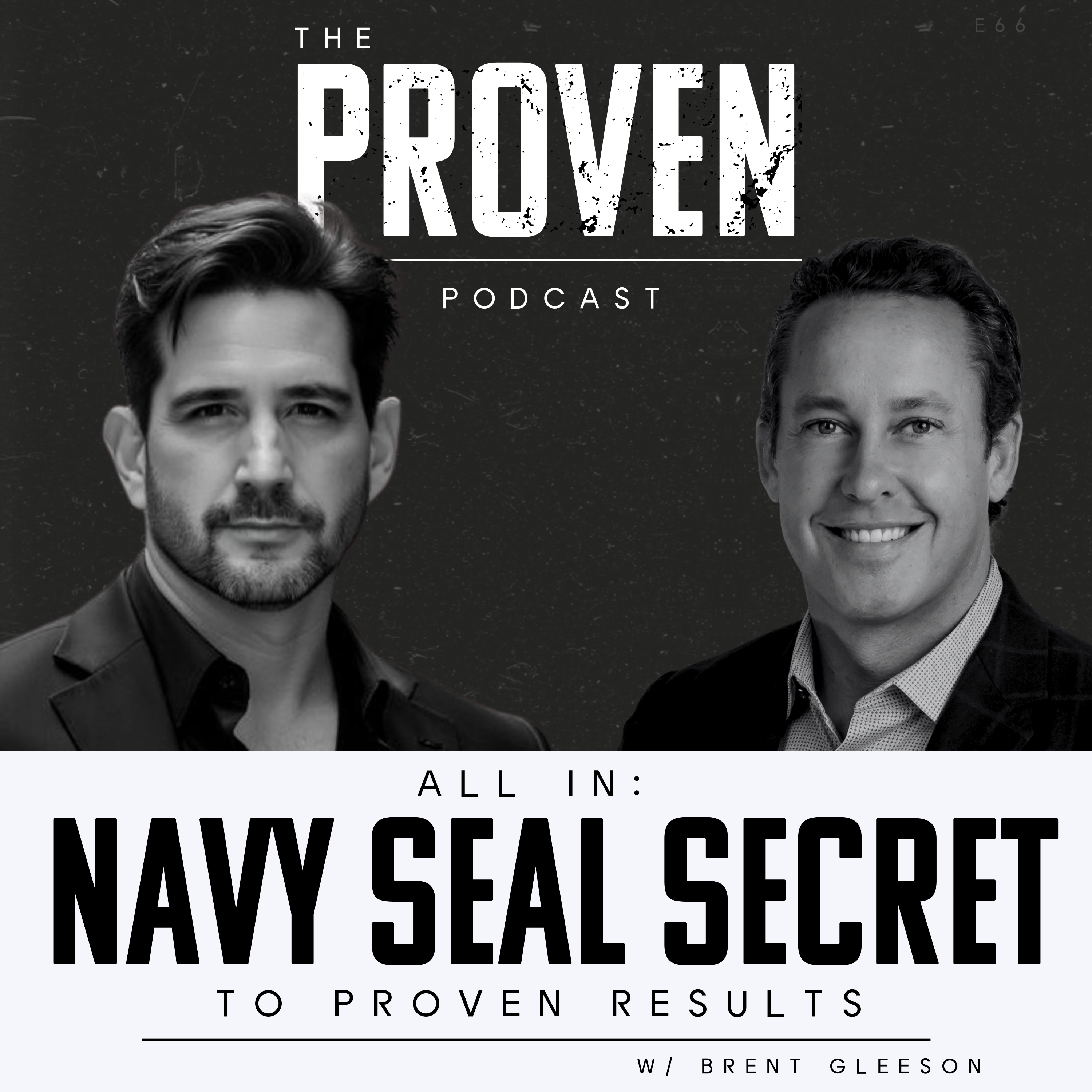
ALL IN: Navy SEAL Secret to Proven Results - Brent Gleeson
In this powerful and deeply human episode, Charles sits down with Brent Gleeson—Navy SEAL combat veteran, bestselling author, and leadership expert—to explore how discipline, resilience, and radical accountability shape high-performance cultures both on the battlefield and in business. Brent pulls back the curtain on his journey from SEAL Team missions in Iraq and Africa to becoming a sought-after advisor for organizations navigating transformation, trust breakdowns, and change fatigue.
He unpacks the core principles that drive elite teams—clarity of mission, extreme ownership, emotional regulation under pressure, and the relentless pursuit of improvement—and reveals how those same habits can rebuild companies, strengthen families, and rewire your personal identity. From confronting loss and hardship to leading with compassion and courage, Brent shares the stories and systems that forged his mindset long before he ever stepped on a stage.
KEY POINTS:
01:22 – From SEAL Team missions to the boardroom:
Brent opens up about his deployments in Iraq and Africa—while Charles explores how combat forged the leadership philosophy Brent now teaches worldwide.
05:44 – The emotional weight of reintegration:
Brent discusses the silent battles veterans face after returning home—while Charles highlights the importance of identity, purpose, and psychological transition.
10:18 – What elite teams get right about culture:
Brent breaks down how SEALs create clarity, unity, and accountability—while Charles connects these principles to companies struggling with communication and trust.
15:33 – Why most organizational change fails:
Brent explains how behaviors—not slogans—determine success—while Charles reflects on why leaders often underestimate the human side of transformation.
22:07 – Extreme ownership in real life:
Brent shares stories of mission planning, failure, and course correction—while Charles emphasizes why great leaders take responsibility before assigning blame.
28:49 – The psychology of resilience:
Brent details the coping strategies used in high-stress environments—while Charles ties them to emotional health, burnout, and modern workplace pressure.
33:55 – Leading through fear and uncertainty:
Brent reveals how SEALs stay calm under fire—while Charles explores how those same principles apply to crisis leadership in business.
RELATED LINKS/PRODUCTS MENTIONED:
Gain valuable insights with our Companion Guide
https://provenpodcast.com/all-in-navy-seal-secret-to-proven-results-brent-gleeson/#guide
KEY TAKEAWAYS:
-How Brent Gleeson transitioned from Navy SEAL combat missions to becoming a leading authority on culture and organizational change
-Why accountability, clarity of mission, and emotional discipline are the backbone of elite performance
-The psychological cost of combat and the challenge of reintegrating into civilian life
-Why organizational change fails without trust, aligned behavior, and consistent communication
Visit our site: https://provenpodcast.com/
The Proven Podcast YouTube Channel: https://www.youtube.com/@theprovenpodcast/
THE PROVEN PODCAST FREE RESOURCES:
Get all the reports from our guests, and their secrets-their success is exposed and ready to be repeated by you through our reports: https://provenpodcast.com/
FEATURED GUEST/PEOPLE MENTIONED:
Brent Gleeson: https://www.exlr8.ai/
Charles Schwartz: https://www.instagram.com/iamcharlesschwartz/
CONNECT WITH US:
Instagram: https://www.instagram.com/iamcharlesschwartz/
LinkedIn: https://www.linkedin.com/in/iamcharlesschwartz/
PODCAST:
Apple Podcast: https://podcasts.apple.com/us/podcast/i-am-charles-schwartz-show/id1744386875
Spotify: https://open.spotify.com/show/5dc9KqFWEz5b4RfGqbx4eC
YouTube: https://www.youtube.com/@theprovenpodcast
---------------------------------
Brent Gleeson is a Navy SEAL combat veteran, award-winning entrepreneur, author, and acclaimed speaker on topics ranging from leadership and building high performance teams to culture, resilience, and organizational transformation. Upon leaving SEAL Team 5, Brent turned his discipline and battlefield lessons to the world of business and has become an accomplished entrepreneur, best-selling author and acclaimed speaker on topics ranging from leadership and building high performance teams to culture and organizational transformation.
He is the author of All In: The Pathway to Personal Growth and Professional Excellence (on-sale December 2, 2025).
Pre-order All In by Brent Gleeson
link: https://www.hachettebookgroup.com/titles/brent-gleeson/all-in/9781668652077/?lens=balance
Press play and read along
Transcript
Speaker 1 Welcome to the Proven Podcast, where I don't care what you think, only what you can prove.
Speaker 1 On this episode, Brent Gleason, a Navy SEAL operator, a father, and a multi-time best-selling author, explains exactly what it means to go all in, not just as a SEAL, but on every aspect of your life.
Speaker 1
There are few people out there that I would trust to scale companies more than him. The show starts now.
All right, everybody, welcome back to the show. Man, I'm excited to have you on.
Speaker 2
Thank you, brother. It's good to be here.
Ben, looking forward to this.
Speaker 1 So, for the four or five people who don't know who you are, who are you? What have you done? What's going on?
Speaker 2 I am Bryn Cleeson, Navy SEAL combat veteran, longtime tech entrepreneur, two-time best-selling author, hopefully three-time best selling author here coming down the pipeline, Forbes leadership columnist.
Speaker 2 I am married and have four children.
Speaker 1
Man, thank you. So there's a lot to unpack there, just in that.
So first off, before we go too far, thank you so much for your service. Thank you for...
Speaker 1 the brothers that didn't make it home and for you allowing us to be here and do silly podcasts and do all of that.
Speaker 1 Thank you for that.
Speaker 2 It was a blessing to have had the opportunity. Appreciate that.
Speaker 1 So you have a new book coming out, and it ties into what I want to talk about with everything that you do and how you live your life. What's the name of the new book?
Speaker 2 The new book is titled All In, The Pathway to Personal Growth and Professional Excellence.
Speaker 1 So a lot of people, when they hear SEAL and they hear about they've had professional success, in your world, there's a divide, right?
Speaker 1 There are people who are unbelievably successful as SEALs because in order to do that, the limited exposure that I have, which I will never be a a SEAL, I don't like discomfort, I don't like cold water.
Speaker 1 Coronado is really frizzy to visit, but good God, is that cold? So, uh, a mutual friend of ours, Mark, is out there. And I remember asking him, I was like, Do you think I could ever be in a SEAL?
Speaker 1 And he's like, Go put your foot in the water. And I'm like, No, I can't be a SEADA.
Speaker 1 But there are some who transition well, and some who, again, another title of your book was embrace the suck, who can embrace the suck, but also embracing the suck to then be, you know, being successful in business are two very different things.
Speaker 1 Yeah. Why do you think some people who are at the top of their game as operators don't seem to do so well?
Speaker 1 Because people assume, hey, if I'm an operator and I execute over here, I'm automatically going to execute and just finish these evolutions in the same manner.
Speaker 2 I think it really boils down to one critical factor that all successful entrepreneurs do master.
Speaker 2 And it's interesting because it doesn't translate exactly. Obviously, they are high performers in the most elite military organization in the world.
Speaker 2 However, at the same time, as high performers, sometimes people, you know, some of those traits that make them high performers in one arena are their enemy in another arena, and that's focus.
Speaker 2 So oftentimes, when folks transition out of special operations, they just try to do too much, too many shiny objects, chasing too many different projects.
Speaker 2 They're excited about doing different things, which is great. And oftentimes, obviously, they're...
Speaker 2 pursuing multiple paths to see which one sticks and what they're passionate about and where they feel like they can build a new career.
Speaker 2 They're also going through a pretty significant identity transformation from from operator to entrepreneur or professional executive, whatever their career path ends up being.
Speaker 2 But what I see that drags guys down a little bit is that they're trying to do too many things. They're losing that sense of focus that
Speaker 2 what drives success through the training, what drives success on the literal battlefields, but at the same time, really needing to narrow their focus, finding one path, going all in on that path.
Speaker 2 And that's what really the entire book is about.
Speaker 2 And I get asked that a lot, you know, when I'm, you know, after speaking or working with clients, like this philosophy around being all in all the time, tell me more about that, because that sounds counterintuitive to what drives success in most areas.
Speaker 2 And it really is about narrowing your focus, identifying a few key relationships, a few key business practices and strategies and priorities, a few key,
Speaker 2 you know, personal goals.
Speaker 2 Whereas when we're trying to do too many things, we're just practicing the fine art of mediocrity in every single one of those categories.
Speaker 1 Yeah, it goes from embracing the suck to being the suck.
Speaker 1 So, one of the things we talk about getting really ridiculously focused, I remember the first time I ever had it explained to me how you get through any sort of evolution, be it hell week or anything else.
Speaker 1 They're talking about running on a beach, and all you're focusing on doing is landing in the other guy's footstep because he's already compressed the sand down and being that militarily focused.
Speaker 1 You're not care about, I don't care how long the run is, I just have to land there because if I don't, it's gonna make it significantly harder. So, that laser focus in has always hit me.
Speaker 1 That makes sense in the SEAL world. In the entrepreneurial world, we have
Speaker 1 shiny coat, signy coat, whatever.
Speaker 1 Squirrel syndrome. That's what I'm talking about.
Speaker 1 How do you, what are the tactical ways that you could do that?
Speaker 1 You know, we talk about here in Provence, this is what you can do because we all have these little dopamine screens that are following us around all the time.
Speaker 1 And then, you know, you've got multiple children and you've got the misses and you've got multiple books and you're running organizations and you're scaling up.
Speaker 1 There's a lot of moving targets for you. How do you lock in on that one? And how do you teach people to do it as well?
Speaker 2 yeah and
Speaker 2 in referencing the different things that uh that i focus on when doing that it sounds like a lot but all of those key areas have intentional strategic overlap whereas if they're living in their own silos and their own you know their own separate projects that really don't add value to the other projects then yeah i would be pulled in too many different directions uh but it comes down again to really taking some time not too much time you don't want to get caught in that you know that uh time-consuming bunker of reflection and finding your purpose and all those things.
Speaker 2 It is action that drives that discovery process. Taking action, course correcting, pivoting, collecting data, getting feedback, finding a good mentor, a good coach, things like that.
Speaker 2 Not necessarily when you pay for, but like if you and I were coaching each other on,
Speaker 2 you know, sharing best practices and what's worked in your career versus mine, you could learn a lot just doing that through just friends and colleagues.
Speaker 2 But really listening and then identifying a path and putting your time, resources, your learning learning into one of a few key areas, you know, as opposed to trying to do too many things.
Speaker 2 And then putting systems in place to ensure that you're continually working towards,
Speaker 2 you know, whatever KPIs and goals or milestones, metrics that you put in place to know that you're showing progress, just like on any project, goal, or business you're trying to build,
Speaker 2 having a system and a framework in place to know that you're making progress, getting feedback along the way, as opposed to, hey, let's team up over here and build this new app, or let's go try to do this startup, but also we're going to do a podcast and we're going to do all these different things.
Speaker 2 And it's like, it's going to be great and we're going to win. Well,
Speaker 2 unless those things, like I said before, are intentionally designed as part of one cohesive system to drive,
Speaker 2 you know, to drive continuity across all of those different types of seemingly separate projects, then you're just going to be doing too many things and you're not going to win in any one of those key categories.
Speaker 1 You talked early on, you always talk about this, that execution wins above ego and emotions. So if you're sitting there in self-reflection, there's a time and a place, but you need to execute.
Speaker 1
We also talk about don't ever make a plan because everyone goes through like, hey, I made plans. I'm like, cool.
How many have gone exactly the way you thought it would? No, stop making plans.
Speaker 1
Marry your goal. Get out of the way.
But you mentioned something about purpose. And I'm curious about that because,
Speaker 1 again,
Speaker 1 when someone decides to join the military or decides to be in service on that level, there's a driving purpose. And I'm curious when you did the transition over.
Speaker 1 and okay, you know, again, you're a father and you're an author and you're, you know, you're doing business stuff and you're a friend and you have all of these different things.
Speaker 1 How much does purpose align? And in those in your business, how
Speaker 1 important is purpose versus mission? And that, and are they separate?
Speaker 2
Purpose is incredibly important, but it is a messy path. It doesn't have to be identified all at once.
I mean, that's a very difficult thing to do.
Speaker 2 And as we evolve, we mature, we go through different life experiences, that purpose can take different forms, different shapes, or transform completely.
Speaker 2 Like when I, you know, I went to SMU for undergrad in Dallas and I was working in finance for a year.
Speaker 2 And when I initially decided six months before 9-11 to join the Navy and try out for the SEAL program, it was really, quite frankly, more of a
Speaker 2
selfish goal, a resume building activity, if you will. Let's see if I could take on this challenge.
One of my buddies from college was doing it. So
Speaker 2 it wasn't an overnight decision, of course, but at the same time, there is some element of purpose. Yes, I wanted to give to a cause greater than myself.
Speaker 2 I had a bit of a call to serve.
Speaker 2 I reflected on it a lot, prayed on it a lot. But at the same time, it was peacetime.
Speaker 2 But when 9-11 happened, when my class was going right in the middle of training, going from buds to advanced training, that purpose evolved immensely because there was a new mission and it was very clear.
Speaker 2 So again, things in our life will happen that will evolve or completely transition that purpose, something that we can emotionally connect to that aligns with our values, assuming we've gone through some
Speaker 2 spent some time defining what those values are. So those values don't suck.
Speaker 2 But then upon transitioning out,
Speaker 2 again, not spending so much time
Speaker 2 in deep reflection and trying to identify, you know, what is my why and all these things that sound a little bit cliche, but it is taking action, like you said before, that will help you identify what your why is and what your purpose really is.
Speaker 2 It's the foundation there is your values.
Speaker 2 Now, I highly encourage anyone to really sit down just like any great business, any great team, any great organization has clearly defined, concise, measurable, and actionable values that are their guiding principles.
Speaker 2 It defines how they make decisions, how they behave, how they show up as leaders. Well, if high-performing teams do that, High-performing individuals need to do that as well.
Speaker 2 And those values help us make decisions. It helps us identify our purpose.
Speaker 2 It helps us explore the right opportunities and most importantly, say no to the majority of quote unquote opportunities that come our way.
Speaker 1 Can you walk me through a list of an example of a values or set of values?
Speaker 2 Yeah, typically, and we coach this in our enterprise clients and customers and things like that, when sometimes we're taking them through a major transformation or a cultural transformation or operationalizing mission, vision, and values.
Speaker 2 It's the same exercise that an individual should go through is really identifying,
Speaker 2 you know, starting with some reflection on in various times in your life. one question might be when you were at your most resilient and adaptable, what was true about you in those moments?
Speaker 2 You know, what feelings, what thoughts, what principles were really guiding you to overcome those obstacles?
Speaker 2 Or when you felt the most joy at any time in your life, what was true about you in those moments?
Speaker 2 And then taking it a step further to start to identify, you know, how do I want to show up every single day?
Speaker 2 for my spouse, for my kids, for my family, for my business or the team at the organization that I'm a part part of, and identifying even down to the granular nature of always never statements.
Speaker 2 Like today, I will, you know, always do this, that, and the other thing. I will never do this.
Speaker 2 Never statements obviously correlate to where you're not going to color outside the lines of values that you've identified.
Speaker 2 So, again, just like any goal, your values ideally should be very concise, very measurable, clearly defined, and have some sort of metrics tied to them.
Speaker 2 So, you know that you're actually living those in a measurable way every day.
Speaker 1
So there's a lot, again, to unpack there. I love that you talked about always and never.
This conversation that goes, you're like, how do I be happy? Well, stop doing the things that make you unhappy.
Speaker 1 This isn't, this isn't complicated. It isn't that.
Speaker 1 So when you're having like, I will never do this. And we talk about this where people are like, hey, I want to make.
Speaker 1
$50,000 of passive income every single month. Awesome.
Then you're never going to take things that deter you from that goal. And people are like, oh, that sounds crazy.
And it is what it is.
Speaker 1
They're like cool. Will you let a rhino have sex with your spouse? And they're like, wait, what? That's insane.
I would never. What are you talking about?
Speaker 1 I'm like, okay, that's the level of just repulsion you have to have to anything that doesn't align with
Speaker 2 rhinos.
Speaker 1
It's just, it is to me with rhinos and giraffes today. It's just, it is what it is.
I mean, you know me at this point. So it just, it's weird.
So,
Speaker 1 um, exit only. You know me by well.
Speaker 1 Exit only. No, not going to happen.
Speaker 1
So from there, people, this is what happens when you get a son of a cost. Yeah.
So people talk about systems all the time. It's become very cliche.
It's very much like
Speaker 1 finding your why, which obviously I have resistance to, and your purpose and all of that. There's a difference between processes and systems.
Speaker 1
And again, you're very tactical in the way you do things and you've evolved that to become very successful. Most people take a very long time or never even write a book.
You've done three.
Speaker 1 at this point. I mean,
Speaker 1
I wrote one in nine days. It hit WSJ 16 days after.
I'm good. I'm done.
I don't want to do that again because I can't spell to save my life. You're spending two years doing it.
Speaker 1
I think that was the mistake I made. And my system or my process was just vomiting it out.
And then someone else fixed this.
Speaker 1 When someone talks about systems and they talk about processes, what's the difference? What is a system from your point of view? Because you're at a higher mountaintop than other people have been.
Speaker 1 Looking back when you're like, hey, this is what I thought a system was.
Speaker 1 What are systems in your world? And how do you make it that they're all in on them?
Speaker 2
Yeah, it is a good question. And people confuse these.
And we do talk a lot about systems a lot and how they drive desired outcomes. I take it a step further, too.
Speaker 2 And the book All In is actually built around a framework that we've developed. I touched on this framework in a slightly different way in Embrace the Suck.
Speaker 2 And it's a framework we've actually implemented in organizations, but in All In, it's really focused a bit more on personal development.
Speaker 2 Now, granted, you could apply any good framework or model to team development and organizational development with some small tweaks, but it's called the Remarkable results pyramid.
Speaker 2 And there's five layers to the pyramid. At the top, you have your existing results, and it's a transformation model.
Speaker 2 So then you move into your desired outcomes and the remarkable results you want to achieve, whatever type of nature you want to put to that.
Speaker 2 The second layer under there is systems and processes. There's some
Speaker 2 minor subtleties into the differences, those that I'll get into in a second. But skipping past the middle, at the bottom is routines.
Speaker 2 And so one thing I go into in defining is what is the difference between a routine or a ritual and a process? And they're very different.
Speaker 2 The rituals and routines being the foundation of the pyramid are habit-building and habit-breaking
Speaker 2 daily routines and rituals that you put in place as a foundational element to being in a continuous state of improvement.
Speaker 2 So, if I want to break certain habits or build certain habits, you follow the exact same model. And this isn't a model I've created.
Speaker 2 This is, you know, from behavioral psychologists and things like that that are are built where you look at, and James Clear, his book, Atomic Habits, dives deep into this.
Speaker 2
My book dives deep into it as well. But you look at the cue, the routine, and the reward.
You can apply this to building a new habit or breaking a bad habit.
Speaker 2 One of the things I did at the beginning of writing all in was, we don't need to get into all the details right now, but I decided to eliminate alcohol from my life completely, you know, overnight.
Speaker 2 And it's, you know, ironically, the book comes out in a couple weeks on December 2nd. That will be exactly to a day, two years of commercial tough.
Speaker 1
I know, it's it. Congratulations.
That's amazing.
Speaker 2 That was not by design,
Speaker 2
but it's interesting. And so in order to do that, I had to create new routines and rituals following that same path.
So
Speaker 2 what were the trigger points or the cues that would make me want to drink at certain times of the day or things like that? Well, you do the same thing following that cue.
Speaker 2 Let's say it's end of the day. You've had a long day, a good day, a bad day, it doesn't really matter.
Speaker 2 But then that routine would be to have a drink or multiple drinks.
Speaker 2 So instead of, you know, that time of day or, you know, whatever, you know, however we've trained our minds to be addicted to certain routines, if it's a bad habit, you replace that actual routine with something different, like a workout or a long walk or something like that.
Speaker 2 And you actually get the same but a better reward, which is, you know, an elevated, you know, dopamine spike or a natural high from the exercise, just an example.
Speaker 2 But the same thing goes into how we build new habits, whether it's work habits or daily routines and rituals, you know, fitness, wellness, business practices.
Speaker 2 The same thing applies to how we build those habits. It takes about 66 days to build a new habit if you're doing those routines on a regular basis.
Speaker 2 Now, when you go up the layers of the pyramid to systems and processes, the system is your overall framework, you know, for
Speaker 2 putting all these things in motion to achieve desired outcomes. Just like in a business, you have specific systems,
Speaker 2 how you use technology, how you conduct meetings, how you meet with clients, all the different things.
Speaker 2 Those are your systems that are put in place that you do on a consistent or semi-consistent basis to achieve specific results, how you use resources, how you use technology, all those different things.
Speaker 2 Now, a process is a layer below that and how you go through those on a day-to-day weekly, whatever. time-bound cadence you put to those.
Speaker 2 But the big difference really there is looking at the difference in the systems, but also the rituals that will drive the mindset necessary to be disciplined and accountable in how you follow your systems.
Speaker 2 That's where teams and individuals fall short is they don't have that foundational element of daily rituals that will build the mindset of doing new things or following a good system or process.
Speaker 2
Organizations always complain about they don't have enough resources, they don't have the right technology, the right software. Oftentimes they do.
People just aren't.
Speaker 2 using those resources for their intended purpose or they're using them so inconsistently that they have bad data and they're not getting the desired outcomes that they're trying to achieve.
Speaker 1
So when I want to jump into, because a lot of people have problems drinking, I'm allergic to alcohol. I take three sips of it.
It comes right back out. My body views it as, you know, spoiled milk.
Speaker 1
It's just, it's a gift from my grandmother. Thank you, grandmother.
So I haven't had that. I've helped people get through it.
Speaker 1 And people, when they hear things like this, like, oh, I'm just going to change my patterns.
Speaker 1 I'm going to say, hey, instead of like when I do intermittent fasting, I do three day water fasts or seven day water fasts.
Speaker 1 Whenever it's five, six o'clock, I'm going to eat, I'll just get up, throw out a rock, and then go for a walk instead. So I'm replacing the activity with something else.
Speaker 1
And people get to understand the tactical of that. And that's easy.
Where I go through, and I'm curious what your thoughts are on this.
Speaker 1 You have to pivot who you want to be before you go change those habits. So in other words, before someone says, so for those of you who are watching on screen,
Speaker 1 there was a trigger there. Yeah, he agreed.
Speaker 1 So most people, when they go, I want to stop drinking because, you know, I want to get in better shape, or I want to, or I want to stop drinking because I have certain toxic behaviors or I want to stop drinking because there was this thing with a rhino again.
Speaker 1 So as you go through that,
Speaker 1
I would encourage everybody, you have to switch your identity before you do that. So in other words, I want to stop drinking because I want to be a better father.
I want to be a better husband.
Speaker 1 And then you say, okay, a better husband does this. Just like if you're eating,
Speaker 1 I have to watch that. If you're eating not so good food, I had to catch myself there.
Speaker 1 If you're eating not so good food, saying, okay, I'm not going to eat Mickey D's or I'm not going to eat fast food for a week you're going to break that pattern but it's not until you sit there and say i'm a healthy person this is who i am how does a then a healthy person operate so when you were kicking out and you could share or not share why you wanted to stop drinking uh i would highly recommend anybody do a test on what you look like doing six months drinking then six months not drinking and you'll see what your body looks like eight years of hospice it'll it'll give you some data what you do with that data Awesome.
Speaker 1
You want to drink? Please, by all means, drink. Have fun.
You want to eat Indian food? Please eat Indian food. I'm not going to do either because neither of them tastes good to me.
Speaker 1 So as you're going through that,
Speaker 1 would you be open to sharing, you know, what was the things that you changed? It was like, hey, this was, this is the time. This is how I'm going to change it.
Speaker 1 This is important to me enough that if I'm going to go all in on my professional life, if I'm going to go all in on my fitness, I'm going to go on in my personal life.
Speaker 1 This was something that, again, the laundry list of things you could do, this was the one you hit on.
Speaker 2 Yeah, it's a great question. I could not agree with you more about the identity piece and being intentional on what that identity transformation needs to look like.
Speaker 2 That is a critical piece that people miss and why they just time and time and time again, they can't stick to a new routine, especially wellness activities or fitness related or, you know, breaking bad habits or quitting drinking or eating crap, that kind of thing.
Speaker 2 But it really goes back to the foundation, like you said, of like, who am I trying to become? Why am I doing that?
Speaker 2
And therefore, you're trying to tie some sort of deep emotional connection to that desired outcome. Without that, you will not stick stick with it.
Other distractions sort of come by.
Speaker 2 You'll backslide to your old habits and
Speaker 2 the reasoning behind why you engage in those bad habits or practices in the first place.
Speaker 2 For me, it was, and as a SEAL and a combat veteran, I know stranger to death and loss, but for me, the catalyst, and we all have these things, we all experience tragedy, adversity, and loss.
Speaker 2 That's just part of the human condition. But a couple of years ago, we lost my dad suddenly, unexpectedly.
Speaker 2
And, you know, he was 80 years old. He liked three things, three things only.
It was work,
Speaker 2
working out, and family. Those are the three things.
And, you know,
Speaker 2 varying orders depending upon what's going on.
Speaker 2 And so I got a lot of my work ethic and discipline from my dad, a former Marine, collegiate athlete.
Speaker 2 And but when he passed, he, you know, he had taken a fall, had a brain bleed that was inoperable due to some heart medication that he was on. And that was it.
Speaker 2 By the grace of God, this is the chilling part of the story. I mean, that in the best possible sense, I was in Dallas where I grew up and where my parents still live or were living.
Speaker 2
And I go there so often. We have a few of our largest clients and investors in Dallas.
So I'm there once or twice a month.
Speaker 2 Sometimes I was like, didn't even mention it to my parents that I was coming in. It was like an overnight in and out.
Speaker 2 And
Speaker 2 by the end of these meetings we were in, my phone had been blowing up in my pocket. And
Speaker 2
it was actually my mom saying, your dad's taking a fall and he's in the hospital. Basically, it's not looking good.
And so I texted her back immediately saying, you know, actually, I'm in Dallas.
Speaker 2 So the CEO of this client, he's like, let's go. We got in his,
Speaker 2 he loves fast cars. We got in his Corvette and he drove me through Dallas rush hour traffic all the way to Presbyterian Hospital where I had the opportunity to spend last
Speaker 1 moments with your dad and be able to have that. Because a lot of people don't have that closure, right? They don't have the ability to say those things.
Speaker 1 And, you know, you've been around death on a level that's a little different than mine because you know mine was hospice no one was deciding to try and kill me with lead poisoning so that it's a different ballgame from what you grew up with and what you were exposed to versus where i did most people don't have the ability to connect and to share with them and hold that space for them and to really have that moment with their loved ones which is again the you know we talk about this all the time somebody got up today and got on a plane and was worried about christmas gifts and they're not coming home just it is what it is someone's going to get in a car and they're going to have an accident and taking the time out.
Speaker 1 So, if there's anything you haven't said to the people you love more than anything else, just whatever you're doing, stop listening to the stupid podcast of these two idiots.
Speaker 1 Take out your phone and say, Hey, mom, dad, you remember that one time you bought me the ice cream, which is healthy food?
Speaker 1
You know, you had that. Yeah, you know, I really appreciate that you bought me that ice cream or whatever it is.
So, you know, people don't get to do that.
Speaker 1 And, and, you know, you're, you're in the situation and your father's, you know, moving on and he's, he's transitioning into whatever's next, whatever people believe or don't believe, I don't care.
Speaker 1 But you had that experience.
Speaker 1 I'm guessing that that triggered something in you that moved you in a different way that like, okay, my identity has to change as it comes down to whiskey or whatever else that you were drinking.
Speaker 2
Well, we, yeah, it forces us to consider our own mortality. I mean, time is our most precious commodity.
We spend it freely without ever really knowing the balance in our account.
Speaker 2 And so that deep reflection period led me through, you know, a a lot of people know what kind of that stop, start, continue methodology is.
Speaker 2 And I was using that methodology in reflection, thinking about what are things that I need to start doing that will help me maximize the time that I have, you know, by creating the best possible marriage that I can, the best possible parenting experience that I can, being the best possible founder and CEO and entrepreneur and leader that I can be.
Speaker 2 What should I start doing? And more importantly, what blockages are getting in my way?
Speaker 2 I've achieved some semblance of success, however you want to define that, but there's always more that can be be done.
Speaker 2 And I know there are things that are holding me back, you know, to live a life of meaning and more importantly, a life that has an impact in a positive way on others.
Speaker 2 And so one of the things on the list of stop doing was
Speaker 2 drinking. And for me, I also had some close friends, whether they be former teammates, successful entrepreneurs, colleagues, clients who had made that same choice.
Speaker 2 None of them were drunks laying in a gutter on the side of the road, but all of them did it with some purposeful intent, whether it was to improve their marriage, improve their productivity, their energy, their health, their business.
Speaker 2 Usually it was some combination of all of those things. And for every single one of them, it was an absolute game changer.
Speaker 2 So I was, as that's, I think the saying is like sober curious or something like that. I was, I was definitely curious about the outcomes
Speaker 2 looking at those people that I deeply respected. So, you know, it came to the culmination of making that decision one day and I've never looked back.
Speaker 2 And it has truly been, for me, I don't preach it to anybody. I don't talk about it all that time, all that much.
Speaker 2 But for me, it has truly been in the same way, a game changer in my marriage, in my ability to be fully present with my children,
Speaker 2
in my business transformation capabilities, and just generally how I show up. I mean, my health, my energy, sleep, all those things.
Yeah.
Speaker 1
So you talk about this thing I've never heard of, sleep. What is sleep? I've never heard of that.
What is
Speaker 2 entrepreneurial? I don't know.
Speaker 1 No.
Speaker 1 So it's
Speaker 1 important.
Speaker 1 I'll discover it one day at this point.
Speaker 1
When it comes to, you know, because there's a lot of sugar inside alcohol. And when I purge sugar out of it, it is my addiction, 100%.
I love sugar.
Speaker 1 However, when I stopped consuming it, all of a sudden I could think clearly. I could execute faster.
Speaker 1 And I was like, all right, listen, I love ice cream more than I honestly should, but I enjoy the results I get more. And I think that people come into this when they're like, oh, I'm giving this up.
Speaker 1 I'm like, yeah, but what is the trade-off?
Speaker 1 Like, I could go and pound DQ and Hagen-Daz, which is a wonder drug, or Talente if you're in Switzerland, but it means that the rest of the day I can't execute.
Speaker 1
And I'm in my way and I'm slurring my words and my brain just doesn't work or I'm going to blow out a night of sleep. So it's a cost-benefit analysis.
And we talk about this in business all the time.
Speaker 1 In businesses that you go and you're going all in on, and because again, you can't get an organization to stop drinking. It is a different conversation.
Speaker 1 Organizations and corporations don't drink because they're different.
Speaker 1 What are some of the patterns and what are the things that you've worked with with your clients that you're like, like, hey, these have proven to be as impactful as purging out certain behaviors?
Speaker 1
Again, guys, if you want to drink, drink, I don't care. Just don't make me do it.
Just do whatever you want to do.
Speaker 1 But in an organization, what are some of the ones you've gone and said, hey, I've seen over and over and over again, these orgs do this pattern, and it's as toxic as blah, blah, blah.
Speaker 2 Yeah, it's
Speaker 2 the interesting thing in having.
Speaker 2 clients and customers, you know, on both the management consulting and
Speaker 2 enterprise software side, usually it's a combination of both, but different types of organizations all over the world, different industries, different sizes.
Speaker 2 As most of us know, their challenges and opportunities are uniquely similar
Speaker 2 because most organizations, if not all of them, are made up of human beings.
Speaker 2 And human beings are driving whatever those outcomes, behaviors, cultural, and team dynamics that exist within those organizations, which are going to be either haphazard or by design.
Speaker 2 High-performing organizations and teams, that is purely by design.
Speaker 2 The cultural dynamics, team dynamics, values orientation, that is something that is actively managed every single second of every single day. 100%.
Speaker 2 And that, as we know, that leads to high trust, greater accountability, talent retention, growth and profitability, customer experience, all the incredible things. Now, we work with organizations.
Speaker 2 We're not typically going in to fix some sort of broken organization. It's more of a good to great effort or post.
Speaker 2 private equity scenario, merger acquisition, IPO, things like that, or just type of growth in general. So change comes in many forms.
Speaker 2 But ultimately, if I had to boil it down to one thing, it is how organizations deal with and/or lead change. You know, is it a reactive approach to change? Is it a proactive approach to change?
Speaker 2 How do leaders engage with change at every level of the organization?
Speaker 2 And it's the hardest thing for organizations to master, which is why the data comes back the same year over year, regardless if it's Deloitte or McKinsey.
Speaker 2 And McKinsey data is always the best, as we all know. They'll tell you that.
Speaker 2 But at the same time,
Speaker 2 the data is the same. Shearabir, forget COVID and all these other things.
Speaker 2 All organizations dealt with
Speaker 2 engagement issues and turnover issues and growth obstacles and issues of silos and alignment before COVID. It just exacerbated what other problems they had in their organizations.
Speaker 2 But again, if I had to boil it down to one thing, it is how successful organizations are or not at dealing with change.
Speaker 2 You see a lot of this in my first book. I wrote a lot about organizational transformation and that I did that intentionally to build the baseline of this organization around that.
Speaker 2 And organizations fall short most of the time. And usually the data shows that about 70% of organizational change initiatives, whether they're macro or micro or somewhere in between,
Speaker 2 not necessarily fail, but fall short of meeting their intended objectives due to several key factors, but also mainly because they skip past those foundational elements of, and again, we all intellectually understand these things to be important, yet we just blow past them because we're moving so quickly and we're focused on growth and sales activation and shareholder value and the next board meeting or whatever it is that's driving us to skip past fundamental things that will actually have a massive positive impact on the financial outcomes of the organization.
Speaker 2 And those are the cultural pieces, getting good, consistent feedback from the employee base, especially those people who are the closest to the execution of those change initiatives.
Speaker 2 But as you get closer to the top, one of the biggest things you see is just general misalignment, not so much on direction and strategy, but definitely on strategic priorities of how we're going to get there.
Speaker 2 And as you go across different business units and you asked seven different senior leaders on what the top three priorities are, you're going to get typically six or seven different answers.
Speaker 1 A thousand percent. Yeah, it's one of the favorite things when you get the C-suite together.
Speaker 1 You're like, okay, everybody write down what you think the goal is, like the number one priority of the organization is, and you will get completely different answers. Okay, now we found the problem.
Speaker 1
Let's start with that. Yeah.
And having that conversation. And it's hilarious.
We're like, oh, well, the marketing guy's like, oh, well, we need to keep increase our revenue by 3%.
Speaker 1
And then this guy's like, oh, this one was, we need to cut our losses over here. We don't, we have our turnover is too high.
And this one's over here.
Speaker 1
It's like, well, we have to make our shareholders. Okay.
You can't hit five different targets with one gut. I'm like, with one round.
I'm like, it's, come on. One thing.
Choose one thing.
Speaker 1 And you double down on that one thing. And getting that clarity on that is for for anybody listening, sit down with your org, have everybody sit down and say, hey, what's our goal for the next year?
Speaker 1 What's going to go for the quarter after that? Let's map it all out. And you will see that you guys are not talking to each other and understand you're not aligned on it.
Speaker 1 And then you can get into how do you fix it
Speaker 1
and having those conversations. But most people aren't doing that.
You mentioned culture a couple of times and it has become this word that most people don't like.
Speaker 1 They sit there and go, oh, well, it's either too far to the left or too far to the right or it just doesn't align or it's just who cares about culture? Just get it done. It doesn't matter.
Speaker 1 Where do you fall down on the culture conversation?
Speaker 2 The way organizations and teams fall short around that is making sure that every aspect of their culture, hopefully, again, it's clearly defined when it comes to mission, vision, values.
Speaker 2 Again, we all fundamentally know these things to be important, but how do you actually operationalize those into our systems, our processes, daily and weekly rituals at every level of the organization to ensure there's measurable execution happening related to your high-level fluffy culture stuff.
Speaker 2 All that nonsense that doesn't drive revenue or profitability. It's like, oh, wait, no, actually, this stuff actually is financially measurable.
Speaker 2 in the organization on how we attract and retain top talent, how we create an institutional customer and client experience,
Speaker 2 how we go through significant transformation and growth initiatives within the organization, but also
Speaker 2 how we instill discipline.
Speaker 2 And even if accountability or other buzzwords like that aren't on your list of values, all research points to the same fact that a culture of accountability, however you want to define that, has a distinct and very measurable impact on growth, on profit, on operational excellence and efficiency.
Speaker 2 Again, it doesn't have to be.
Speaker 2 defined as one of your guiding principles, but it definitely has to be a baseline. And that's something, obviously, that we learn from day one in the special operations training pipeline.
Speaker 2
You definitely learn it as an operator on and off the battlefield. And that's another thing where, and again, not just my opinion.
I've done a lot of research on this.
Speaker 2 And our organization works with our clients in ensuring that accountability is a number one cultural pillar because you can't have a high trust organization. Same data comes back, leads to growth.
Speaker 2 It leads to retention of.
Speaker 2
employee and customer. The list goes on and on.
But you can't have a high trust organization without extreme ownership. You You just can't.
Speaker 2 That's why accountability is listed above trust as the two most important cultural pillars, but the priority is accountability because then organically you'll get higher degrees of trust across the organization.
Speaker 2
And then you can do more with less. You can execute with precision.
And everything else seems to kind of work itself out.
Speaker 1 Yeah, I like how you mentioned that it's measurable because people don't think that culture is measurable. It absolutely is measurable.
Speaker 1 It will change your bottom line based on how you implement your culture. So I guess the next question I have is, how do you implement that culture?
Speaker 1
Because if you're dealing with a mindset of special force operators, you guys are going to deal with the cold water in Coronado. You just are.
You guys have already embraced it.
Speaker 1 You're going to embrace the SOC.
Speaker 1
This is what's going to happen. You weed people out.
And as much as I wish the hiring process was more
Speaker 1
rigid and more harsh, it is not, right? But we deal with the fact that some people who show up in organizations, they're not going to show up on that level. And that's okay.
That is what it is.
Speaker 1 We need people at different levels. But if you're building a culture of people who are
Speaker 1 not operators and maybe a little bit softer or have different priorities, how do you build that culture where you've got some people who are way over here as far as performers and some people are on the extreme opposite side with performers?
Speaker 1 What are the typical ways that you do that? Like, hey, this is what our meetings look like. We're going to have this many meetings or this is what we're going to talk about.
Speaker 1
Because most people, when we talk about values, they ignore them in most calls. They're like, yeah, whatever.
They don't listen. Like, hey, can I, can I feed my kids?
Speaker 1
Because the organization to them is something, it's not their first job. It probably won't be their last job.
So they're not going to buy into it as easily. So how do you build that?
Speaker 1 So it does have that, that hold and that lock-in.
Speaker 2
Yeah. And you touched on a few interesting things.
Everything we do
Speaker 2 in our teams, in our organizations, will start to formulate some kind of culture. And again, it's either haphazard.
Speaker 2 like it is in, unfortunately, the majority of organizations, or it is by design in high-performing organizations, something that's actively managed. It's,
Speaker 2 you know, it's integrated into every single operating rhythm, to your point, in how you conduct meetings,
Speaker 2 into performance management systems, decision-making frameworks for managers and leaders at every level, but also for non-people leaders.
Speaker 2
These types of things are put in place so that you can actually have a flatter organization. You can decentralize.
You can create a greater sense of autonomy. So let's take, for example, core values.
Speaker 2
People can understand that. They can visualize it.
Let's take a typical core value. Let's say integrity, for example.
Speaker 2
Where organizations fall short is they list, you know, five or six cool core values. They look great on the boardroom wall.
They look great to customers and they sound good.
Speaker 2 And yes, okay, integrity and excellence and all these customer obsession and all the typical core values. Yeah, it's great, but how do you define that in your organization?
Speaker 2 Like specifically define it. When we say integrity or customer obsession, what is our distinct definition of that? Document it.
Speaker 2 And then a layer below that is defining specifically and not just in performance management systems, but defining for the entire organization how we know we are meeting the standard of integrity because our behavior will dictate standards regardless of what we've defined.
Speaker 2 If I am
Speaker 2
behaving this way over here, that's the standard, not what we've defined. And as leaders, we get the behaviors that we tolerate.
That's the basic.
Speaker 2 And so how do we know we're specifically meeting that standard of integrity based on our definition? How do we define exceeding that standard? And how do we define missing that standard?
Speaker 2 Where are we below board? Where are we above board?
Speaker 2 And so, doing that with your values, doing that with any types of culture manifestos or anything you've defined as guiding principles, but also the same thing applies to your mission, to your vision.
Speaker 2 And I know people start to roll their eyes on mission statements and vision statements. No, same thing.
Speaker 2 If you're going to have it, it better be authentic and it better guide every single decision from strategic partnerships to customer acquisition, employee acquisition, you will, growth strategies, all those different things.
Speaker 2 But integrated into every single system, every process, every cultural ritual, so that these are living, breathing things that are frameworks in your organization as opposed to just things that sound nice or look good on your website or on the wall in your office or to customers.
Speaker 1 But I also think it's important. I agree with all of that.
Speaker 1 I also think it's really important that whoever is in the organization, that the lowest common denominator can articulate it and fully understand it.
Speaker 1 If you made it so that, you know, the, again, lowest common denominator does not fully understand it, embrace it, then you have failed because then you've got a break in the chain.
Speaker 1 So when you do get breaks in the chain, how do you reward the high-end achievers, like the people who are crushing it versus the individuals who are not?
Speaker 1 And you've got to, because you're always going to have it. There's going to be days where people perform.
Speaker 1 There's days that don't people perform, but there are also going to be individuals who are toxic to the culture. There are going to be those, and that's a simple answer, right? Those are the extremes.
Speaker 1 What happens when you're having someone in flux where they're decent and you kind of value them, but they're not performing well and they're not aligning?
Speaker 1 How do you get them, again, go back to our duct tape conversation we had earlier? We can't duct tape them to the wall and they can do what we want to do.
Speaker 1 How do you get people to start performing and executing in a manner that also adheres to that culture?
Speaker 2 Yeah, I've found waterboarding to be incredibly love it.
Speaker 1 It works really well. Unless you're a free diver.
Speaker 2 Performance management tool. Yeah.
Speaker 2 Yeah. No, I try to.
Speaker 1 They both go to hell for so many reasons.
Speaker 2 HR, legal, how to fit. It was,
Speaker 2
but God, HR, you're always in the way. It doesn't translate from special operations over to the end.
Really does.
Speaker 2 Well, you know, kind of like we talked about, you know, in this, in this sort of more performance management-related topic,
Speaker 2 you're making your life a lot easier when you've clearly defined all those different metrics and definitions and APIs that associate with those defined cultural pillars, if you will, for the organization.
Speaker 2 Because then there's zero ambiguity.
Speaker 2 So we're not just measuring performance on the tactical day-to-day execution of your job function or based on your job description or whatever goals we've set for you.
Speaker 2 You're based on your behavior. You're based on your values orientation.
Speaker 2 And so that is part of what you're being evaluated on every single, and not just in your one-on-ones and that kind of nonsense, but every single day, these are conversations and stories that are being told and you're elevating people based on those values or you're having performance management conversations or constructive feedback conversations based on where they're coloring outside the lines of those values.
Speaker 2
It leaves room for no interpretation, no ambiguity. You're pointing to this.
Okay, you're missing the standard here, or you're exceeding the standard or incredible. You are
Speaker 2 a change evangelist and a culture carrier. You're exceeding the standard in every category.
Speaker 2 Now, where
Speaker 2 we all make this mistake is that,
Speaker 2
and we love the model around radical candidate. Kim Scott created it.
It's a two-by-two framework. The vertical axis is caring personally.
Speaker 2 So any good leader, any good team member, you want to without crossing barriers, care personally about your teammates.
Speaker 2
So we can elevate them. We can learn from one another, it creates a trusting environment.
But more importantly, the horizontal access is challenging directly.
Speaker 2 So, because I care about you personally, I'm going to tell you what you need to hear, and you're going to tell me what I need to hear so that we can all be in a continuous state of improvement, not waiting for some one-on-one or some performance management conversation that's scheduled for next month, like right now in the moment, or in a debrief, or during a meeting, in a group setting, if need be, where feathers aren't ruffled because we trust each other.
Speaker 2 And so, when you have
Speaker 2 people that have consistently been, to your point earlier, toxic to the team, you need to have one or two hard conversations and then you need to eliminate those people from the organization, regardless of their rank, regardless of their title, regardless of their tenure.
Speaker 2 Tenure and rank can often be the driving forces of toxicity because they are 100%.
Speaker 2 Now, if it's somebody who you believe to be, you know, a culture carrier, they're doing their best or they're going through some sort of transformation in their personal.
Speaker 2 Give them the time. You know, some organizations, we have one
Speaker 2 client that's that actually does this well. And they will,
Speaker 2 some organizations are bad at this, and you know, they'll move people around, they'll hang on to people that are good, or they'll move them over here, give them another career path opportunity over here.
Speaker 2 Some organizations do that so they can avoid making tough decisions. And they're like, oh, we don't want to get rid of Timmy because Timmy's, we like Timmy, but Timmy sucks.
Speaker 2
But I don't want to fire him. So let's move Timmy to marketing and see if he thrives over there.
Oh, Timmy.
Speaker 1 Put him in HR.
Speaker 2
That doesn't help out anyway. Yeah, I know.
It's like put him in HR. It's a little too much.
Speaker 2 But when we do that authentically and through getting good feedback from team members and finding a home for someone in our organizations where they will thrive, that can work.
Speaker 2 But otherwise, we have as leaders, and I don't mean by title necessarily, we have a responsibility to the team
Speaker 2 first and foremost.
Speaker 2 And if there are people who are dragging the team down, because if you have one person who's underperforming or toxic or typically both, whatever that looks like from a performance management standpoint, it's impacting five, six, 10 other people, other business units, other departments.
Speaker 2 And therefore, it's damaging trust and leadership because we hang on to those people for too long.
Speaker 2 I've done it many times, unfortunately, not any, but for all different types of reasons, we hang on to them for too long.
Speaker 2 We gain that wisdom through, you know, looking back and saying, wow, I should have done that six months ago. Or people are asking me, why didn't you make that decision six months ago or a year ago?
Speaker 2
And the same thing with, you know, clients and customers. We have to make sure that we're aligned from a values perspective.
I mean, you're nodding. I know you've had those experiences.
Speaker 2 I've had them for sure where we're aligned with the wrong clients, wrong customers, where they treat our team like crap.
Speaker 2 And ultimately, if you really look under the hood, how muchever money they're paying you, you're actually losing money on those relationships, or you're losing money on that team member who's toxic, regardless if they're the quote unquote subject matter expert or the best in the field of what they do.
Speaker 2 They're other fish in the sea.
Speaker 2 And you'll find that most of the time you find someone who's just as good or better, and they're a culture carrier, and they're a change evangelist, and all these great things, or maybe they're even like less expensive.
Speaker 1
I like it when they're less expensive. My last name is Schwartz.
I like it when they're less expensive.
Speaker 1
But I think there is something to that because you mentioned it earlier. Let's say Timmy is just being really, really toxic.
Timmy's not affecting just Timmy.
Speaker 1 It's also affecting Susie's ability to feed his kids. And you as a leader, your job is to stand there and say, listen, my job is to make sure that my other employees can eat.
Speaker 1
You're physically taking away from my ability to execute right now. You're hurting everyone else around you.
I have a responsibility to their families that I'm going to do this.
Speaker 1 And I think, you know, you talked about it before where you decided to quit alcohol. You know, you're leading in every action.
Speaker 1 Everything you do, your kids are watching you going, oh, okay, well, you know, dad has exceeded and he's excelled in this environment. Huh, I wonder why.
Speaker 1
Because kids will ignore everything you say to only pay attention to what you do. And we have this conversation in our leadership organizations as well.
When I come in, I'm dressed a certain way.
Speaker 1
I act a certain way. I interact with a certain way because on purpose, I want, that is the example I want to be.
Now, I will adjust my example because I know there's going to come as a surprise.
Speaker 1
I'm far from perfect. Ask anybody I've ever dated in my entire life.
They will tell you I'm far from perfect. But in this environment, going through, hey, you know what?
Speaker 1 I'm flawed and I'm going to make mistakes, but I'm going to try to adjust those as quickly as humanly possible.
Speaker 1 You know, you mentioned that you have a very specific organization and you consult with people. What do you do? And, you know, what does the organization do? And then what is the first thing?
Speaker 1 that you normally do as far as eval when you go in, when you're trying to get, you know, basic information and you're, you deploy the team out and you need a sip rep on it, when you're going through that, you walk and say, okay, here's this company.
Speaker 1 It's McDonald's. They clearly make amazing food.
Speaker 1 What is the organization that it does? And then what is the first thing you always just, that's it. Is it culture? Is it, what is it, what is it you immediately attack?
Speaker 2 Yeah, it's again, company's called Accelerate, and we are a fully integrated hybrid of management consulting and enterprise software. So one of the things, and that is purely by design.
Speaker 2 So we spent five years as a management consulting firm also to identify the AI technology and software opportunities for
Speaker 2 what are these organizations spending millions of dollars on that nobody uses? What do they have and they like?
Speaker 2 What features are being adopted versus not being adopted in different types, whether it's workforce technology, productivity tools, performance management systems, all these different things.
Speaker 2 And five years of in-depth work and research and getting feedback from our clients based on those resources too, because oftentimes we're doing transformation work or organizational development work, and that always involves tools and resources or
Speaker 1 duct tape.
Speaker 2 Getting duct tape and getting rid of old duct tape and buying new duct tape.
Speaker 2 And so,
Speaker 2 that being said, we work and we're
Speaker 2 industry invertly agnostic, but we do a lot of work, for example, in healthcare, a lot in, ironically, construction is one of our biggest industries. They just keep coming.
Speaker 2
God bless it. Yeah.
I mean, it's, it's one industry that doesn't seem to be typically overly impacted by economic cycles or COVID. They just keep, they keep going.
Speaker 2 And now with AI and technology, you know, just building and data centers and all these different things, there's so much growth.
Speaker 2 We work with a lot of big airlines, hypergrowth tech companies, things like that.
Speaker 2 So all of our clients and customers are in some state of transformation, whether it's hypergrowth, pre- or post-IPO, going through private equity driven M ⁇ A scenarios,
Speaker 2 or just trying to go through some sort of transformation to drive more operational efficiency or improve engagement and retention. Usually it's some version of all of that.
Speaker 2 And so the first thing we do, of course, is to go in and do an in-depth diagnostic analysis, both, and that usually involves around
Speaker 2 discovery on existing operating rhythms, doing a culture diagnostic,
Speaker 2 doing executive interviews and feedback, using our software tools and AI tools to really dig in and look at how aligned is culture with strategy and desired outcomes, where are the silos, where are the blockages, and just generally getting a sense from them on what are the challenges, what are the opportunities, and how are you going to capitalize on those opportunities to drive growth and change, and what blockages do we need to address immediately in a prioritized fashion, because there's always going to be a lot,
Speaker 2 to ensure that those are no longer blockages to growth and change. And so, whether it's, again, an airline or a hypergrowth company seeking IPO in the next 24 months,
Speaker 2 Usually, a lot of the things that need to be focused on or executed are very similar. There's cultural elements to it, there's strategic leadership alignment pieces to it.
Speaker 2 And also, just a lot of these organizations have elevated people into management positions in the middle that have no management training, more importantly, no leadership training.
Speaker 2
They need to go away. Or they go from subject matter expert or your best salesperson to VP of sales.
And you're like, holy shit, that was a terrible idea.
Speaker 2 Yeah, that was a good idea off the battlefield and now they're trying to lead all the other snipers, but somehow
Speaker 2
it's dipped. I don't know what's happening.
Yeah, I don't know why.
Speaker 1
I took my best salesman off of the field and then put him in charge of all of them. I'm like, oh my God.
I love that you say that there's some, for some reason, not alignment.
Speaker 1 I don't know what you're talking about. I've never experienced that before in any organization ever.
Speaker 1 Okay.
Speaker 1 So I'm going to be kind of selfish here and tie it to a couple of things because, you know, there are things and there are people that you've met that are no longer with us. And
Speaker 1 we lost some some people and that were part of the teams and i want to make sure that not only do we remember them but we also remember the lessons from them so um take a couple minutes here and and because it's just a selfish thing for me because i could not ever do that um i'm lucky i have a torn legroom in my left arm i i can't lift so i can't physically do that stuff on purpose but on top of that i i can hide behind that excuse all day long but no i'm a i'm a very delicate sensitive snowflake uh you know just it's not gonna happen i don't like this
Speaker 2 we'll go the way.
Speaker 1
Talk to Mark about it. He'll give you some more insight.
He, he, he's more aligned on where you are, by the way. Just, I try to put this one like, please don't make me uncomfortable.
Speaker 1
I've already done that. I've embraced the suck.
I don't want to embrace the suck anymore. I'm good.
Neither do I.
Speaker 2 I'm uncomfortable.
Speaker 1 I was like, there's the reason I decided to make the money I want to make is because I want to at least be in business class. If I'm not in business class, I have failed somewhere along the line.
Speaker 1 So that are the plane's really small.
Speaker 1 So I'd love to talk about, you know, not only the people that we've lost and to give, you know, to share them and so we won't forget them and that they're, what their legacy and who they are and connection, their lessons, but also what you learned from them and maybe even in the process of us losing them, what the lessons that you got to that makes you a better husband, makes you a better father, makes you a better operator, makes you a better leader in your world.
Speaker 1 I'd love to hear and talk about some of those guys.
Speaker 2 Yeah, I mean, I tend to think about this, unfortunately, in chronological order,
Speaker 2
you know, 20 years of conflict. My first experience with the loss of a teammate started in Hell Week, like literally week five of my Navy SEAL career.
And we lost our class leader during Hell Week.
Speaker 2 It was Thursday, and he had had,
Speaker 2 and the lesson here is he was a phenomenal leader, a true servant leader in every sense of the word.
Speaker 2 He put the class's needs before his own every day, every single time, including during Hell Week when he entered Hell Week, like a lot of guys do with severe pneumonia, refused to quit.
Speaker 2 He was coughing up blood at every med check, which we do every four hours.
Speaker 2 And we don't need a Monday morning quarterback whether they should have pulled him from training, which they probably should have, but they didn't.
Speaker 2
He was a well-respected officer as an Intel guy at one of the SEAL teams already. So we had a lot of good relationships, great reputation.
So I think they, you know, let him stay the course.
Speaker 2 But pneumonia turned pulmonary edema and he ended up drowning in the pool.
Speaker 2 And
Speaker 2 it
Speaker 2 interestingly, when we were, you know, formally briefed that John was gone, literally the CEO of Buds at the time, and this is sort of an introduction to the mindset and culture of Naval Special Warfare out of necessity.
Speaker 2
It's not about being macho. Literally all he said to us was, hey, guys, listen up.
We'd been waiting in the classroom for a few hours. He came in, wasted no time.
Speaker 2
Listen up, Lieutenant John Scott's pronounced dead at 1.30 a.m. He looked at the second officer in command.
He said, Lieutenant Parado, you're in charge of the class now.
Speaker 2
That's all he said. And he said, gentlemen, get used to this feeling that you have right now.
This will not be the last teammate you're going to lose.
Speaker 2
And he said, you know, he said some things to like come together as a class, stay focused on the mission, get the job done. And he walked out.
That's all he said. And so there was no hugging.
Speaker 2
There was no empathy intertwined into his message. And I think that was by design or just skill in that category as a lawyer.
But then, you know, and then
Speaker 2
that was, he was absolutely right. If that was a movie or a book, we'd call that foreshadowing.
A few few months later was 9-11, and that's when everything got real.
Speaker 2 And, you know, I went through buds with, he got rolled back, but early part of Buds went through buds with Mike Murphy, who was posthumously awarded the Medal of Honor for his actions as team leader during Operation Red Wings.
Speaker 2 Another example of someone who not figuratively sacrificed his life, literally sacrificed,
Speaker 2 literally sacrificed his life for the lives of Marcus, Danny, Matt, you know, and others. And so it, um, and that is
Speaker 2 something that just continued, unfortunately, to happen time and time and time again, where you're seeing guys and gals willingly put the needs of the team before themselves, willingly, not begrudgingly, without thinking.
Speaker 2 Other guys who've jumped on grenades, guys who've done, you know, incredible act, not just in naval special warfare, across all branches of the military and living medal recipients.
Speaker 2
We have more of those now, unfortunately, than ever. You know, medals aren't a good thing.
Medals are happening.
Speaker 2
Bad stuff happens on the battlefield or loss happens on the battlefield. That's where heroism comes from.
And so, again, people ask you, well, who are your heroes or who do you look up to?
Speaker 2 My only answer is the same. You know, it's the brothers that didn't come up.
Speaker 2
And, you know, we carry, you carry guilt, you know, for that type of thing naturally. Of course, we all do.
as humans, but survivors, guilt, whatever label we want to that.
Speaker 2 But at the same time, you know, I truly believe if we were to ask any one of those individuals if they were here with us today or on this podcast right now, if they had any regrets, I would venture to say
Speaker 2
their response would be not one, you know, because they, again, going back to it, they were purpose-driven. Their lives had meaning.
They were sacrificing with something very intentional in mind.
Speaker 2 It wasn't an accident.
Speaker 2 And so
Speaker 2
those are things we can learn without. applying death to it, of course, or loss to it.
The same thing goes into being purpose-driven. And ultimately, the happiest, most successful people in the world
Speaker 2 every pursuit they do in some fashion is for something greater than themselves
Speaker 2 and that is what drives deep emotional connectivity it's what drives resilience in the face of adversity it's what drives whether it's you know week one of buds or you know overcoming massive obstacles while you're trying to build a startup you know which every single day there's either something good that's happening or something bad that's happening, but maintaining focus.
Speaker 2 So there's one last piece on that is, you know, that you learn from, you know, the brothers and sisters we're talking about, or just people who are naturally very resilient or who've worked on resilience.
Speaker 2 They do two things simultaneously: they maintain a long-term emotional connection to what they're trying to accomplish, or the relationship they're trying to build, or maintain, or the cause that they're giving to, while simultaneously not just accepting the obstacles, or the pain, or the suffering, or stress, anxiety, and adversity, but leaning into it, really leaning into it in a true source every day because they know know it's part of the journey.
Speaker 1 I think it's, you know, what your commanding officer did with, you know, when CO came in and said, get used to it, let's get going. It was the idea that this, this isn't going to stop.
Speaker 1 This doesn't mean you don't reflect on it later, but right now that makes this combat ineffective.
Speaker 1 If we sit here and we stop and we have this moment, I'm trying to train you that in the future, when you're downrange and you're, you know, someone's trying to put holes in you, it's going to happen.
Speaker 1 And if you stop at that moment, you're putting not only yourself, but everyone else at risk. And I think people don't understand that.
Speaker 1 I think they look at people that have been in your world and the people that I've been blessed enough to call friends and to coach and be part of that world and get them through some of their survival guilt and some of the PTSD.
Speaker 1
It's helping them understand that there is a time and a place to address it. There is a time when you have to sit with it.
And whatever you run away from, it's just going to come back bigger.
Speaker 1
So whatever your fear is, run towards it. It's your shoreline.
It's your way home.
Speaker 1 But there's a time and a place.
Speaker 1 And I don't think people embrace it enough and don't understand that enough because they view it as being callous or being indifferent.
Speaker 1 And it's no different to make it less dramatic that if you're playing football and a guy tackles you and you get a Charlie borse, deal with it after the play is over.
Speaker 1
You've got to keep running the play. It's just, yes, your leg doesn't work so good right now.
It's okay. It will work again at some point.
Let's go. Just, you know, again, no.
No medicine in the gun.
Speaker 2 There you go.
Speaker 1 There you go. So
Speaker 1
I think those are important factors. And I also think, you know, something you mentioned, you know, yeah.
So yeah, they're willing to die to get that done and to sacrifice the ultimate sacrifice.
Speaker 1
And most people are like, oh, that that's the ultimate sacrifice. Yeah, but are you willing to, are you willing to, you know, you're willing to die.
Are you willing to live?
Speaker 1 Are you willing to change how you approach how you show up? Like you talk about with, you know, drinking. How am I showing up for my kids, my wife, my partner?
Speaker 1 Am I being the best version of me that I can be with my knowledge of where I am right now? That might change down the road.
Speaker 1 I might decide that down the road I want to transition into being a flamingo that dances around with a rhino to bring that back again for some weird reason, whatever it is.
Speaker 1 You know, going with it and doing the best you can with what you have have with that purpose, with every step, landing the other footstep and going from there. Man,
Speaker 1 there's so much value in what you do above and beyond, because again, I get that the, everyone's like, oh, Seal, that's a chapter and that's great.
Speaker 1 But I think what you've done at a professional level and the people you've been in service for and how you're helping at those is as impactful.
Speaker 1 And to do it on such elite status is very challenging to do, especially with the transitioning out of what you did beforehand.
Speaker 1 It's not a, you know, a buddy of mine worked for the IDF and someone came up. We were at the range and we were, you know, being professional hole punchers at this point.
Speaker 1 And he comes up and goes, have you ever, the stupid question you always get from these guys? And he goes, have you ever, is it, have you ever killed anyone? He goes, we don't make cupcakes.
Speaker 1
And he goes, like, that, but that doesn't define me of who I am. I am, I am a father.
I am a husband. I am, there are, there is far more than me than just this.
Speaker 1 And I think for the people who do have the honor of meeting the gifts that you guys are, the operators and the special forces and the people who are in service to our country, the only thing I would ask is don't just see them as that.
Speaker 1
Yes, you, you know, you guys did that. And it's something I will never understand.
And I'm unbelievable, just, just humbled and just in awe of what you guys have done.
Speaker 1 But, you know, when you talk to other people, like, you know, you know, our friend Mark, he's so much more than what he did with that, when he did in the Teams.
Speaker 1
Mark is a gift of a human being and how we approach his spirituality and awareness and all that. There's so much value on that.
Yeah. Couldn't you teach me how to build my kit differently?
Speaker 1
But I don't care. There's so much.
So the stuff that you're bringing
Speaker 1 the business and the proven things that you do over and over again is just, it's awe-inspiring as much as the other stuff is. And
Speaker 1 if people are trying to track you down and they're like, okay, if Charles is willing to give this much praise to someone, you know, how do they track you down? How do they learn more?
Speaker 1
How do they get access to the new book, All In? I want a copy. So I expect a signed copy very soon.
Fucker. Yep.
Speaker 1 How do we, how do we, how do people get a hold of you? How do they connect with you?
Speaker 2
Sure. I'll go in reverse order.
The book, All In, comes out on December 2nd. Obviously, you can pre-order it now on any of your favorite retailers, so Amazon or
Speaker 2
whatever retailer you prefer. Again, the title is All In, The Pathway to Personal Growth and Professional Excellence.
I'm on LinkedIn, of course.
Speaker 2 So find me on LinkedIn, Instagram, Brent underscore Gleason,
Speaker 2 and our company website is accelerate.ai, but that is spelled EXLR, the number eight.ai.
Speaker 1
I'm going to pick on you for that later. So, as well, you can.
You have to spell it out. Absolutely.
It's like E-A-L Batman Symbol 4 Sanskrit. What are you doing? I heard it too
Speaker 2 when I was saying it.
Speaker 1
All right. I appreciate you coming on.
Thank you so very much. Thank you, brother.
Speaker 1 While many leaders are distracted by shiny objects and complex strategies, Brent Gleason proved that professional excellence is achieved through laser focus and an all-in commitment built on a foundation of daily rituals.
Speaker 1 Stop practicing the fine art of mediocrity and start implementing the concise, measurable systems that transform your identity and drive your remarkable results.