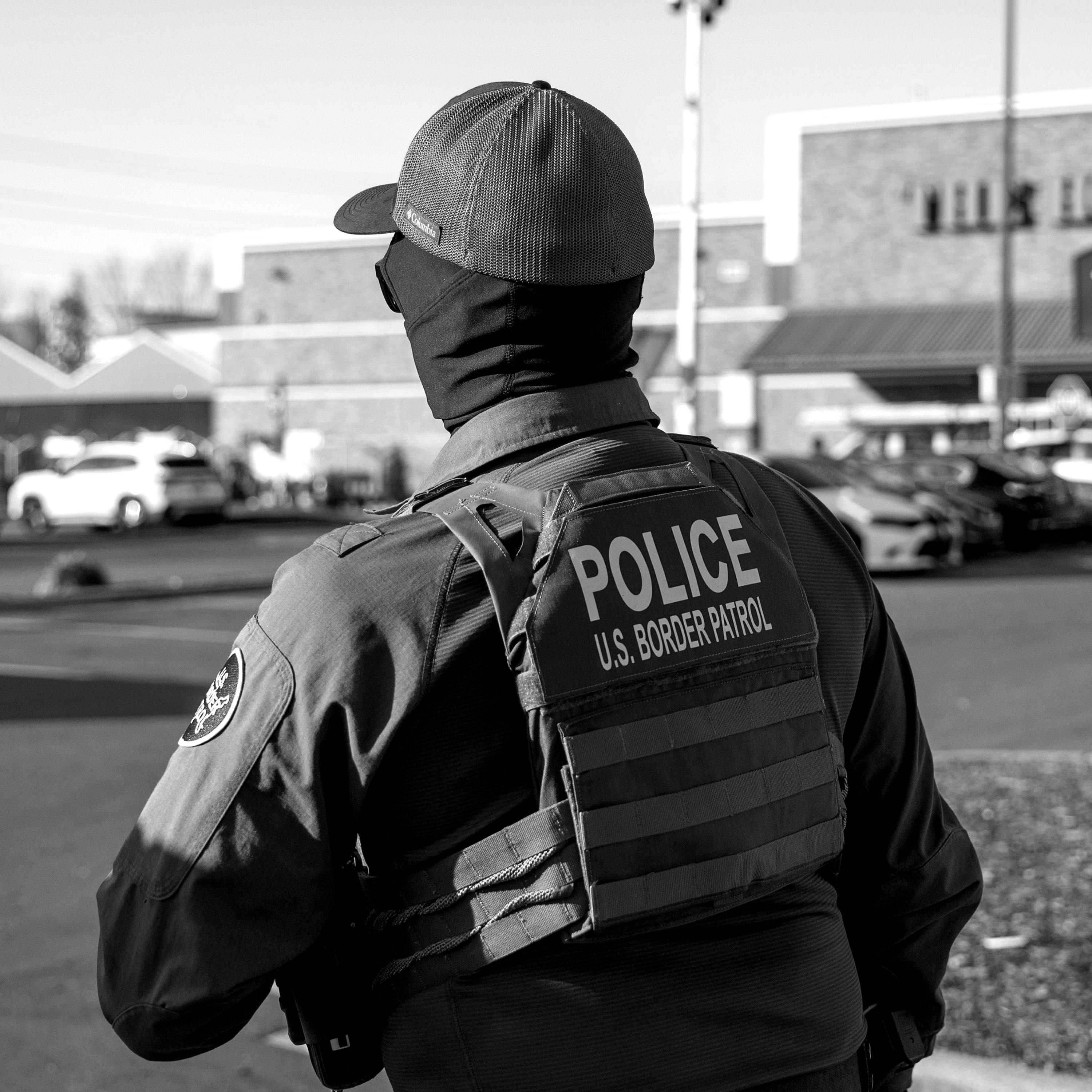
Strike First, Explain Never
Nancy Youssef covers national security for The Atlantic. She joins the show to discuss the strikes, the administration’s changes to the military, and the lack of transparency in the transformed Pentagon.
Get more from your favorite Atlantic voices when you subscribe. You’ll enjoy unlimited access to Pulitzer-winning journalism, from clear-eyed analysis and insight on breaking news to fascinating explorations of our world. Atlantic subscribers also get access to exclusive subscriber audio in Apple Podcasts. Subscribe today at TheAtlantic.com/listener.
Learn more about your ad choices. Visit megaphone.fm/adchoices
Press play and read along
Transcript
Speaker 1 You're cut from a different cloth.
Speaker 1 And with Bank of America Private Bank, you have an entire team tailored to your needs with wealth and business strategies built for the biggest ambitions, like yours.
Speaker 1 Whatever your passion, unlock more powerful possibilities at privatebank.bankofamerica.com. What would you like the power to do? Bank of America, official bank of the FIFA World Cup 2026.
Speaker 1 Bank of America Private Bank is a division of Bank of America NA member FDIC and a wholly owned subsidiary of Bank of America Corporation.
Speaker 2 This episode is brought to you by Buffalo Trace Distillery. Powerful yet smooth.
Speaker 3 Contained but never tame.
Speaker 2
Proudly going their own way, but never going alone. This is the spirit inside Buffalo Trace Bourbon.
Made at Buffalo Trace Distillery, the world's most award-winning distillery.
Speaker 2
Buffalo Trace is always perfectly untamed. Distilled aged and bottled by Buffalo Trace Distillery, Franklin County, Kentucky.
90 proof, 45% alcohol by volume.
Speaker 2 Learn more at Buffalo Trace Distillery.com. Please drink responsibly.
Speaker 4
We come on the air tonight with breaking news. The U.S.
has launched a military strike against a boat in the Caribbean, killing 11 people on board.
Speaker 5 So starting on September 2nd, the United States started striking boats in international waters as they were leaving Venezuela.
Speaker 4 The president says the boat was part of a cartel operation carrying drugs from Venezuela and heading right towards the U.S.
Speaker 5 The way the United States justified it is that they said these are narco-terrorists that pose a threat to the United States that the way to combat the fentanyl overdose problem in the United States is to take out the source of it, which is these boats.
Speaker 6 This is Atlantic staff writer Nancy Youssef, who covers national security.
Speaker 5 The problem is we don't know who are on these boats, why these boats versus others are being targeted, what was on those boats.
Speaker 4 In addition, fentanyl doesn't come from that part of the caribbean we want to keep fentanyl out of the the out of the united states and i don't know how widely known this is but those routes through the caribbean are predominantly used to bring cocaine to europe that was senator mark kelly and he's right according to the da and dhs Most of the fentanyl comes from Mexico.
Speaker 6 And the boats that we've seen sunk, they look like small fishing vessels that would struggle to make the thousand mile journey to the U.S.
Speaker 6 Despite what Trump says about Venezuelan President Nicolas Maduro, fentanyl.
Speaker 6 So why is the Trump administration killing people over it?
Speaker 5 If fentanyl is not coming from there and you've declared that that is the problem drug, and the boats can't reach the United States, I'm having a hard time understanding what legal justification there is.
Speaker 5 I'm not saying you have to let them all go, but to use military action to put that threat down rather than using the law enforcement measure. That's what I'm having a hard time from.
Speaker 5 The use of military force should be exceptional and should be for threats to the country and should be for threats that we as a country agree need to be addressed with militarily.
Speaker 5 To me, none of those standards have been met here.
Speaker 6
I'm Hannah Rosen. This is Radio Atlantic.
Since the strikes began two months ago, the U.S. has blown up at least 14 boats and killed almost 60 people.
Speaker 6 Last week, Defense Secretary Pete Hegseth ordered the largest aircraft carrier in the world, the USS Gerald Ford, to waters off Venezuela. And now, Trump is talking about striking targets on land.
Speaker 8 Something very serious is going to happen, the equivalent of what's happening by sea. And we're going to Congress just to tell them what we're doing.
Speaker 6 Nancy, there have already been a number of boat strikes in the Caribbean. So why is the arrival of this aircraft carrier significant?
Speaker 5 The arrival of the USS Gerald Ford Carrier Strike Group essentially allows the United States to potentially strike ashore.
Speaker 5
So we'll have, by early next week, more ships than we've had since the Cuban Missile Crisis. The Carrier Strike Group is particularly notable because we only have 11.
And so when the U.S.
Speaker 5 commits one to the region, it really signals something about its commitment to either support an ally or for potential military action.
Speaker 6 Got it. So it's a message, and it could be just a message, or it could be more than a message.
Speaker 5 Yeah, I mean, the reason we're all thinking it would be more is because we haven't seen a carrier strike group in that region in such a long time. So I'll give you an example.
Speaker 5 One place where we often see the carrier sent as messaging is in the Middle East, where the U.S.
Speaker 5 will send it as a form of, for example, deterrence message to Iran or to show support for Israel when it faces potential threats. So
Speaker 5 I think there's more expectation that something will happen in the Caribbean because we haven't had one there in so long.
Speaker 5 Okay, got it.
Speaker 6 But to step back, why is the Trump administration doing this in the first place? If fentanyl isn't coming into the U.S. from Venezuela, but from Mexico, why are these boat strikes even happening?
Speaker 5 So I think of this as a Venn diagram where the strikes kind of are in the middle.
Speaker 5 Secretary of State Marco Marco Rubio has long supported the Venezuelan opposition groups and seen Maduro as authoritarian, as a tyrant who has been unwilling to leave office, and that the U.S.
Speaker 5 should be supporting that opposition to bringing democratic reforms to Venezuela as a potential means to not only stabilize Venezuela, but potentially reshape parts of the region.
Speaker 9
The Maduro regime is not a government. It's not a legitimate government.
We've never recognized them as such. They are a criminal enterprise that basically has taken control of national territory.
Speaker 5 I think Stephen Miller sees this as an anti-immigration measure and that if you can stem the instability in Venezuela, you can stop the flow of migrants.
Speaker 5 The president has signaled First of all his particular frustration with Maduro dating back to his first term and that he wants to see the military used in a more law enforcement kind of way.
Speaker 5 And so, in the middle, are those strikes. And I think there's an overall feeling that if the U.S.
Speaker 5 strikes boats, even boats that might not pose a preeminent threat to the United States, that others will see it and it'll be a form of deterrence. So, I think that's what's going on.
Speaker 5 But having said that, we haven't had like a policy speech. We haven't had a press conference at the DOD to answer these questions.
Speaker 5 So, we're trying to put pieces of this opaque puzzle together to kind of figure out what's happening.
Speaker 6
I want to break this down. There are two separate questions.
One is, do we know if these are drug boats or fishing boats? Like, do you feel certain about that? Does anybody feel certain about that?
Speaker 5 And the short answer is no. We have tried to find the relatives of those who've been killed to get a sense of who they are.
Speaker 5 The president of Colombia said that one of them was only carrying a fisherman. We don't know.
Speaker 5 Is it possible that some of these boats are carrying fishermen who decide to sort of take a shipment to sort of make extra money? We just don't know.
Speaker 5 The U.S. says that it has intelligence, that it's been tracking these boats for a long period of time.
Speaker 5 But again, without any specifics, it's very hard to say anything for certain because we don't have names. We don't have any details about why these boats are being struck.
Speaker 5 And so you can sort of see large cargo on these boats sometimes, but certainly not enough to make a solid determination that they pose an imminent threat so much so that they required a U.S.
Speaker 5 military strike rather than an interdiction or other response.
Speaker 6 Aaron Powell, okay, so there's a question mark over: are they drug boats or fishing boats? Whether they're drug boats or fishing boats, how unusual are these kinds of military strikes?
Speaker 5
I would describe them as unusual. The U.S.
in the past, when
Speaker 5 they have faced these kinds of boats coming, let's assume they're drug boats, when they've seen drug boats that they think pose a threat to the United States, it has been treated as a law enforcement issue.
Speaker 5 What is happening here is that the United States is taking lethal strikes on these boats in international waters and saying that this demands military action, that this poses an imminent threat to U.S.
Speaker 5 national security, requiring military intervention rather than law enforcement intervention.
Speaker 5 And really using a lot of the same language that we heard in reference reference to the global war on terror. Rather than criminals are being described as terrorists, for example, they're combatants.
Speaker 5 They're not drug traffickers. There's been a lot of change in language and
Speaker 5 that's important because I think those who have questions about it would note that al-Qaeda, ISIS, some of these terror groups that we heard about for so years stated that their mission was to destroy the United States, whereas those trafficking drugs have not indicated that that is their aim.
Speaker 5
What they have indicated is that they want financial benefit. Their aims are not ideological.
They're financial.
Speaker 6 I mean, I see what you're saying about the language being important,
Speaker 6 because if they are drug traffickers, maybe this metaphor is too blunt. Isn't this the equivalent of, say, a police officer sees someone dealing drugs and kills them?
Speaker 5
In some ways, yes, because there's no due process in all this. I don't know why that person had to be killed with a military strike.
I don't even know what kind of strike is being conducted.
Speaker 5 I don't know why this requires a sizable portion of the United States Navy assets in the region.
Speaker 5 I don't understand why this is such a threat that we're pulling resources away from support for our allies, for example.
Speaker 5 And we're not getting answers to those questions and Congress isn't getting answers to those questions.
Speaker 5 And so if you believe that the authorization for war has to come from Congress, or at least they have to be notified, that's not happened here.
Speaker 6
You mentioned an absence of information. We don't really know who's on these boats.
We don't have a lot of information. This is also coming at a time when the Pentagon has barred reporters.
Speaker 6 Can you tell us about that change?
Speaker 5 The Pentagon is a unique place for reporters. People think of the Pentagon as this big building of like war planning and everything else, which I guess it is, but really it's an office building.
Speaker 5 There's a CVS there, there's a Popeyes there, there's a Taco Bell there, there's a shoeshine, there's a dry cleaner's. It's a little mini-city
Speaker 5 and filled with offices, hundreds if not thousands of doors in that building and we as reporters because of the way the building was sort of physically configured were allowed to walk anywhere in the hallways of that building and obviously not in secure spaces and we had done so since it opened in 1943
Speaker 5 And the current Secretary of Defense decided that if we wanted to continue to be able to report from that building, we had to sign rules that said that we would not ask for information or publish anything that was not approved by the department, and that we would agree that any information, even unclassified information that was published could pose a potential national security threat.
Speaker 5 And so the majority of the vast majority of the press corps decided that they couldn't sign that because to sign that would be to say we're no longer journalists, but stenographers.
Speaker 5 It's not our job to simply report what the department wants us to report. And so we all walked out collectively.
Speaker 5 The intersection with Venezuela is it is much, much, much harder for us to get basic information.
Speaker 5 and we're all feeling it in the sense that there's been excellent journalism since then but it's been harder to get answers to basic questions because it's not just that we're not allowed in the building but there is a climate of fear in that building people are afraid to talk the secretary has threatened or polygraphed top officers and created a sense that there's real repercussions for engaging with the press and so at a time when we're seeing a real ramp up of the U.S.
Speaker 5 military presence in the Caribbean Sea, we can't get information. There are no press conferences that are held.
Speaker 5 We're learning about things like the deployment of the USS Gerald Ford by tweet, and there was no opportunity to ask a follow-up question. When does the Ford get there? Why is it going there?
Speaker 5 Why this carrier? Will it be followed up by other carriers? How long will it be there? What is the mission? There's no opportunity. to ask those questions.
Speaker 5 And so it's made it much harder to provide the American public the kind of answers to the questions that you're asking.
Speaker 5 You know, reporting to me is being in a very large room with a very small flashlight, and you're just trying to figure out what am I seeing and what can I take from it.
Speaker 5 And to me, the aperture has shrunk.
Speaker 6 So, the administration is using the military in new and unusual ways and limiting the press's ability to track that. Is anyone pushing back? That's after the break.
Speaker 10 Some tech leaders question whether we're in an AI bubble, but others say the best of what AI has to offer is yet to come.
Speaker 11 Maybe in 10,000 years, AI will be based on physics that we don't even understand right now, and we'll have many different approaches.
Speaker 12 Join us weekly, starting October 15th, for the most interesting thing in AI, brought to you by Rethink, the Atlantic's creative marketing studio, in collaboration with PwC, wherever you get your podcasts.
Speaker 3 With Black Friday Savings at the Home Depot, you can get up to 40% off, plus up to an extra $1,000 off select appliances like LG, America's most reliable line of appliances.
Speaker 3 Check out the newest LG refrigerator with new mini craft ice straight from the dispenser. Shop Black Friday Savings on Select LG Appliances, plus, get free delivery now at the Home Depot.
Speaker 3
Free delivery on appliance purchases of $396 or more offer about 11-5 through 12.3 U.S. only.
See
Speaker 6
To summarize, the U.S. is killing people in seemingly extra-legal ways.
They're using the military in situations where they used to use law enforcement.
Speaker 6
That's unusual, and we're not sure how far they can stretch that. At the same time, there's a vacuum of information.
Is there any debate or dissent?
Speaker 6 Nancy, what do you know about members of Congress Congress or people inside the military questioning these actions?
Speaker 5 Well, we do have some indications of frustration. I'll start with the military and then on the hill.
Speaker 5 Admiral Alvin Halsey, who is the commander of U.S.
Speaker 5 Southern Command, which is responsible for all military operations in that region, unexpectedly submitted his resignation one year into what was supposed to be a three-year job.
Speaker 5 We know based on our own reporting there had been tense conversations between him and his civilian leadership about these strikes and some of the legal questions around them.
Speaker 13 In a statement, Admiral Halsey said, it's been an honor to serve, but he didn't say why he was retiring.
Speaker 13 It comes just after President Trump floated the idea of strikes against cartels inside Venezuela and that he authorized covert action there.
Speaker 5 On the Hill, we've seen a growing number of Republicans express concern. I think Rand Paul has been one of the most vocal.
Speaker 14 You cannot have a policy where you just allege that someone is guilty of something and then kill them.
Speaker 5 Raising questions about the legality of these strikes.
Speaker 14 We interdict ships all the time off the coast of Miami, off the coast of California. And the Coast Guard statistics say that about 25% of the boats that we stop to search don't have any drugs.
Speaker 14 So if one out of four of the boats don't have drugs on them, you know, what kind of person would justify blowing up people when one out of four boats may well not have drugs on them?
Speaker 5 We know that there was a quite a tense meeting between a top Pentagon lawyer and the Senate Armed Services Committee, which even Republicans were getting frustrated because they couldn't get specific answers.
Speaker 5
There was a vote recently to sort of indicate Congress's objections to these strikes. It did not pass.
So we know that there are concerns.
Speaker 6
Nancy, this isn't the first time that the U.S. has policed Central and South America.
You know the term America's backyard. So this setup is somewhat familiar.
Speaker 5 But we haven't done it with this kind of force posture.
Speaker 5 We've done things like training. And I I mean we've done things, don't get me wrong, and by the way our interventions haven't always gone so great.
Speaker 6 Right.
Speaker 6 It's a very spotty history of intervention in Central and South America, but it's a familiar history.
Speaker 5 Yeah, what stuns me is the size and scale of it. The U.S.
Speaker 5 administration's stated goal of moving away from force posture in other parts of the world towards the hemisphere also has me thinking about it in these terms.
Speaker 6 And what are the options for engagement? Like, what do you see as totally outside the the possibility and what seems in the realm of the plausible in terms of escalation?
Speaker 5 Aaron Powell, so the most minimal engagement would be none at all. That the carrier is there as a show of force to signal the United States' commitment to going after drug traffickers.
Speaker 5 That's sort of one end of the spectrum.
Speaker 5 Possible,
Speaker 5 seems unlikely given the amount of power you're bringing to the region. The other extreme would be a ground invasion.
Speaker 5 Again, possible, but not likely based on our reporting and the indications we have so far, because you don't bring in a Navy for ground war, right?
Speaker 5 If we saw the 82nd Airborne deployment as well, then I'd be making a different assessment. But having said that, I can't tell you specifically what it could be.
Speaker 5 Could it be a series of strikes over a period of days or weeks? Something akin to what we saw in the campaign against the Houthis in Yemen?
Speaker 5 Could it be a salvo of strikes one day, like we saw against the nuclear sites in Iran? Could it be something totally different?
Speaker 5 I think what the carrier opens up up is the possibility for strikes ashore on Venezuela, on infrastructure supporting drug tartels or maybe, you know, houses owned by some of these narco groups.
Speaker 6 But if the ultimate goal is to topple the Maduro government, like if you were Marco Rubio and they are pretty open about wanting regime change, what would be the scenario?
Speaker 5 So from what we can tell, their hope is that these strikes create enough pressure that either Maduro flees or you see defections inside his military that say you have to go.
Speaker 5 The challenge is the last time we were in something similar to this situation in Venezuela is 2019, and there were hundreds of defections then.
Speaker 5 There's no indication of defections so far given the strikes that have happened.
Speaker 5 And so if you think of this as like how many shakes does it take to tip over whatever it is you're trying to get out of the vending machine,
Speaker 5 That's the calculation that this will be the shake that'll sort of tip it over. What we haven't heard is an extensive conversation of what follows that.
Speaker 5 And, you know, there are a lot of groups within Venezuela, armed groups and supporters of the Maduro regime that are likely to react in some way if there's a change.
Speaker 5
And so to me, it's sort of akin to the fall of Gaddafi in Libya. That's the risk anyway, is that there's minimal sort of outside intervention.
It leads to sort of an internal change.
Speaker 5 But there are so many factions internally that fight for control that it leads to a new kind of instability. That's the risk right now.
Speaker 5 Now, having said that, the opposition have said that they are prepared to step in, that they have a plan for how to run the country.
Speaker 5 But that appears to be sort of how the strategy is shaping up in terms of potentially affecting events in Venezuela if you believe that these strikes are being driven by a desire to see a regime collapse within Venezuela.
Speaker 6 Right. And we should note that some in the Venezuelan opposition are in favor of U.S.
Speaker 5 involvement.
Speaker 6 I think that's important to mention.
Speaker 6 But, Nancy, I want to expand beyond Venezuela. As you've noted, the administration is using the military in a new way there.
Speaker 6 But the administration also seems to be testing other kinds of unusual uses of the military, like deploying them in a half dozen cities, the National Guard here in D.C.
Speaker 6 Do you connect all these things? Do you see maybe a fundamentally different idea about the military emerging?
Speaker 5 One thing that I've been struck by reporting in places like Egypt and Libya and Bahrain is that that their militaries are there in large part to combat domestic threats.
Speaker 5 And what has made the United States so unique is it's a large, powerful force designed to protect the United States from external threats.
Speaker 5 That when we have threats internally, that that is to be handled by law enforcement agencies, not military force.
Speaker 5 And now we're seeing a military that is more inwardly directed, or at least more directed towards this hemisphere, right? And that's a big shift. To me, the thing that I'm watching for is where U.S.
Speaker 5 military standing relative to the American public ends up a year from now or two years from now.
Speaker 5 Because the other thing that's happening at the same time is that the Secretary has indicated that he doesn't see diversity as a strength of the military.
Speaker 5 He's not enthusiastic about women joining the ranks. And in fact, we've seen a lot of minority officers and female officers asked to leave or deciding to leave, including Admiral Hosley himself.
Speaker 5 And so it portends of a force that looks less like a representative of the American public and more like a representative of those who support the president.
Speaker 5 It's a different relationship that it has with the American public. So that's the thing I'm watching long term.
Speaker 5 How does all this shift how we think of our military and how much it's seen as representing being America's military, an apolitical force? How long does that hold?
Speaker 6 Aaron Powell, that is a real fundamental shift. Like, do you think of yourself as potentially covering a pretty fundamentally different military than you did at the start of your career?
Speaker 5 Aaron Powell, yes.
Speaker 5 Because
Speaker 5 how can you not when you're seeing it deployed in such a different way? You know, I mean, how it's deployed is sort of how we see it.
Speaker 5 And
Speaker 5
so, and I could be wrong, you know, but you can't help but ask these questions when you're seeing these kinds of shifts happening. It does feel different to me.
And it's the totality of it.
Speaker 5 It's, it's not one thing.
Speaker 6 Well, Nancy, thank you so much for explaining your work to us. Thank you.
Speaker 6 This episode of Radio Atlantic was produced by Rosie Hughes and Kevin Townsend. It was edited by Claudina Bade and fact-checked by Alex Moronia Porto.
Speaker 6 Rob Smersiak engineered this episode and provided original music. Claudina Bade is the executive producer of Atlantic Audio and Andrea Valdez is our managing editor.
Speaker 6 Listeners, if you like what you hear on Radio Atlantic, you can support our work and the work of all Atlantic journalists when you subscribe to the Atlantic at theatlantic.com slash listener.
Speaker 6
Also, I have a favor to ask. I'm interviewing chef and cookbook writer Allison Roman in a couple of weeks.
If you have any questions for her, recipe related, biography
Speaker 6 cookbook-related, Thanksgiving-related, please email them to me at radioatlantic at theatlantic.com.
Speaker 6 I'm Hannah Rosen. Thank you for listening.
Speaker 7 Go Beyond the Lab in the new season of When Science Finds a Way, a podcast from Welcome, a global charitable foundation supporting science to solve urgent health challenges.
Speaker 7 You'll join me, Alicia Wainwright, your host for Bold's conversations about the scientific breakthroughs changing lives around the globe.
Speaker 7 In this season, each episode explores how science is not just in the lab, but alive in homes, supermarkets, hospitals, schools, and communities.
Speaker 7 We'll hear from a Nigerian artist who's channeling his lived experience into creative ways to support mental health, from Brazilian researchers who are using climate data to forecast and prevent disease outbreaks.
Speaker 7 From European scientists developing developing new imaging technology that reveals disease in the body in unprecedented detail.
Speaker 7 We'll even explore a groundbreaking new study that's reimagining reproductive healthcare.
Speaker 7 These are all stories about how communities and researchers are working together to meet urgent health challenges with empathy and impact.
Speaker 7 Listen to When Science Finds a Way, a science podcast that tells the human story wherever you get your podcasts.