The Wubi Effect
Today, we tell the story of Professor Wang Yongmin, a hard-headed computer programmer who solved this puzzle and laid the foundation for the China we know today.
Special thanks to Martin Howard. You can view his renowned collection of typewriters at: antiquetypewriters.com.
EPISODE CREDITS:
Reported by - Simon Adler
Produced by - Simon Adler
Sign up for our newsletter!! It includes short essays, recommendations, and details about other ways to interact with the show. Signup (https://radiolab.org/newsletter)!
Radiolab is supported by listeners like you. Support Radiolab by becoming a member of The Lab (https://members.radiolab.org/) today.
Follow our show on Instagram, Twitter and Facebook @radiolab, and share your thoughts with us by emailing radiolab@wnyc.org.
Leadership support for Radiolab’s science programming is provided by the Simons Foundation and the John Templeton Foundation. Foundational support for Radiolab was provided by the Alfred P. Sloan Foundation.
Press play and read along
Transcript
Speaker 1 Radiolab is supported by AT ⁇ T. Few things feel better than knowing someone is in your corner, like when your friend saves you a seat when you're running late.
Speaker 1
That's why AT ⁇ T has connectivity you can depend on, or they'll proactively make it right. That's the AT ⁇ T guarantee.
Terms and conditions apply. Visit ATT.com/slash guarantee for details.
Speaker 1 AT ⁇ T connecting changes everything.
Speaker 3 WNYC Studios is supported by Apple TV.
Speaker 4
It's 1972. A young British family is attempting to sail around the world when disaster strikes.
Their boat is hit by killer whales and it sinks in seconds.
Speaker 4 All they have left is a life raft and each other.
Speaker 4 This is the true story of the Robertson family and their fight to survive, hosted by me, Becky Milligan. Listen to Adrift, an Apple original podcast produced by Blanchard House.
Speaker 4 Follow and listen on Apple podcasts.
Speaker 5 Radio Lab is brought to you by Progressive Insurance. You chose to hit play on this podcast today? Smart choice.
Speaker 5 Make another smart choice with AutoQuote Explorer to compare rates from multiple car insurance companies all at once. Try it at progressive.com.
Speaker 5 Progressive casualty insurance company and affiliates, not available in all states or situations. Prices vary based on how you buy.
Speaker 5 Hey, I'm Latif Nasser. This is Radio Lab.
Speaker 5 So I've been seeing headline after headline lately about how the U.S. is in a race
Speaker 5 with China.
Speaker 8 We are in this high-tech competition with China.
Speaker 9 Over AI.
Speaker 10 AI arms race.
Speaker 4 The country that leads in technology tends to lead the world.
Speaker 10 We need to win the race here in the United States.
Speaker 5 And this AI technological arms race, if you want to call it that,
Speaker 5 has been making me think about this episode that our senior producer Simon Adler made back in 2020.
Speaker 5 The story he tells is the story of another arms race between China and the U.S., one that took place in the 1970s and 80s over a piece of technology that we now completely take for granted.
Speaker 5 Crucially, though, the story starts at a moment when China, instead of being the technological superpower that it is today, was about to be left behind.
Speaker 5
And the way that they caught up sort of set the table for this whole AI situation we are in right now. Simon did a great job with it.
It is a super fun story to listen to.
Speaker 5 So, without further ado, I give you the Woobi effect.
Speaker 12 Wait, you're listening.
Speaker 6 You are listening
Speaker 7 to Radio Lab.
Speaker 12 Radio Lab from
Speaker 11 WNYC.
Speaker 8
Hey, I'm Jad Abum Ra. This is Radio Lab.
To start things off today, a couple months ago,
Speaker 11 you want some coffee?
Speaker 9 Too small?
Speaker 8 In that magical, forgotten time before the coronavirus, our reporter Simon Adler somewhat
Speaker 8 mysteriously walked me a few blocks from our office, mic in hand, to a coffee shop.
Speaker 9 Okay, with our coffee purchased, let's go stand in the corner where it's maybe a little less loud.
Speaker 8 Sort of a fancy one.
Speaker 8 Exposed brick, bare Edison bulbs.
Speaker 9 So let's gaze out upon the hipsters of
Speaker 9 Lower Manhattan.
Speaker 8 Let's survey and count the number of laptops.
Speaker 9 Yeah, so how many laptops are using Greenhouse?
Speaker 8 Okay, starting from the left, we're going to circle around. We got one, two, three, four, five,
Speaker 20 six. Two more on the mark.
Speaker 12 Two more on the mark.
Speaker 9 And they're all typing the same way, right? They're all using a QWERTY keyboard.
Speaker 18 Yeah, yes.
Speaker 8 And the reason that he dragged me there, as I now know.
Speaker 9 Now let's imagine we're in Shenzhen in a Chinese Starbucks.
Speaker 8 Was to point out a massive cultural difference hidden in plain sight and to propose a bit of a reporting trip. Are you going to send somebody to Starbucks in Shenzhen?
Speaker 9 Well that's my hope that I will be the one sent to a Starbucks in Shenzhen.
Speaker 18 Well played Adler.
Speaker 20 Now you did not bite on that reporting trip.
Speaker 11 Nope.
Speaker 9 Plus pretty soon thereafter, traveling to China became a lot more difficult.
Speaker 23 So
Speaker 24 okay, I'm in this big Starbucks shop
Speaker 24 here in Hong Kong.
Speaker 17 To play out this comparison I had in mind, instead, we hired and sent local reporter Yang Young to scope it out for us.
Speaker 24 There are about 50 people here, maybe 30 laptops or tablets open.
Speaker 29 Because, and here is where we get to the point,
Speaker 30 everyone in this Starbucks.
Speaker 24 You know, typing and writing and browsing on the internet.
Speaker 9 We're all using their keyboards in a different way.
Speaker 8 What do you mean? So using it in different ways in the way that they use the keyboard or that the keyboards that they're using themselves are different?
Speaker 9 The physical keyboard's going to be the exact same thing.
Speaker 33 They're QWERTY keyboards, just like here in New York.
Speaker 12 Oh, okay. I didn't even know that.
Speaker 9 But like, even if everybody in this Chinese Starbucks was really into dogs, it was a dog convention, and so they were all typing the word go, which is dog in Mandarin,
Speaker 9 no two people would be typing the word dog the same way.
Speaker 12 That's right.
Speaker 10 There could be 50 different ways that that keyboard is being used to type the Chinese language.
Speaker 9 This is Professor Tom Mulaney.
Speaker 10 I'm professor of Chinese history at Stanford University.
Speaker 34 Okay, well, and this is the
Speaker 9 doorway into the grand mystery, it would seem.
Speaker 10 Yeah, because, I mean, in theory, there are an infinite number of different ways to type Chinese with the QWERTY keyboard.
Speaker 8 I don't even know what that means.
Speaker 18 How is that possible?
Speaker 10 Well, it turns out that figuring out how to type in Chinese on a keyboard was one of the most complex engineering, linguistic, and conceptual puzzles of its time.
Speaker 39 It's a puzzle that threatened to erase an entire culture, nearly prevented China from becoming the technological superpower that it is today, and says a whole lot about where all of our communication is heading.
Speaker 12 All right,
Speaker 9 so before we get into why typing in Chinese is such a crazy difficult problem to solve,
Speaker 9 let me introduce you to one of the guys who
Speaker 14 actually set out to solve it.
Speaker 12 Hello?
Speaker 42 What did I suddenly have the dead town?
Speaker 12 Hello, Simon.
Speaker 16 Hi.
Speaker 43 Hello,
Speaker 35 is everybody here? Can you all hear us?
Speaker 20 Professor Wong Yongmin.
Speaker 24 Yes, Professor Wang is here. You can talk to him.
Speaker 9 My interpreter, fixer, and really co-reporter on the China side of this, Yang Yang, and I spoke with him a couple months back.
Speaker 2 Professor Wang, I think of you as sort of
Speaker 2 almost like the Chinese Steve Jobs.
Speaker 29 Is that a fair way to think of you?
Speaker 24 He says that he's nowhere close to the wealth Steve Jobs held.
Speaker 24 But in terms of his fame and reputation,
Speaker 42 yes,
Speaker 24 it's a fair comparison.
Speaker 9 Professor Wong was born in the 1940s in a small rural village.
Speaker 24 Growing up in this village, they had wheat and corn.
Speaker 37 His family farmed and his dad was also a carpenter, but it was a hard scrabble existence.
Speaker 24 His family was so poor that they couldn't afford any clothes for him.
Speaker 24 And, you know, because they were dirt poor, he understood at a very young age that going to school was not a small thing.
Speaker 24 So he studied extremely hard.
Speaker 24 He said that from the first grade all the way to university,
Speaker 42 always the number one, okay?
Speaker 24 I am always the number one.
Speaker 9 And all that hard work paid off. He was selected to attend the University of Science and Technology of China, which is basically the equivalent to MIT.
Speaker 24 And after graduating from college, he was assigned by the government to a research institute located in this remote district.
Speaker 38 And this wasn't just any research institute.
Speaker 24 It was a top-secret, highly classified national defense research institute. Even the locals didn't know what these people were doing there.
Speaker 20 And the top-secret, highly classified work that was going on there
Speaker 2 was building computers, which in China wasn't just an engineering question.
Speaker 23 It was much deeper.
Speaker 10 Keep in mind, this was the early 1970s, and everyone that was paying attention knew that computing was going to change the fabric of economy, warfare.
Speaker 9 Again, historian Tom Mulaney.
Speaker 10 Communication, everything.
Speaker 24 But at that time, China was just starting to enter this field and
Speaker 24 was lagging behind.
Speaker 32 I mean, the best estimates I could find say that around that time, in the entire country, with a population of nearly a billion people, there were only 3,000 computers in use.
Speaker 47 Why is that?
Speaker 10 Well, the simple reason is the Chinese language could not fit inside a computer.
Speaker 8 Meaning what?
Speaker 9 So in English, we put our words onto the page or the screen by shuffling around these 26 letters, right?
Speaker 1 Say them with me.
Speaker 44 A, B,
Speaker 9 C.
Speaker 9 Each one representing a sound in the word.
Speaker 44 F.
Speaker 9 And the writing, in fact, tells you how to say the word.
Speaker 44 B,
Speaker 12 I,
Speaker 44 G.
Speaker 12 Big.
Speaker 9 Well, Chinese writing is completely different.
Speaker 49 The person character is placed next to a tree to convey the idea of resting.
Speaker 20 When you write in Chinese, you aren't writing down the sounds of the words so much as you're drawing a picture of each word.
Speaker 49 Three trees here are combined in the character for
Speaker 49 to mean a forest.
Speaker 32 This Chinese writing goes back at least 3,000 years, and in fact, some of the earliest known examples of it were found on artifacts in Professor Wang's home province.
Speaker 25 And this writing system, these characters, grew out of an attempt to represent the actual things in the world around us.
Speaker 9 Water, stars, animals, actions, feelings.
Speaker 7 You can
Speaker 24 see a thing, see a picture,
Speaker 24 a long history in a Chinese character.
Speaker 9 So that today, there are more than 70,000 of these Chinese characters, each a unique visual representation of a word or an idea.
Speaker 20 And so the problem was, in the 1970s, computers had only a few bytes of memory, not even enough to store a single email message.
Speaker 10 And so the available memory on most of these, on all of these computers,
Speaker 10 commercially available computers, couldn't even store the Chinese character set. Huh.
Speaker 2 Or display them on a screen or even print them.
Speaker 40 Like, again, back in the day, the 1970s, the way we're printing things is with dot matrix printers, right?
Speaker 8 Oh, I remember, yeah.
Speaker 12 Okay.
Speaker 10 Where these tiny needles strike the paper composing letters out of a set of little dots.
Speaker 38 Paper pixels.
Speaker 10 Paper pixels, exactly. It takes way more pixels to produce a Chinese character than it does to produce a letter of the Latin alphabet.
Speaker 9 And so inside these printers, those little needles weren't packed densely enough to tattoo a legible character onto the page.
Speaker 10 And if you take those pins and shrink them
Speaker 10 to get more paper pixels in a pinhead, well, what happens is they bend and break
Speaker 10 because they are not tuned metallurgically. They're not tuned to being that size.
Speaker 10 So it's not as if China could simply just buy these computers wholesale because the English language, the Latin alphabet, was in effect being baked into
Speaker 10 the architecture, in some cases, the very matter and materiality of these machines.
Speaker 16 Whoa.
Speaker 8 That's funny. Like, I've heard, you know, we talk sometimes about algorithm bias, but I had never
Speaker 8 realized there was this huge cultural barrier in the basic hardware of the computer.
Speaker 12 Totally.
Speaker 9 And I mean, for China, this was seen as an existential threat.
Speaker 34 Like, consider the fact because of these limitations into the 80s, they were forced to conduct and tabulate their senses with pencil and paper.
Speaker 10 And so, by Lord, if China couldn't figure out a way to computerize Chinese or to Chineseize computers, then it was going to be on the outside looking in.
Speaker 9 So, this was the problem they were trying to solve at that top secret research institute.
Speaker 9 And the full magnitude of it, of this problem, really smacked Professor Wong in the face when he saw his first fully formed Western computer, which, amazingly, because he'd been focused on such hyper-specific electrical problems, didn't happen until about eight years into his research.
Speaker 38 He remembers seeing it in a local printing shop.
Speaker 24 The first ever in real life.
Speaker 24 He was totally amazed.
Speaker 24 Yeah, I mean, that was incredible.
Speaker 27 But then he says he looked down at the keyboard attached to the computer and saw the Latin letters.
Speaker 14 And he thought, like, wait, how am I supposed to type 70,000 characters with just those 70 keys?
Speaker 30 Like, how are we going to fit the Chinese language on this thing?
Speaker 10 That would be the equivalent of trying to get all 26 letters of the Latin alphabet onto less than one key.
Speaker 9 And as Professor Wong began looking into this,
Speaker 26 he found that the consensus at the time was it simply couldn't be done.
Speaker 24 At that time, there was a saying that
Speaker 24 computers are the gravediggers of Chinese characters.
Speaker 10
Gravediggers. Oh, totally.
People were making very loud calls for the absolute abolition of character-based writing.
Speaker 8 You mean like throw out Chinese characters altogether?
Speaker 12 Yeah.
Speaker 24 It was like a doomed day.
Speaker 8 Because of this very thing.
Speaker 37 It was a big part of it.
Speaker 39 And so tons of folks in the field of computing were arguing.
Speaker 10 We've got to replace Chinese with Esperanto or with English or with something else so so that we can participate in global modernity.
Speaker 52 Behind the plans is the realization that China must modernize or starve.
Speaker 31 There was even a government body,
Speaker 9 the State Commission on Language Reform, that was looking into how to do this.
Speaker 17 However,
Speaker 24 Wan wasn't convinced.
Speaker 9 He thought there has to be a way to type in Chinese and save the Chinese character.
Speaker 24 He called it destiny. He felt like it was fate.
Speaker 38 And he was convinced that if he couldn't do it, if he couldn't find a way to save the character,
Speaker 24 Chinese culture would be over with it too.
Speaker 42 Quote unquote.
Speaker 24
So I didn't know if I would succeed. I didn't know if I would fail.
There was no return, regardless of life and death.
Speaker 19 Whoa, so dramatic. It's so dramatic.
Speaker 3 But
Speaker 24 it was really pressing for him. Yeah.
Speaker 13 And for good reason.
Speaker 9 Because in fact, Chinese writing had nearly been wiped out once before.
Speaker 32 And we're going to get into that right after this break.
Speaker 1
Radiolab is supported by AT ⁇ T. Few things feel better than knowing someone's in your corner.
Whether you're celebrating a win or trying to work through a loss, staying connected matters.
Speaker 1 Check-ins, no matter how casual or quick they may seem, are moments that matter.
Speaker 1 AT ⁇ T wants to ensure these moments are always in reach with their guarantee that covers both wireless and fiber internet service, that is all about having your back. Staying connected matters.
Speaker 1 That's why in the rare event of a network outage, AT ⁇ T will proactively credit you for a full day of service. That's the ATT guarantee.
Speaker 1 That's a wrap for now, but if you're thinking of reaching out to someone who has been on your mind, go for it.
Speaker 1 Credit for fiber downtime lasting 20 minutes or more or for wireless downtime lasting 60 minutes or more caused by a single incident impacting 10 or more towers.
Speaker 1
Must be connected to impacted tower at onset of outage. Restrictions and exclusions apply.
See ATT.com/slash guarantee for full details. ATT, connecting changes everything.
Speaker 1 Radiolab is supported by Built. Nobody wants to pay rent, but if you have to, Built works to make it more worthwhile.
Speaker 1 By paying rent through BILT, you can earn flexible points that can be redeemed toward hundreds of hotels and airlines, a future rent payment, your next lift ride, and more. But it doesn't stop there.
Speaker 1 You can dine out at your favorite local restaurants and earn additional points, get VIP treatment at certain fitness studios, and enjoy exclusive experiences just for BILT members every month.
Speaker 1 Earn points on rent and around your neighborhood wherever you call home by going to joinbilt.com slash radio lab that's j o i n b i l t dot com slash radio lab
Speaker 5 radio lab is supported by capital one banking with capital one helps you keep more money in your wallet with no fees or minimums on checking accounts and no overdraft fees just ask the capital one bank guy it's pretty much all he talks about in a good way he'd also tell you that radio lab is his favorite podcast too oh really thanks capital one bank guy What's in your wallet?
Speaker 5 Terms apply. See capital one.com slash bank, capital One N A member F D I C
Speaker 3 Hey, I'm Molly Webster and this is an ad by BetterHelp. So it happens every year.
Speaker 3 The seasons are changing, the days are getting shorter, and basically once it becomes dark outside of my window, I feel like the rest of the world disappears and I'm just alone and there's nothing left to do but watch television.
Speaker 3 This November, BetterHelp is asking everyone to reach out to our people. That could be your family, your friends, your neighbors, and to resist this call of the cocoon.
Speaker 3
And yeah, reaching out can take some courage. I've got text messages from January I haven't responded to.
And you know what? I'm gonna write them back right now.
Speaker 24 Hi.
Speaker 3 Sorry, I've been missing. How are you?
Speaker 3 Why don't we all do this sooner? Therapy is the same way. BetterHelp makes it easier to take that first step.
Speaker 3 You just fill out a short questionnaire and they find a licensed therapist who they think you'll like. Our listeners get 10% off their first month at betterhelp.com slash radiolab.
Speaker 3 That's better H-E-L-P dot com slash radiolab.
Speaker 12 Okay, three, two, one.
Speaker 19 Hey, I'm Jad Ab Umraad.
Speaker 9 And I'm Simon Adler.
Speaker 8 This is Radiolab and today, China's technological twist of fate.
Speaker 8 And before the break, Simon, you introduce us to a guy named Professor Wong, the man who was tasked with solving this problem, which it sounds like he took pretty seriously.
Speaker 9 Yeah, and for good reason, because the Chinese writing system had almost disappeared once before.
Speaker 9 To set the scene, it's the 19 teens. China is emerging as a nation out onto the world stage.
Speaker 9 And they're noticing technological advancements in the West.
Speaker 55 A Chinese visitor to the U.S., let's say he goes by the Ford Company corporate headquarters.
Speaker 9 Historian and collector Martin Howard.
Speaker 55 Well, walking in through the front door and down the halls to the administrative area, what they're going to hear is a cacophony of sound. Okay.
Speaker 55 He's going to get louder and louder, and then he's going to turn the corner and he's going to be faced with rows and rows of hundreds of typists typing away.
Speaker 9 And these typewriters in businesses across the United States were literally remaking English communication.
Speaker 55 Simon, it was a revolutionary machine, a paradigm shift.
Speaker 10 Typewriter speed queens are lined up to show the world how fast they are.
Speaker 38 For three basic reasons.
Speaker 55 Number one,
Speaker 55
speed. Tap tappers setting the keyboards on fire.
One could type four times faster than a clerk could write with a pen.
Speaker 10 149 words a minute.
Speaker 55 Number two, you know what it's like reading other people's handwriting? Some people's handwriting is goddamn awful.
Speaker 56 Legibility.
Speaker 12 Awful to read.
Speaker 57 It's a tremendous step forward in business efficiency.
Speaker 55 The third reason, making copies.
Speaker 55 Think about that. If it's four four times faster and you're producing 10 copies at the same time, one could argue that's 40 times faster.
Speaker 55
I think my math is right there. I think so.
If it's 20 copies, then it's 80 times faster. That's mind-tingling, right?
Speaker 20 And so China's like, we have to have that speed, that efficiency.
Speaker 10 We have to have these machines.
Speaker 9 And so some 50 years prior to Professor Wang's problem, you had people saying, we've got to get rid of Chinese.
Speaker 37 I mean, Mao himself advocated for either throwing the Chinese character out completely or at a bare minimum, adopting an alphabet so that they could spell out the way characters sound.
Speaker 10 Yeah, he was one of the chorus.
Speaker 8 And so the thought there was that if you alphabetize the Chinese characters, you could then lay it out on a keyboard and the problem goes away.
Speaker 12 Exactly. Okay.
Speaker 9
Now, obviously, Chinese writing did not disappear. And there was actually a Chinese character typewriter.
Several of them, in fact.
Speaker 32 And what's striking about it, the model that won the day, is just how untypewriter-y it is.
Speaker 10 This is a typewriter with no keyboard.
Speaker 23 It's this clunky yet eloquent device with just two levers, one for your left hand, one for your right,
Speaker 20 and then this big tray bed full of metal characters.
Speaker 9 And using those levers, you move the tray bed vertically and horizontally to line up the character you want.
Speaker 10 And then press down on the lever that your right hand is holding. And in one fell swoop, sort of ba-ba-ba, the metal character gets sucked into the type chamber.
Speaker 36 The character swings further up towards the page on this metal arm.
Speaker 8 Oh, like a jukebox, the way it reaches in and lifts up a record.
Speaker 44 Exactly.
Speaker 9 And on its way up.
Speaker 10 Rubs against an ink spool and then strikes the paper, printing the character onto the page.
Speaker 10 Before finally, the arm swings back down, and the force of it doing so spits that metal character back into the tray bed.
Speaker 12 Dang.
Speaker 9 And while you could only type about half as fast on one of these as you could on a quirty English typewriter, I mean, it worked. It was enough to stave off the death of the character.
Speaker 41 And for Professor Wong, 50 years later, it was a sign,
Speaker 9 a sign that instead of forcing the Chinese language to bend to the will of technology,
Speaker 9 technology could be bent to the will of the Chinese language, the Chinese character.
Speaker 33 And so to do that,
Speaker 2 he actually started by breaking down the Chinese characters themselves.
Speaker 10 Because, well, let's face it, even though Chinese doesn't have an alphabet,
Speaker 10 that doesn't mean that every character in Chinese is absolutely unique and singular in a snowflake.
Speaker 10 There are pieces and components and shapes that reappear over and and over in these different characters.
Speaker 24 Just imagine
Speaker 24 this is chemistry.
Speaker 24 There were tens of thousands of molecules in chemistry,
Speaker 24 but there are only 100 or so atoms.
Speaker 39 Professor Wang believed that if he could just figure out what the atoms of Chinese characters were,
Speaker 10 the components of characters,
Speaker 10 like a shape alphabet.
Speaker 10 That he could put those on the keyboard and that people could then quote unquote spell Chinese characters not by sound, but by shape.
Speaker 33 Now, to help visualize this, let's take the character for river, jiang, which looks like a capital I
Speaker 20 with three dashes to its left, two near the top and one near the bottom.
Speaker 12 Got it.
Speaker 26 Now, this character, Jiang, contains two components.
Speaker 9 The first is that capital letter I, and the second is those three dashes.
Speaker 17 Now, on its own, that capital letter I is actually the character for work.
Speaker 13 And those three dashes actually represent water.
Speaker 12 Huh.
Speaker 8 So work plus water equals river.
Speaker 45 Correct.
Speaker 9 And just as with this character, Jiang, these quote-unquote work and water components often appear in combination with other components.
Speaker 9 So for example, those three dashes, the water component, are present in the characters for juice and sweat and soup.
Speaker 23 Anyhow, so what we just did, taking a character and breaking it into its parts,
Speaker 30 is what Professor Wong began to do as he searched for the most common and fundamental of these components.
Speaker 32 He got himself a room, emptied it out of everything but a couple desks,
Speaker 28 and with a small staff he'd assembled, he took 10,000 characters and began breaking them apart and making note cards.
Speaker 24 Yeah, note cards.
Speaker 20 One note card for each component of each of the 10,000 characters he was dissecting.
Speaker 9 So, like, Jiang River would get two note cards. One with the I on it, one with the three dashes on it.
Speaker 32 When this was all said and done, what he had laying out on these various desks
Speaker 24 were 120 000 cards if you stack them all together they were like 12 meters tall about the height of a three-story building but of these 120 000 cards many of them were duplicates or triplicates or quadruplicates
Speaker 20 like there would be at least four cards with the same water component on them, right?
Speaker 9 One from the character for River, another from Soup, and two more from Sweat and Juice.
Speaker 9 So from there, what he did was sorted all of the common components together.
Speaker 9 All of the water components on that table, the work components over there, leaving him now with just several thousand piles.
Speaker 46 Several thousand components.
Speaker 9 Clearly, still way too many to put onto a keyboard.
Speaker 29 So he did it again.
Speaker 31 Broke each of those components apart and made more note cards and regrouped and repiled the new common components.
Speaker 24 And he did this again, boiling down lower and again
Speaker 24 and lower and again and again.
Speaker 24 Lower and lower.
Speaker 19 Restacking pieces of paper.
Speaker 24 Yeah, just passing cards.
Speaker 12 Wow.
Speaker 20 Professor Wong did this for five years until he had it down to 125 components.
Speaker 9 The periodic table of Chinese, as he referred to it.
Speaker 8 And then how would you type with this periodic table?
Speaker 9 Well, just like texting on a flip phone.
Speaker 20 You remember texting on a flip phone where each number key represents three different letters?
Speaker 33 So that to type, say, the word dad, you'd just type 323.
Speaker 14 Well, just like that,
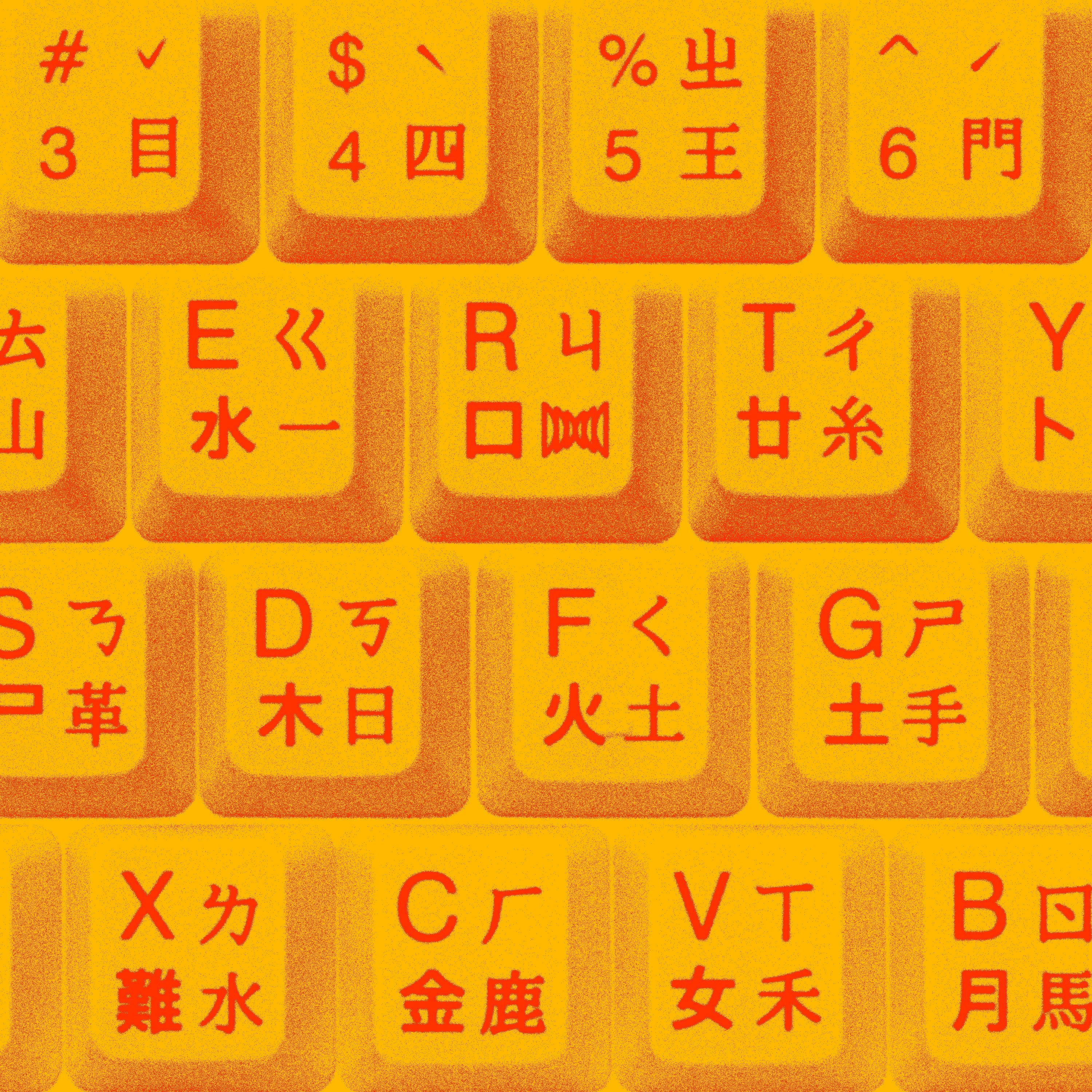
Speaker 9 Professor Wong placed five or so of these components on each key of the QWERTY keyboard so that by typing in the component pieces of a character,
Speaker 9 the computer would sum them up for you and generate it on the screen.
Speaker 48 He named his creation
Speaker 48 the Wubi method
Speaker 24 and described Wubi as
Speaker 24 a sacred invention.
Speaker 46 All he had to do now was convince the rest of the world.
Speaker 11 He got that opportunity in 1984.
Speaker 57 Mr. Secretary General, thank you for granting me the honor of speaking on this first day of the 38th session of the General Assembly.
Speaker 24 He was invited to the United Nations
Speaker 24 to present his invention.
Speaker 20 When he arrived, he sat down, set up his computer, you know, to demo it, and with a bunch of people watching him, he took a deep breath and started typing.
Speaker 24 And immediately, the deputy secretary,
Speaker 24 who was standing over his shoulder watching, was astonished
Speaker 24 to see Chinese characters rapidly appearing on the screen.
Speaker 20 In fact, she was incredulous.
Speaker 24 You know, they thought one had played a trick on them.
Speaker 20 They asked them to stand up and step away from the computer.
Speaker 24 And they flipped the keyboard.
Speaker 20 Looking for some hidden piece of hardware.
Speaker 24 And at that time, one replied,
Speaker 42 you know, what?
Speaker 24 It's just your keyboard. It's the same keyboard.
Speaker 7 And after this,
Speaker 24 he and Wubi went viral.
Speaker 24 He became one of the top 10 biggest names in China.
Speaker 28 He and Wubi were on the front page of newspapers.
Speaker 39 He was licensing Wubi all over the world.
Speaker 38 This sound is actually from an infomercial for Wubi,
Speaker 20 filled with flying photos of Professor Wong sitting next to important people.
Speaker 9 I mean, for China's version of July 4th.
Speaker 24 China's National Day.
Speaker 24 He was chosen as the head of ceremonies of Hunan province.
Speaker 20 I'm imagining him as like the leader of the parade with his baton in hand marching down the street.
Speaker 6 Totally.
Speaker 12 Totally. Yeah.
Speaker 30 And then that same year,
Speaker 34 his crowning achievement.
Speaker 52 Dramatic political and economic changes are taking place in the world's most populous country.
Speaker 24 On April the 4th, 1984, a new leader, Hu Yaobang,
Speaker 24 Hu Yaobang, the head of the Communist Party, came to visit Professor Wan
Speaker 20 and sitting down with him, the most powerful man in China at the time.
Speaker 24 After Wang explained his invention, Hu Yaobang stood up
Speaker 42 and asked,
Speaker 24 Comrade Yongming, do we still need to forsake Chinese characters? And Wan replied,
Speaker 24
No, no. Chinese characters don't need to be replaced.
They can be efficiently input, just like English.
Speaker 24 Hu Yaobang went back to Beijing, and according to Professor Wang, not long after, the State Commission for Language Reform, that government body looking into how to do away with the Chinese character, was closed, shut down, in no small part.
Speaker 24 Because of Wang's invention.
Speaker 24
Companies were using Ubi. Students were taught to use Ubi.
Learning Ubi became synonymous with learning how to use the computer.
Speaker 20 He had saved thousands of years of the Chinese language.
Speaker 9 and given it a place in the modern world.
Speaker 10 And as far as Professor Wang was concerned, to be this person was to be placed alongside, I don't know,
Speaker 23 Ford, Thomas Edison, Steve Jobs, perhaps?
Speaker 10 Steve Jobs, yeah, this sort of singular genius inventor.
Speaker 31 So he sort of at this point has slayed the dragon.
Speaker 29 He is the victor.
Speaker 24 He was, or he thought he was.
Speaker 24 The battle hasn't finished.
Speaker 9 In fact, it was only beginning.
Speaker 8 When we come back from break, Chinese typing gets predictive and the keyboards start directing us.
Speaker 1
Radio Lab is supported by ATT. Few things feel better than knowing someone's in your corner.
Whether you're celebrating a win or trying to work through a loss, staying connected matters.
Speaker 1 Check-ins, no matter how casual or quick they may seem, are moments that matter. AT ⁇ T wants to ensure these moments are always in reach.
Speaker 1 With their guarantee that covers both wireless and fiber internet service, that is all about having your back. Staying connected matters.
Speaker 1 That's why in the rare event of a network outage, AT ⁇ T will proactively credit you for a full day of service. That's the AT ⁇ T guarantee.
Speaker 1 That's a wrap for now, but if you're thinking of reaching out to someone who has been on your mind, go for it.
Speaker 1 Credit for fiber downtime lasting 20 minutes or more or for wireless downtime lasting 60 minutes or more caused by a single incident impacting 10 or more towers.
Speaker 1
Must be connected to impacted tower at onset of outage. Restrictions and exclusions apply.
See ATT.com/slash guarantee for full details. AT ⁇ T, connecting changes everything.
Speaker 5
RadioLab is supported by Ripling. Finance teams often spend weeks chasing receipts, reconciling spreadsheets, and fixing errors across disconnected spend tools.
This can be frustrating.
Speaker 5 And that's not software as a service. That's sad.
Speaker 5 Software as a disservice. If you've been thinking about replacing stitched together tech stacks with one platform for all departments, Rippling can help.
Speaker 5 Rippling is a unified platform for global HR, payroll, IT, and finance, helping people replace their mess of cobbled-together tools with one system designed to help give leaders clarity, speed, and control.
Speaker 5 By uniting employees, teams, and departments in one system, Rippling works to remove the bottlenecks, busy work, and silos in business software.
Speaker 5 With Rippling, you can choose to run HR, IT, and finance operations as one, or pick and choose the products that best fill the gaps.
Speaker 5
Right now, you can get six months free when you go to Rippling.com/slash Radiolab. Learn more at R-I-P-P-L-I-N-G.com slash Radiolab.
Terms and conditions apply.
Speaker 5 Radiolab is supported by Planet Visionaries, the podcast created in partnership with the Rolex Perpetual Planet Initiative.
Speaker 5 The show is hosted by Alex Honult, who you may recognize from Free Solo where he climbed El Capitan without ropes.
Speaker 5
Now he's turning his focus to the biggest challenge of all, protecting the only planet we've got. Every episode brings you stories that prove climate optimism isn't naive.
It's a strategy.
Speaker 5 The episodes span the globe from Arctic scientists and Amazon forest guardians to entrepreneurs reimagining fashion and food systems.
Speaker 5 You'll hear from explorers, scientists, activists, and storytellers who are working to reshape the future in practical human ways.
Speaker 5 In one episode, Alex sits down with wildlife photographer Birdie Gregory to discuss how animals can teach humans resiliency, empathy, and hope.
Speaker 5 In partnership with the Rolex Perpetual Planet Initiative, check out Planet Visionaries. Listen or watch on Apple, Spotify, YouTube, or wherever you get your podcasts.
Speaker 5 Radiolab is supported by the National Forest Foundation, a nonprofit transforming America's love of nature into action for our forests.
Speaker 5 Did you know that national forests provide clean drinking water to one in three Americans?
Speaker 5 And that national forests and grasslands cover nearly 10% of the U.S., hosting 150,000 miles of trails and providing habitat. for over 3,000 species of plants and animals.
Speaker 5 The National Forest Foundation supports the places where we come come alive, keeping the trails, rivers, and forests we love healthy.
Speaker 5 Last year, they planted 5.3 million trees and advanced over 300 projects to protect nature and communities nationwide.
Speaker 5 Their work creates lasting impact by restoring forests and watersheds, strengthening wildfire resilience, and expanding recreation access for generations to come. And when forests struggle, so do we.
Speaker 5 the water in our taps, the air we breathe, and the trails that connect us all. Learn how you can help at nationalforests.org.
Speaker 5 Radiolab is supported by the National Forest Foundation, a nonprofit transforming America's love of nature into action for our forests.
Speaker 5 Did you know that national forests provide clean drinking water to one in three Americans? And when forests struggle, so do we.
Speaker 5 The National Forest Foundation creates lasting impact by restoring forests and watersheds, strengthening wildfire resilience, and expanding recreation access for all.
Speaker 5 Last year, they planted 5.3 million trees and led over 300 projects to protect nature and communities nationwide. Learn more at nationalforests.org slash radiolab.
Speaker 8 Jad Radiolab, back to producer Simon Adler.
Speaker 9 So before the break, Professor Wong had seemingly solved this massive technological linguistic challenge and saved the Chinese character.
Speaker 9 He'd found a way to type Chinese with a plain old QWERTY keyboard.
Speaker 8 But thinking back to the beginning, when you took me to that cafe, Simon,
Speaker 8 and we heard about all the different ways people were using the keyboard in that Hong Kong Starbucks, how did we get from Wong doing
Speaker 8 making his method to suddenly like infinite ways of typing?
Speaker 22 So first of all,
Speaker 9 while Professor Wang really cracked this thing open, he wasn't alone. I mean, there were others who had been hammering and chipping away at this problem as well.
Speaker 40 So from the beginning, you had a few variations, a few different ways to type.
Speaker 34 However, after Wubi, things do really explode.
Speaker 23 Because underlying Wubi was this subtle but spectacular departure.
Speaker 10 The keyboard changed from something where what you typed was what you got to a system where you were telling the machine certain features or characteristics of the Chinese character that you wanted on the page or I guess on the screen.
Speaker 20 Again, historian Tom Mulaney.
Speaker 10 It seems like a minor distinction when you say it, but once you do that,
Speaker 10 once you have entered into a reality in which A is not equal to A,
Speaker 10 I push the button that has the little symbol A on it, and I no longer expect that symbol to appear on the paper or the screen.
Speaker 10 Effectively, I can set the letter A equal to any property of the Chinese character that I want.
Speaker 12 A could equal that water component or that work component or something far more abstract.
Speaker 10 Anything goes. And so in the early 1980s, different ideas about how to do this started to flood in.
Speaker 8 Oh, you mean beyond Wubi?
Speaker 59 Oh, yes.
Speaker 60 At that time, many people and companies developed their own IME.
Speaker 9 This is Joe Ming.
Speaker 60 Zhou Ming, computer scientist in Microsoft Research Asia.
Speaker 20 And he was really on the front line of this development.
Speaker 60 Immediately, there are over 1,000 methods developed and put into use.
Speaker 27 So, just a couple of quick examples here.
Speaker 33 Some of these broke the characters into components that looked like English letters.
Speaker 8 Does that mean look at the characters and be like, I think there's a D in that picture?
Speaker 32 Exactly.
Speaker 9 And then place those components on their English lookalike key.
Speaker 23 So A represented a sort of mountain peak looking component.
Speaker 44 Wow.
Speaker 31 Others looked to English spelling.
Speaker 11 So the component for tree was represented by the letter T.
Speaker 31 Others had you input just what was present in like the four corners of the character.
Speaker 35 And then going even further afield.
Speaker 10 Some of these don't even use letters at all. They just use the numeral bank of the keyboard.
Speaker 9 You know that square number pad on the right side of most keyboards?
Speaker 9 In essence, every character was given its own numeric code that you would tap in there.
Speaker 37 4303, dog, 9080, fire, 400.
Speaker 9 Almost like a clerk ringing up vegetables at a grocery store checkout.
Speaker 51 And we're just scratching the surface here.
Speaker 8 I was starting to dawn on me what you mean when you say if we go to that
Speaker 8 Starbucks,
Speaker 8 everybody would have their own preferred way of going from those 26 Roman letters to the thousands of different Chinese characters.
Speaker 13 Right.
Speaker 20 And I'll say that the competition between these methods got heated.
Speaker 60 Yeah, people are actually fighting each hazard.
Speaker 7 Oh, really?
Speaker 47 Really?
Speaker 9 For example, Ming says at one conference he attended, someone actually had to be thrown out
Speaker 59 because of a fight. This kind of thing happens.
Speaker 23 And what they were fighting and arguing over was just like with the typewriter way back when speed.
Speaker 10 Every single new input system, the inventor claimed we haven't achieved maximum speed yet, and that my system, it's easier to use and faster.
Speaker 23 And one way they went about this, pushing the limits of the speed, was by trying to predict what it was the typist was trying to say.
Speaker 10 Both predictive text and auto-completion were anticipated in Chinese information technology decades before they were in English language computing and new media.
Speaker 10 To get to the character you want faster and faster.
Speaker 20 So the way this began was you'd be typing in the components of the character, but before you'd finish typing them all in, it would guess what it thought you were going for and offer you a couple of options.
Speaker 10 And it would give you those options ranked by the probability that this is the one you want.
Speaker 9 But then even that wasn't fast enough.
Speaker 10 Almost immediately, people started to think about next character suggestions.
Speaker 28 So predicting and suggesting not just the character you were trying to type, but also the next character, the next word you were going to type.
Speaker 10 And so if someone types in the character Bei, meaning north, it is a very high likelihood that the very next character is going to be zing for Beijing, or maybe Bei Fang for Northern.
Speaker 10 So I'll give you that as a suggestion.
Speaker 9 And keep in mind, this is the 1980s, a full decade before we had anything comparable here in the United States. Anyhow, right as all these technological changes were taking place,
Speaker 21 the Chinese language itself changed.
Speaker 61 Tomorrow, ABC News will begin conforming to the Chinese standardization of its language's spelling and pronunciation. Pinyin, it's called.
Speaker 9 China went all in on pinyin.
Speaker 8 Pinyin.
Speaker 33 Pinyin.
Speaker 10 Pinyin is a way of using the Latin alphabet to spell out the sounds or the pronunciation of Chinese characters and words. Interesting.
Speaker 12 So it's an oral,
Speaker 12 oral, oral. Yes.
Speaker 5 A-U.
Speaker 13 A-U.
Speaker 8 It's an oral translation.
Speaker 19 Correct.
Speaker 61 The big advantage of pinyin is that it more accurately reflects the actual Chinese pronunciation of a name or place.
Speaker 48 So, for example, Beijing, B-E-I-J-I-N-G, is pinyin for the two characters Bei and Jing.
Speaker 9 Now, pinyin had been around for a while, but in the 1980s, right around the time Professor Wang saved the Chinese character from the threat of computers, the Chinese government started to prioritize pinyin in the classroom.
Speaker 10 So that when a Chinese kindergartener begins developing literacy in reading and writing, they learn pinyin at the same time or even earlier than they start to learn Chinese Chinese characters.
Speaker 12 Really?
Speaker 33 Yeah.
Speaker 10 And so these computer scientists who had spent years trying to figure out how to visually relate Chinese characters to the letters on a keyboard, they think to themselves, basically we have the Chinese educational system teaching a way of relating the Latin alphabet to Chinese characters.
Speaker 10 Right. So it would be kind of foolish not to exploit that.
Speaker 20 Like we should start in putting characters by typing their sounds in pinyin.
Speaker 9 And now, of course, Professor Wong
Speaker 9 was staunchly opposed to this.
Speaker 24 When we use pinyin to type,
Speaker 24 we lose sight of the Chinese character's form, and the form is the soul of a character.
Speaker 24 It's like you're grabbing hold of a person's and doing away with their flesh.
Speaker 24 And you can't express the meaning of a Chinese character by its sound.
Speaker 24 And the more people use pinyin, the more good Chinese characters are.
Speaker 10 Nonetheless, beginning in the early 1990s, Chinese input moved to phonetic pinyin input, replacing character shape systems like Professor Wong's.
Speaker 24 Actually, at the moment, I don't know if you can hear me clearly.
Speaker 25 I mean, to the point that,
Speaker 9 as Yang Yang told me, if you go into a Starbucks in China today, yes, people will be typing using different methods, but...
Speaker 24 Most chances are they are typing with pinyin.
Speaker 32 Some sort of pinyin editor. Yeah.
Speaker 24 And I mean,
Speaker 24 that's one of the things that actually saddens me after this interview.
Speaker 24 And because by all means, Professor Wan, he is right about it, that you do forget how to write Chinese if you are so used to typing in pinyin.
Speaker 24 And that happens to me.
Speaker 24 You know, it's through throughout our interviews, you know, that lasted so long, I didn't have the heart to tell him that I couldn't type in Ubi, which
Speaker 24 just to confirm that young generation has no hope in preserving the Chinese culture anyhow.
Speaker 9 But even as young Chinese people, I don't know, as they sit down at their computers or stare down at their phones, are being drawn away from this long, rich history of Chinese characters and towards this pinioned phonetic future.
Speaker 34 The allure of speed and the search for the fastest way to type continues.
Speaker 10 Absolutely. The question still remains, what is the best, fastest way to do this?
Speaker 21 And so, what you have today in China
Speaker 9 are these typing competitions.
Speaker 10 Yeah, there are typing competitions in Chinese.
Speaker 9 Where these different methods and different typists face off.
Speaker 51 And these things are sort of a big deal.
Speaker 10 They take place at the local level, at the national level.
Speaker 20 They're sometimes even televised.
Speaker 10 In a certain sense, it's like America's Got Talent for Input.
Speaker 9 This audio is from the finals of a competition back in 2016.
Speaker 17 took place at China's eSports Hall in Beijing.
Speaker 9 And the broadcast opens with the audience looking down towards a young lady MC
Speaker 48 who's standing in front of 10 or so desks, each with a computer on them.
Speaker 9 And before the race can begin,
Speaker 9 she invites the contestants out to stand with her on the front of the stage.
Speaker 30 This crew of lanky glasses and t-shirt wearing Han Chinese folks.
Speaker 9 They introduce themselves one by one.
Speaker 47 And then also,
Speaker 10 this is a little bit like sponsoring race car drivers for your, you know, for your brand.
Speaker 9 They declare which input method they'll be using.
Speaker 30 Because oft times the folks who designed the input methods have actually hired and trained these super speedy typists to use their input method.
Speaker 9 With the introductions done, the MC sends the typists back to their keyboards, some of which are interestingly blank, like they have no script on them at all.
Speaker 10 And in essence, what happens is a text appears on the screen that no one in the competition has seen, the same text for everyone in the competition.
Speaker 58 And then,
Speaker 10 you know, the stopwatch starts
Speaker 27 and the race is on. Just like...
Speaker 10 I mean, they're just like, it's like unbelievable the speed at which they're going.
Speaker 20 the room is totally silent other than the clacking of keys
Speaker 9 the cameras cutting between contestants capturing these over-the-shoulder shots of their screens just filling with text and when they do linger on one typist's screen long enough
Speaker 17 and really you'd need to almost go frame by frame to catch this uh
Speaker 2 But what you see is a typist inputting a string of sort of nonsense letters,
Speaker 25 which prompts a little tiny box to pop up with five or so options,
Speaker 9 which they then select from with one final keystroke.
Speaker 36 How many like
Speaker 8 words, characters per minute, can they type?
Speaker 13 244.
Speaker 12 What?
Speaker 9 That was the winning. Yeah.
Speaker 12
That's insane. That's insane.
Yeah.
Speaker 12 I didn't understand.
Speaker 8 I did not understand, Simon.
Speaker 12 That's so fast.
Speaker 13 Oh my god. Yeah.
Speaker 8 My dad, who's the fastest typist I know,
Speaker 13 he can only do like 80.
Speaker 8 That's that's a that is
Speaker 8 that's kind of wild.
Speaker 20 Well, and wilder still,
Speaker 20 in this competition, the winning typist was using
Speaker 12 Wooby.
Speaker 7 Really?
Speaker 23 Yes, the guy who typed 244 characters a minute was using Professor Wong's Wuby.
Speaker 12 Wow.
Speaker 12
Whoa. Yeah.
That's...
Speaker 8 So
Speaker 8 they're collaborating us for speed, but also able to do that in a way that preserves character writing.
Speaker 26 And this is not uncommon.
Speaker 12 Like,
Speaker 9 oftentimes in these competitions, it's these older Woobi-like input methods that win.
Speaker 10 Ironically, by all accounts, their top speeds are faster than the top possible speeds of phonetic input.
Speaker 20 Wow.
Speaker 8 So wait, but then if he's made this thing that is like so blazingly fast and also is able to sort of preserve Chinese way of writing, goes back thousands of years.
Speaker 8 Why is it that these other input methods, these phonetic-based methods, are winning in terms of usage?
Speaker 9 Right.
Speaker 20 Well, the reason there is pretty much the Chinese government.
Speaker 10 The Chinese state promote the idea of phonetic-based input systems really for one major reason.
Speaker 9 One of the same reasons they prioritize teaching pinyin in school, the unification of the Chinese language.
Speaker 20 Because although when we think of the Chinese language, we think, oh, there's Mandarin and Cantonese, in reality, when it comes to speaking, there are dozens of different Chinese languages.
Speaker 28 Cantonese, Shanghainese, Fujianese.
Speaker 9 Languages that sound totally different, but on the page look the exact same because they're all using the same characters.
Speaker 33 Now, with a structure-shape-based input like Wubi,
Speaker 9 where you're describing what the character looks like, you can type and still maintain your spoken language.
Speaker 10 It doesn't care if you speak Cantonese or Fujianese or something, or so forth, because you're typing it based on what the character looks like, not how you pronounce it.
Speaker 10 But if you get people having to learn phonetic-based input input systems, they have no choice really but to learn to type and speak the standard pronunciation of every character.
Speaker 44 And so now,
Speaker 23 in a sense, the ubiquity of the quirty keyboard is being deployed to erase difference and quiet dissent.
Speaker 7 Look no further than Ubi.
Speaker 24 The very commission that was closed down by UBI, the Commission on Language Reform,
Speaker 24 they came back to life
Speaker 24 and kicked the UBI method out of schools.
Speaker 23 And you can argue that which typing method you use, how you type, has a real impact that goes beyond the death of the Chinese character, or beyond the government's desire for unification of the language, beyond China itself.
Speaker 34 And so let me give you an admittedly small example of this.
Speaker 9 There's this aptly named thing called the QWERTY effect.
Speaker 36 Have you heard of the QWERTY effect?
Speaker 12 Go for it.
Speaker 9 So this is an English study. It was initially done here in the States in the early 2000s.
Speaker 17 They did a bunch of tests on people trying to find what feelings they associated with words.
Speaker 9 And what they found was that people like words that have more letters in them typed from the right hand of a QWERTY keyboard than not.
Speaker 19 No way.
Speaker 13 Yeah.
Speaker 8 So the U's and the L's and the P's and the K's and the M's and the J's, those are having more positive associations than the Q, W's, X's, Z's, Rs.
Speaker 27 Yeah.
Speaker 9 People like O more than they like E. This has been found in English, in Spanish, in German, and in Dutch, both for right-handed people and left-handed people.
Speaker 8 But couldn't that just be that the keyboard was designed so that the letters that we like happen to just be on the right side? Do you know what I mean?
Speaker 8 Like, is it a chicken or the egg type of situation?
Speaker 30 It likely
Speaker 9 is not that. It's likely not that those letters were intentionally placed there.
Speaker 31 And there are a variety of stories about how the layout of the QWERTY keyboard happened.
Speaker 9 But sort of one of the indisputed facts is
Speaker 13 if you look at the top row of your keyboard, QWERTY row,
Speaker 37 it has all of the letters of the word typewriter in it.
Speaker 12 T-Y-P-E-R-I-T. Yeah.
Speaker 35 They're all there.
Speaker 9 The story goes that the reason it was laid out this way is because you had these salesmen who would show up and want to demo the product, demo this typewriter, but these guys didn't know how to type.
Speaker 9 So they put all the letters for typewriter on the top row so they could very quickly punch out the word typewriter in their demo.
Speaker 37 Oh, wow.
Speaker 8 So it's totally arbitrary. Like they didn't, it was put in the order it was put for reasons that have nothing to do with anything we're talking about.
Speaker 12 Yes, correct.
Speaker 23 And there is some evidence that the layout of the keyboard created those left-right preferences rather than the other way around.
Speaker 30 So just a couple of years ago, researchers asked, okay, has our feeling towards letters changed over time?
Speaker 9 And so what they did was they got social security records from the 1960s through 2012, and they looked at
Speaker 9 names of babies being born.
Speaker 29 And they decided we're going to pick 1990 as our year that the QWERTY keyboard became ubiquitous.
Speaker 9 And let's look at the prevalence of names with more right-handed letters than left before 1990 and after.
Speaker 9 And it spikes after 1990.
Speaker 29 That is crazy.
Speaker 8 So suddenly a lot of Paul's and a lot of like
Speaker 8 Leah's start to appear. Yep.
Speaker 15 That is bizarre.
Speaker 9
So like Simon is four right hand, one left hand. Jad is one right hand, two left hand.
So you and I bear out the idea.
Speaker 8 Yeah, you know, it's funny. It's like there's, who is it? Was it Wittgenstein? I don't think it was Wittgenstein.
Speaker 18 Heidegger? Was it a Heidegger thing?
Speaker 8
Somebody, one of those, like, those nihilistic German philosophers had this idea that the hammer isn't just a tool. The hammer actually feeds back.
The hammer changes the hand. Right.
Speaker 8 And it's interesting to me that this arbitrary,
Speaker 15 leftover,
Speaker 8 arguably outdated QWERTY keyboard that we're all stuck with is actually influencing our preferences when it comes to naming our offspring. I mean, who knows what else it's doing?
Speaker 15 It's probably doing all kinds of weird things to us.
Speaker 8 Wait, so do we know, sorry, just to get back on track, do we know
Speaker 8 if this QWERTY naming thing is influencing the way Chinese people name their kids?
Speaker 37 Right.
Speaker 31 Well, so with the QWERTY effect in general, the lab that I spoke to looked into studying it in China.
Speaker 9 They had some Chinese grad students, actually, who wanted to see if it applied back in China.
Speaker 14 But in part, I think because there are so many different ways to type, they weren't methodologically able to figure out how to do it.
Speaker 35 But I will say
Speaker 9 the idea you bring out of, or you bring up of the hammer changing the hand, like where Chinese typing is going, I think is sort of the hammer changing the hand on steroids.
Speaker 5 What do you mean?
Speaker 10 Now we've got this new phase of this era of input, which is cloud input.
Speaker 40 Typing that uses artificial intelligence.
Speaker 10 In the United States, I would say the way that people are most familiar with this is the Google search bar.
Speaker 10 That when you start to type, it will give you suggestions, not based on the absolute mathematical probability of the frequency of a word that you might be doing, but really what's hot in the news and what other people are searching for.
Speaker 9 However, in China, this goes way beyond search engine suggestions.
Speaker 10
In Microsoft Word, this is not a search field. This is like Microsoft Word.
And you say, okay, in the news today, some star has done something terrible and fallen from grace.
Speaker 10 And so some input user is starting to enter the name of this befallen pop star. The system is smart enough to say, okay,
Speaker 10 this user has never entered this person's name before, but up in the cloud, millions of people are entering this particular person's name.
Speaker 10 Let's give this local user that suggestion based upon what users elsewhere in the cloud are doing.
Speaker 23 And so, with this cloud-based input, like
Speaker 33 everything you write,
Speaker 9 every keystroke, every word is being in some way influenced by what everyone else is typing.
Speaker 10 It is totally unparalleled in the Western world. There is nothing even close to this.
Speaker 10 And in fact, now, arguably over the last two decades, there has been an inversion in which Chinese in the computational world is arguably the fastest language in the realm of typing.
Speaker 34 And so we're the ones now looking east seeing these technologies and wondering, like, shit, how do we catch up?
Speaker 27 Like, in the course of 40 years, China,
Speaker 31 they've leapfrogged us.
Speaker 8 That's what it is. It feels like a crazy leapfrog.
Speaker 12 Yeah.
Speaker 9 But with this cloud input, there's also a question of, like, do we want to catch up to that?
Speaker 10 It's both invigorating exciting strange and also eerie and and and uh you know and and post-futuristic because right now it's guessing what the writer already wants to say
Speaker 10 but what happens when the speed of suggestion outstrips the speed of thought and the speed of intention and what it says is you know simon what if you did this and you say wow actually that's a really good suggestion thank you yes i will do that at At that point, we have co-writing.
Speaker 10 And once we move, once we move into the stage of further into the stage of suggested writing,
Speaker 10 then
Speaker 10 we're not,
Speaker 10 it's kind of like a writing partner that's giving you a good suggestion. But of course, it's a writing partner who's also the writing partner of thousands of other writers at that exact moment.
Speaker 10 And that is,
Speaker 10 from my standpoint, a pretty terrifying scenario.
Speaker 2 Well, right, because it's a writing partner with an agenda, potentially.
Speaker 10 It is a writing partner. I mean, and not perhaps.
Speaker 10 There is agenda, absolutely.
Speaker 20 I bet you will never type quite the same way again, Chad Abelrod.
Speaker 8 No, I definitely am looking at my QWERTY right now, and I'm very.
Speaker 8 I don't trust you.
Speaker 19 Got my eye on you, QWERTY.
Speaker 35 It's watching you too.
Speaker 12 Here's that. Apparently.
Speaker 8
Producer Simon Adler. The story was reported and produced by Simon with reporting assistance by Young Young.
Original music throughout the piece by Simon. Special thanks again to Young Young.
Speaker 8 Without her, the story would not have happened. Also to Tom Mulaney for his years of research on this topic and for sending us down this path to begin with.
Speaker 8
And to Daniel Casasanto for teaching us about the CORTY effect. Joshua Souter, Marion Renault, David Mosier, Chen Gao, Riancle Chang, Martian Wickery, and Ying Ying Liu.
I'm Jad Abumraad.
Speaker 8 Thanks for listening.
Speaker 63
Hi, I'm Hafiz, and I'm from Toronto. Here are the staff credits.
Radio Lab is hosted by Lulu Miller and Lettha Finasser. Soren Wheeler is our executive editor.
Speaker 63
Sarah Sandbach is our executive director. Our managing editor is Pat Walters.
Dylan Keefe is our director of sound design. Our staff includes Simon Adler, Jeremy Bloom, W.
Speaker 63 Harry Fartuna, David Gable, Maria Paz Gutierrez, Sinju Nanam Sambundam, Matt Kielty, Mona Mudvilkar, Annie McEwen, Alex Neeson, Sarah Kari, Anissa Vitza, Arianne Wack, Molly Webster, and Jessica Young, with help from Rebecca Rand.
Speaker 63 Our fact-checkers are Diane Kelly, Emily Krieger, Anna Pujol-Mazzini, and Natalie Middlesex.
Speaker 58 Hi, I'm Jerry, and I'm calling from Capsawar, Kenya. Leadership support for Radio Lab science programming is provided by the Simons Foundation and the John Templeton Foundation.
Speaker 58 Foundational support for Radio Lab was provided by the Alfred P. Sloan Foundation.
Speaker 5 Radiolab is supported by the National Forest Foundation, a nonprofit transforming America's love of nature into action for our forests.
Speaker 5 Did you know that national forests provide clean drinking water to one in three Americans? And when forests struggle, so do we.
Speaker 5 The National Forest Foundation creates lasting impact by restoring forests and watersheds, strengthening wildfire resilience, and expanding recreation access for all.
Speaker 5 Last year, they planted 5.3 million trees and and led over 300 projects to protect nature and communities nationwide. Learn more at nationalforests.org/slash/radiolive.
Speaker 54 The Who's Down and Who Newville were making their list, but some didn't know Walmart has the best brands for their gifts.
Speaker 52 What about toys? Do they have brands kids have been wanting all year?
Speaker 1 Yep, Barbie, Tony's, and Lego. Gifts that will make them all cheer.
Speaker 54 Do you mean they have all the brands I adore?
Speaker 1 They have Nintendo, Espresso, Apple, and more.
Speaker 54
What about bad... So the who answered questions from friends till they were blue.
Each one listened and shouted, from Walmart? Who knew?
Speaker 54 Shop kiss from top brands for everyone on your list in the Walmart app.