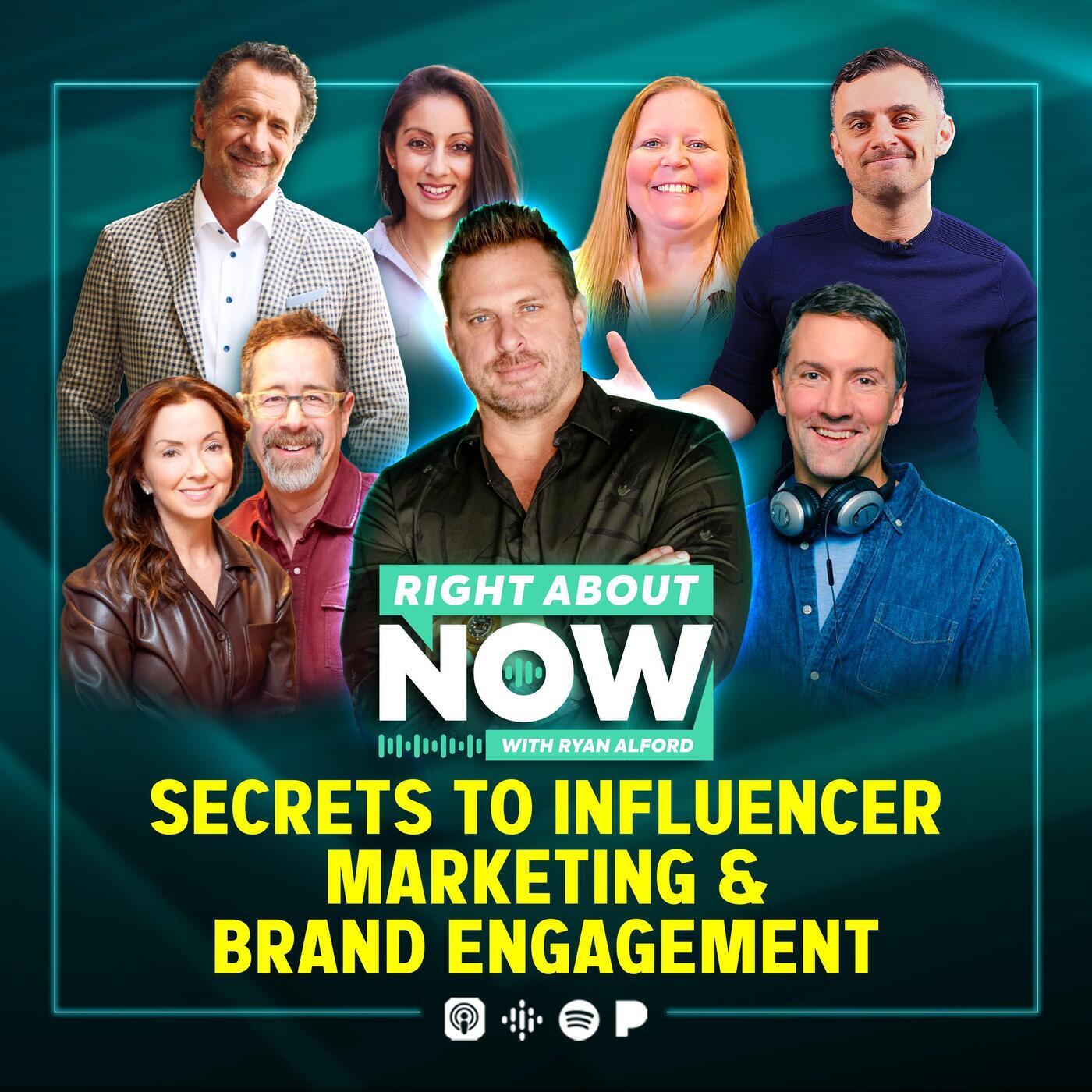
Secrets to Influencer Marketing & Brand Engagement
In this Right About Now compilation, host Ryan Alford is joined by top voices in marketing and entrepreneurship—Gary Vee, Mike and Kass, Mark Kohler, Steve Pratt, Dani Lynn Robinson, and Ishveen Jolly—to break down what it really takes to stand out in today’s crowded content landscape.
From the decline of traditional media to the rise of digital-first strategies, these experts share how to earn—not expect—attention through authentic content, clear goals, and smart influencer partnerships. Whether you're building a brand or scaling a business, this episode delivers real-world insights you can act on.
TAKEAWAYS
- Fundraising processes and the skills required for successful fundraising in entrepreneurship.
- The importance of focusing on customer revenue rather than relying solely on investor funding.
- Dynamics of co-founder relationships and the significance of complementary skills in partnerships.
- Innovations in the collectibles market, particularly the intersection of physical and digital products like trading cards and NFTs.
- Strategies for small business owners regarding tax planning and financial management.
- The role of mindset and consistency in overcoming entrepreneurial challenges and achieving success.
- The impact of content saturation on audience attention and the necessity of creating valuable content.
- The evolution of media consumption habits, particularly among younger audiences and the rise of podcasts.
- The importance of amplifying content across multiple platforms for maximum impact.
- The need for clarity in campaign objectives and flexibility in creative approaches to influencer marketing.
See Privacy Policy at https://art19.com/privacy and California Privacy Notice at https://art19.com/privacy#do-not-sell-my-info.
Press play and read along
Transcript
Speaker 1 Look, we get it. You can hardly go anywhere or do anything these days without hearing about AI this or AI that.
Speaker 1 And if you're like most people, when it comes to AI, you're impressed, but you have a few concerns. But what if AI was used not as a tool to replace people, but as a way to help understand people
Speaker 1 better?
Speaker 1 AI from SurveyMonkey is designed to do just that, from crafting the perfect survey, which is harder than you might think, to analysis that digs deep, finds patterns, and surfaces trends quickly.
Speaker 1 SurveyMonkey's powerful suite of AI capabilities make it faster and easier than ever before to get insights from real people, helping you make confident decisions for your business.
Speaker 1 Try it today at surveymonkey.com slash Ryan.
Speaker 1
What's up, guys? Welcome to Right About Now. We're always talking about how to make you get right in the moment.
We could talk about yesterday. We could talk about last week.
Speaker 1 We could talk about a month from now. We could talk about the future, but we're here to talk about now.
Speaker 2 This is right about now with Ryan Alford, a Radcast Network Production.
Speaker 2 We are the number one business show on the planet with over 1 million downloads a month.
Speaker 2 Taking the BS out of business for over six years in over 400 episodes. You ready to start snapping next and cashing checks? Well, it starts right about now.
Speaker 1
Right about now. Talk to me about the raising money thing.
You talk about it in the book, by the way, the handbook for an entrepreneur.
Speaker 3 It's, you know, it's a muscle that you have to develop and you get better at it the more you do it. So there's a lot of fear that you build up, right?
Speaker 3
Like, oh my God, I don't want to ask this person for money. Oh, my God.
At the end of the day, you know, it really is about your own fear because all they're going to say is yes or no, right?
Speaker 3 It's like they say no, just move on. And that's something I think for me, Mike's much better at it than I am.
Speaker 3 But for me, I think I just realized, oh, like the worst thing could happen is they just say no, right? That's it.
Speaker 4 So I think that what you've done, Ryan, what, like our friend who we're talking about, Gary Vee and others, that's raising money, right?
Speaker 4 You don't go to investors, you go to customers, you win the business, you generate the revenue to then generate the profits to plow back in the business. to grow.
Speaker 4 And so our heroes are the people not that have the safety of venture capital, right?
Speaker 4 But it is those entrepreneurs like a lot of your listeners who don't have the safety net, who are running restaurants, who are running service companies, who are running agencies.
Speaker 3 And they need the revenue to survive.
Speaker 4 And that's how you fundraise. And if you do a good enough job on the customer side, then maybe you have the ability to
Speaker 4 you know, raise money to do an acquisition or to take some money off the table or to do, to make some moves, right? Yep.
Speaker 4 We've always been in businesses up until now that requires building software and a lot of upfront costs.
Speaker 4 And frankly, it's just easier for us than I think what you and a lot of others have done, which is hard.
Speaker 1 I appreciate you saying that. It is hard.
Speaker 1 But at the same time, though, like there's brilliance in both sides, I think, you know, like depending on what works for you, like, cause I'm, I ask even for my own self, I mean, because I'm developing something now that's tech heavy and you know it's like and i've never had a partner and i'm like or i've never had a dollar from anyone i have no debt in the bank
Speaker 4 so protect that yeah and it's it's not easy and it's not poo-poo that like that's very rare and awesome investors are great some of our best friends but you're bringing a partner on board and so unless you're ready to communicate and report and listen,
Speaker 1 it's work.
Speaker 4 You know, it's work. It's a relationship.
Speaker 1 I do think it's fascinating for you guys, being a husband and wife, founders of companies and investors together.
Speaker 1 You talk about in the book, if you are going to have a partner and a founder, those skill sets that work well, like you fill a gap. Like, I have a certain number of skills.
Speaker 1
You need to work with another person or group that fills the holes you have. That's right.
And vice versa.
Speaker 1 And it sounds like that worked. Maybe that's why it has worked.
Speaker 1 I know it's been work, but for you two, because like you said, Mike, you know, you've got the operator and then the sales and marketing and, you know, maybe idea guide.
Speaker 1 I don't want to say you don't have ideas, Cass, but I'm just
Speaker 1 the split is totally there and you're dead.
Speaker 3 Yeah, you nailed it because that's exactly what you need. When you have co-founders, you really do need to figure out like how to balance out the skills.
Speaker 3 And if you overlap, there's going to be just absolute micromanagement and like paralysis of decisions.
Speaker 3 So the best thing you can do is have a co-founder or more than one co-founder that had different skills.
Speaker 3 And that's when things really gel and you build this like implicit trust and you can move very fast.
Speaker 1 I love how you've sort of embraced the, you know, part of me, I think some people might would ask, well, why Tops Chrome and why this and why the parallels and all that. Oh, I get it, man.
Speaker 1 I feel like you've created something uniquely original while tapping into sort of the hype and interest that already exists with some of these products. Talk a little bit about that.
Speaker 5 Yeah, I think to your point, obviously, you're a little bit deeper and you're knowledgeable.
Speaker 5 Like, there's a lot of inserts and structure to this checklist that honors the Chrome model, the, you know, the red refractors to five and 50
Speaker 5
gold and the superfractor one of one. And then there's uniquely new stuff.
We did something something really smart. Our main character, the very, very, very, very lucky black cat
Speaker 5 has yellow eyes, but we did an insert, a variant where you could get him with green eyes or blue eyes or white eyes or red eyes.
Speaker 5 And
Speaker 5 that's the little head nod to Pokemon's original set with the Pikachu. And so
Speaker 5 there's a lot of
Speaker 5 really clever things. There's a one in every nine cases insert called Erupt that I'm very fond of that is a hat tip to the kaboom
Speaker 5 inspired by that great insert.
Speaker 5 And we found the original artist of that kaboom set
Speaker 5 and he designed the characters. So it's,
Speaker 5 you know, I think it's been fun because even people that let's say are cynical to this project or even me in the hobby of trading cards because it's a very insular kind of protective community which i respect and love um
Speaker 5 have been giving flowers to how thoughtful the checklist is. And that has been rewarding.
Speaker 1 Yeah, man. Smart is what I'd call it.
Speaker 1 Where does
Speaker 1 what gets me, you know, you brought up the NFT thing, but we live in a digital world and you're an attention arbitrage guy.
Speaker 5 Yep.
Speaker 1 Where does V-Friends fit? And, you know, two parts for you in attention arbitrage and building your long-term, you know, legacy.
Speaker 1 Where do you see V-Friends in that? And then part two of that,
Speaker 1 you've got to. We live in this digital world, but physical cards are still booming.
Speaker 5
Yeah, I mean, it's, I'll do the second part because it's so easy. Six, seven years ago, eight years ago, people were like, Gary, why do you still write books? You're so Mr.
Digital.
Speaker 5 And my answer always was, because people read them.
Speaker 5 Like, I don't know why the world is obsessed with or.
Speaker 1 Yeah.
Speaker 5 Right? People love or. People are like, even in politics, blue or red, right?
Speaker 5 Like, you know, digital or physical, you know, like the life is gray.
Speaker 5 Everything is the middle.
Speaker 1 So I,
Speaker 5 of course, physical cards and comic books and
Speaker 5 I'll do toys, like, because the world is physical, but the world is also digital. And the world continues to become more digital, not less digital, right?
Speaker 5 So, you know, all those hours today that are being played on Roblox 40 years ago were kids that were outside playing physically. So, you know, things are changing, but not to zero.
Speaker 5 We're not in ready player one full-time yet.
Speaker 1 So
Speaker 1 true, thankfully.
Speaker 5
That's why I keep doing those things. Where do I see VeeFriends sitting? Really at the center.
You know, I think VeeFriends is probably going to end up being the biggest business I ever built.
Speaker 5 You know, I feel like it's a very substantial intellectual property collectible business. I think the characters represent the things I most care about in the world.
Speaker 5 So I think these 250 characters are going to to allow me to extend all these things I want the world to know about.
Speaker 5 And so Patient Panda will take the baton in helping people learn that patience matters, not just Gary Vee's content, the one that you've been consuming for 20 years.
Speaker 5 I've done a lot as a human and put myself on the map, but I'm not going to reach all 8 billion people.
Speaker 5 Meanwhile, a V Friends cartoon that talks about tenacity and hustle and kindness can be dubbed in Italian and be running on Netflix Italy in five years.
Speaker 5 And I'll be accomplishing the same ambition, which is my whole life has been about really a framework of selfish and selfless behavior, right?
Speaker 5
Selfishly, I'm an entrepreneur. I want to build things for me and my family.
I think I'm allowed. I think you're allowed.
I think everyone's allowed. However, I do like leaving a positive impact.
Speaker 5
I want other entrepreneurs. I get pumped when entrepreneurs come up to me that basically make more money than me, taking my learnings and applying them.
I'm like, good for you. That makes me happy.
Speaker 5 That doesn't make me unhappy. So, I think that's kind of the goal with the framework here.
Speaker 1 I always think there's knowledge in trends and numbers.
Speaker 1 And so, when you get asked a lot of the same questions, when you deal with a lot of the same challenges, I tend to think that brings knowledge to our listeners.
Speaker 1 What are some of those key things that you're always sort of tackling or working with clients on? Great question. And what's interesting is since COVID, we've had the great formation.
Speaker 1
We now have almost, we're pushing up to almost 45% of working Americans have a side hustle. And people, that's a small business.
That's a gateway drug. It's not a burden.
Speaker 1 We should look at it as an opportunity to use those funds to get out of debt, build wealth, create assets. And one in five Americans own a rental property in some form or fashion.
Speaker 1 So if I've got a rental property and a little small business, people, you're not quitting your day job. Let's just tap into that.
Speaker 1 And so a common, common theme and what we do every day is meet with that community, those people that are the backbone of this country that are starving for simple answers to get their kids on payroll, save some taxes, right off their auto, you know, whatever it is.
Speaker 1
And I love that bread and butter stuff. And so it's just, there's no mystery.
It's not like there's this secret thing like, Mark, how do I save tax?
Speaker 1 It's just, it's just doing the basics and knowing it, understanding it, owning it. And that's, so there's no sexy secret there except that you
Speaker 1
really can build a wealth that you maybe maybe never imagined with just those simple base hits. It's not about getting rich quick.
It's not getting rich slow. I want to get rich slow.
Speaker 1 Yeah, adding them on and saving the most with
Speaker 1 that extra time, right? If you're going to moonlight over and above the day, the daytime job, it's keeping as much of that as possible, correct? Oh, yeah. See,
Speaker 1
you give me a day, you know, and there's nothing wrong with that. W-2 day job, work corporate America.
That's cool. It's great.
Let's go do your taxes. Bend over.
Speaker 1
I can't do anything. I mean, you're screwed.
But if you've got that small business, oh,
Speaker 1 now that little 1099 some of you were getting, that's like, that's a golden ticket. Now I'm writing off home office, auto, dining, computers, electronics, your cell phone, family members.
Speaker 1
I'm funding a Roth IRA. You can set up your own damn 401k.
Now we're going to take all that money and start deploying it. And we're going to be efficient.
Speaker 1 We're going to be lean and mean and that i can you can pay 30 less in taxes on that money than your day job your day job you're screwed let's go get this other money that's a lot cheaper to get everybody wants to talk about making money why don't we talk about saving money it's easier to save money than make money
Speaker 1
yeah it is that's true I mean it's a very simple statement, but it's very true. I'm sitting here going, yeah, it's true.
It's because it's not always easy to make it.
Speaker 1 Let me talk to you about this, Mark. You know, they talk about tax brackets, right?
Speaker 1 And I think some of this terminology, you know, W-2s and X bracket, if you're self-employed and small business owner, like, what's the least?
Speaker 1 And there's always the talk, you know, like, especially like three or four years ago, like Trump pays like an effective 8% tax rate or whatever it was, you know?
Speaker 1 But for the average small business guy, And even the W-2, because we have people that are both that are listening to our show, that are small business owners, and that maybe are W-T thinking going small business.
Speaker 1 What's the least you could truly get away with, like legally, you know, doing it the right way? But like, what kind of tax brackets should the average small business guy be in?
Speaker 1 Well, very,
Speaker 1 very perceptive question. And I'm going to try to answer this simply.
Speaker 1 So, everybody, there's seven tax brackets out there,
Speaker 1 and the highest being 37.5%.
Speaker 1 Okay, cool.
Speaker 1 No one pays in total 37.5% in federal taxes because it's graduated. So when we have brackets, that's our bracket on the next dollar after a certain limit.
Speaker 1
So once everybody kind of gets that, that just is a graduated bracket. That's point number one.
So then what we want to look at is what is your effective tax rate?
Speaker 1 So like after we take all the killer write-offs we can think of,
Speaker 1
lots of options. What's that effective rate? And for some people, it could be zero.
For others, it could be 35%.
Speaker 1 Now, it is generally true, the more money you make, the more tax rate you're going to pay,
Speaker 1 a larger percentage of your income and taxes. But then we've got strategies and tools.
Speaker 1 For example, why Trump was such an anomaly, and he really wasn't, it's just the Wall Street Journal wanted to point this out, is that he is a real estate professional.
Speaker 1
I've got his tax return here on my laptop. I got Joe Biden's and his from 2016.
He was a real estate professional. Now, you talk about here on your show all the time.
Speaker 1 If you want to invest in short-term rentals, long-term rentals, do real estate and deploy money in real estate, it's not for everybody.
Speaker 6
I love giving gifts, but you know what? I don't love shopping. It seems impossible to find unique gifts these days.
I got four boys that seem to have it all, and a wife that I want to make happy.
Speaker 6
That's why I love uncommon goods. They have products that are unique from some small vendors, handmade, handcrafted, made in the USA.
I love these guys.
Speaker 6 Uncommon goods makes holiday shopping stress-free and joyful with thousands of one-of-a-kind gifts you can't find anywhere else. Trust me, I know, because I couldn't find anything.
Speaker 6 And Uncommon Goods comes to the rescue every time.
Speaker 6
Games, toys, clothes, one-of-a-kind, unique things that you can't find anywhere else. I love these guys.
Let me tell you, you want to go there.
Speaker 6 You want to shop USA-based and Uncommon Goods has me and you covered.
Speaker 6
So shop early, have fun, and cross some names off your list today. To get 15% off your next gift, go to uncommongoods.com slash Ryan.
That's uncommon goods.com/slash Ryan for 15% off.
Speaker 6 Don't miss out on this limited time offer uncommon goods raw out of the ordinary
Speaker 1 hey small business owners let's talk about how found can help you wrangle your finances once and for all when was the last time you felt like you had your business finances totally under control every expense categorized every receipt tracked every invoice sent oh and you were prepared for tax season if the answer is never, you're not alone.
Speaker 1 And that's what found is for. Found is reimagining what business banking should be by putting your bookkeeping, invoicing, and tax tools directly into your business checking account.
Speaker 1 They've automated things like expense tracking, finding write-offs, and budgeting for tax time. You can even send invoices for free and pay your contractors, everything all from one app.
Speaker 1 Look, I struggle with this myself. I pay contractors left and right,
Speaker 1
here, there, everywhere. Keeping up with all of it as a small business owner with multiple companies is next to impossible.
That's what I love found. They help me with this.
They'll help you.
Speaker 1
I basically replaced three apps with just found. And I don't miss the stress at all.
And neither will you. Take back control of your business today.
Open a found account for free at found.com.
Speaker 1
That's F-O-U-N-D.com. Found is a financial technology company, not a bank.
Banking services are provided by Lead Bank, member FDIC.
Speaker 7 Corporate megastores are spending millions lobbying DC politicians on one-sided policies that send small businesses tumbling.
Speaker 7 They want to enact harmful credit card mandates that take resources away from your local credit union and community bank, leaving Main Street businesses with less access to credit, making it harder for your family to pay for everyday goods like gas and groceries.
Speaker 7 Tell Congress to guard your card and oppose the Durbin-Marshall credit card mandates.
Speaker 9 Paid for by Electronic Payments Coalition.
Speaker 1 But we have depreciation strategies and investment strategies that can offset my income over here.
Speaker 1 Trump had so much in depreciation from his hotels and real estate investments, he was able to wipe out his income from the apprentice and his retail.
Speaker 1 So his effective rate at the end of the day was very low.
Speaker 1 Now, someone else that just works works a day job, has no write-offs, makes 500 grand a year at Verizon as a VP, okay, you're going to be paying 30% or more in an effective rate because you're not using the strategies in the best way.
Speaker 1 I do hear people all the time, because I'll tell people, because they'll ask, okay, well, how did you, you know, go to your podcast or how, you know, something that, you know, we all have our strengths.
Speaker 1 And so people will ask you, like, how did you do that? And it's like, I just followed the formula and like, and consistency and showing up and like doing it.
Speaker 1 It's like, yeah, you got to get, you know, you learn and you get wisdom to make things better.
Speaker 1 But it's amazing how few people are just willing to sort of put one foot in front of the other every single day. Yes.
Speaker 8 Yeah, absolutely right. We actually tested out being coaches with that same mentor because he was like, I want to take you and travel with you.
Speaker 8 And you just tell them you did exactly what I told you to do and you were successful. So we did and we started a coaching program.
Speaker 8 And that's where I found lack of fulfillment because truly people are handing over $10,020, $30,000 and then not doing what you tell them to do to be successful.
Speaker 8 And I thought, huh, well, that's interesting.
Speaker 1
Why is that? Like, what, what is that roadblock? Is it self-sabotage? Is it, I mean, I'm going to call spade spade. You're going to learn that Danny asked me.
I mean, is it laziness?
Speaker 1 Is it self-sabotage? Is it
Speaker 1 what is it?
Speaker 8
Yeah, that's a great question. I really think it's probably different for every single person.
We all have our limiting beliefs. We all have our traumas.
We all have our blockers.
Speaker 8 And I I think every person is probably a little bit different. But I think, and you can tell me if you agree or not, I'd be interested in your opinion.
Speaker 8 I think more than anything, it's lack of belief in their ability to succeed and or their fear of actually succeeding.
Speaker 1 Yeah, it's an interesting thing. Like I always thought it's fear of failure, but fear, fear of actually succeeding.
Speaker 1
That one always gets me. I hear people say that.
I'm like, why, why would you be scared to make the damn thing happen?
Speaker 1 Why is that?
Speaker 1 Is that what we want? Yes.
Speaker 1 Yes.
Speaker 8 I think it turns into the what happens now, right?
Speaker 1 Yeah, like duplicating it, repeating it, or, or is it the responsibility that comes with it?
Speaker 1 Could you be
Speaker 1 sometimes?
Speaker 1 Yeah, I'm not trying to ladder.
Speaker 1
Yeah, all roads back to, I don't know. It took me a long time.
And I don't know about you, Danny, like in your journey. Like, it's not that I thought people were the same.
Speaker 1 Like, we all have our differences, clearly.
Speaker 1 And there's definitely different attributes, but there is a level of drive and initiative and want that I just always assumed everyone else had.
Speaker 1 Like, I, I think in my, even though I was almost 30 years old, I'm well past that now. But I thought that that was sort of universal.
Speaker 1 We all had different traits, okay? You know, different looks, different things.
Speaker 1 Like, but I've learned that's not always the case, or there's just different motivations, you know, like, and I don't know, especially as you've learned and needed to hire people and do different things.
Speaker 1 Talk to me about how you've seen that.
Speaker 8
Yeah, so I'm going to relate it to actually building the companies. And one of my probably epic failures was thinking that everybody was like me.
Like, they all have this drive.
Speaker 8
They're always going to do exactly what they say they're going to do. They're going to never give up.
They're going to push, push, push because they want to win and they refuse to lose.
Speaker 8 And I didn't care about hiring the Ferrari who had proven success because I thought I can meet anybody and just say, hey, I'm going to take you with me. Let's go and we're going to drive together.
Speaker 8 And ultimately, I learned really fast and I learned this lesson over and over and over again that people aren't like me and they really just want to follow directions.
Speaker 8 And you have to go find that elite, maybe top three, two, one percent to be able to lead the companies so that you're not stuck leading all of them with a bunch of followers.
Speaker 1
Yeah, that's true. Well spoken and well learned.
And you and I, maybe you and I would have worked well together back in the day. We both had that gene.
Speaker 1 Obviously, you followed the steps and the 12 things, but now that you've done it long enough, what is it that it takes other than, you know, following the steps?
Speaker 1 Is there intuition, wisdom beyond that?
Speaker 8 Here's what I've learned.
Speaker 8 A lot of people understand that there's power and wealth behind real estate investing, but it's not what they're passionate about and it's not what they're going to do full time.
Speaker 8 So they think they can become an active investor because that's the door that most people enter in.
Speaker 8 I wanna be a landlord, I'm gonna buy and hold, or I'm gonna fix and flip this property and make $40,000. And they lose a lot of money, they lose a lot of time and they're not doing what they love.
Speaker 8 And so ultimately, what I've learned is active investors get miserable, lose a lot of money, and ultimately turn into passive investors.
Speaker 8 And that's where they find joy because they get to pursue what they wanted to do anyway.
Speaker 8 And then they get to invest their money with other people who love doing the active side of real estate, are really good at it, and they just get a passive income and they get to build their wealth.
Speaker 9 If you want to be one of the few things that people actually pay attention to, no matter what platform you choose, no matter what kind of content you make, it's hard.
Speaker 9 Like it's a, it's a really hard deal, but it's also, that's also kind of the fun of it.
Speaker 9 And, uh, is figuring out how to make things that are actually valuable for people that they want to spend their time with.
Speaker 9 Because I don't know, I feel like people don't suffer through mediocrity anymore. They don't have to, which is nice.
Speaker 1
Yeah. I mean, choice is amazing.
And back, you know, 15, 20 years ago, maybe even 25 years, I'm starting to age, Steve. I don't know about you, but
Speaker 1 my years are still ticking. I can't seem to keep it in pause.
Speaker 1 But, you know, you had so many channels to watch on TV.
Speaker 1 You know, being a guy, it's sports for me for the most part. But then you have your other cable channels and smartphones barely existed
Speaker 1 and definitely didn't have the video and data bandwidth that we have now that enables all of these things.
Speaker 1 I tell people all the time I was a pioneer of enablement, you know, working on smartphones in 2007 and 2008.
Speaker 1 But the throughput. And now,
Speaker 1 like you said, you got so many choices. You can, you either,
Speaker 1
I've been playing with this notion, Steve, and I think you'll get it. It's somewhat yours.
It's kind of like,
Speaker 1 either you're getting turned on or you're turned off as a brand and as content because people get to choose.
Speaker 1 And that's really what you're talking about, isn't it?
Speaker 9 I think it's a great way of phrasing it. I may have to borrow that.
Speaker 9 Mine is usually something like, you're either earning attention or you're getting ignored.
Speaker 1 I have literally, I'm a creative guy. I mean, I haven't sketched the on button for our like relaunch of our company, Radical, like on the brand with an on play button.
Speaker 1 And you either get choosed, you know, like it's that simple, right? Well, we were talking earlier about this idea of sampling, right?
Speaker 9 Like I think you brought up, you know, like the
Speaker 9 goal of everybody is to get sampled, and then it's the job of the show to keep people listening afterwards or, you know, the video or the newsletter or whatever it is.
Speaker 9 Just getting sampled is the on button, right?
Speaker 9 Like it has to be so interesting that out of all the different options, all the Netflix tiles, all the Spotify podcasts, all the TikTok creators that they're even willing to give you a shot to give you a second or two to get in there.
Speaker 9 That's a hard on button to get into, right?
Speaker 1
Yes. Oh, God.
It's so hard. It's crazy how much competition there is.
There's just unlimited content. And that's what I love about your book and the tenets of it.
Speaker 1
You got to earn it, baby. I mean, we all, it was, hey, back in the day, TV commercials, there's nothing else to watch.
There's no phone, distracting.
Speaker 1 Because now I make the joke, the TV, if you have one,
Speaker 1 18 to 34-year-olds may not even fall in this. We may be talking 35 to 55 or 35 up.
Speaker 1 The TV is the radio and the smartphone's the television. Like, that's where I think audio is actually more important than TV.
Speaker 1 Like, because your head's down.
Speaker 9
Yeah, it's funny. Even in podcasting now, the video stuff is fascinating.
Like,
Speaker 9 I have a 22-year-old who loves podcasting,
Speaker 9
never listens. It's always on YouTube.
And she knows it's like it it is like podcasting is like the new television on YouTube where it's,
Speaker 9
she knows exactly what shows she watches, what days they drop, what time they drop, all of it. It's, it's amazing.
And
Speaker 9 to be able to get to that point where people know that about you and look forward to you, like appointment viewing or listening,
Speaker 9 that's really hard also. Like you have to be pretty awesome or pretty valuable to a very specific group of people to get in there.
Speaker 9 I'm fascinated by all of it.
Speaker 1 We gave you gold and you treated it like silver. Like it's like,
Speaker 1 why, why didn't you use it all over the place? It's like, it doesn't need to just live within the influencer's channel. You got to amplify it.
Speaker 1 That's such a miss, isn't it? Sometimes 100%.
Speaker 10 And this is why, you know, we talked about it slightly when we were kind of chatting before that.
Speaker 10 We started off, you know, I created open sponsorship with my co-founder as the LinkedIn, the Airbnb, the match.com of the industry.
Speaker 10 You know, we were like, right, we're going to help you find the person, connect, boom, done.
Speaker 10 And then
Speaker 10 we realized in the journey that if you're on like a dating site or like a job recruitment site or something, if you get the match, that's success.
Speaker 10 But we were, people were coming to us and they're like, great, you, you're great, but what the outcome wasn't. The ROI wasn't there.
Speaker 10 And I was like, shit, I need to start thinking about the ROI on these deals because otherwise we're just going to see all of these guys like trying it once and leaving. And then we did what you did.
Speaker 10
We started trying to build into what you were saying. We tried to build into the platform.
Have you thought about doing this? And have you thought about doing this? And share this.
Speaker 10 And then we realized people just either don't have the time, the knowledge, or whatever else. And so that's kind of why about three years ago, we were like, you know what?
Speaker 10
we're going to get rid of the self-service. We're going to be completely full service.
We're going to be like an extension of your team.
Speaker 10 And we're going to like make you, we're going to, we're going to do it for you.
Speaker 10 Great examples.
Speaker 10 Like a few months ago, I was speaking to my team, and I didn't even know that they did this, but like they'll go to like a tool like CapCut and they'll put music overlay and the text overlay onto a video.
Speaker 10 And I was like, you do that for our clients. And they're like, yeah, but it's just like, it's harder to get them to do it and teach them and say, oh, this video would be so much more effective.
Speaker 10 They're like, we'll just do it for them and it'll take a few seconds. And so I think like what I've realized is it's whatever the brand's reason is is to not do,
Speaker 10 it's ultimately our problem.
Speaker 10 And so
Speaker 10 there's no point doing these partnerships if you're not going to make it happen.
Speaker 1 Yes. And what you realize is the total, I don't know,
Speaker 1
the total filling the entire circle in, okay, is not just connecting brand to influencer. It's all the magic in between.
Making sure the content gets done, making sure the content gets used.
Speaker 1 you know, all of you got to lead them to the water and make them drink it.
Speaker 10 Yeah, yeah, got it. Honestly, yeah.
Speaker 1
It's true. And because ultimately, it's what makes it work.
And the only way for it to keep happening and to have success is if it works, right?
Speaker 10 100%. 100%.
Speaker 1
Yeah. I love that.
And it's an interesting
Speaker 1 pivot. I mean, I've definitely seen with like the athletes, especially,
Speaker 1 you know, they can get all these deals. They want the deals, but you know, creating the content is like the hardest part, isn't it?
Speaker 1 How many emails have been sent with? We got to get content for this brand.
Speaker 10 Yeah. And making it not look like it was like read off a script or that they could
Speaker 1 do it.
Speaker 10 Definitely a challenge that still exists. I think, again, going back to the point,
Speaker 10 what are you using them for? So if what you want is content creation and great UGC to put in ads, don't use that guy who never does reels and like
Speaker 10
is a little bit stiff. But if what you want is to be able to say that you sponsor the quarterback of Clemson, then great.
Then, you know, or whatever else.
Speaker 10 And I think that's the other thing is I realize that a lot of times when you, and I do this as a CEO with a marketing budget, you conflate everything.
Speaker 10
You're like, you start off going, I want, I want a testimonial. And then five weeks later, you're like, oh, but it didn't produce sales.
And you're like, well, that was never the goal.
Speaker 10
And so I think it's really important. Again, the benefit of being hand in hand is like you can keep saying, reminder, this is the goal of this campaign.
This was the goal of this partnership.
Speaker 10
If you want to change the goal, we've got to change the creative. We might need to change the person.
We've got to change the deliverables.
Speaker 10 So it's like, if you, like, a great example is if you want sales, Reels doesn't allow you to have a link.
Speaker 1 Yeah.
Speaker 9 It's not going to produce sales.
Speaker 10
But if you want a brand awareness piece, stories disappear after 24 hours. Very, very different.
Which one do you want?
Speaker 2 This has been Right About Now with Ryan Alford, a Radcast Network production. Visit ryanisright.com for full audio and video versions of the show or to inquire about sponsorship opportunities.
Speaker 2 Thanks for listening.
Speaker 1 Look, we get it. You can hardly go anywhere or do anything these days without hearing about AI this or AI that.
Speaker 1 And if you're like most people, when it comes to AI, you're impressed, but you have a few concerns. But what if AI was used not as a tool to replace people, but as a way to help understand people
Speaker 1 better?
Speaker 1 AI from SurveyMonkey is designed to do just that, from crafting the perfect survey, which is harder than you might think, to analysis that digs deep, finds patterns, and surfaces trends quickly.
Speaker 1 SurveyMonkey's powerful suite of AI capabilities make it faster and easier than ever before to get insights from real people, helping you make confident decisions for your business.
Speaker 1 Try it today at surveymonkey.com/slash Ryan.
Speaker 11 Verbo's last-minute deals make chasing fresh mountain powder incredibly easy. With thousands of homes close to the slopes, you can get Epic POW, Freshies, First Tracks, and more.
Speaker 11 Find last-minute deals with the Minute filter on the app. Book a private vacation rental now at Verbo.com.