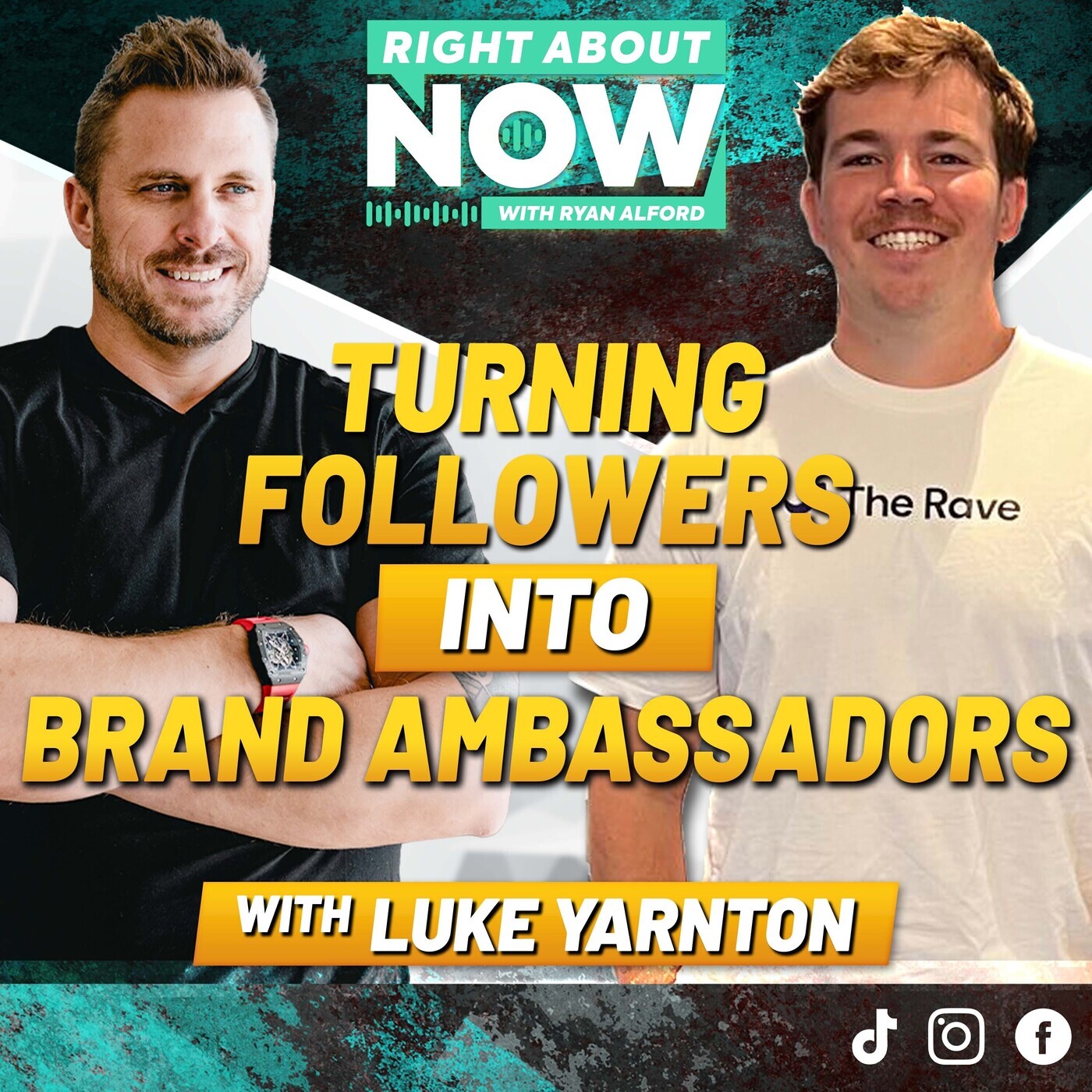
Turning Followers into Brand Ambassadors with Luke Yarnton
Right About Now with Ryan Alford
Join media personality and marketing expert Ryan Alford as he dives into dynamic conversations with top entrepreneurs, marketers, and influencers. "Right About Now" brings you actionable insights on business, marketing, and personal branding, helping you stay ahead in today's fast-paced digital world. Whether it's exploring how character and charisma can make millions or unveiling the strategies behind viral success, Ryan delivers a fresh perspective with every episode. Perfect for anyone looking to elevate their business game and unlock their full potential.
Resources:
Free Podcast Monetization Course
Subscribe To Our Youtube Channel
SUMMARY
In this episode of "Right About Now," host Ryan Alford and guest Luke Yarnton, co-founder of The Rave, explore the evolution of influencer marketing. They discuss the shift from relying on big-name influencers to leveraging micro and nano influencers—often existing customers—for authentic brand advocacy. Luke shares strategies for building “ambassador armies,” engaging customers through simple, rewarding tasks, and fostering community. The conversation highlights the importance of authenticity, effective tracking, and gamification, while predicting a future where influencer and affiliate marketing are democratized and accessible to all.
TAKEAWAYS
- Evolution of influencer marketing over the past decade
- Shift from large influencers to micro and nano influencers
- Importance of trust and authenticity in influencer endorsements
- Building an "ambassador army" of genuine brand advocates
- Strategies for identifying and engaging potential brand ambassadors
- The role of community management in fostering brand loyalty
- Balancing performance marketing with brand marketing through influencer partnerships
- Utilizing gamification to motivate micro and nano influencers
- The impact of demographic factors on influencer effectiveness
- Future trends in decentralized and democratized influencer marketing
See Privacy Policy at https://art19.com/privacy and California Privacy Notice at https://art19.com/privacy#do-not-sell-my-info.
Press play and read along
Transcript
Speaker 1 Look, we get it. You can hardly go anywhere or do anything these days without hearing about AI this or AI that.
Speaker 1 And if you're like most people, when it comes to AI, you're impressed, but you have a few concerns. But what if AI was used not as a tool to replace people, but as a way to help understand people
Speaker 1 better?
Speaker 1 AI from SurveyMonkey is designed to do just that, from crafting the perfect survey, which is harder than you might think, to analysis that digs deep, finds patterns, and surfaces trends quickly.
Speaker 1 SurveyMonkey's powerful suite of AI capabilities make it faster and easier than ever before to get insights from real people, helping you make confident decisions for your business.
Speaker 1 Try it today at surveymonkey.com/slash Ryan.
Speaker 2 10 years ago, the default approach to influencer marketing was, I'm going to find the biggest influencer that kind of is in my segment or in my sector.
Speaker 2 And I'm going to get them to post about me once with some big splash Instagram post, and then we're done. And then I move on to the next one.
Speaker 2 Whereas now, if you go down that follow-up count tree, these micro-influencers and nano-influencers tend to be the ones who have that high level of trust and high level of credibility within their audiences.
Speaker 2 So that's where a lot of brands are shifting toward that activation.
Speaker 3 This is right about now with Ryan Alford, a Radcast Network Production.
Speaker 3 We are the number one one business show on the planet with over 1 million downloads a month.
Speaker 3 Taking the BS out of business for over six years in over 400 episodes. You ready to start snapping next and cashing checks? Well, it starts right about now.
Speaker 1 What's up, guys? Welcome to Right About Now. We're always talking about how to get your business right today.
Speaker 1 This isn't about last year, next year. This is about what works right about now.
Speaker 1 That's why we're going to talk about one of my favorite topics because it gets kicked around so much. You see it.
Speaker 1 It's a buzzword, but it is becoming the here, the now, and how brands, marketers, business people, coaches, whoever you are need to be thinking about leveraging influence or marketing to grow their business and to grow the awareness of whatever they're doing.
Speaker 1 That's why, hey, we go to the source, Luke Yarnch, and he is one of the founders of The Rave.
Speaker 2 What's up, Luke? Hey, how's it going? Excited to be here today, Ryan.
Speaker 1 Me too, man. I selfishly, I was like, you know,
Speaker 1 we get asked, we get a lot of requests, and I was looking at your stuff. And, you know,
Speaker 1 I'm on a soapbox here recently with, you know, with influencer working with internally and externally with my companies about how to leverage it.
Speaker 1 And I'm like, you know, this would be an education course for me.
Speaker 1
I think I know most of it, but I don't know it all. And I think our audience can learn a lot from it.
I know you're a firm believer in it, right?
Speaker 2 Absolutely.
Speaker 2 It's a very quickly changing space at the moment as well. What it means to be an influencer and how to capture that and the ways to capture or changing it week by week.
Speaker 2 And so I'm excited to dive deep on that with you today, Ryan. I think it's going to be a fun chat.
Speaker 1
Yeah, man. And let's start right there.
I mean,
Speaker 1 what has been the change? You know, I think... you know, at its core, when you hear influencer marketing, it's like, okay, someone who has a big following is promoting a product or service.
Speaker 1
And like, that's it. But that's not wrong, but it's evolved into a lot more than that.
So, why don't you kind of start down that path for us?
Speaker 2 Yeah, I think a good place to start is if we look in the rear vision mirror 10 years in the past, and 10 years ago, the default approach to influencer marketing was: I'm going to find the biggest influencer that kind of is in my segment or in my sector.
Speaker 2 And I'm going to get them to post about me once with some big splash Instagram post, and then we're done. And then I move on to the next one.
Speaker 2 And maybe they would have three or four influencers on their roster throughout the year, super high touch, and it's purely just they want to be associated with this person who has a big following because you can get a bunch of reach.
Speaker 2
That's changed a lot now. So that's changed for a bunch of reasons.
One of the key reasons that it's changing now is sort of this inverse relationship with trust and follower count now.
Speaker 2 So as follow account increases, trust decreases.
Speaker 2 So a lot of that's probably been eroded away by the fact people realize that in 2015, people were just getting paid bucket loads of cash to post about some brand that they've never actually used or sort of experienced, and people can see through that pretty clearly.
Speaker 2 Whereas now, if you go down that follow-up count tree, these micro-influencers and nano-influencers tend to be the ones who have that high level of trust and high level of credibility within their audiences.
Speaker 2 So, that's where a lot of brands are shifting towards that activation.
Speaker 2 And rather than a one-and-done approach, where it's, I want this micro-influencer or a nano-influencer to post about me just one time, and then we'll move on to the next one.
Speaker 2 It's more about creating this always-on ambassador army where you've got a group of people who are really closely aligned with your brand.
Speaker 2 Ideally, they're genuine users of the brand, and they're trying to talk about you as much as possible.
Speaker 2 It becomes part of their content, and you build a really close relationship with that influencer, which then gets sort of passed on through that connection with their really engaged audience.
Speaker 1 Yeah, and the micro-influencer I hear a lot, though. Now, we got the nano-influencer.
Speaker 1 We got all of them. I mean, how many
Speaker 1 how many followers does the nano influencer have versus the micro influencer?
Speaker 2 So,
Speaker 2 at least for us, and there's no scientific agreed consensus on how to classify them.
Speaker 2
But we say nano is sort of, we're saying between 2,500 and 10,000, and then 10,000 to 50,000 is where we'd probably call that micro. Okay.
So those are the bands that we like to operate in.
Speaker 2 But we, like me personally, and you'll see this come through throughout the chat today, I'm a big fan of the nano and the micro. I love that small end of the influencer spectrum.
Speaker 2 I think that's where a lot of the opportunity and the low-hanging fruit is today.
Speaker 2 And time and time again, see so many of these businesses that we engage with burning hours and burning cash, sort of chasing the Instagram DMs of these bigger influencers that end up in these campaigns that turn out to be absolute duds.
Speaker 2 So I think we'll lean into that nano and micro end of the scale today.
Speaker 1 Yeah, that means I'm out you know i'm i'm in the uh i got 200 and something i guess i'm like you know i've been building it for 15 years eight years with the number one show like yeah i needed i needed to slow down
Speaker 2 i'm becoming irrelevant because my following is growing oh who knew yeah well it's a horses for horses approach right where we're being there are still uses for these larger influences in specific cases but it's not the only influencers you should care about have more than 100 000 followers anymore it's about finding the right fit for your brand for whatever you're trying to achieve with your influencer marketing.
Speaker 1 Well, over time, everything gets improved and you know like you learn like from the from the targeting and gets more targeted, right?
Speaker 1 So I mean that's what we're doing instead of painting with a wide brush or you know getting I don't know a Kardashian to talk about something that may or may not be that related and it's great to get the reach.
Speaker 1 Exactly. But how much frequency are you getting and how much relevancy are you getting to the audience? So that's what we're going for, right?
Speaker 2 Exactly.
Speaker 2 I can tell like a personal story here that sort of gives some relevance to this as well. And this is one of the origin stories of what we're doing, why we're doing what we do now.
Speaker 2 Is that like through COVID time, I tried my hand at being an influencer. My area of media was I was producing a bunch of slow-motion coffee videos.
Speaker 2
I'm not sure if you've seen them on your TikTok feed or Instagram feed. Set to some music.
There'd be like a sexy espresso pulled into a cup. We'd see the coffee coming out, really relaxing.
Speaker 2 I got like a couple of thousand followers on my TikTok and was like pretty active on Reddit as well.
Speaker 2 But in that time, even with such a small influence, I generated probably more than $10,000 worth of transactions for the brands and the equipment that I was using because people would reach out and say, oh my God, what is that grinder?
Speaker 2 It's such a cool grinder. Or...
Speaker 2
That is a beautiful machine. I want that machine.
And so I'd send them to the direction of where I bought it from.
Speaker 2
But I didn't have enough followers that any brand would want to give me the time of day to have a conversation. So I didn't get to monetize that in any way, shape, or form.
I didn't get any free shit.
Speaker 2 I was just me plodding away with my iPhone 13, making some pretty average content. And now that's completely changed, right?
Speaker 2 Where people would now take a little bit more notice about what I'm doing and try to activate that in a way that's beneficial to their brand.
Speaker 1 Have we lost the appreciation for amazingly produced high-end content? Because now, you know, everything's on the phone and everybody likes organic.
Speaker 1 But like, is there appetite still for influencers or people that produce content sharing like really well-produced stuff?
Speaker 2 I think the question is not to the quality of the content, at least the way I view it is, is it still authentic?
Speaker 2 You can find really highly produced, really authentic content, and you can find low-quality authentic content.
Speaker 2 I think the reason people, at least we're going through this wave at the moment, of content shot on an iPhone and the way that their friends and family would produce it.
Speaker 2
Because this is how me as an audience, I'm used to consuming media from my friends. It feels a little bit more authentic and I feel a better connection.
But the style of content comes in waves, right?
Speaker 2 We'll see it change time and time again.
Speaker 1 It's the authenticity that makes the
Speaker 1 that makes sense. So you paint that brush across it.
Speaker 1 And that's probably back to like if it's just, you know, when you think back to the, I don't know, what I think of is the cringy stuff is just okay,
Speaker 1
the 21-year-old in a high-polished Ferrari, you know, like video that's like, it just screams, I don't know, inauthentic. Exactly.
Yeah. I think that's kind of what we're saying a little bit.
Speaker 1 No, that's an extreme example, but I don't know. I just, I love it.
Speaker 1 And like being a content creator and owning an agency and working on large brands in the past, I love just high-produced, high-end content that storytelling, you know, obviously has a narrative and things like that.
Speaker 1 And I'm like, I just hope we haven't lost the appreciation of that on some level.
Speaker 2 I think it's a short-term hack.
Speaker 2 And you see a lot of these bigger brands doing it now. They want to be trusted and to
Speaker 2 sort of tap into that authenticity and making it look like something that your friend might produce can, at least for now, give that illusion, whether that's a long-term strategy or not.
Speaker 2 We'll check back in 12 months from now and have a look at that.
Speaker 1 How do I build an ambassador army? You know, like, how do we, how is this done?
Speaker 2 Excellent question. So, that's something that I've spent a lot of time and energy trying to unpack and work out how to do it time and time again.
Speaker 2 That's the main way that we at the Rave help businesses unlock goals. There's a couple of key steps to building an ambassador army.
Speaker 2 And by ambassador army, we mean a group of ambassadors that will talk about a brand that they love time and time again and ideally can have some positive outcome.
Speaker 2 So typically what that means is let's find a bunch of these sort of micro creators or creators, influencers, or even just everyday shoppers that have the ability to impact sales or whatever outcome you want, whether that's clicks or transactions, and do that consistently.
Speaker 2 The way we typically work with brands is we break it down into three key steps. So, first of all, you need to make sure you've got the right people coming in the top of the funnel.
Speaker 2 And the way we do that, or the easiest way we do that, is that we've got a piece of technology that can go through a brand's email list or be actively monitoring their checkout.
Speaker 2 And every single time we see a customer profile that we can match against an influencer profile, so we've got access to about 15 million creator and influencer profiles around the world.
Speaker 2 As soon as we see an exact match, we flag that and we update the SCRM or update a notification channel for them saying, Hey, this influencer here, this guy Ryan, he's got 250K followers.
Speaker 2 He just purchased some socks. Maybe you want to reach out to him.
Speaker 2 Um, so first things first, let's go through all of the previous people who have shopped and identify who has this outsized chance to be a great influencer and ambassador for your brand.
Speaker 1
And I love that, but I because I oftentimes, there are certain things. I look, I'm a consumer like everybody else.
You know, I have a big following.
Speaker 1 We've had luck, we've been blessed to have a good show with, you know, loyal listeners and all that. So we have influence.
Speaker 1
And there's stuff that I buy like everybody else, the grocery store and all that. And I don't go, man, I should be paid to buy this.
No.
Speaker 1 But there are a handful of things that I buy that I'm like, I should not be buying this because, not because I earned it, but I did build an audience and have influence.
Speaker 1 This brand should be paying me to buy this or buy it for me, and then I should be promoting it because I'm a firm believer in it. And it's like right down their demo.
Speaker 1 So
Speaker 1 I love that, but I'm like, man, we need more people discovering these things, right?
Speaker 2 Exactly. But you've touched on an interesting point there as well, Ryan, where it's like, obviously, we've talked about authenticity and trust.
Speaker 2 That's also super valid from the creator's perspective as well. They want their audience to trust them and listen to what they have to say.
Speaker 2 So they would much rather promote a brand that they genuinely love than have to like feign love for some brand that has been like hammering their Instagram DMs for a while.
Speaker 2 So this is this is why we're saying the influencers and ambassadors you should be looking to build into this army are people who already freaking know and love you.
Speaker 2 Don't go chasing these people who've never heard of your brand before that might be interested and might not.
Speaker 2 So first, we'll build the cohort of people that we think are a great fit for promoting your brand. They're the ambassador army.
Speaker 2 The next step, and this is where a lot of people get stuck, is the natural inclination is, how do I get them to love me and join the ambassador army and participate always and forever and we'll be in love.
Speaker 1 But let me ask a question because
Speaker 1 I think this is a key distinction back for step one. What if I don't have that list? What if I'm a startup or early phase and we don't have a 20,000 person list to vet out those people?
Speaker 2 In that case, what I would recommend is let's monitor it in real time.
Speaker 2 So every single time a transaction comes through, we'll make sure that we're not missing a single opportunity of someone who might have a small influence to post about you.
Speaker 2
And even the small community you do have, simply putting an ask out there saying, Hey, saw you made a purchase from us. We're trying to build an ambassador army.
Here's what's in it for you.
Speaker 2
Here's what's in it for us. Be transparent around sort of how it cuts both ways.
If there's any chance you're interested, let me know, opt in. There'll be some benefits.
Speaker 1 Do you help people if, again,
Speaker 1 it's great if monitoring sales, but is your whole premise around just purely people that have already are buying or just bought is sort of, you know, building that army of those existing customers.
Speaker 1 Is there any amount of yours that's prospecting of influencers or whatever it might be?
Speaker 2
Yeah, look, we can help brands out with that. That's a skill that we do have.
But we're eagerly, what we're trying to do is
Speaker 2
help people realize. And where we're the best at what we do is helping people find the low-hanging fruit or the golden goose that lives within their...
their customer list.
Speaker 2 I think that's where the most overlooked value is. But if it does come to prospecting.
Speaker 1 You're hidden super fans that also have influence.
Speaker 2 Exactly. But look, when it comes to prospecting and outreach, let's say you're a business that has very few customers and no budget for influencer marketing.
Speaker 2 The places I would start is spend a lot of time on Reddit and find there'll be some voices in Reddit that have a lot of reach.
Speaker 2 Tap into those people if they have some sort of expertise around your space. Jump into the hashtags and TikTok, jump into the hashtags
Speaker 2
and Instagram. And the folks you want will have less than 7,500 followers because those are the ones who are going to get a likelihood of some response from.
And they have that high engagement.
Speaker 2 And you're not going to piss away hours and hours and hours trying to get someone on board who's then going to want to charge you $5,000 for a single post.
Speaker 2 You want those young, hungry creators that are willing to believe in what you're doing. Those are the ones who you want to be connecting with if you're early on the journey.
Speaker 1
I love the community thing and the power. And I've been late to the game on this.
I've known it.
Speaker 1 I think I've counseled people but like myself and I'm I'm a practitioner like I mean I have teams and we do stuff the Facebook group Reddit thing all that stuff is gold mine you know like you've they've got these conversation groups and things that are happening and even if they're not talking directly about your product they're having conversations about things topics in your area and like The next hire that I would probably make is, it's like a growth manager, but really it's almost like audience finding, community manager, audience or community finding.
Speaker 1 There's a balance of like, because I don't, it's almost like this balance of managing what you have is kind of community manager. Yep.
Speaker 1 Finding and nurturing and building and discovering community is kind of like the secret sauce.
Speaker 2 Fostering a community is such an important part of.
Speaker 5 I love giving gifts, but you know what?
Speaker 1 I I don't love shopping.
Speaker 5
It seems impossible to find unique gifts these days. I got four boys that seem to have it all and a wife that I want to make happy.
That's why I love uncommon goods.
Speaker 5 They have products that are unique from some small vendors, handmade, handcrafted, made in the USA. I love these guys.
Speaker 5 Uncommon goods makes holiday shopping stress-free and joyful with thousands of one-of-a-kind gifts gifts you can't find anywhere else.
Speaker 5 Trust me, I know, because I couldn't find anything, and uncommon goods comes to the rescue every time.
Speaker 5 Games, toys, clothes, one-of-a-kind, unique things that you can't find anywhere else. I love these guys.
Speaker 5 Let me tell you, you want to go there, you want to shop USA-based, and uncommon goods has me and you covered.
Speaker 5
So, shop early, have fun, and cross some names off your list today. To get 15% off your next gift, go to uncommon goods.com/slash Ryan.
That's uncommon goods.com/slash Ryan for 15% off.
Speaker 5 Don't miss out on this limited time offer. Uncommon goods were all out of the ordinary.
Speaker 1 Hey, small business owners, let's talk about how found can help you wrangle your finances once and for all. When was the last time you felt like you had your business finances totally under control?
Speaker 1
Every expense categorized, every receipt tracked, every invoice sent. Oh, and you were prepared for tax season.
If the answer is never, you're not alone. And that's what Found is for.
Speaker 1 Found is reimagining what business banking should be by putting your bookkeeping, invoicing, and tax tools directly into your business checking account they've automated things like expense tracking finding write-offs and budgeting for tax time you can even send invoices for free and pay your contractors everything
Speaker 1 all from one app
Speaker 1 look i struggle with this myself i pay contractors left and right
Speaker 1
here there everywhere keeping up with all of it as a small business owner with multiple companies is next to impossible that's what i love found. They help me with this.
They'll help you.
Speaker 1
I basically replaced three apps with just found, and I don't miss the stress at all. And neither will you.
Take back control of your business today. Open a found account for free at found.com.
Speaker 1
That's f-o-u-n-d.com. Found is a financial technology company, not a bank.
Banking services are provided by Lead Bank, member FDIC.
Speaker 2 Longevity success now.
Speaker 2 Like you can see that once you've got a group of people who want to listen to what you have to say and want to engage with you, that is a forever asset that you can tap into in a million different ways.
Speaker 2 And it creates so much value. And the other benefit is it can sort of, once you've got that critical mass, it then can go on and grow itself.
Speaker 2 And you don't actually have to be monitoring it and putting as much time and effort into it.
Speaker 2 Ideally, you can get these sort of folks who exist within that community themselves, the type of people who can then go on and
Speaker 2 be the champions of the the community out of love alone.
Speaker 1 Yes, I love it. I love it.
Speaker 1
So talk to me. Okay.
We helped build with step one. We helped them build their army, either existing, some prospecting, but really mining what's there.
Sure.
Speaker 2 Now what? So the next step is we only want to get them to do one thing. And that one thing varies brand to brand.
Speaker 2 What you don't want to do is try and onboard them to be part of the ambassador army straight away.
Speaker 2 That you get a lot of friction there, you get a lot of drop-off, timing might not be right, and then you'll burn a lot of opportunity.
Speaker 2 So, the key thing here is once you've got them to do one simple task for you, the likelihood of them doing a subsequent task is significantly higher.
Speaker 2 So, typically, what we'll do, I'll give you a real-life example. There's an athleisia brand we're working with called Form.
Speaker 2 They blew up a couple of years ago because Taylor Swift was seen wearing one of their sports bras.
Speaker 2
They do posture correcting athleisiaware and they do it really well. They're growing at a rapid pace.
For them, what we do is we've got this automation set up.
Speaker 2
Plus, we're doing the retrospective mining. And we say, hey, saw you made a purchase from us.
Love your content.
Speaker 2 By the way, if you just want to, like, this is a really low lift ask. If you just want to post a picture of you in anything from form on your Instagram story, we'll refund your most recent order.
Speaker 2
It's not a big ask. It's pretty easy.
We're not asking them to sell out, no affiliate links, no anything.
Speaker 2 It's probably just, if you can post about our brand and just show that we're relevant, that first ask, and then we'll, we'll keep our promise of giving you a refund. That's the first offer.
Speaker 2 So that's a really easy offer for a creator of any size, whether it's 2,500 followers or 50,000 followers. They're like, I was probably going to post about this anyway.
Speaker 2
Now I might post about it a little bit quicker. And I don't have to tag them or do anything like gross like that.
It's just showing that this is a brand that I wear, that I paid organically for.
Speaker 2 Brilliant. But then then what that also does is it builds a little bit of trust, right? So we've come to an agreement that you're going to post about us, and then we'll give you a refund.
Speaker 2 The refund hits the account, magic moment, a little bit of delight.
Speaker 2 And then following that, so that's when we get to stage three, which is now you've got a group of influencers or ambassadors, creators that love the brand.
Speaker 2 Second point is they've actually done something for you once.
Speaker 2 And then once they've done a single task for you, that's when they become part of this closed group of ambassador. I mean, that's when you can sort of foster that community.
Speaker 2 And every single time there's a new drop, anytime there's something interesting happening, they get updated, they feel part of the brand.
Speaker 2 And then all of a sudden, through very little effort, you've got a group of 200 odd micro creators consistently posting about this brand that they feel connected to for very little cost.
Speaker 1
I love it. The first step is always the best.
Because you get them to do that one thing.
Speaker 1
I mean, it's low ask, like you said. Yeah.
then they're in, and there's some connection, and then you build from there. I mean, what's the percentage of, like,
Speaker 1 I don't know, do you have data like the average that could, if they do that one thing, like that they
Speaker 1 join the army, so to speak?
Speaker 2 Yeah, so it varies a lot segment to segment.
Speaker 2 Certain brands that have more like social currency, and by social currency, I mean people want to naturally talk about it, obviously they get higher cut through than something that's significantly less interesting.
Speaker 2 So, for every 10,000 shoppers, we know that about 200 to 250 of them have more than 2,500 followers. And then obviously of those, some of them are going to be duds.
Speaker 2 It'll be like some auto garage that has a high following count or it'll be a dog account. So let's say that the real amount is going to be 200 per 10,000 customers.
Speaker 2
Ideally, we'll be able to convince to join the group. 30 to 50 of those is a good outcome.
They've got noisy inboxes, it's hard.
Speaker 2 But generally speaking, if you can catch them with a good serendipitous message, right person, right time, and all you need is for one of those to turn into a powerhouse for you to get really, really incredible outcomes.
Speaker 1 What industries does this work best for?
Speaker 2
We're still relatively new on the journey at the moment. We've got less than maybe just over 200 brands using the platform at the moment.
I need to check the numbers, but it's still relatively new.
Speaker 2 We're skewing more towards e-comm at the moment, so we're seeing a lot of proof coming out in the e-comm space.
Speaker 2 And we're dipping our toes into ticketing and we're dipping our toes into SaaS apps at the moment. We haven't found a segment where it very clearly doesn't work.
Speaker 2 What we are finding is that if the average age of the customer is above 40, the likelihood of us discovering an influencer is slightly lower, but that specific customer base are significantly more receptive to these micro-influencer and nano-influencer people.
Speaker 2 So the impact is higher.
Speaker 2 So it's a little bit more of a grind, but once you do unlock those customers, they provide a significantly better impact because the number of creators or influencers that people over the age of 40 are following is significantly lower than, say, someone in the Gen Z cohort who's going to be aware of 200 or 300 creators posting consistently.
Speaker 2 Whereas like my parents probably know of four influencers or like five.
Speaker 1 It's interesting because
Speaker 1 I talk all the time about performance marketing versus brand marketing.
Speaker 1 You know, like the marketing that's driving a sale today or as fast as possible at the bottom of the funnel versus building brand over time.
Speaker 1 And, you know, we all need outcomes and you need business outcomes, but you do, you know, believe it or not, no matter what these performance marketers have tried to tell us, you have to actually create awareness and intent before they buy, which there is a funnel or a cycle that is still there.
Speaker 1 It doesn't, one ad or one influence or whatever insert ad-like object doesn't always drive a sale that day.
Speaker 1 And so I'm building to a question here, Luke. Is
Speaker 1 I see this as beneficial both for the top and the bottom of the funnel.
Speaker 2 So that's an interesting point. I'm very often speaking to performance marketers when we're discussing our technology stack.
Speaker 2 There is a performance element to this where often it is paired with affiliate-based marketing.
Speaker 2 We've got a fully fleshed out affiliate marketing tool and ours is built around this idea that affiliate and influencer marketing will be completely democratized within 10 years.
Speaker 2 So I'm speaking often sat opposite. There'll be a brand marketer, a head of influence, and a performance marketer when I'm having sort of these higher-level discussions with a bigger brand.
Speaker 2 And the performance marketer's approach is
Speaker 2 what is
Speaker 2 the right give and the get to make this work.
Speaker 2 So when it comes to affiliate marketing, for example, they're consistently doing how much can we afford to give away as a discount for a referred shopper and how much can we give away as a commission to that affiliate, creator, or influencer for making that.
Speaker 2 And it's got to be a right balance, right? Where for certain brands, that discount that's attached to an affiliate link is a really effective lever to get people purchasing.
Speaker 2 For other brands, they'll rather have like a super low or even just 0% discount, but they'll heavily incentivize the affiliate or the influencer for posting about it.
Speaker 2 So they might go up to 30% commission. And so the performance marketer is thinking, how do I optimize this? How do we A-B-test this?
Speaker 2 And how do I make sure that we get as high a conversion rate for a referred shopper versus a standard shopper that's that's arrived to the site on their own.
Speaker 1 Yeah. And because I mean, I mean, ideally, you know, the outcomes for me would just be, you know, more trial of the show.
Speaker 1 And if we're doing our job, it translates to more subscribers at some percentage level.
Speaker 1 But being able to track, you know, if we build the ambassador army for any given podcast, then tracking the downloads that they drive.
Speaker 1 for you know individual episodes and those are the sort of sales for this approach approach.
Speaker 2 Exactly. Look, you can shoot them.
Speaker 1 All that can be done.
Speaker 2 They get their own unique link with a specific UTM. You can see who's actually effective at driving traffic to your site and who's not.
Speaker 1 Yes. The now.
Speaker 1 Honestly, that's one of the biggest things we've found as well.
Speaker 2 This is like a little secret that I'll share with the audience. Oh, yeah.
Speaker 1 It's hike secrets for the show, Luke. I like it.
Speaker 2
A lot of these, at least what I've found so far, a lot of these micro-influencers and sort of nano-influencers, they are natively very competitive people. They like to win.
They like to,
Speaker 2 they're often very metric obsessed. If you can have a sneak a little bit of a leaderboard in there or some sort of
Speaker 2 competitive element to it, that's a good way to get a squeeze a little bit of extra juice out of it. Let's say that they'll get a little bit more excited about it.
Speaker 2 Whoever can drive the most clicks to the site, transparent leaderboard, by the end of the month, you get
Speaker 2 something that is of the appropriate value. The now army.
Speaker 1
That's what I need. The now army.
And
Speaker 1 who's driving the most
Speaker 1 downloads or audience for the show. And they get the winning badge.
Speaker 1
Exactly. I'll creatively come up with that.
We'll have merch and everything else.
Speaker 1
Make it cool. Like I'll mart.
Yeah.
Speaker 2 They can get one of those big wrestling belts that's sat in front of you.
Speaker 1 Oh, hey,
Speaker 1 we'll send them a belt just like this.
Speaker 2 Come champion of the world.
Speaker 1
The now army. I like it.
See?
Speaker 1
There you go. I mean, you got it.
But see, I did say whenever someone overtakes me as the number one marketing and business show, they can come get the belt. Now I'm 65260.
Speaker 1 You might have to wrestle me for it. But the numbers back it up as I drop my sponsor drink.
Speaker 1
But yes, it's fun. I'm liking it.
I'm liking it. And we're brainstorming here selfishly, but it applies to any business is the point.
Speaker 1 You can use influencers community and again, gamifying it a bit, which I like. People love that.
Speaker 2
But it's also such a human thing to want to be a part of a a community. You want to be involved in something.
You want to be collaborative and co-create something with your peers.
Speaker 2 If you just provide that structure for them and provide a little bit of incentive to get them moving, it is just something native to human nature that people want to be a part of something.
Speaker 1 Yes. Influencer marketing is like it's the now version of
Speaker 1
spokesperson. You know, like back in the day, and even now, brands use spokespersons.
I mean, if you watch the Super Bowl, every ad has a celebrity in it. And you had spokesperson marketing.
Speaker 1 So you have Michael Jordan or you have Michael Phelps if you're a swimmer, like whatever it might be, Olympian, actor, Tom Cruise. And they're the spokesperson for the brand.
Speaker 1 Influencer marketing is like the evolution of that on some level. But then it's the more authentic version because it's everyday people, right?
Speaker 2
Absolutely. Yeah.
Look, I think at least when I was
Speaker 2 in college and you learned a lot about marketing, there was always that saying that they keep bringing out, which is your brand is what they say about you when you're not in the room.
Speaker 2 I think that's a Jeff Bezos quote.
Speaker 2 And I think brands are starting to realize that gone are the days where they have absolute control of what people are saying about the brand.
Speaker 2 And they can put words in Michael Jordan's mouth to assert who they are as a brand.
Speaker 2 It's changed now, and that the amount of media and the access to media has been a complete paradigm shift from when that spokesperson style of marketing was proper and present.
Speaker 2 So now people are talking about your brand whether you like it or not.
Speaker 2 But the key now is not to control what people are saying about it. As a brand, you just need to make sure your product is solid and does what it says on the box.
Speaker 2
And then what you do is try and make people talk about it as much as possible. You just want to be top of mind.
You want to be the brand that's getting discussed.
Speaker 2 And if you've built the right product and you can facilitate getting people talking about it at scale, that's how you win in 2025.
Speaker 1 I think that's
Speaker 1 well said, Luke.
Speaker 1 As we close out here, where you see the company evolving to anything on the horizon, you know, we're talking about what's working now, where this whole influencer market craze is going, and all those things, and then some of the calls to action of where to find you guys.
Speaker 2 Yeah, so I think where we see, or at least the direction to which we're building, is that I'm a firm believer that affiliate marketing and influencer marketing is going to be completely democratized and decentralized within the next 10 years.
Speaker 2 And by that, I mean gone are the days of brands picking influencers who are going to represent them.
Speaker 2 And instead, the opportunity should be available for anyone who wants to promote a brand to be able to participate in the rewards that go alongside that.
Speaker 2 So that's why we're building, in this space here, we're building A, a tool that can analyze influences in real time.
Speaker 2 And B, a really, really simple tool that will allow any single customer, whether they have a following or not, to refer a friend, family, follower, and get a Venmo reward or a PayPal reward for doing so in a way that's completely seamless.
Speaker 2 So we believe that gone are the days of traditional influencer and affiliate marketing.
Speaker 2 And in a world where search is changing, advertising on meta, and traditional platforms are becoming more difficult, we see no reason that relying on customers who know and love your brand, that should be a very meaningful growth channel for every brand going forward.
Speaker 2 And I think that's a smart place for brands to start investing their time and energy. So that's the direction we're building.
Speaker 2 And we're going to keep going that direction, foot to the floor, and continue to unlock a bunch of benefits for the brands that we like to work with.
Speaker 2 If you're interested, obviously you can find me, therave.co, find me on LinkedIn, Luke Yanton, Y-A-R-N-T-O-N, like a ton of yarn, and maybe in the show notes here.
Speaker 1 Yes. We will have it, of course, in the show notes.
Speaker 1 It's fascinating, I think, as you were talking about it, you know, removing sort of the boundaries and the stages of it now. It's both the democratization and just it's almost like
Speaker 1 we're making purchase decisions every day and allowing and empowering consumers to sort of get just commission immediately from the word of mouth
Speaker 1
that they're naturally doing anyway. Exactly.
And unlocking that in a very easy way. Because even now the affiliate stuff.
Speaker 1 I don't do many affiliate deals with our sponsors because it's just a pain in the ass to keep up with. And like all this stuff.
Speaker 1 And I'm like, just look, I'd rather have a low fee leveraged audience if I believe in the product. But if we can bring down
Speaker 1 sort of the,
Speaker 1 I don't know, the walls that are the complexities, the more this really takes off.
Speaker 2
Exactly. I think the key is making it seamless, making it easy, making it transparent.
And I think this is the way that you can engage people at scale.
Speaker 1 Removing friction. from influencer marketing and
Speaker 1
everything else in this whole realm. Luke, it's been a pleasure having you on the show.
I really appreciate it.
Speaker 2 Ryan, this has been super fun.
Speaker 2 It's been a blast.
Speaker 2 Even got to do some real-life brainstorming mid-show, which is a...
Speaker 1 I know. I'd like to pick your brain some more on that.
Speaker 1
We'll do a follow-up. Hey, guys, you know where to find me, Ryan is right.com.
We'll find all the highlight clips, the full episode, and the links to the rave.
Speaker 1 Everything that all of Luke's personal profiles, all that will be in the show notes and on the website. You are to find us
Speaker 1
on Instagram, Right About Now Show. It's got that blue check.
Yeah, Ryan Alford on Instagram. Shoot me a DM.
We're building that now army. We'll see you next time on Right About Now.
Speaker 3 This has been Right About Now with Ryan Alford, a Radcast Network production. Visit ryanisright.com for full audio and video versions of the show or to inquire about sponsorship opportunities.
Speaker 3 Thanks for listening.
Speaker 4 Finding great candidates to hire can be like, well, trying to find a needle in a haystack.
Speaker 4 Sure, you can post your job to some job board, but then all you can do is hope the right person comes along, which is why you should try ZipRecruiter for free at ziprecruiter.com/slash zip.
Speaker 4
ZipRecruiter doesn't depend on candidates finding you. It finds them for you.
Its powerful technology identifies people with the right experience and actively invites them to apply to your job.
Speaker 2 You get qualified candidates fast.
Speaker 4 So, while other companies might deliver a lot of hay, ZipRecruiter finds you what you're looking for.
Speaker 4 The needle in the haystack.
Speaker 6 See why four out of five employers who post a job on ZipRecruiter get a quality candidate within the first day. ZipRecruiter, the smartest way to hire.
Speaker 6
And right now, you can try ZipRecruiter for free. That's right, free at ziprecruiter.com/slash zip.
That's ziprecruiter.com/slash zip. Ziprecruiter.com slash zip.
Speaker 1 Look, we get it. You can hardly go anywhere or do anything these days without hearing about AI this or AI that.
Speaker 1 And if you're like most people, when it comes to AI, you're impressed, but you have a few concerns. But what if AI was used not as a tool to replace people, but as a way to help understand people
Speaker 1 better?
Speaker 1 AI from SurveyMonkey is designed to do just that, from crafting the perfect survey, which is harder than you might think, to analysis that digs deep, finds patterns, and surfaces trends quickly.
Speaker 1 SurveyMonkey's powerful suite of AI capabilities make it faster and easier than ever before to get insights from real people, helping you make confident decisions for your business.
Speaker 1 Try it today at surveymonkey.com/slash Ryan.