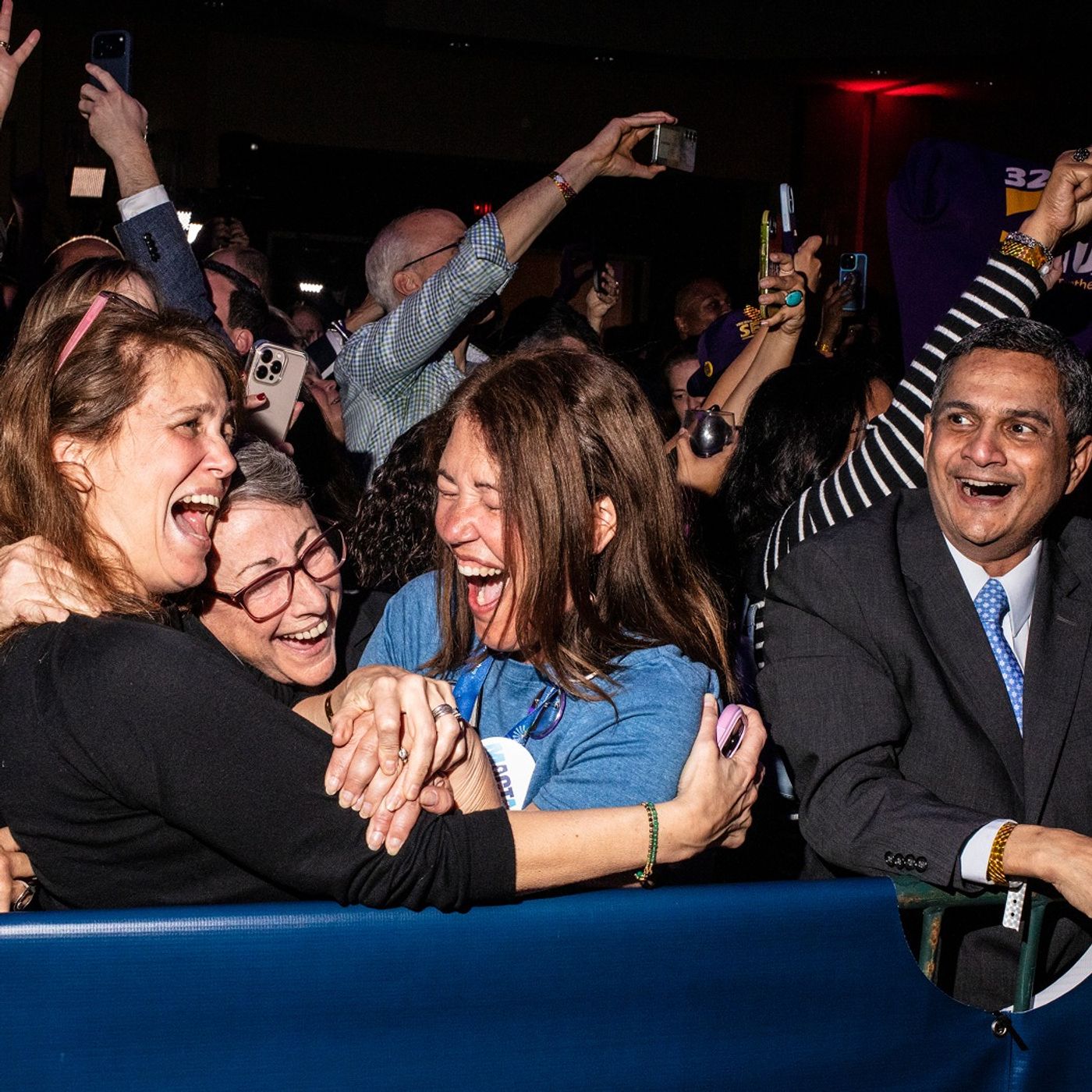
A Good Night for Democrats
Shane Goldmacher, a national political correspondent, explains what the voting tells us about President Trump’s status and discusses whether Democrats have finally found their footing.
Press play and read along
Transcript
Speaker 1
This podcast is supported by ATT, the network that helps Americans make connections. When you compare, there is no comparison.
ATT
Speaker 2 from the New York Times, I'm Natalie Kitroff. This is the daily.
Speaker 3 Now, to election night in the high-stakes race is marking the first electoral test of President Trump's second term.
Speaker 4 We can now make a major projection.
Speaker 2 In Virginia, Democrat Abigail Spanberger will be the first woman to serve as governor.
Speaker 3 Mikey Sherrill is the next governor of New Jersey, defeating Jack Chenarelli.
Speaker 4 CNN projects that Democratic socialist Zoran Mamdani, the Democratic candidate, will be elected the next mayor of New York, New York.
Speaker 2 Last night, in the first big elections of the new Trump era, Democrats won in New Jersey. Man, with this vote,
Speaker 2 you guys should scream from the rooftop.
Speaker 2 Virginia, we sent a message to the whole world that in 2025,
Speaker 2 Virginia chose pragmatism over partisanship.
Speaker 2 And New York City.
Speaker 5 New York, tonight you have delivered
Speaker 5 a mandate for change.
Speaker 2 And up and down the ballot across the country.
Speaker 5 So Donald Trump, since I know you're watching,
Speaker 5 I have four words for you.
Speaker 5 Turn the volume up.
Speaker 2 Today, national political correspondent Shane Goldmacher explains what these elections tell us about how voters feel about Trump and whether Democrats have finally found their footing.
Speaker 2 It's Wednesday, November 5th.
Speaker 2 Did you choose blue M ⁇ Ms?
Speaker 5
No, it just like came out. They lose.
sweep. There was extra blue.
That's
Speaker 5
very, I mean. On brand.
You did a good job. Okay.
Speaker 2
So, Shane, New York City, Virginia, New Jersey, the Democrats won. Maybe on one level, not that surprising.
These were all blue states, blue city. But the races were called pretty early.
Speaker 2 We are talking before midnight.
Speaker 5 Well before midnight?
Speaker 2
Well before midnight. I honestly was hoping to have a little more late-night pizza.
We did both have cupcakes, so we're ready to go.
Speaker 2 The big question going into this off-year election was, would voters soften on Trump from just a year ago?
Speaker 2 This is the first temperature check on how voters are feeling about the president when you're in after everything he's done in office. The other question was, how would the Democrats perform?
Speaker 2 So what do these results tell us?
Speaker 5 I think that there's almost nowhere on the ballot that you can look this year
Speaker 5 that there isn't good news for the Democratic Party.
Speaker 5 You can look at the top of the ticket where there's governor's races in Virginia and New Jersey, where the Democrats are not just winning, but winning pretty big.
Speaker 5 You can look at the ballot measure in California to redraw five congressional districts, that that's winning overwhelmingly right now. You can look at the Pennsylvania Supreme Court.
Speaker 5 You can look really, really far down the ballot in Georgia, where there's a public utilities commission election where Democrats are ahead, really all up and down the map.
Speaker 5 The House of Delegates in Virginia, Democrats are winning almost everywhere right now.
Speaker 2 So this was a good night for Democrats, bad night for Republicans, and Trump himself. It was also a good night for Democratic socialists, too, right?
Speaker 5 Yeah, I mean, I think one of the biggest names to win is Zoran Momdani here in New York City. And look, it wasn't a surprise that he won this election, right? He won the primary.
Speaker 5 He's been the frontrunner in the polls. But if you had asked me in January who was going to win this November, Momdani was not on my or almost anyone's radar.
Speaker 2 No, he wasn't on the map.
Speaker 5 Yeah, he was at 1% virtual unknown assembly member in New York in a city where nobody knows any of the assembly members, frankly, and built a campaign that built a huge following and obviously is now the mayor-elect as a 34-year-old Democratic socialist.
Speaker 2 Yeah, and I think that gets at this second and maybe bigger question around these races, which has been, what kind of vision were the Democrats going to put forward here?
Speaker 2 Would the Democrats coalesce around a coherent version of of themselves that presented a path for the future?
Speaker 2 And what's interesting about tonight is that we saw two very different versions of Democrats win.
Speaker 5 I mean, I think we saw two divergent pathways in Mikey Sherrill, who's now the governor-elect of New Jersey, and Abigail Spanberger, the governor-elect of Virginia.
Speaker 5 Moderate women with national security credentials, centrists aim for the middle of the political electorate.
Speaker 5 And then you have in New York City, a democratic socialist who inspired thousands of people to big rallies and juiced turnout in the city to basically double, more than double the last mayor's race just four years ago.
Speaker 2 Just to kind of linger for a moment on the fact of Mamdani's victory, the extent of it, the breadth of it, it's fair to say that he did something remarkable, even Even in a place like New York City, progressive New York City, we're getting a pretty clear sense, as you said, that the turnout was historic.
Speaker 2 Over 2 million people turned out. More than a million of those voted for a Democratic socialist in the capital of capitalism.
Speaker 5 I think it's a huge election. I think it tells you a lot about where the Democratic Party is today, right? The Democratic Party today is unhappy with the Democratic establishment, right?
Speaker 5 And so, yes, in these states like Virginia and New Jersey, they picked sort of more traditional candidates, people who'd first won in the 2018 midterms.
Speaker 5 But in New York, they took a flyer, a flyer on somebody totally different who's speaking almost a different language of expansiveness in his agenda, right?
Speaker 5 You know, there's a real frustration in the year since Trump won from Democratic voters with the Democratic Party. And I think that his rise represents that.
Speaker 5 You know, it really is that encapsulation of what I think we're going to see all across the country next year, which is a fight between the old guard of the Democratic Party, age and otherwise, and a frustrated new guard that wants to push the party to take bigger and broader positions on issues.
Speaker 2 So let's dig into how Mamdani did it, how he pulled this off. You're starting to talk about it a little bit, and we've covered this quite a bit on the show.
Speaker 2 He was a candidate who almost relentlessly focused on these affordability issues, free buses, rent freezes, free child care. That was clearly a very potent message.
Speaker 2 And I'm curious, how much of his victory do you think is that message in and of itself?
Speaker 2 Or if it's that message plus everything else that comes with this candidate, which is someone who's a very capable messenger who can deliver that message.
Speaker 5 I mean, it's so hard to tell because, right, it's hard to separate the candidate from the message and the messenger from the message, right?
Speaker 5 We all know the three things that he's standing for because they delivered it so well and so repeatedly, right?
Speaker 5 Many candidates don't have that kind of message discipline, but then they might not also have a message that's quite as expansive and memorable, right?
Speaker 5 Mikey Sherrill running in New Jersey has promised repeatedly to declare on day one a state of emergency for utility bills. That was a winning message, right?
Speaker 5
The utilities bills have been going up in New Jersey. This is something that sounds clearly like a poll-tested winner.
Voters are frustrated about that.
Speaker 5 Does that sound like the kind of thing that she dreamt her whole life of running for governor to declare a day one emergency on utility bills?
Speaker 5 Probably not, right?
Speaker 2 Right, right. It also doesn't quite roll off the tongue like freeze the rent.
Speaker 5 Not quite freeze the rent and not quite free child care, right? That's not going to change the complexion fundamentally of New Jersey as a place to live. Right.
Speaker 5 The things that Mom Donnie's talking about could, right? They are hard. He's unlikely to get that full agenda very quickly, right?
Speaker 5 But it's the idea that he came up with something transformational that I think has drawn so much attention to his candidacy and made him sort of a unique figure right now.
Speaker 2 Trevor Burrus, And he was also very much a kind of representative of this deeply progressive wing of the Democratic Party.
Speaker 2 I mean, just thinking about his message on Gaza and his pro-Palestine stance that he did not compromise on, even though, you know, there were Jewish New Yorkers who were alienated by it.
Speaker 5 Aaron Powell, Jr.: I mean, this felt like the table stakes of his candidacy in the primary. It wasn't the emphasis of his campaign, certainly in the general election.
Speaker 5 I think he did make a big pivot to reach out to the Jewish community and to Jewish voters, especially as Andrew Cuomo hammered him on this issue.
Speaker 5 So it wasn't that he ever shied away from the topic, but I think it was less his focus and more the basis of his campaign at the very beginning.
Speaker 2 Aaron Ross Powell, you're saying he didn't make that the centerpiece of his campaign. And neither, right, was a message about Trump being a threat to democracy.
Speaker 2 It was these economic concerns that he just kept hammering on, the cost of living issues that really resonated.
Speaker 5 Every single day.
Speaker 5 That was his focus.
Speaker 2 You mentioned, Shane, that Mamdani had something like 90,000 volunteers. Our colleagues have reported that his campaign became like an antidote to loneliness for the Gen Z.
Speaker 2 You know, volunteers who were involved and they came out, they canvassed for him, they made friends, they explored the city, they touched grass, they got out there.
Speaker 2
Like his personality, that charisma, it obviously genuinely inspired people. maybe people who had never been invested in politics before.
And I'm wondering how much weight we should give that.
Speaker 5 I mean, I think you should give that a lot of weight, right?
Speaker 5 I think that, you know, we reported over the weekend that former President Obama called Mom Dani ahead of the election and spoke to him, offered to be a sounding board for him, and basically praised the campaign he had just run so far.
Speaker 5 And people have been drawing parallels between these two men who have brought hope to Democratic voters at a time where they feel feel pretty bleak and dark.
Speaker 5 And there's a whole lot of Obama veterans and alumni who have said, hey, this is the first time I've actually seen somebody else who's inspiring hope like that.
Speaker 5
And there's a lot of responsibility for that. New York's big and complicated, and he's 34 years old, has managed a very small staff.
as a member of the legislature, a fairly large campaign team.
Speaker 5 But this is a daunting thing, and he has to fulfill the hope and promises that people have put. Otherwise, this ultimately is going to be a struggle for the left.
Speaker 5 He's become this really important figure for the left of the Democratic Party, not just his victory, but can he actually accomplish things?
Speaker 2 Aaron Ross Powell, and then even if he is, right, able to have success in New York City, I think there's a question about whether you can be this kind of Democrat and put together a winning coalition, not just in New York City, but at the state level, you know, at the purple state level, in swing state America.
Speaker 2 What can you say about that?
Speaker 5
I mean, I don't think we can say much of anything about that yet because they haven't tried. This is why he's plowing new ground.
This is why it's a historic candidacy, right?
Speaker 5 A democratic socialist running a city of 8 million people is new, right? New York City is bigger than a whole bunch of states in the country.
Speaker 5 And so, no, we don't know whether it's politically viable, but that's the whole idea of the project, right? Which is if you are successful, then there'll be people who will emulate you.
Speaker 5 And if you're not, there will be fewer people.
Speaker 2 Aaron Trevor Brandon- So then what is the lesson, do you think, that Democrats take from Mamdani's win at the end of the day?
Speaker 5 I mean, talking about Mom Dani with Democrats has been a total Rorschach test in recent weeks. The centrist and moderates look at his candidacy and say, like, he had an enviable message discipline.
Speaker 5 on the issues of affordability, and that can work everywhere.
Speaker 5 That that focus on the cost of living is exactly right, exactly what the party needs to be doing to win in 2026, all over the country, red states and purple states and blue states.
Speaker 5 And you talk to people on the left, and they say,
Speaker 5 sure, he had a focus, but that's not what made him a success.
Speaker 5 What made him a success was the scope of the solutions that he was proposing to the problem, that he was meeting people with their level of frustration with the system that he was saying is broken, that we need such big solutions because the system has stopped working.
Speaker 5 It's ill-equipped to handle your problems.
Speaker 5 And that that is the secret to his appeal.
Speaker 2
Right. It's not just that he was diagnosing the problems correctly.
It's that he was offering people policy solutions that were bold enough that they could get behind.
Speaker 5 Absolutely. That is what the people around him would say is the actual secret to his appeal.
Speaker 5 And of course,
Speaker 5 his election is only one piece of the puzzle that we got tonight because there were places in bluish-purple states with big races, and you had Democrats win there too with a totally different set of solutions that they were proposing.
Speaker 2
Right. So, bottom line, at this moment in New York City, this is a big loss for the moderate centrist Democrat.
But in Virginia and New Jersey, moderate Democrats won handily.
Speaker 2 So, how do we understand that? After the break.
Speaker 1 This podcast is supported by the American Petroleum Institute. Energy demand is rising, and the infrastructure we build today will power generations to come.
Speaker 1 We can deliver affordable, reliable, and innovative energy solutions for all Americans, but we need to overhaul our broken permitting process to make that happen.
Speaker 1 It's time to modernize and build, because when America builds, America wins. Read our plan to secure America's future at permittingreformnow.org.
Speaker 6
Let's be honest, most HR platforms aren't exactly a joy to use. Deal is different.
It's AI native, keeps you compliant, and grows with your team, whether you're five people or 50,000.
Speaker 6
HR, IT, and payroll. on one platform that just works.
See for yourself at deel.com/slash nyt.
Speaker 1 Every Vitamix blender has a story.
Speaker 2 I have a friend who's a big cook. Every time I go to her house, she's making something different with her Vitamix, and I was like, I need that.
Speaker 5 To make your perfect smoothie in the morning or to make your base for a minestra verde or potato leek soup.
Speaker 2 I can make things with it that I wouldn't be able to make with a regular blender. Because it does the job of multiple appliances and it actually has a sleekness to it that I like.
Speaker 1
Essential by design, built to last. Go to Vitamix.com to learn more.
That's Vitamix.com.
Speaker 2 Shane, for the purposes of understanding what the lessons are here in these races for Democrats about what kind of Democrat can win with what message and how,
Speaker 2 tell me about how these two women won their races for governor. How'd they pull it off?
Speaker 5 Let me start with two words, Donald Trump, and then give you some specifics in each state, which is there's probably no state that has been more impacted by Trump and his cuts to the federal government than Virginia.
Speaker 5 And that is where Abigail Spanberger won and one of the issues she campaigned on.
Speaker 5 She was running against a Republican opponent who never won Trump's endorsement, and yet she still relentlessly tied that Republican candidate to to Trump, holding her to account for his cutbacks from Doge in the Elon Musk era to the recent cutbacks during the federal shutdown.
Speaker 5 At the same time in New Jersey, Mikey Sherrill similarly ran against a candidate who she relentlessly tied to Donald Trump and then got a big boost during this recent federal government shutdown when Trump threatened New Jersey and specifically the tunnel.
Speaker 5 It's known as the Gateway Tunnel that connects New Jersey to New York, this new artery that they're going to build to help with traffic, a huge infrastructure project.
Speaker 5
He said, I'm cutting off that funding. And the Republican candidate wouldn't criticize him for it.
And she pounced all over that issue.
Speaker 5 And so it wasn't just Trump, it was Trump specifically in these places and finding a way to say, you need to elect a Democrat because I will push back on a president who doesn't have your interests at heart.
Speaker 2 This idea of running against Trump, this is something Democrats have been criticized for, right? The idea that
Speaker 2 you have to have some more identity and vision than just being against Trump. But in this case, it sounds like it was a very potent message in these places.
Speaker 5 I mean, I think the answer is that if it ain't broke, don't fix it. And in these cases and in these states at this moment, running against Trump was the easiest, simplest, and best way to go about it.
Speaker 2
Right. You can win doing this.
So when you dig into the demographics of all these results in New York City, in Virginia, and in New Jersey, what do they tell us?
Speaker 2 Like, can you say anything meaningful yet about how specific populations voted, how that's different maybe from how they voted last year? You said Democrats did better than in 2024. So who shifted?
Speaker 5 If you want to compare the results tonight, to the results a year ago, in basically every single county in both New Jersey and Virginia, the Democratic Party is doing better.
Speaker 5 What does that tell you? It tells you that there is a movement away from the president that's not just one demographic group, but all the demographic groups, right?
Speaker 5 That's sort of what you saw a year ago in the other direction, all those red arrows across the whole country.
Speaker 5 You're seeing blue arrows across all of these counties.
Speaker 5 Now, it's only two states, but you're seeing it in the red corners of Virginia and the blue corners of Virginia, the red pockets of New Jersey and the blue pockets of of New Jersey.
Speaker 2 Across the board.
Speaker 5 Across the board, the Democrats are improving how they did from a year ago.
Speaker 2 So in the last election, President Trump made these huge gains among Latino voters.
Speaker 2 And now there have been questions, as you know, as you've been covering, about whether fear over ICE raids might keep them home, whether anger over ICE raids and tactics might motivate them to go to the polls.
Speaker 2 This is a hugely critical voting bloc in New Jersey, for example.
Speaker 2 Can we say say anything about what this election told us about shifts within that community, about whether they are moving to the right for good
Speaker 2 or maybe not?
Speaker 5 So I spent some time in parts of New Jersey with big Latino populations, and that's one of my central questions going into this election.
Speaker 5 And one of the places I went is Passaic County, which is a place that has shifted three times consecutively in Trump's direction, and that Trump actually won narrowly last year.
Speaker 2 This is one of the counties you discussed with us on the show.
Speaker 5 Yeah, this is a diverse county just outside of New York City. And with more than 95% of the vote in Mikey Sherrills, winning that county by 15 percentage points.
Speaker 5 And so.
Speaker 2 What do you make of that?
Speaker 5 I can't tell you which demographic groups because it's little towns within the county that are more diverse and less diverse.
Speaker 5 What it does tell you is that these places that have diverse populations have not continuously, permanently shifted to the right. Aaron Ross Powell, okay.
Speaker 2 I want to ask broadly about the lessons that Trump and the Republicans might take from these races. We've talked a lot about the Democrats.
Speaker 2 Yes, these are blue states where Democrats were favored to win.
Speaker 2 But as you've explained, these results seem to show that the cost of living issues and concerns are really reaching a broad swath of people. It's something a lot of people care about.
Speaker 2 People who've voted for Trump. So how worried should Trump and the Republicans be?
Speaker 5 I mean, I think that there's not really a way to read the election results and the polls that have led up to them as anything other than a warning shot for the Republican Party that Trump's promises to fix the economy, to slow inflation, to lower prices, that voters are going to hold him to those promises.
Speaker 5 And polls, not just in these states, but nationally leading up to this, have shown that voters are increasingly mistrustful that Trump is actually focused on those issues.
Speaker 5 Really bad numbers in recent surveys from NBC and CNN and other pollsters that show somewhere around 30% of voters are really satisfied with Trump's efforts. on these issues.
Speaker 5 And historically, the economy has been an area of strength for trump ever since he emerged on the political scene as the former host of the apprentice people had seen him for years as a decisive businessman and trusted that he had a good sense of the economy yeah right and this is what he ran on but it's not the only thing he's focused on right i've talked to democrats in the last week who have been just sort of almost over the moon with trump's inability to focus on this issue and instead his pursuit of a new ballroom at the white house and raising the east Wing, posting photos of the remodeled Lincoln bathroom in the White House, hosting a Gatsby-esque party at Mar-a-Lago just before benefits are going to be suspended because the government shut down, that he's not focused on these sort of bread and butter issues that brought so many voters to him a year ago.
Speaker 5 And so now you have Democratic candidates who won in these states focusing on affordability issues.
Speaker 2 Trevor Burrus, Jr.: Trump and his management of the economy were quite a drag for Republicans in these races, which is really interesting because the president just posted on Truth Social kind of the opposite message.
Speaker 2 He said, and I'm quoting, Trump wasn't on the ballot and shutdown were the two reasons that Republicans lost elections tonight.
Speaker 2 What you're saying is actually he was on the ballot and it wasn't good for Republicans.
Speaker 5 This is a fundamental challenge for the Republican Party in the Trump era, which is that there's a whole set of voters who have only come out for Donald Trump.
Speaker 5 And can other Republicans go get them out? Or is Trump's presence on the political scene only helping Democrats unless he's the one you actually get to cast your ballot for?
Speaker 5 This is one of the questions I had going into this election. We knew that was the case in term one, right? Republicans lost down ballot races pretty regularly in his first term.
Speaker 5 This is the first test in term two.
Speaker 5 And the stakes are ultimately next year who will control Congress and whether Trump's second term will include complete Republican control for four years or only two years.
Speaker 2 Okay, just to return to the other part of that Truth Social post, he says that one of the reasons that Republicans lost is because of the shutdown.
Speaker 2 And that does make it seem as though he thinks Republicans are getting blamed for the shutdown.
Speaker 2 I'm wondering if you think that's the case, and if so, whether that's going to affect the negotiations over the shutdown.
Speaker 5 It certainly appears to be the case on a plain reading of this posting. That said,
Speaker 5 I gave up a long time ago about fully interpreting the plain meaning of Trump's postings.
Speaker 2 Yes, a fool's errand.
Speaker 5 But I do think that there's no question that the results tonight are going to impact the negotiations about when
Speaker 5 and how to end the shutdown.
Speaker 5 And I think that's going to start tomorrow when Trump is already scheduled to meet with Republican lawmakers who he appears to be blaming at least a bit for the defeats tonight.
Speaker 5 Because if there's one thing we know about paying attention to Donald Trump and election losses, is that he never thinks it's actually his fault.
Speaker 2 Can you just say more about how the races themselves might impact the negotiations over the shutdown?
Speaker 2
Because there is a world in which you could see Democrats saying, okay, look, we did what we needed to do. We won.
People are angry over the shutdown. Time to end this thing.
Speaker 5 You know, pack it up.
Speaker 2 We got what we needed.
Speaker 5 Yeah, I think that that's one world.
Speaker 5 There's another world where they dig in and think they have more leverage and they see this post and they think, we need to make sure we extract very specific concessions, not just a vote, but a policy outcome.
Speaker 5 You know, one of the most remarkable things about tracking what is now the longest shutdown in federal government history is how little negotiations have been happening.
Speaker 5 It's really only in recent days where we've started to hear flurries of conversations, but for the most part, the two sides haven't even been talking to each other.
Speaker 2 Shane, we started this conversation talking about what these races told us about whether Democrats had actually coalesced around a vision after this really painful election year in 2024.
Speaker 2 And while these races were really different and these candidates were different, there were two kind of different pathways here, a moderate and a much more progressive profile.
Speaker 2 It does sound like in general, Democrats have actually begun to coalesce around a single message that they think is winning and that won on this night. and that's affordability.
Speaker 2 That is hammering these cost of living issues, whether you do it from the Mamdani perspective with these very resonant policies that people got excited about in New York, or whether you do that in a kind of more moderate way in New Jersey and Virginia.
Speaker 2 It's hammering Trump on the thing that people care about the most in elections, which is the economy.
Speaker 5 I would put it this way.
Speaker 5 People were unhappy about the economy a year ago, and they blamed Democrats. People are unhappy about the economy now,
Speaker 5 and they're blaming Republicans.
Speaker 5
This is the difference about being the party in power. And so if you're Democrats, step one is being the opposition party.
and blaming them for things that they're unhappy about.
Speaker 5 And the number one thing people are unhappy about and have been unhappy about is economic issues. And polls show
Speaker 5 and the results of this election suggest that the amount of rope that they're willing to give the Republicans on this issue is running out.
Speaker 5 That said, it might be enough to oppose Trump on economic matters to win the House in 2026. But there are bigger fish to fry if they really want to take back power.
Speaker 5 To win the Senate, you're going to have to win states where Trump is still pretty popular and you're going to have to come up with a bigger and broader message.
Speaker 5 And eventually, if you want to win the presidency in 2028, you're going to need a message of your own.
Speaker 5 And maybe it's some combination of the inspiration from Mom Donnie and the moderation from Spanberger and Cheryl. We don't know what that looks like yet.
Speaker 5 And frankly, that's going to be the huge fight of the Democratic Party in the coming years.
Speaker 5 But what we know right now is that after a year of being on the mat, the Democratic Party has been desperate for a fight.
Speaker 5 And I think the elections on Tuesday are the first real punch that they've landed in that fight.
Speaker 2 Thank you so much, Shane.
Speaker 5 Thank you.
Speaker 2 We'll be right back.
Speaker 6 By now, you've probably heard of Built, where you could earn points on on your monthly rent payment. But did you know they make it possible for you to get more outside of your home too?
Speaker 6 By paying rent through Built, you earn flexible points that can be redeemed toward hundreds of hotels and airlines, a future rent payment, your next lift ride, and more.
Speaker 6 Earn points on rent and around your neighborhood, wherever you call home, by going to joinbuilt.com slash NYTimes. That's j-o-i-n-b-i-l-t.com slash nytimes.
Speaker 6
Make sure to use our URL so they know we sent you. We all have moments when we could have done better.
Like cutting your own hair. Yikes.
Or forgetting sunscreen so now you look like a tomato. Ouch.
Speaker 6
Could have done better. Same goes for where you invest.
Level up and invest smarter with Schwab. Get market insights, education, and human help when you need it.
Learn more at schwab.com.
Speaker 6
Say hello to the all-new AlexaPlus, our smartest, most proactive AI assistant yet. Chat naturally about anything and watch your to-do list disappear.
Planning date night?
Speaker 6 One conversation handles everything from dinner reservations to entertainment. It learns your style, anticipates what's next, and puts thousands of services at your fingertips.
Speaker 6
Always ready when you are. Across Echo, Fire TV, and your favorite devices.
Experience AI. That's all yours.
Amazon.com slash new alexa.
Speaker 2 Here's what else you should know today.
Speaker 2 Dick Cheney, who was widely regarded as the most powerful vice vice president in American history and a singular figure in an era of terrorism, war, and economic change, died on Monday.
Speaker 2 As vice president under George W. Bush, Cheney was a key architect of the administration's war on terror in the aftermath of the 9-11 attacks.
Speaker 2 He helped engineer the passage of the Patriot Act, which expanded the government's powers of surveillance.
Speaker 2 And he was a dominant voice behind President Bush's decision to invade Iraq in 2003, and then to justify that war.
Speaker 2 In recent years, Cheney denounced President Trump, saying he was a grave threat to American democracy.
Speaker 2 And in 2024, Cheney surprised both parties by announcing that he would vote for Vice President Kamala Harris in the presidential election.
Speaker 2 Today's episode was produced by Asta Chathurvedi, Caitlin O'Keefe, and Michael Simon Johnson.
Speaker 2 It was edited by Paige Cowitt and Mark George, contains music by Dan Powell, Pat McCusker, and Alicia Baitu, and was engineered by Chris Wood.
Speaker 2
That's it for the daily. I'm Natalie Kitroff.
See you tomorrow.
Speaker 6 We all have moments when we could have done better. Like cutting your own hair.
Speaker 5 Yikes.
Speaker 6
Or forgetting sunscreen so now you look like a tomato. Ouch.
Could have done better. Same goes for where you invest.
Level up and invest smarter with Schwab.
Speaker 6 Get market insights, education, and human help when you need it. Learn more at schwab.com.