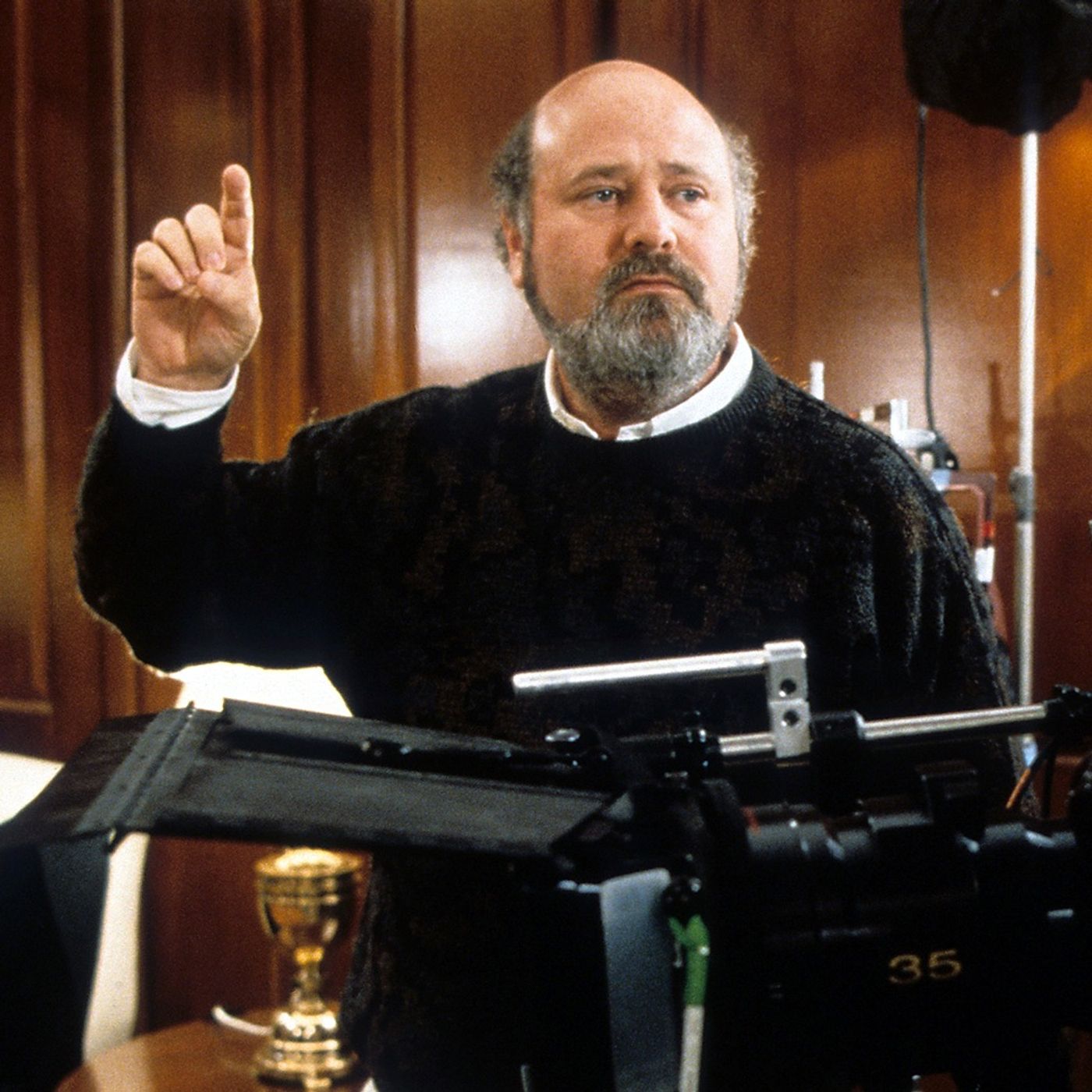
The Tragic Death and Enduring Legacy of Rob Reiner
Julia Jacobs, an arts and culture reporter for The New York Times, explains what we have learned about the deaths, and Wesley Morris, a critic at The Times, discusses why many of Rob Reiner’s films are so beloved.
Press play and read along
Transcript
This podcast is supported by the Capital One Venture X Card. Venture X offers the premium benefits you expect, like a $300 annual Capital One travel credit for less than you expect.
Elevate your earn with unlimited double miles on every purchase, bringing you one step closer to your next dream destination. Plus, enjoy access to over 1,000 airport lounges worldwide.
The Capital One Venture X Card, what's in your wallet? Terms apply. Lounge access is subject to change.
See capital1.com for
On Tuesday, prosecutors investigating the death of Rob and Michelle Reiner said they plan to charge the couple's son, Nick, with first-degree murder. Today,
Julia Jacobs on what we're learning about the death of a Hollywood legend and Wesley Morris on why so many of Reiner's films are among the most beloved movies ever made.
It's Wednesday, December 17th.
Julie, I appreciate you coming in today. Thanks for having me.
I just want to say at the outset, perhaps this is obvious, but the death of Rob Reiner and his wife, Michelle, is a very gruesome and tragic situation.
And we do not want to linger on it for a long time in this conversation. In fact, I hope we don't have to linger on it much at all.
But I do think
we should briefly talk about what we know at this point about what actually happened.
You're right. It's an absolute tragedy, and there are a lot of questions right now.
But what we do know is that on Sunday, the authorities were called to Rob Reiner's home in Brentwood, a neighborhood in Los Angeles. And
the first information that came out was that there were two deceased individuals inside. And they listed the ages, but not initially the identities.
But the ages matched up roughly with those of Rob Reiner, the Hollywood director, and his wife, Michelle Singer Reiner, who is a photographer and a producer.
And later that night, on Sunday night, their son, Nick, was arrested. And eventually, police said they were investigating his role in their deaths.
Right, which was a shocking piece of information.
Yes. And then on Tuesday, prosecutors announced that they intended to charge Nick Reiner with two counts of first-degree murder.
Right, making very official this genuinely horrible scenario in which a child had killed both of his parents. Correct.
And the son, Nick Reiner, had a long documented history of drug addiction.
And, you know, that story had been out there for years. He had struggled since he was a teenager.
He had been in and out of rehab.
He had gone through bouts of homelessness when he didn't want to be in the rehab that his parents wanted him to be in.
But he eventually made his way back home and started living in his parents' guest house.
And what I'm told is they had a very tight-knit, warm household. They spent a lot of time together.
And in fact, on Saturday night, some of my colleagues were told that Rob Reiner and Nick Reiner were at the house of Conan O'Brien for a Christmas party.
The night before.
The night before. And that, you know, one person told my colleague that Rob Reiner said something about his son's behavior, something to the effect of, you can't act this way.
And this was the night before Rob and his wife, Michelle, were found stabbed to death, allegedly, by Nick.
And what we all had to reckon with thereafter was
that this huge force in Hollywood, this enormously successful and influential director and producer, who himself had quite famously escaped the shadow of his own father,
had
allegedly, as you said, been killed by his own son. And I wonder if you can tell us that story of Reiner and how he became what he became.
So after the news of Rob Reiner's tragic death, everyone automatically started reliving his career. And something that he talked about a lot is his father, Carl Reiner.
He was a giant of 20th century television. He helped define the medium of television comedy.
He was a performer, a writer, director.
He created the Dick Van Dyke Show, one of the most celebrated comedies of all time. He won nine Emmys and directed many movies.
He worked as a close collaborator with Steve Martin.
And throughout Rob's long career in Hollywood, he could actually be quite candid about how overwhelming it could be to live in the shadow of his father. How did he talk about it?
He talked about feeling misunderstood as a child. Once he was quoted as saying it was frightening to be compared to him.
And he tells this story about how a friend of his father, Norman Lear, another giant of television, pointed out to Karl Reiner that, you know, his son Rob was quite funny.
But Carl Reiner was surprised. He's like, my son, funny.
I think he's quite quiet and sullen.
And in Rob's later years, he would tell that story a lot as an example of how he just felt like his father didn't get him. Didn't know him.
Right.
But he wanted to be like his father, just like his father, and he didn't shy away from that either.
He told another story that when his father, at one point, encouraged him to differentiate himself, he suggested, you know, what other name would you want to take on?
What would you want to change your name to? And Rob said, what if I changed it to Carl?
And so he embraced this desire to be like his father. He was a teenager on the set of the Dick Van Dyke show, learning everything he could about entertainment.
And, you know, eventually he got into theater. He struck out on his own.
And his first major television role, he was cast by Norman Lear, his father's friend. And this was for the sitcom from Television City in Hollywood.
All in the family.
Boy, the way Glenn Miller played.
Songs Songs that made my hip parade.
It was a defining television show of the 1970s for the way it put generational conflict on display.
This was a time when members of the silent generation, like the show's patriarch Archie Bunker, were really grappling with the youth counterculture that stemmed from the 1960s and the anti-war movement.
And Rob Reiner's character was this guy named Michael Stivick. He was a leftist, a pacifist, a hippie, and he was really the avatar for that younger generation.
Anything interesting in the paper?
Yeah, 200 arrested at Vietnam Day peace demonstration. 200.
They should have thrown a whole bunch of them in the can.
Well, I think they just don't like the idea of America fighting an illegal and immoral war.
Well, if they don't like it, they can lump it.
Take it down the road and dump it.
And a lot of the show's comedy came from this back and forth between Archie Bunker, the conservative father-in-law, to Mike Stivick, who he calls. Mike Stivick, you are a meathead.
Meathead. Meathead.
Right. A meathead.
Dead from the neck up. Meathead.
And even though they weren't, you know, father and son by blood, this was a show with a strong undercurrent of this familial narrative.
And the two two would fight over politics, over Michael's lack of a job that Archie would deem respectable. That's all you care about, Archie, is what you got and how you can keep it.
Well, you'd care about it too, sonny boy, if you had anything.
It wasn't living on for me without a pot to peel a potato in.
And yet there's also this deep undercurrent of love between them. Right.
There are moments of real connection.
And the scene that comes to mind immediately is one where they're stuck together in a storage room full of alcohol and you know both of them are drunk and talking about their fathers.
Did you ever think that that possibly your father just might be wrong?
Wrong my old man. Don't be stupid my old man.
I mean tell you about him he was never wrong about nothing. Yes, he was Arch.
My old man used to call people the same things as your old man. But I always knew he was was wrong.
So was your old man. No, he was.
Yes, he was.
Your father was wrong. Sir, your father was wrong.
It's this moment where Archie Bunker
kind of, whether he wants to or not, unloads a lot
about his own childhood.
Father who made you?
You won.
Your father.
The breadwinner of the house there.
the man who goes out and busts his butt to keep a rope over your head, and clothes on your back. You call your father wrong.
Hey, hey, your father.
Your father.
Archie Bunker has this conviction that he shares with Michael Spivak that a father cannot be wrong.
And yet he explains all that his father did to him as a child. My father had a hand on him now.
I tell you,
he busted that hand once and he busted her on me
to teach me to do good.
My father, he shoved me in the closet for seven hours to teach me to do good.
Cause he loved me. He loved me.
And yet there's still this nagging conviction that a father can't be wrong. Let me tell you something.
You're supposed to love your father
because
your father loves you.
How can any man that loves you
tell you anything that's wrong?
And as Archie Bunker is telling this story, the reaction of Michael,
it seems to dawn on him why his father-in-law is like this, why he's so harsh on him, why their relationship can be so at odds, because
he doesn't always act like his father-in-law is always right.
And at the end of the scene, you know, as Archie Bunker lies down and falls asleep, there's this really tender moment where Michael gets up and
puts the blanket over him almost in a fatherly way. Right.
The son-in-law Reiner becomes, in a sense, the father, the parent of a suddenly, quite openly wounded, although not self-aware, of his wounds, Archie Bunker.
It's a really tender moment, and in this comedy, it really stands out as
a moment of real substance. This was a huge breakout role for Reiner.
He won two Emmys, and he spent really the second half of his 20s and into his 30s on this show.
But he had this nagging feeling that he wanted to do more. He wanted to direct.
And so, after All in the Family ended, he became a prolific film director.
And his first major feature film was This is Spinal Tap in 1984. Your first drummer was
John Stampy Pepys. Oh, yeah.
Great, great
tall, blonde geek with glasses.
Good drummer. Great look, good drummer.
Yeah, good drummer.
What happened to him?
He died. He died in a bizarre gardening accident some years back.
And for those who don't know that movie, it's quite specific. Yes, it's this satire about a hapless British metal band that really helped define the form of mockumentary.
This is a top to you know what we use on stage, but it's very, very special because if you can see, yeah, the numbers all go to 11.
Look, right across the board, 11, 11, and mostly 11 and amps go up to 10. Exactly.
And Reiner's in this movie, he doesn't just directly do that. Right, he's in it as kind of the straight man.
One louder. Why don't you just make 10 louder and make 10 be the top number and make that a little louder?
These cards are 11. And this release really started the spectacular eight years of cinema for Reiner, where he leapfrogged from genre to genre and really became a force in Hollywood.
You had the coming-of-age drama Stand By Me.
You had the fantasy adventure film, The Princess Bride. Hello! My name is Iniego Mantaya.
You killed my father. Prepare to die.
Stop saying that!
You had the psychological thriller, misery.
You dirty bird. How could you? The courtroom drama, a few good men.
You want answers? I think I'm entitled. You want answers? I want the truth.
You can't handle the truth.
And of course, the rom-com, probably his most famous movie of all, when Harry Met Sally.
I know. But I would be proud.
But I would be proud. Touparte.
Touparte. Of your pecan pie.
Of your pecan pie. Peak and pie.
Peak and pie.
Peek and pie.
Right. And these movies are not just memorable.
They literally become part of pop culture, part of our vernacular.
There is a quote from each and every one of the movies you just mentioned that either one of us could recite back to each other, including, and this is from Spinal Tap,
it's such a fine line between stupid and clever.
Or from a few good men, you can't handle the truth. I can't handle the truth.
And what's fascinating about this string of movies is that Reiner would often tap into his own personal experiences in making them. I think he said that's what kept him honest as a filmmaker.
And one example of that is Stand By Me, which is based on a novella by Stephen King.
It's not the secret knock.
I forget the secret knock. Let me in.
And it's about four preteen boys who have this adventure. So, what are you pissing and moaning about, Verno? You guys want to go see a dead body? Trying to find this dead body.
And along the way, they're revealing the story of who each of them are. Right.
And when it comes to the protagonist, this 12-year-old aspiring writer, he has this devastating scene where he breaks down in front of his friend. Why did he have to die, Chris?
Why did Denny have to die?
Why?
His brother, his beloved older brother, had just died, and he was expressing how he felt like his father wishes that he was the one who died. He hates me.
He doesn't hate you.
He hates me. No, he just doesn't know you.
He hates me. I never hates me.
And his friend is sitting there trying to console him in the best way he can, you know, as a kid. And Reiner would say that that is how he felt as a little boy.
You're going to be a great writer someday, Gordy.
You might even write about us guys if you ever get hard up for material.
He felt like the character Gordy talking to his friend. Right.
And he felt like his father didn't know him.
And, of course, Reiner's personal life ends up figuring into the plot of when Harry Met Sally.
Right. Reiner had the idea for when Harry Met Sally after he divorced his first wife and he was back in the dating pool and actually in the making of that movie he was introduced to his wife Michelle.
And the way he tells it he actually changed the ending of the movie after meeting Michelle. He changed it so that the two protagonists end up together.
Right.
And it's actually kind of unfathomable that that movie would end any other way than it did with Harry and Sally in that famous scene telling each other that they love each other and that they will be together.
Absolutely. It's film history.
And over the years, Reiner's success goes beyond even directing. He starts this production company, Castle Rock, that ends up creating some of the classic movies.
And Seinfeld. Exactly.
It actually produced one of the most successful comedy series in history, Seinfeld. Pretty full circle for a guy who stars in one of the great sitcoms of his era.
Right.
And he also has this vibrant political life. He gets really involved in the fight for gay marriage.
He actually spearheads a ballot measure revolving around early education in California.
He becomes this really multifaceted figure that is known for more than just his filmmaking. Right.
And he becomes a thorn in the side of President Trump.
Absolutely. I mean, Reiner.
was against Trump from the beginning, became a vocal critic over the years, and in one of his final interviews in recent months, warned that Trump was leading the country into autocracy.
And this was all thrown into sharp relief after his death when Trump suggested that his death had to do with Reiner's own opposition to him.
Aaron Ross Powell, right, which is a pretty wildly unsubstantiated, I dare say, reckless claim. And I think that, Julia, brings us back to Reiner's relationship with his son, which we started with.
And I know that the two, father and son, end up working on a film together.
Right.
As everyone sifts through what there is on the internet about the relationship between Nick and his parents, what keeps coming to the fore are these interviews that he did with his father when they were making this movie together.
Right. And just remind us about this movie.
It's called Being Charlie, and it's actually loosely based on their own relationship, focused on a son who who is battling a drug addiction and a father who's an actor turned politician.
And the idea from this movie came from Nick Reiner when he was in rehab. You know, throughout his teenage years, he said he was in treatment roughly 18 different times.
And in one of those rehab facilities, he meets a friend who he starts working on a script with, and they're pulling from their experiences with drug addiction.
Now, eventually, Rob Reiner embraces the idea of making this script into a full-length film and that becomes Being Charlie which is directed by Rob Reiner.
There was clearly a deep conflict between Nick and his parents over how to approach his own addiction recovery and those themes really shine through in the movie.
There's this line where the father in the movie is talking to his son who's battling drug addiction and the father says All I could tell myself was I'd rather have you alive and hating me than dead on the streets.
Wow. And so during this round of interviews, Rob and Nick are talking about how this movie affected their relationship.
And how did it affect it?
We didn't do it to be cathartic, but it turned out that that's what happened. I mean, Rob said it made him understand his son a lot more and that he hoped it made him a better father.
And that brought us closer together.
And Nick said, we didn't bond a lot as a kid. Like, he really likes baseball.
I like basketball. And he could go watch that with my brother, but baseball.
Even though he and his father didn't bond a lot as a kid, it better helped him understand his dad. It made me feel closer to him.
And in those interviews, it's clear that Nick and his parents had worked very hard to keep him sober. But Nick also talked later about relapsing after the movie came out.
After this healing exercise of making a movie with his dad. Right.
There was a podcast where he talks about having a heart attack on a plane from cocaine use and ending up in the hospital.
And there's another time he talks about being on cocaine and completely wrecking his parents' guest house, which he lived in,
where he punches the television, punches a lamp, you know, and the whole place ends up in shambles.
So, in these interviews, it's clear that the whole family was striving for sobriety for Nick and some lasting stability in terms of the family relationship.
But it never came.
Well, Julia, thank you very much. We appreciate it.
Thanks for having me.
After the break, Wesley Morris on why Rob Reiner's movies are so beloved.
We'll be right back.
AI promised intelligence, but it also exposed everything we couldn't see. Now there's a new way forward, where protection, governance, and AI trust move as one.
Veeam and Security AI, accelerating safe AI at scale. Learn more at Veeam.com.
This podcast is supported by the International Rescue Committee.
Co-founded with help from Albert Einstein, the IRC has been providing humanitarian aid for more than 90 years.
The IRC helps refugees whose lives are disrupted by conflict and disaster, supporting recovery efforts in places like Gaza and Ukraine, and responding within 72 hours of crisis.
Donate today by visiting rescue.org/slash rebuild. We all have moments when we could have done better, like cutting your own hair.
Yikes. Or forgetting sunscreen so now you look like a tomato.
Ouch.
Could have done better. Same goes for where you invest.
Level up and invest smarter with Schwab. Get market insights, education, and human help when you need it.
Learn more at schwab.com.
Wesley, thank you for making time for us. Of course.
I mean, I'm sad that it has to be under these circumstances. It's a really sad circumstance.
As our colleague Julia Jacobs just walked us through.
It's a really tragic end to a remarkable career. And the reason we've asked you to come in the studio is because we wanted a critics assessment of the career and the work of Rob Reiner.
You are the Times' chief critic. You're also, and I know this from first-hand experience, a genuine film buff.
So in that context, what is the significance in your mind of Reiner and the films that he directed? What kind of a filmmaker was he in your mind?
He was the sort of director who was really interested in pleasing people, right? He wanted to make movies that made people happy.
Even when they were like dark movies, he was looking for a way to
find the pleasure centers that we as moviegoers
needed met when we went to a movie theater. Or, you know, because a lot of the times with Reiner, you would be watching these movies at home over and over and over again.
Over and over again.
And because they somehow made their way onto your TV screen at home over and over and over again. Oh, yeah.
Whether you went to a video store and pulled one of those movies off the shelf or it was just on cable all the time.
The thing about them that is so wonderful is also the thing that made Rob Reiner kind of
he wasn't a critics director, right?
In a lot of ways, you go back and read the reviews of his movies and it would always be, the charge would be the movies didn't go far enough. They didn't go deep enough.
They weren't getting into the nitty-gritty of human relationships in the way that they probably could have. Right.
In fact, I went through this exercise within the last 24 hours, and it should be humbling to the film critics of the world. You go back and look at the reviews of something like Stand By Me.
Sure.
I just wish
that I could go someplace where nobody knows me
In the Times. Too much saccharin.
Sure.
But that's not the experience of a young Michael Barbara watching Stand By Me and finding it to be a complete revelation of what brotherhood, fraternity, and youthful adventure might look like.
I mean, I think the thing about Rob Brainerd that's this important to make the distinction between is a question of what the greatest movies are and what your favorite movies are.
He makes your favorites. That man has made your favorite movie.
He's made one of your favorite movies and everybody's got one. He's made two of my favorite movies and like, you know,
When Harry Met Sally, I mean, come on. There's a couple of things with Rob Reiner that makes this outpouring of grief over his death important.
His peak as a director was at a time when the movies were interested in just simple things brought to life by a good script and a couple of stars. These are not values the movies have anymore.
These are bygone aspects of American movie making. And he embodied, he was one of the principal embodiments, his movies were of that era.
For me, when Harry Met Sally was great because It had these two people that I kind of knew, Meg Ryan and Billy Crystal.
Rob Reiner made them movie stars. This movie made them movie stars.
It's kind of hard to imagine that they weren't movie stars before that, but somehow. Yeah, you'd seen them in things before.
And, you know, Billy Crystal was a well-known comic, and Meg Ryan was somebody who'd been in other movies as like a supporting character.
And you also had in Harry Met Sally this great script by Nora Efron. Nora Efron, William Goldman, Aaron Sorkin, they wrote the great Rob Reiner movies.
And
he knew what to do with a good screenplay and good actors.
And part of the pleasure of watching them all congeal,
just come together and, you know, transmogrify into this like amazing experience of just feeling, right? I mean, you watch The Princess Bride and it's all exuberance.
You watch when Harry met Sally and it's just whatever you believe about people getting together and like spending time with each other and communicating. It's amazing.
You look like a normal person, but actually you are the angel of death. Are you gonna marry him?
We have only known each other for a month and besides, neither one of us is looking to get married right now. I'm getting married.
You are?
You are.
Just some great talk.
Well, you're getting on your own to what I
deeply would love for you to do,
which is to take us into one scene of a Reiner-directed film.
And at this point, I have to believe, because of what you've already said, that that scene is going to be coming from When Harry Met Sally. Sure.
And there's a lot of scenes in that movie.
I think When Harry Met Sally, to me, it's the peak of all his priorities as a filmmaker. The human part, the love part.
And obviously, if you're going to boil this movie down to one scene, it's the diner scene, right? It's the deli scene.
Meg Ryan, Sally, and Billy Crystal, who's Harry, these people have been friends now for a few years, and
they are very familiar with the cadences of each other's dating and sex lives.
They go to have lunch one day and they proceed to talk about Harry's latest disappointment romantically. It's not working out.
It's not working out, and she's gone and he has moved on.
So, what do you do with these women? You just get up out of bed and leave? Sure.
Well, explain to me how you do it. What do you say? Just to have an early meeting, early haircut, or like squash game.
You know, play squash. I don't know that.
They just met me.
That's disgusting. I know, I feel terrible.
And she's like, well,
you probably wouldn't know that a woman's never been satisfied by you.
Hey, I don't feel great about this, but I don't hear anyone complaining. Of course not.
You're out the door too fast.
I think they have an okay time.
How do you know?
I mean, how do I know I know? And he's like, I think I would know because I was there.
I created the satisfaction. Because they.
Yes, because they.
How do you know that they're really.
What are you saying that they fake orgasm? She's like, Meg Ryan, Sally, says, well. Why? Most women at one time or another have faked it.
I'm telling you that most women at some point in their lives have faked it. Well, they haven't faked it with me.
How do you know?
Because I know.
And he's like, no, they haven't. That's insane.
Right. That's right.
I forgot. You're a man.
What is that supposed to mean? Nothing.
It's just that all men are sure it never happened to them, and most women at one time or another have done it, so you do the math.
You don't think that I can tell a difference?
No.
You're ass.
So I cut to Meg Ryan. Her eyes go, oh, okay.
There's like a twinkle, like a little mischievous twinkle. She's telling us, she's telegraphing to us what she's about to do.
And she kind of half-smiles and she proceeds to start
her orgasm.
Are you okay?
And she does not break.
And this is a really difficult thing to do, both directing and editing-wise, because you have to, there's a rhythm that has to be maintained here. Oh, God.
Ooh, oh, God.
But you also have to establish that she is staying in this orgasm, and he is going to suffer through the discomfort of watching her perform it.
Oh, yeah, right there.
And that all of this, we should just remind the listener, revolves around the consumption of a very average looking sandwich.
That's, we got to talk about the sandwich because it's just a pile of meat.
But there's a cut to Harry and his increasing awareness that what is happening is happening and he is about to lose this argument. But Billy Crystal is performing increasing mortification at the fact.
Now, it's interesting because it's simultaneously him losing this argument and him being embarrassed by this spectacle that she's created.
And there are so many looks on his face of just like, oh my God. She's, oh my God, oh my God.
And he's like, oh my God.
And so there's this tension. There's this like physics between
his
mortification and her ecstasy.
And an important thing happens at about the 30th second in this scene. Wow, you really don't know.
Well, of the orgasm part of this scene. The scene goes like three minutes long.
It's this. The camera's on Meg Ryan mid-fake orgasm.
And a man turns around behind her. And he is wearing a Yankees cap.
And he is completely deadpan,
but looking in her direction.
And it's just the two of them in this shot. And you realize, oh my God, you as a viewer realize they're not going to do the thing that a television show would do.
This is the Rob Reiner going to the movies part. This is Nora Efron knowing how the world works.
We're not going to pretend that this is a closed environment and these people are just here to make you think you're in a diner.
People are going to hear this orgasm. Lots of people.
Because it could have ended just like that. It could have ended the minute that guy in the Yankees cap turns around.
Even before that, Billy Crystal was selling the comedy in this bit as much as Meg Ryan is. You could have just ended it right there.
That scene could have ended and she would have just like, I rest my case.
But instead, this scene goes on for like another 30 seconds. Yeah, it's deeply uncomfortable.
No, Michael, no. It's not uncomfortable at all.
It's hilarious. Hilariously uncomfortable.
And the thing that makes it hilarious is us, the people watching this woman fake this orgasm. They don't know she's faking it.
They don't know what's going on.
This sandwich must be real good.
This pile of meat must be doing something to this woman.
Every subsequent shot during this sequence, we've established how Meg Ryan is going to perform her fake orgasm. We understand that Billy Crystal is mortified.
But now we spend the rest of this sequence, most of the rest of it, watching everybody else in the deli react.
Oh, yes.
Like, not even react. They're just watching her do this.
And it's, it's an amazing sight because some people are concerned. Some people are like, you know, it's New York.
So this is also one of the great New York movies, right? So it's New York. And people are like, oh, it's Orgasm Day, I guess, in the deli.
Okay, great. Fantastic.
And
she reaches her climax. Yes! Yes! Oh!
Oh!
Oh!
Oh, God.
She picks up her fork. She stabs her salad or whatever it is that's on that plate.
She takes a bite.
And we go from shot, reverse shot, cutaway, cutaway, cutaway, to a, like I would say, a master shot of the two of them facing each other in the booth.
And you can see in the background, two women also having a meal, looking at Meg Ryan.
And the famous line. Because the scene could have ended.
Right, right. When she picks up the fork, we're done.
We're done. This scene is already killed.
But he goes for it. We're done.
And this woman says to the waiter,
you know the line.
I'll have what she's having.
I'll have what she's having.
Yeah, it's one of the most memorable lines in all of cinema.
It never gets old. You could watch that once a week and still pee pee your pants because
that's how joyful it is. It's just how joyful it is.
Also, it's so New York. I
by the way, that's his mom who says it. Oh, yeah.
Estelle Reiner is the person who delivers the line. Perfection.
Perfection. But also, the thing that kills is not just the line.
It's the look of like, I guess I'll have to have what she's having. Like her face is like, it's not, she does not look delighted.
She looks kind of disgusted and repulsed, but it's like, I just need to see what this is all about. It's as funny as it is because Rob Reiner keeps going, right?
And he understands there's still another joke in there somewhere. I want to, I want to get all the jokes out.
So I want to pause
for just a moment
and talk about how you, how we should juxtapose all of the hilarity and joy that you just described that defines these films. How we're supposed to hold that in one hand
and the brutality and the awfulness of how his life ends
in the other.
The terrible thing about this death, a terrible thing about it, in terms of the millions of people who never met, didn't know Rob Reiner, but whose lives were touched by his work is that the work was about the opposite of how he died
and
yet
you know the very moving aspect of this grisly tragedy is i mean from all reports you know the riners were determined to like help their son right
the ethos of the family life is the ethos of the filmmaking You know, sometimes to the movie's detriment because the movies didn't want to go to really dark places.
The movies weren't about the real darknesses, right? The real difficulties. They were about the attempt to believe in our better natures, our better selves.
And that is what is so shocking about his death. But, you know, I was,
you know, as one, as at least I do, when great or important people die in popular culture,
you were often tasked with eulogizing them in print.
Yeah, and so you go back and you look and see how things went for them in real time or how they've been memorialized before their death, how their work is considered.
And I found, you know, one of the great Tomes, one of the great movie projects ever,
is David Thompson's Biographical Dictionary of Film. It's right here.
I've got a new biographical dictionary of film.
The Merriam-Webster's of movies written by one man, David Thompson. And his Rob Reiner entry is
kind of amazing because he's a little more dismissive of the wonderful movies. He gets it, but he doesn't really.
They're not for him, apparently.
But here's what he says in his dismount, and it's deep.
As a director, Rob Reiner, he seemed more struck or polaxed by the notion that niceness could save the the world.
It is a petty thought, but one that stifles so many human and social realities.
And so his work turns to pie in the sky, with good and bad all too clearly labeled. He's carried along by a fundamental decency and a sense of scenes that play.
But his films are predictable from their first moments and they begin to establish a weird, dumb orthodoxy that if we're good to our kids, everything will be okay.
This is not true. Life is more interesting.
Wow.
I mean, that is, Rob Reiner was very alive when that was written. And I think
terribly prescient.
I think the thing that made him lovable, Rob Reiner, as a human being, the reason he was so beloved by so many different people
was that he
really
believed in the fundamental goodness of people
no matter what.
You know, it's an impossible situation for a parent to turn your back on a child. Right.
And in the end, he did not. And he didn't because, you know, those movies were this man
for better and for worse, but ultimately for better because they were about our better selves.
This was a man who believed in life. He believed in people.
And the movies stand as a testament to that belief, as far as I'm concerned. And when it clicked, and for like,
I'd say 10 years, this man was humming.
It really, really, really
made people happy, the work that he made. And it's just that, you know, there's the family tragedy part and then there is the
happy guy part. He just seemed like such a joyful, like a, he was a big bear of a man.
And
you just, he seemed like either he was gonna hug you or you could hug him completely and he would be okay with that
his movies were like that too for the most part they were they're always there to hug you and if you want to hug them back feel free because they're on HBO right now
and Netflix and Amazon um Wesley thank you very very much appreciate it Michael you're welcome and I'm sorry that I'm sorry that I have to be here to do it.
We'll be right back.
At Memorial Sloan Kettering Cancer Center, we know that a cancer diagnosis touches more than than one life. It touches entire families.
Make a gift to MSK in honor or in memory of someone you love.
Your donation fuels groundbreaking research and compassionate care for patients and their families all over the world. Honor their legacy.
Give hope to others.
Your impact can be doubled for a limited time. Donate now at msk.org slash honor dash 2x.
This podcast is supported by the International Rescue Committee. Co-founded with help from Albert Einstein, the IRC has been providing humanitarian aid for more than 90 years.
The IRC helps refugees whose lives are disrupted by conflict and disaster, supporting recovery efforts in places like Gaza and Ukraine, and responding within 72 hours of crisis.
Donate today by visiting rescue.org/slash rebuild. We all have moments when we could have done better.
Like cutting your own hair. Yikes.
Or forgetting sunscreen so now you look like a tomato. Ouch.
Could have done better. Same goes for where you invest.
Level up and invest smarter with Schwab. Get market insights, education, and human help when you need it.
Learn more at schwab.com.
Here's what else you need to know today.
On Tuesday, President Trump expanded the U.S. travel ban to cover five more countries countries and added partial bans on 15 additional countries.
The bans, which began in June, started with countries including Afghanistan, Myanmar, and Haiti. The newly banned countries include Mali, Niger, South Sudan, and Syria.
Palestinians are also now banned. Those affected by the bans cannot immigrate to or enter the United States.
Trump has described the banned countries as, quote, third world, and declared that their citizens pose a threat to Americans.
And the Australian government said that the gunmen who carried out the mass shooting at a Jewish celebration over the weekend were motivated by ISIS.
Police said that they found two homemade Islamic State flags in the car that the suspects, a father and son, had driven to the site of the massacre.
Today's episode was produced by Michael Simon Johnson, Mooj Sadie, and Luke Vanderpluk.
It was edited by Brendan Klinkenberg and Michael Benoit,
contains music by Diane Wong and Dan Powell, and was engineered by Alyssa Moxley.
That's it for the daily. I'm Michael Rebar.
See you tomorrow.
This podcast is supported by the International Rescue Committee. Co-founded with help from Albert Einstein, the IRC has been providing humanitarian aid for more than 90 years.
The IRC helps refugees whose lives are disrupted by conflict and disaster, supporting recovery efforts in places like Gaza and Ukraine, and responding within 72 hours of crisis.
Donate today by visiting rescue.org/slash rebuild.