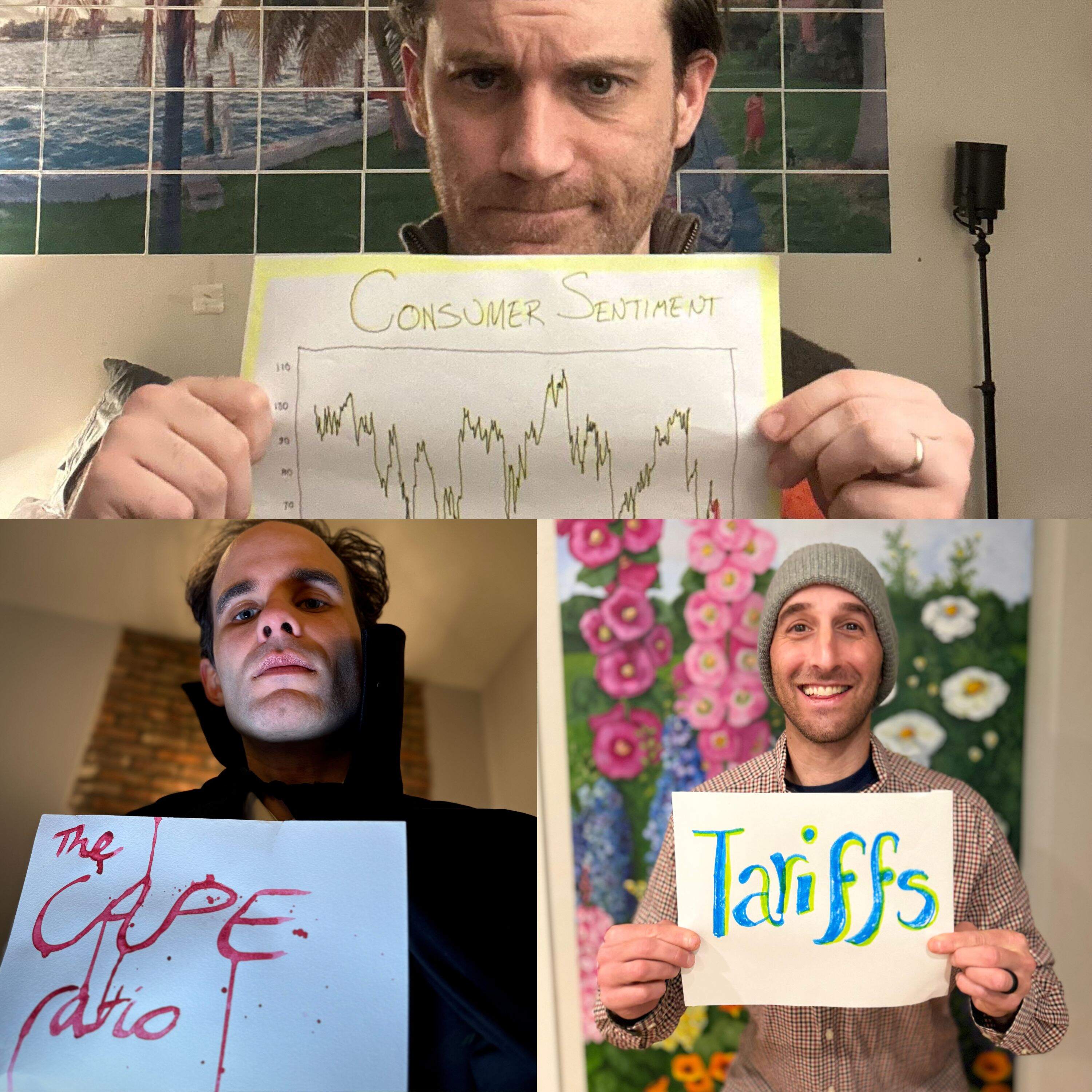
This indicator hasn’t flashed this red since the dot-com bubble
You can find John Campbell's book here: Fixed: Why Personal Finance is Broken and How to Make It Work for Everyone
Related episodes:
What’s a Bubble?
Zombie 2nd mortgages are coming to life, threatening thousands of Americans' homes
For sponsor-free episodes of The Indicator from Planet Money, subscribe to Planet Money+ via Apple Podcasts or at plus.npr.org. Fact-checking by Tyler Jones. Music by Drop Electric. Find us: TikTok, Instagram, Facebook, Newsletter.
Learn more about sponsor message choices: podcastchoices.com/adchoices
NPR Privacy Policy
Press play and read along
Transcript
Speaker 1 NPR.
Speaker 2 This is the indicator from Planet Money. I'm Darien Woods.
Speaker 1 And I'm Patty Hirsch. At this point, we can pretty much stipulate that the internet can be a very scary place.
Speaker 1 And right now, it's particularly scary if you pay close attention to a certain stock market indicator that a lot of internet people are wigging out about.
Speaker 2 It's called the Schiller PE ratio and it's at its highest level since November of 1999.
Speaker 2
So 1999 was a turbulent time. This was the peak of an online gold rush.
Investors making big bets on how the internet was going to change everything.
Speaker 1
Heady times, GeoCities, Excite, Pets.com. It all ended up being a huge dot-com bubble that burst spectacularly in 2000.
And it was actually really scary. You know, the market cratered.
Speaker 1 Lots of companies went out of business, including the one that I was working at at the time. Pretty soon after the bubble burst, I was out of work.
Speaker 2 Yeah, so the scars are real. And because it's a bit scary and because it's an indicator and because this is the indicator, today we're going to look at the Schiller-PE ratio.
Speaker 2 We'll explain what it is and how it works and tell you whether or not you need to be scared too. That's coming up after the break.
Speaker 3 This message comes from ATT. America's first network is also its fastest and most reliable.
Speaker 3 Based on Root Metrics United States Root Score Report 1H 2025, tested with best commercially available smartphones on three national mobile networks across all available network types, your experiences may vary.
Speaker 3
Root Metrics rankings are not an endorsement of ATT. When you compare, there's no comparison.
ATT.
Speaker 3
This message comes from LinkedIn Ads. One of the hardest hardest parts about B2B marketing is reaching the right audience.
That's why you need LinkedIn ads.
Speaker 3
You can target your buyers by job title, company, role, seniority, and skills. All the professionals you need to reach in one place.
Get a $250 credit on your next campaign so you can try it yourself.
Speaker 3
Just go to linkedin.com slash nprpod. That's linkedin.com slash nprpod.
Terms and conditions apply only on LinkedIn ads. This message comes from Wealthfront.
Speaker 3 It's time your hard-earned money works harder for you.
Speaker 3 With WealthFront's cash account, you earn a competitive APY on your cash from program banks higher than the average savings rate with free instant withdrawals to eligible accounts.
Speaker 3
Go to wealthfront.com. Cash account offered by Wealthfront Brokerage LLC.
Member FINRA SIPC, not a bank. Funds are swept to program banks where they earn the variable annual percentage yield.
Speaker 1 All right, so the Schiller-PE Schiller ratio.
Speaker 4 It was developed by Robert Schiller, who is an economist.
Speaker 2 This is Lizanne Saunders. She's the chief investment strategist at Charles Schwab, and she quite often consults the ratio, which is sometimes called the CAPE.
Speaker 4
Cyclically adjusted, price to earnings is CAPE. So it's often shortened to Schiller's Cape.
Schiller's Cape?
Speaker 1 He's like a stock market superhero.
Speaker 2 Yeah, with an acrostic poem to match.
Speaker 1 But Schiller didn't come up with this CAPE concept on his own, Lizanne says. There's another hero in this story.
Speaker 4 Also another economist, John Campbell. I'm not sure why his name is not attached to the metric.
Speaker 5 Well, I think it should be the Campbell-Schiller Cape, strictly.
Speaker 1 This is John Campbell. economics professor at Harvard, author of a new book called Fixed, and of course co-creator of what should be called the Campbell-Schiller Cape.
Speaker 1 He's got no hard feelings, though.
Speaker 5 In fairness, Bob Schiller did a lot of work work popularizing it and he used it very importantly in his famous book Irrational Exuberance.
Speaker 5 So in no way do I begrudge the fame that Bob won by doing that.
Speaker 2 John and Bob Schiller came up with the CAPE in the 1990s, just ahead of the dot-com crash. It built on the age-old method of valuing a company with a PE or price-to-earnings ratio.
Speaker 2 Let's go through the explainer, Patty.
Speaker 1 Okay, just a short one. The PE, the price-to-earnings ratio, is where you divide a company's stock price by its earnings per share.
Speaker 1 You compare whatever number you get to a bunch of other data about the sector, the company's past earnings, etc. And that tells you whether the stock is cheap or expensive or Goldilocks.
Speaker 2 The CAPE ratio blows this concept wide open, and it applies to the entire S ⁇ P 500 and not just for the last year of earnings.
Speaker 4 It looks at the average of real earnings over the past 10 years. So it's a much longer historical look back than your standard 12-month trailing earnings that might be in a more standard PE.
Speaker 1 Yeah, going back a whole decade takes volatility out of the question. Like if you looked at the PE ratio for just 2020 when the pandemic made a royal mess of the market, you'd get a skewed number.
Speaker 1 Over 10 years, you get a much more accurate picture of the way the market has performed. And CAPE also adjusts for inflation.
Speaker 4 What CAPE does is it kind of provides a normalized measure of how expensive or cheap stocks are relative to their long-term earnings power.
Speaker 2 A high CAPE number means stocks are expensive and a low number means they're cheap. Right now, John says the number is pretty darn high.
Speaker 5
It is close to a record level. It's not quite as high as it was at the peak of the technology boom in the year 2000.
At that time, the ratio peaked at about 45.
Speaker 5 But the CAPE ratio today is pretty close to 40. And that's higher than it's been at any other time besides the turn of the millennium.
Speaker 1 Okay, I'm sorry, but whenever you use the word millennium to quantify something in the market, you're pretty much guaranteeing a freakout, in my opinion.
Speaker 1 But before we all lose our minds, John says, if you're looking to the CAPE number to tell you what's going to happen in the market tomorrow or in the next few weeks or even the next few months, you are looking at the wrong dial on the dash.
Speaker 5 This isn't something that's going to tell you, oh, there's going to be a crash tomorrow or even this year.
Speaker 5 But if you look over 10 years, high values of this ratio are associated with low subsequent 10-year returns, and low values of the ratio are associated with high values.
Speaker 2 In other words, when the CAPE number is high, returns tend to be lower over time.
Speaker 2
And when the number is low, returns tend to be higher. Again, over time.
This is a long-term predictor.
Speaker 1 But Lizanne says that is not the way that a lot of people are reading the CAPE right now.
Speaker 1 No, they are seeing the number, they're remembering or looking at charts that show how the market fell out of bed the last time it was that high before the dot-com crash.
Speaker 1 And oh my god, they're predicting a wipeout.
Speaker 1 And that is just not the way the ratio works.
Speaker 4 The market can sometimes get on a roll and
Speaker 4 buck what on paper anyway would often be seen as a contrarian signal from some of these indicators.
Speaker 4 There are times where valuations become very expensive and stay expensive for an extended period of time, and the market continues to do well, and vice versa.
Speaker 1 The CAPE, she says, works best as a gauge of investor sentiment. If investors are feeling flush and confident and bullish about the future, they'll be willing to pay more for stocks.
Speaker 4 It's sort of taking the temperature of the market, which is lots of enthusiasm. And at times,
Speaker 4 there's just less regard for whether the market is expensive or not.
Speaker 2 And she says, right now, the market is expensive, regardless of what indicator you choose to look at. And that's just one thing giving market strategists like her concern.
Speaker 4 There's, in general, a concern right now about the market being in some sort of bubble. A little more of an AI-specific concern, but lots of comps to the late 1990s.com bubble.
Speaker 1 The comparisons are pointed, John says. As with the internet in the late 90s, a lot of companies are pouring a lot of money into a nascent technology with AI.
Speaker 1 And none of them have a real idea of what just AI might or might not be able to achieve.
Speaker 5 They can't all win. There may be one winner, or even two, but there's not going to be five, six, or seven winners.
Speaker 2 It's not at all clear what competition or regulation or politics might do in the race to adopt and monetize AI.
Speaker 2 John says the picture is complicated by the fact that much of the investment is coming from just a few big corporations that actually take up a third of the market.
Speaker 5 We're in a strange time where you have a mix of excitement about the prospects for AI and optimistic narratives about what AI may do to growth, and also a lot of apprehension about AI and its disruptive potential.
Speaker 1 Yeah, and something similar happened before the dot-com bubble burst also, but high valuations aren't necessarily off base.
Speaker 1
Like back in 99, for example, Cisco Systems had a price-to-earnings ratio of nearly 200. I mean, that's ridiculously expensive.
But guess what? It ended up being a good bet.
Speaker 1 Companies can grow into their valuations, and the market can too.
Speaker 2 And this is why Lizanne and John say that even though the CAPE ratio is the highest in a quarter century, it can't tell you anything about what's right around the corner.
Speaker 2 10 years down the road, on the other hand.
Speaker 5 If exuberance is a state of of mind that tends to wear off gradually, then the exuberance that we see today is unlikely to still be there, say, in 10 years.
Speaker 5 And that will mean, in all probability, that prices will be lower in 10 years, or at least lower in relation to earnings.
Speaker 1 Well, with the caveat that neither Darian nor I are specialists in personal finance, and that nothing in this episode constitutes investment advice, please do, listener, come back to us in a decade and we'll see how we all did.org.
Speaker 1 Looking forward to seeing you.
Speaker 1
This episode of The Indicator was produced by Cooper Katz McKim and engineered by Kwasey Lee. It was fact-checked by Tyler Jones.
Kate Kincannon is our editor and The Indicator is a production of NPR.
Speaker 3 This message comes from Vanguard. Capturing value in the bond market is not easy.
Speaker 3 That's why Vanguard offers a suite of over 80 institutional quality bond funds, actively managed by a 200-person global team of sector specialists, analysts, and traders.
Speaker 3
They're designed for financial advisors looking to give their clients consistent results year in and year out. See the record at Vanguard.com/slash audio.
That's Vanguard.com/slash audio.
Speaker 3
All investing is subject to risk. Vanguard Marketing Corporation, Distributor.
Support for NPR and the following message come from Washington Wise.
Speaker 3 Decisions made in Washington can affect your portfolio every day. Washington Wise from Charles Schwab is an original podcast that unpacks the stories making news in Washington.
Speaker 3 Listen at schwab.com slash WashingtonWise.
Speaker 4 This message comes from Greenlight. Ready to start talking to your kids about financial literacy?
Speaker 4 Meet Greenlight, the debit card and money app that teaches kids and teens how to earn, save, spend wisely, and invest. Start your risk-free trial at greenlight.com slash npr.