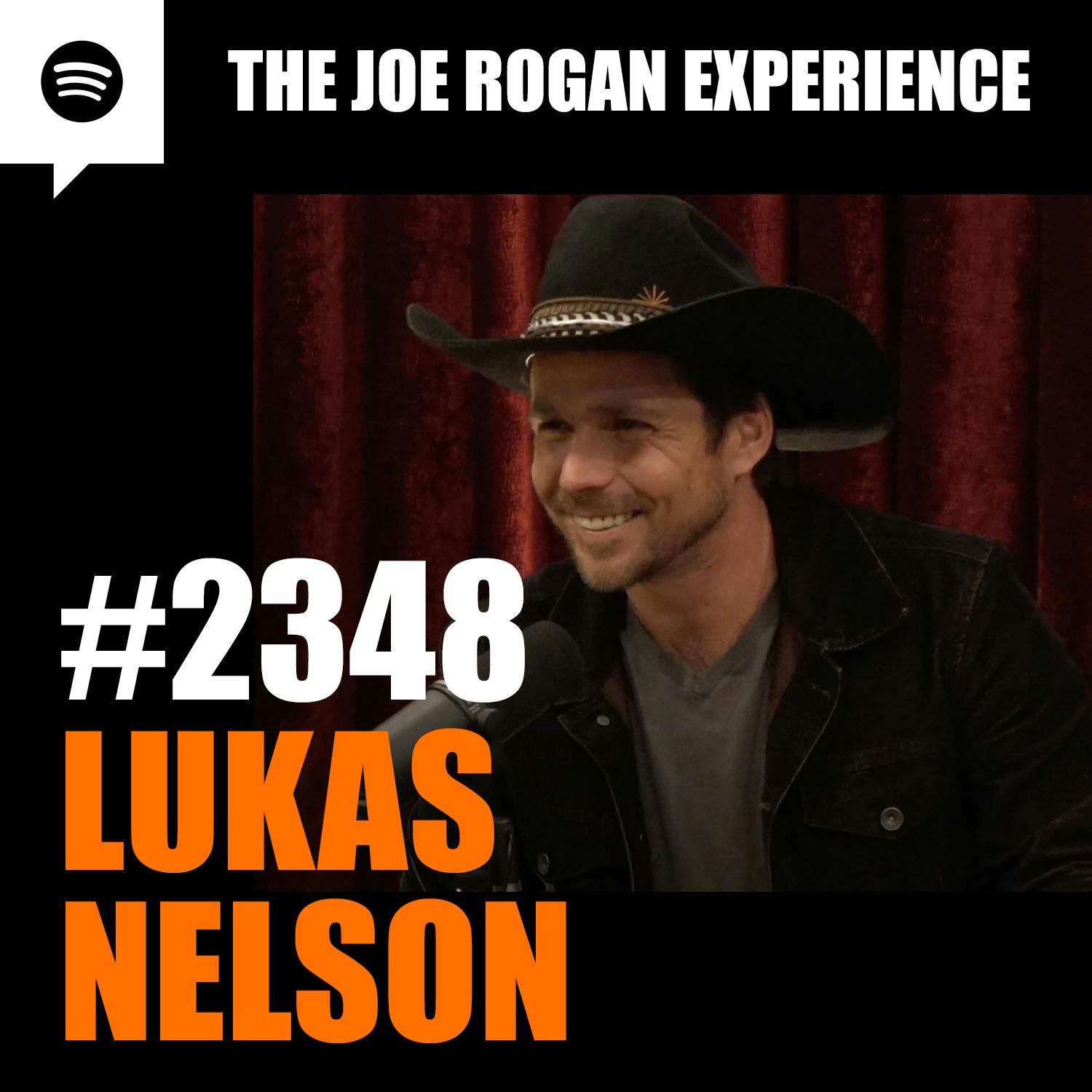
#2348 - Lukas Nelson
The ultimate wireless hack. Make the switch at https://visible.com/rogan
Learn more about your ad choices. Visit podcastchoices.com/adchoices
Press play and read along
Transcript
Speaker 0 Joe Rogan podcast, check it out.
Speaker 1 The Joe Rogan experience. Showing by day, Joe Rogan podcast by night, all day.
Speaker 1
We're up, Lucas. What's up? Hey, Lucas.
Good to talk to you, man. Thanks for being here.
Speaker 1 I got to tell you, you know, when I heard Willie Nelson's kid plays music, there's a thing that you always do, and I have to admit it, you do it like when the son of a great man you always assume well
Speaker 1 yeah he's probably mediocre you know what I mean and then you performed at McConaughey's that charity function thing and you fucking killed it man you blew me away it was incredible and I was like wow it was really cool to see man it was really exciting
Speaker 2 it was really fun you know you were the highlight of the night man you really were it's moments like those where i started to gain confidence you know i'd have over the years
Speaker 2 i'd go out and play and i'd play my songs that i've written and you know i'd get crowds that would do that you know and so that gave me the confidence to keep going
Speaker 2 and it and and i first started playing music in order to get closer to my father oh wow you know what i mean so i i i he would be gone all the time right and i'd be missing him
Speaker 2 and uh
Speaker 2 and so in order to get close to him, I figured I needed to speak the same musical language. And so I learned Young, and I wrote a song, Young,
Speaker 2
that's on the new album, actually, I got it. It's called You Were It.
It's the first song I ever wrote when I was 11.
Speaker 2 And my dad loved it so much that he covered it at the time, and he put it out on his album back in 2004.
Speaker 2 Called it always will be the album was called it always will be and that gave me the confidence at a a young age Chris Christopherson came up to me and he's like man you don't have a choice but to be a songwriter and so I had all this inspiration at a young age kind of like an athlete at a certain point you kind of have to look at like oh well if I have a talent at this I have opera like I have connections in the industry
Speaker 2 I need to work like I was going to go to the Olympics on this because it's something that I can do that will make it so that I never have to rely on my family or my my father for anything. Right.
Speaker 2 You know,
Speaker 1 my whole goal in life
Speaker 2 is to discover who I am as an individual. You know.
Speaker 1 Is that a part of the difficulty of growing up with an incredibly famous father?
Speaker 2 I think the,
Speaker 2 you know, Viktor Frankl has a
Speaker 2 book, a very famous book called Man's Search for Meaning.
Speaker 2 And it's about Auschwitz, and he was an Auschwitz survivor, and he wrote about
Speaker 2 what was the common denominator in terms of people who persevered and survived in these camps.
Speaker 2 And
Speaker 2
dignity and meaning were the common denominators generally. And so finding what you mean in this life to yourself, it doesn't have to mean anything to anyone else.
And I think that's where...
Speaker 2 For me, I've lived my whole life trying to discover who I meant to myself so that at the moment of my death, I can look back and say
Speaker 2 I did something that I enjoyed, that was meaningful, that gave me a sense of purpose.
Speaker 1 Yeah,
Speaker 1 there's both a blessing and a burden to
Speaker 1
being the child of someone who's incredibly famous at a thing that you're trying to do. Sure.
You know, like there's
Speaker 1 a lot of sons of athletes, for instance,
Speaker 1 that live in their father's shadow, and very few of them ever rise to the level that their father was at.
Speaker 2
Sure. I think for me, I was never trying to be as great as him.
I was only trying to be close to him. Because more than anything, my father's a great human being.
Speaker 2 He's a well-rounded, kind, empathetic human. And
Speaker 2 I am truly grateful to be his and my mother's son.
Speaker 2
you know, because I have a good family. I'm lucky, you know.
That's awesome. You know, I have a good parent.
So what I was trying to do was just be closer to them. And
Speaker 2 as a little kid,
Speaker 2 the best thing my mom ever did was when I was like earlier, I was probably five or six years old. And my brother had just passed away not too long before this, actually.
Speaker 2 And I would cry every time my dad would leave.
Speaker 2 And my mom sat me down one time and he said, it tears him apart when you cry like this because he doesn't want to leave. He's going out there.
Speaker 2
He's making people happy, he's giving people joy and he's doing what he came here on this earth to do. And he's supporting this family.
And so the support that my mother had for him
Speaker 2 at that moment, I never cried again.
Speaker 2 I was able to let go of that idea and then just from that point on work towards creating what would make me happy in my life and give me the same joy and then be able to take care of a family hopefully.
Speaker 2 You know, one of my greatest sources of pride is that I haven't had to ask my parents parents for anything. I bought my own house.
Speaker 2 I went and did Starsborn. And I got, you know, I mean, I've been able to make myself
Speaker 2
a living, and I think that makes my parents proud. It makes my dad proud, and that's what I've always wanted to do.
That's been
Speaker 2 my whole life is wanting to make them proud.
Speaker 1
That's awesome. Well, it's a great motivation, you know, for sure, especially when you have great parents to try to get away with that.
I'm lucky in that way.
Speaker 2 You know, I know a lot of people who have broken homes and grew up, and even
Speaker 2 I caught dad at a good time.
Speaker 2 I mean, my dad was 55 or so when he had me, you know, and so he had already been through a lot of his demons and gotten through them and faced them, you know, and was still going through them at the time that I was born.
Speaker 2 But he had come out of
Speaker 2 a life of habit and sort of formed the ones that would take him at that point to where he is now at 92 years old.
Speaker 2 And so I got a good version of dad,
Speaker 2 you know, who had grown since.
Speaker 2 And so,
Speaker 2 man,
Speaker 2
I'm the luckiest guy in the world. I feel like I was able to be exposed to a lot of great music, a lot of great mentors, you know, in my life.
And
Speaker 2 I'm also lucky that I, at a young age, I'm grateful to my younger child, to myself as a young child for having the wisdom to say, all right, work hard now, forget about parties, forget about hanging out, work hard eight hours, ten hours a day, practice your guitar, write all the time, sing all the time, so that when you get to a certain point in life, you'll have something to show for it, you know, something that you can leave behind that's yours.
Speaker 1 Yeah,
Speaker 1 that's awesome, man.
Speaker 1
You know, that's what most people in this life want. They want a purpose.
Yeah. You know, they want something that means something both to them and to other people.
Exactly. Yeah.
It's hard to find.
Speaker 2 It's hard to find a purpose, you know.
Speaker 2 That is something that I've always had growing up, and I think it's because I was,
Speaker 2
you know, again, I'm grateful to that younger kid. Sometimes I feel like he's wiser than I am now.
You know, that younger self is like almost,
Speaker 2 I'm, you know,
Speaker 2 and now that I'm sober, I mean, I quit smoking weed, I quit drinking.
Speaker 1 When did you do all that?
Speaker 2 Really around the pandemic. Yeah.
Speaker 1 But that's usually when a lot of people started.
Speaker 2 Yeah, it went the opposite way. I started meditating twice a day.
Speaker 2 You know, the only thing I'll do now is mushrooms every once in a while to check in with myself and, you know, just kind of make sure that I'm,
Speaker 2 you know, I feel like mushrooms is like taking a nice good hose to your soul and just kind of like, you know, clean out all the bullshit.
Speaker 1
Clean out all the bullshit. Yeah.
I feel like, you know,
Speaker 2 they should be legal.
Speaker 1 Yeah, 100%.
Speaker 1 Really, if I could talk Trump into one thing,
Speaker 1 that might be the one thing.
Speaker 1 You know, I had this conversation with Paul Stamitz the other day.
Speaker 2
I love Paul Stamitz. He's amazing.
Yeah, he's great. I just saw him at the Dead Show, the Sphere Show.
Speaker 1
Oh, yeah. Oh, that's cool.
That's cool.
Speaker 2 Have you been to his place?
Speaker 1
He invited me to nice up there. It's supposed to be amazing.
I was just reading an email from him today inviting me to his place.
Speaker 2 That's awesome.
Speaker 1 Yeah,
Speaker 1
he's a prepper. He's ready for the apocalypse.
This episode is brought to you by the farmer's dog. I think we can all agree that eating highly processed food for every meal isn't optimal.
Speaker 1 So, why is processed processed food the status quo for dog food? Because that's what kibble is, an ultra-processed food. But a healthy alternative exists, the farmer's dog.
Speaker 1 They make fresh food for dogs. And what does it look like?
Speaker 1 Real meat and vegetables that are gently cooked to retain vital nutrients and help avoid any of the bad stuff that comes with ultra-processing. And it's not just random ingredients thrown together.
Speaker 1
Their food is formulated by on-staff board-certified vet nutritionists. These people are experts on dog nutrition and they're all in on fresh food.
The farmer's dog also does something unique.
Speaker 1 They portion out the food to your dog's nutritional needs. This ensures that you don't overfeed them, making weight management easy.
Speaker 1
Research shows that dogs kept at a healthy weight can live up to two and a half years longer. Head to thefarmersdog.com/slash Rogan to get 50% off your first box.
plus free shipping.
Speaker 1
This offer is for new customers only. This episode is brought to you by Squarespace.
If you've got something to sell or want to take your business online, Squarespace has you covered.
Speaker 1 Their built-in SEO tools help people find you
Speaker 1 and you can sell products, take payments, even manage bookings all from one easy platform. Go to squarespace.com/slash Rogan for a free trial.
Speaker 1 And when you're ready to launch, use the code Rogan to get 10% off your first purchase of a website or domain.
Speaker 1 Yeah,
Speaker 1 Well,
Speaker 1
that might be a good idea. I mean, maybe.
I don't know. I think we're going to be okay.
I do, too. I do.
I mean, I think the feeling that we might not be okay, though, is a great motivator.
Speaker 2 We should always be checking in with ourselves and asking ourselves, are we going too far to certain extremes?
Speaker 1
Yeah. Well, that was the part of the conversation that we had.
You know, we're like, is there a thing that could really help the world? And it sounds so cliche and hippie,
Speaker 1 especially especially to someone who's never done mushrooms.
Speaker 1 But I think that might be the thing, you know, even if it's just like small doses, just a little something to alleviate anxiety, bring people closer together, make them understand that there's more to life than conflict and bullshit.
Speaker 1 And most of your conflict is bullshit, most of it is nonsense, and most of it's unnecessary.
Speaker 2 Yeah, my dad always says 99% of the things you worry about never come true.
Speaker 2 You know, and it's just a matter of,
Speaker 2 yeah, I mean, it is sort of a cliche.
Speaker 2 I read the The Power of Now, which is an Eckhart Tolle, when I was like 13. I used to I went to school next to a Buddhist temple.
Speaker 2 And so I grew up with my dad teaching me the Lord's Prayer that I'd say every night. And then I'd go to this Buddhist temple and hang with these monks.
Speaker 1 Really? Yeah, yeah. When I was in Maui.
Speaker 2
I grew up part-time in Austin. I was born in Austin.
I was in Maui.
Speaker 1 And so
Speaker 2 there was a Buddhist temple right near where I was going to school at the time. So after school every day, I'd sit with these monks.
Speaker 2 And just the vibe of that is powerful, the chanting, the energy around that, you know, the presence, though, that they have, you know, their whole goal, obviously, is to just, you know, be purely present.
Speaker 2 Yeah. And so while that sounds like a cliché, I truly believe that that's an important thing, you know, to let go of the
Speaker 2 battle of positive and negative, that in the mental space, that's all that exists, is duality.
Speaker 1 Well, to find a true path, you have to avoid being pushed and pulled in a bunch of directions that are totally unnecessary.
Speaker 1 And sometimes you get sort of preoccupied or captivated by the push and the pull of bullshit. Well, and we're...
Speaker 2 There is a manipulation that happens on purpose. I have a song called Turn Off the News and Build a Garden.
Speaker 1 Did you ever hear that song? No, I haven't heard that one. You want me to play it for you? Fuck yeah, yeah, play it.
Speaker 2 This is a song called Turn Off the News and Build a Garden.
Speaker 1 And I wrote it because
Speaker 1 it's great advice.
Speaker 2 Yeah, and
Speaker 2 I just, I was just the news cycle. I mean,
Speaker 2 there's a difference between being informed and being constantly captured by this.
Speaker 1 Overwhelmed. Yes.
Speaker 2 Got a tune for all your listeners
Speaker 2 I believe that every heart is kind
Speaker 2 Some are just a little underused
Speaker 2 Hatred is a symptom of the times
Speaker 2 Lost in these uneducated blues
Speaker 2 I just want to love you while I can
Speaker 2 All these other thoughts have me confused
Speaker 2 I don't need to try to understand
Speaker 2 Maybe I'll turn off the fucking news
Speaker 1 Turn off the news and build a garden Just my neighborhood and me.
Speaker 2 We might feel a bit less hardened.
Speaker 2 We might feel a bit more free. Turn off the news and raise the kids.
Speaker 2 Give them something to believe in.
Speaker 2 Teach them how to be good people.
Speaker 2 Give them hope that they can see.
Speaker 1 Hope that they can see.
Speaker 1 Turn off the news and build a garden with me.
Speaker 1 That's awesome.
Speaker 2 Yeah, so I, you know, I've always felt that way, and I think that there's
Speaker 1 action
Speaker 2
is so important. Being a part of your community, being a part of decisions that are made, I think that's huge.
I think local communities are really important.
Speaker 2 I think local town meetings, understanding where you're going,
Speaker 2 you know, and understanding where your neighborhood is going and getting to know your neighbors because it's really hard to
Speaker 2 it's hard to have any hatred when you understand and know your neighbor. You know what I mean? And you know the people that are around you.
Speaker 2 You know, and so I think that,
Speaker 2 yeah, that's kind of where I come from. I just think like, you know, it's important to get out there and I put my, I usually try not to stand on soap boxes, though, you know what I mean?
Speaker 2 If I have something to say, I'll put it in my music, you know, and I'll and I'll put it out there.
Speaker 1 Well, that's the best way to get it to people anyway.
Speaker 2
Yeah, look at Bob Dylan, Masters of War. I mean, that's the military-industrial complex right there.
That's an incredible song.
Speaker 2 Only a pawn in their game is the history of
Speaker 2 racism and how that
Speaker 2 started. It is pretty much a controlled political ploy to get the poor blacks and the poor whites to blame each other for everything happening.
Speaker 1 You ever hear Bill Hicks' bit about the news?
Speaker 2 I was just listening to Bill Hicks. That's so funny.
Speaker 1
He's got that great bit about the news: like war, famine, disease, AIDS. You go outside, chirp, chirp, chirp, chirp.
Where the fuck is all this shit happening?
Speaker 1 I think Ted Turner's making this shit up because his wife won't fuck him.
Speaker 1 Well,
Speaker 2
look, I think it's out there. I think it's always been out there.
But I think the way to
Speaker 2 combat it
Speaker 2 is to build build strong local community.
Speaker 1 Yeah.
Speaker 2 You know, and build, you know, that's why I think
Speaker 2 regenerative farming is really important. And trying
Speaker 2 to,
Speaker 2 and then, you know, voting for people that will support local agriculture and
Speaker 2 properly grown food and properly, you know, like sourced food. And these things are very important, you know.
Speaker 1 Well, yeah, that's certainly important for a community if you know exactly where your food's coming from.
Speaker 1
I think we're just so, it's not, you know, in the Bill Hicks days, it was just the news. But now, I think the real problem that people have today is social media.
And,
Speaker 1 you know,
Speaker 1
I never, I very rarely, if I post things, I just post them and then get out of there. I don't read anything.
And I very rarely read social media anymore.
Speaker 1
And since making that decision to kind of stay away from it, I think occasionally I have to dip in just to see what what's because I'm a comedian. It's part of the problem.
Sure, you got to know.
Speaker 1 And I need to know what people are doing what why everyone's so mad what's happening
Speaker 1 but um
Speaker 1 there's too many people that are on it all day long and i think it's poison i really do i think it's bad for your mind i think it it it uh generally attracts negativity i think most of the stuff that people post is negative and they're complaining all the time and and then that gets into your mind and that gets into your whatever you know your your headset is your headspace and then you start thinking the way these people are thinking and
Speaker 2 i like to be informed on what i'm talking about you know i really do and that takes a lot of time yeah it's not something that i can look at something online that comes up and just have an immediate opinion on sure
Speaker 2 and i think that really i'm just
Speaker 2 like
Speaker 2 I don't know where I stand on half the issues that are out there because
Speaker 2 I see a lot of I have to sift through most of the bullshit to find it like so so really where it ends up happening is that by the time I get to the voting booth, I'm hoping that I'm properly informed.
Speaker 1 You know, yeah, it's hard to be properly informed because it's hard to know who's telling the truth. It is.
Speaker 1 Like, if you pay attention to this big, beautiful bill that just got passed, I've been trying to sort out what's real and what's not. You know, and the real fear that people have is Medicaid, right?
Speaker 1 The real fear is that people are going to lose access to health care.
Speaker 1
But then there was this just giant arrest where they found billions of dollars of fraud and hundreds of people were arrested. Doctors, health care providers.
You know about all that, right, Jamie?
Speaker 1 You saw that big arrest?
Speaker 1 It's,
Speaker 2 you know, something. Sounds like something, but
Speaker 2 I just don't know enough.
Speaker 1
Yeah, I don't know enough either. So they're trying to eliminate fraud as a part of this.
Right. But the consequences of that is like, well, okay, but is this going to affect poor people?
Speaker 1 Is this going to affect legitimate poor people that just need help?
Speaker 1 To me, that's the most important thing. National health care fraud takedown results in 324 defendants charged in connection with over
Speaker 1
$14.6 billion in fraud. Wow.
Largest Justice Department health care fraud takedown in history, more than doubles prior record of $6 billion.
Speaker 2 Wow. That's a government website, right?
Speaker 2 I don't know.
Speaker 2
I just don't know. And I don't know enough.
And I know that there's probably more to the story than we're seeing.
Speaker 1 Oh, yeah, for sure. Right.
Speaker 2 Also, you know, that's kind of how
Speaker 2 controlled opposition works to, you know, you just sort of, you know.
Speaker 1 It says Medicare Medicaid Services also announced it successfully prevented over $4 billion from being paid in response to false and fraudulent claims and that it suspended or revoked the billing privilege of 205 providers in the month leading up to the takedown civil charges against 20 defendants for $14.2 million in alleged fraud, as well as civil settlements with over 106 defendants totaling 34.3 million
Speaker 2 yeah well i'll have to do some research or not
Speaker 1 well that's the thing i'm a i'm a musician man you know this episode is brought to you by visible i want to let you in on something your current wireless carrier does not want you to know about visible because visible is the ultimate wireless hack no confusing plans with surprise fees no nonsense just fast speeds great coverage without the premium cost.
Speaker 1 With Visible, you get one-line wireless with unlimited data powered by Verizon's network for $25 a month, taxes and fees included. Seriously, $25 a month flat.
Speaker 1
What you see is what you pay. No hidden fees on top of that.
Ready to see? Join now and unlock unlimited data for just $25 a month on the Visible plan. Don't think wireless can be so transparent?
Speaker 1
So visible? Well, now you know. Switch today at visible.com/slash Rogan.
Terms apply. See visible.com for plan features and network management details.
Speaker 1 I don't want to waste my day going through all that freaking out about I do think it's important to know, but at the same time,
Speaker 2 what I do know is that there's a lot of marginalized communities, whether it's a class issue or it's a, you know,
Speaker 2 I just see that that there's a lot of people who don't have a lot of money who are suffering. And
Speaker 2 there's a lot of people getting caught in crossfire
Speaker 1 all over the world.
Speaker 2
And it's a humanitarian issue, you know. Yeah.
And I think, you know, and so, you know, as a musician, I have a responsibility to observe. I think as an artist, I have a responsibility to observe.
Speaker 1
As a human. As a human.
Yeah. I think we all have a responsibility to observe.
Speaker 2 And I also don't like to keep my opinion
Speaker 2 resolute.
Speaker 2 I don't like to identify with my opinion, meaning like I'm not joining any teams here.
Speaker 2 I don't have any teams. I want to know
Speaker 2 what based on if I get conflicting information, I have to make a decision on which one's going to sway the decisions I make going forward.
Speaker 2
It's tough. It's not easy.
In this world, it's really not easy. But But back in the day,
Speaker 2 interestingly, I think they had more of an ability to manipulate us back in the day because we only had one or two sources of information.
Speaker 1
Oh, no doubt. No doubt.
Well, listen, as confusing and as frustrating as social media is and as dangerous as it is for your psyche, it's better.
Speaker 1
It's better to have it than to not have it because you don't have to listen to it. You don't have to go on it.
And that's what I always tell people, stay off it. But it's there for you.
Speaker 1
Like when shit pops off in the world, it's the best source of information. I Google things all the time and they're not there.
And then I'll go to X and they're there immediately.
Speaker 1 When something happens in the world, it's on X before it's on anywhere else.
Speaker 2 Well, there's a lot of platforms, I'm sure, that, yeah, that
Speaker 2 Google is.
Speaker 1 But the thing is, X is immediate, right? It's people that are on the ground and people that are experienced and independent journalists use it more often than anything else.
Speaker 1 That's interesting. And substack.
Speaker 2 Yeah, I think that, you know, I think the only thing that
Speaker 2
I think I worry about with that is that the pendulum swings so far in either direction in response to certain things. Sure.
In response to perceived censorship in one way, then it becomes
Speaker 2 instead of it being completely a platform of opinions,
Speaker 2 then censorship happens on that side with dissenting opinions.
Speaker 2 And so I think that the censorship just continues to be like, okay, well, it just goes back and forth. And so
Speaker 2 I have a hard time understanding. And that's why I don't really feel like I have an ability to form a proper opinion on a lot of this shit.
Speaker 1 Well, that's an intelligent perspective, because the reality is so many people that have really strong opinions aren't informed.
Speaker 2
Well, that's the thing. And I see people that die on certain hills and then, you know, but with no ability to formulate.
Like, that's why I'm a musician.
Speaker 2 That's why I do what I do here. Because I, you know, all I do is, you know, I err on the side of compassion.
Speaker 2 And I think, you know, I'm compassionate for people who are suffering. I, you know, I have compassion for suffering.
Speaker 2 I believe that
Speaker 2 I believe that empathy can be manipulated, but I don't believe that.
Speaker 2 I think it's a necessary emotion
Speaker 2 for cooperation and human condition.
Speaker 1 That's a great way to put it. Because empathy can be manipulated.
Speaker 2 It can be manipulated through psychological warfare, but I also believe that it's never a good idea to then
Speaker 1 shut it off. 100%.
Speaker 1 Well said.
Speaker 1 Yeah, that's a really good question.
Speaker 2 And I also will say this,
Speaker 2 I think
Speaker 2 throughout history,
Speaker 2 there have been examples where people have put their faith in policy over character.
Speaker 2 And I think that's a mistake.
Speaker 2 I think the character of the person implementing the policy is just as important as the policy they represent.
Speaker 1
Well, you know, and today nothing gets implemented. There's no policy that gets drafted or implemented without a lot of weird influence.
Oh, influence from money. It's always money.
Speaker 2 And I have no idea the depth of that. So
Speaker 1 where am I?
Speaker 2 Where am I...
Speaker 2 My truth lies in compassion
Speaker 2 and in trying to reach the hearts of people through music.
Speaker 2 Do you know Daryl Davis?
Speaker 1
Sure, I've had him on a couple times. Oh, my God.
Yeah, he's great. He's amazing.
Speaker 2 He's a hero of mine.
Speaker 1 Yeah, he's an amazing person.
Speaker 2 What a fearless person to be able to go and sit down with these people and change their hearts.
Speaker 1 Yeah. Hundreds of them.
Speaker 2 Hundreds of them. Collecting.
Speaker 1
One-on-one. Let's tell people what he does.
So Daryl is a musician, and Daryl, through the course of his travels, met.
Speaker 1
He told me the whole story. The first guy he met, he didn't really believe him that the guy was actually actually in the KKK.
Daryl's a black man.
Speaker 1 And so this guy pulls out his KKK membership card or whatever the fuck it is, right? And he couldn't believe it. And he's like, Well, you're not like the other ones.
Speaker 1 And he's like, Well, what do you mean? Do you know everyone that's black? Like, what is this?
Speaker 1 And so he becomes friends with this guy, has dinner at his house, and then the guy gives him, over the course of their friendship, gives him his robe. And he says, I quit, man.
Speaker 1
Obviously, what I'm doing is wrong because you're my best friend. You know, like, I love you.
And so i it can't be true that the black man is my enemy if you are such a cool person. Yes.
Speaker 2 And humans must be allowed to grow.
Speaker 1 Yes.
Speaker 1 You know,
Speaker 2 we have to allow people who have made mistakes in their past to
Speaker 2 we have to suspend judgment enough to allow that person to grow.
Speaker 1 No question.
Speaker 1
Because you have to understand what influences was this guy subject to that led him to join the KKK in the first place. Yes.
Like, what was the community that he was in? What had he been exposed to?
Speaker 1 Obviously, he had never been exposed to anybody like Daryl before he met him. So, he meets Daryl and then changes his ways.
Speaker 1 Well, who knows if that guy grew up with cool parents in a different community, he would have been a different person.
Speaker 2
100%. We're products of how we were brought up.
Yes.
Speaker 1 For the most part. Our life experiences and what we've learned and the paths we've taken.
Speaker 2 Yeah. And, you know, and, you know, there's a lot of
Speaker 2
there's a lot of that going on. I mean, I'm from Texas, and I've toured the South, and I know how that is.
And there's a lot of people that grow up being indoctrinated
Speaker 2 with
Speaker 2 really
Speaker 2 not good ideas.
Speaker 2 But they don't know until they're able to. That's what I was saying earlier about,
Speaker 2 you know.
Speaker 2
That's what music does. I love a great example.
Paul Simon
Speaker 2 played a show in South Africa just after apartheid. When he did the Graceland album, right, he went down there and he
Speaker 2 worked with local African musicians and created, in my opinion, one of the greatest albums of all time. I mean, with Lady Smith Black Mambazzo doing the vocals on that,
Speaker 2 Vincent Nguini, the most incredible musicians. And
Speaker 2 at the time,
Speaker 2 that was a culturally powerful thing because there's a show online. You can watch it.
Speaker 2
You should probably pull it up. It's amazing.
There's like Paul Simon playing for tens of thousands of black and white people
Speaker 2
right after apartheid ends. Or you may even be during apartheid.
And they're all dancing and bobbing up and down. It's the most joyful thing ever.
Music is powerful. It can bring people together.
Speaker 2 Because what it does is it reaches everybody's heart and it cuts through all the bullshit, the mind stuff, you know?
Speaker 2
And everyone can relate to having their heart broken. You know, maybe it happened for some at a young age.
Maybe it happened, maybe
Speaker 2 some people had their heart broken at age four to the point where they closed their hearts off nearly completely. But even Darth Vader had a little bit.
Speaker 2 You know what I mean?
Speaker 2 Darth Vader, everyone forgets that Darth Vader.
Speaker 2 At the end of Star Wars,
Speaker 2 redeemed himself. It's the Carl Jung, the archetype, right? The dark night of the soul, and then being able to come through that.
Speaker 1 Yeah.
Speaker 2 And like, and really, like,
Speaker 2 you know, and you can judge.
Speaker 2 You can not want to be around, like, I think Carl Jung actually talks about like, there are certain people and things that you can't allow to exist because they're dangers to everyone else.
Speaker 2
But at the same time, you don't have to judge their humanity. Right.
You just like, it's like a wasp. You have to swat the wasp because it's going to sting you.
Speaker 2 But, you know, or, you know, however you feel about that, you can put it outside, but you get it away, right?
Speaker 2 But
Speaker 2 you don't call the wasp evil.
Speaker 2 There are people that have just been corrupted for whatever reasons to the point where you just need to remove them from the situation. But I try not to have hatred towards that.
Speaker 2 I just sort of understand that they are where they are in their lives and they got there for some reason.
Speaker 1 Well, it's a cautionary tale for everyone. Yeah.
Speaker 1 That's the thing about today's access to information is you could see so many different cautionary tales. You could see so many different people that went down the absolute wrong road
Speaker 1
and you get to see them and you get to shine a light on them in this very strange time. And you get to see like this, this is, you could have been that person.
Anybody could have been that person.
Speaker 1 We're all
Speaker 1 we have so many similarities. All of us do.
Speaker 1 And we have to recognize that your unique situation in life, your unique community, family, life experiences, all the things you've gone through that have made you who you are today
Speaker 1 didn't have to be that way.
Speaker 1 You could have been in the worst circumstances, and there's people that are in the worst circumstances,
Speaker 1
and they're a product of that. And that's the weirdness of life.
There's not necessarily good and evil. There's good and evil results.
Speaker 1 But humans inherently.
Speaker 2 we're the yin and the yang.
Speaker 1 Yeah, you know, I think you need that unfortunately too. We need to know that the exists
Speaker 1 in order to grow.
Speaker 2 When people you know ask, you know, and I'm a very lucky human. So like
Speaker 2 I say all these things with
Speaker 2 hopefully the right perspective that I am
Speaker 2 As far as I'm in like the top 1% of the luckiest people, or probably even higher than that, you know, with access to clean water. I don't have to worry about when I'm pulled over being shot.
Speaker 2 I don't, you know, there's not, there are a lot of things that I can be very grateful for. And so when I make
Speaker 2 comments about these things, you know, I can only come from my own perspective.
Speaker 2
Yeah. Of course.
But I do believe that.
Speaker 2 We all have the light and the dark inside us.
Speaker 2
Like the story of the wolf, you know, the story of the two wolves inside of us, and you know, which one survives is the one you feed. Right.
You have the light wolf and the dark wolf.
Speaker 2 And you just constantly make decisions in order to feed the right wolf over time. And some people get lost and they start feeding the wrong wolf.
Speaker 1 And
Speaker 2 I feel like I've been there before too. You know, I've gone through darkness and come out the other side, you know, in my own way, in my own, you know,
Speaker 2 in my own experience, you know, in my own pain, in my own heart, you know,
Speaker 2 you know, I think that's why I believe it's so important to reach people's hearts and why music is so powerful because we all have a heart, you know,
Speaker 2 disregarding certain sociopathic people.
Speaker 2 For the most part,
Speaker 1 we all have a heart,
Speaker 2 and so that's where you reach, you know. And I think sociopaths,
Speaker 2 you know, that's on a spectrum too is what we're hearing. You know what I mean? So you have people who can learn sociopathic behavior but aren't necessarily devoid of feeling.
Speaker 1
Right. There's people that become sociopaths or survive, I bet.
Exactly. Yeah, absolutely.
Speaker 2 I'm sure. 100%.
Speaker 1 Yeah,
Speaker 1
it's not that clear-cut. And, you know, to demonize people is that's the instinct, right? That's how wars get started.
We other
Speaker 1 an entire group of humans. They're the other.
Speaker 1 And I think this is tribal
Speaker 1 society behavior that developed because at one point in time, when you saw someone from another tribe that was invading, they were coming to steal your resources and kill people. Yes.
Speaker 1 And that's what people did.
Speaker 2 And again,
Speaker 2 that also,
Speaker 2 there's an exception to that in the sense that, like, for example, in Germany, you know,
Speaker 2
there were clear-cut decisions that people had to make about survival and about, you know, like, I'm sorry, but the Nazis had to go. Right.
You know,
Speaker 2 we can't just say that, you know, they're good people.
Speaker 1
No. Everyone's the same.
You know,
Speaker 2 they're so far gone
Speaker 2
that they just have to go. Yeah.
And that's, there are certain
Speaker 2 examples of that. So it's not like
Speaker 2 you don't have to forgive people. You just have to understand them, I think.
Speaker 1 Yeah,
Speaker 1
that's why people call that the Last Great War or the real war. Right.
You know, because it's like there was such a clear-cut case of good and evil.
Speaker 2 Yeah. And that's, I I mean, look,
Speaker 2 I think the military-industrial complex has been around since even before then.
Speaker 1
Oh, for sure. Well, Smedley Butler wrote about it in 1933.
Yeah.
Speaker 2
Yeah. So anyways, that's where Bob Dylan comes in.
You know, masters of war.
Speaker 2 Look, man, I'm, again.
Speaker 1
Well, that's also why mushrooms are illegal. Is it really? Oh, yeah.
Yeah.
Speaker 1 Mushrooms were made illegal during the Nixon administration because they wanted to figure out a way to stop the anti-war protests.
Speaker 1 They wanted to figure out a way, they turned everything Schedule I.
Speaker 1 They took all the psychedelics and lumped them into a Schedule I because they wanted to go after civil rights activists and anti-war activists. That was the main reason.
Speaker 1 Like, this is the best way to lock these people up.
Speaker 2 Well, and interestingly,
Speaker 2 yeah, I mean, I think that
Speaker 2 you know,
Speaker 2 right, because the thing is, is that there are a lot of studies about marijuana now that say, oh, it could be harmful, right? That come out. But then at the same time,
Speaker 1 there
Speaker 2 the way that those that that's harmful and then the the you know comparatively to the other things that are legal
Speaker 2 and allowed to just propagate yeah like whiskey or cigarettes you know like i mean like you know you have
Speaker 2 it it there's obviously a a bias against and that you can see clearly and um and obviously it came from this well it's also deep sea who's funding these studies right and what what did they look for when they're funding these studies?
Speaker 1 And did they have, it was their bias attached to these studies? Like, what does this mean?
Speaker 1 You know, like, I know a lot of people who use marijuana, it's not harmful to them at all. So, like, did you include those people in that study?
Speaker 1 Like, and then I know people that use marijuana, and it really does over it, consumes their life.
Speaker 1
They overindulge. Yeah.
I had to stop.
Speaker 1 What was happening with you with it?
Speaker 1 Well,
Speaker 2 I had to stop for many reasons.
Speaker 2
I wanted to be clear-headed. I started exercising a lot.
You know, I got my whoop. You know, I got my whoop right here.
You know, I started tracking my sleep.
Speaker 2 And I, funny enough, the sleep is really what got me the most because every time I'd take a hit or take one drink, my sleep would go to shit.
Speaker 1 It's amazing when you look at the results. Oh, my God.
Speaker 2 It was intense. And so, and, you know, I started working out heavy, and I really, I had a lot of great, like,
Speaker 1 you know,
Speaker 2 I have a, you know, a high,
Speaker 2 good engine, you know, I'm VO2 and like I was like, you know, I really started to feel like an athlete again. And
Speaker 2 I started to feel great. I started to get addicted to the high that I would get saying no,
Speaker 2 of being proud of myself.
Speaker 1 Having discipline.
Speaker 2 And having the discipline. I love the high that I get from exercising discipline.
Speaker 2 I'm addicted to that.
Speaker 1
That's a good thing to be addicted to. Totally.
Right?
Speaker 2 You get addicted to that that feeling that you get that's like self-improvement. You know, like Goggins, he talks about, you know, all carrot, no stick, right? Or all stick, no carrot.
Speaker 2 Can't remember which one it is.
Speaker 1 Right.
Speaker 2 But the thing is, is that
Speaker 2
for me, the reward is the high that I get from having discipline. Yeah.
And I get a, it's a dopamine hit.
Speaker 2 you know, and it's, it's just vastly more rewarding than
Speaker 2 whatever temporary thing I'll get from having a drink.
Speaker 2 I don't know, like, like drinking that much, but smoking weed was cool because it put me into a very creative spot and kind of gave me this surge of inspiration, if you will.
Speaker 2 But it's bad for my lungs. And
Speaker 2 there were a lot of ups and downs emotionally. I'd get high and I'd get low and I'd get high and I'd get low.
Speaker 2 And now this clarity that I have is just, it's incredible.
Speaker 2 It's just this steady,
Speaker 2 you know,
Speaker 2 it's this steady sort of joy, you know, that I, I have, I mean, because I had to face myself too.
Speaker 2 When you get clear, you have to, things come up and then you look at them and you're like, and things that maybe you didn't want to look at before, you know.
Speaker 1 Yeah.
Speaker 2 Habits that you had or things in your past that you have to forgive yourself for, but you didn't really, they're like floating in the back of your mind as unfinished thoughts. And so
Speaker 2 with without it, all of that masking,
Speaker 2 I was able to sit and, I mean, look, I was able to sit and write this record, which is the most clear album I've ever, you know.
Speaker 2 I wanted to know who I was throughout
Speaker 2 the,
Speaker 2 without all the, you know,
Speaker 2
I didn't want to chase a six-minute guitar solo. I didn't want to chase, I wanted to just figure out who I was, stripped away from all that.
It's funny, there's this guy, Marcus Dowling. He's a,
Speaker 2 he writes for the Tennessean, and I was sitting talking to him in Nashville. And he was, he said that when I put, he had it, he was ready to listen to my record and he was about to have a whiskey.
Speaker 2 And he
Speaker 2 first the first song comes up and he puts his whiskey down. He's like, oh, I I don't want a drink for this.
Speaker 2 And I think that music puts you in the state of mind that the artist is in when they recorded it or when they wrote it.
Speaker 2 So this this it's it's kind of almost like interesting that he decided to put his drink down when he heard this album like the first song because like that's where I'm at you know and so I I wonder if there's that feeling of like this kind of like it's less of a jam-band thing and more of just like straight songs.
Speaker 1 There's probably definitely something to that because I think that's something that happens when someone's on stage performing. It's like you let them take over your mind.
Speaker 1 You know, you let the music, the song.
Speaker 2 It's like creating a holographic bubble that you're all participating in this
Speaker 2 sort of vibe. Yeah.
Speaker 2 And it's, I mean, you were there at the McConaughey thing.
Speaker 2 It was an electric feeling, right?
Speaker 1
Yeah, it was pretty wild. It was wild.
Yeah, it was awesome. And I felt like,
Speaker 2 you know, it was cool to see everyone there. And just like, you know, it just.
Speaker 1
There's also like the added thing to that, that, you know, they do that every year and it's a charity. Yeah.
And all the money goes to go given back. Yeah.
Speaker 2 And a lot of charities, like there's like five different charities that they were given to McConaughey.
Speaker 1
He's a good guy. He's a great guy.
He's a great guy. He's a very wise man.
He is a wise man. Especially for someone who's an actor.
Speaker 1 A lot of them, and that's again, that's a thing that I have to get over because I was around so many of them in LA that were fools that I just immediately associate acting with like these empty vessels
Speaker 1 that are just struggling for attention and trying to say the things that they think will get them the best spot. Yeah.
Speaker 2 I think that, look, I mean,
Speaker 2 to become an entertainer, there's a level of
Speaker 2 self-absorption
Speaker 2
that you have to sort of like accept. All right, I got a big ego.
Now, can I keep my ego in check for my whole life? Like, I think my dad has, you know.
Speaker 2 I mean, I see my dad as a great example. I see Paul Simon as a great example.
Speaker 2 I see, you know,
Speaker 2 Neil. And, you know, I see these people that like...
Speaker 1 that just they're just artists through and through.
Speaker 2 You know what I mean?
Speaker 2 And, you know, for better or worse, not perfect people, but they are who they are. And
Speaker 2 for the most part, I know my dad
Speaker 2 has an ego, but he has a good relationship with it. Because the ego is just the representation of who we are to the rest of the world.
Speaker 1
Well, everyone has an ego. Yeah, we all do.
And the struggle with the ego is just like the struggle with good and evil.
Speaker 1 I think part of it is necessary for you to overcome.
Speaker 1 You need that. You need those.
Speaker 1 And you also need to see see people fall prey to it.
Speaker 1 We see that a lot.
Speaker 2
Wren, there's an artist named Wren. No.
Oh, man. You'd love you'd love his work.
He's like a, he plays guitar and he sings amazingly.
Speaker 1 Spell it? R-E-N. R-E-N?
Speaker 2
He's from England. He's from Wales.
He's Welsh.
Speaker 1 Oh, okay.
Speaker 2 And he's... Yeah, this guy.
Speaker 2 Yeah, so he's got a song called
Speaker 2
Higher End. Listen to Higher End.
This is the one.
Speaker 1 Here, put the headphones on. Okay.
Speaker 2 I've seen him for a while.
Speaker 1 He's like a, he started as a busker kind of. Right?
Speaker 1 One of them dudes at the subway station. Yeah.
Speaker 2 This is a crazy song. It's about communicating with your ego.
Speaker 1
What a weird fucking start to a video. A guy with a pig mask on.
Oh, man. Hi, Ren.
Speaker 1
Hi there, Ran. It's been a little while.
Did you miss me? You thought you buried me, didn't you? Risky, cause I always come back. Deep down, you know that.
Deep down, you know more moves in periphery.
Speaker 1 Rant, aren't you pleased to see me?
Speaker 1 It's been weeks since we spoke, bro, I know you need me, you're the sheep, I'm the shepherd, not your place to leave me, not your place to be batting off the hand that feeds me.
Speaker 1 Hi, Bren, I've been taking some time to be distant. I've been taking some time to be still.
Speaker 1
I've been taking some time to be by myself. Since my therapist told me I'm ill.
And I've been making some progress lately. And I've learned some new coping skills.
Speaker 1
So I haven't really needed you much, man. I think we need to just step back and chill.
Bren, you sound more insane than I do. You think that those doctors are really there to guide you.
Speaker 1
Been through this a million times. Your civilian mind is so perfect, you're always being lied to.
Okay, take another pill, boy. Drown yourself in the sound of white noise.
Speaker 1
Follow this 10-step program, rejoice. All your problems will be gone.
Fucking dumb, boy. Nah, mate, this time is different, man.
Trust me. I feel like things might be falling in place.
Speaker 2 Right, he just has a whole conversation with his own
Speaker 2
mind, you know, his own ego. Yeah.
And it tries to tell him, you know, that he's not worth shit. And then he's like, no, wait, I'm getting myself together.
And this whole conversation with him,
Speaker 2 and then at the end, it talks about
Speaker 2
where good and evil isn't a battle, it's a dance. And no one ever wins, you know, with their battle with their ego.
It's always just a dance. And it's always just kind of finding balance.
Speaker 2
And there's a song I have on my album called All God Did. And it's actually the same concept.
So, and I wrote it before I heard that.
Speaker 2 But then when I heard that, I was like, oh, shit, that's way better.
Speaker 2 But it's great, you know, and it's super, it's, it's beautifully written. I mean, you know, it's very, you could tell all his influences,
Speaker 2 and then he just kind of adds onto that, which is.
Speaker 1 That dance is critical. You need that dance.
Speaker 1 That dance is, I think this is one of the problems of people that don't exercise. I think the struggle of exercise is oftentimes conflated with vanity.
Speaker 2 Yeah.
Speaker 1 And I don't think it's that.
Speaker 1 I think you can keep your body covered up to the end of time and never be proud of it, and you will benefit greatly from the struggle of exercise because I think the struggle of exercise is is mental as much as it is physical there's a dance
Speaker 1 like when I talk to Goggins about it like he's the most bizarre of all cases because
Speaker 1 he's doing it all in silence he's doing it all by himself and occasionally he lets people peer into it but it's it's going on right now like right now that guy's out there running probably 30 miles today sure with destroyed knees
Speaker 1 He's a real freak. And when I talk to him about it, he's like, I'm downloading knowledge.
Speaker 1
That's what he says. That's great.
He's like, I'm in the lab and I'm downloading knowledge. Like, he's struggling in his own mind every day and forcing himself to do it every day.
Speaker 1 And then he brings elite athletes to try to keep up with him occasionally.
Speaker 1 Like, he brought Israel Adesanya. Israel Adesanya is former UFC middleweight champion, like one of the best fighters of all time.
Speaker 1 And you realize, like, he can't even keep up with Dave, not even close. This is one of multiple workouts that Dave is doing in a day.
Speaker 1 And this guy can't keep up with him. And Dave's 50.
Speaker 2 What was the part of the brain that gets
Speaker 2 enlarged that Huberman was talking about, that gets enlarged when you do things you don't want to do?
Speaker 1 I always forget the name of it, but Jamie will pull it up.
Speaker 2 Yeah, the
Speaker 2 anterior middle.
Speaker 1 I don't know.
Speaker 1 It should be like an easier name.
Speaker 2 Cortex anterior or something like that.
Speaker 1 The discipline part. Yeah, the discipline.
Speaker 2 That enlarges throughout your life when you do things that you force yourself to do.
Speaker 1
Yeah, it literally does. It literally gets bigger, which is crazy.
You know, being.
Speaker 2 What is it, Jamie? The
Speaker 2 anterior mid-cigular cortex. You got it.
Speaker 1 Ha! Ha! Nice.
Speaker 1
Success. Mid-cingulate.
Mid-cingulate. Mid-cingulate cortex.
Yeah. Yeah.
Shout out to Andrew Huberman. There you go.
Speaker 1 Doing things you don't want to do can strengthen your brain, particularly the anterior mid-cingulate cortex, which is associated with willpower and tenacity. That's incredible.
Speaker 1 The idea that it actually grows.
Speaker 1 So willpower is not just
Speaker 1 an airy-fairy concept. It's like a muscle.
Speaker 2 No, it's.
Speaker 1 This episode is brought to you by Visible. When your phone plans as good as Visible, you've got to tell your people.
Speaker 1 It's the ultimate wireless hack to save money and still get great coverage and a reliable connection.
Speaker 1 Get one-line wireless with unlimited data and hotspot for $25 a month, taxes and fees included, all on Verizon's 5G network.
Speaker 1 Plus, now for a limited time, new members can get the Visible Plan for just $19 a month for the first 26 months. Use promo code switch26 and save beyond the season.
Speaker 1
It's a deal so good, you're going to want to tell your people. Switch now at visible.com/slash Rogan.
Terms apply, limited time offers subject to change.
Speaker 1
See visible.com for planned features and network management details. This episode is brought to you by Dodge.
The 2026 Dodge Durango SRT Hellcat is all about one thing, unlocking performance.
Speaker 1 With 710 horsepower, 645 pound feet of torque, and a supercharged 6.2 liter Hemi V8 under the hood, The Dodge Durango SRT Hellcat is the most powerful SUV in the segment.
Speaker 1
It's also insanely capable, towing up to 8,700 pounds with seating up to seven. That's best in class muscle in a three-row SUV.
Plus, you can jailbreak it and customize the hell out of it.
Speaker 1
The SRT Hellcat jailbreak has over 6 million possible configurations. You can customize everything from paint to wheels to badging to seats.
Make it your own. This isn't a quiet SUV.
It's loud.
Speaker 1
It's fast. It's powerful and unapologetically Dodge.
Learn more now at dodge.com based on the latest competitive information available, IHS standard full-size CUV segment and horsepower.
Speaker 2
Incredible that willpower can be also can be enhanced. Yes.
That that's it it it just goes to brain plasticity and
Speaker 2
that's a concept that I think a lot of people don't understand is that we are not set in who we are. Right.
We are
Speaker 2 if especially if we adopt a growth mindset,
Speaker 2 that we are never set in who we are. We can always
Speaker 2 improve
Speaker 2 and refine the neural structure of our brain to where that it works more efficiently.
Speaker 1 Not just that, but you have to.
Speaker 1 Right.
Speaker 1
It never ends. Like, there's never a time when you're done with discipline.
It's not, you don't just get it, and now I have discipline. No, every day is a struggle.
Gaggin said that.
Speaker 1 He goes, Sometimes I stare at my sneakers for like a half hour before I put those motherfuckers on. Yeah, yeah.
Speaker 2 At like four in the morning, you know, every day.
Speaker 2 But here's the thing:
Speaker 2 it becomes a philosophical question because when you say you have to, I'm like, you know, there are people who get by life, you know, and they,
Speaker 2 there is a Tibetan tradition that the monks do where they spend months and they take these little like flute things and they and they have colored sand, right? And they all sit in a circle.
Speaker 2
And it takes them months sometimes to create this beautiful, intricate sand art. And they chant while they do it, and it's this most incredible thing.
And at the end, they go,
Speaker 2 and they blow it all away.
Speaker 1 Yeah.
Speaker 2 And it's meant to represent the impermanence of life. But then it's meant to also pose the question, why make something so beautiful when it's going to be, when you know it's impermanent?
Speaker 2 And I believe it goes back to the first thing we started talking about today, which is that meaning
Speaker 2 is everything in life. And nothing really in life inherently has any meaning except the meaning we give it, right?
Speaker 2 So you could go, you could like go through life as sand on the beach that blows in the wind and you you know
Speaker 2 you no one you
Speaker 2 it wouldn't really mean much
Speaker 2 when you blow one way or another.
Speaker 2 But if you choose to give your life meaning and build a sand castle and make it as intricate and beautiful as you can and make it like, you know, as detailed as possible, knowing that one day it's going to get washed away,
Speaker 2 the only person that it matters to is you and knowing that you did the best you could at that moment that the wave comes.
Speaker 1 If that's true, they should never let anybody film them making those things.
Speaker 1 They should never let anyone film them making those things
Speaker 1 because then it becomes permanent. Someone can see it forever.
Speaker 2 Sure.
Speaker 1 But.
Speaker 1 You know what I'm saying?
Speaker 2 But yet, again, I think it's for them anyways.
Speaker 1 Yes.
Speaker 2 It's not for everyone else.
Speaker 1 But like when you let people peer into that world and you film it, there's something about that like, okay, you just cheated it.
Speaker 2 Well, in a way it becomes permanent, but it also,
Speaker 2 I mean, is, you know, just because you see it happening. Let's look at it.
Speaker 1 Can you find that?
Speaker 2 Yeah, sure, you could find it on there.
Speaker 1 I mean, I'm not dismissing it.
Speaker 2 No, no, but I think it's an interesting question because something that lives in our subjective reality, if you see a video of that happening, and then you grasp the concept of it, and then that makes you consider that concept in yourself, understanding that, you know,
Speaker 2 that
Speaker 2 the meaning is a subjective experience anyways,
Speaker 2 then now you understand, like, okay,
Speaker 2 it just causes one to ask the question to themselves. And I think that's the purpose that the monks are, you know, they're there as sort of like, in a way, they're teachers, you know.
Speaker 2 So they show you something that like then you ask, you know, inside.
Speaker 1 Yeah, so what you were saying was that in response to the idea that everyone should exercise and
Speaker 1 discipline.
Speaker 2 Yeah, well, but it's like you don't have to do that, but your life will have,
Speaker 2 you will experience
Speaker 2
a different sense of meaning. Sure.
You know, if you do that. And that will, I think that's enough for me at least, because I'm driven by finding a sense of meaning.
Speaker 2 And I think maybe because of how I grew up, you know, maybe others aren't driven by that.
Speaker 1 I think that's really important to say too. Because you never know
Speaker 1
what is driving one person. Right.
I don't know how your brain works. Exactly.
I could only guess. Yeah.
I could only assume your brain works like mine. Sure.
And that's silly.
Speaker 1 That's That's a silly thing to assume.
Speaker 2 Yeah, we don't even know if we see the same colors. Right.
Speaker 1
There it is. Oh, wow.
That's so beautiful. Isn't it? That's amazing.
Speaker 1 And then they're going to fuck that up.
Speaker 1
I wrote a piece once for, God, it was Esquire or Maxim or one of those things about your body's like a sand castle. Yeah.
That you're building this body, but one day it will be eroded.
Speaker 1 Now they're just sweeping it away.
Speaker 2 Yeah. And then they'll dump the sand in the sand.
Speaker 1 Oh, that's kind of cool, too, though.
Speaker 2 Isn't it?
Speaker 1
It's kind of abstract as they swirl it. It's kind of beautiful, too.
Yeah.
Speaker 2 But think of how long that took them.
Speaker 1
Oh, my God. It must have taken forever.
And they're scooping the sand up. They just scoop it up.
Yeah, look. Look at this doing it with these little things.
Speaker 2 They just tap on it.
Speaker 1
Look at that. Wow.
That's beautiful. Yeah.
Speaker 1 That's kind of amazing.
Speaker 2 I've always loved that concept, right?
Speaker 2 And I think that, you know, yeah, maybe they shouldn't let you film it.
Speaker 2 I don't know, I'm like, I'm glad they did.
Speaker 1
Yeah, I mean, they're letting people watch it. Yeah.
And, you know, just allowing people to see what the whole thing is. And it'll allow more people to understand the concept.
Speaker 2
Well, that's kind of like Alan Watts always says, you know, don't listen to what I'm saying. Right.
Because the Tao that can be spoken is not the real Tao. Right.
Speaker 2
And yet, here I am just loving the sound of my own voice and talking about it. You know what I mean? That's a good problem.
You know, so it's like, you know,
Speaker 1 that's the great paradox of the spiritual self and understanding what that means you know well that's that becomes readily apparent after you have a psychedelic experience i remember one of my first ones that i had i realized when i was trying to describe it like i'm trying to impress people with the way i use my words i was very aware yeah i was like oh i'm trying to impress people with my grasp of language that I'm using to describe an experience.
Speaker 1 And I was like, oh, that's kind of gross.
Speaker 2 One of the great,
Speaker 2 of course, actually, when I started listening to you,
Speaker 2 it was in like
Speaker 2 2007, 2006.
Speaker 2 And
Speaker 2 it was, I was listening to a lot of Terrence McKenna
Speaker 2 at the time. And Terrence McKenna talked about someone who had a grasp on the English.
Speaker 1 Yeah, oh, he was amazing.
Speaker 2 What an incredible
Speaker 2 I'd listened to his lectures, you know, that were available online.
Speaker 1 Psychedelic Salon is the best resource. That's still up, right?
Speaker 1 Lorenzo from Psychedelic Salon, who had been on the podcast before back in the day, he's collected like the greatest assembly of McKenna, Alan Watts, Timothy Lee. Ram Das, probably.
Speaker 2 Yes. There's a Ram Das conversation, I think, with Alan Watts.
Speaker 1 Oh, wow.
Speaker 2 Somewhere out there, which is really interesting.
Speaker 1 Well, my friend Duncan became friends with Ram Das.
Speaker 2 Yeah, I actually met him in Hawaii one time.
Speaker 1 Really? Yeah.
Speaker 2 I got to meet him.
Speaker 1 Yeah, Psychedelic Salon.
Speaker 1 So it is psychedelic salon.com, and there's Lorenzo. And Psychedelic Salon is like this incredible resource of all the McKenna lectures.
Speaker 1 He's, I mean, he has, because it's such a great resource, so many people who were there at like, you know, some talk that he gave in Hawaii at some conference room somewhere recorded it and then they would send that to Lorenzo and then he'd put it online and have it available for everybody.
Speaker 1 And, you know, some amazing insights and conversations.
Speaker 2 He lived not too far from where I live in Maui.
Speaker 2 So I went on a whale watch with him one time.
Speaker 1 Really? With McKenna?
Speaker 2 No, with Ramdock.
Speaker 1
With Ramda. Sorry.
Oh, okay.
Speaker 2
Okay. Yeah, yeah.
But not McKenna. I think McKenna died when I was a kid, like really early.
Speaker 1
Yeah, I think he died in. 1995 or something? No, it was a little later than that.
Oh.
Speaker 1 What year did McKenna die?
Speaker 2 You're Jamie, right? Yeah. Jamie,
Speaker 1 2000.
Speaker 2 2000? I heard you play golf.
Speaker 1 I do.
Speaker 2
And you were in a simulator earlier. I was.
I was in a simulator last night to like. His hands are
Speaker 2 all blistered out.
Speaker 1
Yeah. I had that.
We were having a conversation while we were getting espresso, and I was saying, I can't play music for the same reason I can't. play golf.
Right. And then he shows me his hands.
Speaker 1
So he's. Yeah.
We're all lying.
Speaker 2 And you're like, oh, that's what he was just doing back there.
Speaker 1 Jamie's got this.
Speaker 2 He's got the bug.
Speaker 1
Yeah, he's got it bad. Well, he wants to fuck his friends up.
It's fun.
Speaker 2
Yeah. It is a fun game.
It's fun to make people mad.
Speaker 1 That's a weird motivation, but okay.
Speaker 1 Yeah.
Speaker 2 It's funny, like
Speaker 2 the closest friends we have are sometimes
Speaker 2 you know, the ones we give the most shit, though.
Speaker 1 Oh, yeah, for sure.
Speaker 1 Well, they're the ones that know you love them, so you can give them shit. So you can kind of, of, yeah, you can.
Speaker 1 And it's fun.
Speaker 2 There's nothing like that feeling of like having a friend that can take it and dole it out.
Speaker 1
Oh, that's why I love comedians. They're the best.
Right, right, right, right. They're the best because you shit on them.
They love it. They shit on themselves.
Everyone's having fun. Yeah.
Speaker 1 Exactly.
Speaker 2 That's one of the great joys in life, I think.
Speaker 1 Yeah, the people that can't take that, boy, you're missing out on a giant chunk of what it means to be a person if you're so sensitive. You can't let people crack on you.
Speaker 1 That's so silly.
Speaker 2 Well, yeah, yeah.
Speaker 1
Yeah, exactly. You're missing out on a lot of the fun.
You're missing out on half the laughs because half the laughs are at your own expense. Exactly.
Speaker 2 I've probably laughed harder at myself than at anyone else in my life, probably.
Speaker 1 That's a healthy perspective, then. And you're a fairly healthy person.
Speaker 2 Yeah, well, I mean, it's funny. You know, we're running around,
Speaker 2 you know, trying to find meaning in life, and, you know, one day, you know,
Speaker 2
like one day is a crazy thought, but one day the last remembrance of the human experience will happen. Yes.
You know, and uh shit, it might be in our lifetime.
Speaker 2 I doubt it. I think it'll be, I think it'll be, because even now we're uploaded into the AI system, you know, so like something will survive, you know, something.
Speaker 1 Yeah, some, but whatever we are will lead to whatever comes next.
Speaker 2 There's a great episode of Star Trek called The Inner Light. Have you ever seen that? The first Star Trek? The real one? The Next Generation.
Speaker 1 Oh, that's bullshit, star trek whoa
Speaker 1 whoa
Speaker 2 them's fighting words man you're a picard guy hell yeah i'm a picard guy i'd vote for him right now that's hilarious meanwhile he probably could win diplomacy man
Speaker 2 so this is it the inner light the inner light here's a story okay here's a story they come across a probe
Speaker 2 all right Because they're exploring space, obviously, if you don't know Star Trek, you're exploring space and the whole,
Speaker 2
their whole mission is to to go where no man has gone before. Right.
And so they find this probe, and as they're scanning the probe, it zaps Picard, and he goes unconscious, and he wakes up
Speaker 2 on this world where he remembers the spaceship. He remembers where he was, but he's got a wife and a family and kids, and this world is being threatened by an exploding sun.
Speaker 2 And so he's got a lot of scientific knowledge. So he, over the next 20 years in this world,
Speaker 2 he eventually grows old and accepts his fate, that he has no idea how he got here, but he's got to live this life now. And he starts to love his wife and his kids.
Speaker 2 He starts to try and save this planet from the exploding sun. He ends up not being able to.
Speaker 2 And then as he dies, he wakes up back on the spaceship
Speaker 2 with only 20 seconds having gone by on the spaceship.
Speaker 2 And the probe
Speaker 2 had been sent by that civilization. They knew they were going to be destroyed, so they uploaded this thing that
Speaker 2 would let Picard experience what happened to their civilization and tell their story.
Speaker 2 And he did it, experienced it.
Speaker 2 He experienced a lifetime of 40 years or 25, whatever years before he died in the span of 20 seconds, and then woke up at the moment of his death in that other life and then was able to now tell the story of
Speaker 2 this forgotten civilization in space.
Speaker 1 Whoa.
Speaker 2 It's the coolest concept ever.
Speaker 1
Okay, I'll have to watch it now. I mean, it's, you know, I just told you.
Sounds pretty hard.
Speaker 1 Do you know who Joseph McGonagall is? No. Joseph McGonagall was like,
Speaker 1 he was remote viewer number one.
Speaker 2 Oh, interesting.
Speaker 1 He was the first guy.
Speaker 1 And
Speaker 1 they gave him an assignment once without him knowing
Speaker 1 where he was looking into and what it turned out he was looking into
Speaker 1 Mars one million years ago
Speaker 1 and when he looked into Mars a million years ago Mars was falling apart and there were beings on Mars that were going into hibernation they had built pyramids and all these structures and they had to leave Mars because Mars was being destroyed their atmosphere was being destroyed and they had to come to Earth right and
Speaker 1 what he surmised from that is that what we are is the children of the people of Mars. That's why we're so different from all the other primates.
Speaker 2 There's a whole movie dedicated to that exact premise. Really? Called Mission to Mars.
Speaker 1 Who's in it? I don't know.
Speaker 1 Is it Greg Kinnear, maybe? Greg Kinnear. No, I don't know.
Speaker 2 Let's look at it because it's like a great movie, and it's about that at the time.
Speaker 1
I might have seen it now that I'm thinking about it. Yeah, Gary Sinise.
Gary Sinice.
Speaker 2 Gary Sinise.
Speaker 1 What year was this? 2000.
Speaker 1
Yeah. Okay, I don't know.
Mission to Mars. I didn't see it.
Yeah.
Speaker 2 And that's exactly the premise of the entire movie.
Speaker 1 And so the premise of the movie is that these people...
Speaker 2 They go on a mission to Mars, they see like a structure on the surface of Mars, so they go and they check it out.
Speaker 1 Whoa.
Speaker 2 And then like, that's the whole thing.
Speaker 1
And they realize that Mars... Well, you know, this is not...
outside of the realm of possibility. No, not at all.
Speaker 1 And one of the reasons why I say that is like they found recent, they've recently recently found structures on Mars that are
Speaker 1 so
Speaker 1 obviously man-made that it's almost impossible to deny. Like, I showed it to Elon, and he was like, oh, we should go look at it.
Speaker 2 Okay, but here's the thing about, like, have you seen that?
Speaker 1 Do you know what I'm talking about? No. Show them
Speaker 1 the square on Mars. So, there's this.
Speaker 1 In the 1970s, they took satellite photos of what looked like a face on Mars in Sidonia. And it's kind of weird.
Speaker 1
Kind of weird, but it's hard to say if that's like there's things on Earth that look like faces. It's just like, it's just a natural formation.
Right. But then they found this.
This is recent.
Speaker 1
Look at that. I mean, what the fuck is that, man? Look at those right angles.
Look at that. That's on Mars.
Yeah.
Speaker 1 And that's interesting. That may have been a structure.
Speaker 1
It may have. Yeah.
I mean, look, it's too complete. It's too square.
It's a square.
Speaker 2 I mean, look, I would.
Speaker 1 It might actually be a rectangle, right? Is it kind kind of a rectangle?
Speaker 2
Well, I don't know. We'd have to measure it.
I'm sure they could measure it
Speaker 2 throughout.
Speaker 2 Here's the thing. When I looked up remote viewing, for example, and I really looked and did research on it, the studies that were done
Speaker 2 were kind of discredited about how the effectiveness of those actually were. So if you really dive in, there's literature that says that it wasn't really
Speaker 2 the reason that they, you know,
Speaker 2 apparently, now this is all like, but conflicting information. You know what I mean?
Speaker 1 I had Hal put off on who was a remote viewer and who was involved in the remote viewer, the Stargate.
Speaker 1 Right.
Speaker 2 So, what does he say about the idea that
Speaker 2 the actual studies were not that conclusive and that that's why they depends on who's doing it?
Speaker 1 Who's doing it? What's the methodology? But
Speaker 1
they were able to accurately find within a small radius a downed Russian spacecraft. So, a Russian spacecraft that re-entered orbit and crashed.
It was a spacecraft or an aircraft.
Speaker 1 Do you remember, Jamie?
Speaker 1 But they used remote viewers, and the Russians couldn't find it, and they found it. And this is, you're talking about in like a vast expanse of wilderness.
Speaker 1 It could have been anywhere, but they found the area where it was. They also found a Russian factory that was making an enormous nuclear submarine.
Speaker 1 They found it, accurately described it, the dimensions of it. They knew where it was, and
Speaker 1 it was an accurate location.
Speaker 1 Not just the thing that was being hidden,
Speaker 1 but where it was, the dimensions of it.
Speaker 1 I don't dismiss it.
Speaker 2 I can't dismiss anything. I just know that when I looked up like
Speaker 2 UFO experiences and like, you know, this disclosure stuff that's happening lately. And, you know, I mean, I'm a huge.
Speaker 2
I'm not just a believer. I'm a ho.
I pray that there is someone out there disarming nuclear missiles,
Speaker 2 especially right now.
Speaker 2 My great hope is that there is someone just trying to
Speaker 2 not step in, but oversee it to the point where hopefully we can survive to a point of having an interstellar civilization.
Speaker 1
This episode is brought to you by Activision. You know me.
I love a bit of action. That's why I'm excited to tell you that Call of Duty Black Ops 7 is out now.
Speaker 1
And let me tell you, this game is the biggest Black Ops ever. If you're into intense action, strategic gameplay, and just straight up kicking ass, this is it.
Kicking ass?
Speaker 1 Sounds like that's right up my alley. Black Ops 7 drops you right into three massive modes.
Speaker 1
First, you've got the co-op campaign where you can team up with your buddies to tackle some serious missions. Then, the multiplayer.
It's explosive.
Speaker 1
18 maps that keep the fights fresh and the stakes high. And zombies.
Oh boy, this is the best zombie mode yet, featuring a brand new drivable wonder vehicle that completely changes the game.
Speaker 1
Seriously, whether you're a hardcore gamer or just want to jump into some crazy action, Black Ops 7 delivers. Call of Duty, Black Ops 7 is available now.
Rated M for mature.
Speaker 1 This episode is brought to you by Life360. I bet the first things you think of before leaving the house are, where are my keys? Did I leave my wallet somewhere?
Speaker 1
Well, you can now keep tabs on them with Life 360's tile trackers. They're small Bluetooth devices you can stick on anything that can go missing.
They are great.
Speaker 1 Use Life360 with your keys, your phones, gear. It's a game changer.
Speaker 1 You never have to search your house from top to bottom to find your most important items when they were on the counter the whole time. You can just open up the app and know exactly where you put them.
Speaker 1 If you like hunting like me, you could put them in your gear or in your cars and track where they are using the location sharing app.
Speaker 1 Tile trackers also have safety features like anti-theft mode, an SOS button, and car crash detection with emergency dispatch for that extra peace of mind.
Speaker 1 And now, Life360 just launched something really cool, a new weekly in-app giveaway called Life360 Pays For.
Speaker 1 Every single week, they're choosing winners and paying their bills, covering the costs for things like your rent or mortgage, tuition, your car, gas, or even holiday gifts for the fam.
Speaker 1 Get peace of mind in the palm of your hand with Life360's tile trackers. Use code Joe30 for 30% off tile trackers on life360.com/slash Joe30.
Speaker 2 It's the great dream of humanity, right?
Speaker 1 You know, sure, but we have to be a different civilization than we are now. Oh,
Speaker 1 otherwise we're going to do the same shit.
Speaker 2 That's the thing is that, and that's what I, you know, I was always, even before
Speaker 2 Elon was as famous as he is now, when I was like 15, I read his book. And the one thing that I, you know, I'm a friend of...
Speaker 1 What was his book?
Speaker 2 He read, it was like a book about him, maybe. Okay.
Speaker 2 And I don't remember. But what I really wanted the focus to be on was, let's put all these resources into
Speaker 2 getting this planet right first.
Speaker 2 Let's put everything we have.
Speaker 2 And, you know, it felt at the time like, okay, well, yes, we're spending all this money to go off and maybe we're hopeless. It's possible that we're hopeless.
Speaker 2 And it sounds like that's where they err on this. You know, it's like, oh, well, humanity on Earth
Speaker 2
is just over. We just have to go somewhere else.
But then if we go somewhere else, we're just going to do the same thing, like you're saying.
Speaker 2 So like.
Speaker 2 All of the resources, in my opinion, should be focused on like, like there's devices that
Speaker 2 they have invented that can be put in river mouths around the world to filter out pollution and plastics going into the ocean, right? And it's like this incredible technology.
Speaker 2 If the budgets were spent towards these innovations, you know,
Speaker 2 and maybe AI will help it. You know, right now AI
Speaker 2 is kind of a tax on the planet in terms of like, you know, it's not very good for it. But maybe the AI technology itself will then invent something that makes itself more efficient for the planet.
Speaker 1 What do you mean by AI as a tax?
Speaker 2 Well, because the energy required for the servers and all of that is so,
Speaker 2 you know, it it drains a lot of resource. Right, right.
Speaker 2 And so, but what AI may do is help us create like an ion battery or something that like that like makes energy give off less you know, you can have this much more energy with way less heat and way less
Speaker 2 and so then you can create, you know, instead of having to have giant s warehouses full of servers, you can have just, you know,
Speaker 2 like, I mean, like, it's the same stuff that happened with the computer,
Speaker 2 where the computer required a giant building when it was first created. And now you have computers smaller than a.
Speaker 1 Just to be clear, Elon's position is not that Earth is like, that humans are helpless or hopeless and we have to just leave Earth. It's not that.
Speaker 1 It's that life is so fragile here because of the possibility, not just of us fucking it up, but of natural disasters. And that we need to become interstellar in order to propagate life and to survive.
Speaker 1 And so we can carry on this growth that we're involved in as a human species. Because
Speaker 1 there's, I mean, they just, what was the number that they just found? A bunch of new asteroids? Like,
Speaker 1 the possibility of us being hit by a near-Earth object is extremely high over the next X amount of hundreds of years. It's extremely high.
Speaker 1 And these things might not wipe everything out, but they'll start civilization all over again. They'll bring us back to cave people.
Speaker 1 So the idea was that the more places that we are, the more likelihood that the human race survives. It's not just that we're going to fuck this up.
Speaker 2 And I appreciate wanting the human race to survive.
Speaker 1 Don't get me wrong.
Speaker 1 But it should be better than it is now.
Speaker 2
I want us to learn our lessons on this planet. And I think that that's even more important than surviving.
I mean, here's the thing. When you ask yourself,
Speaker 2 when when someone asks themself, have I lived a life worth living?
Speaker 2 Is it be is a life worth living someone who lives a very long time?
Speaker 2 Or is a life worth living someone who's lived a good life and maybe for shorter? So is what is the ultimate effect that humanity has on the natural world and environment? Are we do we deserve?
Speaker 2
to be space faring. And if we do, then I say let's go.
But I mean, I think...
Speaker 1 It's served by whose judgment?
Speaker 2 Well, I mean, I mean, it's by my own individual judgment at this point, you know.
Speaker 1 But I mean,
Speaker 1 are we better than the lions who killed the gazelles?
Speaker 2 No, but the lions, everyone who all the natural world works cyclically.
Speaker 2 The way that the lion kills the gazelle and the way that the alligator takes the
Speaker 2
everything works with balance in nature. You have just enough give and take.
It's worked that way for years and then yes, extinctions, events happen and then things die out.
Speaker 2 But there has never been a creature on the planet
Speaker 2 with the ability like we have to take as much resource as poss as we can without replenishing that or balancing that out.
Speaker 2 So we, I think, have a responsibility as humanity to understand how to balance ourselves with the and harmonize with nature. And I think that's where my great hope is, is that we figure out how to
Speaker 2 find a cyclical
Speaker 2 arrangement with nature where we
Speaker 2 just like photosynthesis, just like plants give us oxygen and then the carbon dioxide we breathe and the plants then sequester.
Speaker 1 Well, our disconnection to nature might be a part of our disconnection to psychedelics.
Speaker 1 That might be one of the reasons why why we're disconnected is we're lacking a crucial element that's there to humble the human species.
Speaker 1 Yes.
Speaker 2 I think that's the great key.
Speaker 1 I think that's part of it.
Speaker 1 I really do. And I think that these monsters that were trying to silence the anti-war and the civil rights movement in the 1970s by making those things illegal,
Speaker 1 they essentially hampered our development. but not all of it, right? So our technological development continued, but our spiritual development ceased.
Speaker 2 yeah and and and intellect devoid of wisdom is dangerous yeah for sure especially like overcome with ego yeah intellect overcome with ego is like really disgusting so and the thing about it is is that no one believes they're a monster right everyone justifies
Speaker 2 right their their behavior when they think they're doing good i mean with the exception of like i said a few sociopathic completely devoid of empathy individuals you know yeah but for the most part everyone
Speaker 2 everyone justifies their behavior yeah for themselves they don't they judge themselves and then they somehow make it well because I'm doing this because I'm doing this you know I you know I can sleep at night and so they let themselves sleep at night and a lot of times
Speaker 2 they should be looking at themselves and changing but they don't you know yeah and like so that's why my policy is
Speaker 2 I try to just always look at myself and see,
Speaker 2 is this actually beneficial for not just me, but for the people around me?
Speaker 2 Music has been one of the great things in life that is a win-win.
Speaker 2 It's always a win-win.
Speaker 1 Yeah, that's a great way to look at it.
Speaker 2 It's like, wow, I'm so lucky to just be able to observe, be able to play, be able to sleep well for the most part.
Speaker 1 You're a chef for the soul.
Speaker 1
You know, like a chef provides food. It's a win-win.
People eat. It's wonderful.
You enjoy the food. Oh, man.
It sustains you. And I think music is, that's a lot of what a musician is.
Speaker 1 You're a chef for the soul.
Speaker 2 Jimi Hendrix,
Speaker 2 you're a huge fan.
Speaker 1 Huge. Yeah.
Speaker 2 He was,
Speaker 2 other than my dad, it was Jimmy and Stevie Ray Vaughan. And Stevie Ray being here from Austin, I sort of had a special affinity for, even though Hendrix.
Speaker 1 Stevie Ray is the only one who's allowed to do Voodoo Child.
Speaker 1 Other than Hendrix.
Speaker 1 I think you're probably right there.
Speaker 1 I mean, other people can. I'm just just joking right now.
Speaker 2 No, no, I actually heard you say that with Charlie, and I was like, yeah, I think I agree.
Speaker 1 You're kind of right, because he's the only one that I can listen to where I go, yeah, yeah, this is like a Stevie Ray version of Voodoo Child.
Speaker 2 Well, and he was a disciple of Hendrix.
Speaker 2
He really sat and, you know, and really lived that life. And that's the thing that I learned that was the best lesson I learned.
It goes back to why I am sober now and where I'm at.
Speaker 2 It was because I think the greatest lie I ever believed for so long, I did 15 years on the road, you know, 250 shows a year.
Speaker 2 And I told myself I had to live like my heroes in order to be, you know, and I think, I think, I think that's what it didn't kill Stevie Ray, but it derailed him for a long time before he got sober, you know.
Speaker 2 Stevie Ray died in a tragic accident, obviously. It was, you know, just that's what happened.
Speaker 1 I almost had a chance to drive him. Really? Yeah, I was driving limousines
Speaker 1
for this limousine company in Boston. And he was supposed to take a limousine, but he wouldn't take limousines.
He would take cabs.
Speaker 1
He always wanted to take cabs. So I drove this limousine.
I drove Jeff Beck once. I drove Annie Lennox's crew.
I didn't drive. I love Annie Lennox.
Speaker 2 She's beautiful. She's amazing.
Speaker 1 I went, I had to drop off the crew at this restaurant, and Annie Lennox was talking, and her voice was so powerful.
Speaker 1 It's like, the way I described it, I was like, her vocal cords were made out of like piano wire
Speaker 1 because like her voice was carrying in the room. And I was at the time, I was 20 maybe.
Speaker 1
And I remember like watching her talk, oh, this is crazy. Like this lady's voice is like traveling.
Like it has a different power than everyone else in the restaurant.
Speaker 2 The voice is such an incredible thing, is it not? I mean, you know, the power of a vocal cord. Like, look at James Earl Jones.
Speaker 1 Oh, yeah, yeah, yeah. Right? Yeah, Yeah, yeah.
Speaker 2 You know, like to change.
Speaker 1
Darth Vader, by the way. Darth Vader.
Yeah, he is Darth Vader.
Speaker 2 Yeah. And he lived to be, what, 95, something like that.
Speaker 1 How long did that be? He was crazy.
Speaker 2 And he was still doing that.
Speaker 1 Well, yeah.
Speaker 1
There's certain one. But Stevie Ray didn't wouldn't take limos.
Like, fuck this limo.
Speaker 1
He liked to talk to cab drivers, like to get in a cab, and he liked to just keep it real. Oh, man.
Even though he was a superstar, he didn't want to be treated like one. He just wanted to be normal.
Speaker 2 Some of the best conversations I've ever had have been in like Ubers or Lyfts or whatever, just sitting and chatting about where they're from and how they got there.
Speaker 2 And there's a lot of incredible stories that
Speaker 1 of
Speaker 2
perseverance. Yeah.
You know, escaping certain situations.
Speaker 1 Yeah, no doubt.
Speaker 1 I mean, and then, you know, this, everybody's got their own little journey. And sometimes you dip into someone's journey and go, what are you doing, man?
Speaker 1 What's going on? What you up to?
Speaker 2 I always try and learn a little bit of the language, too. Like, how do you say this?
Speaker 1 Yeah.
Speaker 2 You know, there's something like, there's something that just makes people, I think, really drop their defenses when you submit yourself with humility to learn their language. Yeah.
Speaker 2 And just say, you know what?
Speaker 2 Like, look, thank you for driving me. I'm so glad you're here.
Speaker 1 Right.
Speaker 2 How do you say thank you?
Speaker 1 Right, right, right.
Speaker 1
How do you correctly pronounce your name? Exactly. Yeah.
Yeah. Well, you know, I work for the UFC, so there's a lot of people that I have to ask them, tell me how to say your name.
Speaker 1 Because some of these names are just insane. Like some of the names from Dakestan or from, you know,
Speaker 1
Kazakhstan. There's so many places where it's like Shavkot Rachmanov.
Like, Jesus Christ. Yeah.
It takes forever. And I have to, I can't fuck their names up.
Speaker 2
No, I'm glad that you think that. Yeah.
Because that's a beautiful thing.
Speaker 1 Well, it's interesting. I'm fascinated by the different sounds that people choose to use as their language in different places.
Speaker 1
It's like human beings evolved in all these different places with all these different ways of communicating. Oh, yeah.
They're all different.
Speaker 2 What's the clicking of
Speaker 1 in Africa?
Speaker 2 There's a musician, and I can't remember for the life of me her name, which is it maybe Angelique Kijo, but no.
Speaker 2 But
Speaker 2 she sings and she uses the clicks and then just does this sort of, oh my gosh, it's
Speaker 2
the clicks in her singing. Inner music.
Oh, it's so beautiful. Oh, man.
Speaker 1 You got to wonder, like, what caused them to develop that kind of language, you know?
Speaker 1 It's like they're all developing it in a vacuum, right?
Speaker 1 Because they're all the people in that area, in that community, generation after generation after generation, all agree to communicate in this certain way. Yeah.
Speaker 1 You know, and then they run into people in China and you're like, well, Jesus, this is so different.
Speaker 2 And in China, there's like, I don't know how many different dialects.
Speaker 1
Oh, yeah. You know.
Yeah.
Speaker 2 And they're completely different.
Speaker 1
Oh, yeah. Well, my grandparents were from Italy, and they spoke a Sicilian dialect.
Oh, I'm Sicilian, too. Oh, that's right.
On the other side, yeah. But I remember
Speaker 1 me like learning Italian in college, and it was so different than the way that they were speaking Italian.
Speaker 2 Well, and I think,
Speaker 2 I'm not certain, but Dean Martin had a specific, and it may have been Sicilian or maybe a specific northern Italian or Napoli, maybe it's certainly but the way that he would sing Domenico Modugno's song, you know, volare tenso que un sonio cosino ne toni ma piu.
Speaker 1 Vola.
Speaker 2 Right.
Speaker 2 And he would do it and he'd go, he'd, you know, he'd he'd have these like slang.
Speaker 2 In his version, it's quite it's quite different. The Italian, if you listen to both of them together.
Speaker 1 Interesting.
Speaker 2 It's really interesting, yeah.
Speaker 1 Yeah, dialects are weird, right? Because it's like people learn how well, I mean, look at in America, right?
Speaker 1
You can go to like New Orleans, and people have a completely different way of talking than people do in New York City. Oh, yeah.
Yeah.
Speaker 2 Have you heard about the new, speaking of AI, the new
Speaker 2 adventures that we're now embarking on? Some scientists, they're like using AI to communicate with animals, like whales.
Speaker 1
I saw that with cats. I saw that today, that AI.
You saw that today? Yes. AI is translating cat language with like 95% accuracy.
They think they they know what cats are saying to each other now.
Speaker 2 Do you think that will have an effect on how we treat animals if we're able to communicate with them?
Speaker 1 Probably, yeah.
Speaker 1 Well, I'm sure you've seen dogs when people say, I love you, and they go,
Speaker 1 yeah, yeah. You know, like,
Speaker 1
yeah, they're trying to say, I love you. They just don't have the same lips.
Yeah.
Speaker 2 And they're very, dogs will, you know, they're very good at mimicking.
Speaker 2 You know, and behavior.
Speaker 1
Well, they certainly understand language. Because I talk to my dog like a person.
I talk to him.
Speaker 1 Like, I can say, come on, man, is it time to go outside?
Speaker 1 What do you want to do? You want to get crazy? And they're like, hmm?
Speaker 1
Like, he knows what I'm saying. Like, I can, I don't have to say it in a certain tone.
I can just say it.
Speaker 1 He knows.
Speaker 2 It's funny, my dad, you know, Roger Miller. You ever hear Roger Miller?
Speaker 1 It was Roger Miller.
Speaker 2
Trailers for sale or rent. Room still at 50 cents.
You know, King of the Road.
Speaker 1 Oh, King of the Road. Yeah, that's funny.
Speaker 2 So my dad
Speaker 2 and him were good friends, and
Speaker 2 he used to tell a lot of great jokes. But one of them was, it's true,
Speaker 2 they say, you start looking like your dog. I just got chewed out by the neighbor for shitting in their front yard.
Speaker 2 My dad has so many amazing jokes.
Speaker 1 Well, you, it must have been really interesting.
Speaker 1 the people that your dad brought around. Yeah.
Speaker 2 Yeah, well, man, one of the greatest moments I ever
Speaker 2 felt like I was a part of was
Speaker 2 just a sort of a normal afternoon. And I was in Hawaii, and I was at my parents' house there.
Speaker 2 And
Speaker 2
it was me and dad. We're sitting around, and Chris Christopherson walks by, and in behind, walks in.
They're on their way to the airport or coming from the airport or whatever.
Speaker 2 And in walks in with him, Muhammad Ali.
Speaker 1 Whoa.
Speaker 2 And so I'm sitting there, and me and dad are just picking,
Speaker 2
and Muhammad comes and sits down and Chris is on one side of him and dad's on the other and I'm the one who got the guitar. And so we just start singing for him.
And he's shaking.
Speaker 2 He can't speak really, you know. But you could just see
Speaker 2
me and dad and Chris were just like serenading Muhammad Ali one afternoon. Wow.
And we sang Help Me Make It Through the Night. We sang Always On My Mind.
I sang one of my songs.
Speaker 2 You know, so it's just like, it was like a beautiful afternoon. I'll never forget that moment.
Speaker 1 It must have been so strange to be constantly surrounded by these exceptional people. Not just exceptional, but exceptional worldwide, like the way they're received worldwide.
Speaker 1
Like these are like iconic humans. Like Chris Christopherson is like an iconic human being.
Muhammad Ali is an iconic human being.
Speaker 2
Yes. He's.
And
Speaker 1 the...
Speaker 2 And the key language there is
Speaker 2 human being, well-rounded,
Speaker 1 thoughtful,
Speaker 2 empathetic. empathetic.
Speaker 2 I mean, wise.
Speaker 2 And these people are, you know,
Speaker 2 they made their life their work. Jimi Hendrix, I think, was famous in saying that
Speaker 2
your art isn't just the music, it's your life. You make your life the work of art.
And that's what, I mean, he had no problem with all the colors that he used in his whole life.
Speaker 2 He had no problem expressing himself in many other forms other than, you know, in how he dressed and how he worked. everything
Speaker 2 was
Speaker 1 an expression of who he was yeah and his art and I you know I'm grateful to have been exposed to a lot of those people in my life yeah it's just a very exceptional childhood in that regard right because for some people they grow up and I remember the first time I ever met like a really famous person I was like whoa this is weird you know like it was probably in my 20 well I mean other other than like seeing Jeff Beck and seeing Annie Lennox I never really met them you know I didn't really start meeting famous people until I became a comedian and then really meeting famous people until I got on television.
Speaker 1
Right. And then it was just, it was odd.
It was just so odd. And still to this day, sometimes I'll have someone in here like I had Bono in here.
And it's just weird to me.
Speaker 1
Like one of my first Bono memories, I was like 25 years ago. I was doing mushrooms and I was listening to In God's Country.
And I got to tell that to Bono. Wow.
I was like, it was one of the wildest.
Speaker 1
Versions of your song. It was like looking out over this canyon while that song was playing.
It's beautiful, though. Yeah.
Oh, it's an amazing song. It's a beautiful memory.
Speaker 1 But it's just weird, you know, to just accept that they're human beings because you see them on television, you see them in all these things, and
Speaker 1 you grow to realize, like, oh, we're all just human beings. And, like, that's part of the lesson of it is to meet someone who you don't think is just a human being.
Speaker 1 And you realize, like, oh, all of us are human beings.
Speaker 2 That's a great lesson. I mean, and when I think that I was able to understand
Speaker 2 fame and its trappings at a young age, and that's, I'm, you know, that's something I'm also very grateful for that I you know I was able to see like okay a lot of dad's friends a lot of the people that that I grew up around didn't make it very long because they got into this or they got into that
Speaker 2
or they you know or and I see it all happening a lot to a lot of young people that are unable to handle fame. Oh, yeah.
You know and fame is not inherently a good thing.
Speaker 2 I think it's actually probably a net negative, although it's a necessary thing if you want your art to get out to as many people as possible or if you want to create a living.
Speaker 2 Like I don't depend on my parents, so I want my music to get out there so that I'll have a career when I'm 90.
Speaker 2 I want to be playing, you know, I don't want to, I don't, I mean, eventually I have to keep making a living, you know, and so you have to be a little famous.
Speaker 2 I have to, you think there's a part of you that, you know, part of
Speaker 2 the entertainment world where you have to make sure, you have to put yourself out there. Yeah.
Speaker 2 And that's kind of despite knowing that when you put out yourself out there, then all the you know, that you you get unwanted attention too.
Speaker 2 I think one of the worst things about it is the scammers on the internet.
Speaker 2
There's so many scammers now on Instagram and Facebook and everyone and they prey on elderly people. Oh, yeah.
And they prey on
Speaker 1 they're you?
Speaker 2 They pretend that uh they're me. And they go out there and these people are
Speaker 2
are I think they're the lowest form on this planet really. Because these are people that have dementia issues.
They have, you know,
Speaker 2 they're elderly, you know, and they prey on that demographic specifically because they know that they're more gullible and don't understand technology.
Speaker 2 And they think that I'm talking to them, and they'll give, in some cases, thousands and thousands of dollars of their own savings in my name.
Speaker 1 And that...
Speaker 2 has almost made me get off the internet many times. But even so,
Speaker 2 what happens when I get off is then they just run rampant.
Speaker 2 You know, they create new accounts. And then the people that are, you know, sort of, and they don't want to believe it's not me.
Speaker 1 Of course.
Speaker 2 You know, and so like the people that are caught in it get caught and they get hooked, you know.
Speaker 1
This episode is brought to you by Tommy John. I really love their underwear.
They're very comfortable. And if you prefer classic colors or holiday prints, they have all kinds of different styles.
Speaker 1
And comfort never gets out of style with Tommy John. They have up to four times more stretch than competing brands.
They're very breathable, these fabrics they use to keep you cool and dry.
Speaker 1 No more chafing, adjusting, or jingling, just softness and support right where you need it.
Speaker 1 At Tommy John, I can grab gifts for myself and others all in one place because it's not just men's underwear. They have women's products too, including pajama sets, hoodies, joggers, and more.
Speaker 1 And don't forget, your first purchase is backed by Tommy John's risk-free guarantee. So in the rare instance that you don't love it, you get your money back.
Speaker 1
Look, with 30 million pairs sold, there are thousands of other guys wearing Tommy John right now that are way more comfortable than you are. Don't settle for less.
I wear Tommy John.
Speaker 1 They're great as gifts, and you're going to love it. Give the gift that lasts with Tommy John and get up to 50% off site-wide right now at tommyjohn.com slash Rogan with promo code Rogan.
Speaker 1 This episode is brought to you by Montana Knife Company. Do you know there are a little over 100 master bladesmiths in the world?
Speaker 1
Well, Josh Smith, my friend, is one of the best, and he's the founder of this company. Designed, tested, and built by hunters.
All of Montana Knife Company's knives are manufactured in Montana.
Speaker 1
Like my personal favorite, the SpeedGoat 2.0, it's ultra-light and insanely sharp. And it's just an actual, like, perfect tool for the job.
And just, I love a really well-made product.
Speaker 1 And Montana Knife Companies are super well-made. They're a hunting knife company that's first and foremost, but Montana Knife Company also makes some of the best chef knives on the planet.
Speaker 1 I use them all the time in my kitchen. Plus, they're backed by a multi-generational guarantee promise, meaning you can send them back to be sharpened whenever you need, free of charge.
Speaker 1 Starting to think about a Christmas gift, Montana Knife Company's knives are the best presents out there and don't just wait until December to order.
Speaker 1
They sell out fast and always sell out before the holidays. So get yours now and give a gift that can be passed down for generations.
Montana Knife Company, working knives for working people.
Speaker 1 I remember watching this documentary once, and it was about people that get scammed romantically online. Right.
Speaker 1 And there's this guy who's this lonely man who's in his 60s and he had this girlfriend that he was communicating with in Europe that was non-existent. And he flew over there twice to meet her.
Speaker 1
And every time she conveniently couldn't meet him. Totally.
And
Speaker 1 his daughter rather was trying to explain to him that it wasn't real, that he was getting scammed, that he didn't want to believe it.
Speaker 1
And in the documentary, you could see this guy coming to grips with it, but not wanting to believe it. And like, oh, something just came up.
She couldn't go. She loves me.
Speaker 2
It's the saddest thing. That just happened to us recently.
I played a show with Eric Church at Chiefs, and I had a bunch of friends there and everything. And we had someone show up
Speaker 2 at the door saying that
Speaker 2 they had been put on the list by me, that I was in a relationship with that person.
Speaker 1 You said they weren't just schizophrenic?
Speaker 2 Well, these people are in some cases schizophrenic, or they have Alzheimer's or dementia or memory issues or whatever. But a lot of times they're just
Speaker 2 being catfished, you know, or just like, you know, like, I mean, I've seen,
Speaker 2 there is that show Catfish that was on the TV not too long ago.
Speaker 2 I don't know if it's still around, but like, these are otherwise sort of normal people that get tricked into believing they're in a relationship and they have a girlfriend and they're online and they get to the place and it's you know these are like sometimes younger people that even get
Speaker 2 it just shows you how easily
Speaker 2 sometimes even intelligent people can be manipulated. For sure.
Speaker 2 Yeah.
Speaker 1
Well, it's just the perils of dealing with this non-material world. Yeah.
Dealing with the internet world.
Speaker 2 I mean, and I'm sure it happened in some ways back in the day, you know, with letters and things like that.
Speaker 1
Well, it happened with everything. I mean, snake oil salesman.
I mean,
Speaker 1
I was reading some. Oh, no, I was watching Cody Tucker today.
He had something about this guy who was treating people for cataracts, and it didn't really treat them. It actually blinded them.
Speaker 1
And he had done it to two different famous composers. This one guy was like, and he was a traveling guy.
He would go from town to town and do things like that. There's always been people like that.
Speaker 2 And you ask yourself, do those people have any
Speaker 2 con like conscience? You know, at that a certain point,
Speaker 2 what are they telling themselves to justify their behavior?
Speaker 1
Yeah, they're probably just getting by and probably they've been fucked over too. Yeah.
Most of those people have been fucked over to the point where they can justify fucking over other people.
Speaker 1
Like those people have it coming. You know, it someone did it to me.
I'm going to do it to them. This is the game we play.
Speaker 2 What is the antidote to that?
Speaker 1 You know, I think those people exist so you can appreciate people that don't do that. Yeah.
Speaker 1 I think that's where like heartless, nasty, vicious people exist. It's like if you've ever been in a relationship with someone who's just like a real shithead, just mean, nasty, insulting.
Speaker 2 Gaslighty.
Speaker 1 Yeah, and trying to diminish you as a person. And then you meet someone who's not like that, and you're like, oh.
Speaker 1
If I didn't know someone who sucked, maybe I wouldn't appreciate this person. Totally.
You know, and like, that's the beauty. Like,
Speaker 1
one time, me and my friend Brian, we went on this hunting trip with my friend Steve Ranella to this island in Alaska. And we were there for a week, getting rained on every day.
It was miserable.
Speaker 1 Just freezing, shivering every day for a week. Then I came back to LA and the sun felt so good.
Speaker 1
It never felt that good. I've been living in LA for 25 fucking years.
It never felt that good. But I appreciated the sun.
Why did I appreciate the sun?
Speaker 1 Because I had just been rained on for a week and i i had taken it for granted this beautiful amazing sunlight that i just just go oh it's a fucking sunny day where's my sunglasses let me drive to work and get inside real quick because it's too fucking bright out you know and i didn't and but because of the rain for a week of rain i i really felt it and i remember calling my friend steve i have never been happier and that's why is because it sucked for a week and i think you need that i think you need shitty people so that you appreciate good people.
Speaker 1 And I think when you meet someone who's gaslighty and you know, someone who tries to ruin your life, like those people exist so that you can appreciate people that aren't like that.
Speaker 1 The yin and yang of life.
Speaker 2 Another great example of that is when you have to pee so bad.
Speaker 2 Right. And then that moment when you get to the toilet and it's
Speaker 1 beer drinkers understand that. Oh man, yeah.
Speaker 2 Or when you're sick and you know, and then you're like, oh man, it's almost like you can't even remember how it felt to feel good.
Speaker 1 And then when you feel good, you're like, oh, wow, I'm so grateful that I feel good.
Speaker 2 That's
Speaker 2 an amazing feeling.
Speaker 1
Yeah, and that is the thing we take for granted more than anything is personal health. And you give up personal health for short-time, short-term experiences.
Like, you know, drinking.
Speaker 1
Like, drinking is terrible for your health. But you give it up.
you give up these little chunks of your health for these like small bursts of release of inhibition, you know? Right.
Speaker 1 Yeah, I never really liked it anyways.
Speaker 2 It never really actually put me in
Speaker 2 too often
Speaker 2 I
Speaker 2 always was like,
Speaker 2 yeah, I wish I hadn't.
Speaker 1 It puts you in bad spots.
Speaker 2 Yeah, I mean, I feel like, I think the people, and I've read this, that the people who actually
Speaker 2 sort of drink and become
Speaker 2 like happy or the life of the party or whatever are the ones who are more likely to become addicted, obviously.
Speaker 1 Oh, for sure.
Speaker 2 You know, because there is like, there are two types of people that when they drink, like for me, when I drink, it kind of makes me think more and I get kind of depressed and I get like kind of like down.
Speaker 2 I don't really actually.
Speaker 1 Well, you're a sensitive artist, literally. That's literally what you do.
Speaker 1 Hold on.
Speaker 1 You're right. Now you can lean into that.
Speaker 1
That's a weird thing, too. People lean into that sensitivity.
They lean into it. They carry it around as a badge of courage.
Speaker 1
You know, it's just fine. It's okay.
But, you know,
Speaker 1 those are the type of people that I mean that's why it feels so good for them yeah exactly
Speaker 1 when you
Speaker 1 when you know you drink and then you just like become overly sensitive and think about things it's just like it's because you have a lot of empathy and the alcohol the the release of inhibition makes you like be overwhelmed by the empathy yeah be overwhelmed by thinking I mean you know the world is filled with a lot of weird shit man and it it's like there's all these different channels that you can tune into all these different things that you can focus on yeah I I think that, you know,
Speaker 2 the ice bath analogy for me is like, I love the clarity that I get after an ice bath, and I feel like sobriety gives me that.
Speaker 2 You know, it's just like, it's just like this great, awake, alive feeling, and I'm living in that clarity.
Speaker 1
Yeah, it's a perfect example. Yeah.
Because you have to go through it to get there. Yeah.
You get out of that ice bath, you feel so fucking good. Why do you feel so fucking good?
Speaker 1 Because for three minutes, you feel like you're going to die.
Speaker 1
Exactly. It's literally the benefit of it.
And what's fascinating to me is I watch all these people try to dismiss it, and all these people try to say, you know, it's foolish and silly.
Speaker 1 And like, the one thing that those people all have in common, the dismissers, is they all lack discipline. They all are fighting it intellectually.
Speaker 1 They're fighting whatever that fucking mid-cingulate cortex thing is.
Speaker 2 Anterior mid-cingulate cortex.
Speaker 1
Yeah, theirs is weak as fuck. And they don't like it.
And so they try to diminish the people that do have it.
Speaker 1
They try to diminish it. Which is just a compensation thing that people do.
People are always doing that. Yeah, they are.
Speaker 1 And you know, those voices are important too, because those voices, like, you go, oh, I know why you're doing that. Even the gaslighty people, like, oh, I know why you're doing that.
Speaker 2 Well, it's helped me get through life understanding
Speaker 2 people and that their their behavior comes from their own trauma and their own past.
Speaker 1 Sure, and the thing that you hate in other people, oftentimes you hate it because you're terrified of t seeing it in yourself.
Speaker 2 Well,
Speaker 2 that's the great lesson, you know. I mean, and or
Speaker 2 and it doesn't mean that
Speaker 2 here's what I think it doesn't mean that you are that, it just means that you're afraid of that inside. Oh, yeah.
Speaker 1 Yeah, it doesn't necessarily mean you are that.
Speaker 2 But I think that, yes, it's like what you're most afraid of.
Speaker 2 Because everything exists in all of us. We're the exploded universe in manifested motion.
Speaker 2 We are the unfolding universe every moment.
Speaker 1 Yeah, and when you get angry at foolishness that you see in other people, what you're angry at is that that thing
Speaker 1
could be in you. And it is in you.
It's just you haven't fed it. It's the wolf you haven't fed.
Speaker 2 Yeah, and discipline helps with that. It helps you to understand that you are responsible for your feelings.
Speaker 1
Yes. Yeah.
You're responsible for your feelings. And also, like,
Speaker 1 there's things that you can do that can make life more bearable.
Speaker 1
And one of those things is physical exertion. It makes life more bearable.
And the way I realize this is when I don't exercise for like three or four days in a row, which is very rare. Oh, yeah.
Speaker 1 But when it does happen, I start getting really weird and anxious. And I'm like, oh my God, people are like this all day.
Speaker 1
Like some people are like this their whole life, where they're just riddled with anxiety. And everything is a crisis.
Every little mo, every fucking moment is unbearable.
Speaker 1 I'm like, oh, this makes sense. This makes sense in our sedentary, weird world where people are just sitting and staring at a screen all day and, you know, and not doing things.
Speaker 1 So you're not, you don't have,
Speaker 1
you don't have meaning, right? And then you're just overwhelmed. Yeah.
And then, you know, then you find a protest and go out there and start fucking screaming in the streets. Well,
Speaker 2
I think there's more to that than that. But yes, I agree.
I mean, I think.
Speaker 1
A lot of it is that, though. A lot of it is that.
A lot of what people protest.
Speaker 1 A lot of protests have real good purpose behind them. but a lot of the people participating in those protests are looking for meaning in their life, and they don't have it anywhere else.
Speaker 2 Yes, well, and you know, I mean, look, we need those people, too.
Speaker 2 We need those people to drive change.
Speaker 1 Sure, if they're organic. And then, again, the problem with this world is that those things are manipulated.
Speaker 1 It's weaponized.
Speaker 2
It's important that you don't let your emotions be manipulated. I think that's one of the great lessons in this wild world that we're in.
I mean, that's what I try the most.
Speaker 2 That's why I try not to make concrete statements, you know, unless I know, at least,
Speaker 2 you know, where I err on is like, okay,
Speaker 2 this is the compassionate thing to support or do. I have a charity that I work with called Music Heals International.
Speaker 1 And it's a music school.
Speaker 2 in Haiti, in Venezuela, in India. I think there's a presence here too.
Speaker 1 And And it's just,
Speaker 2 I know that I can, in concrete ways, make someone's life more joyful
Speaker 2 and on a face-to-face basis. David Blaine was telling me about, I met David Blaine one time and he was,
Speaker 2
he's a cool guy. Very cool guy.
And
Speaker 2 we were discussing that it's almost more powerful to be at a hospital and
Speaker 2 go and talk to the kids that you're supporting in this hospital rather than to donate to that hospital and just sort of be.
Speaker 2 I think there's just something so spiritually significant about being with the people that you're helping and the joy in that being reciprocated and that feeling of being at the, you know,
Speaker 2
just giving is joy, you know, ultimately. I think that's a really cool thing.
You know, like there's a great quote: a man slept and dreamt that life was joy. He awoke and found that life was service.
Speaker 2 He acted and behold, service was joy.
Speaker 2 And I like that. Always remember that.
Speaker 1 There's definitely something to that, right? Making people feel good is selfish.
Speaker 2 It is, and it's a joy and it's a win-win.
Speaker 1 Yeah, it's a win-win. Like you get rewarded for being nice.
Speaker 2
Yeah. And I mean, there's also, I don't like, I think the word kind is more appropriate.
Because people can be nice and not good, but I don't think you can truly be kind and not mean it.
Speaker 1 Because if you're kind, you actually are thinking.
Speaker 1 Yeah, you feel it.
Speaker 1 Where others, you're just being polite. Yeah.
Speaker 1
Yeah. Yeah.
And you can be, you can say the right words with like a shitty feeling to it, like, have a good day. And you're like, ew, yeah.
Fuck you. Yeah.
Yeah, exactly.
Speaker 2 Yeah, like, I know what's behind that.
Speaker 1 British people are really good at that.
Speaker 1 Yeah. You know, they're really good at like
Speaker 1
saying the right words with like a county attitude behind it. Yeah, yeah.
Because that's part of their culture. It's like keeping up appearances.
Speaker 2 Well, it's I mean in in a a way, it's part of every culture.
Speaker 1 Sure. And
Speaker 2 I think that, you know,
Speaker 2 yeah, keeping up appearances, you know, keeping up.
Speaker 1
That's one of the things I hated the most about Los Angeles. It's like the hollowness of communication.
That's
Speaker 1 my bias against actors and people because I encountered so many people that were like artificial constructs. Well, I loved it there.
Speaker 2
when I went, and I still love it when I go. I mean, I've spent a lot of time.
Yeah, I lived there for 10 years.
Speaker 1 Where'd Where'd you live?
Speaker 2 In Venice.
Speaker 1 Okay, well, that's a little different.
Speaker 1 Venice is
Speaker 1
fucking hard. It's kind of an art.
At least it was before it was overwhelmed with homeless people. Here's what I think about
Speaker 2
Los Angeles is Los Angeles is like the cave in Star Wars, an Empire Strikes Back. And when Luke asks Yoda, what's in there? And he says, only what you take with you.
Because you can go to L.A.
Speaker 2 and find any type of energy.
Speaker 2
You can go to L.A. and find any type of person.
There's groups of really amazing people, and there's groups of people who are lost, you know, and there's different areas and there's different places
Speaker 2 where these different types of people congregate.
Speaker 2
But L.A. is a very powerful place.
It's a lot of moving place, you know, and I prefer to be in places that are less, there's less movement.
Speaker 2
I live in Maui. I have my friends in Maui.
My best buddy, Matt Meola, is a professional surfer, and he's a bow hunter.
Speaker 2 And
Speaker 2
my friend Ollie works construction. And, you know, when I go home to Maui, I like a simple life.
You know, I like, you know, my friend, they're all fishermen.
Speaker 2 They're all, you know, I like to go out there and that's how I want to raise my kids.
Speaker 2 You know, when I want to be out there in nature, I want to be giving and taking with the land, and I want to be able to understand the planet that I live on by working with the earth and working with, you know, and that community in Maui there is a really special place.
Speaker 1 Well, I think Hawaii in general is a very special place because it's surrounded by ocean. And I think there's something about the ocean that gives you humility.
Speaker 1
And it lets you understand that you're a part of nature. That's where we came from.
Yeah, we came from it. And not only that, it's so huge and massive and overwhelming.
It's like the mountains.
Speaker 1 Mountains have a similar effect. It's like
Speaker 1 they're so vast, you can't have much of an ego when you're in their presence.
Speaker 2 My other favorite place is Montana.
Speaker 1 There you go. Mountains.
Speaker 2 Other than, you know, yeah, I mean, anywhere there's nature, but I really like,
Speaker 2 that's being in the mountains of Montana and being on Hawaii, there's only a few places in life that I actually am sad when I leave. Like, I get really upset when I leave.
Speaker 2 You know, it's like breaking up with someone, you know, when you have to leave.
Speaker 1 Yeah.
Speaker 1 When you write, do you have a purpose in mind or do you just sit down and try to find out what comes to mind or do you have a thought in your head before you write?
Speaker 2 My best work comes, it just,
Speaker 2
it's like a conduit. It like comes from another place.
And
Speaker 2 I hear like a
Speaker 2 like when I was
Speaker 2 11, I wrote this song called You Were It.
Speaker 1 And
Speaker 2 I was on the school bus and I started hearing this song in my head and I realized that it hadn't been written yet. It was something that was coming from
Speaker 2 I guess my own experiences, but also filtered through somewhere else. It felt like it came from somewhere, like it was a download.
Speaker 2 And
Speaker 2 I think that
Speaker 2 I look at writing as if there's a beautiful muse sitting there and she's giving me these gifts every once in a while and then she sends them to me.
Speaker 2 And if I'm open and clear and not in my own way, and I'm, you know, if some, if I get like
Speaker 2 something that hits me, like a clever line, like there's a song I have called Find Yourself, and I hope you find yourself before I find somebody else to be my love.
Speaker 2
And I start singing that in my head. And I start like, oh, the melody comes and it's a gift.
And
Speaker 2
wherever I'm at, if I got one right now, I'd have to write it down while we were talking. You know what I mean? I'd have to sit down.
I'll be like, hold on.
Speaker 1 Let's write a song.
Speaker 2 But
Speaker 2 I try not to,
Speaker 2 you know, I can't force her to send me because they're gifts.
Speaker 2
And it's like my dad always says, like waiting for the rain to fill up the well. You can't force the rain to come.
You just have to wait.
Speaker 2 And the real stuff comes when you just allow yourself to receive it.
Speaker 1
And I think I like what you just said, too, about getting out of your own way. Yeah.
Because that's the thing.
Speaker 1 It's like these ideas are out there, but you're so in your own head and so worried about yourself and your own bullshit that sometimes like you block them. Yeah.
Speaker 1 Because all of your attention is on yourself.
Speaker 2 Oh, yeah. I mean,
Speaker 2 you know, and you overthink it and you overanalyze it.
Speaker 1 How am I going to look? Yeah, and is it going going to be cool? People are going to like it.
Speaker 2 That's the big one.
Speaker 2 I think a lot of people get caught up in like, well,
Speaker 2 you know, like this latest record, you know, people, like, I didn't want to be too flowery with it.
Speaker 2
I wanted to write simply what came to me. And sometimes the songs are simple.
And I think that simplicity for some people can be like, oh, well, what about the...
Speaker 2
the intricate arrangements and what about the long jams and the exploration like that's not what came to me right Right. And I can't cater to those people.
You know, right now, where my heart is, is
Speaker 1 Zen.
Speaker 2 I'm trying to be as simple as I can be in terms of just only putting out what comes to me at the moment.
Speaker 2
And sometimes people aren't going to like it because they're used to me rocking and jamming and doing all that or they're used to me doing that. But that'll come back.
It'll come back around.
Speaker 2 There's a time and a place for everything. And right now,
Speaker 1 I have to be open to it as it comes, comes not as I want it to be or as I think other people will want it to be you know that's it right you know yeah you just have to whatever the thing has to be kind of pure in its form yeah and don't over molest it with a bunch of different production values and fucking layers and stuff like that
Speaker 2 yes exactly yeah and and I I I prefer
Speaker 2 I mean when I listen to my heroes you know Hank Williams Dad Merle Haggard
Speaker 2 Stevie Ray and Jimmy are, look, what came to Jimmy was
Speaker 2 an explosion of color and sound. I mean, when I hear his music, I see colors that are like I can't even describe in real life.
Speaker 1 Right.
Speaker 2 Might have something to do with the psychedelics that I also took. But at the same time, I think that other people.
Speaker 1 And the psychedelics he took.
Speaker 2 And that's the thing, is that he, it goes back to what we're saying, like the state of mind that he was in. 100%.
Speaker 2 He captured and he put it out.
Speaker 1 Imagine writing Voodoo Child if you're sober.
Speaker 1 Yeah, you know, like, yeah, exactly. And there's a time and a place for it, you know.
Speaker 2 Yeah. You know, and and but, you know,
Speaker 2 I have hundreds of songs I have not released that I wrote at different times in my life. And I'll eventually put them all out, hopefully, if I'm lucky, you know.
Speaker 1 Did you just go back to them and look at them every now and then? Like, how do you how do you file them away? Do you have them on a couple of them?
Speaker 2 I have it on a Dropbox file.
Speaker 1
Oh, okay. Yeah.
So every now and then you check them out.
Speaker 2 A couple hundred songs in there, more probably now, because I write them all the time, you know, and then
Speaker 2 and Yeah, it's like it's just kind of it just like sometimes it's like God I wrote another one It's gonna go there and then that one shoots to the top of the list of the one you're interested in because you just wrote it and then something that might be really great just gets kind of pushed down and then like so what really what you really have to do is each project that comes up you have to say what am I trying to what am I trying to get across right now?
Speaker 2 And it's not about whether a song is better or worse. It's about what am I trying to say and how do I present that?
Speaker 2 And so I have to collect 10 or 12 or 14 songs
Speaker 2 that kind of fit in this in a narrative that you're trying to put out there.
Speaker 1 And do you write
Speaker 1
pen to paper or do you write on a computer? Like, how do you do it for the most part? You write on your phone. I do it for the most part.
Really?
Speaker 2
Yeah. Well, because I have fast thumbs.
Okay. And my brain works really fast.
And when I get really excited, I'll write it down there. I can read read it properly.
Speaker 2 Sometimes I'll write on a piece of paper, don't get me wrong.
Speaker 1 Do you ever talk it to your phone?
Speaker 1 I use voice memo to record everything.
Speaker 2 So th a lot of the demos that I have are are just voice memo to phone because my brain's working fast and this thing works pretty fast.
Speaker 1 Yeah, you know voice memo has a transcription aspect to it too now.
Speaker 2 Oh, I didn't even realize that.
Speaker 1
Yeah, yeah, I've been using that a lot. So when you I it works on both Android and on um iPhones.
Yeah. But when you
Speaker 1 make a voice note, it can transcribe it now. So, like, what I'll do is I'll, you know, record sets.
Speaker 1 And sometimes we do this show at the Comedy Mothership called Bottom of the Barrel, where you have like a whiskey barrel, and inside is all suggestions from the audience.
Speaker 1
You just put your hand in there and pick out a piece of paper and pull it out. It's like tomato soup or whatever.
Right, right.
Speaker 1
And you just have to start talking about it, try to find something in there. And every now and then, it's like, you know, one out of X amount of times you have a genuine idea that becomes a bit.
Sure.
Speaker 1
And the best way for me to fish those out is to go over the transcription. Instead of just listening to myself for an hour.
Yeah.
Speaker 2 I mean, that's great. I didn't realize that was a feature, and I'm going to start using it.
Speaker 1 Yeah, it's pretty dope because you can just talk, and it'll transcribe it, and then you can copy and paste that transcription into voice note or into notes.
Speaker 1
Oh. And even notes itself has a voice memo aspect to it now.
Oh, wow. So if you go to just when you're in notes on on an iPhone, you can actually make a voice memo,
Speaker 1 voice note from that, and it'll transcribe that for you.
Speaker 2 When you're doing a set, do you have people put their phones away?
Speaker 1
Yes. Yeah.
Yeah, the club has
Speaker 1 that.
Speaker 2 We have most comedians do that, right? Because they're trying a lot of material out there.
Speaker 1 Yeah, you're trying material out, and also you don't want people distracted. It's better for everybody.
Speaker 1
It's better for the audience. It's better for you.
And also, you're saying a lot of stuff that's not done.
Speaker 1 And if somebody releases it because they want clicks and then they put it on you to fuck the whole bit up because it's not done. It's like, and a lot of bits, they suck at first.
Speaker 1 Like, you don't know where they're going. Like, you have an idea, and the only way comedy really gets made is in front of a crowd.
Speaker 1 I have a lot of ideas that I think are really good until the audience tells me different.
Speaker 1 You don't know. Really, you have no idea until you say it in front of people.
Speaker 2
That's interesting, yeah. And it's very much the same for, you know, in music.
I feel like there's stuff that I try out live. You know,
Speaker 2 I do a lot of new material live just to see how the audience will react.
Speaker 1 Does it feel weird the first time you sing it? Yeah.
Speaker 2 It depends on what type of song it is, too.
Speaker 2 If it's a song that requires focus on the lyrics, you know, then sometimes it feels weird because a lot of people, when they listen to music, they don't hear a lot of lyrics.
Speaker 2 It takes a certain type of listener to listen to lyrics and be able to internalize them.
Speaker 2 A lot of people take the song as a whole and the melody and they hear it and they're like, oh, this song makes me feel good.
Speaker 2
And then later on, if they like the song, they'll go in and listen to the lyrics. I've found a lot of people listen to music that way.
And then it takes them a while to actually hear what,
Speaker 2 you know,
Speaker 2 unless it's a stripped down me and a guitar with no band around.
Speaker 2
And then it forces the listener to then listen to... the words, you know, which I actually, I really like doing that.
Sometimes I like just playing just me because then
Speaker 2
there's no distraction around. And it's sort of just me, a guitar, and the words that I'm saying.
And I think they have more impact sometimes that way.
Speaker 1 Yeah, people love that too. That's why they love acoustic performances, right?
Speaker 2 Yeah, exactly. Like Bob Dylan was an amazing
Speaker 2 Paul Simon, again, I like, you know, these are people that I
Speaker 2
cite a lot, you know, in in this in this way. But, you know, Sierra Farrell, do you know Sierra Farrell? Oh, my God.
She's on my new record.
Speaker 2
Stephen Wilson Jr., he's another great amazing country singer-songwriter. Sierra Farrell has has one of the greatest voices I've ever heard.
Really? Oh, my God. Yeah.
Speaker 2 You love her music.
Speaker 2 And Stephen Wilson Jr., not only is he a great writer, he used to be a food scientist. So
Speaker 2 he was a food scientist
Speaker 2 and
Speaker 1 he
Speaker 2 wrote songs kind of as a hobby on the side, but he was responsible for like what percentage of what sort of
Speaker 2
goes into making dog food and like things like that. It was really really interesting.
Yeah, and now he's like really hitting it off.
Speaker 2 He's a great artist.
Speaker 1 That's interesting.
Speaker 1
Like a food scientist too. Well, yeah, I guess there's probably an art to that too, right? Yeah, absolutely.
Yeah.
Speaker 1
Create something delicious. Well, you could be an evil food scientist.
You're creating junk food that's like super addictive. I think there's a lot of those out there, man.
Oh, hell yeah.
Speaker 2 But I don't, you know, do they think they're evil? They probably just, you know, getting a job, you know, getting the job done.
Speaker 1
They're just doing their job. What's their job? You know, I mean, a lot of these food companies, unfortunately, are now owned by the same people that used to own tobacco companies.
Right.
Speaker 1 Or still own tobacco companies.
Speaker 2 Yeah, that's interesting.
Speaker 1 Yeah. And then they develop super addictive junk food.
Speaker 2
Family farms, man. Family farms, regenerative farms.
Support your local family farmer.
Speaker 1
Yeah, you don't have to eat junk food. No, you don't.
But also, you can. Yeah.
Just don't eat it all the time.
Speaker 1
Twinkies are great. Yeah.
They make you feel like shit, but while you're eating them, they're delicious.
Speaker 2 Yeah. I like, I think as far as junk food goes, I'm just a good old Snickers bar.
Speaker 1
Oh, yeah. Snickers bar are great.
I don't even know if Snickers bar is like really junk food because there's a place for Snickers bars.
Speaker 1 Like
Speaker 1
if you're in the backcountry, say if you're hiking. Yeah.
Snickers bars is.
Speaker 2 Oh, it has nuts,
Speaker 2 some protein.
Speaker 1
There's plenty of sugar in it, too, which you're going to need if you're burning off a shit ton of calories. You're operating at a calorie deficit.
And sometimes that's like exactly what you need.
Speaker 1 You know, you need like a little bit of protein, a lot of sugar, and you know, it helps fuel your muscles. Yeah, and it gives you just simple, simple, simple calories.
Speaker 2 I think I just heard you were talking about this.
Speaker 2 Was it George Foreman? He used to drink a Coke after each other.
Speaker 1 No, Floy May with it.
Speaker 1 Yeah, he drank Coca-Cola after he worked out.
Speaker 1
There's something to that. There's something to that as hard as he worked out.
Just like immediate sugar after exercise to replenish the body. Yeah, my friend Corey Sanhagen was talking about that.
Speaker 1 Okay. He does that.
Speaker 1 You know, he's a big fan of like, because he's an MMA fighter, and so he'll do two and sometimes three workouts in a day.
Speaker 1 And, you know, like, if you're going to do that, you have to do something after a hard workout to replenish the muscles in order to be able to work out.
Speaker 2 And the carbs then replenish the muscles.
Speaker 1 Yeah, you need those sugars.
Speaker 1 Yeah, you need fruit. You need fructose.
Speaker 2 But wouldn't you want it to be like a more
Speaker 1 pure
Speaker 1 form of sugar than the like isn't there aren't there different types of like refined sugar is not you know yeah perhaps but also the the like high sugar stuff gets in the muscles quicker that's the argument for doing it like right after a workout okay yeah and is it when what is right after is it like within 15 minutes i think it's within 30 i think that's the argument i mean you have to like look at i mean there's a lot of exercise scientists that i'm sure would have arguments one way or the other, which is interesting, so they can't all agree.
Speaker 1 Right. You know, there's a lot of arguments.
Speaker 2 Yeah.
Speaker 1 And it also depends on what kind of exercise you're doing. You know, are you a weightlifter or are you a marathon runner?
Speaker 1 You know, because we had Courtney Dowalter on the podcast once, and she does ultra marathons.
Speaker 1 And, you know, my friend Cam Haynes, who also does ultra marathons, says like she's like one of the toughest human beings he's ever met in his fucking life, and she exists on sugar.
Speaker 1 She eats like candy and drinks beer.
Speaker 1 Like it's not,
Speaker 1 she's not like formed in a lab.
Speaker 1 Like whatever willpower that she has that allows her to, you know, she's beaten people where she does like these 250-mile runs where the second-place person is like eight hours behind her. Wow.
Speaker 1
Which is just bananas. Yeah, that's right.
The idea of like you could run 250 miles and then second place, it takes them eight hours longer than you to run those 250 miles.
Speaker 2 Wow.
Speaker 2 That's got to be genetic slightly, too. I mean, it's got to be like the VO2 max is pretty high.
Speaker 1
I don't know. Genetic.
It's body type for sure. You're not going to get like a 6'5, 300-pound man that can do that.
Sure. Because
Speaker 1 your form physically can't really perform.
Speaker 1 There's so much of a physical energy requirement to move that much mass in defiance of gravity over long periods of time.
Speaker 1 Most of those people that are ultra-marathon runners are very slight, small people.
Speaker 1 Like Cam, when he gets ready to do ultra ultra marathons, he loses like quite a bit of weight.
Speaker 1 You know, like
Speaker 1 at one point in time, he was like in the high 180s, and now he's down to like 160, and he'll get even lower than that. How tall is this race? He's my height, so he's like 5'8,
Speaker 1 5'7.
Speaker 1
So he'll get down to like 150-something when he's gonna do like a 250-mile race. Yeah.
But it's like a that kind of mindset is a crazy mindset.
Speaker 1 That's like a very unusual punishment that you're going to put yourself through voluntarily.
Speaker 2 When Chris died, Chris Christopherson died, it hit me real hard and I went and ran, I just kept running like Forrest Gump and I ran
Speaker 2 just 13.1 miles. I stopped when I got half a mile, a half a marathon.
Speaker 1 And I I was worked.
Speaker 2 I was like, oh man, another 13.1 miles for a marathon, that's a lot.
Speaker 1 Well, you build up to it, right? That's the whole thing.
Speaker 1 It's like, you know, like if someone wants to work out tomorrow and they never worked out, like, I've done this with a lot of my comedian friends. I take them to the gym.
Speaker 1 I go, look, we're not going to break you.
Speaker 1 If you're going to work out with me, it's going to be very easy. And you're going to maybe want to do more, but I'm not going to let you.
Speaker 1
Like, I'm going to make you do a certain amount of push-ups, a certain amount of body weight squats. We're going to do a few of these and a few of those, and then we're done.
We're done.
Speaker 1
And I don't want you to be tired. I want you to be just a little energized.
And then two days later, we'll do it again. And then we'll do it again.
And then we'll do it again.
Speaker 1
And then we'll do it again. And then after a while, your body gets stronger.
Like, now I'm going to require more of you. Now we're going to actually exert.
Speaker 1
And now, okay, now you've got some muscle mass. Now you've got some endurance.
And now we're going to build on top of that.
Speaker 1 The way I describe it, I'm like, you're building a mountain one layer of paint at a time. Wow.
Speaker 1 That's a good way to describe it.
Speaker 2 Do you do the
Speaker 2 scans, the body scans?
Speaker 1
Or DEXA scans? Dexa scans. I have in the past.
I haven't done one in a long time.
Speaker 2 I just found this guy, Colin Anderson.
Speaker 2 287 pounds did a 100-mile Whoa.
Speaker 1
He's set out to do, like, to break the world record. I like it says ultra-large.
That's the name of the little documentary they made.
Speaker 1
So he's 280 pounds and he ran an ultra-marathon. Yeah, wow.
That must have been hell.
Speaker 1
That's incredible. That's the weight he lost at the end of the video there, too.
Oh, my God. I bet he lost 50 pounds.
It just checks right here.
Speaker 1
How much weight did he lose? About to find out. Skip ahead.
Spoiler alert. Spoiler alert.
Get to the end.
Speaker 1
Wait, he gained weight. No.
It's 297, it says.
Speaker 1 What did he weigh before? That's 287, is what I was seeing. What? How's that possible?
Speaker 1 10-pound weight gain after 100 pounds? Or 100 miles around?
Speaker 1 What the fuck did you eat, bro?
Speaker 1 Wow. That's crazy.
Speaker 1 He must have been eating the whole time, like, right, like every
Speaker 1 stacking every five minutes. Yeah,
Speaker 1
that's it. Yeah, I agree.
Incredible, though. I guess.
I don't know.
Speaker 2
I guess. Oh, yeah.
Your body probably is doing everything it can to keep the water.
Speaker 1
I mean, I can only guess. Yeah.
That's pretty wild. That is interesting.
Speaker 2 That's something I didn't expect to see.
Speaker 1
Yeah, to be that big and run 100 miles is very, very unusual. Most of those guys are super slight, and they just keep on trucking.
Yeah.
Speaker 2
Did you read that book a long time ago? It came out. I think it was called Born to Run, but it was like about the Tarahumara tribe.
They run barefoot.
Speaker 2 And
Speaker 2 I don't remember what it was actually called,
Speaker 2 but it was really interesting.
Speaker 1 Yeah, they run through the mountains. It's like a South American tribe, right?
Speaker 2
Yeah, South American or even Mexican. I can't remember.
Is it Mexican? I don't remember.
Speaker 2 But the Tarahumara is what they're called, and they would run barefoot.
Speaker 1 Wild.
Speaker 2 What the fuck? And apparently, you know,
Speaker 2 they would also run, which was interesting, they would run happily.
Speaker 2 They would have smiles on their faces and they'd be light. And
Speaker 1 they said that that helped them sort of lightly grace themselves through the the mindset that they had when they ran helped help them to outperform everyone else well they're probably doing it all the time and in order to be able to run that much again you're building slowly but surely building on top of what you had before right like you can't stop it's like if someone wants to just get out today and run a marathon don't fucking do it right you're gonna blow your ankles apart you're gonna fuck your knees up you're gonna ruin your hips like don't do that don't do that run around the block yeah and then the next day maybe run twice around the block.
Speaker 1
But you have to get better the same way you got sick. Like, you didn't get unhealthy, you know, in a day.
You got unhealthy over the course of a long stretch of life.
Speaker 2 Do you run?
Speaker 1 Do you like to run? No.
Speaker 2 You don't run? No.
Speaker 1 I've done it.
Speaker 1 I have a knee issue.
Speaker 2 So do you swim instead?
Speaker 1
I swim. I do.
But most of my cardiovascular exercise I do on an air dynam bike. Oh, it's a bike.
Or I hit the bag.
Speaker 2 But does the bike hurt your knee too? No.
Speaker 1
No, it doesn't. No, because you're not pounding.
Right, there's nothing. You know, I've had knee surgeries
Speaker 1
from years of martial arts. So I have like one knee that has meniscus missing.
And I can run. I do, but I just don't think it's the best thing,
Speaker 1 you know, for someone who's got like...
Speaker 1
Then again, there's Goggins, who has like fucking zero meniscus. And he's basically bone on bone, just running around.
But he gets a bunch of operations.
Speaker 1
He's done like seven or eight operations to try to correct his knees that are fucked up from doing this. They put plates in there and shit, and he wears them out.
Like, it's nuts.
Speaker 2 I, you know, I respect the guy,
Speaker 2 but that's a lot.
Speaker 1 Oh, yeah, I mean, he's ruining his body. And he's hoping that science will get to a point where they could repair all that shit
Speaker 1 without him having to do replacement.
Speaker 2 He's like placing it on that.
Speaker 1 Well, it's like you can get a knee replacement now, right? And you'll be in significantly less pain.
Speaker 1 But once science comes around, well, they're getting closer and closer every day to be able to completely regenerate cartilage, meniscus, and all that tissue that you have inside your knee that keeps it healthy.
Speaker 1 If you decide that you want to get a knee replacement, that kind of stops all that because now you have an artificial knee and you can't regrow a knee once you've cut your knee out. No, you can't.
Speaker 1
And so this is why he's not doing that yet, I think. He's talked about it.
He's like, maybe someday I'll have to, but right now it's just, he'll just deal with it. Wow.
You look like you have to pee.
Speaker 1
Do you? No. Okay, I thought you did.
You're weaseling around a little bit. Because I always get sensitive to guests.
Like, if they're
Speaker 1 peeing around a little, I was like, oh, you got to pee?
Speaker 2 Well, now let me take an assessment now.
Speaker 1
Because we're like two hours in. We are two hours in.
At least. Yeah.
Speaker 2 I feel good, though. Okay.
Speaker 2 I just sort of like, yeah, I guess I've just been sitting a while. It's kind of like a little bit of a little bit of a little bit.
Speaker 1
Yeah, no, I do that too. I do that too.
Yeah, but for people out there that are thinking about like, oh, this is inspiring me, start slow. But do it again.
Speaker 1 Make sure you don't just get inspired one day.
Speaker 1 Inspiration Inspiration is great. Discipline is better.
Speaker 2 You know what I did, which I loved, is
Speaker 2 that really helped me was
Speaker 2 wherever I would walk, just in general, I would just do a little jog
Speaker 2 instead of walking somewhere. I'd just go like, you know.
Speaker 1
Just a little something. Just like this.
Yeah.
Speaker 2 Just kind of like, almost like this, and I'd walk wherever I was going. And
Speaker 2 I started to do that every day, just like, oh, you know, instead of walking to get my coffee in the morning, I'd kind of do a little jog, you know. And throughout the day, I'd do that.
Speaker 2 And eventually I started wanting to go out for a run. Like, my body just started warming up.
Speaker 1
And I kind of wanted to do that. Same concept.
Yeah. Yeah, same concept.
Build it up slowly. Yeah, exactly.
Just do something, people. I'm telling you.
Just go fucking do something. Find a yoga class.
Speaker 1
Do something. Treat your body like a temple one.
Well,
Speaker 1
just for your brain. You know, you got to understand that there's a connection.
If your body is sedentary, it's just sludge. It's all just
Speaker 1 blocked up.
Speaker 1 That fucks with your mind.
Speaker 1 The mentally unhealthiest people that I know are all
Speaker 1 terribly out of shape. Yep.
Speaker 2 And I mean, you know, there is a correlation for sure.
Speaker 1
100%. You know, this is this life.
This life is...
Speaker 1
You've been given this meat vehicle. And you got to maintain it.
It's a good band name. Meat vehicle? Probably already exists.
Speaker 1
They probably have some banging songs. It's probably a hardcore band.
Definitely a hardcore band.
Speaker 1 Meat vehicle.
Speaker 2 Wait, there are some other ones. Oh, biblically accurate angel.
Speaker 1 Ooh.
Speaker 1 Biblically accurate angel.
Speaker 2 Have you seen what a biblically accurate angel looks like?
Speaker 1
Yeah, they look like aliens. That is pretty cool.
Yeah, they look like geometric patterns. Yeah.
Speaker 1 I always wonder what the alien, you know, Tucker Carlson's convinced that aliens and devils are, that's, that's what, like, angels and
Speaker 1 devils and aliens are all the same thing. He thinks that they're not visiting from somewhere else, that they've always been here, and that there's some sort of spiritual aspect to like the UFO
Speaker 1 encounter, UAP phenomenon.
Speaker 2 Oh, I see. Yes.
Speaker 2 Well, there's a lot of interesting pictures that are, you know, drawn
Speaker 2 on cave walls
Speaker 1
and things like that. Well, we've gone over a shit ton of them.
And then also ancient religious art where it looks like people are in vehicles flying through the sky.
Speaker 1 I'm sure you've seen those too, right?
Speaker 1 Yeah, like, what is that? Like, what are you trying to?
Speaker 1 There's no other stuff that you're in that thing that's fantastical.
Speaker 1 Everything else is like an accurate representation of life at that time, except for these people that are in these flying things in the sky. Like, what is that? Yeah.
Speaker 1 We just don't know.
Speaker 1 Unfortunately.
Speaker 2 When I looked at all of the
Speaker 2 credible UFO reports, the only ones that really had no explanation. I actually asked Chat GPT,
Speaker 2 of all of the credible
Speaker 2 UFO, of all of the UFO reports, which ones have not in some way been sort of explained?
Speaker 2 Right? And which ones are the ones that are still like, and the one that was not complete, the one that's still sort of outstanding is the USS Nimitz experience.
Speaker 1
Commander David Fraver. Right.
Yeah, I've had him on the podcast talk to him. Have you really?
Speaker 2
Yeah. Yeah.
That seems to be the most compelling.
Speaker 1 There's other ones, though.
Speaker 1 Ryan Graves, he's another fighter pilot, and that was off the east coast. So the Nimitz is off the coast of San Diego.
Speaker 1 But off the East Coast, they upgraded their sensors in 2014 on the fighter jets and then immediately started encountering these things that defied known physics that were in the sky.
Speaker 1 And, you know, and these guys had these encounters with these things that were like a cube inside of a sphere that's like
Speaker 1 motionless at 120 knot winds and no heat signature moving through the sky. They don't know what the fuck they are.
Speaker 2 What what what do you say to the theory that of the possibility that that is um sort of black ops?
Speaker 2
Like I the idea that the SR-71, I think, um Blackbird. The Blackbird.
Um
Speaker 2 there's a there's a company called Skunk Works, right? And they were they were responsible for the declassification of that aircraft. And then I think the F-111 or the stealth bombers.
Speaker 2 But since then, and that was like 25 years ago or more, there have not been any more declassifications.
Speaker 1 Yeah, that's a good argument.
Speaker 2 I just, I'm curious as to like
Speaker 2 what
Speaker 2 in 25 years, based on the technology that we've been able to see that makes it to the modern society,
Speaker 2 how much
Speaker 2 is
Speaker 2 held back and what we don't see
Speaker 2 you know just interests me and I I don't know I don't have an answer you know I'm not asking myself whether you know I don't I actually
Speaker 2 believe that it's it's almost unlikely that we have that technology
Speaker 2 but
Speaker 1 because I feel like it would just take so much more than we may be capable of to cover it up but maybe not I don't know yeah I don't think it would I think there's a high likelihood that a lot of this stuff is ours and I think one of the reasons for that statement is that this stuff always happens over military airspace.
Speaker 1
Yeah. East Coast and West Coast.
So the East Coast stuff, the Ryan Graves stuff, they're doing it over areas where these fighter jet pilots run training missions.
Speaker 1 And then the same thing is the West Coast stuff, like the where it's off the coast of San Diego, which is like tons of military out there.
Speaker 1 I do believe that there's some programs that are operational.
Speaker 1 And there's a great podcast, Jesse Michaels, has an amazing YouTube channel that's he's got he's covered this stuff like really extensively and he's a brilliant guy.
Speaker 1 he really understands it and they were working on some anti-gravity technology in the 1960s yeah and most likely they continued that work yeah artificial horizon technology and stuff like that you know that that I mean it's got to have come far since yeah and there's the idea that they could hide all that stuff no they could never hide it of course they could of course they could they definitely could you're being naive you're being naive as to how much the government
Speaker 1 I'm only asking the question I don't yeah no
Speaker 1 I actually
Speaker 2 pretty much,
Speaker 2 that's what I lean towards when it comes to that.
Speaker 1 I think some of it, but some of it also could be from somewhere else. And I think some of it just exhibits, like
Speaker 1
the Nimitz one, okay, this is 2004. So this Tic Tac goes from more than 50,000 feet above sea level to sea level in less than a second.
Yeah. Like seven eighths of a second.
Sure. Like that's crazy.
Speaker 1 That is.
Speaker 1 And you're right.
Speaker 2 What is that? And it does, it does,
Speaker 2 changes it when you remember how long ago these things were being seen. Right.
Speaker 1
Because this is 2004. But then you go back to the 1960s, if they're really working on anti-gravity technology back then, it's possible that they could have created a drone.
Right.
Speaker 1 The thing is, like, could a human being survive inside of those things at those extreme speeds? Well, the question is, like, what are they experiencing in that?
Speaker 1 Because if it's a gravity device, if it's moving, if it's manipulating gravity, so it might not have g-forces at all. It might be operating in a completely different paradigm.
Speaker 2 Yeah, well, they may be sort of just,
Speaker 2 you know,
Speaker 2 trillions of
Speaker 2 alternate sort of,
Speaker 2 you know, momentum shifts. in the outside protective layer that balance out whatever's happening on the inside to the point where, you know, they're using this crazy technology.
Speaker 1
That's also why the argument is that they're blurry. Like, so a lot of the photographs of these things are blurry.
It might be because they're actually existing in some sort of a gravity like void.
Speaker 1 Yeah. And what you're seeing is not exactly what's there.
Speaker 1 You're seeing it through like a dirty windshield.
Speaker 2 I've seen some stuff.
Speaker 1 Have you? Yeah. What have you seen?
Speaker 2 When I was in Maui,
Speaker 2 twice I've seen something that I could not explain. The one time I looked up and about nine of us were hanging out
Speaker 2 and we all looked up at the same time to see an orange orb and it was probably it looked like it was a hundred yards away maybe 200 just floating kind of observing
Speaker 2 and then I swear it seemed like as soon as enough people saw it
Speaker 2 it went whoosh and then it went whoosh
Speaker 2 and it moved like nothing else I thought possible at the time. It went out of the atmosphere.
Speaker 2
And it was crazy, faster than any drone. And this was back in like 2004, 2003, five maybe, you know.
So it was very, we were all, you know, young.
Speaker 2 I was maybe a little teenager, so it was probably like 2006, you know, but it was like, it was crazy. I'm telling you.
Speaker 1 Well, a lot of them happen near the ocean, too, which is interesting.
Speaker 2 And another one, I was out on Lanai, and we were hanging out with some friends, and we were laying down.
Speaker 2 on the lawn and and when you're out in Lanai on the backside of Lanai there's no light pollution at all and so you have just this big giant fishbowl of stars and it's the most incredible it's like you're sitting in a spaceship in a spaceship exactly and you feel that you're on spaceship earth at the time you know like you are on that rock hurtling through space at that point and I saw this we all it scared the girls we all saw this pulsing colored thing go from one side of the horizon to the other
Speaker 2 but in a in a very like it was like pulsing different colors, and it was like really interesting. And so, you know, who knows what that could have been, but it was quite interesting.
Speaker 1 Well, the
Speaker 1 vast majority of the ocean floor is unexplored. Right.
Speaker 1 And so this is the theory is that if you were going to set up a base here to observe human beings, if you came from somewhere else, you would probably do it in the ocean. Especially if you have
Speaker 1 the kind of technology that allowed them to travel here from other star systems would also allow them to not be intimidated whatsoever by the way.
Speaker 2 By the pressures? I mean, that's I guess the the deep pressure
Speaker 2 is what would be the
Speaker 2 you know, it's almost the opposite of being in space, you know, the vacuum and then you have the deep
Speaker 1 pressure of,
Speaker 2 you know, that that
Speaker 2 like, you know,
Speaker 1
but there's videos of these things going in the water and not creating a splash. Yeah.
So like what is that? Is it a hologram? So is it not a physical object?
Speaker 1 Or are they doing something that allows them to not interact with any physical thing on Earth? Like some sort of a void that they travel through. So they can go through the trees.
Speaker 1 This is like part of Jacques Valley's research, too, in one of his books that was really fascinating was this woman observed this like egg-shaped thing.
Speaker 1 And when it took off, it went through the trees. But it didn't hurt the trees.
Speaker 1 But it was on the ground, like as a physical object. And when it took off, it went through the trees.
Speaker 2 Well, I wonder if then we're talking about like bending space-time
Speaker 2 at that point. Are you creating some sort of like
Speaker 1 warp
Speaker 1 warp drive? That's the idea.
Speaker 2 You know, where you're just like warping space and time around
Speaker 2 a centralized location. And you sort of have to be, you know, use sort of the
Speaker 2 these like different sort of exotic forms of matter and having an understanding of exotic matter, which we're now just starting to understand that there are like are these exotic matter types that you know that work in these weird ways.
Speaker 2 But as we, if you read about it now, the only information available is that we're only like cracking the surface of the understanding of these types of matter and
Speaker 2 hundreds of thousands of years away from understanding that.
Speaker 1
But I mean, you know, that's that old saying that any technology that's sufficiently advanced is indistinguishable from magic. Is it Carl Sagan said that? I forget who said that.
Yeah.
Speaker 1 But yeah, I mean, if you're looking at something from
Speaker 1 a thousand years from now, it would seem like magic. I mean, if we continue, we don't blow ourselves up and science and AI continue to figure out more
Speaker 1 compelling uses of
Speaker 1 universal energy, like whatever background energy that we have.
Speaker 2 Yeah.
Speaker 1 Who knows? Who knows what human beings will be capable of? So you've got to imagine if something's visiting us from somewhere else, especially if they have artificial superintelligence.
Speaker 1 If they've traversed this journey that we're on, if they've gotten to the point where
Speaker 1 whatever we're currently investigating, whatever they're working on right now in terms of like super intelligent AI, what if they've gone through that and they're a thousand years more advanced?
Speaker 1
All that stuff would be probably simple for them to be able to go through the water, to have these transmedium crafts that are capable of flying in the air, through the water. Right.
Well,
Speaker 2 the interesting question for ourselves is how do we get to a place as a society to where we can trust in
Speaker 2 our science, we can trust
Speaker 2 to say that we trust it enough to fund it.
Speaker 1 Well, that's not trust in the science. The problem is the human beings that are in possession of the science.
Speaker 2 Well, but that's what I mean. Like, how do we restore faith in that? And because there are,
Speaker 2 it's not all bullshit. There is real,
Speaker 2 you know, like we wouldn't exist where we are without the science that has brought us to where we are.
Speaker 1 Yeah, technology.
Speaker 2 And technology.
Speaker 2 And so understanding and trusting
Speaker 2 and figuring out how to restore faith in certain institutions that we have. because we need them to survive and to keep going.
Speaker 2 So it's like not tearing down the airplane while it's falling. You have to repair the airplane from inside
Speaker 2 and then keep it flying if you can.
Speaker 2 So is there a way to write the ship while we're in it?
Speaker 1 I think the problem is a lot of this stuff is military funding.
Speaker 1 So a lot of the applications for any sort of super advanced technology is going to be weapon systems.
Speaker 1 And that's what everybody's terrified of. What they're terrified of is that you're going to develop more efficient ways to kill people.
Speaker 1
And that's really the only way these things get funded. They're not going to.
No, that's the problem. I'm just what I'm saying.
Speaker 2 I'm like, how do we, how do we switch it so that we can have people in power that really are looking out for the future of humanity? Yeah. And then have people that actually want that.
Speaker 2 And because some people are going to have to take
Speaker 2 sacrifices for that. You know,
Speaker 2 in a way, and I mean, people high up are going to have to say, well, I'm going to have to get paid a little less because this, you know.
Speaker 1
It's a great struggle, Lucas. Yeah, it's a great struggle.
Yeah, it really is. It's a great struggle.
It's the great struggle of like people in power, you know, don't necessarily deserve power.
Speaker 1 And the kind of people that you want running the world aren't interested in the job.
Speaker 2 No, mostly.
Speaker 1 Yeah, exactly.
Speaker 1 Well, yeah.
Speaker 1 Well, hey, brother, I really enjoyed talking to you. Thank you very much for being here.
Speaker 2 I appreciate you having me, Joe.
Speaker 1 And I encourage everybody to go see you live because you're fucking amazing.
Speaker 1
It was really an incredible performance at the McConaughey thing. And I wish you all the best, man.
I wish you all. It's been cool being your friend, too.
I enjoyed talking to you.
Speaker 1 I enjoyed talking to you, too.
Speaker 2 All right.
Speaker 1 That was fun. Thank you.
Speaker 1 Tell everybody where they can find you. Where's the best place to find your music?
Speaker 2 Yeah, well, on all the platforms, of course,
Speaker 2 we're there, and we got a tour posted. We're going to come
Speaker 1 up there.
Speaker 1 Live in concert. Oh, you're going everywhere.
Speaker 1 Yeah,
Speaker 1 yeah. I mean,
Speaker 2
we're about to put out new dates, too, for the fall. We're going to be all over the east coast, the west coast.
We're going to be everywhere.
Speaker 1
Hell yeah. Sorry, Kansas City.
That shit sold out. Oh, yeah, that was a while ago.
Speaker 1 Yeah.
Speaker 2 That was
Speaker 2 the ones coming up: Charlottesville, Virginia, Allentown, Pennsylvania.
Speaker 1
Oh, yeah, those are May. Yeah, looking at May.
Yeah, yeah.
Speaker 1 So there's plenty of stuff coming up for people to want to do. Montana is going to be great.
Speaker 2 Big sky. Big sky.
Speaker 1
Park City, Utah. Yeah, there you go.
Wyoming.
Speaker 2
All right. Yeah, man.
Thank you. Thank you.
Speaker 1
It's fun. I enjoyed it.
All right. Bye, everybody.