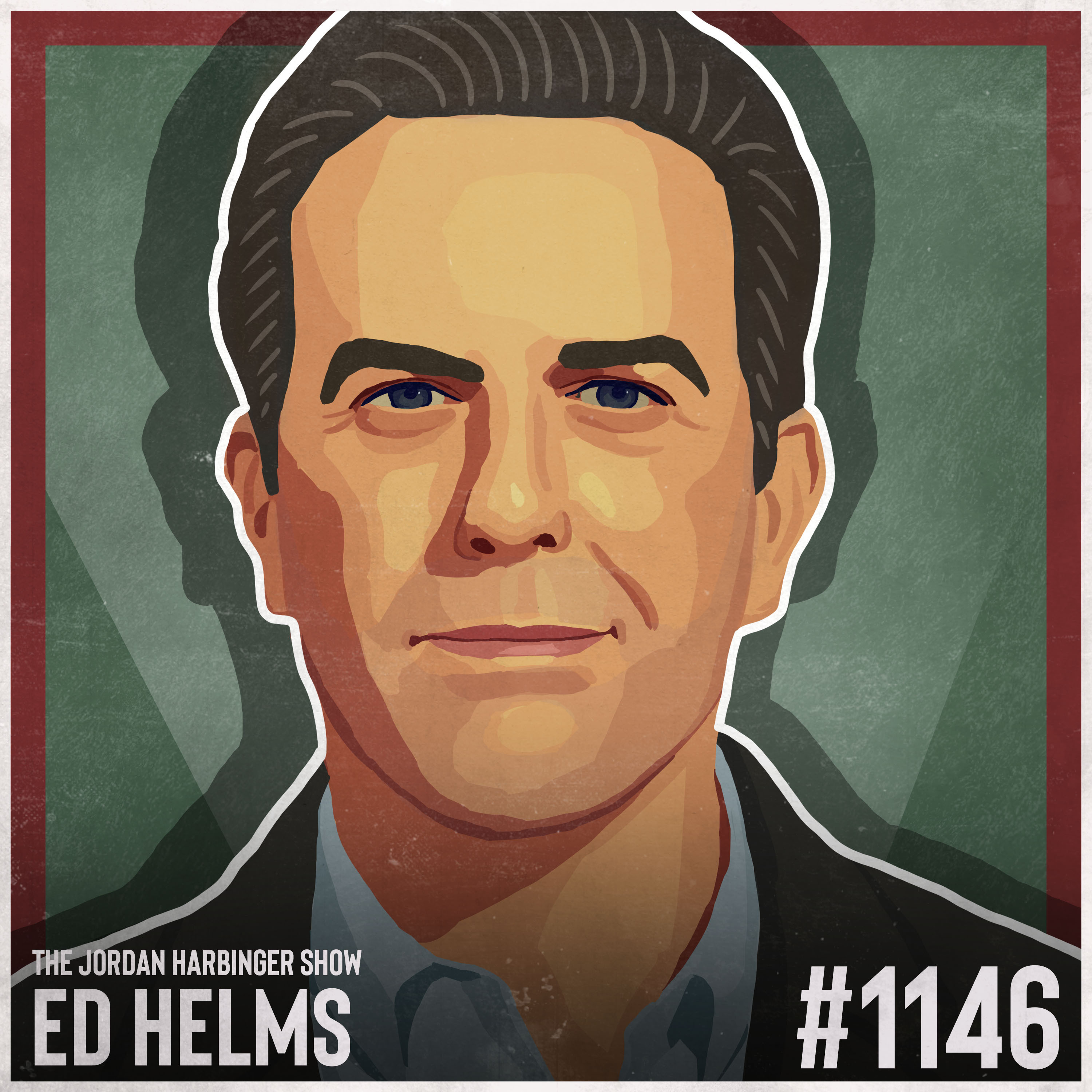
1146: Ed Helms | Fame, Family, and Finding Joy in Failure
Ed Helms dishes on fame's hidden costs, his Office-Hangover filming marathon, and why historic blunders might be humanity's most reassuring legacy.
Full show notes and resources can be found here: jordanharbinger.com/1146
What We Discuss with Ed Helms:
- At 17, Ed Helms knew exactly what he wanted: to be an actor/producer for TV and film. This rare clarity gave him a massive head start, though he now recognizes success wasn't just hard work but also luck, privilege, and opportunity — a constellation of factors for which he's deeply grateful.
- Ed says the strangest part of fame is that friends claim "you've changed" when they're actually projecting their own discomfort. Fame also strips away your ability to control public spaces — no more escaping the awkward stranger at baggage claim.
- At his career peak, Ed filmed The Office Monday-Tuesday, then The Hangover Wednesday-Sunday — chartering flights from Vegas for 6 a.m. Office call times. He even removed his actual dental implant for The Hangover's missing tooth scenes while shooting Office episodes with a flipper tooth.
- Young Ed naively thought he'd balance being a traveling dad with non-stop film work. But reality hit hard, and now he declines projects that would separate him from family — even hypothetical Spielberg films. His former ADHD-fueled hyper-focus has given way to prioritizing presence.
- Ed's book chronicles humanity's epic blunders — from dropped nukes to CIA cat-spies — revealing our enduring resilience. These absurd mishaps offer perspective: we've always faced ridiculous challenges and somehow survived. Next time anxiety strikes, remember we've been falling on our faces — and getting back up — throughout history!
- And much more...
And if you're still game to support us, please leave a review here — even one sentence helps! Consider including your Twitter handle so we can thank you personally!
This Episode Is Brought To You By Our Fine Sponsors: jordanharbinger.com/deals
- Sign up for Six-Minute Networking — our free networking and relationship development mini course — at jordanharbinger.com/course!
- Subscribe to our once-a-week Wee Bit Wiser newsletter today and start filling your Wednesdays with wisdom!
- Do you even Reddit, bro? Join us at r/JordanHarbinger!
See Privacy Policy at https://art19.com/privacy and California Privacy Notice at https://art19.com/privacy#do-not-sell-my-info.
Press play and read along
Transcript
Speaker 1 This episode is sponsored in part by LinkedIn. If you've ever hired for your small business, you know how important it is to find the right person.
Speaker 1 That's why LinkedIn Jobs is stepping things up with their new AI assistant, so you can feel confident you're finding top talent that you can't find anywhere else.
Speaker 1 The best part is that these great candidates are already on LinkedIn.
Speaker 1 In fact, employees hired through LinkedIn are 30% more likely to stick around for at least a year compared to those hired through the leading competitor. That's a big deal when every hire counts.
Speaker 1 Early on, I learned that hiring isn't headcount. It's do I see my family this week? Do we actually release episodes on time? Can I take a few days off without everything falling apart?
Speaker 1
When I've hired the right person, my life got easier. They took real work off my plate, caught problems early, and treated the business like it was theirs.
That's when we actually grow.
Speaker 1 With the wrong hire, I've spent months training, fixing mistakes, having the same conversations, and still ended up letting them go and starting over.
Speaker 1 You don't just lose money, you lose momentum, you lose morale, and you lose time. That's why I'm big on hiring right the first time, even if it takes a little longer.
Speaker 2
Hire right the first time. Post your job for free at linkedin.com/slash harbinger.
Then promote it to use LinkedIn Jobs' new AI assistant, making it easier and faster to find top candidates.
Speaker 2 That's linkedin.com slash harbinger to post your job for free. Terms and conditions apply.
Speaker 1 Welcome to the show. I'm Jordan Harbinger.
Speaker 1 On the Jordan Harbinger Show, we decode the stories, secrets, and skills of the world's most fascinating people and turn their wisdom into practical advice that you can use to impact your own life and those around you.
Speaker 1 Our mission is to help you become a better informed, more critical thinker through long-form conversations with a variety of amazing folks, from spies to CEOs, athletes, authors, thinkers, performers, even the occasional Emmy-nominated comedian, music mogul, or special operator.
Speaker 1 And if you're new to the show or you're looking for a handy way to tell your friends about the show, I suggest our episode Starter Packs.
Speaker 1 These are collections of our favorite episodes on topics like persuasion and negotiation, psychology and geopolitics, disinformation, China, North Korea, crime and cults, and more.
Speaker 1 That'll help new listeners get a taste of everything we do here on the show.
Speaker 1 Just visit jordanharbinger.com/slash start or search for us in your spotify app to get started today on the show the one and only ed helms you know him from the office as the nard dog and as stu from the hangover we talk about of course the office and the hangover his new book snafu which is some of history's greatest screw-ups having a super successful career as a creative and a whole lot more it's just a fun conversation as you might expect from somebody like ed helms he was an open book really cool really laid back especially since we got to do it in person i just thought it was a hell of a lot of fun and i think you will too all right here we go with ed helms
Speaker 1 By the way, I heard you love RC cars.
Speaker 3 Oh, yeah.
Speaker 1 I still have a shitload of Traxis cars in my garage.
Speaker 3
Are you serious? Yeah. Wow.
Tons. I got really into RC helicopters when they were first coming out at a consumer level.
Yeah. And as a kid, I was into RC cars and I had had the Kyosho Optima.
Speaker 3 Those are cool. Oh, they're so great.
Speaker 3 Those are a little out of reach for actual kids, unfortunately. Yeah.
Speaker 3 And then it's so weird when I got super into those little helicopters and I remember there was a hobby shop right next to my hotel in Ypsilanti, Michigan, where I was filming the movie Cedar Rapids.
Speaker 1 Which Ipsy, for those who don't know, is if you're in Ann Arbor going to college, Ipsy is the dangerous part near Ann Arbor where you only go there for one reason. Do you know that reason?
Speaker 3 The hobby shop? I don't know.
Speaker 1 There's a deja vu strip club that might make it.
Speaker 3 Oh, okay, great.
Speaker 1 You don't know anything about that.
Speaker 3 Of course.
Speaker 1
That's all anybody does there. Deja vu.
If you don't, you fly RC helicopters.
Speaker 3 There you go. Yeah.
Speaker 1 So what is this about you flying one around the lobby of the hotel, though?
Speaker 3
There was a PA that worked on the movie who was like my guy. And I would just be like, hey, run to the hobby shop.
I broke a rotor. Will you go get me another one?
Speaker 3
So he was back and forth all the time. And sometimes I'd be like, all right, here's 100 bucks.
Just buy something cool and bring it back. And he'd come back and be like, here's this cool car.
Speaker 3
And we'd just like race him around wherever we were. So yeah, like all over the set, I was constantly like buzzing people with these little helicopters.
The crew was getting super annoyed.
Speaker 1 Yeah, it's all fun in games until a red camera gets beamed with a
Speaker 3 hundred thousand dollars. And then Miguel Arteta, the director, was like, you know what? There's a face you make when you're flying that helicopter that I've never seen you make otherwise.
Speaker 3
And I want it in the movie. So we're going to have a scene where Tim Lippey, your character, is flying this helicopter.
And he did. And it's in the movie.
I'm just sitting in my office like, like,
Speaker 3
and you see the little helicopter fly by. It's a joy.
That look, yes.
Speaker 1 The look is unadulterated joy, right? Where you're just transported back to kid mode and you're like, this is cool as hell.
Speaker 3
It's almost like a meditative state. Yeah.
Truly. It's like I'm elsewhere.
I'm in this little helicopter that's flying around.
Speaker 3
There's something so exhilarating about controlling an apparatus that when I was a kid, helicopters were the coolest thing. And now I can pilot one.
It totally ignites my childhood enthusiasm.
Speaker 1 There's a guy in a a park near my house, and he flies this plane, this RC plane, around and around and around and around.
Speaker 1 And
Speaker 1
my wife goes, he's there for hours. He must be so bored with his life.
And I was like, no, that guy, this is his happy place, man. He's not thinking about his bills.
Speaker 1
He's not thinking about his bum leg. He's not thinking about his, I don't know, prostate enlargement issue or whatever.
He's not thinking about all the crap that he's been through.
Speaker 1 And this is an older guy.
Speaker 3 He's like, all the losses.
Speaker 3 No, this is where he just is for four hours a day in the sun not giving a crap about the melanoma developing I get it bald head I get him I get that 100% I've gotten into the crawlers recently do you know yeah so they're the really slow RC trucks it's like this meditative thing because they'll go like over rocks and trails and stuff I never thought I would be into a slow RC car, but it's really fun.
Speaker 3
And of course they go fast too, so you can zip them around. But on hiking trails, it's like a little road for a little car.
That's right.
Speaker 3 There's people. How many people have turned this podcast off at this point? Like, what is he talking about? They're going to get to the point at some point in this show, right?
Speaker 1
Yeah. I read that you had some career clarity really early.
You said, I went back to Oberlin and they showed me my application. And there's a question on it that says, what are your career goals?
Speaker 1
And I wrote TV, film actor, producer. I was 17 years old.
It seems like a huge advantage to have that kind of clarity at 17 because I don't even think I had clarity about what I wanted to do.
Speaker 1 I used to be a lawyer before this.
Speaker 3 Wait, you didn't know you wanted to be a podcaster before podcasting existed?
Speaker 1 I did love radio and I wanted to talk on the radio and my mom was like, they don't make any money and it's an impossible job to get, forget about it. And I was like, okay.
Speaker 1 But I was probably eight then because I built an FM radio transmitter that would go around the neighborhood,
Speaker 1 which is illegal, by the way.
Speaker 1 But who cares?
Speaker 3 Your little Marconi in the attic building your radio. That's so cool.
Speaker 1 I thought that was cool. And there's something magical about other people being able to hear you.
Speaker 1 Podcasting really scratched that itch for me, but it seems like it wasn't just, I want to be on TV because you said producer, which is not something you say when you're like, I want people to adore me unquestioningly and get lots of girls.
Speaker 1 But it seems like it's deeper than that.
Speaker 3 I can't explain it, but at least I knew I wanted. I didn't know that it was realistic or even plausible for a long time.
Speaker 3 But even as a little kid, And so many comedy people say this to the point where it's almost hacky, but it's 100% true with me, which is that watching Saturday Night Live and watching Eddie Murphy and Mike Myers and all these guys that I just, I started watching, I think Eddie Murphy was on when I was eight years old.
Speaker 3 How was that allowed? Sneaking downstairs with my best friend Nick, and we would watch these things and then recite them for hours and reenact them. And we didn't get them.
Speaker 3
Like we didn't get the jokes. Like Mr.
Robinson's neighborhood, like I got that as a kid, but I loved it. I just loved the energy.
And it was something I knew I wanted to be a part of somehow.
Speaker 3
And I took it for granted. This is what I want to to do.
And as I got older, it started to feel more possible. Like, I developed this mindset of like,
Speaker 3
any job that I want to have or any adventure that I want to be a part of, somebody's doing it. That person had a path to get there.
There's no reason I can't find a path to get to the thing I want.
Speaker 3
I don't know. That's a very hopeful mindset.
And I don't know where it came from, honestly.
Speaker 3 I think I credit my parents somewhat with giving me a lot of safety and self-confidence to kind of like find that mindset.
Speaker 3
But I also think there was a part of me that really wanted to get away from my home. I was raised in the South and I always felt like a fish out of water there.
I need more, I need some adventure.
Speaker 3
I need something bigger, which is also a fallacy. And so I moved forward with this clarity that I took for granted.
And I look back, I'm like, I'm so grateful I had that clarity.
Speaker 1 And I used to look at other people and be like, why are you so lost?
Speaker 3
Just dig in, figure out what you want to do. And it took me a long time to realize, oh, that's actually a very rare gift that I was given is that clarity.
Now I don't take it for granted at all.
Speaker 3
I'm so grateful that I had such a specific passion. I can't totally explain it, but it was something I had and was lucky enough to follow.
Yeah, I agree, man.
Speaker 1
I started this podcast when I was probably 26 and I'm 45 now. Maybe I was 27.
I have to do the math on this, but. That was early.
It's early for podcasts, but it's early in my life.
Speaker 1 You had yours at 17.
Speaker 1 Most people, I don't think, either either ever get that clarity or they get it when they're like 38 and they go, that's going to be a hobby because I've been a lawyer for 15 years and this is my career and this is what pays the bills.
Speaker 1 And I'm not going to start over to go do improv shows on weekends when I'm making three or four or 500 grand as a lawyer. Like that's irresponsible at that point.
Speaker 1
If you have a family to do that, if you're single, I guess go for it. You only live once.
But it seems like that clarity, like you said, yeah, it's a gift.
Speaker 1 You just get it early and you have a massive head start.
Speaker 3 And I think also having the circumstances in your life, even as a young person to chase that thing, I was fortunate enough that I wasn't saddled with student debt.
Speaker 3 My parents were able to pay my college and things like that. That I just,
Speaker 3 I'm so grateful looking back. Those are the things that enabled me to make some probably riskier choices than a lot of people have an opportunity to.
Speaker 1
Yeah, it's important that we recognize that. I agree with you.
I think it's real easy for people like us to sit up there and go like, man, just go for it and follow your dreams.
Speaker 1 And so let me ask you this. What was going to happen to you if your dream failed? Oh, I go back and live in my in-law unit and then probably work for my uncle's car dealership or whatever people say.
Speaker 1 And it's, oh, I was going to be homeless because I don't know where my father is and my mother lives in public housing and I can't leave. And you're like, oh, yeah, that's a worse alternative.
Speaker 1 I understand why you took the safer route.
Speaker 3
I have evolved so much on my understanding of meritocracy as a concept. I used to.
look at my career and my success and be like, I built it. I did all this.
I took huge risks. I worked my ass off.
Speaker 3
And both of those things are true. True.
Yeah.
Speaker 3
And also I am lucky as hell in a thousand different ways. And I had opportunities that other people don't have.
And I had access to whatever that maybe other people didn't have.
Speaker 3
My career wasn't handed to me, but it's just important to look back with gratitude at some of the things that paved the way. Fell into place.
Yeah, it fell into place. Exactly.
Speaker 1
There's a book I read a long time ago. I can't remember the title, unfortunately, but it was about luck and how most people don't want to acknowledge the role that luck plays in their life.
Yeah.
Speaker 1 But then they went over certain characters like Bill Gates or something and how it might be like a Malcolm Gladwell outliers.
Speaker 3 Outliers.
Speaker 1 Yeah.
Speaker 1 And they go over the luck factor and it's Bill Gates did this and he saw this coming, but he also went to a school where there was a computer and it was like the only one that side of the Mississippi and they got the keys and they could go in there at night.
Speaker 1 So they spent a thousand times more computer hours. than their peers do right in this thing.
Speaker 3 They had access to a mentor in a certain space.
Speaker 3 I go back to this a lot because I have little kids now and I think about this all the time just about when a kid feels safe, what they have access to inside of themselves.
Speaker 3 So many kids aren't safe for a thousand different reasons, whether it's food insecurity or an abusive home or an addicted parent or whatever it is. There are so many things that safety interrupts.
Speaker 3 And there's so many ways, obviously, that kids persevere through these things. And my childhood wasn't 100% safe.
Speaker 3 There were certain difficulties. But I do think that Bill Gates grew up in a home where it was safe for him to be like a nerdy kid.
Speaker 1 Right, leaning to his interests.
Speaker 3 He didn't have the jock dad like screaming at him to go to football practice or whatever that could have looked like.
Speaker 1 That's an interesting point. Yeah.
Speaker 3
So it's, you're right. There are so many factors.
It's just a constellation of factors that allow us to get on these pathways, especially unusual or special ones like the careers that we've had.
Speaker 3 And you just have to be grateful.
Speaker 1
You've been in some massive franchises. The hangover, the office, they have these intense fan cultures.
I'm sure you've noticed.
Speaker 1 What's the most surreal moment you've had when you realized maybe how much public perception had shifted around you?
Speaker 1 Because it happens, I won't say overnight, but you build up to it, but you talk about this on CONAN, there's these different levels of right.
Speaker 3 Yeah.
Speaker 3 Gosh, I do remember being in London when we were doing Hangover Press
Speaker 3 and we were in London for a premiere. And we were out to dinner with, it was me and Bradley and Zach and a few other Warner Brothers brass and I think a couple of of other cast people were with us.
Speaker 3
And they were getting numbers from the U.S. box office.
And the Warner Brothers people were like, this is unbelievable. This is incredible.
Speaker 3 And one of the executives like turns to me and goes, your life is about to completely change. But I just remember being like, I just took a bite of this steak.
Speaker 3 And now the next bite I take of the steak, I'm a different person.
Speaker 1 You're a celebrity.
Speaker 3 It's like a totally different thing.
Speaker 1 Did the second bite taste better?
Speaker 3
The second bite I took was inadequate. It didn't measure up.
The first bite was the best one I ever had. What's your celebrity? Nothing measures up.
Speaker 3 It sort of hit in a way that was like, okay, intellectually, I can understand that, but what's that going to feel like? And then it just creeps into you.
Speaker 3 And I think the strangest thing about your profile rising so quickly and massively is that you no longer control your experience of an environment. Yeah, that's interesting.
Speaker 1 So like.
Speaker 3
An airport is probably the most easy one to understand. Yeah, the classic one.
Right. So you walk into an airport as a anonymous civilian and you can go and stand at baggage claim.
Speaker 3 And if there's some crazy person next to you or like really obnoxious person or stinky person or whatever, you can just walk away and go stand in another place and whatever, read your book, listen to your podcast.
Speaker 3 But at a certain level of celebrity, you can no longer take those little measures of control.
Speaker 3
You might have walked away from a situation in that instance, but at a certain level of celebrity, you can no longer take those little steps because they won't matter. They won't fix anything.
I see.
Speaker 1 So the stinky person just follows you from one part of the baggage queen to the other.
Speaker 3
Yeah, or there's still people yelling at you. You go to a different place.
People are still yelling, nor dog, or worse, like they do. That's very fearful.
I can no longer control my environment.
Speaker 3 And you take for granted how much anonymity allows you to actually control your circumstances.
Speaker 3 So in a weird way, it's been this lesson in letting go that I probably needed at some level when we were on the daily show. This is, we have toy fame, meaning it's fun to play with.
Speaker 3
You get to go to an airport and nobody really recognizes. It's basic cable fame because we were all on the daily show.
So like fans recognized us, but nobody else.
Speaker 3 You can walk through the airport and you're pretty much fine, but you're going to go to like an Einstein bagels and they'll be like, do you want some free cream cheese on that? I'll hook you up, man.
Speaker 3
Yeah, I'll hook you up. It's like you just bump into fans here and there and there's like really fun energy around it.
And then as it grows and grows, it's real. It's like real adult fame.
Speaker 3 And that has a lot of consequences that go with it.
Speaker 1
I think a lot of us are going, what's the hard part about being famous? Come on. Most people don't see the flip side of it.
They only see the upside of it.
Speaker 1
They think, oh man, you get free cream cheese on your bagel. You probably get seated preferentially.
You can pre-board on an airplane. You can do all kinds of stuff.
Speaker 1
You can get a table at this restaurant without waiting. They're not going to make you wait 45 minutes.
They're going to let you come and sit down.
Speaker 1 You're going to look cool for every girl that you're with or whatever at any time. Well, you know, those days are gone for both of us, probably.
Speaker 1 But there's a downside, I assume, too, like you said, where you can't get away from the farter at the baggage claim. There's a farter on the other side waiting to bother you.
Speaker 3 Yeah, it's the change in your existence that's the hardest thing to accept.
Speaker 3 And once you've gotten through that, like any change in your life, any dramatic change is going to upset the apple cart in some way. Yeah.
Speaker 3
There's going to be some good things and some difficult things. But honestly, I don't know.
I've gotten so used to it and it's tempered now.
Speaker 3 When I have a movie coming out or I have something big going on, like this book, my profile does rise in the zeitgeist for a moment and I'm recognized a lot more in those moments. I don't know.
Speaker 3 It's just not as big a deal as it was.
Speaker 1
I can see that. It's very funny that this happened to me right before this interview when I was eating at Sugarfish, which is one of my favorite sushi places in L.A.
It's right near the studio.
Speaker 1 And I zoned out staring at the waitress and the bar because I wanted something. And then she walked away and I just kept staring in that direction.
Speaker 1
And then I noticed this guy who had like a really bright shirt on started staring back at me awkwardly. And I was like, oh, gosh, that guy thinks I'm looking at him.
This is embarrassing.
Speaker 1
Now I have to look away. And then I looked away and I went, the guy looks familiar.
And I looked over and he was still looking at me. And it was Adam Sandler.
Speaker 1 And I was like, crap, he just thinks I'm going to do some weird thing when I was looking for a Diet Coke refill.
Speaker 1 So the whole rest of the meal, I have to awkwardly, deliberately not look at Adam Sandler. He doesn't dare look back.
Speaker 3 Blue shirt.
Speaker 1 And I was like, should I say something? I was like, no, that's the opposite of what's supposed to happen here. So I just end up paying my bill and leaving.
Speaker 1 And I'm like, no matter how much you try to not be weird around something like that, it's not you guys who are changing when you become famous. It's everyone around you changing.
Speaker 3
That's a remarkable insight that you're expressing. And it's something that dawned on me at a certain point.
And I've shared with people close to me at times.
Speaker 3
There's that old adage, like, oh, like someone who gets famous and then everyone. Don't forget what you came, where you came from.
Yeah. Or you've changed.
Speaker 3 What's usually the case is that whoever the person's saying that is the one who's changed their perception of you. That's interesting.
Speaker 1 Yeah.
Speaker 3 Like, hey, you didn't ask me for money before the hangover.
Speaker 1 I don't know if I'm the one that's changed. Yeah.
Speaker 3 And I find that such a fascinating lesson in projection, like how we perceive each other and what we project onto each other.
Speaker 3 And to look at your friend who's become famous and is now maybe has more boundaries, but still your friend. Yeah.
Speaker 3 But then to look at them and say, like, you've changed when actually you're the one nervous around them. Yeah, that's interesting.
Speaker 3 And you've become nervous, but you're projecting that change onto them. Yeah.
Speaker 1 I don't know. That would be kind of unpleasant, right? Because there's this unspoken, are you being weird? Am I being weird?
Speaker 3 Is it weird at all?
Speaker 1 Do you feel that? Because I think I feel that, but I'm not sure I feel that. And then you're like, ah, can we just play golf?
Speaker 1 I thought we were just going to hang out like we did for the last 40 years.
Speaker 3 What happened? What? And they're just like, you've changed.
Speaker 3 No, I haven't. I just want to hang out.
Speaker 3
You've changed. You're so different.
If you haven't changed, why am I so uncomfortable? Because you've changed.
Speaker 1
Exactly. That's a good point.
yeah, why am I so uncomfortable?
Speaker 1 There's this funny moment where I guess it was daily show days where you weren't able to get into a convention because you forgot your ID or something like that.
Speaker 1 But then you had to use the billboard to get in.
Speaker 1 And I thought that was so ironic because you're famous enough that you had a billboard facing the parking lot to get in and you just went, is this enough of an identification?
Speaker 1 And then I was like, sure thing, but you weren't famous enough for that guy to be like, oh, it's you. So you're like in that little midway point where it's like, okay, fine.
Speaker 1 You're the guy on the billboard, but I don't recognize you.
Speaker 3 That was the daily show.
Speaker 1
Yeah. It's really funny that there's that between level.
I wonder if at that point where you're like, one day, I won't need to point to the billboard. You'll just remember your idea at that point.
Speaker 1 But yeah, I don't know.
Speaker 3
I honestly thought a bunch of those years on the daily show, I was like, this is it. This is all I've ever wanted to do.
This is the pinnacle. Yeah.
Speaker 3 And then at a certain point, I was like, I'm 30 years old. I need to start thinking what's next.
Speaker 1 What's something you used to believe about success or fulfillment that you've let go of?
Speaker 3
Let's see. Success or fulfillment.
I think the obvious answer that is true is that I wanted so badly to be on Saturday Night Live for the Daily Show. And I prepared relentlessly.
Speaker 3
And it was, it's why I moved to New York. It's why I started doing stand-up comedy and started doing improv comedy.
It's why I joined the community and surrounded myself with the friends that I had.
Speaker 3
And I just loved that. And I had this goal.
And then I got on the daily show and I had never thought beyond that horizon.
Speaker 3 And I thought somewhere in the back of my head, I was like, once I get on the daily show, everything falls into place.
Speaker 3 Like everyone's career.
Speaker 1 Except for the guys where that doesn't happen.
Speaker 1 My friend just on Saturday Night Live. And then one season later, he was like, that was it, man.
Speaker 3 Yeah. You just think you're going to thrive.
Speaker 3 And I guess it was the realization that the work never ends.
Speaker 3 That was a valuable lesson because, especially at that time, to learn on one of my first major gigs, because, well, the office happened and then the hangover, I still have to hustle.
Speaker 3
I got to keep hustling. That helped you though, right? Yeah, for sure.
Oh, for sure. From that point forward, I didn't assume that everything was going to be fine whenever I crossed a threshold.
Speaker 3 Because, of course, my next goal became like, oh, I want to get on a TV show where I can. act instead of the daily show where I'm kind of this one note thing.
Speaker 3 Now I have to show the world like I can act.
Speaker 3 Well, the office gave me that opportunity, but I was already looking ahead again, but not in a desperate, starving, hungry way, just in a way of like, I have to be thinking about my next moves as a responsible adult and as someone with career aspirations.
Speaker 3 So then it was like movie pursuit.
Speaker 1 You're listening to the Jordan Harbinger Show with our guest, Ed Helms.
Speaker 3 We'll be right back.
Speaker 1 This episode is sponsored in part by Cachava.
Speaker 1 Someday as I get so deep into recording for you guys that I end up having to skip a meal or just forget to eat one, I'll look up from the mic like, wait, it's 9 p.m. How did that happen?
Speaker 1
All in the name of another great episode or three. So on those late nights, when the house is quiet, Jen, and the kids are asleep, my reward for a long day of work is cachava.
It's convenient.
Speaker 1 It's really tasty. It's actually a whole body nutrition that is ready in seconds, which for me is key because if it takes longer than 30 seconds, I'm just going to bed at that point.
Speaker 1 With every two scoops, you get 25 grams of 100% plant-based protein, 85 plus superfoods, nutrients, plant-based ingredients, all the good stuff your body needs without the junk, no artificial flavors, no preservatives, no soy, no gluten, none of that nonsense.
Speaker 1 It's packed with fiber, probiotics, and B vitamins that support metabolism, digestion, even cognition.
Speaker 1 Basically, all the things I need after talking for eight hours straight, and my voice is about to give out. My go-to actually is the strawberry flavor.
Speaker 1 I blend it with ice, a little bit of milk, but the chocolate and a little peanut butter, mm, that is next level good. You also got vanilla, matcha, coconut, acai, all legit options.
Speaker 2
Your future self will thank you. Go to kachava.com and use code Jordan for 15% off your next order.
That's cachava. K-A-C-H-A-V-A.com code Jordan for 15% off.
Speaker 4 The next time you fly, upgrade your comfort to Emirates premium economy. Sink into soft leather seats with raised legrests and adjustable headrests.
Speaker 4 Elevate your dinner plans with delicious regional dining, all served with complimentary premium drinks. Enjoy endless entertainment with up to 6,500 channels, including live sports.
Speaker 4 There's no other premium economy like it. Fly Emirates.
Speaker 3 Fly better.
Speaker 5 Shopify's point-of-sale system helps you sell at every stage of your business. Need a fast and secure way to take payments in person?
Speaker 5
We've got you covered. How about card readers you can rely on anywhere you sell? Thanks.
Have a good one. Yep, that too.
Want one place to manage all your online and in-person sales?
Speaker 5
That's kind of our thing. Wherever you sell, businesses that grow grow with Shopify.
Sign up for your $1 a month trial at shopify.com slash listen. Shopify.com slash listen.
Speaker 1 If you're wondering how I managed to book all these great authors, thinkers, and creators every single week, it's because of my network.
Speaker 1 I'm teaching you how to build your network for free over at sixminutenetworking.com. This course is about improving your relationship skills, inspiring other people to develop a relationship with you.
Speaker 1
It is non-cringy, no awkward strategies, just very practical, very simple, and very fast. Six minutes a day is all it takes.
And many of the guests on the show subscribe and contribute to the course.
Speaker 1
So come on and join us. You'll be in smart company where you belong.
You can find the course at sixminutenetworking.com. All right, now back to Ed Helms.
Speaker 1 The hangover takes off, right? I assume you get scripts for other comedies, but do you get like, here's a serious role?
Speaker 1 And your agent's like, hey, man, do you want to be more like a serious actor in this one? Like Bradley Cooper, right? He's like, you got limit lists. That's not a comedy.
Speaker 1 Do you get those and go, do I stick with comedy or go serious in this one? And how do you make those decisions? It's got to be hard.
Speaker 3 I wasn't getting like the serious offers.
Speaker 1 I'm surprised.
Speaker 1 I thought everybody would come after you for everything, or your agent just threw those in the trash, maybe.
Speaker 3 Maybe.
Speaker 3
Maybe. Let's be realistic.
It's not entirely true.
Speaker 3 I definitely had some stuff across my desk that was maybe a little more serious or dramatic, but I was just very focused on comedy, probably to a fault for a while.
Speaker 3 I just was like, this is what I've always wanted to do. And I just want to be be in these big, funny, crazy movies.
Speaker 3 And looking back, honestly, I wish I had expanded my repertoire a little more earlier on. I've changed things up a little bit.
Speaker 3 Even at that time, I was doing movies like Jeff Who Lives at Home, which was a Duplos Brothers movie that's funny, but very real and a little bit dark.
Speaker 3
And then Cedar Rapids is another one that, again, it's a comedy, but it's dramatic. But I didn't go like full drama.
That's something I wish I had done earlier on.
Speaker 1 I'm curious why. It's not like it didn't work out for you.
Speaker 3
Because I think it would have opened up more possibilities over time. Now I'm definitely more open to those kinds of roles.
And I just did one that's like super dark and I'm excited about it.
Speaker 3
And it was fun. I'm just enjoying variety of challenges now.
I will still always love comedy. There's nothing like just trying to come up with the best bit on a movie set.
It's so fun.
Speaker 3
The pressure is so high. Everybody's, ah, this joke isn't working.
Like, what do we do? What do we do? And you just like, your body just does it and you start figuring stuff out. And I love that.
Speaker 3
I love that process. I love the collaboration.
But there's something about drama and the intensity of certain moments and role. I just am drawn to that.
Speaker 1
Yeah, I can understand that. You joined the office after it already built some momentum.
What was the biggest challenge in stepping into that dynamic? Because speaking of pressure, right?
Speaker 1 Like you're getting in there and it's, all right, don't screw this up because this show's already funny. If it's not funny when you're there, that one's on you, pal.
Speaker 3
Yeah, I had just done a pilot for NBC before that that had gone really, really well. And it was a multi-camera pilot.
So it's one of those ones with a big studio audience. I see.
Speaker 3 And that was terrifying because I had never done anything like that before.
Speaker 3
But like I said, it went really well. And so at the end of the day, it was just exhilarating and incredibly fun and also a huge confidence builder.
So I went into the office.
Speaker 3 I already knew Steve Carell because he had worked on The Daily Show, not for long, but we had overlapped on the Daily Show. And I had also done a little bit part in Evan Almighty.
Speaker 3
So I had that comfort. And then I also wasn't thrown to the wolves.
I was invited in by Greg Daniels to have a conversation about it. They didn't offer me a part.
Speaker 3 They just were like, hey, we have this idea for this character. who's like a Connecticut yacht club kid, went to Cornell,
Speaker 3
and we just just wanted to talk to you about it and see if it resonates. And I was like, yes, that sounds hilarious.
And we start pitching and just having a conversation.
Speaker 3 So I felt very brought in and kind of part of the process from the get-go in a way that I think is extremely rare and was very lucky for me.
Speaker 3 And Greg Daniels had also seen a little short movie I had done about a zombie who it was like a little documentary about a zombie trying to go on the dating scene.
Speaker 3
And of course, as a zombie, like everyone's grossed out by him. So he's really struggling on the dating scene.
And it was a very funny, like little five, ten-minute short film.
Speaker 3
And we really committed to the zombie makeup. So it looked really good.
But it's him like talking to camera, like, yeah, I don't know. It's just hard.
Speaker 3
The minute they see me or smell me, like, they're grossed out. They're already checked out.
Yeah. It's like, I don't, it's like, how do I even get like anywhere with these people?
Speaker 3 So he liked that because it had a very officey
Speaker 3
kind of vibe. Yeah.
And then the cast was so warm. And I'll never forget like John and Rashida and I were both new at the time.
So we were kind of buddies. Oh, yeah.
Speaker 3
And we were in the Stanford branch. I always said to John, you guys were just like this basket for Rashida and me.
And you just welcomed us in. There's no like, let's see what these guys can do.
Speaker 3 Let's see if these guys screw up our show. It was just like, come on.
Speaker 1 Play with us. That's great.
Speaker 3 The best.
Speaker 1 I love, from an acting standpoint, I think one of the funniest parts for me is the disconnect from how you're really feeling.
Speaker 1 Your appearance on the outside is always almost trying, not quite in sync with your emotional status, your real emotional status. Does this make sense?
Speaker 3 Sure, the characters. Yeah, of course.
Speaker 1
That's fun. It finds its way into these different bits, like where you punch the wall and say, is it overreactione? Yeah.
Yeah. Like, all right, he's fine.
Nope. He just smashed the wall.
Speaker 1 And it's just like, there's this tension inside your character from that. I think it's really funny.
Speaker 3 Yeah, that came very naturally because I grew up in the South. And
Speaker 3 very few people are presenting a transparent version of themselves in the South. There's very much a sort of facade that people, not just in the South, this is obviously
Speaker 3
right now. I know, right? This is humanity.
What it means to be human is to struggle with how we present ourselves, with how we really feel. The office writers just got that so well.
Speaker 3
I've always understood that. That tension between who we present and who we want to be and who we hope we are.
That's such a funny battle within us.
Speaker 1 Did you ever disagree, might be a strong word, but disagree with the writers or the producers about where Andy's character was headed? Is there ever any like, oh, really? That's going to happen?
Speaker 1 Or do you not even have the sort of green light to do that?
Speaker 3
I'll be delicate, but there were aspects of Andy's story that I have really struggled with. Yeah.
Especially after years of building a character and committing your life to this thing.
Speaker 3 I think all of us on that show, one of the things that was so special about it was how much we loved our characters.
Speaker 3 And then certain scripts come in and you're like, this doesn't feel like this character.
Speaker 3 And we all felt pretty possessive or not possessive, but just a lot of ownership and affection for our characters.
Speaker 3 And so there were a lot of times where us as a cast would push back with writers or producers like, I don't think Andy would do this. And a lot of times that was a very fruitful conversation.
Speaker 3 There were times, though, that.
Speaker 3 I just felt like all this work I'd put into redeeming Andy, who's also on paper, was a pretty hard to like guy, but I really tried to find heart, a deep goodness in him, and it was his internal battle.
Speaker 3 Anyway, I felt like at a certain point, that was not factoring in to things, and it was tough. There were some tough moments.
Speaker 1
I can imagine that. I get what you mean about being possessive over your character.
I can see why you would be like, this is sort of a part of my identity.
Speaker 1 And on the show, it is my identity. And it's like if you built a really nice, radio-controlled car and someone's like, cool, I'm going to drive this as fast as I can into that wall over there.
Speaker 1 And And you're like, No, no, no, that's not what it's for. The paint job is immaculate.
Speaker 3 Yeah, they're supposed to show this thing, but they're like, But it will be cool, it's going to be cool, it's going to be great.
Speaker 3 That's actually kind of a good analogy because there's also, from a high-altitude standpoint, I think there's value in blowing things up, there's value in destroying something to rebuild it in a narrative context.
Speaker 3 And so, I won't presume that I understood all the choices that were made and I held no grudges. I truly look back on that time with nothing but just like epic, epic thanks and gratitude.
Speaker 3
And like, it was such a joyful time. I bet.
But yeah, there were some narrative moments where I was like, what?
Speaker 1 Yeah, I can believe it. Is there any sort of behind the scenes moment from the office that's never made it into an interview before? As you can tell, my YouTube team told me to ask you that one.
Speaker 3 Viral moment, Jordan.
Speaker 3
Let's see. I'm sure there's tons.
This one you'll never see anywhere, but there were some really funny jam sessions off camera between me and Creed because he's a great musician,
Speaker 3
guitar player. Oh, yeah, he was in a band in the 70s, like big rock band.
Really? Okay. Yeah.
I forget the name of the band. It's killing.
Out of my forgetting, but they had a big hit. The chorus is
Speaker 3 na-na-na-na-na. The four today.
Speaker 3
Creed was in that band. So anyway, he's a great guitar player and I'm a banjo guitar player.
And we would just hang out and jam. And then Zach Woods joined the cast.
Guess what? Zach Woods plays?
Speaker 3
Trumpet. No kidding.
kidding. Jazz trumpet.
Speaker 1 Brings it with him.
Speaker 3 And we were like, Zach, you got to bring your trumpet. And we had some banjo guitar trumpet jams.
Speaker 1 That's pretty fun. It's got to be a good way to blow up Steve.
Speaker 3 How in character is that? Yeah. For Creed,
Speaker 3 for Creed, Andy, and Zach.
Speaker 1 Like, it was pretty great. Sound guys.
Speaker 3
Can you tell them we're trying to work over here? This was like out in our trailers and stuff. But the other thing I'll tell you is the Christmas episode.
I think people have talked about this a lot.
Speaker 3 The Christmas episode where Steve's dressed as Santa Claus and Kevin's sitting sitting at his lap and Steve is like suffering. And the way that he's performing that, it has all of us laughing so hard.
Speaker 3 And I'm in the background of a shot and I'm almost positive it's in the show where I keep ducking behind a plant because I'm laughing so hard.
Speaker 3 And there were so many instances where I just couldn't look at them because they were being so funny. Even if you're off camera.
Speaker 3 if you're talking you're in a dialogue with someone you can't break and laugh at them because then you'll ruin their channel
Speaker 3 so i had developed this practice where when i had scenes with steve a lot of the time i would look at his chin or his ear because i couldn't look into those eyes
Speaker 3 they would destroy me and this make me laugh too hard but this christmas episode i definitely am like i think i'm over in the corner with mindy and she's skirting around and we're both trying to hide yeah it had to be a fun set to be on In the hangover, I heard that tooth really came out or comes out.
Speaker 1 How was that possible? I guess it's probably common and I just don't know that.
Speaker 3
Yeah, it's not that crazy of a story. I was born without that tooth.
So I had the baby tooth, but when it fell out, there was no adult tooth. So I had a flipper, a retainer with a fake tooth on it.
Speaker 3
He meant like a little arm that waves around. That's freaking weird.
So I also had a flipper. No, but it was just a tooth I could pop out on a retainer.
And it had a little tooth on the front.
Speaker 3
that would go right in there. Now you have something else.
Correct. So then I turned over, like around 17, I I got an implant, but an implant is just like a nut that is screwed into your bone.
Whoa.
Speaker 3 And they put a little post into the implant, which they then put the tooth on top of. So we're in testing, doing like wardrobe testing and camera tests for the hangover.
Speaker 3 And Todd's like, we got to figure out how to get rid of your tooth. So we did some camera tests, blacking it out and these other things, and nothing looked good.
Speaker 3 Now you could probably do it digitally. Like
Speaker 3
no problem. We didn't have that then.
So I said, this is an implant. Let me go talk to my dentist.
And so he's like, go to my guy. I got a guy.
I got the best guy here in Beverly Hills.
Speaker 3 And I was like, okay.
Speaker 1 If you're going to pay for it, I'll go to the guy in Beverly Hills.
Speaker 3 So I go to this dentist and he's like, yes, we can take the tooth off the post, unscrew the post out of the implant, and it will look like you have no tooth there.
Speaker 3
And we just have to like keep your gum healthy throughout productions. So that's what we did.
And he then made me a couple of flippers that I could use for the shots where I have a tooth. I see.
Speaker 3
So I was able to pop that tooth in and out at will. And I also was shooting the office simultaneously.
And I didn't tell them that I had taken my tooth out. Yeah.
Speaker 3 But it affected my speech a little bit.
Speaker 3
Got a little air outlet. Like I couldn't move my tongue the same way.
So I sounded just a tiniest bit off.
Speaker 3 But fortunately, one of the episodes that I did while I had the fake tooth was where Andy and Oscar are on a business trip and Andy gets trashed and calls Angela and has some like drunk dials.
Speaker 3 But anyway, I was drunk. The speech thing didn't really matter.
Speaker 1
It's so funny. Yeah.
The scenes with this tiger, that was real, right?
Speaker 3 The tiger is real. Yeah.
Speaker 1 How do you do that safely?
Speaker 3 I honestly can't say for sure it was safe.
Speaker 3 No, it's, oh man, I remember the scene where we're pushing the car with the tiger in it and it's nighttime. So
Speaker 3 the tigers are on a truck in the production area. They're like in these big cages on the back of a truck and we're waiting for night to start shooting.
Speaker 3
As the sun's going down, this is when tigers hunt and this is when their like energy comes up. And so the sun's going down.
The Santa Ana's start blowing. This is the wind
Speaker 3 and like the trees are going and all the grass is moving and the tigers are pacing in.
Speaker 3 There's two or three tigers that we use for the and they're just pacing in their cages and we're like, what the hell's going on?
Speaker 3 And we get all these safety lectures about how to like never turn your back on a tiger because that's when they pounce.
Speaker 3 It's like, as long as, I don't know if you've seen the India, the people that would hunt tigers. had masks on a face on the back of their head.
Speaker 3 And that was to confuse the tiger because they won't pounce if they think you're looking at them.
Speaker 3 good to know i suppose i don't know anyway it was always nuts there was like a leash with a cable but i always was looking at that leash like really this 800 pound cat can't just snap that thing in a second yeah or pull the person who's holding it yeah exactly and then we're doing all those crazy photos in the hotel room and i remember bradley's like can i feed it and i was like buddy what are you and he's like no no come on i don't want to like they're feeding it why can't i
Speaker 1 and they're like sure just hold the bottle like this and so there's pictures in the closing credits of bradley feeding the cat oh my really doing it yeah i would be very nervous around something like that because even if there's a guy with like a giant cannon nearby to sedate the tiger doesn't really understand that tiger's just like i'm hungry these guys look like they are tasty i can smell them and they're right in front of me can't train cats siegfried and roy have taught us this They lived with that tiger and then that was the end.
Speaker 3 Yes.
Speaker 3 Sadly.
Speaker 3 Yes.
Speaker 1
You also got super sick during the shooting of one of the hangovers. Yeah.
Oh, yeah. I remember Bradley Cooper said, we all ate at the same place.
I don't understand why you're the one that got sick.
Speaker 3
He has his theory that I used one of the sauces or something. It's like week one in Bangkok, and this is Hangover Two.
And we're so excited to be there.
Speaker 3
And the first AD, this guy, JP, is like, there's this awesome restaurant. It's like a hole in the wall.
Let's all go out. And we're all just eager for adventure, eager to see the city and do whatever.
Speaker 3
And like, JP's like this boss figure on the set. He's our first AD.
He's looking out for everybody. And we're like, yeah, sure, let's go.
We all go out and it's basically Bangkok street food.
Speaker 3 And we go back and I just explode. That's the only way to describe it is that a bomb went off inside of me and that every orifice was where the explosion went.
Speaker 1 Oh, man.
Speaker 3
I remember I was so sick. It's this weird thing.
Like when you're in a foreign country and you're really sick, your mind just starts going to really dark places. And I was like, I'm going to die.
Speaker 3
And I'm thousands of miles from my family and people that love me. And I'm definitely going to die.
And I called JP and I was like, I am so sick. I think I need to go to the hospital.
Speaker 3
And he's like, your pickup is 6 a.m. tomorrow to go to set.
Right. To go to work.
Not for the hospital. Yeah.
And so we'll see you then. Okay.
Speaker 3
And it just was like, that's right. I'm here to work.
I have a job to do.
Speaker 3 And like this production that costs like a million dollars a day can't just pause because I have a tummy ache or whatever. And that like whips me back into shape.
Speaker 3 And I wind up going on some crazy intense, I don't know if it's an antibiotic or whatever.
Speaker 3
And the next day we're shooting this scene where Cassavetes, he's showing us the video of the riot we started. the night before on his iPhone.
And we're shooting the riot. So it's the riot scene.
Speaker 3
Yeah. And I'm leading the riot.
So I'm shirtless, like F the boys. And there's fires.
It's a pyrotechnics everywhere and crowds all around.
Speaker 3
And we're also in Soy Cowboy, which is the red light district of Bangkok. And it is grimy.
It is not like a chill part of town. And yet, I'm still in between every take.
Speaker 3 I'm curled up on the sidewalk on a blanket. Soy Cowboy.
Speaker 3 And with Bradley and Zach like feeding me little sips of water or sprite and like gently patting me. And I will say, I never felt more
Speaker 3
supported and bonded. Like we went through so much together.
That was one of the things that I was like, I would love these guys forever. Like they really took care of me.
Speaker 3 And then I would just get this adrenaline rush every time I had to stand up and do a take.
Speaker 3 And I got the greatest compliment of my entire acting career ever the next day, which is when Larry, the DP, was talking about something that we had shot the day before.
Speaker 3 He was laughing about it, and I was like, almost comatose with food poisoning that day. And he was like, really?
Speaker 3
Yeah, wow. You sold it, dude.
Yeah. And I was like, yes, that's the hardest I've ever acted.
Speaker 1 I bet. Meanwhile, there's B-roll of you just on this blanket on the dirtiest street in Bangkok petted by Bradley Cooper and fed like a tiger out of a bottle.
Speaker 3 But if he's been murdered by Crystal Meth Triggers,
Speaker 3 well, then we're shit out of luck. We'll be right back.
Speaker 6 Thank you for listening to the Murdoch Murders Podcast, the show that started it all. 93 episodes will take you on a journey of twists and turns, ups and downs, tears and belly laughs.
Speaker 6
We continue this mission with our newest evolution, True Sunlight. Luna Shark's True Sunlight podcast is the antithesis of true crime.
True Sunlight values accuracy over access journalism.
Speaker 6 True Sunlight is shed with empathy, not exploitation. True Sunlight is the intersection of journalism, true crime, and systemic corruption.
Speaker 6 We continue to shed light on Stephen Smith's case and Alex Murdoch's co-conspirators, but also we like to take deep dives into other cases around the country.
Speaker 6 True Sunlight empowers listeners to understand their legal and judicial systems with our unique brand of pesky journalism.
Speaker 6 Listen to True Sunlight wherever you get your podcast or visit truesunlight.com to learn more.
Speaker 1 This episode is sponsored in part by Cup of Justice Podcast. Ever feel like you want to understand the legal system better? Well, you can start that journey by diving into the Cup of Justice podcast.
Speaker 1 It can be tough to grasp the complexities of our justice system. I'm a lawyer, non-practicing now, and it's complex even for me, but it can be a lot easier when you've got the right guides.
Speaker 1 Mandy Matney and Liz Verrell, the journalists who famously cracked open the Murdoch case, teaming up with renowned attorney Eric Bland.
Speaker 1 This trio brings together a blend of legal expertise, journalistic rigor, and a relentless pursuit of truth that makes the murky waters of justice clear and accessible.
Speaker 1 We're all bound to encounter the legal system at some point, so why not get savvy about it while enjoying captivating stories from both the newsroom and the courtroom?
Speaker 1 It'll be your gateway to gaining the knowledge and tools you need to navigate or even challenge public authorities. Check out Cup of Justice, wherever you get your podcasts.
Speaker 1 If you like this episode of the show, I invite you to do what other smart and considerate listeners do, which is take a moment and support our amazing sponsors, those who make the show possible.
Speaker 1 All of the deals, discount codes, and ways to support the show are searchable and clickable over at jordanharbinger.com/slash deals.
Speaker 1 If you can't remember the name of a sponsor, you can't find a code, email us. The team is happy to surface codes for you.
Speaker 1 It is that important, since people are getting on me for saying important, it's that important that you support those who support the show.
Speaker 1 All right, now for the rest of my conversation with Ed Helms.
Speaker 1
The set had so much craziness in it. I think it was you who told the story in some ancient article where there's Mercedes cars and one of them got stolen.
And then oh my God, I forgot about that.
Speaker 3 What is that all about?
Speaker 1 This is like actually ridiculous.
Speaker 3 Oh, yeah.
Speaker 3 So that beautiful mercedes from the first hangover we're in vegas and we're shooting the car just goes missing because we have three or four of those mercedes because you see it in various states of distress it's getting beat up throughout the movie and so in order to do that in movies you have four cars i didn't know that why can't they just damage one car because they need four because you have to shoot out of sequence oh yeah and you can't have a car dictating the sequence of your production because that's a much bigger expense and also if you need to reshoot something or change something or fix something, and it's the same with wardrobe, when you see people's clothes get more and more tattered over time, you're actually looking at eight sets of clothes.
Speaker 3 It's one of many of the sort of like beautifully creative things that you just never know about movies.
Speaker 1 Otherwise, you end up with that Starbucks cup and Game of Thrones where they're like, that's not supposed to be like that.
Speaker 3
Exactly. How cool is that? But yeah, one of those production cars of the Mercedes, and I think it was one of the ones that was a little beat up, got stolen.
And the production is freaking out.
Speaker 3
What are we going to do? We still have to shoot this thing. And they put like an APB out on it and they catch the guy who stole the car.
And there was like crack in the front seat and all this stuff.
Speaker 3
And he presumably just wanted to probably sell it for. drug money or something.
I don't know.
Speaker 1
So the good news is we got the car. The bad news is it's lightly dusted with crack.
However, the bad news is we got to clean it.
Speaker 3 It's going to be a while.
Speaker 1
The second bit of good news is it was already supposed to look like the beater. So once we get the crack out of it and the used needles, it's back in action.
We don't have to worry about the dents.
Speaker 1 When you guys get like a new script for, let's say the hangover of the office, are you as excited almost as the fans to see what happens next with your characters?
Speaker 3 Oh, 100%.
Speaker 3
Yeah. Yeah.
Every office table read, I was so giddy. It was like going to a movie you're excited for every time.
And then also those table reads, the production days are long and they're hard.
Speaker 3 And the table read was like this fun little party, like we get in the middle of the day. It was once a week, so it would be like on a Tuesday or something at 10 a.m.
Speaker 3 It's also one of the rare moments when the entire production team and cast and writers are in the same space. Oh, I see, and so it's the office family.
Speaker 3 And then, of course, you have some network people there too, and that can be good or bad. And the office case-why is this person in there?
Speaker 3 They're usually there to give some notes or a few thoughts, or just so they're aware of what's happening creatively on the show.
Speaker 3 And later on in the run of the show, of course, they weren't giving notes like to Greg Daniels because he was like
Speaker 3 God status, but everybody's together. So like you might be good buddies with someone on the crew or someone in the writer's room, but you don't get to see them that much during normal production.
Speaker 3
But then everybody's together for those things. And it's just the energy was always so great.
You get to hear these jokes for the first time. Yeah, yeah.
And you're kind of like nervous.
Speaker 3 Like, how much am I in this episode? Do I have good jokes? Am I going to sell them? Those were just incredibly fun. The hangover scripts scripts would come like the second and third hangover scripts.
Speaker 3 You just get those.
Speaker 3
Yeah. And then you read those on your own.
But still, it was the same thing of, oh my God, what are we in for?
Speaker 1 I can imagine you're like, I've got to text Bradley Cooper and Zach and be like, holy shit, have you seen this joke?
Speaker 3 This is going to be ridiculous.
Speaker 3 Absolutely.
Speaker 1 And then they're like, oh, I haven't gotten there yet.
Speaker 3
Yeah. I'm in Bermuda.
Don't spoil it.
Speaker 1 Has your definition of good work changed over time? What matters to you now that didn't before?
Speaker 3 Oh, that's an interesting question. I think it's when you're starting out, you're less picky because everything's new and you're just eager to work and your criteria are very different.
Speaker 3 Now that I have so much work under my belt, I have a body of work, but I also have a ton of experience and I kind of know the types of people that I'm going to work well with or the types of people that I want to work with.
Speaker 3 So that's going to be a much bigger part of the evaluation of something now than it ever was before. You know, early on, you still want to work with great people.
Speaker 1 you're just happy to be there.
Speaker 3
But you're also just like, you want me to do this? Sure, I'll be there. And also, I have a family now.
And so my life needs are so different.
Speaker 3
And if I get a script that's like, this is Steven Spielberg. It's you and so-and-so in Antarctica for five months.
Yeah. I'm like, no.
Speaker 1 Well, it's still Spielberg, though, but I know.
Speaker 3 But like, I'm not going to be in a place where I'm inaccessible to my family
Speaker 1 during formative years of my kids' lives how old are they they're young yeah i've got a three-year-old and a five-year-old when they're young like that when i'm going for one night this trip my son was like oh why is it such a long time
Speaker 1 and i'm like oh it's not a long time my wife's not going to miss me i'm gone for one day But my son's like, but I wanted to build Legos tonight and I can't wait.
Speaker 1
And I'm like, I remember what those feelings are like. And they're not going to be that way forever, right? At 13, they're going to be like, yeah, you're going to Antarctica.
Oh, only five months.
Speaker 1 Yeah.
Speaker 3
Yeah. Get out.
Stay for six.
Speaker 1 Right. Leave the car keys on the kitchen island on your way out.
Speaker 3
Yeah. I'm always like, they need me.
This is for them. I want to be there for them to like raise them and give them the pillar of a parent freedom.
But also I'm like, I can't handle being apart.
Speaker 3
Like I'm too mushy to like be apart from the whole family. It's a good crew.
We got a good crew.
Speaker 1 Everybody who is, let's say, in their 50s or 60s or something like that, when I say, oh, my agent wants me to write a book or this huge potential project came up, but it's going to be this and it's a lot of time away from the kids.
Speaker 1 All the guys with kids are like, you can work later.
Speaker 3 You can work later.
Speaker 1
Work's always going to be there. Your kids are not always going to be there.
And with few exceptions, no one has said, just do it and they'll understand.
Speaker 1
The guys that have said that, a lot of them are divorced. Can't help but think that there's a correlation there.
Or I say, really? Or is that like a lie?
Speaker 1 You're telling yourself to justify working too much and being away from your kids. And often like the next day, they'll go, dude, couldn't sleep at all last night.
Speaker 1
Totally think you're right about that. And I'm like, yeah, that's the verdict, man.
Work will always be there.
Speaker 3 It's funny because in my 20s, or I should say my early 30s, when I was really like firing on all cylinders, there were times between the hangover and the office, those overlapped.
Speaker 3 I was doing it at the same time. The office had really graciously agreed to crossboard my scene so that I was working Monday and Tuesday of the week.
Speaker 3
And then the hangover shot Wednesday through Sunday. That's brutal.
That's it's completely insane.
Speaker 3 And there were a couple of nights where I chartered my own flight from Vegas to Van Nuys Nuys after a night shoot in Las Vegas to go straight to the Van Nuys airport, which is just minutes away from the office.
Speaker 3 And I would go shoot all night in Las Vegas, get on a plane that I paid for or chartered to land in Van Nuys at 5.30 in the morning. So I could make my 6 a.m.
Speaker 3
call time at the office, work all day, work all the next day. Because I'm cross-borded, meaning I don't have any downtime.
They've squeezed all my stuff in.
Speaker 1 My eyes are dry just thinking about it.
Speaker 3 And then get back on a flight, like a Southwest flight from Burbank to Vegas that evening, and then work all the next week. And that was probably four or five weeks in a row.
Speaker 3
Jeez, that gave you gray hair. Yeah, it's nuts.
But it was so fun. It was having the time of my life.
And I was so exhilarated and thrilled to be a part of these things.
Speaker 3
I loved everyone I was working with. I couldn't have been more excited and like grateful.
And it was just, it was incredibly fun.
Speaker 3 Now, what I was saying at that time, I would think often i want a family i want a family how is this going to work and i just thought i was like okay i'm going to be like a traveling dad yeah i'm going to be a guy who's gone for chunks but that's going to be okay our family's going to manage that and we're going to be a family that can figure that out and i'm never going to not do awesome movies this is incredible i was so naive yeah i truly was so naive Even before I had kids, I was starting to realize the pace and the pattern of life I really wanted to carve out for myself and the value that I was giving to some of my hobbies honestly not rc cars yeah but music and some other things that i was just deriving tremendous pleasure from not just pleasure but identity sure those were things that were starting to feel important and my wife i don't want to be apart from this incredible person for huge stretches what was i thinking and so
Speaker 1 it's just evolved a lot over time The wife is always the sneak preview of the, is this going to work?
Speaker 1 Because if she's like, so I see you a few few times a month is it always going to be like this and you're like oh this is when i find out she doesn't like being alone for three weeks a month maybe should i do something about this and she's like you want me to have your kids with you and are you going to help with that at all
Speaker 3 i'm starting to take the hint yeah movies are very intoxicating because it's so all consuming It's very easy to detach from a lot of things in your life, whether they're difficult or good.
Speaker 3
Also, as an ADHD person, I thrive in hyper-focus. So when I get into that mindset, it's like I'm in go mode.
And it's thrilling, but there's a cost.
Speaker 1
Yeah. You can't afford to put that cost onto your kids.
It just doesn't work. We got to do the book stuff.
Otherwise, the publicist is going to be like, yeah, Jordan, never again.
Speaker 3
Thanks for having us. This is why I'm here.
Yeah. Come on.
Speaker 1 So this book, Snefu, I read it. I did the audio book.
Speaker 1
And it was great because you read it and that makes it even more fun. There are a lot of uncomfortably close calls where, for example, the nuclear bomb that got dropped on.
Can you tell us about this?
Speaker 1 Because like, that seems like a thing that shouldn't have happened.
Speaker 3
Yeah. It didn't have its nuclear core in it, but it was dropped in North Carolina by accident, basically, on a training mission.
It landed on this guy's property. Fortunately, no one was killed.
Speaker 3
There were some injuries, but it was killed. And the guy whose property it landed on was a World War II vet.
And he was like, you know what? I get it. I'm a vet.
I get it.
Speaker 3 These things happen, and you guys are going to take care of me. Well, surprise, surprise, the government didn't take care of it, kind of boned him.
Speaker 3 So he got pissed, but wound up getting, I think, an okay settlement at the end of the day. But that's just one of many examples.
Speaker 3 This book, every chapter, is a crazy snafu that has happened in our history, basically from the 50s. It's divided up into decades: 50s, 60s, 70s, 80s, 90s, and 2000s, basically, 2000s to present.
Speaker 3 And
Speaker 3 there's 31
Speaker 3 snafus in here. So it's good bathroom reading.
Speaker 1 It's divided nicely. It's good toilet reading.
Speaker 3 You can just kind of sit down and open it anywhere and have fun with it. Yeah, lots of great stories.
Speaker 1
The uplifting message, though, is that we've always been on the brink of something sort of horrible. And maybe you don't know about it.
Maybe you do. But it's not new.
Speaker 1 COVID seems new because it's new for you, but this guy over here had a deactivated or disarmed nuclear bomb dropped on his house. Yeah.
Speaker 3
He's fine. Yeah.
I write about that in the introduction, how there is something when you look back at crazy disasters in history or snafus,
Speaker 3
they're weirdly reassuring for that exact reason. We do get through things.
And obviously, I think a lot of people, myself included, feel like we're in a fraug moment right now.
Speaker 3 And this isn't to say there isn't reason to feel real anxiety and or fear or whatever feelings you're having, but from a very high altitude standpoint, there's reassurance in the long view that humanity is, we're just constantly screwing up and constantly falling on our face.
Speaker 3 And somehow we usually get back up again.
Speaker 1 Unless you bought one of those kids' toys that had uranium in it, in which case you might be dying.
Speaker 1
That was shocking. One of the earlier snafu.
Yeah, some kids toys.
Speaker 3 It's the first one in the book. Yeah.
Speaker 1 Kid toy that had
Speaker 1 actual uranium in it.
Speaker 3 Yeah, the guy.
Speaker 3 The guy who invented the erector set, which was a huge hit. He invented a little nuclear lab for kids to play with, and it had radioactive materials in it.
Speaker 3 And that's that's not what you want, kids playing with.
Speaker 1
Generally, not. And it's, oh, it's safe if you don't open this forbidden container.
And every kid's like, get the hammer.
Speaker 3 I want to see this glow and stuff.
Speaker 3 Of course.
Speaker 1 It's like when your parents go, yeah, we used to break thermometers and dump the mercury around our hand and put it in our mouth and spit it at each other. Yeah.
Speaker 3
Probably shouldn't have done it. Probably shouldn't have done it.
Probably shouldn't have. Probably dealing with some consequences still.
Oh, yeah.
Speaker 1
No wonder you have dementia in your 45 Jordan. The CIA wanted to wire cats for surveillance.
Scientology infiltrated the U.S. government and the IRS, which is that story was nuts.
Speaker 1
A lot of close Cold War calls in the book as well. I really enjoy these snafus.
Did you have a wait this one can't be real moment in this book?
Speaker 1 It seems like there's at least more than maybe a handful.
Speaker 3 I honestly, the one you just brought up about trying to train cats to be spies, like they tried to implant microphones in their ears because the ears are directional and they're so astute.
Speaker 3 But then they tried to train them to actually go and sit next to someone so that you could spy on what they're saying and of course that's a debacle and they're really harming cats in the process which is like grotesque gross yeah and and it also is more evidence of why working with tigers on a movie set is terrifying you can't train cats you just can't train them they also did the same thing with pigeons and that's in the book they tried to put a little harness on pigeons that had surveillance gear so so funny mk ultra is a wild story that's in here where I basically explain how the CIA in the 50s was trying to figure out if LSD can be used as a mind control serum or a truth serum or just what its potential might be.
Speaker 3 How can we weaponize that? That's how the military or the CIA is always thinking, like, how can we weaponize this? And so they just start drugging people.
Speaker 3 Sex workers that they're spying on, which is very creepy.
Speaker 1 The guys doing that, when you're explaining this in the book and you're like, yeah, there's a guy behind the wall and there's a sex worker and and she's drugging the guy and then they're banging.
Speaker 1 That guy was probably just, I don't know if this is working, but it's working for me.
Speaker 3 Exactly.
Speaker 3 Come on, man.
Speaker 3
And the name of that operation was Midnight Climax. Literally, come on.
That was so unethical. Like just drugging people with these really powerful, high doses and then just taking notes.
Speaker 3 Let's see what happens.
Speaker 1 And the end result is, hey, guys that have an orgasm like to talk afterwards.
Speaker 3 Like science. Or like to fall asleep afterwards.
Speaker 1
God, what a ridiculous era the whole thing was. I know you have to run.
Do you have a favorite joke? My buddy's been sending me jokes recently, and I'm like, oh, I bet Ed Helms has a joke off the top.
Speaker 3 My daughter just told me one that I loved. Okay.
Speaker 1 What is it?
Speaker 3 Why did the chicken cross the playground?
Speaker 1 Oh, no.
Speaker 3 Why? To get to the other slide.
Speaker 1
That's not bad. That's pretty good.
It's a good kid joke for sure.
Speaker 3 I also heard a new take on why did the chicken cross the road. So what's the answer?
Speaker 1 To get to the other side, yeah?
Speaker 3 So how have you always thought about that?
Speaker 3 What does that that mean to you it's just funny like the chicken crosses the road to get to the other side and it's a funny joke because that's so dumb right because it's dumb yeah i just like so
Speaker 3 okay sure what if the chicken is crossing the road to truly cross over to get hit by a car oh i see it's suicide that's dark right but what if that's what the joke always meant to get to the other side?
Speaker 1 Oh man, you've been doing that MK Ultra stuff.
Speaker 3
Someone was like, that's what the joke really means. I heard that recently.
I was like, wait, what? Now it's like one of the most profound jokes ever.
Speaker 1 Yeah, now it's something you got to meditate on when you get home.
Speaker 3 Oh, yeah.
Speaker 1 Ed Helms, thank you very much, man.
Speaker 3 Thanks for having me. Super fun.
Speaker 1 Cheers. Appreciate it.
Speaker 1 Dive into the intense world of bare-knuckle boxing with undefeated champion Bobby Gunn and his biographer Staten Bonner as they reveal the gritty realities and rich history of the sport.
Speaker 1 Raised in the raw and resilient world of the traveler community, Bobby's journey began in parking lots fighting for cash at the age of 11 under his father's watchful eye.
Speaker 3
If you understand where I come from, my culture, my upbringing, all dogs are dogs. They got different breeds of dogs.
Loodle swallows their pit bulls. Gypsy traveler people were pit bulls.
Speaker 3
My world is a different world. Fighting is a religion.
My grandfather was a champion fighter. My great-grandfather, old black Bob Williamson, was a great athlete.
Speaker 3 It goes back hundreds and hundreds of years. I was raised around it, formed it to mold it by it.
Speaker 3
Unfortunately, in my life, there was a lot of darkness and growing up in this tough old world, my girlfriend. My old man, he molded me.
I was bred and born to be this person that he made me.
Speaker 3
It was a hard upbringing and he was tough that way. It prepared me.
The Underground Circuit was here before I was here and it's still thriving. It'll be here when I'm dead and gone.
Speaker 3
But there were some fights I was in, and I fought people that were bad, evil bastards. They tried to do me in.
Some people are rotten. I'm a bullies player.
I don't like bullies.
Speaker 3 I was the king of my world for a long time, and I run it, and I'm proud. And I promise you, if you want something, go first.
Speaker 3
You might not get there fast, but you'll get there. I promise you, do it.
Please go first. Don't sit back and don't.
I wish I was. Do it.
Do it. You got one life.
You got one name. You got one story.
Speaker 3 Don't leave the pages blank. My God, fellow, you can do it.
Speaker 1 Tune in to uncover the untold stories behind the scars and successes of bare knuckle legend Bobby Gunn on episode 981 of the Jordan Harbinger Show.
Speaker 1 All things at Helms, well, many things will be in the show notes at jordanharbinger.com. Advertisers, deals, discount codes, ways to support the show, all at jordanharbinger.com slash deals.
Speaker 1
Please consider supporting those who support the show. By the way, our newsletter, you guys love this thing.
I love writing it. You love reading it.
I love the feedback on it.
Speaker 1
JordanHarbinger.com slash news is where you can find it. It's a practical bit from an episode.
It's a two-minute read. I invite you to come check it out.
Again, jordanharbinger.com slash news.
Speaker 1
Don't forget about six minute networking over at sixminutenetworking.com. I'm at JordanHarbinger on Twitter and Instagram.
You can also connect with me on LinkedIn.
Speaker 1
And this show, it's created in association with Podcast One. My team is Jen Harbinger, Jace Sanderson, Robert Fogarty, Ian Baird, Gabriel Mazrahi.
Remember, we rise by lifting others.
Speaker 1 The fee for the show is you share it with friends when you find something useful or interesting. The greatest compliment you can give us is to share the show with those you care about.
Speaker 1 If you know somebody who loves the office, loves the hangover, loves Ed Holmes, definitely share this episode with them.
Speaker 1 In the meantime, I hope you apply what you hear on the show so you can live what you learn. And we'll see you next time.
Speaker 7 The first impression of your workplace shouldn't be a clipboard at reception. Sign-in app turns check-ins into a moment of confidence for your team and your guests.
Speaker 7 Visitors, contractors, and staff can sign in by scanning a QR code, tapping a badge, or using an iPad in seconds.
Speaker 7 We handle the security, compliance, and record keeping behind the scenes so you can focus on people, not paperwork. Enhance security without compromising visitor experience.
Speaker 3 Find out more at signinapp.com.
Speaker 7 That's signinapp.com.
Speaker 1
This episode is sponsored in part by the Something You Should Know podcast. Finding a great new podcast can feel like searching for a needle in a haystack.
Let me save you some hassle.
Speaker 1 Check out Something You Should Know with my friend Mike Carruthers. Every episode is packed with fascinating insights that you can actually use.
Speaker 1 Mike interviews top experts on topics that shape your life, like how to optimize your brain chemistry, the best and worst ways to apologize. Probably could have used that recently.
Speaker 1 Why couples hate to talk about money? No matter the topic, Mike asks the questions you'd want to ask, getting straight to the good stuff.
Speaker 1 And the conversations are always engaging, always insightful, guaranteed to leave you a little smarter than before. They've got thousands of five-star reviews, but do you even need that?
Speaker 1
I'm recommending it. You don't need other people's opinion, right? At this point, I would hope.
Anyway, give it a listen. Just search for something you should know wherever you get your podcasts.
Speaker 1 Look for the bright yellow light bulb and start listening to something you should know.