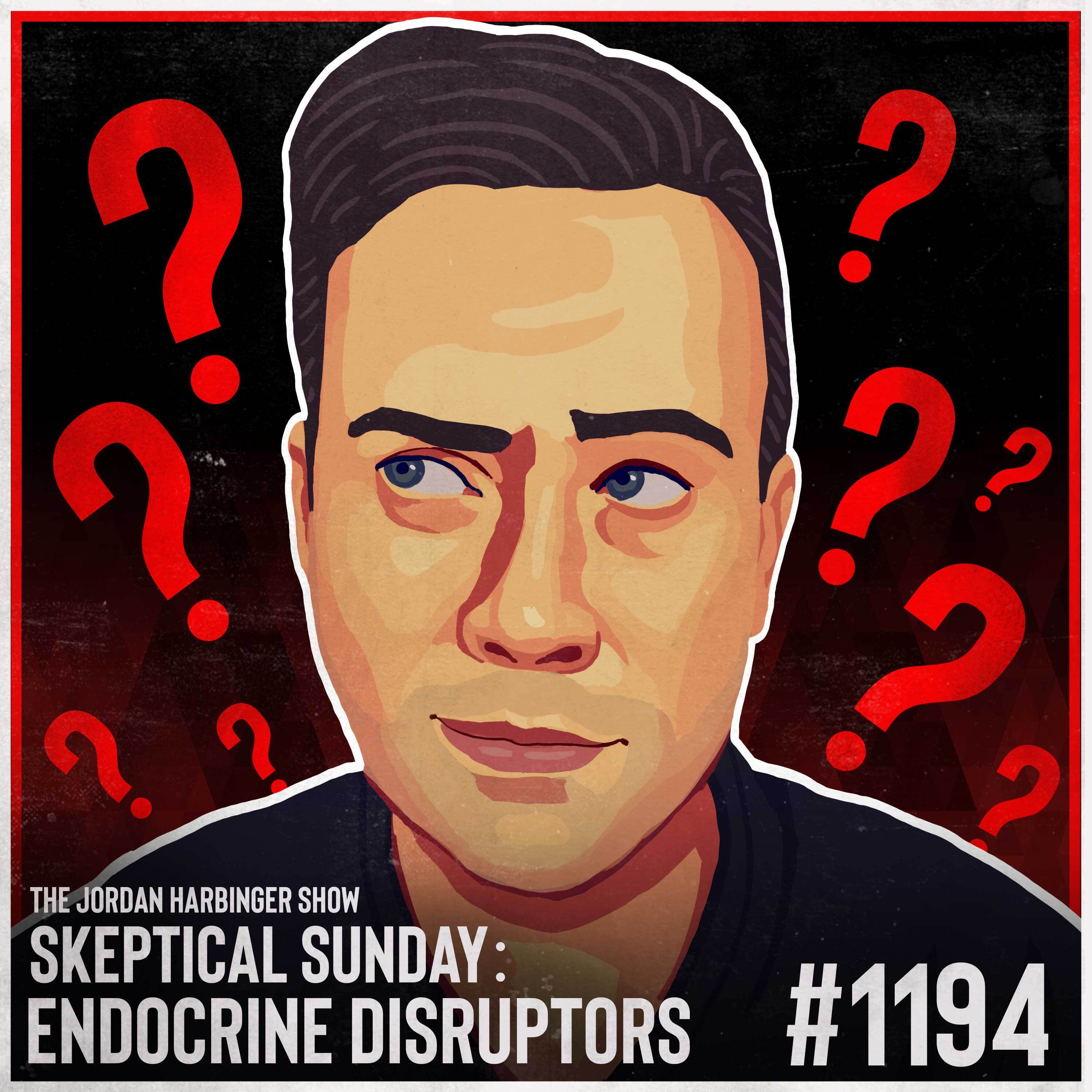
1194: Endocrine Disruptors | Skeptical Sunday
Chemicals in water, food, and receipts are messing with our hormones. Nick Pell helps us understand and reduce the risks on Skeptical Sunday!
Welcome to Skeptical Sunday, a special edition of The Jordan Harbinger Show where Jordan and a guest break down a topic that you may have never thought about, open things up, and debunk common misconceptions. This time around, we’re joined by writer and researcher Nick Pell!
Full show notes and resources can be found here: jordanharbinger.com/1194
On This Week's Skeptical Sunday:
- Endocrine disruptors are chemicals that interfere with your body's hormone signals by either blocking them or mimicking them, potentially affecting testosterone, estrogen, and other crucial hormones that regulate mood, growth, and reproduction.
- These chemicals are virtually everywhere — in drinking water, plastic bottles, receipts, shampoos, soaps, food packaging, and even birth control runoff in groundwater. Complete avoidance is impossible in modern life.
- Evidence suggests EDCs may contribute to declining testosterone in men, early puberty in girls, and male fertility issues. Frog feminization studies show real hormonal effects in wildlife and Alex Jones.
- Unlike typical toxins, endocrine disruptors follow a "non-monotonic dose response" — meaning lower doses might actually be more harmful than higher doses, making it impossible to determine a "safe" exposure level.
- You can reduce exposure by filtering water, avoiding receipt handling, using glass/metal containers instead of plastic, choosing bar soap over liquid, and not microwaving food in plastic wrap — small changes that add up.
- Connect with Jordan on Twitter, Instagram, and YouTube. If you have something you'd like us to tackle here on Skeptical Sunday, drop Jordan a line at jordan@jordanharbinger.com and let him know!
And if you're still game to support us, please leave a review here — even one sentence helps!
- Sign up for Six-Minute Networking — our free networking and relationship development mini course — at jordanharbinger.com/course!
- Subscribe to our once-a-week Wee Bit Wiser newsletter today and start filling your Wednesdays with wisdom!
- Do you even Reddit, bro? Join us at r/JordanHarbinger!
This Episode Is Brought To You By Our Fine Sponsors:
- Quiltmind: Email jordanaudience@quiltmind.com to get started or visit quiltmind.com for more info
- Shopify: 3 months @ $1/month (select plans): shopify.com/jordan
- BetterHelp: 10% off first month: betterhelp.com/jordan
- SimpliSafe: 50% off + 1st month free: simplisafe.com/jordan
- Homes.com: Find your home: homes.com
See Privacy Policy at https://art19.com/privacy and California Privacy Notice at https://art19.com/privacy#do-not-sell-my-info.
Press play and read along
Transcript
Speaker 1 This episode is sponsored in part by LinkedIn. Most social media is a time drain, but LinkedIn, that's the one platform where the time you spend actually pays you back, especially if you're hiring.
Speaker 1 Think of it like this: while you're running your business, LinkedIn is quietly out there playing recruiter on your behalf. You post a job, super easy.
Speaker 1 You can even have LinkedIn help you write the description, and suddenly it's in front of exactly the right people.
Speaker 1 Not just resumes in a stack, but actual qualified candidates with real data to help you pick the best.
Speaker 1 And because LinkedIn is where people actually show up to work on social media, you're not fishing in the wrong pond.
Speaker 1 These are folks who want to be seen, want opportunities, and are open to making a move. That's why small businesses who use LinkedIn, say, 72% of the time, they're getting better quality candidates.
Speaker 1 Plus, you can let your network in on the search, slap the hashtag hiring frame on your profile pic, and suddenly your whole professional circle knows that you're looking.
Speaker 1
Double the qualified candidates, zero extra effort. Post your job for free at linkedin.com/slash harbinger.
That's linkedin.com/slash harbinger to post your job for free. Terms and conditions apply.
Speaker 2
Sucks! The new musical has made Tony award-winning history on Broadway. We demand to be hosted.
Winner, best score. We demand to be seen.
Winner, best book. We demand to be quality.
Speaker 2 It's a theatrical masterpiece that's thrilling, inspiring, dazzlingly entertaining, and unquestionably the most emotionally stirring musical this season.
Speaker 2 Suffs, playing the Orpheum Theater, October 22nd through November 9th. Tickets at BroadwaySF.com.
Speaker 1
Welcome to Skeptical Sunday. I'm your host, Jordan Harbinger.
Today I'm here with Skeptical Sunday co-host, writer, and researcher Nick Pell.
Speaker 1 On the Jordan Harbinger Show, we decode the stories, secrets, and skills of the world's most fascinating people and turn their wisdom into practical advice that you can use to impact your own life and those around you.
Speaker 1 Our mission is to help you become a better informed, more critical thinker.
Speaker 1 During the week, we have long-form conversations with a variety of amazing folks from spies to CEOs, athletes, authors, thinkers, and performers.
Speaker 1 On Sundays, though, it's Skeptical Sunday, where a rotating guest co-host and I break down a topic you may have never thought about and debunk common misconceptions about that topic.
Speaker 1 Topics like acupuncture and astrology, recycling and chemtrails, banned foods, toothpaste, crystal healing, diet pills, energy drinks.
Speaker 1 If you're new to the show or you're looking for a handy way to tell your friends about the show, I suggest our episode starter packs.
Speaker 1 These are collections of our favorite episodes on persuasion and negotiation. psychology, disinformation, junk science, crime and cults, and more.
Speaker 1 That'll help new listeners get a taste of everything we do here on the show. Just visit jordanharbinger.com slash start or search for us in your Spotify app to get started.
Speaker 1 What if I told you that there were chemicals in the food and the water that were messing up your entire endocrine system?
Speaker 1 That's the bodily system which helps your hormones regulate mood, physical growth and development, metabolism and reproduction. Some of you might say, well, that would explain a whole lot.
Speaker 1 And others of you are trying to call BS on things like this. These chemicals are called endocrine disruptors and they're a hot topic right now in health circles.
Speaker 1 Some argue that endocrine disruptors are responsible for everything from declining testosterone rates in men to turning the frogs gay. Yeah, really, apparently.
Speaker 1 But is this much ado about nothing or are we all doomed to a life of hormonal imbalance and potential infertility? What are endocrine disruptors? Are they really in everything we eat and drink?
Speaker 1 What does the science say about all this? And more to the point, is it time to panic? or just stop, I don't know, microwaving plastic rap or whatever.
Speaker 1 Here to help me understand the balance of this subject is writer and researcher Nick Pell.
Speaker 1 So, Nick, I asked you to be on this episode because I remember going on 10 years or so ago now, you were on kind of a kick about don't touch receipts.
Speaker 1 It sounded absolutely insane at the time, but I later actually found out you were not totally wrong about receipts, actually.
Speaker 3 Don't touch receipts, gang. They're absolutely toxic.
Speaker 1 Well, we'll dig more into the specific topic of receipts themselves later, but can you give us the high-level view here?
Speaker 1 To start, I think we need a definition of what endocrine disruptors actually are. It kind of sounds like science fiction before we're even out of the gate.
Speaker 3 So this is kind of defining a word by itself, but endocrine disruptors are anything that disrupts the normal functioning of your endocrine system.
Speaker 3 Now, to be clear, these can be both man-made or natural.
Speaker 3 And it's important to note at the beginning of this, the naturalism fallacy that natural things, so-called, however one defines that, are good for you. And unnatural things are bad for you.
Speaker 3 Rice and gas is more or less natural, and it's obviously very bad for you.
Speaker 1
Yeah, yeah. Cyanide is quite natural as well.
You know, it's an apple seeds. It's just, there's hopefully not too much in there.
I run into this a lot actually on the show.
Speaker 1 People will write in and say, you know, this sponsor is not good for you because it has, there's chemicals in there.
Speaker 1
And it might be bad for you and it might not be natural, but those two things have nothing to do with one another. And pretty much every substance on earth is a chemical.
In fact, maybe everything is.
Speaker 1 I just don't want to say that because someone's going to write in and tell me about a radioactive nanoparticle that's not a chemical and I'm going to have to go like, okay, right.
Speaker 1 So everything's a chemical, basically.
Speaker 3 Precisely.
Speaker 3 So to drill a little deeper into this, there are entire classes of chemicals that are in everything from the food you eat to shampoos and soaps and yeah, even the water you drink that are endocrine disruptors.
Speaker 3 To get a little better at defining what an endocrine disruptor is, other than sort of repeating what we call them a different way, they're chemicals introduced from outside the body that interfere with how the hormones in your body send signals.
Speaker 1 Okay, so how exactly do they interfere?
Speaker 3 I'm going to assume that most listeners here are like me, reasonably intelligent, but not super knowledgeable about human biology.
Speaker 3 I know some of you out there are really knowledgeable about human biology, but for the rest of us, at a very high level, your endocrine system uses chemicals to send messages.
Speaker 3 These chemicals are called hormones, and there's stuff like estrogen, testosterone, and there's others, thyroid hormones, for example.
Speaker 1
Yeah. And the endocrine disrupting chemicals, I guess, disrupt how these, I hate using circular logic, but I kind of have to here.
They disrupt how these work. How do they do that?
Speaker 1 By stopping them getting where they're going? Or do they kind of put on a costume and pretend to be another substance, if that makes sense? What are you talking about here?
Speaker 3 Yeah, that's basically it. So endocrine disrupting chemicals or EDCs block the proper transmission of hormones or mimic hormones.
Speaker 3 So for example, your body thinks that it's getting testosterone, but really it's getting a cheap bootleg version or something else entirely.
Speaker 3 Then your body sends the real thing and it doesn't get used because the metaphorical cup is already full.
Speaker 1 Oh man, there's a joke in here about ordering something off of Timu probably, but
Speaker 1 this is like when the USB port of your iPhone is filled with play-doh and it won't charge. I guess ask me, ask me how I know.
Speaker 1 But that's what this is, right? It's like, oh, instead of the USB plug going in there, it's just loaded with dry Play-Doh or slime or something. And it's like, oh, it still fits.
Speaker 1 It's just now that porridge is not usable.
Speaker 3 Right, right. The other way that EDCs mess up your body is just scrambling up all the wires completely so that none of the signals of your endocrine systems send anything that makes sense.
Speaker 3 You might think this isn't a big deal, but it is, especially when you're talking about things like fetal development.
Speaker 1 Sure, because that's such a small little fetus in there and less resilient and probably fewer sort of checks and balances.
Speaker 1 Because the whole hormone thing in your body, if you've ever had blood work done, it's just a delicate dance going on in there.
Speaker 1 One thing changes, and three other things change, and you try and change those, and then five other things change as a result of each one of those.
Speaker 1 So, what are some of these evil endocrine system-disrupting chemicals that are supposedly turning men into wimps and
Speaker 1 making the frogs gay? I don't like them putting chemicals in the water that turn the friggin' frogs gay. That
Speaker 3 okay, so before we go on i want to address this common misconception that even people who know a lot about endocrine disruptors seem to have endocrine disruptors are bad for everyone not just men let's talk about the impact on women super briefly and in broad terms some endocrine disruptors are also xenoestrogens That sounds like a made-up word off of one of your underground esoteric bodybuilding forums.
Speaker 1 Is it? So what is what is that?
Speaker 3
It's not a made-up word. It's a real thing.
Xenoestrogens are basically exogenous. That's a 50-cent word meaning introduced from outside the body.
Exogenous forms of estrogen.
Speaker 3
Now, you might think, as many people do, women are getting estrogen. Who cares? But it's like you just said about your body's hormones.
And somebody, I use testosterone supplementation.
Speaker 3
I know this very well. Your hormones are a very precarious dance.
It's a ballet. It's not as simple as, you know, for men, more testosterone good.
For women, more estrogen good.
Speaker 3 You need a variety of hormones in your body and you need them in the proper balance.
Speaker 3 So too much estrogen or the wrong kinds of estrogen are absolutely not okay for the proper functioning of the female body.
Speaker 1
Got it. So women are just getting slammed by these xenoestrogens.
Well, men and women, I suppose, are getting slammed by these xenoestrogens, and that's throwing off the ballet. Right.
Speaker 3 To get back to the question of what these chemicals are, most of them have really crazy names. I've actually selected the ones with the easier to pronounce names.
Speaker 3
Astrazine, bisphenol A, which you might know as BPA. Ah.
Phthalates, dioxins, and phytoestrogens. All sound kind of science fiction-y.
Speaker 1 Very much, yeah.
Speaker 3 There's a whole bunch of them, but again, these are both the most common and the easiest to pronounce.
Speaker 1 I see. I remember the panic, well, it was probably a long time ago now about BPA water bottles and the companies advertising themselves as BPA free.
Speaker 3 The funny thing about that is that they ended up replacing BPA bottles with something even worse.
Speaker 1
Right. I mean, not maybe not every bottle.
I'm sure some were made of, you know, bamboo or something like that. But yeah, now it's like not BPA, it's BPW.
Speaker 1 And it's, yeah, 10 times worse, but it's not illegal yet or something. So this shouldn't surprise anybody, right? This is kind of what always happens.
Speaker 3 Yeah, BPAs are also in things like receipts, by the way, and they absolutely do leach into your skin and impact the proper functioning of your hormones.
Speaker 3 And this is one of the more extremely well-documented examples of mass endocrine disruption taking place.
Speaker 1 So people can check the show notes for those. We try to do as much good fact checking, running it by a doctor slash expert as we can on stuff like this.
Speaker 1 But there are show notes for those of you who are in doubt or are like, receipts. Come on.
Speaker 1 The Cliff's notes on this receipts thing is that if you buy something each day at Starbucks and and you crumple the receipt and throw it away, probably not a huge deal.
Speaker 1 But if you're a cashier and you are touching 500 or 1,000 receipts per day with your fingers and then, I don't know, rubbing your eyes and your face or, you know, you lick your fingers so they get a better grip on them.
Speaker 1 You should be aware of this and you should almost certainly wear gloves.
Speaker 3 Actually, BPA will in many cases go right through the latex of the gloves.
Speaker 1 Oh, great.
Speaker 3 In fact, wearing the gloves might be worse because the chemicals accumulate in the gloves that you wear all day.
Speaker 1 Okay, so don't wear gloves. Just cut your hands off.
Speaker 1 No, that's insane and scary because there are people, I mean, you've had transactions, the guy or the lady, they rip the receipt off and they put it on the thing at the restaurant, the little spike, and they do that a thousand times a day, a hundred times a day, whatever it is, and it's the same person.
Speaker 1
And then they go and eat or they, I don't know. Oh, gosh.
So where are people encountering these chemicals besides water bottles and receipts?
Speaker 1
Because a lot of people are going, I don't play soccer and have a water bottle where mine's metal and I don't work at a restaurant or a cashier. so I'm safe.
If it's only in those, fine.
Speaker 1 Or maybe if it's in some weird industrial stuff, I can avoid, but I'm going to guess that we're not doing an episode about this because it's so rare that only a few types of people encounter this.
Speaker 3 I know it sounds like a cop-out or an exaggeration to say they're everywhere, but they kind of are.
Speaker 3 They're basically in every shampoo, basically every liquid soap, tons of the food, most of the water. There's not really any avoiding them.
Speaker 3 I mean, you can potentially buy EDC free alternatives, but get ready to pay.
Speaker 1 I could probably try to buy products without these ingredients, but how do they get into the water supply? Because I can't really avoid drinking water.
Speaker 3 This is going to be one of the most insane-sounding things I ever say on your podcast. But again, check the show notes if you don't believe me.
Speaker 3 So, some women take birth control pills, which may contain estrogen, right? Sure. It doesn't all get absorbed by their body.
Speaker 3 And then when they go to the bathroom to do number one, it goes into the toilet, which gets flushed, which then leaks into the groundwater.
Speaker 1
Okay, this actually does kind of sound insane. All right, I'm going to check the show notes on this one.
I'm, so I'm drinking water with people's pee in it.
Speaker 1
I've accepted this, but I'm getting their birth control runoff, essentially. That stuff doesn't get taken out by treatment or enda.
That's crazy.
Speaker 1 I mean, first of all, some guys out there would pay good money for that, but
Speaker 1 I typically try to avoid drinking people's pharma pee if I can.
Speaker 3 Yeah, well, you know, I rarely say things I can't back up, and I never say things I can't back up on your show.
Speaker 3 Supposedly, the xenoestrogens from birth control runoff are in amounts not enough to impact humans, but we do know that they impact aquatic life.
Speaker 1 Aquatic life is just turning the freaking frogs gay. Is that what he's talking about?
Speaker 3 It's basically the same stuff as the frogs, feminization, including egg production. reduced fertility up to and including total population collapse.
Speaker 3
This is for the aquatic animals, not for the people. Right.
There's also estrogen from other sources in the water.
Speaker 3 And in fairness, I think people, myself included, probably make the birth control thing a kind of bogeyman because it's so impactful.
Speaker 1 Well, it's gross sounding, right? Like it has shock value to say you're drinking pregnant ladies or, you know, birth control pee. And it's affecting you.
Speaker 1 And it's like, oh my God, I want to figure out how to blame women for this.
Speaker 1 But,
Speaker 1 but it's like, you know, I don't know. Yeah, it has shock value compared to my shampoo has a weird chemical in it.
Speaker 3
Yeah. And you know what birth control is.
You know, you've seen it. Industrial runoff
Speaker 3
could be absolutely anything. Xenoestrogens like BPA are in plastics and epoxy resins.
And then there's alkylphenols that are in industrial detergents and pesticides.
Speaker 3
And yeah, that's what the industrial runoff is. And I say that and it's.
It's super abstract, but I say birth control pills and pee and you're like, oh man. So yeah, that's fair.
Speaker 3 I mean, but for context, I did an article about this a million years ago for a website called Made Man. And the editor, Steve Mazzucci, I know you're listening.
Speaker 3
He went into this being like, this is insane. And I am not printing anything you haven't seriously backed up, which is fair.
But he printed the thing about the water and the birth control.
Speaker 1
Yeah. So, and he's a really kind of, what's the polite version of anal retention? He's a very thorough fact checker.
Yes. Yeah.
Yeah.
Speaker 1
And that's how we met Writing for Steve Mizzucci back when online men's magazines were actually a thing. All right.
So it's everywhere. So what, though, Nick? Come on.
Carbon's everywhere.
Speaker 1
A lot of things are everywhere. Oxygen, hydrogen.
Do we actually know that these things are bad or is this just a panic over pseudoscience? I mean, I walk on concrete. Am I getting poisoned by that?
Speaker 1 Don't answer that. That's probably another skeptical subject
Speaker 3 the whole other episode.
Speaker 1 But like, is this pseudoscience? Because I can see that this is potentially one of those like, oh my God, this is so terrible.
Speaker 1 And then in 20 years, it's like, yeah, 0.0001% of people may have had a slight increase in cancer risk because of all these things and whatever.
Speaker 3 And I totally agree that the internet is filled with people who have too much information and not enough wisdom to know what's useful or true or, you know, whatever.
Speaker 3 But there does seem to be something here.
Speaker 1 Yeah, I'm vaguely familiar with this topic just from having an internet connection in the first place and being, I guess you could say, somewhat connected to male self-improvement social media.
Speaker 1
So like the claims are basically EDCs are lowering your testosterone. They're making younger girls go through puberty super early.
They can make you infertile.
Speaker 1 They can, and of course, you know, the old standby, they turn the frogs gay.
Speaker 3 And you know what? There's evidence to support basically every claim you just made.
Speaker 1 Can we talk about the frogs gay thing? Because that's not really 100% accurate, but it's also not fake.
Speaker 3
It's not fake. It's not 100% accurate.
Like a lot of things Alex Jones says that turn out to be true, which does happen from time to time. It's true, but it's more complicated than he's presenting it.
Speaker 3 It is not turning frogs gay. But there was a study in which frogs mega-dosed with xenoestrogens changed biological sex.
Speaker 1 How is that possible? Is that because they can reproduce asexually or something? I feel like this is sixth grade biology and it was just too long ago.
Speaker 3
Don't ask me about the specific process. I'm not a scientist, so I couldn't really make heads and tails of that.
But I do know that it happened. Boy frogs became girl frogs.
Speaker 1
So to speak, right. And again, I know amphibians can reproduce asexually in a pinch.
Sometimes it has to do with temperature and stuff, but yeah, hormonal kind of cues make it happen.
Speaker 1 Do we know about this at all? Or should I just stop talking?
Speaker 3 No, I'm overstating it a little bit. So the male frogs developed female characteristics and in some extreme cases did become hermaphroditic.
Speaker 3 after exposure to atrazine, which is one of these ones that's everywhere and just in everything. It's one of the main EDCs that it's not really possible to avoid.
Speaker 3 One of the reasons why people eat so-called organic food is to avoid atrazine.
Speaker 3 Now, the thing about all of this animal testing stuff is when you drill down into the methodology, a lot of times it does become a little ridiculous.
Speaker 3 You know, like, man, I can't believe monkeys died of lung cancer three months after you forced them to smoke seven packs of unfiltered cigarettes a day. What amazing science.
Speaker 3 And I kind of suspect that this was possibly a case of forcing frogs to encounter some insane dose that they're never going to get in the wild and go, damn, that's crazy that something crazy happened after we did something crazy.
Speaker 1
Yeah. Turns out when you lobotomize people, this happens.
Yeah, that's what happens.
Speaker 1 And now maybe you can divert some of your birth control urine budget to support the fine products and services that support this show. We'll be right back.
Speaker 1
This episode is sponsored in part by Vital Proteins. You've probably heard of Vital Proteins.
They're the number one brand of collagen peptides in the U.S.
Speaker 1 And for good reason, a lot of people, myself included, take it pretty much daily to support things like healthy hair, skin, nails, bones, joints, all the good stuff.
Speaker 1 That starts to matter more the longer you've been walking around on this planet. But now, Vital Proteins is shaking things up.
Speaker 1 Literally, you can tell a dad wrote this copy with a brand new collagen and protein shake. And this isn't your average protein shake that tastes like chalk and sadness.
Speaker 1
This one's light, chocolatey, super smooth, and it's got something pretty unique going for it. High quality protein, 30 grams of it plus collagen.
That's pretty good ROI.
Speaker 1 Usually you're choosing one or the other but vital proteins gives you both a ready-to-drink shake you can toss in your bag or fridge zero added sugar no artificial sweeteners and no karaginin and i don't know what that is or if that's even how you say it but you're supposed to avoid that if you're already taking collagen or you're just curious about how it might support your hair skin nails joints and you don't want any carrageenin this is a super easy tasty way to try it get 20 off by going to vitalproteins.com and entering promo code jordan at checkout This episode is sponsored in part by LinkedIn.
Speaker 1
Most platforms are built to distract you. LinkedIn is built to help you get things done.
And when you're a small business owner, the one thing you don't have is time to waste.
Speaker 1 That's why LinkedIn jobs is a secret weapon. Post your job and LinkedIn doesn't just blast it out to randoms.
Speaker 1 It uses all that professional data people actually keep up to date on LinkedIn to match you with qualified candidates.
Speaker 1 You can post it for free, or you can promote it to get three times more job applicants to expedite everything.
Speaker 1 And here's the cool part: because LinkedIn is where people actually want to be found professionally, the quality is just higher. You're connecting with people who are serious about their next move.
Speaker 1 That's why 2.5 million small businesses use LinkedIn to hire.
Speaker 1 Add the hashtag hiring frame to your profile pic, let your network know that you're looking, and suddenly you've doubled the reach without spending more than 30 seconds.
Speaker 1 So, when the clock's ticking and you need someone great, LinkedIn isn't just social media, it's your best recruiting partner. Post your job for free at linkedin.com/slash harbinger.
Speaker 1 That's linkedin.com/slash harbinger to post your job for free. Terms and conditions apply.
Speaker 4 The questions start early: How do I know when he's full?
Speaker 1 Do babies hold grudges?
Speaker 4
That's why we make one formula that feels right right away. Backed by Breast Milk Science and built for babies' brains, bellies, and beyond.
Learn more at byheart.com.
Speaker 1 By the way, folks, if you haven't signed up for the newsletter yet, you've really gotten a lot of positive feedback about this. We love writing it and y'all seem to love reading it.
Speaker 1
You can sign up at jordanharbinger.com slash news. It's a practical tip from a past episode from us to you.
It's a really good companion to the show. It's an under two-minute read every Wednesday.
Speaker 1 Again, jordanharbinger.com slash news is where you can find it. Now, back to Skeptical Sunday.
Speaker 1
People aren't going to go out and take intravenous BPA or lick a thousand receipts a day for fun. It's just not a thing.
So that's where we kind of have to caveat this is it's like, how much?
Speaker 1
Because the dose makes the poison. I did a show a long time ago.
I think this was Neil deGrasse Tyson.
Speaker 1 And we were talking about people were worried about some sort of antibiotic and ice cream from cows.
Speaker 1 And it turned out that the amount of ice cream you would have to eat, like the sugar would kill you way
Speaker 1 before the antibiotics would even start to have a measurable effect in your body. Like the sugar itself would literally kill you from
Speaker 1
whatever bodily process causes you to die from eating too much sugar. Yeah.
So I don't know.
Speaker 1 That's the little asterisk dagger symbol next to some of this stuff. Yeah.
Speaker 3
Yeah. Like you said, the comparison breaks down because most people aren't going out and seeking exposure to these chemicals.
Like, so is it comparable? I don't really know.
Speaker 3 The thing is, there's all kinds of things, like you said, that are poisonous when you have too much of them, but they're fine and small or moderate or even large but appropriate amounts.
Speaker 1 Dihydrogen monoxide, you know, it kills thousands of people every year. Didn't a celebrity recently die from this, Nick?
Speaker 3 Malcolm Jamal Warner, I believe.
Speaker 1 That's right. Malcolm Jamal Warner, Theo Huxtable from the Cosby Show, very recently died from dihydrogen monoxide, also known as water.
Speaker 1
And most people don't know that you can die from drinking too much water. That's not how he died.
Didn't he drown? That was so tragic.
Speaker 3 He drowned. Yeah, it's sad.
Speaker 1 The lesson here is not never drink water. It's don't drink a bathtub full of water every 20 minutes.
Speaker 3 Yeah, that's, it is a really good way of putting it because I remember there was like a, it wasn't a meme, this was like in the 90s, but my high school chemistry teacher had a photocopied thing that bounced around workplaces that was about like how the government needed to ban the dangerous substance of dihydrogen monoxide and people die and, you know, blah, blah, blah.
Speaker 3 So yeah, I mean, water can kill you if you drink too much of it.
Speaker 1 Yeah, that's funny. I remember the dad jokes plus science teacher jokes days where they're like, here's a thing that's been photocopied 78,000 times that you can barely read.
Speaker 1 Let's spend the hour doing this because I have a hangover. 2020 hindsight, that's what it was, right? The teachers were hungover and you're like, why are we doing this today?
Speaker 1
And it's like, oh, yeah, Mr. Cooper.
put down a few too many last night. Let's get into some of the more realistic and frankly alarming claims about endocrine disruptors.
Speaker 1 Is that what's behind the decline in testosterone levels in men over the past several decades that I keep hearing about? First of all, I should probably start. Is that even true?
Speaker 1 Because I keep hearing like, oh, men's testosterone levels today are N minus whatever of what they were in the 60s and 70s. And that's kind of scary if that's the case.
Speaker 1 I can just tell by looking at photos of men from previous generations that testosterone levels are lower. Is it just me or is everybody hairier back then?
Speaker 3 Why do 30-year-olds not look like Tom Selik on Magnum PI anymore?
Speaker 1
That's right. That's right.
Tom Selik and Magnum P.I., you're like, wow, how old? He's 25 years old. And he looks like he's...
Yeah.
Speaker 1 He's got like a full ass, like Charles Bronson, just hairy from top to bottom, giant mustache, low deep voice. I mean,
Speaker 1
all the smoking and probably sun wasn't good for them, but like... Man, they looked like they were 50.
They still look like they were 55 when I look at those. And it's like, no, he just turned.
Speaker 1 That was, that was his 30th birthday party.
Speaker 3 Yeah, Lee Marvin was born like 60 years old.
Speaker 1
Yeah, yeah. It's unbelievable.
But some of that's fashion, like haircuts and stuff, and having a giant mustache. But still, come on, what's going on?
Speaker 3
So I believe that that is true. It's true as far as I know.
If somebody wants to correct us, you know, I'm sure they're already doing so. Yes.
Speaker 3
We do know that endocrine disruptors are correlated with lower testosterone rates in both men and boys. And yes, I know.
Correlation is not causation.
Speaker 3 The thing is, it's basically impossible to to definitively prove causation here because there are so many factors and isolating this one variable is pretty much impossible. I see.
Speaker 3
I think the important point to make is that it's totally biologically plausible that endocurrent disruptors are doing this. There's evidence that suggests a connection.
And for me, that's enough.
Speaker 3 For others, they might be more skeptical.
Speaker 1 Yeah, it's really tough to decide that, again, little asterisk, little dagger on this one, but that's why people are listening to this episode, I suppose.
Speaker 1 Okay, so let's just grant for the sake of argument here that these endocrine disruptors are causing declining testosterone rates in men. That still doesn't prove the degree to which it's happening.
Speaker 1 And I think there's just a bit of a logical leap involved saying it's doing this in individuals.
Speaker 1 It's the solely or even primarily responsible reason for crashing testosterone rates in men over decades.
Speaker 3 I think you're right in the main, but here's the thing. Aggregates are made up of individuals.
Speaker 3 So if individual men are being impacted by endocrine disruptors and these disruptors are in basically everything, it's not a huge leap to say that testosterone levels are crashing more generally because of this specific factor.
Speaker 3 That's not proof, but it's enough to convince me that it's an issue with broader social implications.
Speaker 1 So I heard on NPR that girls are hitting puberty on average six months earlier than they were in the 1950s and 60s. So are endocrine disrupting chemicals causing that?
Speaker 1 I'm guessing you're going to say that they are, but I don't know. As a father of a girl, anything that could affect her health is concerning to me.
Speaker 3 The evidence here is kind of less clear than it is for declining testosterone rates, but there is some fairly compelling evidence that exposure to endocrine disrupting chemicals like BPA, parabens, phthalates, these are at the very least a contributing factor to early onset puberty in girls.
Speaker 3 There are other compounding factors at play like childhood obesity, genetic factors, psychosocial stress, dietary habits that are completely unrelated to EDCs, sedentary lifestyles, and even stuff you'd never expect like exposure to light late at night and coming from a fatherless home.
Speaker 3
It's less conclusive. And again, it's hard to say what impact duration of exposure has, genetics, timing.
dose level, all of these things have on the process.
Speaker 3 The issue, and I will say this again and again, is that because this stuff is basically in everything, it's nearly impossible to isolate it as a factor.
Speaker 3 How are you going to find a girl or a grown man for that matter who has never been exposed to endocrine disrupting chemicals and then use them as a control group?
Speaker 3 The best you can probably do is find someone from a family that quote unquote tries to avoid them where they can.
Speaker 1 Yeah, and even then it's kind of like, okay, well, what does that mean? What are they avoiding? Which chemicals?
Speaker 1 And with the girls or the women who live in families that don't care about this stuff, how do you measure how much she's getting and over what duration and what age?
Speaker 1 By the way, that fatherless homes thing where they start puberty early because of fatherless homes, I went ahead and looked that up a little bit. It's called the absent father hypothesis.
Speaker 1 That's an interesting rabbit hole to go down that we don't have time for right now, but people should look that up. The absent father hypothesis.
Speaker 1 I guess it has to do with women starting their period early because of instability in the home, in part due to an absent father. I mean, just that's like, that's kind of dark.
Speaker 1 But yeah, anyway, it's impossible to isolate these variables, right? You can't really even say this person has lived an isolated life.
Speaker 1 I mean, if it's in the freaking drinking water, it's just absolutely everywhere.
Speaker 3 Yeah. And you could get one of these people who was raised in a home where they just, they'd never even heard of endocrine disrupting chemicals.
Speaker 3 And maybe they avoided them for other reasons because they don't like, you know, maybe they just don't like liquid soap.
Speaker 1 I see. Yeah.
Speaker 3 Who knows? There's no way to get a control group here. So there's just way too many factors to control for, which might make you say, well, we don't know, so I'm not convinced.
Speaker 3 And again, for me, it's pretty obvious, but I'm just some weirdo bodybuilder who's obsessed with hormone levels.
Speaker 1 The opposite end of the spectrum is male infertility, which I talked about in episode 658 with Shanna Swan. That was the phthalates episode where phthalates are in everything.
Speaker 1 What role are endocrine disruptors playing in male infertility? Do we know? Because we've seen that go down too.
Speaker 1 It doesn't seem to be explained just by guys having kids later or trying to.
Speaker 3 This one is probably the most strong and compelling case we have that EDCs are doing something with regard to proper hormonal balance.
Speaker 3 For me, it's the smoking gun that says, okay, the rest of this stuff is probably happening as well.
Speaker 3 Sperm counts have been declining globally for decades, and there's just tons of evidence that EDCs are playing a key role in that.
Speaker 3 It is a conspiracy theory to say that, you know, ooh, globalist elites are deliberately putting this stuff in everything to lower the birth rates while they rub their hands and cackle from their Dr.
Speaker 3 Evil cave. It's not a conspiracy theory at all to connect EDCs with declining sperm count.
Speaker 3 It is about as well established in scientific literature as you're going to get with regard to the actual impact of EDCs on the human body.
Speaker 1 Let's go back to the idea of dose. Do you need to be consuming a metric crap ton of this stuff for it to make any difference?
Speaker 1 I'm sure I eat atrazine at every meal and I haven't started growing boobs because of it. And I have two kids, which, you know, I mean,
Speaker 1 there's not a sort of tactful way to say this, I guess, but that took each of we basically needed a month to conceive each one. So daddy's still got it.
Speaker 3 I will do every single one of these episodes from now on for free if you promise never to call yourself daddy on air again.
Speaker 1 No deal. Sorry.
Speaker 3 So I think you're right to call this out. And it's actually a point of controversy in the scientific community with regard to EDCs.
Speaker 3 There's kind of an old guard that says there's a threshold that needs to be crossed before it makes any difference. Newer research and more recent literature says it doesn't really matter.
Speaker 3 Any exposure has negative consequences for your health.
Speaker 1 Which is where it starts to get really scary because like you said, it's kind of impossible to avoid all EDCs. So basically everybody's suffering at some level from this.
Speaker 3
It's absolutely impossible to avoid all of them. They're in everything.
Are you going to stop drinking water?
Speaker 1 I mean, hydration is overrated. Cracks open can of Diet Coke.
Speaker 3 Well, there's another episode idea.
Speaker 1 I get your point overall.
Speaker 1 So, people should just try to limit exposure where they can, and maybe we just kind of accept that we're going to get some endocrine disruptors in our system, and that's just life in 2025.
Speaker 3 Here's where it gets absolutely terrifying: the impact of EDCs is such such that lower doses might be worse for you than higher doses.
Speaker 3 Lower doses might also act in completely different ways than higher doses. So it's not like a trend that you can plot or predict.
Speaker 3 The more is worse, less is better assumption is increasingly challenged to the point where we really have no idea what's a safe quote unquote dose, or if there even is one, or if you'd be better off just chugging endocrine disruptors than letting them slowly seep into your body every time you touch a receipt.
Speaker 1 Man, this is so weird.
Speaker 1 I genuinely cannot really, well, I can't wrap my brain around how getting more of something that's bad for you might actually be better than getting less of the thing that's bad for you.
Speaker 1
So in fact, I just confused myself saying that. Getting more endocrine disruptors might actually be less harmful than getting less endocrine disrupting chemicals in your body.
That's crazy.
Speaker 1 That almost seems like I'm not even hearing this correctly.
Speaker 3
It's not. It's from something in toxicology called a non-monotonic dose response curve.
Okay.
Speaker 3 The extra short version is that the impact of endocrine disrupting chemicals is plotted on a non-linear curve.
Speaker 3 And when you get a ton of EDCs, your body might compensate or the receptors are already saturated or your body realizes what's going on and counteracts it.
Speaker 3 Whereas it doesn't do any of these things at lower doses. I see.
Speaker 3 Also, pulling BPAs from water bottles, you know, the ones you used to drink from when you played soccer in elementary school and everything tasted like chemical sludge, that only resulted in bottles with BPS or BPF in them, which might actually be worse.
Speaker 1
Right. Yeah.
Hey, guys, we changed the label and we made this thing comply with the latest and greatest fads and green marketing, but now it's worse for you. Yeah.
Thanks, guys. Good looking out.
Speaker 1 So basically, it's kind of, you know what this reminds me of, Nick? You know how those drugs that they used to sell at gas stations that are basically bath salts?
Speaker 1
And they were like, this is incense or something. Yeah.
And then they outlaw whatever chemical that is.
Speaker 1 And then the factory in China that makes them is like, okay, we're adding a hydrogen molecule onto the end of this. So it's not that chemical anymore, but it has the exact same effect.
Speaker 1
And now it's got a different label, but it's legal. That's what this reminds me of.
Yeah.
Speaker 3 Or like all the weird designer analogs of ecstasy from the 90s and 2000s, like 2CB and, you know, where they were just like, oh, this one chemical is illegal.
Speaker 3 We'll change one molecule and now it's a hundred times more dangerous and a hundred times less pleasant and, but it's legal.
Speaker 1 What is 2CB again? 2CB is one of those weird party drugs that they use in New York, isn't it?
Speaker 3 Yeah, yeah, yeah, yeah. Which for the record, I've never done.
Speaker 1
No, yeah, I'm curious about this. I heard about a drug gang from Venezuela trafficking mostly.
I think it's called pink cocaine, and it has nothing to do with cocaine.
Speaker 1 This is another skeptical Sunday episode, or at least not out of the loop, I think.
Speaker 3 I mean, this kind of like changing the deck chairs on the Titanic is sort of what I think about green consumerism in general, but that's a topic for another episode.
Speaker 1 I mean, unlikely episode because libertarian guy thinks recycling is stupid. That episode's been done to death.
Speaker 1 Yeah, I agree.
Speaker 3 It's not interesting. The thing is, I don't think people should do nothing either with regard to endocrine disruptors or living more environmentally friendly lifestyles in general.
Speaker 3 The issue is that it's just so difficult to tell what to do. I'm not really comfortable prescribing a a plan of action here because, again, who am I?
Speaker 3 I write, you know, I research podcasts and write YouTube marketing videos.
Speaker 1 What happened to your gig sending spam email to boomers to sell Trump Tchotchkis?
Speaker 3 Oh, they went out of business. It turns out he's way more popular when he's not president.
Speaker 1
That's hilarious somehow. So, okay.
To ask a super obvious question, why isn't this stuff regulated? Well, is this stuff regulated? I guess I should have asked you that.
Speaker 3 Is it regulated?
Speaker 3 Kind of, not specifically, anyway. Our current regulatory structure isn't really built for the problem that endocrine disruptors present.
Speaker 1 Why not? I mean, isn't that kind of what they're supposed to be able to do is regulate substances, chemicals, and stuff like that?
Speaker 3 Most of how chemicals are regulated in this country is related to a 1970s law called the Toxic Substances Control Act. Basically, the assumption is that chemicals are innocent until proven guilty.
Speaker 3 And to be proven guilty, you have to prove that they're actually dangerous, dangerous, not just just kind of a pest.
Speaker 1 That doesn't sound so hot.
Speaker 1 Basically, we have to wait around until we find out that these things are causing aggressive forms of cancer or something before the government can even consider taking any action.
Speaker 3 I'm not convinced if the government is the best way to deal with this problem, but I do concede that my general model of government bad starts to break down a little on this.
Speaker 3 You can't just opt out of tap water. You could, I guess, but what are you going to do? Start using bottled water for absolutely everything? Or I guess you could dig a well.
Speaker 3 I'm sure there's people out there who do this, but that's a little outside of my budget.
Speaker 1
Well, Flint, Michigan has entered the chat. Do you remember that whole debacle? They changed the water source and then they have to spend millions on bottled water for everybody.
It's crazy.
Speaker 3 I think it's still not fixed.
Speaker 1
I don't even know how you can fix it because don't you have to fix all the pipes too? I mean, that's just a massive, massive problem. And the sad reality is people just don't care about Flint.
Yeah.
Speaker 1 Like many poor cities in the United States.
Speaker 1 By the way, for a different take on the whole role of plastics with our regard to the environment and your health, check out our episode 924 with Chris DeArmit, author of The Plastic Paradox.
Speaker 1 A lot of people loved it. A lot of people hated it and said it was all wrong, but he does have a free book and brings receipts about why plastic might not be the end of the world.
Speaker 1 So when the market moved to get rid of BPAs and plastic water bottles, you think it might have just made the situation worse?
Speaker 3 Yeah, because on every important level, stuff like replacing BPAs with BPFs, it's kind of more of a PR stunt than a responsible move by companies to make the world a better place.
Speaker 3 They're just going to band-aid the problem for public image because that's the most cost-effective means of dealing with the public outcry over BPAs.
Speaker 1 All right, soy boys and soy gals, time for a word from our sponsors. We'll be right back.
Speaker 1
We're spending more than ever. I hate my job.
The price of everything has gone up. AI is threatening my job.
Speaker 2
It's crisis after crisis. Nothing is working out.
I can't find a
Speaker 1 one disaster.
Speaker 1 Take control of change.
Speaker 1 I need a change.
Speaker 1 Disruption is the force of change.
Speaker 1
Stop the chaos. Stop the madness.
Take control. Read James Patterson's Disrupt Everything and win.
Speaker 5 What can 160 years of experience teach you about the future?
Speaker 1 A lot.
Speaker 5 Especially when it comes to protecting what matters.
Speaker 5 At Pacific Life, we've helped people and businesses confidently embrace the future with life insurance, retirement income, and employee benefits, with strategies built on strength and trust, and a promise to be here for you today and tomorrow.
Speaker 5 Ask a financial professional how Pacific Life can help you today. Pacific Life Insurance Company, Omaha, Nebraska, and in New York, Pacific Life and Annuity, Phoenix, Arizona.
Speaker 1
Hey, Zach, are you smiling at my gorgeous canyon view? No, Donald. I'm smiling because I've got something I want to tell the whole world.
Well, do it. Shout it out.
T-Mobile's Got Home Internet.
Speaker 1 Whoa, I love that echo. T-Mobile's got home internet.
Speaker 1
How much is that? Look at that, Zach. We got the neighbors' attention.
Just 35 bucks a month.
Speaker 1
And you love a great deal, Denise. Plus, they've got a five-year price guarantee.
That's five whole trips around the sun. I'm switching.
Speaker 1
Yes, T-Mobile home internet for the neighborhood. Donald, you still haven't returned my weed whacker.
Carl, don't you embarrass me like this, please. What's everyone yelling about?
Speaker 1 T-Mobile's got home internet! And Donald's got my weird whacker! Yes, T-Mobile's got home internet, just 35 bucks a month with autopay and any voice line, and it's guaranteed for five years.
Speaker 1
Beautiful yodeling, Carl. Taxes of Desupply, see T-Mobile.com slash ISP for details and exclusions.
Thank you for listening and supporting the show.
Speaker 1 It is your support of our sponsors that keeps the lights on around here.
Speaker 1 All of the deals, discount codes, and ways to support the show are searchable and clickable on the website at jordanharbinger.com slash deals. Now for the rest of Skeptical Sunday.
Speaker 1 Why don't companies have to prove that these chemicals are safe before releasing them into water bottles and the groundwater?
Speaker 3 I think it's because requiring them to prove chemicals are safe is, in my opinion, it's a seriously undue regulatory burden. I mean, first of all, what do we mean when we say safe?
Speaker 3 There's all kinds of stuff that's bad for you that's in the air and the water. But for some of it, we've simply decided as a society that the benefits outweigh the problems presented.
Speaker 3 So if we're trying to make companies prove that everything they make is 100% safe and presents no problems of any kind, get ready to have precisely zero new breakthroughs in chemical engineering until the regulatory structure is changed back.
Speaker 3 Because companies are just not going to keep making new chemicals, many of which you want them to make.
Speaker 3 if they have to prove beyond a shadow of a reasonable doubt that there's no problems presented by them whatsoever, so what are the rules in the EU? Who cares?
Speaker 1 No, no, but really, what are the rules in the EU?
Speaker 3 It's kind of a flip script from what we have.
Speaker 3 If there's any indication that there might be a problem, the company has to prove that there's not a problem before they can start manufacturing the chemical, which again, Europe is not exactly a hotbed of chemical engineering breakthroughs.
Speaker 3 I mean, they do innovate, but the regulatory burdens are much higher. So you just don't see as much coming out and cue angry commenters in the EU.
Speaker 1 Yeah, I suppose. So what if I don't care and I just don't want atrazine in my topsoil and tomatoes and stuff?
Speaker 3
And I think that's a fine position to take as long as it's an informed and honest one. There are trade-offs in everything.
And if you're aware of that, okay.
Speaker 3 The problem I have is when people act like we can just wave a magic wand and get rid of all these chemicals and have absolutely no downside as a result.
Speaker 1 So what do you, Nick Pell, some guy who lives in, I don't know, on underground bodybuilding forums obsessed with having a proper hormone balance, what do you do to limit your exposure or mitigate harm done by EDCs?
Speaker 1 Do you do anything besides not touch receipts?
Speaker 3 Well, like you said, I don't touch receipts. The market has kind of responded to this.
Speaker 3 So there's a regional chain here in the Southwest called Natural Grocers that doesn't use receipts with VPAs because their customers spoke and they listened.
Speaker 3
I generally try to buy food that's in glass or metal rather than plastic. I have a metal water bottle.
I'm also not going to pay $9 for a gallon of milk because it comes in a glass bottle. Right.
Speaker 3 So there's an example of me saying it's not worth it. It's all a trade-off, all trade-off.
Speaker 1 What else do you avoid? Do you avoid anything specific?
Speaker 3 Shampoo and soap. I don't mean I avoid them in their entirety.
Speaker 1 I was going to say that explains a lot.
Speaker 3 I don't use liquid hand soap and I look for more natural
Speaker 1 whatever. I mean, I use Dr.
Speaker 3
Brauner's bar soap. Oh, yeah.
It's something to read while while you shower. That's right.
You know, I look for more natural or whatever shampoos. I don't let my kid use liquid hand soap.
Speaker 1 I'm a weirdo and basically don't even, I shouldn't admit this, but I don't even use soap most of the time. Obviously, when I'm washing my hands, I do that before I eat or after I use the bathroom.
Speaker 1 And we've got some natural something or other in here, but I don't put soap all over my body, which I think is probably weird, but my skin is great. I don't stink.
Speaker 1 This is the hippie part of me, but I'm like, shouldn't I be letting certain kinds of things grow and live on my skin? Don't those protect me?
Speaker 1 I mean, you know, soap is sort of a relatively new invention.
Speaker 1 I'm not willing to put that stuff inside my body, but you know, if a weird colony of some harmless bacteria wants to live on my lower back, like, okay,
Speaker 1 fine. I can cede.
Speaker 3
I don't use deodorant and haven't for like years. So, and I didn't use shampoo for like five years, which sounds gross.
Yeah. Sounds grosser than it is because your hair adjusts.
You stop.
Speaker 3 Your hair gets like super greasy for like two weeks and then it dries out and you're good.
Speaker 3 But yeah, there's some guy out there listening who's like nodding his head, pointing at his, whatever he's listening to this through and being like, I know, I know, bro. Sure.
Speaker 3
You know, so none of that's super weird to me. Sure.
Filtering water, always a good idea. It tastes better.
If you live anywhere near agricultural runoff, i.e.
Speaker 3
afrazine, you absolutely should be doing this. All my home food storage containers are glass or aluminum.
I typically don't eat canned food, which cans, I know I said metal is fine a bunch of times.
Speaker 3 Here's the plot twist.
Speaker 1
Cans usually have some kind of plastic coating on the inside. Yeah.
Yeah.
Speaker 1 I found that out too.
Speaker 3
I love tuna, though, and I'm just not going to stop eating tuna because it comes in cans. And I'm definitely not buying it in the bags.
That's unholy.
Speaker 1
That is weird. Yeah.
I mean, this is one of those things where, by the way, I should point out, I've heard fine, the plastic coating on the inside of the can't is not that big of a deal.
Speaker 1
It doesn't leach at all. Okay, it leaches a little, but it's not that big of a deal.
So this isn't like, stop eating canned food. Stop doing that.
Speaker 1 But I would say filter your water because coming from Michigan, you got to filter the crap that's in the water.
Speaker 1 And if you start asking questions about, hey, they treat the water and then it goes through the pipes. Are the pipes clean? The answer is absolutely not.
Speaker 1 And if they are clean, it's because they're running chemicals through there, which you also probably shouldn't be drinking, right? So filter your water. Like you said, it tastes better.
Speaker 1 You have to decide how crazy you want to be of letting this stuff, right? Like we have glass and aluminum containers for food, but then, of course, I keep cereal in a little plastic thing, right?
Speaker 1
So it's like, okay. So you just kind of have to decide how crazy you want to be.
And like I said, we've got reverse osmosis filters in the house.
Speaker 1 I'm probably dying from a lack of minerals because of that, because it filters out the minerals too, but at least I'm not drinking birth control urine anymore, maybe.
Speaker 3 But, you know, if you were, some people pay good money for that.
Speaker 1 Yes, that they do. I've also seen people paying big bucks for hormone harmonizers and other treatments.
Speaker 1 And I'm just going to go out on a limb and say that those are useless, quack science nonsense and people should avoid them.
Speaker 3 I've not seen this specifically, if you can believe that. Yeah.
Speaker 1 I'm surprised you didn't sell it at your old company, actually.
Speaker 3
Actually, let me make a note. Maybe my current company will want to sell it.
There you go. I think it's probably nonsense.
I don't believe any of that stuff works.
Speaker 3 Detoxing, you know, I've kind of file it under detox powders. But yeah, stop microwaving your lunch in plastic wrap and melting plastic wrap into it.
Speaker 3 And you're already way ahead of the curve on this one.
Speaker 3 But beyond moving to some untouched bit of virgin forest and opting out of civilization entirely, you have to accept that you're going to be exposed to EDCs.
Speaker 3 I spent five years of my life trying to opt out of human civilization. And like Ray Charles said about heroin, I don't regret it, but I don't recommend it.
Speaker 1 As usual, you seem shockingly reasonable about this. I do a lot of this stuff myself because there's not a lot of downside to trying to limit your exposure to endocrine disruptors, I guess.
Speaker 1 So, why do you think that there are people who even go totally crazy over the EDCs? Why are people so obsessed with this that we got this suggestion a gazillion times?
Speaker 3
I think there's a tendency to jump to crazy conclusions. Post-COVID, a lot of people don't trust experts.
And I think a healthy skepticism is good.
Speaker 3 But you either just totally abandon a search for truth or you choose to be willing to critically evaluate research.
Speaker 3 I think some people distrust studies because they can be industry funded, they could be misrepresented, they could be cherry-picked.
Speaker 3 I think, especially in the age of clickbait, there's almost no news sources trying to report to you the straight dope about scientific studies.
Speaker 3 They're reporting what gets engagement, what gets them traffic. And I think a lot of people have become wise to that.
Speaker 3 And as an overreaction, they've simply thrown their hands up and stopped trusting expertise or have, in worst case scenarios, become hostile to the idea of knowledge itself.
Speaker 1
Yeah. So I read a lot of scientific studies or abstracts thereof or summaries thereof that are linked from clickbaity news articles.
And you're not wrong.
Speaker 1 The thing is, you can click the study and read it and see what it actually said and what the methodology is and the sample size and all that. And you can make your determination based on that.
Speaker 1 Then whatever BuzzFeed is saying, is that even still a thing? Are they still around?
Speaker 3
I hope not, but. probably.
Yeah. I mean, I do the same thing.
Speaker 3 If I find the topic interesting or controversial or suspect, you don't have to read a 67-page study to understand what the study is saying or if the methodology is good. Read the abstract.
Speaker 3 See what it's actually saying. What's the, is it an N7 study? Did they study seven people for this? The claim that they're making is also usually very, very limited.
Speaker 3 You know, so like the day frogs thing is like.
Speaker 3 This species of frog when introduced to with this amount of atrazine under the, you know, it's always very specific and limited just run that through a basic analytic logic check and do a gut check and don't start rejecting the very idea that people can know things i think this is all true of a healthy skepticism of scientific research leading to a total rejection of truth but more specifically on the subject of edcs why do you think people get a little crazy about this specific area of biochemistry Because the impact of endocrine disruptors is viscerally dystopian and dysgenic.
Speaker 1 Dysgenic, is that a word? What does that mean?
Speaker 3 Yeah, it's the opposite of eugenic. It means selecting for the worst characteristics rather than the best.
Speaker 1
Cool. Okay.
New word learned, I suppose. But tell me what you mean by this.
Speaker 3 Well, we have entire works of art that revolve around the idea of people's hormones getting thrown out of whack, whether it's the time machine or P. D.
Speaker 3 Jane's book, The Children of Men, which I haven't read, but I've seen the movie. It's difficult to prove any direct connection because of the latency of effects.
Speaker 3 It takes years for the impact of the chemicals to show up. So every study kind of hedges on the thesis and waters it down.
Speaker 3 And that kind of ambiguity, while understandable from the perspective of the scientists, they're not really supposed to be claiming anything other than what the actual study says.
Speaker 3 But that ambiguity leaves a lot of room for so-called alternative news sites to take the ball and run with it.
Speaker 1 Right. I would imagine that a big part of it is generational concerns too.
Speaker 1 like ask me if i'm worried that microwaving plastic is going to make my junk shrivel up and fall off and i'll say no but ask me if i'm going to feed my kid something that came out of microwaved tupperware with plastic wrap over it i mean i'm going to say probably not yeah i will dart across the room and perform a leaping dive to make sure my kid doesn't touch a receipt right well parents do a lot of things they wouldn't want their kids doing that's for sure Where it gets really scary, though, is when we start talking about generational impact.
Speaker 3 Because, yeah, if the endocrine disrupting chemicals change your genes.
Speaker 1 Wait, they can change your genes?
Speaker 1 How? What are you talking about?
Speaker 3
It doesn't really change your genes so much as it tells them to start behaving differently, which is a subtle difference. Oh, right.
Okay.
Speaker 3 Subtle but important difference where this really becomes a problem is when your kids inherit the messed up genes from you, which is called epigenetic inheritance.
Speaker 1 So I've heard of epigenetics, right? That's basically where changes get made to your DNA or RNA, not in terms of the actual sequencing, but in terms of how they express themselves.
Speaker 1 And then that can get passed down to your kid and then their kid and so on. I guess I didn't realize that part.
Speaker 3 Here's where we start getting really down the rabbit hole. There's a chemical called, I'm just going to call it DES.
Speaker 3 It was prescribed to prevent miscarriages, but in fact, it increased chances of infertility.
Speaker 3 It increased pregnancy complications and it increased incidence of a super rare form of cancer called clear cell adenocarcinoma.
Speaker 1 Yikes.
Speaker 3
Okay. Yeah.
In fact, who it really impacted was girls whose mothers took the drug while they were in utero, but the damage didn't stop there.
Speaker 3 Research found that not only did DES impact the women who took it, it also impacted their daughters and even their granddaughters through epigenetic transmission.
Speaker 3
So that's at least three generations impacted by an FDA-approved medication. Yikes.
Now, that's regulated.
Speaker 3 Think about what unregulated stuff in the air, water, food, and paper is doing to you and potentially to your children.
Speaker 1 Yeah, that's definitely scary.
Speaker 1 What are some of the other reasons that people seem so focused on endocrine disruptors and why people who know about it, they seem to go down these like crazy rabbit holes with it?
Speaker 1 I mean, it was researching a little bit of this episode. It looked like we had to even cut things that were just, there was a lot of ways we could have gone with this one.
Speaker 3 I think that one reason people are focused on this, well, another reason anyway is regulatory caption.
Speaker 3 I think people are correctly somewhat skeptical of the FDA.
Speaker 3 The folks skeptical of the FDA have a very real sense that the chemical lobby has, and I want to put this in the most generous and agreeable terms possible, it's just not a wild conspiracy theory or some insane crackpot proposition to say that.
Speaker 3 Maybe the chemical lobby has been able to buy undue influence in certain sectors of the federal government that directly impact your life.
Speaker 3 There's this huge revolving door of lobbyists and regulators, just like everywhere else.
Speaker 3 Does that mean every study is a load of bunk or every study is an attempt to conceal some dark secret from the population? No, absolutely not.
Speaker 3 It does mean that you shouldn't always take what they say at face value. And I get why people think it's some elaborate cover-up, but to me, it's just powerful organizations doing what they do.
Speaker 1 Yeah, that sounds about right. The key takeaway here sounds like is you don't need to go full Unabomber, but also maybe don't guzzle a pint of shampoo every night before bed.
Speaker 1 Endocrine disruptors are real, and there does seem to be some credible evidence that they're doing things to your body that you would rather they not do. And also maybe even to your children's bodies.
Speaker 1 We don't know that yet.
Speaker 3
Yeah, that's about where I'm at. Science is catching up here.
Regulation, if that's your thing, generally tends to be slow moving. It plays catch up.
Speaker 3 Your personal choices can help you feel more comfortable, more in control about your exposure, if nothing else, which I think is valuable.
Speaker 1
Yeah, that's a great way to end it. Check your labels, question your sources, and ditch the plastic wrap, people.
Thanks to Nick Pell for the assist.
Speaker 1 He kept us balanced without getting too hormonal about it. Until next time, stay skeptical and thanks for listening.
Speaker 1 Topic suggestions for future episodes of Skeptical Sunday to me, Jordan at jordanharbinger.com. Advertisers, deals, discounts, ways to support the show, all at jordanharbinger.com slash deals.
Speaker 1
I'm at Jordan Harbinger on Twitter and Instagram. You can also connect with me on LinkedIn.
And this show, it's created in association with Podcast One.
Speaker 1
My team is Jen Harbinger, Jace Sanderson, Tadas Sedlowskis, Robert Fogarty, Ian Baird, and Gabriel Mizrahi. Our advice and opinions are our own.
And I am a lawyer, but I'm not your lawyer.
Speaker 1
Do your own research before implementing things you hear on the show. Remember, we rise by lifting others.
Share the show with those you love.
Speaker 1 If you found the episode useful, please share it with somebody else who could use a good dose of the skepticism and knowledge we doled out here today.
Speaker 1 In the meantime, I hope you apply what you hear on the show so you can live what you learn. And we'll see you next time.
Speaker 1 What if the same psychological tricks magicians use to amaze you are the ones con artists use to rip you off?
Speaker 1 Brian Brushwood has spent decades mastering the art of deception, not to scam you, but to teach you how to spot when you're being played.
Speaker 6 When I learned the fundamentals of magic, there's a rhythm and pacing that you have to set things up.
Speaker 6 If you do a good magic trick, you very artfully set up all the walls around the person until you reveal the effect.
Speaker 6 And by the time they see the effect and then they try to backtrack and figure out how you did it, they realize that they're completely locked in a mental cell.
Speaker 6
They can't remember the right part or they were looking at the wrong place. The moment a magician says, now we begin, you're already screwed.
There are a number of fraudsters out there.
Speaker 6 There are people who claim to have actual telekinetic powers, people who claim to be clairvoyant or psychic or talk to dead people.
Speaker 6 But I realized that if I could educate other people, if other people knew magic the way I knew magic, then that would put them in a position where they would have that low-grade alarm ready to go off at all times.
Speaker 6 And I realized that by getting people into magic on scam school, what I'm really doing is I'm forcing them to practice and perform and actually automatize the maneuverings that make magic possible.
Speaker 6 That whole time I was on the road, I had to end up educating a lot of people about the difference between science and pseudoscience and the way people can be psychologically manipulated.
Speaker 1 Those things exist.
Speaker 6 You can either understand them and master them and use them in a safe space like magic or trying to score a free beer or playing a game or trying to create a novel false memory as an experiment with your friends, or you can willfully remain ignorant of them, in which case you can take it to the bank that they will be used on you at some point.
Speaker 1 To hear Brian Brushwood break down how to be more persuasive, less gullible, and way harder to fool, check out episode 722 of the Jordan Harbinger Show.
Speaker 1
It's easy to be a superhero. You don't need a cape or x-ray vision.
You just need to sign up for PowerSaver Rewards.
Speaker 1 That way, when you save energy during a flex alert, you get a credit back on your energy bill. Visit powersaverrewards.org and become a super power saver!