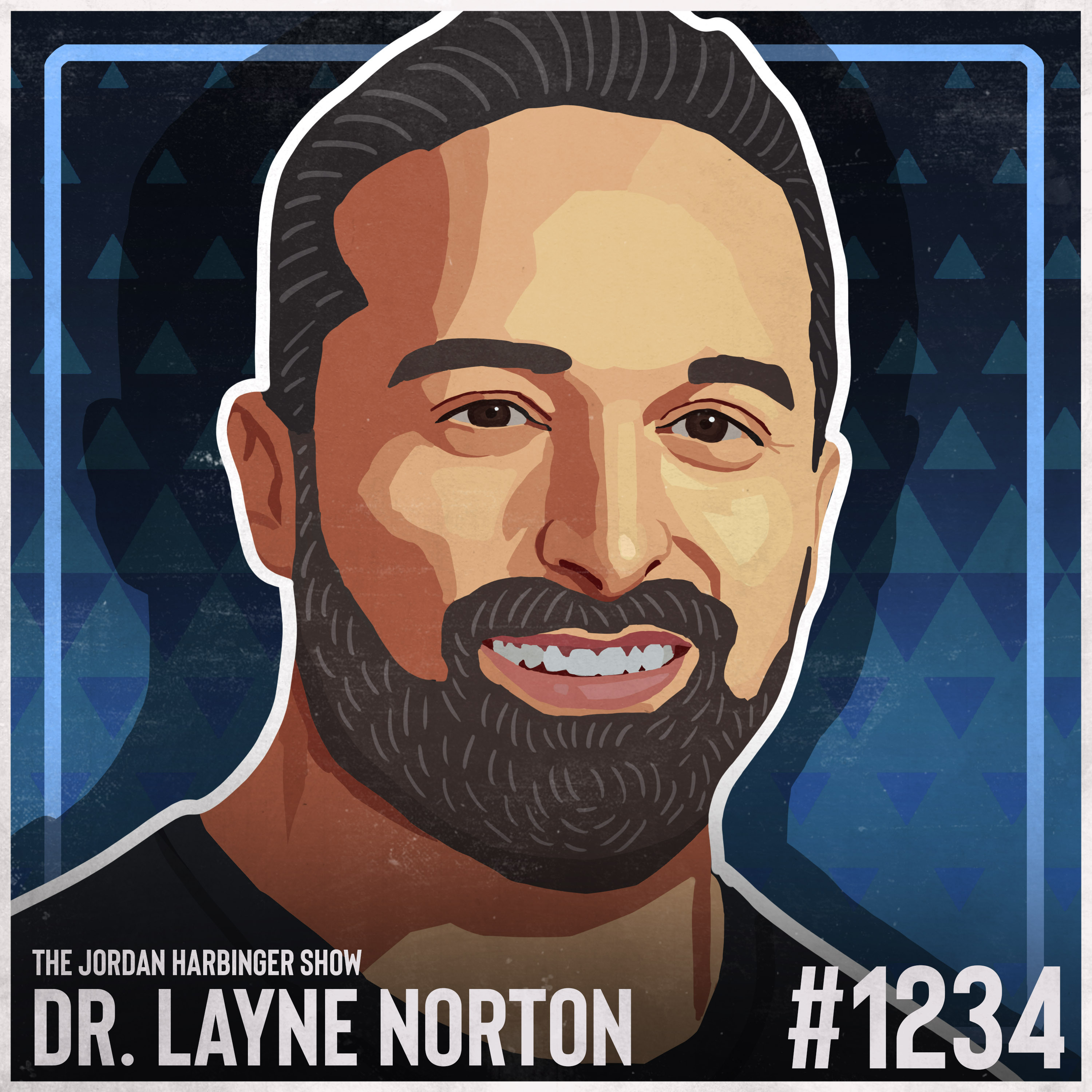
1234: Layne Norton | Debunking Diet Soda Panic and Seed Oil Hysteria
Protein sources, seed oil panic, aspartame fears — nutritional scientist Dr. Layne Norton dismantles the internet's favorite fitness myths here!
Full show notes and resources can be found here: jordanharbinger.com/1234
What We Discuss with Dr. Layne Norton:
- Total protein intake matters more than source. Once you consume 30-40 grams of protein in a sitting, the specific source becomes largely irrelevant since the muscle-building signal gets saturated.
- Aspartame fears are scientifically unfounded. Despite popular panic, artificial sweeteners don't cause insulin spikes, increase hunger, or cause diabetes. Cancer risks only appear at 10,000x normal consumption in lab rats.
- Context over absolutes defines expert communication. Real experts rarely use words like "always," "never," "best," or "worst." They provide nuance, acknowledge uncertainty, and present opposing viewpoints before explaining their position.
- Emotional manipulation drives supplement marketing. The more exclamation points and extreme claims in marketing, the less likely it's legitimate. Extraordinary claims require extraordinary evidence, not just assertion.
- Listen to how fitness experts (or any experts, for that matter) speak, not just what they say. Train yourself to recognize measured, contextual language that acknowledges complexity. When you spot fear-mongering or absolute statements, investigate deeper and demand evidence before accepting claims.
- And much more...
And if you're still game to support us, please leave a review here — even one sentence helps!
- Sign up for Six-Minute Networking — our free networking and relationship development mini course — at jordanharbinger.com/course!
- Subscribe to our once-a-week Wee Bit Wiser newsletter today and start filling your Wednesdays with wisdom!
- Do you even Reddit, bro? Join us at r/JordanHarbinger!
This Episode is Brought to You by Our Fine Sponsors:
- Quiltmind: 10% off 1st year: joingelt.com/jhs
- Article: $50 off first purchase of $100 or more: article.com/jordan
- BetterHelp: 10% off first month: betterhelp.com/jordan
- Airbnb: airbnb.com/host
- AG1: Welcome kit: drinkag1.com/jordan
See Privacy Policy at https://art19.com/privacy and California Privacy Notice at https://art19.com/privacy#do-not-sell-my-info.
Press play and read along
Transcript
Speaker 1 This episode is sponsored in part by Dell. It's time for Black Friday, Dell Technologies' biggest sale of the year.
Speaker 1 Enjoy huge savings on select PCs like the Dell 16 Plus, featuring Intel Core ultra-processors. And with built-in advanced features, it's the PC that helps you do more faster.
Speaker 1 Plus, earn Dell rewards and enjoy many other benefits like free shipping, price match guarantee, and expert support.
Speaker 1 They also have huge deals on accessories that pair perfectly with your Dell PC and make perfect gifts for everyone on your list. Shop now at dell.com/slash deals.
Speaker 2 Extra value meals are back. For just $5, get a savory and sweet sausage, egg, and cheese McGrittles, plus hash browns and a coffee.
Speaker 3 Only at McDonald's.
Speaker 1 For limited time only, prices and participation may vary. Prices may be higher in Hawaii, Alaska, and California and for delivery.
Speaker 3
Coming up next on the Jordan Harbinger Show, aspartame does not cause an insulin or glucose response. It does not increase hunger.
If anything, it reduces energy intake.
Speaker 3
No, it does not cause type 2 diabetes. It does not cause you to be hungry.
People will say, well, they cause cancer.
Speaker 3 Yeah, if you give it to a lab rat at 10,000 times the dose you should normally consume, then yes, you see some weird things.
Speaker 1 Welcome to the show. I'm Jordan Harbinger.
Speaker 1 On the Jordan Harbinger Show, we decode the stories, secrets, and skills of the world's most fascinating people and turn their wisdom into practical advice that you can use to impact your own life and those around you.
Speaker 1 Our mission is to help you become a better informed, informed, more critical thinker through long-form conversations with a variety of amazing folks, from spies to CEOs, athletes to authors, thinkers to performers, even the occasional neuroscientist, war correspondent, Russian chess grandmaster, or legendary Hollywood actor.
Speaker 1 If you're new to the show or you want to tell your friends about the show, I suggest our episode starter packs.
Speaker 1 These are collections of our favorite episodes on topics like persuasion and negotiation, psychology, geopolitics, disinformation, China, North Korea, crime occults, and more.
Speaker 1 That'll help new listeners get a taste of everything we do here on the show. Just visit jordanharbinger.com/slash start or search for us in your Spotify app to get started.
Speaker 1
Y'all caught me mid-crunch on some Quest protein chips. Don't judge me.
It's field research. Today on the show, not all protein is created equal, or is it?
Speaker 1 We're diving deep into the great protein debate with Dr.
Speaker 1 Lane Norton, PhD in nutritional sciences, world champion powerlifter, and a guy who's probably corrected more bad diet advice on the internet than your entire group chat combined.
Speaker 1 We're tackling questions today, such as, does does it matter if your protein comes from chicken, collagen, or a scoop of whey from a plastic tub?
Speaker 1 How much protein is too much before your kidneys start in intervention?
Speaker 1 And what does the 2025 evidence actually say about stuff like diet soda, aspartame, those mysterious non-nutritive sweeteners that everyone on TikTok ironically swears is melting your brain?
Speaker 1 We'll also bust some of the biggest fitness myths that just refuse to die, like whether fasting unlocks autophagy, superpowers, seed oils causing cancer, and a whole lot more.
Speaker 1 Lane just took home the 2024 IPF Masters won world title at 43.
Speaker 1 So we'll talk a little bit about longevity, recovery, and what surprised him about his own physiology after decades of training and coaching.
Speaker 1 Oh, and if you've ever wondered whether food labels are basically a bunch of lies, you know, if the government's nutrition guidelines are secretly big food fan fiction, or if you're literally pissing away your money on creatine, this episode is for you.
Speaker 1 So crack open a protein shake, toss out your detox teas, and get ready for a no BS, evidence-first conversation with the man who lives and dies by the data, not diet drama, Dr. Lane Norton.
Speaker 1 Here we go.
Speaker 1 Is all protein created equal? If I'm eating Quest protein, they don't sponsor me or anything, so if you shit all over the product, it's fine.
Speaker 1 But if I'm eating these like protein Doritos, basically from Quest, is that kind of as good as drinking a glass of milk or am I delusional when I do that?
Speaker 3 Yeah.
Speaker 3
You're worrying about the margins. Yeah, okay.
If you get enough total protein in the day, that's by far the biggest lever. Okay.
Speaker 3 And if you get enough total protein at a meal, the source becomes much less important. Basically, sources of protein are much more important when you're at lower protein doses.
Speaker 3 But once you get up to like over 30, 40 grams at a sitting, it's just not going to matter. You've got enough that the signal gets saturated.
Speaker 1 I see. Yeah, I rarely do that.
Speaker 1 Although I did, like, you know, if you go to like all-you-can-eat Korean barbecue and you're eating, I don't know, 400 grams of ribeye, you're probably overloading the circuits a little bit.
Speaker 1 But generally, I try to eat a few hours spaced apart, but I don't want meat and milk every two, three hours.
Speaker 3 I'm an investor in David protein and people will be like, this is not as good as whole food.
Speaker 3 I'm like, I never said it was supposed to replace whole food, but I'm saying like, you got to think about what people replace this stuff with, which we'll talk about with seed oils.
Speaker 3 But if you're replacing chicken breast and rice and vegetables with a protein bar, I could make the argument that's not as quote unquote good.
Speaker 3 Although I think the overall food matrix of your diet is what determines how healthy you are. But people, They're eating that protein bar instead of getting McDonald's or takeout or delivery.
Speaker 3 They're doing it out of convenience.
Speaker 3 I I don't know anybody who's like, I have the time and the ability to cook, but I am choosing to have a protein bar because it just tastes so great and I love it so much. Like nobody's doing that.
Speaker 1 That's a really good point.
Speaker 1 Usually when I eat something like this, it's because I have a show or I'm about to get on a call or I'm in a call and everyone's just going to have to watch me eat this whatever and get it down because otherwise I don't get enough protein during the day.
Speaker 1 People are always like, how do you eat 180 grams of protein per day? And it's like slowly, like the eating of an elephant, right? No, I don't have a steak for lunch and dinner.
Speaker 1
I just eat small little bits throughout the day. And if I'm driving or in the passenger seat of a car, I might have to eat protein chips because I don't want more chocolate.
I just can't handle it.
Speaker 1
It's disgusting at this point. Like two protein bars a day, three, four.
It's disgusting at a certain point.
Speaker 1 So it doesn't really matter as much if I'm getting my protein from chicken or powdered collagen in a can as long as I keep a balance of real food and fake food, so to speak.
Speaker 3 Well, collagen specifically specifically is not a great source of protein, especially for muscle. For muscle, it's actually probably the single worst protein you can possibly consume.
Speaker 3 It's very low in essential amino acids. It's very low in leucine, which is the amino acid responsible for initiating muscle protein synthesis.
Speaker 3 I know people say it improves the hair, skin, and nails or like tendons and stuff. I would tell people that the data just doesn't make sense.
Speaker 3 There's some human randomized control trials that show better outcomes, but it doesn't increase connective tissue synthesis.
Speaker 3 There's a ton of research on this now showing it doesn't increase connective tissue synthesis, or at least it doesn't increase it more than whey protein.
Speaker 3 So I think if collagen has a beneficial effect, it's simply because you're getting some amino acids compared to nothing.
Speaker 3 And you're probably just better off if you worry about your hair, skin, and nails, just take whey protein and wear a sunscreen.
Speaker 1
That makes sense. Shoot.
All right. Because in the last few months, I was like, oh, I got this collagen protein.
And my wife likes it because hair, skin, nails, like you said.
Speaker 1 And then it's, oh, okay, well, I'll just replace my dimetized whey protein with this. And yeah, back to the other stuff, I suppose.
Speaker 3
Especially for muscle tissue, yeah, pre-workout. It's a pretty horrible protein source.
There's a study looking at 30 grams of collagen didn't stimulate muscle protein synthesis.
Speaker 3
And I'm not aware of any protein source that 30 grams other than collagen doesn't stimulate muscle protein synthesis. Yeah.
It's pretty poor.
Speaker 1
So I work out after having a shake. These people who work out fasted, I don't know who these people are.
I can't do it. I will keel over.
So I started drinking the collagen before the workout.
Speaker 1
Before that, I did drink whey protein. I guess I'm going back to the whey protein and I never thought about that.
I just thought it was the same thing. I don't know.
Speaker 1 They don't tell you that it doesn't do anything, right? That's not of the can.
Speaker 3
And again, like it's more about what your overall diet is like. That's the much more bigger determinant of health.
People can get really lost in the margins with this stuff.
Speaker 1 Yeah, when it specifically comes to muscle metabolism muscle protein synthesis it's just a very poor quality source of protein what about high protein diets and kidney damage people will say you're getting 180 grams of protein per day that's bad for you or my dad did the atkins diet which is not what i'm doing but his doctor said you can only stay on it for a couple of months i keep hearing that less so in 2025 but certainly even just a few years ago almost everybody said you're giving yourself kidney damage which i do blood work work like every few months.
Speaker 1 I'm fine so far.
Speaker 3 People, unfortunately, when something gets published in a textbook, people receive it as the word of God.
Speaker 3 And a long time ago in dietetic and nutrition textbooks, it was claimed that you want to avoid high-protein diets because they might be hard on the kidneys.
Speaker 3 And this was based on some epidemiological studies, which is basically just like looking at correlations, which is not sufficient to prove causation.
Speaker 3
and also looking at some animal data. And I will say, like, weak, pretty weak data at the time, but it got published in textbooks.
And now we have been stuck with that dogma for over 50 years.
Speaker 3 The reality is we now have multiple meta-analyses, which, for those listening who aren't familiar with what a meta-analysis is,
Speaker 3 it is a study of studies. So you attempt to combine the results from a bunch of different studies with similar designs and look at what is the overall effect.
Speaker 3 So probably the top protein metabolism researcher in the world is a guy named Stu Phillips, and he was the lead on a meta-analysis in 2018 that showed that high-protein diets do not negatively impact healthy kidneys.
Speaker 3 There was another meta-analysis similar to that one, looking at human-randomized control trials, which is what we use to establish causality.
Speaker 1 I think a lot of people quote studies, and then I'll get an email that says, there was this in 2015 by this.
Speaker 1 And then I chat GPT that and they're like basically there's reasons you should give certain studies credence and others not or like some like you said epidemiological are not looking at causation and like i don't people like me don't understand really what that means right off the bat i'm not even looking for that if it's a study i believe it i don't know i probably shouldn't do that yeah so that is a big issue is when different studies get cited the average person is not equipped Most undergraduate scientists aren't equipped.
Speaker 3 A lot of PhDs, quite frankly, from what I've seen are not equipped to actually understand
Speaker 3 what studies should get more weight versus others. When it comes to epidemiology, what we were talking about is there's two different basic kinds of epidemiology.
Speaker 3 There's what's called cross-sectional, and then there's what's called longitudinal. Cross-sectional is, for example, we looked at the incidence of,
Speaker 3 I'm just going to make up stuff, may or may not be accurate. We looked at the incidence of type 2 diabetes amongst people who drink diet soda.
Speaker 3
And we found that people who drink diet soda have higher rates of type 2 diabetes. Okay, all right.
The average person hears that and goes, see, diet soda causes type 2 diabetes.
Speaker 3 If you are doing a correlation, you can have also what's called reverse causality. What is it to say that people who have type 2 diabetes are just more likely to drink diet soda?
Speaker 3 What's to stop that from being the correct association? And also, there are tons of confounding variables in these because
Speaker 3 you are not having a treatment in these studies. You are just looking at people's behavior and attempting to correlate things.
Speaker 3 And I will tell you, most of these correlations are pretty weak in these nutritional epidemiology studies.
Speaker 3 And you can Google spurious correlations and you can find correlations that are literally almost perfect, one-to-one,
Speaker 3 and make absolutely no sense. I think something was like, there's almost a perfect correlation between the number of people who die by becoming tangled in their bed sheets and the U.S.
Speaker 3 spending on space exploration.
Speaker 1 So basically the more the U.S. spends on space exploration, the more people die getting tangled in their bedsheets.
Speaker 3
Or the more people who get tangled and die in their bed sheets, the more the U.S. spends on space exploration.
I could have gotten the specific correlation wrong, but stuff like that.
Speaker 1 So it's clearly unrelated. It's just coincidentally correlated.
Speaker 3
I mean, we got to think it's unrelated. You know, I can't imagine what the causality would be there, right? Now, I'm not saying that all epidemiology is garbage.
I'm not saying that at all.
Speaker 3 I'm just saying that you always have to understand that there could be a lot of moderating variables and confounding variables. So that's cross-sectional.
Speaker 3 Then, if we look at something like longitudinal, which are called cohort studies, they're typically rated a higher quality of evidence than cross-sectional.
Speaker 3 And the reason is now you're still not having a treatment, but you're looking at groups of people and you're tracking those people over time.
Speaker 3 And you're looking at the incidence of different things over time. So let's take the same sort of subject.
Speaker 3 We followed people for 10 years and we looked at the amount of people who consumed diet soda and the incidence of type 2 diabetes.
Speaker 3 And we found that people who consumed diet soda were 30% more likely to develop type 2 diabetes.
Speaker 3 Okay, a little bit stronger evidence because now you are looking at, okay, if there is no difference at baseline between these groups, then it's a little bit stronger argument that maybe there's some causality here because you're tracking them over time.
Speaker 3 However, the reverse causality issue still applies. And the reason it does is because
Speaker 3 there may be just inherent characteristics of those people, whether it be genetic, environmental, people don't do things in isolation. They tend to do group behaviors.
Speaker 3 So, what if people who tend to drink more diet soda are just more unhealthy overall, like they do more unhealthy overall behaviors? You can't establish that from cohort studies.
Speaker 3 So, what we do is what's called randomized control trials. And it is the randomization,
Speaker 3 the random part of that is very important. And people need to understand.
Speaker 3 Reason randomization is important is now instead of you self-selecting into a group, right? I choose to drink diet soda versus I choose not to.
Speaker 3 A lot of diet soda are health-conscious people who just drink water. They probably have a bunch of other health-promoting behaviors.
Speaker 3 But if we have a randomized control trial where we just take, say, 100 people and say, all right, 50 of you are doing regular soda and 50 of you are doing diet soda and you don't get to choose. Then
Speaker 3 what we can assume is that any difference in baseline characteristics amongst the participants will be randomly distributed over the treatment groups.
Speaker 3
And so then if there is a difference between the treatments, we can assume. that it was because of the treatment and not because of some confounding variable.
Does that make sense?
Speaker 1 Yeah, it does. And I think a lot of people, again, myself included until recently, didn't really understand that.
Speaker 1 I mean, if you take a group of people, like you said, that are all from like the same place or the same income bracket or the same ethnicity, whatever it is, you're going to end up with these correlations where you can't just point to the one thing and say that this is it.
Speaker 1 Isn't that kind of why the bigger the study, often the more reliable it is, right?
Speaker 1 If you're measuring, I don't know, the circumference of someone's head, you can get a sample size of 20 people and it's potentially going to be off by a lot.
Speaker 1 But if you get 150,000 people, it's probably going to be a lot more accurate. As long as those 150,000 people don't all live in Nuremberg, Germany.
Speaker 3 So we call that sampling bias. Now, the issue is when you're dealing with humans, you're doing human studies, you can't get everything all in one study.
Speaker 3 You can't get like high control, high subject number, and long duration.
Speaker 3 Because the reality is, I think people have this impression that people that are involved in research studies are just like this group of people who just like sit around twiddling their thumbs, waiting for research studies to go, hey, you.
Speaker 3
And they go, okay, great. I'll just put all my entire life on hold.
You can just poke and prod me. No, they are people like you.
There are people like me.
Speaker 3 They're people like your average person who has a life, who has stuff to do. And the more control you try to put under their life,
Speaker 3 the less likely they are to be included in the study. I see.
Speaker 1 So it's like, you cannot have caffeine for a year. And I'm like, I'm out.
Speaker 3
Yeah, exactly. So a great example could be, let's say your personal belief was that diet soda was bad for you.
Guess what?
Speaker 3
When you get randomized to the diet soda group, you go, okay, I'm not doing that. Yeah.
So the researchers have dropouts.
Speaker 3 And that's why when you look at like epidemiological studies or cohort data, you'll see some of them have tens of thousands, hundreds of thousands, even millions of participants.
Speaker 3 Because especially if it's not very invasive stuff that they're looking at, they're just like having a food recall and then looking at body weight, for example, you can get tons of participants from that.
Speaker 3 But if you're wanting very detailed dietary recalls, or you want to say, like, we're going to provide all the food to participants, or let's go really extreme, we're going to put them in a metabolic ward where we are tracking every single thing that they eat.
Speaker 3 They can't eat anything outside of what we provide for them. Who wants to stay in food jail for six months? Right.
Speaker 1
Yeah. The compensation has to be like a lot.
Yeah.
Speaker 3 If you want a long-term study with a high subject number, it's going to be very free-living and very low control.
Speaker 3 If you want high subject number with high control, it is going to be very short in duration. If you want long-duration, high control, it's going to be very low subject number.
Speaker 3 And if you want all those things together, it's going to be in lab rats.
Speaker 1 Right, right, right, right. Who have no choice.
Speaker 3
The reality is that this is why I don't get super excited about single studies. And I very rarely come out and say, this study's good, this study's bad.
Data is just data.
Speaker 3 There are bad interpretations of data, and there are really bad social media hot takes that I see all the freaking time. But the data is just the data and
Speaker 3 how it's collected, the methods that are used, how it's analyzed,
Speaker 3 that is going to tell me how much weight I give that for something.
Speaker 3 There's so many scientists who like, they'll say we're testing this in their hypothesis or their introduction, and I'll read the methods and I'll go, that that study is not equipped to answer the question that you're asking.
Speaker 3 Okay, the data, I can use it as a piece of a puzzle, but it's not telling me what you say it's telling me because it either wasn't collected the right way, it wasn't in the right population, you didn't have the right control group.
Speaker 3 So when it comes to randomized control trials, which is the highest form of evidence because it has high control, you just don't get that many that are over 12 weeks long.
Speaker 3 You don't get them with thousands of people. You just don't, because you when you're trying to implement control on people, they don't want to be involved in that for very long.
Speaker 3 But that is the highest form of evidence.
Speaker 1 And it seems like the problem with that is then you have to extrapolate the answers.
Speaker 1 So over the three weeks that we did this high control, high random whatever study, these people exhibited slightly higher, I don't know, let's say like A1C, right? Or some other thing. Okay.
Speaker 1 So if you do this for years and you have A1C that's that high all the time, you're definitely going to take 10 years off your life. And it's, ah, therefore, diet soda or whatever is bad for you.
Speaker 1 And it's like, well, wait a minute. If you do that study for three weeks, you don't know that.
Speaker 1 Because when you do it with rats or if you did it with, I don't know, a prison population that didn't have a choice, unethical, whatever. Let's just say it's hypothetical.
Speaker 1 Maybe their A1C goes down after four weeks and it just normalizes. But you don't know that because your study was three weeks long.
Speaker 1 So all that extrapolating that you did is actually just bullshit, right?
Speaker 3 Correct.
Speaker 3 I want to come back to your original question because I was talking about meta-analysis, but there was a meta-analysis of human randomized control trials of protein intake and kidney function showing that, again, it did not negatively affect kidney function.
Speaker 3 And also, I'll circle it back to just give people the quick, short answer when it comes to diet soda and say,
Speaker 1 That was my next question. I was like, okay, everyone's like, So, is it bad for you or not?
Speaker 3
God damn it. Yeah.
Yeah. So, with type 2 diabetes, there was actually this study out in Australia that I don't even think it was published yet, but I think it was presented at a scientific conference.
Speaker 3
So, it hasn't gone through peer review yet, but it wouldn't surprise me. I think it's something like a 38% increased risk of type 2 diabetes amongst people who drink diet soda.
People go, aha.
Speaker 3 Okay, but the problem is in the human randomized control trials, we see the exact opposite.
Speaker 3 People who drink diet soda in place of regular soda lose weight and they have better cardiometabolic health outcomes.
Speaker 3 And they actually lose a little bit more weight than people who substitute with water.
Speaker 3 I think that is likely because if you're used to drinking sugar-sweetened beverages and you switch to water, you may still be seeking out that sweet taste elsewhere.
Speaker 3 Whereas if you sub it with a diet soda, maybe that just fills that gap and you're less likely to seek it out somewhere else.
Speaker 1 Anecdotally, personally, that is exactly it. I grew up drinking pop, we called it, in Michigan.
Speaker 1
I drank a ton of it and nobody was like, hey, you shouldn't drink two liters of Coca-Cola per day because Midwest diet, whatever. And I got fat.
Surprise.
Speaker 1 I basically cut it out as a teenager because I was like, eh, girls don't like dudes with giant guts generally in high school.
Speaker 1 And then I started getting in shape and I was working out and a lot of the guys are like, don't drink soda and work out. Then I go to college and it's like an all-you-can-eat buffet or whatever.
Speaker 1
I'm like, I love soda, but they have Diet Coke. I'll just drink that.
And I stopped drinking anything with sugar. And even to this day, I love a good Diet Coke.
Speaker 1
I know everyone's going to die young, whatever. That's why you're here.
But I don't eat chocolate. I don't have desserts.
I don't do any of that.
Speaker 1 Because if I have a sweet tooth craving, I go and get like a diet orange cream Coke Zero or whatever, have a few sips of that.
Speaker 1
And I'm like, I don't want anything else with sugar in it for the rest of the day. And I drink that throughout the day.
And yeah, I don't get any calories from it.
Speaker 1 Now, if it was super bad for you in some other way, that would definitely be a problem. But it sounds like there's just not that much evidence for that.
Speaker 3
So specifically with type 2 diabetes, again, I've traced this logic all the way out. So again, we see the opposite thing in the randomized control trial.
So why would we see opposite?
Speaker 3 The explanation would be reverse causality. And that is exactly what it is.
Speaker 3 So if you look at people who drink diet soda, the reason that they are more likely to have type 2 diabetes is not because diet soda causes them to have type 2 diabetes.
Speaker 3 People who drink diet soda are more likely to be overweight to begin with. And they're more likely to make diet attempts.
Speaker 3 So what they are doing is this is a selection bias where they're looking at, okay, well, these people who drink more diet soda, yeah, because they're trying to lose weight, okay?
Speaker 3 And if they compare people who drink diet soda versus people who just drink water, who don't drink regular soda, diet soda drinkers have a lower overall diet quality and consume more calories on average than people who just drink water.
Speaker 3 Now, some people may say, see,
Speaker 3
diet soda makes you hungry. because it releases insulin and it causes a hunger response in the brain.
That's been roundly debunked.
Speaker 3 There's the only sweetener that's a little bit weird is saccharin, which is a sweet and low.
Speaker 3 I would tell people: like, it's probably better than regular sugar on balance, but it's the worst of the sweeteners.
Speaker 3 There does seem to be some weird effects with that in terms of some glycemic responses and whatnot.
Speaker 3 But aspartame, sucralose, monk fruit, stevia, there were two meta-analysis that came out: one on those sweeteners overall, showing no effect on insulin, blood glucose responses, any kind of like endocrine hormone.
Speaker 3 Basically, the conclusion of the study, and this again, meta-analysis of randomized control trials.
Speaker 3 So this is combining our highest quality evidence showing that their takeaway was it has the same effects as water. And then there was one recently looking at aspartame.
Speaker 3
and insulin secretion, hunger responses, and basically showed the same thing. Aspartame does not cause an insulin or glucose response.
It does not increase increase hunger.
Speaker 3
If anything, it reduces energy intake. So, no, it does not cause type 2 diabetes.
It does not cause you to be hungry.
Speaker 3 If it did cause you to be hungry, then that would actually suggest that these artificial sweeteners are great fat burners because in randomized control trials, these people lose weight when they switch from sugar-sweetened beverages to artificially sweetened beverages.
Speaker 3 And they lose more weight than people that consume water in place of sugar-sweetened beverages.
Speaker 3 So if you're going to say that the diet soda made you hungry hungry and you were eating more calories, but they still lost weight, then doesn't that mean that they're great fat burners?
Speaker 3
So, this logic falls apart. People will say, well, they cause cancer.
Yeah, if you give it to a lab rat at 10,000 times the dose you should normally consume, then yes, you see some weird things.
Speaker 3 But let's take aspartame, for example, because that's one of the most tested compounds in history. Aspartame
Speaker 3 is a dipeptide, two amino acids, phenylalanine
Speaker 3
and aspartic acid, combined with with a methyl ester group. It is metabolized into three things.
It is metabolized into phenylalanine, aspartic acid, both of which are amino acids.
Speaker 3
It's so funny to see these graphics. Some of these social media people will be like, oh, phenylalanine is a neurotoxin.
Yeah, if you apply it directly to brain cells, it's a neurotoxin.
Speaker 3 We have this thing called the blood-brain barrier. And oh, by the way, you get 30 times more phenylalanine in a steak.
Speaker 3 If you're worried about the amino acids that are literally in every protein you consume that you get 20 to 30 times more of in any protein source, then why are you worried about diet soda if you're not worried about those protein sources?
Speaker 3
So then there's other thing it's metabolized into is methanol. People go, aha, see, it's the methanol.
Okay, well, let's break this down.
Speaker 3 The reason that this is important to understand, aspartame has never in any research study been shown to enter the bloodstream or be found in any tissue.
Speaker 3 It is rapidly and completely metabolized into those three components. So if it is bad for you, it is exerting its effects through one of those three things.
Speaker 3 Now, I think we can just set the amino acids to the side because, like I said, if you're worried about those, then you got to be worried about any protein intake whatsoever.
Speaker 3 So, let's look at the methanol.
Speaker 3 First of all, if we look at the things that aspartame is claimed to do to you, that's very different than the side effects from too much methanol, which is basically like central nervous toxicity, cardiopulmonary failure, and death and blindness.
Speaker 3 Methanol itself is not necessarily toxic, but it's metabolized into formate or formic acid, which is toxic.
Speaker 3 Now, in a study looking at aspartame consumption, they gave what would have been the equivalent of 26 diet cokes over an eight-hour period, which I think even the highest consumers of diet soda probably aren't hitting that mark.
Speaker 1 There were a couple guys in law school who I think were damn close, but other than that, during finals week, other than that, I think we're probably okay.
Speaker 3 And they noted that there was no real increase in blood methanol levels, no increase in the blood levels of formic acid or formate.
Speaker 3 You get more methanol in a glass of orange juice or tomato juice, quite a bit more methanol.
Speaker 3 You get more methanol in a lot of servings of fruits and vegetables, and yet fruits and vegetables are associated with better overall metabolic health.
Speaker 3 And once again, even at very high doses of aspartame intake, you don't see rises in methanol.
Speaker 3 Now, there was one study, it was in rats, and they looked at a massive dose, basically the equivalent of what you equate for human-equivalent dosing in animals, a massive dose equivalent to about 100 diet cokes one time, which, by the way, you'd actually die from electrolyte dilution from drinking that much fluid before you would even get these negative effects.
Speaker 3 But I digress. Anyways, in that study, they did note in blood levels of methanol, but no rise in formate.
Speaker 3 So even that was not sufficient to take those blood levels up enough to get to a level of formate that would cause negative effects. And again, even if it did, people say, well, what about over time?
Speaker 3 You're thinking about bioaccumulation, right? But there's more discussion about microplastics now. There's things like lead, mercury, those things take a long time to process out of the body.
Speaker 3
They can accumulate. Okay, fair enough.
Methanol is processed out of your body in hours. So if it is exerting these negative effects, it has to be acute.
Speaker 3 And again, if a spartane is causing cancer, please explain how it's doing this. And whenever I bring this to people, once I go through all this data, they just go to, well, it's man-made synthetic.
Speaker 3 Right.
Speaker 1 The appeal to nature fallacy, right? That natural things are better.
Speaker 3
Yeah, the naturalism fallacy, which I'll tell you, arsenic's natural. Snake venom is natural.
A lot of poisonous plants are natural.
Speaker 1
Cyanide and the apple seeds. No one stays away from apples because of that.
And even in apple juice, I don't think they bother taking the seeds out.
Speaker 1
They just squash it because it's like, ah, there's a little bit of cyanide in your apple juice. Whatever, man.
You'll be fine.
Speaker 3
And the reality is, like, when it comes to toxicity, the dosage makes the poison. You could have something that is thought of as a very toxic compound.
If it's at a low enough dose,
Speaker 3
you will be okay. It won't have negative effects.
You could also have something that people view as being inert. Take water.
Good old dihydrogen monoxide.
Speaker 3 If you drink around 10 times the amount of water that's recommended, you could actually die from electrolyte dilution. Anything can be toxic at a high enough dose.
Speaker 1 What is that called again? The LD50 or the RD50? You know what I'm talking about?
Speaker 3 Yeah, so LD50 is basically like the dosage of a compound that will kill approximately 50%
Speaker 3 of the population. There's a bell curve response.
Speaker 1 Speaking of getting enough protein, look, I'm not saying you need to eat like Lane Norton to hit your goals, but if your idea of a balanced diet is three cold brews in a protein bar that tastes like drywall, you might want to rethink that.
Speaker 1
Personally, I'm team whatever doesn't make me chew for 10 minutes straight. Now, chew on this.
We'll be right back.
Speaker 1 This episode is sponsored in part by Quilt Mind. Hardly anybody in the professional world actually posts on LinkedIn.
Speaker 1 Heck, for many years, I didn't bother either, which means if you do, you actually stand out kind of instantly. It's one of the easiest visibility wins out there.
Speaker 1
Every time I post something, even something simple, I get a flood of DMs. People I haven't talked to in years pop up like, hey, man, that story really hit home.
And that's kind of the magic of it.
Speaker 1
You stay top of mind. So when opportunities come up, podcasts, partnerships, ad sponsorships, interviews, speaking gigs, they think of you.
That's not luck. That's just visibility.
Speaker 1
Now, here's where Quilt Mind comes in. They make this whole process effortless.
They help you turn your ideas, experiences, and insights into short, punchy posts that actually get engagement.
Speaker 1 It's like having your own ghostwriter who gets your voice and it keeps you consistently active without burning hours every single week. Spending money on something like this is not vanity.
Speaker 1
Originally I was kind of like, ah, who cares? I don't need to be an influencer. But actually, it's about staying relevant.
We spend money on gym memberships to look good physically, stay in shape.
Speaker 1 Why wouldn't you invest in your professional presence as well? So if you've ever thought, hey, I should post more, but you never do, Quilt Mind is doing the heavy lifting.
Speaker 1 It's really the difference between thinking about it and actually doing it. And the payoff could be way bigger than you expect.
Speaker 1 So for example, I got one speaking gig, which pays for Quilt Mind for like years.
Speaker 1 So it's really easy to get ROI from this. If you're curious what I'm sharing, look me up on LinkedIn.
Speaker 1 If you're interested for yourself, shoot me a message, or you can reach out to jordanaudience at quiltmind.com. That's jordanaudience at q-u-i-l-t-m-i-n-d.com.
Speaker 1
This episode is also sponsored by Article. Buying furniture is a big decision.
You want something that fits your space, your style, and you'll actually love for years to come.
Speaker 1 That's why I'm such a fan of Article. They make it effortless to create a stylish home that feels high-end, but doesn't come with a high-end price tag.
Speaker 1
When we were updating our guest bedroom, we got an Article upholstered storage bed. It's one of our favorite pieces in the house.
The quality is immediately obvious. The craftsmanship is clean.
Speaker 1
The materials feel solid. It just has...
that built-to-last sturdiness that you rarely find anymore. Even the delivery was impressive.
It arrived in perfect condition, mostly assembled.
Speaker 1
The team was super professional. What I really love about Article is how easy it is to find your style.
You're not stuck scrolling through thousands of random options.
Speaker 1 They've curated everything into beautiful, cohesive collections. Whether your vibe is mid-century modern, coastal, or Scandy-inspired, Scandinavian, I guess.
Speaker 1
Everything just works together effortlessly. Plus, shipping is fast and affordable.
Their customer service is excellent. 30-day satisfaction guarantee you can shop with total confidence.
Speaker 5 Article is offering our listeners $50 off your first purchase of $100 or more. To claim, visit article.com slash Jordan, and the discount will be automatically applied at checkout.
Speaker 5 That's article.com slash Jordan for $50 off your first purchase of $100 or more.
Speaker 1 If you're wondering how I managed to book all these great authors, thinkers, creators, scientists every week, it it is because of my network, the circle of people I know, like, and trust.
Speaker 1
And I'm also teaching you how to build your network for free over at sixminutenetworking.com. This is not about selling people things.
It's not schmoozy. It's very down-to-earth.
Speaker 1 It's about connecting and developing real relationships with other people in a systemized way that doesn't take a ton of time. Six minutes a day is really all it takes.
Speaker 1
And many of the guests on the show subscribe. They contribute to the course.
Come join us. You'll be in smart company where you belong.
Again, the course is free. No shenanigans whatsoever.
Speaker 1 Promise at sixminutenetworking.com. Now, back to Lane Norton.
Speaker 1 I remember Neil deGrasse Tyson was on talking about, we did it with Ben and Jerry's or something, because I was like, what's that pesticide that everyone freaks out?
Speaker 1 And it's like, they use, yeah, they use glyphosate and then it goes in here and then it goes in there.
Speaker 1 And in order to eat enough Ben and Jerry or whatever ice cream it was, to get enough glyphosate from the vanilla beans or whatever it is, you would have to eat so much of this, you would be dead from the sugar.
Speaker 1 before you had enough of that pesticide in your system. Like, not even close.
Speaker 1 Like, it would take you like three years of only eating ice cream to get enough glyphosate, and then you got other problems.
Speaker 3 Yeah, well, then you have the Gary Brekas of the world saying, You want to avoid synthetic vitamin B12 because it has it's cyanocobalamin, and the cyano stands for cyanide.
Speaker 3 So, I did the calculation on this to hit the LD50 of cyanide from cyanocobalamin, which by the way, you still wouldn't be toxic because cyanide is only dangerous.
Speaker 3 People don't understand there's a difference between a free form of a chemical and a bonded form of a chemical. Okay?
Speaker 3 So, for example, chloride gas, kill you. Sodium chloride, that's salt.
Speaker 1 Let's put it on our food. Right, exactly.
Speaker 3 So these things are not the same. Bonded cyanocobalamin, the cyanide group is totally stable and not dangerous at all.
Speaker 3 Now, even if it was, let's say it actually was, I think he was talking about Celsius drinks.
Speaker 3 Maybe that was that, but whatever whatever it was, you would have needed 43,000 servings at one time to hit the LD50.
Speaker 1 Meanwhile, it's got caffeine in it. So you're dead.
Speaker 3 Good luck. Or if it was capsules, can you imagine taking 43,000 capsules at one time? I mean, you would probably like rip your inside apart.
Speaker 1 Be like something out of saw at three.
Speaker 3 Yeah.
Speaker 1 On the other side of all this, what's one food that most people think is healthy, but you think it's overrated or counterproductive?
Speaker 1 What are people sort of hung up on where you're like, ah, give it up. Who cares?
Speaker 3 What's overhyped right now is like like bone broth. How about that?
Speaker 1
Sure. Yeah.
I love, by the way, I love bone broth. I get it from this Korean place that makes this amazing soup and I can eat it every day.
But yeah, people are obsessed with it. You're right.
Speaker 3
Yeah. Hey, if you like the way it tastes and you like to have it, totally fine.
Yeah, there's some vitamins and minerals in it, but it's not like this panacea of stuff.
Speaker 3 And yeah, there's some collagen in there, but I already talked about collagen a little bit.
Speaker 3 But hey, if you like the way it tastes, by all means, I don't think it's necessarily bad for you or anything.
Speaker 3 And this is the problem that a a lot of people just, the society we live in now, it's so hard to have these conversations because everything is so polarizing and so politicized right now.
Speaker 3 I just put out a video today talking about, hey, here's the data on acetaminophen and why I think it's very unlikely that it has any contribution to autism.
Speaker 1 Shut up, libtard. Yeah, right?
Speaker 3
Yeah, yeah, exactly. Me, I get accused of being a liberal.
And I'm like, me, who comes from Indiana, a red state, whose entire family is conservatives.
Speaker 3 But yeah, if I don't agree with every single thing that the Conservative Party says now,
Speaker 3 it's you're a libtard.
Speaker 1
Right. You're riding against your own team.
That's what the problem is. It's become team-ified or gamified.
Speaker 1
And now you're on the wrong team because you're not towing the line when it comes to Tylenol or whatever. I didn't even catch that, the Tylenol thing.
My wife had to tell me about it.
Speaker 3
Yeah, and I'm like, listen, bullshit is bullshit. I don't care who's shoveling it.
When people on the other side of the aisle say dumb stuff nutritionally, I'm going to to call it out.
Speaker 3
And I do call it out. When it comes to these arguments, if I say something like, hey, bone broth, I think it's overrated.
People say, you're saying it's bad for you. No, never said that.
Speaker 3
No, didn't say that. Or if I say, like, for example, diet soda is a healthy substitute compared to sugar-sweetened beverages.
And people go, you're saying diet soda is healthy.
Speaker 3 I said in place of, okay?
Speaker 3
Now, I could make a strong argument that it is healthy, but I won't do that. People say, you're defending or encouraging diet soda use.
I'm like, that's not what I said.
Speaker 3 Why don't you go back and just actually listen to what I said instead of having a two-year-old emotional temper tantrum about something that doesn't align with your personal belief system?
Speaker 1
I think that's well said. And it's very tough to get people to take in information that comes from a source they don't like.
That's really tough. I try to manage that on this podcast.
Speaker 1
It's very tough, though. I mean, because now any information that people don't like, you're automatically off the team.
That's a bigger problem.
Speaker 1
And it's probably a different episode of the show, honestly. But I want to stay on food and nutrition because we're on fire here.
I'm curious about autophagy, right? And fasting.
Speaker 1
A lot of people are like, look, man, there's no magic to fasting. It's fancy calorie reduction.
And then other people are like, no, there is magic.
Speaker 1
It's weak cells dying that would normally cause cancer. Can you shed some light on this? Because I honestly, I don't know what's true.
I know what sounds true, but that doesn't mean anything.
Speaker 3 So, again, whenever we are approaching a question, we always have to ask, compared to what? So does fasting increase autophagy? Yes. But compared to what?
Speaker 3 First of all, we have to back up because the way people like Mindy Peltz and some of these people who talk about this stuff, which by the way, she has no scientific training whatsoever, just going to throw that out there.
Speaker 3
They'll say, insert number of hours, the autophagy switch flips on and this happens. So the body doesn't actually work like that.
These processes are always happening.
Speaker 3
These things are always going on. Now, the relative rates can change, but there is no switch where you hit a certain point.
A body doesn't work like that.
Speaker 3 It doesn't make sense that it it would ever work like that. Now, if you fast over time, autophagy, which is lysosomal protein degradation, you have in your cells these organelles called lysosomes.
Speaker 3 They can engulf different cellular components and then they have a bunch of proteases and enzymes inside of them to chew them up.
Speaker 3 They take whole proteins and turn them into individual amino acids, which can then be recycled and used for different stuff. So elements of what they are saying is true.
Speaker 3
Autophagy can go up, and also autophagy is involved in remodeling and breaking down old or misfolded cellular components. That is true.
By the way, autophagy is not always a good thing.
Speaker 3
Autophagy is elevated in various cancers. It's how various cancers are able to feed themselves.
Autophagy is elevated in wasting diseases.
Speaker 3 So it's not always a good thing. If I could impress anything upon people,
Speaker 3 it would be to stop trying trying to get things to fit into black and white boxes.
Speaker 3 Very few things are either blanketly good or blanketly bad. And in the human body, I want you to consider a lot of these things that you consider bad or unhealthy.
Speaker 3 If they were bad for us, why would we evolve to have those systems?
Speaker 3 If they were going to kill us faster, why
Speaker 3 in the hell would they be passed down from generation to generation and conserved? Because if they killed the organism faster, they would be bred out of the population.
Speaker 3
That is just plain old natural selection. Because nothing is good or bad in the human body.
Any system, if it's dysregulated, can have a negative effect. But those systems all exist for a reason.
Speaker 3
Like cortisol. Everybody thinks cortisol is bad for you.
Take cortisol completely away. And that's called Addison's disease.
And it's not good. A lot of problems with that.
Speaker 1 Yeah, one of my friend's kids has that actually. He's got to take hormones, I believe, because he doesn't.
Speaker 3 Spreadnisone, most likely.
Speaker 1 Yeah.
Speaker 1 He is a chill kid, and I don't ask too many questions, but I know he doesn't have cortisol. And my friend's like, he's so chill, he doesn't have cortisol, but it's actually not that cool.
Speaker 1 There's a lot of medication involved, basically.
Speaker 3
Yeah, because your body evolved to have these systems. So back to autophagy, not always a good thing, but it exists for a reason and it does serve a purpose, some of which may have benefits.
Now,
Speaker 3 what happens when you are not eating? Well, you are in a negative energy balance. Now, if you're not eating for, say, 16 hours, 18 hours, you're in a negative energy balance.
Speaker 3
But what happens in the last six or eight hours? Because a lot of these fasting people, they go, well, it's not about weight loss. It has nothing to do with weight loss.
Okay,
Speaker 3
so let's take two people. right? One person's eating 3,000 calories a day, and let's say that's their maintenance.
They don't fast. They just kind of eat throughout the day.
Speaker 3 The other person fasts for,
Speaker 3 let's just say they eat one meal a day. 3,000 calories at one meal, right? Because they want to get maximal autophagy.
Speaker 3 When they are fasting, are their rates of autophagy greater than the people who are continuously feeding? Probably. But guess what happens when they have that massive meal?
Speaker 3 Autophagy is going to go way down. It is going to very much suppress autophagy and protein breakdown.
Speaker 3 And if we look at the area under the curve, the question is, is the area under the curve different? Over a 24-hour period or over a week, do we see differences?
Speaker 3 I usually don't put a ton of weight in single studies, but this was a well-done study. So they looked at autophagy.
Speaker 3 They looked at the other things too, including weight loss, fat loss, lean mass with alternate day fasting. And the way they did this was they had one group.
Speaker 3 So they ate at 75% of their normal maintenance calories. So they were in a 25% calorie deficit doing alternate day fasting, which means that one day they did zero, the next day they did 150.
Speaker 3
So 150% above their maintenance on another day. And they alternated those days.
They had another group that just did 75% calorie restriction each day.
Speaker 3 And then they had another group that did alternate day fasting, but they did at maintenance overall.
Speaker 3 So they did 200% one day, 0% the next day, so that overall, over the course of the week, they were at maintenance. What they found was that autophagy was not different between any of the groups.
Speaker 3 I feel very confident in saying that the autophagy effect is a calorie effect. If you eat less calories, you have higher rates of autophagy.
Speaker 3 And if we look at the research data on longevity, on risk of cancer, all those sorts of things, again, here's the issue with design limitations.
Speaker 3 You can't conduct a human-randomized control trial looking at longevity because you're going to go to one group of people. We're going to control this until you die.
Speaker 3 Second off, if you're in the trial, aren't you going to go, so which group do you think is going to live longer to the researchers? You know what I mean? Like,
Speaker 3 you can't ethically do that, right? But they have done it in rodents, and probably the best studies we have are in eresus monkeys, which are closer in proximity to humans in human physiology.
Speaker 3 And some of the headlines years ago, calorie restriction improves longevity. I'm sure you've heard this research as well.
Speaker 3 I've read this research, and I am very well familiar with animal study design because my research was in animals.
Speaker 3 So when they say calorie restriction in animals, what they're actually referring to is typically you let animals just eat however much they want. We call that ad libitum.
Speaker 3 And then if you want to do restriction, you pull back whatever they normally eat by a certain percentage. So in these studies, they pull 30% out of their normal diets.
Speaker 3 And they call it calorie restriction. Calorie restricted over the course of their life.
Speaker 3 But they weren't calorie restricted over the course of their life because if they were, they would just keep losing weight indefinitely until they starve to death.
Speaker 3 In most of these studies, there's no weight change or a small period of weight loss followed by weight stabilization guess what animals do in captivity they overeat because they're bored so what you're actually doing is just preventing them from becoming overweight or obese from having too much body fat so in my opinion a lot of this data is basically explained by hey if you maintain a normal healthy body fat level you're getting the benefits of longevity Animals in captivity overeating because they're bored.
Speaker 1
It just sounds like me in the pandemic. During the pandemic, it was like, yeah, all right.
That was the beginning of my weight loss journey because I was like, I'm getting fatter. It's really obvious.
Speaker 1 There's one way to handle this. Speaking of which, a lot of people said, no, it's just because you're older and your metabolism slowed down.
Speaker 1 So this is maybe a dumb question, but is it true that people's metabolism slows down as they age, or are we just moving less than we did as kids because we're sitting at a freaking desk all day?
Speaker 3 Everybody's going to hate the answer to this question.
Speaker 3 So, first of all, probably one of the best studies we have on this is a study from Duke University from Herman Ponzer's lab, who's one of the foremost experts on on energy metabolism, looking at total daily energy expenditure, which do we have to define our terms?
Speaker 3 When people say metabolism or metabolic rate, that is your resting energy expenditure or your BMR, which is basically how much does it cost just to run your body's basic energy systems?
Speaker 3 It's not exercise, it's not activity, it's none of that. It's what is the cost of if you just laid down and breathed for 24 hours, how many calories would that take?
Speaker 3 Now, what Herman looked at was total daily energy expenditure, which is what is everything, right?
Speaker 3 Your resting energy expenditure, the cost of extracting energy from the food you eat, called thermic effective food, your physical activity, exercise, your spontaneous movement called non-exercise activity, thermogenesis, or NEAT.
Speaker 3 What do all these things sum up to? Like your calorie burn, your calorie expenditure, the whole thing on a daily basis.
Speaker 3 And he showed that it rises, obviously, in childhood up to adulthood, Then, from about age 20 till about age 60, it is completely stable in this large cohort of people.
Speaker 3 And then, after age 60, it starts to slowly decline, but it's less than 1% decline per year.
Speaker 3 And it's also, by the way, completely explained by the fact that people just become less active and have less lean mass as they get older.
Speaker 3 When you normalize for lean mass, most of the stuff goes away. And if we looked at BMR specifically, So just the basal metabolic rate literally does not change, even to elderly elderly like 70, 80.
Speaker 3 Now, your absolute resting energy expenditure, absolute metabolic rate does decline because you lose lean mass.
Speaker 3 But if we normalize your metabolic rate to your lean mass,
Speaker 3 we don't see any differences. And that goes for
Speaker 3 people with PCOS, people with type 2 diabetes. Actually, people with type 2 diabetes, believe it or not, have slightly higher metabolic rates, if anything, even when standardized for lean mass.
Speaker 3 People who are overweight or obese when you standardize for lean mass no difference in energy expenditure or metabolic rate so we want to keep working out basically that's the lesson here is keep working out so you keep your lean mass probably the biggest proof of this the most effective obesity treatments in the history of mankind glp1 memetics like ozimpic like chisepatide they do not increase energy expenditure They do not.
Speaker 3
They have no effect on energy expenditure. What they are is powerful appetite suppressants.
People who who are like, my metabolism, it's just my metabolism. I need to use Ozimpic.
Speaker 3 I hate to tell you this. If it's your metabolism, Ozimpic isn't going to do anything for you.
Speaker 3 And the reality is that people don't want to admit that they eat too much for their given level of energy expenditure because that feels like somebody saying it's your fault.
Speaker 3 And I could go into a lot more detail about why. It's more complicated than the fault of the individual when it comes to obesity.
Speaker 3 Obese people are more likely to have, especially obese women, more likely to have sexual trauma in their past, assault trauma in their past. People who are obese have a greater reward from food.
Speaker 3 They have less sensitivity to satiety signals. There's differences.
Speaker 1 People will go, you're fat shamming.
Speaker 1 And honestly, one thing that I think I've just changed my mind or maybe just learned is a better term for it in the last five or 10 years is I really think there's just a difference.
Speaker 1 Cause when I had to go on a diet for 10 months, I was like, okay. And I went on a diet for 10 months and I ate chipotle for lunch or similar.
Speaker 1
And then I had turkey breasts for dinner every day for 10 months. And I had a protein shake for breakfast.
And I just did that for 10 months. And it didn't bother me that much.
Speaker 1
But it's not like, oh, I'm so good. I have such good willpower.
I just don't get that much of a dopamine hit from like eating. I don't care as much.
I feel full when I'm full.
Speaker 1
And other people, they don't have that. Not that they don't have willpower.
It's a completely different pull for them to eat something and then get a reward from it than it is for me.
Speaker 1
And we can't compare that ever. There's no way to compare that.
So I can never put myself in the brain of somebody else who's 100 pounds overweight and be like, dude, just eat less, man. It's so easy.
Speaker 1 He will never understand how not hard it is for me to just eat turkey breast for 10 straight months out of a package because that's a completely alien thing.
Speaker 1 I don't want to excuse everything, but I really do think there's like a different level of people feeling the pull and people feeling full, like you said.
Speaker 3 People have difficulty holding what they feel are two seemingly opposing things in each hand at the same time, which is.
Speaker 3 Obesity is likely not completely the fault of the individual, but also there is a personal accountability and responsibility aspect to fixing the problem.
Speaker 3 It may not be your fault that it happened, but it will be your responsibility to try to change things. And so I think people try to equate responsibility and fairness.
Speaker 3 And the reality is though, no, everybody has, in one way or another, some things that are unfair happened to them.
Speaker 3 But regardless of what happens, you have to take the responsibility to try and change it for the better. And so I think people have trouble reconciling those things.
Speaker 1 You know what I love about Lane?
Speaker 1 He doesn't just believe in science, he lives it, which is kind of my vibe too, whether it's nutrition, psychology, or picking podcast sponsors that don't make me lose brain cells when I read the copy.
Speaker 1 We'll be right back.
Speaker 1
This episode is sponsored in part by BetterHelp. This time of year can feel a little heavy.
The days get shorter. It's dark before dinner.
Everyone's kind of running on like medium, low battery.
Speaker 1 Lately, I've been trying to be more intentional about reaching out to friends, texting people I haven't talked to in a while. Every single time, I walk away thinking, man, why didn't I do that sooner?
Speaker 1
Therapy is kind of like that too. It can feel like a big step to reach out, but once you do, it's almost always worth it.
BetterHelp makes that step easier. You just fill out a quick questionnaire.
Speaker 1
They match you with a licensed therapist who fits what you need. They've been doing this for over a decade.
They've got more than 30,000 therapists.
Speaker 1
And if the match isn't quite right, you can switch anytime. No awkwardness, no waiting.
Over 5 million people have used BetterHelp, and the reviews are incredible.
Speaker 1 An average of 4.9 out of 5 for live sessions. I use BetterHelp because it works.
Speaker 5 This month, don't wait to reach out. Whether you're checking in on a friend or reaching out to a therapist yourself, BetterHelp makes it easier to take that first step.
Speaker 5 Our listeners get 10% off their first month at betterhelp.com slash Jordan. That's better, H-E-L-P.com slash Jordan.
Speaker 1
This episode is sponsored in part by Airbnb. We just booked our very first cruise with the kids and we could not be more excited.
Seriously, can spring break get here any faster?
Speaker 1 The kids are already bouncing off the walls. And honestly, I will too once I see those water slides and all the onboard activities.
Speaker 1 It's basically a floating adventure playground and it feels like the perfect mix mix of relaxation for us and exploration for them.
Speaker 1 But here's the thing: while we're out at sea, our home back on land, just sitting empty, and that's what it hit me.
Speaker 1 Why let it sit unused when I could actually have it work for us by hosting it on Airbnb?
Speaker 1 With their co-host network, you can even hire a local pro to help take care of everything from guest messages to check-ins, so you're not trying to juggle it all from the middle of the ocean.
Speaker 1 And here's the best part: we get to enjoy the cruise, create these family memories, and know that our place was earning a little extra while we were away.
Speaker 1 So if you've got a spot that just sits empty while you're away, why not let it work for you? Find a co-host at airbnb.com/slash host. This episode is also sponsored in part by AG1.
Speaker 1 I get regular blood work to keep tabs on my nutrition, and it is confirmed, no deficiencies here anymore. One scoop of AG1 with water every day helps me stay dialed in.
Speaker 1
AG1 Next Gen is a daily health drink that is clinically shown to support gut health and fill in common nutrient gaps. You might be thinking, I eat pretty healthy.
I don't need that. Let's be real.
Speaker 1 Nobody hits 100% every day, especially during the holidays. Think of AG1 as your all-in-one nutritional insurance.
Speaker 1 Packed with vitamins and minerals, pre- and probiotics, superfoods, all-in-one convenient scoop, AG1 makes it easy to build a healthy habit that actually sticks.
Speaker 1 I like to think of nutrients like ingredients in a recipe. If you're missing even a little salt, yeah, it still works.
Speaker 3 It's just not quite right.
Speaker 1
Your body's the same way. Each vitamin and mineral plays a role in energy, immunity, overall balance.
And when one is off, everything can feel a little bit off.
Speaker 1 That's why I take it every day, even if you're not a supplement person. AG1 is a simple investment in your health.
Speaker 5 Head to drinkag1.com/slash Jordan to get a free free welcome kit with an AG1 flavor sampler and a bottle of vitamin D3K2 when you first subscribe. That's drinkag1.com slash Jordan.
Speaker 1 If you like this episode of the show, I invite you to do what other smart and considerate listeners do, which is take a moment and support our amazing sponsors. They make the show possible.
Speaker 1 All the deals, discount codes, and ways to support the podcast are searchable and clickable over at jordanharbinger.com slash deals.
Speaker 1
If you can't remember the name of a sponsor, you can't find the code, email us. We are happy to surface codes for you.
Yes, it is that important that you support those who support the show.
Speaker 1 Now, for the rest of my conversation with Lane Norton.
Speaker 1 We see this even in criminal law. Like, you see these people who come from terrible backgrounds.
Speaker 1 We still put them in prison because they're dangerous for society, but we don't rehabilitate them, right? We blame them for having a moral fault for being born into a gang life with no parents, right?
Speaker 1 And it's, I don't know how effective that's going to be. But again, like you said, not your fault, but also your responsibility, right? That's why we love stories of redemption.
Speaker 1 Anyway, it's a completely different podcast. I think I should probably switch gears here.
Speaker 1 What's one thing you used to eat regularly that you completely avoid now based on either new or new-ish science? And don't room Cheetos for me or we're done.
Speaker 3
I don't think there's anything that I completely avoid. I eat less saturated fat now.
It's so funny now because I'm known as a pro-seed oil guy now, which is not my position.
Speaker 1 That's one of my questions too. Like, are these bad for you?
Speaker 3 I came from a low-carb lab. The lab I was in for graduate school was known as being lower carb.
Speaker 3 And my belief in graduate school was saturated fat intake, it's got a bad rap, doesn't matter, LDL cholesterol doesn't matter.
Speaker 3 And over time, seeing enough data, I changed my mind because I think it does matter. But I don't just say, oh, I never eat saturated fat.
Speaker 3
I still have bacon sometimes, and I'll still have a fatty steak here and there. And I don't like completely avoid it.
I try to limit it as much as I reasonably can.
Speaker 3 I just don't get that scared about stuff. Dosage makes the poison.
Speaker 3 And so I just think it's funny that these crazy anti-seed oil people, that they somehow think that I'm in the pocket of like big plant oil.
Speaker 3 When in reality, like my research, let's who funded my research? Who's actually given me money? The National Dairy Council, the Egg Nutrition Board, and the National Cattleman's Beef Association.
Speaker 3 If anyone has a bias towards saturated fat, it's me. Okay.
Speaker 1 Yeah, not a plant in sight. So is there any truth to the claim that seed oils cause cancer, hormonal issues, whatever it was, or is that just internet noise?
Speaker 3 All right, so I'm going to take the arguments as I understand them from the anti-CTOL people and point out where the evidence actually says.
Speaker 3 So, the arguments that exist are something like the following.
Speaker 3 There's a very mechanistic argument that people like Paul Saldino make: it's linoleic acid, this polyunsaturated fat, can be oxidized more easily.
Speaker 3
And that oxidation is going to cause damage to your blood vessels. It's going to cause inflammation, and that inflammation is going to cause heart disease and cancer.
Okay. All right.
Speaker 3
Keep that in mind. Put it to the side.
I'm going to come back to it. Then there's the people that go, the processing of these oils is what's causing it.
Speaker 3 They're heated and it causes them to oxidize and they're rancid.
Speaker 3 The processing is processed with hexane, industrial solvent, and it's processed with sodium hydroxide and they scare you with all that stuff.
Speaker 3 I could make anything that sound scary if I wanted to tell you how it was processed.
Speaker 3 Then the last one is, if you look at the rise in obesity and the issues with metabolic health, it associates with the increase in seed oil consumption. And it does.
Speaker 3 But we have to ask ourselves: okay,
Speaker 3 is that a calorie effect? People just adding oil to stuff or oils being present in ultra-processed foods? So let's go top level.
Speaker 3 If we tell people to eat more polyunsaturated fats, mostly from seed oils, things like sunflower oil, sapphire oil, canola oil, soybean oil.
Speaker 3 If we tell them in a one-to-one ratio, we want you to sub in polyunsaturated fats from these seed oils versus saturated fats, what happens?
Speaker 3 And
Speaker 3 the worst case scenario is a neutral effect on metabolic health.
Speaker 3 Most studies, or I'll say
Speaker 3 it depends on the metric, but for sure, polyunsaturated fats lower LDL cholesterol compared to saturated fat.
Speaker 3 Now, the anti-seed oil people will deny that LDL cholesterol makes the difference, and I'll explain why they're wrong.
Speaker 3 But also, if you overfeed polyunsaturated fats from, I think it was sunflower oil, versus saturated fat from, say, I forget the source, but they overfed both of these things.
Speaker 3 Both increased the levels of liver fat, which liver fat is a strong predictor of overall metabolic health and insulin sensitivity. Saturated fat increased liver fat 70%
Speaker 3 more.
Speaker 3 The liver fat in these people went up by 86%,
Speaker 3 okay, from saturated fat overfeeding. If you look at insulin sensitivity, either a neutral or positive effect from subbing in polyunsaturated fats in place of saturated fat.
Speaker 3 You will not find a study that I'm aware of showing improvements in actual insulin sensitivity by subbing in saturated fat for polyunsaturated fat. You won't find the reverse.
Speaker 3
Inflammation, either a neutral or positive effect by subbing in polyunsaturated fats. Endothelial function, either neutral or positive effects.
Okay, so those are the human randomized control trials.
Speaker 3
So, okay, where's this effect of inflammation that you're talking about? It's not happening. This metabolic health effect that you're talking about, it's not happening.
We're not seeing that.
Speaker 3 In fact, we're actually seeing the opposite from what your hypothesis would suggest.
Speaker 3
Now, let's take the processing argument. So, hexane is used as a solvent to remove impurities from seed oils.
The reason it is used is because it is a non-polar solvent.
Speaker 3 And seed oils, oil, is non-polar. And so if you want to pull impurities out, you have to use another non-polar solvent.
Speaker 3 Now, the reason they use hexane is because it has a very low boiling point, 69 degrees Celsius. So once they put it through the solvent, they boil off the hexane.
Speaker 3 The amount of hexane that is left in almost half of seed oil products is not even detectable via the methods we have to detect hexane. It's so low, you can't even detect it.
Speaker 3 The ones that have detectable levels of hexane, it's in the parts per million and far below the threshold of what would cause any kind of negative effects.
Speaker 3 And now people go, if it's bad in a high dose, it's bad in a low dose. Okay, well, then you got to make the same thing for water.
Speaker 1
Yeah, or apple seed, cyanide, everything else that we just talked about. Yeah, exactly.
That's so interesting.
Speaker 3
They don't like to have logic symmetrically applied. They only like to apply it asymmetrically.
But you you see this with Paul Saladino. He'll say, All epidemiology is garbage.
Speaker 3 And then he'll get on the Joe Rogan podcast and cite multiple epidemiological studies that fit with his narrative. He literally has a video that says, all epidemiology is garbage.
Speaker 3
If you are saying it is garbage, then you have to throw it out. You cannot use it when it benefits you and then disregard it when it doesn't.
You can't pick and choose that way.
Speaker 3
You have to be symmetrical in how you apply that logic. So, hexane, and I looked for studies for hexane toxicity.
I couldn't find them in humans. They basically, like, they got negative side effects.
Speaker 3 I really couldn't find any, like, I think there was one person
Speaker 3 they said that might have died from drinking like a ton, like literally taking hexane and drinking.
Speaker 1 Interesting choice. He ran out of diet soda.
Speaker 3 Now, sodium hydroxide, again, the processing of these compounds
Speaker 3 through the processing turns into sodium and water, and then they just get rid of it.
Speaker 3 There's no sodium hydroxide that's left over in the product, or the amount is so small, it's not going to cause you any issues. Then, the heating portion of it,
Speaker 3 heating oils, frying with oils can be a problem, especially if you're frying in a very low amount of oil.
Speaker 3 The amount of time it takes to oxidize oil and say, like, I believe it was like looking at a centimeter of oil versus four centimeters, it's like a 5X.
Speaker 3 You need like five times longer to actually see oxidation of the oil when you have a bigger amount that you're frying in.
Speaker 1 Which oils are safe to use then? And which ones should we avoid for cooking?
Speaker 3 Well, the reality is that you can oxidize any oil if you have a small amount of it and you heat it long enough. Okay.
Speaker 3 And you repeated, like
Speaker 3
frying stuff repeatedly in oil. over time.
Yeah, you're going to have some oxidized end products. But I would argue, like, okay, the bigger problem is that you're eating a lot of fried food.
Right.
Speaker 3 That's the bigger problem. Okay.
Speaker 3 but spraying canola oil on your pan and heating it for a few minutes while you like saute
Speaker 3 something not nearly long enough to cause any significant amount of oxidation the processing they show that like soybean oil which i think is moderate in its ability to be oxidized soybean oil you have to heat it at like over 450 degrees for like more than two or three hours for you to start to see any kind of significant amount of oxidation above 1% of the oil or any kind of negative byproducts begin accumulating.
Speaker 3 So the processing actually of these oils removes impurities and removes oxidized components. That's part of what the processing does.
Speaker 3
You actually have less oxidized components because of the processing. And then people do the whole scaring.
They used it as motor oil. Yeah, well, they use beef tallow as industrial lubricant too.
Speaker 3 So if you want to use that line of logic, fine, but I can scare you over the.
Speaker 1
That's true. Used to be in the lights.
They used to put it in the lights. Oh, you're eating eating lamp fluid.
Yeah, okay. It's attached to a steak.
It's delicious.
Speaker 3 Yeah.
Speaker 1 It's all sort of fear-mongering.
Speaker 1 It's important to note, like, some of the names you're mentioning, a lot of these people, they make a lot of money selling supplements that don't have this thing in it that they say is demonized.
Speaker 1 They're selling seminars on how to live this way, or they have a special diet that you have to follow and a book that goes with it, all that stuff.
Speaker 3
Well, I don't sell seed oils. So there's that.
Yeah, you don't sell it. I don't make any money off seed oil.
Speaker 1 Not yet. I'm going to email you, but our seed oil side hustle after this podcast.
Speaker 3
Exactly. I have people like, how much is big pharma paying you? I'm like, not nearly enough.
And how much is big seed oil paying you? I'm like, oh man, I wish. I wish, yeah.
Are they listening? Geez.
Speaker 3 The final component of that is the mechanistic component. Linoleic acid, which is one of the most common fatty acids for a lot of these oils, more prone to oxidation.
Speaker 3
And that's going to cause inflammation. Linoleic acid causes inflammation.
If you look at... linoleic acid consumption in the U.S.
Speaker 3
or in Western societies, it's gone up by like 75-fold over the last 150 years. And they go, see, it's got to be the linoleic acid.
Okay, two things.
Speaker 3 What happens in populations where they consume more linoleic acid versus less? And if we feed people linoleic acid, what happens?
Speaker 3 Okay, so there's large cohorts of millions of people showing that basically there's a linear association between dietary linoleic acid consumption and the risk of heart disease.
Speaker 3 There's a linear reduction in heart disease, the more linoleic acid people eat.
Speaker 3
And the anti-cetal crab will say, well, you know, that's dietary meat call logs. You can't rely on those.
Okay.
Speaker 3 They've also done tissue sampling because the fatty acid composition of your diet will be reflected in the fatty acid composition of your adipose and your plasma.
Speaker 3 They've done those tissue samples and shown that people with more linoleic acid in their tissues and plasma have lower rates of heart disease.
Speaker 3 So just on that alone, your entire hypothesis is debunked. Like we don't even need to go any further into it, but let's do it.
Speaker 3 So, one of the things Paul Saldino says is not about the LDL cholesterol, it's about the oxidized LDL cholesterol.
Speaker 3
That's what you have to worry about because oxidized LDL cholesterol is way worse for you. And on a mechanistic level, he is correct.
Oxidized LDL is more easily taken up by the endothelium.
Speaker 1 What is that? Endothelium, what is that?
Speaker 3 That's the lining, that's like the cells that line your blood vessels. That's true, but I'm going to get back to why you don't have to worry about that.
Speaker 3
And he'll say linoleic acid or polyunsaturated fats in LDL are easier to oxidize. Also true.
Now, let me explain why it doesn't matter. So I dug into this very deeply.
First of all,
Speaker 3 regular LDL can penetrate the endothelium. And once LDL penetrates the endothelium, and it's concentration-driven, so people with higher LDL levels get more LDL going into the endothelium.
Speaker 3 Once it is in the endothelium, all LDL particles contain a lipoprotein called apolipoprotein B. Each LDL particle has one.
Speaker 3 That apo-B gets enzymatically modified once it's inside the endothelium, and it causes that LDL molecule to be retained because of the modification.
Speaker 3 And once in the endothelium, that LDL starts to be oxidized. Okay.
Speaker 3 That oxidation recruits macrophages and inflammation to the site because it's an injury. And that causes, over time, foam cells to form and eventually leads to plaque and blockage.
Speaker 3 Hang on, Lane, you just said linoleic acid can be more easily oxidized.
Speaker 3 Here's the rub. If you consume more linoleic acid, your LDL concentrations go down.
Speaker 3 So you're getting less LDL penetrating the endothelium that can even be oxidized at all. But what about oxidized LDL in the bloodstream? Because that's a big argument that Paul makes.
Speaker 3 Well, it's the oxidized oxidized LDL in the blood.
Speaker 3 Oxidized LDL in the blood is present, but it is actually reflective, and they have shown this in studies, it's reflective of spillover from the tissues, oxidized LDL that has been already oxidized in the endothelium, and there's so much of it that it's starting to spill over into the bloodstream.
Speaker 3 It's not oxidized hardly at all in the bloodstream because your bloodstream has antioxidants in it that prevent the oxidation of this. And they have shown this in vitro, in animal studies.
Speaker 3 They have shown it over and over. The amount of LDL that gets oxidized in the bloodstream is infinitely small compared to what gets oxidized inside the endothelium.
Speaker 3 So if you want to prevent LDL oxidation, you are better off trying to drop your overall LDL levels so that you're not getting so much going into the endothelium.
Speaker 3 Because in the endothelium, they're not exactly sure where, but in the microenvironment there, they believe at some point you have less of these antioxidants around.
Speaker 3 And that is when those polyunsaturated fats in the LDL particle can begin becoming oxidized. And again, they're looking at it as oxidized LDL is causing these problems.
Speaker 3 Yeah, oxidized LDL in the plasma is a problem, but it's not coming from the plasma to any appreciable degree.
Speaker 3 It's coming because you've already oxidized so much LDL inside the endothelium that it's beginning to trickle out in the bloodstream. By that time, you're looking at oxidized LDL as like saying,
Speaker 3 Yes, it's atherogenic, but no more atherogenic than regular LDL.
Speaker 3 And it's kind of like being like, fire extinguishers are causing the fire because when there's a fire, there's a fire extinguisher. It's more reflective of the downstream rather than the upstream.
Speaker 3 So, again, linoleic acid reduces this risk because consuming polyunsaturated fats like linoleic acid reduces your overall LDL levels, which means less is going to get into the endothelium and get oxidized in the first place.
Speaker 3 And there's one more kind of mechanism they use, which is linoleic acid is a precursor to arachidonic acid. Arachidonic acid is a precursor to prostaglandins, which are pro-inflammatory compounds.
Speaker 3 And so they could say A equals B, B equals C, C equals D.
Speaker 3 They've already shown that increasing linoleic acid consumption does not increase arachidonic acid formation and it does not increase prostaglandin formation.
Speaker 3 So we can just, again, at every single level of their argument, it has been debunked.
Speaker 1
I love this. This is a very thorough explanation.
Are food labels essentially lying to us? Not like a conspiracy, but how accurate is the 400 calorie energy bar label?
Speaker 1 Is there a tolerance here and we just kind of have to deal with that? Or is it like they're just guessing and nobody's going to know?
Speaker 3 So
Speaker 3 there's a few different answers to this question. First off, you are allowed a 20%
Speaker 3
error either direction on a food label. Now, that doesn't mean that they take it.
And the reason they do that is because, geez, chicken in San Francisco may be slightly different than the tissue of
Speaker 3 chicken in, I don't know, Arkansas.
Speaker 1 Or a chocolate bar just has a little bit more poured onto it from one machine than the other. I don't know.
Speaker 3
So they allow a tolerance. Now, what I'll tell people is people make a big deal.
Counting calories is stupid because these food labels.
Speaker 3 Okay, but maybe there's a little bit off. But if you're always tracking something the same way, it's like measuring body fat.
Speaker 3
People don't realize, like, they they get a DEXA then they're like, oh, that's my body fat. Exactly.
No, DEXA still relies on assumptions, algorithms, equations.
Speaker 3 But if you're getting DEXA the same way every time, if your body fat goes down, you can be relatively confident it goes down. Now, are you 15% really, or are you 13 and a half percent really?
Speaker 3
You don't know. The only way to know exactly what your body fat is to die and have your adipose tissue excised and weighed.
That's the only way to know. Okay.
So nobody's signing up for that.
Speaker 3
And same thing with calipers. We don't know exactly.
We're making assumptions and equations.
Speaker 3 Same thing for food.
Speaker 3 Maybe you don't know exactly how many calories you're consuming, but if you're tracking everything the same way over time, if you're not losing weight and you want to, then you need to eat less calories, regardless of what you think it is versus what it actually is.
Speaker 3 So I find this hand-wringing argument is kind of an excuse as to why people, ah, that's why I don't track calories because it doesn't matter.
Speaker 3
And then now that being said, there are standard values in the USDA database. If I create a food product tomorrow, I don't have to throw it in a bomb kilometer.
I don't have to do that.
Speaker 3 I don't have to go get my own Keldahl analysis done. Now, I can, especially if I want to show something,
Speaker 3 but I can take, if it's a multi-ingredient food, I can just take the weights of each ingredient and say, okay,
Speaker 3
here's what the calories, carbohydrates, and fats and protein should be. You can do that.
That's accepted. And there are companies who have misrepresented things.
Speaker 3 I remember I know Lenny and Larry's cookies got looked at and they had way more calories in them than they were claimed on the label. There was this company, which wasn't available in stores.
Speaker 3 They were selling them through their business, and they, these high-protein brownies, high-protein, low-carb, low-fat. Claimed to have 17 grams of protein, 12 grams of carbohydrate, 3 grams of fat.
Speaker 3
Had a client that couldn't lose weight, protein bilingual client couldn't lose weight. And we found out she was eating like several of these brownies per day.
Had them analyzed in a food lab.
Speaker 3 You know what the actual macros were? Three grams of protein, 50 grams of carbohydrate, and and like 17 grams of fat, I want to say.
Speaker 1 This was basically just a regular brownie at that point.
Speaker 3 Just a regular old brownie, right? And I put out that video, and the company threatened to sue me.
Speaker 1 Yeah, I bet they did.
Speaker 3 Yeah, yeah, which I didn't do any more follow-up videos, but I didn't take it down.
Speaker 3 I don't want to get in a lawsuit either, but I'm kind of like, if you want to sue me, then you go right ahead if you think this is going somewhere.
Speaker 1
Yeah, yeah. You know what discovery is, right? It's where they have to prove that they are not lying.
And that's not going to work if they know that they're lying, right?
Speaker 3 That's called a bluff. Right, exactly.
Speaker 1 It's too bad that some people decide to lie. Not saying that they did.
Speaker 3
Some people have decided to lie. Some brownie companies.
Yeah, maybe they just accidentally dumped sticks of butter in there. Who knows?
Speaker 3 But what I'll tell people is like, if you're having trouble losing weight and you're consuming some of these like lower calorie, non-single ingredient foods, it's probably more likely that some of them may be underestimating the calories that are on the label versus you violating the laws of thermodynamics.
Speaker 1 Yes. And a lot of people do things like they don't count sauces and they're putting 50 grams of mayonnaise on sandwiches throughout the day.
Speaker 1 I'm curious if you can do one last thing, which is name some quick ways that my listeners can spot science-washed supplement marketing here in 2025.
Speaker 1 What are some of the common, like, oh, this says this, and you're like, that's meaningless, or that's just hype?
Speaker 3 Typically, the veracity of evidence is inversely proportional to the number of exclamation points used in the marketing. The more extreme the claim, the more likely it is that it's bullshit.
Speaker 3 I tend to use what's called Hitchens Razor, which is from Christopher Hitchens, where he said, extraordinary claims require extraordinary evidence.
Speaker 3 So the amount of evidence you should need to support whatever it is you're claiming should be proportional to how big your claim is.
Speaker 3
And that which can be asserted without evidence can be dismissed without evidence. So many times people will say, well, you can't prove that it doesn't do this.
I'm like,
Speaker 3 I also can't prove there's not a teacup orbiting Saturn for sure, but I feel a high degree of confidence that no teacup is orbiting Saturn.
Speaker 3 And just as a primer for people, a quick 60-second on how to spot bullshit, listen Listen to less of what people say and more of the way they say it, which, if you listen to how I was talking in this interview, very few things were black and white.
Speaker 3 I was giving you a lot of context, a lot of nuance. I was even giving you the devil's advocate argument in several of these cases.
Speaker 3
But then I gave you the reasons as to why I thought my argument was better or superior. And so that's how experts talk.
Experts don't use the following words very often. Always, never, best, worst.
Speaker 3 They just don't talk like that. They just don't talk with like fear to invoke fear, which is exact opposite of how most social media people do things.
Speaker 3
Because the best way, the absolute best way to get what you want from somebody is an emotional response. Because people do not buy based on logic.
They buy based on emotion.
Speaker 3
That is how you get somebody invested. This happens in politics.
People appeal to emotion. It happens with the regular media.
Speaker 3 They do stories that make you angry, that scare you, because they know, even if you say you hate them, that you will watch. Because I think a lot of people are addicted to being pissed off these days.
Speaker 3
or being scared or whatever it is. It's why horror movies are so popular, right? Like people want to get that big cortisol rush.
They want to get like anxious. And I say this all the time.
Speaker 3
The news cycle. People complain about all they do is show negative news.
That's because you want negative news. I'm sorry.
Speaker 3 If everybody on the planet stood up tomorrow and said, we're not taking this shit anymore. We're not going to watch unless you actually put on some positive stuff.
Speaker 3 I promise you, in a couple of months, the entire news cycle would flip. But it's not going to happen because I think human beings are inherently attracted to things that emotionally ramp them up.
Speaker 3 And if somebody who's really an expert is not going to try and get you emotionally charged up, they are going to present the data and then let you make it.
Speaker 3 Even when things like saturated fat, which I said I changed my mind on, I didn't say, don't consume any saturated fat's going to kill you. It's toxic.
Speaker 3
I didn't say any of that because I don't think that. I do try to limit it, but that's how I talk.
That is a measured way that a real expert talks.
Speaker 3 I think one of the hard parts for people to understand is real experts actually sound unsure.
Speaker 3 Whereas there's a quote from Bertrand Russell that is one of my favorite quotes, and he said, the whole problem with this world is only fools and zealots are sure of themselves, and wise people are filled with doubts.
Speaker 3 So look for people who sound unsure of themselves and who give you a lot of context when they're answering a question.
Speaker 1
That's right. Yes.
And you've done that on this episode. Thank you very much.
I really appreciate your time, man.
Speaker 3 Thanks, Jordan. Appreciate it, man.
Speaker 1 Want to master the art of communication?
Speaker 1 Charles Duhigg, author of Super Communicators, reveals key key strategies for enhancing your connections and conversations in this enlightening podcast episode.
Speaker 4 Why do some people manage to connect with everyone else so effortlessly? And then there's times when I'm talking to my wife and like, we cannot connect with each other.
Speaker 4 And it turns out it's just a set of skills, right? Like it's just literally a set of skills that super communicators know and that any of us can learn and become super communicators ourselves.
Speaker 4
Looping for understanding. And has three steps.
The first is ask a question, preferably a deep question. Secondly, repeat back what you just heard the person say in your own words.
Speaker 4 And thirdly, and this is the one everyone always forgets, ask if you got it right. And the reason why this is so powerful is because it proves that I'm listening to you.
Speaker 4 It's really easy to stop thinking about how we're communicating. It's really easy to stop thinking about what's going on until we get in the habit of it.
Speaker 4
Communication isn't something that happens just one-to-one. Sometimes it's one to many, but the same principles still hold up.
You're still having practical or emotional or social conversations.
Speaker 4 Laughter is actually one of the non-linguistic ways that we connect with other people.
Speaker 4 There's been studies that show that in about 80% of the time when we laugh, it is not in response to something funny.
Speaker 4 It's because we're basically in a conversation and we're saying to someone, I want to connect with you. Nobody is born a super communicator.
Speaker 4 That's what feels tiring is when you feel like you want to connect and you can't, right? This isn't a behavior. This isn't a personality type.
Speaker 4 This is a tool that once we learn, we can use when we want to use it.
Speaker 1 Learn how to categorize conversations, improve active listening, and overcome communication barriers to build stronger relationships.
Speaker 1 Tune in and transform your interactions into meaningful connections on episode 963 of the Jordan Harbinger Show.
Speaker 1
That was Dr. Lane Norton, and man, this one is going to stick with me next time I stare down a menu pretending to eat clean.
Big thanks to Dr. Lane for bringing the receipts and not just the reps.
Speaker 1 I love how he takes the emotion out of nutrition without taking the humanity out of it because it's one thing to read studies and another to actually live this stuff day in and day out.
Speaker 1 We covered a lot. Protein myths, diet soda, panic, fasting fads, the fine line between science-based and science-washed.
Speaker 1 And if you're listening to this while pounding your fifth scoop of whey protein, maybe take a walk and let your kidneys know you love them.
Speaker 1
All things Lane Norton will be in the show notes on the website. Advertisers, deals, discount codes, ways to support the show.
All at jordanharbinger.com slash deals.
Speaker 1 Please consider supporting those who support the show.
Speaker 1 Also, our newsletter, Wee Bit Wiser, the idea is to give you something specific and practical that'll have an immediate impact on your decisions, your psychology, your relationships in under two minutes.
Speaker 1 Comes out just about every Wednesday, and it's a great companion to the show. JordanHarbinger.com slash news is where you can find it.
Speaker 1
Don't forget about Six Minute Networking as well over at sixminutenetworking.com. I'm at Jordan Harbinger on Twitter and Instagram.
You can also connect with me on LinkedIn.
Speaker 1 This show, it's created in association with Podcast One. My team is Jen Harbinger, Jace Sanderson, Robert Fogarty, Tadas Sedlowskis, Ian Baird, Gabriel Mizrahi.
Speaker 1 And remember, we rise by lifting others. The fee for the show is you share it with friends when you find something useful or interesting.
Speaker 1 The greatest compliment you can give us is to share the show with those you care about.
Speaker 1 If you know somebody who's interested in fitness, nutrition, diet myths, science, definitely share this episode with them.
Speaker 1 In the meantime, I hope you apply what you hear on the show so you can live what you learn. And we'll see you next time.
Speaker 1
This episode is sponsored in part by Vital Proteins. You've probably heard of Vital Proteins.
They're the number one brand of collagen peptides in the U.S.
Speaker 1 And for good reason, a lot of people, myself included, take it pretty much daily to support things like healthy hair, skin, nails, bones, joints, all the good stuff.
Speaker 1 That starts to matter more the longer you've been walking around on this planet. But now, Vital Proteins is shaking things up.
Speaker 1 Literally, you can tell a dad wrote this copy with a brand new collagen and protein shake. And this isn't your average protein shake that tastes like chalk and sadness.
Speaker 1
This one's light, chocolatey, super smooth, and it's got something pretty unique going for it. High quality protein, 30 grams of it plus collagen.
That's pretty good ROI.
Speaker 1 Usually you're choosing one or the other, but vital proteins gives you both a ready-to-drink shake you can toss in your bag or fridge, zero added sugar, no artificial sweeteners, and no karaginin.
Speaker 1 And I don't know what that is or if that's even how you say it, but you're supposed to avoid that.
Speaker 1 If you're already taking collagen or you're just curious about how it might support your hair, skin, nails, joints, and you don't want any carrageenin, this is a super easy, tasty way to try it.
Speaker 1 Get 20% off by going to vitalproteins.com and entering promo code Jordan at checkout.
Speaker 6
I don't know about you, but when I'm using AI for my business, I don't need it to tell me what to do. I know what I want.
I just need help making it happen.
Speaker 6 With Wix, I finally have an AI tool that gets things done the way I want. I just have to describe the type of website I need, and it's ready.
Speaker 6
I can even ask it to manage my inventory, plan my next marketing campaign, or help out my customers. Wix gives me AI wherever I need it.
Try it out at Wix.com.
Speaker 7 At Grocery Outlet, we are turning up the cheer with your chance to win free groceries for a year. That's $6,000 in Grocery Outlet gift cards.
Speaker 7
From October through December, one lucky winner will score the grand prize each month. Plus, four more monthly winners get a $500 gift card.
Make your holiday shopping pay off.
Speaker 7
Download the Grocery Outlet app and scan your wow card every time you shop for your chance to win free groceries for a year. No purchase necessary, one entry per day.
Restriction supply.
Speaker 7 Visit groceryoutlet.com for details.
Speaker 5 Grocery Outlet Bargain Market.