Nate's Favorite Episode of the Year: Emma and the Trail
Order The Memory Palace book now, dear listener. On Bookshop.org, on Amazon.com, on Barnes & Noble, or directly from Random House. Or order the audiobook at places like Libro.fm.
The Memory Palace is a proud member of Radiotopia from PRX. Radiotopia is a collective of independently owned and operated podcasts that’s a part of PRX, a not-for-profit public media company. If you’d like to directly support this show, you can make a donation at Radiotopia.fm/donate. I have recently launched a newsletter. You can subscribe to it at thememorypalacepodcast.substack.com.
Music
- Sincerely Yours by LLLL
- Across the Other Side by Infinite Scale
- Sunset by Resavoir
- Mammoth by Golden Brown
- Unassigned by Vernon Spring
- Swimming by Explosions in the Sky
- Pure (Ride the World) by The Brendan Eder Ensemble
- Le Tunnel by Sylvain Chauveau
- Floating Away by Lullatone
Notes
- There's a ton written about Emma Rowena Gatewood but so much of it, including this story, owes a huge debt to Ben Montgomery's book, Grandma Gatewood's Walk, which excavated the story of her life with her husband. Besides that, it is wonderfully written. Totally recommend it.
Learn about your ad choices: dovetail.prx.org/ad-choices
Press play and read along
Transcript
This episode of the Memory Palace is brought to you by Rocket Money. Managing your finances takes time, canceling old subscriptions, tracking expenses, and sticking to a budget.
Luckily, Rocket Money does the heavy lifting for you, automatically finding you ways to save and simplify the process. Less stress, more free time, and a clearer path toward financial freedom.
All comes in one app. I like it because it feels like you have someone looking out for you.
This is a true story.
I was setting up my account recently, and after finishing just a couple of the very easy sign-up steps, I got interrupted, got a phone call, had to shift gears, take care of something, ended up going out for the evening, picked it up again the next day, no problem, finished things up.
But here's the thing, even before I did that, Rocket Money was already going to work for me.
It from the jump had flagged a couple of subscriptions, one of which was set to renew soon, and I totally thought I'd canceled it. So I was able to take care of that.
Another that I realized instantly, oh yeah, I haven't used that in forever. Canceled that one too.
I was just a few clicks in to my relationship relationship with Rocket Money, and it was already saving me real money.
And it can help you keep saving, not just by helping you get a handle on what you're spending, which bills you're paying, when they're due. You can set savings goals.
You can automatically create custom budgets. Rocket Money has saved users over $2.5 billion,
including $880 million in canceled subscriptions alone. Their 10 million members save up to $740 a year when they use all of the app's premium features.
Cancel your unwanted subscriptions and reach your financial goals faster with Rocket Money, go to rocketmoney.com slash memory today. That's rocketmoney.com slash memory.
Rocketmoney.com slash memory.
This episode of Memory Palace is brought to you by ExpressVPN.
Going online without ExpressVPN is like scuba diving in a suit made of meat, which is a great idea if you are trying to meet a lot of sharks. There are sharks in the water, people.
These are data-stealing sharks.
Every time you you are out and about in the world and you connect to an unencrypted network, you're at a hotel, a coffee shop, in some office waiting room, and you realize you've just got to take care of that one little quick thing and lo, there's free Wi-Fi.
Anytime you do that, some shark, a hacker, a fraudster, they are the sharks in this metaphor, can get access to your computer. It can get bad fast.
ExpressVPN is an easy way to protect yourself.
It is like putting a shark cage, a secure encrypted shark cage around you and your computer.
ExpressVPN is easy, works on all devices, it is a simple app, you are just a click away from online security and it is cheap, cheaper than ever actually, with plans starting at just $3.49 a month and I literally just spent that on a Diet Coke which is going to do nothing for my online security.
Now I have to admit, I kind of used to think that VPNs were for nerds like, oh, you have a virtual private network. You must be doing some important coding.
But once you start to notice just how often you are connecting to an unsecure network, you realize that VPNs are really for anyone.
Secure your online data today by visiting expressvpn.com slash memory. That's exprsvpn.com slash memory to find out how you can get up to four extra months, expressvpn.com slash memory.
Hey folks, before we get started, I just wanted to say that we are heading to the very end of our annual Radiotopia fundraiser, the time once a year when I ask you to support the show directly.
The show survives and thrives because of listener support. This network is unlike pretty much anything else out there in this landscape of corporate-owned podcasts and venture capital-backed networks.
We are all independent artists just trying to make our shows and our art work.
And you guys do that. If you are in the mode of making your year-end contributions, if you would like to contribute to this show, please do.
Visit radiotopia.fm/slash donate.
Here at the end of the year, I sometimes like to just share one of my favorite episodes that I did this year. And I'm going to do that again today, right now.
Another
exhausting year looking at the news
and often demoralizing.
This is a story that in researching this person
and the way that she put one foot in front of another year after year,
I found some inspiration in this year, and perhaps you will too.
This is the Memory Palace. I'm Nate DeMayo.
She wouldn't put her arms around his waist. Not for a long time.
Part of it was propriety. Everyone saw them riding around town.
She on the back of his horse. His horse.
Him, the most eligible bachelor in town. The college graduate, that rarest of things then at the turn of the 20th century there in rural Ohio.
The beloved teacher, and tall and thin and fit and handsome.
It was no wonder on that first night, when Emma was walking back from church and Perry Gatewood rode up to her on his horse and offered her a ride back home, that her cousin Carrie encouraged her to go.
If P.C. Gatewood picks you of all girls to offer a ride home on the back of his horse, You don't say no.
So part of it was propriety. The rides, that first night and in the next weeks, were the talk of the town.
She didn't want to be seen with her arms around his waist, though it certainly seemed safer than trying as she did to hold on with her legs around the flanks of the horse and with her fingertips around the edge of the saddle.
She didn't want people to talk, but of course they would talk. She was 19, he was 26, and he was the most eligible bachelor.
He was handsome and intelligent and more worldly than any man she'd ever met. He loved books.
She loved books. Loved stories of travel and adventure.
Loved to escape into them and be free for a while of the drudgery of her father's farm.
And she would let her mind wander toward possible futures, possible places her life might be taking her, now that she was riding on the back of P.C. Gatewood's horse.
But
it wasn't just propriety. There was something about him.
It made her uncomfortable.
And she would wish for the rest of her life that she had never put her arms around his waist,
and never said yes when he asked her to marry her.
He made her uncomfortable, but he was so insistent. And she was 19.
It was 1907.
And so she married him.
Three months later, he beat her for the first time, and he did not stop for years.
They had 11 children. She loved them, but she felt more trapped with each birth.
Her husband's cruelty knew few bounds. Her accounts of the many years they were married are horrifying.
She was raped, she was beaten, broken teeth, broken ribs, black eyes, relentless fear, and regret and shame. Her children were terrified and traumatized.
Their father's violence was mostly directed at their mother, but one day P.C.
Gatewood got into an argument with a man in the street which came to blows, and he struck him with the butt of his rifle and killed him.
And Gatewood was convicted of manslaughter, but the judge decided he shouldn't go to jail because he had a wife and children at home, and in doing so, sentenced his family to their own continued imprisonment.
Went like that for decades.
And I don't want to keep going and keep listing acts of violence, physical and sexual, that Emma Gatewood suffered at the hands of her husband. But I also don't want that phrase to just slide away.
The phrase is a thing we say, a way to get more quickly from one place to another in a story. But I am saying to you, I want you to understand that it went like that for decades.
It ended twice.
First, one day when he beat her beyond recognition and her son Nelson, then 15, came home and saw it and dragged his father off his mother and told her to run, and she did.
And his father never beat her again.
The second ending came in a courtroom when a judge said that Emma Gatewood had sufficient cause to divorce her husband after 34 years.
I do not know whether the judge said that divorcing him was a remarkably brave thing for Emma Gatewood to do,
but it was.
Her children would tell a writer that it transformed her. In the years immediately following her divorce, they said she was happier than they'd ever seen her.
She visited friends, she spent time in the garden.
She went to visit her kids, the ones who were grown and had fled the family the moment they could, but who were thrilled to have their mother come and stay.
Her youngest were teenagers and nearly on their own too. And she would write in her diary about the divorce, I am more than glad to be free of it all.
Have been happy ever since.
And I will tell you what she did when she was free. One day Emma Gatewood was at the doctor's office.
It was 1950. Her 11 kids were all grown.
Sons had survived the war.
She had been divorced for nine years. She was 63 years old.
There was a National Geographic that had been sitting on an end table or in a magazine rack in in the waiting room since the summer before.
She flipped through it, and she found an article about the Appalachian Trail, a big spread titled, Skyline Trail from Maine to Georgia, about the longest continuous hiking path in the world,
how it had been plotted out in the 20s and completed in the 30s, how a handful of men, one before the war and a few in the years after, had hiked it all.
including one who had recently, in 1948, become the first to traverse its full 2,200 miles up the east coast of the United States in one go.
National Geographic's reporter and a photographer caught up with people hiking portions of the trail, fit young men clambering across rocky terrain, took pictures of two silhouetted figures looking out from a bluff across a majestic valley in Tennessee, and a group of young New Englanders, teenagers or co-eds in flannel over white t-shirts or tied around waists, staring out at some expanse in seeming awe from atop boulders.
A girl girl with wind-tossed hair, jeans rolled up mid-calf above her bobby socks, the quintessence of mid-century vitality.
Emma Gatewood wanted to see the trail for herself. Didn't tell anyone about it.
But she couldn't forget about it either. It just looked so beautiful.
Think of it. To see the country on foot.
Everyone in the pictures looked so happy. and free and she was starting to relate to people who looked happy and free.
And the article article talked about how well maintained the trail was, how people would go out to hike a section of the trail as a bit of a lark, walk from little community to little community, ones that had been there forever, and others that had popped up along the route to serve the people who had lately been coming in greater numbers to walk it for a bit.
She could see herself there.
She started to walk around the neighborhood. A few blocks at first, then more.
just enough to tire herself out.
And still in her early 60s, she was still at the point in her life life when exercise worked the way it was supposed to. You do a little bit every day, and then a bit more, and you get stronger.
You feel better.
Soon she was up to 10 miles a day. She felt great.
And so she hiked the Appalachian Trail.
I see no reason to make you think otherwise. To keep you in suspense for the sake of drama, though there was plenty of it on her hike.
She didn't make it the first time. She started in Maine and not too far in she stumbled and hurt her ankle.
And that hurt ankle?
Let's just say a hurt ankle was nothing to Emma Gatewood at that point in her life. It wouldn't have stopped her.
But at one point she sat down to rest and put down her glasses on the ground beside her there among the fallen pine needles.
And then she couldn't see where she put them because she didn't have her glasses on and then she stepped on them and that was that.
She didn't tell anyone back home when she finally made it back. Didn't tell anyone that she'd failed.
Because she didn't want them to tell her not to try again.
She hadn't actually told anyone she was even going to try in the first place.
So she just slipped away next spring, stayed with a cousin in Georgia, swore that cousin to secrecy, and she started walking. Again, there is a lot of people who are
fighting. It is find Charlie on YouTube wherever you get your podcast.
If you want these story points,
you can be in Charlie's Place ad-free.
She was quickly discovering an article that it was. Sign up on the Charlie's Place ad free.
Hopefully,
had said explicitly, and she didn't forget this, she quoted it again and again, sometimes surely like a curse as she cut her knees climbing some massive hill that she didn't know was coming or scratched up her arms pushing her way through branches on one of the many stretches of this then overgrown trail that was often barely a trail.
The article had said, Planned for the enjoyment of anyone in good health, the Appalachian Trail doesn't demand special skill or training to traverse.
And she believed it.
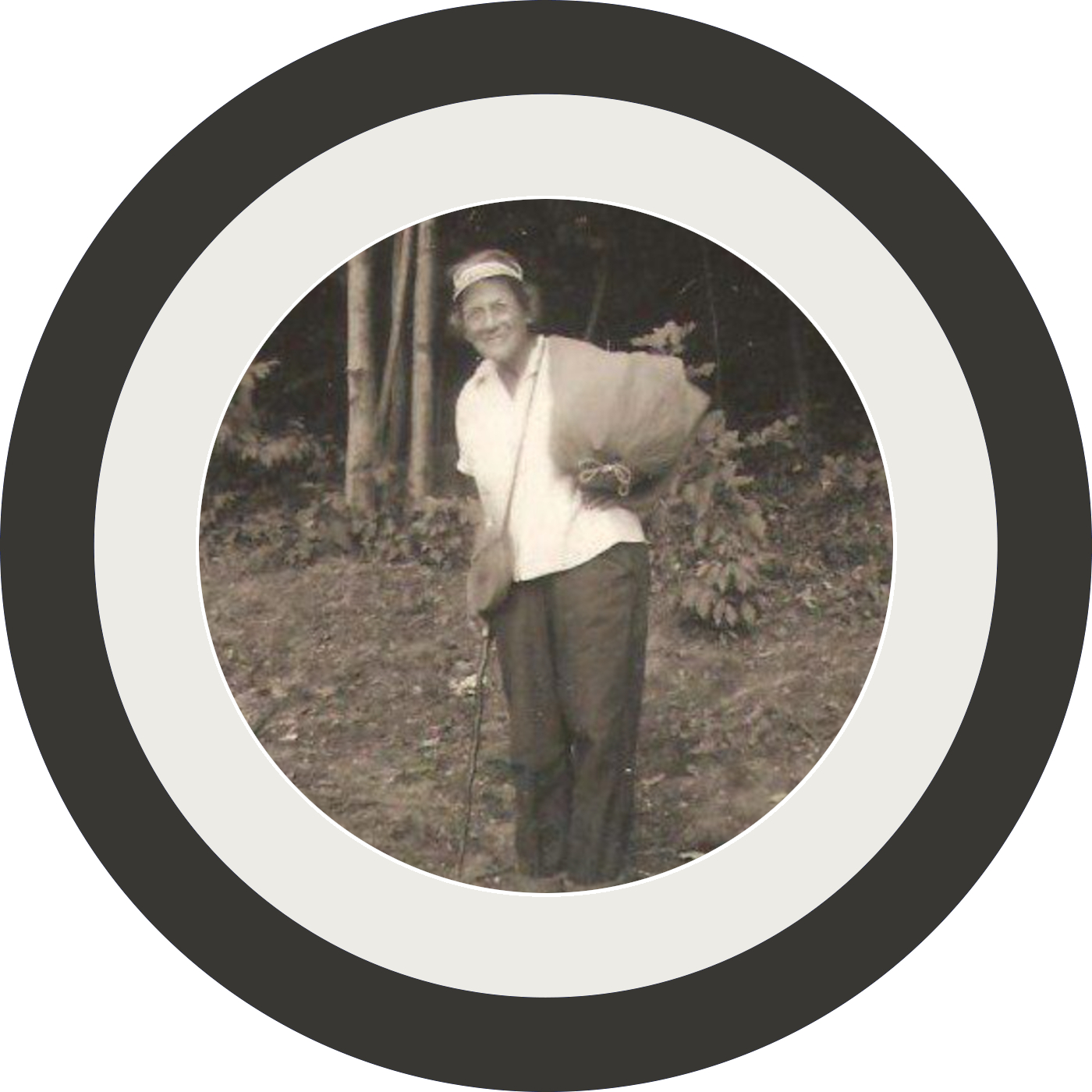
And so she hiked in canvas sneakers, a pair pair of white keds. She brought a single sack that she'd made out of denim.
And she stuffed it with supplies, a first aid kit, a bunch of cans of tinned sausage, a gingham dress in case she needed to wear something nice for some reason. A shower curtain for shelter.
It was incredibly difficult. I could weave drama out of any of her encounters with wild animals, or with wild men who lived off the grid.
or with others sure she was a spy for the federal government sent out to scout their property so Uncle Sam could seize their land or tax their whiskey.
Or with the men who would help her out, maybe give her a porch to sleep on, but who then expected her to cook and to clean for them.
And instead she chose to risk another night in the wilderness, rather than spend another day of her life cooking and cleaning for some man.
I could have drawn out the suspense, but
why should I make you fear for her?
Anymore.
When we could spend the rest of the story, this time we have left to spend together with Emma Gatewood, thinking about this time in her life.
When she is 67 years old, becoming the first woman to hike the Appalachian Trail, and becoming a celebrity.
Because a woman in her 60s in the 1950s who is out hiking the Appalachian Trail all alone, trying to keep it secret from her family so no one says, hey ma, hey grandma, don't do that.
It would have been impossible for her not to be noticed.
Not to have the people she encountered on the way wanting to tell other people that they just met this grandmother, a great-grandmother, in the middle of the great Smoky Mountains who was on her way to Maine.
Soon papers were sending reporters ahead to meet her out on the trail. They'd just wait there in the woods, surely one of their better assignments.
Dappled light through the leaves, deadlines be damned, nothing to do but just sit and wait in the breeze.
Eventually, a reporter for a new magazine called Sports Illustrated, a woman named Mary Snow, caught up with her and kept catching up with her, trailing her along the trail, and would write a feature story that would capture the imagination of much of the country and of TV producers who sent cameras to her house or invited her to appear on their news program or their game show.
She was even called to Capitol Hill to talk about the gap between the promise of the Appalachian Trail, a federal project, and the cleared paths and signage and managed wilderness that the government had been assured a hiker would find, and that Emma Gatewood had read about in National Geographic one day in the doctor's office.
Grandma Grandma Gatewood, as she was dubbed in the press and then known from then on, is the reason that the Appalachian Trail became the Appalachian Trail.
Not just in the public's imagination, but as a matter of public policy, as she convinced the government to make sure that it lived up to the promise of the Trail's founding vision.
She didn't tell reporters, didn't tell Congress surely, about her life before.
the life that led her to the trail.
She would tell them about the doctor's office and the magazine article and
the way that it captured her imagination. The freedom it represented out there in the wide, wide open, just walking.
She'd toss out familiar aphorisms about putting one foot in front of the other or about picking a goal however arbitrary and just sticking to it.
About how there was adventure just beyond your door if you were brave enough to just step outside.
She didn't talk about just how brave one sometimes need to be to step outside.
Changed one's life.
Didn't say what freedom meant to her. Or the solitude of nature.
Or the wide, wide open.
She didn't show her teeth when they'd take her picture, the newspapers. The reporter sometimes noted that, chalked it up to a Midwestern hard-scrabble stoicism.
Didn't know that she didn't want them to notice that so many of her teeth had been replaced or repaired. She told people she was a widow.
though she was not.
Emma Gatewood kept walking. She would hike the trail three times.
She became a beloved, if minor, cultural figure for a while there.
She would lead massive hikes, organize whole groups who were delighted to join Grandma Gatewood on some trail, who were inspired by her tale, what they knew of it. She walked well into her 80s.
If you read about her in the hiking media, in the many histories of the pastime as it has developed in the past decades, in the websites and journals and publishing arms dedicated to spreading its particular gospel, she is often referred to as a pioneer in a subset of the sport called ultra-light hiking, which is one of those niche neologisms that means little to anyone beyond those in a small community to whom it means everything.
It seems comically inadequate as a descriptor for Emma Gatewood.
Throughout the end of her life, she would die in 1973 at the age of 85, she spent most of her time, 10 hours a day, often more, clearing and marking a hiking trail near her home in Ohio.
So it would be there for anyone who needed to get outside, whatever their reasons.
And the Gatewood kept walking.
This episode of The Memory Palace was written and produced by me, Nate DeMayo, in January of 2025. The show gets research assistance from Eliza McGraw.
It is a proud member of Radiotopia, a network of listener-supported, artist-owned, independent podcasts from PRX, a not-for-profit public media company.
Thank you to everyone who donated to our recent fundraiser. If you did not and don't want to miss out on the particular pleasure of knowing that you are supporting independent media,
don't miss out. You can always make a donation at radiotopia.fm slash donate.
I also want to thank all the folks who have bought the Memory Pals book or the audio book or given it as a gift. Thanks to you, this book is doing quite well.
It is not some smash hit, but it is chugging along, which is a rare thing, especially among non-fiction non-fiction books, and readers are finding it. And I mean, that means the world to me.
And also as the proprietor of the Memory Palace, I was thinking about this the other day, a modest, sustainable success,
a beloved, almost cult object.
I mean, that feels comfortable.
So this is going great. So thank you.
And let's keep this thing going, please. It still makes a great gift.
It still makes a nice companion on your next vacation.
And if you ever want to drop me a line, you can do so at nate at theememorypalas.us.
You can follow me on Twitter and Facebook at TheMemory Palace. On Instagram and Substack at TheMemory Palace Podcast.
And on Blue Sky at NateDeMayo.
All right, I will be back with a new story in a couple weeks. Thank you, as always, for listening, and let's look out for each other out there, okay?
Radiotopia
from PRX