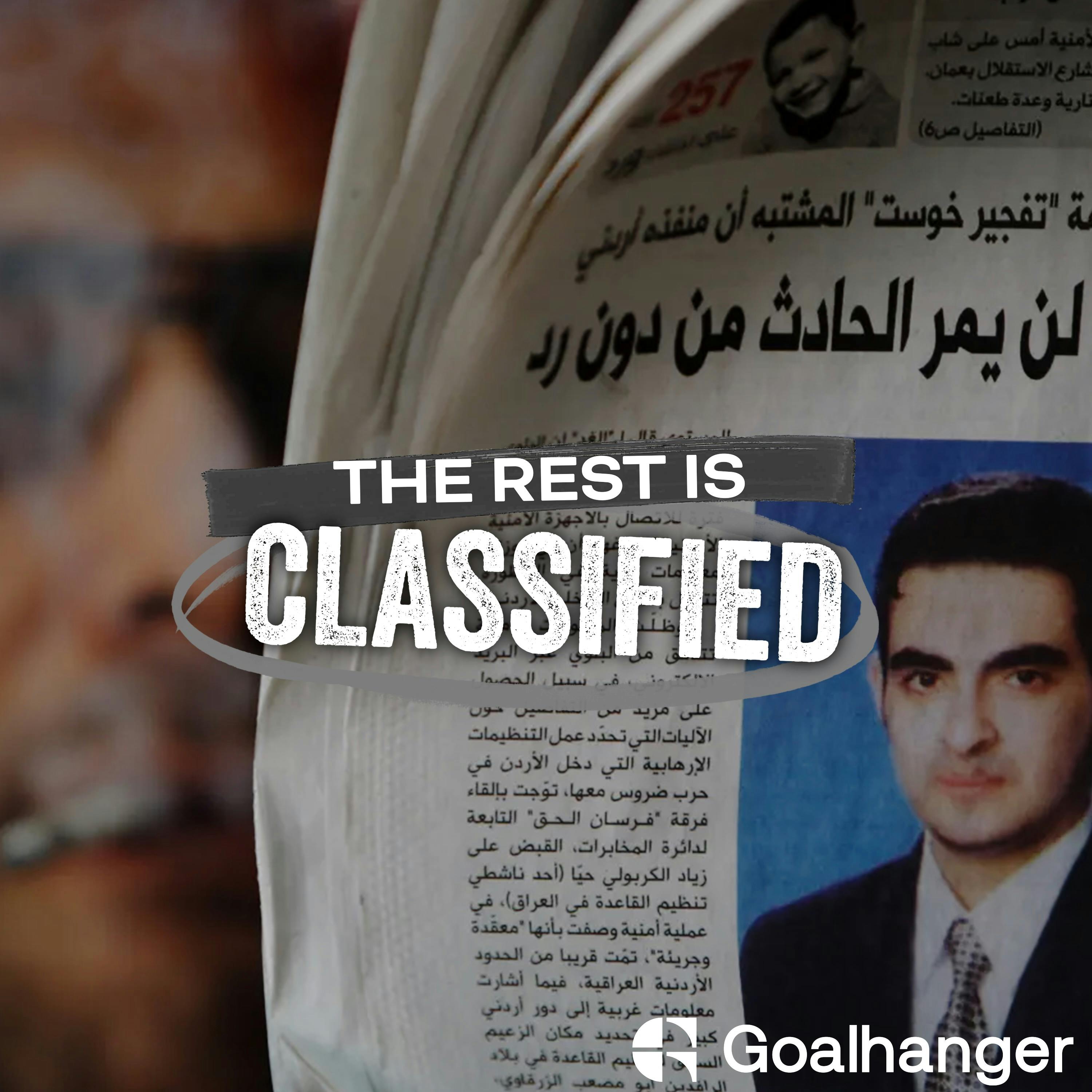
107. Hunting Al-Qaeda: The War On Terror (Ep 2)
In this episode, David and Gordon continue their series on the 2009 Camp Chapman attacks, detailing why the CIA and Jordanian GID felt compelled to trust a man who had spent the past few years wishing death upon all the West held dear.
-------------------
Make someone a Declassified Club Member this Christmas – go deeper into the world of espionage with exclusive Q&As, interviews with top intelligence insiders, regular livestreams, ad-free listening, early access to episodes and live show tickets, and weekly deep dives into original spy stories. Members also get curated reading lists, special book discounts, prize draws, and access to our private chat community.
Just go to https://therestisclassified.supportingcast.fm/gifts
And of course, you can still join for yourself any time at therestisclassified.com or on Apple Podcasts.
-------------------
THE REST IS CLASSIFIED LIVE 2026: Buy your tickets HERE to see David and Gordon live on stage at London’s Southbank Centre on 31 January.
-------------------
Try Attio for free at https://www.attio.com/tric
-------------------
EXCLUSIVE NordVPN Deal ➼ https://nordvpn.com/restisclassified Try it risk-free now with a 30-day money-back guarantee
-------------------
Email: therestisclassified@goalhanger.com
Instagram: @restisclassified
Social Producer: Emma Jackson
Producer: Becki Hills
Head of History: Dom Johnson
Exec Producer: Tony Pastor
Learn more about your ad choices. Visit podcastchoices.com/adchoices
Press play and read along
Transcript
Speaker 1 For exclusive interviews, bonus episodes, ad-free listening, early access to series, first look at live show tickets, a weekly newsletter, and discounted books, join the Declassified Club at the RestISClassified.com.
Speaker 1 This episode is sponsored by HP. Most people are not counterespionage experts, but that won't stop them getting targeted by cyber criminals seeking to extract their secrets.
Speaker 1 HP understands that approximately four in 10 UK businesses have reported cyber breaches in the past 12 months alone.
Speaker 1 That's why HP business laptops, desktops, and workstations bought directly on HP Store are secure straight out of the box with their endpoint security.
Speaker 1 No more stressing about dodgy emails or unexplained pop-ups.
Speaker 1 HP's independently verified Wolf Pro security works alongside your existing security tools to protect your business, users, and reputation from malware and evolving cyber threats with your first click.
Speaker 1 You don't need an alias or a secret hideout to stay safe, just Wolf Pro security working tirelessly to protect your hard work. It's security that's built in, not bolted on.
Speaker 1 Find out more about how HP can protect your business at hp.com forward slash classified.
Speaker 1 Podcast listeners benefit from a 10% discount on all business PCs, printers, and accessories using the code TRIC10. Terms and Conditions apply.
Speaker 2
You're deep into your favorite true crime binge. The twist, the theories, and suddenly hunger hits.
Grab a Paleo Valley 100% grass-fed beef stick. These aren't your average gas station snacks.
Speaker 2
They're made from real beef sourced from regenerative, small American family farms. No preservatives, no gluten, no grain, soy, or sugar.
Just naturally fermented protein that fuels your obsession.
Speaker 2 Whether you're road tripping, hiking, or pulling an all-nighter with your favorite case, choose from five bold flavors, original, jalapeno, summer sausage, garlic summer sausage, and teriyaki.
Speaker 2 They're keto, paleo, and carnivore-friendly, made to work with your lifestyle, not against it. With over 55 million sticks sold and a 60-day money-back guarantee, you've got nothing to lose.
Speaker 2 Get 15% on your first order at paleovalley.com. Just use code Paleo at checkout.
Speaker 3
This podcast is brought to you by Carvana. Carvana makes car selling fast and easy from start to finish.
Enter your license plate or VIN and get a real offer in seconds, down to the penny.
Speaker 3 If you accept, Carvana will come pick up your car from your driveway, or you can drop it off at one of our car vending machines.
Speaker 1 Either way, you get paid instantly.
Speaker 3 It's fast, transparent, and 100% online. Car selling that saves your time.
Speaker 1 That's Carvana.
Speaker 3 Carvana. Pickup fees may apply.
Speaker 5
This episode is brought to you by eBay. Buying a car should feel secure start to finish.
That's why you should buy your next ride on eBay. Whatever you're into, eBay's got it.
Speaker 5
From classics to SUVs and trucks to imports, all in one place. And with secure purchase, the process is streamlined and protected.
Secure purchase means no DMV visit.
Speaker 5 Sellers and titles are verified, all the paperwork is handled, and financing, delivery, and insurance options are built right in.
Speaker 5 Plus, eligible vehicle purchases are backed by up to $100,000 in protection. Looking to sell your ride, Secure Purchase makes that easy too.
Speaker 5
Your buyer and their funds are verified, and the title transfer and loan payoff are totally seamless. So, skip the hassle, shop with confidence, buy your next car on eBay.
eBay, things people love.
Speaker 5 Secure Purchase is powered by Caramel Dealer Services LLC, an eBay subsidiary.
Speaker 1 Welcome to the Rest is Classified. I'm Gordon Carrera and I'm David McClarski.
Speaker 1 And this is the second in our four-part series looking at the host bombing of 2009, a devastating event for the CIA, in which
Speaker 1 someone who they trusted turned against them, launching a suicide bombing, which proved absolutely deadly.
Speaker 1 And I guess the key question that we're going to be looking at in this episode and really through the series, David, isn't it?
Speaker 1 Is can you ever trust an agent, a jihadist who you think you've turned, someone who had been ideologically committed to a cause, but is now claiming to be on your side?
Speaker 1 Last time, we looked really at this story of Bilawi, this man who'd been online as a blogger supporting al-Qaeda, become a very prominent and famous blogger in the kind of eco-sphere of al-Qaeda terrorists and their supporters and who turned out to be a pretty mild-mannered doctor living in Amman, Jordan.
Speaker 1 The CIA had passed on intelligence to Jordanian authorities.
Speaker 1 They'd picked him up, they'd interrogated him, they thought they'd broken him, they thought he'd basically confessed, and they'd released him. And the question is, what now, isn't it?
Speaker 1 Well, the GID is certainly not done with him because even though he's given them, you know, a host of information about the forum that he's he's posting on jihadists who are affiliated with the forum.
Speaker 1
Balawi is not obviously in the clear, right? And Ali Bin Zayd, this case officer at GID, is still on the case. Balawi's phone is tapped.
He's followed.
Speaker 1 Reports from the interrogation are passed, it seems, to the CIA.
Speaker 1 And I think here in this period, after the interrogation, and the arrest, the deeper the GID looks into Balawi, Balawi, the more concerning his case becomes. We talked in the last episode about how
Speaker 1 it kind of first blush,
Speaker 1 Balawi didn't seem to have any deep connections or any connections at all outside of the forum to radical Islamist groups.
Speaker 1
And at the end of that interrogation, Balawi essentially says, hey, that online persona is not me. I was playing at jihadist online.
I'm live-action role-playing a character. Yeah.
Speaker 1 But the deeper GID looks, the more troubling this all becomes, because despite Bilawi's claims about opposing violence, it appears that at least twice he tried to join the Sunni insurgency in Iraq, the virulently jihadist part of it run by Abu Musab al-Zarqawi, who's a Jordanian terrorist who ran the Al-Qaeda branch in Iraq for many years until his death.
Speaker 1 As a backup plan, when that didn't work, Bilawi had canvassed friends and relatives to collect money for the insurgency and had raised just over $1,400, so again, not much, before abandoning the effort.
Speaker 1 But here we have a couple glimpses of the Abu Dhujana personality that he rates under stepping into the real world.
Speaker 1 After Israel's invasion of Gaza in 2008, Balawi had tried to volunteer as a Hamas medic to treat Palestinian wounded, right?
Speaker 1 I mean, you could say, okay, fine, but again, it's a connection with Hamas that he tries to establish. While studying in Turkey, Balawi had gone to medical school in Turkey.
Speaker 1 He had flirted with, joining, or interacted with a terrorist organization that had links to al-Qaeda.
Speaker 1 And here in Turkey, where Balawi met his future wife, Daphne, Balawi seems to have become much more conservative during that courtship, really. Balawi had really never been religious before.
Speaker 1 He had memorized portions of the Quran, but as a child, again, he had regular skipped Friday prayers and apparently had on several occasions referred derisively to Jordan as, quote, that Islamic country.
Speaker 1 But Daphne is,
Speaker 1 it seems, a true believer herself. She had translated these sort of hagiographies about Osama bin Laden and Saddam Hussein.
Speaker 1 The title of the Osama bin Laden book was Osama bin Laden, the Che Guevara of the East. So obviously this very laudatory biography of bin Laden.
Speaker 1 The couple, Balawi and his wife Daphne, they name their oldest daughter after her name is Layla.
Speaker 1 They name her after Layla Khaled, a Palestinian woman who hijacked a TWA airliner in 1969 and served time in a British jail.
Speaker 1 And their younger daughter was named after a Swedish-born Palestinian filmmaker who made a documentary about Layla Khaled. So you have these
Speaker 1 real-world sort of facts that start to pile up after the initial round of interrogation that Ali Bin Zayd at GID is starting to log as part of Balawi's sort of case file.
Speaker 1 Yeah, which all suggests that it's not simply just a persona that he inhabits online while being the mild manner doctor in the rest of the world. And I guess that's only emerging after his arrest.
Speaker 1 And he's been released. I mean, he's back at work, but he's clearly troubled, I think it looks like, by what's happened.
Speaker 1 I mean, who wouldn't be, having been arrested by the intelligence service and interrogated, but also perhaps by, you know, what he talked about, the humiliation and the impact of
Speaker 1 having confessed and having talked. Yeah, I mean, I guess you'd have to say
Speaker 1 after you're arrested, after you spend several days in a sensory deprivation tank, and after you're treated, even though, you know, Blowy said that he wasn't beaten.
Speaker 1
during his interaction with GID, I mean, you're psychologically tortured, you know, I think is fair to say. He's obviously not in a good spot.
His headspace is all messed up after this, right?
Speaker 1
He's back at work. This is February of 2009.
It's been a couple months since his arrest.
Speaker 1 He's back working at the refugee camp, but he sold his car, which is kind of odd because it's how he gets to work, you know, typically.
Speaker 1
He sells the car. He's losing weight.
He's disappearing for hours at a time. Seems very distracted.
He's praying all the time, asking for God's guidance. And this was not normal prior to the arrest.
Speaker 1 You know, he's got the two little girls. When their noise becomes too much for him, he kind of runs.
Speaker 1 Sometimes Joby Warwick writes in his book, sometimes literally, Bilawi would run out of the house and go down to the neighborhood mosque and pray quietly in the prayer room.
Speaker 1 And we should say he is still in touch with Bin Zaid, with the general intelligence directorate. That wasn't a just, we're going to interrogate you,
Speaker 1 you're going going to confess, we're going to release you. There are now regular conversations where he's going to get picked up, you know, at prearranged spots.
Speaker 1 Zayd's going to kind of come along in his Land Rover, take him to some nice meals, it sounds like, to talk to him, but basically trying to work him as a source, as an agent.
Speaker 1 This begins, I think, a part of this story that...
Speaker 1 I find to be sort of a fascinating decision because
Speaker 1 you could, I guess, say, look, we squeezed all of the intelligence possible out of this guy. We were interrogating him.
Speaker 1 And now we're just going to watch him to make sure that he doesn't rejoin the forum or he doesn't actually get in connection with any actual jihadists anywhere.
Speaker 1 You could just sort of watch him if you're GID.
Speaker 1 This isn't the choice that the GID makes, right? So Ali Ben Zayd really starts to kind of
Speaker 1 court him in some ways, right? He takes him out to some of these nice meals. Once, apparently, Ben Zayd met Balawi and took him out to the,
Speaker 1 there's a Safeway grocery store in Amman. Benzaid took him there, did shopping, gave Balawi several bags of groceries as gifts.
Speaker 1 And Benzaid, I think in this couple month period after Balawi's arrest and release, he takes this kind of interesting tack in these conversations where he puffs up the GID and talks about all of these kind of impressive intelligence successes of the GID about how the GID is, you know, entrapping Wanabi Jihadists on the way to Iraq.
Speaker 1 The GID had supplied the targeting information that led to Zarkawi's death in 2006. Kind of an interesting thing to be bragging about because of
Speaker 1 how
Speaker 1 lionized Zarkawi was by the Abu Dhujana persona. But there's this kind of, I think, attempt to, on the part of Benzaid, to sort of
Speaker 1 show
Speaker 1 Balawi that he might have the opportunity to work with or for
Speaker 1 a really impressive organization.
Speaker 1 And the pitch by Ben Zayd, I think, is essentially: work for your country, and we might be able to put together an interesting sort of operation together.
Speaker 1 And at some point, Ben Zayd floats the idea to Balawi that, you know, if Balawi can help GID track down other terrorists, he would be rewarded financially. There would be a payoff.
Speaker 1 Now, keep in mind up to this point, the CIA has been receiving some of these reports. Unclear exactly
Speaker 1
how many of them, but the CIA is aware of Balawi at this point. The CIA hasn't met the guy.
This is a Jordanian-run operation at this point, where they're sort of sharing the product, probably.
Speaker 1 You know, I think the financial motivation here probably bears some discussion because,
Speaker 1 you know, again, hindsight is 2020 here, but you got to wonder, I mean, this guy who's driving around a Magda Ford escort, who's a refugee doctor, who's made decisions throughout his life to not accrue material wealth, is all of a sudden put in a position where, you know, it seems like the sort of leverage or
Speaker 1 the benefit he might gain is money for working with the GID.
Speaker 1 It's also the bin zide, you know, floating the idea that effectively help us for the sake of your country, for Jordan, for working with a great intelligence service and for money.
Speaker 1 I mean, you can see why that might work on a criminal, on someone who is not ideologically motivated. But I do struggle to think why
Speaker 1 they think it would work on someone who is clearly, deeply, emotionally, in his interior life, aligned with the jihadist cause.
Speaker 1 Now, you know, I get the exteriors of him as the kind of not very well-off doctor, you know, who's got a family, but you also know he's got this other side to his personality, which is after all, why you're interested in him.
Speaker 1 And it does seem surprising to me that, that, that they thought it would be that easy to just leverage one side of his personality, if you like, and not the other.
Speaker 1 But I guess that's what they thought they'd done when they'd broken him to some extent.
Speaker 1 They thought they'd broken him down and kind of got him to kind of recognize one side of the personality and dispel the other side to some extent.
Speaker 1 So, what happens is that in February, during one of these dinner chats, Bilawi suggests that he might travel to the Fatah.
Speaker 1 Those are the federally administered tribal areas in Pakistan, this kind of strip of mountainous terrain in northwestern Pakistan that runs along the border with Afghanistan.
Speaker 1 It's the place we talked about in episode one that the agency has been sort of pounding in its drone war against al-Qaeda.
Speaker 1 And this is where I think the potential value of Malawi starts to come into focus because he's got contacts in the Fatah through his Abu Dhana persona.
Speaker 1 And he has a credible cover story, right? He's Abu Dhujana.
Speaker 1
He's this sort of widely known jihadist online personality. It's not a cover story.
He really is, you know, or he is kind of Abu Dhujana, or at least one part of him has been.
Speaker 1
And he is someone who would have been well known in the jihadist world, you know, a kind of legend in his own way. And he's a doctor.
So he has
Speaker 1 immediate value to Al-Qaeda and the sort of band of associated militants and Taliban types who have congregated in the Fatah, who are always short on qualified doctors.
Speaker 1 And Joby Warwick, in his book Triple Agent, which again, I'll just recommend to listeners of this series because it goes so deep into all of the detail on this case.
Speaker 1 You know, Joby Warwick says the agreement is essentially that Bilawi will work on spec, which means they'll give him a little bit of startup cash to get him there, get him started.
Speaker 1 But he'll get paid when he delivers. So if he delivers intelligence that allows the Jordanians or the agency to eventually take out members of Al-Qaeda or these other militants, he'll get paid.
Speaker 1 And that's the arrangement that gets worked out between Bin Zayd and Balawi. And the agreement is that Bilaw will get a few thousand dollars, again, as startup cash.
Speaker 1 There won't be any spy gear or anything like that. They'll set up email accounts that they can communicate through because him having gear is going to be if he's caught with that.
Speaker 1
And again, produce intel and get paid. And you can see from Bin Zaid's perspective why this is appealing and makes some sense.
Yeah, you can.
Speaker 1 Obviously, one of the problems is it's tempting to look at this story in hindsight of what he ends up doing.
Speaker 1 But at this point, you probably, if you're Bin Zaid and the Jordanians, you think, well, what have we got to lose? Yeah, he's expendable, isn't he? He's expendable.
Speaker 1 If he either gets, you know, rumbled as a spy, who cares, even if he's not loyal, well, what at this point have we lost?
Speaker 1 You know, I guess they think maybe we've got him, but I guess you don't need to be totally sure at this point. No, you don't.
Speaker 1 You know, we talked in the first episode about how the Jordanians are partners with the Americans, but they're also the sort of dependent partner.
Speaker 1
And in this case, I think this is exactly the sort of thing that the Jordanians would think about as being, and would recognize rightly, as being extremely valuable to us. To the CIA.
To the CIA.
Speaker 1 It's a good offer, isn't it? We've got a guy. Yeah.
Speaker 1 Now, obviously, it's the kind of thing the Jordanians would want to collect on on their own because the Jordanian monarchy feels existentially threatened by groups like al-Qaeda.
Speaker 1 But as soon as you start thinking about Abu Dhana slash Balawi's connections in Pakistan and how those could potentially be turned into you know, a secondary set of connections that get him sort of closer and closer to targets of real intelligence value, it's going to be the case that the Jordanians are going to want to bring the CIA in.
Speaker 1 Because if you think about the way a a case like this would have to be run in Pakistan, all of the agent vetting would really be done via signals intelligence and imagery platforms, some of which are probably drone-based, that the agency runs, not the Jordanians.
Speaker 1 It makes sense for Binzaid to bring this idea. proposal both to his leadership and then once they approve to CIA.
Speaker 1 And so the case will be run jointly with the CIA and the logistics of Balawi's journey into Pakistan come together from there.
Speaker 1 I think this is the point in the story where, you know, this case is sort of coming into the agency, right?
Speaker 1 Because again, up to this point, the agency has been aware of Balawi, but they're not running him in any way, shape, or form. At that point in time, even though this is coming into a MON station,
Speaker 1 This case is going to immediately go into the Counter Terrorism Center, CTC. Case like this is going to come into CTC.
Speaker 1
It's not going to come into what at the time was the old NE division, the Near East division. This is going to be a terrorism case.
It's cut and dry. No one's going to fight over it.
Speaker 1 But I do think that the fact that this becomes a and will become a CTC kind of front office
Speaker 1 case
Speaker 1
is going to end up being really important for some of the kind of headquarters and field dynamics to come. So this will come into the agency.
It's a CT case really quickly.
Speaker 1 you know, Balawi obviously needs a visa to go to Pakistan. So the CIA and GID draft a letter that invites him to this medical conference in Pakistan.
Speaker 1 There's a, you know, maybe a little bit of debate about whether the Pakistanis should be informed about sending him into Pakistan.
Speaker 1 Of course, we're not going to do that because there's concern that there'd be some penetration inside the Pakistani service that would turn the information over to militants and Balawi would be killed.
Speaker 1 So the Pakistanis are not informed. The Kama plan is basically an email connection with Benzaid
Speaker 1 with some code word kind of language to allow them to talk to one another. Again, no, you know, CoveCom or Covert Communications gear or anything sexy like that.
Speaker 1 And his kryptonym, which had been Panzer, it seems, inside the Jordanian system, is changed to wolf inside CTC.
Speaker 1
So the final step. It's purchasing airline tickets and Balawi is given an open-ended sort of, you know, return flight.
His tickets are hand-delivered by Benzaid along with the startup cash.
Speaker 1 And in mid-March of 2009, Balawi announces to most of his family that he's decided to apply to study medicine in the U.S., but he needs to go to Istanbul first for this qualifying exam.
Speaker 1 It does seem that his wife knew where he was actually headed, and he heads off as a
Speaker 1 joint CIA-GID asset who's going to be run against Al-Qaeda. And he heads to Peshawar, Pakistan, with his ultimate destination being the al-Qaeda-infested tribal areas of Northwest Pakistan.
Speaker 1
So, there with Balawi on his way to the heartland of Al-Qaeda, on behalf of the Jordanians, think them and the CIA. Let's take a break.
And when we come back, we'll see how he fares with Al-Qaeda.
Speaker 1 This episode is brought to you by Attio, the CRM for the AI era.
Speaker 1 Now, David, people think that Spycraft is just car chases and secret codes, but an awful lot of it is just idling around, waiting for the action. It's a bit like starting your own business.
Speaker 1 You think it's going to be as easy as creating and selling a product, but the reality is business owners spend far too long trying to get their CRM to fit a system not built for them.
Speaker 1 Attio's AI-driven CRM enables you to take control of your platform, to build something from the ground up that fits your needs. James Bond had Q's X-ray shades, an explosive watch, and a pen grenade.
Speaker 1 Business owners have Attio's real-time customer insights and platform that grows with them. All tools relevant for your mission to build a company from the ground up.
Speaker 1 Attio even has something called agent collaboration. Yes, but in this case, that means giving people the ability to let AI work seamlessly in the background for them.
Speaker 1 Try Attio for free at ATTIO.com slash trick.
Speaker 1
This episode is brought to you by Ancestry. Hello, James Holland here, joined by Al Murray from Goal Hangers World War II podcast.
We have ways of making you talk.
Speaker 1 These are those odd days between Christmas and New Year.
Speaker 1 The house buzzing with laughter, leftovers piled high, festive films murmuring in the background, and trivial pursuit debates still raging round the table.
Speaker 1 It's the perfect time to sit close, share family stories, and think about people who came before you.
Speaker 1 Grandparents, great uncles, aunts you hardly knew, everyone who helped shape the family you're part of today. With an ancestry membership, you can take those conversations further.
Speaker 1 All you have to do is provide what you know about your family history, such as your parents and grandparents' birthplaces.
Speaker 1 And Ancestry will help you dig through billions of records to uncover fascinating news stories about the lives of your relatives.
Speaker 1 Maybe it's a great uncle ferrying a hurricane north, a grandmother stitching uniforms at a Glasgow mill, or a relative holding the line on the Normandy beaches.
Speaker 1 And suddenly, the stories around your own table take on a whole new depth. The past isn't behind you, it runs straight through you.
Speaker 1 Head to ancestry.co.uk/slash new year to learn about Ancestry's memberships and start your family history journey today.
Speaker 1
This episode is brought to you by NORAD VPN. A breach used to require a forced door or a lifted file.
Now it begins the moment you join a dodgy public Wi-Fi network.
Speaker 1 Leave one device exposed and operators can map your online activity in moments. NordVPN shuts that down.
Speaker 1 One click encrypts your connection, stopping public networks turning into blind spots and keeping your traffic secure wherever you log on.
Speaker 1 NordVPN's Threat Protection Pro feature blocks malicious links, phishing sites, and even scans downloads for viruses. It's like having your own cyber bodyguard.
Speaker 1 And if you're abroad, you can shift your virtual location for the sites you rely on or check where the prices change by region before you buy.
Speaker 1 To get the best discount off your NordVPN plan, go to NordVPN.com forward slash rest is classified. Our link will also give you four extra months on the two-year plan.
Speaker 1 There's no risk with Nord's 30-day money-back guarantee. The link is in the episode description box.
Speaker 4
Starting your business isn't just about opening the doors, it's keeping the dream you built secure. With New York Life, you get the financial guidance to make it real.
Start today at nyl.com.
Speaker 1 Well, welcome back. We left with Humam al-Balawi on his way to Pakistan on this mission to infiltrate, to get as close as he can to al-Qaeda on behalf of the Jordanians and behind them, the CIA.
Speaker 1 And at first, he's going to go quiet, isn't he?
Speaker 1 Which maybe is not surprising when you've turned up in the tribal areas, the wildlands of Pakistan, which were pretty much out of government control at this point.
Speaker 1 There's no word from him, which inevitably is going to make people, I think, in Jordan and at Langley CIA headquarters think, well, they probably called him straight away and he's dead.
Speaker 1
So Balawi, he's a physician. He's had essentially no training whatsoever in much of any tradecraft.
And he doesn't speak any Pashto.
Speaker 1 So this guy has got, you know, it's a bit of an uphill battle, I think, for him to sort of set up shop there.
Speaker 1
And, you know, Benzaid worries, I think rightly, that Bilawi has maybe been just been killed by the Taliban outright. But then...
A few weeks later, Benzaid gets an email.
Speaker 1 The text that arrives is in code, but there's a few short phrases that they had agreed upon as a way of sort of verifying that it's actually Balawi. And it translates as essentially, hey, it's Balawi.
Speaker 1 I'm here. And Balawi has been living in the South Waziristan market town of Wana, living off of the cash that Benzaid had given him.
Speaker 1 And Balawi has a list of jihadists he had met online as Abu Dhujana, which again, this is a glimpse of the value that
Speaker 1 he could provide provide to Benzaid and the GID because he's got this roster of people.
Speaker 1 It's kind of like if all of your social media friends and not just people who are following you, but people you've interacted with, you've had conversations, you've moderated conversations on these messaging boards, all these people are elsewhere and you show up and you say, well, I'm that guy.
Speaker 1 It's an immediate way to get in. Because we know that, you know, MI6 and the CIA were trying to run sources up into the tribal areas and into al-Qaeda.
Speaker 1
And often, you know, they were trying to do that. And it was hard.
The first thing people would be is like, well, who are you? But he can say, I'm, I'm Abu Dhijana. And he actually is.
Speaker 1 You know, that's the thing. It's not, it's not made up.
Speaker 1 So he's got this list of, you know, people he can reach out to. And the, the ops plan that he's worked up with Benzaid is basically that he'll approach Taliban contacts.
Speaker 1 He'll use the kind of Abu Dhujana persona as the in.
Speaker 1 But then, of course, the question is, well, why are you here and what value do you provide, right?
Speaker 1 And the answer is going to be, well, I want to set up medical clinics where I can treat the sick and wounded of the Taliban.
Speaker 1
And this is extremely valuable to the Taliban and also great cover for wandering around the tribal areas. And the connectivity between Balawi and Benzaid continues.
through April and May.
Speaker 1 Balawi kind of is making these cryptic references to lower level Taliban contacts that he's making.
Speaker 1 And then in mid-May, Balawi informs Benzaid that he had accepted an invitation to move in with members of the Pakistani Taliban, the largest insurgent group based in that province of South Waziristan.
Speaker 1 The Taliban apparently want his doctor skills in a training camp, which again, this is all sort of going to plan. Balawi says, you know, I'm probably going to be watched closely.
Speaker 1 And we should say the way that Balawi is communicating is he's essentially going to internet cafes. So if he's at a training camp run by the Taliban, he's going to be under a lot more scrutiny.
Speaker 1 And it makes sense that the communication tempo will drop significantly, right? And, you know, Balawi basically says, you might not hear from me for a while. So May passes and then June.
Speaker 1 Again, this is 2009. Still no word from Balawi.
Speaker 1 And what's happening and what been able to sort of reconstruct about Balawi in that period is that he's been invited to meet with a warlord named Beitullah Masoud, who's one of the most powerful warlords in the tribal areas and one of these guys inside the Pakistani Taliban who's got these al-Qaeda sort of connections.
Speaker 1 Now, Beitala is basically a gangster, but he, like so many of these militants, is extremely attracted to Balawi
Speaker 1 because Balawi is a physician. And Beitala Massoud is a diabetic who's not well, who's got leg problems, and he wants a doctor around.
Speaker 1 So Balawi gets embedded into this kind of social system around Beitala Massoud, where he's actually dining with Masoud. But this is the point where I think Balawi basically
Speaker 1 comes clean. and says, I have contacts with Jordanian intelligence because they trust me.
Speaker 1 But
Speaker 1
I'm actually like you. I got arrested, interrogated, and tortured by them.
They think that they've turned me so that I'll work against you, but I'm actually not, right?
Speaker 1 So there's a set of conversations he has where he introduces this connection that he's got to Ali Bin Zayd and GID.
Speaker 1 And of course, we don't know, you know, for obvious reasons, exactly the circumstances or what led him to do that. I mean, whether he intended to do it all along, I think it's plausible, isn't it?
Speaker 1 That all along he thought my loyalties are with these jihadist groups, not with GID, or whether it was when he was out there, he suddenly changed his mind.
Speaker 1 I mean, we don't know, I suppose, is the truth, but it's interesting to even speculate as to whether he ever really intended on being loyal to GID and to the Jordanians.
Speaker 1 It's interesting, you know, Balawi's.
Speaker 1 character and personality because in in Joby Wark's book on this, he kind of paints this picture of Balawi as almost this blank slate that others are able to kind of write their, you know, their own script over.
Speaker 1 So he's with Binzaid and GID, and he's this reformed former jihadist sympathizer who's now trying to make good and work for the Jordanian monarchy. But then as soon as he's with...
Speaker 1 the al-Qaeda folks and Masoud,
Speaker 1 well, that identity is sort of wiped and he's Abu Dujana again, but he's in the real world. You know, he's kind of this blank slate in some ways who seems,
Speaker 1 it does seem like there was this core of sort of radical ideology that had defined him for much of his life and that he was deeply interested in.
Speaker 1 There's this push and pull, which is why I think it's so hard to get at exactly what he's thinking at this point in time. And it's interesting, isn't it? Because he is coming clean.
Speaker 1 He is telling them that he's got this link to Jordanian intelligence. Some of, you know, Batella Massoud, this big Pakistani Taliban leader's entourage, clearly don't trust him, though.
Speaker 1
And they behead people. They beheaded, I think, the Polish geologist.
And, you know, they kill spies out there, don't they?
Speaker 1 And I mean, if they have any suspicion that his loyalties are still with the Jordanians, they're going to kill him. You can imagine for him, the stresses at this point are pretty intense.
Speaker 1 And you've got drones flying overhead.
Speaker 1 You've got all these predators which are flying over these kind of federally administered tribal areas of Pakistan and striking targets, I think, quite near him at various points.
Speaker 1 I mean, you can see why he's not sleeping well. There's kind of this low buzzing noise that the predators make.
Speaker 1 The Taliban refer to them as bees because they make that kind of low whine buzzing sound. And apparently, the sound is so constant that Balawi has trouble sleeping.
Speaker 1
And indeed, that June, there is a real uptick in the number of predator strikes in Waziristan. And there are a couple in the village where Balawi and Masood had been, had been living.
And so
Speaker 1 you get this feel in this period that he's probably thinking, I might get
Speaker 1 ritualistically executed by my hosts, or I might be killed in an American drone strike. This is a pretty rough wake-up call from his life in Jordan, right? Because
Speaker 1 he's living with this guy who's personally conducted beheadings, who's got a $5 million bounty on his head. And you kind of get this feel of like
Speaker 1 the sort of court of Beitala Massoud is like Jabba's palace in Return of the Jedi, where you've got all these like unsavory, freakish characters around.
Speaker 1 And I think we've been talking about the trust in Balawi as trust from the standpoint of the Jordanian GID and the CIA. But here, Beitala Massoud and the Pakistani Taliban guys,
Speaker 1 they're asking the same questions. Can Can we really trust this guy? Yeah, can you trust a guy who you know has been in contact with Jordanian intelligence?
Speaker 1 Now, this is the bit that is really fascinating, isn't it?
Speaker 1 Is that they are actually going to come up with their own plan to test him, to test whether he really is who he says he is and whether he really does have a link which can stretch through Jordanian intelligence all the way to the CIA.
Speaker 1 And I mean, it is a kind of wild plan, isn't it?
Speaker 1 Because the idea is that he's going to use his contacts to give the details of where Betula Massoud might be in order for the CIA to order a missile attack on Massoud.
Speaker 1 But of course, the target wouldn't be real and he wouldn't be there. I mean, it's a kind of wild, interesting plan
Speaker 1 to put him to the test, which shows they only half trusted him, if that. Here's my caveat on this story.
Speaker 1 I don't think that it ever happened. So it's, again, Joby Warwick references this story in his book and says basically Beitala Massoud's idea to test this
Speaker 1 linkage between Balawi and GID and eventually CIA was to send word that Beitalah himself would be traveling in a certain district at a certain time in a certain car.
Speaker 1 All the details about the car and the route would match the description given to the CIA by Balawi. There would be a drone strike called in.
Speaker 1 And the Taliban lore is that this actually happens and that a driver the sort of hapless driver who i guess later beytola says consented to be sacrificed in this plan which seems pretty would be killed instead of masoud but it would allow the the taliban allow masoud to test you know balawi's connections right if he's actually able to to talk to western intelligence or to jordanian intelligence and joby warwick is clear about this in his book this was never reported in the press at the time and and it has never been confirmed by the CIA.
Speaker 1
And I've got to tell you, I think it's made up. Made up by the Pakistani Taliban to show how smart they are, basically.
To show how smart they are
Speaker 1 and to explain how they vetted Balawi in the sexiest possible way. Point being, at some point that summer, Balawi convinces his hosts.
Speaker 1 They still have some suspicions, but that he's working for them. Now, on the 5th of August, Baytala is killed in a drone strike while he sleeps on the roof of his father-in-law's compound.
Speaker 1 This is not done on the basis of Balawi's intel, but
Speaker 1 importantly, his sort of benefactor, Balawi's benefactor, is dead on the 5th of August, right? Now,
Speaker 1 simultaneously, CIA director Leon Panetta, who is
Speaker 1
Obama's CIA director and who is a very earthy sort of walnut farmer from Northern California. He's an experienced Washington hand.
Experienced Washington hand.
Speaker 1 He'd been Bill Clinton's chief of staff, I believe, and was a real bureaucratic knife fighter.
Speaker 1 Now, Panetta goes that summer 2009, he goes to President Obama, and basically he wants more resources for the drone program, and he wants to ramp up even more this sort of air war against al-Qaeda.
Speaker 1 Now,
Speaker 1 let's go back to what's going on in Jordan, because Balawi has had this extremely tense summer where he is living under the buzz of drones, sensing that the other denizens of the Jabba's palace out there are sharpening their knives for him.
Speaker 1 But he's been quiet all summer, right? Ali Ben Zayd has no email from him.
Speaker 1
There's nothing from other sources. Remember, the CIA isn't on the case.
So at this point, there's a whole host of other SIGINT gathering capabilities and imagery where
Speaker 1 you'd be thinking, well, is there anything to prove that this guy is actually still alive?
Speaker 1 And there's nothing until August. But then, in late August of 2009, Balawi resurfaces and he sends an email to Ali Bin Zaid saying he has a gift for him.
Speaker 1 And this gift is a few seconds of very low-quality video that shows a small gathering of men in traditional pastune dress. They're talking in this kind of dimly lit room.
Speaker 1
Balawi is in the foreground of the video. Seated beside him is this sort of guy with a thick dark beard.
He's in probably his early 40s. This guy is doing most of the talking.
Speaker 1
And the analysts in the counterterrorism center recognize this guy with the dark beard. but no one has seen him in eight years.
And his name is Atiyah Abdarrahman.
Speaker 1 And he is one of the closest associates of osama bin laden who is known to be alive that is a big deal because this is a guy who i think had escaped with bin laden you know in this famous escape after 9-11 and is known to be close to bin laden the leadership a kind of you know strategic thinker so that video must just have you know set langley on fire in terms of how significant it is because it's suggesting you've got all the jordanians have got an agent who is right by one of al-qaeda's top people yeah and you know the cia runs checks on the video of course to determine if it's real and yes it's real the video is briefed at the time there were i think they were meeting three times weekly there were these afternoon ct meetings counterterrorism meetings on the seventh floor in the director's conference room and i remember Anytime you'd be up there, even just tangentially going to some other office, there were always these, you know, gaggles of people outside of the director's conference room up on the seventh floor waiting for that afternoon CT meeting.
Speaker 1 And
Speaker 1 this is the point in our story where
Speaker 1 we sort of come back to this idea of don't fall in love with your agent. Because here
Speaker 1 we have a guy who, in a very short period of time, seems to have developed real deal access inside the upper echelons of Al-Qaeda.
Speaker 1 And that
Speaker 1 is meeting an insatiable hunger on the part of the Obama White House and the seventh floor, the executive floor at the CIA for something,
Speaker 1 some lead,
Speaker 1 you know, to help get inside the senior leadership of Al-Qaeda.
Speaker 1 And from a Jordanian standpoint, it's kind of the same dynamic where, obviously, this is important intelligence in its own right, but Ali Ben Zayd writes to Balawi in one of his emails from Aman.
Speaker 1
He says, You have lifted our heads. You have lifted our heads in front of the Americans.
And I think it shows some of the dynamics at play here from Ali Ben Zayd's perspective, which is
Speaker 1 this is the kind of case, if you were a 34-year-old GID case officer that could make your career, this is the kind of thing, if it works,
Speaker 1
the service will be talking about this for decades. For years, Yeah.
And you'll be the one who had the idea and who ran this guy and worked with the Americans to get it done.
Speaker 1 And oh, by the way, demonstrated the service's extreme value to the CIA. I mean, the video is such an interesting move to have supplied that video.
Speaker 1 I mean, it does raise some questions for me about how
Speaker 1 he could have
Speaker 1 convinced people that he filmed it covertly or overtly and then been able to, you know, why would you be filming it something with al-Qaeda leaders?
Speaker 1 I mean, I guess the the video is grainy and it looks like, you know, but it's still,
Speaker 1 I don't know, maybe I'm all hindsight, but I still feel to me that the ability to produce, because it's the video which is so powerful, but also that's the key bit of evidence which would make me go, hang on.
Speaker 1
I don't know. But, you know, he's going to start producing more intelligence, isn't he? The flow is going to begin.
The video establishes the credibility.
Speaker 1 Then he starts sending back more and more information about what's going on around him, a kind of steady flow.
Speaker 1 In most like really big cases, there would be a push and a pull between the case officers, the people who are trying to run the asset, and the counterintelligence people.
Speaker 1 There would be like CI rigor that would be applied to a case where you'd have someone, and the case officers typically hate this, even though they recognize the value of the discipline in general.
Speaker 1 They hate the CI people because the CI people come in and crap on cases. Yeah, counterintelligence people going, Are you sure? Are you not being played? That's their job.
Speaker 1 Here's 10 reasons why this might be total bunk, why he might be manipulating us, why he might be making stuff up, why he might be a double, all this kind of stuff. At this period,
Speaker 1 you know, I think it's safe to say that most big CT cases were not undergoing CI reviews.
Speaker 1 And it is interesting, it's worth saying this, that kind of CI counterintelligence review is the kind of thing you do in a Cold War case.
Speaker 1 It's the kind of thing we talked about with Oleg Gordievsky or something like that. Is he being dangled in front of us, you know, when in fact he's still working for the KGB?
Speaker 1 It's that kind of questioning you go through, and which they'd learned in the Cold War to do with cases against the Soviet Union or its allies.
Speaker 1 But now, I guess, in the CT counterterrorism world, it's different. I mean, it always felt like when you talk to people from this world, it was faster, slightly dirtier, slightly looser.
Speaker 1 The checking was less. You didn't think that these groups like Al-Qaeda could do something like, you know, dangle and run double agents.
Speaker 1 And so it just feels like the kind of discipline of counterintelligence counterintelligence hadn't yet been transferred into the counterterrorism world. Because it just, it's too fast as well.
Speaker 1 You're kind of churning through agents and intelligence at a much different rate than the kind of slow production of cases and careful kind of Cold War espionage. Yeah.
Speaker 1 I think I think the CTC management perspective was these are the kind of cases where if we slow them down and undergo, you know, a full CI review, there won't be any cases, there won't be any intel, and people are going to die, right?
Speaker 1 Because we won't stop stop plots like that was the i think that was the logic but we should say even though there wasn't like a a formal ci review done on the case um there was asset validation that was
Speaker 1 being done and you know some of that is balawi because he's in this medical role when there are drone strikes he's oftentimes called to treat victims and so he gives very accurate damage assessments back to Benzaid of what he saw when these drone strikes happened.
Speaker 1 And the CIA can verify those damage assessments with their own drone imagery, right? Because after the strike would happen, there'd be more predators that are watching.
Speaker 1 And so his reporting is spot on. He is also, as he's communicating to Benzaid, you know, he's doing this from internet cafes and things like that.
Speaker 1 The agency can see that he's co-located or close to targets of interest.
Speaker 1 And that,
Speaker 1 I think, in the minds of of the agency the jordanians suggests that okay he's you know he's actually with the people he says he's with it's not like there's no validation done apparently also balawi's reports help the agency do some targeting and joby warwick in his book cites sources claiming that maybe five taliban soldiers were killed um as a result of balawi's uh accounts back so it's not that there's there is validation there's validation yeah going on so you can see why that is going to impress the Jordanians and, I guess, the Americans as well, who are getting deeper and deeper involved in this case or getting more and more interested in it, although kind of still one step remote at this point.
Speaker 1
Through that summer of 2009, it's Ali Bin Zayd coordinating with Balawi. But as we said, there's an Amman station case officer who is involved as well.
Again, it's a joint case.
Speaker 1 And this guy's name is Darren Labonte. I think it's worth kind of briefly setting him up because he's going to be another key personality in the Balawi case.
Speaker 1 Darren Labonte is a former Army Ranger and CIA paramilitary officer who has already done multiple tours in Iraq and Afghanistan. He is
Speaker 1
remarkably impressive. And I've spoken to a number of people who knew him very well inside.
And he was an absolutely exceptional case officer, extremely patriotic. He had been in the Army before 2001.
Speaker 1 After 9-11, he rejoins the Army. Then he becomes a SWAT team officer in Chicago.
Speaker 1
He joins the U.S. Marshals Service.
Then he applies simultaneously to join the FBI and the CIA, ends up at the FBI for a bit, but then in 2006, joins the CIA. And I think Labonte
Speaker 1 is
Speaker 1 teamed up with Benzaid
Speaker 1 to run this case.
Speaker 1 I'll just say, Again, I mean, this is the sort of human face of an incredible tragedy.
Speaker 1 We'll say more
Speaker 1 about him, I think, later. But to kind of set up where this case is right now, you've got LeBonte paired with Benzait in Amman talking to Balawi, who is in Pakistan.
Speaker 1 And in November, which is, again, roughly a year after Balawi's initial arrest and recruitment, Balawi's going to send another really interesting message into this team.
Speaker 1 The video obviously kind of, you know, really woke people up to his potential important.
Speaker 1 This one is almost, you know, more amazing because Balawi, the doctor, is going to say he's got a patient and his new patient is Ayman al-Zawahiri.
Speaker 1 That is the number two in Al-Qaeda, Osama bin Laden's deputy.
Speaker 1 I mean, that is staggering if you, because, I mean, we should just briefly say, you know, he is a very important figure in jihadist circles.
Speaker 1
I mean, many people would say Zawahiri was actually the brains behind al-Qaeda. You know, he's very experienced.
It turned out to not be true, though. That was the assumption, though, wasn't it?
Speaker 1 That kind of bin Laden was the front man, the rich Saudi, but actually Zawahiri was the kind of Egyptian brains, the doctor who was older and had been kind of schooled in jihadism right through the 80s and had been as elusive as bin Laden.
Speaker 1
So, you know, was very much at the top of the list. And here you've got Balawi claiming that he's in contact with him, that he's treating him no less.
It's hard to overstate how big of a deal that
Speaker 1 is
Speaker 1
inside the CIA. And importantly, in that email where Balawi says, I'll be treating this guy.
You know, he's going to be my patient.
Speaker 1 Balawi supplies a summary of Zawahiri's physical condition and his various maladies that perfectly matches records the CIA had obtained years earlier from the Egyptians. So again, in
Speaker 1 this vetting process,
Speaker 1 you think, okay, that's interesting. And
Speaker 1 this feels like it's real because
Speaker 1
how would this guy know this unless, you know. Yeah, on one level it checks out.
On one level it checks out. And Balawi says there's going to be a follow-up appointment in a few weeks.
Speaker 1 And this is where the case,
Speaker 1 I think it takes a really fascinating turn because I think it's fair to say that
Speaker 1 once
Speaker 1 Balawi reports in that he is treating Zawahiri,
Speaker 1 I think you could make the argument that this case becomes the most important
Speaker 1 case inside the Central Intelligence Agency.
Speaker 1 It's obviously it's run as a restricted handling or RH case out of CTC, but this is the most important
Speaker 1 thing that the CIA has going in the fall of 2009, once we get the Zawahiri information. If you're Leon Panetta, this is exactly the kind of interesting, juicy morsel that you'd want to bring to Obama.
Speaker 1 And Panetta says, look, if CIA can meet Balawi,
Speaker 1 we might be able to, you know, of course, vet him, but also train him for a role and give him appropriate tech so that he can communicate with us and so that we can get geo-coordinates for where Zawahiri is.
Speaker 1 And the reason I mention this case being briefed to Obama is because usually, again, outside of maybe a covert action setting, when you're just talking about the gathering of foreign intelligence, it's pretty abnormal to brief the president before an asset meeting.
Speaker 1
You tell him what you get out of the asset meeting. It's not necessarily the wrong move.
But again, what it does is it creates expectation. Incredible expectations for what it'll produce.
Speaker 1 And I think as we'll see as we keep going, those expectations are going to filter down through the bureaucracy in a way that is going to impede the decision-making. And so, this is really remarkable.
Speaker 1 I mean, it's worth saying, the last time they'd had any kind of lead on Zawahiri was 2006, when the CIA had bombed an al-Qaeda gathering that he was supposed to attend.
Speaker 1
But apparently, you know, he hadn't been there. He'd sent his aides instead.
You know, there'd be not really any kind of verified sightings of him for years.
Speaker 1 Now it looks like the CIA, their Jordanian ally, have a lead who could potentially lead them to Zawahiri al-Qaeda's number two himself. I mean, maybe even, who knows, to Bin Laden.
Speaker 1 It's a tantalizing opportunity, isn't it? But as we'll see, it's going to lead to disaster.
Speaker 1 But of course, Gordon, for those who don't want to wait, go and join the Declassified Club at the Restisclassified.com, where you can get early access to all of our series, our bonus club episodes.
Speaker 1 And
Speaker 1 we would strongly encourage everyone to get tickets for our first ever Rest is Classified live show, which is going to take place on the 31st of January at the South Bank Center in London.
Speaker 1 All of the information on tickets, you can get in the episode description box.
Speaker 1 See you next time. See you next time.