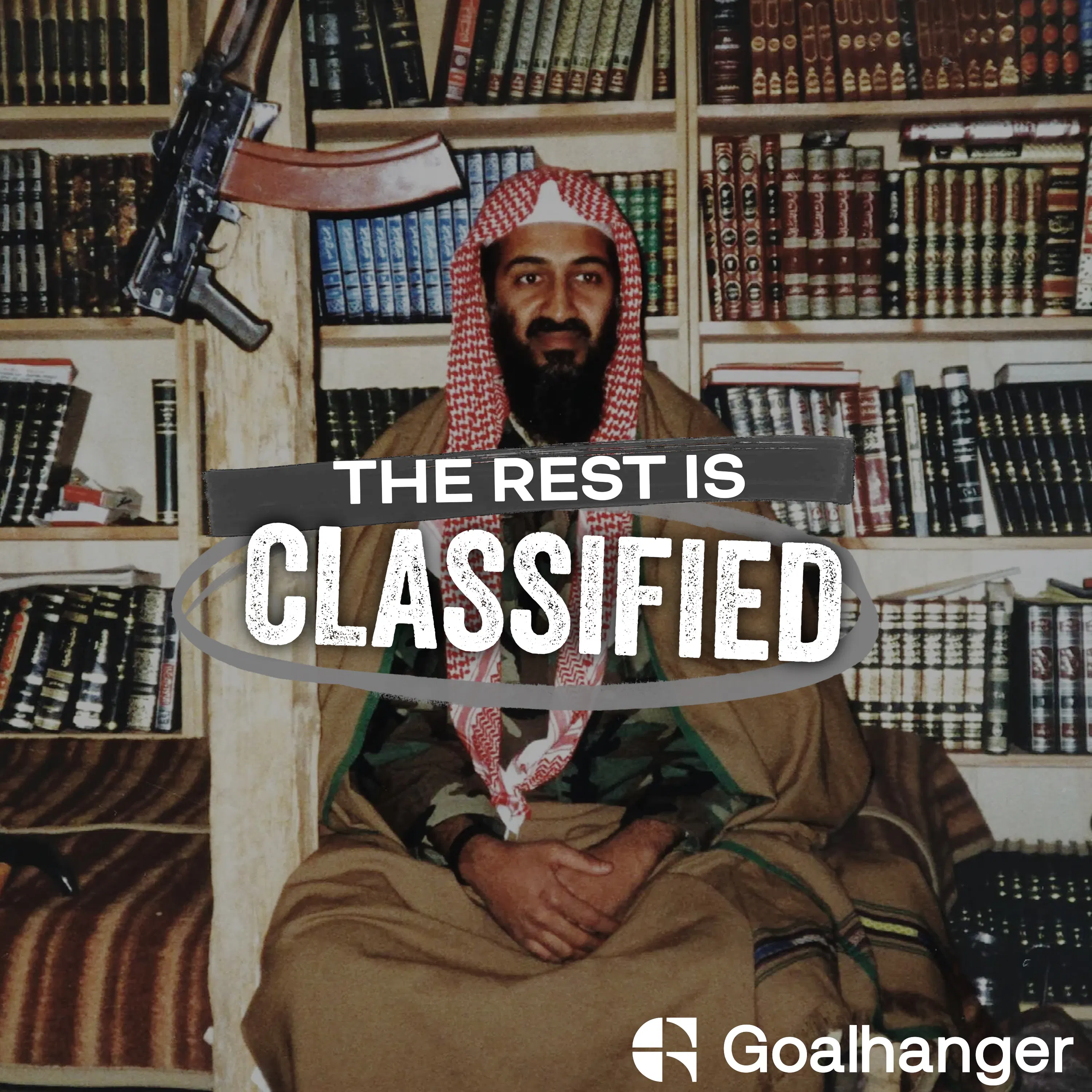
106. Hunting Al-Qaeda: Anatomy Of A Terrorist (Ep 1)
Listen as David and Gordon chart the rise of Humam Khalil Abu-Mulal al-Balawi from a doctor working in a Palestinian refugee camp to one of Al Qaeda’s most prolific online voices.
-------------------
Make someone a Declassified Club Member this Christmas – go deeper into the world of espionage with exclusive Q&As, interviews with top intelligence insiders, regular livestreams, ad-free listening, early access to episodes and live show tickets, and weekly deep dives into original spy stories. Members also get curated reading lists, special book discounts, prize draws, and access to our private chat community.
Just go to https://therestisclassified.supportingcast.fm/gifts
And of course, you can still join for yourself any time at therestisclassified.com or on Apple Podcasts.
-------------------
THE REST IS CLASSIFIED LIVE 2026: Buy your tickets HERE to see David and Gordon live on stage at London’s Southbank Centre on 31 January.
-------------------
Try Attio for free at https://www.attio.com/tric
-------------------
EXCLUSIVE NordVPN Deal ➼ https://nordvpn.com/restisclassified Try it risk-free now with a 30-day money-back guarantee
-------------------
Email: therestisclassified@goalhanger.com
Instagram: @restisclassified
Social Producer: Emma Jackson
Producer: Becki Hills
Head of History: Dom Johnson
Exec Producer: Tony Pastor
Learn more about your ad choices. Visit podcastchoices.com/adchoices
Press play and read along
Transcript
Speaker 1 For exclusive interviews, bonus episodes, ad-free listening, early access to series, first look at live show tickets, a weekly newsletter, and discounted books, join the Declassified Club at the RestISClassified.com.
Speaker 1 This episode is sponsored by HP. Most people are not counterespionage experts, but that won't stop them getting targeted by cyber criminals seeking to extract their secrets.
Speaker 1 HP understands that approximately four in 10 UK businesses have reported cyber breaches in the past 12 months alone.
Speaker 1 That's why HP business laptops, desktops, and workstations bought directly on HP Store are secure straight out of the box with their endpoint security.
Speaker 1 No more stressing about dodgy emails or unexplained pop-ups.
Speaker 1 HP's independently verified Wolf Pro security works alongside your existing security tools to protect your business, users, and reputation from malware and evolving cyber threats with your first click.
Speaker 1 You don't need an alias or a secret hideout to stay safe, just Wolf Pro security working tirelessly to protect your hard work. It's security that's built in, not bolted on.
Speaker 1 Find out more about how HP can protect your business at hp.com forward slash classified.
Speaker 1 Podcast listeners benefit from a 10% discount on all business PCs, printers, and accessories using the code TRIC10 Terms and Conditions Apply.
Speaker 2
This podcast is brought to you by Carvana. Carvana makes car selling fast and easy from start to finish.
Enter your license plate or VIN and get a real offer in seconds, down to the penny.
Speaker 2 If you accept, Carvana will come pick up your car from your driveway, or you can drop it off at one of our car vending machines. Either way, you get paid instantly.
Speaker 2 It's fast, transparent, and 100% online. Car selling that saves your time.
Speaker 1 That's Carvana.
Speaker 3 Carvana.
Speaker 2 Pickup fees may apply.
Speaker 4
You're deep into your favorite true crime binge. The twist, the theories, and suddenly, hunger hits.
Grab a Paleo Valley 100% grass-fed beef stick. These aren't your average gas station snacks.
Speaker 4
They're made from real beef sourced from regenerative, small American family farms. No preservatives, no gluten, no grain, soy, or sugar.
Just naturally fermented protein that fuels your obsession.
Speaker 4 Whether you're road tripping, hiking, or pooling an all-nighter with your favorite case, choose from five bold flavors, original, jalapeno, summer sausage, garlic summer sausage, and teriyaki.
Speaker 4 They're keto, paleo, and carnivore-friendly, made to work with your lifestyle, not against it. With over 55 million sticks sold and a 60-day money-back guarantee, you've got nothing to lose.
Speaker 4 Get 15% on your first order at paleovalley.com. Just use code Paleo at checkout.
Speaker 5
Join Vanguard for a moment of meditation. Take a deep breath.
Picture yourself reaching your financial goals.
Speaker 3 Feel that freedom.
Speaker 5 Visit vanguard.com slash investinginyou to learn more. All investing is subject to risk.
Speaker 1 Those who fell yesterday were far from home and close to the enemy, doing the hard work that must be done to protect our country from terrorism.
Speaker 1 We owe them our deepest gratitude and we pledge to them and their families that we will never cease fighting for the cause to which they dedicated their lives, a safer America.
Speaker 1
Well, welcome to the Rest is Classified. I'm Gordon Carrera.
And I'm David McCloskey. And that was former CIA Director Leon Panetta.
Speaker 1 And he was speaking about the victims of what's known as the host bombing on the 31st of December 2009.
Speaker 1 And this week and and next, we're looking at, I suppose, David, one of the darkest days really for the CIA, an attack by the terrorist group Al-Qaeda on Camp Chapman, a base in Host in Afghanistan in 2009.
Speaker 1 And it was a devastating attack, but it also revealed a kind of spy tradecraft being used by al-Qaeda in terms of running double agents, which surprised many.
Speaker 1 Many people didn't think they were able to do that. And I mean, it's been dramatized in things like the film Zero Dark 30 on the hunt for Osama bin Laden.
Speaker 1 But I guess we're going to try and tell the real story of what happened there. In many ways, Gordon, I think at least for me,
Speaker 1
one of the hardest stories that we've done on the Rest is Classified. It is about the deadliest attack on the CIA during the war on terror.
Seven CIA officers killed.
Speaker 1 It'll be the deadliest overall day for the CIA since the bombing of the U.S. Embassy in Beirut back in 1983.
Speaker 1 And I've spent a lot of time over the past few weeks speaking with agency officers who knew victims, who were involved in some way, shape, or form in the case, who were involved in the subsequent review.
Speaker 1 And it is just an excruciatingly painful story for the CIA. It is indeed one of the agency's darkest days ever.
Speaker 1 And I think for those who are involved or who knew the victims, it just casts a very, very long shadow. Yeah, that's right.
Speaker 1 I mean, it's actually a story we've debated when we should do from when we started the podcast about a year ago, isn't it? Because I think we both knew it would be hard.
Speaker 1 You know, half the CIA, I mean, we might come to it maybe later, but I also knew one of the people who died in the bombing. And so I think there's a kind of rawness to it and an awfulness to it.
Speaker 1 But it is also an important story, isn't it, David, in terms of, you know, what it tells us about the CIA, about tradecraft, about dealing with terrorist organizations, about what they're capable of.
Speaker 1
It is very wild. It's the only instance of al-Qaeda penetrating the CIA.
And it's the only instance, I believe, ever in the agency's history of an asset killing their case officer.
Speaker 1 I think it is really a case study in the peril and the complexity of running human assets.
Speaker 1 And at its center are these kind of very simple questions, but complicated questions when you're running a case. You know, how do you really know if someone is working for you?
Speaker 1 You You know, how much risk are you willing to absorb? And there's one of these sort of famous quote-unquote Moscow rules, right? Which is don't fall in love with your agent.
Speaker 1 And I think oftentimes that's interpreted as don't romantically fall in love with your agent. But really the premise behind that is you should constantly,
Speaker 1 constantly be vetting your agent.
Speaker 1 assessing your agent to determine if they are really under some version of control, really producing intelligence for you, or are they working for the other side?
Speaker 1 And I think this is an example where the potential value of an agent, in this case, a high-level penetration of al-Qaeda, was so
Speaker 1 promising that organizationally, you kind of don't want to look too closely at it because you worry that, you know, the case will go bad. Yeah, that's right.
Speaker 1 I mean, we think about double agents and people being turned back a lot in Cold War espionage, and it's a kind of familiar story then.
Speaker 1 But of course, here we're talking about it in the context of counterterrorism, where in many ways the risks, as we'll see, are much more deadly.
Speaker 1 And I think that's why it's such a powerful and important story. And you've also got other interesting complexities, haven't you?
Speaker 1 Because it's about liaison, because we'll see this also brings in the Jordanian intelligence service, which brings to light interesting questions about how different intelligence services work with each other when they're running a single agent.
Speaker 1 And so I think there's a lot, a lot here to grapple with in this story. I think this will be, for all of the things we've just described, a really in-depth story about
Speaker 1 how a large spy service in concert with liaison runs a massively important case over the course of a half a year and
Speaker 1 how that bureaucratically works, really, which is something I think that oftentimes as we talk about these cases on this podcast, we don't always have the information available to shed light on the kind of bureaucratic wrangling, the complexities of how do you run an asset over multiple geographies?
Speaker 1 How do you run an asset with liaison? What is it practically like kind of day to day and how are the decisions made?
Speaker 1 And the reason we can do that on this case is because a Washington Post reporter named Joby Warwick has written an exceptional book on on this called The Triple Agent, the Al-Qaeda Mole Who Infiltrated the CIA.
Speaker 1 We will be leveraging that book heavily as we tell this story, and we'll also be talking with Joby, who will be coming onto the podcast to join us for our declassified club members to talk about this story and also about how he wrote it.
Speaker 1 Because as we'll see as we talk here, you might be wondering, well, how in the world did anyone get this information?
Speaker 1 And it's because Joby, for his book, was able to get access to the CIA and even to go to places, you know, go to Jordan and interview, you know, family members of the guy who would become the bomber.
Speaker 1 So, you know, I would highly recommend Joby Warwick's book, The Triple Agent. And, you know, it'll, it really paints, I think, a complex and very in-depth picture of this case.
Speaker 1 Yeah, and it is interesting because it gets to the heart of, you know, why do things go wrong? And I think there's been kind of people trying to throw blame around in this case.
Speaker 1 And I think we're going to address some of those issues in a kind of serious and analytical way, you know, by approaching it through what we do know happened and kind of exploring it carefully.
Speaker 1 The term that came up actually consistently in the conversations I had while writing these episodes was airplane crash.
Speaker 1 That what we're about to see here is an airplane crash where, you know, it's usually not just one thing that goes wrong. It's 15.
Speaker 1 And of course, you can debate sort of the relative weight of the different decisions and structural factors and how far back you go. But this is a story of a really,
Speaker 1 really big airplane crash that took the CIA completely by surprise. Okay, well, let's dive into it.
Speaker 1 So I guess we should set it up in the context of this is post the September 11th, 2001 attacks on the United States. We've entered.
Speaker 1 this era of the war on terror and particularly the battle against al-Qaeda, the terrorist group which carried out 9-11.
Speaker 1 Going back, we've done episodes previously on the hump for bin Laden and on 9-11 and Afghanistan. The key fact is the leadership of al-Qaeda has dispersed from Afghanistan.
Speaker 1 It's gone into hiding after that period. And we're not yet in the days of
Speaker 1 which we've covered when Bin Laden himself is going to get caught in 2011. So we're in that kind of intermediate phase where Al-Qaeda is still the enemy.
Speaker 1 for the United States and they're in hiding and the US is going after and really desperate to find the leadership to stop more attacks. So, this story takes place in 2009.
Speaker 1 And I guess you could sort of break the fight against al-Qaeda
Speaker 1
as of early 2009. There have been basically two pieces to that.
And I'm simplifying here, but I think this is an okay mental construct.
Speaker 1 One is there's a fight against al-Qaeda more broadly, this organization.
Speaker 1 And two, there's the hunt for its senior leaders, in particular, Osama bin Laden and Ayman al-Zohri, who is the Al-Qaeda deputy, the number two.
Speaker 1 So if you start with number one, the fight against al-Qaeda more broadly, as the story opens in 2009, as Barack Obama has just been elected U.S.
Speaker 1 president and is getting ready to take office, the CIA is running its most lethal campaign ever. It is running a predator war over the tribal areas in Pakistan.
Speaker 1 And we should say the predators are the unmanned aerial vehicles, the drones which carry hellfire missiles and other types of missiles, which are being used used to target al-Qaeda individuals and the group.
Speaker 1 Yes. And that piece of the conflict in 2009 is relatively new.
Speaker 1 And the addition of the Predator as part of this toolkit against al-Qaeda has come about really because in 2007,
Speaker 1 Al-Qaeda had really reconstituted itself in these sort of very rugged, mountainous,
Speaker 1 lawless, largely tribal areas of Pakistan, more or less outside of central government control.
Speaker 1 And Al-Qaeda is, with sort of collaboration with a bunch of local warlords and militant groups, and the Pakistani Taliban has been reopening training camps. The group is raising money.
Speaker 1 And
Speaker 1 I'd say the threat level is really rising. And this is a part of it that I think 20 years on, it's kind of hard to imagine now.
Speaker 1 But this is a period in these kind of mid-2000s where there are a lot of al-Qaeda plots that are disrupted by the CIA and other global intelligence services. I remember covering a lot of them.
Speaker 1 And I mean, we've talked about the July 7th, 2005 bombings in the UK, which were kind of planned and organized out of Pakistan.
Speaker 1 And then in 2006, you had a very significant plot, which is known as the liquid bomb plot or the airline plot, where Al-Qaeda was planning something bigger than 9-11 in terms of taking down aircraft, which is the reason why you can't take liquids onto planes or you haven't been able to very much in all the years since.
Speaker 1 It's a story we're going to be looking at in the near future. And so there is this sense that al-Qaeda is once again able to plan big things like 9-11.
Speaker 1
And I think, again, we don't have that these days and we haven't had it for many years. But at that point, that was really definitely a worry.
And that was, I think, one of the reasons why.
Speaker 1 you had the CIA being given the authority to go after al-Qaeda, including in Pakistan, using the drones, these predator drone strikes, which they never officially confirmed, but everyone could see and know they were happening.
Speaker 1
Yeah. And I mean, the Pakistan component here is really important, right? Because obviously the U.S.
is occupying essentially Afghanistan at this point.
Speaker 1 And there's a whole network of military bases, intelligence facilities in Afghanistan to support. the war against the Taliban and, you know, sort of the conflict against Al-Qaeda.
Speaker 1 But across the border in Pakistan, what do you do? You're not technically at war with Pakistan. And so the CIA by 2008 has gotten authorities to conduct drone strikes inside Pakistan.
Speaker 1 And at first, that it started with the requirement that the CIA inform the Pakistanis beforehand, could only pull the trigger if the Pakistanis agreed.
Speaker 1
You can imagine that that process was not particularly effective or efficient. Targets would disappear.
So essentially, the CIA had to shift to really a unilateral strategy.
Speaker 1 So by July 2008, this is really starting to tick.
Speaker 1 And what is going on is the CIA is not informing the Pakistanis beforehand or asking for permission, but they're simultaneously notifying Pakistani officials when strikes occur.
Speaker 1 In the back half of 2008, right? So just as our story is starting, about 30 targets, again, according to Joby Warwick's book, about 30 targets are hit.
Speaker 1 in Pakistan, and that is more than triple the combined number of strikes over the previous four years. So the ops tempo is really, really ramped up.
Speaker 1 But it's worth saying, isn't it, that these strikes are going after the tier just below the top leadership.
Speaker 1 So they're going after a lot of the kind of operational commanders, but not the very top leadership.
Speaker 1 So in terms of those two missions you were talking about, degrading, as they put it, al-Qaeda through these predator strikes was having some effect.
Speaker 1 But they hadn't been able to find and they had very little intelligence on Osama bin Laden and Ayman al-Zawahiri is number two. They have really disappeared, haven't they?
Speaker 1 I mean, we talked about this in our Humphrey Bin Laden episodes, the Where's Waldo talk that was going around where you'd have strange sightings.
Speaker 1 I mean, they really are having problems despite all their efforts to actually locate the two key leaders. We talked in those episodes, Gordon, about how
Speaker 1
cold. the trail was.
I mean, there was real solid targeting work going on inside the CIS Counterterrorism center to come up with, you know, vectors through which you might get at bin Laden.
Speaker 1 Could you look at his family? Could you look at the videos that bin Laden would occasionally release? Could you look at his courier?
Speaker 1 Because at this time, the working belief was that bin Laden was in touch with members of al-Qaeda, but he's not doing it digitally, right? So there's a courier, but...
Speaker 1 The courier will be the lead that eventually goes to bin Laden. But in 2009, the year that this story takes place, the CIA knows that courier has sort of disappeared off the map.
Speaker 1 The CIA has his true name, but there's also reporting that he's dead.
Speaker 1 And it's going to be another year before the CIA eventually gets that critical phone number, confirms that the courier is in Pakistan, and eventually follows him to that compound in Abbottabad.
Speaker 1 And what is really important to set up for this story is that when very senior leaders at the CIA in early 2009 are having these initial counter-terrorism briefings, you know, with new director Leon Panetta, with President Obama, with his National Security Council, the story on the hunt for Osama Laden and Ayman al-Zawahiri is basically, we have nothing.
Speaker 1
Your big priority, we've got SQAT. And so this is the crucial point.
2009, the trail is cold. The pressure is there.
Speaker 1 And that's why this story is going to turn out the way it does, because suddenly, through a kind of surprising route, as we'll see, they're going to get what they think might be a lead into getting to that leadership of al-Qaeda.
Speaker 1 And that lead is going to come an unusual route, but it's going to come through a blogger of all things, which is a really interesting aspect of this story.
Speaker 1
But yeah, it's going to be a blogger, a Jordanian blogger, no less. A Jordanian blogger.
Yes. And again,
Speaker 1 as we tell this story, I would just, you know, urge everyone listening to think about this, not through the lens of, oh, there was another path that wound up leading to bin Laden, but you know, think about this as we tell this story from the lens of the people who are there at the time, who, as this case goes on, will see that it presents really incredible potential intelligence value.
Speaker 1
So there is a blogger in 2007, 2008, using a pseudonym named Abu Dhujana al-Khorasani. That is the pseudonym.
Now, this Abu Dhujana character writes for an outlet called Al-Hizbah, which is
Speaker 1 an outlet for radical Islamic teaching and discourse. It's kind of a jihadi message board, Gordon, and chat forum.
Speaker 1 And Abu Dhujana is a very active participant in this platform. Yeah, we've got an example of his post here.
Speaker 1
Brothers, download these videos until your internet cable gets overheated because of how hot the clips are. Readers can then click to view a collage of attacks by Iraqi insurgents on U.S.
troops.
Speaker 1 And then he says, you know, watch how the Americans get killed as if they were in PlayStation video games.
Speaker 1 And I think it is worth saying, it sounds strange now, but these message boards and websites were really important at the time. This is slightly before social media.
Speaker 1 And so websites, bloggers, message boards were the new way of getting content out and where someone could get content out relatively anonymously and with relatively little controls over what they were saying.
Speaker 1 And so they were quite an important route for al-Qaeda to get its propaganda and messaging out and for people who just supported al-Qaeda to kind of communicate.
Speaker 1 And so this Abu Dhajanu is one of those people who's using a pseudonym and posting these pretty bloodthirsty, aggressive, sarcastic, but also as we can see with his reference to PlayStation video games, quite kind of smart in his own way, posts.
Speaker 1 And I think as a result, he's going to get very widely read, isn't he, on El Hezbo.
Speaker 1 He's going to get kind of widely commented on, seen as a kind of moderator for the group, you know, driving further traffic. He's going to become a kind of...
Speaker 1 a big figure in this website world of people supporting al-Qaeda.
Speaker 1 Well, and eventually he'll be asked because he's so active and popular on the on the forum, he's going to be asked to serve as moderator of one of the discussion groups, which is going to draw further traffic to him.
Speaker 1
And here's an example of something he's typing as he's opening one of these sort of chat forums. Welcome to the Al Hezboh Cafe.
This is Abu Dujana writing.
Speaker 1 Go to the menu and pick today's dish: roasted Humvee with sauce of human remains, exploded tank by an IED, improvised explosive device with no survivors, or a pastry made of Americans' brains taken out with sniper bullets.
Speaker 1 Yuck. So, this is
Speaker 1 an example of the kind of internet personality that is going to be increasingly of interest to the CIA, to the NSA, and as we'll see, to the Jordanian General Intelligence Directorate, their service.
Speaker 1 But so a couple more words on Abu Dhana before we get to his sort of connection with the intelligence services. So that pseudonym is carefully chosen.
Speaker 1 Al-Khorasani means from Khorasan, which is the ancient name for the Islamic lands that encompass much of modern-day Afghanistan.
Speaker 1 And Abu Dhujana is a seventh-century Arab warrior who's a favorite of the prophets. And before battle, apparently, Abu Dhujana would put on a headband and he'd sort of
Speaker 1 mock his enemies, very kind of peacock around in front of their lines.
Speaker 1 And I think it's telling, given the sort of online personality that this Abu Dujana has chosen, that that's kind of his online personality tracks with that as well.
Speaker 1 Now, no one knows for a long time who Abu Dujana is. There's speculation that he's Saudi, and I think this is interesting given what's to come.
Speaker 1 There's speculation that he's quite possibly a senior al-Qaeda official, given how closely his postings and commentary track with al-Qaeda's propaganda.
Speaker 1 Now, because of all of this, the National Security Agency, the U.S. SIGIN Agency, the NSA, begin targeting Abu Dhana to try to figure out who he is.
Speaker 1 And they work backward, essentially, through a bunch of databases, a maze of servers and cables, and through some impressive technical collection, narrowed down the search to Jordan to try to geolocate this guy, and then to Amman, and then finally to a single house in a working-class neighborhood of the Jordanian capital.
Speaker 1 And it turns out that Abu Dhujana is a very soft-spoken, mild-mannered Jordanian doctor named Humam Khalil al-Balawi. And this is interesting, isn't it?
Speaker 1 Because they thought he was going to be a top al-Qaeda official, or potentially, given how influential he was. And yet they can't see any connection to al-Qaeda.
Speaker 1
And, you know, here is this guy who's a kind of quiet guy on the internet, as it were. Yeah.
I mean,
Speaker 1
he's obviously very online. And his wife, and we'll talk more about her later because she does play an important role in his radicalization.
But, you know, his wife is...
Speaker 1 kind of worried about all the time he's spending on the computer and balawi is he's very much a social recluse Rarely goes out. He doesn't even attend Friday prayers at the mosque.
Speaker 1 And his wife will later say, you know, he was living in fantasy in another world as Abu Dhujana.
Speaker 1 And the CI have conducted this search alongside the Jordanians, but the information ends up with the Jordanian intelligence service probably in mid to late. 2008.
Speaker 1 Worth introducing the Jordanians here, maybe briefly, as a kind of intelligence service, the GID, isn't it? That's right. General Intelligence Directorate.
Speaker 1
And explaining a bit about the context in Jordan as well. I believe it's the GID's first appearance on the podcast, Gordon.
Is that right? Welcome to the GID. Yeah, welcome.
Speaker 1
It is. I don't think we've featured many spy services, but not them before.
And I don't think we've done much on Jordan either. We haven't.
Speaker 1 It's one of those countries that has a family name stamped on it. So it is the Hashemite kingdom of Jordan.
Speaker 1 It's been ruled by Hashemite family who are direct descendants of the prophet for several generations.
Speaker 1 And I think there's four things to know about Jordan and its intelligence service to kind of set up the context for the story.
Speaker 1 One, relatively small population, about 6 million people, fewer than Manhattan.
Speaker 1 Jordan really has no natural resources or much of economic value, and it is smack in the middle of an absolutely atrocious neighborhood.
Speaker 1 You think about the map, to the north is Syria, to the west is Israel-Palestine, to the east is Iraq. And so you think about what's what's gone on in the Middle East over the last quarter century.
Speaker 1
The Jordanians have been in the thick of it. So that is one.
Two is Jordan has been a very reliable U.S. ally.
There are very deep ties between the Jordanian monarchy,
Speaker 1 the GID, its intelligence service, and the CIA. And this is a long-standing,
Speaker 1 pretty intimate relationship that even predates the Cold War, but certainly was cemented even further in the middle of the Cold War. I mean, just a couple examples of this.
Speaker 1 In 1958, the CIA helped then King Hussein, who's the father of the current king, King Abdullah. The CIA actually sent officers to Amman to help King Hussein ferret out this cabal of coup plotters.
Speaker 1 So the agency actually played a really important role in the sustainment. of the Jordanian monarchy.
Speaker 1 Interestingly enough, actually, we referenced this in our series on Crypto AG, that one of the reasons they knew about the coup plot was because they were inside the Egyptian kind of allies of the coup plotters' communications.
Speaker 1 But yeah, that allowed them to help. And that's just one of the times where they've got this close relationship, isn't there? Particularly in kind of counter-terrorism.
Speaker 1 As terrorism picks up in through the 70s and you get, you know, the wave of kind of Palestinian terrorism, Black September, things like that, Jordan becomes a place where a lot of this kind of centers on people are passing through.
Speaker 1 Some of these groups are challenging the monarchy.
Speaker 1 And the CIA and the Brits as well, I think, to some extent, are there helping Jordan as a kind of what they see as an island of stability, I guess, in the Middle East, in a difficult neighborhood.
Speaker 1 Jordan is one of the few Arab countries that for years has been at peace with Israel. I believe the peace treaty with the Israelis was signed in 1994.
Speaker 1 So
Speaker 1 this is a country that is sort of firmly on side with the Americans in the region. Obviously, there are occasional differences of opinion and spats and things like that, but really firmly on side.
Speaker 1 I mean, I think, interestingly enough, as we sort of dial down to the intelligence services,
Speaker 1 the COS, our chief of station in Amman, traditionally has a direct line to the king, which is very unique. And there's a great book on this by a guy named Jack O'Connell called King's Counsel.
Speaker 1 And he describes, this former COS Amman, I mean, describes how essentially
Speaker 1 he became became the monarchy's lawyer in DC after he retired, right? Took up representing them. So there's this, there's a very close relationship between the station and Amman and the monarchy.
Speaker 1 I'll note that when I visited our station in Amman, at least at the time, there was a very big picture of King Abdullah on a shooting range that was hung in COS Amman's office.
Speaker 1 And I mean, actually, the king, I think, is a graduate of Sandhurst and has quite close ties to the the UK. The one time I actually met him was I produced an interview with him for the BBC.
Speaker 1
And I remember when we got the interview with him, I thought, this is kind of early 2000s. Great.
I'm going to go to Oman. And actually,
Speaker 1
he was in Britain because he spent so much time there. He had a kind of house in Surrey where we went to do the interview.
So I think it shows how close these ties are to the West, really.
Speaker 1 So you had a bit to do with them then, did you,
Speaker 1 in terms of briefing and your time in the agency, David? Are you allowed to talk about it?
Speaker 1 I will share that the worst briefing that I ever gave while an analyst at the Central Intelligence Agency was for a member of the Jordanian royal family. Why was it the worst?
Speaker 1 Well, so this is, and again, another example of just, you know, the closeness of the relationship is we will,
Speaker 1 when it makes sense, you know, given the position, provide for briefings to members of the royal family. And
Speaker 1 one of them was coming to Washington, it wasn't in a month. And
Speaker 1 I was a very young analyst and probably should not have been given this briefing, but I think someone who was more experienced than me was like out on maternity leave or something like that.
Speaker 1 And so I was like the stucky. And there were a couple topics that we got cabled in from Amon with like, he wants to talk about these two things.
Speaker 1 And so, of course, I just went completely heads down on those two things and got in really deep and made this briefing,
Speaker 1 got the talking points all cleared and everything like that. And then when I showed up to the briefing, he was like, let's talk about these three things.
Speaker 1 And they were three things that I had not prepared for at all. And so I just kind of like,
Speaker 1
I just kind of like froze. And my team chief had to like step in.
And it was like, it was a legitimately, it was bad. A legitimately terrible briefing.
Speaker 1 After the briefing, my team chief pulled me aside in the hallway and was basically like, I think that could have gone 90% better or something like that.
Speaker 1 You know, it was like, it was absolutely, absolutely atrocious.
Speaker 1 But again, I mean, just the fact that you have a situation where it's not actually that abnormal for a really young analyst to be briefing a member of the royal family.
Speaker 1 Like the CI is really close with the GID. It is a partnership,
Speaker 1 but
Speaker 1 it's a dependency also for the Jordanians. It is
Speaker 1 both of those things. And
Speaker 1 this is an important point for the story around Balawi is the Jordanians are always, as the smaller members in a partnership always are, they're always keen to demonstrate their worth.
Speaker 1
Bit like the Brits. I wasn't going to say it, Gordon.
I wasn't going to say it. I was going to let
Speaker 1
you say it. So, so that's two.
Jordan, reliable U.S. ally, deep ties between the Intel services.
Third point on GID itself. Obviously,
Speaker 1 you know, the Jordanians, they're not operating in the context of like a progressive liberal democracy, right? This is a this is a constitutional-ish monarchy, right?
Speaker 1 But GID has become more professionalized in the past few decades. The headquarters,
Speaker 1
which I've been to, is on this hilltop, I think in eastern Amman. It's got this sort of this reddish color.
It's like made of big, chunky, you know, sort of reddish limestone blocks.
Speaker 1
I do appreciate the GID's motto, Gordon. justice has come, which is a very, very, very ominous, a very ominous motto.
Sounds like something from a Marvel movie or something like that.
Speaker 1 GID used to have actually a prison at at the center of that compound, which was closed in 2005
Speaker 1 when King Abdullah shifted and turned over the GID leadership.
Speaker 1 But this used to be one of these kind of classic Middle Eastern Mukhabarat, you know, situations where the people were tortured and whipped and electrocuted there.
Speaker 1
It used to be called the Fingernail Factory. As I said, I've been inside for a number of liaison meetings.
Great coffee, I will say. The Jords do the coffee right.
Speaker 1 And based on my visits, I would also say that 100%
Speaker 1 of the GID officers I met are just like chain smoking. I mean, it's like two, it's like two packs a day, right? So GID, much more professionalized than, you know, 30 years ago.
Speaker 1 And then the fourth point is the Jordanians were a really significant counter-terrorism partner for the U.S. after 9-11.
Speaker 1 And I think this is an example of a service that particularly on CT topics, punched above its weight, you know, because you think about the neighborhood they're in, their sort of familial tribal connections into Iraq, into the West Bank, into Syria.
Speaker 1
And that counterterrorism work is like right up GID's alley. And I think it's also fair to say that the Jordanians, you know, they've got a big target on their back.
I mean, you think of in 2005,
Speaker 1 there were massive hotel bombings in Amman,
Speaker 1 conducted by Abu Musab al-Zarqawi, who was then the leader of the Al-Qaeda franchise in Iraq, sends suicide bombers to blow up three hotels in Amman.
Speaker 1 So the Jordanians, I think, on counterterrorism, there's this shared sense of threat.
Speaker 1 And there's this great quote from Washington Post columnist David Ignatius, who asked former CIA director George Tennett, you know, which intelligence service had been most successful in penetrating al-Qaeda.
Speaker 1
And the answer was the Jordanians. You know, they're superstars.
So there, I think, with these superstars from Jordanian intelligence having their
Speaker 1 sights on Balawi, this important blogger who looks like he could be connected in some way to Al-Qaeda. Let's take a break and when we come back, we'll see what they do with him.
Speaker 1 This episode is brought to you by Adio, the CRM for the AI era.
Speaker 1 Now, David, people think that Spycraft is just car chases and secret codes, but an awful lot of it is just idling around, waiting for the action. It's a bit like starting your own business.
Speaker 1 You think it's going to be as easy as creating and selling a product, but the reality is business owners spend far too long trying to get their CRM to fit a system not built for them.
Speaker 1 Attio's AI-driven CRM enables you to take control of your platform, to build something from the ground up that fits your needs. James Bond had Q's X-ray shades, an explosive watch, and a pen grenade.
Speaker 1 Business owners have Attio's real-time customer insights and platform that grows grows with them. All tools relevant for your mission to build a company from the ground up.
Speaker 1 Attio even has something called agent collaboration. Yes, but in this case, that means giving people the ability to let AI work seamlessly in the background for them.
Speaker 1 Try Attio for free at attio.com/slash trick.
Speaker 1
This episode is brought to you by Nord VPN. A breach used to require a forced door or a lifted file.
Now it begins the moment you join a dodgy public Wi-Fi network.
Speaker 1 Leave one device exposed and operators can map your online activity in moments. NordVPN shuts that down.
Speaker 1 One click encrypts your connection, stopping public networks turning into blind spots and keeping your traffic secure wherever you log on.
Speaker 1 NordVPN's Threat Protection Pro feature blocks malicious links, phishing sites, and even scans downloads for viruses. It's like having your own cyber bodyguard.
Speaker 1 And if you're abroad, you can shift your virtual location for the sites you rely on or check where the prices change by region before you buy.
Speaker 1 To get the best discount off your NordVPN plan, go to NordVPN.com forward slash rest is classified. Our link will also give you four extra months on the two-year plan.
Speaker 1
There's no risk with Nord's 30-day money-back guarantee. The link is in the episode description box.
This episode is brought to you by Ancestry.
Speaker 1
Hello, James Holland here, joined by Al Murray from Goal Hangers World War II podcast. We have ways of making you talk.
These are those odd days between Christmas and New Year.
Speaker 1 The house buzzing with laughter, leftovers piled high, festive films murmuring in the background and trivial pursuit debates still raging around the table.
Speaker 1 It's the perfect time to sit close, share family stories and think about people who came before you. Grandparents, great uncles, aunts you hardly knew.
Speaker 1 Everyone who helped shape the family you're part of today. With an Ancestry membership, you can take those conversations further.
Speaker 1 All you have to do is provide what you know about your family history, such as your parents and grandparents' birthplaces, and Ancestry will help you dig through billions of records to uncover fascinating news stories about the lives of your relatives.
Speaker 1 Maybe it's a great uncle ferrying a hurricane north, a grandmother stitching uniforms at a Glasgow mill, or a relative holding the line on the Normandy beaches.
Speaker 1 And suddenly the stories around your own table take on a whole new depth. The past isn't behind you, it runs straight through you.
Speaker 1 Head to ancestry.co.uk/slash new year to learn about Ancestry's memberships and start your family history journey today.
Speaker 6
Starting your business isn't just about opening the doors, it's keeping the dream you built secure. With New York Life, you get the financial guidance to make it real.
Start today at nyl.com.
Speaker 1 Okay, welcome back. We are in Jordan, 2008, 2009,
Speaker 1 and the Jordanian intelligence services, thanks to this tip-off from the Americans, have got their sites on Balawi, haven't they?
Speaker 1 And they're going to be looking at him as the real identity, the real person behind this blogger.
Speaker 1 Yeah, in the case, Gordon is going to end up on the desk of a captain at the Jordanian GID named Ali bin Zaid.
Speaker 1 He's known among his peers as Sharif Ali, which is an honorific that denotes his noble birth.
Speaker 1
He is a direct descendant of Jordan's first king, and he is a cousin to the present king of Jordan, King Abdullah. Ali is 34 in 2009.
He's a ten-year veteran of the GID.
Speaker 1 He's got a slew of medals and commendations to his credit, including one apparently from the CIA. He seems, by all accounts, to be a hard worker.
Speaker 1 He puts in long hours, doesn't seem to have been much of a rank puller, you know, using that sort of royal connection to sort of advance his own career.
Speaker 1
It's so fascinating when you dig into the Jordanians. Everybody's educated in the U.S.
or in the U.K. He went to college in Boston.
Speaker 1 He went to Emerson, was a fan of the Boston Red Sox, went to Fenway to see baseball games when he was in the States. He actually worked as an intern
Speaker 1 for
Speaker 1
then junior U.S. Senator from Massachusetts, Democrat John Kerry, future presidential candidate.
Ali Benzaid is an avid pilot. He's actually got a flight simulator in his home.
Speaker 1 And so I think, you know, in some ways, the kind of deep connection to the United States is very common for a Jordanian royal. But Ali is unconventional in some other ways, right?
Speaker 1
He's married to a Christian, a Jordanian Christian. There aren't that many Christians in Jordan.
It's a pretty small minority.
Speaker 1 Even though he is a Muslim,
Speaker 1 he's openly affectionate toward dogs, which is very, very non-Arab.
Speaker 1 You know, I would say when I was in Damascus, if I had told anybody I had a dog, they would sort of look at you like you are unclean.
Speaker 1
But Ali has two German shepherds that he like he carts around Amman. I would say the pictures of Ali, he looks like a very smiley and happy guy.
He's got thick, dark hair. He's got this wide face.
Speaker 1
He looks very, very friendly. And by all accounts, he was.
Benzaid, he speaks immaculate East Coast accented English. Gordon, I'd love for you to try that.
Try that accent. It's not Boston, is it?
Speaker 1 I don't know,
Speaker 1
it's not like a Southeast accent, Gordon. He's a member of the Royal Family.
He doesn't need to be in the Intelligence Directorate, I'd imagine.
Speaker 1 He strikes me as someone who's probably quite committed to it, perhaps because of his kind of US background, perhaps kind of enjoys it as well, because I guess he's going to get get to interact a lot with the CIA.
Speaker 1 He's going to be close to the kind of CIA station chiefs there in Amanu, we talked about quite influential.
Speaker 1 It allows him to keep that connection with the US, but also in an interesting way, and probably be a bit different maybe from other members of the royal family.
Speaker 1 I can't imagine there are that many royals inside the GID. I don't know how many British royals have
Speaker 1 served inside SIA.
Speaker 1 Yeah. Yeah, the American connection is will be an important one here because it's very natural for the Jordanians, of course, to cooperate with CIA.
Speaker 1 But here, there's going going to be a really, I think, a personal component to the cooperation as well, because
Speaker 1 Benzaid is really close with one of his American counterparts in the CIA station in Amman, a former Army Ranger turned case officer named Darren Labonte, who we'll talk about more in these episodes to come and who is soon going to become
Speaker 1
Ben Zaid's partner on the Balawi case. And, you know, Labonte, the American and Ben Zaider, they're friends.
They work CT cases together.
Speaker 1 Their wives are actually friends, and sometimes they'll actually spend weekends together on the Red Sea in Ben Zayd's boat. He apparently has a Bertram fishing yacht that he anchors in Aqaba Harbor.
Speaker 1 And Bin Zayd is the guy who gets handed the Balawi file. And he starts to look.
Speaker 1
And I think he's really asking this question of like, who is the real guy behind this Abu Dhujana? personality. So the GID conduct physical surveillance.
They trail Balawi for weeks.
Speaker 1 And he's got this 10-mile commute from central Amman to the UN Center for Motherhood and Children, which is where he works inside the Marka refugee camp, right?
Speaker 1 So there's a Palestinian refugee camp in Jordan called Marka.
Speaker 1
The physical surveillance turns up basically nothing. This is extremely boring.
It's not like Balawi is having any meetings with radicals, doing anything interesting at all.
Speaker 1
He's literally just at his house and going to work. Balawi has got no record, right? His most serious infraction at this point is a traffic violation.
He's got two young girls who he dotes on.
Speaker 1
He is a massive introvert, right? He lives modestly. He doesn't go anywhere besides work.
Balawi drives a banged up Ford escort.
Speaker 1 And Ben Zayd's investigation doesn't turn up, at least initially, any connections to Hamas or any other radical groups. There's no apparent signs.
Speaker 1 right up front of radical links or religious fanaticism. As we said, you know, it's not like Balawi is going to sit underneath a radical Islamist preacher.
Speaker 1
He's not even going to Friday prayers at the mosque. The other thing that Ben Zayd finds about Balawi is that he's smart.
He's got impressive academic achievements under his belt.
Speaker 1 He graduated high school with top honors and a 97% grade point average. I don't know how that translates in the Jordanian system, but it sounds pretty good.
Speaker 1
Balawi is the winner of a college scholarship from the Jordanian government. He speaks English.
This part, though, I think is a bit odd, which is Balawi,
Speaker 1 by sort of that record,
Speaker 1 probably could have gone to a premier institution in Jordan, right? But he decides to go to the University of Istanbul to study medicine, even though he doesn't speak any Turkish.
Speaker 1 And he returns with a Turkish wife named Daphne, and they move into an apartment in his father's home in Amman. And
Speaker 1 this is where I think we do get some insight into
Speaker 1 maybe the sort of justice obsession that Balawi has, because he turns down a hospital assignment for a really decidedly unglamorous position, which is tending to mothers and young children at this sprawling refugee camp, which is home to tens of thousands of Palestinians who had moved there as refugees after the 1967 war.
Speaker 1 Yeah, we should say that lots of Palestinians were displaced and moved into Jordan.
Speaker 1 I mean, a kind of significant chunk of the jordanian population is basically palestinian and bilawi's own family you know i think this is kind of interesting isn't it have got links to this refugee community haven't they i mean they've they've been displaced on multiple occasions his father was born in palestine you know left in 1948 he's clearly called to that uh world i think is is what you what you get even though he doesn't appear to be which i think is interesting linked to any particular extremist groups in terms of his outward activity.
Speaker 1 Such an interesting character because it's all inward in his kind of alternate character online. Outwardly, he's this kind of doctor, you know, working in the refugee camps.
Speaker 1 Inwardly, he's quite a kind of blood-curdling jihadist. It's kind of interesting contrast of someone who's built these different personas, I think.
Speaker 1 Yeah, no, that bloodthirsty online persona, you know, lionizes al-Qaeda and Osama bin Laden. Sometimes on that Al-Hasbah messaging forum, I mean, he, Balawi, almost seems to speak for Al-Qaeda.
Speaker 1 He is a big fan of Abu Musab al-Zarqawi, who had been the former leader of Al-Qaeda and Iraq and who personally made videos of, you know, himself beheading hostages, right?
Speaker 1 And who had conducted that spade of vicious terrorist attacks in Jordan.
Speaker 1 Now, anytime Al-Qaeda's number two leader, Ayman al-Zawahiri, comes out with a new statement or video, you know, Abu Dhujana is there.
Speaker 1 He's got his own analysis, his own take, but he's always defending al-Qaeda and parroting its message. And he becomes a kind of proxy, Abu Dhujana does, for Al-Qaeda in this online world.
Speaker 1 Now, then, on December the 27th, 2008, Abu Dhujana writes, when will my words taste my blood?
Speaker 1 Which I think you could read as
Speaker 1
an indication that he might be ready to turn this online persona into something real. So they're going to arrest him.
This kind of dramatic arrest in January 2009.
Speaker 1
Three black cars pull up near the four-story house. Men in dark clothing get out.
His father, so he lives with his father. I mean, the father and lots of the kids all live in this one big house.
Speaker 1
Opens the door. He's pushed back as the men come in.
You know, the father clearly doesn't understand
Speaker 1 why they're there.
Speaker 1 And yet, as his son is brought down, he has no inkling that his son is kind of involved in anything. His son is brought down and his computers are brought down.
Speaker 1 And I think, you know, his father does notice this kind of defiance in his son's eyes.
Speaker 1 And I guess that's the moment maybe the father realizes what the son has been doing online might be a bit more dangerous or a bit more serious than he realized.
Speaker 1 But now clearly he's going to be in the hands of the GID, the General Intelligence Directorate.
Speaker 1 And they're going to think that he's someone significant, even though at this point he's online linked to al-Qaeda in that he's supporting them.
Speaker 1
But he doesn't actually have any direct connection with them, does it? As far as we know, we can tell. But he is notorious.
And he does have connections.
Speaker 1
I mean, I think this is the sort of intelligence brief for the interrogation. So, you know, they arrest him.
He's taken to this interrogation facility run by the GID.
Speaker 1 And their aim is to quickly exhaust him and extract from him any intelligence that he would have about connections, his own connections to radical groups, but also, I think, the identities of other members of the forum.
Speaker 1 Because I think if you're the GID or even the CIA, you're going to be really interested, you know, if any of these people are in contact with actual insurgents in Iraq or terrorists, you know, in Afghanistan or in Pakistan.
Speaker 1 You want to know if any of them are receiving or serving as a conduit for funding for any of these people.
Speaker 1
And so there are actual intelligence questions that I think you'd have as part of this interrogation. And the GID essentially try to exhaust him so thoroughly that he just breaks down.
So they
Speaker 1 spend an hour with him in the interrogation room, then they take him back to his cell, they put him there for a couple hours on his own, and they'll bring him back for fresh interrogators.
Speaker 1
They won't let him sleep. So if he tries to sleep in his cell, you know, the guards will shout or bang on the door.
So he can't. And for three days, there's kind of this
Speaker 1
rinse and repeat where Walawi is held in this nine by six foot cell. He's got a cot.
He's got a two-way mirror. He's got a metal toilet in a sink.
Speaker 1 He's hooded for large portions of the time and left alone in total darkness. And it's kind of this sensory deprivation tank.
Speaker 1 And, you know, I think Joby Warwick in his book, Triple Agent, cites some medical research on what can happen to a human if they undergo sensory deprivation for long periods of time.
Speaker 1 And, you know, volunteers who have been subjected to similar forms of sensory deprivation actually start to hallucinate. in as little as 15 minutes.
Speaker 1 I believe Gordon, our friends on the rest of science, are actually going to be doing an episode episode on sensory deprivation.
Speaker 1 You know, longer periods of this can induce extreme anxiety, helplessness, depression.
Speaker 1 In one study, British scientists actually discovered that people held under these kind of conditions for a couple of days could be made to experience symptoms by mere suggestion.
Speaker 1 So, you know, a very comfortable, kind of clean, cool, dry room could suddenly be made to feel freezing cold or filled with water or alive with snakes.
Speaker 1 And so the point here is that Balawi's sort of sense of reality and his personality in many ways is kind of melded and shaped by GID in this time.
Speaker 1 And Balawi apparently has a dream in which he is visited by Abu Musab al-Zarqawi, the al-Qaeda and Iraq terrorist. And Balawi interprets this dream as an omen.
Speaker 1 that he was being prepared for an act of jihad. And the interrogators, you know, throughout this time are asking him, you know, do you know the identities of other bloggers?
Speaker 1 They want to know sort of the full landscape of al-Hizbah, this messaging board, and other jihadi websites.
Speaker 1 They want to understand also, I think, if he had hinted at this idea that he might actually start participating in jihad.
Speaker 1 So they're trying to press him on, you know, do you have plans for actually joining a group or conducting a martyrdom operation?
Speaker 1 And Balawi seems absolutely spent after even a single day of questioning. And I think this is important because the GID,
Speaker 1 I think, come to the conclusion that this guy is malleable.
Speaker 1
We can shape this guy. Because he breaks pretty quickly.
Yeah, he breaks quickly. He's kind of soft.
He's kind of weak. He's an introverted doctor.
He's got two little girls.
Speaker 1 He's got this online persona, but the actual guy is not tough. And on the third day of interrogation, and then in a bunch of meetings afterward, I mean, Balawi finally just starts to talk.
Speaker 1 You know, he gives up names of figures inside Al-Hasbah, other Jihadis websites. He really starts to cooperate and the sessions become really freewheeling.
Speaker 1
And Balawi basically disowns the entire Abu Dhujana persona. He says, I'm against violence.
You know, that's kind of just me online. None of it's real.
Speaker 1 You know, you can almost think today to the difference between someone's potentially insane persona on X versus who they are in real life, you know, and he kind of says, look, it's just a hobby, right?
Speaker 1 And what I was up to isn't the real me. So it's very interesting here, isn't it?
Speaker 1 Because they've got someone who has this status in the jihadist world in terms of the Abu Dhajana personality, but who the real person they think is weak and soft and they've broken down and they've got control of him.
Speaker 1 They also have elements, don't they, in which they can control him? Because if you know he wants to keep practicing medicine, if he's got vulnerabilities, they've got leverage over him.
Speaker 1 So I guess, in a sense, they think this is an opportunity.
Speaker 1 This kind of high-status online jihadist and this weak individual, the contrast between these two things, being in their hands gives them something. There's an important point here on
Speaker 1 the effectiveness of a jailhouse recruitment, which is kind of a classic Middle Eastern intelligence service move, right? You bring someone in
Speaker 1 and you turn them because you've got a tremendous amount of leverage over them. The longtime case officers I've spoken to about these kind of recruitments in general would say,
Speaker 1 you know, oftentimes your control
Speaker 1
is pretty illusory. It's temporary.
Yeah. It's related to the specific conditions.
It's related to the specific conditions.
Speaker 1 And frankly, it is related to your ability to control that person inside the borders of your state, right?
Speaker 1 That's when a jailhouse recruitment could be really effective because that person who you've brought in, and I mean, I don't know if we'd want to call what he underwent torture, but it's pretty close.
Speaker 1 You've interrogated this guy, beaten this guy down, and all of a sudden you turn him out.
Speaker 1 Well, if he's inside the borders of the kingdom of Jordan and you can watch him and understand exactly what he's doing and control him, yeah, you probably have something you can work with.
Speaker 1 But as we'll see, if you send that person outside and you no longer actually have physical control over them, the extent to which a jailhouse recruitment is going to be effective, you know, it's pretty limited.
Speaker 1
So there he is, broken. He's going to get released, I guess, a few weeks later.
It's interesting when he talks about what happened to his father, he says, they humiliated me.
Speaker 1 It's an interesting phrase, isn't it?
Speaker 1 Which I think, you know, suggests the kind of deep personal pain that he may have felt from what happened to him and what he spoke about and the fact that he was broken, and which might also, you know, raise some flags.
Speaker 1 But I think there with Balawi having been detained, interrogated, but now released, but crucially, in contact with Jordanian intelligence, let's stop.
Speaker 1 And next time we'll see how what happens next takes him on an extraordinary journey, really, into the heart of al-Qaeda.
Speaker 1 But, of course, if you cannot wait and you want access to the rest of this four-part series right now, now, including our interview with Joby Warwick, who wrote the book The Triple Agent on Balawi and on this entire case, go and join the Declassified Club at the restisclassified.com.
Speaker 1 And don't forget, if you want tickets to our live show January 31st on the South Bank in London, where we'll be talking about spy fact and fiction and some extraordinary cases, then don't forget to get those while you can.
Speaker 1 Otherwise, we'll see you next time. We'll see you next time.
Speaker 3 Verbo makes it easy to claim your dream summer spot with early booking deals. From homes with pools to poolside loungers, when you book a Virbo, you don't have to reserve any loungers.
Speaker 3 They're all yours.
Speaker 3 Get that early booking deal at Virbo.com.