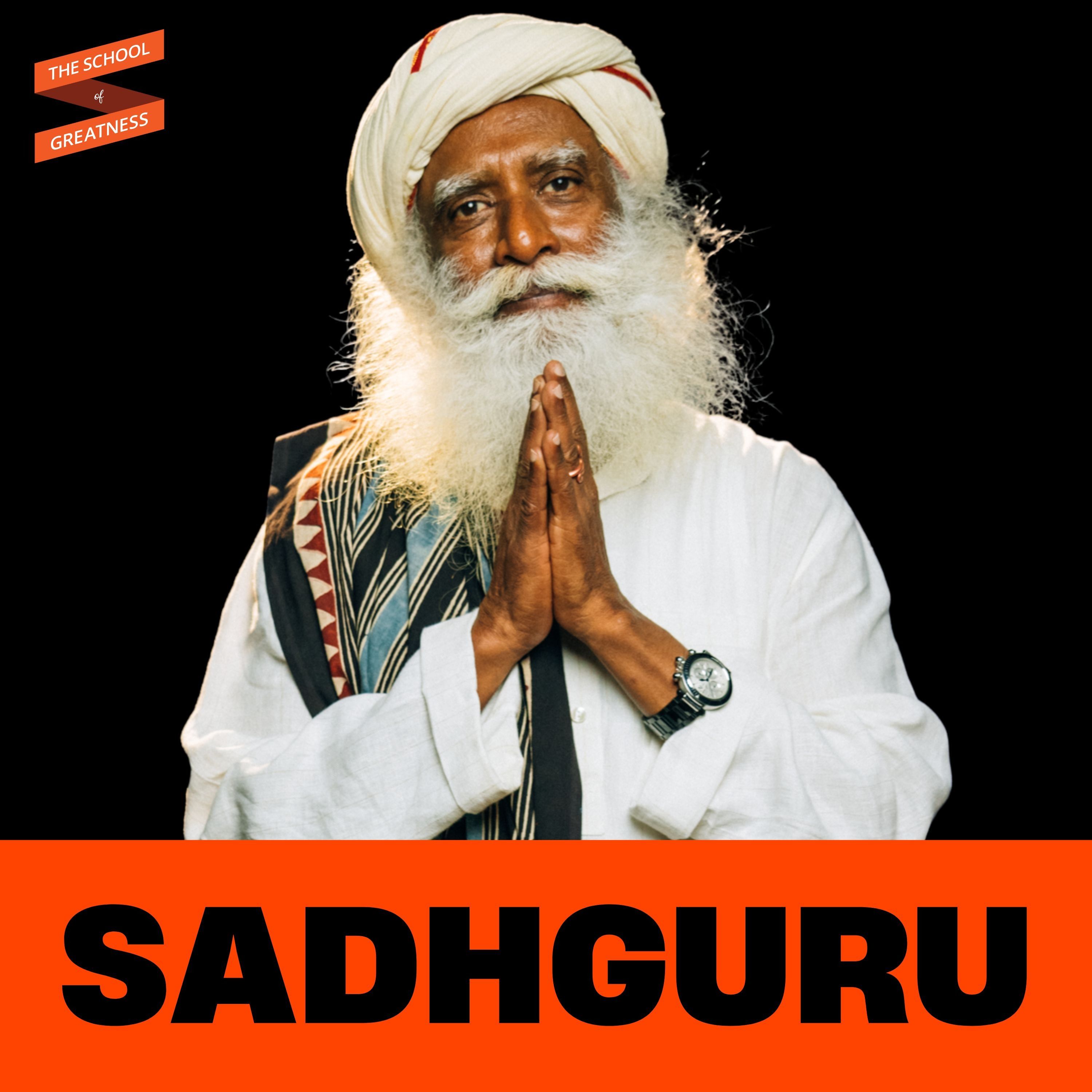
The REAL Reason You're Unhappy In Life & How to Overcome It
Press play and read along
Transcript
Speaker 1 What is our purpose? Why are we here? What happens when we die? All these questions I don't know the answers to,
Speaker 1 but I do know that we can learn from history, we can learn from our personal experiences, and we can create meaning around all these different things.
Speaker 1 And today, we bring back the inspirational spiritual leader, Sadhguru, to share some of these lessons that he's learned from his spiritual practice and all the teachings that he's done to millions of people around the world.
Speaker 1 He's a visionary and spiritual teacher, and we explore the essence of living and dying with awareness.
Speaker 1 We dive deep into what it really means to live a good life beyond material success or spiritual performance. We also talk about
Speaker 1 how to challenge yourself to rethink what you're really chasing in life and hopefully to inspire you to live fully, not for attention, not for likes, not just for money, for money's sake, but why are you living the current life you're living now?
Speaker 1 And what do you want to really be doing? We talk about the meaning of health, peace, love, and bliss, and how to cultivate all of them, not from the outside, but on the inside.
Speaker 1 I am so grateful to be alive today. I'm so grateful that you are here today, listening to this, being a part of this School of Greatness community, because we are on this journey together.
Speaker 1
And believe me, for the last, I don't know, 20, 30 years of my life, I just struggled with so many things internally. I suffered.
I struggled. I questioned things.
I doubted people.
Speaker 1 I doubted my reason for existence. I
Speaker 1
didn't understand why things happened the way they happened. I didn't understand why I was going through so much pain at different times.
And it just was hard.
Speaker 1
And if you're going through one of those moments right now where you feel like, man, it's just hard. I don't know why.
I don't know the answers. I don't know what the purpose is for this.
Speaker 1
I think this might inspire you. There might be something that you can take away from this conversation that hopefully opens you up.
Now, Sadhguru is also,
Speaker 1 you know, can go down a rabbit hole sometimes. So, take with everything that you get out of this that resonates with you and just be willing to explore and try anything on.
Speaker 1 And whatever works for you to support you in your inner peace, your inner harmony, that's what this is intended for. You're designed to experience life.
Speaker 1 We get to choose how we want to experience it and how we want to perceive the experience, which is the hardest thing to do because you could be going through a very challenging time, a lot of adversity, a lot of loss, grief, grief,
Speaker 1 frustration. But for whatever reason, you could perceive it and still be joyful, peaceful, and happy.
Speaker 1 You could be making all the money in the world, have all the success, fame, and be perceiving it with a lot of sadness and depression still.
Speaker 1 Life is about our experiences and how we perceive our experiences.
Speaker 1 We don't know all the answers, but we can ask questions and we can perceive things in different ways to create more peace for ourselves today. So I hope you enjoy this with the one and only Saad Guru.
Speaker 1 Scamming has grown into a trillion-dollar industry with no signs of slowing down.
Speaker 1 And with AI, scammers are exploiting our instinct to trust by using technology to duplicate the voices of people we love.
Speaker 1 Bit Defender helps protect your family's devices, data, and identities from those threats.
Speaker 1 Choose Bit Defender Premium Security, which includes Scam Copilot, the first AI-powered platform designed to safeguard you against scams in real time. Ready to make your digital life safer?
Speaker 1 Visit BitDefender.com and download Bit Defender Premium Security for families. It's time for Black Friday, Dell Technologies' biggest sale of the year.
Speaker 1 Enjoy huge savings on select PCs like the Dell 16 Plus, featuring Intel Core ultra-processors. And with built-in advanced features, it's the PC that helps you do more faster.
Speaker 1 Plus, earn Dell rewards and enjoy many other benefits like free shipping, price match guarantee, and expert support.
Speaker 1 They also have huge deals on accessories that pair perfectly with your Dell PC and make perfect gifts for everyone on your list. Shop now at dell.com/slash deals.
Speaker 1 Being smart with your money is one of the best best ways to invest in yourself and your future.
Speaker 1 With State Farm personal price plan, you can create a competitive price just for you when you choose to bundle your home and auto insurance.
Speaker 1
That way, you can keep more of your money focused on your goals. Like a good neighbor, State Farm is there.
Prices are based on rating plans that vary by state.
Speaker 1 Coverage options are selected by the customer. Availability, amount of discounts and savings, and eligibility vary by state.
Speaker 1 This episode is brought to you by Facebook. Facebook is where real connections happen, a place to find your people, rediscover old friends, and build new relationships that actually matter.
Speaker 1 From alumni groups and local events to marketplace and shared memories, Facebook helps bring people closer in meaningful ways.
Speaker 1
It's where nostalgia meets possibility, reminding us that the smallest interactions can spark lasting connections. Let's reconnect this holiday season.
Explore more with Facebook today.
Speaker 1 Before we go into death, I'd love for you to talk about
Speaker 1 how to live a good life because I think that's what's most interesting for a lot of people.
Speaker 1 See, when you see a good l when you say a good life,
Speaker 1 different people have different ideas.
Speaker 1 Or motorcycle, you know. Or whatever.
Speaker 1 So,
Speaker 1 essentially why we are gathering all these things
Speaker 1
or for somebody else it may be a religious practice or their aspirations to go to heaven or whatever. Essentially, a human being is looking for pleasantness of experience.
Yes.
Speaker 1 We might have talked about this earlier, but let me touch upon that. Yes.
Speaker 1 See, if you become pleasant in your body, we call this health. You want it?
Speaker 1 Absolutely.
Speaker 1
You must say yes. Yes.
Not to me, to every cell in your body. Yes.
Yes. It's very important.
Speaker 1
They're listening to you. Yeah.
You say the wrong things, they'll do wrong things.
Speaker 1 So pleasantness of the body is called health. If it becomes very pleasant, we call it pleasure.
Speaker 1 Yes? Absolutely. Pleasantness of the mind is called peace.
Speaker 1 If it becomes very pleasant, we call it joy.
Speaker 1 Pleasantness of emotion is called love.
Speaker 1 If it becomes very pleasant, we call it compassion.
Speaker 1 If your very life energies become pleasant, we call this bliss.
Speaker 1 If it becomes very pleasant, we call it ecstasy.
Speaker 1 If your surroundings become pleasant, we call it success.
Speaker 1 Only to create pleasantness of our surroundings,
Speaker 1 we need the cooperation of everybody and many, many forces around us.
Speaker 1 It is a talent, you have to harness all these things to create pleasantness in the surroundings.
Speaker 1 But pleasantness of the body, pleasantness of the mind, emotion and energy is one-hundred percent your business.
Speaker 1 That business of being pleasant is forgotten by a vast majority of human beings. Why is it forgotten? I come.
Speaker 1 Because
Speaker 1 they have forgotten that they're mortal.
Speaker 1 If they... when I say mortal or mortality,
Speaker 1 what it means is you are on a limited lease of time and energy.
Speaker 1 Time is a ruthless roll.
Speaker 1
It's rolling for all of us at the same pace. You're happy, it rolls.
You're unhappy, it rolls. You're successful, it rolls.
You're a failure, it rolls. You're awake, you're asleep, it rolls.
Speaker 1 Do whatever you want, it rolls. You don't have breaks on it, nor do you have a rewind set
Speaker 1 on it. It's just ruthlessly rolling away.
Speaker 1 As we sit here, in the last five minutes, both of us are closer to our graves by five minutes.
Speaker 1 This is the nature of life. If you are conscious that I am mortal every moment,
Speaker 1
then you will see how to make the best out of everything. Above all, you will have no time to do things that you don't care for.
Yes. If you are doing genuinely what cares...
Speaker 1 what you truly care for, and I am also doing genuinely what I truly care for, you will see, your life will be beautiful, my life will be beautiful, the world will be beautiful.
Speaker 1 Right now, too many people are doing what they don't care a damn about
Speaker 1 because
Speaker 1 you are doing something.
Speaker 1 I have to do something against that or for that. Either I have to follow you, follow you or I have to you.
Speaker 1 This nonsense has led people away because why people are not aware of their mortality is,
Speaker 1 see this whole development of your brain and your intellect is a very recent happening. Maybe hundred, thousand or I don't know, maybe a quarter million years, probably.
Speaker 1 I don't know the exact time, but it's more recent.
Speaker 1 So we've still not gotten used to our intelligence.
Speaker 1 Right now, you can say many things, but essentially what human beings are suffering is, their own intelligence has turned against them, that's all.
Speaker 1
You can call it stress, anxiety, depression, this, that. I was talking to some top psychiatrist in UK and they said there are seventy-two varieties of mental ailments.
Crazy. I was surprised.
Speaker 1 I thought maybe half a dozen. Right.
Speaker 1
Seventy-two, yeah. Seventy-two.
I asked, what are the seventy-two? They went on giving me the list, one thing stuck in my mind. It seems compulsive nose picking is one of them.
Speaker 1 They start bleeding in the nose but they can't stop,
Speaker 1 okay?
Speaker 1 So right now, what is torturing a human being is
Speaker 1 their own intelligence.
Speaker 1 If you had the brain of an earthworm, you would be quite peaceful
Speaker 1 and you would be eco-friendly also, which the California people are trying very hard.
Speaker 1 So,
Speaker 1 this whole problem is
Speaker 1 this transition from being an ape to human being happened rather too quickly.
Speaker 1 In terms of DNA manifestation, according to the DNA scientists, the difference between you and a chimpanzee is only 1.23%.
Speaker 1 1.23% is not much, isn't it?
Speaker 1 So, physiologically, that's how close you are to a chimpanzee. But in terms of intelligence and awareness, your world's apart.
Speaker 1 So you have an intelligence for which you don't have a stable enough base of physiological and chemical base. You're like fluctuating.
Speaker 1 If you don't stabilize that, your intelligence will turn against you and that's all you are seeing. And in this intelligence turning against you, the...
Speaker 1 one of the most important factors is that we have forgotten we are mortal.
Speaker 1 Our societies, in India it's very common, right from childhood we take them to cremation grounds to see that people die. Everybody should know that you die one day.
Speaker 1
Here we mask it. Even when the man is dead...
dead, he is dressed in a suit and tie.
Speaker 1 It looks like he's going somewhere, he's going to a party and actually lot of people are describing he's going to a party, all his friends and relatives are waiting there, he's going to have a big party.
Speaker 1 If there's such a big party, why are you not going, I'm asking?
Speaker 1 If there is such a party, you must go first, why are you telling me to go? Right, right.
Speaker 1 So, fairy tales and fairy tales has made people build castles in the air, which are
Speaker 1 not true.
Speaker 1 And they may sustain you to an ordinary day. If it's a moment of death, it freaks the hell out of you.
Speaker 1 So, in India, what is the culture like with death? You say when you're younger, you're showing it more frequently or how does the approach to it.
Speaker 1
See, we don't hide death. Slowly we are getting into urban cities, are getting into western ways, all right? Otherwise we cremate people and it's a thing where the whole family goes.
And sees it.
Speaker 1
Sees it. Watches it.
Yes, yes, sir. Wow.
Watches it. If you want to go on a spiritual path, the first thing is you must go and sit in the cremation grounds and watch.
Speaker 1 Because you become spiritual not because you think of God.
Speaker 1 You become spiritual when you realize you're mortal.
Speaker 1 When you realize one day you're going to end, naturally you want to know what is beyond, where did I come from? Where will I go? What is the nature of my life?
Speaker 1 This is a natural question in human intelligence. If you mask it as if it's never going to happen,
Speaker 1
then you... that question never arises within you.
This is a great disservice we have done to humanity by telling them fairy tales and masking the whole process of death. It's a reality.
Speaker 1
When I say death, I am not not talking about it as an event that happens once in... at the end of your life.
Every day, every moment? It is happening. It is happening right now.
You are in tango.
Speaker 1
Life and death are in tango. I can say I am living.
I can also say I am dying. It's the same thing.
Speaker 1
Because there is some negative connotation to the word death, if you say you are dying, it's supposed to be something wrong. No, no, we are all dying kind.
All dying kind. We are all dying kind.
Speaker 1 I must tell you this.
Speaker 1 You know, as a part of... because I felt that
Speaker 1 post-death, the way the services had become in many cities and towns in India, we set up lot of crematoriums as a service.
Speaker 1 Volunteer service, it's free of cost for people who can't afford and everything.
Speaker 1 So this I named it with a Sanskrit word called Kayanta Stanam. It means a place where the body ends.
Speaker 1 So our volunteers came up and said, Sadhguru, this is Sanskrit name, not everybody can understand, can you give an English byline?
Speaker 1 I said, okay, Kayantastanam, everybody is a customer.
Speaker 1 That's true.
Speaker 1
Everybody is. It's true.
They said, no, no, no, Sadhguru, this is too much up in the face. Say something else.
Speaker 1 I said, okay, Kayantastanam, we shall wait.
Speaker 1 We shall wait. You will come.
Speaker 1 Maybe I'll go before you, but you will come anyway.
Speaker 1 We must know this every moment of our life,
Speaker 1
that the way we are right now is not a permanent fixture. You are not a permanent fixture on this planet.
Countless number of people before you and me have come and gone.
Speaker 1 They also thought they were very smart. I don't know whether they were podcasters or not,
Speaker 1 but I'm sure they were something great in their own nonsense, all right? Sure.
Speaker 1 Everybody thought they were great, they were kings and emperors and all.
Speaker 1 Where are they? All topsoil.
Speaker 1 And it's...
Speaker 1 that's how it should be.
Speaker 1 That's how it should be. If you or me are a permanent fixture on this planet, it's unbearable.
Speaker 1 At least the world needs respite from us.
Speaker 1 I mean, you went through... was it two brain surgeries last year?
Speaker 1 I banged up my head a bit.
Speaker 1 When you had those brain surgeries or when you went into those, were you afraid of death or were you afraid what might happen next?
Speaker 1 You can see that it's all recorded.
Speaker 1 So I started having excruciating pain in my head in the month of end of January
Speaker 1 2024.
Speaker 1 And but I had full engagements, so I went on. I don't take painkillers
Speaker 1
because I want to know what's happening. Yeah, me too.
If I take painkiller, then I don't know what's happening. I may be causing damage and I will not know.
Speaker 1 It became excruciating where like one side is like almost paralyzed with pain. Really? Yeah, but I kept on
Speaker 1 with all the activity, lot of travel inside the country.
Speaker 1 Then on March 10th, I think eighth, eighth, March eighth is the Mahashivaratri, Full Night Festival.
Speaker 1
Before that I've been traveling up and down the country. It's a full night celebration.
I'm in lots of pain.
Speaker 1 You look at the videos, you must play that video to you people.
Speaker 1 I'm whole night I'm dancing, meditating, talking, everything, nobody realized anything is wrong. Except one or two people around me, they knew I'm in pain.
Speaker 1
So I was just putting some cold patches just to calm the eyes a little bit because it was like... throbbing in the side, yes, like electric.
It's the worst. It was going on.
Speaker 1 Then tenth I did, and 16th I'm supposed to travel to United States, 16th of March. That's my birthday.
Speaker 1 I was coming for your birthday. I know, I know.
Speaker 1 And
Speaker 1 then I had some travel to Chennai and Mumbai and then I came to Delhi.
Speaker 1 14th
Speaker 1 I had a event.
Speaker 1 The doctor looked at me and said, Sadhguru, you can't do this event. You should not.
Speaker 1
You must immediately come to the hospital. I said, it's a private event I've accepted.
It's nothing much, it's
Speaker 1 somebody very important, but it's a small group, I'll handle them. So he said, okay.
Speaker 1 Next day I had a media event.
Speaker 1 The India Today Television has an event. It's a forty-five-minute conversation with one of the journalists.
Speaker 1 The doctor said, you cannot do it, I'm putting my foot down, you just can't do it.
Speaker 1 So I tried to tell them, the India Today people, you know, I have a family emergency, I need to go.
Speaker 1
This is Sadhguru, tickets are sold, everybody has come only for you. How can you do this? Till now, I have not cancelled a single event in my life.
No matter what's happening with me, I do it.
Speaker 1
So I told the doctor, see, they are saying this. They're counting on me.
Yes, I can't back out of this. He said, I will talk to them.
You can't go, he said. I said, please don't do this.
Speaker 1
I'll just gently do it, it's nothing. I'm just...
as I'm talking to you, I'll talk there.
Speaker 1 He came for the event
Speaker 1 and I'm talking and
Speaker 1
forty-five minutes are over, supposed to stop. The journalist wants to ask who...
He wants to get the best out of me. One more question, one more question.
Speaker 1 By then, my left leg is oscillating by itself. It's just doing this.
Speaker 1 The previous day they did an MRI
Speaker 1 scan and they found out my brain median had moved 8.4 millimeters.
Speaker 1 Doctor said, Sadhguru, twelve is fatal. Oh my gosh.
Speaker 1
I said, I won't go there, I'll just finish this and come. Yeah, I'll lay on this side so it moves back.
Once the legs started shaking, I knew I've crossed lines.
Speaker 1 I could just be paralyzed any time, a stroke can happen, anything can happen.
Speaker 1 Then
Speaker 1
I just stepped off the stage. The doctor was looking at me like this.
I said, I've crossed all lines, do what you want. Wow.
He took me straight to the surgery table.
Speaker 1 When they did the scan, I was 11.5 mm off the median,
Speaker 1 0.5 millimeters of fatality.
Speaker 1 They immediately took me to a surgeon, they cut a big window open and they did whatever
Speaker 1 and
Speaker 1 they're putting me on anesthetic. All these young
Speaker 1 young women who are all nurses from, you know, in Delhi,
Speaker 1 These women come from variety of backgrounds, from all over the country.
Speaker 1 They all know me, they follow me, but they never got to see me. Here they got me down on the table
Speaker 1 and eight of them are looking at me like this with big grins on their face. Probably only one or two are needed, but they all want to be there.
Speaker 1 Then I said, see, when I come out of anesthetic, don't smile like this, I may think I'm on the other side.
Speaker 1 They all burst out laughing, then by then it was working and I just knocked pounds out.
Speaker 1 It just... within minutes it just knocks you out, you know.
Speaker 1 Then the surgery went well and you know, surgeries are surgeries.
Speaker 1 Time to recover and yeah. Yeah, I recovered, very unstable, couldn't walk straight, my balance was gone.
Speaker 1 But I kept everybody up, their spirits up because otherwise everybody is in a... this thing.
Speaker 1 Even the prime minister called to just check how I am, all over the country, big news and some people cursing me, some people saying this, all kinds of things.
Speaker 1 Then I recovered,
Speaker 1 doctor said
Speaker 1 six months no driving.
Speaker 1 And you're like, yeah, I'm going to go tomorrow. And two years no motorcycle.
Speaker 1 Oh man.
Speaker 1 So three weeks I was in Delhi,
Speaker 1 about fifteen days, sixteen, seventeen days I was in Delhi. Then I landed in Coimbatore
Speaker 1 and I drove to the center about
Speaker 1
a car, yeah. For a few minutes.
Their thing was, if you drive and if there's a jerk, something happens. I said, see, if I'm driving, at least I know when it'll jerk.
Yes. If somebody else is driving,
Speaker 1 I don't know when they'll jerk the car.
Speaker 1
Your head like this. Yes.
So they said, no jerks, no shakes, no fall. I said, I'll take care of that.
Speaker 1 Still the wound was open and all that stuff, but I went back and whatever, people were very happy, emotional, because they all got terrified that I'm... come don't end.
Speaker 1 I recovered from that and twenty-one days after that, I had fixed a program in Bali and Cambodia. It's a very niche group of people, they're registered from all over the country,
Speaker 1 particularly Chinese and Russians who can't come to India right now for whatever geopolitical reasons.
Speaker 1 They are all registered
Speaker 1
and doctor said, no way you're traveling. I said, see, I'm...
I'll travel private so that, no, you could knock your head, this can happen, that can happen. I said, I'll take care of that.
Speaker 1
My daughter said, she'll travel with me and they said, we'll take care. And also, there was a whole team taking care of me.
So I went to Bali to do the program.
Speaker 1 Although lots of physical activity, I cut out all that. Just the class part of it.
Speaker 1 Teaching alone, I'll handle. Other things there are other people to handle.
Speaker 1 So it went very well, four days, and then we were supposed to go to Cambodia next day.
Speaker 1 By then I'm putting a plastic wrap on my wound and swimming a little bit because I needed... I needed exercise, you know.
Speaker 1 That's the best thing to do is to be out in the sun and to do something. So me and my daughter were swimming in the pool.
Speaker 1 After that, I just came up and sat on a chair, she was sitting on the floor.
Speaker 1 A big monkey came.
Speaker 1 The doors of the room, the sitting room was open, glass doors all.
Speaker 1 I came through another door, the glass door also.
Speaker 1
And when I came, I left the door open and came. And this big door was open.
The monkey came and wanting to go inside because there are lots of fruits, you know, and Bali,
Speaker 1
lots of heaps of fruits, two monkeys going in. So my daughter instinctively, she screamed at the monkey.
And the monkey turned around and came with his mouth open like this. At her or you? At her.
Speaker 1 Wow.
Speaker 1
I have seen monkey bite injuries, they'll rip off your cheeks like that. I've seen one person with half the face gone.
Oh man. And it's coming towards her.
Speaker 1
So instinctively, I got up, I had my walking stick just inside the thing, so I ran for the stick. Somebody had closed the door.
I went and banged full speed into the glass.
Speaker 1 The glass made such a big bang, the monkey ran away.
Speaker 1 So the purpose was served.
Speaker 1
But my head was cracked. Oh my God.
So I thought immediately I'll fly to Delhi for another emergency surgery because they had said if you hit your head, this is it.
Speaker 1 The School of Greatness is brought to you in partnership with Airbnb.
Speaker 1 Fall always feels like the perfect time to travel, a chance to explore, reset, and spend time with family before the year wraps up.
Speaker 1 And Martha and I both travel often, especially with her family in Mexico and mine spread across the U.S. So we're always on the go a lot.
Speaker 1 And some of the best parts of traveling come from discovering new places, trying local foods, and experiencing different cultures. But when people are away, their homes often just sit empty.
Speaker 1 Hosting on Airbnb can be a practical way to make use of that space and share what makes your community special with travelers passing through.
Speaker 1 From our experience, hosting has always been easy and straightforward. And whether you're on the road often or only once in a while, it can be a simple way to earn a little extra while you're away.
Speaker 1 Your home might be worth more than you think. Find out how much at airbnb.com/slash host.
Speaker 1 Go from skeptic to electric in the new Toyota BZ. Hesitant about going all-electric? One drive can change your mind.
Speaker 1 With up to an EPA, estimated 314-mile range rating for front-wheel drive models and available all-wheel drive models with 338 horsepower.
Speaker 1 The Toyota BZ is built for confidence, conveniently charge at home or on the go with access to a wide range of compatible public charging networks, including Tesla superchargers.
Speaker 1
Inside, enjoy a 14-inch touchscreen and an available panoramic view moonroof. Learn more at toyota.com slash BZ, the new all-electric BZ.
Toyota, let's go places.
Speaker 1
This message is brought to you by Apple Card. It's a great time to apply for an Apple Card.
You'll love earning up to 3% unlimited daily cash back on every purchase and no fees, period.
Speaker 1 Through this special referral offer, when you get a new Apple Card, you can earn bonus daily cash. To qualify, you must apply at apple.co slash get daily cash.
Speaker 1
Apple card issued by Goldman Sachs Bank, USA, Salt Lake City Branch. Variable APRs for Apple Card range from 17.99% to 28.24% based on creditworthiness.
Rates as of October 1st, 2025.
Speaker 1 Offer may not be available elsewhere. Terms and limitations apply.
Speaker 1
Then I thought I'll wait till that night and see if there are any symptoms. Immediately, imbalance will happen, pain will happen, all that.
Nothing happened. Next day morning, I woke up, I was fine.
Speaker 1
I said, okay, I'll fly to Cambodia. three more days I'll finish this.
In any... any signs means I'll go back.
Done, yeah, yeah.
Speaker 1 But I went through next three days of program I went through, then I flew into Coimetra city, which is a southern Indian city. From the airport I went straight to the scan, once again bleeding.
Speaker 1 Internal bleeding. Yeah.
Speaker 1
Not outside, only inside. Then I went for another surgery.
That surgery also went okay, no problem.
Speaker 1 But on the third day after the surgery,
Speaker 1 I'm forgetting the name of that. some kind of psychotine...
Speaker 1 psychotin or psychotine, whatever kind of storm,
Speaker 1
every cell in the body went through a storm. This happens only if you have sepsis or some other kind of serious infection.
I had no infection of any kind.
Speaker 1 So doctors could not make out what happened.
Speaker 1 So I know I'm kind of
Speaker 1 seeping away within myself. Really? Yeah.
Speaker 1
Not with anesthesia. Huh? Not with anesthesia.
No, no, no. Three days later.
Speaker 1 And I opened my eyes and see fourteen doctors are standing there, including the chairperson of the hospital, all tears in their eyes.
Speaker 1 They think they lost me because all organ failure started happening. Wow.
Speaker 1 I looked at them and then looking at their faces, I knew they're kind of sort of giving up on me.
Speaker 1 When I closed my eyes, I could see in every cell in the body like I'm seeping away like that. Like you felt it.
Speaker 1 Yeah, like beautiful, just like that, you know, like suppose in the middle of the night you woke up and
Speaker 1 you know,
Speaker 1 much more, like let's say ten, twenty times more than that, every cell in the body, just letting something go, that kind of feeling.
Speaker 1 So I closed my eyes and I became lot more conscious and I kept myself like that. And in about an hour and a half, I turned around.
Speaker 1 So when I came out of that, six hours I've they were in very difficult situation with me. About an hour and a half they thought they lost me completely.
Speaker 1 So that took some time to recover
Speaker 1 but within two months I was on the motorcycle
Speaker 1 with vengeance I'm riding because
Speaker 1 I just wanted to see if I'm really there or not.
Speaker 1 So I'm fine.
Speaker 1 So I kept joking, they removed half my brain and I'm doing great now. You're doing better.
Speaker 1 Did you have any fear during that time about...
Speaker 1 No.
Speaker 1
I am always living like this, that if it comes now, I'm ready. I won't turn back and look.
But a lot of people don't have that.
Speaker 1
If it comes, they'd be afraid to die right now in their life because maybe they haven't found it. They'll still be afraid even if it's...
if they reach hundred. That's true.
Speaker 1
They'll still be in the same condition. But more of like sad that they didn't live a purposeful life, that they wanted...
the life they wanted to live, right?
Speaker 1 Purposeful doesn't happen because of time.
Speaker 1 Purposeful happens because of intent and awareness.
Speaker 1 The thing is,
Speaker 1 see, over eighty percent of the people, if you observe them during their last moments of death,
Speaker 1 they're not in pain, they are not in fear, they're just bewildered
Speaker 1 because
Speaker 1 they misunderstood their psychological drama as life process.
Speaker 1 What's happening in your mind is your psychological drama, your thought and emotion. But you think that is life.
Speaker 1
It's made up by you. It's not really life.
Life is not made up by you. It's not made by you.
Speaker 1 It's happening, that's why you do your drama.
Speaker 1 Life you did not create, isn't it?
Speaker 1
You created this life? No, I'm creating my life. See, you're creating the situations.
Yes.
Speaker 1 Life is not situations. You're misunderstanding the arrangements of life, accessories of life as life.
Speaker 1 Is this clothing me? No. Is this chair you? No.
Speaker 1 Is this body you?
Speaker 1 It's a part of me.
Speaker 1 You accumulated it over a period of time, isn't it? The cells have accumulated, sure. No, no, it's the food that you've eaten, it's just soil.
Speaker 1
Will you get it now or one day you'll get it from the maggots? That'll be decomposed one day, yeah. No, no, that's not the point.
When the maggots get you, they clearly tell you you are topsoil. Yes.
Speaker 1 But if you know that right now, you live differently. Yes.
Speaker 1 Everybody gets it from the maggots. Few get it now.
Speaker 1 When they get it now, life changes.
Speaker 1 That what you call as my body is a piece of the planet that you accumulated. Magnanimity of creation.
Speaker 1 That you can take soil, make it food and make it into this body and how wonderful it is, how many things it can do.
Speaker 1 So if you forget that, that you gathered this and whatever is on your mind, all impressions gathered or did you come with it?
Speaker 1 Gathered it? Gathered, what you gather can be yours, can never be you, isn't it?
Speaker 1 So now the problem is this, people have never experienced life most of the time.
Speaker 1
So when the moment of death comes, they're just bewildered. They didn't even start and it's ending.
Hmm.
Speaker 1 Better start, I'm saying. So is it the psychological drama that keeps us
Speaker 1 suffering and stress and sadness and distracted from your personal assignment here? See, it need not necessarily be suffering, even if you're enjoying.
Speaker 1
Still it's psychological drama. See, right now it's like this.
You hate me.
Speaker 1
Who is making it up? Me. Me.
You love me. Who's making it up? Me.
Speaker 1 So your love affair, your hatred, your nonsense, your misery, your joy, everything you're making it up.
Speaker 1 So when you're making up everything, the simple logic is, why don't you make up something pleasant and wonderful? Yes. But still, it's not reality.
Speaker 1
A pleasant reality is not reality. Yes.
A pleasant experience is not reality. You are the director of your drama.
Yes. At least the drama should be going where you want.
Absolutely.
Speaker 1 Absolutely.
Speaker 1
You... if you're...
you're the director of the drama and it's going somewhere else, you're a lousy director. As simple as that.
Speaker 1 What is the easiest way then to shift being a director of drama to a director of a pleasant experience?
Speaker 1
That is also drama, I'm saying. Uh-huh.
But it's a better drama. See, whether you want a comedy or a tragedy, you choose.
Yeah, it's a better drama. There are people who enjoy tragedies.
Yes.
Speaker 1
If they like it, it's fine. But they want to have pleasantness and they're having unpleasantness, that is not acceptable for me.
Yes.
Speaker 1
You must be doing what you want within yourself. Around yourself, it's not all yours.
There's a whole world whose opinion, whose
Speaker 1 intentions, everything matter.
Speaker 1 Around us, it's not all us.
Speaker 1 Everybody has a stake, isn't it?
Speaker 1
But within myself, how I keep myself is my business. Nobody can intervene in this.
That itself, your dream is not happening the way you want. How will your life happen the way you want?
Speaker 1 Yeah.
Speaker 1 So for all this, the fundamental is, we have not tasted life. We misunderstanding thought and emotion as life process.
Speaker 1 What is life process then?
Speaker 1 Are you alive or no? I believe so in this world.
Speaker 1 You believe so or you are really...
Speaker 1 I believe I'm alive, yeah. You believe or it's true?
Speaker 1
Depends what you consider it's true. No, no, no.
Let's come to this.
Speaker 1
Do you believe you have two hands or you have two hands? I have two hands. Yes.
But you believe many other things. Why? You are a bull.
Speaker 1 We all are, I guess, right?
Speaker 1 Don't include me.
Speaker 1 I'm saying,
Speaker 1 why don't we become straight enough, sincere enough?
Speaker 1 What I know, I know.
Speaker 1 What I do not know, I do not know. Yeah.
Speaker 1 Isn't it good like that? Yeah, I think so.
Speaker 1 So, what do you really know?
Speaker 1 With Martha and I now bring our twin girls home, the thought of adding meal prep every night on top of our already busy lifestyles sounds unrealistic. Life is busy for everyone else right now, also.
Speaker 1 So, meet the new Blue Apron.
Speaker 1 Now, with no subscription, it's easier than ever to get delicious, high-quality meals delivered right to your door without the commitment because greatness starts with taking care of yourself, even in small ways.
Speaker 1 Blue Apron has shipped over 600 million meal kits, and now it's more convenient than ever. Shop a la carte and order what you want when you want.
Speaker 1 Discover low-prep recipes and pre-made meals that make dinner fast, fresh, and stress-free. Try assemble and bake meals with pre-prepped ingredients.
Speaker 1 Minimal cleanup, perfect for family nights or busy days. And I'll admit, it's so nice to not have to add another subscription in order to get access to these meals.
Speaker 1 My schedule is always changing, and sometimes I have last-minute travels. So it's such a relief knowing I can order when it fits my life without any commitment.
Speaker 1 Try the new Blue Apron today and get 40% off and free shipping shipping on your first two orders at blueapron.com with code greatness40. Terms and conditions apply.
Speaker 1 Visit blueapron.com slash terms for more.
Speaker 1 You ever walk out of the grocery store or fill up your tank and just think, how is everything this expensive? Feels like prices are going up everywhere.
Speaker 1 And how great would it be if just once something actually just went down in price? Well, at Metro, that's exactly what's happening.
Speaker 1
They've lowered their prices and are giving you a five-year price guarantee on on talk, text, and data. One line, now 20% lower.
Family plans, also lowered.
Speaker 1
Oh, and you also get a free 5G phone, all with no ID required and no activation fees. Stop by your neighborhood Metro store.
Visit metro by t-mobile.com or call to find out about their amazing offers.
Speaker 1 Bring your number, not available if currently at T-Mobile or with Metro in the past 180 days.
Speaker 1
Guarantee covers monthly price of on-network talk, text, and 5G data for customers activating on an eligible plan. Exclusions apply.
Details at metro by t-mobile.com.
Speaker 1 I know
Speaker 1
I'm a blessed human being. I have a beautiful woman.
Who told you this? I did.
Speaker 1
So you believe? Yes. No, that means you don't know.
I also know there's a lot that I don't know, and that's why I constantly ask questions. That is fine.
Yeah.
Speaker 1 You don't know? What do you know I'm asking?
Speaker 1 About what? About life? Because that's all that is there?
Speaker 1
What I... what I know is that I'm a grateful human being, that I was born, that I'm here and I want to experience a beautiful life.
And that's what I know. See, all that will change.
Speaker 1
If I put a nail in your foot, it'll all change. You won't be grateful, you'll be hateful.
Yeah, I don't know. I've had a lot of challenging moments that...
Challenging moment, but nobody nailed you.
Speaker 1 A A lot of broken bones, a lot of...
Speaker 1 That you did yourself.
Speaker 1 Some people did to me.
Speaker 1
I've had a lot of pain. And I've had to learn how to navigate.
No, no, please look at this in a more fundamental way. Yes.
What I'm saying is,
Speaker 1
I am a joyful human being, I am a miserable human being, I am a grateful human being. This is all things that you make up in your head.
Yes.
Speaker 1 Good, you made up some pleasant things.
Speaker 1
I'm happy about that. That's good drama.
Yes.
Speaker 1 But this drama is playing upon the fundamentals of you being alive, isn't it? Yes. What do you know about that? Because that is the greatest phenomena that's happening in this universe, life.
Speaker 1 And you're that?
Speaker 1 What do you know about that? I know that I'm alive.
Speaker 1 Thank you.
Speaker 1 Yes, you know that you're alive, fortunately.
Speaker 1 That's because you're that much conscious.
Speaker 1 If you become totally unconscious, you wouldn't even know that.
Speaker 1 But now the question is: what is the nature of your life? Is this like a philosophical question for my life? No, no, it's a factual question.
Speaker 1 What is the nature of my life? What is the nature of your existence, I'm asking? I'm not asking, see, you're misunderstanding the life situations as life. Yes.
Speaker 1 No, life situations are a consequence of things that we do and do not do.
Speaker 1 Right? Yes. I'm asking, right now you said you gathered this body,
Speaker 1 you gathered this mind, you gathered these clothes, you gathered this studio, you gathered many other things, people, relationships, family, this, that, everything you gathered. Why?
Speaker 1 All of this to sustain and make this life good. Yes.
Speaker 1 When I say life, don't think in terms of so many years. Because you're here and alive,
Speaker 1 alive, this life, I'm talking about life as you,
Speaker 1 not life as a situation.
Speaker 1 The word life is very misunderstood. When you say life, people think you are talking about their home, their car, their dog or their office or their business or their money.
Speaker 1 No, no, I'm talking about you, these are all accessories. We need accessories to facilitate many things in our lives.
Speaker 1 What I need, you may not need, what you need, I may not need, but we all make accessories as it is necessary for our lives. Some people make too many and they'll have to carry it on their head.
Speaker 1
What do you know about life as such? The life that you are. What do I know about my life? No, no, don't know.
About life. Life that you are, not the life that you do.
My being?
Speaker 1
Call it what you want, I'm just calling it life. Yeah, what do I know about my life? I'm calling about.
say I'm just you, let's say. Me personally.
Speaker 1 I mean, I thought I tried to tell you that I feel like I'm living a beautiful life.
Speaker 1 No, that's all your idea.
Speaker 1 That's in your head. Okay.
Speaker 1 I guess I'm not sure what the
Speaker 1
answer is. I mean, my life is...
I feel like I'm living a blessed, beautiful life. I feel like I'm here to fulfill a purpose.
And I'm just... These are all things you're making up in your mind.
Speaker 1 I'm blessed, I'm beautiful.
Speaker 1 How should I be making it up? Or explaining it? No, no, you can make up whatever you want. I said, I'm glad you're making up pleasant things.
Speaker 1 See, it's like this. Yeah.
Speaker 1 Suppose you built a castle in the air.
Speaker 1
or let's go with this, just look at my little finger and try to rebuild it in your mind. Okay.
It'll take a lot of effort.
Speaker 1 Only a fine artist can do it, isn't it? Sure. Because he has that level of keen observation of this little finger.
Speaker 1 Small thing in the universe, but if I ask you to build a little finger exactly like this, you will be...
Speaker 1
Be very challenging. No, you...
Very, very challenging, you can't do it. Yeah, yeah, be very challenging.
Some great artist may have the keenness to see this finger exactly and create it.
Speaker 1 But now, using your
Speaker 1 imagination, you built a castle in the air. Yes.
Speaker 1
Every brick in full detail, I look at it and say, fantastic. Louis, fantastic, what a wonderful castle you built.
But after some time, you started thinking it's real.
Speaker 1 Then we say you're neurotic.
Speaker 1 After a while, you started living in that castle, then we say you're psychotic. Right.
Speaker 1 Then a third person will come after some time and starts collecting rent for that castle. We call him a psychiatrist.
Speaker 1 With all due respect for all the doctors who help people who are unwell, that's a different matter.
Speaker 1 But essentially, you lose the boundaries of what is memory, what is imagination, what is experience of life,
Speaker 1 all mixed up. Can you live without your memory? No, without your memory you don't know a damn thing.
Speaker 1 Can you live without imagination? No, you can't create anything without your imagination. Are they a problem? No.
Speaker 1 But if you do not know what is memory, what is imagination, what is present experience of life,
Speaker 1 everything is mixed up and it's a mess. So you living well is a chance.
Speaker 1 When you live by chance, essentially it means you're living accidentally. When you live accidentally, anxiety is normal.
Speaker 1 Suppose you sit in your car and the steering wheel has become little funny. If you do this, it'll go this way.
Speaker 1 You being anxious is normal or no?
Speaker 1 Yeah.
Speaker 1 Right now that's all it is, life. The steering wheel is funny for most people's lives.
Speaker 1 If they turn this way, it'll go that way. Their mind itself, not even life,
Speaker 1
Their mind, if they want to think about this, it'll think about that. With this mind, if you're not anxious, you're a miracle.
That's true.
Speaker 1 Do you feel anxiety ever?
Speaker 1 Look at me and tell me, you tell me.
Speaker 1 Doesn't look like it much.
Speaker 1 There's got to be some moments, right?
Speaker 1 In the hospital or doing the surgery, did you feel any anxiety or were you just at peace? You must talk to my doctors and. Ask them.
Speaker 1 But did you always have that ability to navigate your mind's steering wheel to stay more present in this moment versus having anxious thoughts or dramatic thinking
Speaker 1 where you were kind of all over the place in your mind? See, human intelligence as a faculty is a fantastic thing only if it takes instructions from you.
Speaker 1
Otherwise, it's a terrible thing. That's all human beings.
That's why I said if you had the brain of an earthworm,
Speaker 1 you would be fine. You would be happy.
Speaker 1 That's why we need inner engineering.
Speaker 1 Definitely.
Speaker 1 But most people don't know how to navigate their mind.
Speaker 1
See, they don't have to know all that. It's too complex a mechanism.
You're not going to... See, it's like this.
Speaker 1
Well, you've given up a watch, probably you're on the phone. I had it this morning, but I...
Okay. Right now, it's a simple watch.
Yes.
Speaker 1 But if you open it, there are hundred wheels in it or more, I don't know how many.
Speaker 1 So if I take out all the wheels wheels and keep it here, can I put it back?
Speaker 1 Yeah.
Speaker 1 No. It might take time.
Speaker 1
Even if you have an instruction manual, most of us can't do it. Right, right.
I mean, if you get an engineer who's an expert at it, over time. That guy can do it, obviously he built it.
Speaker 1 You can't, yeah, you. Yes.
Speaker 1
Right, right. His wheels will spin all over the place.
Place and you'll be lost, of course.
Speaker 1 Such a simple thing, all right?
Speaker 1 This is not some rare computer or this is not some super something, this simple watch which has been around for a few hundred years and you can't put it together.
Speaker 1 You're talking about human mechanism,
Speaker 1 the most sophisticated and complex mechanism on this planet. Everything, supercomputer also is a dropout of this.
Speaker 1
Yes? Yes. Everything that we have done is a small dropout of this one.
So you don't try to understand this, you'll just learn to operate it.
Speaker 1
You... you have a phone, you don't know how it works.
No idea. You know how to use it, it makes your life.
At least that much you must learn. To engineer that is another level of application.
Speaker 1 We shouldn't even talk about it at this level
Speaker 1 because that's another level of application. But learning to operate it, we should learn.
Speaker 1 Yes.
Speaker 1 If you don't know that,
Speaker 1 then even your phone can be a big nuisance.
Speaker 1 You...
Speaker 1 you call your friend and it calls the President of the United States. You're in trouble or no? Yeah, yeah, yeah, yeah.
Speaker 1
Yeah. Most people don't know how to operate it.
Why do you think we haven't been taught how to operate it? That's the whole thing. There's no attention about anything inward.
We are...
Speaker 1
we think we conquer the world outside, everything will be okay. Yes.
You can enslave the whole world and you could be still more miserable than a slave.
Speaker 1 It's happening.
Speaker 1 The richest people are going around with the longest possible faces.
Speaker 1 Just look at it and see.
Speaker 1 I mean, you you were asking me about the nature of life i'm trying to understand what would you say is the nature of life for you see you know you gathered the body at least now intellectually yes experientially it may not be so at least intellectually you understand this is an accumulation
Speaker 1 this is a piece of planet which will go back one day
Speaker 1 we wish to complete a full cycle we don't want to go untimely yes
Speaker 1 in india there are only two kinds of deaths in the yogic culture
Speaker 1 sunrityu, akalamrityu. This means timely death, untimely death.
Speaker 1 In the West, people think if they are in pain, it's one kind of death, if they have medical attention, another kind of death, family is around, another kind of death, died alone, another kind of death.
Speaker 1
No, we don't see it like that. We just see timely death and untimely death.
Timely means
Speaker 1 your karmic system, your information has found its...
Speaker 1 it has found its full cycle
Speaker 1 and now
Speaker 1 you come to that place and any human being will become ready to die.
Speaker 1 But when these things or desires and longings are still on, if it comes, you will struggle.
Speaker 1 So right now you're cultivating a whole society where
Speaker 1 doesn't matter, even if you're eighty-five
Speaker 1
It's untimely. Yeah, it's untimely.
No, no, I am not killing you yet. Yeah, Yeah, yeah, yeah.
Speaker 1 You are eighty-five,
Speaker 1 if you go and sit on the street, if a young woman is walking, if you say,
Speaker 1 wow, see how young he is.
Speaker 1 Fantastic, he's still romantic.
Speaker 1 No, it's inappropriate.
Speaker 1 At eighteen, you did that, it's all right.
Speaker 1 It's part of that stage of life. Yes.
Speaker 1
But by now, you should have looked beyond these things. But still, if you do the same thing, it's appreciated.
That means you are neither preparing the world or human beings to get older.
Speaker 1 They can't get old gracefully. Dying is out of question gracefully.
Speaker 1 Struggle and helpless way of dying. So only thing is people start telling you stories, don't worry, you will go to heaven, you'll go to heaven.
Speaker 1
This happened, can I tell you a little story? Sure. Shankaran Pillai and his wife were driving after twenty-five years of marriage.
They crashed the car.
Speaker 1 He died, he went to heaven.
Speaker 1 His wife was injured after three weeks.
Speaker 1 She died and she went to heaven.
Speaker 1 Then she went shanku
Speaker 1 looking for him and she ran towards him. He said, stop!
Speaker 1 The wow was only till death do us apart.
Speaker 1 The deal is over.
Speaker 1 Death do us apart, now you're still following me.
Speaker 1 So I'm saying, your idea of heaven is a childish understanding of life.
Speaker 1 Your idea of heaven is there is a better place than here to live. If you think there is a better place than California to live somewhere else, please go today, why are you waiting?
Speaker 1 Hello, suppose I go and take the whole place, what will you do?
Speaker 1 This idea is a crime
Speaker 1
that People are telling you there is a better place to live. This is creation.
If you believe in God, this is God's creation. If this is not a good place, which other place is better than this?
Speaker 1 Heaven and hell is a question of your experience.
Speaker 1 If you sit here blissed out,
Speaker 1 you think you're in heaven in a black room like this.
Speaker 1 If you sit here in distress, this feels like hell.
Speaker 1 Distress and joy comes because either you're sitting here here absolutely willingly or unwillingly.
Speaker 1 If the best things in the world are done to you when you're unwilling, will it become your hell or no? Yeah, become hell. Yes, yeah.
Speaker 1 It's only if you're doing things willingly,
Speaker 1 if you're sitting here absolutely willingly, every breath becomes heavenly.
Speaker 1 This is all it is. Is life happening willingly or unwillingly? If life has to happen absolutely willingly, there should be no S-No, Yes, No, Yes, No.
Speaker 1 It's yes and yes to life. To life and death you are yes.
Speaker 1
Then you live here willingly. The fear of death will never avoid death.
It'll only stifle life.
Speaker 1 We say that one more time, the fear of death? See, the fear of death will not ward off death.
Speaker 1 It will stifle the life process.
Speaker 1
I don't want to die, I don't want to die. Will you not die? You will not live, that's all.
Yes.
Speaker 1 You're not riding a motorcycle.
Speaker 1 The motorcycle.
Speaker 1
That's interesting. But why...
why do so many people fear death then? And they... they...
Speaker 1 they live life afraid that they're gonna die versus fully living their lives. And I'm not saying you should risk everything and do horrid
Speaker 1
dangerous things because you... No, that's not the point at all.
The point is not about inviting death. death.
Speaker 1 You don't have to invite death.
Speaker 1 Many aspects of life, you have to strive to make those things happen.
Speaker 1 To educate, you must strive.
Speaker 1
Many things to build a family, you have to strive. To build a nation, you have to strive.
To build well-being and wealth for yourself and everybody around you, you have to strive.
Speaker 1 Everything needs application and planning and works.
Speaker 1
Death is super efficient. You don't have to do anything.
It happens. It will come and it will happen perfectly.
Speaker 1 You can't improve on it. Life is such, no matter how you do it, there is a better way to do it.
Speaker 1 Yes or no? Yeah.
Speaker 1 Whichever way you do it,
Speaker 1 If you are a sincere human being with a certain sense, you can see however you have done it, you could have done it better. Yeah.
Speaker 1
Cold mornings, holiday plans, this is when you just want your wardrobe to be simple. Stuff that looks sharp, feels good, and things you'll actually wear.
That's where Quince comes in.
Speaker 1 And the bonus, Quince pieces make great gifts too. This season's lineup is simple but smart and easy with Quince.
Speaker 1 Think $50 cashmere sweaters that feel like an everyday luxury and wool coats that are equal equal parts stylish and durable.
Speaker 1 And it's not just their clothes, Quince also makes it easy to level up your home. Martha and I have the European linen duvet cover set, and honestly, it's become one of our favorite things.
Speaker 1 It's unbelievably soft, looks great, and just makes our whole bedroom feel more relaxed and elevated. Give and get Timeless Holiday Staples that last this season with Quince.
Speaker 1
Go to quince.com/slash Lewis for free shipping on your order and 365-day returns. Now available in Canada, too.
that's quince.com slash lewis free shipping and 365 day returns quince.com slash lewis
Speaker 1 the best b2b marketing gets wasted on the wrong people so when you want to reach the right professionals use linkedin ads linkedin has grown to a network of over 1 billion professionals including 130 million decision makers that's why linkedin has the highest b2b row as of all online ad networks spend 250 on your first campaign on LinkedIn ads and get a free $250 credit for the next one.
Speaker 1
Just go to linkedin.com slash Lewis. That's linkedin.com slash L-E-W-I-S.
Terms and conditions apply.
Speaker 1
But with death, you can't improve on it. It's perfect.
When it happens, it's perfect. So it doesn't need your assistance, nor your welcome, nor your invite.
It's gonna happen. It will anyway come.
Speaker 1 See, other things you may do or you may not do in life. Death is one thing you will certainly do.
Speaker 1 So how can you breed a whole civilization without even telling them what is the nature of your existence? The fundamental nature is you're mortal.
Speaker 1
That means you're on a limited amount of time and energy. Time you can't stop, you can't break, you can't rewind.
But energies you can make it more and more exuberant.
Speaker 1 If you make your energies truly exuberant, you will learn to ride the cycles of time.
Speaker 1 If you lear... if you ride the cycles of time, then your life becomes a dance.
Speaker 1 Otherwise, the cycles of time will crush you like a mill.
Speaker 1 Now you see face becomes long.
Speaker 1 Most human beings, almost everybody who is here,
Speaker 1 when they were six, seven, eight years of age, their faces were like this.
Speaker 1 What were they jumping about?
Speaker 1
Nothing. Life.
No, no, life. Yeah.
Exuberance of life.
Speaker 1 Now why have they become like like this? Cycles of time has crushed them, the mill.
Speaker 1 It's a mill.
Speaker 1 It crushes you if you don't learn how to ride it.
Speaker 1
Very few are as exuberant as they were as children even today. Others are all becoming grave.
Grave means what?
Speaker 1 Either they're going to it or they came out of it.
Speaker 1 I don't know which one
Speaker 1 was there any lessons for you in the last year from the surgery years or from this, you know, closeness to death, maybe? No, no, no.
Speaker 1 I've always lived like that. Yeah.
Speaker 1
I am always living like that. I know.
See, this is like this.
Speaker 1
You're breathing? Yes. You know, you're just agreeing with me.
Check and tell me, are you breathing?
Speaker 1 Yes. You are.
Speaker 1 How many moments in a day are you aware of this?
Speaker 1
Not many. That's what.
Unless I'm focused on it, yeah. Yes.
Speaker 1 This is inhalation, exhalation.
Speaker 1 Inhalation, exhalation. Inhalation, exhalation.
Speaker 1 Next inhalation did not happen.
Speaker 1 Where's Lewis?
Speaker 1 No trace of the guy.
Speaker 1
Search where you want. You won't find him.
You can imagine all kinds of rubbish, but you won't find that guy. Yes or no? Yeah.
See how fragile it is.
Speaker 1 One exhalation went out, next inhalation did not come back, poof, gone. So you are playing yo-yo with life.
Speaker 1 In and out, in yoga we say inhalation is life,
Speaker 1 exhalation is death.
Speaker 1 If you want to look at it the other way, see when you were in your mother's womb,
Speaker 1 You were drowning in her fluids.
Speaker 1
She didn't let you breathe. No.
Of course she put a pipe so that you got everything you needed. Oxygen, yeah, but you won't breathe it, yeah.
No, oxygen also she gave you.
Speaker 1 But not breathing, you're drowning.
Speaker 1
So when you came out, you still don't know how, somebody lifted you by the legs and slapped you on your backside. Start crying, yeah.
No, no. First thing you did was
Speaker 1
a gasp of inhalation. The first thing you did in your life is inhalation.
What do you think is the last thing you'll do in your life?
Speaker 1 Exhalation. Exhalation.
Speaker 1 If you exhale, if next inhalation does not happen, everybody says you're dead.
Speaker 1 Whether you are dead or not, you don't know, but at least the world thinks, the doctor thinks you're dead.
Speaker 1 Death is not an incident or a one-time happening. It is happening.
Speaker 1 As we are living, we are dying. One day, it will reach a certain graduation level.
Speaker 1 This doesn't mean everything is over.
Speaker 1 Body becomes inhospitable for life.
Speaker 1 What was soil became food.
Speaker 1 When it was soil, could you eat it? I guess, I wouldn't be.
Speaker 1
You can eat soil? I mean, you could eat. Technically, it's not going to taste good.
Really? Soil? Try and see. Dirt? Yeah.
It's not going to taste good. You could...
Speaker 1
Try and see. No, it's not that.
It's not easy, but. You can't eat it, you can't digest it.
I mean, you can't... Yeah, it's not nutrients, but you can put it in your mouth.
Speaker 1
You cannot get what you need to build a body. Right.
The same soil became a carrot or an apple or something else,
Speaker 1 a bird or an animal or a fish, something it became the same soil. Now suddenly it nourished your body.
Speaker 1 But if you eat a piece of carrot, does it look like you? No.
Speaker 1 Does it become you? It becomes a part of you.
Speaker 1
The nutrients. nutrients.
How did you get this? How many kilograms are you?
Speaker 1
230 pounds. I want to put that as hundreds of pounds.
Whatever that is. Yes.
Speaker 1 Two hundred and thirty pounds is double U.S. double you, you know.
Speaker 1 Hundred kilograms, let's say. Yeah.
Speaker 1 These hundred kilograms, where did it come from, from your mother? Your parents are very stingy people.
Speaker 1 They didn't give you a million cells, they gave you one each.
Speaker 1 One.
Speaker 1
How stingy? Right. They could have given you million each.
No, only one.
Speaker 1 The rest of it is where?
Speaker 1 Rest of it is where? From here.
Speaker 1
Hundred kilograms. You got it from the planet.
Yeah.
Speaker 1 Yes? Yes. It's soil.
Speaker 1 So,
Speaker 1 this soil
Speaker 1
became food and it became you. If you put it back again, it becomes soil.
Right.
Speaker 1 So as far as your body is concerned, you're just a pop-up and you'll pop back.
Speaker 1 But to gather so much of body and mind, there must be something more fundamental, isn't it?
Speaker 1 Right now, let's not give it names, we'll call it you. Okay.
Speaker 1 You exist or no?
Speaker 1
Yes. You exist.
You may not know what is the nature of the existence, but you have no doubt about whether you exist or not. Can you see me? Yes.
Speaker 1
Are you seeing me or your eyes are seeing me? You are seeing me through the window of your eyes. If you close the window, you don't see me.
Right. If you open the window, you see me.
Speaker 1
But you are there, isn't it? Yes. It's not the instruments of eye which are seeing me.
You are looking at me through the visual apparatus. Like
Speaker 1 a telescope, we are looking, we are looking, telescope is not looking. Just like that, your eyes are not looking, you are looking.
Speaker 1
Yes? Yes. Hundred percent in your experience or no? Yes.
Yes.
Speaker 1 So you are there,
Speaker 1
whatever damn thing you are, but you are there. Right.
So don't assume things, you are there, that's important.
Speaker 1 You gathered the body, you gathered the mind, you gathered many things, you think it's blessed, it's cursed, it doesn't matter what the hell you think, you can think whatever you want.
Speaker 1 You think pleasant things, it's good for you. You think unpleasant things,
Speaker 1 you'll suffer and you will also make everybody suffer
Speaker 1 because you'll do unpleasant things.
Speaker 1 When you're feeling unpleasant, you'll share it one way or the other, isn't it?
Speaker 1 So, right now, when we say death,
Speaker 1 as I said, we call the crematorium Kayantasthanam, where the body ends.
Speaker 1 Body ended, did you end or not?
Speaker 1 That's a big question.
Speaker 1 The soul, where's the soul going? Oh, where those two souls you have? These are the souls.
Speaker 1 No, the theater's soul. How do you know there is one? You're given to a lot of fiction.
Speaker 1 You don't think we have a soul? I'm not saying anything.
Speaker 1 I'm saying do not assume anything because if you assume one thing and the next one and the next one will come, you will become hallucinatory.
Speaker 1 Death is not a psychological process. It is existentially true, isn't it? Yes.
Speaker 1 So don't apply your psychological imagination and create a fairy tale, I have a soul, soul means it has to go somewhere, where will it go? If you are religious, of course it'll go to God.
Speaker 1 If you are a satanic thing, it'll go to devil, some nonsense.
Speaker 1 So what do you believe? Is... is there a soul or where? Why you're again going back to this? Let me settle this for you.
Speaker 1 See, the word believe means
Speaker 1 I don't know, but I
Speaker 1 myself. Okay.
Speaker 1
Okay, so is there a truth that you do know? The truth is this, I know or I don't know. Okay.
This is a fact of life, isn't it?
Speaker 1 If you know, it is fantastic. If you don't know, there is a possibility.
Speaker 1 But if you don't know and you believe something, you destroy the possibility.
Speaker 1 Well, you could say you know something, but it may not be true. I mean, how do you know? That means you don't know.
Speaker 1 You could think it's true.
Speaker 1
See, you can think whatever you want. Exactly.
That's why I'm saying, do not misunderstand psychological reality as existential.
Speaker 1 It's not existentially true, whatever... you think I'm blessed, I'm cursed, this is all your head.
Speaker 1 You can do what you want in your head.
Speaker 1 You have been given so much freedom, most people are misusing it to cause harm to themselves and to others.
Speaker 1 But this is intelligence going wonky.
Speaker 1 This is inability to manage your own intelligence, it's turning against you. You can call it stress, anxiety, this, that, but essentially your intelligence has turned against you, isn't it?
Speaker 1
So leave that condition. That's a medical condition.
I don't want to handle it here, I'm not a doctor. Sure.
Speaker 1 Then what is true about us after death?
Speaker 1 See, as life is a process,
Speaker 1 from the moment of conception, cells multiplied. They gave you only one cell each.
Speaker 1
It multiplied, became a mass of cells, a ball of cells. Maybe like your American football.
Yes.
Speaker 1
Not like a soccer ball. Right, right.
Maybe like this.
Speaker 1 Then life got infused
Speaker 1 somewhere between forty to forty-eight days, life gets into these cells. What these cells mean is, they're creating a housing and welcoming a life.
Speaker 1
Life got infused into it. Generally within forty-eight days, it happens.
In rare cases, it'll go beyond that.
Speaker 1 Max is generally fifty-four days beyond that it won't go.
Speaker 1 But if somebody crosses, if
Speaker 1 in a womb, life has not happened in forty-eight days means most probably this woman is going to deliver in some way an extraordinary human being.
Speaker 1 Only that kind of being can delay that process.
Speaker 1 All others will jump into it the moment they get the opportunity.
Speaker 1 Like in everything in life,
Speaker 1 the whole lot of people, if the moment they get something, they'll jump into it. They got a job, they've got it.
Speaker 1
Because it provides for their food and beer and cigarette, I'm talking American life. Sure, sure, sure.
Because you. I don't drink or smoke, but yeah.
Speaker 1 Because even the beggar on the street is saying,
Speaker 1
please five dollars for my beer. Yeah.
In India, if a beggar says that, they'll throw him out of the damn place, you want to drink and you want to ask money from me.
Speaker 1 But here it's normal, all right?
Speaker 1 So,
Speaker 1 whatever it is,
Speaker 1 lot of people just jump at the first opportunity.
Speaker 1 Somebody with little wiser waits,
Speaker 1 looks at various things.
Speaker 1 So, the same is happening at the fetus level.
Speaker 1 There are only certain lives which wait and choose.
Speaker 1 All others jump at the first opportunity. Where there's a housing, which is hospitable to life, life just jumps in.
Speaker 1 What is this life? See, when we sit here, this is my body, that's your body.
Speaker 1 Unless sometime in future, hundred years after I'm dead, when they bury you, I'm giving you hundred years extra, but... Thank you.
Speaker 1 If they bury you in the same place,
Speaker 1 then you know this body, that body, same soil. Yes.
Speaker 1 But right now, that's your body, this is my body, hundred percent.
Speaker 1 This is my mind, that's your mind. Here and there we may overlap, but this is my mind, that's your mind.
Speaker 1 But there is no such thing as your life and my life. What is it?
Speaker 1 Life is a universal happening. You captured a little bit, I captured a little bit.
Speaker 1 It's like we are blowing soap bubbles.
Speaker 1 The soap bubble happens because of memory.
Speaker 1
There are eight types of memory: there's elemental memory. Elements come together.
In the sense, right now, upon this planet,
Speaker 1 water, air, temperature, earth and
Speaker 1
ether or we call it akash or space. These five elements have to come together for anything to happen.
This is elemental memory is there, how this come together?
Speaker 1 Because it comes together in a trillion different ways.
Speaker 1 So within this life it's come together in a certain way, that elemental memory is there.
Speaker 1
Next thing is the evolutionary memory. You know, modern science is talking about you were an amoeba amoeba a long time ago and this happened, that happened, whatever, now you're Lewis' house.
Am I...
Speaker 1 House, house. Like, how's it going?
Speaker 1
Not like house. Not like house, but how's your day? Okay.
House. House.
Speaker 1 Now you're Lewis' house, but not me. Scientists are saying you were an amoeba
Speaker 1 somewhat ever ten million years ago, a billion years ago, I don't know what, something.
Speaker 1
So the memory of all this is there in this. That is why this doesn't get confused.
If you eat dog food in the next three months, you will not become a dog. No.
Speaker 1 Because the memory is hundred percent, this is a Homo sapien.
Speaker 1 You feed it whatever you want, this will only be a human being, it'll stay human form, suddenly it'll not grow horns or a tail or something because of the nature of food that you eat.
Speaker 1
Because evolutionary memory is intact. Yes.
Next thing is genetic memory. Genetic.
Genetic memory. You every day liked...
what do you like, Indian food, Chinese food?
Speaker 1 Mexican food. I do love Mexican food.
Speaker 1 You can eat as much as you want, but you will not become Mexican. No.
Speaker 1
Your features will not change, I'm saying. No.
You eat only Mexican food.
Speaker 1 Will you become an amigo? No, you remain a gringo.
Speaker 1 They call me the poppy gringo.
Speaker 1 So,
Speaker 1 because there is genetic memory,
Speaker 1 it will stay that way.
Speaker 1
Next comes karmic memory. This is very, very important.
This is what gives you a certain flavor and a character to who you are.
Speaker 1 You may have certain type of genetics, certain type of evolutionary memory, but it's karmic memory which shapes you as a...
Speaker 1 For lack of words, I'm saying as a person.
Speaker 1
Persona happens. Your personality, your energy, yes, yes.
Your persona happens. In this, the influence of genetic memory, evolutionary memory, everything is very much there, but it has taken a shell.
Speaker 1 It is like
Speaker 1
we blew a bubble... bubble.
Now, if you and me start blowing soap bubbles, your bubble came like this, my bubble came like that. Then I say, see, the big bubble is my bubble.
Speaker 1 The little one is yours, the big one is mine.
Speaker 1 But it went poop. The bigger it is, the easier it blows.
Speaker 1 Once it goes poop,
Speaker 1 then I don't see, see, that's my air, that's my air, that's my air.
Speaker 1 This is the same case with life.
Speaker 1 There is no such thing as your life and my life. There's your body, my body, there's my mind, your mind.
Speaker 1
But there is no such thing as my life and your life. It's just life.
You captured some, I captured some.
Speaker 1 But the significance of life is in how much life can you take in to the bubble. Is it a big bubble or a small bubble? You have a small bubble, you work as hard as you want.
Speaker 1 Maybe you'll become a billionaire, but you will not be significant in your own experience.
Speaker 1 This is something one has to learn.
Speaker 1 If you sit here, not because of what you have, not because of what you're doing, simply if you sit here,
Speaker 1 There is a profound significance to your existence. This must happen only then a human being can just close eyes and simplicit.
Speaker 1
Otherwise, for you to become significant, you have... to have so many things.
Acquire more, yeah. Acquire more or do more, something.
Speaker 1
Restlessness. This restlessness is coming because you're not blown a big enough bubble.
Life is small.
Speaker 1 The wall is thick.
Speaker 1 Before you go on to the next four, I think it is. I'm curious,
Speaker 1 for those that have, I don't know, ambitions, dreams, goals, and they want to
Speaker 1 be a creator in life and they want to create things that are inspiring to them and their imagination to bring it to life,
Speaker 1 how can people then bring to life their creations if there's something they want to do in a profound way without
Speaker 1 losing the inner significance? How can they do it? and still be significant either way, if you see what I'm saying. Not just for significance sake, but because
Speaker 1 if there is no profoundness of experience,
Speaker 1 there will be no profoundness in activity.
Speaker 1 How can it be?
Speaker 1 You can't do anything that you are not.
Speaker 1 You may do many things which other people will applaud.
Speaker 1
Too many people are there like that in LA. Yes.
Whole world is applauding them, but they are empty hollow shells of life. It's true.
Speaker 1 Too many.
Speaker 1 Their fame and name and stuff is because
Speaker 1 of something else which is working.
Speaker 1 Right now, I'm not saying it's wrong,
Speaker 1 but
Speaker 1 if outside life is working well, it's very important that you make sure that your interiority becomes beautiful.
Speaker 1 Beautiful does not mean, I'm blessed, I love you, I am full of love, I am full of joy, that's not the point.
Speaker 1 Life has become significant because it is the most
Speaker 1
significant thing that's happening in the universe, isn't it? Life. Life.
Yes. And you capture little.
Speaker 1 If you capture little more, suddenly your experience of life will be very significant and profound. Once it's profound, you don't worry what to create, what no, not to create.
Speaker 1 Anything that you touch will work.
Speaker 1 But what works, what doesn't work, how big it becomes, how big it doesn't become is not all ours.
Speaker 1 It is the times in which we exist.
Speaker 1 See, many great beings have come,
Speaker 1 like a Jesus came at two thousand years ago.
Speaker 1 How many people could he speak to? Twelve people
Speaker 1 and one idiot freaked on him anyway.
Speaker 1 Gautam Buddha came,
Speaker 1 two dozen people, maybe a hundred, two hundred people he spoke to. A Krishna came, a glorious human being, by any standards,
Speaker 1 only one person he could speak and that fellow is full of doubt.
Speaker 1 Today,
Speaker 1 you and me can sit here and talk to the entire world.
Speaker 1 Last year, and this is not to brag about ourselves, just to say what kind of times we're living in. In 2024, our video reaches 5.23 billion B.
Speaker 1 Amazing.
Speaker 1 Just imagine if Buddha had this, Krishna had this, Jesus had this.
Speaker 1 So I'm saying, we are at such times
Speaker 1 where
Speaker 1 even an ant can do what an elephant cannot do.
Speaker 1 That's the kind of times we are in.
Speaker 1 This is the first time we can sit here and address the whole humanity which never ever was possible in the history of humanity.
Speaker 1 When we are at such time,
Speaker 1 if we do not transform individual human beings and human societies,
Speaker 1 It's a crime.
Speaker 1 What is missing is there's no love in our hearts, that's all.
Speaker 1
If that one thing is there, this capability that technology and other things has given us, we would use it, but people are using technology to kill each other. Yes.
How many ways?
Speaker 1 I can
Speaker 1 laser burn up your brains
Speaker 1 from ten kilometers distance.
Speaker 1 People are proud of this.
Speaker 1 No, across the world you can transform human beings.
Speaker 1 This is very important
Speaker 1
because we have turned miracles into disasters. Instead of turning disasters into miracles, we have turned miracles into disasters.
For example, human mind, human intelligence.
Speaker 1 Isn't this the greatest miracle?
Speaker 1 What a disaster it's become for most human beings, that is the source of their suffering, isn't it? Yes. I must tell you this, two...
Speaker 1 about maybe three, four years ago, a young woman of thirty-three or thirty-four years of age, I think, in a city called Hyderabad in southern India, she was a television anchor, reasonably popular television anchor.
Speaker 1
One day she jumped off her fifth-floor apartment and killed herself. What? She left a note, no one is responsible for my death, my brain is my enemy.
Wow.
Speaker 1 It took millions of years of research and development to get this brain to this level of competence.
Speaker 1 You can just dismiss it off with one word evolution, but actually it's tremendous amount of research and development through natural process that our brains got to this level of cerebral capability.
Speaker 1 Now your brain is your enemy, it takes your life out.
Speaker 1 In 2023,
Speaker 1 108,000 people in United States of America committed suicide. Wow.
Speaker 1 How many million people are trying to crawl through the wall and come to United States thinking this is heaven, but here people are killing themselves?
Speaker 1
I'm just saying the irony of the whole thing. Many people think if they come to United States, their life is made.
But people who are living here want to kill themselves. What do you think it is?
Speaker 1
The miracle of mind has turned into a disaster. That's why this year I released this miracle of mind app.
This is to address the mental illness pandemic.
Speaker 1 The idea is with a seven-minute simple meditation, you can transform your life. We want to make sure at least three billion people start doing this.
Speaker 1 The idea behind this is this, meditation means it should not be in the hands of a guru or an institution or an administration or something else.
Speaker 1 See, in the year 1866, some survey says
Speaker 1 Over fifty percent of the American people over forty-five years of age had no teeth left.
Speaker 1
Had no teeth left? Yes. In America? Yes.
What do you think the wild west, they were brushing their teeth? Oh yeah, yeah, yeah. They were shooting at each other.
Oh yeah.
Speaker 1 Most of them died before they were fifty, so
Speaker 1 you find out.
Speaker 1 Yes.
Speaker 1 Over forty-five years of age, most of them didn't have teeth, fifty percent. Wow.
Speaker 1 Today everybody has teeth. What do you think? It's because of dentist?
Speaker 1 No,
Speaker 1 because our mothers told us, you bloody brush your teeth, you don't brush no breakfast today.
Speaker 1 Something they did their own trick and we all started doing this.
Speaker 1 Today we all have teeth.
Speaker 1 Similarly, for mental health, to make this mind into a miracle which it is already,
Speaker 1
we need something. We want to see three billion families on the planet in the next twenty-four months.
This becomes part of that. After that, they should not need any guru institution.
Speaker 1
Every family should be transmitting this within their own families. Their children should learn as a part of growing up to meditate at least for seven minutes a day.
Yes, I believe that.
Speaker 1 Simple thing, which is not religious, which is not a... from a particular culture, nothing.
Speaker 1 A simple thing that you do with yourself internally, because if you understand the miracle that your mind is,
Speaker 1 then you will see everything the way it is. You don't have to believe anything.
Speaker 1 You have the needed intelligence and sharpness to see things the way they are.
Speaker 1 Only thing is, you have a wonky mirror.
Speaker 1 It's showing you all distorted images. Yes.
Speaker 1 And I've only got about ten minutes left with you, Sadhguru, but
Speaker 1 it sounds like you could have...
Speaker 1 you kind of alluded to this and you know sounds like you could have all the money in the world or accumulate all the things in the world but still not learn how to love yourself.
Speaker 1 Why should you love yourself?
Speaker 1 See,
Speaker 1 Why not? No, love means
Speaker 1 there are two trying to become one, that is love.
Speaker 1
Now I am asking you, in this body there are two people or one person? One person. Yes.
Because if there are more than one, either you are schizophrenic or you are possessed. Yeah, multiple
Speaker 1
you are schizophrenic or possessed. You need either a psychiatrist or an exorcist.
Don't go there. There's only one.
Yes. So how does one love oneself? What is that? Why are you playing these tricks?
Speaker 1 I mean.
Speaker 1 I'm not trying to play tricks, I'm just trying to understand that lot of people commit suicide, you know, hundred thousand people.
Speaker 1 That's not because of love or lack of love.
Speaker 1
That's because they're not able to handle their own intelligence. To manage their mind.
They don't know how to manage it.
Speaker 1 If... As I said, if they had the brain of an earthworm,
Speaker 1 they would be fine, peaceful.
Speaker 1 They're not able to handle their own intelligence
Speaker 1 because the social system, the educational system and everything else doesn't tell you a thing about how to manage this. It's all about how to conquer the world.
Speaker 1 How to keep this well.
Speaker 1 See,
Speaker 1 every creature on the planet at least knows what to eat, what not to eat.
Speaker 1 The modern societies don't know what to eat, what not to eat. Every six months somebody is coming up with a new recipe which is the best thing to do and in six months it'll be gone.
Speaker 1
They made their money, they are gone, diet is gone, another diet comes happening. In LA I don't think it'll wait six months, every three months probably.
Every three days
Speaker 1 exactly.
Speaker 1 When you don't know what to eat, what does it mean? See, you throw something to any animal,
Speaker 1 he knows
Speaker 1 whether to eat or not to eat.
Speaker 1 You have a much bigger brain and a much more sophisticated neurological system. How come you don't know?
Speaker 1 Obviously you don't know, you've been given a instrument that you don't know how to handle.
Speaker 1 Time you learn. Every family should have this as they teach their children how to brush their teeth and use the potty,
Speaker 1 they must learn how to meditate.
Speaker 1 You mentioned these eight types of memory.
Speaker 1
I think I got the first four, elemental memory, evolution, genetic and karmic. Yes.
Correct.
Speaker 1 Next comes,
Speaker 1 you know, unconscious layers of memory.
Speaker 1
Subconscious are articulate... in the subconscious is articulate and inarticulate memory.
There are memories which play.
Speaker 1 There are memories which don't play on a daily basis, but once in a way they kick in.
Speaker 1 And there is conscious memory which has many fragments, you can make it into many divisions for understanding.
Speaker 1 But it is a composite of all these memories that right now you call as myself.
Speaker 1 But that's not you, that is an accumulated past.
Speaker 1 Memory is a
Speaker 1 thing
Speaker 1 because without that there's no enrichment of life.
Speaker 1 There's no richness to your life if there was no memory. If I take out your memory cord,
Speaker 1 Louis? Yeah. You don't know your name, come on, don't you?
Speaker 1 You don't don't know your name.
Speaker 1 You don't know who your parents are. You don't know who what is what, all right? So memory is what is giving you a certain color to life.
Speaker 1 You must stabilize that. It must be a stage upon which you stand and do your dance.
Speaker 1 But if it becomes fluid, it becomes your quicksand.
Speaker 1
Or if you focus on the negative memories and you build that up. See, there is no negative, positive memories.
Or if you interpret it as an experience of the surface of the world. How can yesterday...
Speaker 1 How can yesterday, which doesn't exist, be painful or pleasurable?
Speaker 1
Well, if you don't know how to operate your mind... That's the whole thing.
And you're... No, no, that's a whole thing.
So you don't know how to drive your car,
Speaker 1
then you don't think how to avoid hitting a bus, how to avoid hitting a lamppost, how to avoid eating... No, bloody learn to drive.
Yeah.
Speaker 1 Once you learn to drive, you're not thinking how to not hit a lamppost, all right?
Speaker 1 But we haven't been learned how to do that yet, huh? Most people haven't learned how to do that.
Speaker 1 See, we've not... anything that we don't apply to doesn't exist for us, isn't it? Oh.
Speaker 1 Simple thing.
Speaker 1 Right now you're speaking a language. If nobody taught you a language, you'll be very, very, very.
Speaker 1 Something so simple? That's how I sound in Spanish, you know?
Speaker 1 That's good, at least you can't say anything wrong to your wife. I know, I know.
Speaker 1 Oh, man.
Speaker 1
I've only got a few minutes with you, Saad. You're left because I know you got to run.
But
Speaker 1
I want people to check out two things. The Miracle of Mind app, which I haven't checked out yet.
So I'm going to go ahead and check it out. You must check it out.
Not just check it out.
Speaker 1
Do it for 15 days. Then tell me what's happening with you.
I'm assuming it's App Store, Android Store, etc. Yes, it's a free app you can download.
This is called Miracle of Mind app. Okay, cool.
Speaker 1 So it's a seven, 15 minutes a day.
Speaker 1
Seven minutes a day. Seven minutes a day.
It is minimum. If you want to extend it, you can extend it.
Okay, perfect. And in this, it's going to just help people.
Speaker 1 It's an intelligent app, more features will be coming, there will be something that will come, which is called as Life Hopscotch.
Speaker 1
Life Hopscotch? Yes. What is that? Every day in the night before you go to bed, you play hopscotch for about thirty seconds.
In the app? In the app. It will tell you what is your mental status today.
Speaker 1
Amen. It's like keeping an account of where you're going.
Are you getting better or worse with your life? I love that. That's great.
That's amazing. So it's out now, right? It's out.
People get it.
Speaker 1
Okay, perfect. So I want people to get that.
So specifically, if you feel like you've stressed or overwhelmed, you don't. I've also read this audiobook in my voice.
I'm going to listen to it.
Speaker 1 So if you can't read, you can listen.
Speaker 1
This is the new book which we covered a little bit about. It's called Death Only for Those Who Shall Die.
Yes, it's only for those. Are you going to die?
Speaker 1
Well enough. I am dying kind.
I don't know about you. The dying guide?
Speaker 1 Death, a yogi's guide to living, dying, and beyond by Sadhguru. Make sure you guys get a copy of this.
Speaker 1 Again, there's so many different things in here that I was going through just before we started about really understanding the process of death, how do we grieve, how do we navigate all these things, especially in our culture, in the Western culture, which has been taught, like you said, as kind of a scary thing or not to talk about.
Speaker 1 And I just think it's more important that we become aware of our death so that we can hopefully live a better life now in this moment.
Speaker 1 You can live your life well, only if you're aware that you are mortal, that is you're dying kind, that is you have a limited amount of time and energy.
Speaker 1 If you think you're forever, you will live a stupid and arrogant life.
Speaker 1 Human means there's a natural humility in the being because you're capable of being conscious.
Speaker 1 One most important to be conscious is the mortal nature of your existence. If you're conscious of this, you have no time to do unnecessary things.
Speaker 1 See, if you know you have a limited amount of time, you will do what you genuinely care for.
Speaker 1 Otherwise, you will do so much nonsense. Yes.
Speaker 1 What do you think of the three biggest wastes of time that human beings do today?
Speaker 1
I wouldn't like to say anything is a waste of time. Nothing.
If they do it joyfully,
Speaker 1
if it enhances their life, they can do whatever. Okay.
But if you're not... if you're doing something
Speaker 1 not joyfully, then it may be a waste of time.
Speaker 1
If you're miserable, you're a waste of life, not just time. That's true.
That's true.
Speaker 1 You gotta start meditating. Start meditating.
Speaker 1
Sadhguru, final question for you. I've asked you this before, so I'm curious to go back and see your responses, but I'm curious, but what is...
what's your definition of greatness?
Speaker 1 See, there was a time when our program brochure used to say this,
Speaker 1 from ordinary to extraordinary.
Speaker 1 So second, third day, people asked, Sadhguru, you said something special will happen to me, what? I said, I never said anything special will happen. But this brochure said like this, I said,
Speaker 1 ordinary to extraordinary. That means you'll become more ordinary than others.
Speaker 1 If you have no need to be special, you are extraordinary.
Speaker 1 Other people will think you are extraordinary and they'll attach greatness to it.
Speaker 1 If I think I'm great, I'm a bloody idiot.
Speaker 1
If people think I'm great, it's their magnanimity. It's good for them.
Yeah.
Speaker 1
That's good. There you go.
Said Guru, thank you for being here. Appreciate it.
What did I say last time? I don't know. I'm going to have to look it up.
Speaker 1 I'm going to look it up and I'll add it to the end of this. But
Speaker 1
thank you so much for being here, for sharing your wisdom as always. I appreciate you.
Thanks. Yep.
Speaker 1 I hope you enjoyed today's episode and it inspired you on your journey towards greatness.
Speaker 1 Make sure to check out the show notes in the description for a full rundown of today's episode with all the important links.
Speaker 1 And if you want weekly exclusive bonus episodes with me personally, as well as ad-free listening, then make sure to subscribe to our Greatness Plus channel exclusively on Apple Podcasts.
Speaker 1 Share this with a friend on social media and leave us a review on Apple Podcasts as well. Let me know what you enjoyed about this episode in that review.
Speaker 1 I really love hearing feedback from you, and it helps us figure out how we can support and serve you moving forward.
Speaker 1 And I want to remind you: if no one has told you lately that you are loved, you are worthy, and you matter. And now it's time to go out there and do something
Speaker 1 great.
Speaker 1 The School of Greatness is sponsored by Capital One.
Speaker 1 Nowadays, most people subscribe to everything-music, TV, even dog food, and it rocks until you have to manage it all, which is where Capital One comes in.
Speaker 1 Capital One credit card holders can easily track, block, or cancel reoccurring charges right from the Capital One mobile app at no additional cost.
Speaker 1
With one sign-in, you can manage all your subscriptions all in one place. Learn more at capital1.com/slash subscriptions.
Terms and conditions apply.
Speaker 2 What does it mean to live a rich life? It means brave first leaps, tearful goodbyes, and everything in between.
Speaker 2 With over 100 years' experience navigating the ups and downs of the market and of life, your Edward Jones financial advisor will be there to help you move ahead with confidence.
Speaker 2 Because with all you've done to find your rich, we'll do all we can to help you keep enjoying it. Edward Jones, member SIPC.