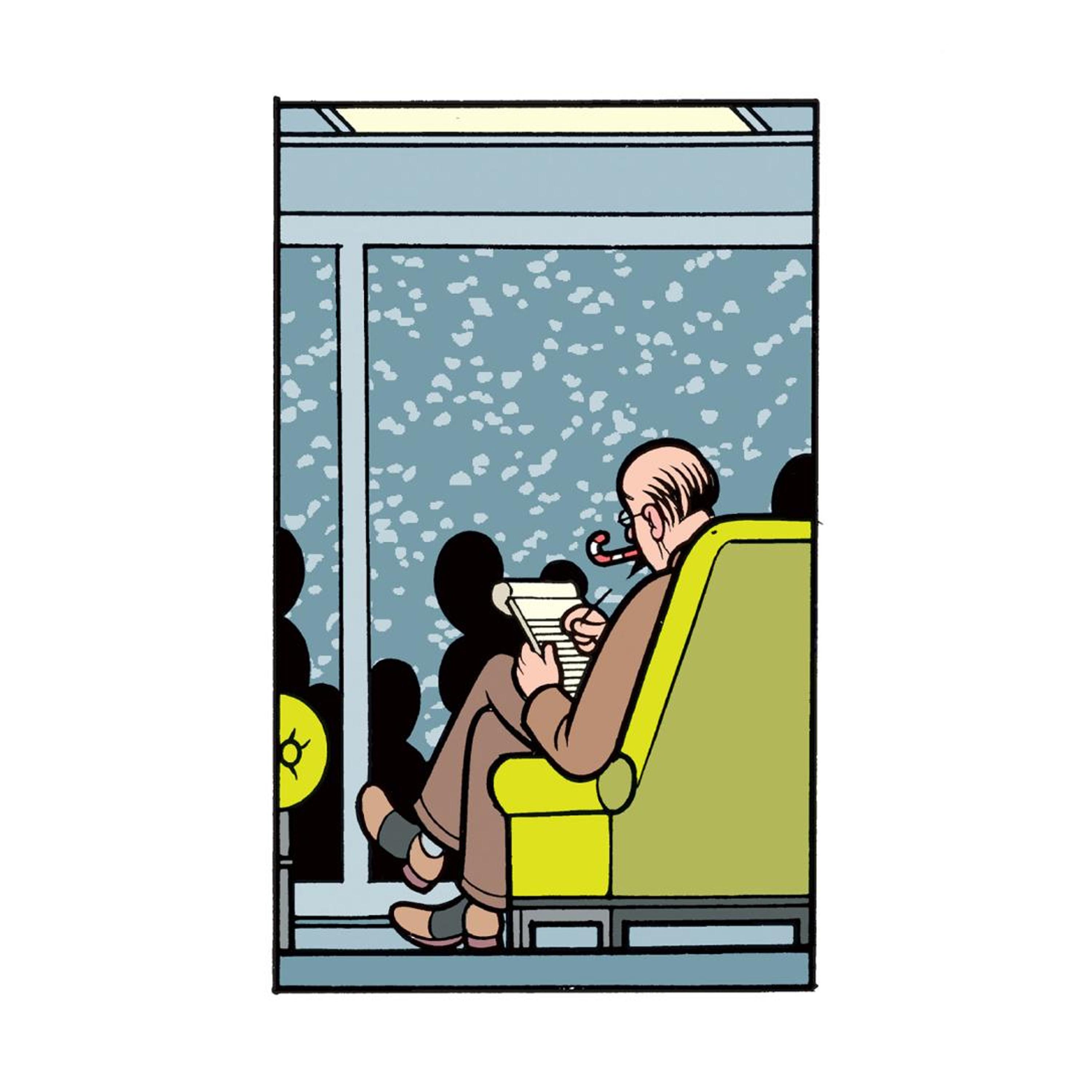
255: Our Holiday Gift-Giving Guide
The vexing difficulty of finding the perfect gift.
Visit thisamericanlife.org/lifepartners to sign up for our premium subscription.
- Prologue: Host Ira Glass goes to a busy Target store one week before Christmas. Most shoppers he talks to don't think any of their gifts will be returned. (3 minutes)
- Act One: Ian Brown tries, after decades of failure, to give his mother the perfect Christmas gift. He and his brother attempt something they haven't done since they were kids: Rehearse and sing her a program of Christmas carols. (19 minutes)
- Act Two: We play a 1959 original recording of Truman Capote reading his holiday story A Christmas Memory. (18 minutes)
- Act Three: Caitlin Shetterly reports on a true-life holiday fable from rural Maine, complete with a misunderstood recluse with a heart of gold, a deserving family in need, and a very special Christmas tree farm with secrets of its own. (16 minutes)
Transcripts are available at thisamericanlife.org
This American Life privacy policy.
Learn more about sponsor message choices.
Press play and read along
Transcript
This message comes from Shipbob. Nothing ruins your holiday faster than the customer emails that say, where is my order?
Shipbob helps win the holidays with reliable, scalable, fast, and cost-effective fulfillment. Go to shipbob.com/slash npr for a free quote.
One week before Christmas, the Target store on Chicago's west side, middle of the day, people are rolling shopping carts full of toys and games through the aisles.
Teenagers and single people, parents from every income.
And I don't really understand this, but if you talk to them, this incredibly diverse group, there's one question that always seems to get exactly the same answer.
Of all these things that you have in this basket, what do you think is the most likely to get returned?
Actually,
none of it.
Not my stuff?
No, I'd say no, not mine.
Actually, I'm not worried at all. Actually, I did a pretty good job.
Majority of the stuff that I'm buying is really for my kids, so they definitely ain't gonna return anything.
So, ah, not my stuff yeah I
made a list of what I was getting everyone and pretty confident in it
when I report their bravado their confidence to the store manager Lee Crumb
this is his response
oh
well um
the day after Christmas is the busiest day in refunds So
I don't know how true that statement is. Nobody ever returns my gifts.
So
Of course, everybody has sunglasses and rubber noses on that day when they're returning stuff, so nobody sees them.
It's really funny when the media is here the day after Christmas and they're filming the return center, everybody's kind of like... He hides his face behind his arm.
Nobody wants their picture taken.
Like criminals.
If you haven't had at least one drama, one stumper, one gift that has been so difficult to figure out this year that you want to cry, then you are a very unusual person leading a very charmed life, my friend.
And as proof, we offer you three stories today of Christmas and Christmas presents. From WBEZ Chicago, it's this American Life.
I'm Ira Glass.
Our show in three gift-wrapped little acts for you today, all tied up pretty with a bow. Act one:
Make a joyful noise unto your mom, in which two sons try once and for all to give their mother a gift that she will actually enjoy. Act two, a Christmas memory.
In that act, Mr.
Truman Capote, recorded in 1959.
Act 3.
Secret Santa.
A very, very secret Santa. Stay with us.
Support for this American Life comes from Superhuman. the AI productivity suite that gives you superpowers everywhere you work.
With Grammarly, Mail, and Coda coming together, you get proactive help across your workflow so you can outsmart the chaos. Experience AI that proactively helps you go from to-do to done faster.
Unleash your superhuman potential today. Learn more at superhuman.com slash podcast.
That's superhuman.com slash podcast.
Support for this American Life comes from Mint Mobile. Turn your expensive wireless present into a huge wireless savings future by switching to Mint.
Shop Mint Unlimited Plans at mintmobile.com/slash American. Limited time offer, upfront payment of $45 for three months, $90 for six months, or $180 for 12 months.
Taxes and fees extra, initial plan term only. Above 35 gigabytes, network may slow and busy.
Capable device required. Availability, speed, and coverage varies.
See mintmobile.com.
This is American Life from Ira Glass. Today's show is a rerun.
Act one.
Make a joyful noise into your mom.
There was one other thing that everyone at the Target store I talked to agreed on, and that is that parents are usually the hardest people to shop for.
They have everything already, they want nothing, they're used to doing the giving themselves. In Toronto, Ian Brown has had it.
I know, I know.
Deck the halls with boughs of holly, tis the season to be jolly. Unfortunately, I keep having a certain conversation at this time of year with my 88-year-old mother.
For a Christmas Christmas present, would you like a new pressure cooker? No,
no, I've got a pressure cooker.
What about a sweater?
I've got at least 20 sweaters.
What about some jewelry?
I have more jewelry than I shall ever wear. I don't like jewelry.
The whole spirit of Christmas is gone. I hate Christmas.
Really? Did you know there are more people who commit suicide at Christmas than any other time of the year? I didn't know that.
Oh, that's true.
I don't have this problem with everyone. I like to think I'm actually quite good at giving gifts.
I am. I put a lot of effort into it.
I remember what so-and-so said or he or she wanted last October.
I write it down in a notebook. I buy things my chosen recipients will like but wouldn't buy for themselves.
But with my mother, all bets are off. She's what's known as hard to buy for.
I'm not sure why. There are a million possible reasons.
Maybe it's generational, all those depression-raised mothers not wanting to be dependent on the kindness of others. Maybe it's a power play.
As long as she doesn't like what you give her, you remain properly beholden.
I realize a lot of mothers are like this, but my mother is an especially hard case. She might say in October, this Christmas, all I want is a tablecloth.
Then, when she unwraps said tablecloth on Christmas Day, she'll look at it without even taking it out of the package, say, very nice, and roll her eyes as if no one can see her.
Then, when you point out that she said she wanted a tablecloth, she'll say, matter of factly, I never said anything of the sort.
And if, by some miracle, she manages not to totally despise what you've given her, you're still not off the hook, because then she likes the gift too much and feels embarrassed.
My brother and I long ago decided we'd buy one gift between us. That way, at least, you split the pain.
We bought her a fur coat.
She opened the box, sat there with her hands in the fur, and started to cry.
This is too much, she said through her tears in a strangled voice, then ran upstairs and locked herself in her bedroom for four hours on Christmas Day.
The last thing my brother, his name is Tim, bought my mother, that she liked, that is, was a wooden napkin ring. It was hand-painted with flowers, very pretty.
That was 40 years ago.
He was six years old. It cost him a nickel at a fair.
Sometimes I think the whole gift-giving experience has scarred him for life.
I heard, I don't know who told me, but you're not giving gifts this year, right? You yourself. I am not giving gifts.
except to children.
And I think that you know, giving gifts to parents in this sort of desperate search for
approval, you know, or is that what you think it's for? Absolutely.
Really? Absolutely. Yeah.
You think we're seeking approval? Yes.
It's a bit late.
I mean, and her disdain for gifts when you give them is pretty bad, don't you think? Here, Mom, here's a beautiful new spring hat. I hate this.
But what sort of a gift is that? Where do you expect me to wear that? It's really horrible.
I mean, do you think she's a good gift giver? I mean, here we are, sort of, you know, trying to get the price. Yeah, no, I think she is.
She is. A very good gift.
Very generous.
I mean, she's almost blind. She's got a cataract.
She's knitting socks for people. I told her I wanted a pair of Argyll socks last year.
She made a pair of that's very difficult. Argyll socks.
You asked her for Argyle socks? Yeah. Well, I like the hand-knit socks.
I like the hand-knit socks. I'm sure you do.
That was on the 6th of December. And still, we had no clue what to give Mom for Christmas this year.
But then I had this idea,
a potentially brilliant idea.
Maybe after all this time, the perfect Christmas present.
When my brother and I were kids in school, we sang in the choir. Tim was talented.
He was a treble and then a tenor. I was a tenor, then a bass.
And when we came home from school for the holidays and we're doing the dishes after Christmas dinner, say, we'd sing Christmas carols.
We'd get my sisters, Maude and Daisy, to sing the melodies, and we'd sing the harmonies. We liked doing it.
Better still, our mother liked it. She started to ask us to do it every time we came home.
We were pretty good too. Our choir had even cut a record which my mother owned about 17 copies of and played all the time.
And that's what gave me the idea.
Instead of buying her something she'll hate, My brother and I will drive out to our parents' place, something neither of us does enough, and as grown men, we will sing her some carols in harmony.
The sheer sound of our soaring voices will, as they say in the Anglican hymn book, lift up her heart and transport her back to those days when we were her boys.
Neither my brother nor I have sung in a choir in years, but we harmonize now and then. We even make harmonies up.
And I've always been very impressed.
And how do you think the singing is going to sound? I think that
I think it might be fairly putrid. Putrid?
Yeah.
Really? I've had this impression that we sound great singing harmonies.
Yeah.
Above thy thy deep and dreamless sleep.
I hear my brother, and I think it's all up to me.
Oh my god, that was hideous. Was it hideous? Does it sound bad?
Bad?
We sounded like people who'd been lost in the woods. But how could we fix it? The 24-hour emergency carol singing repair isn't a service listed in the yellow pages where I live.
So I did the only thing I could think of. I called Eric Hanbury.
Hanbury had been at boarding school with my brother and me. He was in the choir too.
He was an eccentric character even then, very serious and strict, almost terrifying.
He knew how to play the organ for starters, and that was an unusual skill for a teenager to have back in the days when Led Zeppelin were releasing their first album.
Hanbury's musical tastes stopped at Gershwin and favored Bach. Plus, he was 6'2 even then and had full mutton-chop sideburns at the age of 12.
I hadn't seen him in nearly 35 years.
Hello, Eric Hanbury. Yeah, here.
Come on, 1204. All right.
But by 10.30 on Saturday morning, the very day we're to sing for our mother,
we're in Eric Hanbury's two-bedroom apartment on the 16th floor of a high-rise in the northwest end of the city.
The spare bedroom, the one we're all packed into, is mostly taken up by a church organ the size of a Ford Taurus, complete with foot pedals. Now, it is the nature singing.
And heaven, and heaven, the nature sing.
Terrible. Let's do verse three and I'll just play really loudly.
It doesn't take long for Eric to lose hope, which is more depressing than I anticipated.
We're so desperate, we consult three other experts. The only helpful advice we get is from the greatest of them, John Tuttle, the choir master at St.
Thomas's Anglican Church, which everyone around here knows is one of the two or three best choirs in the city.
He's famous for his high standards, his hours of practice.
He gives us a few phrasing tips to make it sound like we actually mean the words we're singing. You wouldn't say, and heaven and heaven and nature sing, and heaven and heaven and nature sing.
And heaven and heaven.
And it works. And heaven and nature sing.
And heaven and heaven and nature sing.
But it doesn't last because just as this thin ray of hope peeps forth, just as we feel good for the first time all day, we stop for lunch at a restaurant and my brother checks his cell phone for messages.
There's one from my father. He sounds pretty frosty.
And this is when I find out that my brother has had a fight with my mother. They haven't spoken in three weeks, which is why my father's making the call for my mother.
I mean, it's really bad.
You can hear my mother in the background telling my old man what to say.
Timmy, my dad says, and I can hear the edge of displeasure in his voice, I understand you're coming out here. We have to go out in 15 minutes.
We don't know where you are, so...
There's no use you coming out. We're not going to be here.
We're not going to wait around for Ian.
And incidentally, incidentally, we will not be coming to your Christmas dinner party next Sunday night. And then he hangs up.
He doesn't even bother to say goodbye. But then, he never does.
We got to get some gas. It's a 40-minute drive to my parents.
They live in a small house in the country beside a river.
All the way out, we practice trying to hone the edge we'd picked up from John Tuttle.
We left to get into it. Would you let me go ahead? Thank you very much.
What a nice
guy.
We finally pull up to my parents' house. It's cold outside.
Around zero Fahrenheit. It's one of those filing cabinet gray Canadian days that feels colder than it would if there was snow on the ground.
We walk up to the front door. Okay, wait, where's the doorbell? There's no doorbell, they'll know we're here.
They'll know we're here. How will they know?
Okay, ready?
I gotta get it close. Okay, ready?
Joy to the world.
Joy to the world, the Lord is come.
Let earth receive her King.
Let every
heart prepare him room and heaven and nature sing.
As we sang,
I thought to myself,
so it has come to this.
The bottom of the barrel. Two grown men in their forties standing outside in the sub-freezing winter, singing to a closed door.
Begging, essentially.
Thank you very much. That was very nice.
Shall we come in? Can we come in? It's freezing outside. Can we come in? Come on.
What's that? Don't bring your germs in here. Don't bring your germs in here.
That's nice. I can hear you.
Oh, little
town of Bethlehem, how still we see thee light
above thy deep and dreamless
My mother moves from the doorway to a dining-room chair and sits down. She's looking at the floor, but I think she's ever so slightly crying.
My brother can see it too.
I don't want her to cry, but then it doesn't seem to last. Our Lord remain you
well.
This is your Christmas present. Thank you very much.
That was very nice. Reminded me of when you were nice boys, went to school and sang in the choir.
And?
Are we implying that we're not like that anymore? I have no, you don't even come to see me unless you want something. So do you want a cup of tea? Yes.
Yeah, that would be nice.
We go into the kitchen. So
how does that compare with other presents we've given you? Very nice.
Very acceptable. Thank you very much.
What's the best present we've ever given you?
Best help.
What, help? Help? Do you know what I would really like? I would like you all to come in the spring. Help me clean up the garden.
Help me clean up the house. Repaper the house.
That would be lovely.
Repaper the house? Repaper the house. Repaper the living room? The living room, the bar, anywhere.
So this has been my problem gift-wise all along.
Here I was trying to satisfy my mother with some $60 blouse when what she really wanted was an $8,000 wallpapering job. Play the odds.
That's my idea.
I'm so distracted by this revelation that I don't notice her trying to reverse the gift-giving polarity in her favor.
Even before the carol is over, before we finish giving her our gift, she starts reciprocating, giving us items she's harvested from all over the house.
Not just our Christmas presents, you know, two envelopes of cash, but other stuff.
A calendar of coupons, half a round of Swiss cheese. And what's this? A beautiful cashmere scarf.
The same one I'd given to my brother at Christmas last year.
Oh my god, where did you get that? It's been up in the cupboard for how long? That's a cashmere scarf. I gave you that for Christmas last year.
I know. And you've left it here.
You haven't even...
Oh, God, you know, why do I bother?
So much for my famous gift-giving abilities. No one in my family appreciates my effort.
And this was true, it suddenly became clear, of this gift of song as well. Um, should we do one more? Yeah.
No, I haven't got time.
You hear that?
She hasn't got time.
Go in there and do it. We're doing it for you.
Rebellious hand. It's your Christmas present.
You want to watch the TV talk?
All right. You don't want to hear it? Blessed are the pure in heart?
No, she was not interested in the pure in heart. Goodbye.
Hold on. And you know why? Goodbye.
Thanks for watching. Because she was about to miss her favorite TV program.
She was giving us the bums rush.
Very nice. Thank you both very much indeed.
You're missing your TV program. Lovely to see you.
Yes, lovely to see you. What's the name of the program? Pinesky.
Pine Sky. Goodbye.
See you, Dad.
So we drove the 40 miles right back to the city.
We devoted a whole day to giving our mother the perfect gift, only to get kicked out of her house after 26 minutes in favor of Pie in the Sky, an English TV series about a country detective who makes the best steak and kidney pie in the world.
Actually, my mother used to make excellent steak and kidney pie herself and give it away as Christmas presents.
Of course, no Christmas story is complete without a grand final realization. And on the way home, I had mine.
We'd been going about it all wrong. We'd been trying to find the perfect Christmas present, but the perfect gift was a terrible idea.
Because the perfect gift upsets the delicate truce of failure and imperfection that holds every family together like a trust bridge. You move one timber, the whole thing can come crashing down.
Whereas if you leave that rickety old span as it has always been, with a little too much need over here and a little too much eagerness to please over there, all offset by an overhang of standoffishness, then everyone's happy.
The secret, obviously, is to give an imperfect gift that lavishes enough attention on your old ma that she knows you still care,
but that's also fundamentally flawed so that no one goes home feeling indebted or beholden or lonely.
Instead, they can go home reassured. Nothing changes.
That's a Christmas present even a mother could love.
Ian Brown, the great iconic Canadian broadcaster, these days is a feature writer for the Globe and Mail.
Deck 2, A Christmas Memory.
We heard about this next recording because the in-laws of one of our producers play it every Christmas when the family gets together. And every Christmas, they all cry.
It's Truman Capote's story, A Christmas Memory, about his own childhood growing up in rural Alabama in the 1920s and 30s.
It's simultaneously this intimate and complicated portrait of somebody that he loved, but it's also a picture of Christmas and of a time and place in America which almost feels like another country.
I think you'll hear what I mean. It's just a kind of life that does not exist many places here now.
This is an abridged version of the story, shortened a bit for the radio.
Imagine a morning in late November, a coming of winter morning more than 20 years ago.
A woman with shorn white hair is standing at the kitchen window. Oh my, she exclaims, her breath smoking the window pane.
It's fruitcake weather.
The person to whom she is speaking is myself.
I am seven, she is sixty something.
We are cousins, very distant ones, and we have lived together, well, as long as I can remember.
Other people inhabit the house, relatives, and though they have power over us and frequently make us cry, we are not, on the whole, too much aware of them. We are each other's best friend.
She calls me buddy, in memory of a boy who was formerly her best friend. The other buddy died in the 1880s when she was still a child.
She is still a child.
I knew it before I got out of bed, she says, turning away from the window with a purposeful excitement in her eyes. Help me find my hat.
We've thirty cakes to bake.
In addition to never having seen a movie, she has never eaten in a restaurant, traveled more than five miles from home, received or sent a telegram, read anything except funny papers and the Bible, worn cosmetics, cursed, wished someone harm, told a lie on purpose, let a hungry dog go go hungry.
Of the ingredients that go into our fruit cakes, whiskey is the most expensive as well as the hardest to obtain. State laws forbid its sale.
But everybody knows you can buy a bottle from Mr.
HaHa Jones. And the next day, having completed our more prosaic shopping, we set out for Mr.
HaHa's business address, a sinful, to quote public opinion, fish fry and dancing cafe down by the river.
We've been there before and on the same errand, but in previous years our dealings have been with Ha Ha's wife.
Actually, we've never laid eyes on her husband, a giant with razor scars across his cheeks. They call him HaHa because he's so gloomy, a man who never laughs.
As we approach his cafe, a large log cabin festooned inside and out with chains of garish gay naked light bulbs and standing by the river's muddy edge under the shade of river trees where moss drifts through the branches like grey mist, our steps slow down.
Even Queenie stops prancing and sticks close by.
People have been murdered in Ha Ha's cafe, cut to pieces, hit on the head. There's a case coming up in court next month.
I knock at the door. Queenie barks.
My friend calls. Mrs.
HaHa, ma'am, anyone to home?
Footsteps. The door opens.
Our hearts overturn. It's mister Ha Ha Jones himself.
And he is a giant. He does have scars.
He doesn't smile. No, he glowers at us through Satan tilted eyes and demands to know what you want with Ha Ha
For a moment we are too paralyzed to tell. Presently my friend half finds her voice, a whispery voice at best.
If you please, mister Ha Ha, we'd like a quart of your finest whiskey.
His eyes tilt more. Would you believe it? Ha ha is smiling, laughing too.
Which one of you is a drinking man?
It's for making fruit cakes, mister Ha Ha, cooking. This sobers him.
He frowns. That's no way to waste good whiskey.
We pay him with nickels and dimes and pennies. Suddenly, jangling the coins in his hand like a fistful of dice, his face softens.
Tell you what, he proposes, pouring the money back into our bead purse. Just send me one of them fruit cakes instead.
Well, my friend remarks on our way home, there's a lovely man. We'll put an extra cup of raisins in his cake.
The black stove, stoked with coal and firewood, glows like a lighted pumpkin.
Egg beaters whirl, spoons spin round in bowls of butter and sugar, vanilla sweetens the air, ginger spices, melting nose-tingling odors saturate the kitchen, suffuse the house, drift out to the whirl on puffs of chimney smoke.
In four days our work is done. Thirty-one cakes, dampened with whiskey, bask on windowsills and shelves.
Who are they for?
Friends. Not necessarily neighbor friends.
Indeed, the larger share are intended for persons we've met maybe once, perhaps not at all.
People who've struck our fancy, like President Roosevelt, like the Reverend and Mrs. J.C.
Lucy, Baptist missionaries to Borneo who lectured here last winter.
Other little knife grinder who comes through town twice a year.
Other young Wistons, a California couple whose car one afternoon broke down outside the house and who spent a pleasant hour chatting with us on the porch.
Young mister Wiston snapped our picture, the only one we've ever had taken.
Now a new December fig branch grates against the window. The kitchen is empty, the cakes are gone.
Yesterday we carted the last of them to the post office where the cost of stamps turned our purse inside out. We're broke.
That rather depresses me, but my friend insists on celebrating with two inches of whiskey left in Ha Ha's bottle. Queenie has a spoonful and a bowl of coffee.
She likes her coffee chicory flavored and strong.
The rest we divide between a pair of jelly glasses. We're both quite awed at the prospect of drinking straight whiskey.
The taste of it brings screwed up expressions and sour shudders.
But by and by we begin to sing, the two of us singing different songs simultaneously. I don't know the words to mind, just come on along, come on along, to the Dark Town Strutter's Ball.
But I can dance. That's what I mean to be, a tap dancer in the movies.
My dancing shadow rollocks on the walls. Our voices rock the chinaware.
We giggle as if unseen hands were tickling us.
Queenie rolls on her back. Her paws plow the air.
Something like a grin stretches her black lips. Inside myself I feel warm and sparky as those crumbling logs, carefree as the wind in the chimney.
My friend waltzes round the stove, the hem of her poor calico skirt pinched between her fingers as though it were a party dress.
Show me the way to go home, she sings, her tennis shoes squeaking on the floor. Show me the way to go home.
Enter two relatives, very angry, potent with eyes that scold, tongues that scall, listen to what they have to say, the words tumbling together into a wrathful tune.
A child of seven, whiskey on his breath. Are you out of your mind? Feeding a child of seven must be looney, road to ruination.
Remember, cousin Kate, Uncle Charlie, Uncle Charlie's brother-in-law?
Shame, scandal, humiliation. Pray, beg the Lord.
Queenie sneaks under the stove. My friend gazes at her shoes, her chin quivers.
She lifts her skirt and blows her nose and runs to her room.
Long after the town has gone to sleep and the house is silent except for the chimings of clocks and the sputter of fading fires, she is weeping into a pillow already as wet as a widow's handkerchief.
Don't cry, I say, sitting at the bottom of her bed and shivering despite my flannel nightgown that smells of last winter's cough syrup. Don't cry, I beg, teasing her toes, tickling her feet.
You're too old for that.
It's because, she hiccups, I am too old. Old and funny.
Not funny. Fun.
More fun than anybody. Listen, if you don't stop crying, you'll be so tired to-morrow we can't go cut a tree.
She straightens up. Queenie jumps on the bed, where Queenie is not allowed, to lick her cheeks.
I know where we'll find real pretty trees, buddy, and holly too, with berries big as your eyes.
It's way off in the woods, farther than we've ever been. Papa used to bring us Christmas trees from there, carry them on his shoulder.
That's fifty years ago. Well, now I can't wait for morning.
Morning.
Scented acres of holiday trees, prickly leafed holly, red berries, shiny as Chinese bells, black crows swoop upon them, screaming.
Having stuffed our burlap sacks with enough greenery and crimson to garland a dozen windows, we set about choosing a tree.
It should be, muses muses my friend, twice as tall as a boy, so a boy can't steal the star.
The one we pick is twice as tall as me, a brave, handsome brute that survives thirty hatchet strokes before it keels with a creaking, rending cry.
After weaving and ribboning holly wreaths for all the front windows, our next project is the fashioning of family gifts.
Tie-dye scarves for the ladies, for the men, a home-brewed brewed lemon and licorice and aspirin syrup to be taken at the first symptoms of a cold and after hunting.
But when it comes time for making each other's gifts, my friend and I separate to work secretly. I would like to buy her a pearl handle knife, a radio, a whole pound of chocolate covered cherries.
We tasted some once, and she always swears I could live on them, buddy. Lord, yes, I could and that's not taking his name in vain
instead I am building her a kite
she would like to give me a bicycle she said so on several million occasions if only I could buddy it's bad enough in life to do without something you want but confound it what gets my goat is not being able to give somebody something you want them to have only one of these days I will buddy locate you a bike don't ask how steal it maybe
instead I'm fairly certain that she is building me a kite, the same as last year and the year before.
The year before that we exchanged slingshots,
all of which is fine by me, for we are champion kite fliers who study the wind like sailors. My friend, more accomplished than I, can get a kite aloft when there isn't enough breeze to carry clouds.
Christmas Eve afternoon we scrape together a nickel and go to the butcher's to buy Queenie's traditional gift, a good gnawable beef bone.
The bone, wrapped in funny paper, is placed high in the tree near the silver star.
Queenie knows it's there. She squats at the foot of the tree, staring up in a trance of greed.
When bedtime arrives, she refuses to budge. Her excitement is equaled by my own.
I kick the covers and turn my pillow as though it were a scorching summer's night. Somewhere a rooster crows, falsely, for the sun is still on the other side of the world.
Buddy, are you awake?
It is my friend calling from her room, which is next to mine, and an instant later she is sitting on my bed holding a candle. Well, I can't sleep a hoot, she declares.
My mind's jumping like a jackrabbit. Buddy, do you think Mrs.
Roosevelt will serve our cake at dinner? We huddle in the bed and she squeezes my hand. I love you.
Seems like your hand used to be so much smaller. I guess I hate to see you grow up.
When you're grown up, will we still be friends? I say always.
But I feel so bad, buddy. I wanted so bad to give you a bike.
I tried to sell my cameo papa gave me. Buddy, she hesitates as though embarrassed.
I made you another kite.
Then I confess that I made her one too, and we laugh. The candle burns too short to hold.
Out it goes, exposing the starlight, the stars spinning at the window like a visible caroling that slowly, slowly daybreak silences.
Possibly we doze. But the beginnings of dawn splash us like cold water.
We're up wide-eyed and wandering while we wait for others to waken.
Quite deliberately, my friend drops a kettle on the kitchen floor. I cap dance in front of closed doors.
One by one the household emerges, looking as though they'd like to kill us both, but it's Christmas so they can't.
First a gorgeous breakfast, just everything you can imagine, from flapjacks and fried squirrel to hominy grits and honey in the comb, which puts everyone in a good humor except my friend and I.
Frankly, we're so impatient to get at the presents we can't eat a mouthful.
Well, I'm disappointed. Who wouldn't be? With socks, a Sunday school shirt, some handkerchiefs, a hand-me-down sweater, and a year's subscription to a religious magazine for children.
The Little Shepherd. It makes me boil.
It really does.
Buddy, the wind is blowing.
The wind is blowing, and nothing will do till we've run to a pasture below the house where Queenie has scooted to bury her bone, and where, a winter hence, Queenie will be buried too.
There, plunging through the healthy waist-high grass, we unreal our kites, feel them twitching at the string like sky fish as they swim into the wind.
Satisfied, sun-warmed, we sprawl in the grass and peel satsumas and watch our kites cavort.
Soon I forget the socks and hand-me-down sweater. I'm as happy as if we'd already won the $50,000 grand prize in that coffee naming contest.
My, how foolish I am, my friend cries, suddenly alert, like a woman remembering too late she has biscuits in the oven.
You know what I've always thought, she asked in a tone of discovery, and not smiling at me, but a point beyond.
I've always thought a body would have to be sick and dying before they saw the Lord.
And I imagined that when he came, it would be like looking at the Baptist window, pretty as colored glass with the sun pouring through.
such a shine you don't know it's getting dark and it's been a comfort to think of that shine taking away all the spooky feeling but I'll wager it never happens I'll wager at the very end a body realizes the Lord has already shown himself that things as they are
her hand circles in a gesture that gathers clouds and kites and grass and queenie pawing earth over her bone
just what they've always seen was seeing him.
As for me, I could leave the world with today in my eyes.
This is our last Christmas together. Life separates us.
Those who know best decide that I belong in a military school, and so follows a miserable succession of bugle-blowing prisons, grim, revelli-ridden summer camps.
I have a new home too, but it doesn't count. Home is where my friend is, and there I never go.
And there she remains, puttering around the kitchen, alone with Queenie, then alone. Buddy, dear, she writes in her wild, hard-to-read script, yesterday Jim Macy's horse kicked Queenie bad.
Be thankful she didn't feel much. I wrapped her in a fine linen sheet and rode her in the buggy down to Simpson's pasture where she can be with all her bones.
For a few Novembers she continues to bake her fruitcakes single-handed, not as many but some, and of course she always sends me the best of the batch.
But gradually in her letters she tends to confuse me with her other friend, the buddy who died in the 1880s.
A morning arrives in November, a leafless, birdless coming of winter morning, when she cannot rouse herself to exclaim, Oh my, it's fruitcake weather.
And when that happens, I know it.
A message saying so merely confirms a piece of news some secret vein had already received, severing from me an irreplaceable part of myself, letting it loose like a kite on a broken string.
That is why, walking across the school campus on this particular December morning, I keep searching the sky, as if if I expected to see, rather like hearts, a lost pair of kites hurrying toward heaven.
Truman Capote, recorded in 1959, a Christmas memory was broadcast with the permission of the Truman Capote Literary Trust, Alan U. Schwartz, trustee.
This version of the story was abridged for radio.
Coming up, more proof that the perfect gift, like the perfect crime, is an elusive thing. In a minute, from Chicago Public Radio, when our program continues.
Support for this American Life comes from BetterHelp. The holidays are a time of traditions, like making your grandmother's pudding recipe or watching that movie you've seen a thousand times.
Incorporating therapy into your life can help you take time for yourself during what can be a joyful but sometimes tough time of year.
And by caring for yourself, you can show up more for the important moments. This December, start a new tradition by taking care of you.
Visit betterhelp.com/slash TAL for 10% off.
Support for This American Life comes from Squarespace.
Their AI-enhanced website builder, Blueprint AI, can create a fully custom website in just a few steps, using basic information about your industry, goals, and personality to generate premium quality content and personalized design recommendations.
and get paid on time with branded invoices and online payments. Plus, streamline your workflow with built-in appointment scheduling and email marketing tools.
Head to squarespace.com slash American for 10% off your first purchase of a website or domain.
Support for this American life comes from Whole Foods Market. Build the perfect holiday meal at Whole Foods Market.
From traditional holiday must-haves to creative twists, everything must pass their strict ingredient standards. Grab sales on their impressive centerpiece mains with no antibiotics ever.
Aim to please with limited-time desserts like chocolate bourbon pecan pie. And ring in 2026 with sales on quality seafood.
Shop for your celebration at Whole Foods Market with so many ways to save.
Terms apply.
This is American Life, America Glass. It's our guide to holiday gift giving in which we guarantee you will find no practical advice for your last-minute shopping.
Instead, we have stories of holiday presents. Today's show was first broadcast in 2003.
We're at Act 3 of our show. Act 3, Secret Santa.
Caitlin Chetrolet has this story about one gift leading to another, leading to another, leading to another, and then stopping.
I grew up in a small town called Surrey on the coast of downeast Maine. At Christmas, most everyone in our town bought their trees at Jordan's tree farm.
$5 per tree, cut at your own risk.
Thinking back, it seems funny to me now since, after all, this is rural Maine, the pine tree state, and you'd think everyone could cut their own trees on their own land.
And it's not like the trees at the Jordan farm were so special. Pretty much everyone called them Charlie Brown trees.
People came because of Robert Jordan.
They were loyal to him, and they figured he could use the money. Every year the drill was the same.
You'd get out of your car with your family, trudge for what seemed like miles in sub-zero wind searching for the perfect tree, drag your prize back through the snow, and then, finally, you'd go find Robert.
This was one of the only times of year most of us saw Robert.
He seemed to live an entirely reclusive life in his ramshackle house perched above the road and bordering the thick trees that fanned out behind his barn.
Many of us know someone like Robert, our own Boo Radley, a poor old man who's lived with his parents his entire life until one and then the other died.
Here's what we knew about Robert from these short yearly transactions. He had a very strange voice.
He wore coke bottle glasses, an orange hunting cap, and in my memory, a red and black buffalo plaid jacket.
But somehow Ron Hamilton and his wife Brenda came to know Robert better than most people did. Here's Ron.
A lot of people thought Robert was retarded because his father was hard hearing and he kind of talked like this, you know.
And I kind of minimized him a little bit, but every now and then he'd say something like, well, how are you today?
And I'd say, pretty good, Robert. Well, what are we going to do today? You know, and it kind of reminded me of Catherine Hepburn, is it? That's got that same kind of broken spot in the voice.
But he never knew he'd done that until later in life that because his father was almost death, Clyde, he'd have to look at you and went, wah, wah, and Robert would beller right out.
The farmhouse and the Jordans' lifestyle on the farm was primitive. The house had no hot water.
Clyde and Robert ate canned cold beans for breakfast.
Their porch was overflowing with junk and cats and smelled like cat food and urine. Robert slept in a chair in the living room, and Clyde slept on a a small cot next to the wood stove in the kitchen.
Robert's mother Bessie had passed away in 1987 in one of the small bedrooms upstairs. Since then the two men were on their own.
About 15 years ago Ronnie Hamilton and his wife Brenda met Robert and Clyde.
Brenda was making and selling Christmas wreaths and when Robert saw them he invited the Hamiltons first to get brushed from the farm to make their wreaths and later to sell them at the farm.
They ended up spending a lot of time together.
Despite the Christmas tree farm, Robert and his late mother were Jehovah's Witnesses, and so the family didn't actually celebrate Christmas.
But Ronnie and Brenda wanted to include them into their holiday. One day Ron noticed Clyde was wearing two different boots and that on the coldest days they weren't keeping his feet warm.
So I went and bought him a pair of boots.
And we bought Robert a pair of sneakers because I knew Robert liked the ones that you didn't have to lace up. They just had the Velcro.
Anyway, we got several little things in a Christmas docking.
Well,
day before Christmas, I'd come over and I said, knock on the door and I says, Santa's here. And they'd come in.
He said, what did you do that for?
I says, because I want to.
And I says just because you'd like to do things for people. And I asked, what did you do that for? And he says, because he wanted to.
So I kind of put it right back to him that way.
You know, he liked Christmas. After that first Christmas, Robert began exchanging gifts each year with Ron and Brenda.
As Clyde got older and started to rely on Robert, Robert started to rely on the Hamiltons. Late one night, Clyde got so sick, Robert called Ron for help.
And he says, Father's sick.
Can you come get him?
This was like 11.30, 12 o'clock at night, and snowy and stuff.
I went over and got him, picked him up, and put him in the truck and took him to Blue Hill Hospital.
Well, needless to say, he had cancer, and
that went on for about a year and finally
Robert's father was in the hospital real bad there and Robert called me out and he said would you take me over and see dad and I said yeah
went in and
the doctor just
matter of time and I said to Robert I says you know if you want to say something to your father you want to say it now.
We get a
kick out of this because we chuckled about it afterwards.
He said, but I can't get him awake. I says, I can get him awake.
He says, you can? He says, how? And I says, you watch. I says, Clyde,
there's somebody in your Christmas trees.
He opened up one eye and he looked at me. He said, I'm not dead yet.
I says to Robert,
I says, you want to say something to your father? You want to talk to him now? So they talked a few minutes and then Clyde dozed off. And
Robert called me the next morning and told me his father died.
Robert asked Ron to take care of the burial arrangements. So Ron dug the hole for Clyde's remains, gathered some friends, and said a few final words.
Then Robert asked Ron if when it came time, he would do the same for him. Ron said yes.
Robert was 65 when his father died. He had struggled with diabetes for most of his life.
He had had heart problems, and he was in and out of the hospital.
He stayed with Ron and Brenda for a couple of months in the winter of 2000 because he couldn't take care of himself.
He loved the hot showers and the television with remote control they had at their house. Eventually, Robert went back to the farm and to his independence.
He started walking four miles a day and lost some weight. Then, in mid-April of 2001, Ron went over early one morning to pick Robert up to take him into town.
He found Robert lying on the floor.
He was dead.
Ron kept his promise to Robert and held a small ceremony on a sunny April afternoon. He scattered Robert's ashes out back of the farm among the Christmas trees.
A few days later, the Hamiltons were contacted to come to a reading of Robert's will, along with representatives from five local nonprofit organizations.
As the lawyer started to read out the will, people were stunned. It turns out Robert Jordan was a millionaire.
Robert had inherited a couple hundred thousand in AT ⁇ T stock from three neighbors, wealthy sisters who had a summer place across the road.
When Robert was growing up, he had mowed lawns and run errands for the sisters, and when they got older, he had taken care of them.
When the last sister Betty died in 1984, she left Robert the stock and her house. Robert sold the house, and as for the stock, his timing was perfect.
It boomed.
Robert had divided up his money between local organizations he was interested in or had been kind to him. But the largest gift was left to Ron and Brenda Hamilton.
Robert Jordan had left them the farm. Well, I was fabulous.
I mean,
I couldn't believe it. I just, you know, to this day, I don't believe it because I didn't look for nothing for nobody.
We were so excited, so we packed up our stuff and
started cleaning on the farm and fixing the farm up a little bit and the barn and stuff and moved in. And, you know, it was just a lovely spot.
The tree farm Robert left to Ronnie and Brenda sits on top of a hill looking over Route 172. It has 66 acres of trees and a natural spring.
The house is white, and from the road, it looks bigger than it really is. The only sink was in the kitchen, and the house had no heat besides the wood stove.
In August of 2001, Ronnie and Brenda moved in. They were excited, not daunted, by the task that lay ahead of them.
A year later, I went to visit Ronnie and Brenda. It was the first time I'd actually been able to walk onto the porch.
The clutter was gone, a small gray kitten lay curled on a couch, and three dogs met me at the door.
It was as if Ronnie and Brenda's world had opened up.
Ron told me that Robert's gift had completely changed his life.
I don't have so much
tension on me, you know, thinking that
what am I going to do? Now I know what I'm going to do. I'm going to work on these Christmas trees most of the rest of my life and enjoy it like he did.
When I left that night, Ron walked me to my car.
That's great. Thank you so much.
Well, thank you, dear. I think I'll come back at Christmas.
Okay. You're going to get your tree? Yeah, I'm definitely gonna come get a tree for sure.
Thank you. Thank you, dear.
Test, test.
Four months later, it's Christmas Eve, and I'm back at the tree farm.
Hi. Hi, good morning, dear.
How are you?
Why, your house looks great. Thank you all for that.
Coming together. Oh, look at the tree.
Hey, hey, I'm going to walk.
Is it going well, though, living here? Are you feeling good about it?
I had nothing but trouble over here all summer long. Tell me why.
Some people broke into my pickup truck and hadn't taken my pills and come in here.
After the Hamiltons moved in, things got complicated. The house and the barn needed a lot of work, and the Hamiltons needed money they didn't have to do that work.
Tending to 66 acres of farm that stretched over a mile back from the road was hard for Ron.
One day he fell while surveying the land, and he pulled the muscles and tendons in his neck.
Ron went to the hospital and was given painkillers, which he brought home. And a day later, some kids broke into his truck and stole his medicine.
Then, believe it or not, things took a turn for the worse. They tried to arrest me and charged me with growing marijuana, which wasn't fine.
Where was the marijuana? Somebody planted it out back in the Christmas trees, two or three different plots of it.
And the police came? Whole helicopter, the whole nine yards. Who planted that, do you think? I don't know.
I have no idea.
Ron had to hire a lawyer to prove that the plants weren't his, putting him into even more debt. And on top of all that, Ron had a heart attack.
This all happened within four months.
Finally, Ron and Brenda decided to sell the farm.
With the money they got from selling the farm to their neighbor Bill Cadu, they built a small one-level house on seven acres of land over closer to Ellsworth on a busy road.
Ron has been back a few times to cut brush for Brenda's wreaths, but when I asked Ronnie to take me back to the farm, he refused, saying it was just too painful. Well, yeah, it kind of bothers you.
Why does it bother you?
Hmm.
I don't know.
Just thinking it was mine and,
you know,
I wish that I could have kept it.
This is Brenda, Ronnie's wife. It was nice in the summer.
You'd go out and sit on the porch there, and
we'd watch traffic go by.
Because it didn't tell it was real dark because it was all screened in.
It was nice out there.
Nice porch.
Oh, yeah. When we first moved to the farm,
just like we were remarried and everything was,
you know,
cozy and,
you know, and the colder it got, the more we snuggled, you know. And,
you know, it was different. It was better.
It was more. It's a country life.
You know, every morning she'd get up and have a coffee park going and take a cup of coffee within the dogs and she'd walk out back and she'd say, well, we've got several deer crossings out there or you ought to see the turkey tracks or there's coyote droppings out there.
And
we had visions, we talked about, and we wanted to take this little pond
and it would make a beautiful ice skating pond. And we thought, well, we'd have the kids come over and they could ice skate over there, get them off the streets, you know.
And then eventually that we could have a horse and a sleigh and give sleigh rides over there.
But it didn't turn out that way.
But we dreamt of it, didn't we, dear?
Later, Brenda tells me that she doesn't like the new house they've built. She says it doesn't feel like a home and she doesn't want to decorate Christmas this year.
Their whole idea of Christmas is still tied up in the dreams they had for the farm.
In the Dylan Thomas poem, A Child's Christmas in Wales, there's a point toward the end where the narrator and his childhood friends go caroling in the dark.
They walk up a long driveway to a large house, and although they are afraid, they soldier on.
And as they begin to sing, a voice joins theirs from behind the dark door. Thomas writes, A small, dry voice, like the voice of someone who has not spoken for a long time, joined our singing.
A small, dry, eggshell voice from the the other side of the door. A small, dry voice through the keyhole.
The boys run and never finish their song.
When I was little, I used to go with the Surrey Elementary School to sing carols outside Robert Jordan's house. And I always confused the voice in the poem with the real-life Robert Jordan.
Someone isolated, someone people don't stick around for.
But that wasn't really who he was. He reached out to people.
He helped out his neighbors across the street without asking for anything. In return, they made him a millionaire.
And when Ronnie and Brenda helped him without asking for anything, in return he gave them the farm. So much of his life was about a kind of selfless giving.
And sometimes it didn't work out, sure.
Ronnie and Brenda are definitely going to miss the farm this Christmas. But Ron still has hope for the holidays.
He thinks their house won't feel so much like a motel once they get the tree up, put some lights outside, and have some family over.
Already, Brenda's nearly sold all her wreaths.
And when I called this week, Ron was already ahead of the game. His shopping's all done, and he was busy wrapping presents for his wife.
Caitlin Shedowi. Our latest book is Pete and Alice in Maine.
We're broken by Spooch today by Jane Marie and myself with Alex Bloomberg, Diane Cook, and Starley Kine. Senior producer for the show, Julie Snyder.
Production help from Todd Bachman and Kelsey Diltz.
Help Help on today's rewrite from Susan Gabber and Stone Nelson. Special thanks today to Elizabeth and Ron and Adam Beckman.
To Mr.
Gary Stewart, Sarah Meyer, Dimitri Shube, David Weiss, Peter Krinski, Bill and Gail Cadu.
Jane, thanks Rick for the ring. Our website, thisamericanlife.org.
You can stream our archive of over 850 episodes for absolutely free.
Right now, if you sign up to be a life partner, this week's bonus episode, we try something new.
We bring you a story that is just an early draft in progress. This is a personal story with some funny moments that I told on stage as I was working it out.
I'm still working it out.
It may or may not end up on the radio show. If you want to hear that and all of our bonus episodes and lots of other stuff, go to thisamericanlife.org/slash life partners.
This American Life is delivered to public radio stations by PRX, the Public Radio Exchange. Thanks as always to our program's co-founder, Mr.
Tori Malatia,
or, as he likes to be known, our Lord de Manuel.
I'm Ira Glass. Back next week with more stories of This American Life.
Next week on on the podcast of This American Life,
nearly every night in Portland, left-wing protesters and right-wing streamers face off in the streets. But it's not like you think.
They know each other really well.
These are right-wing streamers at the apartment of one of the protesters. That's next week on the podcast from your local public radio station.
This message comes from NPR sponsor, Capella University. With Capella's FlexPath Learning Format, you can set your own deadlines and learn on your schedule.
A different future is closer than you think with Capella University. Learn more at capella.edu.
This message comes from Shipbub. Nothing ruins your holiday faster than the customer emails like, where's my order? Or worst of all, why can't you deliver by Christmas?
But peak doesn't have to be chaotic when Shipbob's in your corner.
Shipbob helps brands like Our Place, Bloom Nutrition, and Tony's win the holidays with reliable, scalable, fast, and cost-effective fulfillment. Make this your best holiday season yet with Shipbob.
Go to shipbob.com/slash npr for a free quote.