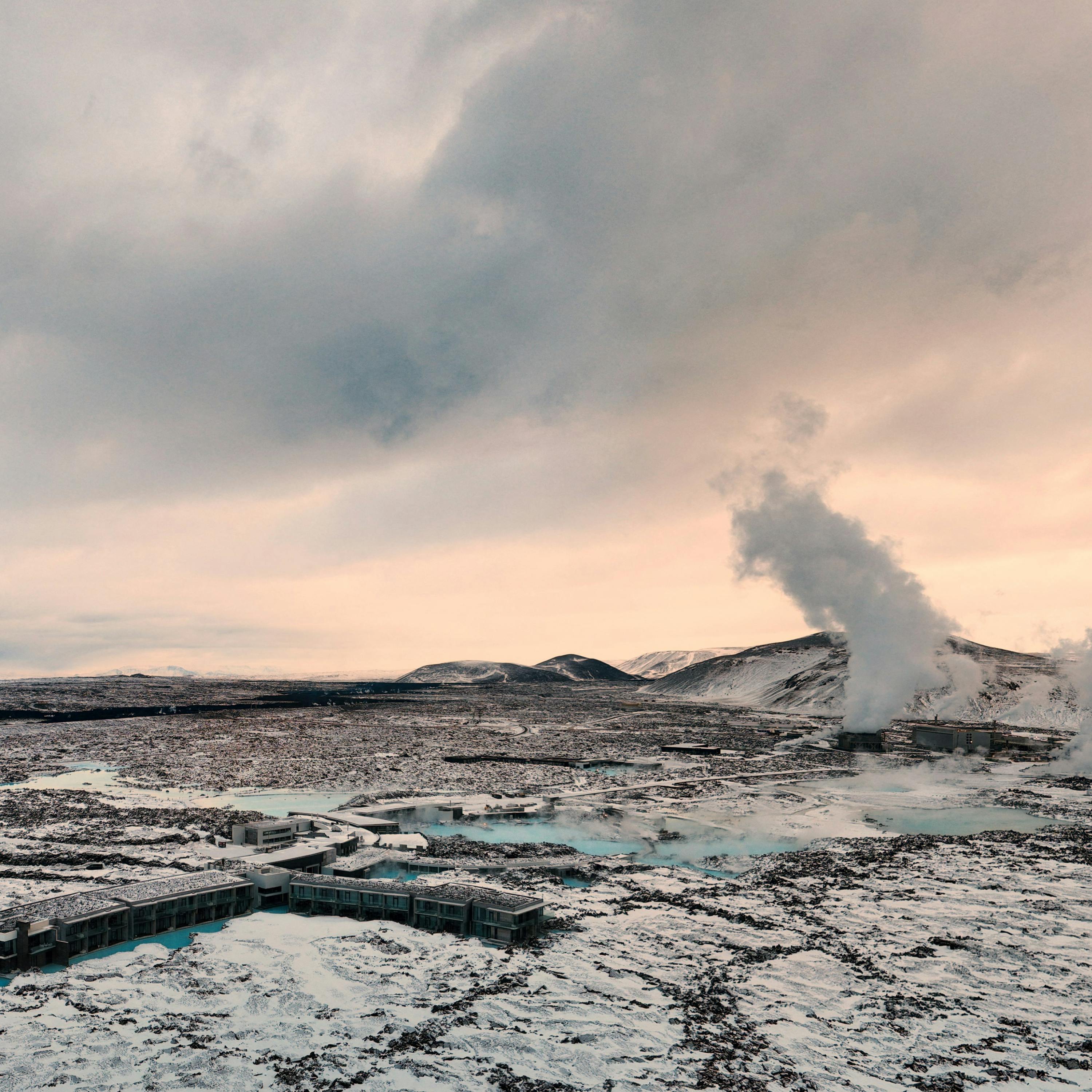
Drilling for clean energy
This episode was produced and hosted by Noam Hassenfeld, edited by Jorge Just, with mixing and sound design from Cristian Ayala, production support from Thomas Lu, and fact checking from Melissa Hirsch.
Listen to Today, Explained ad-free by becoming a Vox Member: vox.com/members. Transcript at vox.com/today-explained-podcast.
The Blue Lagoon geothermal spa and retreat hotel, next to a hardened lava stream and the Svartsengi Geothermal Power Plant, in Grindavik, Iceland. Photo by HALLDOR KOLBEINS/AFP via Getty Images.
Learn more about your ad choices. Visit podcastchoices.com/adchoices
Press play and read along
Transcript
Speaker 1 President Trump's big, beautiful bill was many things to many people. For those people who are worried about climate change, it was a disaster.
Speaker 1 Gone are the solar tax credits, the EV tax credits, and no surprise given the president's long-running fixation on birds, the wind tax credits.
Speaker 2 But I've restricted windmills in the United States because
Speaker 2
they also kill all your birds. You know, they wipe out, you know, it's interesting.
If you shoot a bald eagle in the United States, they put you in jail for five years.
Speaker 2 And yet, windmills knock out hundreds of them.
Speaker 1 But one form of clean energy did survive the Bills' assault, and that is geothermal energy. Geothermal projects are still going to get those tax credits.
Speaker 4 Why?
Speaker 1 Today, on Today Explained, we're going to travel to Iceland to learn why everyone is so excited about geothermal energy.
Speaker 6 Support for today's show comes from ATT, the network that helps Americans make connections according to ATT.
Speaker 7 When you compare, there's no comparison, ATT.
Speaker 8 With a Spark Cash Plus card from Capital One, you earn unlimited 2% cash back on every purchase. And you get big purchasing power so your business can spend more and earn more.
Speaker 8 Capital One, what's in your wallet? Find out more at capital1.com/slash spark cash plus. Terms apply.
Speaker 1
I'm Noel King. It's today explained from Vox with a very special episode from Unexplainable from Vox.
Here's Noah I'm Hassenfeld.
Speaker 10 All right, so I'm at the Blue Lagoon
Speaker 10 in Iceland,
Speaker 11 which
Speaker 10 is this
Speaker 10 100-degree
Speaker 10 almost fell into the lagoon.
Speaker 10 A while back, I went to Iceland and I decided to check out this dreamy, hot spring. It's kind of like in Pirates of the Caribbean, where Jack Sparrow is like kind of slowly going through the fog.
Speaker 10 I actually got lost for 15 minutes a couple minutes ago trying to find my way through this place because you can't see more than five or ten feet in front of you because it's so misty the whole place is filled with this mineral rich blue water it's this weird kind of thing where you can see your hand when it's at the top of the water and then you move it away and you basically can't see it at all because there's so much stuff in the water here It's also filled with tons of tourists like me just hanging out, drinking cocktails, getting massages.
Speaker 10 And then there's just all this steam in the distance. I guess like from the
Speaker 10 power plant?
Speaker 11 The power plant.
Speaker 10 And I am bathing in
Speaker 10
power plant wastewater at the moment. This is not what I expected to be swimming in on vacation.
But this is a power plant that's so incredibly clean, even its wastewater is a spa.
Speaker 10
And tourists like me, we love it. National Geographic even picked it as one of the 25 wonders of the world.
But I got to say, I think National Geographic slept on the real wonder here.
Speaker 10 What that wastewater does before it gets to the tourists.
Speaker 10 The water bubbles up from deep underground. It gets converted into steam.
Speaker 11 It spins a turbine, generates power.
Speaker 10 And then after that whole process, that's when it settles into this eerie blue pool. The blue lagoon.
Speaker 10 The reason I think this is the real wonder here is because of what this means for climate change. By far, the biggest contributor to global warming is fossil fuels.
Speaker 10 But geothermal energy barely has any emissions.
Speaker 10 In a lot of ways, it's even better than solar or wind because the inside of the Earth doesn't turn off at night or stop making power when there's no breeze. And these plants are all over Iceland.
Speaker 10 A ridiculous sounding two-thirds of Iceland's energy is geothermal. The country basically runs off power from the Earth itself, which makes sense.
Speaker 10 It's on a fault line, so all this hot water is just bubbling up to the surface all the time.
Speaker 10 But the fact is, no matter where you are on Earth, there's just tons of potential clean energy buried underneath you.
Speaker 10 We all just need to figure out how to get at it.
Speaker 10 I'm Noam Hasenfeld, and today on Unexplainable, why getting at all that unlimited energy is such a tough problem, and how we might just be on the verge of cracking it.
Speaker 11 It's really tantalizing that we are sitting on this big mass of hot rocks just a few miles beneath us.
Speaker 11 And it's so hot that in theory, it's more energy than we could ever need if we we could maybe get at it.
Speaker 10
That's Dylan Matthews. He's a senior correspondent on Vox's Future Perfect team.
And he writes about all kinds of big world-changing ideas from global health to economics to energy.
Speaker 10 So I asked him just how possible all of this is. So if you aren't lucky enough to have that hot water kind of bubble all the way up like it does in Iceland, what do you do to get at it?
Speaker 11 So up to now, the answer has been that unless you're on geysers or volcanoes or things, you don't. But there are efforts to make geothermal viable outside those areas.
Speaker 11 And the basic idea, which takes a bunch of forms, but all of them share the idea that you drill down really, really deep and you pour some kind of liquid down there and you get steam or hot water coming up.
Speaker 11 And then you can either use the hot water directly or you can use it to spin a turbine and make electricity. Okay.
Speaker 11 There's a few different companies trying this, but they're all variations on the same idea of like dig or blast really, really deep, pour some liquid in there, use that to spin a turbine or get some hot water.
Speaker 10 I mean, that seems like relatively straightforward to me.
Speaker 11 It is a lot harder than it seems.
Speaker 11 The biggest barrier that I've heard from people is just that getting that deep into the earth is really tough. It's really expensive.
Speaker 11
And there's also been a concern about what happens when you pour liquid into rocks that deep. There was a demonstration project in South Korea that wound up causing a magnitude 5.5 earthquake.
Whoa.
Speaker 12 Residents of the city of Puhang had to evacuate as aftershocks from Korea's second largest earthquake on record destroyed thousands of homes and injured dozens of people.
Speaker 10 Investigators confirmed it was man-made, caused by a nearby geothermal power plant.
Speaker 11 I feel obliged to say that this was an unusual incident and most geothermal to date has not been associated with any significant seismic activity.
Speaker 11 But this was a concern people had about fracking that has, I think, held up to some degree.
Speaker 10 Yeah, I mean, you're kind of like weakening the ground, right?
Speaker 11
You're weakening the ground. You're messing with the system deep in the earth, and you're putting liquid potentially in places where it hasn't been before.
Yeah.
Speaker 11 This is part of the reason why some companies are building what they call closed-loop systems.
Speaker 11 So instead of just pumping liquid into the ground and it heating up, you actually place a pipe all the way into the ground.
Speaker 11 and that way you're not leaking the liquid permanently but that's really hard you're actually like placing in piping potentially thousands of meters under the earth and so it's it's more investment in a very difficult kind of drilling and we don't have really good drill bits uh it sounds like such a trivial or technical thing but when i talk to people about geothermal one of the things they bring up again and again is just like we don't have good drill bits um that that is crazy that like the thing that is standing, or at least one thing that is standing between us and kind of limitless, clean, constant energy is drill bits.
Speaker 11 It seems really dumb, but also, I don't know, like rocks are really hard.
Speaker 11 It makes sense that that can be a real technical limitation.
Speaker 11 The more you learn about industries like this, it all becomes like incredibly complex to do something seemingly simple.
Speaker 11 In most closed-loop systems that people are trying to build right now, it is still at a point where you could generate electricity, but it won't do so super efficiently.
Speaker 11 So even if you nail all this, it might be hard for it to be cost competitive with something like solar or wind.
Speaker 10 So then why do it at all?
Speaker 11 So right now it's inefficient and we can't make that much energy from it relative to the cost. But the ultimate dream is that you can get four kilometers or even deeper into the ground.
Speaker 11 And this is where we get into what is super technically known as super hot rock energy.
Speaker 11 Oh,
Speaker 11
all right. We've so far been talking about hot rocks.
Now we're going to talk about super hot rocks. Hot and hard rocks.
Hot, hard rocks. Super hot.
Super hot, super hard rocks.
Speaker 11 And at that point, the rocks are going to be over 752 degrees Fahrenheit.
Speaker 11 And a special thing happens then, which is that water, H2O, becomes supercritical, which is a phenomenon where it acts both like a liquid and a gas. The pressure sort of liquefies it.
Speaker 11
The heat like is pushing it toward being a gas. It's stuck in this sort of mysterious in-between state.
But that means it can hold a lot more energy.
Speaker 11 The heat in the water is easier for turbines to turn into electricity.
Speaker 11 And you can get more electricity from the heat you're taking out of the earth than if you were sort of digging a little shallower and not getting to the supercritical level. Okay.
Speaker 11 The hard part is getting four kilometers into the earth.
Speaker 11 And so once you start asking that question, you start to hear ideas like this one company wants to fire what are called millimeter waves into the ground, vaporize the rock.
Speaker 10 Vaporize the rock.
Speaker 11 Just like fully vaporize it. Like
Speaker 11 things get more and more sci-fi sounding in this.
Speaker 11
And the best part about this is you could just hook into our pre-existing power grid. So we've got all these coal plants.
They're already hooked up to the grid.
Speaker 11 They already have the transmission you need. And you could just replace the sort of coal burning that goes into the turbines with geothermal.
Speaker 11 So once you get this to work, it's kind of plug and play. It's a pretty easy transition.
Speaker 11 But the sort of once we get this to work is a huge caveat.
Speaker 10 So given what we know we need to do here and even the vision that we have of it working efficiently someday,
Speaker 10 why isn't this happening?
Speaker 10 Is it the drill bits?
Speaker 11 I mean, there's,
Speaker 11 yeah, there's a lot of ways to look at the causes. Some degree it's about the drill bits, but why don't we have better drill bits? We've gotten better mining technology and other things.
Speaker 11 We've gotten better solar. Why haven't we invested in this? And I think some of that is that we need a lot for this to go right.
Speaker 11 You need a lot of technical innovations, especially if you want super hot rocks.
Speaker 11 And often when we're trying to develop early stage technologies like this, you need a lot of government help and subsidy. It requires a ton of just like physical investment up front.
Speaker 10 Yeah, they're like these huge complexes.
Speaker 11
Right. And we're at a time when administrations differ really profoundly on energy issues.
Politics is really unpredictable. With Trump, it's not always clear what he feels about stuff day to day.
Speaker 11 So, if you're one of these projects that's like a multi-year, hundreds of millions of dollars physical infrastructure project,
Speaker 11
one thing you want is consistency. You just like want to know that the support you're relying on from the government is always going to be there.
And
Speaker 11 one thing our government has not been recently is consistent.
Speaker 11 All that said, the geothermal people I talk to are kind of optimistic, cautiously optimistic at this point,
Speaker 11 for some maybe surprising reasons.
Speaker 1 Dylan Matthews, he's a reporter on Vox's Future Perfect team. Coming up, Noam Hassenfeld returns from Iceland to tell us where all this optimism is coming from.
Speaker 5 Support for J Explain comes from ATT.
Speaker 13 There's nothing worse than needing to make a call and realizing you can't connect says ATT.
Speaker 14 And of course, every wireless provider will claim that they're the best, but ATT says ATT has the goods to back it up.
Speaker 16 According to Root Metrics, ATT earned the best overall network performance.
Speaker 17 While the other guys are busy making claims they can't keep, AT ⁇ T says they're making connections on America's fastest and most reliable wireless network.
Speaker 4 No matter if you're at a concert, a huge sporting event, or just out enjoying nature, you can post when you want to post. Don't post when you're enjoying nature, guys.
Speaker 5 Keep it in control.
Speaker 15 Call when you want to call and rest easy knowing that no matter where you go, AT ⁇ T has got you covered.
Speaker 7 When you compare, there's no comparison.
Speaker 5 ATT.
Speaker 14 Based on Route Metrics, United States Route Score Report 1H2025 tested with best commercially available smartphones, smartphones on three national mobile networks across all available network types, your experiences may vary.
Speaker 5 Root Metrics rankings are not an endorsement of AT ⁇ T.
Speaker 6 Support for J Explain comes from AT ⁇ T. There's nothing worse than needing to make a call and realizing you can't connect is AT ⁇ T.
Speaker 5 And of course, every wireless provider will claim that they're the best, but but AT ⁇ T says AT ⁇ T has the goods to back it up.
Speaker 5 According to Root Metrics, AT ⁇ T earned the best overall network performance.
Speaker 17 While the other guys are busy making claims they can't keep, AT ⁇ T says they're making connections on America's fastest and most reliable wireless network.
Speaker 3 No matter if you're at a concert, a huge sporting event, or just out enjoying nature, you can post when you want to post.
Speaker 4 Don't post when you're enjoying nature, guys.
Speaker 5 Keep it in control.
Speaker 15 Call when you want to call and rest easy knowing that no matter where you go, AT ⁇ T has got you covered.
Speaker 7 When you compare, there's no comparison.
Speaker 5 ATT.
Speaker 14 Based on Root Metrics United States Route Score Report 1H2025 tested with best commercially available smartphones, smartphones on three national mobile networks across all available network types, your experiences may vary.
Speaker 5 Root Metrics rankings are not an endorsement of ATT.
Speaker 18 Support for Today Explained comes from Chime. What's Chime? Chime is different.
Speaker 15 Chime is a financial technology company that wants you to embrace each and every dollar.
Speaker 15 When you set up direct deposit with Chime, you can get access to fee-free features like overdraft protection, or they say you can get paid up to two days early and even more.
Speaker 6 Speaking of no fees, Chime says that when you open a check-in account with them, there are no monthly fees and no maintenance fees.
Speaker 17 And with qualifying direct deposits, you can be eligible for free overdraft up to $200 on debit card purchases and cash withdrawals. Not to mention, although I will, $47,000 fee-free ATMs.
Speaker 17 You can work on your financial goals through Chime Today.
Speaker 18
You can open an account in two minutes at chime.com/slash explain. That's chime.com/slash explain.
Chime feels like progress.
Speaker 19 Chime is a financial technology company, not a bank. Banking services and debit card provided by the Bank or Bank NA or Stride Bank NA members of DIC.
Speaker 19
Spot me eligibility requirements and overdraft limits apply. Timing depends on submission of payment file.
Fees apply at out-of-network ATMs, bank ranking, and number of ATMs, according to U.S.
Speaker 19 News and World Report 2023. Chime checking account required.
Speaker 5 I'm Noelle King.
Speaker 1 Today Explained is airing an episode from our friends at Unexplainable. Here's Noah.
Speaker 10 This year, geothermal has been everywhere.
Speaker 10 That geothermal so hot right now.
Speaker 10 In the first few months of 2025, there's been almost as much geothermal investment as there was all of last year. And there's also been a lot of progress on the ground, or under the ground.
Speaker 10 One company in Utah has drilled 15,000 feet down to a point where the temperature is over 500 degrees Fahrenheit.
Speaker 11 So almost to that supercritical stage.
Speaker 10 There's a company that does closed-loop geothermal, so the kind where the water is always in an underground pipe and it doesn't leak. They're on track to generate actual electricity this year.
Speaker 10 The rock vaporization guys just made their first real-world demonstration.
Speaker 10 And then even though Trump's big old bill made huge cuts to wind and solar investment, there was a specific carve-out for geothermal, in large part due to the current Energy Secretary, Chris Wright.
Speaker 20 Will you pick up the phone and push Congressional Republicans to maintain the energy tax credits for geothermal?
Speaker 10 I have been doing just that. Wright has founded multiple fracking companies, and he's been a big investor and backer of geothermal for years.
Speaker 10 It's just an enormous, abundant energy resource below everyone's feet.
Speaker 10
Geothermal energy crosses partisan lines. It's renewable energy just for people that like oil and gas because it's all about drilling.
And fracking is a big reason geothermal has even gotten this far.
Speaker 11 The fracking revolution has dramatically improved the technology for drilling deep into the earth.
Speaker 11 And it's been a big boon to geothermal sort of accidentally that natural gas has invested many, many billions of dollars into getting better at drilling deep.
Speaker 11 And so you have this very skilled workforce and
Speaker 11 these new drilling technologies that can make it easier than it would have been 15 years ago before fracking had made all this progress.
Speaker 10 That's interesting.
Speaker 11 Yeah, this is something you hear a lot from geothermal people of what does a just transition away from a fossil fuel economy look like?
Speaker 11 And one of the questions they want to ask is, you know, what happens to the people who are doing all the drilling who are producing all this oil and gas right now?
Speaker 11 And one potential answer is, well, they keep drilling, but they drill geothermal wells rather than oil and gas wells.
Speaker 10
This all sounds great. It sounds even, you know, dreamily bipartisan.
But we do know there are downsides. There's the earthquake you mentioned, even if it's maybe a rare event.
Speaker 10 If this is kind of relying on a lot of fracking technology, is there a possibility that this is going to lead to a lot of the problems that fracking led to?
Speaker 11 I mean, I think there's, anytime you're drilling into the earth, there are risks, especially regarding sort of the liquid. You're using potential contamination of groundwater.
Speaker 11
And I think there have been fracking projects in the U.S. that have had fairly minimal impacts in that regard.
They're ones that have had very bad impacts.
Speaker 11 And so I would hope that if we're doing this with geothermal, we would try to emulate best practices and avoid that.
Speaker 11 But at the end of the day, geothermal and natural gas are very different technologies. One of the big concerns with natural gas is that methane leaks from either the drilling site or from pipelines.
Speaker 11 And that just doesn't happen to any significant degree with geothermal.
Speaker 10 Yeah, we're not trying to get at methane in the ground here.
Speaker 11
Right, right. Natural gas, like, sort of is methane.
Yeah, yeah, yeah. That's strange.
Speaker 21 Strange rebranding.
Speaker 11 Yeah. It's a fairly specific problem to them.
Speaker 11 And I think with any new technology like this, the thing that everyone developing is afraid of is that people will get spooked about it, the way people got spooked about nuclear and will shut it down before it has a chance to prove itself.
Speaker 11 And so I would say that the attitude is one of an abundance of caution.
Speaker 10 So if this does work, you know, and we do end up doing it safely and responsibly, it feels like this has the potential to really stick.
Speaker 11 Yeah, I think that's the dream. The Asterix is always like, it needs to work, right?
Speaker 10 Right.
Speaker 11 The thing about fracking is that it provided all these jobs for people in drilling, but it also like provided a really cheap and reliable source of energy. And
Speaker 11 it worked and it was cost competitive. And
Speaker 11 the challenge for geothermal is, okay, you have this attention. You have government regulators that are paying attention.
Speaker 11
You have the Trump administration that is pretty positive on all kinds of drilling, both oil and gas and geothermal. So now can you do it? Right.
And I don't know.
Speaker 11 I think the nuclear industry has had a lot of like innovation and big ideas in the last 15 years and it's just kept getting more expensive. And ultimately, the proof is in the
Speaker 10 drilling.
Speaker 11 The proof is in the drilling.
Speaker 11 I was going to say something about the levelized cost of energy, but the proof is in the drilling is pithier.
Speaker 10 I'm curious if you can just paint me a picture of what the world might look like if we do get this right. Like,
Speaker 10 what would a world with fully tapped geothermal potential look like?
Speaker 11 Yeah, there was a report from these two energy experts I like a lot, Austin Vernon and Eli Dorado, that was trying to like really give a kind of blue sky, almost sci-fi picture of what you could do if you just like didn't need to worry about scarcity of energy.
Speaker 11 And I think part of the point of the exercise is to sort of highlight ways in which not having enough energy for stuff kind of structures our worlds, even as we don't realize it.
Speaker 11
Like vertical farming. People have been trying to do farming in a way that makes better use of land and takes up less of our landscape.
the real problem is that you need tons of energy for it.
Speaker 11 If you had abundant geothermal, you could have skyscraper farms. You could have desalination plants that obviate the need for these huge aqueduct systems in places like California.
Speaker 11 You would have more than enough energy to get all the drinking water you need from the ocean.
Speaker 11 I think the point of this is not like draw some sci-fi utopia, but just a lot of our world is structured by what we don't have.
Speaker 11 And we definitely don't have enough energy to do all the things that we want to do.
Speaker 11 And an appealing thing about geothermal is that there's way more heat in the Earth's crust than humans would ever know how to use in a million years. And that can be pretty exciting.
Speaker 10 So then to get to our sci-fi energy abundant future, we just need to have consistent politics that we all agree on, massive government spending, and
Speaker 11 really, really good drill bits yeah but other than that yeah very easy so
Speaker 11 so what do you think ends up happening here how optimistic are you in the end so i want to sort of yeah distinguish kinds of optimism here like do i think there will be one company or two that is doing geothermal the kind that you can do almost anywhere and doing that at a reasonable scale I'd say I'm pretty optimistic.
Speaker 11 I think that's more likely than not. There's a difference, though, between that and this is a major source of energy in the U.S.
Speaker 11 And I'm a lot less certain on this will get to a point fast enough that it is, it can sort of win the race with wind and solar and batteries and that kind of thing.
Speaker 10 And it's just a matter of what works fastest, best, and cheapest in the end.
Speaker 11
Yeah. For better or worse, the U.S.
energy system is run by rapaciously bottom-line-oriented capitalists.
Speaker 11 And so, like, if the cheapest way to provide electricity in Texas, the state that produces more oil than any other state, is to use solar, they'll use solar. Right.
Speaker 11 And sure enough, like they build a lot more solar than states that you would think of as more pro-solar. And I think that's been driving a lot of progress toward renewables lately.
Speaker 11 And that can be pretty ruthless for young technologies. So I don't want to, I think there's totally a world where this is a cool idea that gets some adoption, but does not take the world by storm.
Speaker 11 But there's also a world where it works better than we thought it would, and it kind of surprises everybody.
Speaker 11 And yeah, in that world, maybe you come back and you re-listen to this and think, yeah, maybe those guys were onto something.
Speaker 10 All right, Dylan, thanks so much for coming on the show.
Speaker 11 Thanks for having me.
Speaker 10 This episode was produced by me, Noam Hasenfeld.
Speaker 10 We had editing from Jorge Just, mixing and sound design from Christian Ayala, music from me, production support from Thomas Liu, and fact-checking from Melissa Hirsch. Meredith Hodenott runs the show.
Speaker 10 Julia Longoria is our editorial director. And Bird Pinkerton stared at the platypus,
Speaker 10 who looked down and sighed.
Speaker 5 They have the babies, the puggles.
Speaker 10 The bird said, if we didn't help them.
Speaker 10 Thanks as always to Brian Resnick for co-creating the show. And if you have any thoughts about the show, any criticisms, show ideas, personal reflections on anything you've heard, send us an email.
Speaker 10
We're at unexplainable at box.com. We love hearing from you.
And we read every email.
Speaker 1 They do read every email. Today Explained will be back tomorrow with an episode about affirmative action.
Speaker 1 The Supreme Court ended race conscious admissions two years ago, about two years ago, but the Trump administration thinks elite colleges are cheating and it's trying to catch them in the act.
Speaker 10 If your team is spending more time chasing paperwork than actually closing, then it's time to consider using Smartsheet.
Speaker 10 Smartsheet is the intelligent work management platform that embeds AI-powered execution to drive the velocity of work.
Speaker 10 With AI-first capabilities, you can make work management your superpower, getting personalized insights, automatically creating tailored solutions, and streamlining workflows to elevate your work.
Speaker 10 Plus, this intelligence layer unites people, processes, and data, helping you tackle any work management challenge. Visit smartsheet.com/slash Vox.
Speaker 21 Nobody knows your customers better than your team, so give them the power to make standout content with Adobe Express.
Speaker 21 Brand kits make following design rules a breeze, and Adobe quality templates make it easy to create pro-looking flyers, social posts, presentations, and more.
Speaker 21 You don't have to be a designer to edit campaigns, resize ads, and translate content. Anyone can in a click.
Speaker 14 And collaboration tools put feedback right where you need it.
Speaker 21 See how you can turn your team into a content machine with Adobe Express, the quick and easy app to create on-brand content. Learn more at adobe.com slash express/slash business.


