What the right gets wrong about Tolkien
This episode was produced by Peter Balonon-Rosen with help from Ariana Aspuru, edited by Jolie Myers, fact-checked by Laura Bullard, engineered by Patrick Boyd, and hosted by Noel King.
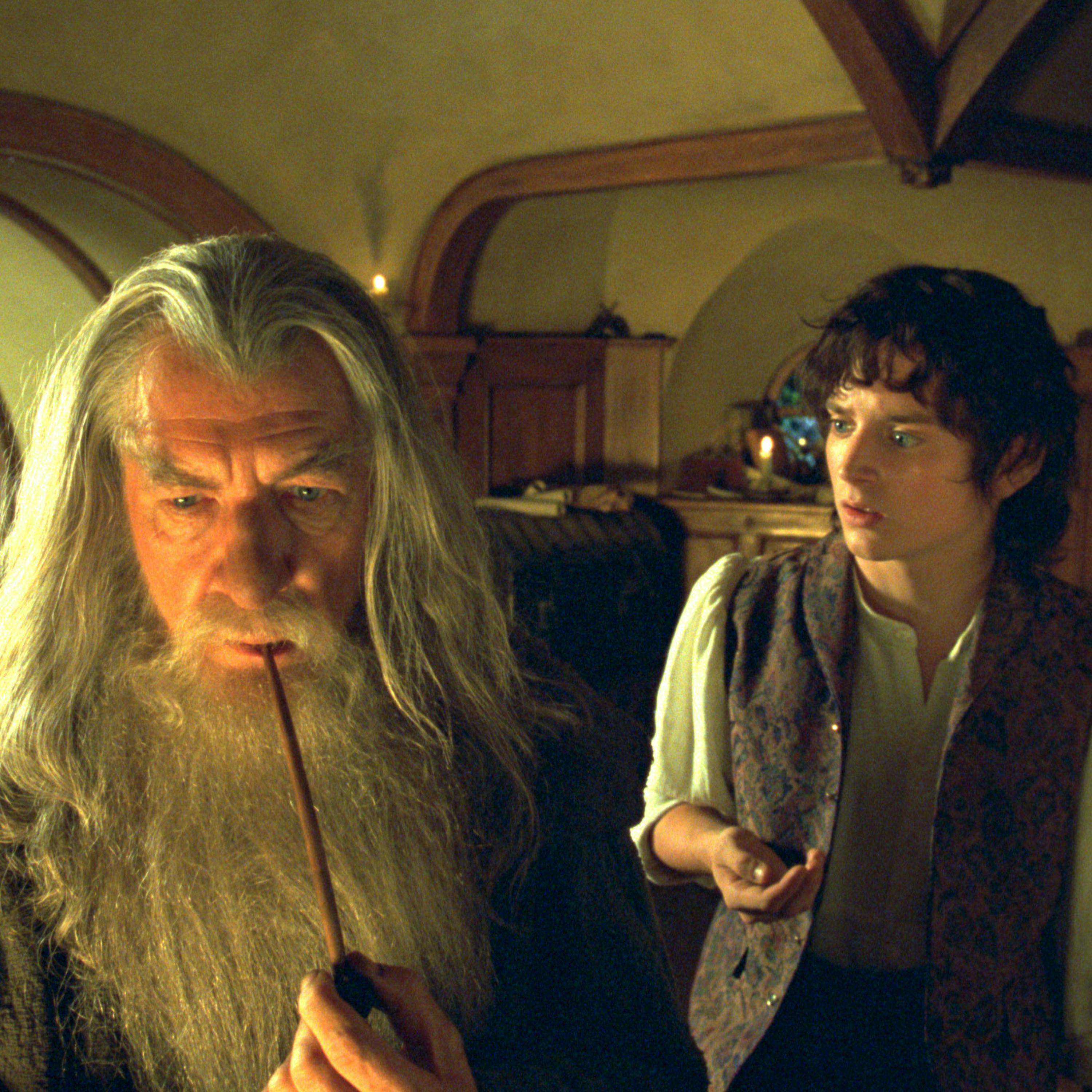
Ian McKellen as Gandalf with Elijah Wood as Frodo in "The Lord of the Rings: The Fellowship of the Ring." Photo by New Line/WireImage.
Listen to Today, Explained ad-free by becoming a Vox Member: vox.com/members. Transcript at vox.com/today-explained-podcast.
Learn more about your ad choices. Visit podcastchoices.com/adchoices
Press play and read along
Transcript
24 years ago, a nation on edge after the attacks of September 11th went to the movies. One does not simply walk into Mordor.
To watch the Fellowship of the Ring, Americans saw themselves in J.R.R.
Tolkien's tale of good and evil and hobbits. Don't think he knows about second breakfast, baby.
What about Elevensies?
Luncheon, afternoon tea, dinner, supper. He knows about them, doesn't he?
And why not? A fellowship of good guys and good elves and good dwarves trying to restore peace to the world by destroying the one ring. Americans love and love to be the good guys.
Then in the great political upheaval of the last decade or so, some people on the right claimed the mantle of the Lord of the Rings as their own. But did they misunderstand the message?
Coming up on Today, explain from Vox why those books and those movies still resonate in a nation still on edge.
Support for today's show comes from March of Dimes. The United States is among the most dangerous developed nations in the world for childbirth.
This giving Tuesday, you can support the health of all moms and babies with the gift to March of Dimes.
March of Dimes leads the fight for the health of all moms and babies through research, education advocacy, and programs like our NICU Family Support, plus things like mom and baby mobile health centers.
You can donate today at marchofdimes.org slash vox. That's marchofdimes.org slash vox.
Support for the show comes from Crucible Moments, a podcast from Sequoia Capital.
Success is never a given, especially in tech, where everything is evolving at breakneck speed.
The difference between victory and catastrophe can sometimes all come down to a counterintuitive instinct or ignoring conventional wisdom to make a bold decision.
That's what Crucible Moments is all about. Crucible Moments is back with a new season season telling us about the unlikely triumphs of tech giants like Supercell and Palo Alto Networks.
New episodes out now and available everywhere you get your podcast.
And at CrucibleMoments.com. Listen to Crucible Moments today.
This is today's plant.
My name is Constance Grady, and I'm a senior correspondent on the culture team.
A young hobbit embarks on a journey through a magical but dangerous world, and The Lord of the Rings, one of six holiday movies, we'll review this week. My God, Middle Earth does exist, eh?
It's not just a story for kids, it's a story for everyone. So, The Lord of the Rings comes out after September 11th.
It comes out on December 10th. What makes this story so special?
By appealing to generation after generation after generation, often for different reasons.
So it reaches this audience that's really, really primed to interpret almost everything through the lens of 9-11.
Talking representing the counterculture will be quite different from maybe the audience at the moment,
particularly in America, at north. Here's a movie about a grand, sweeping, epic battle between good and evil.
Middle-earth stands upon the brink of destruction. None can escape it.
You will unite or you will fall for it.
That fits really nicely into the narrative that the Bush administration especially had begun building for the country about how we were going to respond to 9-11.
We will rid the world of the evildoers.
We will call together freedom-loving people
to fight terrorism. Nearly every review makes a mention of 9-11.
They say, oh, this is the moment for this kind of epic good and evil battle movie.
With the world newly obsessed with the clash of good and evil, the time would seem to be ideal for the Lord of the Rings.
Tolkien's tale of good people who band together against a dark lord and his minions has never been more timely than in our troubled age.
There was an enormous piece in the New York Times by the film critic Karen Durbin, sort of nailing down what she calls the accidental echoes between the Lord of the Rings and the current geopolitical climate.
Evil or evildoers. Sauron or Saddam.
And how many towers? The second book and the second film are both called The Two Towers, which had some pretty unfortunate echoes.
In the current climate, it's impossible not to experience Peter Jackson's Two Towers as war propaganda of unnerving power. The movie was very expensive, right? It was like a big risk.
And
what was the perception at the time of how it would do?
So the savvy take about Fellowship of the Ring when it first comes out is this is probably not going to make its money back. These movies were incredibly expensive to film.
They had to develop whole new forms of CGI for the battle sequences.
We ended up with, you know, upwards of 350,000 characters. For this animation on Gollum,
for all the kind of optical tricks that they do to make the hobbits and the dwarves small and the elves and the humans big.
I mean, we'll just have a look at the footage, but I think we're not gonna notice.
It's a really, really expensive movie. And Peter Jackson, at this point in time, is not really considered that dependable of a director.
He has made a couple really well-regarded indie movies, but his big budget movie,
they've flopped. And not to mention, Hollywood hasn't made a successful fantasy series since at this point since the Star Wars movies in the 70s.
The smart money kind of is saying, if there's going to be a fantasy movie franchise that does really well, it's probably going to be Harry Potter.
Not me, not Hermione, you. Lord of the Rings is much older, and the mythology is so complicated and kind of baroque that it doesn't seem like it's going to lend itself to movies as well.
But then, dot dot dot.
Yeah, then it's a huge hit.
Breaks all kinds of box office records and famously is nominated for best picture at the Oscars. This is a point in time when no genre movies are getting nominated for best picture.
It's like a real, real big deal when it breaks through there. Did 9/11 have anything to do with the success of the movie? Do you think?
You know, in a lot of ways, the Lord of the Rings are were movies.
They're about
these
peaceful towns that are being menaced by this
faceless,
almost animalistic other.
We see Sauron as just an eye and the orcs are kind of this mass.
That becomes really appealing when you're trying to psych yourself up for this idea that
You were a blameless, peaceful town and this enemy just attacked you out of nowhere and they're they're evil, and you're good, and you are going to go and make them pay for what they've done to you.
The bad guys
are mostly faceless, mostly don't really talk, kind of this indistinguishable horde that you don't even have to think about whether they're worth sympathizing with, right? They're just the bad guys.
Yeah, that all makes sense. I think, um, okay, so let's say that the orcs are, you know, our enemies, the attackers, and the United States, we're thinking of ourselves as the hero.
But the hobbits. What about Second Breakfast? The Hobbits were like little peaceful guys in their, what do they call them, in their little holes? The Shire, the Shire.
The little holes. Right, yeah.
Who in the American narrative were the Hobbits? That's such a good question. Yeah.
The Hobbits are not necessarily the most compelling characters on screen. No.
No, they are not. Yeah, yeah.
They're They're the main characters of the books, but when you think of the movies, you think of, you know, like
Aragorn opening those two doors really dramatically and striding through, or like Legolas and Gimli having their bet about who can kill more orcs. Final count
42. 42.
It's really about the military characters. They're who are dynamic.
They pop on screen. They're cinematic.
And that's who we were paying most attention to at the time. All right, let's go.
Let's go back in time because prior to 9-11, the world had fought wars, including two of them quite famously.
How did the post-9-11 interpretation of these books in the war context compare to earlier interpretations?
Yeah, so earlier interpretations of The Lord of the Rings had really been focused on the idea that these are books about the cost of war.
They're focused so heavily on the trauma of war and how terrible it is and how it's ruined lives when everyone comes back from the battles at the end.
One evening, Sam came into the study and found his master looking very strange. He was very pale and his eyes seemed to see things far away.
What's the matter, Mr. Frodo, said Sam.
I am wounded, he answered. Wounded.
It will never really heal.
So there's this strong, strong tradition of using these books as ways to talk about the horrors of war. In the 1960s,
there are hippies who are protesting the war in Vietnam, holding up signs that say like hobbits against the war.
There's a tradition of reading the ring as a metaphor for the atomic bomb. The kind of allegory of the H-bomb.
What is said somewhere in the book is that the one ring is a power so enormous that even if a good man were to use it against a bad, it would corrupt the good man.
No one can be trusted to really use it responsibly.
The
post-9-11 moment is kind of unique for being the time when people are like, actually, this story is about how war is like kind of cool and rad and like a good thing to do when
you're the good guys and you're fighting the evil guys.
How did that time,
20, 24 years ago now, how did that set up Lord of the Rings, the movies,
to have a life today?
I think that 9-11 is no longer really considered part of the Lord of the Rings film legacy. I think it's been kind of memory-hold in a lot of ways.
And now we just kind of think of them as, you know, the craft. They're well-crafted movies.
They introduce all of these cool new film techniques.
And, you know, they're a good adaptation of an epic story.
But I think looking back at this moment when this narrative that the Lord of the Rings was about, the war on terror was so
strong and potent can really help us see how the things we're living through now shape the stories that we are experiencing today,
and whether we'll still think of them the same way 24 years later.
Vox's Constance Grady. Coming up, what the Lord of the Rings means to the right.
Support for Today Explained comes from Quo. Quo says every time you miss a call, that's money left on the table.
Quo, formerly Open Phone, is a business phone system that's built for 2025, not 1995.
They say they help you work smarter, build stronger relationships, never miss an opportunity because that's what your business deserves, says Quo. Quo works from an app on your phone or computer.
Your whole team can share one number and collaborate on calls and texts. Quo says they're not just a phone system, they're a smart system.
And they say that their built-in AI logs calls, writes summaries, and even sets up next steps.
And if you can't answer the phone, Quo's AI agent can qualify leads, route calls to the right person, make sure no customer is ever left hanging.
That's why over 90,000 businesses from solo operators to growing teams are already using Quo, according to Quo. Quo is offering listeners 20% off your first six months at quo.com/slash explained.
That's quo.com/slash explained. You can even keep your existing number for free.
Quo, no missed calls, no missed customers.
Support for Today Explained comes from Framer. Framer wants to know, does your website look good?
Well, if you're in the market, Framer wants to help you create a beautiful website with designs that can be used across your brand. What's Framer? Framer is a full-featured design tool.
Unlimited projects, unlimited pages, unlimited collaborators, and all those essentials, those vectors, those 3D transforms, those gradients, those wireframes, everything I'm told you need to design.
Framer claims they've built the fastest way to publish websites and are now defining how we design for the web.
True all-in-one design platform, social assets, campaign visuals, vectors, and icons, all the way to a live site. Ready to design, iterate, and publish all-in-one tool?
You can start creating for free at framer.com/slash design and use code explained for a free month of framer pro. That's framer.com/slash design and use promo code explained.
Framer.com/slash design promo code explained. Rules and restrictions do apply.
Support for Today Explained comes from Ethos. What's this about? It's about life insurance.
Term life insurance can give you peace of mind that should the unthinkable happen, your family will be able to continue on without you, frankly.
Ethos says it's an online platform that makes getting term life insurance easy. There is no complicated process, 100% online, says Ethos.
No medical exam required.
You just answer a few health questions. And I'm told you get a quote in as little as 10 minutes without ever leaving your house.
You can get up to $3 million in coverage, and some of these policies are as low as $2 a day, billed monthly.
As of March 2025, Business Insider had named Ethos the number one no medical exam instant life insurance provider. Protect your family with life insurance from ethos.
Get a free quote at ethos.com/slash explained. That's e-th-h-os.com/slash/explained.
Application times may vary. Rates may also vary.
One ring to rule them all.
One ring to find them.
One ring to bring them all.
And in the darkness, explain them.
I'm David French. I'm a columnist for the New York Times.
And you are a self-described nerd.
Yes, yes. I own that.
I own that. Absolutely.
All right. So, in The Lord of the Rings, which character do you most identify with? Who are you? You know, that's a really good question.
And I think it evolves over time. So, when I first read it, when I first read it, I wanted to be Legolas.
You know, very cool elven warrior that is almost got superhuman powers. You know, you imagine yourself like that.
And then the older I got, the more I wanted to be the Faramir character, which that is one of,
we're going to go deep. It's going to get nerdy.
The difference between Boromir, his brother, and Faramir is that both of them had the ring of power, in essence, in their grasp.
And Boromir grabbed for it, this ultimate weapon to fight evil. Why not use this ring? If you would but lend me the ring.
So that you could fight strength with strength. And then Faramir rejects it.
He says, absolutely not.
I would not take this thing if it lay by the highway, not where Minas Tirith falling in ruin, and I alone could save her. So using the weapon of the Dark Lord for her good and my glory.
Two very different views of power and very different views on how to fight evil.
That Boromir versus Farimir distinction is really central to sort of the Tolkien approach to power and the sort of the Tolkien ethos that suffuses Lord of the Ring.
so i've over time aspired to be more like farmer as opposed to just being wowed by the superhuman capabilities of the elven warrior legalis
so what you're pointing to is that there is in these books there is enormous depth right yeah there are dynamics that are as old as humanity itself you write that
The Lord of the Rings today in 2025 has geopolitical implications. What do you mean by that?
Well, it's very interesting that a number of leading figures in sort of the global new right have identified the Lord of the Rings as deeply influential on them.
So when you think of the new right, I think of it as the Trump right or the post-Reagan right that has explicitly rejected the sort of more libertarian view of government in favor of a much more authoritarian view, a much more statist, top-down, dominating, authoritarian version of the role of government in American life.
Lord of the Rings shaped J.D. Vance's worldview.
He even named one of his companies after an elven ring, Naria.
Gandalf now wore openly on his hand the third ring, Naria the Great. Peter Thiel is a founder of a company called Palantir, and that's a term from Lord of the Rings.
A palantir is a dangerous tool, Salaman. Vance is also an investor in Andural Industries, another name from Lord of the Rings.
Anduril, the flame of the west, forged from the shards of Narcin.
So full disclosure, unless anyone think I'm condescending about this in any way, I own a replica of the sword Andural.
It's in my house.
So it's been undeniably influential. And the point I was trying to make is it's been influential, but they've taken the wrong lessons.
Yeah, let's talk about that.
What is the message and what are they getting wrong about it? Yeah.
You know, there's this sort of underdog story element of it where a lot of movements that feel as if they are counted out or that the establishment is against them or large forces are against them see themselves in kind of the hobbits or the fellowship of the ring and Lord of the Rings, this sort of band of brothers and sisters battling a great evil.
And so it really appeals to dissident movements and insurgent movements in that way.
But then when you read deeper and deeper and you really begin to understand the underlying ethos of the work, you see that, yes, it is a tale of good versus evil, but it's also a tale of how corruptible good can be.
Good gets corrupted when it adopts evil's tools to defeat evil, when it yields to sort of this ends justifies the means.
And so consistent in the Tolkien work is that it's unlikely people, it's unlikely events that undo great evil. It is not that you you confront power with power.
And so that's the part that a lot of these guys miss is this profound rejection of power as the means of fighting evil. What are they missing when they miss that? What are the implications of that?
Oh,
they're missing the heart and they're missing the heart and they're missing it in a dangerous way.
Go back to what I was talking about earlier about the Boromir versus Faromir contrast, that at a time of great need and a time of great danger, Boromir does the thing that it would be natural for humans to do.
He says to, you know, in the Council of Elrond,
he talks and he is puzzled and stumped by this idea that you would not use this incredibly powerful weapon created by the enemy against the enemy.
But it's this quest for power that is the most insidious element of it of it all in the Tolkien universe.
And so Sauron, yes, Sauron is the big bad guy, but there's a more subtle evil at work that is not personified by Sauron. The more subtle evil is that will to power.
So that even if good defeats evil, if good adopts evil's means to defeat evil, then good becomes evil.
You get the feeling like a lot of the sort of the new right
is a lot of Boromirs.
boromirs they're the ones that are questing and seeking that will to power seeking the ring when you're in the pursuit of power every every step you take needs to generate more power everything you do needs to make further actions easier the nor new right wants to seize power it wants to dominate and then it says that it's just a better form of domination than the other side because it's dominating for virtue for good in their in their construct we don't like the model of the left we have a different model model in mind, and we're going to exert both power and we're going to spend resources in remaking.
Fighting itself generates tremendous information and if you win, it generates more power. You really need to be really ruthless when it comes to the exercise of power.
But Tolkien says the very quest to dominate is what corrupts you. Even if you have motives to try to do justice, that quest to dominate is ultimately corrupting.
The new right is essentially a movement and a very interesting one.
If we were to look throughout history, the last hundred years or so, what other movements have taken Tolkien and said we see ourselves here? Oh, lots, lots. The old right, you know, so like
what you might consider me, you know, we use different terms now, but Reagan conservatives, like I would consider myself a Reagan conservative.
Any movement that I would say has seen itself as being sort of against all odds, embattled minority underdog.
So, for example, environmentalists for a very long time, especially I would say in the 70s and 80s, really latched on to Tolkien because when you read his works, you see this big contrast between kind of the industrialization and destruction of nature by the forces of Mordor and Isengard.
The old world will burn the fires of industry, the forests will fall
versus the Shire,
Old Tovine, the finest weed in the South Valley. And the elves of Rivendell who care for nature and nurture it.
Welcome to Rivendell, Frodo Baggins.
You see evangelical Christians take up the banner, Catholics take up the banner.
Lots of different people, especially people who see themselves as underdogs,
can connect with the story. And that's part of the genius of it.
That's part of the beauty of it.
But what's even more beautiful about it is that when you really dive into it, it doesn't just teach you about good and evil and a battle between good and evil.
It also teaches you what good should be and what good should look like.
Good is compassionate. It cares for the vulnerable.
It preserves and protects natural beauty. It shuns domination and the will to power.
So if you look at Tolkien, it's definitely not a pacifistic tale. I mean, Aragorn is a warrior, Legolas is a warrior, Gandalf, my goodness, very powerful wizard, you know.
So, he,
you absolutely have all of this physical courage and this martial courage that you see in Tolkien.
It is in this concept of the defense of what's true, the defense of what's good, the defense of what's beautiful, and not appealing to domination, will to power to ultimately triumph over evil.
So to pull back into the present day, the new right here in the United States, let's focus on them.
Is the takeaway that they may love Tolkien, but Tolkien likely would not have loved them back?
I would say that Tolkien would be frustrated and that Tolkien would urge them to read again and give it a bit of a closer read.
Because this sort of, especially the way in which
the will to power has manifested itself on the Trump right,
with often accompanied by very vulgar displays of wealth and opulence, that is not very Tolkien-esque. That doesn't say that there's not much of that that screams the shire.
For example, you know, if you're if you're in the new right and you read the Lord of the Rings as we're taking on terrible people and we see ourselves in that role, you can see why they embrace it.
But when you dig deeper, when you dig deeper, you feel like they need to give it another read.
David French is a columnist for the New York Times. Peter Balinon Rosen produced today's show with help from Ariana Espuru.
Jolie Myers edited. Patrick Boyd is our engineer.
And Laura Bullard checks the facts.
Today Explained is made by Avishai Artsi, Rebecca Ibara, Hadi Muwagdi, Miles Bryan, Danielle Hewitt, Kelly Wessinger, Denise Guerra, Devin Schwartz, Adrian Lilly, and Amina El Sadi.
Sean Ramas firm thinks it's AI at 19 seconds. Miranda Kennedy is our EP.
We use music by Breakmaster Cylinder. Would you like Today Explained without ads?
Try vox.com/slash members. Would you like more Vox podcasts? Visit podcasts.voxmedia.com.
We are distributed to public radio stations by WNYC in NYC. I'm Noel King.
It's Today Explained.
300 sensors, over a million data points per second. How does F1 update their fans with every stat in real time? AWS is how.
From fastest laps to strategy calls, AWS puts fans in the PID.
It's not just racing, it's data-driven innovation at 200 miles per hour. AWS is how leading businesses power next-level innovation.
If you're tired of database limitations and architectures that break when you scale, then it's time to think outside rows and columns. MongoDB is the database built for developers, by developers.
It's ACID-compliant, enterprise-ready, and fluent in AI. That's why so many of the Fortune 500 trust MongoDB with their most critical workloads.
Ready to think outside rows and columns?
Start building faster at mongodb.com slash build.