Should Democrats shut it down?
This episode was produced by Miles Bryan and Danielle Hewitt with help from Avishay Artsy, edited by Amina Al-Sadi, fact-checked by Laura Bullard, engineered by Patrick Boyd and Adriene Lilly, and hosted by Noel King.
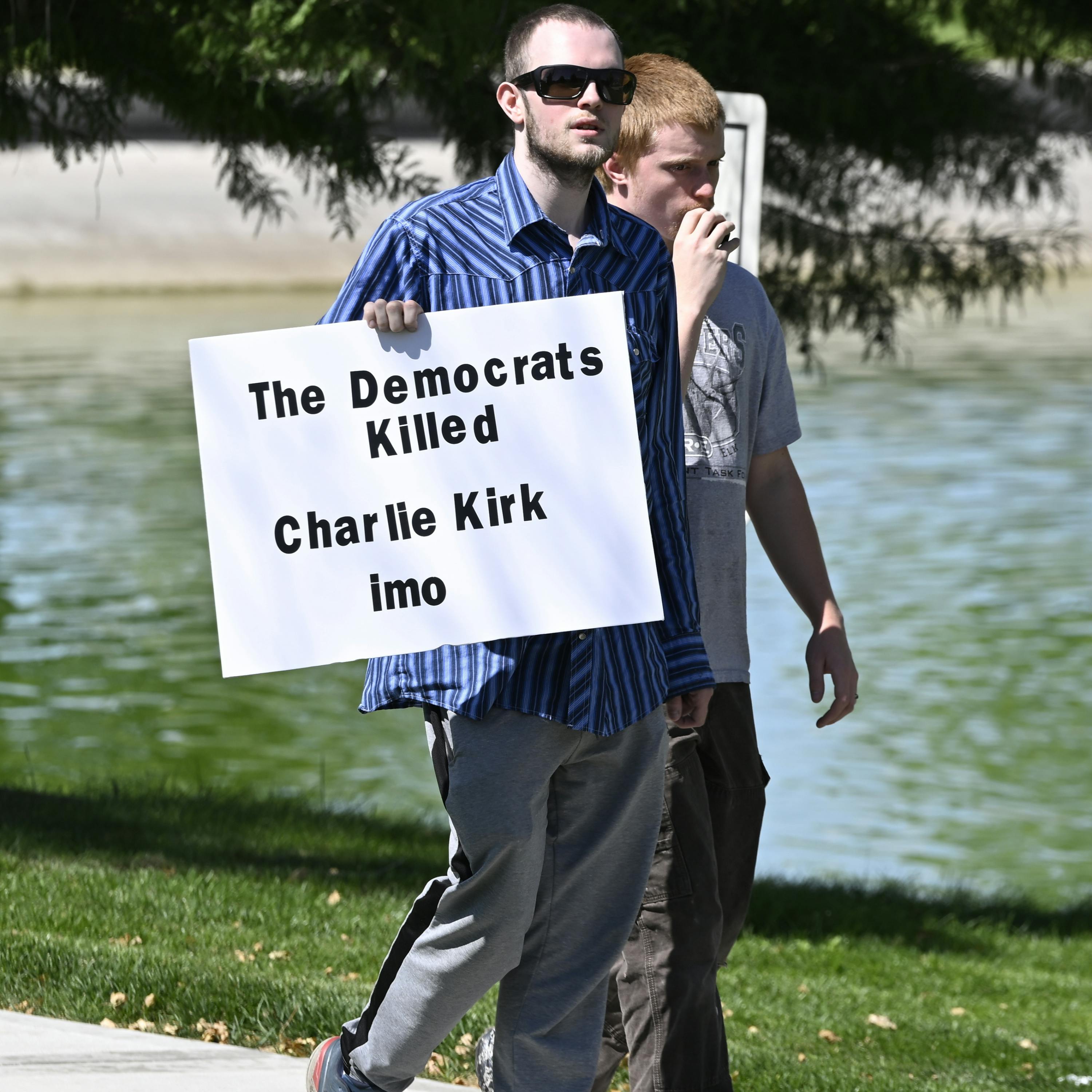
Young men carrying a cardboard that says ''The Democrats Killed Charlie Kirk'' in Orem, Utah, near where conservative activist Charlie Kirk was killed. Photo by Tayfun Coskun/Anadolu via Getty Images.
Listen to Today, Explained ad-free by becoming a Vox Member: vox.com/members. Transcript at vox.com/today-explained-podcast.
Learn more about your ad choices. Visit podcastchoices.com/adchoices
Press play and read along
Transcript
In just a few weeks, the federal government is going to run out of money. And per the filibuster, unless seven Democrats vote with Republicans, the government will shut down.
Now, many Democrats don't want to do anything to aid President Trump's agenda, and some have said maybe the Dems should just shut it down.
Don't make demands, don't ask for concessions, just refuse to play ball.
But then Charlie Kirk was killed, and all of a sudden, this position became much higher stakes.
Because if the Democrats Democrats force a shutdown, they open themselves up to Republicans deciding to end the filibuster. And without the filibuster, Republicans can do whatever they want.
At this very moment, for Democrats to stoke a confrontation that could very well end with one of the last remaining guardrails on Trump's power in Congress being demolished seems very short-sighted.
Coming up on Today Explained from Vox, the case for treading very carefully.
Support for today's show comes from ATT, the network that helps Americans make connections according to ATT. When you compare, there's no comparison.
ATT
with a Spark Cash Plus card from Capital One, you earn unlimited 2% cash back on every purchase. And you get big purchasing power so your business can spend more and earn more.
Capital One, what's in your wallet? Find out more at capital1.com/slash spark cash plus. Terms apply.
This is Today Explained.
I'm Andrew Prokop, senior correspondent, Vox. So you've been writing about what the Democrats should do next.
Democrats had been considering shutting the government down even before Charlie Kirk was killed in Utah. Why was that?
When this question first came up about the government has to be funded or else there's going to be a government shutdown, this was back in March.
And Senate Democratic leaders at first looked like they were going to make a big fight over it, but in the end, they kind of let it go through. And the Democratic base was apoplectic about this.
Since then, the pressure has been building. Commentators like my former colleague Ezra Klein
has been making the case that like Trump is consolidating power. He is making an authoritarian push and it would be complicity to continue to fund the federal government while he is doing this.
A shutdown is an intentional event. It's an effort to turn the diffuse crisis of Trump's corrupting the government into an acute crisis that the media, that the public will pay attention to.
Democrats do not control either the House or the Senate, but since a government funding bill requires 60 votes to get passed a Senate filibuster, and Republicans only have 53 Senate seats, Democrats can use the filibuster to shut the government down.
Ezra's argument went far and wide, as you know. What do you think about it?
Well, it made me a little uneasy, and that unease continued to mount in the days since Charlie Kirk's killing.
I think it's important to try to game out how a government shutdown would likely play out.
The arguments are overwhelmingly focused right now on, well, Democrats have to fight, they have to do something, and so they should try this.
But let's assume for a moment that Democrats actually succeed in shutting the government down via filibuster. And big assumption, they hold true to their demands.
They don't cave.
They keep the government shut down indefinitely. They are going to keep filibustering anything until their demands they're making on Donald Trump are met.
I think we have to think about what happens next in this situation. And what happens next, in my view, will not be Donald Trump surrenders, meekly caves to Democrats and says, okay, fine, you win.
I'll give you whatever you want. Please just let the government reopen, please.
Instead, what will happen is that Republican senators will face increasing pressure from Trump and from their base to use what is known as the nuclear option to change Senate rules to get rid of the filibuster entirely.
So I think if there is a government shutdown that Democrats actually stick to,
The way that shutdown ends is not going to be Democrats win policy concessions from Donald Trump.
It's Republicans eliminate the filibuster and gain the power now to pass whatever they want with their votes alone.
Why would getting rid of the filibuster entirely be so bad? So a lot of progressives would say it wouldn't be bad. Progressives have hated the filibuster for many years.
Ezra made these arguments back during the Obama years. Hello and welcome to Ezra Glencho on the Box Media Podcast Network.
Really helped popularize them, which was that the filibuster was undemocratic, it was bad for the health of democracy. There are various versions of this argument.
The context at the time was that it was something that was preventing Obama from passing more liberal or more progressive versions of what he wanted to do.
This is a context that reappeared under Biden when there was a renewed push from Democrats to get rid of the filibuster.
Good evening, everybody, and welcome to tonight's End the Filibuster National Town Hall.
My name is Congresswoman Pramilla Jayapal, and I'm so proud to be the chair of the Congressional Progressive Committee.
There's also a kind of high-minded argument that it's important for the health of democracy that the president and Congress get the power to enact their agenda because what needs to happen is that they should get to do what they want and then the voters get to decide in the next election whether they like it.
And finally, there is a third kind of ideologically self-interested argument, which is that the filibuster is better for conservatives than it is for progressives because conservatives just want to stop government from doing things.
They don't need to pass new things.
All they want to do is cut taxes, and they can already do that with a special procedure called budget reconciliation that goes around the filibuster.
But it's progressives who want to do big, bold things, and the filibuster keeps stopping them from doing it.
I think all of these arguments need to be revisited for the specific dangers that this administration poses and what we've seen transpire in the opening months of this administration so far.
Tell me what you mean by those specific dangers with this administration.
The connection that people are not making is that if you start a government shutdown fight, and it ends with Republicans being provoked into taking away the filibuster, filibuster.
That's just another guardrail on Donald Trump's power gone. And suddenly, he and Republicans now have the true ability, which they don't have right now, to pass whatever they want into law.
People don't realize because it's kind of invisible, but the filibuster has really constrained what the Trump administration's agenda has been so far.
They've been overwhelmingly focused on what they can do through executive power or existing legal authority.
And they often try to stretch those authorities, which makes them vulnerable to legal challenge and threat. They're not even trying right now to think of new laws they would like to make.
But if the filibuster went away, you better believe they would start taking advantage of that new power if they could suddenly pass whatever they want into law.
The reason that this is dangerous is that new laws can be passed to lock in new authoritarian policies that could cement Trump and Republicans' power in place.
They could crack down on the political opposition. They could make it more difficult for Democrats to win the next election.
And the Charlie Kirk killing and specifically the reaction on the right to that killing is what really crystallized this in my mind, because we started seeing immediately calls from conservative activists like Christopher Ruffo and the president himself for some sort of
an effort to hold the left accountable. They're already under investigation.
You know, they're already under major investigation.
A lot of the people that you would traditionally say are on the left.
This is something that has historically happened in many other countries after a killing or a national tragedy or something like this.
The government uses it as kind of a pretext to pass authoritarian laws, crack down on the opposition, and so on. But that can't happen right now because of the filibuster.
Then there is the question of the next elections. A few months ago, Trump basically tried to bully states into getting rid of mail voting by threatening to pull certain funding from those states.
Mail-in ballots are corrupt.
And it's not really clear how impactful that will be in the end, whether states can have different opportunities to get that funding, whether they actually need that funding.
But again, it would be much more impactful if he and Senate Republicans could actually pass a law that says, hey, no more mail-in voting in federal elections. We're not going to allow that anymore.
Anything they do would be challenged in court in some way, but
if they justify it in a way that can appeal to the conservative justices, it has a good shot at surviving.
And this gets to the core flaw in the high-minded argument that it's okay if the filibuster gets away.
It relies on the idea that the president and Congress should be able to pass whatever they want, and then the voters in the next election will get to render their verdict on it.
But what if passing whatever they want includes interference with the next election? What if it includes repression that makes that election unfair?
These are the sorts of possibilities that, you know, they still sound a little far-fetched, but I don't think they're totally totally out of the bounds.
All right, the Democrats can't win for losing at this point, but isn't there a risk that if they forfeit their leverage with the shutdown, President Trump still pushes for emergency laws that strip civil liberties, civil rights?
Well, he could do something like that. And right now,
it would just run straight into the filibuster. And maybe he would argue, hey, get rid of the filibuster.
But for eight years, Senate Republicans have kept the filibuster. They want to keep it.
The filibuster is kind of like a handy excuse for Republicans to take a lot of things off the table and just say to Trump, sorry, we just can't do this. It's out of our hands.
It's an excuse to say no.
And if that excuse goes away, then the pressure on them will be far stronger.
There's reportedly a belief that the optics of the last cave were very bad and that it's going to be hard for Chuck Schumer and other Democratic leaders to sell another cave.
But, I mean, again, what is the exit strategy here? If you resolve, okay,
I can't cave again, and you shut down the government.
And then the next step is, okay, Republicans are facing increasing pressure to go nuclear and get rid of the filibuster.
And then at the end of the story, you've proved you were tough to the base and you've given Donald Trump more power than he's ever had before.
Vox's Andrew Prokop. Coming up, Maryland Senator Chris Van Hollen on high stakes for the Democrats and why he's endorsing Zoran Mamdani.
Every story you love,
every invention that moves you,
every idea you wished was yours, all began as nothing.
Just a blank page with a blinking cursor.
Asking a simple question,
What do you see?
Great ideas. Start on Mac.
Find out more on apple.com/slash Mac.
Support for Today Explained comes from Bambas. Putting on a new pair of socks can instantly feel refreshing, according to Bambas, especially according to Bombas, if they're Bombas socks.
Bombas makes socks for just about any activity. Your warm merino wools, your comfortable compressions, your cushioned running socks, and so much more.
High-quality slippers, t-shirts, mudans.
Nisha Chital tried Bambas. Here's what she thinks.
Bombas has great kid socks. I have a three-year-old.
She runs around a lot indoors in her socks and she's often slipping on the hardwood floors.
But Bombas kids socks have grips on the bottom and they're really great to prevent that slipping around on hardwood or tile floors.
So we love those for her. They're definitely our preferred socks.
for our daughter. Bombas says that for every pair of bombas you buy, they donate one to someone facing homelessness.
Anytime you get something cozy, someone else can too. According to Bombas, you can go to bombas.com slash explain and use code explain for 20% off.
Your first purchase, that's bombbas.com slash explain, code explain to checkout.
Support for Today Explained comes from Found. Running a small business is hard, says Found.
There's the sales, there's the hiring, there's the customer support.
Found is a business banking platform that says they can let you effortlessly track expenses, manage invoices, and prepare for taxes all in one place.
Found says they've identified the things that create the most hassle for small businesses, categorizing expenses, prepping for taxes, managing invoicing, budgeting.
And they say that they have built an app that does it all directly from your business checking account. They say they can help you uncover tax write-offs and free up valuable time.
Time you can put toward chasing new opportunities. You can take back control of your business today.
You can open a Found account for free at found.com. That's F-O-U-N-D.com.
Found is a financial technology company. It is not a bank.
Banking services are provided by lead bank, member FDIC.
You can join the hundreds of thousands who've already streamlined their finances with Found.
This is Today Explained.
I'm Noelle King. Back in March, Congress was in the same position it's in today, and Senator Chris Van Hollen of Maryland voted to shut the government down.
So we invited him on to talk about where he stands now.
Senator Chuck Schumer and Minority Leader Hakeem Jeffries have set their terms for avoiding a government shutdown. They want Republicans to reverse Medicaid cuts and to extend the Obamacare subsidies.
What's your position on a shutdown?
Well, first and foremost, we should not be giving President Trump a blank check to continue his lawless activities, including his illegal withholding of funds from, for example, NIH, where people are undergoing clinical trials for cancer, and he's withholding funds that could literally mean a death sentence for them.
And the GAO, the Government Accountability Office, has found that he is illegally impounding, withholding these funds.
And so we can't give him a blank check without guardrails and safeguards to make sure that that won't happen.
What do guardrails and safeguards look like? What specifically are you after here?
So, for example,
the Republicans
in the Senate and the House voted for this so-called rescission package, meaning that they voted to undo
resources, appropriations that they previously voted for.
You can make that much harder to do by requiring, for example, a 60-vote margin to pass it. You can also do other things, Noel.
So, for example, if the president were to engage in an illegal rescission,
you could have an across-the-board immediate cut in White House appropriations.
So, there are things you can do if Republicans were willing to join us, but so far they're not willing to take on President Trump in any way.
The country was in a very similar position back in March of this year. And the concern back then was that if Democrats shut down the government, they would end up taking the blame.
They would end up alienating voters. Is that a concern this time around?
Well, this would be the Trump administration and Republicans in the Congress shutting down the government because they decide to go it alone. They decide to have a one-way street.
They decide to give President Trump a blank check for his lawless activity. And I don't think the American people want to see
President Trump get a total blank check because they've seen that he's withholding monies from things like FEMA and places that have been hit by disasters and refused to provide funding for disaster relief.
He's withholding funds from the National Institutes of Health.
In fact, by our calculation right now, they're withholding about $400 billion of funds for important priorities for the current fiscal year we're in, which ends in just a few weeks.
So if they're doing that now, he will do it again unless we stop it.
In the first half of the show, our colleague Andrew Prokop
proposed this as one possible scenario. An extended shutdown leads Republicans to believe that Democrats are abusing the filibuster.
And so they end the filibuster.
And so that means that Republicans no longer need any Democrats to vote with them and they can do whatever they want. He's painting the shutdown as quite a dangerous possibility for Democrats.
What do you think about that?
There are always risks, but again, it's Republicans and the Trump White House that will be taking this risk because they will clearly be seen to be going it alone, trying to essentially impose total one-party rule on the country.
Trump's sort of authoritarian impulses would have no checks and no balances on them.
With respect to Republicans getting rid of the filibuster, I think they recognize that more democracy in the Senate and the House does not favor them. in the long run.
I mean, I've been an advocate for ending what's called the super majority requirement to end a filibuster.
You would still have ample debate weeks or months, but at the end of the day, you would bring debate to a close with 51 votes. Republicans have been able to do what they want without doing that.
So, for example, they use the reconciliation process to pass big tax cuts for the very rich and cut programs for working Americans.
We saw them do this in the so-called Big Beautiful Bill, which is beautiful if you're a billionaire, but stinks for everybody else.
So the big things Republicans like to do, like tax cuts, they get to do even with the filibuster in place.
I don't think the Republicans will go down that road because the supermajority requirement to end a filibuster favors their agenda, not the people's agenda.
Let's talk about what you describe as the president's authoritarian impulses and what they might mean now.
Okay, so after the conservative influencer Charlie Kirk was killed by a shooter last week, President Trump in a speech from the Oval Office blamed, quote, the radical left.
He vowed to, quote, find each and every one of those who contributed to this atrocity and to other political violence, including the organizations that fund it and support it.
This strikes people as
a potentially very concerning threat to free speech, civil liberties. Have the events of the past week changed your mind at all about how you approach the Trump administration?
Like, what do you think the president is saying here?
Well, I'm very, very alarmed by what the president is saying.
There's no room for political violence in our discourse. We can have robust debates without it veering into violence, and there should be no vengeance.
President Trump had a chance to bring the country together to say that political violence is unacceptable regardless of its source. But instead, he's decided to engage in finger-pointing.
Instead, he is weaponizing this awful tragedy, this murder, to advance his political goals, which include going after what he calls folks on the left, which in Trump world means anybody who disagrees with Donald Trump.
So, yes, it's very concerning that he would
threaten to use the full power and instruments of the federal government to literally go after people who disagree with him.
There is a lot at stake for for Democrats here, as you've been saying. Polling shows that Americans are really displeased with the party and not just the general public.
Democrats themselves are not happy with the party. So in August, an AP poll of Democrats saw people using words like weak, tepid, ineffective, and broken to describe their own party.
What do you think is going on here?
Well, I don't think the Democrats have done enough to stand up to Donald Trump's lawlessness, nor do I think Democrats have done enough to put forward our own positive vision of what we would do, including taking on very powerful special interests and fighting instead for the common good and the public interest.
I was invited just over the weekend to speak to the Polk County Iowa Democratic Party, and I laid out exactly that argument that more needs to be done to stand up to Donald Trump in this moment. But
clearly in 2024, the American people, the majority of the American people, did not trust us to take on the status quo and take on these special interests.
And so I believe we need to be much more clear, not only about what we're fighting against, but what we are fighting for.
At that event on Saturday, you also endorsed Zohran Mamdani. You criticized other Democratic leaders for delaying on endorsing him.
You referred to something that you called spineless politics.
What's going on? What's Mom Dani doing that you like?
Well, what I said was as we prepare to try to win majorities in the House and the Senate in 2026,
we need to first win the 2025 races. We have big races in Virginia and New Jersey for the governor's seats, great candidates.
And we also
need to win the mayoral race in New York City. I pointed out that Donald Trump has spent a huge amount of time and resources trying to defeat Momdani.
Momdani's platform was people who work in New York should be able to afford to live in New York, which would be good for people in New York City and Des Moines, Iowa, and in Maryland and throughout the country.
And yet you have these very, you know, powerful big money special interests, financial interests. combining with Donald Trump to try to defeat Mamdani.
And so I do think this is a moment where Democrats need to stand up for the person who is fighting to reduce costs and make sure that people can afford to live where they work.
Senator Chris Van Hollen of Maryland, thank you so much for taking the time. Thank you.
Miles Bryan and Danielle Hewitt produce today's show. Amana El Saadi edited.
Laura Bullard is our fact checker. Adrian Lilly and Patrick Boyd are our engineers.
And I'm Noelle King.
It's Today Explained.
Support for this show comes from Atlassian. Wish projects could manage themselves? With Jira AI-powered project management software, keeping things organized and on track is a snap.
AI agents manage the busy work, handling details that let your team focus on the work that matters. Now, that's a team changer.
Visit atlassian.com slash JIRA to learn more.
That's A-T-L-A-S-S-I-A-N dot com slash J I R A. Atlassian.com slash JIRA.
Support for this show comes from Atlassian. Wish projects could manage themselves? With JIRA AI-powered project management software, keeping things organized and on track is a snap.
AI agents manage the busy work, handling details that let your team focus on the work that matters. Now, that's a team changer.
Visit atlassian.com/slash JIRA to learn more.
That's A-T-L-A-S-S-I-A-N.com/slash J-I-R-A. Atlassian.com/slash JIRA.