Why Democrats caved
This episode was produced by Kelli Wessinger with help from Avishay Artsy, edited by Amina Al-Sadi, fact-checked by Peter Balonon-Rosen and Ariana Aspuru, engineered by Patrick Boyd and Adriene Lilly, and hosted by Astead Herndon.
Our guest was David Axelrod, host of the podcast Hacks on Tap. Listen at http://vmpod.co/hacks
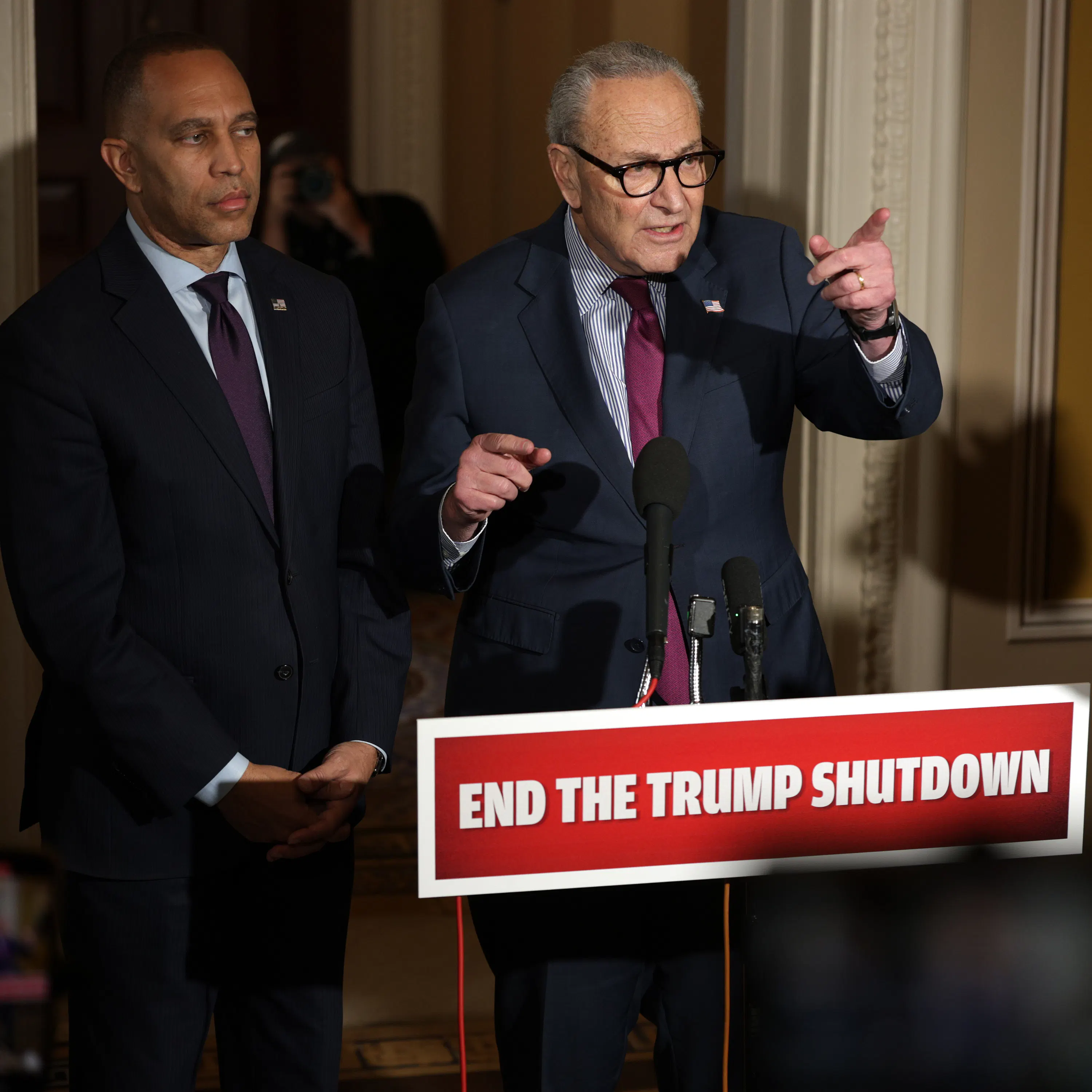
Senate Minority Leader Sen. Chuck Schumer and House Minority Leader Rep. Hakeem Jeffries speaking to the press about the shutdown. Photo by Alex Wong/Getty Images.
Listen to Today, Explained ad-free by becoming a Vox Member: vox.com/members. New Vox members get $20 off their membership right now. Transcript at vox.com/today-explained-podcast.
Learn more about your ad choices. Visit podcastchoices.com/adchoices
Press play and read along
Transcript
Speaker 1 So, after all that, it looks like we have a deal.
Speaker 2 I am optimistic that after almost six weeks of this shutdown, we finally will finally be able to end it.
Speaker 1
If everything holds, the government should reopen by the end of the week, putting an end to the longest shutdown in U.S. history.
As of this morning, there was a zero chance of having
Speaker 1
a work on the ACA. Now, there's a measurable chance.
Will it be everything that everybody wanted? No, because we need 60 votes. And so there's going to be a negotiation.
Speaker 1 But Republicans have already started saying, well, here, you know, if this did this or did that, maybe we can get there.
Speaker 1 So, what was it all for?
Speaker 1 And why did some Democrats cave to Republicans and President Trump?
Speaker 1 That's coming up on Today Explain from Bobs.
Speaker 3
Support for Today Explained comes from March of Dimes. Every year in the U.S., about one in 10 babies is born preterm.
It doesn't have to be that way, says March of Dimes.
Speaker 3 For more than 85 years, March of Dimes has led the fight for the health of moms and babies.
Speaker 3 With supporters like you, they fund research, they provide education, they do advocacy, they offer programs and services so every family can get the best possible start.
Speaker 3 You can donate today at marchofdimes.org/slash vox. That's marchofdimes.org/slash vox.
Speaker 3 Support for Today Explained comes from Crucible Moments. What is that? It's a podcast from Sequoia Capital.
Speaker 3 Every company's story is defined by those high-stakes moments that risk the business but can lead to greatness. That's what Crucible Moments is all about.
Speaker 3 Hosted by Sequoia Capital's managing partner, Rulof Botha. Crucible Moments is returning for a brand new season.
Speaker 3 They're kicking things off with episodes on Zipline and Bolt, two companies that are still around with surprising paths to success.
Speaker 3 Crucible Moments is out now and available everywhere you get your podcasts and at crucible moments.com. Listen to Crucible Moments today.
Speaker 5 You're listening to Today Explained.
Speaker 1 Okay, so Andrew Prokop, senior political correspondent for Vox. It seems as if Senate Democrats and Republicans have reached a deal to end the shutdown, the longest shutdown in American history.
Speaker 1 Can you tell me what we know about it so
Speaker 6 So, the deal came together pretty quickly on Sunday.
Speaker 7 So, eight senators who caucus with Democrats have broken rank with their party to advance a Republican plan to end the shutdown.
Speaker 8 The bill advanced by a vote of 60 to 40, just barely meeting the 60 votes needed to keep it moving forward.
Speaker 6
It'll have to pass the Senate and then the House and be signed by Trump, of course. But for now, it seems to be moving.
As to what's actually in it, yeah, what's in the deal?
Speaker 6 So, not much, to be honest.
Speaker 6 This is kind of just a status quo. Restart the government's funding and continue it on until the next expiration, which will be the end of January.
Speaker 9 This agreement funds SNAP and food assistance programs, ensures that law enforcement, air traffic controllers, and other federal workers get paid, reverses the President's recent reckless layoffs, and prevents them from happening in the future, and crucially, gives Congress a clear path forward to protecting people's health care.
Speaker 6 But, you know, that's all just undoing stuff that happened during the shutdown itself.
Speaker 1 Yeah, cleaning up their own mess.
Speaker 6 Yes, as far as the big picture demand which Democrats made, which was to extend the expiring Affordable Care Act subsidies,
Speaker 6
they got not much. They got a commitment for the Senate to hold a vote sometime before the end of the year.
But really, that's nothing.
Speaker 10 You can can get 100 votes here in the Senate. Won't mean anything because the House is not going to take it up
Speaker 10 and the President of the United States certainly will not sign it.
Speaker 6 And so basically they struck out on that and that was their stated demand. A lot of Democrats wanted something more from the shutdown, some sort of deeper concessions from Donald Trump in some form.
Speaker 6
And those didn't happen at all. Trump basically made no concessions.
And so I think
Speaker 6 many are characterizing this as essentially a Democratic cave. And I think that's largely correct.
Speaker 11 This health care crisis is so severe, so urgent, so devastating for families back home that I cannot in good faith support this CR that
Speaker 11 fails to address the health care crisis.
Speaker 1 So it seems like beyond the kind of nuts and bolts of reopening the government, only thing Republicans conceded was a promise to hold a vote on the health care subsidies that Democrats have been focused on in the coming months.
Speaker 6 That's right.
Speaker 1 All right. Well, based on all that, it would seem as if the conclusion that Democrats caved, or at least some wanted the shutdown to end on their own, is an obvious one.
Speaker 1 So what was motivating the seven Democrats and one Independent who worked with Republicans to end this shutdown? Why did they break from their caucus?
Speaker 6 Yeah, so in a dynamic like this, where almost every Senate Democrat voted against this deal, and they're saying, oh, we need to fight harder. We need to keep going.
Speaker 6 But somehow the eight magical votes materialize to cut the deal. And typically that doesn't happen via a actual break from what party leadership wants.
Speaker 6 Typically, what explains this scenario is what's known as the vote no hope yes approach, that a lot of Democrats are continuing to vote no, but in reality, there is kind of a consensus in the party that enough is enough.
Speaker 6
We made our point. We're not making any progress on getting Trump to agree to any concessions.
A lot of the damage is now spiraling out. Federal workers haven't been paid for over a month.
Speaker 6
Many have been forced to work without pay, like air traffic controllers. Snap benefits are being suspended.
Flights are now being delayed or canceled. and I think there was a sense that, okay,
Speaker 6 we've stoked the longest shutdown in history, we tried to make our messaging point, but in the end, the federal government has to reopen. We're not going to like keep it shut down forever.
Speaker 6 And we don't see any path towards getting the things we actually wanted by stoking this shutdown fight. So it's time to just kind of cut bait and bring it to a close.
Speaker 6 And the Democrats who actually voted for this deal, they were kind of a grab bag of purple state Democrats and retiring Democrats.
Speaker 6 Some were moderate, some are liberal, but a lot of Democrats, the default position was to make the base happy by continuing to fight.
Speaker 6 And when we see retiring Democrats saying, oh, actually, I'm going to vote for this, it's a signal that actually, you know, in their heart of hearts,
Speaker 6 probably there was broader support for this deal in the Democratic caucus than many are currently admitting.
Speaker 1 I mean, I saw Governor-elect Abigail Spamberger of Virginia say that she wanted the government to open immediately.
Speaker 7 The entirety of Virginia's economy is impacted by this shutdown, just as we've been impacted by Doge attacks. And the government needs to reopen quickly.
Speaker 1 And it would seem as if from what you're saying, that that sentiment might be a wider held one among congressional Democrats, or at least among Senate Democrats, than they may have led on, at least because these eight senators joined up with Republicans to functionally keep the government open.
Speaker 6 Yes. And, you know, Spanberger, she represents Virginia, and Virginia is obviously a very important state for federal workers, and a lot of her constituents haven't been paid.
Speaker 6 And I think what came clear in Spanberger's comments is that she didn't buy into what has been sold as the logic of this shutdown, which is that it was a very important,
Speaker 6 fight against Donald Trump's authoritarianism, that it was a way to stand up to Trump. This is what the base wanted.
Speaker 6 This is why the Democratic base was furious that Schumer cut a government funding deal several months ago because they wanted to fight. and stand up for Donald Trump.
Speaker 6 And this was believed to be the leverage that Democrats had over Trump, that Republicans need Democratic votes to keep the government funded. So why not try to sort of
Speaker 6 fight him, to get him to back down on some of his authoritarian practices?
Speaker 6 Or the eventual demand that the Democratic caucus settled on was, okay, let's just focus on this issue of the Affordable Care Act subsidies that are expiring.
Speaker 6 And I think most of the political strategists in the party knew that going in.
Speaker 6 And the shutdown, I think, was privately understood to always be kind of like a losing fight, but something that, you know, the base was so furious when it wasn't even tried last time around that they had to at least try it this time.
Speaker 6
And they tried it for over a month, the longest shutdown in history. And Donald Trump has not put forward any concessions.
So I think they decided enough's enough. We made our point and
Speaker 6 let's move on.
Speaker 1 Do you think there was a tipping point here? How much did things like flight cancellations or SNAP benefit reduction, you think, play a role in this coming to an end?
Speaker 6 I think they're important. I think it's kind of all important that the damage has been piling up.
Speaker 6 It's been kind of easy to ignore the shutdown for many people, for those not personally affected, for quite a while.
Speaker 6 But once we get into this realm of SNAP benefits being canceled and flights being delayed or canceled, that's when the impact on ordinary people who don't work for the federal government specifically
Speaker 6
gets more pronounced and painful. Some Democrats were saying, fine, like, you know, this is hard-nosed political combat.
We are winning in the realm of politics and messaging.
Speaker 6
Polls show that Trump is getting more of the blame for the shutdown. His approval has dropped.
So why not keep fighting? Regardless of, you know, the damage to
Speaker 6 the people affected by this, we are winning and we should keep going and kind of force Trump to agree or cave in some way.
Speaker 6 But I think what became clear in recent days is that Trump definitely wasn't going to cave.
Speaker 6 What he was going to do was to keep turning up the pressure on Republicans in the Senate to eliminate the filibuster. And that would have let them reopen the government with their votes alone.
Speaker 1 What do you think happens to Trump's push to abolish the filibuster? Does that just go away?
Speaker 6 I think for now it will go away. You know, Trump has been arguing that the Senate should abolish the filibuster since 2017, and they've been ignoring him since then.
Speaker 6 Because Democrats did cut the deal in the end, I think this does take some of the air out of this trial balloon of we should eliminate the filibuster. But, you know, it's going to come back.
Speaker 6 The partisan logic under polarization of the filibuster is a powerful obstructionist weapon for the minority. And if the majority feels that it's being abused, the majority can just take it away.
Speaker 6 That's going to continue.
Speaker 6 I don't don't know exactly how much longer the filibuster has before it's likely demise, whether it's a few years or whether it's longer than that, but it doesn't seem sustainable over the long term.
Speaker 1 What happens next? What's the next step for the government reopening?
Speaker 6 Well, the Senate has to give final approval to this deal. Then it will go to the House where a lot of House Democrats, most if not all, are expected to oppose it.
Speaker 6 And then it will be a lot of big drama about whether Mike Johnson can nail down the Republican votes,
Speaker 6
including the cranky hardliners in the GOP conference, about passing this deal. And then it would go to Trump's desk.
But really, it's kind of just kicking the can down the road.
Speaker 6 We are going to be doing this again at the end of January.
Speaker 1 Come the end of January, there'll be another fight about government funding, and we may be in the same place.
Speaker 6 Yes, except I'll be on parental leave, so I won't be there.
Speaker 1 So you'll be in a better place. I'll be stuck.
Speaker 6 Mercifully excused from the next shutdown.
Speaker 1 Awesome.
Speaker 1 Andrew Prokop, senior political correspondent for Vox.
Speaker 1 So, some Democrats caved, and the shutdown seems to be ending. Coming up, was it all worth it?
Speaker 3
Support for Today Explain comes from Quince. Winter is here and winter is cold.
How about some layers that last?
Speaker 3 Sweaters, outerwear, everyday essentials that feel luxurious, look timeless, and make holiday dressing effortless.
Speaker 3
$50 Mongolian cashmere sweaters, down outerwear, oh, built to take on the season, and Italian wool coats. Perfect for gifting or just for you.
Here's Nisha Chital.
Speaker 12 Sweater weather is like my ideal weather
Speaker 12 and Quince has such a huge sweater selection.
Speaker 13 I got the organic cotton cropped cardigan in this like chocolate brown color.
Speaker 3 It feels really you know polished and will work with a lot of different things. Step into the holiday season with layers made to feel good, look polished and last from Quince.
Speaker 3
Perfect for gifting or keeping for yourself. Go to quince.com slash explain for free shipping on your order and 365 day returns now available in Canada to Canadians.
That's quince.com slash explained.
Speaker 3 Free shipping 365 day returns quince.com slash explained.
Speaker 1 What do walking 10,000 steps every day, eating five servings of fruits and veggies, and getting eight hours of sleep have in common? They're all healthy choices.
Speaker 1 But do all healthier choices really pay off? With prescription plans from CVS CareMark, they do.
Speaker 1 Their plan designs give your members more choice which gives your members more ways to get on stay on and manage their meds and that helps your business control your costs because healthier members are better for business go to cmk.co slash access to learn more about helping your members stay adherent that's cmk.co slash accirrd banks commercial payments are fast and efficient but they're not not just fast and efficient.
Speaker 4 They're also powered by the latest in payments technology built to evolve with your business. Fifth Third Bank has the Big Bank Muscle to handle payments for businesses of any size.
Speaker 4 But they also have the FinTech Hustle that got them named one of America's most innovative companies by Fortune magazine. Big Bank Muscle, FinTech Hustle.
Speaker 4 That's how Fifth Third brings you the best of all worlds, going above and beyond the expected, handling over $17 trillion in payments each year with zero friction.
Speaker 4 They've been doing it that way for 167 years, but they also never stop looking to the future to take their commercial payments two steps ahead of tomorrow, constantly evolving to suit the ever-changing needs of your business.
Speaker 4
That's what being a Fifth Third Better is all about. It's about not being just one thing, but many things for our customers.
Big Bank Muscle, FinTech Hustle.
Speaker 4 That's your commercial payments of Fifth Third Better.
Speaker 1 The house will be in order. The clerk may call the roll.
Speaker 6 Today, yay.
Speaker 3 Explained, yay.
Speaker 1 So, how should we think about last Tuesday's results, which seemed like such good news for Democrats, given this week's news, which seems to show the party on completely different pages, at least when it comes to the shutdown?
Speaker 1 I call David Axerat, Democratic political strategist. And my first question was, why he thinks some Democrats folded on the shutdown?
Speaker 5 I think as the shoes started to pinch of the shutdown and real-life impacts were being felt, be it in terms of food security or airport security.
Speaker 5 I think there was a sense of nervousness amongst those who broke about imposing those things on people to carry on the fight and perhaps some suspicion that they were not going to be successful at the back end.
Speaker 5 So why endure the pain?
Speaker 1 There was some sense that the election could embolden Democrats because it seemed as if at least the anti-Trump sentiment in the electorate was confirmed.
Speaker 1 Why do you think it went the opposite direction, at least for the group of Democrats who have seemed to join with Republicans to end this shutdown?
Speaker 5 Well, first of all, I think it says a lot that the Democrat, none of the Democrats who voted for it are on the ballot next year. And several of them, or at least two of them, are retiring.
Speaker 5 So the folks with the least risk were among the folks who cast these votes.
Speaker 5 Look, I think Tuesday
Speaker 5 could go two ways, right? One is it satisfied Democrats that Democrats had a pulse, that Democrats could fight and win, because Democrats did fight and win on Tuesday.
Speaker 5 And so, to some degree, that may have released some of the pressure rather than emboldened.
Speaker 5 But more than anything, I think that the folks who voted wanted out of it and believed that the longer it went, the more
Speaker 5 both parties would bear the blame and people would suffer.
Speaker 1 In reaction to the announcement of this deal, we have seen some Democrats take implicit and some explicit swipes at Senate leader Chuck Schumer.
Speaker 1 Are you surprised at the level of blowback that it seems Senate Democratic leadership is coming under from this deal? And if not, where is that coming from?
Speaker 5
Not at all. I'm not at all surprised.
All you have to do is go back to March when the last continuing resolution was passed. And
Speaker 5 after telling Democrats for a month in advance that Democrats were going to fight, fight, fight, Schumer led the retreat and was absolutely excoriated for it.
Speaker 5 And a lot of people thought that was one of the impetuses for him to want to fight this time.
Speaker 5 And I thought Democrats very appropriately focused on the Affordable Care Act because these subsidies were expiring and premiums are, as people now know, going to go up exponentially for people around the country, at least 20 million people.
Speaker 5
So it made sense. But here's the thing.
I mean, Schumer suffered here for what he suffered from then, the idea that you charge up the hill and then roll down again.
Speaker 5 And I think this time it looked as if he got rolled by some members of his own caucus, that he wasn't in command of his own caucus.
Speaker 5 And so, you know, he just he hasn't handled communications particularly well
Speaker 5
around these things. And I do wonder, honestly, Schumer is a superior fundraiser.
He's very supportive of his members. But I wonder
Speaker 5 if
Speaker 5 he's in this gig for the long run.
Speaker 1 I mean, it seems as if some of the critics are pointing out one of two problems with him.
Speaker 1 Either it's an expectation-setting issue and Democrats think that what he has been able to promise Democrats in terms of fight has not matched what they've delivered, or, you know, it seems as if the whole caucus is not in line behind him.
Speaker 1 Both of those seem to spell not great signs for the Democratic leader.
Speaker 5 Yeah, no, I think he's got problems, you know, and he's going to have to make a decision as to whether he runs for re-election in 2028, and Democrats are going to have to make a decision as to whether they want him to be the leader in 2027.
Speaker 5 And I think both of those are open questions, and maybe someone will take a run at him here, though I think think the caucus would probably stand by him.
Speaker 5 Look,
Speaker 5 one of the impacts of the Trump II era here is that until last Tuesday, Democrats felt supine in relation to Trump, like he was running over them. And
Speaker 5 so anything that lends to it is going to incite Democrats.
Speaker 5 I got a text this morning from someone who I deeply, deeply respect, who's someone who's been around Washington a long time, who said, man, oh man, we are so fucked.
Speaker 5 These senators are killing the Republic. This is from a prominent Democrat.
Speaker 1 I mean, that's dire.
Speaker 1 That's not small stuff.
Speaker 5
It got my attention. Now, I will say this.
This doesn't let Republicans off the hook because there's going, you know, if there's not a vote,
Speaker 5 you inflame the Democrats again in the Congress. But more than that, if these premiums go up on schedule and nothing is done, done, you own them.
Speaker 1 I wanted to know how we should calibrate this in terms of the excitement we saw from the party last week.
Speaker 1 I think sometimes with these kind of congressional fights specifically, it's hard to know exactly where the chips land.
Speaker 1 When people go to vote next November, how much do we think this kind of shutdown plays in folks' minds? And does it at any point damper the excitement we saw from Democrats just last week?
Speaker 5 You know,
Speaker 5 I really doubt it.
Speaker 5 I think what it may do is put a little bit more jet fuel behind some of the insurgent Democratic candidates.
Speaker 5 Because, you know, I think that there is a real jaundice about sort of status quo figures in politics. And candidates who were embraced by Chuck Schumer probably don't take a step forward here,
Speaker 5 even though he voted against this thing. Plattner in Maine, for example, the oyster fisherman who's giving the governor of that state a run for her money in that primary.
Speaker 5 El Said in Michigan, you know, those kinds of candidates are going to take this issue and run it against figures who are seen as part of the establishment that knuckled under here.
Speaker 1 Trevor Burrus, Jr.: In a primary season that was already set to pit insurgents versus establishment, this becomes another wedge in the fight.
Speaker 5
I would think so. I would think that it will.
But in terms of the November election, I honestly don't think this is.
Speaker 5 I think you're going to see Democrats come out in large numbers, as you saw on Tuesday, because at the end of the day, it's about Trump.
Speaker 1 Yeah.
Speaker 5 And it's going to be about Trump. Just parenthetically, I said,
Speaker 5 it's been stunning to me how Trump has reacted to the election. What do you mean?
Speaker 5 And he has reacted in classic Trumpian fashion, which is,
Speaker 5 what do you talk about affordability?
Speaker 14
Energy is way down. Look at energy.
We're going to have $2 gasoline. I did that.
That brings everything else down. Groceries are way down other than beef.
Now, beef is going to come down.
Speaker 14
We have to do that. You remember when I started, eggs were up by four times what they were previous? It was in two days in the office, and they told me about eggs.
I solved that.
Speaker 14 Because the fact is, we have prices way down, we have prices down.
Speaker 5 This is precisely, precisely the thing that really killed Joe Biden politically. I mean, at the end, the final blow was his denial of the conditions that exist.
Speaker 5
Now, you know, in his case, I think people said, well, he's out of touch. He doesn't know what's going on.
I mean, Trump said that.
Speaker 5 In Trump's case, the suspicion may not be that he's not in touch, but that he just doesn't care.
Speaker 1 Last question I would say is just one about your sense of people's reaction to this deal, particularly the ones who have criticized Schumer and the Democrats who got on board.
Speaker 1 What is the salience of that message, do you think?
Speaker 1 Like, it's hard for me to gauge how many Americans would want Democrats to fight versus how many Americans would just want the government to be open.
Speaker 1 Is there some sense of you that's like maybe this is the best Democrats could have done, that this was the way the shutdown was always going to end?
Speaker 5
Yeah, no, I think there is. I think that's a fair analysis.
And I think it's the analysis that the eight who voted the way they did made from the start.
Speaker 5 I mean, a number of them were negotiating for this deal for weeks.
Speaker 5 I think they gave Schumer the room to throw out the one-year extension of the Affordable Care Act after their caucus on Tuesday to see if that would fly.
Speaker 5 And Thune, I think, probably knowing that he had this deal in his back pocket, shot it down immediately. You know, it's a danger of negotiating against yourself.
Speaker 5 But I think the vast number of Americans probably think two things. Yes, they think we have a health care crisis and they're angry about that, but they also
Speaker 5 felt like this thing needed to come to an end.
Speaker 5 But among activist Democrats who believe deeply in this health care issue, I think this one stings.
Speaker 1 Thank you so much, David, for your time. We really appreciate it.
Speaker 5 Always good to be with you.
Speaker 1 David Axarath, political analyst and commentator for CNN.
Speaker 1
Today's show was produced by Kelly Wesinger with help from Avishai Artsy. It was edited by Amina Al Sadi.
Fact-checked by Peter Baladin-Rosen with help from Ariana Ospadu.
Speaker 1
Engineered by Patrick Boyd and Adrian Lilly. I'm Estead Herndon.
This is Today Explain.
Speaker 15
Adobe Acrobat Studio, so brand new. Show me all the things PDFs can do.
Do your work with ease and speed. PDF spaces is all you need.
Do hours of research in an instant.
Speaker 15
With key insights from an AI assistant. Pick a template with a click.
Now your prezzo looks super slick. Close that deal, yeah, you won.
Do that, doing doing that, did that, done.
Speaker 15
Now you can do that, do that, with Acrobat. Now you can do that, do that with the all-new Acrobat.
It's time to do your best work with the all-new Adobe Acrobat Studio.
Speaker 16 Nobody knows your customers better than your team, so give them the power to make standout content with Adobe Express.
Speaker 16 Brand kits make following design rules a breeze, and Adobe quality templates make it easy to create pro-looking flyers, social posts, presentations, and more.
Speaker 16
You don't have to be a designer to edit campaigns, resize ads, and translate content. Anyone can in a click.
And collaboration tools put feedback right where you need it.
Speaker 16 See how you can turn your team into a content machine with Adobe Express, the quick and easy app to create on-brand content. Learn more at adobe.com/slash express/slash business.


