Bettor living through Polymarket
This episode was produced by Ariana Aspuru, edited by Jolie Myers, fact-checked by Miles Bryan and Kelli Wessinger, engineered by Patrick Boyd and David Tasciore, and hosted by Noel King.
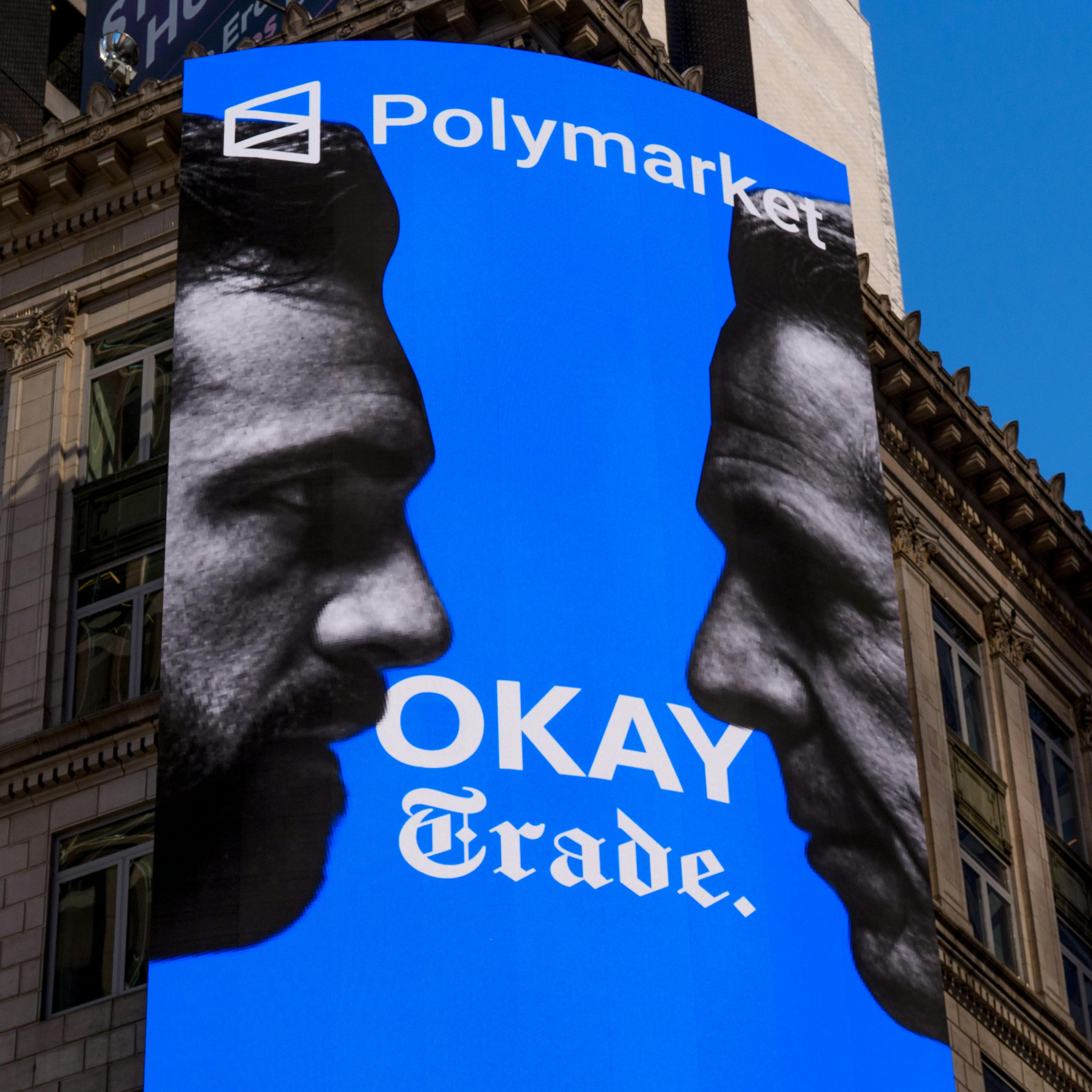
A Polymarket billboard displaying New York City mayoral election odds in Times Square. Photo by Adam Gray/Bloomberg via Getty Images.
Listen to Today, Explained ad-free by becoming a Vox Member: vox.com/members. New Vox members get $20 off their membership right now. Transcript at vox.com/today-explained-podcast.
Learn more about your ad choices. Visit podcastchoices.com/adchoices
Press play and read along
Transcript
Polymarket is a platform that lets you place bets, and people are betting billions.
All it takes is a little cryptocurrency and a dream, and you can gamble on when the US will invade Venezuela or the Jets game or who's going to be the next Fed chair.
The odds change as bets are placed. So, will Russia and Ukraine declare a ceasefire in 2025? Probably not.
Right now, only 6% of bettors say yes.
But if Putin and Zelensky grow up this month, those yes bets are going to win a lot of money. Vladimir and Vlodimir have the potential to do the funniest thing.
I mean, they won't, but what if they did? You want to bet on it? We can. In the last few months, President Trump relaxed restrictions on Polymarket.
Google announced a partnership, and the New York Stock Exchange said it is investing. Coming up on Today Explained, it's Polymarkets World.
Support for this show comes from strawberry.me. Be honest, are you happy with your job? Or are you stuck in one you've outgrown? Or never wanted in the first place?
Sure, you can probably list the reasons for staying, but are they actually just excuses for not leaving? Let a career coach from strawberry.me help you get unstuck.
Discover the benefits of having a dedicated career coach in your corner. Go to strawberry.me unstuck to claim a special offer.
If you're tired of database limitations and architectures that break when you scale, then it's time to think outside rows and columns. MongoDB is the database built for developers, by developers.
It's ACID-compliant, enterprise-ready, and fluent in AI. That's why so many of the Fortune 500 trust MongoDB with their most critical workloads.
Ready to think outside rows and columns?
Start building faster at mongodb.com/slash build.
Today explained.
Jen V. Echner is a features writer at NYMAG who covers finance, crypto, business, and she recently wrote about the founder of Polymarket, one Shane Copeland.
So Shane is 26 or maybe 27 now.
He dropped out of NYU. He was only there for a semester.
He grew up in New York City City and then went to NYU and was only there for about a semester, maybe less, when he dropped out because he was so determined to become an entrepreneur.
And he eventually settles on this idea to build what's called a prediction market.
And during the pandemic, when everyone in New York City is kind of, you know, isolated in a way, he holes up in his own bathroom on the Lower East Side and starts building this website.
People can, you know, debate each other and be like, oh, you're wrong, this, this, that. But the way that those, that really dissipates is when you let people put their money where their mouth is.
Shane is someone who, if you meet him, he's probably going to be the most self-confident and self-assured person you ever met.
You know, in the early days when people were like, how are you going to compete against these people? And now it's like not even a question. So I think we've just out-executed, candidly.
Believing 100% in his own potential to become a billionaire, which
has recently proven true.
And he was obsessively writing
all of these annotations of people like Mark Zuckerberg and Travis Kalinek, these billionaire entrepreneurs.
And he had just done, you know, studied them and emulated them and sort of was just determined to be the next one of that class.
And he set out with that ambition and he has just kind of stuck to following it ever since.
All right, so he has smarts, real smarts, ambition, ego. And he decides that he wants to build something that lets you do what exactly? What was the purpose of Polymarket from the jump?
He says that, you know, he was obsessed with prediction markets. It's the most accurate thing we have as mankind right now until someone else creates some sort of super crystal ball.
Which, you know, kind of sort of,
in theory, anyway, harness the wisdom of the crowd to become the sort of modern oracle where you can ask people to bet on various outcomes, whether it's in politics or sports or something else, you can kind of harness, you know, this knowledge and sort of bring you know forth these betting outcomes, and then where they can actually win money if they're right.
And I use it to vote on anything I think is going to happen in the near future, like sports, pop culture,
politics, and I use it to get some coffee money. So, let me click into one to show you.
So, there's this whale on Polymarket who bet over $37,000.
That drone powell will start the meeting by saying, Good afternoon.
Good afternoon. There it is.
Give me an example of where smarts play into this, how we see this at a macro scale being like a kind of intelligence.
Yeah, so I would say it's almost like, you know, kind of, it kind of brings out the common sense of people and the public and the most likely outcome to happen that might elude, you know, some of the kind of smartest pundits, pundits, because they're just not willing to actually say it out loud.
It's sort of like, what do people really believe will happen?
And so, here's a good example: if you remember the first presidential debate with Biden, and everyone immediately leaves that debate, you know, very concerned about Biden's age, you know, his ability to govern.
Out of the gate, President Biden's voice faltered. We brought out another.
The 81-year-old spoke quietly and several times seemed to lose his trait of thought.
Dealing with everything we have to do with,
Look,
if
we finally beat Medicare.
You were watching CNN or reading the New York Times.
No one was actually thinking that the current sitting president was about to drop out of the race just a few months before the presidential election. Come on, man.
But if you looked at Polymarket, it was heavily leaning towards him dropping out right away, which surprised a lot of people.
And that, you know, eventually came true. And Polymarket essentially, you know, kind of had that news a bit earlier, if you take that as news.
And that is why Polymarket takes off. Yes, exactly.
And so that kind of momentum builds and builds heading into the 2024 election.
We might as well just call the election now because using Polymarket, you can predict what's going to happen and it's 63 to 36 percent. So I downloaded the app.
I'm giddy. Welcome to the Red Kingdom.
If you looked at Polymarket during election night, I mean, people went into election night thinking that it was a fairly close race hours before the election was called, even while if you were to watch CNN, you know, or watch other news, the New York Times, the race was far from called.
Polymarket had Donald Trump at almost 100%
much before,
you know, the results were even in. When you were working on this piece, did you bet at all? You know, I did.
And I had to kind of be a little sneaky about it.
I needed to try it out for myself because I think, you know, it seems really complicated. And, you know, talking about it, you do it, you walk through it.
It's pretty easy.
The only thing for me was because I'm in the U.S. and at the time,
and even today, as we talk, polymarket
is not open for most U.S. traders.
And at the time, it certainly was illegal for me as a U.S. person to be betting on that.
And so I had to download a VPN,
basically log in as if I were in Spain, and then I traded like 20 bucks on the website. And I was betting on silly things like, is Adrian Brody gonna win an Oscar? And the Oscar goes to
Adrian Brody.
But it was fun, you know, and when you make a bet, there's like a little eruption of confetti on the screen. And,
you know, and as someone who doesn't have, I think, particular knowledge and sort of any of those things I was betting on, it felt just kind of, you know, very unserious. And for fun.
I will wrap up. Please turn the music off.
I've done this before. Thank you.
But, you know, it's, I think, something that people will just enjoy because there is kind of this fun element to it.
And you did not win a ton of money. No, I don't think in the end I won anything.
I think, you know, whether at some point I was up like a 20 cents or 40 cents or something.
And then by the, you know, by the time I, well, they ended up shutting my account down because I wasn't trading legally and I told them that I traded,
I was, you know, I'd lost like 50 cents or something like that. Okay, so nothing too tragic.
Talk to me about legality.
You danced on the edge of the law. How and why did Polymarket run into legal trouble in this country?
Yeah, so, you know, after they launched in 2020, it didn't take very long,
you know, for the CFTC, which is the Commodities Futures Trading Commission, to begin investigating them, which is because, you know, companies like Calci that have been able to offer these types of prediction markets in the U.S.
had to go and get a license through the CFTC and are still subject to a lot of limitations. Polymarket didn't do that.
They just went ahead and said, look, we're a decentralized blockchain platform.
You know, Shane's in his bathroom in the Lower East Side, just went live and just let people trade on it. And the CFTC, you know, said, you know, you can't do that.
You can't just, you know, go ahead and,
you know, make something available. without, you know, that's not legal.
And I've talked to Shane about it and basically they just went for it.
They said, you know, better to ask forgiveness than permission. People say, breaking the law, it's like which law? You know, so if anything, it's incompatible.
And as a result, they ended up paying $1.4 million to settle with the CFTC. But part of that agreement, through that agreement, they also had to promise that they would not allow U.S.
traders.
So they could operate from the U.S., but they were only allowed to let people trade
who did not live in the U.S., which is why we got all these VPN workarounds where you kind of had to pretend that you didn't live in the U.S. if you were trading from the U.S.
You know, and so after several years of that, where they had so many people like getting around it in this way, the Trump administration came in after winning saying, you know, like, why is this even illegal?
People obviously want this. There's huge demand for it.
They relaxed the restrictions.
And Polymarket was able to reach an agreement later, earlier this that cleared the way for them to operate again in the U.S.
After it became clear that Polymarket was going to be cleared for launching in the U.S., you saw the Intercontinental Exchange, which is the company that owns the New York Stock Exchange, invest $2 billion into Polymarket,
which was widely seen, that values the company at $8 billion.
And that's widely seen
as a move preparing for the huge increased demand that's going to come from this U.S. launch.
And I think you just have a lot of people who
weren't willing to kind of circumvent the law to use this.
But now if you're saying, oh, it's legal, it's fine, we can do this, there's nothing illicit about it, that's going to bring a huge market of people in the U.S.
who want to trade on it because obviously the U.S. is the biggest financial market in the world.
Jen Viechner of New York Magazine, coming up, betting took over sports and that made a lot of people justifiably nervous. Now it is taking over politics.
Can you even imagine what happens if this goes wrong?
Support for Today Explain comes from Shopify. Shopify believes that one of the most exciting parts of starting a business is when the sales start coming in.
That makes sense.
If your business is looking to start selling online, Shopify has everything you need to create your online store.
Shopify says they're the commerce platform behind millions of businesses around the world.
And they say 10% of all e-commerce in the U.S., from those household names like Mattel and Gymshark, to newer brands with hundreds of ready-to-use templates, Shopify says Shopify can help you build a beautiful online store to match your brand's style.
They say their platform is packed with those AI tools that write product descriptions, page headlines, and even enhance your product photography.
Best of all, according to Shopify, Shopify can help your business with world-class expertise in everything from managing your inventory to international shipping to processing returns and so much more.
If you want to see fewer carts being abandoned, it's time for you to head over to Shopify.
Sign up for your $1 per month trial and start selling today at shopify.com/slash explain. Go to shopify.com/slash explain.
That's shopify.com slash explained.
300 sensors, over a million data points per second. How does F1 update their fans with every stat in real time? AWS is how.
From fastest laps to strategy calls, AWS puts fans in the pit.
It's not just racing, it's data-driven innovation at 200 miles per hour. AWS is how leading businesses businesses power next level innovation.
Sometimes the difference between success and failure comes down to one chance encounter or following a counterintuitive instinct or ignoring conventional wisdom to make a bold decision.
Like when the founders at Palo Alto Networks wanted to redefine cybersecurity for the modern age. Everybody thought we were crazy.
Nobody would use the cloud for cybersecurity.
Or when mobile gaming giant Supercell could only rewrite the rules of the industry after failure in the company's formative stages.
Many of the best things we've learned have actually come through failures. These are all examples of Crucible Moments, turning points in a company's journey that made them what they are today.
Hosted by Sequoia Capital's Rolof Boto, Crucible Moments is back for a new season. With stories from Zipline, Stripe, Palo Alto Networks, Supercell, and more.
Subscribe to season three of Crucible Moments. New episodes are out now and you can catch up on seasons one and two at crucible moments.com on YouTube or wherever you get your podcasts.
Listen to Crucible Moments today.
It's the most accurate thing we have as mankind right now until someone else creates Today Explained.
My name is John Herman and I'm the tech columnist at New York Magazine.
If we're okay with betting on horses, betting on football games, why does betting on elections, something that became really prominent on polymarket, why does that skeeve us out so much?
I mean, it's a good question.
If we think back to the way that sports betting, online in particular, sort of took over sports media, there was a lot of squeamishness early on.
And so you had these media outlets being like, all right, we need to be careful with this gambling thing.
This is really going to contaminate sports, where it's not about sportsmanship and your team winning.
It's going to be about the money. Yeah, you'll be able to profit off of their pain and misery.
It's the integrity of the game that everyone's worried about. Well, and that transparency.
This is sort of like grimy. It makes you think of the track, you know, and sad old men, you know, spending all their families' money.
That took maybe five years to break and 10 years to be completely meaningless.
And that's in a situation where we're betting on games, we're betting on sports, we're betting on things that aren't life or death, that aren't, you know,
the types of things you can bet on now on Polymarket or Calci, like how many people will be deported in the next six months.
With politics, For decades, it has been a way to sort of judge other people's consumption to say, oh, well, you're treating this like a horse race, or
you are behaving as though you're in a fandom, or maybe even, you know, you're being cultish cultish about your politics or something like that in the the cult of trump it's all about mega and the storm and fake news the deep state etc
the vibe behind it all is just ah politics fandom is toxic right and so i think that you have a lot of these people who are actually looking at their politics like they look at their football team
there's concern about virtue uh because you know this is the way that we primarily are supposed to be making the world around us and giving that to betting.
It's not the world that I think people would say they want. More obviously, you have just unbelievable opportunities for corruption here.
Like if you scroll through Calchy today,
in politics alone, you have... Will Trump be impeached? Will Trump release any of the Epstein files? Who will be the first to leave the Trump cabinet? Some of these things are genuinely up in the air.
Others are things that people in the world know about.
These are all just such a target-rich environment for someone who is, let's say, corruption-curious that it's hard to believe that it wouldn't go there.
Okay, so here's my question to you. And I'm glad you're the one answering it and not me, because my head went to some very dark places.
If we think about the ways in which betting on, let's say, a presidential election could go sideways, What is a worst case scenario?
The presidential election is a good example for the platforms because it is full of people. It's hard to distort.
There's a ton of money.
But beyond just the prospect of the bets not being fair, you have a vision in recent elections of a completely different type of engagement in politics.
You have people who have basically removed themselves from the democratic process to engage instead in
a market process. It turns everyone into
speculator rather than a voter.
I think in politics, the types of things that we worry about affecting elections in negative ways are like, you know, people getting bad information, people following bad impulses,
people being too tribal, like all the types of things that you hear talked over forever and ever in media.
A world in which people are just trying to figure out who's going to win makes everyone into not just a speculator, but a pundit.
It sort of takes them out of this decision that will have a massive effect on how the world works.
And it potentially just like, you know, replaces a lot of the also problematic ways that they interact with elections and politics through media and through social engagement with something that is just like reading the financial news or like, you know, reading about options calls or something like that.
It's just a completely abstract way to engage with politics. And to me, it represents, if enough people do it, kind of an exit from politics.
The dark scenario, here's where my brain went. Tell me if I'm being nuts.
Someone has the opportunity to win $10 million if a candidate is assassinated.
There's an enormous incentive to do a very bad thing.
That's actually one of the early foundational concepts of prediction markets, where people were sort of imagining and contriving ways where a prediction market might be set up to function explicitly as an assassination market.
And it was an interesting thought experiment, like it would work. Now, these actual platforms in the world have prohibitions on that.
But yeah, I think it's completely plausible in the world we live in that someone might manifest events in order to settle a polymarket or a Calci bet in the way that they want.
We should probably prepare for a world where much in the way that sports has become nearly impossible to follow or talk about without talking in this sort of meta way about odds, betting outcomes, et cetera, politics will start to feel like that.
I'd like to ask you about sports because we just did an episode about prop betting.
And we talked about how fans are saying that when they learn about these betting scandals again and again and again, their trust in the sport starts to erode.
They start to say, is anybody actually playing baseball these days or is everyone faking baseball these days?
I think if people are losing trust in sports, it seems possible that if we bet on elections, we could be looking within a couple of years at people losing faith in the outcome of elections.
Is that a viable worry?
Yeah, I mean, there are a couple really interesting things that you bring up there.
One is that if your candidate, for example, loses an election, you might be crestfallen, you might be scared, you might be worried for the future.
But none of those sensations are quite the same as losing a bunch of money on a bet.
Like,
they're not humiliating in the same way. They don't alienate you from the thing that you're betting on in the same way.
That is a new flavor of interaction with politics.
I wouldn't say that politics in general, and certainly like American electoral politics, is like a trust-rich environment, but losing even more trust in the process is like, I mean, where I don't know how much lower you can go, but it seems like we're trying to find a way and someone is maybe making a lot of money on it.
Think about like the biggest news junkies you know. Now imagine a similarly sized group of people, but it's all about bets.
They are frantically trying to settle something in the way that someone scrolling a feed endlessly might be doing already, but they're doing it with skin in the game.
They're doing it with the belief that they might know something other people don't, or that they know something about other people that other people don't.
It is that like
hyper-focused engagement with politics captured in a business.
But wait, but I do, you are actually making me wonder if there is an upside to this. And I will say, John, you did this.
You did this to me.
So the thing, one of the problems that we've seen in politics my entire lifetime is that people are not engaged.
Is there an upside here if we're letting people bet on elections that they become more engaged?
I could sort of see that.
But I don't think that gambling in general is the type of thing that is like a gateway to other stuff. I think generally things are gateways to gambling.
So I don't know.
I don't want to invest too much in that.
But I do want to make sure that we mention upfront here that prediction markets as just like an additional source of information in the world are really interesting and I think useful.
Like I will make a case for prediction markets as good aggregators of information.
And I think it also allows people to sort of check out where you are on one hand voting and on the other, betting. Are these things complementary? Do they synergize or whatever?
Or are they kind of at odds with one another? And I think it's very possible to imagine that they could be at odds. Trump World, the people who surround the president, they absolutely love this stuff.
Don Jr. is advising both Kelchie and Polymarket, I've seen reported.
What role do you think prediction markets are going to play in this administration?
And what do you think it means that they're playing a role in this administration?
I do think that the Trump administration's relationship to
non-public information and trading and markets and just
corruption in general is something that I'll say a lot of people are
concerned about.
And so,
if you are in the family that has arguably more non-public, important information than any other family in the world and you are doing everything you can to make as much money as possible in a variety of ways, here is a situation situation where it's basically not illegal to bet on something where you know the outcome.
Like that's just your advantage.
And like, I mean, there was a great thing that I believe Matt Levine at Bloomberg or maybe one of his colleagues at Bloomberg pointed out a little while ago, which is that at the end of an earnings call, Brian Armstrong, the CEO of Coinbase, jokes that he had been following the prediction markets.
I was a little distracted because I was tracking the prediction market about what Coinbase will say on their next earnings call.
At the time, there were bets about what he would or wouldn't say on the earnings call. Would he say Web3? Would he say Bitcoin? And so he gets to the end of the call.
He says, add here the words Bitcoin, Ethereum, blockchain, staking,
and Web3 to make sure we get those in before the end of the call.
Like, it's a joke. It is like a joke to him.
And he's not just some guy. He runs a huge company.
He is in the mix. He is like shaking hands with the people we were just talking about.
It just feels very much like part of the suite, you know,
in ways that are
very intuitive, sort of cultural and political, but also just like, wouldn't, I mean, this is a family that has
Donald Trump himself, you know, he ran casinos. This is like, why shouldn't there be more types of gambling? Like, this is just, well, of course, this should be.
Of course, this should be the future.
Of course, we should be involved in it. And of course, they like us.
And of course, the people using it like us. It's all very like, you know, synergistic.
John Herman of New York Magazine, Ariana Espudu produced today's show. Jolie Myers is our editor.
Patrick Boyd and David Tattishore engineered. And Miles Bryan and Kelly Wessinger check the facts.
I'm Noelle King. It's Today Explained.
Remember, Vox.com/slash members if you want to join our membership program.
Support for Today Explain comes from Saks Fifth Avenue. Fancy, Saks Fifth Avenue makes it easy to holiday your way, whether it's finding the right gift or the right outfit.
Saks is where you can find everything, like a Chloe bag. What does that look like? Maybe you could buy something for Noelle, because she likes fancy stuff.
If you don't know where to start, Saks.com is customized to your personal style so you could save time shopping and spend more time just enjoying the holidays, make shopping fun and easy this season, and find gifts and inspiration to suit your holiday style at Saks Fifth Avenue.
Support for this show comes from Atlassian. Wish projects could manage themselves? With JIRA AI-powered project management software, keeping things organized and on track is a snap.
AI agents manage the busy work, handling details that let your team focus on the work that matters. Now, that's a team changer.
Visit atlassian.com/slash JIRA to learn more.
That's A-T-L-A-S-S-I-A-N.com/slash J I R A. Atlassian.com/slash JIRA.