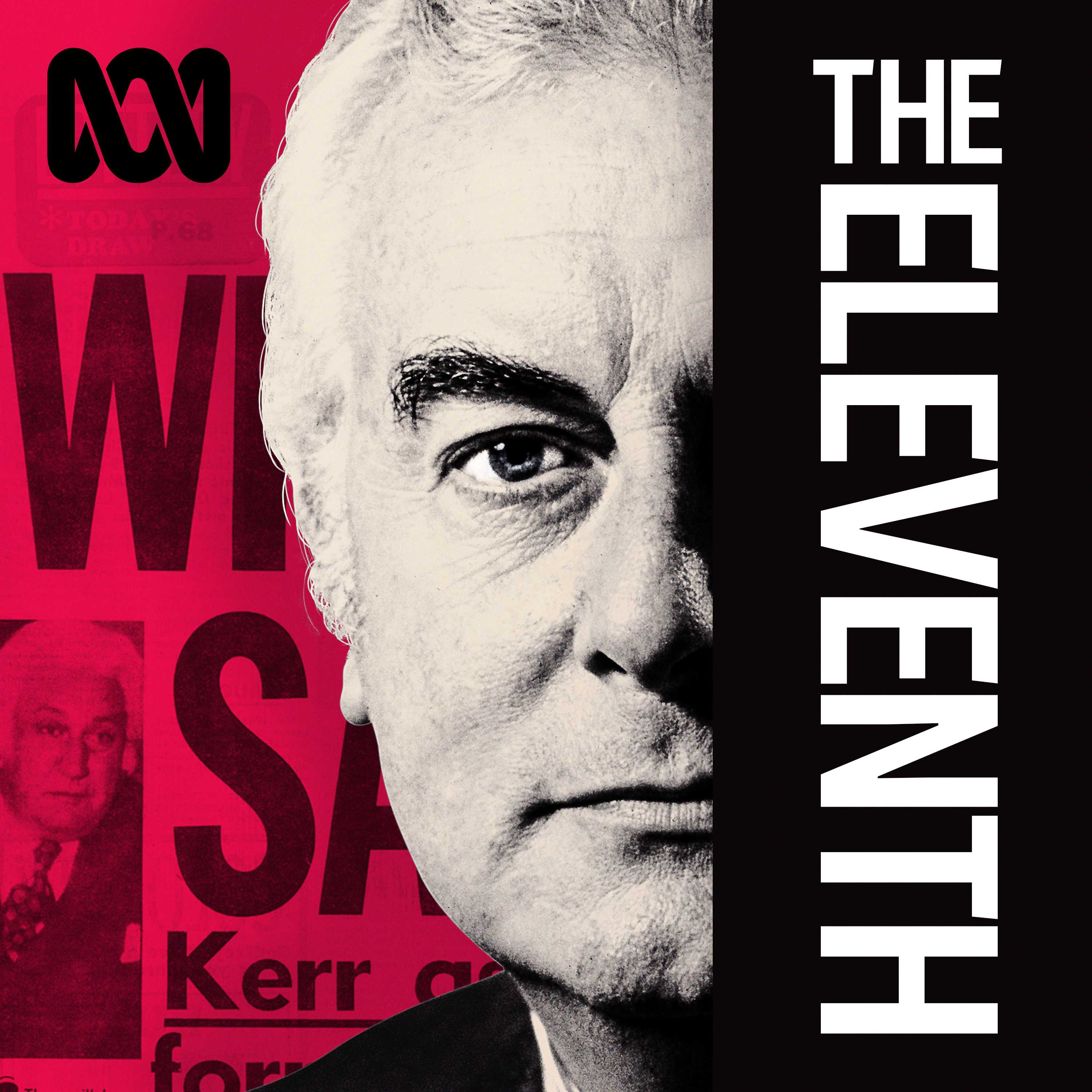
PRESENTS — The Eleventh
If you're an Unravel and true crime buff, here's another podcast you'll love — The Eleventh.
It's about what really happened during the biggest scandal in Australia's political history — the dismissal of Prime Minister Gough Whitlam.
This year marks the 50th anniversary of the dismissal and its effects are still being felt today. The Eleventh has all the elements of a great true crime podcast — chaos, ridiculous characters and even a love story.
The first episode starts in 1972. Australia has an appetite for change, and Gough Whitlam exploits the mood of the nation to become Prime Minister, but not everyone appreciates the headlong rush into a more modern Australia. Pretty soon, the new government is making some powerful enemies.
To hear the entire series, search 'The Eleventh podcast' on the ABC listen app and wherever you get your podcasts.
* WARNING: This episode contains some strong language.
To binge more great episodes of Unravel, the ABC's award winning investigative true crime podcast documentary series, search 'Unravel podcast' on the ABC listen app (Australia) or wherever you get your podcasts.
There you'll find previous series covering various crimes and crime-related topics including solved and unsolved murder cases, forensic analysis, gangland crimes, love scammers, con-artists, drugs, terrorism, neo-nazis, and miscarriages of justice — all investigated by some of Australia's best reporters and people who know the story best.
Press play and read along
Transcript
Speaker 1 This is an ABC podcast.
Speaker 2 Hey, Unravel listeners, Alex Mann here. I've been a producer behind the scenes at Unravel, and I'm also an investigative journalist at the ABC.
Speaker 2 We're hard at work on the next season of Unravel, but while you wait for it to appear, I've got another podcast that you'll love. It's called The 11th.
Speaker 2 Like every season of Unravel, at the core of this podcast is a mystery, and it's one I actually set out to investigate a few years back. back.
Speaker 2 This mystery surrounds what really happened during the biggest scandal in Australia's political history, the dismissal of Prime Minister Gough Whitlam on the 11th of November, 1975.
Speaker 2 This year is the 50th anniversary of that constitutional crisis, and its ripples are still being felt today.
Speaker 2 And, well, if you're wondering whether a political story can be as compelling as true crime, trust me, this story unfolds like a thriller.
Speaker 2 It's got spies, chaos, ridiculous characters, and even a love story. But don't take my word for it, reviews at the time called it riveting, utterly transfixing, gripping, and inspired.
Speaker 2
It was even named Podcast of the Year by Apple Podcasts. So find out what all the fuss was about.
Here's the first episode of the 11th.
Speaker 2 To binge the whole season now, search for the 11th on the ABC Listen app or wherever you get your podcasts. And just a warning before we start, this podcast contains some strong language.
Speaker 1 November the 11th, 1975 was one of the most momentous days in Australian political history. But it didn't start out that way.
Speaker 3 It was just another day.
Speaker 1 A cadet journalist was answering phones at the Parliament House Bureau.
Speaker 3 I was sitting in the office in my little corner.
Speaker 1 Meanwhile, a comedian known for his political satire was eating lunch in a Sydney Chinese restaurant.
Speaker 4 Not in a Chinese restaurant, the best Pekinese restaurant in Sydney at the time.
Speaker 1 And a teenager was making an after-school snack.
Speaker 5 I remember I'd just taken the toast out of the grill and I was sort of fixing it up with a knife.
Speaker 1 What they didn't know was that the day was about to take a dramatic turn. Soon they would all converge on the steps of Parliament House in Canberra because they were about to hear some big news.
Speaker 6 Canberra is the scene of events unprecedented in Australian political history.
Speaker 3 The phone rang and I answered it.
Speaker 5 Mum was on the phone and just came racing into the room.
Speaker 4 And I got a phone call and I had to go up to the desk to take it and she said, Gough's been sacked. Gough Whitlam has just been sacked.
Speaker 3 You really need to get downstairs onto the steps. You've got about 10 minutes.
Speaker 6 The Prime Minister, Mr. Whitlam, was today sacked.
Speaker 4 And I think I probably had to have that explained to me what that meant.
Speaker 5 Basically, we all said, what?
Speaker 3 I'm like...
Speaker 3 I was,
Speaker 3 I guess I panicked.
Speaker 1 You know, we have a democratically elected government and this guy, the Governor General, fires it. I mean, it was unprecedented.
Speaker 3 I grabbed my notebook and went running down.
Speaker 5 And she said, we're all going to Parliament House to demonstrate.
Speaker 1 Get in the car.
Speaker 4 I got on the plane to Canberra, picked up a crew and went off to Parliament House.
Speaker 3 I got there quite quickly. There were a few people starting to gather.
Speaker 5 It was just so confusing.
Speaker 1 It was unbelievable.
Speaker 5 We ran to the front of Parliament House.
Speaker 1 Before she got to the steps of Parliament House, that school student, Susan Menadieu, ran into her dad. He was biting his lower lip when he came and I thought, oh wow, he's really stressed.
Speaker 1 Susan's dad was stressed because he'd actually been caught right in the centre of the dramatic events that day.
Speaker 1
He was the head of the Prime Minister's department, the public servant closest to the centre of political power. His name was John Menadieu.
and he's actually central to our story.
Speaker 1 A few hours earlier, he'd been told that his boss, Gough Whitlam, had been sacked.
Speaker 1
I thought I'd been working for Gough Whitlam. Now it was clear to me that I wasn't.
I was working, in fact, for Malcolm Fraser. And so I didn't know quite what to do.
Speaker 1 As he rushed around trying to understand what was happening, he ran into his kids and his wife Cynthia near the front of Parliament House. And I said, where are you going?
Speaker 1 And Cynthia said,
Speaker 1 we're going over to demonstrate against that bastard Fraser. It's a phrase term like bastard I'd never heard her use in my life, then or since.
Speaker 1 More than 40 years later, the emotion of that moment is still raw.
Speaker 1 But it suddenly dawned on me, it's almost like a bucket of water being thrown over my head, that
Speaker 1 something quite dramatic had happened.
Speaker 1 Finally, the gravity of what had happened, the immorality,
Speaker 1 the deception
Speaker 1 that I had witnessed now started coming to me.
Speaker 7 And an extraordinary scene, the like of which probably hasn't been seen too many times before.
Speaker 8 Enormous spontaneous sense of outburst both. We can sense it.
Speaker 7 There are literally hundreds of members of the general public who have thronged King's Hall and are spilling out onto the steps of the Parliament as news of what had happened got around.
Speaker 1 By now there were hundreds on the steps and they were chanting.
Speaker 3 And then you just hear this big whoosh noise as the big front doors opened and I just turned around and there was Whitley.
Speaker 6 Ladies and gentlemen.
Speaker 6 Well may we say, God save the Queen.
Speaker 6 Because nothing will save the Governor-General.
Speaker 8
Here's one of the most extraordinary times ever seen in the national capital. But these news conferences, both Mr.
Fraser and...
Speaker 10 John Kerr, Governor General of Mr. Witland
Speaker 1 This is probably the most iconic moment in Australian political history. The sacking of Gough Whitlam on the 11th of November 1975.
Speaker 1 The grainy black and white footage of that moment when he spoke to the crowd on the steps of Old Parliament House. It's etched into my brain and I wasn't even born when it happened.
Speaker 1 But what's missing for me is what's outside the frame of that shot. The unseen players, the scandals, the plots, the abuses of power.
Speaker 1 I went looking for those missing pieces, and now I want to tell you what I've found. Because the incredible part of Whitlam's dismissal isn't what happened on the steps.
Speaker 1 It's the story of what led up to that moment. And there are parts of that story that no one has heard before.
Speaker 11 The ordinary punter in the street had no idea what was going going on.
Speaker 1 Where can you get a more dramatic, fantastic, unfathomable, incomprehensible and catastrophic story than this? And I said, would you in the interest of history speak to me about it?
Speaker 1 And he looked at me and said, I owe history nothing.
Speaker 1 This is the story of a government that came to radically transform Australia and in doing so came completely undone.
Speaker 1 If the government wasn't going to play by the rules, well then they were going to stop the game.
Speaker 1 It's a spy thriller, a political drama, and a romance novel. How could these people be trusted anymore? I think there are enormous secrets and deceptions at the time of the dismissal.
Speaker 1 As one American official referred to it, a bit of spooky fiddling. Can you believe this shit?
Speaker 1 I'm Alex Mann, and over the next seven episodes, I'll take you inside the highest circles of power and speak with those who are there to uncover the hidden story behind what happened on the 11th.
Speaker 1 To truly understand the dismissal, you need to understand the story of the transformation Australia went through to get there.
Speaker 1 You need to go back to a time before Whitlam lost his job, before the gloss came off his government, and before he was even elected.
Speaker 1 This story starts with a guy called Peter O'Brien because his story is the story of an Australian political awakening and it starts when Peter was just a kid.
Speaker 12 I always wanted to be a policeman because the policeman I dealt with in the suburb I was brought up in, which is South Melbourne in Victoria, we had a police force down there which was very community orientated.
Speaker 1 Growing up, Peter O'Brien looked up to his local cops.
Speaker 12 In those days,
Speaker 12 if you were perhaps using a Shanghai in the street and busting a few street streetlights,
Speaker 12 the general result was you got a clip behind the ear from the local copper who took you home to your father who gave you another clip behind the ear
Speaker 12 and the matter was settled in that way. But there was always that feeling that that man was there to protect you.
Speaker 1 When Peter eventually left school, he signed up at the police academy to become a cop himself. His belief in enforcing the law only got stronger.
Speaker 12
The only alternative to law and its enforcement is anarchy. And in anarchy, the weak go down, only the strong survive.
So therefore, it became a moral crusade as well as a personal one.
Speaker 1 In many ways, Peter's outlook was pretty typical of most Australians. He'd grown up in a conservative time when things seemed simple and it felt easy to identify who the bad guys were.
Speaker 1 But for Peter and the rest of the country, things were about to get a whole lot more complicated.
Speaker 13 What do you feel about going out on a patrol like this? Don't really know yet, first time I've experienced it.
Speaker 14 Australia's commitment of nearly 2,000 more men to Vietnam was announced in Parliament today by the Prime Minister. How long have you been in Vietnam?
Speaker 13 Two weeks.
Speaker 1 To many people in the 60s, the ultimate bad guys were the communists. And the concern was that if Southeast Asia went communist, the Australian continent would soon be threatened.
Speaker 1 So initially, there was widespread support for the nation's commitment to the Vietnam War.
Speaker 1 But as Australia's war effort ramped up, confronting images from the front lines started beaming straight into people's lounge rooms.
Speaker 15
You don't feel a bit scared? Oh, oh, a bit, you know. How do you feel about the fact that you're up in Vietnam now? Oh, well, I'd prefer to be at home.
I hope they abolish national service.
Speaker 1 Back then, national service was decided by a brutal and devastatingly random ballot.
Speaker 1 For that young copper, Peter O'Brien, and for the rest of the country, it would soon become a catalyst for radical social change.
Speaker 12 It was later in 68 that I attended the first ballot, the ball drawing, at 125 Swanson Street. in Melbourne, the headquarters of the Department of Labour and National Service.
Speaker 1 Peter O'Brien was there as an undercover cop to monitor the ballot.
Speaker 1 He watched as dozens of small marbles rattled around in the barrel, each one carrying a small number and the destiny of young men all around Australia.
Speaker 9 Numbered marbles representing all of the birth dates applicable to the men covered by this ballot would be placed in the barrel.
Speaker 1 An official would reach into the barrel and pluck out a marble and then read out the number.
Speaker 16 23023.
Speaker 1
And if the numbers matched the day you were born, 30, August 17, February 17, correct. You were going to war.
And if you said no,
Speaker 1 you went to prison instead.
Speaker 1 This process of randomly forcing young men off to war was becoming pretty controversial. That's why Peter O'Brien was there at the ballot draw that day, to make sure that the ballot went smoothly.
Speaker 1 So when a group of protesters rocked up, Peter wasn't happy.
Speaker 12 I was horrified to see these people, this group of people, not a large group, there would have been only perhaps 40 or 50 involved in it.
Speaker 12 There was still a general acceptance in the community of Australia's involvement in Vietnam. And this demonstration,
Speaker 12 I looked at it and I thought, who are these bunch of idiots? What right have they got to question the supremacy of the law? Are these people insurgents perhaps?
Speaker 12 Are they being paid by the Communist Party to stir up actions against the government? All of these thoughts cross your mind.
Speaker 1 That day, Peter couldn't understand why people were protesting against the war, but soon he would make an arrest that would leave him questioning everything.
Speaker 1 The man he arrested was a young high school teacher whose birthday had come up in the ballot.
Speaker 12 This was a teacher, a simple, straightforward, ordinary teacher that you would find probably in the majority of our high schools.
Speaker 1 The teacher had refused to go to war. He was a draft resistor.
Speaker 12 We went into the high school and we arrested him in the front of his students.
Speaker 1 Peter O'Brien had to cuff him and take him to one of the most notorious prisons in Australia.
Speaker 12
I'd been in and out of the place many, many times. I felt nothing.
You know, I took prisoners in, took prisoners out, felt nothing.
Speaker 12 But in this day, I felt
Speaker 12 that I was taking an innocent man into prison.
Speaker 12 There was almost a look of despair on his face.
Speaker 12 Perhaps saying to himself, why have I done this to myself?
Speaker 12 But I'd like him to know that I felt that despair too.
Speaker 12 That it was at that point that I said to myself, my God, what have I done?
Speaker 1
But Peter O'Brien was still a cop. He had responsibilities and he still had this strong sense of duty.
He decided to squash those feelings and get on with his job.
Speaker 12 You rationalise, you say to yourself, the law is supreme, so therefore they must be wrong.
Speaker 12 I must be right.
Speaker 1 But the voices arguing against those laws were getting louder, and Peter O'Brien was finding it harder to ignore them.
Speaker 1 There was one guy especially that he just kept hearing about, the most prominent leader of the anti-war movement, a Labor MP called Jim Cairns.
Speaker 14 I have always said if I were 20 20 years old and required to go into the Army under conscription in relation to a war like Vietnam, I would not go.
Speaker 14 I have also said this is a very significant decision for any young man to take and I leave it to him to take it. But I say quite clearly if I were facing that situation, I would not go.
Speaker 14 I would not be in it.
Speaker 1 Jim Cairns was someone who brought people with him, someone who changed the way that people thought about the war.
Speaker 1 Also I'm told, because to me he seems a bit like a cross between a worldly orator with grand convictions and an awkward librarian.
Speaker 17 In fact, the Australian forces in Vietnam today,
Speaker 17 although they operate efficiently as a unit, in fact can achieve very little in the situation in which they are.
Speaker 1 Cairns was a radical with ambition and incredible political influence. He was the leader of Labor's left wing and would later rise to become Whitlam's deputy.
Speaker 1 But during the Vietnam War, his party, the Labor Party, was still in opposition, and Cairns was busy organising these huge protest marches.
Speaker 1 On a Friday afternoon in May 1970, about 70,000 people marched through the streets of Melbourne to protest against Australia's role in the Vietnam War. Jim Cairns was there.
Speaker 18
We have made it clear. that we propose to have a limited sit-down for a limited time in Berke Street.
This is a symbol of the stopping of the war.
Speaker 1 But Peter O'Brien was there too, and it was his job to go undercover and follow Jim Cairns.
Speaker 12
I was on, to all intents and purposes, an intelligence operation. I was in scungees.
That was just civilian dress, t-shirt and a pair of jeans, runners and that sort of thing.
Speaker 12 We were active all the time in watching Dr. Cairns.
Speaker 12 We carried out continuing ongoing surveillance and we were there to try and identify the whereabouts of key draft resistors to see if they would turn up and if they turned up to track them to where they went.
Speaker 1 But after a couple of years of locking up draft resistors and following activists, the certainties of his childhood, the clear line between law-abiding citizens and troublemakers, it had all crumbled.
Speaker 1 And when Jim Cairns started addressing the crowd, O'Brien found himself hanging on every word.
Speaker 19 The Australian contribution of forces to Vietnam.
Speaker 12 And I listened to Cairns talk about this
Speaker 12 and I couldn't help but believe what he was saying, that there was a moral ineptitude to this whole affair. Here we had our Australian people involved in a war,
Speaker 12 a bloody war that our people were dying in.
Speaker 12 and that I was part of sending those young people to Vietnam. That I was part of of the system that sent them there.
Speaker 1 Peter had gone from covertly monitoring a supposedly dangerous radical to being in total agreement with him.
Speaker 12 I don't care what they say about Jim Cairns. This man was a decent man,
Speaker 12 a man driven by conscience, of rightness.
Speaker 12 And what he said at that demonstration in Berke Street that day
Speaker 12 was right.
Speaker 12 Australia should not have sent her young people to that war.
Speaker 1 It wasn't just Peter who was changing his mind. On the back of the anti-war movement, Jim Cairns and the Labor Party's quest for government was gaining momentum.
Speaker 1 This funky jam was the theme for their election campaign in 1972. If you listen closely, you can almost hear the flares and big hairdos.
Speaker 1 It captured a feeling that after 23 years of Conservative rule, Australia was ready for a change.
Speaker 1 The leader of the Labor Party was Gough Whitlam. He was a headstrong and persuasive politician.
Speaker 20 We will abolish conscription forthwith
Speaker 20 because it's intolerable that a free nation at peace and not under threat should cull by lottery the best of its youth to provide defence on the cheap.
Speaker 1 Whitlam was a crash or crash through politician with a fully formed alternative vision for Australia honed over 20 years in opposition.
Speaker 1 He was tall too, six foot four, and he had what some people called a towering and beautiful arrogance.
Speaker 20 All of us as Australians have to insist that we can do so much better as a nation.
Speaker 20 And will you believe with me that a new government, a new program, a new team is desperately needed to provide that change?
Speaker 1 This was a time when homosexuality was illegal across the country and God Save the Queen was the national anthem.
Speaker 1 According to Whitlam, Australia had been rocked to sleep by decades of Conservative government and it was up to him and the Labor Party to wake it up.
Speaker 13 I need your help.
Speaker 20 I need the help of the Australian people and given that, I do not for a moment believe that we should set limits on what we can achieve together for our country, for our people, for our future.
Speaker 1 By the time election day arrived, the momentum felt unstoppable. No matter how radical the change would be under Whitlam, Australia seemed up for it.
Speaker 13
Good evening. In the federal teller room, the federal election 1972.
The first voting returns are just coming in.
Speaker 13 And in a few hours, it's these boards that will tell the story of whether the Liberal Country Party Coalition remains in power for the next three years or whether the Australian Labour Party gains office for the first time since 1949.
Speaker 1 By the end of the night it was clear
Speaker 1 for the first time in more than a generation the Labor Party had won.
Speaker 8 There's certainly a degree of excitement that goes with it as well.
Speaker 10 Mr.
Speaker 19 Whitlam is now going out into the garden to join the hundreds of supporters who are just clamouring to congratulate him. Women are now kissing him, men shaking his hands.
Speaker 19 He's getting a tremendous reception from the party workers.
Speaker 11
Gough had this air of promise about him. He was the future.
I mean America had had Kennedy and we had Whitlam. He was somebody who was on the wavelength of an aspiring generation
Speaker 11 and people who were fed up with 23 years of same, same Liberal government.
Speaker 1 Labor was now in government and they were hiring. Patty Warne was 28 years old and sold on Whitlam's vision.
Speaker 11 A couple of days after the election, I got a phone call from Whitlam's principal private secretary who asked if I would be interested in working for the Whitlam government.
Speaker 1 Patty said yes and was soon working in the office of one of Whitlam's ministers. It rattled with the sounds and smells of 1970s Australia.
Speaker 11 In Old Parliament House, there were no photocopiers, no mobile phones,
Speaker 11 there weren't manual typewriters because the electrics hadn't come in And there was an air of utter bushfire smoke around the entire building because everybody except me, it seemed, smoked.
Speaker 1
Whitlam had this small blue book he called The Program. In it was a list of progressive social reforms that he was determined to enact.
Things like free health care and free tertiary education.
Speaker 11 Whitlam had a sense of how important it was to get on with the job. There was this sense of enormous energy from the top.
Speaker 1 In the days straight after the the election, votes were still coming in and some seats were undecided. But Whitlam wanted to get started.
Speaker 1 So instead of waiting for the final election results to pick his ministers, Whitlam just divvied up all 27 portfolios between him and his deputy, a guy called Lance Barnard.
Speaker 1 13 ministries to Gough and 14 to Lance. And just like that, the two of them started changing the country.
Speaker 11 He and Gough, Lance and Gough, were the government, were the ministry, were the cabinet of the day for several days.
Speaker 1 The government of two, basically. That's right, that's right.
Speaker 11 You probably will never see its luck again.
Speaker 1 They formally recognised China, removed the sales tax on the contraceptive pill, took steps towards equal pay for women, passed measures relating to Aboriginal land rights, withdrew more troops from Vietnam, abolished conscription, and pardoned anyone who'd been locked up for dodging the draft.
Speaker 1 So remember that young teacher who'd been thrown in prison? Now he was free. He'd spent eight months inside and the cop who put him there, Peter O'Brien, felt a wave of relief.
Speaker 12 At last we can get on with the business of investigating crime. And when Whitlam came to power, we all suddenly felt this release of
Speaker 12 tension over this,
Speaker 12 this dastardly period. A lot of us thought we were being redeemed.
Speaker 1 So at this point, Whitlam's been elected. The Vietnam War seems like it's nearly over, and the last of the Australian troops are coming home.
Speaker 1 The radical thinking of the anti-war movement had moved into Parliament House, and day after day after day, new milestone progressive reforms are being announced.
Speaker 1 I can almost imagine Whitlam and his team saying, see, this is how you do it. This is how easy it is to make Australia a better place.
Speaker 1 Now just hold that feeling for a moment, because this, right now is the sweet spot. And for the government, it's as good as it gets.
Speaker 1 Looking back on Whitlam's time in government, what strikes me most is that even by today's standards, so much of it was spent mired in scandal. That sweet spot, it lasted less than three weeks.
Speaker 1 The first problem was a US military attack that caught everyone by surprise.
Speaker 1 It's now simply called the Christmas bombings, and it set Whitlam on a collision course with the US President that would eventually threaten to undermine the entire alliance.
Speaker 1 What you're listening to right now is a recording from inside the cockpit of a B-52 bomber. It's flying over Southeast Asia and it's fully loaded.
Speaker 1 The voices you can hear are of the US Air Force crewmen running through a few final checks as they fly towards the coast of Vietnam.
Speaker 1 Through the cockpit, the air crew can see dozens more B-52s flying in this epic formation across the sky. They're in constant radio contact.
Speaker 1 Their mission is to bomb targets in the North Vietnamese cities of Hanoi and Haiphong.
Speaker 1 This recording was made the day after Christmas.
Speaker 1 As the crew of this B-52 arrive over their target, they start raining bombs on Hanoi.
Speaker 1 Villages and houses were destroyed, and hundreds of civilians died across the 10 days of bombing. One errant string of bombs landed on a hospital, killing dozens of doctors and nurses.
Speaker 1 The human costs of U.S. air attacks on North Vietnam were massive.
Speaker 10 It's
Speaker 22 Thursday morning, quarter of eight, and we're going off to see Nam Tien Street, Nam Tien District, where the bombing was extremely heavy the last couple nights.
Speaker 22 A woman is crying in the background.
Speaker 22 Oh my son.
Speaker 1 The Christmas bombings came at a time when the US was negotiating the final stages of a peace deal with the North Vietnamese.
Speaker 1 But in recent days, those talks had broken down and the bombing was supposed to intimidate the North Vietnamese leaders back to the negotiating table.
Speaker 1
Nixon had said, let's really hit these people. Let's really hit them.
And Henry Kissinger said, Mr.
Speaker 1 President, we will drop more bombs on Hanoi and Haifong than the Allies dropped on Europe during the whole of World War II. So that gives you an extent of the kind of bombing that took place.
Speaker 1 Back in Australia, Whitlam's new ministers had been sworn in on the very day the bombing started, and they were horrified.
Speaker 1 The man who knows more about what happened next than almost anyone else is historian James Curran. Just picture this.
Speaker 1 Here is the first Labour ministry being sworn in at Government House in Canberra to positions that they had been, many of them had been thinking of and eyeing off since 1949.
Speaker 1 They had been opposed to the Vietnam War right from the middle of the 1960s. They had opposed every American escalation and every American bombing campaign.
Speaker 1 And the first major international development, the major announcement is that the United States has embarked on this
Speaker 1 carpet bombing with these B-52s. They went for the juggular and they didn't hold back.
Speaker 16
Good morning. This is Ian Finlay with AM.
Many of this morning's newspapers carry the headlines that Dr.
Speaker 16 Jim Cairns will not stay silent on the issue of the Vietnam War and American bombing, despite the fact that Prime Minister Whitlam said at his press conference on Tuesday that he he himself, as Foreign Minister, would be the only spokesman on the issues.
Speaker 1 Jim Cairns talked about the White House being run by maniacs, said it was the most brutal and indiscriminate slaughter of men, women and children in living memory.
Speaker 1 So these ministers are off the leash. They are off the leash, if ever they were on the leash.
Speaker 1 But it wasn't just Jim Cairns and the other members of Whitlam's newly minted ministry making their feelings heard. Gough Whitlam was furious too.
Speaker 23 Our government has a mandate to do all it can
Speaker 23 to stop the continuation of this war.
Speaker 23 And I hope this is quite clear to everyone in Australia and abroad. It's our duty to do it.
Speaker 1 Whitlam took a different approach to his ministers. Instead of accusing the US President of war crimes, he wrote Nixon a letter.
Speaker 1 You read this letter and it's expressed in very moderate diplomatic language, but the sting comes in the tail.
Speaker 1 The letter ended with a joint appeal to both President Nixon and to the North Vietnamese to return to the negotiating table and find a peaceful solution to the war.
Speaker 1 But if that sounds sensible and fair to you right now, that is not how the US took it.
Speaker 1
The essence of it is that the Australian government was putting the United States on the same level as its communist enemy. And Henry Kissinger was pissed off.
Kissinger blows his gasket.
Speaker 1
The US had grown used to Australia being a compliant, obedient and predictable ally. Now that Whitlam was in, those days were over.
And at the White House, the shock was palpable.
Speaker 1 Kissinger grabbed the phone and found the first Australian diplomat he could get his hands on. He called the Australian Embassy in Washington.
Speaker 1 Well, Kissinger unloads, and the transcript of this telephone conversation is quite brutal to read.
Speaker 1 And Kissinger says to him, I want to let you know something, but I don't want to, how can I tactfully say to you that this should not be recorded?
Speaker 1 Even though, of course, Kissinger's secretaries are on the other line writing down every word of it. He says, I want to convey to you the depth of feeling.
Speaker 1 in the White House about receiving this kind of letter. The fact that you have put us on the same level as our enemy, I can tell you now this is not a great way to start a relationship with us.
Speaker 1 You're a new government in Canberra, and this is the way you're starting off.
Speaker 1 And then comes the threat. He says if this letter becomes public, then there are going to be great consequences for this relationship.
Speaker 1 Kissinger hung up the phone, but that dressing down was not the end of the US response. Kissinger needed to work out what to do about it beyond a surly phone call.
Speaker 1 So later, he picks up the phone again, this time to discuss the issue with President Nixon.
Speaker 1 So nine days after that letter had been received by the White House, Nixon and Kissinger around lunchtime have a telephone exchange.
Speaker 1 This is the actual audio of that phone call.
Speaker 1 This recording was one of many made of Nixon's conversations and they would later be used to destroy his presidency in the Watergate scandal. But this phone call is not about Watergate.
Speaker 1 This phone call is about Whitlam. And the scratchy tape captures the fury of a superpower scorned.
Speaker 1 President Nixon tells Kissinger that Whitlam is one of the peacenicks and that he's taking Australia down a very, very dangerous path.
Speaker 1 Kissinger is outraged too and makes a suggestion to Nixon to freeze out Whitlam for a few months. He'll get the message.
Speaker 1 After all, says Kissinger, they need us a hell of a lot more than we need them. They don't need us much, a hell of a lot more than we need them to have
Speaker 1 to go.
Speaker 1 Now, this is where Nixon decides to punish the Australians. There's to be no contact between the Australian Ambassador in Washington and the State Department.
Speaker 1 Anything to do with Australia, any cable going from Washington to its embassy in Canberra, must go through Kissinger first. He even says,
Speaker 1
we're not going to send any Christmas cards to Australia. Australia's got the cold diplomatic shoulder.
You know, it's in the deep freeze.
Speaker 1 If that was supposed to intimidate Whitlam and his ministers into submission, it didn't work. They had a new vision for Australia and little interest in blindly following old allies and traditions.
Speaker 1 In the next episode of the 11th, the government picks a fight with its own intelligence service, and our cop, Peter O'Brien, finds himself at the centre of the action yet again.
Speaker 12 This was one hell of a shock. This is Australia's intelligence organisation.
Speaker 8 You know, ASIO?
Speaker 12 We're going into ASIO?
Speaker 11 What the hell for?
Speaker 4 This was the domestic intrusion.
Speaker 1 A deep resentment towards the government evolved from that point. We voted for this fucking knock.
Speaker 1
The 11th is hosted by me, Alex Mann. Supervising producer is Tim Roxburgh.
Audio producers Nina Koppel, Shane Anderson, and Ellen Leebeater.
Speaker 1 Our wonderful researchers are Steph Collett and Jane Curtis. Sound designer is Tim Jenkins, with additional sound design and a theme composition by Martin Peralta.
Speaker 1 Thanks to Justine Kelly and Ian Walker, who were there in the very beginning and very end.
Speaker 1 Our executive producer is Nikki Tugwell. The 11th is a product of ABC Audio Studios, led by Kelly Riordan.
Speaker 2 That was the first episode of The Eleventh. To binge the whole season now, search for The Eleventh on the ABC Listen app or wherever you get your podcasts.