Documented Military Reports of Vampires
In the age of enlightenment, the disciplined Austrian army brought order and science to its newly acquired territories. Yet in the rugged mountains of Serbia, they stumbled upon a darkness that defied all logic – a plague of undeath that forced hardened soldiers to take up wooden stakes against the walking dead.
See Privacy Policy at https://art19.com/privacy and California Privacy Notice at https://art19.com/privacy#do-not-sell-my-info.
Press play and read along
Transcript
Speaker 1 Why choose a sleep number smart bed? Can I make my site softer? Can I make my site firmer? Can we sleep cooler?
Speaker 1
SleepNumber does that, cools up to eight times faster, and lets you choose your ideal comfort on either side. Your sleep number setting.
Enjoy personalized comfort for better sleep night after night.
Speaker 1 It's our Black Friday sale, recharged this season with a bundle of cozy, soothing comfort. Now only $17.99 for our C2 mattress and base plus free premium delivery.
Speaker 1 Price is higher in Alaska and Hawaii. Check it out at a sleepnumber store or sleepnumber.com today.
Speaker 1 What image comes to mind when you hear the word vampire?
Speaker 1 Perhaps it is the classic depiction of Belo Lugosi's Dracula, an elegant, immortal, reclusive figure. Or maybe it's the more feral, animalistic sort.
Speaker 1 cold, unfeeling, superhuman killing machines, driven only by an insatiable thirst for blood, a creature whose only weakness is exposure to pure silver and sunlight.
Speaker 1 But is there any truth to these creatures' existence?
Speaker 1 Surprisingly, yes.
Speaker 1 In the first half of the 18th century, following the Austrian Empire's seizure of Belgrade and much of Serbia, reports of strange deaths would make their way into the hands of Austrian officials.
Speaker 1 Unusual reports from Serbian villages now under the control and supervision of the Austrian monarchy, villages whose inhabitants were being picked off, one by one, by what was described as an inhuman and unnatural enemy.
Speaker 1 Austrian doctors and men of science scoffed at these absurd claims, attributing the villagers' strange deaths to some unknown disease.
Speaker 1 But when Austrian medical officers and soldiers were sent to investigate these deaths and to bring order to what was clearly a population of uneducated and superstitious peasants.
Speaker 1 These military men quickly realized that the villagers were telling the truth.
Speaker 1 This is the story of the Austrian army and the vampire.
Speaker 1 I'm Luke Lamana,
Speaker 1 and this is wartime stories.
Speaker 1 In the early years of the 18th century, the Austrian Habsburg monarchy found itself embroiled in a bitter war with the regional powerhouse of the Ottoman Empire.
Speaker 1 From 1716 to 1718, in what is now known as the Austro-Turkish War, rival imperial forces conducted battle over the Balkans, leaving an estimated 80,000 dead in their wake.
Speaker 1 The short but violent conflict would culminate in the Austrian capture of Belgrade, forcing the Ottoman surrender and the signing of the Treaty of Pasarovitz.
Speaker 1 With the Ottoman defeat, the Habsburgs expanded their empire into the Balkan region, the territories of Banat, Alencia, northern Bosnia, and Serbia then falling under the flag of the Austrian Eagle.
Speaker 1 With new kingdoms to their name and thousands of new subjects under their rule, the Habsburgs set about exploring the Balkan territories.
Speaker 1 Administrators, explorers, and cartographers were dispatched into the rugged, mountainous land, cataloging everything from geography, wildlife, and the unique social dynamics at play within the regions.
Speaker 1 Located along the banks of the mighty Danube River in northeastern Serbia, just outside the now capital city of Belgrade, the small fishing village of Kisiljevo welcomed one such adventurer in the summer of 1725.
Speaker 1 Provizar Frumbald, an imperial administrator, was already well into his journey, the humble village, just one of dozens he was tasked with recording on his way through the Serbian kingdom.
Speaker 1 However, while studying this little town and its inhabitants, Frumbald would bear witness to what he considered a unique and rather grotesque sort of ritualistic practice.
Speaker 1 As Frumbald went about his duties, his attention was drawn to an angry crowd of villagers clustered in the town's modest cemetery.
Speaker 1 Intrigued, the administrator made his way to the burial grounds, nudging his way through the excited mob of people, trying to get a better look at what was happening.
Speaker 1 Finally breaking through the crowd, Frumbald was confronted with a sight both confusing and disturbing. The villagers appeared to be exhuming a corpse, a man recently deceased at about the age of 60.
Speaker 1 As the burial detail hoisted the man's body from his grave, Frumbald took note of how fresh the buried corpse appeared. The body, despite supporting the layer of dirt, still maintained a lively glow.
Speaker 1 The man's fingernails and hair likewise appeared healthy and intact.
Speaker 1 Surely, Frumbold thought, showing no signs of bloat or decay, the man couldn't have been buried more than a few hours before his arrival, or perhaps the day prior.
Speaker 1 What reason would they have, he then pondered, to be exhuming the body now?
Speaker 1 Quite an unusual practice.
Speaker 1 Still more strangely, he watched as the villagers grew increasingly riled, hurling curses and spiteful words towards the corpse that now lay on the ground.
Speaker 1 Others remained stoic, their hands tightly clasped, heads lowered in silent prayer.
Speaker 1 The bizarre scene, made all the more eerie against the backdrop of the priest's passionate readings of scripture, and the crowd's jeering, took a final, dark turn.
Speaker 1 Reaching into a small crate, one of the men retrieved two items, a sharpened stake carved of hawthorn wood and a mallet.
Speaker 1 Placing the jagged end of the stake against the corpse's chest, Frumbald watched with bated breath as the man then raised the mallet high above his head.
Speaker 1 Taken aback by the horrifying display, staring at the wooden stake now deeply planted in the dead man's heart, the administrator couldn't help but be doubly startled by the tremendous amounts of fresh blood now pouring from the corpse's chest, mouth, and ears.
Speaker 1 Was this man even dead? How could a corpse without a beating heart produce so much blood? The administrator could have even sworn he heard the man issue a low, pained groan when being impaled.
Speaker 1 Increasingly baffled by the series of events, Frumbald watched as the men set about the final phase of their now apparently well-rehearsed ritual.
Speaker 1 The men lowered the bloody corpse back into the open grave before setting fire to it.
Speaker 1 The smell of burning hair and flesh quickly filled the graveyard, the crowd having now become transfixed and eerily silent.
Speaker 1 As the flames devouring the man's corpse climbed high into the darkening sky, Frumbald asked his guide about what he had just witnessed. Who was the dead man?
Speaker 1 and why did his corpse deserve such unusual and seemingly spiteful treatment?
Speaker 1 The guide, guide, hesitant and pale with fright, explained that they had just witnessed the final execution of what was called a vampire.
Speaker 1 Observing his look of confusion at the term, the man explained, a vampire, a foul, unholy, and predatory spirit who stalks the earth with an insatiable thirst for human blood.
Speaker 1 Having retired to his evening quarters, Provisor Frumbald began making a detailed report of the day's events, a report which would later be published that same summer of 1725.
Speaker 1 This official government report is the first documented use of the word vampire in recorded history.
Speaker 1 Once published, the testimony of the provisor, further expanded upon by the testimony of locals from Kisolevo, sent shockwaves throughout the Austrian Empire.
Speaker 1 But who was the dead man whose ritualistic impalement Frumbald witnessed? According to the document, while he still lived, this so-called vampire was a local man by the name of Petar Blagoyevic.
Speaker 1 Ten weeks before Frumbald's arrival to the small town of Kisolevo, Petar, then a man of about 60 years of age, was laid to rest after a short bout with illness.
Speaker 1 In and of itself, this was no cause for concern. However, shortly following Petar's passing, something terrifying was unleashed upon the unsuspecting village.
Speaker 1 A string of mysterious deaths of several villagers took place in the week immediately following Petar's burial.
Speaker 1 One after the other, affected individuals would fall violently ill and then die within 24 hours.
Speaker 1 But far from being a normal bout of plague or illness, on their deathbeds, each victim uttered the same ominous testimony.
Speaker 1 Petar Blagoyevic, at least a monstrous perversion of him, had appeared to them in their dreams, viciously strangling them to within an inch of their lives before they suddenly woke from the terrifying vision.
Speaker 1 And these were clearly no ordinary nightmares.
Speaker 1 Within eight days of his burial, nine more villagers were also dead, victims of what seemed nothing less than a repeating series of supernatural attacks, an unholy scourge that, without intervention, seemed bound to continue.
Speaker 1 For the people of Kisolyevo, there was never any doubt about what Petar was and how he needed to be dealt with.
Speaker 1 Unlike the newly arrived Austrians, the Serbs, alongside their other Slavic brethren, were well acquainted with identifying and disposing of vampiric creatures.
Speaker 1 If historical accounts are to be believed, Balkan peoples had been dealing with such entities for hundreds of years.
Speaker 1 In spite of the harsh laws in place that prevented the burning and staking of bodies under the guise of witchcraft, the villagers continued in this gruesome practice.
Speaker 1 For them, upon exhuming the long-departed Petar, the telltale signs of vampirism were plainly evident.
Speaker 1 Despite being dead and buried for 10 weeks, Petar's flesh maintained its lifelike color, while his fingernails and hair continued their growth.
Speaker 1 Perhaps the most damning evidence came in the form of fresh blood smeared about the dead man's mouth. proof, the villagers thought, of the very life drained from their murdered citizens.
Speaker 1 Killing a vampire was a solemn and grisly task. Prayers are recited before a sharpened stake, carved of hawthorn wood, is to be driven into the vampire's heart.
Speaker 1 The wood of the hawthorn tree had long been believed to possess certain spiritual and healing properties.
Speaker 1 In a final effort to rid the body of the vampire possession, the afflicted individual's remains are then burned. And with that, the vampire of Kisiljevo was no more.
Speaker 1 Frumbald's account of the Kisiljevo vampire submitted to the Imperial Austrian court in the summer of 1725 gave the Western world its first true glimpse of these terrifying creatures.
Speaker 1 From there, the incredible story was published in some of Europe's most renowned journals and newspaper publications, further stoking the fears and imaginations of people all over the continent in the following years.
Speaker 1 Despite the religious laws of the day condemning both the belief in such entities as well as the practice of killing them, it is said that the Holy Roman Emperor himself, Charles VI, took keen interest in these blood-sucking creatures.
Speaker 1 Not only did he send copies of Frumbald's findings to all the crowned heads of Europe, but ordered that all reports of vampire-related activity be sent directly to the imperial court.
Speaker 1 Perhaps this is why, six years later, in the winter of 1731, when new reports of mysterious deaths came across the desks of imperial administrators, a swift, militarized response was deemed necessary by Austrian officials.
Speaker 1 This time, the reports came not from the town of Kisiljevo, but from a remote Serbian village, the village of Medvedja.
Speaker 1 At first glance, Austrian authorities were more concerned at the prospect of some sort of viral outbreak burning its way through the village inhabitants.
Speaker 1 However, the reports strangely indicated a number of people had died after only two or three days of falling ill, with no previous signs of disease. Quite mysterious.
Speaker 1 By order of Lieutenant Colonel Schnetzer, the Austrian military commander in the central Serbian town of Jakodina, a small contingent of medical officers, imperial infectious disease experts, were thus dispatched to the region to investigate the deaths.
Speaker 1 Spearheading the group of specialists was a man by the name of Glaser.
Speaker 1 Not one to be swayed by local folklore and outlandish spirituality, Glaser was determined to uncover the truth behind the trouble plaguing the village of Medvedja.
Speaker 1 By the time Glaser arrived in the village, the number of victims had already reached double digits.
Speaker 1 Whatever the ailment was, the specialist was alarmed by the fact that, according to witness testimony, affected individuals barely lasted a day after falling violently ill.
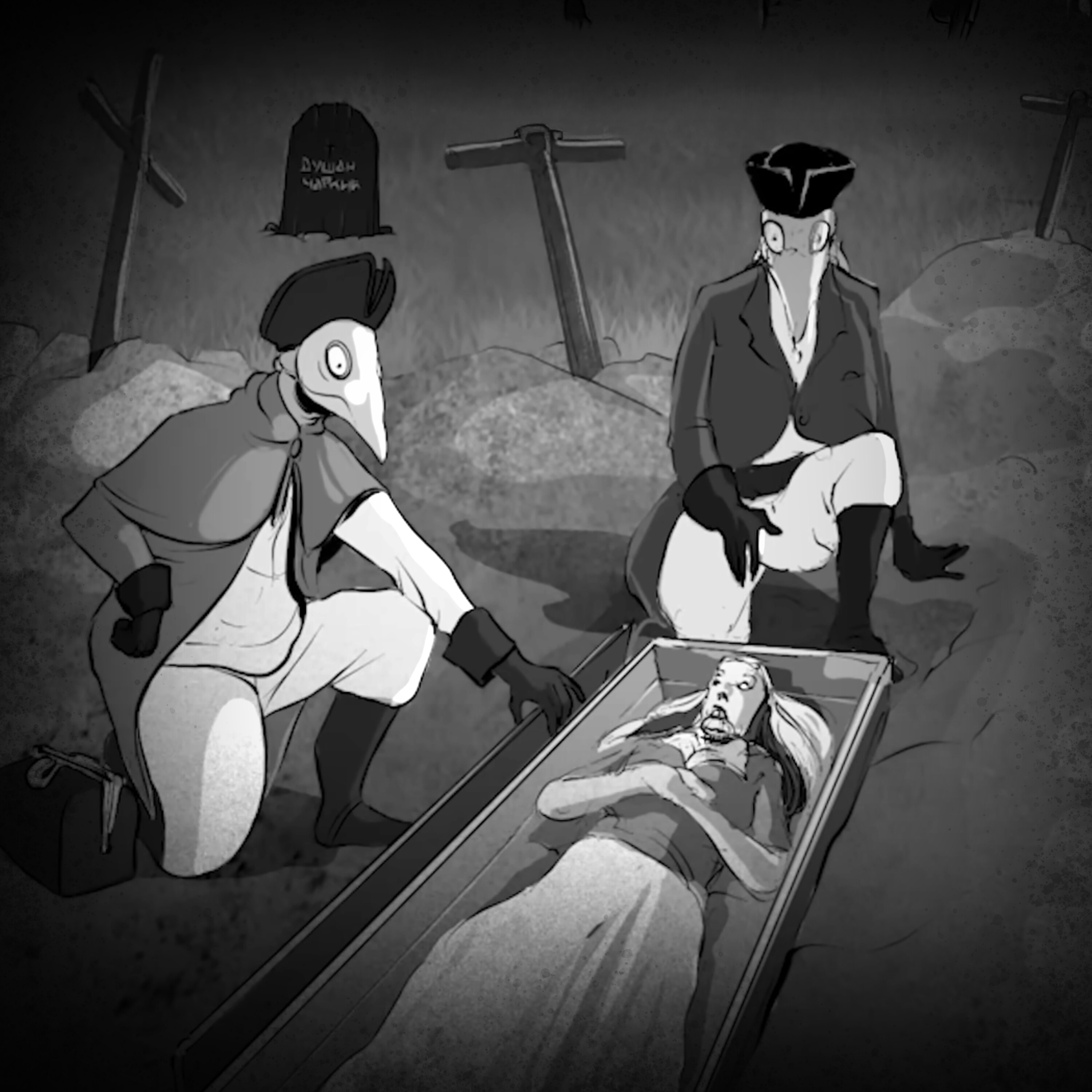
Speaker 1 Glasser then went straight to the source and with the help of reluctant villagers, exhumed the remains of several of the recently deceased neighbors.
Speaker 1 Glasser noted that, quite strangely, Despite the most recent victim expiring several days before his arrival, little to no decomposition had taken taken place.
Speaker 1 And the same could be said for the corpses that were buried weeks earlier. More haunting still was the complete lack of evidence pointing to any known sort of disease or infection.
Speaker 1 There were no sores, rashes, boils, or blisters evident on their skin, while no residue around the mouth or nose indicated any of the expected bodily secretions.
Speaker 1 As Glasser subsequently wrote off every logical answer in the medical books, the insistent testimony of Medvege's residents became increasingly harder to ignore.
Speaker 1 Despite the quelling looks of disbelief that the imperial specialists gave them, the villagers were adamant that they were dealing with a rampage of at least one, if not several more, vampires.
Speaker 1 When Glasser's report made its way back to the Austrian regional headquarters at the Kalimagden fortress in Belgrade, it detailed a unique and dire situation.
Speaker 1 The infectious disease experts were unable to find any evidence of some sort of viral outbreak. Quite bizarrely, they themselves started to find merit in the locals' vampiric rationale.
Speaker 1 To worsen things, tensions within the region were now reaching a boiling point as Serbian villagers clashed with imperial authorities, who were now actively enforcing laws banning them from staking and burning the suspected vampires.
Speaker 1 Whether it was the alarming nature of Glossar's strange findings or the threat of local upheaval, Imperial authorities deemed it necessary to muster a military response.
Speaker 1 In January of 1732, troops from the Honorable Regiment of Foot under the command of one Baron Felstenbusche, as well as the men of the Honorable Maruli Regiment and the Honorable Alexandrian Regiment, set out from the fortress to the Serbian village.
Speaker 1 Amongst them was an Austrian regimental field surgeon, Johann Flukinger, who rode along in nervous anticipation.
Speaker 1 Like many men of science and medicine, Flükinger's rational mind found little merit in the peculiar superstitions and folkloric beliefs of the Empire's Serbian subjects.
Speaker 1 But after reading excerpts of the reports made by the infectious disease specialists who were sent in before them, the surgeon couldn't shake the thought that they were marching into something highly unnatural, or at the very least, something never before witnessed in the realm of medical science.
Speaker 1 In the name of keeping up public relations with the Empire's newest citizens, the Austrians, reluctantly, entertained the first-hand testimony of the villagers, who appeared sincere and greatly distressed by what they conveyed was nothing less than a life-and-death struggle against supernatural forces.
Speaker 1 In spite of their skepticism, however, much to the Austrians' amusement, the villagers' story, bizarre as it seemed, was eerily consistent across all of their testimonies.
Speaker 1 The trouble, the villagers told them, began five years earlier with the death of a local Albanian man named Arnand Peyol.
Speaker 1 Prior to his sudden death, Arnand had privately disclosed to a few of his friends that he had made efforts to protect himself from a vampire's bite by eating dirt from its grave.
Speaker 1 Going one step further, he told them he had been compelled to exhume the grave's corpse, then smearing himself in the vampire's blood to cleanse himself.
Speaker 1 Unfortunately, his macabre efforts to ward off vampirism didn't stop him from later falling off of a hay wagon and breaking his neck, nor did they appear to stop him from still inheriting an unholy bloodlust following his sudden demise.
Speaker 1 About a month after Peel's sudden death, four villagers reported having terrifying dreams in which the dead man appeared, tormenting them. A menacing and sinister grin on his face.
Speaker 1 His red, beastly eyes leered at them from darkened corners. Soon after these dreams began, the bodies started to pile up.
Speaker 1 These same four villagers, mere days apart, would all die under identical and ominous circumstances. A terrifying vision followed by a bout of sudden, violent illness.
Speaker 1 Their lives seeming to be quite literally drained out of them.
Speaker 1 Having recognized the all-too-familiar implications, long familiar with the telltale signs of vampirism, the local elders conferred on a plan of action to stop Peol from killing anyone else.
Speaker 1 Upon exhuming his body, buried 40 days prior, they were greeted with an unnaturally fresh corpse. seemingly untouched by decomposition.
Speaker 1 More unnerving was the appearance of fresh blood smeared all over the the man's body and coffin, freshly dried blood even caked between his lips and teeth.
Speaker 1 Still more shocking as a Hawthorne stake was driven into his heart, the men claimed that Pale uttered a low, pained groan as copious amounts of more blood flowed from his mouth, nose, eyes, and ears.
Speaker 1 But even after burning the body and reducing the vampire's remains to ash, despite the next five years passing peacefully, the villagers were greatly discouraged to later realize that their vampire troubles were far from over.
Speaker 1 With 17 newly dead villagers to account for, Flukinger and his men listened as the villagers described the cause for these more recent deaths.
Speaker 1 During his 40 days of terror, in which he had fed on the lives of four of his fellow villagers, Arnand, it seemed, had also fed on the blood of several young calves.
Speaker 1 As these calves had recently matured and been slaughtered, it was the meat of these tainted animals that was blamed for passing the vampire's curse onto those who consumed it.
Speaker 1 Whatever the cause of these recent string of deaths, it was imperative, the villagers thought, that they stake and burn each and every one of the suspected vampire corpses in order to bring an end to this demonic reign of terror.
Speaker 1 Prior to the Austrian military's arrival, Serbian locals had already acted, staking and burning one of the suspected corpses before the imperial officers halted any more rituals.
Speaker 1 An expert in contagious diseases, Flukinger systematically ordered exhumations and conducted autopsies on all the suspects.
Speaker 1 In the interest of preventing an epidemic and further panic in the village, he sought a scientific explanation for their sudden deaths and the apparent anomalies in decomposition.
Speaker 1 Of the corpses they exhumed, the ages of the deceased ranging from men as old as 60 to infants as young as eight days, 10 were found to be in a state of supposed vampirism.
Speaker 1 As Flukinger and his colleagues worked tirelessly in their examinations, conducting thorough autopsies of each supposed vampire, they found themselves increasingly baffled by their findings.
Speaker 1 Much like the disease specialists before them, they found no evidence to support the theory of a newfound viral strain being the cause of death.
Speaker 1 While their organs and brains were clearly dormant, the afflicted bodies, to the eyes of the surgeons, seemed very fresh and healthy, as if they were being kept in a state of suspended animation.
Speaker 1 With each new cut, warm blood continued to flow from the bodies.
Speaker 1 Fresh skin had taken the place of old, and in one case, the reports indicate that a woman's body, which was emaciated and thin at the time of her burial, appeared to have gained weight.
Speaker 1 By all accounts, this woman, who the villagers knew had lived her life on the brink of starvation, now seemed to be very well fed in death.
Speaker 1 Completely dumbfounded and in a reluctant effort to appease the wants of the terrified locals, the Imperial troops yielded to the requests to destroy the bodies.
Speaker 1 Returning the corpses to their graves, the people of Medvedya then went about their disposal process with cold, unfeeling efficiency.
Speaker 1 When all was said and done, the bodies of 17 supposed vampires had been staked, burned, and disposed of.
Speaker 1 And, strangely enough, it seemed to work.
Speaker 1 Supernatural or otherwise, the Austrian troops couldn't deny that the only effective measures that seemed to stem this series of mysterious sudden deaths were these very macabre rituals performed by the Serbs on the corpses.
Speaker 1 Like their remaining ashes, the vampires of Medvetya, their devilish killings, the villagers' nightmares, these withered away into nothing, leaving the imperial authorities with far more questions than answers.
Speaker 1 What unearthly forces, they must have pondered, were at work within the empire's new and unfamiliar territories.
Speaker 1 Upon his return to Belgrade, Flukinger's completed report, titled Vissum et Repartum, Seen and Reported, ignited another fervor.
Speaker 1 Like Frumbald several years prior, his report similarly acknowledged the existence of vampires.
Speaker 1 Debates then raged in scholarly, religious, and court circles regarding the nature of these so-called vampire epidemics. Could vampires be real?
Speaker 1 Did citizens need to fear blood-sucking creatures might attack them in their beds? In which case, was it even safe to live close to a graveyard?
Speaker 1 something which was quite common throughout many European settlements at the time. Should the dead be securely interred in high-walled burial grounds outside city limits?
Speaker 1 Many such fears were quelled around a decade later, in 1746, when Vatican scholar Dom Augustine Calmet concluded in his Dissotation sur les apparitions that, scripture aside, nobody was rising from the grave.
Speaker 1 He classified vampires as creatures of imagination rather than an immediate threat.
Speaker 1 Over the course of the last three centuries, mankind's understanding of the natural world has dramatically increased.
Speaker 1 At first glance, historical cases of vampirism are easy to chalk up to a poor understanding of human biological sciences, or even human psychology pertaining to the effects of what is called mass hysteria.
Speaker 1 Taking into account the lack of what we now consider a formal education, as well as the devout religious beliefs of that time, it certainly wouldn't take much to convince even an entire village that nefarious spirits were running amok.
Speaker 1 But even still, considering the many contemporary stories of demon possession and supernatural encounters, who's to say that such ancient superstitions are entirely irrational?
Speaker 1 If such unseen spiritual forces exist, as many believe with all sincerity that they always have, it's evident that they make themselves known through the flesh of humanity.
Speaker 1 Illness, nightmares, strange visions, and other unexplained afflictions are notably common among such stories.
Speaker 1 Regardless of the truth behind supposed vampire attacks, What is very real is the almost universal belief in the existence of such beings, not only in Slavic Europe, but the world over.
Speaker 1 Perhaps, depending on a given culture, such supernatural entities are simply called by different names.
Speaker 1 Before the Serbs coined the iconic term vampire, these creatures otherwise appeared as malevolent spirits and demonic entities in countless oral histories.
Speaker 1 Asian, African, North, and South American cultures all speak of evil beings hell-bent on consuming the flesh and blood of the living, each with their own supernatural or superhuman capabilities.
Speaker 1 While the vast cultural tapestry of varying accounts makes it difficult to clearly define what a vampire is, the 20th century interpretation of such beings is likely an amalgamation of certain relatively consistent traits.
Speaker 1 Far from the unholy creatures described during these encounters in 18th century Serbia, vampires have more recently been depicted as something far more appealing and romanticized.
Speaker 1 If the Serbian depiction is truer to the vampire's original form, then clearly, we have been greatly desensitized by modern depictions of immortal, highly seductive beings with great powers and an intolerance to sunlight.
Speaker 1 Now, in the 21st century, whatever it is that gives us such confidence in our greater knowledge of the world and all of its unsolved mysteries, Vampires are largely dismissed as creatures of fantasy and fiction, a relic from a bygone era of ancient folklore.
Speaker 1 Even in the Serbian capital of Belgrade, now a modern city, the very legend of the vampire is something most passers-by would roll their eyes at.
Speaker 1 Nothing but a myth born out of a time of ignorance and paranoia.
Speaker 1 However, if you were to leave the modern world behind and journey into the rural heartland of Serbia, you would find that the locals' belief in vampires is still very much alive.
Speaker 1 In 2012, the tiny village of Zarozia in western Serbia was thrown into a state of bedlam when a 300-year-old water mill collapsed.
Speaker 1 The residents were adamant that the mill housed a dangerous vampire by the name of Sava Savanovich.
Speaker 1 So convinced were they of the vampire's presence, or at least wary of it, tour guides refused to venture near the mill after sundown.
Speaker 1 Likewise, the owners of the mill, for fear of disturbing Savanovich, flatly refused to perform regular maintenance on the historic structure.
Speaker 1 It was this fear and the lack of maintenance that directly resulted in the collapse of the mill, and, supposedly, the release of a very angry, now homeless vampire into the surrounding hills.
Speaker 1 Terrified that the infamous entity was once again on the hunt for victims, the citizens of Zarozia, calling on hundreds of years of ancestral knowledge, acted as their predecessors once did.
Speaker 1 Garlic sales in the region skyrocketed as crucifixes and holy icons were placed above the doorway to every home.
Speaker 1 As a self-defense measure, the villagers armed themselves with sharpened hawthorn stakes in anticipation of direct confrontations with Savanovich.
Speaker 1 Remaining vigilant for the next seven months, nothing more seemed to come from the matter.
Speaker 1 The mill was eventually rebuilt, and with the vampire supposedly gone, calm once again returned to the humble village. A passing hysteria, perhaps, but only to an outsider.
Speaker 1 From our enlightened point of view, it's very easy to be amused by such an incident, to laugh at what we believe are poorly educated country folk caught up in their own ridiculous superstitions and outdated beliefs.
Speaker 1 However, to the people of rural Serbia, far more familiar with the natural and unnatural elements of their own homeland, they know better than anyone else that there are things in the region and perhaps the wider world that the scientific eye cannot and will never comprehend.
Speaker 1 A sentiment that rings as true today as it did for the Austrian soldiers and disease experts who, so many years ago, marched into a strange foreign land to confront a series of unusual deaths and strange happenings.
Speaker 1 They too felt confident in their education in the natural sciences. Soldiers who then marched out of those villages to write official reports which we can still read today.
Speaker 1 Reports which conveyed not confidence, but bewilderment in their findings.
Speaker 1 Military reports, which, like those men, leave us with only a dark and insidious mystery that by all accounts remains
Speaker 1 unsolved.
Speaker 1
Wartime Stories is created and hosted by me, Luke Lamana. Executive produced by Mr.
Bollin, Nick Witters, and Zach Levitt. Written by Jake Howard and myself.
Speaker 1
Audio editing and sound design by me, Cole Lacascio, and Whitlacascio. Additional editing by Davin Intag and Jordan Stidham.
Research by me, Jake Howard, Evan Beamer, and Camille Callahan.
Speaker 1
Mixed and mastered by Brendan Kane. Production supervision by Jeremy Bone.
Production coordination by Avery Siegel. Additional production support by Brooklyn Gooden.
Speaker 1 Artwork by Jessica Klox and Kiner, Robin Vane, and Picada. If you'd like to get in touch or share your own story, you can email me at info at wartimestories.com.
Speaker 1 Thank you so much for listening to Wartime Stories.