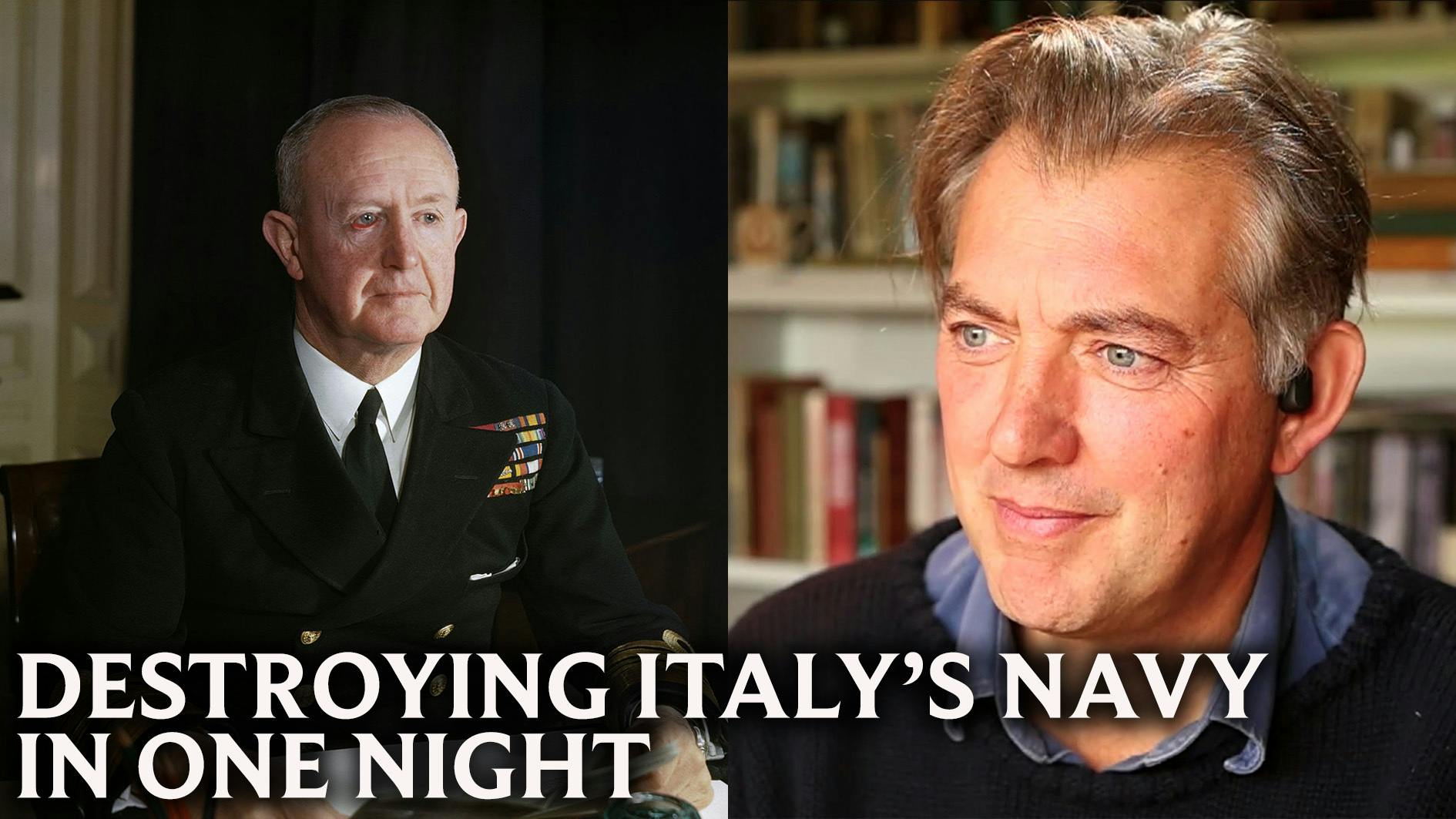
Atlantic War: Papering Over The Cracks (Part 4)
Join James Holland and Al Murray for part 4 of this deep dive on the war in the Atlantic, the most vital theatre of war in WW2 and the long-running campaign between the British Royal Navy and the Nazi German Kriegsmarine.
Start your free trial at patreon.com/wehaveways and unlock exclusive content and more. Enjoy livestreams, early access to podcast episodes, ad-free listening, bonus episodes, and a weekly newsletter packed with book deals and behind-the-scenes insights. Members also get priority access and discounts to live events.
A Goalhanger Production
Produced by James Regan
Exec Producer: Tony Pastor
Social: @WeHaveWaysPod
Email: wehaveways@goalhanger.com
Membership Club: patreon.com/wehaveways
Learn more about your ad choices. Visit podcastchoices.com/adchoices
Press play and read along
Transcript
Speaker 1 Thank you for listening to We Have Ways of Making You Talk. Sign up to our Patreon to receive bonus content, live streams and our weekly newsletter with money off books and museum visits as well.
Speaker 1 Plus early access to all live show tickets. That's patreon.com slash wehaveways.
Speaker 2
Tis the season for all your holiday favorites, like a very Jonas Christmas movie. And Home Alone on Disney Plus.
Did I burn down the joy?
Speaker 3 I don't think so.
Speaker 2
Then Hulu has National Lampoon's Christmas vacation. We're all in for a very big Christmas treat.
All of these and more streaming this holiday season.
Speaker 2
And right now, save big with our special Black Friday offer. Bundle Disney Plus in Hulu for just $4.99 a month for one year.
Savings compared to current regular monthly price. And it's $12.1.
Speaker 2
Offer for ad supported Disney Plus Hulu bundle only. Then $12.99 a month or then current regular monthly price.
18 plus terms apply.
Speaker 4 Are your business expenses playing hide and seek? With Uber for business, the small spends that slip through the cracks, like rides and meals, go right where you need them.
Speaker 4
Because it integrates with leading expense platforms. You can say goodbye to surprise costs, missing dollars, or chasing receipts.
Everything's track-downable. Uber for Business.
Speaker 4 Make small steps that make a big impact. Learn more at uber.com slash smallsteps.
Speaker 3 Tito's Handmade Vodka is America's favorite vodka for a reason.
Speaker 3 From the first legal distillery in Texas, Tito's is six times distilled till it's just right and naturally gluten-free, making it a high-quality spirit that mixes with just about anything.
Speaker 3 From the smoothest martinis to the best Bloody Mary's, Tito's is known for giving back, teaming up with nonprofits to serve its communities and do good for dogs.
Speaker 3 Make your next cocktail with Tito's, distilled and bottled by Fifth Generation Inc., Austin, Texas, 40% alcohol by volume, savor responsibly.
Speaker 1 It is absolutely necessary to recognize that the greatest task of the hour is the concentration of all our power against Britain.
Speaker 1 In other words, the means necessary for the defeat of Britain must be produced with energy and speed. All demands not absolutely essential for warfare against Britain must deliberately be set aside.
Speaker 1 There are serious doubts of the advisability of Operation Barbarossa before the overthrow of Britain. The fight against Britain is carried on primarily by the Air Force and the Navy.
Speaker 1 There is, therefore, the greatest need to produce the weapons used by these two services and to concentrate these weapons on the British supply lines, which are taking on increased significance in view of the fact that the entire armament industry, particularly aircraft and ship construction, is being shifted to America.
Speaker 1 Britain's ability to maintain her supply lines is definitely the decisive factor for the outcome of the war.
Speaker 1 The Naval staff is firmly convinced that German submarines, as in the World War, are the decisive weapons against Britain.
Speaker 1 And that was, of course, Admiral Rader filling Hitler in on what he thinks of the state of the naval war on the 7th of December, 1940.
Speaker 2
And that was brilliantly done. Well, we know he's going to be Rader from now on.
Yeah, absolutely.
Speaker 2
Really funny. Thank you.
Crikey, he's changed his tune a bit, hasn't he? He has. I thought it was all surface fleets.
He certainly has.
Speaker 2 You know, here we are in December 1940, and it's U-boat, U-boat, U-boat. It's a bit late, mate, isn't it?
Speaker 1 Yeah. The penny has Britain, the most dangerous enemy.
Speaker 2 Britain.
Speaker 1 Welcome to We Have Ways of Making You Talk with me. I'm a James Holland for episode four of our Atlantic War quest,
Speaker 1 our attempt to try and fit the Atlantic War, or at least this phase of it, into six episodes, maybe, Jim? Because the Atlantic is vast, and so is this story of this campaign.
Speaker 2 It's the longest campaign.
Speaker 1
Longest campaign and the most important, of course. Certainly while we're doing podcasts about it.
Raider has changed his tune and the British Shipbuilding Commission now swings into view.
Speaker 1 And for those people who are fans of committees, smoke-filled rooms, of horse trading, arm wrestling, deal making, this is a story with that and some additional knobs added, isn't it?
Speaker 1 It's the most extraordinary story this, as it pans out.
Speaker 2 It really is. Yeah.
Speaker 1 I mean, this is so fascinating because this is the period where the British, you know, everything's gone wrong that possibly could go wrong on land.
Speaker 1 But the muscle they have at sea and that they're going to, and the muscle they're going to flex in terms of the money that the British Empire has to spend on solving this problem, I think it also
Speaker 1 puts a different gloss on Britain being alone and all this sort of thing. Britain is incredibly powerful, has very, very, still has very deep pockets at this stage of the war.
Speaker 1
And it's going to use that power and those deep pockets. And I think it's very interesting.
Thompson is the person you would send to America.
Speaker 1 You send a young guy who is a shipping genius, and the Americans think, well, they're not sending sending some stuffy old admiral. They're sending
Speaker 1 one of their Tyro genius people because that's what appeals to the American sensibility. So, I mean, he makes it to New York on the 3rd of October.
Speaker 2 They're one of the 99.3% of ships which are getting through and skate.
Speaker 1
There we are. There we are.
And the thing is, let's be honest,
Speaker 1 if they'd gone to the bottom, they'd have sent someone else the following day, wouldn't they? The British would have sent their next fellow in line the next day.
Speaker 2 Yes, it might have been very different, though, had that happened.
Speaker 1 Yeah, yeah. It might have been, but you just feel that
Speaker 1 there's the depth in Britain's maritime power and experience and know-how.
Speaker 2 Well, yes,
Speaker 2 I think more because of his ship design, but more of that in a bit. Yeah, yeah, yeah, yeah.
Speaker 1 They're met in New York by Sir Walter Layton, who's the British director at the Ministry of Supply, who's already in the US, of course.
Speaker 1 Also, there is Arthur Purvis, who's a Scottish businessman who's made a fortune in Canada. There since the start of the war as head of the British Purchasing Commission.
Speaker 1 And one day maybe we should do like a, not a two-parter, but an episode about the British Purchasing Commission because they're incredibly important.
Speaker 2 Well, and Purvis is an extraordinary character.
Speaker 1
Yeah, exactly. So we'll get around to that at some point.
So Leighton and Purvis brief Cyril Thompson and Harry Hunter on who they've got to convince in the US.
Speaker 1 And that's Rear Admiral Jerry Land, who is head of the US Maritime Commission, and his deputy, Commander Howard Vickery. The committee phase of the Second World War campaign here, everybody.
Speaker 1 We know how exciting that is.
Speaker 2 Yeah, but it's good to get out of of the firepan and into the kind of the calm surrounds of modern America in 1940.
Speaker 2 Yeah, yeah.
Speaker 1 But whether armed wrestling and horse trading has to happen to make this work, because there's an immediate setback, isn't there?
Speaker 1 Because Land himself is in trouble for having not expanded the US Navy quickly. The US, they've got loads of contracts set up that they've cleared for 948 naval vessels, including 292 warships and 12
Speaker 1 carriers.
Speaker 2 I mean, you know,
Speaker 1 what a thing to turn around. And we've talked a lot about tank production being turned around in the Second World War.
Speaker 1 But if the Germans had known this at this stage of the world, would they have sat themselves down and someone sat Hitler down and gone, you know what?
Speaker 2 Suck it off.
Speaker 1 I mean, the British are allowed to... They're allowed to approach shipbuilding firms, aren't they? The private firms, but the US government has to clear the deals.
Speaker 1 Because obviously what the Americans are worried about is British production burning off American capacity. They've got got their own things they want to build,
Speaker 1 their own plans, and they don't want the British taking a bite out of that. And so
Speaker 1 the deal the Americans demand, this is very much how things then roll for the rest of the war. Yay, we'll let you build ships here, but you've got to
Speaker 1 build us and pay for new shipyards to do that.
Speaker 2 Whoever said that Lend Lease was a one-way ticket?
Speaker 1 We've got to pay for the bloody things. I mean, anyway.
Speaker 2 Well, yeah, but
Speaker 2 you're paying America for infrastructure, which it can then use and get rich on.
Speaker 1 Yes,
Speaker 1 that does sound quite one way.
Speaker 2 But Thompson's only got 10 million quid.
Speaker 2 He's only got 10 million quid, which is, you know, 100 million in today's money.
Speaker 2 But it still looks like the entire plan might be dead in the water because he's guessing and guessing quite rightly that building shipyards is going to be an expensive business.
Speaker 2 But anyway, despite this, undeterred, Thompson and Hunter set off on their three-week tour of shipyards and marine engineering works in the US and Canada.
Speaker 2 And everywhere they go, they get the same message. They're already working at full capacity, and there's absolutely no room for British orders.
Speaker 2
The other message they get through is they think Britain's a busted fluss and going to lose. It comes across really, really loud and clear.
They're really, they're really kind of taken back by this.
Speaker 2
What? You know, well, we don't think we're going to lose. So they spend an awful lot of time trying to persuade the Americans that they're not going to lose.
They're still in the fight.
Speaker 2
And all the Americans are like, yeah, yeah, whatever. But anyway, on the 23rd of October.
is an auspicious day because that is the day that Cyril Thompson and co.
Speaker 2
meet Henry Kaiser in Portland, Oregon. Kaiser is one of, he's a tremendous figure.
He looks like a massive boiled egg. He's kind of small and round and he's, you know, completely bald.
Speaker 2 Glasses, 58 years old,
Speaker 2
but he's this absolute ball of energy and positivity. He's completely can-do, you know, firebrand entrepreneur.
He's not a qualified engineer himself, but he understands money and what can be done.
Speaker 2 And he doesn't like saying no to anything.
Speaker 2 And so he's headed up a number of construction businesses in the 1920s 1930s 1931 he's set up the six companies incorporated which built the boulder dam in colorado and then the hoover dam uh he's also built loads of roads uh it's his idea personal idea to put a plow on the front of a tractor and calls it a caterpillar the dozer that's his invention which becomes a very very useful over 100 000 built and sent to europe for example uh and become standard construction equipment but also standard war equipment um in the in the second world war later on um the six companies Incorporated has gone into business in partnership with the Todd Shipyards to build a new yard at Seattle.
Speaker 2 So suddenly they've got a bit of shipyard building experience. And now, and when Kaiser meets Thompson, he goes, Yeah, sure, I can sort this out for you.
Speaker 2 It's like, ah, at last, and finally, there's someone who's saying yes, not no. And he thinks that Britain can actually survive rather than go under.
Speaker 2 Kaiser says to him, not only would he build two shipyards,
Speaker 2
he can build three shipyards if they like, he would build 200 merchant vessels in 1942. And Thompson's going, at last, I've found my man.
You know, this is the answer to all my, I found him.
Speaker 2 They go and visit the Kaiser Todd shipyard in Seattle, which was created from scratch, plus a few new ships in just 11 months. So he's thinking, you know, this is just absolutely superb.
Speaker 2 But there are some issues to resolve. And the first one, of course, is the design of the ship to be built.
Speaker 2 Clear that if you just have one design, that makes it simpler, particularly if you're dealing with someone like Kaiser who doesn't really have shipbuilding experience.
Speaker 2 You know, just give me the blueprints, I'll make it. That's basically his attitude.
Speaker 2 So, Kaiser agrees to build the ships based on the blueprints that Thompson's brought with him from his one ship that he's developing in the northeast of England.
Speaker 2 So, throughout November 1940, Thompson and the engineers at the Todd Kaiser shipyard work through these designs, and there's a few modifications because the British do riveting, but there isn't much experience of riveting so much in the US.
Speaker 2 That's not how they do it. They weld.
Speaker 2 And certainly the Todd Kaiser shipyard,
Speaker 2
they don't know how to rivet. So they're going, well, we're going to have to weld it rather than rivet it.
And Thompson goes, yeah, I don't have a problem with that, whatever.
Speaker 2 And they also agree to use coal-fired steam engines, which are familiar to the British crews.
Speaker 2 But then comes the setback because a cable for London on the 16th of November, which saying, actually, that blueprint you've gone across, I think it's a bit small.
Speaker 2
I think what we really want is a larger blueprint. But Thompson's also developed that as well.
So he's thinking, okay, well, that's not a problem. We can just use my larger design.
Speaker 2
Trouble is, is the blueprints are back in Sunderland. So he goes, okay, well, but Kaiser again says, well, that's not a problem.
Just send them over. You know, and we'll just adjust.
Speaker 2
That's absolutely fine. No, no issues at all.
So that is agreed. And they now have to get the authority from the US government via Admiral Jerry Land.
Speaker 2 And it's absolutely clear that the Todd shipyard is not a possibility. So Kaiser needs to build two new shipyards.
Speaker 2 And he suggests the first should be at Richmond in California, which is on the east side of San Francisco Bay. And Kaiser takes Thompson and Harry Hunter there.
Speaker 2 And all they can see are these sort of dismal mud flats.
Speaker 2 And Kaiser goes, it's true, you see nothing now, but within months, this vast space will have a shipyard on it with thousands of workers building the ships for you. It's a bit like Tintin in America.
Speaker 2 Do you remember when he goes there and the city sort of evolves in like two frames of the cartoon? And it's going to be run and built by the newly formed Todd California Shipbuilding Corporation.
Speaker 2 So he he goes, ah, I'll just build another,
Speaker 2 create another company, especially for this. And then the second yard's going to be built in Portland in Maine.
Speaker 1 Yeah, one of Kaiser's specialities, though, is dealing with federal contracts and dealing with government, getting money out of government, isn't it?
Speaker 1 This is his superpower, actually, as well as being this sort of incredible can-do Tyro businessman. He is capable of getting money out of government, which is the sort of...
Speaker 1 At this crucial moment, the thing you really, really, you really need is he knows how to go in and get federal money, which is how he's able to spring these things to life obviously say the right thing to the right person in the right way that makes gay of course carry on it's extraordinary their good fortune in running into kaiser is um well i mean it's game-changing isn't it he's an absolutely amazing character he is he is a force of nature but of course the deal is going to cost more than 10 million quid it's going to cost 24 million quid and so that's more than double the authorized expenditure so there's only one thing for it thompson's going to have to sail back to britain and argue his case.
Speaker 2 So
Speaker 2 he alone boards the cargo liner Western Prince in New York on the 6th of December 1940. What follows is just absolutely insane.
Speaker 1 Come on, because this is ridiculous. As you said, when he sails to New York, he's in the 99.3% of convoys who get through, right? Ships that get through sailing in convoy.
Speaker 2 But on the way back, he's in the 0.7% of the convoy. He's in the 0.7%.
Speaker 1 So that's 50-50, really, isn't it? If we're rolling the dice for Thompson in this instance,
Speaker 1 the odds are working a little differently. So on the 14th of December, the West Indies is struck by a torpedo fired by U-96, which is Kapiten Leutnant, Heinrich, Lehmann, Willenbuch.
Speaker 1
It's one of seven merchant vessels sunk this U-boat patrol. They also take down the Emperor Razorbill on the 14th.
It's three British vessels, two Dutch, one Swedish, one Belgian. This is...
Speaker 1
a global effort to supply the UK. The global shipping is now involved.
And this is absolutely unbelievable. Thompson has a draft agreement of the deal struck with Admiral Land in his black briefcase.
Speaker 1 Is the briefcase handcuffed to him? That's the only thing that would increase the drama here, right? The torpedo from U96 hits the
Speaker 1
forward of the bridge on the port side, a massive explosion. The ship shutters, begins tilting at the bows.
Captain orders everyone into lifeboats immediately.
Speaker 1
You know, the U-boats are attacking at night times. It's around 6.40 a.m.
in December, so it's dark, obviously. Thompson's in in his cabin at the time.
Speaker 1 He chucks some more clothes on, grabs the briefcase, so it's not handcuffed to him, and he hurries to the lifeboat. The ship's already dangerously low in the water.
Speaker 1
He gets in, it's lowered into the water, then rowed for all they're worth. And Thompson's a big lad, so he's useful for rowing hard.
Suddenly, U96 surfaces 60 yards away.
Speaker 1 I mean, where is Hollywood right now? Come on, you need stories, do you? Thompson watches some of the crew clamber onto the deck and take photos of the sinking ship as the Western Prince goes down.
Speaker 1 He didn't know, but the captain of the Western Prince had suddenly remembered that the ship's Spitfire Fund collection was still in the safe, so they row back to fetch it, and they're still on board.
Speaker 1 Oh God, while U96 fires its coup de grace, there's a huge second explosion with a sheet of flame, down she goes with the whistle blasting mournfully.
Speaker 1 This is, I mean, this is all a bit on the nose, Jim, isn't it? In terms of drama. Darling back, the great screenwriter in the sky.
Speaker 1 Thompson and his briefcase and the other people in the lifeboat are now alone in the Atlantic on the rising swell of the Arctic wind.
Speaker 1 The fate of the British shipping effort hangs on the next few hours.
Speaker 2 I mean, yeah, and of course the sinking is announced on German radio, which has picked up in the UK.
Speaker 2 You know, there's no report of any survivors, so it's terrible news for the Admiralty because they're waiting for him with his contract. And it's also terrible news for Thompson's wife, Doreen.
Speaker 2
I mean, you can imagine, can't you, and his kids? But actually, Thompson's still alive. He keeps rowing for nine hours.
I mean, it's one way to sort of keep the temperature up.
Speaker 2
Anyway, they're ready themselves for a long, cold night when suddenly they spot a freighter. So they send up flares.
And the ship spots them and turns around. Many wouldn't, by the way.
Speaker 2
Many don't stop because it's dangerous to stop. And this is the Baron Kinnaird.
And at nine knots, it's too slow for the fast convoy. So sails alone.
Speaker 2 And it stops, picks up the survivors, which is a very, very brave decision.
Speaker 2 And instead of going on to Halifax, turns around and goes back to Scotland with its cargo, cargo, but with its most precious cargo of all, which, of course, is Cyril Thompson with his draft contract.
Speaker 2 And he reaches Guruk on the Clyde on the 18th of December.
Speaker 1 But that must be Thompson going to the captain and going,
Speaker 1 back as quick as you get.
Speaker 1
You have to go back. Oh, yeah.
Why? Well, in this briefcase.
Speaker 2 The future of the world. Continue.
Speaker 2 Honestly, slightly.
Speaker 1
Exactly. Don't you come to me with that future of the world in your briefcase nonsense.
No, seriously, Captain, we have to turn around.
Speaker 2 I'm not joined by the helicopter. Cruz is Cyril Thompson.
Speaker 2 Twice as old.
Speaker 2 Well, but I'm not six foot so
Speaker 2 he doesn't.
Speaker 2
Yeah, yeah, yeah, yeah. That's also true.
They get to Guruk on the Clyde on the 18th of December. And instead of rushing to his wife Doreen, he hurtles straight down to London and presents his case.
Speaker 2
And of course, It's the best advert of all for going ahead with the £24 million deal. Look, this is what's happened to me.
We've got to sort this out.
Speaker 2 And there he is, literally, still sort of dripping wet. And
Speaker 2 of course,
Speaker 2
they agree. The deal is signed on the 20th of December, 1940.
Hooray! And Kaiser and his corporation agree to build two new shipyards and the ships. It would be Thompson's new larger design.
Speaker 2 The one currently under construction is given provisional name of hull number 611. But when it's completed, it's going to be called the Empire Liberty.
Speaker 2 And the design from then on is called Liberty Ships.
Speaker 1 That's right.
Speaker 2 Yes, indeed. So good news for Britain and her allies, not so good for the Germans.
Speaker 1 I mean, the Liberty Ship in itself,
Speaker 1
the story of how quickly they can be produced, is excellent in itself, right? But the drama that delivers them gets absolutely incredible. Far too on the nose.
And you think of him
Speaker 1 ringing out his socks, you know.
Speaker 2 In the train department, as he
Speaker 2 flying Scotsman, hurtles southwards.
Speaker 1
And soaking wet on the bridge of the Baron Canair going, no, no, turn it round. You listen to me, old man.
There's something that we gotta do.
Speaker 1 Although he's British, obviously.
Speaker 2 Yeah, Daisy, Geordie.
Speaker 1 No, you listen to me, pal. We're going butt reat, no.
Speaker 2 We're going butterguruk, and then I'm going to get myself down to London.
Speaker 2 That's terrible, isn't it?
Speaker 2 I'll stick to my King George VI impersonation.
Speaker 1 We're on safer ground there.
Speaker 2
Imagine a conversation between Henry Kaiser and Cyril Thompson. God, the comedy to be had there.
Maybe we should do that if we have Waste Fest 6.
Speaker 1 I think there's a decision made.
Speaker 1
We've thrown down a damp gauntlet to ourselves there. Very good.
We'll see you after the break.
Speaker 3
Chronic spontaneous urticaria, or chronic hives with no known cause. It's so unpredictable.
It's like playing pinball.
Speaker 3 Itchy red bumps start on my arm, then my back,
Speaker 3 sometimes my legs. Hives come out of nowhere
Speaker 3
and it comes and goes. But I just found out about a treatment option at treatmyhives.com.
Take that, chronic hives. Learn more at treatmyhives.com.
Speaker 1 Welcome back to We A Ways to Make Your Talk with me, Al Murray and James Holland. So that is a, you know, a turn of fate that will have huge impact later in the war.
Speaker 1 But what about the Kriegsmarine surface fleet at this actual point? As you go into the winter, it gets harder to attack in U-boats, isn't it?
Speaker 1 We saw that turn down in October, didn't we? In tonnage sunk. And it's because the worse the weather, the harder it is for the U-boats, the better it is for the convoys, actually.
Speaker 1
Even though it's unpleasant, it's safer. So by November, the U-boats are having a dry patch.
And they don't sink a single ship between the 5th and the 21st of November, 1940.
Speaker 1 So the happy time is in the rearview mirror now. You've also got the Italians have tried to make an effort in the Atlantic.
Speaker 2
You know, love Italy, love the Italians. But, I mean, you know, thank goodness.
When it comes to war, it's not their kind of strong point. So 30 Italian subs are sent by Mussolini.
Speaker 2
And Dernitz can't really refuse them. And they're based at Bordeaux, where Surin's old skipper, Capitan Leuntnant Rosing, is sent as the liaison officer.
They sink one ship between them.
Speaker 2 in the whole of October and November. And in the same period, Dernitz's half-dozen operational subs sink 80.
Speaker 2 Anyway, so in December, Dernitz stands him down and he writes, I felt obliged for the time being to dispense with close Italian cooperation.
Speaker 1 How are they going to learn, though? How are they going to learn? This is the thing.
Speaker 2 Well, as we know, the Germans aren't great allies.
Speaker 2 Well, it's a warning, isn't it, of what happens when you don't have experienced crews.
Speaker 1
But the Kriegsmarine surface fleet, however, now pops up. Having taken its mauling over the summer, you have the pocket battleship.
Whatever that means.
Speaker 1 Please argue somewhere else about what a pocket battleship is. The Admiral Shea slips out of the blockade and she gets out into the Atlantic.
Speaker 1 She spots a convoy, sinks the escort, then five merchant vessels, so 47,300 tons.
Speaker 1 And
Speaker 1 this is the fear of the capital ships, of battleships, isn't it? British Home Fleet then have to react.
Speaker 1 They send out four battleships and heavy cruisers, destroyers, and they suspend convoys for a fortnight, which impacts badly on the U-boats, as we mentioned earlier.
Speaker 1 But the Admiral Share gets away because the Atlantic's enormous. The very things that make things difficult for one side make things difficult the other side too.
Speaker 2 Yeah, and it can speed at 32 knots.
Speaker 2 You can see the thinking of Hayer and Admiral Carls in the Z plan that their idea was thinking, well, you know, surface vessels can sink disproportionately large amounts of merchant vessels, and that's the reason they're going for it.
Speaker 2 But it still doesn't get away from the underlying problem that they don't have enough of them and they don't have the support for them. And that is the Achilles heel here.
Speaker 2 You know, when you can get into the Atlantic, yeah, sure, they can cause havoc.
Speaker 2 But actually, six merchant vessels for all that effort, for that scale, that size, the building costs, the fuel costs, the ammunition costs, all the rest of it, it's not great return, really.
Speaker 1 No.
Speaker 2 And
Speaker 2 it doesn't alter the basic equation that they're not sinking anything like enough Allied merchant vessels.
Speaker 2 In this period, their successes are constantly paper over fundamental flaws, which they haven't got enough of everything.
Speaker 2
You know, they haven't got the bases and the infrastructure to support surface vessels. So, okay, so the Admiral Scheer slips through.
It's very humiliating for the British and it sinks 47,000 tons.
Speaker 2
But kind of, so what? I mean, it's obviously bad for those ships that get sunk. It's not a significant amount.
It's not war-changing, is it? It's not campaign-changing.
Speaker 1 But in the German command culture, you go to Hitler with the good news that Admiral Scheer got out and and sunk 47 000 tons and he goes why can we not have more of this rather than you go to hitland and you go go it's terribly difficult we're we're fighting with one hand tied behind our back because because the z plan was poorly conceived and then didn't deliver and cancelled and you know yada yada yada that command structure is a good news command structure isn't it we have to go to him with good good stuff or you get balled out or fired that is a bit of good news if you're the germans but they're not thinking strategically they're thinking they're always thinking tactically Tactically, that's good news.
Speaker 1 Strategically, it's meaningless. Even the British reaction, they might not be able to find it, but they've sent four battleships and heavy cruisers.
Speaker 1 You know, like the reaction is colossal automatically. And it's just Admiral Scheer is the thing because Tirpitz and Bismarck are still being finished.
Speaker 1 And the rest of the Surface Fleet is in dry duck or being fixed.
Speaker 2 And the rest of the Surface Fleet have either been sunk earlier on this year or they're undergoing repairs. Or at least they were until the end of 1940.
Speaker 2 And then Operation Berlin is another planned cruiser raid into the atlantic so this is a gneisenau and the scharnhorst operating in tandem once again they finally you know do you remember they were coming back from trondheim they'd had their spat with the glorious then they get they get injured they get damaged and have to you know they're out for the next six months so they head out but a severe storm then damages the nisernau and so the two ships are forced to return so the scharnhorst then goes to gottenhafen and gneisenau to kiel you know so so the only that autumn the only ship that's got through is the admiral it's one pocket battleship.
Speaker 2 It's kind of, you know, so what? Anyway, I mean, I do think it's odd how unconcerned both the OKW and Hitler seem about the Atlantic.
Speaker 2 And I think it's really important, but really, really worth looking at the Führer Directive number 23, which is just fascinating.
Speaker 2 This is in response to plans which are put in place by General Walter Wallermont, who we mentioned a number of times, who heads up the planning division at the OKW.
Speaker 2 The Ober KW, the Oberkommander de Wehrmat, for those who are new to this, who have forgotten, which is the combined general staff
Speaker 2 of the German armed forces, but is effectively Hitler's mouthpiece. And Walmart doesn't seem to have factored it in at all.
Speaker 2 Führer Directive number 23 is directions for operations against the English war economy and is issued on the 6th of February 1941.
Speaker 2 And it's kind of, you know, reading it, it's kind of more of a situation report than a plan. And it's completely delusional in its tone of overconfidence and lack of any specifics whatsoever.
Speaker 2 So there is at no point does it mention the word Atlantic at all. I mean, it's really, really interesting.
Speaker 1
That is remarkable. Hitler's monomania is focused on smashing Bolshevism, right? We've called him a land lobber.
I think we've some proof there.
Speaker 1 I mean, it's that is absolute that is absolutely amazing when you when you think about it. The strategic nouse there, completely absent.
Speaker 1 Point one of this directive, number twenty-three, is the effect of our operations against England to date, which says,
Speaker 1 Contrary to our former view, the heaviest effect of our operations against the English war economy has lain in the high losses in merchant shipping inflicted by sea and air warfare.
Speaker 1 This effect has been increased by the destruction of port installations, the elimination of large quantities of supplies, and by the diminished use of ships when compelled to sail in convoy. What?
Speaker 1 A further considerable increase is to be expected in the course of this year by the wider employment of submoines, and this can bring about a collapse of English resistance.
Speaker 1 Wizzins are for foreseeable future.
Speaker 2 It's astonishing that it's overconfidence.
Speaker 1 Well, yeah, but the idea that you're drawing a conclusion that forcing them to sail in convoy, haha, that's making their shipping less efficient.
Speaker 1 But it's also making defend the convoys easier, the shipping easier. Like, you doughnuts, to draw a positive from sh from convoy ship anyway.
Speaker 1 Then point 4A, the shipping of merchantmen is more important than attack on enemy warships. The same is true of the use of aerial torpedoes.
Speaker 1 By reducing the available enemy tonnage, not only will the blockade, which is decisive to the war, be intensified, but enemy operations in Europe or Africa will be impeded.
Speaker 2 So what he's implying is that the blockade is on Britain. Yeah.
Speaker 2 And I would argue that the sinking of merchantmen is not more important than sinking than attack on enemy warships, because if you get rid of the enemy warships, then it's easier to hit the enemy shipping.
Speaker 1 But still, they don't get it, do they? They just don't get it.
Speaker 1 And then, point five: until the beginning of the regrouping of forces for Barbarossa, and here we are, you see, that's what he that's what he's really interested in.
Speaker 1 That's what the boss is really interested in. This is an agree with the boss good news culture.
Speaker 1 Efforts will be made to intensify the effect of air and sea warfare, not only in order to inflict the heaviest possible losses on England, but also in order to give the impressions that an attack on the British Isles is planned for this year.
Speaker 2
So, that hasn't worked. Everyone's discounted that idea.
They've already discounted that, the British. but no that's not going to happen uh pretty much and
Speaker 2 you know by the beginning of march they've they've they've absolutely discounted any chance of a an invasion anytime soon completely absolutely you know this of course is you know the air attack on on britain of course is the ongoing blitz um which is not achieving very much it's it's achieving lots of destruction but it's not achieving much against britain's war effort I mean, it is absolutely delusional, this.
Speaker 2 And also, where are all the statistics? Where's the kind of following document full of charts and tonnage drop, you know, sunk and all this kind of? Not a bit of it.
Speaker 1 It doesn't want to read that, does he? We'll prosecute our air and sea warfare to fool the British rather than deliver a result, which is to knock England out of the war, right?
Speaker 1 We need to keep the British guessing because Barbarossa is what we really want to do.
Speaker 1 So we'll keep the British hanging on by making them think they're going to be invaded so that we can concentrate on what we really...
Speaker 1 It's the thinking is so confused and not strategic at all.
Speaker 2 By the way, the whole point about Barbarossa is to knock out Russia quickly so that you can then turn back and destroy Britain. That's the motivation of going in early.
Speaker 2 And the other thing I think is completely striking is the lack of any detail or any consideration whatsoever of what the enemy might be thinking, i.e. Britain, or planning in response.
Speaker 2 You know, there's no consideration that the lack of escorts for the convoys was due to anti-invasion duty. No analysis of that at all.
Speaker 2 There's no mention of what the UK, Canadian and US shipyards might be building. Only that Germany is going to build more U-boats, so therefore it's going to become more successful.
Speaker 2 There's no assumption the Allies will develop better weapons.
Speaker 2 There is an assumption that the Allied shipbuilding will stand still.
Speaker 2 I mean, it's just, you know, they've elevated the Middle East and the Mediterranean, but that's not going to lead to the defeat of Britain.
Speaker 2
You know, there's only one thing that's going to defeat Britain. That's severing its sea lanes.
You know, that is the only way that Britain is going to fall.
Speaker 2 And they're not doing it.
Speaker 1 If you do, if the Med and North africa is in is important to you then you're making yourself fight the british the way the british have always fought which is at the end of their sea lanes where you are at full stretch and the british aren't because they've got they've got great shipping they've got great naval reach and power what this also points to jim you know so often that after the war there's that i you know the generals the german generals saying you know we all knew what we were doing and hitler basically made a mess of it and if we'd been allowed to fight do things the way we wanted to it would have worked out well well, what's this stream of bullshit that Wollemans delivered?
Speaker 1 If he really knew what he was doing, why are there no coherent arguments in here for him to offer Hitler?
Speaker 2 I agree.
Speaker 2 It's absolutely bonkers.
Speaker 2 And what's really interesting is that the Allied losses by tonnage in December, January and February, they're still high, 380,000 and a half tons in December, 302,000 in January, 372 in February.
Speaker 2 That's high, but it's lower than it was in the autumn. And you know, there are no more than eight U-boats operating in the Atlantic in January 1941.
Speaker 2
That is the most that's any ever operating at one time. It's just not enough.
It's not enough. And of course, you know, Britain and the Allies are not standing still.
Speaker 1 It's extraordinary.
Speaker 2 Yeah, you know, they're just not on it. They are not on it.
Speaker 2 The opportunities are flashing by them thick and fast.
Speaker 2 They passed over golden opportunity before the war, and now that the war has begun, they become complacent, is the truth of it.
Speaker 2 They're over-reliant on too few, too few surface vessels, too few U-boat aces,
Speaker 2
and their figures are flattered by those very few people and very few crews and very few vessels. It's the truth of it.
But there are new U-boats emerging from the shipyards in Germany. They are,
Speaker 2 not at 25 a month as planned by any stretch of imagination, but they are coming out. And they are new U-boat Mark 7
Speaker 2 C types. And, you know, I don't want to get overly geeky about all this.
Speaker 2 I don't want to get overly geeky, but up until that point, they've been Mark 7B types. And the difference, they're actually
Speaker 2 a little bit slower.
Speaker 1
Oh, really? But that's because they're heavier. Yeah.
Two feet longer.
Speaker 2
Because they've got more tanks and eight tons heavier. And that's so they can dive quicker.
So they've got larger saddle tanks, larger fuel tanks, so they're longer range than the 7B.
Speaker 2 And they're two feet longer. And they're equipped with newer hydrophones and escrate.
Speaker 1
Which is a sonar, basically, an active sonar. So they could seek out targets and mines.
Because I think it's quite interesting, isn't it?
Speaker 1 We always always forget about mines because they're boring, aren't they?
Speaker 1 They get left in the sea, and maybe you bump into one or not, but they're actually really, really, they're a really important maritime weapon. So they need looking out for mines too.
Speaker 1 And they've got a computer, haven't they? Yep, yeah, yep. Torpedo data computer, haven't they? It's superior to the old model.
Speaker 2
Yeah. So by early 1941, Dernitz is at Lorient.
A huge U-boat pens are being built in Brittany and on the French Atlantic coast. Brest, Lorient, La Palis, and San Azer.
Speaker 2 And.
Speaker 2
Doesn't alter the fact, though, there's just nothing like enough U-boats. And that is the bottom line.
And, you know, I just can't get over this statistic.
Speaker 2
There's only eight operating in the Atlantic at any one time in the whole of January 1941. You know, this is their moment, people.
Cyril Thompson's just signed his deal.
Speaker 2 You know, you've got to get a move on.
Speaker 1 They're just not going to, are they?
Speaker 2 They're just not going to. And of course, what's happening is, is they're starting to fake the aces, aren't they? You know, the Kretschmers, the Shepkas, the Gunter Preen.
Speaker 2 You know, Preen's had his ghost written book about sinking the Royal Oak. You know, it's a bestseller in the developed
Speaker 2 best-selling charts. You know, Otto Kretschmer, who we've mentioned a number of times, who's the commander of U99, he's the leading ace at the time.
Speaker 2
He's been awarded the oak leaves to his Knights Cross back in November. And at that time, he's invited to Berlin to be given them by Hitler in person.
Lucky him.
Speaker 2 And Hitler gives him the time of day and sits him down and asks him, How's the U-boat war going then?
Speaker 2 And Kretschmer decides this is his opportunity to be candid and tells him, well, you know, it's all good, but we need a load more U-boats and we need far greater air reconnaissance.
Speaker 1 And Hitler says, thank you, Commander.
Speaker 1 You have been admirably frank, and I shall do what I can for you and your colleagues.
Speaker 2 Then, lucky him, gets invited to stay for lunch.
Speaker 2 But it's veggie. There's no booze and there's no fags.
Speaker 2 He's a U-boat captain. He likes the sauce, you know.
Speaker 2 Of course they do. They like meat, they like booze, and they like fags.
Speaker 2 Teddy Teddy Surin, who we've mentioned a lot, he's also awarded the Knights Cross, which is unusual for a first watch officer, but is strongly recommended for it by Skipper, who by this point is Heinrich Bleitkrot, for 200,000 tons of Allied shipping sunk in U-48 with Surin as First Watch Officer.
Speaker 2
And soon after, Surin is... Finally posted away from U-48.
He'd hoped for his own command, but he's not 25. So he becomes the torpedo instructor.
Speaker 2
But although his birthday is not until the 16th of April, he's actually given his first command on the 1st of March. And this is a new Mark 7C U564.
And he's absolutely pleased as punch about it.
Speaker 1
Oh, excellent. He's got what he wants for his birthday.
A snazzy new submarine.
Speaker 2 Well, an early birthday present, I would say.
Speaker 1 Yeah, yeah, yeah. Yeah.
Speaker 2
I love it. Well, he's a, you know, he's quite an alpha male, his old Teddy.
And, you know, he wants, he likes being the boss. He wants to be in charge.
Yeah.
Speaker 2 And he's experienced, you know, he should do. I mean, you know, he's one who's who's probably ready for the task, you know.
Speaker 1
Thing is, though, for all Hitler's, because Hitler's done what he does always to everyone. He goes, yes, yes, I'll do what I can for you and your colleagues.
Thanks for telling me.
Speaker 1
Which is what he tends to do to people at that level. If someone comes and sees him, an ace comes and sees him, he says, you're doing terribly well.
And trust me, I'm doing everything I can to help.
Speaker 1 How he then deals with... I mean, he doesn't act on that at all, does he? He wants to gladhand people and he wants them to admire the Fuhrer, right? Because after all, he can't get the Luftwaffe
Speaker 1 on board with this campaign either, can he?
Speaker 2
Well, not really. I mean, not full throttle.
That's for sure.
Speaker 1 No, because Dernitz is expecting help from the Luftwaffe, but it's not coming. And of course, we've talked in a previous episode about inter-service rivalry that, you know, exists
Speaker 1 in any of the combatants of the Second World War to varying degrees. But in Nazi Germany, it's inter-service rivalry with inter-Nazi rivalry ladled on top, isn't it?
Speaker 2
Bonkers, isn't it? So, you know, there's no fleet air arm, for example. There's no naval air squadrons or anything like that.
It's all got to be Luftwaffe.
Speaker 2 It's all got to be completely under Goering's control. And if whatever planes are going to be operating with the Kriegsmarina, they still have to be rubber stamped by him.
Speaker 2
And, you know, it's all a bit tedious, really. Yeah.
Goering has created a Fliege Fuhrer Atlantic, but under command of Luftlot of 3.
Speaker 2 And, you know, it's next to useless and they're generally slow to depon. But Hitler, to be fair, Hitler does intervene.
Speaker 2 Not in November when he gives Kretschmer his Knight's Cross with oak leaves, but on January the 7th.
Speaker 1 Yes, he goes over Goering's head and hands over some condors for the bdu to use for the u-boat arm to use but goering is furious about this because he's been countermanded and so donitz and goering as a result become lasting enemies forever and
Speaker 1 yeah that's it it's the way hitler treats his subordinates like jealous teenagers is i think very interesting sort of sets them off against each other like he must know it's going to cause a problem but that's fine That's fine.
Speaker 1 While they're squabbling, they're not a threat to him.
Speaker 2 Yeah, but it's also, it's one camp group. So what's that?
Speaker 1 That's like 18, what's that 36 isn't it 30 36 planes yeah that is it to support the whole entire bdu the whole u-bit arm on the other side of the hill the fit foot dragging about giving coastal command serious aircraft in order to be able to prosecute anti-submarine warfare there are other problems with the allies as well aren't there and that the air ministry is gripping very tight onto four-engine aircraft that would have the range to close the air gap.
Speaker 2 Yes, but...
Speaker 1 Yes, I know, but you always have this sort of teenage hissy-fit element added on top
Speaker 2 with with you and there is there is there is a whole command called coastal command which is there to do coastal stuff and cooperate with with the navy and there is the fleet air arm so you know it's not and frankly all of that is about to change in a very big way as well but more of that anon but there's no question that you know kg 40 campf grouper 40 of condors and the condors are are these are are the fokkerwolf 200s they're civilian liners they're very good looking planes actually um they're not big enough for bombers they're not really big enough for fausion jaeger but they're they are okay for reconnaissance work and so they're militarized.
Speaker 2 And, you know, one example is a work carried out by KG-40 on convoy OB-288. And this is one of the ones that comes from Gibraltar on the 23rd of February near the Pharaohs.
Speaker 2 And recce routes were to fly from Bordeaux out into the Atlantic, up off the west coast of Scotland and then onto Norway where they land and refuel.
Speaker 2 So their convoy research searching trips are a big sort of oval shaped loop.
Speaker 2 And of course, although the convoy's coming from Gibraltar, it's going up into Scotland and around the northern part of Northern Ireland, of course, and then into the Clyde that way.
Speaker 2 You know, and so they spot this and several condors for once are operating together, so they attack the convoy and sink three merchant vessels themselves.
Speaker 2 You know, on another occasion, Preen, Gunter Preen, he of Royal Lake fame, he's in U-47, he spots OB-290. The convoy is routed well to the south of the Wolfpack strife that's ready for it.
Speaker 2 So the other U-boats can't redeploy redeploy in time so preen goes for it on his own sinks two merchant vessels two freighters no other u-boats are able to make contact but the condors of kg-40 do and on this occasion six condors attack the convoy to the west of ireland on the 26th of february and sink seven breighters you know so this is the single most successful attack by condors during the entire atlantic war and this is in february 1941 which begs the question why aren't you reinforcing success doesn't it well their eyes eyes never properly on the ball.
Speaker 1 That's what I'm saying.
Speaker 2 You know, because if I remember rightly, when the Admiral Hipper goes out and sinks three,
Speaker 2
everyone's going, wow, that's amazing. Well, you know, it's so lethal.
But here,
Speaker 2
they've just sunk seven. They're an aircraft, rather, that doesn't require getting through an economic blockade.
Yeah. I'd have thought the lesson from that is get more condors all over the place.
Speaker 1 Yes, but these condors are there on sufferance, aren't they? Yep. You're not going to get any more out of Gerring, are you? And are they even manufacturing them at the rate they need to?
Speaker 1 Do they have the logistic capability to deliver it? Or is this everything they're capable of doing?
Speaker 1
And always with the Luftwaffe, it tends to be what they're doing at the time is everything they're capable of doing. But there is no redundancy.
There is no flexibility.
Speaker 1 There is no, they don't have deep pockets. They're always hard-pressed.
Speaker 2 No, but if you listen to Admiral Rader, Rader will point out that the number one job is to defeat Britain. So you need to bomb the ports and you need to strangle their sea lines.
Speaker 2
You know, they go, oh, you know, we're not in Barbarossa yet. We haven't got to Russia.
You know,
Speaker 2 why are you farting around in North Africa when you could be doing this? I mean, so it's interesting, isn't it?
Speaker 2 Because, you know, what you're seeing over the last nine months or so since the fall of France, you're seeing the happy time. You're seeing the rise of these incredible U-boat aces.
Speaker 2 You're seeing a situation where there's very rarely more than half a dozen to 10 U-boats operating at one time in the entire Atlantic. Raiders surface ships.
Speaker 2 Yes, they're making their brief forays, going out there occasionally, you know, know, the Abruel Hipper and the Abruel Shear and whatever, and they're sinking a few ships and then they're scuttling back again and evading, you know, the home fleet and all the rest of it.
Speaker 2 The Condors are briefly wreaking havoc, and the U-boats are clearly a menace to Allied shipping. But it's hardly bringing Britain to its knees, is it?
Speaker 1 No.
Speaker 2 That's the point. You know, however menacing it is, however serious it is.
Speaker 1 The thing is, is they don't... They don't know where Britain's knees are, do they?
Speaker 1 What constitutes Britain's knees, do they? Because, you know, the amount of shipping they think they need to sink is a guesstimate. We can go back to the Battle of Britain, can't we?
Speaker 1 Beppo Schmidt's fantasy intelligence picture of the state of the REF and of Britain and Britain's fighter defenses and the state of the country and the air industry, you know, the entire thing.
Speaker 1 That's a fantasy. The idea that the U-boat arm wouldn't be, would be operating in a rational world as well is, you know, it's for the birds, isn't it?
Speaker 2 Yeah, but I think that the history of the Battle of the Atlantic and the history of the Atlantic War is, I mean, I think everyone would concede the point that there's not enough U-boats out there, but this is one of menace and threat.
Speaker 2 And, you know, this is the thing that gives Churchill the most sleepless nights, et cetera, et cetera. And, you know, I think there is a kind of sort of slight awe in which we view
Speaker 2 the fleeting forays of the Kriegsmarine surface fleet breaking the blockade and all the rest of it. And, you know, it doesn't actually add up to that much, really, in the big scheme of things.
Speaker 2 And the bottom line is there's also been this assumption from Dernitz and Co.
Speaker 2 that somehow the pressure is going to stand still, that 500,000 is going to be of tons a month is going to be a figure that's going to last forever.
Speaker 2 You know, the enemy has a vote, as you say, and the enemy here is Britain and Britain's allies. And, you know, they're not standing still.
Speaker 2 And they're realising that actually this is the key battleground, although it's out at sea. And this is the key thing.
Speaker 2 And this is this is absolutely you know, if if Britain's going to have any chance of winning the war, it needs to get itself together and organise its supply lines.
Speaker 2 It needs to safeguard its supply lines. And actually, the main emphasis of its research and development at this stage of the war needs to be plowed very quickly into winning or
Speaker 2 should be making much more secure their all-important sea lanes coming across the Atlantic. And they're not standing still.
Speaker 2 And there are now, by the beginning of 1941, lots of developments which are just about to bear fruit. You know,
Speaker 2 the British are rediscovering their mojo, as the Germans will soon discover, and as we shall explain in in our very next episode.
Speaker 1 So, we'll see you for our next episode as we enter 1941 and see how the fruits of these changes pan out. Thanks for listening, everyone.
Speaker 1 If you want to listen to this series in one go, of course, you can go to our Apple podcast channel, Officer Class, it calls itself, price of a pint, no adverts. It's a bargain.
Speaker 1
Or you go to our Patreon for a similar deal with even more stuff bolted on, and a very friendly community of people also interested in the subject. Afflicted, as we call them.
Thanks for listening.
Speaker 1 Jim, could you splice the main brace, please? Avast Avast Miharti's dive, dive, dive or something. It's the sea.
Speaker 1 Cheerio. Cheerio.