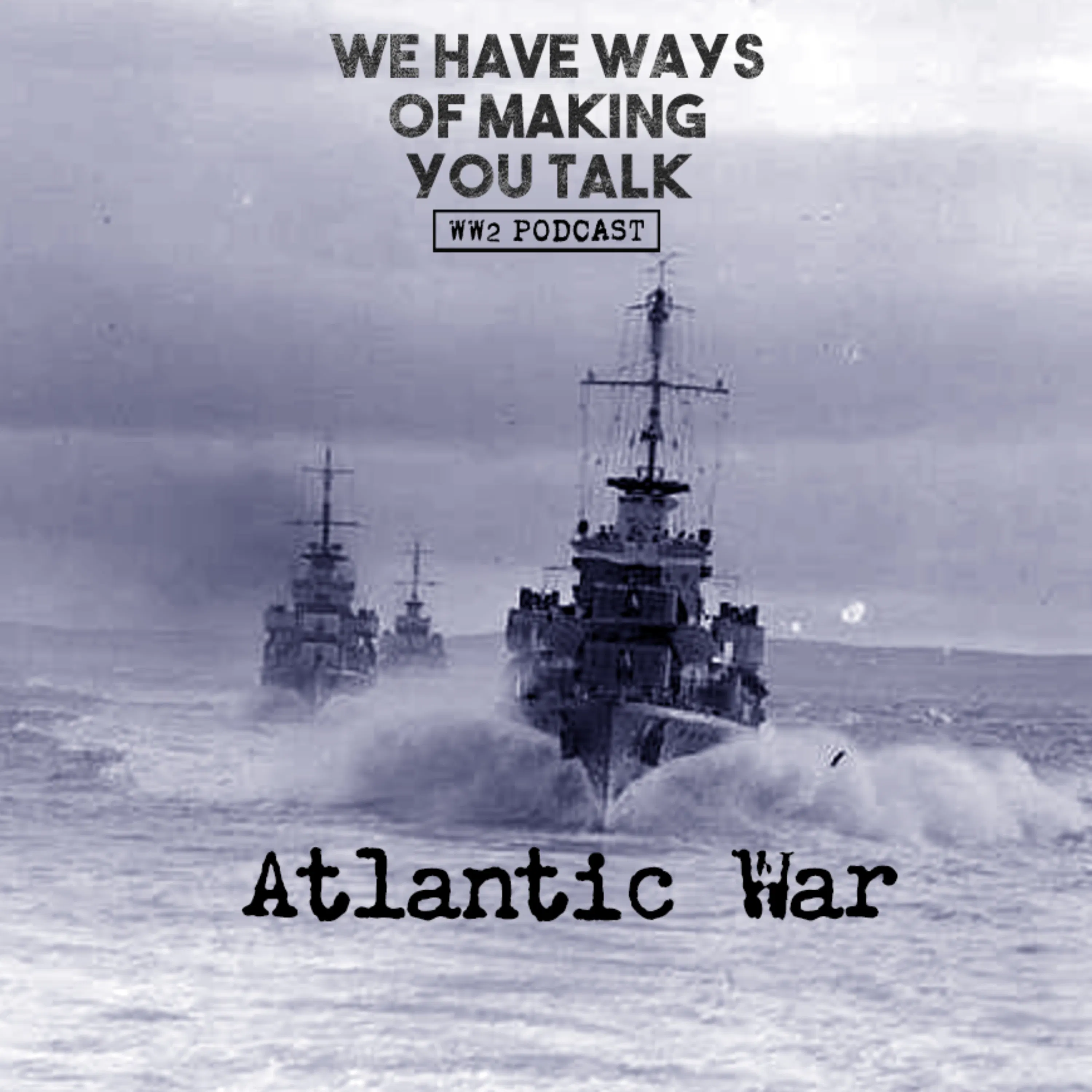
Arctic Patrol: Stringbags (Part 4)
Join James Holland and Al Murray for part 4 of this exploration of the Fairey Swordfish biplane torpedo bomber, and the brave crews of the Fleet Air Arm who achieved incredible victories in an 'obsolete' airframe.
Make someone a We Have Ways Club Member this Christmas – unlock the full WHW experience with exclusive live-streams, ad-free listening, early access to episodes and live show tickets, a newsletter with book deals, model discounts and extra behind the scenes information.
Just go to wehavewayspod.co.uk
And of course, you can still join for yourself any time at https://www.patreon.com/wehaveways
A Goalhanger Production
Produced by James Regan
Editor: Charlie Rodwell
Exec Producer: Tony Pastor
Social: @WeHaveWaysPod
Email: wehaveways@goalhanger.com
Membership Club: patreon.com/wehaveways
Learn more about your ad choices. Visit podcastchoices.com/adchoices
Press play and read along
Transcript
Speaker 1 Thank you for listening to We Have Ways of Making You Talk. Sign up to our Patreon to receive bonus content, live streams, and our weekly newsletter with money off books and museum visits as well.
Speaker 1 Plus early access to all live show tickets. That's patreon.com slash we have ways.
Speaker 2 This episode is brought to you by Toyota. This winter, explore California in a brand new Toyota hybrid.
Speaker 2 Test drive the stylish all-hybrid Camry, the adventure-ready RAV4 hybrid, or the rugged Tacoma hybrid at your local Toyota dealer.
Speaker 2 Every new Toyota comes with Toyota Care, an exclusive hybrid battery warranty, and Toyota's legendary quality and reliability. Toyota, let's go places.
Speaker 2 See your local Toyota dealer for hybrid battery warranty details.
Speaker 6 Every chase card holder experiences more, savings on food, drinks, and merch at some of the biggest biggest sports and music events. Enjoying great views from prime seats.
Speaker 6
And relaxing in exclusive lounges at top sports and music venues. Reserve your spot in advance and make more of every Chase experience.
Tap the banner to learn more.
Speaker 6
Benefits available only to eligible Chase card holders. Terms, conditions, restrictions, and limitations apply.
Deposit and credit card products provided by JP Morgan Chase Bank, NA member FDIC.
Speaker 7
Shopping is hard, right? But I found a better way. Stitch Fix online personal styling makes it easy.
I just give my stylist my size, style, and budget preferences.
Speaker 7
I order boxes when I want and how I want. No subscription required.
And he sends just for me pieces, plus outfit recommendations and styling tips. I keep what works and send back the rest.
Speaker 7
It's so easy. Make style easy.
Get started today at stitchfix.com slash spotify. That's stitchfix.com slash spotify.
Speaker 8 Par-rappa pum-pum.
Speaker 8 Par-rappa pum-pum.
Speaker 3
Merry Christmas, everyone. Ah, the little drummer boy.
Everyone's favorite at this seasonal time of year.
Speaker 3 It's me, Al Murray, co-host of the WW2 pod, We Have Ways of Making You Talk, the world's finest Second World War podcast. And you know what?
Speaker 3 At this time of year, it's important to think about what's important, isn't it? Spending time with loved ones, looking to the year ahead, enjoying the finer things in life.
Speaker 3 And of course, the most important thing of all, the question that irks so many at this seasonal time of season. What exactly is a pocket battleship?
Speaker 3 Now, we all like to say, of course, that it's just the thought that counts when it comes to gift-giving, but actually, why not have a good thought? Right? It can't just be a thought.
Speaker 3
Go for a thoughtful gift. And the best gift, of course, is a subscription to WW2Pod We Have Ways of Making You Talk.
With a subscription to We Have Ways. You know what?
Speaker 3 Your loved one, your loved one, or even someone you only like a bit, could enjoy ad-free listening.
Speaker 3 priority access to news series and ticketed events, regular live streams, a weekly newsletter with book and model discounts. Oh yes,
Speaker 3 you know, the kind you glue together and bonus episodes. In fact, why not give yourself a membership this year?
Speaker 8 Go on.
Speaker 3 You deserve it. Santa says you should.
Speaker 8 Ho ho ho.
Speaker 3 So head over to wehavewayspod.co.uk and you two can present the very best gift that they'll ever get this year or any other year. Even as you remember.
Speaker 3
On the way to dinner that you forgot to get them anything. Yeah, exactly.
You can do this just like that. Go to the website, we havewayspod.co.uk and put that in your Christmas string bag.
Speaker 3 Merry Christmas and a Happy New Year. Meine Lieblingen!
Speaker 3 Alvinesen on Trusitrus.
Speaker 3 They had flown in the far north. Down endless avenues, 200 miles of hanging gardens, snow squalls in clear skies, glinting in bright sun above black Arctic.
Speaker 3 Three minutes maximum survival time if the engine failed, but ravishing beauty that squeezed the heart nevertheless, and at each cloud corner the chance of a lurking U-boat surprised on surface.
Speaker 3 Stalk it, hold breath attack from cloud, dive firing rockets, screaming obscenities, die, fuck you, die, sink, sod, you sink.
Speaker 3 Later, remorse and silent shame for this bloodlust staining the beauty. And that's a poem by Robert LePage from his account of flying swordfish in the Second World War, Luck of the Devil.
Speaker 3
Welcome to We Have Ways of Make You Talk with me. I'm Marian James Holland.
And Jim, we're just
Speaker 3 giving the swordfish one last lap of glory, aren't we?
Speaker 8 Yeah, very much so.
Speaker 3 We looked at the development of the fleet air arm. We looked at the Taranto raid, plane by plane, which is terribly exciting.
Speaker 3 But the thing is, the swordfish then fades from view as a torpedo aircraft as the war progresses.
Speaker 3 And, you know, is perhaps, I'm going to say it, obsolete in that role, but goes on to be incredibly important in the Atlantic War because of its ability to loiter, because you can fit anti-submarine radar in it, and
Speaker 3 because you can use it as a rocket firing or bombing platform, death charge dropping platform for anti-submarine warfare, because there are no helicopters, right?
Speaker 3 So what we thought we'd look at in this episode is the Arctic War.
Speaker 8 Yes, I should just say, though, for anyone who's worrying. Yeah, but what about the Bismarck?
Speaker 8 Of course, that is coming up.
Speaker 8 Hood and the Bismarck, the new four-part series, which will be coming up at some point relatively soon, and where the swordfish will also be playing a key role in the whole epic, amazing story.
Speaker 3 But we thought we'd offer this as a kind of, I don't know, as a sort of, you know, when in a movie, they do, after the credits, they do the thing where they go, you know, James Holland went on to run a successful bakery.
Speaker 3 You know,
Speaker 3 Al Murray went back to being a plumbing contractor. You know,
Speaker 3 the end of Banner Brothers. This is what happened to the swordfish after the big adventures, right? After its glory is where its reputation is burnished in military legend and
Speaker 3 aviation stardom. This is what she then went on to do workhorse style.
Speaker 3
And it's as crucial as anything else. And so we're going to look at Arctic Convoy JW57, Stringbag Patrol, we're calling this episode.
And we're using Robert LePage as our narrator for this.
Speaker 3 Now, LePage, he writes this amazing account of flying as an observer. And if you listen to our Taranto episode, second Taranto episode, we talked about how being an observer in a stringback is crap.
Speaker 8 It's worse than being a pilot.
Speaker 3 Much worse than being a pilot. You're at the back,
Speaker 3 you don't know where you're going, and all this sort of stuff. He flew with 816 Naval Air Squadron on HMS HMS Dasher on this convoy on JW 57.
Speaker 3 And in later life he goes on to become an expert in languages and he makes a name for himself at Jamaica University studying Jamaican Creole, formulates a dictionary and postulates ideas about linguistics and identity that apparently really like that are part of the sort of fabric of the study of linguistics.
Speaker 8 God, how amazing.
Speaker 3 Isn't that incredible? Yeah, goes on to do that and is one of the all-time greats in linguistics in the study of it.
Speaker 8 All the more amazing since he has come from such, yeah, such humble beginnings.
Speaker 3 Exactly. Son of a window cleaner, born in Progress Estate, Wellhall,
Speaker 1 Woolwich.
Speaker 3 And LePage, because his family are from Guernsey originally, and he's called up before his family are bombed out.
Speaker 3 You could say, here's an interesting example of, you know, his social mobility as a result of the Second World War. He wants to fly, so the Navy will have him.
Speaker 3 and or he wants to join the the fleet air arm and ends up um you know an incredibly important professor in the memo He says his war experience is an important part of this.
Speaker 3 When you join the fleet air arm, you go to train as a naval conscript at HMS Daedalus at Leon-Solon, right? Yes. So before you become a pilot, before you can fly, you have to train as a seaman.
Speaker 3
You learn knots, you learn gunnery, you learn Morse code. You learn how to be an officer of the watch.
You have to pass your watch exams. If you pass this, you go on to the flight training.
Speaker 3
If you fail the flight training, that's called being dipped. And at his medical, they decide his eyes are wrong for a pilot.
So he's
Speaker 3 assigned a role as an observer. And he thinks, well, if my eyes are no good, right, why do you want me to observe?
Speaker 8 Yeah, how am I doing being an observer? Oh, yeah, don't worry about that. That'll be fine.
Speaker 3
Don't worry about that. We've found something for you.
You're the right sort of fellow.
Speaker 3
He thinks at the time that there's a shortage because a ship that's gone on its way, it's on its way to Trinidad for training has gone down. And so they've lost a whole load of observers.
So
Speaker 3 they need people.
Speaker 3 Right?
Speaker 3 So these are his origins as an observer in swordfish.
Speaker 8
Amazing, isn't it? Yeah. The many, many unlikely stories of people in the Second World War.
I mean, don't you think? How many people end up doing
Speaker 8 bizarre things in the Second World War because of a quirk or something or piece of luck or a piece of misfortune?
Speaker 8 It's just incredible, isn't it?
Speaker 3 Well, it's the story of the world.
Speaker 8 I mean, he doesn't sound like the kind of man who's going to end up in a swordfish over the Arctic, does he? No.
Speaker 8 No.
Speaker 3
No. But here he is.
So that's our observer. And he, you know, we've got an observer observing what it's like being on convoy.
So I think we're quite well set here. So his ship is HMS Chaser.
Speaker 3 And Chaser is an escort carrier. And these are the carriers developed for convoy escort, right?
Speaker 3 And she's built by...
Speaker 8 And they're smaller, aren't they?
Speaker 8 They're very much smaller vessels.
Speaker 3 I mean, they're not unlike a helicopter carrier or whatever. It's the idea that
Speaker 3 they've got an air element to being able to prosecute anti-submarine warfare. That's the entire point, right? Although there are fighters on Dasha, which we'll come to.
Speaker 3 And she's built by Ingalls Shipbuilding at Pascagoula, Mississippi.
Speaker 3 Her keel is laid down in June 1941 as a merchantman, but before her launch, she's requisitioned by the US Navy for conversion to an aircraft carrier.
Speaker 3 And from an early stage, she's fitted with the British Type 271 shipboard radar. In terms of escort carrier, state-of-the-art, right?
Speaker 3 She's completed and handed over to the Royal Navy as HMS Chaser in April 1943. And I think what's quite interesting is
Speaker 3 the previous episodes, we're talking about, you know, naval air power being developed and the sort of genesis of it and experimental efforts towards it.
Speaker 3 This is when the gear, those lessons have been digested, the prescriptions for
Speaker 3
the cure of the U-boat menace have been sort of enacted. And this is it.
You know, 1943, when this stuff's coming online.
Speaker 3 And she first sails for active duty from Norfolk, Virginia, and joins Convoy HX245 out of Halifax bound for the Clyde.
Speaker 3 The convoy reaches Britain without loss, so it's one of our non-event convoys, as it were.
Speaker 3 But an accident occurs on the 7th of July that's unfortunately reminiscent of HMS Dasher, which we'll come to in a moment, because there's an explosion in Chaser's boiler room.
Speaker 3 Now, Dasher is one of the great
Speaker 3
Royal Navy cover-ups of the Second World War. Her engines blow up.
There's a fueling issue. 379 of 528 of her crew are killed.
Speaker 3 And this is covered up because it's an American-built ship that has gone wrong for the Royal Navy. So it's kind of glossed over.
Speaker 8 Yeah, we don't want to mention that.
Speaker 3 No, the Americans blame the Navy because they're handling a ship that they don't understand.
Speaker 3 The Royal Navy blames the American fuel system.
Speaker 8 But let's never mention it ever again.
Speaker 3 We'll never mention it ever again. The story of a cover-up and of bodies being dumped in a mass grave and all this sort of stuff.
Speaker 3 If anyone listening knows about Dasha or has some sort of family story to do with Dasha, please let us know because it's one of those grey areas. Now,
Speaker 3 she's got the small bridge structure on the starboard side. This is to prevent a lopsided weight.
Speaker 3
And also, one of the other things is they don't want it being knocked off when the ship docks alongside a key. They don't want the bridge being knocked off.
It's
Speaker 3 part of the design structure. And again, it's on the starboard side because of the way props turn and the torque pushing the planes to port.
Speaker 3 What they've got for this convoy is wildcat fighters, which have been flying out of Scapperflow since 1941.
Speaker 3 8-Net 16 Squadron that Robert LePage is going to fly with now has some of those as interceptors for this Arctic convoy. Swordfish is no longer torpedoing.
Speaker 3 It's not a strike aircraft anymore, but it's an anti-submarine plane.
Speaker 8 Is that because it's just been usurped by
Speaker 8 Bowfoots and things?
Speaker 3
Quicker and heavier stuff, basically. Yeah.
It's been moved aside, but they still need it. And, you know, you've got all these crews trained on it.
Speaker 3 And Swordfish can fly from a carrier in conditions that will keep any other plane down in the hangar, right?
Speaker 3 She still has no equal for getting off for getting off a flight deck, particularly in extremely stiff winds. And
Speaker 3 we'll see exactly
Speaker 3 what they're getting up to on the Arctic Convoy. So this convoy, JW57, consists of 45 merchant ships, which depart from Loch Hu on the 20th of February 1944.
Speaker 3 And close escort is provided by a force led by Commander I.J. Tyson in the destroyer Keppel with three other destroyers and four Corvettes.
Speaker 3 And this is 816's second attempt to get to Murmanx because they were on Dasher,
Speaker 3
816, that blew up and were meant to go. So she blew up.
They're transferred. And with the loss of lots of the crews, because she was in harbour, they'd flown off.
But enough of the guys were killed.
Speaker 3
And so they have to rebuild the squadron as well. With JW57, there's six Corvettes.
They're flower cloths. So you've got your bluebell, Camellia, Lotus, etc.
Speaker 3 A dozen destroyers, including HMS Beagle, which settled in 16 convoys.
Speaker 8 Oh, my goodness.
Speaker 3 You think of that, right?
Speaker 3
PQ-14. Incredible.
QP-11, JW-51A, JW-52. Been all over the world, right?
Speaker 8 And JWPQQP, they're all Arctic ones, aren't they?
Speaker 3
Yeah, exactly. RA-51, 52, 55, 57, 58, 59, RA-62 Bedouin.
And there's a force of cruisers in the background, because there's a cruiser force that sort of is on call.
Speaker 3 Two support groups from the Western approaches with frigates and minesweepers, as well as a specialist anti-aircraft cruiser, HMS Black Prince, with Vice Admiral I.G. Glenny.
Speaker 3 And she sails in two convoys. I think what's really interesting about this is that when you look at this naval effort, some ships, like Beagle, backwards and forwards, just at it constantly.
Speaker 3 Some ships sail two convoys. And of course, Jim, you talk about the tyranny of overlord in
Speaker 3 the Italian campaign. The tyranny of overlord is going to kick in with the Arctic convoy campaign because they basically have to get all this done before this shipping is needed for Overlord.
Speaker 3 Just as resources are drawn away from Italy during the Italian campaign, during the Italian land campaign, the reason there isn't the shipping to do more in Italy in terms of, you know, flank hopping, like the Anzio style stuff, the reason there isn't the shipping for Italy is the same reason that the Arctic convoys need to get everything done and dusted and the fact of the amount of daylight there is that serves the enemy an advantage.
Speaker 3 They have to get this all done because of D-Day. So the tyranny of Overlord affects all theaters in the West that it's coming because this is February 1944 and everyone
Speaker 3 up the planning tree knows what's coming.
Speaker 3 LePage is part of this thing where they go and meet the wildcats to bring them to the carrier and in his account he says everyone knows how stupid fighter pilots were and their tendency to get lost.
Speaker 3 They couldn't navigate. So we fly out.
Speaker 3 And
Speaker 3 because we haven't got the radio that they've got, we use zogging, which is tipping the wings, doing signals with the wings, basically signals flipping their wings, the swordfish wings, to give the wildcats instruction.
Speaker 3 So turning left three now, three degrees, or whatever, right? The wildcats have to fly around in big circles because they can't fly as slow as the swordfish, right? So it's great, sort of
Speaker 3 absurd parade.
Speaker 8 Well, we all know they can't, you know, nothing, nothing else can fly that slow. Exactly.
Speaker 3
Exactly. So they joined the convoy off the Pharaohs instead of Iceland.
And he says there's no point in pretending. We know we're going to be spotted almost immediately.
Speaker 3 and the convoy this convoy has to steam almost the full length of the Norwegian coast unable to move a few hundred miles offshore because of the ice of the Arctic winter pressing down from the northwest so you're basically in a sandwich you're trapped you can't go near the ice and it's just after it's you know it's still winter so there's plenty of ice and apart from the Luffaffa fighters and Condors coming have a look they're going to be in a range of shore-based bombers let alone submarines and battleships so we should also just point out that the the jw JW and RA, because this is two convoys.
Speaker 8 So JW is going to Murmansk, and RA is coming back. And actually, JW replaces the PQ.
Speaker 3
Yeah, that's right. Yeah.
Yeah. And the Germans, they have a U-boat force, 14 boats, arranged in two patrols, which are undisappointingly named Verwolf.
Why wolves? Yeah, exactly. Wolves, mate.
Yeah.
Speaker 3 We talked about open cockpits and all this sort of stuff in the Mediterranean. The conditions are completely brutal.
Speaker 8 The deck can ice up the deck you're landing on can ice up right can ice up oh my god do you ever think to yourself some of the things that were asked of young men in the second world war really i mean
Speaker 8 not being under fire just just the circumstances in which they find themselves are just
Speaker 8 so beyond the pale i mean yeah the tin can of the lancaster at night in the middle of winter you know etc yeah being in a swordfish on an arctic convoy yeah in winter.
Speaker 3
Before you're trying to shoot anyone down, right? Or be shot down or engage a submarine. LePage, I mean, his account is there's things where you think, that can't be right.
Or is that?
Speaker 3 He says that no one has thought to bring Arctic grade oil, right? And they're the air coolers on the starboard side of the Pegasus engine. He says the oil's freezing in the air cooler.
Speaker 3
This is the bigger engine, the Pegasus 2, so it's an upgraded. It's much more power.
It's got more power, which is what it needs.
Speaker 3 And he says, as usual, we solve this with the sort of makeshift expedient the swordfish could take in its stride so they had protected covers for the engines they'd leave the covers on the engines outside when they were parked outside and they'd start the plane inside the ship which is an absolute no-no you don't you know you don't do that because of spark and flame and all that but they were doing that right because otherwise they can't get the damn thing going 22nd of february jw 57 proceeding to muransk is um Yep, they're met by their ocean escort and by Chaser and her group while the local escort turns and goes.
Speaker 3 So this sort of day, you know, relay where they're handed over.
Speaker 8 Day one is the 23rd, isn't it? Yeah.
Speaker 3 So condors appear immediately.
Speaker 8 So these are Fokkerwolf 200s.
Speaker 3
Four-engine aircraft that's got the range. It's exactly, actually, exactly what you need to loiter and spot and have a good look.
And direct U-boats, right?
Speaker 3 The Germans are getting this right.
Speaker 3
A wildcat goes out to attack it, sent out to attack it. His guns freeze 5,000 feet, so he can't shoot it down.
Exasperated, the pilot flies back to Chaser. As he lands,
Speaker 3 the hook catches the arrestor wire and the jerk sets the frozen guns off spraying the flight deck on the cannon shelf
Speaker 8 so no one's in the way no one's hurt this is the stuff they're dealing with so that's day one that's day one day two is the 24th of February the U-boats gain contact but are unsuccessful in their attacks while U-713 is sunk in a counter-attack by Keppel assisted by a swordfish from Chaser which is the destroyer yeah And interestingly, the captain of the Keppel wrote a memoir about this convoy in which he never mentions the swordfish.
Speaker 3
Never mentions them. And it's apparently a gripping account.
It's a brilliant account of working on a destroyer. Never mentions the swordfish patrols, nothing.
Speaker 3 They don't feature.
Speaker 8 Piles don't cross.
Speaker 3 Or they run on time, you know? It's just part of how it works, right? So he doesn't think to think about it. And
Speaker 3 also this idea that the Royal Navy, if you're on a destroyer, the Royal Navy is the destroyer. It goes no further than you and the men on the boat, right?
Speaker 3 There isn't a Navy outside, you and your immediate concerns, right?
Speaker 3 On day three, the 25th of February, an RAF Catalina
Speaker 3 spots a U-boat, dives on the submarine, and releases homing torpedoes that destroy it.
Speaker 8 You're getting a sense, aren't you, that these U-boats aren't very good by this point?
Speaker 3 And that between them, the RAF, Fleet Air Arm, Royal Navy, they have the answers.
Speaker 3 And the tactic they developed is during the short hours of daylight, when the swordfish can fly, the submarines cruise just under the surface with their schnorkel, schnorkel because they've got a schnorkel by this point.
Speaker 3 And then, when the light fades, they surface, speed ahead, trying to get the convoy's destroyers and corvettes after them, creating a high-speed signal from the ship's propellers that are the best target for the other submarines' acoustic torpedoes.
Speaker 3
So, the idea is one submarine pops up as bait and draws the destroyers away, and then the others attack. And this works.
So, U-990 torpedoes the destroyer Maharata,
Speaker 3 and she sinks quickly with the loss of most of her crew, 17 survivors. What's the metric nowadays? If you lose a third of your strength
Speaker 3 as an infantry company, then you're not battle capable, right?
Speaker 3 Here are ships going down with a handful of survivors, right?
Speaker 3 But there are no further losses and JW-57 reaches Kola safely on the 28th of February.
Speaker 8 Good news.
Speaker 3
Yeah, good news. And there are two more days.
Those two more days involve the wildcats forcing the condors away.
Speaker 1 Scaring them off, basically.
Speaker 3
Scaring them off. So, what they do, they leave before dawn.
So, you're taking off in the dark gym in the Arctic. Yep.
With the ship pitching and rolling in high wind.
Speaker 8
It's freezing cold. It's winter.
It's February.
Speaker 3 And the first thing they do is they circle low over the merchantmen so they can see the planes and know what not to shoot down.
Speaker 3
And also to reassure them that there is a presence. So there aren't grumbles about you weren't up in the air and about when you should have been.
Because being, you know,
Speaker 3 it's like justice being seen to be done as much as being done you know what i mean and they do 90 minute to three hour patrols and the visibility dictates the patrolling obviously so there are different styles of patrol all named after reptiles
Speaker 8 so the first one's cobra yeah so cobra is a patrol of around around the convoy at a distance of y miles y is it is is the distance from the convoy so that the instruction cobra 12 would mean a patrol of a distance of 12 miles.
Speaker 3 That's patrolling around the convoy at distance of visibility. So if you've got 10 mile visibility, you sit on the edge of the visibility.
Speaker 8 Right. And what about ADDA?
Speaker 3 Adder is to patrol ahead of the convoy at a distance of 8 to 12 miles with the length of patrol 30 miles. That is 15 miles on either side of the center line.
Speaker 8 Okay. And then X python Y?
Speaker 3
This is given when a submarine has been spotted. So the aircraft would patrol on the bearing of X at a distance of Y miles.
So submarine at 240.
Speaker 3
And we want you to at 10 miles away, we want to patrol 240 10. So 240, Python, 10.
Off you go. You jump in the plane and you're gone.
Speaker 3 And then you carry out a square search around the indicator position for 20 minutes.
Speaker 8 I think this is my favourite. Frog Y.
Speaker 3
Yeah. You patrol astern of convoy at a distance of Y miles.
Length of patrol will be two Y miles, that is Y miles on either side of the center line.
Speaker 8 Yeah, lost me already. Yeah.
Speaker 3 Yeah, I know. This is to stop U-boats trailing the convoy, often shortly before dusk.
Speaker 3 It's also essential prior to any change of course so that the U-boat commander would keep his craft submerged and not realise that the change had taken place until it was too late.
Speaker 8 I'm not 100% following that.
Speaker 3 Well, so what you do is you patrol astern of the convoy. The length of the patrol is two Y miles, Y miles on either side of the centreline.
Speaker 3 So if the convoy is two miles wide, so you patrol four miles, right, two Y. The length of the patrol is two Y.
Speaker 8 Got it. Yeah.
Speaker 3 On either side of the centreline. So basically you're sweeping behind the convoy at a distance to force the U-boat down to the point where it won't be able to see the convoy change course.
Speaker 8 So that would be a total of 10 miles because it's four miles either side plus the two miles of the convoy.
Speaker 8 There would be a point where this would all just click into your head, isn't it? And you'd just go, yeah, okay, got it.
Speaker 3
Yeah, I'll do a frog, no problem. I'm doing frogois.
But also, Jim, all these words can't be confused with each other. So you can yell this across a flag deck, right?
Speaker 8
It's the same principle as the Battle of Britain radio traffic, isn't it? Exactly. And there's one more.
One more, the Crocodile Y.
Speaker 3
Crocodile Y is the last of these. Patrol ahead of the convoy from beam to beam at radius Y miles.
In effect, a half cobra gym.
Speaker 8 Yep.
Speaker 3 I like a half effect.
Speaker 8 Yeah, me too.
Speaker 3 This is popular with fast convoys because then they don't have anything to worry about with the U-boat sneaking up from a stern.
Speaker 8 Should we take a break at this point? I'm exhausted by all this. all these alligators and crocodiles and frogs.
Speaker 3 We'll take a break. I'm just going to perform an alligator, a starboard alligator,
Speaker 3 while you do a port alligator, and that way we'll chase the U-boats away. We'll see you in a moment.
Speaker 1
This episode is brought to you by Ancestry. Hello, James Holland here, joined by Al Murray from Goal Hangers World War II podcast.
We have ways of making you talk.
Speaker 1 These are those odd days between Christmas and New Year.
Speaker 1 The house buzzing with laughter, leftovers piled high, festive films murmuring in the background, and trivial pursuit debates still raging around the table.
Speaker 1 It's the perfect time to sit close, share family stories and think about people who came before you. Grandparents, great uncles, aunts you hardly knew.
Speaker 1 Everyone who helped shape the family you're part of today. With an ancestry membership, you can take those conversations further.
Speaker 1 All you have to do is provide what you know about your family history, such as your parents and grandparents' birthplaces, and Ancestry will help you dig through billions of records to uncover fascinating news stories about the lives of your relatives.
Speaker 1 Maybe it's a great uncle ferrying a hurricane north, a grandmother stitching uniforms at a Glasgow mill, or a relative holding the line on the Normandy beaches.
Speaker 1
And suddenly the stories around your own table take on a whole new depth. The past isn't behind you.
It runs straight through you.
Speaker 1 Head to ancestry.co.uk/slash new year to learn about Ancestry's memberships and start your family history journey today.
Speaker 9 Vitamin Water Zero Sugar has great taste, zero BS, and obviously, zero sugar. For those with zero room in their calendar, zero patience for slow walkers.
Speaker 9 Those who get zero hours of sleep on a Saturday night
Speaker 9 have zero filter, zero f given, and zero interest in grabbing a plain, boring water. Grab a delicious vitamin water, zero sugar today.
Speaker 1 On December 12th,
Speaker 1 Disney Plus invites you to go behind the scenes with Taylor Swift in an exclusive six-episode docuseries.
Speaker 5 I wanted to give something to the fans that they didn't expect.
Speaker 4 The only thing left is to close the book.
Speaker 1 The end of an era.
Speaker 1 And don't miss Taylor Swift, the Era's tour. The final show, featuring for the first time the tortured poets department.
Speaker 1 Streaming December 12th, only on Disney Plus.
Speaker 3 Welcome back to We Avaza Making You Talk. We hope your Crocodile Y went well.
Speaker 8 Or your frog or whatever.
Speaker 3 Or your your frog or whatever whatever it was you chose to do i think these these could be t-shirts couldn't they i mean maybe these are beers for next we have waste fest
Speaker 3 cobra 4.3 percent you know maybe that's the session ale anyway
Speaker 8 now i think we need to talk about flying the swordfish in this weather how can you do it how can this possibly be in an open cockpit it's absolutely insane but anyway open cockpit in the arctic Pilot, observer, radio operator, stroke, rear gunner.
Speaker 8
Pilot slightly protected by the wing. Yes, by the wing and by the wing almost above his head.
But the observer and the tag, the telegraphist air gunner, are completely exposed.
Speaker 8
So, this is not the modern day. It's 1944.
So, it's silk underwear. Well, that's alright then.
Over which went oiled wool longjohns. Everyday cottons and a woolen battle dress.
Speaker 8 Then you have a Sidkut flying suit, lots of zips, windproof gabardine.
Speaker 8 Gabardines is waterproof. With huge pockets into which one stuff maps and torches, navigation protractors, chocolate and the like.
Speaker 8
Under the leather flying helmet and goggles, they'd wear a woolen balaclava. Yeah.
Sheepskin flying boots, heavy leather with silk gloves underneath.
Speaker 8 You'd have to get the levers off to do the navigation. And then a leather Irvine flying jacket on top.
Speaker 3 Which in theory had provision for electrical heating, but they were told not to use it because the swordfish systems couldn't cope with heating three extra circuits for the air crew. I don't know.
Speaker 3 I think we could safely say Avery will not be making a Sidcut flying suit,
Speaker 3
which is like a great big one-piece windproof Gabardine thing that zips from heel to neck. We're not going to bother with that.
No one wants that, right?
Speaker 8 Bottom line, though, it doesn't matter how much you weigh, you're never going to be warm enough, are you?
Speaker 3 You're never, ever going to be warm enough. And the other thing is they have a safety harness as well.
Speaker 3 But because it's so cold and because they're wearing so many layers, it makes it very difficult to move and it restricts circulation because they're so cold and they're wearing so many layers.
Speaker 3 So you could let it off, but during our mine-laying operations in the channel, one swordfish had run into a group of German fighters, taken evasive action, and the observer had been thrown out and lost, killed in the ocean.
Speaker 8 Oh, my goodness, man. So you are basically flying into the Arctic Sea around the North Cape without proper heating, without proper clothes, and with no safety harness at all.
Speaker 3 And if he wants to navigate, he's got to take his gloves off.
Speaker 3 You know, and he's got to navigate his observer.
Speaker 8 And that's not all, is it? Because there's a final discomfort.
Speaker 3 Which is, ladies and gentlemen.
Speaker 8 Urinating.
Speaker 3 Yeah. And we never talk about this sort of thing, really.
Speaker 3
Going for a slash. You're flying an alligator and you've been up for an hour and a half and you really need to go.
And of course, in the cold, you need to go, don't you?
Speaker 3 There's a P-tube in later swordfish, right? And LePage says, you know, we could do, in theory, do away with... Because they would have funnels and bottles and all this sort of stuff.
Speaker 3 But the P-tube designers had not allowed for the swirling backdraft of the propeller that would send the P
Speaker 3 in a fine spray over the air gunner.
Speaker 8 But also there's the other point that you've got to get your knob out and you've got to have a slash in Arctic conditions.
Speaker 3 Yeah.
Speaker 3 So what they'd do, they'd urinate in their suits and he said there'd be a pleasant warmth for a couple of minutes, then a growing chill, then an acid chafing that left them all with red, sore red groins.
Speaker 8 Oh my god.
Speaker 3 As soon as you landed, you're straight in, putting your underwear on warm piping to dry it out.
Speaker 3 So that he said that any warm piping was soon draped in underwear gently steaming air crews soon learned to carry as much clean underwear as possible on convoys and one of the interesting things the american built carriers have hot showers just hold that thought so what that means is that anything that's british built doesn't have hot showers doesn't have a hot shower or doesn't necessarily yeah exactly and he says but you could keep the skin clean you could prevent it from breaking down if you were lucky this is this is the day today of flying these patrols you know and in 1940 of course the fleet air arm was introduced the fairy albacore right which is rubbish.
Speaker 3
It's slow. It's got an unreliable engine.
And they're phased out well before the swordfish that they're supposed to replace. But they've got enclosed cockpits.
They've got windscreen wipers.
Speaker 3
They've got heating. They've got a toilet.
But they are not deployed on Arctic convoys. Why not?
Speaker 8 Why?
Speaker 8 You know, you're not asking anyone to carry a torpedo. All they've got to do is just fly around.
Speaker 3 Yeah. I mean, this is...
Speaker 8 barely comprehensible what they're expected to do, isn't it? I literally can't think of anything I'd rather do less.
Speaker 3 We've talked about some tough tough gigs this has got to be right up there hasn't it it's got to be right up there just flying on and off an aircraft carrier in the arctic and in an open cockpit the convoy arrives so what mer the merchant ships go down to murmansk itself yep while the naval escort drops anchor at vaenga roads which is halfway up the inland 15 miles north of the port and vaenga airport which is now uh seromorsk was where operation benedict had been staged which brought hurricanes up in september 1941 of course with 151 squadron bolstering defense of the port and getting the Soviets to use the hurricanes, converting them to the following month.
Speaker 8 Bengal Rhodes is miserable, isn't it?
Speaker 3 It's bleak.
Speaker 8 It's cold.
Speaker 8
There's no joy there to be had at all. There's a few Russians with some vodka, and that's literally it.
Yeah.
Speaker 3 Big Royal Navy presence, sloops, minesweepers working with the Soviet Navy to keep U-boats away from the harbour entrance.
Speaker 3 That is literally the British and the Soviets alongside one another working together, which I think is, again, an interesting component of the war that maybe doesn't get talked about.
Speaker 3 Actually working together.
Speaker 3 Not this sort of Soviets over there who don't really know what they're like and are rude to us and don't like us. Actual proper tactical operational cooperation for something really important.
Speaker 3 There are friendly Russians driving American military trucks sliding around on the docks and the small town there that's been completely bombed
Speaker 3
flat to annihilation. And there's snow all over it, low hills, stunted little pine trees.
So this is the end of the world, isn't it?
Speaker 8 Absolutely awful.
Speaker 3 You've endured all this to get there, peeing in your flying suit, in your open cockpit, flying your ex-Python Y. And the merchantmen are unloaded.
Speaker 3 The tanks of machinery and crates of ammunition stacked high on the quay. And in return, they're swapping out for bulk materials and ballast, basically, for the return journey.
Speaker 3 816 squadron, they're invited to a party to drink terrifying quantities of vodka with the Red Army Air Base outside town.
Speaker 3 And then they invite the Soviets back to Chaser to drink comparable volumes of Royal Navy whiskey.
Speaker 8 Yes, there's lots of back slapping and lots of glasses. To judge you!
Speaker 8 Exactly. So they've gone to to be in the roads.
Speaker 8 They've got shit faced with the Russians. They've cleaned out
Speaker 8
their underwear, put on some new drawers. Yeah.
Then they've got to go back. And that's the RA bit of the convoy.
Speaker 3
Yeah. So they set off on March 2nd, having arrived on the 28th of February.
So it's only a couple of days of this heavy drinking and dusting themselves down.
Speaker 3
And the first two days of the weather is too bad for flying. Flower-class corvettes are rolling on an 80-degree roll.
So right down to the gunwales.
Speaker 3 On the 4th, to the northwest of Norway, they damage U-472, which is finished off by the destroyer onslaught. It's better weather, so the Condors and J-U-8-28s are out spotting.
Speaker 3
U-boats are pushing again. The swordfish are running patrols despite ice on the flight deck.
It's minus 40, so the metal is becoming so brittle.
Speaker 3 Tailwheels, tail wheels will snap off.
Speaker 3 Right? With the iced up flight deck, the crew get out with the steam hoses and chip away at the ice.
Speaker 8 and they do night patrols as well honestly i mean this this just defies belief doesn't it and i'm ashamed to say i had no idea they were still doing this in swordfish in 1944.
Speaker 3 it's crazy isn't it it's completely crazy absolutely nuts you've got to spot the carrier at night Is it going to be ice-free when you come into land? Probably not. Yep.
Speaker 3 You know, on a dusk patrol on the 4th of Suport, Swordfish flying 15 miles astern of the convoy. So what's he on? He's on a Frog 15 astern of the convoy through a snow cloud.
Speaker 3 It's a 40-not wind at 2,000 feet just imagine being in the open carpet with that spots a u-boat through a gap in the weather they close on the u-boat
Speaker 8 can see hey this is a u-u-u-u-u-u-bo-ba-ba-ba-ba-ba boat jolly good in we go you know my hands have frozen to the
Speaker 3 control column i've just peed it's awful i mean
Speaker 8 i've now got ice coming out of my knob
Speaker 3 this is the insight, the kind of insight our listeners are desperate for. Do you know what?
Speaker 1 It's actually making me feel cold.
Speaker 3
Yes, it is, actually. Yeah.
The swordfish attacks, the submarine dives as the swordfish fires its rocket. Then snow wipes out the scene, so they have no idea if they hit it or not.
Speaker 8 Oh my god. And no idea we're ever going to find the aircraft carrier again.
Speaker 3 We've got some telegrams and some typical exchanges, right? James, would you like to
Speaker 3 be Chaser's telegraphist, please?
Speaker 8
Device Admiral destroyers from Chaser. Aircraft report: one U-boat attacked in position 250ZZ16 at 0820.
One certain hit, two possible. U-boat submerged and was attacked by destroyers.
Speaker 8 One U-boat sighted in position 187ZZ22 at 0847.
Speaker 8 Offer, destroyer, home to position of swirl.
Speaker 8
One U-boat attacked in position 187ZZ22 at 0615. Two certain hits, two possible.
U-boat eventually finished off by gunfire from Onslaught Destroyer, who took off survivors.
Speaker 3 To Chaser from Vice Admiral Destroyers.
Speaker 8 Well done.
Speaker 3 It is nice to read.
Speaker 3 He's at the Stoic Club.
Speaker 8
To Vice Admiral Destroyers from Chaser. Aircraft report submarine sunk 095ZZ15.
Survivors in water will confirm.
Speaker 3
Vice Admiral to Chaser. Stoke work.
You always were a good cricketer.
Speaker 8 What does that mean? I don't know.
Speaker 3
But when I found this, I thought, I've got to put that, and Jim will love that. Yeah, I love it.
You always were a good cricketer.
Speaker 8
We need a t-shirt with that on, don't we? That's a t-shirt. People with a swordfish with just icicles coming off it.
Yeah, yeah.
Speaker 3 Just that alone. That first telegram, they're really kicking the U-boats here.
Speaker 8
I was literally about to make that exact point. You know, you can see at this stage of the war, the U-boats are, they're next to useless.
They're so under-trained, the crews.
Speaker 3
And also, the Navy have got all these traps set for them. They've figured it out.
Yeah, yeah.
Speaker 3 You know, those patrols designed to force the U-boat down so the convoy can change course, all of it, you know, they've got it worked out.
Speaker 3 So in the next two days, in spite of the bad weather, they destroy U-366, U-973.
Speaker 3 And the second escort group moves from Atlantic convoys to support the Russian convoy, JW58. So two days after leaving Lok U, and by now off Iceland, Starling, who's come out to meet...
Speaker 3
the returning convoy, sinks U961 on the 29th. So more U-boats are lost before the convoy reaches Russia early in April.
So they're just taking an absolute wrecking ball to the convoy effort.
Speaker 3 And you do think, given these escort carriers, that a concerted air effort, airstrikes on these convoys would be much more effective than trying to deal with them with U-boats, don't you?
Speaker 3
You know, because the Martlets and the swordfish don't have the answer. And we talked about high winds being a problem.
If there's no wind, there's also a problem.
Speaker 8 Can't take off properly.
Speaker 3
Can't take off properly. So the carrier can only do 17 knots to create the headwind, which a swordfish can do.
The wildcat cannot take off in that kind of weather.
Speaker 3 So you end up with swordfish being sent up to meet the JU-88s, which carnage for the Germans.
Speaker 3 Chaser is eventually diverted to Scappaflow rather than going on to Loch Hue and runs aground when she gets there, which is a footnote to this story.
Speaker 8 I'm absolutely gobsmacked by this. Yeah.
Speaker 3 The intensity and the drama of these operations and how important they are.
Speaker 3 And then, of course, this all winds down because the longer days make it much more difficult and easier for the U-boats, right? Spotting the convoy is the thing.
Speaker 3 And then, of course, Overlord comes into view. So all of Black Prince has to go be part of the flagship effort for D-Day.
Speaker 8 But it's also amazing, isn't it, that these convoys are still going. The supply line of goods to the Soviet Union
Speaker 8 doesn't stop at any point. I mean, it's just incredible.
Speaker 3 It's absolutely crazy.
Speaker 8 I feel like I need to go and have a hot bath and kind of then sit in a sauna for an hour.
Speaker 3 What's really interesting here, though, is this is this is the thing we've talked about before on the podcast, about how often you don't look at the naval effort because the trains kind of run on time.
Speaker 3 You know,
Speaker 3 there are many more convoys that go unscathed than are attacked, right? Yes.
Speaker 3 By this stage of the war, and, you know, Marutta's sunk the destroyer, they lose the destroyer on this trip.
Speaker 3 In order to make the trains run on time, you have to fly this kind of combat air patrol with swordfish, with whatever you've got, and the swordfish is ideal for this role. And you have to do it.
Speaker 3 day in day out regardless of the weather and what that strain must be on the crews not just the flight crews but the maintenance crews and all those people i think this is like a corner of the war where imperturbability and indefatigability and all those values and virtues we've talked about before are absolutely center stage and no one knows about it.
Speaker 8 It's war at the fringes, isn't it? The war of the fringes.
Speaker 3 The war of the fringes, which is incredibly important. And this is a it's an unequivocal victory, this.
Speaker 3 And the Arctic convoys get off to the start, they do, but by this, this is a victory we don't talk about. And you know, the Arctic Convoy medal took ages to be coughed up eventually.
Speaker 3 Again, fleet Air Arm, man. Can't knock it, can we?
Speaker 8
You can't knock it. Well, thank you for all that.
Al, that's just been amazing.
Speaker 3 I mean, and I thoroughly recommend Robert LePage's book, The Luck of the Devil. And there's another book called String Bag by David Ragg, the fairy swordfish in war.
Speaker 3 And he, he, you know, he talks about
Speaker 3 the shifting roles.
Speaker 3 of the of the swordfish and the you know the last swordfish patrol this is amazing stuff and these crews are of a of a of a different caliber altogether anyway thanks everyone for listening this is our post match this is our post uh finale credits for the history of the swordfish because we have we yet have yet to sink the bismarck haven't we jim in which the swordfish plays a central yeah yeah that's that's that's that's that's still to come there we go thanks for listening everybody we'll see you soon wrap up warm and don't pee in your trousers those are the morals of this those are the morals of this particular story we'll see you soon cheerio cheerio
Speaker 4 The Uniswap wallet makes crypto easier and safer to own and use. Discover new tokens, research confidently, swap instantly, and manage it all securely in one place.
Speaker 4 The Uniswap Trading Protocol has powered over $3 trillion in volume, and it's trusted by millions worldwide.
Speaker 4 Buy your first crypto assets in a few taps and experience the freedom of decentralized finance with Uniswap. Tap the banner to get started.
Speaker 10
Been out here all morning. Not a single bite.
Guess the fish finally figured it out. Just like hackers do when Cisco Duo is on guard.
Speaker 10 With Duo's end-to-end fishing resistance, every login, every device, every user stays protected. No hooks, no catches, no bites.
Speaker 10 Cisco Duo, fishing season is over. Learn more at duo.com.