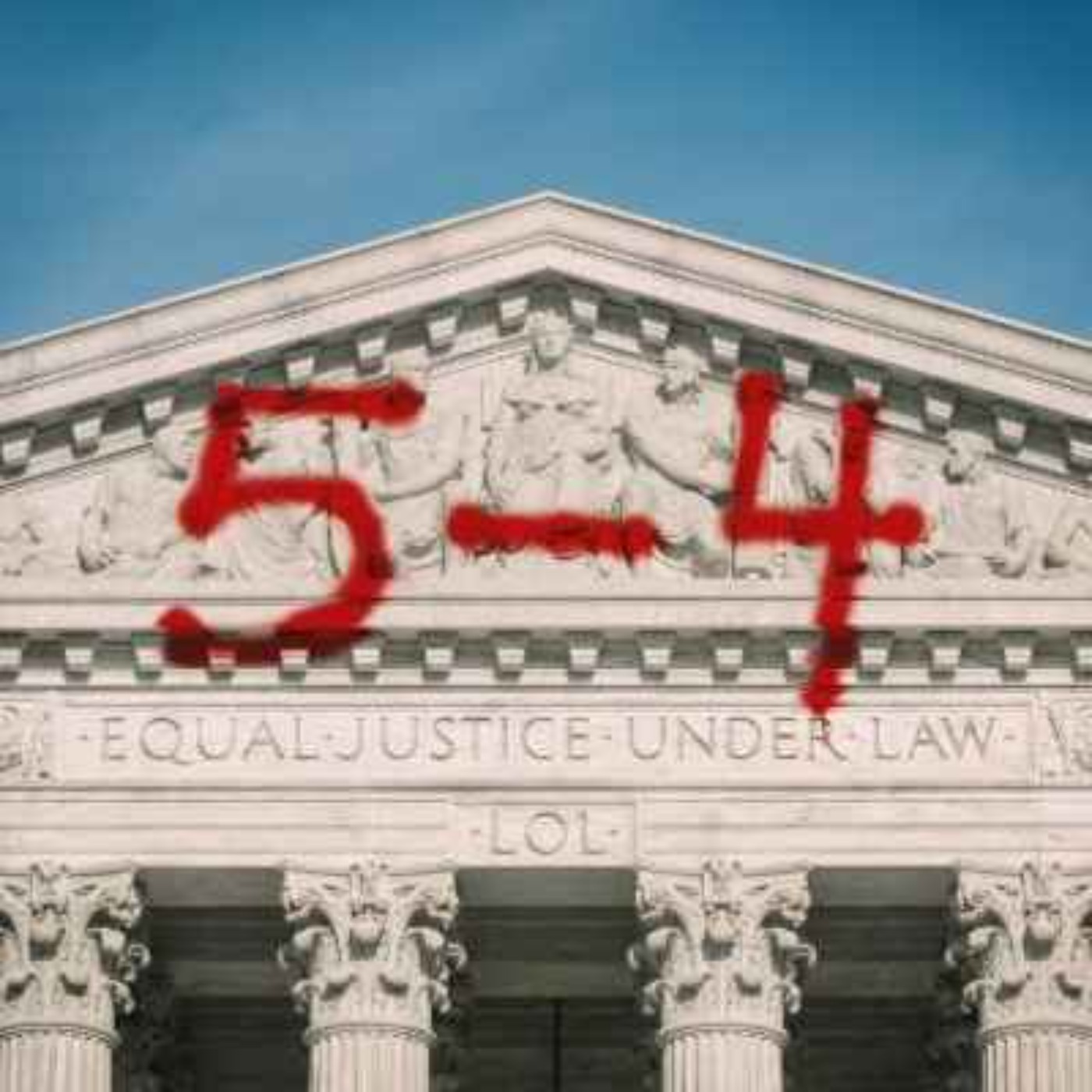
Cedar Point Nursery v. Hassid

45m

You know what's exactly the same? When the government kicks you out of your house so it can build a military base, and when a union organizer gives a farm worker a pamphlet. Or at least that's what the majority of justices on the Supreme Court think, based on the ruling in Cedar Point Nursery v. Hassid.

We want to know what you think about 5-4 - give us your feedback on this survey!

To get premium Patreon-only episodes, access to exclusive events, and membership in the 5-4 Slack, sign up for our Patreon at www.patreon.com/fivefourpod.

Hosted on Acast. See acast.com/privacy for more information.


Advertising Inquiries: https://redcircle.com/brands

Press play and read along

Runtime: 45m

Transcript

Alright folks, a quick word from our sponsor Quince. A lot of people come up to me and they say, Peter, how is it that you are by a wide margin the best dressed legal podcaster in the game?

And how could I replicate that? And I say you can't. It's natural talent.
But if you want to try, it's about essentials. Quince provides essentials.
Italian wool coats.

Mongolian cashmere sweaters for $50 somehow. I got a pair of drawstring corduroys from them, and I had the coolest pants in Trader Joe's this afternoon.

So get your wardrobe sorted, get your gift list handled with Quince, go to quince.com slash five four for free shipping on your order and 365 day returns. Now available in Canada as well.

That's q-u-in-ce.com slash five four. I'll spelled out free shipping and 365 day

Hey everyone, Leon Napok here with a message about our new sponsor, Give Well.

At a time when deep cuts to foreign aid have raised real concerns about people's well-being in some of the world's poorest communities, it can be hard to know what's actually happening or how to help.

GiveWell doesn't claim to have all the answers, but its team of researchers are analyzing the impact of foreign aid funding cuts in real time, identifying highly cost-effective ways to save and improve lives, and sharing what they're learning for free so that everyone can have a big impact.

GiveWell has spent 18 years researching global health and poverty alleviation and only directs funding to the highest impact opportunities they found.

Over 150,000 donors have already trusted GiveWell to direct more than $2.5 billion.

Rigorous evidence suggests that these donations will save over 300,000 lives and improve the lives of millions more. You can find all of their research and recommendations on their site for free.

And thanks to the donors who chose to sponsor their research, GiveWell doesn't take a cut from your tax-deductible donation to their recommended funds.

To make a tax-deductible donation today, go to givewell.org and pick podcast and enter the numbers 5-4 at checkout. Make sure they know that you heard about GiveWell from 5-4.

Again, that's givewell.org to donate or find out more.

We will hear argument this morning in case 2107, Cedar Point Nursery versus Hasid.

Hey everyone, this is Leon from Fiasco and Prologue Projects. On this week's episode of 5-4, Peter, Rhiannon, and Michael are talking about Cedar Point Nursery v.
Hasid.

The case, which was decided this past June, centers on a California regulation that allows union organizers to enter farms for a few hours each day during certain parts of the year to talk to farm workers.

Cedar Point Nursery sued, saying that the law represented a taking, as in the government taking away the farm's property.

The only question before the court is whether that regulation is a per se taking, and the answer is no.

But the court ruled in favor of the property owners, paving the way for future cases that could have sweeping ramifications for safety regulations and civil rights.

This is 5-4, a podcast about how much the Supreme Court sucks.

Welcome to 5 to 4, where we dissect and analyze the Supreme Court cases that have left our nation parched and weak, like a record-breaking heat wave.

I am Peter. I'm here with Michael.
Hey, everybody. Henri Annan.
Hello.

Pretty brutal. heat wave out there this week.
The good news is that it'll actually get worse every single year for the rest of our lives. That's right.

So this is the best it's going to get, which in and of itself. Enjoy it.
Yeah. Yeah.
Right. Glass half full kind of guy.
You know, we'll never see temperatures this cold again. Yeah.
Hot girl summer.

We're supposed to be vibing.

Yeah.

Hot girl summer cut to a girl just passed out of dehydration on the sidewalk. Right.

I get sunstroke.

You need stroke girl summer.

Today's case. is Cedar Point Nursery v.
Hasid. The best part about doing a podcast about shitty Supreme Court decisions is that new material, not too hard to come by.
Keeps rolling in. That's right.

This one just dropped a couple of weeks ago, and it's about union busting.

Oh, I'm sorry, private property rights. Yeah, come correct.
That's right.

The Constitution has a clause in the Fifth Amendment called the Takings Clause, and it says that the government cannot just take your shit.

Specifically, it says that private property shall not be taken for public use without just compensation. Right.
So the government cannot seize your property without compensating you for it.

Now, there is a law in California dating back to the famous labor organizing efforts of Cesar Chavez that allows union organizers to occasionally go onto private farmland for the purpose of organizing farm workers.

The corporations that run those farms don't care for that. And so they said, hey, this violates the takings clause.

The government is forcing me to allow these union organizers onto my farmland, and that is sort of in an abstract way like the government taking my property.

So that's not allowed under the Constitution.

And in a six to three decision authored by Chief Justice John Roberts, the court agrees with the farming companies.

They say that a law that requires the companies to allow union organizers onto their land is the constitutional equivalent of the government seizing the land.

Now,

this is a decision deeply rooted in

crackpot libertarian conceptions of property. Absolutely.
Right. Yes.
Where any interference with a landowner's property is excessive encroachment by the government.

And that is at the core of this case. Not just the sort of like obvious anti-union sentiment but the age-old protection of the landowning classes from everyone else so re

believe you have a little bit of color here yeah let's dive into the crackpot shit shall we so yeah the 1975 agricultural labor relations act in california that's the law that peter was just referencing the specific provisions of the act which come to be at issue in this case are that the law allowed union members, as long as they give prior notice to California's Agricultural Labor Relations Board, it allows those union members to come on to agricultural properties up to three times a day, one hour at a time.

and up to 120 days during a year. Now, they're allowed to do that so that they can perform unionization activities, right?

Encourage people to join these collective bargaining associations, flyer among laborers, and that kind of thing.

So this case comes out of efforts by agricultural union organizers who were encouraging laborers at a strawberry nursery and a fruit packing operation to join the union, right?

And this happened in 2015.

Now, The nursery and the fruit packing company, those owners decide to turn around and sue, saying that the law in California allowing those union organizers to come onto their land, again, maximum three hours a day, just 120 days a year, to encourage people to join a union, that that was taking their land without compensation.

So here we are. So this case requires a little bit of academic background.

The takings clause of the Constitution, again, says that private property shall not, quote, be taken for public use without just compensation.

What exactly that means has been the subject of much debate over the years among academic morons.

Some cases are obvious. If the government seizes your land to build a public park, the takings clause covers that situation, right? That is what's called a per se taking.

But there's another type called a regulatory taking, which is when the government interferes with your property use in a more limited way.

So, you know, if the government passes a zoning restriction that limits how you can use your property, what kind of building you can build on your land, that might be a regulatory taking. Right.

The one thing that I really like about the regulatory takings is that any interference with the use of your land is not a regulatory taking.

The official test of the Supreme Court is when the regulation goes quote unquote too far. That's the test.

It's cited all the time. That is literally the test.
This is the greatest legal minds of a generation at work. Thank God for judges.

It's pure judgment call, which, like, you know, maybe that's what judges are supposed to do, but just to see them write a rule that's like, well, whatever you think is just a little too much.

If it's bad, it's unconstitutional. If it's good, it's constitutional.
Right. And that's the literal legal rule.

So lots of more libertarian-minded conservatives have a theory that this clause should be read to apply to almost any government interference with your property, no matter how abstract that interference is.

So here you have these big farming companies saying, hey, you passed a law that allows union organizers to come onto my land.

That's the government forcing me to let people onto my land, even though I don't want to.

So that's the equivalent of taking my land for public use. And the government isn't paying me any compensation for that taking, which is required by the Fifth Amendment.
So this is unconstitutional.

Yeah.

Bada bing, bada boom.

And

now, what's interesting is I just outlined the two types of takings.

They are claiming that this is a per se taking, which, as I mentioned above, is the more severe type of taking, not like the regulatory taking that Michael was mentioning, where you're dealing with zoning restrictions or whatever.

The standard for this, a per se taking, is that the government's action must force the landowners to suffer, quote, a permanent physical occupation of their land or be deprived of, quote, all economically beneficial or productive use.

All.

All. 100%.

All. In other words, for it to be a per se taking, the government needs to either seize a property or render it completely useless.

And that is what Cedar Point Nursery, the farming company, is arguing here.

They are arguing that allowing a union to access their land for three hours a day, 120 days a year, to organize workers is the equivalent of having the property seized or made completely valueless.

Yeah, like literally, there's no justifying it beyond just saying it is and then repeating it is in very, various different ways, being like, oh, property is a bundle of rights and the right to exclude is an important one.

And this modifies your right to exclude. So it's a per se taking.
But there's no effort to really show how this actually is an appropriation of land, how this is taking someone's property.

It's hard to square. The opinion just states it.
Yeah. There's some weird shit in the conservative academic psyche about like dominion over your property.
where like it must be total.

Like your control over your property must be total or else they're stepping on your snake, right? They're treading all over you.

And it's like fucking weird Ron Paul shit. Yes.
And

it's being like fully adopted here. I think what like really gives the lie to this analysis by Roberts is that if you use his analysis, the entire takings framework falls apart.

Again, there's supposed to be two kinds of takings, regulatory takings, where the government imposes a regulation that impedes a person's ability to use their property in some minor minor way, and then per se takings where the government physically seizes or appropriates the property entirely.

So if this temporary intrusion by union organizers is a per se taking, then what's a regulatory taking? Like, how's a more minor intrusion onto the land than this?

I think what Roberts is really doing is saying that these two categories don't really exist anymore.

According to Roberts, almost any law that interferes with an owner's property rights, no matter how minor, is going to automatically infringe upon their constitutional rights. Totally.

And I think, you know, something that's important that is relevant is a little bit more of this history, this background of how this California regulation was passed in the first place.

Before this California law allowing union organizers on to agriculture companies' land, before it was passed, there was a decade more, more than 10 years of labor strife, literal violent struggle, right?

There was the Delano grape strike, the Salad Bowl strike. People are getting arrested by the police for striking.

People are being met by anti-unionist rioters and anti-unionist laborers who are straight up assaulting them, trying to make them go to work, trying to force people to cross the picket lines.

And so, yeah, this legislation, it's about the fundamental right to organize kind of on a political or a philosophical level.

But on a practical level, like there is a public benefit of this law, and that is keeping the peace and getting laborers access to political power that they had been violently struggling for for years beforehand.

Yeah. There's something so

stark about this law that is like born in workers' blood and then struck down by some fucking nerd who went to Harvard. Yeah.

Right? Yeah. There's a sort of detachment in anti-labor jurisprudence from the struggle from which those labor laws were born.
You see it here and you see it in Janice and in Epic Systems.

It's just all over these cases. Totally.
Yeah. And there's something else

I wanted to note that Roberts does implicitly that I think is important, which is he says, look, this isn't as sweeping and as bad as the dissent thinks, because look, there are all these sort of exceptions to this rule, right?

And he lists them, and one of them is that the government may require property owners to cede a right of access as a condition of receiving certain benefits without causing a taking.

That's what he says.

And so there's something implicit in this, which is that like these labor laws have no benefits to the employers or to the public at large, to be frank, which I think the history of this law shows that that's bullshit, right?

Like these owners don't want riots, they don't want years-long strikes. Labor peace is a real benefit.

It's just the way they want labor peace is to just have the state punish anyone who has the temerity to, you know, act out, right? To speak back. Right.

It's a very sneaky and shitty way of construing labor laws as solely interfering with and impinging on employers without having any benefits inure to them, which is just wrong.

Yeah, and it construes public benefit as being separate from the workers themselves, right?

As if a benefit to the workers is not a benefit to the public at all. Right.
Right. That's exactly right.

As if protecting labor's interests and protecting workers' rights is not of a public benefit or public use.

John Roberts, you are doing what is called othering, and we do not appreciate it.

So I do want to switch gears for a sec. Peter mentioned conservative academic psyches.
And so this sort of crank shit has been bouncing around in conservative circles for a while.

Sort of the headliner in this is Richard Epstein, who is a crank in all sorts of ways, maybe most infamously claiming that there would only be 500 deaths due to COVID in a memo that circulated in the Trump White House and was apparently very influential in their initial response.

And by the way, I've been pitching this recently. Any media outlet that wants it, I will pitch an article about Richard Epstein titled The Worst Epstein.
Wow. And it'll just be sort of a bio.
Bold.

Yeah.

So he's had this very like libertarian idea about the takings clause that has an extremely expansive view of it that's like far out of step with how it was used in the early days of the Republic or any days of the Republic for that matter.

It would be sort of a sea change to take it to these extremes where just about any government use of land or any government interference with land at all is a takings that requires compensation, you know, which makes sense because as a libertarian, he is opposed to the administrative state.

He's opposed to regulatory state. And this has been sort of working its way through conservative academia for a long time.
And I don't think anybody ever saw it as a real threat.

Maybe there was a period in the early 2000s when, you know, people were concerned about it.

But the fact that it seems to be resurfacing now, that this feels like maybe the thin edge of the wedge here.

right that like cedar point is maybe just the start of this new expansive view of the takings clause that could eventually be like a serious assault on the administrative state is it's pretty scary.

Right, right. It's so dangerous in the way that conservatives want small government to work, right? Yeah.
To say that

union organizers coming onto land for three hours a day is the government totally seizing a property, right, to render it economically useless for the owners.

I worry about how this language will be used in the future to limit any,

you know, you can think of a whole host of things that state legislatures would do that would then be struck down. I'll tell you how this language is going to be used in the future.

When the meter eater comes, I'm going to tell them they cannot invade my land.

That the right to exclude is fundamental to my ownership in the land. Right.
And until I am justly compensated, they may not invade.

This could have pretty broad implications going forward.

It hasn't gotten that sort of play at this point in the press and amongst liberal academia, but I don't really trust the conservative justices or conservative academics or the federal society or any of them to stop here.

Right. To say, I'm good, right?

Like this just seems like an invitation for the next case that's going to be even more extreme, that's going to cite to this case.

Yeah, they really revel in the breadth of these constitutional amendments when it's beneficial to them, right? That's right.

They will yammer on about judicial, like liberal judicial activism when it comes to like the 14th Amendment.

And then they see something like the Fifth Amendment or the Second Amendment, and they get that shit as broad as possible, right, in their mind. Oh, yeah.
And that's their sort of starting point.

The takings clause, they're like, oh, yeah, if the government tells you to do anything, that's a taking.

You start with that position and you work your way

towards something that looks like a little more palatable. Exactly the shit that they complain about.
Exactly the shit that they complain about. Right.
And they do it knowingly, right?

Like, this is sort of explicitly hypocritical. Like, this is the,

John Roberts knows that this decision is not constitutionally sound, right? And well-reasoned.

John Roberts knows that this is flying in the face of precedent, but this is completely in line with a conservative court's political agenda to be the arbiter of deregulation, right?

He knows that this is a precedent that can stand for so much more deregulation. And that's kind of the point.
They don't give a fuck. Yeah.
I mean, even in the opinion, they sort of like

concede that this isn't how takings were originally conceived of, right?

Like they talk about the history of takings and it's like, yeah, back in the early 1900s and the 1800s it was like when the government like condemns a property right when the government takes possession of a property formally without acquiring title to it when the government floods a property and makes it useless right like things that are not at all like this and the way they get around that is by saying but actually this is like that

right what if we just said it is those things right that's it that is the reasoning this is our second straight case episode because we did we just did Fulton where John Roberts does the same thing where he does the cadence of logic.

Yes. It's like he's almost doing syllogistic reasoning, except it doesn't make sense, where he's just like,

well,

takings involve a physical invasion of the land. This is a physical invasion of the land.
Therefore, it is a taking.

All right, moving on. And you're like, wait, I think there's actually a lot of incredibly incorrect assumptions built into that.
Exactly. That I would love to explore.
But you don't get to.

Right, right. In this case, John Roberts is asked to basically compare apples and oranges, and he comes out saying, no, apples and oranges are the same thing.
Right, right.

An apple is a fruit, an orange is a fruit, therefore they are the same thing. That's right.

This feels like a good spot. We should take a break.

Okay, we are back. This is like a...
disconcertingly dangerous precedent. You know, you have the administrative state side of this, which I think is a concern that will become real very quickly.

You also have

the civil rights side of this.

What the court says is that the company had a, quote, right to exclude people from its property.

And by requiring them to allow union organizers on the property, they were being deprived of that right to exclude.

And if you take that logic, All of a sudden, a lot of progressive laws, civil rights laws, look potentially unconstitutional, right? That's right.

Anti-discrimination laws deprive employers of their right to exclude workers on discriminatory grounds.

Public accommodations laws deprive business owners of their right to exclude people of different races or genders or sexual orientations, legally disabled people, et cetera, from their places of business.

Are those now constitutionally questionable?

The good news is that the court expressly says, well, public accommodations laws are different because unlike the farm, those are businesses open to the public, which is reassuring that they're distinguishing it.

But like, is that actually true? Are they actually substantively different?

Like, if the constitutional issue is triggered by a company's right to exclude people from its property being interfered with, why wouldn't it apply to that context just as directly? Right. Right.

It feels like the court is trying to provide bullshit reassurances to give the initial impression that this ruling is not as sweeping as it seems like it logically should be.

My, this holding is not a slippery slope that will devastate civil rights t-shirt is resulting in a lot of questions already answered by my shirt.

Yeah, the point is that many civil rights laws frequently limit the property rights of some person or corporation.

When you read the takings clause, broadly enough, it calls almost any of those laws into question. And that's what's so disconcerting about this.
Yeah, that's right.

And not only sort of the far-reaching impact of this case and what it means as like precedent in the future for what legal developments like come out of it, but turning back to just union organizers and unions in California, labor rights of farm workers right now, this case has a massive impact.

Maybe the first thing that comes to mind is that unions have way less of an ability now to help California's agricultural workers, right?

Agricultural workers, people who work on farms, day laborers, often are paid the lowest wages in the country, often work jobs that are listed and reported as the most dangerous for on-the-job injuries, for on-the-job death, and they work in extremely harsh conditions, right?

You're talking about California summers, high temperatures, not a lot of room for taking breaks to take care of your body, you know, on and on and on and on.

Not to mention that these workers are incredibly important, not to just the American economy, but to our society, right?

Without California's agricultural workers alone, just take that one state, right? Without California's farm workers, this country doesn't have food. Right.

They are the people who put food on the table for all of us in restaurants, in our grocery stores.

And so this case obviously limits organizers' ability to reach those workers to make sure that they are kept safe, to make sure that they can organize and use their collective power to ensure their rights rights are protected in those kinds of conditions.

So then you might say, okay, well, unions can't go onto the farms, onto the land, but they could reach these workers in another way, right?

Why don't they send out an email or why don't they meet at the community center or what have you?

Well, I mean, the particular conditions that these workers work in, many are migrant laborers, and many are laborers who move with the seasons. So they move to different properties.

They work for different employers. They work on different farms and move around the state often.

And so not being able to reach them at their workplace means that by and large, thousands of these laborers are now inaccessible to organizers. They can't reach them.

Union access to the workplace is essential. for organizing because there's no other place where you can ensure that all the workers are actually going to be

anything else is just going to to be so imprecise, right? You're just doing your best to get as many of them as possible. Right.

I mean, union organizers' access to the workplace has been a battleground, not just in California, but across the country, because it's so important to the union mission to actually be able to target workplaces physically, because that's the only place, obviously, where you know the workers are going to be.

That's right. When your goal is to

rally a large percentage of workers to the cause of joining your union, you need access. And so it's essential to the function of unions.

And companies are always pressing back on union access to their workplaces, trying to keep them out on the street, away from the parking lots, whatever it might be in different contexts.

And that's why this law is so important, because especially in this context, like Ree mentioned, with so many migrant workers, access is necessary for any real organizing to take place. Absolutely.

And I do want to return to sort of the illogic of this decision. Something that I had been thinking about with this is in terms of value.

A lot of the examples that are used here are a law that says cable companies need to have access to buildings, roofs, in order to put cable boxes up there. Right.
Right.

And in addition to being a permanent physical intrusion, unlike these temporary rights of access, that's also just literally taking away your access to part of your property, right?

There's a physical space that's no longer yours that has value that maybe you could have sold, right? You could have sold someone a roof deck there, and instead it's going to a cable company. Right.

Right.

Similarly with like an easement, you know, if you have a beachfront property and the government has an easement granting access, you know, to the public to get through your house, not through your house, but through your yard to get to the beach, right?

Like that's, that's land that you could have sold or that you could have used that now you can't. And there's a certain value loss, right? And you can sort of

quantitatively say, my land is worth X or was worth X, but now it's worth Y. It's worth something less because I have less use of it or I have less of it, period, right?

I can't convey this portion of it to somebody else in exchange for money. It's worth less.
That's not what's happening here, right?

Like the land isn't worth less if unions are allowed to organize on it. It's not less tillable land.
The soil isn't less fertile.

You know, it's not, there's not less space. It just means that they can't pay their workers as shitty.
Right, right. Right.
That's the problem that actually John Roberts is trying to address, right?

It's not that landowners lose the value of their property or their property depreciates because union organizers for an hour, three times a day, are there talking to their employees, right?

It's that their employees are learning about unions. Right.
I mean, Roberts expressly seems to be referring to like disruption of the workers, right?

But they don't have a property interest under the Constitution in like their workers' productivity. If a worker stops working for an hour, then they don't get paid for an hour, right?

That's, that's, that's simple enough. That's wage and hour fucking law.
That's not a constitutional issue. Right.

And what he seems to be like implying or at least the way in which he seems to be mudding the water is like creating this gray area where the employer almost has a property interest in their workers productivity and that is slave-owning shit right that is fucked up that's right yeah that's like literally yeah that's literally slave-owning logic right and this law in particular specifically sort of circumscribes when and where labor organizers could be and what they could do.

And so

the remedy, if the law is not being followed by labor organizers, if they're not showing up with adequate notice, if they're not coming in the prescribed times, if they're not doing what they're supposed to be doing, you know, which includes no work disruptions, right?

Like,

there are other remedies than this is a constitutional violation. They're not even in compliance with the law.
Right, right. There are consequences under the law.
Right. So

it really is sort of like the slave-owning logic aspect of this is almost inescapable. Yeah.
Right. Because it has to ignore everything else.

And literally, this only makes sense if the interests the owners have here that's constitutionally protected is in the productivity of their workers. Yeah.

And just a really quick point that I think Breyer in Dissent does a good job of describing the sort of far-reaching impact of this decision, the kinds of things that we have talked about already, right?

Can a food inspector then enter a factory farm or a restaurant if this activity here in this case is a per se taking? You know, he points out those sort of examples.

But one thing I think that the dissent fails to do is point out sufficiently that slave-owning logic, right?

What it means for migrant laborers, what it means for people who work in fields, on farms, picking fruits and vegetables day in and day out in the state of California. Right.

I think the dissent, it makes a lot of good points, but is overall pretty weak in a lot of ways. I think that's one.

I think the other was there was a point where I was rolling my eyes reading the dissent where Breyer sort of hinges everything on like, well, this doesn't fit with our precedent.

And part of me is like, well, who gives a shit?

Right. Like, who cares

about the precedent? It's absurd. Like, forget about the precedent.
It's not consistent with the text or history of the Fifth Amendment.

But even beyond that, it's such like a empty thing, a weightless thing to hinge your argument on. Like, this is not something that anybody is going to give a shit about in 10 years.

Sometimes something is like so nonsensical that saying like, well, this doesn't comport with precedent is just underselling it by so much. Right.
Exactly. Yeah.
Just call it ridiculous. Yeah.
Right.

It's lawyer brain shit where he's like wow this is this doesn't fit with our precedent yeah i can't find one citation to go with this what points do you get for that like roberts called the dissent thoughtful who gives a shit it didn't change the outcome that's right it just made everything seem like a high-minded debate Yeah, and also, this is the precedent now, right?

Like, this is the fucking precedent now. Like, this is what we're stuck with moving forward.
So, you need to make an argument that future lawyers can actually hold on to, right?

Because if your argument is this doesn't comport with the precedent, that argument fades over time, inherently. Right.
You need something that you can actually sink your teeth into.

And in 20 years, if this issue comes up again, you can make that argument. Right.
Exactly.

So as the term wraps up, we've gotten the sort of usual influx of op-eds about how the court is showing signs of moderation and restraint.

You know, the legal media loves to do this, well, actually thing where they sort of say, see, the worst case scenario didn't happen. You were all wrong about the court being a partisan instrument.

And part of that is just sleight of hand, right?

Where they take something like the case that upheld the ACA, Obamacare, this term, and use it as a symbol of moderation, when in reality, that case was absolutely batshit.

And the fact that several justices... seemed to sign on to the argument for striking it down is the sign of an aggressively far-right fringe on the court that we should be very concerned about.

But another part of the media cycle is that it almost always completely ignores the ways in which this court is actually extremely conservative and consistently conservative.

Roberts himself, the supposed moderating influence on the court, is deeply conservative on questions of corporate interests.

This is like, by just about any metric, the most anti-labor court since the 1930s.

And

that goes largely ignored in media coverage about the court. I think.

The real reason for that is that the political consensus in America is so neoliberal that questions of labor and and corporate power have become steadily cordoned off from the mainstream political discourse, which has become just increasingly focused near exclusively on cultural signifiers.

And the result is that these hack analysts can reassure you that things aren't going so bad while the court is at this very same time aggressively wiping away the power of American workers.

That to me is like the most glaring defect in like legal journalism today, that they can't look at things like this and see that it is part of a very consistent pattern of anti-worker jurisprudence from this court.

That's right.

I mean, I think the MO of this court in the past year has been to throw the left and liberals' crumbs on certain civil rights issues while going full speed ahead, conservative nutjob shit on voting rights and corporate rights and these sort of areas that are a little less centered in the political discourse.

And when they are centered, a little bit easier for them to claim or, well, it's like a legal issue, right?

Right.

And there's such a campaign of obfuscation going on from like the legal media who, for some reason, has some fucking vested interest in convincing you that this institution is going to take care of itself over time.

And it's just fucking not true. And this case is a great example.
Yes. Yeah, that's right.
All right. So before we get out of here, we have a gift to give.

Some University of Chicago students had an auction and they auctioned off us roasting someone of their choosing. Yes.
And so our friend at UChicago, Joseph, maybe Joe, maybe he goes by Joe.

I don't know. Joey.
He was like, yeah, I want you to roast Judge James Ho of the Fifth Circuit.

I thought we were going to get like somebody's friend, right? Like we would hop on his.

I thought he was going to be like, here's a picture of my friend. And we were going to be like, looks like shit, dude.
dude.

Instead, he was like, this is

a sitting appellate judge.

Right.

In line for the Supreme Court. Who really sucks.
I was like, great, now I have to read cases for this roast. Yeah.
What the fuck? Like, I feel like we were given homework. Yeah.

And I was really just looking to do some problematic insults towards someone's close friend.

A law professor would have been a nice choice, too.

Those are easy. Yeah, that's true.
This is the most batshit federal judge, maybe. One of the top five.
For sure. Oh, definitely.
That helps.

And what also helps is that I was like, what are we going to say about James Ho? And then he came out with a decision like last week that was like,

we follow the Constitution, not the woke Constitution.

Okay, you fucking dork. That's when we start to get really excited about this.
It was like, all right, fuck this guy. Yeah.
Yeah, that's absolutely right.

I just love the degree to which everyone's like, the Republican base has lost its mind. It's all like QAnon shit.

And like the implication is that there's this, this big segment of like the Republican Party that is actually still very like intellectual.

And then like all of their judges are like, Tucker Carlson says that immigration is out of control.

And this isn't, Poe is not one of the bullshit nominees, right? The ones with zero experience who were like 31.

You know, this was a guy who worked in the White House, right? He worked in the DOJ, the civil rights division, helping dismantle it under George Bush. Yep.

And was considered like one of their like top ones, one of the ones that like centrists like to be like, no, he's really well qualified. And meanwhile, he's out here writing.

He's written some of the dumbest shit I have read, which is saying something.

But like literally one of the worst arguments I have come across was his on campaign finance when he said that if you think there's too much money in politics, that the solution to that is to enact the preferences of rich people and cut the social safety net.

Yeah. His solution is to give conservatives what they want because then they won't need to spend money on politics.
Right. That's the brightest legal minds in the conservative movement at work.
Logic.

Yeah. Yeah.
Broken on the wheel of logic. A very tight circle of logic there.

Unfortunately, our producer told us that we can't do problematic roasts, which means I can't talk about the proportional size of his face to his head, which is way off.

It's not normal.

Is it a Charlie Kirk small face to head ratio?

It's an unbelievably small face. It looks photoshopped.
Anyways, so this guy, after law school, clerked for Crazy Bones himself, Clarence Thomas.

Like Michael said, he has experience, real experience in politics. He worked for Senator John Cornyn out of Texas.

And then later, Judge Ho replaced, before he was a judge, obviously, he replaced Ted Cruz as Texas's solicitor general back in the late aughts.

And during that time, he led my state's shit-throwing exhibitions against the federal government back during the Obama administration. So, yeah, he super sucks really deeply.

Once he got up to the Fifth Circuit, he has been whining nonstop.

In a case that was about like like a ban on interstate handgun sales, Judge Ho said, quote, the Second Amendment continues to be rated as a second-class right.

Law-abiding Americans should not be conflated with dangerous criminals. Constitutional rights must not give way to hoplophobia.
Hoplophobia. Which is a morbid fear of guns.

Wow.

Do you think he knew that, or do you think he like made a clerk like look that up? Look up the fear of guns.

He's like waving his pistol in a clerk's face. Right, right.
In another case, he's talking some shit that makes no sense at all. That 15-week ban on abortions in Mississippi.

We know that case has been accepted next term by the Supreme Court.

You know, the Fifth Circuit unanimously, a three-judge panel of Fifth Circuit judges unanimously struck that law down, saying, look, this law clearly violates Supreme Court precedent on abortion, right?

This violates Roe v. Wade, but Judge Ho writes separately to say, like, yeah, that's the right result if you're going based on precedent, but this precedent is garbage, right?

He's complaining the whole time about Roe v. Wade and the Casey decisions upholding the right to reproductive autonomy.

In that concurrence, he also used it as an opportunity to underscore and reiterate something that Clarence Thomas did in a 2019 case where he linked abortion health care providers to racist supporters of eugenics.

So, you know, this guy is really, really out here going cuckoo Lulu on the law. That's because if eugenics kicks off, people with tiny little faces are going to be the first to go, and he knows it.

You're stupid.

So stupid.

I did, I wanted to call attention to something he said way back in the 90s about affirmative action. This is a quote explaining why he's against affirmative action.

It's along the same lines that you normally hear conservatives say. That's the really racist stuff about basically black people having trouble with academic rigor that's like beyond them.

And so he says, if I,

five feet six and uncoordinated, were told I could someday make the NBA,

I'd try real hard. Then I'd spend the rest of my life cursing the system that lied to me rather than exert my energies on more fruitful and realistic pursuits.
What a piece of shit.

That's a pretty shit thing to say and a lot of racism embedded in it.

But I do like imagining that instead of somebody telling him he could make the NBA when he was a teenager, like his mom or his guidance counselor sat him down and was like, look,

you have the moral bankruptcy. If If you try really hard, one day you could shill for white people and racists.
You got that. You got it, buddy.
You work towards that and dedicate your life to it.

Yeah. And he has.
He has. Plus, Ben Simmons made it.

Judge James Ho,

more like Judge James, no, thank you. Got his ass from us at five to four.
Pull up, bitch. You heard that? More like James Schmo.

Boom. Boom.
Okay, we are getting him. We're on a roll.
Yeah, he can't come back from this. He's done.
Hearing now in my earpiece that he's gotten wind of this segment

and he is resigning. He is stepping down from the Fifth Circuit.
Yeah. Yeah.
You heard that, Judge Ho? Like, three people at your alma mater, the University of Chicago, they don't like you.

And we, three people right here, we don't like you either. Yo, you dork.
We buried him.

If we didn't quite have as much fun with this as you had hoped, part of that is because he's just like the fucking most boring person.

I looked far and wide for fun stories about him and there are none. Yeah, and the other part is artificial limitations put on us by our producer.

All right, we are taking off for a couple of weeks. Michael is going to Barbados, I believe.
Right.

I will,

as always, just be grinding and hustling. That's what you call what you do? Yes.
Yes, it is. That's an interesting label.

Big talk from someone who needed an extra 10 minutes to prep for this episode when we started.

Listen. Typing is hard.

And then we will be back with an episode about legal journalism, which we think is in some disrepair.

But also, we have proposals for fixing, like giving me a column in the Washington Post and other stuff. I'm going to think of others too.

Follow us on Twitter at 54Pod. Join our Patreon, patreon.com slash 54pod, all spelled out.
Get our incredible benefits. That's where I'll be posting hot pics of me on the beach.
Ooh.

See you in three weeks. Hot girl summertime.
Bye.

5-4 is presented by Prologue Projects. This episode was produced by Rachel Ward with editorial support from Leon Napok and Andrew Parsons.
Our production manager is Percia Verlin.

Our artwork is by Teddy Blanks at ChipsNY, and our theme song is by Spatial Relations.