Trump verdict, COVID Cover-up, Crypto Corner, Salesforce drops 20%, AI correction?
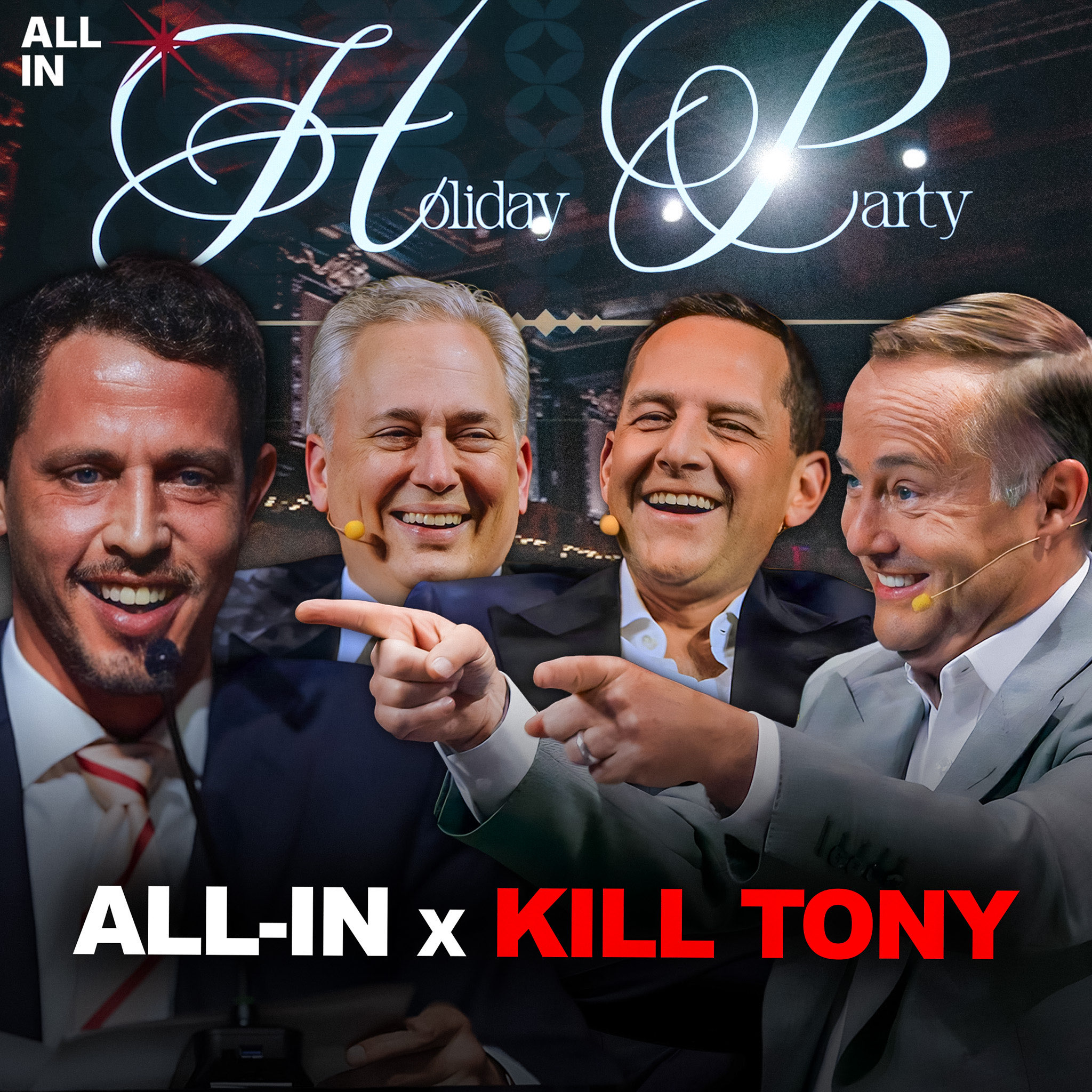
(0:00) Bestie Intros: Jason's first show for his new production company
(2:15) Why Sacks and Chamath are hosting a Trump fundraiser
(18:40) House COVID investigation: findings, cover-up, what's next?
(41:36) The Deep State Problem: unelected bureaucrats running three letter agencies for decades
(53:04) Crypto Corner with Chamath
(1:04:15) State of SaaS: Salesforce drops 20%, market teetering
(1:20:10) Trump verdict: guilty on 34 counts of falsifying business records
(1:37:36) Are we seeing an AI correction?
Follow the besties:
https://twitter.com/DavidSacks
Follow on X:
https://twitter.com/theallinpod
Follow on Instagram:
https://www.instagram.com/theallinpod
Follow on TikTok:
https://www.tiktok.com/@all_in_tok
Follow on LinkedIn:
https://www.linkedin.com/company/allinpod
Intro Music Credit:
https://twitter.com/yung_spielburg
Intro Video Credit:
https://twitter.com/TheZachEffect
Referenced in the show:
https://www.axios.com/2021/07/20/fauci-rand-paul-wuhan-institute
https://x.com/emilyakopp/status/1795482121739354552
https://x.com/R_H_Ebright/status/1795454118594568312
https://www.youtube.com/watch?v=jGxSlW0NrB4
https://www.cidrap.umn.edu/dual-use-research/feds-lift-gain-function-research-pause-offer-guidance
https://www.ncbi.nlm.nih.gov/pmc/articles/PMC3484390
https://www.thelancet.com/journals/lancet/article/PIIS0140-6736(20)30418-9/fulltext
https://fiscaldata.treasury.gov/americas-finance-guide/national-deficit
https://www.youtube.com/watch?v=nvQTXAgtA6s
https://www.nytimes.com/live/2024/05/30/nyregion/trump-trial-verdict
Press play and read along
Transcript
Speaker 1
All right, everybody. As you know, there was a big verdict that came out today in the Trump trial in New York City.
However, it came right after we were taping. So, enjoy this episode.
Speaker 1 And then at the end, we'll go around the horn and get a quick reaction from each of the besties on what they think of the Trump guilty verdict in the New York Hush Money trial.
Speaker 1 And a little update on the market close and tech stocks tanking in after-hour trading. Stick with us.
Speaker 1 Man,
Speaker 1
what a week I've had. Oh, you have an intro.
I smell an intro.
Speaker 1 Tell us, Jay Cow, what was it? What kind of weekend have you had?
Speaker 2 What kind of week of you creditable?
Speaker 1 You know, I got,
Speaker 1
you know, I've always been a fan of Howard Stern, and his agent, Dom Buckwell, called me. He saw the show last week.
This is all true. And they said they want to start a production company.
Speaker 1 So I started a production company and I've already got my first show. I've signed my first show with the pilot.
Speaker 2 What is the show?
Speaker 1
Well, here it is. Let me show you.
Thanks for asking.
Speaker 1 What you are witnessing is real.
Speaker 1 The besties are not actors.
Speaker 2 The cases are real.
Speaker 1 Both parties have agreed to settle their disputes here in our forum, J-Pal Production, Lorraine Man's Court.
Speaker 3 Ye ass lawfare.
Speaker 1 On today's show, Schumap guilty of first-degree unbuttoning.
Speaker 1 Friedberg accused of plastic perjury.
Speaker 5 Jason appealing his drifting conviction.
Speaker 1 Throwing the book. Felonious Fauci.
Speaker 1 Welcome to the stand.
Speaker 2 Judge David Sachs.
Speaker 1
Hot water burn baby. Nice.
That's really good. It's a first show from J.
Coppertown.
Speaker 5 Judge, then, what does that make you? Are you like the bailiff?
Speaker 1 Like what? I'm kind of like the host. Yeah, like the
Speaker 1
business guy who does American Idol. Ryan.
Ryan Seacrest. I'm like going to be the new Ryan Seacrest.
That's what they envisioned for me. And that's my first final show.
So here we go.
Speaker 1 And it said, we open source it to the fans, and they've just called it recently. Love you,
Speaker 1 queen of kin.
Speaker 1 I'm going to
Speaker 1
there's a lot of news. My inbox is blowing up.
I went over to threads to see what was going on over there, and I got absolutely savaged. Threads is like all the hall monitors left one school.
Speaker 1 Like if they took the four hall monitors from every school in the country and could put them all in one place, that's the Reds.
Speaker 1 That is the threads is like Zuckerberg's Twitter revenge killer that he created, but all the journalists and woke folks went there.
Speaker 1 And then all the conspiracy theories took over X and Twitter and like freedom of speech in one place and then the hall monitors in the other.
Speaker 1 But my lord, the inbound I'm getting, Sax, on apparently you're having a party this Thursday and a couple of people are coming, a soiree.
Speaker 1
What's my birthday? It's my birthday party. Oh, yeah, Okay.
So there's a little soiree happening. Sachs, enlighten the audience.
Speaker 1 What are you up to?
Speaker 5 Well, we're hosting an event for President Trump.
Speaker 1 I'm sorry. Why did you say
Speaker 1 what?
Speaker 5 Yeah, we're hosting an event for the once and future president.
Speaker 1
45. 45 is soon to be 47.
Who's we?
Speaker 5 As I saw from your own polling data that you tweeted this morning, Jason.
Speaker 1
God, it's so dark. It's so dark.
I mean, the betting markets are just basically they seem to have already made their decision. The betting markets, right?
Speaker 1 And the betting markets, they're not always right, but they were wrong, actually, about Hillary and Trump. So who knows?
Speaker 5 And polling historically has underestimated Trump's support because people have been reluctant to say they're supporting him for some reason. So,
Speaker 5
yeah, things are looking very positive for Trump right now. But in any event, we're hosting a fundraiser for him.
And
Speaker 5
he said that he wants to come on the all-in-pod at some point. So we just need to schedule that.
And by the way, we did this for,
Speaker 5 let's not forget, we did this for RFK Jr.
Speaker 1 He appeared on the pod.
Speaker 5
We did a fundraiser for him. We did it for Vaik, Ramaswamy.
He came on the pod. We did a fundraiser for him.
Speaker 2 We did it for Dean Phillips.
Speaker 5 Yep, that's right.
Speaker 1 Chris Christie came on.
Speaker 2 And Chris Christie came on, although I don't think we technically did a fundraiser, but we would have.
Speaker 2 And we've asked President Biden, and we have not heard back.
Speaker 1 And when we say,
Speaker 1 sorry, let me just
Speaker 1 parse that out.
Speaker 3 So first of all, who's we? And Shamat, would you host a fundraiser for Biden as well as Trump?
Speaker 2
Absolutely. Look, here's the thing.
I am an apolitical person who has to make a difficult decision every four years. And I think most of us are like that.
Speaker 2 I don't think it's so easy to wake up in the morning and say, oh, I'm clearly a Republican or I'm clearly a Democrat. There's parts of both sides that appeal to me.
Speaker 2 And so you have to make these reasoned decisions. And then that gets even more complicated, right?
Speaker 2 So the most important thing for me is get as many people on in a position to tell their version of the truth so that you can see an unfiltered version of that truth and decide for yourself.
Speaker 2
So I was really blown away when I heard Dean Phillips and Bobby. And I thought, there's parts of both of those platforms that I agree with.
There's parts that I disagree.
Speaker 2
And the same thing happened when I sat down with Vivek. I thought that I wouldn't agree with much.
I ended up agreeing with a lot.
Speaker 2 There's a lot of stuff that Trump, in hindsight, again, as I've said before, that he did, which was really helpful to America. And one big thing, which had he done,
Speaker 2 frankly, sets up our children, which is these hundred-year bonds and defraying the cost of all of this indebtedness far out into the future. So there are many things.
Speaker 2 And I think there's things that Biden has done that I think will look back and say those were good things that he did.
Speaker 2 And then there are things in the future or today that I think we could disagree with as well. So the point is, I would like this this place
Speaker 2 to be a place where impartiality rules, where we can be on all sides of an issue and just decide what makes the most sense after looking at the facts.
Speaker 2 And I would like, four years from now, every major political candidate for president to look at all in as the first place.
Speaker 2 And I think if we can earn that trust and have the integrity to allow all sides to tell a fair story, that is going to be a really powerful thing and an artifact to leave behind for people.
Speaker 1 Well, in fact, RFK believes that we shot him out of a cannon, is I think what he said or something, and that we got the sort of candidacy going.
Speaker 1
Vivek, I think, also kind of debuted here in a major way. To be clear, All In isn't hosting the fundraiser, Sachs.
You and Chamothar. I'm not donating.
I'm not going. Freeberg, you're not donating.
Speaker 1 I don't know if you're going or not.
Speaker 2 I think you told me you're not going.
Speaker 1 You're not donating or going.
Speaker 1
Got it. Okay.
He waved his hand.
Speaker 1 And so, I don't know.
Speaker 5 Look, donating to political candidate is an individual choice that each person's going to have to decide if they want to do it.
Speaker 1 Right. As Americans, we can do that.
Speaker 5 Yeah, if you're willing to open your pocketbook, which I know, Jason, is not something that you're inclined to do very often.
Speaker 1 No, I mean, I don't, I'm not like big into politics, and the idea of giving money to politicians to me, not my thing. You know, I'd rather invest in the next startup, to be totally honest.
Speaker 1
If I'm going to put 50K towards something, or God forbid, 250K, for me, I'll put that in a startup. That's what I like to do.
But, you know, everybody's different.
Speaker 1 And, you know, for the people who are asking me to not be friends with Sachs anymore, I'm going to to be friends with Sachs forever. We love each other for besties.
Speaker 1 And he can have a different opinion than me. I'm getting
Speaker 1
absolutely crucified that I'm supporting Trump. And how could I be friends with Sachs? Go f ⁇ yourself.
Sachs is my friend. We can have a difference of opinion on some topics.
Speaker 2 Good for you, Jesus. Deal with that.
Speaker 1 That is the thing. And maybe you can learn something from it.
Speaker 2 Good for you.
Speaker 3
Sorry, I'll just say I've heard the same thing. And I told friends.
and others that have reached out, why are you associating yourself with people that are doing a fundraiser for Trump?
Speaker 3 And I I said, exactly, because I think it's really important that people can have different political interests, different points of view, different beliefs, and still be friends and still have a conversation.
Speaker 3 If we can model that in any way, I think it moves the needle because this whole thing where you only speak with, only hang out with, only talk to, only have dinner with people that you agree with, I think is exactly what got us in the mess that we're in today.
Speaker 3 People need to have a broader perspective.
Speaker 1 So well said. And
Speaker 3 I'll support you guys with whatever in terms of like being your friends, I'm not going to ever judge you guys in terms of what you believe in or choose to do.
Speaker 2 We've said this before, but you know, in the end, what do you have? You have your family, you have your children, you have your friends, and hopefully you have work that gives you some purpose.
Speaker 2 And in all of that, if there are random people that are judging you for one thing, they'll eventually judge you for another thing. And that is not a path to any sort of contentment.
Speaker 2 I've donated to Bobby Kennedy. I've donated to the Democrats massively, and I'll donate to Donald Trump.
Speaker 2 And if there's an opportunity to talk to President Biden and really understand where he's at, I donate to him as well.
Speaker 2 And so the point is that I would like to be an organizing principle.
Speaker 2 And I would like to replace
Speaker 2 today the places that I don't trust to organize and give unfiltered access to knowledge. And those things are the mainstream media.
Speaker 2 And so I'm willing to put my resources behind being that organizing principle.
Speaker 2 And I think having a broad cross-section of friends who have different political beliefs is actually a useful thing for a lot of these candidates.
Speaker 2 Because as it turns out, most people are sort of in the middle. And most people in any given election can be persuaded one way or the other.
Speaker 2 So the most important thing that we can do is get all of them, give all of them an opportunity to really tell an unfiltered version of their truth. and then let the chips fall where they may.
Speaker 2
That is the right thing to do for America. That's what democracy means.
So this kind of like cajoleying and bullying in either side, I find really distasteful and I find very immature.
Speaker 1 Yeah, and it's not going to work.
Speaker 5 What's amazing is, I mean, I really haven't gotten any blowback. You know, there was a question about people asking me, have you gotten blowback from this thing? And no, not really.
Speaker 5 I mean, other than the reporter knocking on my door and that kind of stuff. But
Speaker 5 people really
Speaker 5 hasn't really created blowback. And I think you guys are getting more blowback.
Speaker 5 And that's an indication of just sort of the cowardly response to it, which is, you know, it's like a cancellation tactic.
Speaker 5 We're going to try and like go behind your back and ostracize you instead of even telling you to your face what you think.
Speaker 5 And I think the reason why they're doing that is because, quite frankly, there's a lot of preference falsification going on in Silicon Valley. I know there's a lot of people in Silicon Valley,
Speaker 2 we know who's coming.
Speaker 1 Yeah, you have a list of people who don't. I mean, look, nobody is excited about Biden.
Speaker 5
Okay. Nobody's excited about Biden right now.
So the the only question is, do they hold their nose and vote for him or do they vote for Trump or do they vote for Bobby Kennedy?
Speaker 5 But there's a lot of people who I do think support Trump. And look, we've A-B tested this, right? It'd be different if we didn't have four years of Biden and four years of Trump.
Speaker 5 There's a lot of people who can look back and say that the A-B test we ran indicates Trump. So I know there's going to be a lot of people who support Trump, but they don't want to admit it.
Speaker 5 And I think that this event is going to break the ice on that.
Speaker 5 And maybe it'll create a preference cascade where all of a sudden it becomes acceptable to acknowledge the truth, which is a lot of people support Trump. And it's not just this.
Speaker 5
It's also Steve Schwartzman came out. I think Bill Ackman's on the edge of coming out for Trump.
So there's a lot of people who are now like flipping.
Speaker 5 And I think it could really start to cascade on itself.
Speaker 2 I think the thing that hasn't happened yet is we haven't actually now started to talk about the contours of a handful of policy things where there is some deep diversion now, where these candidates are diverging from each other.
Speaker 2 And I think that that's going to be really interesting to see how much people value that differentiation.
Speaker 2 I'll give you an example, which is President Trump in the last few weeks has become incredibly pro-crypto. Now, the contours of that, I think we need to define, right?
Speaker 2 But the question is, is a pro-crypto environment, especially in a world where we think that there's just going to be continued dollar debasement, an important issue, an unimportant issue, or a thing that is a small issue today, but that will be critical for us in 20 and 30 years to get right.
Speaker 2 That's an example.
Speaker 2 And there's a handful of these other things that I think that now we have a chance to really double-click on, where there really is some differentiation amongst the three presidential candidates.
Speaker 2 And I think that's healthy as well. And so it's important, again, get their specific thoughts on the record so that we can really figure this out.
Speaker 2 And I think that over these next few months, I think it's going to be important to do that. So I hope President Biden also comes on the pod, quite honestly, and
Speaker 2 allows us to ask him the hard questions.
Speaker 2 And I hope Bobby comes back on, actually, and I think Bobby will if we ask him, just to tighten up where he's at now a few months before.
Speaker 1
Yeah, there's definitely a lot of great follow-up questions. I would love to interview Trump.
I'll ask him hard questions. I'll respect him as president 45 and as a candidate.
Speaker 1
So for people who like, are like, you have Trump derangement syndrome, like, that's just like a childish thing to say. I disagree with his policies.
I'll ask him questions.
Speaker 1 Hey, why don't you support EVs? Like, that's a valid question to ask him. Why is he anti-EV? He said all these crazy things about EVs, and then apparently, he's courting Elon privately.
Speaker 1
I don't know if that's true or not, but you know, there's hard questions, and I'm sure he'll answer them. And he's more than capable of doing that.
I'm excited for me.
Speaker 2 I'm really excited for President Trump to come on the podcast.
Speaker 1
I'd love to have him on. And for me, I'll be totally honest, I think the Democrats have to wake up for a second and just take the temperature of the room.
Like, read the room, Democrats.
Speaker 1 You have put up a candidate that nobody wants. His policies on the border and some other issues are not, you know, in sync with the majority of the country.
Speaker 1 At some point, the Democrats just have to take a deep look in the mirror.
Speaker 1 James Carvell is doing it, a bunch of them are doing it, and say, We feel that a bad candidate who's too old and people don't believe will stand up to scrutiny of, like, say, being on the all-in-pot for two hours or in the debates, or with a hostile interview, or any of those possibilities.
Speaker 1 And so I think if that's the case, we really need to have the Democrats think deeply about maybe fielding a different candidate. And I believe that's what's going to happen in the next 30 to 60 days.
Speaker 1 So I'm pretty sure.
Speaker 5 Do you think there's going to be a switcheroo?
Speaker 1 100%. I mean, if you just
Speaker 1
100% there'll be a switcheroo. Who's the switcheroo? I have no idea.
It could be Gavin. It could be anybody.
Anything's possible. I think Trump's going to demolish him in the debate.
Speaker 1 I think he'll sink to 30% in the polls. And then the Republicans are going to find a, I'm sorry, the Democrats will find a way to give him a graceful out, and then they'll field somebody else.
Speaker 3 When's the first debate?
Speaker 2 June 17th.
Speaker 5 Can I respond to that, Jason? I saw your tweet basically saying something very similar, that Democrats need to wake up and
Speaker 5 recognize the situation they're in. I think this is a case of once you've made your bed, you have to sleep in it.
Speaker 5 Look, the Democrats have set the table pursuing certain policies for the last three and a half years. We've had an open border.
Speaker 5 We had so much spending that it fed into this inflation, which jacked up interest rates. We had Ukraine become the central obsession of focus of our politics, which blew up in
Speaker 5 Biden's face with the whole summer counteroffensive. I mean, I could go on.
Speaker 5 You have the hostility to crypto, which they're now trying to desperately backpedal on, but you had three years of Elizabeth Warren and Gensler basically making crypto the enemy.
Speaker 5
And now all of a sudden, we're at first single, we're at that like 10-yard line. And you're all of a sudden saying, well, just read the room and make all these changes.
You can't.
Speaker 5
You know, I don't think people are going to be fooled by that. We've A-B tested this thing.
We've had three and a half years of Biden, four years of Trump. Who do you like better?
Speaker 5 And we're, how many months are we from pulling the lever? Five months?
Speaker 1
Never too late. I'm telling him to do it.
Don't take Sachs's advice. He is a hardcore partisan and wants to win desperately.
Take J. Kyle's advice.
Field another candidate.
Speaker 1 The worst thing the Republicans could ever deal with is a great candidate who can speak and who's nimble on their feet because I think people are looking for a choice that's not these two individuals.
Speaker 1 I'm not going to say I'm anti-Trump. I'm not going to say I'm anti-Trump.
Speaker 5 Why don't you support Bobby Kennedy then?
Speaker 1 I don't think he's going to have the platform behind him to get enough votes. I think the Democrats need to immediately, this month, in June, do the switcheroo.
Speaker 1 And if they do, I think they win in a lens.
Speaker 5 They had their chance. They had their chance.
Speaker 1 They could have gone for Bobby.
Speaker 5 They drove Bobby out of the party.
Speaker 1 That's not their only thing.
Speaker 5 He didn't start as an independent.
Speaker 1 He started as I know by his last name and it's a Democrat.
Speaker 5
Kennedy, Democrat. Kind of in the name of Dean Phillips.
Dean Phillips took the chance.
Speaker 5 And of course, he was pushed out, not of the party, but basically ostracized.
Speaker 1
They had their chance. I think, you know, if I want to be a strategist, this is just a conspiracy theory.
I don't want to go to like chinfoil hat corner.
Speaker 1 I think the Democrats, as cynical as it sounds, were waiting to see what happens with this Trump trials, conviction, what you call lawfair, what other people call fair use of the law.
Speaker 1 And then they are going to see how he does in the debates that's why they moved the debate up in june and i think they know to pull the plug on this if it gets too far gone and they have the ability to do that because all he's got to say is you know what i i'm i'm feeling old and i want us to win and i'm going to slot somebody else in but listen let's go get to this issue how many translate what you just said which is the democrats hope to put trump in jail using law fair And when that fails, they realize that they're going to lose the election to him and they've got a big problem.
Speaker 5 So they're going to try some desperate strategy to find a new candidate, candidate, but it's way too late for that.
Speaker 1 I think precisely.
Speaker 1
Thank you for repeating back to me. And I think the only disagreement we might have there is I would agree, like, there's Lawford in two of the cases.
And I think two of the cases I think
Speaker 1 should be pursued. But, you know, we can, intelligent people, as we said at the start of this, can agree to disagree about it.
Speaker 1 And I think you should all take, if you're a listener to this podcast, you're smart. If you're here, you're smart.
Speaker 1 You're not listening to two-hour podcasts with us going this deep on issues if you're not a brilliant, smart, and attractive individual. So let's get to the docket.
Speaker 1 Present.
Speaker 1 Yes, that's what I just said. He heard brilliant and attractive, and he's here.
Speaker 1 All right, listen, I hate to go into another
Speaker 1
controversial topic, but the four of us were all on fire about this. Apparently, the COVID-19 investigation is leaning towards a massive cover-up.
There's a subcommittee going on right now.
Speaker 1 The world's not paying attention to this, but I think some savvy savvy people are, especially over on X. There's a lot of great journalists who are doing incredible investigative work.
Speaker 1 Let me just catch everybody up in the audience real quick here and get the besties involved.
Speaker 1 Over the past year and a half, a House subcommittee has been focused on the origins of COVID-19, and they've been investigating the NIH's ties with gain of function research in Wuhan.
Speaker 1 The subcommittee was painted early on as like, this is angry Republicans. This is about mask mandates.
Speaker 1 It was like highly politicized, but it's actually turned out to be very effective, bipartisan investigation we'll get on we'll get in on that in a minute but so far most of the investigation is focused on nailing down this timeline of communication between nih officials and an organization called eco health alliance this is a nonprofit that's focused on infectious disease research now
Speaker 1 these uh committee videos are online we'll pay you play you on in a moment But through funding in the NIH, the EcoHealth organization was awarded research grants to various labs.
Speaker 1 This included the Wuhan Wuhan Institute of Virology, the infamous one. EcoHealth violated terms of its grants by failing to report that gain-of-function experiments were being conducted in Wuhan.
Speaker 1 EcoHealth was supposed to report any experiment that exhibited characteristics leading it to being 10 times more infectious. But when that happened, it failed to disclose this research to the NIH.
Speaker 1 And on May 17th, a deputy director of the NIH acknowledged that the agency funded gain of function research in Wuhan via EcoHealth. This is the key because Fauci initially denied this.
Speaker 1 During his 2021 Senate hearing, Fauci said, quote, I totally resent the lie you are now propagating in response to questions from Rand Paul about the lab league theory.
Speaker 1 So Fauci either didn't know or he lied under oath. Let me pause there for a second.
Speaker 1 There's a lot more to the story, but when you hear this sort of setup, Friedberg, our Sultan of Science, In this initial setup, what rings concerning to you, true to you?
Speaker 1 And then we'll go on and we'll play some clips of this testimony, which is pretty wild. I don't think that pre
Speaker 3 the emergence of the pandemic, that there was nefarious motives.
Speaker 1 In other words, their funding of this was not done to create a pandemic. It might have been a mistake in hindsight, but.
Speaker 3 Yeah, for many years, particularly following the original SARS pandemic, there was a lot of conversations around how do we get in front of the next pandemic? How do we figure out what's coming?
Speaker 3 And how do we prepare for it? And there was a lot of research that was launched to try and resolve that key question.
Speaker 3 This is like the movie 12 Monkeys. You guys ever see that movie?
Speaker 1 Yeah, sure.
Speaker 3 It's like, does the
Speaker 3 effort to try and stop the problem cause the problem? I think that from my point of view, there's a very high probability that there was
Speaker 3 some leak.
Speaker 3 That meant that the work that was going on to try and get in front of the next pandemic and understand what we could do to prepare ourselves and what vaccines could be developed and so on actually led to the pandemic.
Speaker 3 So then when that happens, how do you respond when you're sitting in that seat?
Speaker 3 That's the key question that I think this committee is uncovering.
Speaker 2 Do you think there was a cover-up, Freeberg? What is your intuition on that?
Speaker 3 Yeah, I think that these guys definitely didn't want... I think what they were trying to do was prevent that from being the focal point and protect their own asses at the same time.
Speaker 2 Do you think they should go to jail?
Speaker 3 I don't know the extent of it yet. It'd be good to get more information from this whole thing.
Speaker 3 Yeah, so let me queue up those next details because I will say this guy that gave testimony last week where he was like deliberately changing the names of people in the email, Anderson, and he put the dollar sign so that you couldn't find that email when you did a FOIA search.
Speaker 3 He knew what he was doing.
Speaker 5 He knew.
Speaker 5 I don't understand how you could say this wasn't nefarious. This whole thing was nefarious from top to bottom.
Speaker 1 Well, yeah, let me cue this up here, Saxon, then get your.
Speaker 5 Why are you exonerating it?
Speaker 1
Hold on, let me queue it up. All right.
So we started to see some consequences in accountability. Last week, the U.S.
Speaker 1 Department of Health cut all funding to EcoHealth in response to the committee's investigation. They disbarred its president, Peter Dasek.
Speaker 2 Dasik, yeah.
Speaker 1 Dasik. And so we don't have direct evidence to be clear that the pandemic was the result of a lab leak.
Speaker 1 And, you know, just even saying the lab leak would have gotten this.
Speaker 5
The fear and cleavage site makes it clear that this was a lab leak. That's not a naturally occurring virus.
The fear and cleavage sites were engineered.
Speaker 1
Let's go to that in just one second. And thankfully, this isn't going to get our YouTube channel shut down because we have freedom of speech back a little bit.
But
Speaker 1
this is where it gets really interesting. Emails were written as eco health with a tilde.
That's that little squiggly line instead of an O.
Speaker 1 And they would spell Anderson with a dollar sign in the E.
Speaker 1 Christian Anderson, in this example, is a biologist who was reportedly awarded $9 million in grants from the NIH two months after publishing a paper claiming COVID did not come from a lab.
Speaker 1
And so let's get to some of these clips. Here's a clip of Fauci's former top advisor, David Morins, getting grilled in the hearing.
And I'll play two clips and then I'll give it to you, Sex.
Speaker 4 On October 25th, 2021, another scientist wrote, quote, David is concerned about the privacy of text and other messages from his cell phone to you and me because he has been using a government phone.
Speaker 4
This came from Tony, end quote. Sir, did you ever have any conversations with Dr.
Fauci regarding using personal phone or email to communicate with Dr. Dasick? I don't remember it.
It's possible.
Speaker 4
I probably wouldn't have remembered it, and I don't remember it. On January 18th, you testified that you did not have any conversations with Dr.
Fauci regarding eco health.
Speaker 4
On October 25th, 2021, you wrote, quote, Peter, from Tony's numerous recent comments to me, they are trying to protect you, end quote. You meaning, EcoHealth and Dr.
Dasick. Dr.
Speaker 4
Renz, did you ever have any conversations with Dr. Fauci regarding eco-health? Well, the ones you just mentioned, I don't have any recollection of that.
No recollection. No recollection.
No.
Speaker 1
All right. So we're on the no recollection train, and then I'll give this final clip here.
This is unbelievable, Sachs.
Speaker 1 Currently, there's a FOIA lady, Freedom of Information Act lady, working at NIH to train and help and mentor people on how to avoid having their
Speaker 1 communications. These are people who
Speaker 1
work work for us. And she's the FOIA lady at NIH.
Play the clip, Nick.
Speaker 4 And as you've said, you previously testified that you did not delete any federal records.
Speaker 4 But on February 24th, 2021, you wrote, quote, I learned from our FOIA lady here how to make emails disappear after I'm FOIA, but before the search starts. So I think we are all safe.
Speaker 4 Plus, I deleted most of those earlier emails after sending them to Gmail, end quote.
Speaker 4 And the next day on February 25th, 2021, you wrote, quote, but I learned the tricks last year from an old friend, Marge Moore, who heads our FOIA office and also hates FOIA's, end quote. Yes or no?
Speaker 4 Is Marge Moore the FOIA lady you were referring to?
Speaker 4
She was at the time. I believe she's retired since then.
Did the NIH FOIA office instruct you on how to delete emails or avoid FOIA? No.
Speaker 1
All right, Sachs. There's your red meat.
Smoking guns everywhere. What do you think?
Speaker 5 Please give me a couple of minutes to kind of lay out what happened here. Okay, so
Speaker 5 Fauci knew very early, as early as February 1st of 2020, that COVID came from a lab leak.
Speaker 5 The scientists said, so all they had to do was look under a microscope and see the furin cleavage site, which is not naturally occurring.
Speaker 5 It's something that was added, basically bioengineered to the virus in order to make it more transmissible in humans. So they knew right away that this somehow came from a lab leak.
Speaker 5 And Fauci and Collins said in emails that they were going to begin a brutal takedown in order to conceal this fundamental truth of the lab leak from the public.
Speaker 5 Now, why would Fauci need to conceal this?
Speaker 5 Because he had funded gain of function research programs via Peter Dazik and the EcoHealth Alliance to conduct, again, gain of function research at the Wuhan Institute of Virology.
Speaker 5 Moreover, Fauci was personally responsible for reversing an Obama-era decision to prohibit gain of function research because it was so risky. Fauci wrote op-eds
Speaker 5 justifying gain of function research. He wrote a paper in 2012, which was actually quite candid about the risks of gain of function.
Speaker 5 He describes the kind of lab leak that could occur and the type of virus that could escape from a lab because of gain of function, but then he says that it's a risk worth taking.
Speaker 5
So this is somebody who funded the Wuhan lab. He funded gain of function research.
He was personally responsible for lifting the ban on gain of function research.
Speaker 5 He had a lot of reasons to want to hide the fact that COVID was engineered in a lab and was lab leak.
Speaker 5 And so we know that even before this conspiracy to basically defraud the FOIA request, that Fauci had done things like organized that letter to the Lancet, which smeared and demonized scientists who were trying to tell the truth, saying that the so-called zoological theory was nonsense, that this had to be from a lab.
Speaker 5 He was doing things like this. And now we have this added piece, which is this longtime colleague of Fauci and Collins at NIH, Dr.
Speaker 5 David Morenz, developed a strategy for evading FOIA requests that would expose the truth.
Speaker 5 He did this by deleting government emails, which is a crime, by using private email to conduct government business, which is also a crime, and then strategically misspelling names and titles to frustrate the FOIA searches.
Speaker 5 And then the craziest part is that Morenz foolishly detailed his schemes in emails that Fauci would have seen, that Fauci was on the distribution list stuff. So he has no plausible deniability.
Speaker 1 It's literally like they're like, here's how we can avoid getting caught in an email.
Speaker 5 You have to see the FOIA piece within the overall picture here, which is
Speaker 5 Fauci from the get-go was lying about the origins of COVID in order to cover up his role. in
Speaker 5 funding this type of research.
Speaker 5 And there was a comprehensive effort by people at NIH,
Speaker 5 likely at Fauci's direction, to again, not just cover this up, but to smear scientists who were not going to be able to do it.
Speaker 1 They went on the offensive in addition to trying to cover their assets.
Speaker 5 Yeah, people like Jay Bonacharia, who then got censored and banned on social media.
Speaker 1 And by the way, who is a Stanford professor?
Speaker 1
Was banned for speaking up. Chumov, let's zoom out here and start thinking strategy and theories of what's going on here.
I have my own, but I'm curious to hear yours as we go around the horn here.
Speaker 1 What's your take on this?
Speaker 2 I would like to make four points, I think, that kind of summarize my view of this. I think what happened here needs a really
Speaker 2 clear accounting because the implications are far greater than I think people realize.
Speaker 2 And I think why maybe the four of us have always been tugging on this little thread is because each of us instinctively understood that.
Speaker 2 So, the first is: if you just look at the macroeconomic consequences of what COVID did and our reaction, we broke the seal of having absolutely no accountability on massive spending, right?
Speaker 2 So there are subsidies, there are kickbacks, there are government programs that now number in the trillions of dollars a year incremental to what we were going to spend if things were the status quo.
Speaker 2 And the problem is that, and Friberg has talked about this really eloquently in the past, it's creating a massive debt issue that us and our children and our grandchildren will have to deal with.
Speaker 2 If we had responded to this pandemic differently, those issues would not have occurred. If we had just kept the economy open because we understood what was going on,
Speaker 2 we would not have reacted the way that we did, and we would not have nearly as much debt as we had, and we would not have made it okay for politicians to spend trillions of dollars.
Speaker 2
That is a direct consequence of our reaction to COVID, not COVID itself. The second is we caused billions of people all around the world to take immaturely tested drugs.
They were called vaccines.
Speaker 2
We found out that they were modestly effective at best. And then some of them were designed in some ways to manipulate our DNA.
And we just don't know what the long-term impacts will be.
Speaker 2
We see some small issues of myocarditis. We see other issues of all-cause mortality.
But the point is we just don't know.
Speaker 2 And that would not have happened had we not rushed to force people to to stand in the line and get a jab in order to get back to their normal life.
Speaker 2 That was a direct consequence, not of COVID, but of a reaction. The third is what we're realizing right now is that we had this power-drunk apparatchik.
Speaker 2 And this is similar to the quote that Mike Pompeo made when he took over the CIA.
Speaker 2 What he found, and he said this after when he left, was there were people on the top floor of the CIA building, the seventh floor of the Pentagon, that fundamentally believed that it wasn't the Democrats nor the Republicans that ran the country, but it was them.
Speaker 2 And I see a similar level of arrogance here, which is this belief that they know better.
Speaker 2 And so what they did was they committed the greatest sin, which is where the cover-up is way greater than the crime.
Speaker 2 And they created a setup where all of these things were amplified by their prestige, their perceived scientific knowledge.
Speaker 2 But what they were really doing was keeping critical information to themselves and then trying to cover it up, Jason. That is so unacceptable when you think of the broad consequences of what happened.
Speaker 2 And that's what needs to get documented. And I do think there needs to be some form of accountability for that.
Speaker 1
I think it's well said. And, you know, just looking at it, I think we are now at the point of this conversation and investigation where we can say this is not a bipartisan.
This is an issue.
Speaker 1 And everybody knew, like we had these conversations on this very podcast, the public knew, something didn't seem right about this.
Speaker 1 And if you just think about this from first principles of what occurred here,
Speaker 1 just what occurred here,
Speaker 1 Freyberg, we funded gain of research to create these super viruses,
Speaker 1
what I think other people could just as equally call a bioweapon with the Chinese. Now, we're supposed to be arch rivals here.
We're like these competitors.
Speaker 1 And then when it came out and it leaked and of course i don't think it was released on purpose
Speaker 1 when it came out the people who work for us and we trust with our family safety who funded this in order to save their own reputations to cover their asses then lied about it and then like as you said sax perfectly they went on the offensive
Speaker 1
These people were not elected by anybody. That's right.
These people work for us and they failed us. This is a crime against humanity of the greatest cause.
People committed suicide.
Speaker 1
People died because they had depression. Our kids lost two years of school.
Totally.
Speaker 1 This generation has lost their education and now we have burdened them with billions, hundreds of billions of dollars in debt from this. This is
Speaker 1
trillions. Trillions.
Tens of trillions. This is a failure of leadership.
It is a crime. And when people said, prosecute Fauci, they were like, you're being hysterical.
This is ridiculous.
Speaker 1
These people need to be prosecuted. If you hid this stuff from a FOIA request, you need to go to jail.
There needs to be accountability here
Speaker 1 for what they did to society, our children, and the future. I am infuriated by this.
Speaker 2 Imagine what happened in the situation room or the equivalent, wherever the president of the United States, all these world leaders were
Speaker 2
coalescing to try to make decisions in that period. They all looked at this quote-unquote expert.
They pointed at Fauci and said, lead us out.
Speaker 2 And so do we not think that at any point he was thinking, how do I do this in a way where I have no fingerprints?
Speaker 2 Clearly, the answer is, in fact, he was leading from a position of, how will I not have any fingerprints on this? And so do we, did we get the best advice?
Speaker 2 On the margin, I think it's pretty fair to say we could not have gotten it because he was too conflicted.
Speaker 2 He was figuring out how to cover up what happened as opposed to just own it and then help the world get out of it.
Speaker 1 Yeah, I mean, talk about like incinerating your entire career and legacy, but putting that aside, the morality of covering this up. And, you know, so then you have to think, Trimov.
Speaker 1 And this is why I was like, what is this strategy? What goes through somebody's mind when they decide to do a cover-up at this level?
Speaker 1 Is it just fear of getting caught and their lives being, in their mind, ruined and they're going to do this incredible cover-up?
Speaker 1 I actually think that they thought this would become a globally destabilizing moment between the United States and China, and that there could be revolutions.
Speaker 1 Now, I know that this is now sounding really conspiracy theory, but if you're sitting there and you're like, what if the public finds out we created this and their grandparents died from it and their kids didn't go to school because of it?
Speaker 1
There'd be riots in the street. But if enough time passes, maybe there's not riots in the street.
Well, you know what?
Speaker 1 This is something that is just so abhorrent that, I mean, people need to really be held accountable. Freeberg, your thoughts.
Speaker 3 What would you guys do if you're sitting in a policymaker's seat today
Speaker 3 and you're being offered by scientists this ability to go and figure out what the next big virus will be and start to make plans for getting in front of it by understanding the biology of these viruses, by seeing where they're going to evolve to, and by trying to get in front of the next pandemic so that we can protect the population.
Speaker 3 Do you guys support that sort of research? And what are the questions you ask? So let's, you know, rewind 15 years, pretend Fauci doesn't get to make those decisions. You guys are the policymakers.
Speaker 3 And folks say, SARS just happened. We want to do this research.
Speaker 1 We want to figure out how to get fair. What do you do?
Speaker 3 And how do you answer that?
Speaker 1 There's a really simple question.
Speaker 1 If anybody who's watched any kind of science fiction or knows the history of this kind of research, which is don't do this in a population center, and how will you prevent it from breaking out?
Speaker 1 Like literally, that's job one. If you're going to,
Speaker 1 even if you're not going to,
Speaker 1 like, literally every science fiction film
Speaker 1
has this. It's like, put it on an island.
And there's an island off Long Island where they keep these things. I forgot the name of it.
Is it Plum Island or something? Well, look it up. Yeah.
Speaker 5 And by the way, there are internal NIH emails that suggest that COVID leaked from a level two facility. They call it BSL2.
Speaker 5 which does not operate with the top level biohazard safeguards. So they knew the Wuhan lab was not at the level of safeguards that it should have been.
Speaker 5 But look, I would go deeper and say that why would you do this kind of research at all? I mean, you are deliberately manipulating viruses in order to make them transmissible in humans.
Speaker 5
This was a bat virus that was not transmissible to humans. It was bioengineered.
They had the furion cleavage site to allow it to gain access to human cells. Yeah.
Speaker 3 So Sachs, I am going to push back because that is not conclusively true.
Speaker 3 What you're saying is something that some people have claimed, but there are other scientists, including papers published recently in The Lancet and other pretty reputable medical journals and research journals that indicate that the evolution seen in the fear and cleavage site can be traced back to an evolutionary origin, not necessarily to a human-engineered origin.
Speaker 3
So I want to just make that clear that that is a possibility. I'm not dismissing it, but I'm not supporting the other side.
I'm saying we have work to do to figure this out.
Speaker 1 Just to be clear.
Speaker 5 It's a possibility that's so remote. I mean, look, I heard Professor Jeffrey Sachs talking about this in a recent interview, and he went through the whole history.
Speaker 5 He said there's like 200 of these coronaviruses in this like class or category and there's not one fear and cleavage site among any of them.
Speaker 1 So
Speaker 1 can you say that there's not a one in a billion chance of it happening? No, no, no. So back to your question, it's a very, very, very low probability.
Speaker 1 Let me punch up your question, Freeberg, because if you know, if your question is, what should you do? I want to ask you guys, what do you do? So like forget about, oh, there's bad guys.
Speaker 3 Fauci's a bad guy. Like, what do you do to protect the world against the next pandemic?
Speaker 5 Number one, you don't do this type of gain of function research.
Speaker 5 Number two if you are going to do it you don't do it at a level two facility like the wuhan lab number three when the virus leaks from the lab you don't basically lie about and conduct a cover-up campaign that smears the reputation of honest scientists number four when you're hauled into the oval office in response to this once in a century pandemic you don't pretend like you're America's doctor and you have all the answers when in fact you're the guy who created this problem.
Speaker 1
You own it. There's an idea.
You own it. And you know what? Like the question really embedded in your question, Freeberg, I think is,
Speaker 1 is there any argument to doing gain of function? If so, how?
Speaker 1 And then is there any reason to research, you know, the bat dung or whatever material they get it from, you know, from those caves and take it out of the caves?
Speaker 1 I could see the latter, Shamoff, of like, hey, this existed nature. You studied on an island somewhere far away from everybody with massive controls.
Speaker 1 The gain of function seems like, it literally feels like the speech from Jurassic Park. Like, I think it's not
Speaker 1 anybody who's not a person. Jurassic Park took place on an island for a reason.
Speaker 5
There were many scientists who were opposed to gain of function research. They thought it was unduly risky and didn't have offsetting benefits.
And that is exactly why Obama banned it.
Speaker 1 Very good decision.
Speaker 5 To me, this whole idea that we need to amplify these viruses in order to find out what would happen if this happened naturally is insane.
Speaker 1
You didn't have this to come until you created it. Yes.
This is nutty. This is nutty.
It's nuts. Go ahead.
Speaker 2
There are examples we know. I'll just point to two.
Let's just say the attempted overthrow of the Ukrainian government in 2014.
Speaker 2 You can go back to Iran-Contra as yet another example.
Speaker 2 And you can add gain of function research now, which is, again, I'll just go back to when there are these lifelong bureaucrats that believe they're above the law, that there's this sensation that they can pull the levers of power silently behind the scenes because they know better.
Speaker 2 And then what they're doing, as you guys said, is they are controverting the desires of the people. So whether you like President Obama or not, he's duly elected by the people.
Speaker 2 And when he says this isn't allowed, it shouldn't be allowed.
Speaker 2 And when you instantiate chaos and wars and all of this other stuff, overthrows and all of these other places that then create create all these long tail effects.
Speaker 2
They're not done with really America support. They're done by a small group of people who think they know better.
And I think that we've created that kind of a problem that needs to get fixed.
Speaker 2 And so I think that this has to be an example where you can make them an example, because otherwise it will keep happening. And there are other parts of the American bureaucracy.
Speaker 2 where people are in charge of very critical and important decisions. And I suspect 99% of them are good, earnest, honest people doing the right thing for America.
Speaker 2 But it's just the law of large numbers. There will be one or two, and all it takes is one or two, who get drunk with that power.
Speaker 2 And so unless that there's a check and balance on that dynamic, we'll have more issues of this.
Speaker 2 And as the world gets more sophisticated and we rely more on experts, I hate to say this, guys, but you have to be more skeptical of experts.
Speaker 2 As much as you think an expert is an expert, you have to fight the tendency of saying, I'm going to abdicate all of my intellect onto you and you decide.
Speaker 2
I think you have to find a way of just gut checking. And Sach said this critical thing.
If I was the president of the United States in a pandemic, I didn't need the COVID to teach me this example.
Speaker 2 But if I'm trying to solve a very technical and hard engineering problem, what I always do is I bring a cross-section of people in a room.
Speaker 2 Typically, some of them have to have disagreeing opinions and I make them intellectually fight it out.
Speaker 2
And my job is to observe. And in that, I apply my judgment.
I'm not nearly as smart as them. I'm not nearly technically as trained as them, but that is a process that works.
Speaker 2 And I'm just questioning, it couldn't have happened here because as Sach said, if you basically bury the reputations of the folks that are pushing back, you could never bring them inside the room in the oval.
Speaker 2 and have a conversation with them and say, hey, Jay, Bhattacharya, give us the red team version of what you think is happening.
Speaker 1 Yeah. And that's
Speaker 2 steel man the opposite side.
Speaker 5 Let me build on a point Jamath made, which is I think we have to ask the question, what type of government do we really have?
Speaker 5 You know, we call ourselves a democracy, but are you a democracy when the elected leaders come and go and the really powerful bureaucrats running the government, running these agencies stay for decades and decades.
Speaker 5
And if the president disagrees with their policy, they can just wait them out. Fauci wanted to do gain of function research.
Maybe, by the way, at the behest of DOD, we don't know.
Speaker 5 It could have been a bio-weapon or biodefense program. There's a lot more to this that we don't even know about yet.
Speaker 5 In any event, it's clear he was passionately committed to funding gain of function research. He just waited for his opportunity and implemented his will.
Speaker 5 Victoria Newland in the State Department, passionately committed to basically bringing Ukraine into NATO and using that to essentially provoke a regime change operation operation in Russia.
Speaker 5 Again, she just had to wait for her opportunity to basically keep pushing these policies for decades. These are the people who are really running the
Speaker 1 American government. How would you change it? We have to turn these things over, these organizations, or get rid of them.
Speaker 2 We talk about term limits for politicians. Maybe we actually need term limits for the administrative apparatchik that runs all these critical organizations.
Speaker 5
Right. It's called the deep state, right? You ever hear the expression deep state? It sounds conspiratorial.
It's not. It's just the permanent bureaucracy.
Speaker 5 We elect a president, but how many people does the president actually appoint? A couple hundred? You know, 99.9%
Speaker 5 of the people running the government are there permanently.
Speaker 1 Well, and then I'll just say here: I want to give a shout out to the journalists, Katherine Iban and Catherine Iban and Emily Kopp. I know that people also have no faith in journalists.
Speaker 1 These are two journalists I think you could have tremendous faith in and who are going to win bullets because they've been doggedly pursuing this.
Speaker 1 And you have to wonder why this is not the top story on the news networks and why this isn't the head of you know the new york times or the or the washington post like there needs to be much more coverage of what's going on here i don't understand why i want to say what is yeah because trump takes every headline yeah i don't think it has anything to do with trump i think it's got everything to do with the fact that the new york times was covering for fauci
Speaker 5 fauci has been there fauci's been there for decades he is a major source for the new york times just like he was a major funder of grant programs right so there's a lot of people who have developed a dependency on fauci I mean, everyone.
Speaker 5 Free information.
Speaker 1
You think access journalism is what's going on here. He gave them access journalism.
There's no question that
Speaker 5 the New York Times was covering for this. The New York Times definitely promoted the idea that anyone pushing the lab leak theory was somehow a conspiracy theorist or a nut.
Speaker 1 And you have to lay on top of all this, Sachs, the political environment.
Speaker 5 They were pushing that whole crazy wet market theory.
Speaker 1 Well, the wet market theory.
Speaker 1 The pangolin. Remember the pangolin?
Speaker 2 We needed Jon Stewart to dismantle the pangolin theory.
Speaker 1 You You know, in relation to that, these wet markets have spread massive viruses and
Speaker 1 all kinds of things. And they do need to be.
Speaker 1
There was like a UN report on like, hey, we have to upgrade these people. We have to stop doing wet markets.
That's why I was a colleague. I don't know that it was a great cover story.
Speaker 1 I think it was a logical theory to pursue to the end point of eliminating it because they around Wuhan, there are a lot of these wet markets.
Speaker 1 It is completely conceivable that a person who was in that lab went to a wet market and it spread via via the wet market.
Speaker 1 This is why we need a full investigation, folks, because all these theories could come together and there are more cards to turn over, which one of you alluded to.
Speaker 1 Like, who knows what the turn in the river are going to be here? Like, what did China know? What did our government and China know? Maybe they are making bioweapons.
Speaker 1
Maybe they're doing even worse stuff that we don't know about. Maybe there's all kinds of rogue programs that are occurring here.
That's why we need to keep digging and digging.
Speaker 1 The American public must hold these people accountable and they need to tell us who else was involved. Because if Fauci's involved and this guy's involved, there's other people.
Speaker 1 I want to hear from everybody.
Speaker 5 There's many crazy parts of this, but I think maybe the craziest part of the whole thing is that when the pandemic happens and the elected government of the United States, the president, needs to pull in the resources to manage a policy response, who do they pull in?
Speaker 1 Fauci, the guy who created the problem.
Speaker 5 It's kind of like when they have Newland be our chief diplomat in the State Department, and she's fomented the coup in kiev in 2014.
Speaker 5 it's again these these bureaucrats are doing the exact opposite of what they're supposed to be doing they're taking ownership of this and being honest yes
Speaker 5 but i think to answer your question what do we do about it i think we just got to clean out the stables here yeah i think we just got to disband some of these government departments why do we have so many this whole alphabet soup of three-letter agencies i think vivek ramaswamy had the right idea let's just get rid of a bunch of these things start over base budget zero base budget the whole government start over yeah and just go right through each one.
Speaker 1 Like if, and you know what? It should be a bipartisan issue, but there's so much money involved.
Speaker 1 And this is one of the challenges in a capitalist system is there's so much money, there's so much grift to go around that when something like this happens and there's an opportunity to, I don't know, make a vaccine and, you know, put a couple of billion dollars into this light speed thing, which was a great idea, seemingly.
Speaker 1
Everybody lines up. Okay, yeah, sure, we'll get involved.
We'll take some of that money. Yeah, buy a billion shots from us.
Speaker 2 President Trump was really onto this because he's the one that really coined the term the deep state and went after it. And if you think about the other side, right, the people that are there,
Speaker 2 it must be very discomforting to hear because a lot of those people are folks that worked hard, tried to go to good schools, get educated, and join an infrastructure to move a country forward because they believe in the country and the value of the country.
Speaker 1 Sounds like a noble mission, right?
Speaker 2 But over long periods of time, most people come and go, and then there's a small cohort of folks that sort of end up ossifying and running the top parts of this permanent bureaucracy.
Speaker 2
And I think Sachs is right. They start to observe just the simple principle that all these folks come and go, yet I'm still around.
President comes, president goes.
Speaker 2
Undersecretary comes, undersecretary goes. The secretary of this comes, then they go.
And so they start to believe that they're really in charge. And that's where the deep state idea comes from.
Speaker 1 At least we're in a democracy where these hearings are occurring.
Speaker 1 I just want to give kudos to, in addition to those two journalists, to the people on this subcommittee who are doing it in a bipartisan way and they will be, and they're being relentless.
Speaker 1
I think that's the honorable thing to do. I encourage them and those investigative journalists to be relentless.
And kudos for St.
Speaker 5 Paul, too. Remember when he
Speaker 1 profile encourages. People were like, this guy's a loon.
Speaker 2 No, random.
Speaker 5 To your point about what does this mean for our democracy, I want to just bring up the Semaphore article where they polled young people and young voters, they despair over U.S. politics.
Speaker 5 They describe the United States as a dying empire led by bad people.
Speaker 5 After what we've learned about COVID, and I would argue also the whole background to the Cold War, is this right? Exactly.
Speaker 2 Their intuition is right.
Speaker 1
Yeah. From the mouths of babes.
I mean, bad is, I mean, if they covered this up in the way it's looking like, I would call this behavior not bad. I'd call it evil because it was premeditated.
Speaker 2 And then, look, the point is, we're supposed to have this check and balance from the media.
Speaker 2 But when the media is complicit, because they like to be in those halls of power, that's where, that's where these feelings come from.
Speaker 2 I think the latest stat that I saw is I think more than 52% of Americans now believe that the mainstream media is untrustworthy.
Speaker 2 And that's a really terrible place to be, which means you're basically... Where do you get truth? You're consuming something that's just fundamentally not true.
Speaker 1
I mean, burn it down. I mean, that's the conclusion any logical person would come to is just burn it down.
This makes no sense that they would try and cover this up.
Speaker 1 The right thing for Fauci to do is say, hey, listen, we didn't do gain of function, you know,
Speaker 1
under Obama. We did do it here.
It's obviously been a mistake. We need to never do it again.
And here's the roadmap to make sure that we protect people from the next one.
Speaker 1
Thank God this one didn't kill children the way it's killing old people. And by the way, this is going to crack open.
I encourage you all to be vocal about this and to watch on Monday because Dr.
Speaker 1 Fauci is scheduled to appear in a hearing before this same subcommittee. And that is is going to be exclusively.
Speaker 2 Live streamed on YouTube. We'll put the link in the show notes.
Speaker 1
Since we're in the don't trust anybody and have your own sovereignty, and we're in the libertarian moment, let's go to our crypto correspondent. It's Crypto Corner.
With Chama.
Speaker 1
It's part of my production company. I'm now doing Crypto Corner with Chama.
That would be next week's Cold Open.
Speaker 2 I thought it would be good to talk about crypto for a couple of reasons. One
Speaker 2 is because we just had the having at the end of April.
Speaker 1 How does this happen?
Speaker 2 The having is where, just for folks that don't know, the way that Bitcoins are created is by solving these complex mathematical algorithms that take a lot of time and energy and money.
Speaker 2
And when you solve it, you get rewarded with some number of Bitcoin. And roughly every four years, that reward gets cut in half.
It's called a having.
Speaker 2 And
Speaker 2
this week, I saw somebody who reminded me all of this. And I just want to give this guy a proper shout out.
So his name is Wences Cassaris, and Wences
Speaker 2
in Silicon Valley, I would say, really was agent zero of Bitcoin. He was the one in 2010 that introduced it to me.
I remember he reminded me of the story, actually. We were at Oren's Hummus,
Speaker 2
and he's like, he's Argentinian. He's a great, so I'm going to try to copy.
He's like,
Speaker 2
you need to buy the Bitcoin. So I heard the story.
I fell in love with it. I remember I called my family office.
I'm like, buy me a million of these things.
Speaker 2
And he was like, or a million dollars worth. And he was like, are you crazy? And I was like, no, it's just a little appetizer.
We'll get to the main, main course.
Speaker 2 Anyways, he has done a phenomenal job of understanding and proselytizing Bitcoin.
Speaker 2 And I want to thank him because he really put me onto this.
Speaker 2 But he mentioned something to me when I saw him a couple of days ago, which is you should really look at the pattern of Bitcoin after a having.
Speaker 2
And so I was really curious. And so I had a guy on my team, Quentin, put this together.
So, Nick, let me just, let's go to the first page. So why is this interesting?
Speaker 2 So here's a little Bitcoin price analysis for you guys. So there's been a couple of halving cycles that have happened.
Speaker 2 And I asked him to go back and look at the price performance one month after a halving, three months, six months, nine months, 12 months, and 18 months after a halving.
Speaker 2 And what you notice is that there are these moments.
Speaker 2 Initially, where essentially when you go through a Bitcoin halving, people are sort of reassessing what's happening and they're trying to figure it out.
Speaker 2 That's sort of what I would say is happens in the first month, and roughly what also happens in the first three months.
Speaker 2 But then, within six months to a year and 18 months of these things, there are these crazy price appreciation cycles that happen.
Speaker 2 So, that's what this page shows: which is, you know, 18 months after the first halving,
Speaker 2 the Bitcoin price returned 45x.
Speaker 2 After the second halving, halving, it returned almost 28x.
Speaker 2 And after this third halving, it returned almost an 8x, which is really incredible returns in such a short period of time. If you go to the next page.
Speaker 2 And so if you graph that, this is what it starts to show, which is what is this price performance after each of these halving cycles. Now, why is that interesting?
Speaker 2 Well, it's interesting because on top of this halving, which theoretically, if history
Speaker 2 is a guide, we should see some price appreciation. Obviously, the other thing that's happened is we've commercialized Bitcoin.
Speaker 2 And we talked about this sort of as my big prediction for 2024, which is these ETFs are really going to allow Bitcoin to cross the chasm and have its sort of central key moment, right?
Speaker 2
And so if you apply the averages, and again, these are just averages. They're by no means predictions.
Okay, so I just want to qualify back.
Speaker 1 This is not financial advice.
Speaker 2 It's not financial advice. These are just statistics.
Speaker 2 We took these and we applied it to the price of Bitcoin.
Speaker 2 And if you go to the next page, you start to see what could happen if you just take the average of the last few cycles, so because the first cycle was so extreme, and you start to approach.
Speaker 1 Oh, so you're just doing cycle two and three here, to be clear.
Speaker 2
Just the averages of cycle two and three. And what you start to see is some really meaningful appreciation.
And
Speaker 2 when I talked to Wences about this, how he explained it, which makes a lot of sense to me, is there are a lot of countries that will never look at Bitcoin credibly, even if they support it.
Speaker 2 The US may be one of those, but there is an increasing body of countries that will become dual currency.
Speaker 2 And they will look at their local currency, and then they will look at Bitcoin, and they will say both of these two things are needed.
Speaker 2 One, when you're transacting on a daily basis for random goods and services, and two, when you need to buy a permanent asset that needs to have residual value, you'll use something like BTC.
Speaker 2 And I think that's a very powerful concept. And if you look at what this price chart could indicate,
Speaker 2 is that if this thing starts to get to these levels of appreciation, it is going to completely replace gold and start to become
Speaker 2 something that has transactional utility for hard assets. And I think if you marry that with this worry that some folks have about dollar debasement,
Speaker 2 You start to see some really interesting opportunities. So I just thought that this was a
Speaker 2 interesting thing thing that he, that he, here's our disclaimer, interesting thing that he put me on. I thought I'd share that with you.
Speaker 2 I'll publish this on Twitter, but that's your crypto corner for the year, folks.
Speaker 5 I think it's really interesting how the crypto community is getting organized into basically a lobby to advocate for its interests because they've been.
Speaker 1 It's the biggest lobby in America. Did you know that?
Speaker 5 Yeah, they've been so targeted over the last few years because
Speaker 5 Gensler and Warren have been on a crusade to basically make crypto illegal or drive it offshore. Well, every action has an equal and opposite reaction.
Speaker 5 And now the crypto people have basically had a political awakening and realized they have to get involved in the political system just as a matter of defense, self-defense.
Speaker 1 Shout out SBF. So they're getting pioneer.
Speaker 5 Well, not like that.
Speaker 1
I mean, that guy was. No, I mean, he was dropping money on everybody.
Yeah.
Speaker 1 Did you guys hear this?
Speaker 5 Did you hear this rumor that he was doing that to basically push for regulatory capture?
Speaker 1
Remember? Yeah. I think it's a good point.
Did you guys hear this nuance point?
Speaker 2 Did you guys hear this rumor that SBF was going to put a billion dollars into the election and convince Tom Brady to run as a Republican?
Speaker 1 And give no, give the billion to Trump.
Speaker 2 Oh, sorry, give the billion to Trump.
Speaker 1 He was going to give Trump a billion to not run. Okay.
Speaker 1
And then get Tom Brady to run. I mean, this person had delusions of grandeur.
He thought he was a Jedi knight, and he's like literally in job as fowls right now.
Speaker 1 I don't know what this, I mean, what a lunatic he was. I mean, talk about delusions of grandeur, Sachs.
Speaker 1 This guy thought he would just drop a billion dollars and convince somebody not to run for government.
Speaker 1 I think we're going to get a regulatory,
Speaker 1 you know, back to the young people we talked about in the previous story. I think the reason they're attracted to crypto is because it doesn't have government control.
Speaker 1 And since if you don't trust the government and you see the government over and over and over again cover things up or the grift or make decisions that are not in your generation's best interest, why wouldn't you opt out of their financial system?
Speaker 1 And you know what? There's a lot of them and they have, and they're getting organized to your point, Sachs. I think we're going to have a crypto framework and
Speaker 1 it's worth probably five points in this election what do you think sax how many points is being the pro crypto candidate worth in this election one two three points of votes four points it's got to be some significant
Speaker 2 basis points i mean young people do not show up to vote because there isn't an issue that they care about correct but there's 50 million americans that own crypto 50 5-0
Speaker 1 okay so if 10 of them are like let's say that's their single checkout, that's 5 million votes.
Speaker 2 No, no, no.
Speaker 2 There's a plausible case where 40 million of those folks show up because you're talking about a structural part of their wealth creation, right?
Speaker 2 So for example, like, you know, Biden, President Biden talked about giving people a head start by eliminating their debt. That's a narrow issue.
Speaker 2 And the reason it's a narrow issue, there's just as many people that don't have debt and just as many people that paid off their debt. And it creates a lot of haves and have-nots, right?
Speaker 2 And there's all these rules around who will get the debt relief, et cetera. You end up touching four or five million people maximum.
Speaker 2 But if there are 50 million people who have now decided to have at least a hedge against the establishment and the traditional financial system,
Speaker 2 and you are threatening to take that wealth away,
Speaker 2 I could see how 80% of those folks show up to the ballot box and say, all right, which one of you will just leave me alone?
Speaker 2 And if the answer is President Trump, then they're all going to vote for President Trump.
Speaker 1
I think this is like like such a great issue for political candidates to embrace. And it's just such a simple framework.
I've said it a dozen times. Create a sophisticated investor test.
Speaker 1 Let a thousand flowers bloom. People can make whatever crypto projects they want.
Speaker 1 But to buy it, you just have to take a simple test, like a driver's license, so that you don't risk your entire net worth or whatever. If you do, you're an informed buyer of crypto.
Speaker 1 Just make a sophisticated investor test and let's move on. Chamap, just since we're in crypto corner, before we leave crypto corner, when is is my ape going to be worth money again?
Speaker 1 When will my ape go back up?
Speaker 2 Never.
Speaker 1 Okay, so my ape's not coming back. Okay, so I guess I shouldn't have done that.
Speaker 5 All right.
Speaker 5 How's Saxcoin doing? We had Saxcoin and we had
Speaker 1
my coin went crazy, but that was a pump and dump scheme that we had nothing to do with. I will never sell you a coin until I do.
I just want to let everybody know that.
Speaker 1 If you get a DM from me, I am not selling Jcoin until you hear it first. I would literally do an angel investing coin immediately if there was a framework for it.
Speaker 1 It would be the greatest idea ever to have like a J coin and I could just like put it into startups and then people could buy and sell it and be like this ongoing evergreen venture. Where's my J DAO?
Speaker 1 I love DAOs and I love the idea of an angel investing coin, but man, a startup coin would be brilliant.
Speaker 5 Yeah, the Jason coin is basically at zero. Man, it was worth it.
Speaker 1 The Sax coin is down to eight grand. Yeah.
Speaker 5 I don't don't have anything to do with Sax coin either, but I was more amused by it than anything else.
Speaker 1 Yeah. Well, my friend decided to tell everybody he was going to buy some and then straight to the moon.
Speaker 1 It was pretty funny.
Speaker 1 It's hilarious. I have some.
Speaker 1 We've only bought crypto twice. We have some Doge, which I bought during
Speaker 1 our Doge phase a couple of years ago.
Speaker 1 And then my wife presently bought Bitcoin
Speaker 1 at a very low low price when everybody was talking around Thanksgiving. And
Speaker 1 her Bitcoin went phenomenal, and my
Speaker 1
Doge is at break-even now. So I've spent two years just on the pendulum.
But who knows? Maybe Doge will become a thing again. I love Doge.
All right. We have a bellwether of sorts here.
Speaker 1 Salesforce dropped more than 20% after reporting earnings. We should talk about the state of SaaS software as a service if you're not in the industry.
Speaker 1 Salesforce had its worst day in the markets in nearly 20 years on on Thursday, and that's when we taped this. They lost about $40 billion in market cap, or as we say in the industry, two Figmas.
Speaker 1 On Wednesday, Salesforce missed Q1 revenue estimates for the first time since 2006. Revenue was up 9.1 billion, 11% year over year, but about 40 million below Wall Street expectations.
Speaker 1 So they're doing great, but Wall Street is concerned for a reason, and we'll get into what that is. Net income was $1.5 billion, 7x year over year, because they've been doing a lot of cuts over there.
Speaker 1 Free cash flow, $6 billion, up 43%.
Speaker 1 Profits are up huge because if you remember, those activist investors came in and had Benny Off really rethink the structure of the business and the footprint of the business.
Speaker 1 But guidance for Q2, down.
Speaker 1
Salesforce projecting 7% growth, relatively low for them. Freeberg, you and I were talking about this.
Like, what are your thoughts here on
Speaker 1 what's happening? in the markets.
Speaker 1 And then we had the side discussion, which we didn't dock it, but I think it's worth bringing up here and dovetailing, which is it does seem like the consumer, which this is an enterprise story, but the economy is cooling off.
Speaker 1
Consumers, I think, are running out of money. The YOLO economy is finally, I think, at its end.
What does this say to you, Freeberg?
Speaker 3 Well, I think the key question to your point is, is there a macroeconomic reason for a slowdown in their business? They're forecasting
Speaker 3 for this next fiscal year, revenue growth of only 8% to 9%.
Speaker 3 And for this next quarter, it's basically a flat revenue quarter relative to the past quarter. So for this fiscal year, 38 billion of top line revenue, 9 billion of operating cash flow.
Speaker 3 And with the market cap coming down by 20%, the stock's at a $200 billion valuation.
Speaker 3 So it's trading at, you know, call it roughly 20 times their operating cash flow forecast with sub-10% revenue growth. And that's basically where treasuries trade, right?
Speaker 3 Because treasury yields for a 30-year treasury, you can can get 4.7% today.
Speaker 1 Yeah, I was about to say almost five.
Speaker 3 You know, that's about 20X, right? So that's about where the multiple is on this Salesforce stock.
Speaker 3 So I think it really begs the question on, you know, is there a macroeconomic force where the enterprise is spending less because
Speaker 3 of, you know, a revenue slowdown in the economy, which we saw in the latest GDP report?
Speaker 3 That's number one that could be driving this and will affect ultimately the multiple for all these enterprise SaaS companies.
Speaker 3 Or number two, is there a shifting underway in the SaaS business model that the premium that SaaS companies were able to charge in the pricing model on a per seat basis and the dollars that they're able to charge per employee or per user
Speaker 3 is so significant relative to what that enterprise can build themselves now with the commoditization available to them under this new era of AI and the ability to build tools internally or the ability for competitors to emerge.
Speaker 3 with significantly underpriced alternatives because they can use generative AI to make software that can compete.
Speaker 3 And then there's this other question because Salesforce has been leaning in heavily on the generative AI capabilities that they're offering their customers.
Speaker 3 And it seems like the question is: are enterprises waiting to see the value of that generative AI service capability? Is it worth paying for today? Should I wait and see?
Speaker 3 Or is it actually indicating that there's a big commoditization in generative AI underway?
Speaker 1 Okay.
Speaker 3 Meaning, why do I have to pay Salesforce a bunch of money when I can use some open source third-party tool or some more freely available tool?
Speaker 1 So Chamatha Freyberg presented two options here. One of them, macroeconomic slowdown.
Speaker 1 The other one, hey, software, you know, belt tightening is happening inside the enterprise and it's cheaper to make. So maybe we have a deflationary kind of situation inside companies.
Speaker 1 I guess this is adjacent, that last part of his theory is adjacent to the 80-90 mission you're on with your new startup. And maybe this, is this an or or an end in your mind, Jamath?
Speaker 1 Is it both these things?
Speaker 3 But sorry, before you answer, the third point I made was that generative AI issues.
Speaker 1 Generative AI might, yes. And the third point.
Speaker 3 It may not be a product line. It may not be enough to charge for it given all the open source tools.
Speaker 1
Yes. And there's a big question mark about the AI new software.
Will people pay for it? So Chamap, take those three. What are you looking to say?
Speaker 2 I think that if you look at what happened before, we had
Speaker 2
a cycle where very large monolithic software was replaced by these SaaS vendors. And Salesforce led that charge and they led the, in many ways, the definition of the cloud.
So that was amazing.
Speaker 2 That was this one big cycle. And before that,
Speaker 2 those monolithic software vendors were replacing like mainframes and very archaic stuff.
Speaker 2 This is sort of this third disruptive cycle. We're going to go through a process of ripping and replacing these legacy products.
Speaker 2 And so Gen AI is just an enablement layer that allows you to deliver functionality to people.
Speaker 2 And I think what you're going to find is that it allows you to deliver that functionality at much, much cheaper. To your point, that's the whole point of 80-90.
Speaker 2 And we, you know, we always joke: is Salesforce going to get 80-90? Yeah, because you can deliver 80% of the features at a 90% discount pretty easily today.
Speaker 2 And what you can't deliver today will get much, much easier in a year and two years and three years,
Speaker 2 for sure in 10 years.
Speaker 2 So I think what the market is voting with their dollars is that these large, lumpy, monolithic software companies that need big, $50,000, $100 million customers, they're not going to find them soon because those customers will realize that you could get, you know, what Freeberg said, what you need for $10 million or $5 million or $1 million or $500,000 and in some cases, free.
Speaker 2 And so the cost structure of your organization makes no sense.
Speaker 2 And so you're going to have to go through this very complicated cycle of recycling the business model, which unfortunately will mean tons of layoffs.
Speaker 2 And that's not a today thing, but over these next five and 10 years, that's probably what's going to happen. And it doesn't mean Salesforce is a bad company.
Speaker 2 It's just that it is on the wrong side of the life cycle.
Speaker 2 And the odds are overwhelmingly such that a bunch of small companies will flood this opportunity and provide cheaper, smaller, more flexible capabilities.
Speaker 1 Sachs, obviously, you made your bones in the SaaS business over the last two decades at least. What are your thoughts here on the challenges?
Speaker 1 I just interviewed Owen McCabe from Intercom, and he says he thinks the seat model is going to change.
Speaker 1 And obviously, if there's less people at companies, there's less seats, and that may be a headwind that you just can't win against.
Speaker 1 So, maybe a consumption model has to happen or a different pricing model. But what are your thoughts on what's happening at Salesforce?
Speaker 1 And then open the aperture there and tell us what you think is going to happen in terms of how corporations either decide to make that build or buy decision.
Speaker 5 Well, I think it's pretty amazing that Salesforce lost something like 40 billion of market cap because of a revenue miss of 40 million.
Speaker 5 It's amazing how these relatively small in percentage terms misses in revenue or earnings drive such huge changes in market cap.
Speaker 2 It's quite a ripple, isn't it?
Speaker 5 Yeah. I mean, look, my view is that
Speaker 5
I don't have a strong view about the stock, but my sense is it's probably a buying opportunity. I mean, I think Salesforce is still a great company.
Mark Benioff's a great CEO.
Speaker 5 He's always positioned the company to chase after whatever the current thing is. So obviously he was one of the first to
Speaker 5 realize that software was headed to the cloud, evangelized for the cloud.
Speaker 5 Then when the social networking revolution happened, he launched Chatter, which was a competitor to my product, Yammer, back then. But he was ahead of the curve on social and the enterprise.
Speaker 5 Then it was big data and they launched Einstein. Now they've got AI and they're going to be doing a bunch of different things there.
Speaker 5
So my guess is he's going to figure out how to take advantage of this AI trend for the company. They're not going to miss it.
They're not going to get caught totally flat-footed.
Speaker 5 So
Speaker 5 look, I don't have a super strong point of view on it as an investment, but
Speaker 1 what about the bigger picture?
Speaker 1 Open the aperture there with the status versus end pricing and how many people will work at these companies.
Speaker 1 And then if the perceipt model is the model, and then people are going to have less humans working at companies and do more with less, what does that mean for SaaS writ large?
Speaker 5 I'm honestly not worried about the per seat model. I mean, the point of a pricing plan should be to align
Speaker 5
revenue expansion with ROI, meaning the more value that a customer gets from your product, the more they're willing to pay. And you just need some proxy for measuring that.
Seats are a good proxy.
Speaker 5 It's a good way to measure how much value the customer is getting out of your product because the more seats they're buying the more value they must be getting yes you could do it some other way you could basically meter
Speaker 5 data usage you could meter api usage sure those models will work for other kinds of companies but i don't think there's going to be a huge disruption to the seat model is my sense
Speaker 5 Look, I think the bigger issue here is that their forecast was soft, right? They are forecasting, what, sub 10%
Speaker 5
revenue growth. They're going to.
And this is why the stock got punished. And I'm seeing that a bunch of SaaS companies are kind of hurting today now in the wake of this.
Speaker 5 They're down like 5%, not 20%.
Speaker 5 So I wonder if what the market is wondering is whether there's a more general slowdown that we're on the precipice of.
Speaker 2 I don't think that that explains 40, 20% drop in a day. I think typically these public market investors internalize a bunch of fears and they don't execute on those fears.
Speaker 2 And then when given an opportunity, they just barf it all out because it's like now it's acceptable. And so to your point, David, like it was such like
Speaker 2 an insignificant revenue miss so as to not even be important, quite honestly. But the reason it's down 20% is I think folks have internalized a different set of risks.
Speaker 2 And then they've found an escape hatch where they have plausible deniability for selling. That's just what a lot of public market investors do.
Speaker 5 I don't think it's a coincidence that we just had the GDP forecast revised down for the latest quarter. What was it? It's down to like 1.4%.
Speaker 2 Something, yeah.
Speaker 1 We talked about this last week because it's that this number is fake.
Speaker 5 The economy is looking pretty soft right now, which is, I guess, a good jumping off point,
Speaker 1 which is what do we think is happening here with the economy and then interest rates?
Speaker 1 Because the whole goal here was to get us under, you know, get us close to 2%, get rid of the three-handle at least, in terms of interest going up and maybe get the consumers to not be spending so much money, which is crazy to think about, or maybe get more people laid off and have the unemployment not so low.
Speaker 5 Remember when everyone was talking about soft landing?
Speaker 1 Yeah.
Speaker 5 The reason why they were having that conversation is because the Fed jacked up interest rates really suddenly from roughly zero to five, five and a half percent. And it worked.
Speaker 5 That has an impact on people's consumption because debt is much more expensive.
Speaker 1 So again, it's worse. It's harder to buy a house, harder to buy a car.
Speaker 5 Anything you need to finance gets much harder. It took a long time for this to work its way through the economy, but I think we're finally seeing it now.
Speaker 1
I think that's exactly right. I think we're here.
When you see that three handle, like, does it go down? You know what's very interesting about the 2% target?
Speaker 1 I went down the rabbit hole to try to figure out that 2% target. Like, I was like, who came up with 2% as a number? Like, why isn't it three or 2.5 or 1.5 or 1? It's a guy in New Zealand who
Speaker 1 came up with what he thought was a good target, 2%. The world adopted it.
Speaker 2 Going back to our conversation about experts. Yeah.
Speaker 1
And he just fairly admits it. He's just like, yeah, I just thought 3% seemed like the right number.
It wasn't too high, wasn't too low.
Speaker 1
And it's kind of healthy to have things go up in price because that means the economy is growing. It's just a random target, 2%.
It was his gut.
Speaker 1 Incredible, right?
Speaker 2 Incredible.
Speaker 3 Yeah. I mean, if you look at this, we are at, what is it, 3.6% annualized CPI inflation
Speaker 3 and 1.3% annualized GDP growth and a 4.7% 30-year treasury yield. This is, I don't know what else is more definitional of stagflation.
Speaker 3 The economy is not growing, prices are going up, and the cost to borrow has gone through the roof.
Speaker 1 Yeah, someone's got to give. And then also, if they keep raising taxes
Speaker 1 like their plans are, then affluent people are going to be trying to protect their assets.
Speaker 1 I'm just thinking like a politician, like if a politician. were to raise taxes
Speaker 1 dramatically. But which
Speaker 1
I don't want to, I don't want you to have Biden derangement syndrome here, Sachs. Okay.
Well, I can promise you,
Speaker 5 I don't think Trump's going to raise taxes, but Biden will
Speaker 5 pass the trifecta.
Speaker 1
Absolutely. Absolutely.
That's why I'll see you Thursday night with my $50,000 check. I can't wait to be there.
Speaker 1 It's going to easily be paid for by my tax cut.
Speaker 3 Just to jump back for a second on the Salesforce point. So, you know, Salesforce faces these challenges, but it's still led by Mark Benioff.
Speaker 1 Absolutely. That dude's tremendous.
Speaker 3 And if you look at the performance of the average public company, regardless of the sector that that business operates in, that is run by a hired CEO versus run by a founder CEO. Yeah.
Speaker 3 The founder public companies that have gone public, achieved a $10 billion market cap, and are still founder run as the CEO from there outperform nearly any index you look at.
Speaker 3 And this is, I think, like a really key point.
Speaker 3 You could probably put together, I think some people have done this, put together a founder portfolio, but I wouldn't count out Benny off just because of some of the stuff that we talked about.
Speaker 3 Founders can and will maneuver their way to success.
Speaker 1 That is the hunger of the entrepreneur.
Speaker 1 Let's do our draft. The one
Speaker 1
founders you should not bet against. Which founder would you least want to short Jamaf, you're first in the draft.
Who do you got? Who would you not want to bet against?
Speaker 1 Worst person to bet against.
Speaker 2 Sorry, what do you mean?
Speaker 3 Like founders?
Speaker 1 Any entrepreneur in history.
Speaker 5 We already know what happened when people tried to short Elon. They got incinerated.
Speaker 1
Barbecue sauce, okay. You picked Elon in the draft then? That's number one.
Shamat, who you got?
Speaker 2 Yeah, no, that's easy. I would pick him too.
Speaker 3 Okay, but you got to pick somebody else.
Speaker 1
That's why it's a draft. He already took Elon.
I got to take the next person. It could be anybody.
It doesn't have to be alive. It doesn't have to be in position right now.
Speaker 2 Who would I? Sorry.
Speaker 1 What founders? Who are you least likely to short? An entrepreneur, you least want to short. Well, you have Elon.
Speaker 1
Errors and Jars. Hold on.
Now, Freeberg, you get to go in the draft. Who do you got?
Speaker 3
I don't know. I mean, all these founders, I don't know how to pick one.
I mean, what do you think?
Speaker 1 I'm going to go with
Speaker 1 Bill Gates.
Speaker 3 What? He's not dogging him.
Speaker 1 No, I said it could be any period of time.
Speaker 5 Yeah, now that you know the stock performance, what are you talking about?
Speaker 1 I just think even in the next couple of years. And it's behind
Speaker 1 your position.
Speaker 5 You're going to go out on a limb.
Speaker 1
You're going to go out on a limb and say that that when Bill Gates was doing his legendary run, I wouldn't have shorted it. Absolutely.
I also wouldn't short Michael Jordan or LeBron James.
Speaker 1
Steph Curry definitely wouldn't have been against him. All right, everybody.
Breaking news. Today in the law being fair, I'm sorry.
Speaker 1
Today in lawfare, depending on your view, Trump was found guilty on all 34 felony charges. You can choose your own framing here.
Some say it's election interference.
Speaker 1 Some people are referring to this as the hush money porn star case. Other people are calling it the deep state lawfare case.
Speaker 1 The jury deliberated for about a day and a half. Trial lasted six weeks, including testimony from 20 witnesses.
Speaker 1 Key moment seems to have been Trump's CFO Weiselberg, who's, I think, in jail right now for other charges, outlining the terms of the payments to
Speaker 1 Michael Cohen, the disgraced lying attorney who recorded Trump's conversations.
Speaker 1 And
Speaker 1 that's, I think, all I can tell you about this, except for maybe the sentencing is coming up. It's going to be July 11th, which is but four days before the RNC.
Speaker 1 Clearly, a sad day for America. I'm not sure if anybody on the panel has any opinions on the Trump verdict, but let's just randomly start with you, David.
Speaker 1 Any thoughts on Trump being convicted of 34 felonies in this case?
Speaker 5 Well, first of all, in terms of understanding this case, I think it's important to understand that both Merrick Garland's DOJ and former former Manhattan DA Cyrus Vance, they looked at this case, they looked at these charges, and they passed on bringing this case.
Speaker 5 Alvin Bragg, who was a SOARS-funded DA, he won a hotly contested race to succeed Vance by pledging to get Trump, and that's why he brought this case.
Speaker 5 And in order to bring these charges, he had to use a creative legal formula that turned a misdemeanor charge of falsifying business records, a charge that would have been passed the statute of limitations, into a felony by claiming it was in the service of a second crime, but he never named exactly what that crime was or proved that it happened.
Speaker 5 And I think it's safe to say that a case like this, which is novel and creative and torturous, would never have been brought against anybody but Trump.
Speaker 5 Now, there's about five different grounds for appeal on this. Number one, the judge is a Biden donor with a daughter who works for Biden.
Speaker 5 Number two, prejudicial and irrelevant evidence was admitted that should have been excluded, including Stormy Daniels' testimony.
Speaker 5 Number three, Trump was not able to call his expert in election law, former head of the FEC, Bradley Smith. Number four,
Speaker 5 the prosecution never named the second crime.
Speaker 5 And then number five, the judge let the jury pick from a range of options for what the second crime might be, including tax crimes for which no evidence was presented and federal election crimes for which the court had no jurisdiction.
Speaker 5 So my guess is that at the end of the day, this case is going to get tossed on appeal, but that's probably going to happen after the election, after November 5th.
Speaker 5 And Democrats now have what they wanted.
Speaker 5 They wanted to get out of this case for words, Donald Trump convicted felon. And you're going to be hearing that phrase, convicted felon, repeated ad nauseum from now until November 5th.
Speaker 5 And I think that's the whole point of this case.
Speaker 1 Freeberg, your take.
Speaker 3 No, I mean, it felt like this was always a win-win trial for Trump. If he gets
Speaker 3 convicted, then, you know, the conversation that we're hearing now, you know, this was an unfair conviction. How could they do this? This is lawfare.
Speaker 3
And if he doesn't get convicted, they tried to burn him at the stake. How could they try and do that? Clearly, he's innocent.
He was made innocent. So, you know,
Speaker 3
it never really struck me as being a smart. I'm not a political guy, but the political calculus just seemed off on this entirely.
It certainly wasn't clear what they were trying to accomplish.
Speaker 3 Either way, Trump looks good. And I think we saw tonight reports that his website for making donations crashed.
Speaker 3 A lot of people started making public statements on Twitter that are not typically Republican donors, that they're donating a lot of money to Donald Trump coming out of this.
Speaker 3 And so it is clearly infuriating a lot of people that, as Sachs points out, you know, something that some people are considering to be, you know, a bookkeeping or accounting crime has turned into 34 felony convictions.
Speaker 3
It feels unfair. It feels like the wrong decision.
And it's going to infuriate people because people worry about the quality of the justice system.
Speaker 3 Anyone who's sitting in the middle as an independent or an undecided, I think it is much more likely that they are going to have sympathy for Donald Trump coming out of this, not admonishment.
Speaker 1 Shamaf, your take.
Speaker 6 I think that if you went into this
Speaker 6 looking to confirm your hatred of President Trump,
Speaker 6 you were the one that was given red meat.
Speaker 6 And I think that if you were undecided or pro-President Trump, you probably found more reason to support him for all the reasons that Frieberg said.
Speaker 6 The thing that's unique about this specific trial that I found rather interesting was the diversity of people who just couldn't understand what this trial was about.
Speaker 6 Whether it was Bill Barr, who worked for him, but was not a huge fan of his, nor was, you know, Trump,
Speaker 6 or vice versa, right? To an Alan Dershowitz, to a Cyrus Vance, you had Democrats and Republicans and Independents,
Speaker 6 legal scholars, legal experts, some who liked President Trump, some who did not, some who got along with him, some who did not, some who fought with him, some who did not, some who got fired by him, some who did not.
Speaker 6 And they were all categorically confused about what this whole thing was about.
Speaker 6 I'm not legally well versed enough to understand what it was. So as a layman,
Speaker 6 you then tend to go to this next obvious thing, which is you have to bucket this decision as here are some experts and what they know is better than what I know.
Speaker 6 And we talked about this earlier on the pod today when it came to Fauci, and it turned out to not be so true.
Speaker 6 Or you go to this other place where are there systems of government that can be convoluted and turned in the favor of the majority who is in power. against someone that they feel is a threat.
Speaker 6 And we've talked about that as well with respect to how some of these governmental governmental institutions have targeted some of our friends.
Speaker 6 So
Speaker 6 I think that we're in a very precarious moment where
Speaker 6 the systems of governments in the United States are a little bit more fragile than they were the moment before.
Speaker 1 Okay, if people are wondering what the case is actually about, falsifying business records, this is a pretty serious crime in New York City.
Speaker 1 Basically, when people don't keep correct records, when they're committing crimes, this is taken seriously in New York because it is the financial capital of the world.
Speaker 1 They've got a long history, whether it's,
Speaker 1 you know, Bernie Madoff, Enron, et cetera, of pursuing these. I don't know why this didn't get communicated well to the public,
Speaker 1 but there were obviously tons of business records falsified here, and they basically admitted to it. Michael Cohen had pleaded guilty to it already.
Speaker 1 And so it really feels like a misdemeanor.
Speaker 1 And then to understand what happened after that, there is a law in New York, as Sachs correctly pointed out, on top of the falsifying of business records, which New York takes deadly seriously, and they put this in every indictment when people do it, because they want the accountants, lawyers, CFOs to behave themselves and not cheat the public.
Speaker 1 The election interference, also taken very seriously in New York, there's been tons of cases. Again, typically minor things, but people who
Speaker 1 do things like try to stuff ballots, et cetera. And so you put those two together.
Speaker 1 If you do falsifying, if you falsify business records and you do it as part of a second crime, which he did, which he was convicted of, then you get these penalties.
Speaker 1
So that is the explanation of the case. That was why he was found guilty.
It's pretty easy to figure this all out.
Speaker 1 If you don't know all this, it's because you didn't take the time to read anything about the case. in terms of the basic heuristics of it, which I think is because people are burned out on this.
Speaker 1 Trump has committed so many misdemeanors and crimes over time that we're kind of used to it.
Speaker 1 And, you know, my personal take on it, and I'll just leave it at this, is I think it's going to be a speeding ticket. I do think it's going to get overturned.
Speaker 1
I think Trump has done this his whole career. I lived in New York.
All these real estate guys were doing all these kind of like little ticky-tacky cheating things.
Speaker 1 And I do think that this was politically motivated.
Speaker 6 What was the second crime, JKL? If you understand that.
Speaker 1 Election interference.
Speaker 1 What does that mean? You're not allowed to interfere with elections. So the theory here, which
Speaker 1 the jury unanimously voted in front of
Speaker 1 over these six or seven weeks, election interference was
Speaker 1 because Trump was in dire straits. He, after the Access Hollywood
Speaker 1 tape came out that weekend, when he admitted to assaulting women, the grab them by the blank came out. His team in this case
Speaker 1 admitted, including his assistant, Michael Cohen, Alan Weiselberg, and of course the guy from the National Enquirer, Pecker, all of them agreed, testified, and just were completely honest that this payment and the reason they bought these people off was because they were scared that it would reduce his
Speaker 1
chances of being elected. They were in panic mode.
They all testified to that.
Speaker 1 The jury found that they committed these crimes, the falsifying of business records, in order to save his election chances. So that is the legal concept.
Speaker 1 This legal concept was available to everybody for the last, you know, since it's been filed in the New York Times.
Speaker 1 Anybody who doesn't read these basic things and comments on this case is just a partisan who doesn't want to accept the reality. that these are actual legal concepts that are completely valid.
Speaker 1 Now, I do think, despite all of that and me making it abundantly clear to anybody that you don't want people falsifying business records and you also don't want anybody interfering in elections, I do think it was politically motivated.
Speaker 1
So you've got to keep two things in your mind at the same time. It's politically motivated.
Trump commits crimes regularly, often, but they tend to be taken.
Speaker 5 You just said it was going to be reversed on appeal. So if you're so confident it's a crime, then why do you also say it's going to get reversed?
Speaker 1 Yeah, because I think, well,
Speaker 1
let me restate that. I think he's going to get a speeding ticket.
I don't think the case is going to reverse. I think there's going to be some sort of a pardon.
Speaker 1 Now, this is a state kind of situation, so it wouldn't be Biden who would pardon it. It would be the governor.
Speaker 1
And I think what's going to happen is somebody like Trump, Teflon Don, he's called that for a reason. He gets away with it every time.
He's rich. He's powerful, like all rich and powerful people.
Speaker 1
You have to really do something heinous to wind up in jail. So I think it's going to be a speeding ticket.
I do think the documents cases, that one is a pretty legitimate one with the obstruction.
Speaker 1 And I do think the election interference, those are the two he should be really worried about. Because if he is found guilty on those, those are legit.
Speaker 1 But I do think this country is going to need to come together. I hate to be the bigger person here, but I do think the company, the country, needs to get together and get us two new candidates.
Speaker 1 And we can't be having this lawfare and politically motivated lawsuits every time somebody loses or they're afraid of losing an election.
Speaker 1 Let me ask you a question, Jason.
Speaker 6 You're a famous, successful person.
Speaker 6 Over the next 10 or 20 years, the the odds are pretty good you'll be more famous and more successful.
Speaker 1 Say more, Chama.
Speaker 6 Do you feel the less the same or more? Okay, you have to say less, same or more.
Speaker 6 If somebody in government doesn't like what you're up to after today, are you less the same or more in terms of the risk that the laws could be used to fight you?
Speaker 1
I think we're kind of in the same area. I think there's always been politically motivated prosecutions that have occurred.
That's part of the flaw in our legal system.
Speaker 1 And I do think appeals, pardons exist as the relief valve for those things.
Speaker 1 And I think for rich and powerful people with great representation, they always get off unless they've done something incredibly, incredibly heinous. And I don't think this is incredibly heinous.
Speaker 1 And so when it's framed as simply, oh, it's a porn star. He banged a porn star, who cares? It was consensual and she got a payoff, or maybe she was extorting him, even.
Speaker 1 I don't know if those details were ever determined, if you could frame it as extortion or not.
Speaker 1 I think none of that matters. Like this, this falsifying business records thing is just
Speaker 1
something they did. They should just own it.
They should have just pled it out. And it should have probably never been escalated to the next level with the election interference.
Speaker 1 I thought that was a little bit of a stretch, but not that much of a stretch.
Speaker 5 It got escalated because Alvin Bragg got elected to pursue this case.
Speaker 6 And that's the only way you you could get it from a misdemeanor to a felon yeah
Speaker 1 exactly so i think that is part of the lead
Speaker 1 sound i know you're really giddy about this j cal i can hear you in your voice no i'm not honestly i wish all you're doing no no no i'm going to stop you right there no sorry sax you don't get to say i'm giddy i'm not going to tell you how you feel you don't get to tell me how i feel i actually am sad for america i'm sad for america
Speaker 1
that Trump and Biden are our choices. Okay, great.
So speak for yourself, not for me.
Speaker 5
Okay, great. Well, maybe I'm just detecting enthusiasm in your voice.
I'm not quite quite sure.
Speaker 1 No, enthusiasm, not at all.
Speaker 5 You're presenting these documents on the screen that are basically from Alvin Bragg's case.
Speaker 5 That's all you're doing is repeating his theory of the case, which I must say is extremely tortured and it's novel. I don't think a case like this has ever been brought.
Speaker 5
And if you are going to bring a case against a former president, it should be for something more than ticky-tacky type stuff. Stuff that you yourself admit is politically motivated.
It's obvious.
Speaker 5
Bragg was out to get Trump. This is a campaign strategy.
You have to bend the law into a pretzel to create the case that you're describing.
Speaker 1
Listen, you know, I think Trump will continue to do these. He's had these long before he was in public office.
He got tons of speeding tickets like this. He'll get them after he's out of office.
Speaker 1 He's always committed crimes. He's always done this.
Speaker 5 What this reminds me of is, you remember Ken Starr and what they went after Bill Clinton for with the whole Monic Lewinsky thing? Sure.
Speaker 5 And when that star report dropped, you know, and they had hundreds of pages of legalities and they described all the prurient behavior in, you know, amazing amounts of detail.
Speaker 5 At the end of the day, the American people looked at it and decided that maybe there's a tauddry element to this, but it's personal behavior.
Speaker 5 And after some period of time, Clinton's popularity rebounded and he actually gained seats in the midterms because the Republicans overplayed their hand.
Speaker 1 Yeah, totally.
Speaker 5 And I think in a similar way, it's very clear to me, and in fact, you've already said this is politically motivated.
Speaker 5 And they basically have taken some sort of bookkeeping error that was a misdemeanor that was passed the statute of limitations, and they've combined it again with this very novel legal theory about somehow committing fraud in the election, which, by the way, was not actually proven in the case.
Speaker 5 And as part of the jury instructions, again, the judge allowed the jury to have a multiple choice on what the second crime was, which is what a lot of legal experts think will become the basis for appeal.
Speaker 5
So again, this whole case was tortured. It was politically motivated.
I would go so far as to say it's a sham. It's an outrage.
And I think people are reacting as though it's an outrage.
Speaker 5 And again, if you're going to bring a case not just against a former president, but the current frontrunner to be the next president, it better be something important,
Speaker 5 not this ticky tacky thing that the way you describe it as being ticky tacky. Why even waste the public's time with this? Why even spend all the money pursuing this?
Speaker 1 I think I told you why.
Speaker 1 Yeah, no, that is.
Speaker 5 He's Donald Trump convicted felon. That's the reason why the media wants that talking point.
Speaker 5 And by the way, if you want to make a switcheroo and get a different candidate than Joe Biden, that's not going to happen now because Democrats and the media think that this is their salvation.
Speaker 5 They know they're running a candidate.
Speaker 1 It's not going to be. The obstruction case and the January 6th case,
Speaker 1 those are legit cases. They should have just gone after those because those are the ones that are completely legit.
Speaker 5 But here we are.
Speaker 5 The Democratic Party knows the running a candidate who can't debate, who can't put two sentences together, who can barely barely find his way off a stage, whose policies are coming home to roost.
Speaker 5
The economy, like we talked about on the show, is slowing down very rapidly. His foreign policy is a disaster.
But they think that somehow this is going to be his salvation, is
Speaker 5 being able to say that Donald Trump is a felon. That's their plan.
Speaker 5 And I think at the end of the day, this is probably not going to work.
Speaker 1
All right. There you have it, folks.
There's your quick hot take around the horn with your bestie on Trump being convicted by a jury in New York today.
Speaker 1 He'll be sentenced on July 11th, and we'll see what happens there. The market also, after we talked about Salesforce, a bunch of the SaaS companies took a dive in the after hours.
Speaker 1 Freeberg, any thoughts there as we quickly returned?
Speaker 3 Not just SaaS, but also Dell.
Speaker 3 And in particular, Dell reported their stock is down 20% after hours.
Speaker 3 So I do wonder if there is a slow reckoning underway right now in technology that's, as we talked about in the show, a function of both kind of an economic slowdown, so enterprises making fewer investments, but they clearly called out the increased cost associated with AI.
Speaker 3 So they are spending quite a lot, and their
Speaker 3
COGS on AI systems is much higher. And so they're showing a more cash burn.
And I think this is to Chama's point.
Speaker 1 Jamas' been talking for a while. This is unsustainable.
Speaker 6
Guys, I've been saying this now for a month. So let's just be precise again.
You cannot spend this kind of money and show no incremental revenue potential.
Speaker 6 So while this is incredible for NVIDIA, the chicken is coming home to Roost, because if you do not start seeing revenue flow to the bottom line of these companies that are spending $26 billion a quarter,
Speaker 6 the market cap of NVIDIA is not what the market cap of NVIDIA should be. And all of these other companies are going to get punished for spending this kind of money.
Speaker 6 Now, Dell is a unique example in the sense that I actually think it's a beneficiary of spend.
Speaker 6 And I think that it will build data centers and it will actually do well in the move to AI because it's a very smartly positioned pick and shovels provider.
Speaker 6 But the threshold question is, where are all these newfangled things that we're supposed to see that justifies $100 billion of chip spend a year, $200 billion of energy spend, $100 billion of all this other stuff?
Speaker 6 Guys, this is, we're now spending $750 billion. This is on the order of a
Speaker 6 national
Speaker 6 transfer payment. And we've seen nothing to show for it except that you can mimic somebody's voice and you can make like a cat jump on another cat.
Speaker 1
I mean, making a developer 30 or 40% more efficient, that's actually legit. But I will say, I don't know if you can do that.
And that can't happen yet either. No, that's totally happened yet either.
Speaker 1
No, no, that's happening in startups right now. I'm seeing startups with four developers do what just a couple of years ago, they would need eight to do.
And that's the premise of your 80-90 company.
Speaker 1 But honestly, I think that developers can go faster with these tools.
Speaker 6 Yes, but these are aspirational things. When you take, for example, a 30,000-person company, it is not true that those engineers are now all of a sudden as productive as 130,000 employees.
Speaker 6
It's not even true that a thousand employee company is as productive as a 4,000 person company. And the reason is for one very specific thing.
Even as all of these
Speaker 6 next generation models get released, the practical threshold problem is when you introduce a completely new way of doing things into an existing workforce, what happens is people push back.
Speaker 6 And even in the companies that I own, where I could theoretically mandate you must use these tools because I am the owner of this company.
Speaker 1 Yeah, something happened.
Speaker 1 And so
Speaker 6 I think what you're really seeing, Jason, is a few people embrace it. Those people may be 50 to 100% more productive.
Speaker 6 But when you blend that into the entire workforce, it's still a single-digit percentage, which means the overall productivity gains are nominal.
Speaker 1 I think that's a fair force because you're being forced to spend,
Speaker 6 again, $750 billion a year. It doesn't all hang together yet.
Speaker 1
Yeah, I agree. There's going to be a bit of a gap there.
And I am biased because I see startups, which are always looking for the most resourceful way to do things.
Speaker 1 And you're talking about large enterprises, which are slow to adopt, right? And both could be right here.
Speaker 6 You get around the innovator's dilemma by saying, guys, you need to be AI first from the outset, which a startup can do because they can recruit people that... For example, with 8090, same thing.
Speaker 6 You must use these tools. For example, we are not allowed to have any administrative staff.
Speaker 6 Everything is done by an agent or workflow, but that's because we're a new company and we can make those decisions. But somebody who is at an established company, I suspect that
Speaker 6 these gains are nominal at best, yet the spend is outrageous. And it gets
Speaker 6 up with you when you report, I think the market is sort of like
Speaker 3 the first, you know, the general statement might be made that perhaps the first AI mini-bubble is bursting a bit, and particularly particularly with respect to the accelerated expectations that public market investors had for public market technology stocks, that perhaps now is the time for a bit of a reckoning, that perhaps this isn't going to happen at the same margin level or the pace that folks had modeled.
Speaker 3 And this is going to cause a bit of a setback.
Speaker 1 I think pace is a very good point you're making.
Speaker 3 I also think that with the GDP slowdown that we've seen report that just came out this week, with a sub 2% US GDP growth, we are seeing an economic slowdown underway.
Speaker 3 There is going to be reduced spending. There is going to be reduced conversion of enterprise customers to buy anything.
Speaker 3 And so that is going to dramatically affect the market.
Speaker 3 We're looking at 5% 30-year treasury rates, which means that you are going to see multiple compression that's going to happen across the market for tech stocks.
Speaker 3 So this could be the beginning of what I think might be a slow contraction.
Speaker 1 One thing I just want to make sure I'm not a marketer.
Speaker 1 I do have some information on the Dell stuff. One thing to keep in mind is they had like a 30% run-up or 20% run-up at least since
Speaker 1
NVIDIA's CEO praised them. And like, I guess all these meme stock people has just jumped in.
So I think it's just like a little ticky-tacky correction back to the ticky-tacky.
Speaker 1 Saxon, any final thoughts here on AI before
Speaker 1 we all leave to go to our,
Speaker 1 you know, Trump celebrations and or,
Speaker 1 yeah.
Speaker 5 Maybe the market doesn't like the U.S. becoming a banana republic.
Speaker 1 There it is, folks. The banana republic.
Speaker 1 I can still be friends with you guys.
Speaker 1 All right, everybody. Four.
Speaker 1 Who's you guys?
Speaker 1
Oh, you guys. Wow, so in front of those guys.
All right. Four Chamaths, two missing buttons.
We'd like to encourage everybody to enjoy their summer. Three buttons are coming.
We have
Speaker 3 to see my short shorts.
Speaker 1
Oh, oh, God, that's so pasty white. I got to get my sunglasses.
The over-under on when Chamath goes for the third button is June 25th.
Speaker 1 So June 25th in the betting markets right now for the third button.
Speaker 2 Love you guys.
Speaker 1 We'll see you all next time on the World's Greatest Podcast. Bye-bye.
Speaker 1 Brain Man David Sachs.
Speaker 1 We open source it to the fans and they've just gone crazy with it. Love you guys.
Speaker 1 Let your winners ride.
Speaker 1 We should all just get a room and just have one big huge orchie because they're all just useless. It's like this like sexual tension that they just need to release somehow.
Speaker 1 What? You're the beat, beat. What? You're not going to be your feet.
Speaker 1 We need to get mercy.
Speaker 1 I'm going, Ollie.
Speaker 1 Okay, last year at the All-In Summit, we had a wonderful talk by Jenny Just, and they have a very cool program called Power Poker.
Speaker 1 They're holding a 2024 summer boot camp and tournament for women only.
Speaker 1 So, for the ladies out there, if you want to learn how to play poker, just like the besties and Jenny Just, you can join this four-week training class. Get unlimited playing time.
Speaker 1
You play in a tournament. I'm going to come and play in one one of the sessions.
But here's the great part.
Speaker 1
We donated a ticket because we think it's worth encouraging women to join the poker community. And so there's a $7,500 all-in summit 2024 ticket at stake.
There's only 80 spots.
Speaker 1
Go ahead and join at pokerpower.com/slash summer dash boot camp. PokerPower.com slash summer dash bootcamp.
It's going to fill up quick.
Speaker 1
I know a number of the women who work at my venture firm launch have joined and they're looking forward to learning poker again. 80 spots.
I think they charge 100 bucks just to make sure you show up.
Speaker 1 And there's an all-in-summit ticket there for you.
Speaker 1 You can actually see the video of this podcast on YouTube, youtube.com slash at all in, or just search all-in podcast and hit the alert bell, and you'll get updates when we post.
Speaker 1
And we're going to do a party in Vegas, my understanding, when we hit a million subscribers. So look for that as well.
You can follow us on X, X.com slash the all-in pod.
Speaker 1
TikTok is all underscore in underscore talk. Instagram, the all-in pod.
And on LinkedIn, just search for the all-in podcast. You can follow chamoth at x.com slash chamoth.
Speaker 1
And you can sign up for a sub stack at chamoth.substack.com. I do.
Freeberg can be followed at x.com slash freeberg. And oh, is hiring.
Click on the careers page at ohalogenetics.com. Three, two.
Speaker 1
Okay, everybody, follow Sachs at x.com slash David Sachs and check out Sachs's slack killer, glue at glue.ai. I'm Jason Calicanis.
I am x.com slash Jason.
Speaker 1 And if you want to see pictures of my bulldogs and the food I'm eating, go to instagram.com slash jason in the first name club. You can listen to my other podcast this week in startups.
Speaker 1 Just search for it on YouTube or your favorite podcast player. We are hiring a researcher.
Speaker 1 Apply to be a researcher doing primary research and working with me and producer Nick, working in data and science and being able to do great research, finance, et cetera.
Speaker 1 All in podcast.co slash researcher. It's a full-time job working with us, the besties.
Speaker 1 And really excited about my investment in Athena. Go to AthenaWow,
Speaker 1
AthenaWow.com and get yourself a bit of a discount from your boy JCOL. AthenaWow.com.
We'll see you all next time on the All In podcast.