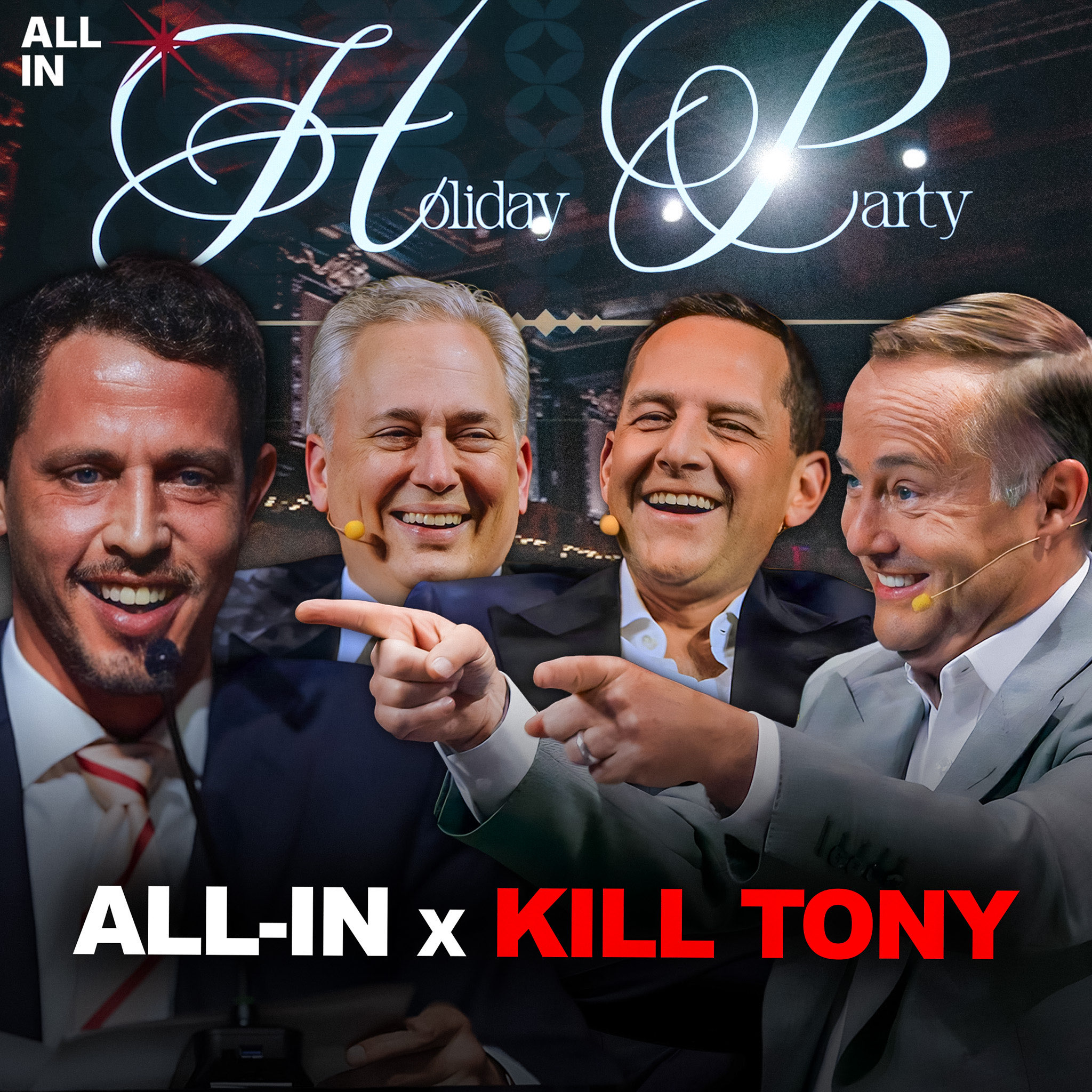
All-In Live from Austin: Colin and Samir, Chris Williamson, and Bryan Johnson
(0:00) Friedberg and Jason are live from Austin!
(2:51) How building an audience has impacted the Besties
(11:15) Colin & Samir join the Besties!
(12:01) Evolution of short-form and long-form content
(22:18) Business models for creatives
(35:04) Advice to up and coming creators
(42:10) Chris Williamson joins the Besties!
(50:17) Making it seem effortless
(57:47) Monetizing content
(1:05:02) Scaling a one-man show
(1:19:15) Bryan Johnson joins the Besties!
(1:20:13) Spotify’s move to video
(1:21:21) Bryan’s Ketamine experience
(1:28:03) Creators and value props
(1:36:52) Issues with the US food industry
(1:43:10) Top tips for healthy living
Thanks to our partners for making this happen:
Gemini: Go to https://www.gemini.com/allin to get $50 in bitcoin when you sign up and trade.
Function Health: Go to https://www.functionhealth.com/allin and use gift code ALLIN100 at checkout to get a $100 credit toward membership - limited to the first 1K listeners.
NIAGEN Plus IVs: Visit https://www.niagenplus.com to discover the future of cellular performance.
Follow Colin and Samir:
https://www.youtube.com/@ColinandSamir
Follow Chris Williamson:
https://www.youtube.com/@ChrisWillx
Follow Bryan Johnson:
https://www.youtube.com/@BryanJohnson
Follow the besties:
Follow on X:
Follow on Instagram:
https://www.instagram.com/theallinpod
Follow on TikTok:
https://www.tiktok.com/@theallinpod
Follow on LinkedIn:
https://www.linkedin.com/company/allinpod
Intro Music Credit:
Intro Video Credit:
Press play and read along
Transcript
Speaker 1 That was perfect.
Speaker 1 It rocked it, bro. It's Bryce Chris.
Speaker 2 Hey, everybody.
Speaker 1
Welcome to Austin. Welcome, everybody.
That's my friend Dave Freebert. Thanks for having me.
How are you doing, brother? Welcome to Texas. It's a little late.
Speaker 1
We're missing a couple friends here tonight. We have some new friends.
We got some Austin friends. And we wanted to do something around this sort of new media creator economy.
Speaker 1 It's something, you know, we're experiencing with the podcast. And that's obviously having a big impact on society, right? A lot of people say this was the podcast election.
Speaker 1 The big media companies, from journalism, Fox News, CNN,
Speaker 1 to the big platforms, Netflix, Amazon, Hulu,
Speaker 1 to Disney and others, are kind of rearranging their pawns on the chessboard based on and responding to what's going on.
Speaker 1 And so we thought it'd be really interesting to hear about some of the people who we think are probably the smartest in the creator economy in terms of building a business and how you maneuver and how you play and how you grow as part of that conversation today.
Speaker 2 You
Speaker 1 didn't, you had a Twitter account when we started all in,
Speaker 1
but you literally had never tweeted. And now you've become the Sultan of Science.
You're very famous. Any Sultan of Science fans out there?
Speaker 1
Awesome. Awesome.
Did anybody see him win Celebrity Jeopardy?
Speaker 1 I mean, we're so proud of our bestie.
Speaker 1 You have no idea how
Speaker 1 anxious, ashamed,
Speaker 1
hand-wringing he was for six weeks. He knew he won.
He wouldn't tell us the outcome because he knew that Shamath Jamath would gamble it and it would be like a whole controversy.
Speaker 1 He'd figure out a way to make, you know, a bet on it. Actually, someone doesn't know how to keep their mouth shut, but yes.
Speaker 1 Yeah, that's right. I keep talking to Jamath about that.
Speaker 1 And then he wins and he wins, but he's so upset at himself because he didn't win enough. I'm going to thank our sponsors.
Speaker 1
I mean, this is what happens on an average show. I say about 17 inappropriate things.
He goes, strike, cut, strike, cut.
Speaker 1 And then we have to have a grand negotiation after the episode where we horse trade the inappropriate things Tramath and I say and what he's going to allow.
Speaker 1 I don't mind when Chamoth says inappropriate things.
Speaker 1
Because it usually doesn't involve other people. It's you where you kind of cross the line a little bit, but you know.
That's why they tune in. I have to save you from you, J.
Cal.
Speaker 1 But what has it been like in terms of, because we're going to talk about this here, a lot of people now are taking the playbook of creating audience and then building companies.
Speaker 1
And you were doing the production board, you're building a bunch of different companies. Ohalo became very successful.
You said, hey, wait, I got to go all in on this, so to speak.
Speaker 1 But you're going into it with a certain amount of audience, a certain amount of notoriety, and the ability, let's face it, a lot of people in business know you from the podcast now.
Speaker 1 So what's it like being a CEO now and having the pod as like a platform? That's actually a great question. Because for me, I'm like not doing this podcast to like build a media thing.
Speaker 1
I just thought it'd be interesting. We started doing it during COVID, and I just kind of kept doing it.
And I don't know why I kept doing it, to be honest.
Speaker 1
Tried to quit it. Because I tried to quit every week I wanted to quit.
And I
Speaker 1 still contemplated so much tension the first two years.
Speaker 1
Until we got it to sign an LLC agreement, now it's all smooth sailing. The votes are what mattered.
It was a big... Well, actually, but I think it's like a real important evolution.
Speaker 1 You know, we had this thing going ad hoc, and I was trying to keep it together. And, you know, the one thing I...
Speaker 1 I learned in media from Engadget, I asked Peter Rojas, who I had stolen from Gizmodo, Nick Denton's company, to come to Engadget.
Speaker 1
I said, tell me the secret of why Gizmodo, Gawker, and now Engadget are doing so well. And he said, oh, the secret to blogging is very simple.
Show up every day. It's actually a great point.
Speaker 1 And then, yeah, I mean, Jason did keep us showing up, and then it became a thing.
Speaker 1 And then it's like, okay, we should probably do something legit to make this into a business or make it into something structural that stays alive. So we did.
Speaker 1 But to answer your question, I go to meet with farmers a lot and business executives in the agriculture industry. And I can't tell you how often I run into someone who's like, I watch your podcast.
Speaker 1
I'm a fan. That is like Farmer Joe.
Farmer Joe. Like the other day, I was in a meeting.
Speaker 1 I won't reveal too much, but like, look, I mean, you guys won't have any idea, but like some big farmer company, big company that does farming, who you would have never heard of.
Speaker 1
No one in this room has ever heard of. And then I'm in the hallway after we do this big pitch, and the guy pulls me aside.
He's like, give me a fist bub. He's like, love the pod.
I'm like,
Speaker 1 it is weird.
Speaker 1
It is weird. And then I'm like in like another state at a meeting and the COO comes out.
He's like, dude, I'm a big fan of the pod. And so it helps with getting building trust.
Speaker 1 You've earned a reputation. And so then when I go into meetings, people know me because of this pod.
Speaker 1
And that reduces friction. I don't have to go sell myself in a meeting.
I'm already sold. And it makes business easier.
Speaker 1 And so for me, the pod isn't about making money on the pod as much as it is like helping me in my everyday work, which is where I spend pretty much all my time except for a couple hours a week here.
Speaker 1 To contextualize that in the conversation we're going to have today, you create an audience with your content.
Speaker 1 What do you do with that audience?
Speaker 1 What are you doing this for? You can sell ads and make money against that audience.
Speaker 1 You can get sponsors that you speak to, you know, quality products that you endorse and you can make more money and you can either get paid cash or get some equity.
Speaker 1 You can build your own product and actually own it and then own all the equity and participate meaningfully in the the upside as you sell your audience your product.
Speaker 1 Or in other cases, you're building credibility. You're building, which is what a lot of venture capitalists did after our show, I think, kind of became big.
Speaker 1 They realized that they have this opportunity to build credibility with entrepreneurs.
Speaker 1 So when an entrepreneur shows up, they're like, oh, I want to work with you because I've seen you on your podcast. Or investors show up.
Speaker 1 I want to invest with you because I've seen your comments on your podcast.
Speaker 1 So I think there's a lot of ways to think about the value of this, but building an audience, building credibility is really beneficial and it can work out in a lot of ways.
Speaker 1 Yeah, and you take it seriously.
Speaker 1
You know, it's an investment in time for you. Today, we've recorded a great episode.
We had our first comedian on, Andrew Schultz, and that'll come out tomorrow. He was hilarious.
Speaker 1 But you had an emotional moment today on the show. We were talking about entrepreneurship and your journey.
Speaker 1 And, you know, I got to give you a lot of credit. You know, you're not like a professional broadcaster or whatever, but you prepare and you put it all out there.
Speaker 1 And I'm very proud of the work you've done and how you've evolved as a broadcaster and as you know, somebody on the pod. I'm very, very proud of
Speaker 1 how much you've started to put out there of yourself. And it's not easy to do because you're an introverted, personal person.
Speaker 1 I mean,
Speaker 1
extroverted. I'm like, I mean, yeah, I mean, on the MDMA.
I'm pretty good at
Speaker 1
it. You don't want to lock yourself up in the room.
I mean, maybe, maybe in the 90s when you were going to Raves and you had a little of the Molly, the MDMA, you were different.
Speaker 1 But I'm saying, like, now you're a little bit, you know, but you
Speaker 1
back in the day. It's hilarious because he's such a perfectionist.
And every time the pod comes out, Chamoth and I just wait 60 minutes after the pod. That sucked, right, producer Nick?
Speaker 1
It sucked, right? We should delete it, cancel it. There's a worst episode ever.
And then the stats come out. Oh, we broke another record.
Oh, it's number eight in the world. Oh, okay.
Speaker 1 Look, the reality is we can always do better. I mean,
Speaker 1
I am such an optimist, as some of my friends who are here know. Like, I just like, oh, that was fucking great.
It was a train wreck, but for me it was a great train wreck
Speaker 1 and you know just so y'all know we couldn't do it without the audience and the love that you give us and is such an amazing motivation especially for me like I feed off the energy and when y'all tell me your favorite episode or a great moment or you email us something where
Speaker 1 You know, the thing I'm probably most proud of now is people are telling me they're having more difficult conversations with their friends while remaining friends.
Speaker 1 And I think that's like one of the most beautiful things for me and my motivation on the pod is really
Speaker 1 to help give an example of how you can really have a hardcore discussion, learn from each other, appreciate each other. And I hope that you all take that back to your poker games, dinners, et cetera.
Speaker 1
Families, you know, it's a very divided country right now. There's a lot of important issues.
But friendship is worth investing in. I just want to give you all that as like a note.
Speaker 1
Invest in your friends. Invest in those hard conversations.
Your life will become so rich because of it. And have a couple of laughs.
Don't take it all so seriously, David. Yeah.
Well,
Speaker 1 before we bring our friends out, Colin and Samir, I'm going to just quickly, we do those, we don't do sponsors on the show or ads on the show, but when we do live events.
Speaker 1
It's incredibly infuriating to me. I want to read it.
You'll be fine. You'll be fine.
Oh, God, we'd have a jet by now. We want to pay for these.
Speaker 1
We don't want to pay for live events out of pocket, so we do have sponsors. We have a million dollars left on the table.
You'll be fine.
Speaker 1 Find another another Uber.
Speaker 1
I did. It's called Robin.
It's doing great.
Speaker 1
So I want to say thanks to Gemini. Gemini just stepped up.
I think we just got them involved this week in helping us put this event on and the after party on, Global Cryptocurrency Exchange.
Speaker 1
Everyone knows Gemini. Available in all 50 states with a focus on security.
And you can buy, sell Bitcoin plus 70 other cryptocurrencies.
Speaker 1
Gemini's offering new users 50 bucks in Bitcoin when you sign up with the code all in, A-L-L-I-N. Even you might trade crypto after this.
No, no, no.
Speaker 1
We own a decent amount of Bitcoin, and I think everybody should own like a low single-digit percentage. It's not investment.
What's their net worth?
Speaker 1
I think like a low single digit in Bitcoin, if you lose it, so be it. If it's 100x from here, anything's possible.
My channel. Gemini.com slash all-in, use the code all in.
Speaker 1
50 bucks free Bitcoin with $100 deposit. And then function health.
We've negotiated a special deal for users today.
Speaker 1
They have access to over 100 lab tests, which I think is super interesting personally. It's really hard.
I just signed up. I'm just doing it.
It's hard to go to your doctor and get the tests you need.
Speaker 1 You can sign up at Function Health. It's brilliant.
Speaker 1
They'll send a phlebotomist. That's a fancy word for somebody who draws blood.
Phlebotomist. I learned that from Function.
And then you can be like Brian Johnson, my friend here in the front row.
Speaker 1
Yeah. And you can live forever with function health.
All in 100 checkout to get 100 bucks credit. And then TrueNiogen, which is a product I take.
I take it. NAD plus booster.
Speaker 1
Lots of studies, very efficacious. So thank you to TrueNiogen again.
Great product. But those are the sponsors.
They help pay for this. Give it up to the sponsors one time.
Come on now.
Speaker 1
Very good. Very good.
You want to get Colin and Samir out? Yeah. Hey,
Speaker 1
let's bring out our first guest. Colin Samir run the Colin and Samir show, and they are experts on building content business.
Come on out, Colin. Come on out, Samir.
Speaker 1 Welcome, welcome.
Speaker 1
You get the couch. Come sit on the couch here.
Are you going to see a friend?
Speaker 1
All right. Yeah, sit on the couch.
You guys are like real creators.
Speaker 1
Look at that brand deal. Thanks for being here.
I think we wanted to talk to you guys a little bit about the evolution in media.
Speaker 1 I want to talk a little bit about the origination in the creator economy where folks were putting out...
Speaker 1 And tell me if I'm off on this, but what felt like more kind of short-form content. It was almost like a new type of media that was different than traditional long-form media, TikTok type content.
Speaker 1 But then what happened, it's like folks started doing podcasts and the content started to eat into other forms of media. It started to eat up journalism now and eat up news media.
Speaker 1 And now the platforms are doing deals with the independent creators to put out long-form content. Can you talk a little bit about the evolution of like short form, long-form?
Speaker 4
Sure. I don't think you can underscore the importance of the YouTube app.
on TVs.
Speaker 4 Just the fact that there was now a free option and you have people who are in a setting where they want to actually sit and consume something for a longer period of time.
Speaker 4 So as creators started putting out longer videos, they started serving more ads, making more money, investing back in their channels, in their shows.
Speaker 4
And now they can actually produce things consistently. They can make things better.
They can elevate it. They can make them longer.
And that's what you're seeing now.
Speaker 4 I mean, like 50% of our watch time is on connected TV.
Speaker 1
The reach has grown. because of YouTube on TV.
Yes, yeah.
Speaker 1 Specifically, YouTube now, like when you buy a new TV, I just, when I, when I moved to to the ranch, I got a new TV and it's got YouTube on the remote. And you just think about that as a concept.
Speaker 1 And then I watch my daughter's behaviors and they are watching YouTube on the giant television, not on their iPads. It's really
Speaker 1
a major difference. And there's something about I'd like you to get into is the algorithm versus subscribers.
Sure.
Speaker 1 Because I grew up in a subscriber world where I thought about, okay, I'm going to get one more subscriber and then I'll have them or a certain number of them out of ten, I may keep five, but they're going to watch every episode.
Speaker 1 But then there's something that's gone on where people are creating content not with the intent of subscribers, but with the intent of getting picked up by an algorithm and getting non-subscriber viewers.
Speaker 1 This seems like there's some tension here, maybe.
Speaker 1 Yeah, I would say probably the biggest creators, most successful creators, largely have like a 70% viewership base that's not subscribed to them, right?
Speaker 1 And I yeah, I would say that's pretty, pretty common amongst our friend group and amongst the people people that we work with.
Speaker 1 And I think a lot of that has to do with the algorithm shift towards viewer satisfaction. And YouTube is a recommendations algorithm.
Speaker 1 So first, when we first started making YouTube videos, if you could make a great thumbnail, people would click.
Speaker 1 That then inevitably got into clickbait, where you would click into a video, it was really short, it wasn't representative, what was in the thumbnail.
Speaker 1 So YouTube shifted their algorithm into what is called viewer satisfaction, which is essentially gauged off of click-through rate, did they click on the video?
Speaker 1 And then average view duration, how long did they watch? What percentage of this video did they watch? Then there's other engagement metrics. Did they like the video? Did they comment on the video?
Speaker 1 There's a lot of different ways to understand satisfaction.
Speaker 1 But essentially, as creators, every YouTube creator, what they're trying to do is go, what video are you watching before you watch my video?
Speaker 1 Because
Speaker 1
I want you to click on my video. After you're done with that video, or maybe in the middle of that video.
So most traffic on YouTube comes from suggested. Okay.
Does that make sense? Yes.
Speaker 1 You have the suggested along here. So you're telling me people are creating videos with the intention of hijacking a popular video and trying to get that suggested.
Speaker 1 So everybody's talking about, I don't know, pick the latest thing Trump did today.
Speaker 1
So, or who's on Joe Rogan or what Mr. Beast did.
So now I try to get one of those slots that would be related to the latest Mr. Beast video.
Speaker 1 Yeah, I wouldn't say that timely because I think YouTube operates as a catalog, right? Like some of our videos that are still picking up viewership today were made four years ago.
Speaker 1 So the best way to do it is to build a catalog that accrues viewership over time. So you're mainly looking at like subject matters with high total addressable markets on YouTube, right?
Speaker 1
Like specific on YouTube. So that is why when the world of Mr.
Beast really exploded on YouTube, you have a lot of people. talking about Mr.
Beast or reacting to Mr.
Speaker 1 Beast or going, there is 200 million people to tap into here who are probably watching a Mr. Beast video.
Speaker 1
Ah, this is fascinating because right now there are people doing after all-in videos where they talk and kind of drag us, you know, a bit. And they're doing phenomenally well, too.
Oh, they are.
Speaker 1
Maybe we'll get into that too. We see that you can drag us as well.
There's not just money to drag us. I wouldn't call it phenomenally well.
There's like a couple hundred views. Whatever.
Speaker 1 But you could be the best in that category.
Speaker 1
You could own that category. So you can own that category.
I just want to do for Colin art and the artist that this is in their brands. Because, you know, Freeberg and I,
Speaker 1 after a show happens, I talk about the moments.
Speaker 1 And Freeberg has, you know, got that other brain where he's like talking about the metrics and he's wondering about the wait time and the thumbs up and the thumbs down. Who liked it?
Speaker 1
I'm like, I don't give a fuck about that. There was a funny moment.
There was this moment people laughed. It was this moment that had emotional resonance.
Speaker 1 So maybe you could talk a little bit about art versus commerce, art versus algorithm, art versus algorithm.
Speaker 4
Yeah, I mean, it's... It's difficult to create right now within a vacuum.
Right. I would say even opening up TikTok, the first couple of TikToks you see are going to show you what works.
Speaker 1 Totally.
Speaker 4 So it's hard to create something now that I know what works, now that I know what people will see.
Speaker 1 If that's the objective, audience growth. But
Speaker 4 a true artist does not necessarily care if someone loves your work.
Speaker 1 If one person loves my work, that's all that matters.
Speaker 4
But a true artist doesn't always know actually what they could do to get people. to watch their work.
And so we immediately know what would work.
Speaker 4 And so you find for a lot of creators, they're on two ends of the spectrum. They're either an artist or they're a distributor.
Speaker 4 But to be an impactful creator, you kind of actually need to lean more towards distributor. You need to be like that programming executive that's like, okay, well, Spider-Man worked.
Speaker 4
Let's do it again. Let's do it again.
Let's do it again. Let's do it again.
Speaker 1 Correct.
Speaker 1 We see that a lot if we change the title of the show or the order of the topics. We debate this a lot.
Speaker 1 Where it's now, this might be the thing that I want to talk about, but no one wants Science Corner up front because then the audience won't click.
Speaker 1 No, I mean, we literally, but I think some of the biggest... Don't you guys think if we had Science Corner up front, more audience would click?
Speaker 1 Thank you, bro.
Speaker 1 But that's the media business, right? More Trump. It's like, well, we've got enough Trump.
Speaker 1 I mean, this is the tension we've had. And we're
Speaker 1 a band, not a solo performer, right? So you have four people with distinct perspectives. And, you know, Sachs was always of the mind, what's the top story in the world?
Speaker 1 I'm trying to think about, well, like, what's the most interesting, you know, discussion? Freeberg's like, well, what's the biggest breakthrough? And what did we do last week?
Speaker 1 And you kind of, and then Shamap's like, well, what am I wearing? And how does it look?
Speaker 1 What am I wearing? What am I wearing this week? How? Yeah.
Speaker 1 What did I consume this week?
Speaker 1 Everybody's got different things there, but it's kind of disheartening to me to even know about all this. I feel like it's ruining it to a certain extent for me.
Speaker 1 Yeah, I think it's, look, there's tension between creativity and strategy on these platforms, right? Because these are businesses. And if you zoom out and go like, how do media businesses work?
Speaker 1
This is how media businesses work. Sure.
But I think what you have to think about is also choosing your platforms.
Speaker 1 I think we struggle because we entered into the world of YouTube 15 years ago as creatives, as you know, guys who are exploring, wanting to get into Hollywood and saw this as a different route.
Speaker 1 And where we've come to as now entrepreneurs is we're in the media business. And there's still tension where we want to express our creativity.
Speaker 1 We want to do cool things that we think are cool, but they're very anti
Speaker 1 media. But what I think, what you're talking about, what's really interesting is you just need to pick the right environment.
Speaker 1 So we think about platforms in the context of like permission and interruption. So YouTube is an interruptive platform.
Speaker 1 You have to stop someone in their tracks with a thumbnail to get them to click in, right?
Speaker 1
But Spotify, for example, is a permission-based platform. Like RSS feeds are permission-based.
Email, which we have an email newsletter. That's where we can have permission.
Speaker 1 People have given us permission to be in there. That's where you're seeing the rise of memberships too, whether it's like Patreon, right? Like people have said, hey, you know what?
Speaker 1
I'll pay whatever you guys make. I'm down.
And so I actually think you just think about those environments of, you know, top of funnel, bottom funnel, or you go permission interruption.
Speaker 1 It's an interesting way to think about in this environment, I can play around and my audience has given us permission.
Speaker 1
Everyone who's in here, we have the permission to kind of talk about whatever we want to talk about. Yes, you're not worried about the title.
Yeah. Right.
Speaker 1 Yeah, and that's sort of where I'm getting to.
Speaker 1 And the other trend that Freerberg and I have been talking about, you know, we have this natural tension. We don't have ads on the pod.
Speaker 1
On my other pod, it makes millions of dollars in ads this week in startups. And that helps me have a team of nine people.
We like to throw good parties. And we like to, yeah,
Speaker 1 we spent
Speaker 1 like a million to a party in the middle. I spent $900,000 on the Barbie party
Speaker 1 on the gear.
Speaker 1
Oh, we spent more this year. This year.
We did. Oh, my God.
Speaker 1 Fuck. Well, see, that's a lot of fun.
Speaker 1
Let me just put a little plug-in. This year at the All-In Summit in LA, the first night is going to be insane.
Insane.
Speaker 1
It's like everything last year combined. Like, yeah, it's going to be awesome.
Anyway, I mean,
Speaker 1
my job is to burn all the money. I'm like Jimmy at Mr.
Peace.
Speaker 1 Let's flip a coin and double it.
Speaker 1 I kind of feel that that's what's interesting.
Speaker 1 when you have success as an artist is being able to deploy resources to make something that gives joy or that experience, right?
Speaker 1 And I, one of the great things about the event is when people show up and they dress,
Speaker 1 when a party has a theme, great music, great people, and it's in a really great location, something happens. Has anybody been to one of the all-in-summit parties? Raise your hand.
Speaker 1
Open, open bar. Open bar.
Well, Jake Howe fought me on the open bar. I'm like, you got to have a beer.
Speaker 1 No, no, my thing was wine and beer and like a couple of cocktails, but this guy is like, he's a bit of a lush. And he's like, we got to have like all the high-end stuff.
Speaker 1 And then what happens is the last hour. David thinks everyone's like sipping champagne, looking in the sunset.
Speaker 1 No, people are pounding double McAllen 18s because they're like, I got to get my money's worth. And then all of a sudden I'm in a headlock getting, somebody's taking a self of me.
Speaker 1 You're my way with Fred Jack. I love you.
Speaker 1 What do you think of the
Speaker 1
phenomenon now of building audience to distribute a product because this is infected. This is a great by the the way, let's just ask the broader question.
What's the business model?
Speaker 1 You have a new creator. They're starting to build an audience.
Speaker 1 Advise them on what are the paths they can walk and where that can go because this is one of the paths, the great one that we're talking about. But like,
Speaker 1 what are the options and when does one become an option? Sure. I mean, no matter what, everyone is.
Speaker 1
making videos, attracting an audience, and selling a product. That product is either theirs or someone else's.
Like, if we go back in the history of media, why are they called soap operas?
Speaker 1
They were literally created to sell soap. Yes.
Right. And so I think
Speaker 1
that is right. Interesting.
Ivory Soap. That was like the car companies
Speaker 1 Ivory Soap were the big sponsors early on.
Speaker 1
No, but like it was programming that was created to attract a specific audience that was interested in buying soap. Totally.
Right. And so that's why the programming happened in the middle of the day.
Speaker 1
And so the reality is like... You can say housewives at that time.
Nobody's going to think you're a misogynist.
Speaker 1 You said it, not me, but you know. I mean, at the time,
Speaker 1
that was the nuclear family. Yeah, that was the nuclear family.
And that's why they were called soap operas.
Speaker 1 So, you know, the reality is for a young creator, I would say that the number one piece of advice is actually keep your operation lean and your costs very low.
Speaker 1 Most great creators can create, if you're a good storyteller, you can make videos right now on the internet with your iPhone.
Speaker 1 The number one thing you have to think about is the audience that you are engaging. Because at the core of it, your product is your relationship with the audience.
Speaker 1 It's the trust that you have with the audience.
Speaker 1 And so that takes a long time to build.
Speaker 1 Some creators make the mistake of raising money to start making their content or some creators make the mistake of hiring a big staff. That creates too much overhead.
Speaker 1
You're going to start doing deals that maybe you don't want to do. You need cash to finance your content.
First and foremost, it's like, keep it lean, make good stuff, find the audience.
Speaker 1
Your first hundred videos are going to suck. Just build until you find the audience that you want.
And then the business models will start to
Speaker 1 emerge, whether that's, hey, you know what? I built a great brand and part of my content, I'm Emma Chamberlain, and part of my content is I drink coffee every day.
Speaker 1 So maybe I should launch a coffee brand. I take the coffee that I'm drinking every day.
Speaker 1
Meaning make your own brand. Yeah.
Right. And that, that's, but that's hard.
That means you have like critical mass, big scale, you're reaching millions and millions.
Speaker 1
So cost challenge, but payoff is higher. Yeah.
And that's the big problem. It can be, right? It can be.
I think CPG is really. It's all predicated on connecting with an audience first.
Speaker 1 So the advice, I think, what I'm hearing is:
Speaker 1
hey, connect with the audience and put on the back half of your career monetization, but just connect. And Marquez, I don't know if you've ever seen his early reviews.
Of course.
Speaker 1
I mean, it's hilarious. He's like, how old is he? 15, 16, 17 years old.
And he's like, I'm using this phone. It's the iPhone for Jimmy's first videos are still up on YouTube.
Mr. Beast's first videos.
Speaker 1
He's still up there. You got to go watch him.
I mean, I watched one of them. It's him counting to 10,000, I think.
That was that, by the way, that was a later video.
Speaker 1 His very first videos, you gotta go watch like the first 10 videos.
Speaker 4 I mean, he's playing video games, you can't even see his face.
Speaker 1
You're like, what? Yeah, and he's speaking, speaking literally. He's kind of become the most famous person in the world from that.
But you can see the evolution. He watches paint dry in a video.
Speaker 1 Yeah, it looks like a 20-hour-long video.
Speaker 1
But just to go back to the question, isn't one of the other pabs selling your content? So now we're seeing a bunch of deals. Jimmy's getting a deal from Amazon.
Amazon paid him for the Beast Games.
Speaker 1 We're seeing more comedians that do live shows getting deals with Netflix. We're seeing a bunch more of those happen.
Speaker 1 We're seeing Hulu and other platforms start to bid. Even X might be doing some more content deals with folks that look more like journalists.
Speaker 1 So ultimately, how do you decide whether I want to monetize by ads and making a product?
Speaker 1 Or is there becoming a more liquid market for selling my content onto bigger platforms that are losing their audience to be independent so they need to basically go rebuild an audience?
Speaker 1 Like, is that a realistic path, or is that just like the cream of the cream get to have access to kind of?
Speaker 4 I think that's a realistic path for the top.
Speaker 1 And maybe you could talk about the Spotify thing.
Speaker 4 Especially if we're talking about streaming, I think it's a realistic path for the top.
Speaker 4 And I don't look at it as like selling content. I look at it as selling distribution, like bringing distribution and audience.
Speaker 1 Because the ads get layered on.
Speaker 4 To these platforms.
Speaker 1 You hear about Amazing Digital Circus. Yeah, I think where it's interesting.
Speaker 4
Where it's probably going, there's an interesting case study. There's a YouTube channel called Amazing Digital Circus, which is an animated channel.
And they did a deal that is super unique.
Speaker 4 I think the first of its kind, where they will be distributing on Netflix at the same exact time as they distribute on YouTube. So Netflix licensed the content, and it's coming out at the same time.
Speaker 1
It's not their content. It's not proprietary to Netflix.
No, right.
Speaker 4 It's licensed. So in that regard, he's making money on advertising.
Speaker 1 But he wouldn't be getting, he's not getting paid as much, or they're not getting paid as much as if they sold the content and the rights to Netflix. Is that right? Yeah,
Speaker 4 if it was like an original, yeah, I guess if it was exclusive.
Speaker 1 But this is a watershed moment in many ways because Netflix was really about them being the tastemaker, them underwriting it. That's right.
Speaker 1 You know, at least in this, like Netflix licensing DVDs, then they became the creators, the arbiters, and now they're going back in some ways to saying we're going to cherry-pick people off of YouTube, give them money for their quarter billion subscribers.
Speaker 1 It's a really fascinating moment. Probably if you've seen the Nielsen ratings of connected TV usage, YouTube's at the top at 11%, right? It's the most used streaming app on connected TVs.
Speaker 1 Netflix is at 8.5%.
Speaker 1 And in December, after Beast Games, Thursday Night Football, and that movie that they did with The Rock, Amazon
Speaker 1 moved up to 4%.
Speaker 1
Netflix moved up, you mean? No, Amazon Prime Video moved up to 30%. Oh, because of it.
10%.
Speaker 1 Manning up. 8.5%.
Speaker 1 And YouTube, but YouTube's at 11%, right? Like, the reality is, there's a really interesting quote from Ted Sarandos when Netflix won their first Emmy for House of Cards.
Speaker 1 Because Netflix was an aggregator beforehand, right? So Netflix goes from aggregator, starts producing original programming.
Speaker 1
And it was a massive moment when they won an Emmy because that was pretty new that some internet tech company can win an Emmy. Very strange.
And Ted Sarandos said, television is television.
Speaker 1 It doesn't matter which pipe brings it forward.
Speaker 1 And I think it's a really important thing that the major difference when it comes to YouTube is Netflix is going to spend $18 billion on content this year. YouTube doesn't spend on content.
Speaker 1
YouTube does a revenue share. They actually technically don't know what's going to get uploaded today.
And it could be the biggest video of the day.
Speaker 1
It could be something like Amazing Digital Circus that did 500 million views across three episodes. Wow.
It's also interesting. Netflix, I'm sorry, YouTube Premium taking the ads out is at 110.
Speaker 1
125 million subscribers. It's at 125 now.
And youTube's broken up. YouTube TV.
How many people here pay for Netflix red or the premium version that takes out the ads?
Speaker 4 Wait, YouTube. YouTube Red? Oh, YouTube Premium.
Speaker 1
YouTube Premium. YouTube Premium.
They keep changing the goddamn name. How many people are YouTube Red? Wow, that's pretty significant.
It's like a third of the audience. And what is that, 12 bucks?
Speaker 1
It's like 20 bucks. It's 20 bucks now? It's 20 bucks.
I think it's the best 20 bucks I spend on it. I agree.
Speaker 1 How do the guys that are losing audience, which are the traditional broadcasters, how are they going to respond as their audience gets tritted away? Like we're seeing as long form is taking up more
Speaker 1 time and attention from the independents.
Speaker 1
Fox News is losing an audience. CNN is losing an audience.
MSNBC is losing an audience. I mean, their audiences are gone.
Like, they're just vaporizing right now. What are they going to do?
Speaker 1 They've got a lot of cash. They've got a lot of advertising dollars still flowing in for now.
Speaker 1
They're well capitalized. They've got very motivated shareholders.
What's their response? If you guys are an executive running Fox, what would you do?
Speaker 4 And we spoke about this recently, but there already are some shows on cable that are starting to act more like digital channels, more like YouTube channels, right?
Speaker 4 If you look at like Saturday Night Live, or you look at late night, those are actually just a bunch of segments segments that can work really well when uploaded to YouTube or to the internet.
Speaker 4 And I think when you bring up Fox News, news is actually one of the last genres of cable to try and figure out or be able to figure out how to put themselves into segments that work at the 20-plus minute range, which is what's working on YouTube right now.
Speaker 1
But the long form is crushing it too, right? Like the hour-long, I mean, our show is 90 minutes. Lex does three and a half.
I would say 20-plus is long. Rogan's like hours long, and he's number one.
Speaker 4
When I say 20 plus, I mean like that's like the minimum. I see what he's saying.
It's like 20 and continuing to go. Yeah.
Speaker 1 But does that mean that they're going to try and license Rogan? They're going to try and license Lex. They're going to try and license one of these independents in.
Speaker 1 Is that the move that they're going to have to make ultimately? That's going to be like a big changing of the guards because that's like a...
Speaker 1 There's like some risk mitigation that I don't know if they would be comfortable with.
Speaker 2 Maybe it's like Pat McAfee.
Speaker 1
Yeah, I guess Pat McAfee is a good example on ESPN. He's a sports guy, yeah.
Yeah. He does sports.
So ESPN just picked him up. Yeah, that's right.
Yeah, and he does independent.
Speaker 1 Well, he came on to ESPN, but that also created some, you know, ESPN tried something similar with Barstool a while ago, right?
Speaker 1
And Barstool got taken off the air within an episode or two because, again, there's a risk factor. They said some stuff on air, and they were like, we can't, we can't do this.
Get them off the air.
Speaker 1 But McAfee is the more mature, you know, iteration of that as both spaces have kind of matured. That's like a YouTube show that was brought.
Speaker 1 to television and McAfee is really good where he's doing, I don't know if you guys have saw the College Game Day stuff where he's doing the big field goal kicks for $100,000.
Speaker 1
It's essentially a YouTube title, but built for TV that then gets clipped and put onto YouTube. Right.
And so I think that's what Colin's saying.
Speaker 4 You're on ESPN at any moment and it looks like you're watching a podcast. When you see his show, the production level is pretty low.
Speaker 1 So is the media exec going to go out and find the next or the up and coming and say, I want to bring you on. I'm going to pay you to come and do this on my platform now.
Speaker 1 You're going to become a Fox News show. You're going to become an ESPN show.
Speaker 1 They have to give irrational deals to creators.
Speaker 1 Yeah, versus the talent agent showing up and saying, here's a good one. The other problem is distribution.
Speaker 1 So like Jimmy, for example, like Jimmy is, yes, he's in the media business, but he's in the chocolate business. Right.
Speaker 1 And so being able to get to 200, 300 million people in a video is really significant.
Speaker 1 And YouTube being at the top of the connected TV streaming apps, like you'd probably choose YouTube if you're just going pure distribution. If you're selling.
Speaker 1 a chocolate brand or some other type of CBG product, you choose distribution over not. Totally.
Speaker 1 And so I think when you're getting offered a deal to go onto Fox News, do stuff on linear TV, it has to be such an irrational deal because it limits my distribution, right?
Speaker 1 Even if I go onto a Netflix, technically I'm actually limited in distribution if I'm Mr. Beast,
Speaker 1
not if I'm another creator. Also, the money and control issues are also very acute.
When this week when Stardust was doing good, right before All In started, I met with the Sirius XM team.
Speaker 1 And they were like, hey, you know, we think you might have some like Howard Stern potential. And what if you got Travis from Uber?
Speaker 1 He was very hot at the time um and a couple of guys to come on and and do like a you know round table thing and and make it fun and then when i like we started talking money i was like that's less money than this week in startups makes already and i own a hundred percent of it would i own the ip here and they're like well no no we own the ip and i'm like i mean this is we're talking six years ago seven years ago and then even now you know i once in a while i'll talk to cnbc or somebody and we'll come and say hey you know you have any ideas and i'm like
Speaker 1 it doesn't economically make sense for a creator who has escape velocity to go backwards. And
Speaker 1 I wonder, Freeberg, if the answer to this question is anybody who is actually talented enough, like a Megan Kelly or somebody who, like Mr.
Speaker 1
Beast, or even Tucker Carlson, like, how could they ever go back to Fox now, right? That's the point. I don't think they will.
I think
Speaker 1
it's entropy. It's only going in one direction.
I think their audience erodes, their advertising dollars erode.
Speaker 1 and then they're getting whatever broadcasting distribution deals they have on cable are going to slowly be worth less. I don't know what it's going to be worth.
Speaker 1 I think, Colin, isn't this Colin, like, because
Speaker 1 Fox and Sirius XM and CNBC have a cost infrastructure.
Speaker 1 So when they meet talent, they're like, talent gets 20%, and then we need to get our 20%, and then the other 50-60% has to go to the shareholders.
Speaker 1
Yeah, and the building, and the 50 fucking camera operators. No, you're 100% right.
The model's broken.
Speaker 1 The greatest thing about your guys' show is
Speaker 1
it started on Zoom. We talk about this in the context of creators.
Like,
Speaker 1
the advice to up-and-coming creators, it's the same advice. Keep your overhead costs extremely low.
Creators are the startups of... Hollywood.
We always say, like, think out on a 52-week schedule.
Speaker 1 Could you do this every week for 52 weeks? If you're someone who loves to set up cameras and lights, sure, you might be able to do that.
Speaker 1 But if you're 100% right, busy people, you're like, yeah, we can hop on Zoom every week for 52 weeks. And
Speaker 1
if it were like what you're describing, there's no frigging way I'd do it. Like zero chance.
Like the only reason I do it is because I can get on Zoom for 90 minutes and be done.
Speaker 1 And then I go on the rest of my day for work.
Speaker 1 The turning point of the pod really was when
Speaker 1
it used to run out of my operation. And I said, you guys have to commit to Thursdays the same time.
We cannot, if this is going to work, everybody has to agree that Thursdays at 11 a.m.
Speaker 1 Pacific are sacrosanct.
Speaker 1
And everybody agreed. We all blocked it out.
We all blocked it out. And we said, no, if anybody has to move, then we go to our list of, you know, fifth besties, sixth besties, and we rotate them in.
Speaker 1 But we're not going to like move around Chamad's schedule, Max Schedule, Free Breakthrough. And that's when the show really actually.
Speaker 1 Okay, let me take the conversation in the opposite direction now, which is we're going from like points of high, low leverage, Fox News, lots of cameras, lots of buildings, expenses, to low leverage being on Zoom and a laptop.
Speaker 1 Let me talk about the lower leverage. Are you guys seeing any success in Gen AI only content channels out there?
Speaker 1 And maybe you could talk about as Gen AI gets better and better and better, do we have agents that ingest the news, ingest content, ingest data, repackage it, and then create new versions of, through an iterative process to kind of hack the algorithm to figure out how do I get stuff that people stay on?
Speaker 1 What's the right cut rate? What's the right color balance? What's the right sound? What's the right audio? What's the right music?
Speaker 1 And ultimately, the Gen AI does what great content creators like Jimmy took 10 years to do in a couple of weeks and ultimately creates like a whole new category.
Speaker 1 And I'm just thinking ahead here now, but like maybe tell us today on the ground if you're seeing any Gen AI that's like got realistic traction out there.
Speaker 4 For me personally, there's no Gen AI channels that are 100% Gen AI that I am watching or at least that I know of.
Speaker 4 that I'm consuming and that I'm enjoying.
Speaker 4 But I mean, even within our organization and with a lot of other creators, the amount of AI tools that we're using from like scripting to even cutting the angles on our show, like we're continually adopting more and more AI tools.
Speaker 4 And I think, which is the way it should be, the audience, I don't think, even really can tell.
Speaker 1
Yeah. Right.
So it's like slowly seeping in. Into production.
Yeah. But not taking it over.
Have you played with Notebook LM? Yes. So it's pretty amazing.
Speaker 1
My vantage point with the first time I fed a PDF into Notebook LM was the Spotify earnings report. And I was like, I have a 20-minute drive.
I want to hear this.
Speaker 1 And it was nine minutes and it was perfect.
Speaker 1
And you can, if you don't know what Notebook LM is, it's a project by Google. You can, you can feed in a bunch of text.
It'll turn into audio. It'll have two hosts.
They host it like a podcast. Yeah.
Speaker 1 So then I started to think, okay, well, actually, you can just custom make yourself a podcast for your drive, right? And go, hey, I'm driving 30 minutes. I want to know about the NFL scores.
Speaker 1 I want to know about the Netflix earnings call. And I'm also interested in what's going on in the world of the creator economy.
Speaker 1 And all of a sudden, you have an aggregate of news and articles, and it gets turned into audio, and it's compelling. And
Speaker 1 does that replace the time that you would otherwise spend listening to podcasts and watching videos?
Speaker 1 It's a more, so what's interesting about Gen AI content I found, especially with Notebook LM, is it's a more efficient way to consume content.
Speaker 1
But I don't think we prioritize efficiency always as humans. Oh, of course not.
This is what that would be like soylent. You know, it's like, well, this is easy, Jayco.
Speaker 1
No offense, Brian, but I'm just saying like this nutty pudding concept. My wife makes me the nutty pudding.
I'm thinking, you know what? I kind of want the regular pudding.
Speaker 1 Anyway, no, it's healthier.
Speaker 1 But this is, it kind of takes out the spontaneity of what, you know, if you want that NBA content,
Speaker 1
I watch this Knicks thing, Knicks Fan TV. Yeah.
And this guy takes all the clips. And last night the Knicks won in overtime.
The Kel Bridges, amazing buzzer beater. And I was...
Speaker 1 As excited to open up Nick's fan TV. Right.
Speaker 1 You know, he comes on 15 minutes after the game and watch the community's reaction to it. And every time the Knicks win, I will give a $100 tip in a super chat.
Speaker 1 I probably give $2,000 or $3,000 a year just to support this creator because it reminds me of WFAN in New York. And he has all these regular callers.
Speaker 1 It is such a spectacular product. And then I noticed that I'm like into Corvettes and I'm in the YouTube thing and I got the Corvettes in my sidebar, right?
Speaker 1
And this motherfuckers are like creating fake AI Corvette announcements that aren't real. And they're using generative AI and they're saying, the new ZR17 is here.
And I'm like, what?
Speaker 1
I'm going to get the ZR1. And then there's a 17.
I click on this thing and it's just AI voice. Chevy Corvettes are known for having the greatest engineering.
But that's the thing.
Speaker 1
And I blocked that motherfucker. No, but that's blocked that channel.
So look, you're right.
Speaker 1 But
Speaker 1 I hit the triple dot, bam. Look, I would be less dismissive, as As we all know, every month, we're a little more surprised by what Gen AI can do and the power of it.
Speaker 1 There's a really important human directorial role in the early days of this Gen AI revolution, and I think that it enables an incredible fragmentation of media, even more than we're seeing today in their creator economy.
Speaker 1 Maybe you end up getting your personal news feed with the newscaster or the podcaster or the Knicks super fans reading to you what happened at the game last night.
Speaker 1 That's Gen AI completely, and it's indistinguishable from reality. That's where I think things may get a little more funky in the next couple of years.
Speaker 1 I don't think it's like that suggests also like this kind of far move away from monoculture into like 100% extreme microcultures, which kind of already existed. Each of us opens our phone.
Speaker 1 I got a point of view on this one, which is like, I do think that there's shared cultural facts, but different cultural experience of the facts, meaning like the game is the game, but the commentator that tells me about the game is different.
Speaker 1 Yes. And that's where I think this all plays out, where I'm going to have like my own tuned broadcaster.
Speaker 1
She could be really beautiful. I don't know.
And she could be really cool. She could be easy.
Speaker 1
She could be talking to me, you know, one-on-one. I don't know.
It could be really weird. It's really funny.
I actually, I get on
Speaker 1
ChatGPT Advanced Voice, and I have this female voice. And when my wife's in the car, I start working.
I'm like, I'm like, I'm like, hey, baby, what's going on? And my wife gets so upset.
Speaker 1 Yeah, I was about to say, Freemaring, as your counsel, I'm going to go ahead and advise you to not share, but you don't. You what I said.
Speaker 1 And I think that's where it might start.
Speaker 1 By the way, we're going to come back and talk again in a few minutes.
Speaker 1
Colin and Samir, thank you guys. Thank you guys.
These guys are awesome. Thanks so much.
Speaker 1 Austin's unique.
Speaker 1 Okay.
Speaker 1
There's a lot of podcasters here. So, you know, I came to town.
I got a lot of podcasting friends. And
Speaker 1 as you know, I'm podcast famous, which is the fame that goes right below reality television.
Speaker 1 And we're incredibly lucky because our next guest is both podcast famous and reality television famous, and he's in Austin.
Speaker 1 And when I came here, I was like, you know, I'm going to come here and I'm going to hang with all my podcasting bros.
Speaker 1 So I texted Tim Ferriss. I was like, Tim,
Speaker 1
let's get dinner. Tim's like, yeah, I'm trying to find a girlfriend, wife.
You know, I got to try to grow up, make a baby, all this kind of stuff. And so I'm out and about.
I'm not in town.
Speaker 1 then i i text okay well i'm old for one but i'll text lex freeman text lex freeman he's like i'm having panic attacks i don't know my life existential i had kanye on you told me not to do it he was you were right and then i i had zelensky i had zelensky on then i had putin on everybody hates me but everybody loves the pie he's he's he's a he's a hot mess and he's like i can't find a girlfriend either
Speaker 1
so then i text Chris Williamson and I'm like, hey, you know, let's have dinner. He's like, J.Cow, let's eat a steak.
I need your help. I'm trying to find a girlfriend.
Speaker 1 And so, ladies and gentlemen, Chris Williamson.
Speaker 1 We're going to find out.
Speaker 1 It's a good wingman. Good to see you, brother.
Speaker 1 Get over here.
Speaker 1 Oh, man. You know,
Speaker 1
Chamaf is off the program, and now we've got a real man on the pod. Chris Williamson will be taking Chamat's seat going forward.
He's so handsome. What's going on? You and I had a little steak,
Speaker 1
and I think you double-booked, but I appreciate being the first seating on your Friday night. You went out.
I think I'm sloppy thirds for this choice.
Speaker 1 No, no, we said the best for last.
Speaker 1
There it is. Good save.
Yeah, I'm full of it.
Speaker 2 That's why you're such a good wingman.
Speaker 1
I'm a solid wingman. I helped Lex out a bit, but what's going on on the dating front? Let's be honest here.
Did you,
Speaker 1 where are you at? Because a lot of ladies want to know, is Chris Williamson still on the market or not?
Speaker 2 Off the market currently, but I did shave the handlebar mustache, which I think sort of straightened me up as well. People were worried about it.
Speaker 1
He shows up for our state dinner with the porn stash of all porn stashes. It's unbelievable, this handlebar thing.
And I was like, you know, Chris, we don't know each other, whatever.
Speaker 1 Are you straight? It's like, as an arrow.
Speaker 2 He spent 50% of the meal asking me whether I'm straight. That kind of sounded a little bit like wishful thinking after the lady Doth inquired.
Speaker 1 I thought there was a window.
Speaker 1 I felt there was a window. But you started in reality TV, yeah?
Speaker 2 Technically, I suppose so, yeah.
Speaker 1 I mean, that's how you got your first taste of media and fame, yeah? You were on Love Island?
Speaker 2
That would be fair. Yes, I actually did a reality TV show before that.
I have a lustrious history of reality TV. Oh, okay.
I was a nightclub promoter, commercial model, DJ, reality TV.
Speaker 1 That's my career, too, by the way. I was about about to say,
Speaker 1 actually, I did a little summer stock.
Speaker 1 Very similar to your reality television.
Speaker 2 Commercial mail model,
Speaker 2 club promoter, DJ, reality TV is otherwise known as Kunt Bingo.
Speaker 1 Ah, yes.
Speaker 1 Yes, absolutely.
Speaker 2 So I had a full house.
Speaker 2 And yeah, look, did some reality TV stuff that was kind of like an existential crisis that was captured on television 24 hours a day, being trapped in a house for a little while.
Speaker 2 And then got toward the end of my 20s and
Speaker 2 Rogan, Sam Harris, Alain de Boton from the School of Life, Jordan Peterson are all coming to the front. And I thought, wow, I'm learning a lot from these people.
Speaker 2 I'm less of an adult infant as I was when I first started listening to them. Maybe if I started my own show,
Speaker 2 I would be able to have these sorts of conversations. They felt really nourishing to me.
Speaker 2 And 900 episodes and billion and a bit downloads did you think about it did you think about it as an interview show were you like I want to interview people or were you like I want to explore the world or I want to teach people or what was the kind of I had nothing to teach people right how do you yeah so it was very much yeah I'm gonna find these interesting people who understand how the world works I want to understand myself and the world around me and uh but you start off with who you've got around you your friends you know like Kai Wei the guy that invited invented the light phone he was episode 10 because I was super obsessed with digital minimalism and what social media was doing to our brains.
Speaker 2 And then there was a season of relationships and a season of health and fitness and there was a season of evolutionary psychology. So
Speaker 2 it's a thinly veiled autobiography, which I actually think a lot of people's sort of true bodies of work are.
Speaker 2 If you're following your instinct, you're just, it's a little trail of breadcrumbs of where your mind was at at that time.
Speaker 1 Yeah, and
Speaker 1 you figured out the great hack of podcasting, which is...
Speaker 1 If you want to learn really quick, if you hang out with smart people and you ask them very simple questions and you you're present and you listen to the answers maybe you're really good at the follow-up question by the way which is always how I judge an interviewer how good they are at being present and not being like okay question number one done check now let's go to number two the you know you're really good at listening and finding that next question but you you it is such an amazing hack to learn right and and to build a network and to even build a group of friends look i always felt reticent that i did business at university i did two business degrees including a master's and i can't remember anything from either of them.
Speaker 2 I spent a lot of time partying, again, club promoter cutting bingo.
Speaker 2 And I always thought, I wish I'd gone and done psychology. I wish I'd sort of followed something more approximating a passion or philosophy or sociology or something.
Speaker 2 And then I realized a couple of years ago, I was like, well, you have done that.
Speaker 2 You've got to design your own degree, only speaking to the best in their field about the very specific niche part of their topic that you want to learn on your terms with no coursework or homework beyond what you want to do and you get to call it a job.
Speaker 2 So whatever version of the simulation that we're in at the moment, I need to sort of thank the designer because it's wild that I get to call this a career.
Speaker 1 I think we all feel that way
Speaker 1 in many respects. Tell me about...
Speaker 1 You know, Sam's a good friend of mine.
Speaker 1 We had the same book agent for a long time. And I remember I had him on my podcast and he said, what's podcasting? And I explained it to him and he said, well, how do I do it?
Speaker 1
And I said, well, you get two microphones and a guest. And he's like, then what? I'm like, well, then we hit the record button.
And I helped him start the pod.
Speaker 1 What are your thoughts on
Speaker 1 what he's done and his influence? Because I know you've really had him. You've had him on a couple of times, yeah?
Speaker 2 No, he's been on once.
Speaker 1 Only once. Yeah, yeah.
Speaker 2 His wife's been on as well.
Speaker 1
Oh, Annika's been on as well. Yeah, she's fantastic.
So tell me about your favorite guest, Sam. Jordan Peterson, I know it's a bunch of.
Speaker 1 He's pretty great.
Speaker 2 It's kind of like having a choose from 900 children, I suppose.
Speaker 2 One of the most reliable guests, actually, a guy called Rory Sutherland.
Speaker 1 I love Rory. Amazing.
Speaker 2 For the people who don't know, imagine a gruff, upper-class British, sweary uncle who also happens to be one of the best behavioral economists on the planet.
Speaker 2 So this guy understands consumer behavior like... like nobody else.
Speaker 2 In fact, if you go into Ogilvy's website and you look at the job description on the board members, it says Rory Sutherland, vice chairman of Ogilvy Advertising.
Speaker 2 Rory got to design his own job title specifically so no one actually knows what he does
Speaker 2 and he's just he's he's fantastic just speaking to Jordan was great Alan from the School of Life is just he sees the human condition very accurately so it's fun you know I get to indulge my own curiosities and and follow my instincts do you think other people
Speaker 1 can do it should do it this is a big thing I see is like folks that want to kind of create a business through this kind of new creator economy.
Speaker 1 There's all these paths to monetization, build the audience. And they're like, what I'll do is I'll go find people to interview and I'll interview.
Speaker 1 What's the barrier for folks? What makes folks really great at this? What's the challenge in the business? And how do you kind of do it better than others?
Speaker 2 Yeah, I think Christopher Hitchens says everyone has a book in them. And for most, that's where it should stay.
Speaker 2 And
Speaker 2 I wonder whether podcasting may be something similar. But it's certainly a skill set that you can develop.
Speaker 2 Look, I think the best thing is a project so personal to you that you would do it if nobody listened. Right.
Speaker 2 And for me, if everybody switched off tomorrow, I did this when no one listened.
Speaker 1 Your conversations with people that you were truly interested in learning from. Right.
Speaker 2 It's a private, it's an autobiography for me. It's a repository of my own.
Speaker 1 I think that's really interesting because it's kind of like our podcast was us literally talking with each other.
Speaker 1 about the things that were going on in the world and how we were maneuvering in COVID and talking about markets, stuff that we would literally do at the poker table. Look.
Speaker 1 And then we just did it on Zoom and put on the internet.
Speaker 2 All of the people that are here, I listen every week. I think the pod's fantastic.
Speaker 2 I get to tune in and just listen to between three and five guys, depending on who's available that week, just have a hang.
Speaker 2 And it feels like you're dropping in on precisely the poker table or the private room of the steak dinner. And that's why I think people are massive fans of the show, because it feels like...
Speaker 2 I know you're
Speaker 1 genuine, authentic conversations that you want to have as an individual that you're you're interested in having. Yeah.
Speaker 2
And it's like if your friend list was just a little bit better educated than you. And you're like, okay, I get to find out.
It's a little bit more elevated as a conversation.
Speaker 1 Yeah.
Speaker 1 By the way, this is a little different than what we talked about, which is the other side of this, a creator economy, which is hacking an audience, making stuff for an audience, growing the audience, where your focus is on...
Speaker 1
algorithmically, technically, tactically, identifying things that the audience likes and then focusing on those things and building from there. And this is a very different kind of tack.
Both work.
Speaker 1 This is the right tack, by the way, is to pursue your muse and to do something that's authentically interesting to you.
Speaker 1 But you and I both agree on like film and the importance of great film, and great directors are the ones that were left the fuck alone.
Speaker 1
You know, the great directors are the ones who got the deals at the studios where they were told they had complete creative control. Final cut.
Yeah. Final cut.
Look,
Speaker 2
you can still play that game. I have two full-time front catalog strategists and two back catalog strategists as well for YouTube.
So we have a big team that's playing the algo game.
Speaker 2 They're chopping down clips. So look, I think that what is it that Ferris says about in the short term, your results are determined by your intensity.
Speaker 2 In the long term, your results are determined by your consistency, but don't trade the latter for the former.
Speaker 2 And if you try and go too hard, if you try and do things where you're being ventriloquized by the audience, I'm going to try and reverse engineer what I think the audience wants from me, which means that if they stop loving you, not only do you not have the one thing you used to have, but you didn't even make a body of work that you cared about either.
Speaker 2
So you end up resenting the audience. And yeah, for me, it's kind of like a bulletproof strategy.
You're going to keep going for longer because you like what you do.
Speaker 1 So, can we talk about monetization? How you think about making money? And before we get to that,
Speaker 1 I really want to bang on this just a little bit more. You also made a decision.
Speaker 1 We were talking before about we did something lo-fi to just get ourselves in the same space virtually with Zoom for a couple of hours.
Speaker 1
your production quality is absolutely stunning. You care about aesthetics.
You care about the lighting and the location. Just for the audience here, take us through that decision.
Speaker 1 And I don't know the earliest part of the catalog and if you did it to that level. You have done some Zooms, I believe, because Rory is only available on Zoom.
Speaker 1 But take me through the aesthetic choices you made and why.
Speaker 2
Yeah, so I realized about three years ago that most podcasters are something with a podcast. They're a UFC fighter with a podcast.
They're a comedian with a podcast.
Speaker 2 They're whatever, investors with a podcast, right? It's not their profession. So I asked myself, what would it look like if we turned pro at being a podcaster?
Speaker 2 And part of that is the lift needs to be very low for most people that are busy doing other things because they're busy doing other things.
Speaker 2
So they can't spend ages going towards this one big production. So I started working with cinematographers.
I got one of the best directors of photography in America. He's out of Nashville.
Speaker 2
I got a producer. We got grips, gaffers, we started using location scouts.
And we started to dial in a very specific look.
Speaker 2 We started to use handheld cameras on tripods, monopods, dollies, doorways dollies. We did the first ever five-camera podcast on
Speaker 2 LED video wall, the same technology that was used for the Mandalorian. And as we were talking live, the video...
Speaker 2 controller changed the scenes based on what we talked about.
Speaker 2 So if we moved from a war story to a scary story in a spooky house, we went from an Afghan base with trucks driving around and helicopters coming in to a spooky house that had this is like literally the opposite of what Khaled Samir was saying, with keep the budget low.
Speaker 1 No, but it did. I gotta, I mean, I just, yeah, knowing what I know about production costs, that sounds like you're spending 30, 40 dimes an episode.
Speaker 2
It's uh, yeah, it's not far off that. Um, we can get it down by squeezing here and there.
Thankfully, my line producer is a sort of bully when it comes to trying to get that stuff down.
Speaker 2 But look, I like pretty things, and I think that one way that you can excel is to stand out visually. Say mine.
Speaker 2 Look who I'm on stage with.
Speaker 2 I like things to look nice. And I didn't see anyone that was really elevating the way that stuff looked.
Speaker 1 Does it change the subject's
Speaker 1 mindset and the interview? itself when they when they see how beautiful it is, when they see the investment in it, does it change something in the subject?
Speaker 2 So I have this belief that at least in the world of podcasting, we're sort of splitting into two directions at the moment. One of them is perhaps a little bit more elevated.
Speaker 2
It's the modern wisdoms, it's the Stephen Bartletts of the world. And then the other side is the more sort of low-tech.
It would be all in. It would be Matt and Shane's secret podcast.
Speaker 2 And then, you know, you've got sort of a Rogan or a flagrant that sort of sits somewhere in the middle, which is good quality, not insane. It's just facilitating the hang.
Speaker 2 And I think that barbelling both of those is a good way to go. You can lean into the real sort of high-end production stuff.
Speaker 2 And when the guest turns up and they're like, wow, we're in a, you know, 25,000 square foot warehouse in the middle of LA and there's a team of 15 people here and there's huge lights and there's guys holding dollies, like they lock in.
Speaker 2
You know, they're really there to, oh, this is an occasion. This isn't me just turning up for a chat.
But that wouldn't work for every type of show.
Speaker 2 In fact, what you want to do is facilitate a little bit more ease. So that's why I still like doing stuff over Zoom, or I guess like Riverside or whatever we use,
Speaker 2 because I want to
Speaker 2 have that casual sort of conversation. Not everyone wants to turn up and it feel like it's the World Cup final of podcasting.
Speaker 1 Yeah. Should we go to the monetization? So like, how'd you start thinking about building the business, high-quality content, authentic content?
Speaker 1 Was it a conversation about, hey, let me just put this out there, make ads, and I'll figure it out later? Or was it very deliberate? And how's how's the model kind of evolving for you?
Speaker 2 Yeah, so it was emergent over time.
Speaker 2 You start off just taking whoever you can get. A lot of supplement companies and teeth whitening companies, whatever, whatever's...
Speaker 1
You read ads. Yep.
And they come in or you call out?
Speaker 2
I did outreach for the first five or six hundred episodes of the show. So I was managing my own ads.
I was sending the invoices. I was slowly scaling up the CPMs.
Speaker 2 You can get between a $15 and $25 CPM, something like that, audio only. I made the commitment not to do ads on YouTube because if it was a a virtual episode, it felt like it was
Speaker 2 such a low lift that that kind of didn't justify making people sit through baked in ads at least on YouTube, but we got away with it.
Speaker 1 I mean where you have the option to turn them off?
Speaker 2 No, these are hard-coded into the file itself.
Speaker 2 So you're just, yeah, that's what's referred to as baked in. And then look, we've got ourselves to the stage now where we have some pretty interesting setups.
Speaker 2 I think I'm one of the only podcasters that does this where we sell an entire ecosystem.
Speaker 2 So if you come on board as one of what we call our flagship partners, you get a set of impressions across the entire year. Let's say 40 million, 60 million impressions.
Speaker 2
Then you get a number of Instagram story sequences on my Instagram. You'll get newsletter drops on my newsletter, which has got 300,000 subs and a 50% open rate.
Lots of click-through on that.
Speaker 2 And then maybe I'll come speak at your AGM or I'll do something else. And we build out this big package.
Speaker 1 That will
Speaker 1 elevate the level of the partner, too, because they're being thoughtful. So you're going to remove the nickeling diming people who should just be buying cost-per-quick ads on a meta.
Speaker 1 And now you've got people who are actually thinking about their brand and what they want their brand associated with.
Speaker 2
I mean, Function Health, who I think on here somewhere, we did a two-year deal with them. And I love what they do.
I use them to track my blood work.
Speaker 2 And I thought, well, why would I not want to be in bed with a company that I use all the time?
Speaker 1
Absolutely. Yeah.
And I mean, in our case, it's...
Speaker 2 And you deepen the relationship as well.
Speaker 2 So Element, James from Element, if there's something he wants to talk about to do with brand, I have a good insight when it comes to brand, especially from a creator side, or ad reads.
Speaker 2 And I'll happily just do a couple of hours of work. This is what we've seen that's been working on it.
Speaker 1 It's interesting when we were talking about the old media model.
Speaker 1 I'm new to all this stuff, so I'm not like big in this podcasting space, but I just observed, so maybe what I say is super reductive and obvious, but it's like you've got these pharmaceutical ads on Fox News, and it's in between the segments, and no one on the, none of the anchors give a shit about the pharmaceutical ad, nor do they talk about or promote it.
Speaker 1
And they have no connection to it. There's no authenticity to it.
But here there's an opportunity to be selective and to have it be part of the content, part of the experience.
Speaker 1 And it actually probably does better as a result with the audience than you would get with that, you know, have you talked to your doctor about
Speaker 1 diarrhea, like horror.
Speaker 2 In the same way, you know what it is? In the same way as following your instincts on the show when it comes to what you talk about, if you can...
Speaker 2 get yourself to the luxurious position where you get to choose your partners as well, every single product that I partner with, I use.
Speaker 1 So let's talk about, so you got left.
Speaker 1 Yeah, we whitelisted advertising was something we started on this week. It started from the beginning, which was if I don't use the product or don't like it, we turn it down.
Speaker 1 We turn down all kinds of crazy offers from, you know, services that you'll hear. Like I was on Megan Kelly and I heard her read one of two of these ads.
Speaker 1 And I was like, God, I would never read that ad.
Speaker 1 Because I know that if you type in that product and scam or complaints, it'll be like a long list of people complaining about it.
Speaker 1 And then we were talking about her business, and she's using a third-party agency to sell her partnerships. I said, Megan, you're Megan Kelly.
Speaker 1 Like, just get to ad reps and partnership people, and you have to build that leg of the stool. You've got the content, you've got the distribution, you've got the advertising, the partners.
Speaker 1 You have to have all three of the stool, or else,
Speaker 1 let me ask both you guys
Speaker 1 two questions. Who have you turned down? Like, advertising-wise?
Speaker 1 No, The category, just talk about
Speaker 2 anything, anything which is to do with investing. We've said no to buy gold.
Speaker 2 Jonathan, my ads, guys, stood there and he hates it because these guys are prepared to spend big money.
Speaker 1 Yeah. You don't want your customers losing money, being upset at you.
Speaker 2
I can't, I don't have the chops to be able to assess whether or not this bank or this new investment opportunity. Can you turn your Roth IRA into a 501k backed by? I don't know.
I have no idea.
Speaker 2 I hear these things, and I go, Ben Shapiro, you don't know either.
Speaker 1
Right, that's interesting. Yeah.
Well, so let me ask you guys both a question.
Speaker 1 In the old internet world, there were these companies that emerged within DoubleClick, Aquantive, that were the site rep firms. So there were a lot of independent websites out there.
Speaker 1
They didn't have the most sophisticated sales force. They couldn't go hire the two great sales reps to go do the work and dial in.
There wasn't a very liquid market.
Speaker 1
So the site rep firms would rep your site. They would go out and get at.
Do you see more of those kind of emerging today? Are they getting more sophisticated?
Speaker 1 Are they getting better to enable smaller creators to be able to kind of be successful in this space right now?
Speaker 2 Maybe. I mean, I think it's a difficult...
Speaker 1 And you've never done it.
Speaker 1 Finish your thought, and then I'll add mine. Yeah.
Speaker 2 It's a difficult game to play because people can go to creators of sort of... around about my size and it's very reliable.
Speaker 2 You know what you're going to get in terms of plays, you know what you're going to get in terms of demographic, but the shows that are smaller are growing.
Speaker 2 So you don't actually know what it is that you're going to get.
Speaker 2 So maybe you can bundle all of these guys together into some weird sort of dispersed multi-channel network type thing, and they will bulk be sold by some company that sits above them.
Speaker 2 But it's so effortful. And when you think some podcasts are going to do 25,000 plays, you've got to go through all the rigmarole and the red tape and the ad read to hit 25,000 people.
Speaker 2 Or you could go to Rogan and hit like a hundred, a thousand times that.
Speaker 1 Have you ever used side reps? No,
Speaker 1 I always hated the concept, even when we were doing blogs, because
Speaker 1 yeah, you wind up
Speaker 1 if you're going to take it seriously and you want to make it into a great effort, I think you have to have that relationship and not somebody mitigating it. Right.
Speaker 1 I think it's better to just focus on the content until you hit, to Chris's point, the
Speaker 1 reach that is necessary to have people calling you on the phone and then being able to choose it.
Speaker 1 And there's other monetization that's available now, merchandising, creating premium content that people can do. And so it's just, those are better avenues
Speaker 1 than using these rep firms.
Speaker 1 And the rep firms, it's a terrible business because if you do your job and you actually do make money and the creator does break out, then they will leave you like Megan Kelly will leave hers or Tucker.
Speaker 1 I don't know what the one that does all the Tucker Carlson and all those folks, but I'm just shocked. Like Tucker and Megan were getting paid $10, $20, $30 million a year.
Speaker 1 They can afford to have one or two ad people doing this for them and not giving 40% to somebody. And it just corrupts the whole relationship.
Speaker 1
Let me ask you guys both another question. So you've now got a great content creation engine, which is you.
You have a great content creation at This Week in Startups, which is you.
Speaker 1
And then you've got this advertiser set up. So you got ad dollars coming in.
How do you get leverage so that it's non-linear? Any great business has a non-linear scaling function.
Speaker 1
And in your business, you guys are limited. And this is something we've talked with Jimmy at Mr.
Beast about.
Speaker 1 If it's just you making the content, you can only make X number of units of content per month, per year.
Speaker 1 So that limits the scalability of the revenue for your organization in terms of how big this can get.
Speaker 1 Do you ever think about creating leverage in the system where you do almost like what a Spielberg does with an Amblin Entertainment or any great director producer does, where they scale up, they become the producer.
Speaker 1
They create a network. They create a network, they create a studio model.
And then you have several content shows that are under your brand. And have you ever thought about that?
Speaker 1 Is that kind of the model where this is eventually going to go, where some of the great breakouts are going to end up realizing they can kind of scale up and build the next studio model.
Speaker 2
If you want to do that, then fine. But I have no desire to start managing a ton of other content creators.
Managing myself is hard.
Speaker 1 What if you still did your show, but you have others that you kind of bet on, basically?
Speaker 2
Perhaps, I guess. It just doesn't speak to me all that much.
And I think a question is: what do you need this additional money for?
Speaker 2 Like, is it that you just need to continue to build more and more profit?
Speaker 1 Because I quite like where I'm at. I quite like
Speaker 2 the level of revenue that I make, the workload that I have, the fact that I get to spend a morning reading, and I don't feel like I should have been on more Zoom calls.
Speaker 2 So my ability to put my foot on the gas or take it off is exclusively on me as opposed to having other obligations. So it's very much a lifestyle business.
Speaker 2 And I understand that that's going to cap the upside. Now there's some things I can start CPG, I can start to do some clever stuff with ads where that will begin to ramp and ramp and ramp.
Speaker 2 But yeah, I'm...
Speaker 1 You've got unlimited upside with how you spend your time now that you don't have to do work 24-7.
Speaker 2
Absolutely. And, you know, there may be a day when I decide to press press that button again, but it's not right now.
But just to like before Jason jumps in,
Speaker 2 you've got YouTube AdSense, Partners, Spotify Partner Program, which is brand new, and that's actually cranking quite a lot.
Speaker 2 And then the one area that I think way more podcasters need to look at, which is monetizing clips.
Speaker 2 So you do mid-roll ads on a long podcast episode, you know, 20 minutes, 30 minutes, 50 minutes, 120 minutes into an episode, but you can also be seven minutes into an eight minute long clip. Totally.
Speaker 2
And you can crank clips out all the time. So you can be putting out one a day.
Right.
Speaker 1 And so
Speaker 1 there's other points of leverage. Exactly.
Speaker 2 So you can look at, okay, how can we be a little bit more innovative?
Speaker 2 We can put Instagram stories up, we can use newsletters, these sort of 360 deals, and fill out all of the ecosystem where you can without obliterating the viewing experience and like making the audience hate you.
Speaker 1 You know, I think that's well said. And
Speaker 1
there's going to be international as well with AI. I don't know if you've experimented.
We have a company, Podcast AI.
Speaker 1 dubbing stuff, and then that'll be built into YouTube. So all of a sudden, you'll be in Spanish, Japanese, and French, and the whole cycle will start all over again.
Speaker 1 But, you know, I did actually try that with this week in startups.
Speaker 1
I got the domain name thisweekin.com, and we did this week in poker with Annie Duke, and this week in blank, this week in blank, this week in comedy. We tried a bunch of those.
The problem was...
Speaker 1
But you did. You did different shows? I did some different shows in the beginning.
I did it for about a year. And what I realized was you could get,
Speaker 1 you know,
Speaker 1 average hosts, broadcast hosts, but you couldn't get someone like Chris or Andy Duke for the long term. We had a guy, Dave Pensato, who's a music producer, and I wanted to do this week in music.
Speaker 1
He wanted to do the Dave Pensato show. He had his own view.
And the really great creators, what they realize is, I want control of my art. I want control of my brand.
I want to own my IP.
Speaker 1
I want to pick my team. I don't want to be part of a machine.
And so what we're seeing is people like Megan Kelly and Tucker Carlson now are free. Ben Shapiro started with,
Speaker 1 he was on AM Radio in
Speaker 1
Los Angeles, and then he worked for Breitbart. And now he's got his own company.
He makes his own decisions.
Speaker 1 So I think a lot of the talent, the most talented people, will want to be independent practitioners.
Speaker 2 That's true. There's a sort of a weird level that people get to.
Speaker 2 Anybody who is sufficiently talented for you to think that they're an A-grade player is probably not going to want to sit underneath anybody else.
Speaker 2 And if someone isn't that good, you're kind of just filling the air with something that maybe isn't going to catch.
Speaker 1
So in the new media world, is it all just lots of independent producers and there is no studio model? I think so. Absolutely.
I think so.
Speaker 2 Because a lot of people want that lifestyle.
Speaker 1 Well, what happens when you get rid of distribution? It's not like we have to ask somebody for permission anymore. It's not like the record labels where you had to have distribution.
Speaker 1 You had to go to Columbia Records if you were a Bob Dylan to be in a record store.
Speaker 1
You can just do it. Yeah.
Well, I think the question is the economic moat being can you reinvest capital in creating high quality content?
Speaker 1 Because it's if that capital is invested well, it builds an it creates an audience. So
Speaker 1 you give certain people money, people will show up.
Speaker 1 More money comes out. Yeah, more money comes out.
Speaker 2 Yeah, so I mean, you know, some high points of leverage would be getting a strategist who understands the YouTube algorithm and can ensure that no matter what it is you're recording and how honest and truthful that is to your instinct, it's it's being presented in the best way for the algorithm.
Speaker 2 We can repurpose clip. What are the sections that we're choosing? So one thing that hasn't been spoken about today, which is interesting on YouTube, is timeliness.
Speaker 2 So YouTube is increasingly becoming where people go to find out their news. So maybe you see something that trends on Twitter and you'll catch some clip of some kind.
Speaker 2 But then you quickly over to YouTube. Okay, where's the breakdown? And you'll have seen, to use Shapiro as a good example, Daily Wyman, I think it's called Ben After Dark or something like that.
Speaker 2
It's not Ben After Dark. It's Ben in his living room because something's happened today.
And before he can get back into the studio tomorrow, they need to get a video.
Speaker 2 Trump gets shot today, you need to do your video today because people are going to be going. And that's the hack to get to the top.
Speaker 1 We've had this issue where we put out a show because we record Thursday mornings, and then it doesn't publish usually till Friday afternoon. Something happens Thursday after we show
Speaker 1
up. It's got a show.
And literally, no one watches it. Yeah, no one will watch the show.
That's not true. Well, I mean, well, he watches it, but everybody comes out.
Speaker 1
But the volume goes down, break out. 40% out.
Like, what are we going to do?
Speaker 1 But literally.
Speaker 2 We've got a 24-hour turnaround.
Speaker 2 I'm sorry, that's stale. That's old now.
Speaker 1
That's right. Which is crazy when you think about it.
I mean, I think this is the
Speaker 1 next great opportunity will be somebody who just is sitting there and has the ability to go live at any time.
Speaker 2 And this is what a lot of streaming is doing, right? You look at a Hassan Abi, you look at Destiny, you look at Asmund Gold, Charlie, Penguin Zero.
Speaker 2 All of these guys are doing it. Now, yeah, they're also playing
Speaker 2 video games too, but they're commenting on a lot of culture.
Speaker 2 And they crush on this, not because they're insane cultural commentators that are, you know, really deep in the research, but because they're timely and they've usually got some take.
Speaker 1 It would be really fascinating if somebody with depth, you know, imagine if Sam Harris, when some breaking news story happened, turned on his live stream and you're like, oh my God, now we've got Sam Harris commenting on this assassination attempt, or et cetera.
Speaker 1 And you see it in sports. I noticed Bill Simmons has started, whenever there is a major trade, when the the Kyrie trade happened, when the Luka Donchik trade happened, he just goes, emergency pod.
Speaker 1
And I think they're really starting to embrace it. That is like a hack, and I think that will become a thing.
I often go to the live tab on YouTube now just to see what they're talking about, right?
Speaker 1 It's typically low quality, but once in a while, somebody will do something.
Speaker 2
We were talking about the relatability authenticity thing before. Yep.
If somebody is talking about a developing situation which happened
Speaker 2 three hours ago, ago.
Speaker 2
It has to be related. You haven't had time to become contrived.
Totally. You know what I mean?
Speaker 1
Totally. Yeah, I think that's a big point.
What other content do you think is going to win, going to continue to accelerate time and attention away from other forms of content?
Speaker 1 So the long-form podcast conversation, learn about the world with me.
Speaker 1 Are there other forms that are out there that are interesting to you, that formats that you think are new or emerging or that are real winners that are?
Speaker 2 I would continue to bet on Substack, I think, and that style of blogging, very frictionless. You know, it's enabling writers to work out loud.
Speaker 2 I think Jonathan Haidt basically wrote his entire new book chapter by chapter, published it on his Substack, allowed for...
Speaker 1 The Anxious Generation?
Speaker 2 There's another one about the Tower of Babel thing, which he's working on next.
Speaker 2
But yeah, it's this seamless transparent door. So writing, I think, has got just huge, huge upside there.
I'm not too sure what we're going to see from short form.
Speaker 2 I'm aware that algorithmically it's able to get the bottom of your brainstem really well.
Speaker 2 But you were talking about this before it doesn't seem like tick-tock creators are able to convert one tick-tock sub is worth you know or a hundred tick tock subs is maybe worth one youtube sub correct and uh and a hundred youtubes are worth one email by the way it's a lot it's a lot like having a cigarette like you need it but you don't want it you know you end up being like I'm not really looking forward to that TikTok tonight.
Speaker 1 You're not really sitting there at work being, I can't wait to watch that TikTok. Then all of a sudden you get home and you're like, I need my TikTok.
Speaker 1
But you do look forward to seeing this great new movie that's coming out this weekend. Or the latest episode.
Or the latest episode. You're like, I want that.
I don't need it, but I want it.
Speaker 1
And I think there's a big difference between that. And I think that's where the short form really hits the limbic system.
It doesn't actually activate the rest.
Speaker 1
I think this is a form of addiction that's going to wind up like MTV. going away.
MTV and music videos, we all as Gen Xers, I think you're on the tail end of Gen X or you're millennial? Millennial.
Speaker 1 Millennial.
Speaker 1 We kind of got addicted to it.
Speaker 1 And then it kind of went away as a format of just sitting there and watching three-minute videos. And everybody thought our brains were getting scrambled because we were watching the aha video.
Speaker 1 And then this one.
Speaker 2 TikTok said, hold my beer.
Speaker 1 Yeah, and TikTok's like, yeah, wait one second, seven seconds. And I think it's fucking with people's dopamine to a level that they don't understand.
Speaker 1 And you do because you dip into this stuff and you have an interest in it. But you can't fire your serotonin and see the moment,
Speaker 1
the most exciting, terrifying, funny moment in every piece of media, back to back to back. Oh, dopamine addiction.
It just
Speaker 1 the next day people are feeling hungover. It's because they're fucking with that dopamine receptors in their brain, and then they can't have a normal conversation.
Speaker 1 They can't go to a normal dinner or have a conversation like this. They feel happy having a walk and a long talk.
Speaker 2 I think this is one of the reasons why I wouldn't bet against the reading thing. I'm aware it's limbically way less hijacking, but it feels like going to rehab for your dopamine system.
Speaker 2 It's one of the few things
Speaker 2 that you can only do it, right? You can watch a movie and double screen. You can be listening to a podcast while scrolling Instagram.
Speaker 2 You cannot read and do anything else.
Speaker 1 I'll tell you what I think might win.
Speaker 1 My personal point of view on this is I think that that content will get turned into like an AI chat experience.
Speaker 1
Jason makes fun of me about this, but I do sit in my car when I go, I do a lot of long drives now. It's at my office, like Santa Cruz and the city.
So I drive a lot.
Speaker 1 And I talk to ChatGPT Advanced Voice. but I'll talk about a topic, and I'll like learn about it, and I'll engage with it, and I'll kind of go back and forth.
Speaker 1 But if I find if I flip on like a book on tape or something, my brain wanders off, and I got questions and ideas, and I'm like, oh, then I started thinking about it, and then I realized, oh man, three minutes have gone by.
Speaker 1 And so for me personally, and maybe this is just the way I'm wired, I kind of like the interactive model, but I do think this great content, like Jonathan Hait's new book, gets put out as kind of an interactive mode where I get to go engage.
Speaker 1
It starts telling me about it. I can ask questions.
And it's almost like I'm having a conversation with the author.
Speaker 1 And that's where going back to the earlier point, like the cultural experience is the book written by the author, but the way I experience it is going to be different than the way you experience it in an AI world.
Speaker 2 I would love to look at how people pay attention to a conversation between multiple people, like a podcast, compared with an audio book.
Speaker 2 And the author is trying their best to come across with bounce and energy and engagement and stuff like that. But really, it's not.
Speaker 2 And it's one person, just one tone going through, recorded very carefully.
Speaker 2 Whereas when you've got stuff bouncing around, even that author talking about that book on a podcast, why am I so much more engaged than something about that which is
Speaker 1 compelling?
Speaker 1
It's the way humans are. Humans aren't designed to sit on the floor and be lectured to by another human.
Humans are designed to be social creatures, to have engagement, to have that process.
Speaker 1
And I think that that's how it plays out in our brain. There's more of a responsive chemistry to that.
I'm excited.
Speaker 1 for this pendulum to swing back and for people to like read a book again or to watch a Kurosawa film.
Speaker 1 Well, you know, that's that's a hundred.
Speaker 1 No, I mean, you can't watch a Kurosawa film and not feel like I'll tell you what.
Speaker 1 You know, I think for a lot of young people, they're missing out on some of like the great beauty in life is to be able to give yourself over for two hours to a Kurosawa film or to give yourself over to a book for an hour, just but an hour.
Speaker 1 And that's what we're going to see, I think, in the coming years, is people are going to look at this like they looked at junk food, like they looked at cigarettes, and say, this is not healthy for me.
Speaker 2
You've seen that list of five regrets of the dying. It's things like, I wish I'd allowed myself to be the person I wanted to be, not the person others expected of me.
I wish I'd worked less.
Speaker 2
I wish I kept in touch with my friends. I would bet an awfully large amount of money that one of them in starting about 30 years' time is going to be, I wish I spent less time on my phone.
Yeah.
Speaker 1
And that's going to be great for you. I wish I don't need a TikTok.
That's a great point.
Speaker 1
By the way, we're going to continue the conversation. So guys, join us thanking Chris, and we're going to invite the rest of the crew back out.
Oh, yeah. Come on out, everybody.
Speaker 1
Brian, come on up. This is my friend Brian Johnson.
Come on up. We'll talk to you, too.
Speaker 1 He's here, yo. Can we get him a microphone? Can we get him a detailed or something?
Speaker 1 Will you introduce Brian?
Speaker 1
Yeah, Brian Johnson created a payments company. He was on This Week in Startups years ago.
And then I looked up, and he
Speaker 1 was sharing his nighttime erections on social media.
Speaker 3 It's three hours and 12 minutes, yes.
Speaker 1 Three hours and 12 minutes.
Speaker 2 Brian, you're Kardashian famous now.
Speaker 1 Yeah.
Speaker 1 Oh, really? You weren't on the Kardashians?
Speaker 3 Yeah, last week's episode.
Speaker 1 You were on last week's episode. And
Speaker 1 who was you hanging out with Kim? Or which Chloe?
Speaker 2 Andrew Hubman, who was the star of the show.
Speaker 1 Who was?
Speaker 2 Andrew Hubman and Brian. That was my Trump Zelensky moment, you two in a room, I'm aware.
Speaker 1
Oh, is this like East Coast, West Coast? It's like Crips and Bloods? You guys get along, or is it... We do get along.
Yeah, we're friends. You're friends? Yeah.
Speaker 1 Okay. What do you do together? Like the two of you meeting together? A secret.
Speaker 1 I mean, do you guys exchange blood? What's the friends? It's a secret, yeah.
Speaker 1 They do lab tests. They do lab tests on a Saturday morning.
Speaker 2
Spotify moved to video. I think that's an interesting one to talk about.
That's something people aren't really sort of factoring in because you turn what was an audio platform into is this audio?
Speaker 2 Is this video? Now there's trailers that you can see as well. And they are paying creators a pretty penny.
Speaker 2 So we were were a part of the partner program for January and February, and we made more money from them with only 10% of our catalog uploaded than the entirety of our YouTube AdSense.
Speaker 2 So they are throwing, they're throwing everything at it to try and take it.
Speaker 1 Well, you do. We don't.
Speaker 1
And we're working on it. Yeah, but we're working on it.
But I think also like... There's, I think in all these platforms, when they announce a new monetization model, they need model citizens.
Speaker 1
And I think, Chris, like your show is a model citizen for Spotify. Like they've put you on billboards.
They're definitely going like, hey, Golden Child. Yeah.
Speaker 1
Modern Wisdom is the show you want to be on Spotify. It's video.
It looks beautiful. It uploads quite a bit.
It has a big back catalog. So
Speaker 1
I think it's a really interesting model. To me, it feels experimental.
I think if it works, it's great. Share of premium subscription revenue is awesome.
Speaker 2 Ryan, are you going to be able to be within the vicinity of that passive smoke? I imagine this is, you're going to be counting down how many minutes it's going to knock off your life.
Speaker 3 Jason, what is this?
Speaker 1
That's a Puente. It's a nice cigar.
You can just chew on it.
Speaker 3 What's going to happen if I chew on it?
Speaker 1 You're going to get a little nicotine hit, and you're going to enjoy life for the first time in three years.
Speaker 1
I don't know. I don't know if this fits in the protocol.
I mean, just chew it, come on. Like this.
See what I'm doing here? All right.
Speaker 3 Should I do it? Wait, hold on. Before you say something,
Speaker 3 Don't Die is in your hands.
Speaker 2 Do I chew on it?
Speaker 1
No. Yes, yes.
Do it. No.
Speaker 1 That was a very clear response.
Speaker 1
It's either that or you got to do Chris's ketamine. It's one or the other.
Which one either?
Speaker 1 Which one? Chris, you do ketamine?
Speaker 2 Yeah, we'll do it backstage.
Speaker 1 I'm an ex-club promoter.
Speaker 2 I do everything.
Speaker 1
Yeah. Do you want the cigar? I'm okay.
Thank you. You did ketamine recently, didn't you, Brian?
Speaker 3 I did, yeah.
Speaker 3
So we... We did, we built a brain interface at my company, Colonel.
We were trying to build a wearable fMRI, and we had this question, what happens when?
Speaker 3 You know, there's like when you take an ssri or when you take ketamine and so yeah i did a um a dose an intramuscular dose and we measured my brain 30 days before the ketamine during ketamine and then for was it an injection your snorting or you did the
Speaker 1 injection we did the max fda loud amount and what was cool is we saw you just did it on your you're like i'm just gonna max out right
Speaker 1 no we had an irb we had it approved ethically and what we saw so sorry just real quick have you done ketamine before this no first time so you're just chilling you're like i'm gonna max out on ketamine
Speaker 1
you just want to make sure I really get this. I want to get your mindset.
Yeah.
Speaker 3 We wanted to see the effect.
Speaker 1 When you say we, you know, that's just you, right? Like,
Speaker 3
well, okay, so we spent six years building this brain interface. We built a custom ASIC.
We pushed it through COVID.
Speaker 1
Like, it was like an all-in effort. And you don't have like an intern or 23-year-old analyst or something to be able to max out on ketamine.
Well, I was also doing blueprints.
Speaker 3 So I was like, you know, this is interesting. Like, what actually happens to the brain when? And so you think about, so you put this helmet on your head and think of your brain like a globe.
Speaker 3
It has airports all around. You see traffic, like New York to Tokyo.
And so my patterns were very fixed in that 30 days running up to taketamine.
Speaker 3
And then I did ketamine and it just scrambles your brain. Like all the traffic patterns are just remixed.
And then two or three days afterwards, it drops.
Speaker 3 So now you're like open-minded to new patterns. And then days three, four, five, you come up to your old patterns again.
Speaker 3 So that's why it makes sense there's this therapeutic window where if you do a psychedelic, you're open to new ideas and doing things. Yeah.
Speaker 3 But so like there was on the second day, I was in the office, and we were walking in between meetings. We have these big walls, and I thought, why don't I just jump over that wall?
Speaker 3 Like, why am I going to take this long route? I just jumped over the wall, not thinking about it. Like, Brian, what are you doing jumping over the wall? But it just, I did really behave differently.
Speaker 3 And I had the way I thought, the way I behaved. I couldn't really see my patterns very well, but because we were all watching it so closely, but it was cool now.
Speaker 3 We have the ability to say what happens when take anything.
Speaker 1 But you could have done gotten that information without doing that.
Speaker 1 Well, no, no, I think what you're referring to is this phenomenon where it kind of refrags
Speaker 1 your hard drive a bit and you disconnect from reality. Did you disassociate a bit? Did you see yourself outside of your own body? Did you see like
Speaker 1 you were here and Brian Johnson's here and then there's a universe and then you go past the universe and you're in that space that's outside the universe? How much have you done to the next one?
Speaker 1
Same place. Same trip.
Same place? Yeah. Yeah, I've been there.
Speaker 1
It's pretty great. Sorry, Brian, let me just, so there have been a lot of studies on this kind of neural plasticity that arises when you take these.
You get like maximal neuroplasticity.
Speaker 1 Like basically the neurons are out searching for new connections. It really kind of activates those cells to go hunting, and people get rewired.
Speaker 1 That's why trauma can get rewired out of your brain, and you can learn new stuff and develop new experiences.
Speaker 1 But it can also have profound changes on people's psychology, motivations, other sort of factors. Have you noticed any of that kind of residual effect?
Speaker 1 Motivations changed, point of view has changed, people changed
Speaker 3 personalities are different, relationships where people are like you're different, you're X, Y, or z and you're not brian yeah where that's kind of affected you in a way it was only one time so i didn't notice anything in particular it was really that that acute like two or three day window i think if i would have paired some therapy in there i probably could have done something meaningful but i didn't like i we just were really looking at the quantitative measurements But yeah, I mean, it really, you're right.
Speaker 3
Like it scrambles the brain. It was cool to see it because before this, nobody had ever seen ketamine on the brain.
You don't see the patterns that are in place. You don't see what's scrambled.
Speaker 3
You don't see when they reform. And like you can take these patterns, think of it like a 96 by 96 grid.
You can use these patterns to assess intelligence, emotions, character traits.
Speaker 3 Like it's very informative. And so these things, when you assess and you reassemble, you really can deduce a lot of, you infer a lot of things about the person.
Speaker 1 Yeah, I mean, we're joking about it here, but
Speaker 1 I have some friends who have spent a great deal of time, money, and effort on
Speaker 1 the MAPS project. Tim Ferriss, a number of my friends have really worked on this in a clinical session and setting.
Speaker 1 And it can have a profound impact on PTSD, on relationships, on trauma. But I just want to give people like a caveat here that these are extremely powerful modalities.
Speaker 1
And you need to do them in the proper setting. The set, the setting, the dose are all extremely important.
But people with PTSD, you know, are coming out of, you know, 9-11.
Speaker 1 My brother's a firefighter. A lot of firefighters in New York and first responders, you you know, they haven't gotten over it.
Speaker 1 And they've gone to some of these sessions and they've come out of it and they've found peace.
Speaker 1 And it can process, you know, what can't be done in 100 sessions of psychotherapy can get processed in two or three of these sessions.
Speaker 1 I think it's very important that we take it seriously, even though some people are doing it at Burning Man and having fun with it. I get it.
Speaker 2 People want to do that. There's a dependency risk with ketamine that there isn't with a lot of the other substances that you can use too.
Speaker 1 This is the problem.
Speaker 1
It's interesting. My friend Tony Shea passed and he got addicted to ketamine specifically and it disassociated him.
And that's the problem with the recreational use or the use alone, Chris.
Speaker 1 There's a lot of very
Speaker 1 notable CEOs, I know, friends, who have gotten into it and they've had good intention and then maybe they're at home watching Netflix or YouTube and they are doing it out of boredom.
Speaker 1
And that's where it gets very pernicious. And I just be careful.
careful. Can we go back just to the content creator piece? Brian, I mean, you basically
Speaker 1 started talking about don't die, and you've created quite a bit of content around this. What's the model for building a business?
Speaker 1 Did you actively think, hey, I got to build an audience to get this effort to be successful? Yeah.
Speaker 3 No, we actually didn't. Kate, my co-founder, is here with me.
Speaker 3 We were posing the question,
Speaker 3 we thought it was a cool question to ask, are we the first generation who won't die?
Speaker 3 You know, it's kind of like in 1870, you're back in there and you hear in town, people are like, hey, there's this new weird idea. There's this guy saying that there's these microscopic objects.
Speaker 3
They're called bacteria or something like that. They cause infection.
They lead to death. And then others are like, that's stupid as fuck because really it's just, you know, it's bad spirits.
Speaker 3 We know that's what's causing the situation. And so if you're getting to surgery, you really care to know, is this a correct idea or incorrect idea? And it turns out bacteria are real.
Speaker 3
They actually cause infection. They can lead to death.
And I think the parallel here for us right now is like, are we legit the first generation who won't die?
Speaker 1 And so that was our effort, just actually scientifically go do that.
Speaker 3
And then someone did a Twitter thread on this and it just went viral. You have fake 50 million views.
And we're like,
Speaker 3
what's going on? The tsunami of hate came our way. And it was just like, there's so much raw energy under this topic.
We didn't know that was the case.
Speaker 3 And so, yeah, we've just been trying to basically take people along the journey of like, this is what we're doing. So content's really been like
Speaker 3 an afterthought to a primary mission and now it's a primary modality for us to go after
Speaker 1 you productized it i i came home my wife was i was joking about the nutty pudding it's it i mean it's not my favorite but it's healthy and i've had it a couple of times i eat it and my wife's got the whole cupboard filled with blueprint stuff
Speaker 1 i was told the whisper numbers over a hundred million dollars in sales Yeah,
Speaker 3
we'll be at $100 million in less than 12 months. And so, but the, but the goal was not to make money.
It was like, so it went viral and people are like, I love this.
Speaker 3 I want to do it but it's so damn hard right you have to like source all this stuff and we had learned ourselves that when we source things that most labels are incorrect most things are toxic and there's like a disaster out there so we started sourcing our own stuff and so like well why do we why don't we just package this up like cpg sucks it's the worst business in the world so we were legit like do the world a solid like make this available like we've worked so hard to make this available and it's impossible to do unless you're all you're losing money or you make it just a very modest profit margin very yeah so we're almost basic break-even got it so it's a for break-even not a four not not a non-profit and chris you're you're drinking this new category of beverage you created maybe you could talk a little bit about your intent with your product yeah i think one of the easiest and can we get a couple of these out here i want to drink i'm losing my energy thank you uh i think let's go jonathan hurry one of the easiest hacks that you can do if you want to be successful in cpg is take something that people are already consuming source it better, improve the formulation, and then put it back out, right?
Speaker 2 A better for you dot, dot, dot, a better for you pair of underwear, a better for you chocolate bar a better for you hydration drink so we made a better for you energy drink so evidence-based research backed nootropic ingredients efficacious doses blah blah blah we bootstrapped it and i got to build it from the ground floor up and create the brand and come up with the copy the shoots and everything else and uh and i love it and now we've got to the stage where some really big players are sniffing around and we've only been in the market for 18 months are you guys going to do a cpg business it's kind of the trend of journey
Speaker 1 what would you do what are you going to do i mean we're a little bit different in that like our value prop is creator education.
Speaker 4
So we try and think of like what is an extension of our value prop. And for us, you know, digital goods courses, that's like a direct extension.
So that's what we have.
Speaker 1 As much as Brian is a content creator, I will say like I came across Brian's content. I was marginally interested, kind of like, you know, confused by it, then got invited to one of his dinners.
Speaker 1
And I really commend you for doing the dinners. Because I think the dinners, like it's very unscalable, but it actually creates a lot of scale.
And people come to those dinners like me.
Speaker 1 I've been talking about the dinner for, I don't know when that was, six, seven months ago, and telling a lot of people about it. And it was a very impactful event.
Speaker 1 And I think actually like the creators today who are doing things like this, getting people together physically,
Speaker 1 last week when we were here, there's a creator named Jake Shane, sold out the Moody Center. It was about 3,000 people.
Speaker 1
He started as a TikTok creator, up there for an hour and a half by himself doing comedy. Amazing.
And it's amazing.
Speaker 1 And I think like getting people together and actually having like face-to-face impact, that's where I think you can build a product like that.
Speaker 2 You know how we were saying it's going to be lovely if there's a counter counter-movement against the TikTokification, very short-form video.
Speaker 2 I do get the sense that Coffee and Chill, do you know what that is? Have you heard of Coffee and Chill? Or Mushroom Cowboy? These are daytime sober raids.
Speaker 1 Oh, I saw this on TikTok.
Speaker 2 Yeah, so
Speaker 2 a couple of hours on a Saturday or a Sunday from 10 a.m. or midday or something like that.
Speaker 2 And I think that what we're seeing is the equivalent here of the work from anywhere, digital, nomads, degenerate, wake up whenever you want, fuel yourself with caffeine and get to work.
Speaker 2
And this is the backlash against that, which is people are desperate for in-person events. They're desperate for stuff like this.
And it's not just this.
Speaker 2
Think about any conference you've ever been to. The speakers, cool, whatever.
They're the headliners you go to see. But what you're really there for are the conversations and the foyer in between
Speaker 2 the different events.
Speaker 1 I gotta say,
Speaker 4 the higher the barrier sometimes, the bigger the fan, right? Like your episodes are three hours long.
Speaker 3 That's a pretty big barrier.
Speaker 4
Like you get to the end, you're invested. Like you're a fan of you guys.
It's the same thing with events, right?
Speaker 1 Like there are brands and creators now that are starting with events i think it makes so much sense like you think about like you give up your time um your form of social engagement in a kind of free way not a structured way as soon as you're done with college and then you're at the workplace and at the workplace if you're working in an office it's like you got the thing to do and you're done then you go like where else do you have this kind of social engagement at scale you're also pre-selecting you know as you say if it's a three-hour long podcast or it's a really niche topic you know it's a particular series of warhammer 40k that not many people know about, or it's some weird Japanese anime.
Speaker 2 Like, you are pre-selecting for people like you, assuming that you're interested in it. This is why Reddit is so good, right?
Speaker 2 Reddit is a website filled with people who couldn't find others to have that discussion with in their hometown.
Speaker 1
That's true. That's very true.
It's very true. Well, you know what? I just want to point out with these CPG products, the...
Speaker 1 The creators who are making them, like when you two gentlemen make something or Sax is making this all in tequila. Or where's my supergut bars? And he has super gut, which is fantastic.
Speaker 1 The peanut butter one is pretty good.
Speaker 1 You know that Freeberg's not making super gut or you're not making blueprint or you're not making
Speaker 1 Newtonic.
Speaker 1
You're not doing it because you want to maximize profitability. You want to be proud of it.
You want to know that the person buying it had a great experience and it was good for them, right?
Speaker 2 It fills a hole that didn't exist. And the other thing, which I'm sure you guys have sensed as well, the online course is the best way.
Speaker 2 If you want to, the margins are amazing, the scale is just fantastic, but you never get to see someone holding your course.
Speaker 1 If you get to see someone...
Speaker 1 If you do it as cohorts, which we have done,
Speaker 1
you do get to see them digitally. And now our idea is to actually go, hey, can we take that and have that be also entry into a live...
workshop or live session. That's going to crush.
Speaker 2 Perilously close to like the creator, Tony Robbins. I can see you on stage joking.
Speaker 1 I'll make a bet right now that'll make you guys more money than anything else combined. Yeah, I think that's
Speaker 1 your question that you asked before was like, how does that compare? Like right now, the reality is like in a single check, a brand deal makes more money when it's one client.
Speaker 1 But as what we're watching right now in the course business is like, you know, 100 people on an $800 product is significant. 1,000 people, it gets even more significant.
Speaker 1 Because you guys will sell tickets to the live event, but the sponsors to get that targeted audience in a captive way will pay you more than they'll pay for the online. That's what you guys will make.
Speaker 1
But also think about the value prop. For, you know, people go to school, they go $50,000, $250,000 in debt.
And then what I hear from young people all the time is they go take a course afterwards.
Speaker 1 And that course for $800 does more from them in the marketplace and getting jobs than the degree did. And I think this roll your own education.
Speaker 1
is very similar to function health in a way, which is like, I'm going to take control of it. I'm not going to have an MD direct my healthcare.
I'm going to get my blood work myself.
Speaker 1
I'm going to do my research. I'm going to go on ChatGPT or Grok or whatever.
I'm going to ask about peptides. I'm going to ask about this.
I'm going to cross-reference it.
Speaker 1 I'm going to listen to your podcast or Huberman, you know, whatever.
Speaker 1 And I think that this self-reliancy and this new category of products and services that are available, it kind of resets this industrialization that occurred.
Speaker 1
I'm sure Procter ⁇ Gamble and some of these things didn't start out with the evil intent that is now in their products and in their systems. You've got to cut that out.
Well, I don't give a fuck.
Speaker 1 I'm not
Speaker 1
Procter and Gamble. I don't give a shit.
They're putting dye in fucking kids' cereal.
Speaker 1 You know, when you watch
Speaker 1 that space, Procter ⁇ Gamble.
Speaker 1
F ⁇ them. And f their cereals.
General Mills can go fuck them. They're the enemy.
They're the bad guys. I don't give a shit about their sponsorship.
Speaker 1
Seriously. I guarantee you're using Procter ⁇ Gamble toothpaste in about three hours.
No, no, no. I got that Tom's amazing.
Speaker 1 Why puts me on all this shit? I'm telling you, they literally are putting dye in children's cereal. They're putting corn syrup in children's cereal.
Speaker 1 They're poisoning the fucking country to make an extra two or three, four or five cents. What's the word you used? You were talking about the word England you use, the C word?
Speaker 1 Ah, yes. So I agree, Jason.
Speaker 1 These guys, right?
Speaker 1 So
Speaker 3 we can cut it, but I agree.
Speaker 3 But I mean, so we just launched a new endeavor called Don't Die Certified, and we're testing foods.
Speaker 1
Oh, yeah. Let's go.
Baby foods, pet foods,
Speaker 3 all packaged foods. And we got the early results back.
Speaker 1 You got the receipts.
Speaker 3
We do. And so, yeah.
How bad is it?
Speaker 3 Worse than you think.
Speaker 1 Yeah. Sorry, what are you going to ask? Brian, what are you telling us? Guys,
Speaker 3
yeah. So we're doing heavy metals, heavy metals.
Four heavy metals, yep. Then we're doing glyphophate, some other agrochemicals, and then maybe a few phthalates.
Speaker 1 What's the worst product you got so far?
Speaker 3 So we, okay, we got results back from.
Speaker 1 Have you done any phthalates? Have you done plastics? Or is is that seven? Yes, we're doing that too. So we'll probably have it later.
Speaker 3 There's less evidence around that. Yeah, but yes, like the cool model we're doing is if you can you find your food, go to the website, we'll launch this next week.
Speaker 3
Yeah, find your find your food and say I want this tested. So you can then put up the money.
If you get enough money, so it what does that cost?
Speaker 1
Three, four grand? No, like 500 bucks. What? Wow.
Yeah, yeah. Oh, I'm doing 10 years
Speaker 2 crowdfunding.
Speaker 2 So other people that also eat that thing from sweet green can be like, I want to know if it's got loads of plastics in it. Exactly.
Speaker 3 So then the test gets triggered, results come back, and then we go to the brand and we say, hey, come claim your product.
Speaker 3
So they then come back and we say, all right, now you pay back the people who funded your test. Like you should have been testing in the first place.
So they're doing the work for you.
Speaker 3
So we want to do the food om in the U.S. We want to test 20% of the foods that make up 80% of the U.S.
diet.
Speaker 3
So then we can say, on average, the average American consumes blank, you know, mercury per day or cadmium or whatever. So we tested a few of the things.
We looked at diapers.
Speaker 3 There was a dangerously high level of glycophane in diapers.
Speaker 1 Because of the cotton.
Speaker 1
Cotton, exactly. Round-up ready cotton.
Exactly.
Speaker 3 And then we also tested tampons.
Speaker 1 Which brands is it yourself?
Speaker 3 High heavy metals. Which brands?
Speaker 1 Heavy metals. Call them out right now.
Speaker 2 Yeah. We can't.
Speaker 3 So we.
Speaker 1 Oh, yeah. We got the test soon.
Speaker 3
Exactly. So we're going to reveal the first few ones, but dog food was really bad, which makes sense.
Dogs have been living their shorter lives now.
Speaker 3 But yeah, once you start seeing this, it's really pretty.
Speaker 2 Have you guys checked out plasticlist.org? Do you see that? Non-deliver.
Speaker 1 Oh, yeah, that's another rich dude spending his money intelligent.
Speaker 1 I love it.
Speaker 1 no i'm totally here but i look this hold on a second i don't it's all i know it's super hyperbolic but like just the plastic thing it's really important to note they they rank things but you also have to look at the absolute numbers this is where this can get a little too carried away i i think that there's a lot of shocking in there that's super bad but you've also got to recognize that a tiny amount that's like one one trillionth of something that could ever affect your body to flush out may not be that bad so we've got to be really cognizant on how we interpret this stuff.
Speaker 1
These motherfuckers knew a whole time they were doing it. They knew.
Who's that? They were, these people weren't going to be able to do that. This is like the induction.
Brian's like fleeing.
Speaker 1
Like you're going to give you one third of a new tonic and you got fired just like going on. Thank you.
This is great. This is a great news.
Speaker 1 No, I'm telling you, I'm so, I have,
Speaker 1
I am so infuriated about this because these people, you know it's true. You know it's true.
They knew they were doing this.
Speaker 1 And it takes some rich guy who's bored and principled, No offense, I love you. You know I love you.
Speaker 1 And who's the guy who's doing the plastic.org?
Speaker 1 Not Friedman.
Speaker 1 Oh, Nat Friedman.
Speaker 1
It's another rich internet guy. He's like, you know what? I'm bored.
These guys are screwing people over. I'm going to test plastics.
Speaker 2 Annie Hari turns up with 400,000 signatures outside of Kellogg's HQ and says, You make in the same factory, the Canadian version, which uses...
Speaker 3 beetroot coloring and carrot coloring to make it and the exact same factory is throwing red 40 and yeah so like so again to back you Jason on this so Gerber so there's a law passed in by California that said baby food providers have to disclose heavy metals in their foods so it went into effect January 1 and so we go to Gerber's website where all heavy metals yeah I think the four for big and so it's like okay so we go to Gerber's website I can't find heavy metals results anywhere And then I realized my VPN's on, and I'm coming from a server outside of California, they've IP blocked.
Speaker 1 No way.
Speaker 3 To California-only IP origination, and they hide it. And so this is what I'm saying.
Speaker 1 These companies, like these are nefarious.
Speaker 3 It's really not good.
Speaker 1 What do you think of Bobby Kennedy, friend of the pod, and you know, him taking this on from Maha? I don't want to make it political, but... How did we get to this?
Speaker 1 This is interesting.
Speaker 1
Freeberg, this is the good shit, man. This is the good shit.
You guys like this?
Speaker 1 Yeah, they love it, man.
Speaker 1 This is how long.
Speaker 1
We take little detours. They hate proctoring.
We take detours. This is a side quest worth taking.
Speaker 1 Give me one of your nicotine drinks.
Speaker 1 Maybe.
Speaker 2 There's others in the other green room.
Speaker 1
There's some in the other green room. I'm okay.
I'm okay. I did.
Speaker 1 But I did a lot of drugs earlier.
Speaker 1 What do you think of Bobby Kennedy?
Speaker 3
I think he is going to challenge status quo power. And I think that's going to create a lot of conflict and a lot of reconfigurations.
I think it'll refrag.
Speaker 1
I like the refrag. There's a lot.
Look, the thing, there's a lot of really important questions being asked that are not asked in the way that they're being asked now. That's the most important thing.
Speaker 1
Is the system needs to be challenged, and whatever's left will get hardened, and whatever shouldn't be there will get blasted away. And that's it.
But you got to name and shame.
Speaker 1
You got to ask the hardened. That's the only thing that really pisses me off.
You got to name and shame in order for them to do what's right. That's what's so fucked up.
Speaker 1 Do you want to do any of the AMAs?
Speaker 1 I mean, I don't know. I felt like this was going in a nice direction.
Speaker 1 I enjoyed the conversation.
Speaker 1
I got to do the conversation I find enjoyable. Just see if there's any cool AMAs.
People ask these questions.
Speaker 2 I've got a question for Brian in the meantime.
Speaker 1 I'll look for a good question.
Speaker 2 Brian, if you were to, without someone having to completely decimate their entire diet and never look at meat again, what would you say are sort of top triaged lifestyle changes most people should look at making based on what it is that you guys have looked at?
Speaker 3
Yeah, I mean, the power laws are so clear. Sleep is like by far and away the biggest power law.
Then exercise, number two, diet, number three. And so it's just being consistent on those three things.
Speaker 3 Then once you get those three layers, you can go down other layers. But like what we've tried to do is we've tried to say, anything which increases my speed of aging is a form of dye.
Speaker 3 So how do you eliminate that? And then we just started with the power laws. I start with zero all the way down and just, yeah.
Speaker 1 Top three things for sleep.
Speaker 3 So the thing you want to do is you want to lower, so the key marker is lowering your resting heart rate before bed. That is the number.
Speaker 3 I'd say if you can mark, if you can optimize one marker in your entire life, it's that.
Speaker 3 So before you go to bed tonight, look at a wearable or take your pulse it's your resting heart rate so tonight let's just say you're at 55.
Speaker 3 so your goal of the next week or two is to try to get down to 50 the next month 45.
Speaker 3 as you do that so the way you drive it down is you have your final meal of the day at least two hours before bedtime so if you go to bed at 10 be done at eight and then push it back an hour okay 30 minutes each day and as you push it back more uh every day your heart rate is going to go down incrementally because your body has more time to digest so then you also find that food you eat like if you eat a big pasta or
Speaker 3 pizza or something, it will jack up the heart rate. So mine right now is 44 beats per minute.
Speaker 3 So if I eat late in the day, if my last meal of the day is at noon, and I did that after like a few hundred experiments of like what optimizes my rising heart rate, if I have a big meal like at five or six, I'll be up like low 50s and that will take away about 30 to 40% of my sleep.
Speaker 1 So you go to sleep super hungry?
Speaker 3
Actually, I'm okay. Yeah, my body is really adapted.
So food is a really big one. And then two is wine down routine.
So you need to calm yourself down. You can't have your phone up.
Speaker 3 You need to turn it off. Give yourself like 30 to 60 minutes, decompress in the day.
Speaker 1 Leave your kids in the house and go sleep in the garage. Yeah.
Speaker 1 No, no, one shower. That could help.
Speaker 3
And actually a book in hand has probably the best evidence. Yeah.
So it's what Chris was saying, right? It's like you can't do anything.
Speaker 3 So screen off, book in hand, spend even 10 minutes, and you'll be amazed at how much it'll calm you down.
Speaker 2 Yeah, there's some cool stuff around.
Speaker 2 People thought it was the blue light from screens that were impacting melatonin release and cortisol and stuff as you went to sleep it seems like it's much more what you're interacting with on the phone that you're so engaged that dopamine's firing you're probably getting riled up about you sending stuff to friends it's triggering all of these ideas in you as opposed to if you just sit down and read red rising or something by piers brown and you go off to sleep dreaming about being in exactly and you can and you can measure it by how much your heart rate goes up or down so you now have a quantitative benchmark every single day if you could peg that those habits uh regularity versus duration what's more important uh consistency is so important because your body tells time like a clock.
Speaker 3 Like when I was, I did eight months of perfect sleep, 100% sleep every night to show I could do high quality sleep.
Speaker 1 Are you tracking on whoop or are you tracking on
Speaker 1
whoop? Yeah. And they tend to are pretty close.
No. Oh.
Yeah. I mean, like,
Speaker 3
they're all relative comparisons. They're not absolute.
So just stick with it. Find one.
They're all fine.
Speaker 1 Yeah.
Speaker 1
This has been the big unlock for me. I am now sleeping.
I got a 94 last night. I got a 99 two nights ago.
It's my higher score ever. I'm really dialing in the sleep.
Speaker 1 And it's changed everything for me.
Speaker 3
It's the biggest life improvement you can do, period. It's the best performance enhancing drug.
It is like, it is just better than anything on market.
Speaker 3
But like be consistent because your deep sleep window happens in the first two hours of night. And so that's when the garbage.
trash collector comes through to pick up all the trash in your body.
Speaker 3
If you miss that window, you miss it. So you miss the garbage trash collection.
So that's why pick your bedtime and be consistent. Otherwise, you get junk accumulation.
Speaker 1 On the inverse of that, I have a six-week old baby, so I have like the least consistent sleep right now. How long can I endure that?
Speaker 1 I'll tell you two things that also worked for me because I sometimes sleep with my bulldog and that was killing it. But I got these
Speaker 1 nice headphones and I'll listen to some
Speaker 1
really high-fidelity sleep music and use an eye mask. And both of those added a couple of points.
And that was really a good unlock for me. How are are you sleeping, Chris? Yeah, pretty good.
Yeah.
Speaker 2
Pretty good, thank you. Yeah, audiobook as I go to sleep, turn that off.
And you've probably got a problem with the ionizing radiation, non-ionizing radiation.
Speaker 2 You bothered about Bluetooth headphones, Brian? No.
Speaker 2 Oh, that's good. That's the first thing I've proposed to you that I'm still allowed to do in my life.
Speaker 2 Everything else is...
Speaker 3 They're like the fun police that comes in and tells me everything's the die police, I guess. Yeah, I'm actually the happy police, right? Like, the shit I say, it makes you happy.
Speaker 3
People, they have this misconception that like staying up plate and missing bedtime and drinking is happy. It's not.
It is sad. It makes you depressed.
Speaker 3 And we have to be honest: we think it's happy. It's not.
Speaker 1
Well, listen, thank you to all of our guests. And you're very busy.
I really appreciate you coming here. I know that you've been busy, and congratulations on the big win for No Swaratu.
Noah's great.
Speaker 1
That's an Oscar's reference. Thank you to the people who got it.
But seriously, are you worried? Because, I mean,
Speaker 1 yeah,
Speaker 1 are you sure what you're doing, like, this extreme is a good idea?
Speaker 1
I'm a little concerned about that. You might be turning into a vampire.
I don't know.
Speaker 1 You are doing the blood transfusion?
Speaker 3
Yeah, you know, I did it because my dad was experiencing cognitive decline. And he called me in a panic.
And he said, I will do anything to save my consciousness. And so I did it for him.
Speaker 3 So the headlines was all about my son and
Speaker 3 me.
Speaker 1
But you did a transfusion with your dad. Yeah, that was the whole thing.
After doing it with your son.
Speaker 3 Yeah. So I did my.
Speaker 1 Pre-generational. Yeah.
Speaker 3
So my dad called me. He's like, okay, I'm experiencing cognitive.
So he was writing something for work. He walked away away and he came back and it was a jumbled mess.
Speaker 3 And he's like, I'm experiencing cognitive decline and I can't see it.
Speaker 3
He said, when I thought I would start like forgetting names or like missing keys, but like right there in front of me, I didn't see the jumbled mess. So he called me.
He's like, I'm panicking.
Speaker 3 And so I was like, dad, we're actually looking at this new evidence on these plasma infusions. I'm happy to give you a plasma if you, if you want to try it.
Speaker 3
Like, we don't know if it's going to work or not. So then my son heard and he's like, I'm in.
Like, we'll do a trigenerational thing. I'm like, great.
It's a family activity.
Speaker 1 Is there any empirical evidence of this? Chris? Yes, this is, we should talk about this another time, but this is, there's a lot of good work on this. This is a good thing.
Speaker 1 You think that this is a path worth pursuing? This is, I mean, it's a longer conversation. Chris, what are you doing after? You want to do some more transfusion?
Speaker 2 I'm doing ketamine with Brian.
Speaker 1 Okay, can we transfuse?