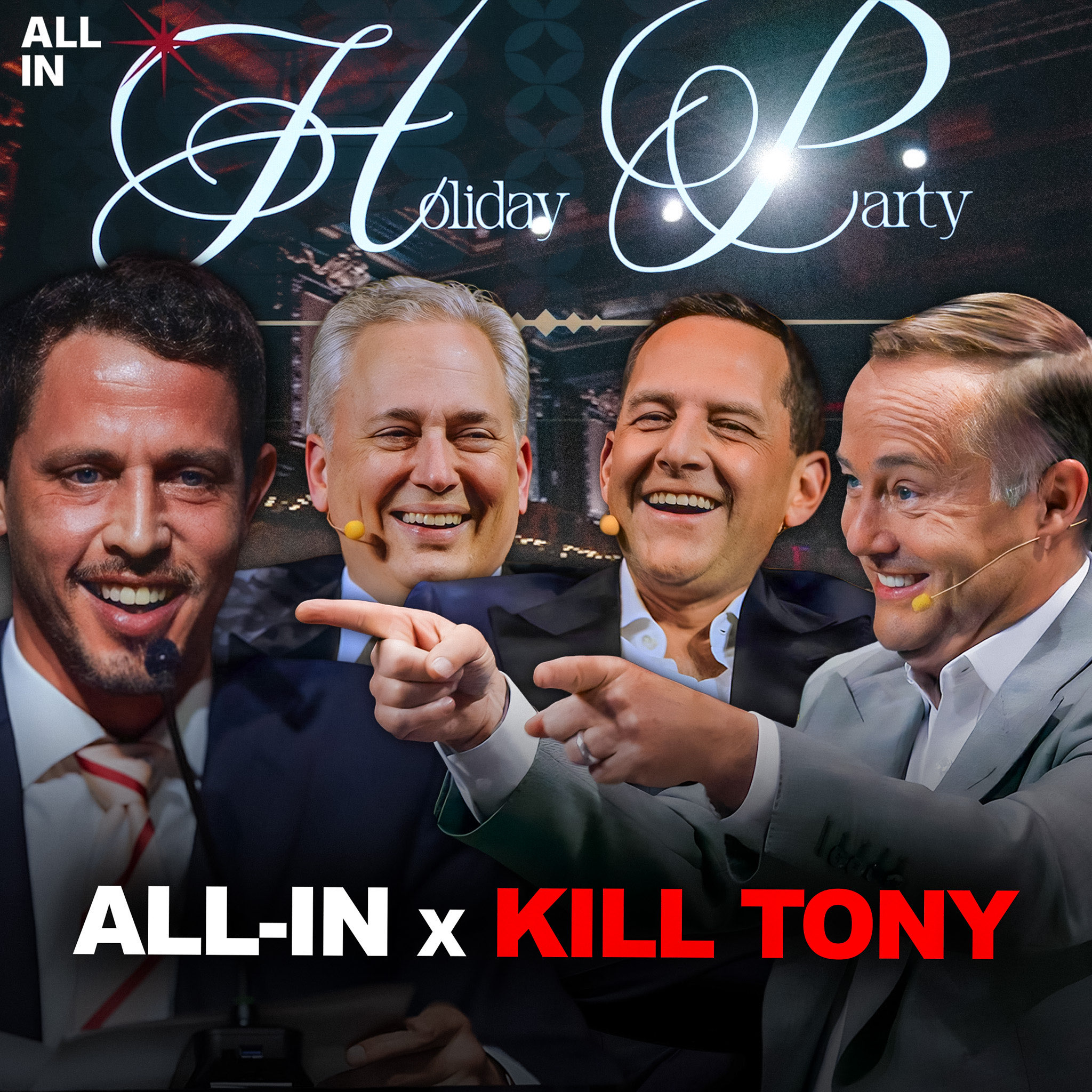
Trump's Big Week: Middle East Trip, China Deal, Pharma EO, "Big, Beautiful Bill" with Ben Shapiro
(0:00) The Besties welcome Ben Shapiro!
(1:53) A Bestie apology to Phil Hellmuth, All-In Poker Tournament
(7:58) Trump's majorly consequential Middle East trip: Saudi, Qatar, Iran, and his vision for a "New Middle East"
(35:18) US-China deal: is the tide turning on tariffs?
(46:33) GOP divided over "Big, Beautiful Bill" due to its impact on our debt spiral
(1:18:48) Science Corner: Montana bans cell-based meat, joining Florida and others
(1:24:31) Trump's EO on pharma prices: role of PBMs, is this too much government intervention?
Follow Ben Shapiro:
Follow the besties:
Follow on X:
Follow on Instagram:
https://www.instagram.com/theallinpod
Follow on TikTok:
https://www.tiktok.com/@theallinpod
Follow on LinkedIn:
https://www.linkedin.com/company/allinpod
Intro Music Credit:
Intro Video Credit:
Referenced in the show:
https://www.semafor.com/article/05/16/2025/qatar-commits-more-than-200-billion-in-us-investment
https://www.cnbc.com/2025/05/13/trump-saudi-investment-speech.html
https://www.cnbc.com/2025/05/13/trump-says-us-will-remove-all-sanctions-on-syria.html
https://www.reuters.com/world/what-have-china-united-states-agreed-geneva-2025-05-12
https://www.cnn.com/2019/07/02/politics/donald-trump-dictators-kim-jong-un-vladimir-putin
https://newrepublic.com/post/185836/trump-brags-dictators-orban-debate-harris
https://www.cnbc.com/quotes/US30Y
https://fred.stlouisfed.org/series/GFDEBTN
https://fred.stlouisfed.org/series/GFDEGDQ188S
https://www.nytimes.com/2025/05/12/opinion/josh-hawley-dont-cut-medicaid.html
Press play and read along
Transcript
Speaker 1 All right, everybody. Today on the all-in podcast, we're joined by our friend Ben Shapiro, and we have a full docket, including Trump's trip to the Middle East, the executive order on pharma benefits.
Speaker 1 We talk a little bit about mock meat being banned in Montana, and Friedberg is really upset. He drops a dispatch
Speaker 1
on the tax bill being supported by Republicans. All that and more on the number one podcast in the world.
The all-in podcast, stick with us.
Speaker 1 One thing I'm trying to figure out: do daily mail stories actually end?
Speaker 1 Because I've scrolled up like seven times. No, no, no.
Speaker 2 And the daily time.
Speaker 2
They never end. Those guys are like the methamphetamine of clicks.
It's like click crack. Yeah.
Speaker 1 They're like one more paragraph.
Speaker 2 Every time I see a daily mail article, I'm like, okay, do I have 15 minutes here? Because I'm going to click on one. I'm going to look at the photos and I'm going to go to the right rail.
Speaker 2 I'm going to click on that.
Speaker 1
You're going to see that's descraziad. You go on the right rail.
You're a true degenerate.
Speaker 2 Oh, Oh, I love it. Stay off the right rail.
Speaker 2 They'll keep you on the carousel for hours. Oh, my God.
Speaker 3
My favorite Daily Mail story. One time that Jared and Ivanka were over at our house, and the paparazzi were following them around.
They were like, Can you give us a tour of the area?
Speaker 3 So we drove them outside for a hot second, and the paparazzi immediately captured a picture of them on the back of our golf cart because we're in Florida and me and my son in the front.
Speaker 3
And the Daily Mail. It was the Daily Mail paparazzi.
And so the headline was, Jared Ivanka, unnamed driver and small boy.
Speaker 2 Nick, Nick, find the picture.
Speaker 2 Can you cut it in?
Speaker 2 Let your winners ride.
Speaker 1 Rainman David Saxon.
Speaker 1 And it said, we open source it to the fans and they've just gone crazy with it. Love you, Messi, Queen of Kinf.
Speaker 1 If you want to come to our next event, it's the All-In Summit in Los Angeles. Fourth year for All-In Summit, Go to allin.com/slash events to apply.
Speaker 2
Hold on one second. Let me do the intro properly.
No, I have to do an apology. Ben, this is going to be so good right now.
You're going to feel so uncomfortable. It's going to be amazing.
Go ahead.
Speaker 2
So, look, Ben has a heart out in an hour and 40 minutes. So, we're going to get the show started.
However, Ben, we need to take a pause. Jason will explain what happened last week.
Speaker 2
He is going to issue a formal apology. If that formal apology is not good enough, I will step in.
Over to you, Jason. Okay.
Speaker 1 We, being members of the All-In podcast, including Shamaf Polyhapatia and myself, Jason Callakanis, would like to formally and respectfully apologize to Poker Ledge and Phil Helmuth for our previous comments about his relationship with Hollywood actor Timothy Chalamay and the Los Angeles celebrity community more generally.
Speaker 1 On a previous episode of this podcast, a number of inaccurate, potentially illegally actionable statements were made by the hosts regarding Mr. Helmuth.
Speaker 1 It was strongly implied on this program that Mr. Helmuth was not acquainted with Mr.
Speaker 1 Chalamet, and it was further suggested that he had arrested and manheld of the Oscar-nominated performer during a social event in Miami, Florida.
Speaker 1 This was a flagrant misrepresentation of the facts for which we are sorry.
Speaker 1 We here at All In are committed to journalistic responsibility and integrity, and we hope to use this time to correct the record.
Speaker 1 In fact, as a noted bon vivant and publicly visible representative of the gaming community, Mr.
Speaker 1 Helmuth is acquainted with many celebrities from the worlds of film, television, athletics, business, modeling, finance, and beyond.
Speaker 1 The list of celebrity friends is far too vast to list here in its entirety, but we have prepared this section we feel demonstrates his overwhelming popularity among this demographic.
Speaker 1 Matt Damon, Steve Martin, Charles Barkley, Bill Clinton, Chloe Kardashian, Mr. Beast, the guy from Billions, Tiger Woods, Mario Lopez, Drake, and of course, Jay-Z.
Speaker 1
Once again, we here at All In regret the era. We should publicly apologize to Mr.
Helmuth and recommit ourselves to truth and accuracy in reporting.
Speaker 2
Thank you. Jason, that was great.
I would just like to add a couple things.
Speaker 2
Phil is my best friend, has been for a very long time. I love him.
He does have a lot of friends and he opens his Rolodex to us.
Speaker 2
And so to the extent that Phil was hurt, because he was a little bit hurt last week because we were ribbing him. We rib him a lot.
We make jokes in the group chat a lot, but it's because We enjoy it.
Speaker 2
He enjoys it. But I think the way that we said it really hurt his feelings.
So Philly, I love you. We love you.
We love you, Phil. We're sorry.
Speaker 1
Sorry for that. And I'm sorry.
I specifically am sorry because to be honest,
Speaker 1 I probably started the whole thing and got everybody.
Speaker 2 Yeah.
Speaker 2 We're just trying to have fun with you, Phil.
Speaker 1 Sorry. We love you.
Speaker 2
Love you, Philly. Sorry, I called you a panda eating bamboo.
And I did not mean to say that you put your meat hooks into Timothy Shalomet.
Speaker 1 And I didn't mean to say that you took credit for and
Speaker 1 didn't have a major contribution to the on-in podcast, obviously.
Speaker 2 But Phil, honestly, you're the best.
Speaker 2 you've been really instrumental in a lot of these important relationships that have joined our group so thank you and we love you and let's keep going okay yes absolutely and we wish you well in the world series of poker go get him hope you hit go get him world's greatest 17th 18th 19th who knows isn't he not playing he's not playing this year
Speaker 2 isn't he isn't he skipping he's not playing the main he's not playing the main he's not playing the main because the wsop are ridiculous in how they've set up these tournaments it's stupid we will do a better version by the way of the WSOP to announce this.
Speaker 2 We will be doing an event during the F1 in Las Vegas where we will be launching our poker tournaments.
Speaker 2 So, for those of you who would like to have some quality, high-class poker tournaments and some ridiculous cash games,
Speaker 2
let us know. Late November, guys, book it.
Make sure you got five, six days where you can pretend you have COVID, get out of your job, and don't want to.
Speaker 1 What about you, Ben? Do you like to gamble? You ever played the horses, the ponies?
Speaker 3 I can't say that I've been big on the gambling. It hasn't worked out well for me.
Speaker 3 I have an addiction. So
Speaker 3 I wouldn't want that to get out of control, you know?
Speaker 2 All right. Well,
Speaker 1 we will absolutely take advantage of your addiction.
Speaker 2 Oh, Ben,
Speaker 2 have you ever rolled the dice? Have you ever rolled dice? No?
Speaker 3
I've never rolled dice. No.
Okay, so this is perfect.
Speaker 2 We have to take. Okay, Ben, you're coming to...
Speaker 2 Our all-in event in Vegas, and I'll tell you why.
Speaker 2 We'll do something on stage. But more importantly,
Speaker 2 more importantly for me,
Speaker 2
there is an incredible rule in craps where when you have a virgin shooter, somebody who's never touched the dice. Absolutely.
I don't know what it is,
Speaker 2
but you are the people that go off where you can make millions. Yes.
I have seen this 20 times in my gambling life in Las Vegas. I remember I took my father-in-law.
Speaker 2
I took my father-in-law and my kids. Well, my wife was pregnant.
She was like, get out of the house.
Speaker 2
My father-in-law and I took the three older kids to Vegas. He had never shot dice before.
He touched the dice,
Speaker 2 broke the casino.
Speaker 2
It is the most fun game, Ben. I'm telling you.
So you need to come November 22nd. We'll make the arrangements.
We'll make sure you get out there. You'll have a really great time.
Speaker 2 You'll do something with us on stage. And
Speaker 2
Ben is going to touch those little dice and he's going to break the wind. And I'm going to be there to finance it.
Absolutely.
Speaker 1 You are going to get such great parenting and husbanding advice from Shama, Ben, all of this dedication you have to your family, we're going to teach you a new approach, which is to just f off to Vegas and, yeah, take your kids and your father-in-law and leave your pregnant wife at home.
Speaker 1
She's got work to do. All right, everybody, welcome back to the All-In Podcast.
Really excited to have Ben Shapiro back on the program. Yeah, I'll listen to the Ben Shapiro show.
Speaker 1
You know about Daily Wire. And Ben, you've been covering this Trump Middle East trip all week.
So let's get into that as our first topic here. As everybody knows, Trump was in the Middle East.
Speaker 1 He secured a huge investment from the Saudis, $600 billion, $140 billion for a defense partnership, and MBS said he wants to make it a trillion.
Speaker 1 A bunch of high-profile CEOs joined Trump, including friends of the show, Elon, and of course, Dara from Uber, Andy Jassy from Amazon. Who else was there?
Speaker 1 Alex Karp, Jensen, tons of people, including our fourth bestie here, David Sachs, was there.
Speaker 1 He also closed a $200 billion deal with Qatar or Qatar, which includes $96 billion from Boeing to send 160 planes there with an option of 50 more. And he removed sanctions against Syria.
Speaker 1
A little controversial. We'll get into that.
To, quote, give them a chance at greatness. He gave a speech at a Saudi-U.S.
investment forum in Riyadh,
Speaker 2 where he powerfully outlined his vision.
Speaker 1 for a new Middle East, basically rejecting 20 years of American interventions and forever wars.
Speaker 1 And he gave big credit to a, quote, new generation of leaders, including MBS, for building better societies. Ben, what do you think here? What was your take on the trip? Is this the best Trump?
Speaker 1 Of all the versions of Trump, this did seem to me to be the best version. He seems really comfortable with this category of leader and this region in particular where we're the.
Speaker 3
Oh, for sure. I mean, there's no question about that, right? I mean, he likes MBS.
He obviously likes the Emir of Qatar. He likes the folks in UAE.
Speaker 3 We've known that for a while.
Speaker 3 And he's really signaling a shift away from the Obama-Biden policy toward a lot of these places where Biden liked to say the word democracy and then immediately divide off from Saudi Arabia on the basis of that and chide MBS and all this kind of stuff.
Speaker 3 And then try to cut a deal with Iran, for example, at the same exact time, which of course pisses off the Saudis. Trump is going over there and he's in deal-making mode.
Speaker 3 And you can see he's in dealmaking mode. And his entire sort of approach to the Middle East is what he said in the speech, commerce above above chaos, right? Let's do some business here.
Speaker 3 And he understands that there are a lot of people in KSA,
Speaker 3 Kingdom of Saudi Arabia, and also in Qatar, UAE as well, who are really looking to do business. And I think there are a bunch of strategic aspects of this that are really good.
Speaker 3 One of them, obviously, is driving these places away from China. And the more business ties you have with places like Saudi Arabia or Bahrain, UAE, Qatar, the further away they're going to get.
Speaker 3 from China. I think you do have to be careful with Qatar in particular, which has some divided priorities, shall we say, when it comes to terrorism.
Speaker 3 Obviously, Qatar, the case they will make to sort of steel man what Qatar says about itself is that they have to have good relations with terrorists so that the West can talk with the terrorists on occasion to not steel man the case.
Speaker 3 They gave $2 billion to Hamas over the course of the last several years and have funded the American university systems, the tune of $6.3 billion for a country that has a grand total of 2.6 million citizens.
Speaker 3
It's smaller than the state of Connecticut in terms of its citizenship. It spends something like two-thirds.
what China spends on lobbying, which seems, you know, pretty weird.
Speaker 3 But with that said, the idea of bringing dollars into into the United States, combining on things like AI, it's what David Sachs has been working on over there. That stuff is all really, really good.
Speaker 3 The warning that I'd issue to President Trump is just make sure that you have strings attached to. Meaning, clearly there are strings attached from the other side when you're talking about Qatar.
Speaker 3
So also the United States should have strings attached. So you mentioned Syria there.
If you're talking about
Speaker 3 getting rid of the sanctions on Syria, there's an argument to be made. Obviously, Erdogan in Turkey would love that because basically
Speaker 3 the leader of Syria now, Al-Jalani, he changed his name. He's kind kind of like the prince of terrorists, right?
Speaker 3
He's the artist formerly known as Al-Jalani. Now he's Al-Shara'a.
I think he changed his name to. He was Al-Qaeda, then he was ISIS, then he's HTS.
He basically works for the Turks.
Speaker 3 And so obviously the Turks would love for Al-Jalani to have sanctions removed. That's fine.
Speaker 3 I mean, I think there's a case to be made for it, but you have to make sure that he actually delivers on the other end of that, which would be getting rid of the terrorists in his country.
Speaker 2 What do you think, Ben, about Qatar, Qatar?
Speaker 1 For people, it's the same word, just said differently here in the West and in their country.
Speaker 1 Do you think we should have deep ties to them? And is the steelman argument that their relationship with Hamas and the Muslim Brotherhood acceptable to you, Ben Shapiro?
Speaker 1 Or do you think we should hold the line with them and say, hey, you got to cut off these relationships if you want to have a relationship with the United States?
Speaker 3 I mean, it seems to me that we have a lot more leverage in the latter situation. And Qatar has obviously been...
Speaker 3 paying some $8 billion to have this airbase on its own territory, but then it puts restrictions on how the United States can use that sort of airbase. That airbase was previously located in Saudi.
Speaker 3 And so, you know, it's my perspective that after October 7th, for example, the United States under Joe Biden should have gone to Qatar, which obviously has a deep relationship with Hamas, as proven by the release of that American hostage while President Trump was in the Middle East, which was done at the behest of Qatar.
Speaker 3 That probably the United States should have gone to Qatar and said, listen, the airbase goes away unless all the hostages come out and the Hamas leadership goes into exile and you avoid the entire war.
Speaker 3 So there is leverage that can be exerted.
Speaker 3 I'm not sure that the leverage is being properly exerted on Qatar.
Speaker 3 Let's put it this way, I'm much more enthusiastic about the ties that President Trump is fostering with Saudi and UAE than I am the ties that he's fostering with Qatar.
Speaker 3
I mean, back in 2017, there was nearly a war between Saudi and UAE and Qatar. I mean, that's how bad the relations were back in 2017.
And President Trump was on the Saudi-UAE side of that.
Speaker 3 So, you know, moving,
Speaker 3
let's just say trust but verify, I think, would be a much better strategy than just trust. Here's some stuff.
We'll hope that you give us back on the back end.
Speaker 1 Jamath, let's go to the business side here.
Speaker 1 Trump making a lot of deals, a little bit of a brouhaha over a $400 million plan given to Trump. I'm not sure how relevant that is or if he's even accepted it personally.
Speaker 1 And I'm sure you've got some thoughts on that. But what did we see there? I saw Sandeep, our friend from Grok, one of your investments was there.
Speaker 1 We're seeing a level of investment and collaboration between Saudi, UAE, and America and the West that, hey, let's face it, we haven't ever seen.
Speaker 1 And they do seem to be leaning more towards, I wouldn't say democracy, but a lot of social reforms and a lot of women, what was pointed out by David Sachs in the business community there.
Speaker 1 I've made a couple of trips there. It seems to have changed on a human rights basis more in the last three or four years than in the last, I guess, 20.
Speaker 1 So what's your take generally on this position Ben has of, hey, better they be doing business with us and let's build and foster these relationships as opposed to have them fall into the arms of Russia, North Korea, or China.
Speaker 2 Let's just go do a little cleanup on a couple of these things and I'll give you my take.
Speaker 1 Sure.
Speaker 2 First thing is we announced almost $2 billion deal, 1.7, I think, is what it was.
Speaker 2
Mrs. Brock did a deal.
Yeah, for AI inference. We're starting to build some enormous data centers in Saudi.
I'll get to why Saudi is a critical place to do that, but they've been exceptional partners.
Speaker 2 We are the only inference company in the world with an export license from the United States to do this.
Speaker 2
So, yeah, it was great. That's why Sonny was there.
And Jonathan Ross, our founder and CEO. So that was really big for us.
This has been a company that Jonathan and I got off the ground 10 years ago.
Speaker 2 It's been a long, long slug.
Speaker 2 So, yeah, there's a lot of commercial activity that happened there. Our friend Brian Yuko,
Speaker 2
who was just announced as the head of the commercial plane development group at Boeing, who's making all the next-generation planes. Boeing was there.
Kelly Ortbrook, they announced a $160 billion
Speaker 2 deal for Boeing's and a bunch of other stuff. Elon announced that Saudi allows Starlink now for maritime and aircraft usage.
Speaker 2
He also announced robo-taxis are coming to Saudi. So the business community, I think, was quite central to this trip, which is cool.
With respect to the plane, just to do some cleanup, this is a
Speaker 2 gift
Speaker 2 that is being handled between the Department of Defense and the Department of Defense of Qatar.
Speaker 2 If and when that plane does get transferred over,
Speaker 2 it will then be scanned and retrofitted to military grade spec
Speaker 2 that then can be used by the then sitting President of the United States.
Speaker 2 And while people want to be up in arms, just to be clear, This has happened, and Qatar specifically has done this multiple other occasions.
Speaker 2 You may dispute the countries, you may not like the fact that it's happened, but they've given a plane as a gift to the leader of Iraq, to the then-sitting leader of Turkey, to the then-sitting leader, I believe, of Yemen.
Speaker 2 So there are customs, I guess, and again, who am I to judge these customs?
Speaker 2 But that to us may seem excessive or untoward or maybe an attempt at graft, but to them is just actually a sign of deep respect or relationship building.
Speaker 2 I think that we should not overjudge this thing and let the DOD do their job and it's a gift to the United States of America and move on. I don't think it's a particularly big deal.
Speaker 2 What is the big deal? Here is what Trump did that I think is historic.
Speaker 2 I think the most important thing to recognize is that we, America, has been a global hegemon since World War II.
Speaker 2 But I think that what we did was we took our eye off the ball. And over the last 20 years, and particularly the last 17,
Speaker 2 we have seen China slowly erode our global influence through an initiative that they, frankly, were very open and honest about and branded called Belt and Road.
Speaker 2 And in Belt and Road 1.0, what China did was use the balance sheet of China to invest incredibly aggressively and thoughtfully in all these critical geographies of the world, Southeast Asia, the Middle East, and Africa.
Speaker 2 Specifically in the Middle East, and specifically between Saudi and Qatar, China, I think, has invested about $200 billion
Speaker 2 over the last 15 years.
Speaker 2 What does that do? It allows them to exert influence and economic cooperation, hard power and soft power, right?
Speaker 2 In one week,
Speaker 2 the sitting president of the United States announced $2 trillion.
Speaker 2 of investment from those countries into the United States. What does that effectively do? I think what that effectively does is say that the Middle East is turning a page,
Speaker 2 that
Speaker 2 they are beyond these regional conflicts, that they want to thrive as a society, and that they are 100% aligned with the United States. How do you know that?
Speaker 2 Because I don't think that there's another $2 trillion of deals to be done with any other country other than America. That's number one.
Speaker 2 And then number two, the reciprocation of how American companies are investing in that region is to the tune of several hundred billion dollars. Now, why is that region critical?
Speaker 2
It's critical for two things. The first is that when you draw a thousand mile radius around Saudi Arabia, you touch 4 billion human beings.
Four.
Speaker 2 Half the global population is within a thousand mile radius of Saudi. And so if you can establish cooperation and strategic alignment with that area, it is an incredibly important thing to do.
Speaker 2 The Saudi coastline, as an example, is thousands and thousands of miles.
Speaker 2 These are all these huge strategic things that we've known in the context of other conflicts and other geopolitical things that we've done for decades.
Speaker 2
But what Trump basically did was clean the slate. He wiped the floor with all this neocon establishment nonsense.
That's what his speech did, which we can talk about in a second.
Speaker 2 But he created and forged an economic alliance that I think is going to be very difficult for any other country to undo. That is what I saw, $2 trillion.
Speaker 2 That is an enormous bet for a country to make on it with another country. And I think the fact that he did that with Saudi and Qatar and UAE speaks a lot to a really important strategy.
Speaker 1 Freeberg, your thoughts?
Speaker 1 On this trip and the growing and deepening relationship between UAE, Saudi, and the United States, and apparently Qatar as well.
Speaker 2 I think the biggest moment was the speech that Trump gave. It underscored, I think, a really important narrative shift for me.
Speaker 2 This was a powerful embrace of Saudi Qatar, of their choices, their way of life, their way of being, basically showing, I would say, respect
Speaker 2 to those peoples without judgment. which I think is quite different from leadership of the past.
Speaker 2 I'll just highlight the mainstream media narrative is, oh my gosh, Trump goes to Russia, Trump goes to China, he goes to North Korea, he goes to Saudi. He embraces dictators.
Speaker 2 So the narrative has been that these individuals in leadership positions in these countries are dictators, and Trump embraces dictators.
Speaker 2
He loves Xi, he loves Putin, he loves Kim Jong-un, he loves MBS. That's a bad thing.
Because the liberal view,
Speaker 2 and I would say largely the American view in the past, has been that there's right and there's wrong. There's our way of
Speaker 2 governing, and then there's the other way of governing. And the other way of governing is always wrong.
Speaker 2 That our form of American democracy is the only model that is right, and all the others have to be wrong. And fundamentally, that's a colonial mindset is what he's highlighting in this speech.
Speaker 2 He's saying that the point of view that all others are wrong means that they should come around to our point of view, our model of democracy, our model of governing.
Speaker 2 And in the speech, he basically underscored that that's not really the case anymore.
Speaker 2 We are no longer going to be colonizers where we are going to enforce our view of government on the rest of the world and say this is the only good path, but there are other paths and we can respect them.
Speaker 2 We can work together so long as we aren't harming one another, so long as terrorism goes away, which he underscored in his speech, has gone away.
Speaker 2 And by the way, I'm not trying to highlight or kind of prop Trump up for the speech itself, but I do think that this underscores a shift in the political viewpoint that has now come to power in America.
Speaker 2 That, you know, we are no longer going to have this kind of moral or socio-political framework that says it's our way or the highway, but we are now going to go to folks like Xi, like North Korea, like China, and say we can respect your way of living, we can respect your way of governing, and we can have partnership and continue to build a world together without saying that if you don't follow our path, we're never going to be true partners.
Speaker 2 So for me, the biggest thing that came out of this whole visit was that shift in narrative that I think really is different than what we've seen in the past.
Speaker 2 And it counters a lot of how the mainstream media has kind of, you know, framed his quote embrace of, you know, differing ways of governance.
Speaker 1 Ben, this was obviously a Republican position as well.
Speaker 1 You know, just we're going to have a hard line on human rights and democracy. And in fact, the entire Republican position in terms of, and globalist Clinton too,
Speaker 1 was, hey, let's embrace China and we will lean them towards democracy. That obviously didn't happen.
Speaker 1 They did build a vibrant economy and took 400, 500 million people out of poverty into a middle class. But here we're seeing something different.
Speaker 1 You know, I've spent a lot of time in the region, maybe four or five trips in the last couple of years.
Speaker 1 Last couple of times I was there, women doing business, dancing, music, and now there's alcohol in the kingdom kingdom in some select locations. There's a casino coming to UAE.
Speaker 1 We're actually seeing maybe this strategy of less judgment, more engagement, actually result in more modernization. So what's your take on this?
Speaker 3 I mean, I think that one of the things that's happened in the media coverage of President Trump's speech is this sort of false binary that isn't really what's going on.
Speaker 3 So it was sort of posited as neoconism versus isolationism. And he mentioned both of those sorts of concepts in his speech.
Speaker 3 But the reality is that I think we should be careful about how we define these terms.
Speaker 3 What we really mean is that Wilsonian interventionism has been completely rejected by the American people and by President Trump.
Speaker 3 President Trump is saying that we are not going to go into these, like to pretend that President Trump is being isolationist is obviously not true.
Speaker 3 I mean, he's literally cutting trillion-dollar deals with foreign countries and traveling there and making common bonds with them. It's the opposite of isolationism in a lot of ways.
Speaker 3 It's a realism, right? He's a foreign policy realist who wants to make deals where he can make deals, and he wants to make the best deal for America.
Speaker 1 That's the exact opposite of isolation if they're doing projects, you know, in the Trump family and the plane. This is the opposite of isolationism.
Speaker 3 Right, exactly. And so I think that all the debates that are currently happening within sort of the Republican ecosystem are sort of which version of realism are we pursuing, right?
Speaker 3 There's a more hawkish version of realism that suggests that you ought to be more skeptical. I mean, I think that's where I am of what you want from these countries in addition to the money.
Speaker 3 And then there's a sort of more dovish realism that says, you know, basically as long as the deals go forward, maybe no strings attached. And that's an interesting debate.
Speaker 3
And it depends on sort of what levels of trust you have in various countries. And again, I think it differs country to country.
How would you make sure that you're saying that?
Speaker 2 Ben, I want to build on what you're saying and just ask a question because I completely agree that that rejection has all of these downstream consequences.
Speaker 2 The most interesting consequence for me, but I would just like your opinion on this, is
Speaker 2
Trump goes there, cuts all these deals, announces all of it. There's just an incredible show of force, frankly.
right? Economic force and political alignment.
Speaker 2 And then within one or two days, Iran caves.
Speaker 2 Now, we don't know what the final contours of that deal are going to look like, but that also has incredibly important implications to the safety and security, not just of that region, but for everybody.
Speaker 2 I don't know what you thought about just how
Speaker 2 it seemed that there was a capitulation.
Speaker 3 You know, so this is where, again, I remain pretty skeptical.
Speaker 3 I think that one of the issues that we have when it comes to negotiations with Iran, the sort of phrase that's been used by Saudi, Israel, UAE with regard to Iran, is the Iran has never won a war or lost a peace.
Speaker 3
So Iran is very good at negotiation. They're quite sophisticated in how they approach these issues.
And when President Trump says they can't have a nuclear weapon, that's all we need to know.
Speaker 3 All the rest is details.
Speaker 3 But actually, when it comes to things like negotiating a nuclear deal, the devil is the details, because is it going to be JCPOA Part 2, which is basically you can enrich to civilian levels with a certain level of transparency, but also you get money and the money can be used for terrorism or for ballistic missile development or rebuilding your air defenses.
Speaker 3 And what do those details actually look like? And obviously, Qatar is very, very close with
Speaker 3
the Islamic Republic of Iran. And so they've been negotiating again as sort of a representative of Iran in those negotiations.
And so I'm going to hold off. Let's just say,
Speaker 2 I'll be skeptical until... I agree with you.
Speaker 2 They need to be in the penalty box for some number of years because they have not earned the trust of the world in that they can conform to these things and they're not going to do nefarious things once they get access to capital and funds.
Speaker 2 So to your point, I think they have to earn their way up for sure.
Speaker 3 That's right.
Speaker 3 And I think that when you look at Saudi Arabia, I think that one of the things that would be interesting to see is President Trump said in his speech in Saudi Arabia that he would consider it an honor if they would join the Abraham Accords.
Speaker 3 His signal accomplishment, obviously, during his first administration was the Abraham Accords.
Speaker 3 The notion that he, again, continued to press forward, that commerce matters more than sort of ideological conflict.
Speaker 3 That's why UAE and Israel, for example, now have a pretty solid relationship that's withstood a lot of
Speaker 3 the stressors that have been created by October 7th and the ensuing war.
Speaker 3 The question of whether Saudi actually does that is an interesting one, because if you're looking for a new region in which commerce really does take the fore, then obviously UAE, Saudi, they're very close.
Speaker 3 I mean, essentially, UAE is
Speaker 2 no distinction. There's no better place, I think, in the world right now, if you're trying to find a net new place to put capital to work than the UAE and then Saudi.
Speaker 3 Yeah, no, I mean, I agree with that. And I think that, you know, obviously integrating the region across religious boundaries would be a very, very good thing.
Speaker 3 And I think President Trump also has an interest in that. So it'll be interesting to see how things develop from here.
Speaker 3 Again, I remain skeptical of sort of the idea that just commerce alone is going to usher in a new era.
Speaker 3 I do think that the United States typically, when it's brokering these deals, does put its thumb on the scale in particular ways.
Speaker 3 And those ways are not just putting money into KSA or taking money out of KSA, which, again, I'm great with that. I think it's brilliant what President Trump is doing.
Speaker 3 I know a number of businesses, obviously, that are working in Riyadh and doing wonderful work in Riyadh. And I think what MBS has done transformatively to KSA is incredible.
Speaker 3 If what you're looking for is a broader sort of regional calm that's going to last the course of time, what you don't need is an upsurgent Muslim Brotherhood or a resurgent Iran or the rebuilding of terrorist groups that threaten both Saudi Arabia as well as Israel and other Sunni allies in the region.
Speaker 3 And so, you know, I think that there are a couple of ways to see what President Trump is doing.
Speaker 3 One of them is I hope that there's a step two, right, which is, okay, now Saudi Arabia, we have a great relationship with you. It would be really great if you did join in Abraham Accords.
Speaker 3 And now you have this very strong regional bloc that economically is more interdependent, which is, of course, what he pursued during his first administration.
Speaker 3 Or is he moving in a direction, and this is also plausible, where he's basically saying, listen, everybody's sort of on their own.
Speaker 3 We're going to cut independent deals with each one of these nations in bilateral fashion with the United States.
Speaker 3 And I think it sort of remains to be seen which strategy President Trump is taking, the sort of bilateral approach to relations with each one of these countries individually, or whether he's attempting to forge more of an interdependent regional economic bloc.
Speaker 1
Two questions for you, Ben, rapid fire. Abraham Accords was brought up.
Will the Saudis sign it? Will NBS sign it? And Trump sort of alluded, hey, they're going to do it in their own time.
Speaker 1 What's holding it up in your mind? And if and when they do sign it, what impact would it have on the region?
Speaker 1 Then, number two, your thoughts on this Qatar plane kerfluffle and the media sort of obsessing over it? Are they over-indexing on it or not?
Speaker 3 So as far as the Abraham Accords, again, I think that it is a shift in tone for President Trump. Abraham Accords was considered sort of his signal foreign policy accomplishment during term one.
Speaker 3 And it's my belief, if he'd been re-elected in 2020, by February 2021, I think Saudi would have been in the Abraham Accords.
Speaker 3 Obviously, one of the obstacles continues to be the war in Gaza, what actually ends up emerging there.
Speaker 3 But one, ironically, one of the things that actually has undermined the kind of incentive for Saudi to join the Abraham Accords is Israel's complete devastation of all of the proxies of Iran.
Speaker 3 So one of the things that was driving Saudi and Israel together was the fact that there was this really giant threat in Iran.
Speaker 3 And so now it appears, it could be at least plausibly read, that one of the reasons why President Trump is selling $150 billion worth of military hardware to KSA is to provide a defensive barrier against Iran while assuming that maybe Iran does end up going nuclear.
Speaker 3 So, you know,
Speaker 3 what happens with Iran does have serious ramifications for the possibility of an Abraham Accord, including Saudi Arabia. That seems like it's more distant than it was a couple of years ago.
Speaker 3 And it may take more time than I think that Special Envoy Steve Witkoff and the Trump administration would like it to be.
Speaker 3 As far as the plane kerfluffle, on my show, I said that it looks skeezy, you know, and I will maintain that position.
Speaker 3 It doesn't have to be that it's illegal in order for it not to look particularly good, because, of course, the other half of the deal is that once the plane is retrofitted and used by the president for a certain period of years, it then goes to the Trump presidential library.
Speaker 3 And that was one of the conditions of the gifting.
Speaker 2 And Qatar is quite famous for putting a lot of money in a lot of areas' pockets, ranging from the attorney, I mean, the current attorney general of the United States, Pam Bondi, was a foreign registered agent for Qatar qatar for a while uh being paid by by qatar to do that sort of lobbying work um qatar is pretty famous for for putting its money yeah in a variety of pockets by the way just just just to put a number on that qatar uh in sovereign wealth fund the qia the investment authority is about a half trillion dollars of capital about 50 billion of which is invested in u.s funds And many of the folks in and around the circles that are associated with the White House obviously have QIA as an LP or have had funds that they're affiliated with that have QIA as an LP.
Speaker 3 And my point about this is that put aside whatever moral qualms anybody has about this sort of stuff, which again, you can argue either way.
Speaker 3 The key to me is if you like President Trump's agenda, the biggest obstacle to President Trump's agenda, they're basically two obstacles. One is the economy goes south, right?
Speaker 3 That's an obstacle to any president's agenda. That's why it's really important what he's doing in the Middle East.
Speaker 3
It's why it's important what he's been doing, backing off of the tariff war in a lot of ways. It's why deregulation, passing the tax cut is important.
All of that's important.
Speaker 3 And then the the second thing that can really hurt any administration is corruption. And even allegations of corruption can be incredibly damaging.
Speaker 3 And so, for example, there was a crypto bill that was on the floor of the Senate or is about to enter onto the floor of the Senate just last week.
Speaker 3 And it ended up being killed by Democrats plus a couple of Republicans.
Speaker 3 And Democrats, at least publicly, maintained the reason they killed the crypto bill was specifically because of allegations surrounding the Trump family and Trump coin, Trump meme coin, World Liberty Financial, and all this sort of stuff.
Speaker 3 And so the question, listen, as a Trump supporter who raised money for President Trump and campaigned with President Trump and campaigned for President Trump, as a person, what I want is his agenda to be successful.
Speaker 3 If an obstacle to that agenda is the optics of a thing like taking a $400 million jet from Qatar, which does amount to the single biggest monetary gift ever given to the United States, even if you consider it to just be a gift to the United States generally, not to the Trump library personally or anything like that.
Speaker 3 Is that the kind of thing that harms him in the public mind?
Speaker 3 And if that ties into a broader narrative that his political opponents are trying to drive that he is corrupt or the people around him are corrupt, is that a win for him?
Speaker 3 Just on a practical, efficacious level, is that a win for him? Is that a win for his agenda? Because
Speaker 3 the media coverage this week, it could have all been about him doing deals in these various places and bringing money back home to the United States.
Speaker 1 Unecessary distraction.
Speaker 3 That's kind of my view of it at the time.
Speaker 2 And the appearance of impropriety
Speaker 1 amongst half the country who doesn't like him, and he is now tipping into, you know, almost as unpopular as his first term, they're just going to weaponize that in the midterms and it's going to scuttle the important agenda, Doge, you know, and this is one of the things that I'm actually afraid of.
Speaker 3 You know, this is the thing that also ties into the economic problem, right?
Speaker 3 Right now, everybody is basically like, oh, who cares about this kind of, I think a lot of people are like, who cares about this kind of stuff?
Speaker 3 As long as the number goes up into the right, then all this sort of stuff doesn't matter very much.
Speaker 3 If the number starts going down, then you start having all these kind of corruption allegations rise to the surface in a new way, right? Because that's what happens happens with presidents very often.
Speaker 3 Is what you see is there are kind of a bunch of little dents that are in the vehicle. And then there's a car crash, and suddenly, you know, all the dents are very evident to the naked eye.
Speaker 3 And that's what I'd like for him to avoid.
Speaker 1 What if he loses the midterms and then we start impeachment three, four, and five, investigation three, four, five? And now we're back to lawfare and insanity, which nobody wants to be in.
Speaker 1
Let's talk about another win. It was a pretty great week, objectively, for Trump.
On Sunday, Treasury Secretary Besant announced a trade deal with China in Geneva.
Speaker 1
The details were basically: here we go, another pause. Tariffs will go down from 145% to 30%.
Maybe that's manageable. China's cutting their tariffs for the U.S.
from 125 to 10%.
Speaker 1 And they're going to end this de minimis rule, also known as the like garbage fashion rule, Timu, Sheen, all that kind of stuff, when they drop shift you stuff.
Speaker 1 That's under, I think the number's 800 or so.
Speaker 1 The market loved the news.
Speaker 2 Don't, don't make America dress well again. Don't do it.
Speaker 1
I think this is like an important part of this. It's like this, you know, ridiculous garbage fashion.
I hate it.
Speaker 1 The market was up massively, but, you know, the Dow and the NASDAQ are basically flat to slightly negative. Our partners over at polymarket,
Speaker 1
you know, have a nice market on the chances of a U.S. recession.
That peaked at 66%
Speaker 1 during the Liberation Day chaos fallout.
Speaker 2 And hey, here we go.
Speaker 1
Now it's 38%. So we're kind of maybe cleaning up the chaos.
He shook the globe, the economic globe, Friedberg. And now maybe, as I think a lot of people have predicted, he found an exit ramp.
Speaker 1 Maybe that was the plan all along.
Speaker 2 Maybe it's 4D chess.
Speaker 1
Maybe he's reacting to the market. Maybe all that doesn't matter.
But here we are.
Speaker 2 Dave Friedberg, when we look back on
Speaker 1 this whole trade, Trump, tariff turmoil. What are we going to look back on this a year from now and think?
Speaker 1 Was it just a distraction or is it actually going to create a trillion dollars in tariff revenue and we're going to get rid of 150 people paying taxes who make under $150,000?
Speaker 1 What's going to happen with this when we look back on it a year or two from now?
Speaker 2 Well, I don't know where the tariff deals are going to end up. So we don't know yet.
Speaker 1 I'm asking for a guess, right? Yeah.
Speaker 2
Yeah. And so I don't know.
I don't know. Like I said, I think one of the biggest things that needs to happen that is being discussed in these trade deals is regulatory parity, such that U.S.
Speaker 2 companies can participate evenly in foreign markets. I kind of have highlighted a few examples of why it's challenging for U.S.
Speaker 2
companies to set up and do business in the local jurisdictions for a lot of our trade partners across multiple industries. I think that's being heavily negotiated.
So, that doesn't make the headlines.
Speaker 2
That's not kind of the top of the news. Everyone talks about the tariff number, the tariff number, the tariff number.
But at the end of the day, the access to foreign markets for U.S.
Speaker 2 companies, you can even think about, I mean, a good example for us is a lot of the fines that happen to U.S. tech companies in the EU.
Speaker 2
And there are just billions and billions of dollars of fines being paid out of our companies. That's another form of taxation.
The fact that China won't allow U.S.
Speaker 2 tech companies to operate, but we allow Chinese tech companies to operate here.
Speaker 2 So the regulatory parity is kind of the biggest thing that I think needs to kind of be identified in these deals before we have a real sense, Jacob, because This, again, could be a real economic growth driver for American businesses, and that could have a a real effect on our GDP.
Speaker 2
So that's the biggest thing I'm looking for versus just the tariff number is parity and access to global markets for U.S. companies.
And I don't think we know.
Speaker 2 And those are the details of the deals that are going to take several months.
Speaker 2 Normally, these are multi-year trade negotiations with big trade teams that go back and forth over several years to figure these deals out.
Speaker 2 So to create maximal leverage and accelerate outcomes, it seems like a lot of this trade hype got everyone to the negotiating table.
Speaker 2 Now the hard work's being done to figure out the details of these deals. And hopefully, we end up in a better place for American businesses because of it.
Speaker 1
Shamath, I know where you stand on this. He creates that big pothole crater.
Everybody gets excited. It creates a lot of attention.
And then maybe the real negotiation starts.
Speaker 1 So, a year from now, when we look back on this, what would success look like for the Trump administration in Shamath Padapatiya's mind and assessment?
Speaker 2 I think this goes back to what I said at the beginning.
Speaker 2 I think tariffs
Speaker 2 have the potential to be the on-ramp to our version of Belt and Road. And I think that that is
Speaker 2 an incredible jiu-jitsu move
Speaker 2 of what was an exceptionally well-executed and methodical program by the Chinese government.
Speaker 2 to cement hard and soft power all around the world while the United States wasn't looking and obsessed with cheap garbage that they could buy at Target.
Speaker 2 Okay?
Speaker 2
So this should be a wake-up call to us. We don't need all this cheap nonsense.
We can live with fewer things.
Speaker 2
Those things could be of higher quality. They may be of higher price.
But more importantly, we need to make sure that we're cementing
Speaker 2 bilateral deals with as many countries in the world and building the next phase of PAX America, of American hegemony. We need to do it.
Speaker 2 So the fact that we are negotiating with China, I think, is very good. I think that they are a necessary partner of ours, but we can't take our eye off the ball.
Speaker 2 The tariffs was a way of ripping the band-aid of all this globalist free trade nonsense, and now we need to reset this in a methodical, calm way.
Speaker 2 Now, some markets we're not going to get right, and in some industries, we have some very complicated thinking to do.
Speaker 2 As an example, which we'll get to later, the pharma EO is very complicated and very nuanced, okay?
Speaker 2 But this is the hard and necessary work. So my perspective is this is the beginning of Belt and Road 2.0.
Speaker 2 I think we started with a real bang in the Middle East. And I just encourage the administration to go and finish the job and get as many bilateral deals done as possible and reset
Speaker 2 how important the United States is as a partner. We always knew it.
Speaker 2 But we allowed that hard influence and hard power to get frittered away with all kinds of nonsensical, idealistic thinking that was just wasteful. And now we just need to.
Speaker 1 And it was also globalists who wanted to make money, right? It's like easier to make cheap stuff over there and then sell it here. And it's harder to make money.
Speaker 2 I think that was short-term and non-strategic thinking by many of those companies. I think that we've created dynamics that we can change.
Speaker 2
We can change the incentives for how consumers consume in the United States. And I think it's worth thinking about how to do that.
All right.
Speaker 1 Well, here is the polymarket on tariffs generating greater than $250 billion in 2025 that we set, or polymarket set.
Speaker 1 Basically, no chance that that's going to happen. So we will see, I think, everybody coming to the table and wrestling.
Speaker 2 I don't even know how you're going to settle this, Jason, because what does it mean will tariffs generate? I think it's a really interesting bet, but the real question is on the measurement.
Speaker 2 There is not going to be some number that OMB or somebody else puts out that says it generated X.
Speaker 1 Well, I think Lutnick was saying he was tracking that, but we'll see.
Speaker 1 I mean, because if it's reciprocity and we see us making more money or getting charged less fines to the examples we had earlier, then you could include those in it.
Speaker 1 But yeah, it's a hard bet to settle, but I think people believe it's not going to generate a massive amount of revenue. The relationship with China and this sort of changing.
Speaker 1 concept of consumerism, you think that's a possibility for America? Do Americans just want cheap stuff on Amazon and an unlimited number of Amazon boxes in their recycle bin?
Speaker 3 I mean, I'm not sure that's how consumers have ever thought about this sort of stuff.
Speaker 3 I remember when I was younger, there was a lot of talk about Made in America cars and
Speaker 3 buy made in American. And that just kind of failed because it turns out that the American cars just weren't as good as the stuff that you could get elsewhere.
Speaker 3 And it turns out that Americans are both producers and consumers. And yeah,
Speaker 3 it's easy to say don't buy cheap crap from China, but it turns out a lot of stuff that actually is not all that cheap also was manufactured in China.
Speaker 3 Hopefully now it'll be manufactured in Vietnam or manufactured in India or in other third-party countries.
Speaker 3
The idea that we're going to be reshoring all that stuff to the United States, we're not going to be making t-shirts in the United States. That's not a thing.
But
Speaker 3 I do think that right now, my read is that it's too early to tell. Meaning that this just reminds me of the old Yiddish joke where the couple isn't getting along.
Speaker 3 So they go to the rabbi and they say, what do we do, rabbi? He says, I want you to bring a chicken into your house. They bring the chicken in their house and still isn't working.
Speaker 3
And they go back to the rabbi. He says, I want you to bring a cow in your house.
So they bring a a cow into their house and they say, it still isn't working, rabbi. It's just terrible.
Speaker 2
They go back to the rabbi. He says, I want you to bring two goats into your house.
They do that. They come back.
Speaker 2 The husband says, this is awful. I can't handle it.
Speaker 3
He says, take everything out of your house. They take all the things out of their house.
And they're like, oh my God, this is just fantastic. Because that's basically what Trump did here, right?
Speaker 3 He put the chicken and the cow and the two goats in the house. I still think he left the chicken, right?
Speaker 3 And so it's kind of, it's going to be, you know, a question as to how much impact the chicken has, meaning the 10% tariff rate that we still have on the rest of the world is more than quintuple what it was at the very beginning of this process.
Speaker 3 I mean, the average tariff rate, and not to use a number that David doesn't like, but the average tariff rate right now is higher than it's been anytime since the 1930s.
Speaker 3 Is that going to have some carryover effect? I mean, Walmart is already suggesting they're going to have to start increasing their prices. So I don't think that we're out of the woods.
Speaker 3 And I do think that the biggest threat with regards to this sort of stuff is less the tariffs than the feeling of uncertainty for investors as to what comes next.
Speaker 3 And that's where the pharmaceutical EO starts to come in or the negotiations over the tax bill. What actually makes it in? What doesn't make it in.
Speaker 3 When it comes to the stuff that makes investors sanguine, and one of the reasons why investors are sanguine about Saudi Arabia is because Saudi Arabia is a kingdom and that kingdom is very wealthy.
Speaker 3 And that very wealthy kingdom doesn't have to worry about the next election. They don't have to worry about the next policy that they just have to throw out there for public consumption.
Speaker 3 President Trump, because of the rapid shifts in policy,
Speaker 3 if the feeling comes away is we're now back on a solid path, this was all a tactic and we're hunky-dory, great. You're going to see the markets go up.
Speaker 3 You're going to see see more investment and all the rest.
Speaker 3 If the feeling, basically, more Scott Bessant and fire Peter Navarro into the ocean via catapult would be my advice to the Trump administration.
Speaker 1 It gives you a reasonable, actionable suggestion, Ben.
Speaker 2 A very reasonable action.
Speaker 1 What predictability? You know, we were sitting here a couple of weeks ago and as I was mentioning, I know a lot of e-commerce folks and they were saying layoffs coming. We don't have predictability.
Speaker 1 And the really hard part is how do you invest in a business? You know, you're running Daily Wire. It's a nine-figure business.
Speaker 2 you want to hire people, you know, you need to have advertisers.
Speaker 1 Many of the advertisers you probably have are somehow related to consumption in America. What's the first thing they're going to pause? They're going to pause advertising, right?
Speaker 1 Why am I advertising this
Speaker 1 mattress? And why am I advertising 8 sleep, the best mattress in the world? I happen to be an investor, I'm a little biased.
Speaker 1 But why am I going to market 8 sleep if I can't get it to the country or if the price is too high?
Speaker 1 It causes all these downstream issues. I guess during all of this now, talking about like shaking the globe and the economy here, Republicans are working hard on the big, beautiful bill.
Speaker 1 It's big and it's beautiful, Ben. I don't know if you want to get into your Trump dueling Trumps, but it's a big, beautiful bill.
Speaker 3 So big, so beautiful. Many people are saying.
Speaker 1
And many haters, Nancy Pelosi, nasty woman. She bet on Walmart.
Bad bet.
Speaker 1 GOP's plan is to push this bill via reconciliation so they can avoid the Senate filibuster with 51 votes instead of 60. The Trump bill would extend the 2017 tax cuts and jobs act through 2034.
Speaker 1 That's kind of the big piece here is these tax cuts.
Speaker 1 And there's a bunch of campaign stuff like no taxes on tips or overtime, things that Trump promised to, you know, in some cases, swing states like Nevada, those are trying to get in there.
Speaker 1 And an increase on universities' endowment tax.
Speaker 1 And the tax foundation, this is a nonprofit that analyzes tax policy, estimates the tax cuts would reduce revenues by 4.1 trillion over 10 years, 400 billion a year.
Speaker 1 And the bill also aims to cut 1.5 trillion in spend over the next decade. Some Republicans think this is weak and are pushing for $2 trillion in cuts or more.
Speaker 1 Notable cuts include a stricter snap rules, tighter Medicaid taps, and removing taxpayer benefits from illegals. Gosh, Freeberg, you actually, I understand from our group chat, did a deep dive here.
Speaker 1 And you, I think, are responsible in many ways for bringing the issue of our national debt to the forefront, especially, particularly with this administration in Doge, which we give you a lot of credit for.
Speaker 1 You being a single-issue voter for this.
Speaker 2 Are you worried about the budget now?
Speaker 1 We're 100-plus days into Trump. Do you think he's got any chance of cutting the deficit?
Speaker 2 I'll talk about the House tax bill, which I think is,
Speaker 2 to use your term, J. Cal, absolute discraziad.
Speaker 2
Bill is discraziad. Doge.
This bill is a discratia.
Speaker 2 Wow. It is absolute disgrazion.
Speaker 2 If you're an American, you should feel shame that your elected officials are proposing that this is the bill that gets passed, that we vaporize this much money, that we put ourselves this much further in debt, that we do not treat the situation as the fiscal emergency that it is.
Speaker 2
The bill ultimately yields no real change. in the annual deficit.
The annual deficit could climb to $2.5 trillion
Speaker 2 being added to the federal debt load every single year going forward. In fact, if you look at the Treasury yields, the 30-year is now kissing 5%.
Speaker 2 So the United States has called $37 trillion of debt. At 5%,
Speaker 2 we're paying close to $2 trillion a year just in interest on our debt as this debt gets refinanced.
Speaker 1 Freeberg, do us a favor for the audience if you could explain why it's going up, why it's so high, and what that means is that it wasn't so high, the debt or the interest rates?
Speaker 2
The interest rates. Interest rates rates.
Yeah. Well, the interest rates are going up because the probability that the U.S.
Speaker 2
will default on its debt payments, which is what you're buying when you buy U.S. Treasuries.
You're getting the U.S. government to pay you some number of dollars with interest over time.
Speaker 2 And the market is now demanding that that interest rate be as high as 5%
Speaker 2 because of this fiscal situation that the United States finds itself in. We are now burning an additional $2.5 trillion a year, adding to our debt load.
Speaker 2 We are in a fiscal crisis and we're not willing to admit it. And I've said this from day one, that Doge can only do so much.
Speaker 2 And clearly that's the case where they're now talking about sub $300 billion a year in potential annual savings from Doge action. At the end of the day, Congress needs to take action.
Speaker 2 And this bill from Congress doesn't take much action. I will tell you that if you look across the board, all of these programs are still being proposed to be run at a cost.
Speaker 2 that is well in excess of their pre-COVID levels. And so I would set two guiding principles if I was to be the benevolent dictator of the United States of America.
Speaker 2 My guiding principle, number one, would be that any program that we intend to continue to persist have its budget level cut to pre-COVID, to 2019 levels.
Speaker 2 Second would be, and if we did that, by the way, we would be in a much better fiscal situation. The second would be that we add no new programs in the moment.
Speaker 2 There's a whole bunch of new shit thrown into this bill, as well as increasing the cost and a few cuts here and there. I'll just highlight a couple that I think are worth noting.
Speaker 2 You know, there's a cut in the SNAP program, which is the supplemental nutrition assistance program. That's food stamps.
Speaker 2 And I talked about this with Brooke Rollins in the interview I did a few weeks ago. You can watch it on YouTube.
Speaker 2 And we talked a little bit about how this SNAP program has absolutely exploded in size from 60 billion a year in 2019 to 120 billion a year today.
Speaker 2 So in this budget proposal, they're actually cutting it back by about 30 billion, so to 90 billion. So it's still 50% higher than it was pre-COVID.
Speaker 2 And there's a lot of kind of stories we could go through on what happened during COVID that caused this thing to blow up the way it did.
Speaker 2 But political wrangling pulled money out of the government into people's pockets, and that is persisting today. I'm a big believer in cutting taxes.
Speaker 2 Obviously, I'm probably more libertarian than anyone else on the show or that we've ever had on the show.
Speaker 2
But at the end of the day, you can't just say, hey, let's cut taxes and spend more than we're making. It doesn't make sense.
A lot of the stuff's going to be exploitable.
Speaker 2 The tips and overtime exclusions are a way to pander to people to get votes and now keeping your promises on those votes.
Speaker 2 I think at the end of the day, the tips and overtime rule could invite a lot of gamesmanship and loopholes that will be created. And people will wake up and be like, Uh-oh.
Speaker 2 For example, if I'm an independent contractor, I will enter into a contract with someone that says, Here's the service I'm providing you for 50 bucks.
Speaker 2 And then there's an optional tip you can give me at the end. And then I will pay taxes on that tip.
Speaker 2 And I can give you 100 other examples that this will create an inordinate number of crazy, insane loopholes. The interest on the debt at $1.9 trillion trillion a year equates to 7% of GDP.
Speaker 2 That means 7 cents of every dollar that moves in every transaction in this country is being used to pay down interest on money we overspent in the past. It has become an absolute crisis.
Speaker 2 I think that there's a few folks that should be shout out on this, which is Senator Paul.
Speaker 2
and Senator Ron Johnson, who both highlighted how ridiculously underimpressive the spending cuts are in this bill. I think we've got a lot of work to do.
I'm deeply disappointed. I'm scared.
Speaker 2 And I hope that this all gets kind of fixed up and reconciled. Do you think that we should line item out all the new spending, irrespective of what it is? All new spending, line-itemed out.
Speaker 2
That's rule one. And rule two is all existing programs got to go back to pre-COVID levels.
You do those two things. We're in a great place.
Speaker 1
Yeah. And just to put some numbers and some charts behind it, here is the debt back to the Clinton era.
Clinton obviously balanced the budget, so you get this nice flatness there.
Speaker 1
Clinton added $392 billion in eight years. It's barely noticeable on the chart, $40, $50 billion a year.
Bush, $5.4 trillion four years, about $1.3 trillion a year. Obama, a trillion a year.
Speaker 1
And then we get to Trump, $1.00, $2 trillion a year. Suddenly, we decided we would double it.
Biden, same thing. They added almost exactly the same amount to
Speaker 2
the right way. And then Trump right now is on track to do the same.
Yeah, it's not total dollar amount. It's percent of GDP that you're adding.
Speaker 2 And, you know, right now at $2.5 trillion a year of deficit, we're talking about
Speaker 2 a deficit to GDP of like 8%.
Speaker 1 Yes.
Speaker 2 8%
Speaker 2 a year.
Speaker 2
This is like Argentina. This is like insane.
The fact that we don't treat this like a fiscal emergency and everyone goes up and they tout, oh, we're going to make 60 billion in cuts in Medicaid.
Speaker 2 That's out of $820 billion of annual spend. You know, oh, we're making 30 billion in cuts in SNAP.
Speaker 2 That's still 50% higher spend in total than we were in 2019, a few years ago, when we didn't have that much of a problem. This has become like
Speaker 2
such a reset of expectations. And I worry, again, that we went into this, I think, in a very optimistic way, thinking that this administration was going to treat things differently.
We had Doge.
Speaker 2
We had alignment on the importance of the budget. Besson has highlighted it.
And then it's kind of back to gamesmanship in DC.
Speaker 2 All these representatives from Congress show up and try and get money for their constituents constituents in a way that is not sustainable.
Speaker 2 We're not going to be able to keep this up, and we're not really having the hard and tough conversations we need to be having.
Speaker 2 And every year, everyone wants to get elected by keeping programs and keeping money flowing that their constituents elected them to do.
Speaker 2
And they want to add new programs so they can go on CNBC and say, Look at this cool new program I stood up. It's great.
This is going to create the future of America.
Speaker 2 And meanwhile, there's no future of America because we're burning $2.5 trillion a year. So, would you call this the Besant wants the 333 plan? You'd call this the 338 plan?
Speaker 2 I don't know if there's a three,
Speaker 2 but yeah, it's definitely the eight. This is eight, almost nine.
Speaker 2 Yeah,
Speaker 3
I think all of this is right. I mean, the reality is the U.S.
debt to GDP ratio is extraordinary already.
Speaker 3 It's, it's only going up from here.
Speaker 3 And we have to acknowledge here that the Republican majorities in the House and the Senate are incredibly narrow.
Speaker 3 That for every Ron Johnson who's saying the right things, you have Josh Hawley who's saying the wrong things in Missouri and writing full-scale op-eds in the New York Times Times talking about how not a buck should be cut from Medicaid under any circumstances.
Speaker 3 And this does run headlong up against a reality, which is that one of Trump's signal changes from the old Republican Party was not just a change away in terms of foreign policy toward more realism and less interventionism, but it really was a change away from the Paul Ryan Tea Party Republican Party as well.
Speaker 3 And whatever you think about Paul Ryan on a lot of other issues, Paul Ryan was on your side of this, David, when it came to actually trying to fix the fiscal problems with the United States.
Speaker 3 And I'm old enough to remember the Tea Party when we were out protesting literally in the streets about government overspending as a response to Obamacare. And that's gone completely by the wayside.
Speaker 3 And so when you're looking at Republicans today arguing over whether to zero out waste, fraud, and abuse, the problem is not in the end, waste, fraud, and abuse.
Speaker 3 The problem is the programs themselves as they are currently structured.
Speaker 3 And unless you're willing to make serious systemic changes to things like Medicare, Medicaid, and Social Security, you're not going to solve any of these problems.
Speaker 3 And here's the sad reality is nobody is willing to do that. So just as we were saying earlier, maybe Americans are addicted to cheap goods from from abroad.
Speaker 3 Americans are certainly 100% addicted to government sustenance. They are absolutely addicted to this.
Speaker 3 All net taxes in this country are paid by the top quintile, all of them, because below the top quintile, you're getting as much back from the government or more than you are paying into the system.
Speaker 3 And we are also gaming out to the future, paying away our kids' fiscal future because of all of this.
Speaker 3 So, you know, when people ask me what's going to happen, I mean, the answer is we're going to either wildly inflate our currency or we're going to go into massive austerity measures five to 10 years from now.
Speaker 3
There's not going to be a third choice. I mean, and so maybe politicians keep kicking it down the road.
Maybe that's what this is.
Speaker 3 But even the kind of cuts that are that are being talked about by some of the people in Congress who I like are not going to be enough to actually put us back on the right fiscal road.
Speaker 3 Even if the Republicans do what they're talking about with regard to work requirements, for example, on Medicaid, they're saying there should be an 80-hour a month work requirement if you're an able a month, two months.
Speaker 3 That's crazy. That's crazy, right? That five hours, four hours a weekday
Speaker 3 for a month to get your Medicaid requirement. If you're an able-bodied person in the United States of working age,
Speaker 3 that sort of stuff is not sustainable, but nobody's actually going to take that on.
Speaker 3 And so the question for President Trump is going to be, is he willing to actually go to the barricades and not just make the case that the tax cuts have to be maintained, because they absolutely do, but also that Republicans need to get on board with some of these cuts because you're going to have a lot of pushback.
Speaker 3 from the purplish Republicans, from the Josh Halleys in Missouri and from the Mike Wallers in New York. That's right.
Speaker 3 And all of the people who are afraid they're going to lose their seats if there are any cuts.
Speaker 2
That's right. And existential cuts.
I mean, it is like an existential crisis that no one's willing to stand up and highlight just how critical this emergency is.
Speaker 2 Two and a half trillion dollars of deficit spending on a $28 trillion GDP.
Speaker 2 Tell me when in history that's actually worked out at the end of the day, except when you're in some war and you're going to end up taking over some country and getting all their resources.
Speaker 3 And as you mentioned, this actually, this has knock-on effects with regard to things like de-dollarization. Why are you investing the American dollar if you believe
Speaker 3 that the dollar is going to be
Speaker 2 this is the debt-death spiral that we find ourselves in because what happens is people stop owning treasuries when they start to question whether or not 30 years from now the U.S.
Speaker 2 government is going to meet its debt obligations. Even the smallest marginal question of that drives interest rates up 1%, 2%.
Speaker 2 Suddenly, your 30-year treasury yields at 6%, 7%.
Speaker 2
And then your interest rates climb and then your deficit spending climbs. And that's how it becomes a spiral.
So now the debt goes up even more than it did the year before.
Speaker 2
And then the next year it goes up even more per year than it did the year before. That's why it's called a debt-death spiral.
And I will say that, let me, sorry, let me just say one thing.
Speaker 2 One of the things I've heard in a lot of members of the cabinet that I've met with over the last couple of months is we've got all these new sources of revenue. I had an interview with Doug Bergham.
Speaker 2
He talked about unlocking America's assets. We've got this balance sheet with lots of assets.
We're going to do land leases and all sorts of other things.
Speaker 2
We met with Lutnick. He's going to sell the Trump gold card, the immigration card.
We met with Besent. He's got these ideas on how we're going to drive.
Speaker 2 Everyone's got great theory theory on how we're going to grow GDP and actually grow government revenue. But until those dollars start to flow in, we have to get our fiscal house in order.
Speaker 2 We have to cut spending.
Speaker 2 When those dollars start to flow in, then you can start to spend, but you can't spend ahead because otherwise the cost of the debt and the economics uncertainty is going to limit our ability to execute on the back end on that revenue generation.
Speaker 2 And I'm very worried about no one kind of paying enough attention to this. So I just, you know, I feel very passionate having seen this bill that we're just not on the right track.
Speaker 2 It's really, it's really frustrating.
Speaker 1 Let me pull up a tax chart here, Nick, from the chat and get Jamathi, your comments on this bar chart here, just who's paying taxes. As you can see, you know, the top 1%,
Speaker 1 which I think is this panel here, and the top 5% paying the majority of the taxes in the country. Is there any way to increase revenue?
Speaker 1 And is there any way for politicians to say, hey, let's cut military?
Speaker 1 That hasn't come up yet as a concept, but maybe cut a little bit of military spending and maybe put in some modest austerity measures now before, as Ben's pointing out, we get to
Speaker 1 Spain and
Speaker 1 Greece. I don't know, what was that, 10 years ago when they had to Portugal and they had to do like intense things, your home country, Jamon of Italy.
Speaker 1 Like with austerity measures, Americans, I don't think we've had to ever face austerity measures, certainly not in our lifetime. So income taxes, can we get more revenue in?
Speaker 1 Or is that unrealistic? And then cutting military maybe on the margins, Jamath? Or do you not see this as a major issue?
Speaker 2
It's easy to catastrophize. Okay.
I think that is easy
Speaker 2 because I think there's enough data there. The harder thing, if you're going to make a directional bet, is to try to find the nuance.
Speaker 2 So what is the nuance? The nuance is... You can point to all of these countries, but what is singularly different between all of those countries and the United States of America? Is that a question?
Speaker 2
It's entrepreneurial. No, it's rhetorical.
It's rhetorical.
Speaker 2 The difference is we're the shining city on a hill, and every other country is not. And as much as we want to believe that there is equality, there isn't.
Speaker 2
There's a hierarchy, and America is the most important country in the world. Period, full stop, end of story.
What does that give us the ability to do?
Speaker 2 It gives us very different parameters with which to solve this problem. It gives us, I think, the parameter of time.
Speaker 2 And it gives us the parameter of acceptance from a lot of other foreign governments. Why? Because they need America to also succeed.
Speaker 2 There's this very funny quote, which is, when you owe the bank a million dollars, it's your problem. But when you owe the bank a billion dollars, it's their problem.
Speaker 2
This is true here. And I think that we have to recognize that the right thing to do is obviously what Ben and Dave are saying.
I don't disagree with that.
Speaker 2 But if you panic, I think you're going to start a cascade that is unnecessary.
Speaker 2 And by moving to a place where you're all of a sudden trying to cut entitlements incredibly aggressively,
Speaker 2 I don't think sets the stage for a thriving American population that then allows this problem to actually be solved. So while it is my proposal,
Speaker 2 I do think we have to monetize the balance sheet of America.
Speaker 2 I do think we own probably 100 trillion to 150 trillion of assets, all of us as citizens. We own that.
Speaker 2 And I do.
Speaker 1 Explain what those assets are to the people listening because they may not know.
Speaker 2
So, the largest landowner in the United States is the United States of America. The ability to allow you to drill is given by the United States of America.
The ability to do many things.
Speaker 2 By the way, Chimat, I'll just give you the numbers from my interview with Bergham. The federal government owns 500 million acres of land,
Speaker 2 and they have control over 3.2 billion acres in the outer continental shelf, which is the land under the ocean around North America.
Speaker 2 The resource availability in that land under the water and in the kind of mainland is in the kind of immeasurable trillions of dollars of value.
Speaker 2 And their business model, Bergham stated business model in the interview I did with him, is land leases and royalties. So enter into private partnerships and then participate in the value gradient.
Speaker 2
I've talked to Doug about this, so I agree with him. We're talking about a balance sheet.
Again, I said 100 trillion.
Speaker 2 You could probably make the case that it's 20 or 30 or 400 trillion, but let's just use 100 trillion. My point is that our balance sheet is much larger than our debt obligations, number one.
Speaker 2 Number two, we owe $33 trillion. It's as much their problem as our problem.
Speaker 2 And number three, every country that owns debt does so in part because they need America to be successful so that they themselves can be successful.
Speaker 2 So I think if you look at all of these interdependencies, the right thing to do is we need to monetize the balance sheet of America much more aggressively than we've looked at before.
Speaker 2 And two, what Dave and Ben said we must do, which is we need to draw a firm line and say no new spending. I completely agree with that idea.
Speaker 2
But I think if you do both of those two things at once, you have meaningful inflows. That can fund.
a lot of the tax cuts that people want to propose.
Speaker 2 It'll also allow us to show that we have some level of discipline by not overspending in all of these other random pork barrel projects. And I think it allows us to set a path towards this 333 plan.
Speaker 2 Just to be clear to everybody what Scott Besson's 333 plan is, it's which is also Dalio's plan.
Speaker 2 It's 3% inflation. It's 3%
Speaker 2
GDP growth. And it's a 3% deficit to GDP percentage.
And if we do that, that's the renaissance in the United States mathematically.
Speaker 2
Okay, we can quibble about the politics, but it would be an economic and mathematical renaissance. So that's what I would do.
If this is the best plan that Jason Smith
Speaker 2 and
Speaker 2 Mike Crapo can get done between the House and the Senate, if this is the best plan, I urge...
Speaker 2 the United States government to figure out how to start aggressively and quickly monetizing our balance sheet.
Speaker 2 I'll just respond to two things on that question.
Speaker 1 Hold on, before you do that, let me just ask one question.
Speaker 1 The land we're talking about here, Friedberg,
Speaker 1 and the oil, I guess, or the minerals that are under the ocean floor?
Speaker 2 Everything, everything.
Speaker 2 Well, what else is there under the ocean floor? Is sort of the question that we're asking.
Speaker 1 Who is the customer, I think, is what we're all wondering, of this land in the United States and for what purpose?
Speaker 2 The private companies that would then use those resources to manufacture critical requirements for the United States and other countries who have been able to do it.
Speaker 2
And so, for example, the U.S. is now the largest exporter of methane.
We have four pipelines that go to this facility that I visited with Doug in the interview I did in Louisiana.
Speaker 2
They liquefy that natural gas, which is methane. They put it on ships.
Those ships go to India. They go to Taiwan.
They go to Japan. So U.S.
Speaker 2 companies are selling liquid methane that we're pulling out of the ground to those countries that they then use to heat their homes and power electricity production.
Speaker 2
We don't necessarily need to go back today and say, hey, let's cut entitlement programs deeply. We certainly should make entitlement programs more efficient.
We don't need to.
Speaker 2 All we have to do is take all the other programs and reset them to COVID or pre-COVID levels.
Speaker 2 And secondly, is get rid of all the new programs. What's wrong? Okay, so we all agree on the new programs.
Speaker 2 No, my wife,
Speaker 2
she texts me. She's sitting there and she does things to tilt me.
And she says this
Speaker 2
in the series moment, my wife went into fight last week. You got in a fight last night? We got a fight last night.
And I just sent her a very quick text that said, I'm really sorry about last night.
Speaker 2 And she says, I've moved on. Just the pain comes from the fight to remove.
Speaker 2 That's the question. Did you send her that text
Speaker 2 while I was talking about definitely?
Speaker 2 What was your last fight with your wife over? Let's get it all out in the gym. By the way, Darrell, what are you fighting with?
Speaker 2 When Chamag and his wife get into a fight,
Speaker 2 it's like sitting. You know, I was on on a plane with them.
Speaker 1 I was on a plane with them, flying back, fucking mine. Oh my god, this fight.
Speaker 2 Oh my god, so what?
Speaker 1 I assure you, you're talking to the waitress, and you, the way you look at the waitress, no, it's not the way you're serious.
Speaker 2
You're supposed to look at a waitress. It's way more serious than that.
Way more serious than that. And it's like when you're
Speaker 2 in a coffee house or a coffee shop in Europe, and there's this like European couple speaking some language you don't understand.
Speaker 2 At some point where we already started thinking,
Speaker 2
The more you hang out with us, there will be a moment where you will observe me and not fighting. It will be a multi-hour affair.
It is not initiated by me. It is not a long time.
Speaker 2 I want to keep it going. It does end with a passionate love making from 12:30 to 12:36 a.m.
Speaker 1 It's a full of six minutes of exabelossi, exotic love making.
Speaker 2 Honestly, right now, six minutes feels like a long time.
Speaker 2 And then we all go downstairs and we eat the leftover managot.
Speaker 1 It's an incredible tradition in Italy.
Speaker 2
We fight for three hours and we make a love for four minutes and then we eat. Okay, look, get this thing back on the rails.
Let me get this back on the rails here.
Speaker 1 I want to ask you an important question, Dave, if I may.
Speaker 1 Are you, as a man of science who believes in global warming and who cares about the environment, is it a great idea is what a lot of people are thinking about.
Speaker 2 Great question.
Speaker 1 Is it a great idea for us to rip everything out of the ocean shelf in Alaska and sell all this incredible land we have that's preserved with nature and trees to foreign governments and people who own our debt.
Speaker 2 Is this a great idea? Do you have concerns about this versus
Speaker 2
austerity and maybe not buying as many bombs? Here's the economic argument. Energy demand, heating demand, power demand is growing globally with or without the United States.
Okay.
Speaker 2 Does the United States, which produces that energy cleaner than anyone else, want to participate and benefit from that energy demand?
Speaker 2 Or do we want to leave it to other countries that are going to do it in a dirtier way? And what do I mean by that? So natural gas is methane. I'll just give you the natural gas story real quick.
Speaker 2
And we pull it out of the ground. We figured out a technique for putting pressure into the ground.
That pressure forces the methane to come up through the rocks.
Speaker 2
And then we capture that methane and then we liquefy it. So reduce it down by like 800 times size.
So now it's liquid. It's negative 160 degrees Celsius and we can transport it.
Speaker 2 Methane, when it burns to create electricity, is 60%
Speaker 2 less carbon into the atmosphere than burning oil or coal. So the first argument is methane is a cleaner way of producing electricity than oil or coal, which would be alternatives.
Speaker 2 However, when methane leaks, it's 80 times more heat capture than CO2.
Speaker 2 So you've got to make sure that your methane production, your methane extraction systems are tight, aren't leaking methane, and that makes it a cleaner.
Speaker 1 And we have net regulation in America and other countries don't.
Speaker 2 And other countries don't do as good a job, et cetera, et cetera. And then that power is going to be generated and someone's going to make that energy somewhere.
Speaker 2 So if it is a cleaner power source and we can make it cleaner and we can do it better then it's certainly the case that the united states should be as we are today an lng or liquefied natural gas or liquid methane exporter so that's like also can i can i build on this can also it's like can americans grow up
Speaker 2 i mean these are industries that have to exist have the courage to have some hierarchy and some priorities, please. Like we are talking about a potential debt spiral on the one hand.
Speaker 2
We're talking about cutting entitlements on the other. And people want to run around and basically say don't do anything.
Well, don't do anything is not an option.
Speaker 2 So yeah, monetize the assets.
Speaker 2 Okay, you may not like the way that Trump says it when he says drill, baby, drill, but the actual outcome is the same.
Speaker 2
We need to monetize. We need to generate revenue in the United States as quickly as possible.
We need to do the things that maintain technical supremacy.
Speaker 2
We need to do the things that maintain political supremacy. If we don't, we will be a second and third tier country.
Why does anybody in America want that?
Speaker 2 If you're an American citizen that wants that, go to another country.
Speaker 1 Ben, as we're saying here, do you think maybe we do solar or maybe clean gas here, drill, baby, drill?
Speaker 1 Or probably some people in the audience are thinking, well, why don't you rich guys pay 1% more taxes and cut the military 5%?
Speaker 1 And then a little bit of austerity measures on the margin sound like a better strategy. How would you respond to that argument? that many people in the audience are probably thinking right now?
Speaker 3 So, I mean, if the numbers added up, that might be plausible, but the numbers just don't add up.
Speaker 3 I mean, the idea that if you just incrementally increase the top tax bracket, that that's going to pay off the massive national debt that we have racked up or the national deficit that we're racking up every year, the numbers don't add up in any way like that.
Speaker 3
And when you take a look at energy production, the same thing is true. Solar is not going to be making up for LNG anytime soon.
That's for sure true globally.
Speaker 3 And, you know, when it comes to America's role in the world, which is the biggest thing here, when we talk about cutting the military budget, that always sounds sexy, but the reality is that undergirding things like, for example, the big deals that President Trump is cutting in Saudi and UAE is the giant American airbase that we have in Qatar and the ability of the United States to provide the defense mechanisms for those countries.
Speaker 3 I mean, let's be very clear about what's going on in the Middle East.
Speaker 3 If the United States did not exist, there's a solid shot that the Saudi monarchy, the Qatar Emirate, and the UAE would not exist in their current form.
Speaker 3 And you would have something like a Muslim Brotherhood running many of those nations. And so the reality is that always backing American soft power is the threat of American hard power.
Speaker 3 And this is for sure true when you look at things like what's going on in Taiwan. I mean, one of the ways that we, you guys know much more about this than I do.
Speaker 3 One of the ways we've been talking about getting out of the possible debt spiral is massive increases in productivity due to AI.
Speaker 3 Well, if China outcompetes us in AI, or if China were to take Taiwan like right now, that would basically crush the hope of that.
Speaker 3 And the reason that China is not doing that right now is because, number one, we actually are building up the American naval assets. President Trump is working on that.
Speaker 3 But number two, because we are rapidly scaling with regard to our own energy production. I mean, you have to be an energy-intensive nation in order to produce AI.
Speaker 3
And so the United States has to play this game. If we're not playing this game, we're losing.
I mean, China is out-producing us on energy by leaps and bounds right now. It's leaps and bounds.
Speaker 2
My simple request for Americans is: don't be mathematically illiterate and let's all grow up together. Come on.
Yeah. Yeah.
And I'll just say, like,
Speaker 2
just to go back a couple comments to Chamat's point. Number one, monetize our assets.
Totally agree. There's opportunities.
We got to do it in a clean way. We follow the law.
Speaker 2 We follow the EPAs there to make sure that these methods and systems that we use are not endangering species or the planet or whatever other kind of acts are important.
Speaker 2 But I'm not sure that the ramp up is going to make up for the deficit. I think that's really important.
Speaker 2
It's great to say that at a high level. There's a North Star there.
We can monetize our assets.
Speaker 2 But as you build out the annual plan over the next 10 to 15 years, first of all, political cycles are going to affect this.
Speaker 2
If the Democrats come back into power in this next election cycle, they'll put a blockade on this stuff. It's not going to be persistent.
So again, we have to fix the spending problem.
Speaker 2 And this idea that we have to cut entitlements to fix the spending problem, I don't even think that that's step one. I think step one is don't add new programs.
Speaker 2 Step two, go back to COVID level spending. And then step three is you can address the entitlements and all the other kind of spending.
Speaker 2 And step four is you execute as quickly as you can on monetizing America's assets. But I'm not sure that the ramp up is going to be fast enough to make up for the deficit over the next year.
Speaker 3 One quick comment here also that I think is important, and that is that the American people, we're going to have to get used to the idea that we can't just spend every dollar that comes in.
Speaker 3 So if you take a look at the Spanish Empire in the 16th century, Spanish Empire in the 16th century is a dominant power in Europe. And then they discover all the gold in the new world.
Speaker 3 And so suddenly they are easily the richest power on earth because of the amount of money that's coming in. And they immediately start spending all of it.
Speaker 3 And they immediately start expending all of that capital in order to build up and build up and do different projects. And pretty soon they're bankrupt and they're defaulting on their debt routinely.
Speaker 3 I mean,
Speaker 3 there is not a correlation between your asset base and inability to go bankrupt. I mean, we all know very rich people who go bankrupt because they outspend their asset base.
Speaker 3 And in the United States, we can expand our asset base for sure. And we should do that, of course.
Speaker 3 But if we don't wean ourselves from the addiction to spending, particularly on social programs, because that's what's going to bankrupt us, then all we will do if we increase our asset base is say, hey, hey, look how much more money we now get to spend because it's there.
Speaker 1 Just so you know, Shamoff did hit the brakes before he hit that situation.
Speaker 3 He bumped the brakes.
Speaker 2 I churched a couple billion, but I learned a couple lessons. He almost flipped the car.
Speaker 2 Not really, but I think I just want to pick up on what Ben and Dave said. This is a great opportunity for us to grow up as a society collectively to have some priorities.
Speaker 2 The problem that we have right now is we allow all kinds of fringe belly aching, and we don't have a good sense-making mechanism to prioritize that bellyaching.
Speaker 2 And so everything seems like a class five hurricane, and everything is not a class five hurricane. And how we respond should be proportioned.
Speaker 2 We need to react proportionally to the actual challenge at hand. And I think what maybe it's just said differently is this is a class five category issue.
Speaker 2 How we spend and our revenues are completely, completely broken. So we need a new way of addressing it.
Speaker 2 And the people that would have issues with how that's solved need to have the maturity to actually point to what the alternative is.
Speaker 2 Because there is no way to quickly raise several trillion dollars without selling land and without giving land leases and without taking royalties for drilling.
Speaker 2 And so they should say explicitly, I would rather the country go into a debt spiral and go bankrupt. Okay, then just say that.
Speaker 3 Yeah.
Speaker 1 I mean, and to the point of taxes, even if you raise taxes 20% on the rich, it's going to like impact 300%.
Speaker 2 It's not about the pimple. It's the pimple on the dog's ass, people.
Speaker 1 We have to stop the spending train. Hey, let's talk about.
Speaker 1 Do we want to go farm or do we want to go science corner? I don't want to have you miss your science corner there, Freebook.
Speaker 2 Well, my science corner today is just a rant against the governors who are signing laws banning cellular meat.
Speaker 2 And I'll just hit on it real quickly.
Speaker 2
This is your take too on this because you've done this once, Miss Randall. Correct.
Governor DeSantis did this in Florida. Since then, Alabama, Mississippi, Indiana.
Speaker 2 What's your issue with the cellular meat, sir? I am a governor. Why are you trying to make cellular meat?
Speaker 2 The way you 3D print a little flemignan.
Speaker 2
It tastes like a little pepperoni. Yeah, like a tape.
Okay, so
Speaker 2 this week, this week,
Speaker 2
this week, Montana's governor, Greg Gianforte, signed a law, House Bill 401, banning cellular meat. That bill goes into effect on October October 1st.
You guys can laugh all you want.
Speaker 2 If it was in a market that you were an investor in, in innovation or technology, for example, if they said we ban AI in our state, how would you guys react?
Speaker 2 What sort of opinion or commentary would you guys have on that?
Speaker 2 Move around the state, let the state go to zero, and then come pick up the ashes later.
Speaker 1 We have 49 other rules.
Speaker 2 And I think that that's really important. And now, by the way, there's a House bill being proposed to do the same thing throughout the United States.
Speaker 2
Meanwhile, China and Europe are building cellular meat systems that are rocketing ahead. They're actually economic drivers because they make the cost of food cheaper.
They create new industries.
Speaker 2
There's a lot of supply chain that goes into these industries. Whether consumers like or want to buy the product or not should be left to the consumer.
It should be a free market.
Speaker 2
The market should decide. As long as they're regulated, check for health, check for safety, as they all are today.
The FDA, the USDA, and others are all involved in regulating these systems.
Speaker 2 They shouldn't be banned because in every single state,
Speaker 2 they said the reason we're banning them is to protect our ranchers, our cattle ranchers. And so in all these cases, they're saying
Speaker 2
that's economic protectionism. No, but that's I look, I take this very different view.
I mean, these are... Okay, let's ban Uber to protect the cab drivers.
Whoa, whoa, whoa, whoa, we just hit 90.
Speaker 2 I guess
Speaker 2
we're crazy. Yeah.
I don't like the benevolent dictatorship model of running a country. Each of these 50 states have the ability to make decisions.
Some are good, some are bad, some are neutral.
Speaker 2 If they want to make fundamentally bad decisions for themselves, let them. If they want to make fundamentally good decisions for them, let them.
Speaker 2
At the end of the day, those populations in those places are making those decisions. I don't see it as a big deal.
Yeah.
Speaker 2 And I think the reason is that most of the consumers, 95% of them, don't give a shit about the product, whereas Uber and others were different. Many people did care about the product.
Speaker 2 But fundamentally, it unlocks economic opportunities that they don't see today.
Speaker 2 And I think that's what's really frustrating about this is a small cohort has created regulatory capture mechanisms by getting these laws passed in these states. These are this rancher industry.
Speaker 2 Can I say something?
Speaker 2
As somebody who's tried this, that meat sucks ass, okay? If the meat was delicious, that's fine. I'll just be honest with you.
You don't have to.
Speaker 2
No, this is my point. I've not even had it.
I don't give a shit about the meat. No, the meat is dead.
Let me make my point.
Speaker 2 If this product was exceptionally delicious, it would be widely consumed all over America, and this would never come to pass because there were taxi drivers in Montana, but the reality was Uber was better in Montana.
Speaker 2 And there were taxi drivers in Florida, but Uber was better in Florida. And my point is that when the product is so good,
Speaker 2 it allows adoption and it quells the naysayers at the fringe of the business? Okay, then let me
Speaker 2 back to you. When the product is a little bit more meant,
Speaker 2 but what if someone banned Uber before it had a chance to do that?
Speaker 1 Yeah, that's a good point. I mean, I think you're pointing out.
Speaker 2
And there was no office. This is a developing technology.
It's early stage, and they're stopping it for a while.
Speaker 2
Because what would happen is there were places that banned Uber, and what happened? They all flipped. That's because Uber went forward and broke the law.
No. No,
Speaker 2 we reinterpreted regulations
Speaker 2 in favor of what's right for the people of america what i'm saying is not in the place that it was banned but there were enough places around it yes where the product value could be demonstrated and government
Speaker 2 that doesn't mean you pass a law banning it you should still let the consumers have the choice it's regulatory capture
Speaker 2 who cares if this was some one of your companies jamath and they were banning some pharma company or social media or some bullshit that you had started or got invested in you'd be all up in arms saying they're blocking us they're keeping us from developing we're early stage
Speaker 2 no i don't i don't cry i'm not an investor in anything that's going to benefit from this i think it's up well i don't think so because it happens all the time i would say get over it grow up figure out the markets where you can make it and make the product excellent so that then all these people in these states that you and i have a very different point of view on regulatory capture capitalism and free markets chimap that's a fact no shapira would you eat would you eat pork that's made in a fermentation tank instead of making sure because it's jewish you got to bring up pork no i'm actually curious about this i'm curious honest to god this is the only reason i'm interested in this topic at all this is like not to get into abstruse Jewish law, but this is like an actual open question: is that if you grew pork in a tank and it didn't come from an actual pan,
Speaker 3 would it then become kosher? And is it considered a vegetable as opposed to a meat? Because it's not coming.
Speaker 2 I'm not going to
Speaker 2 talk about it.
Speaker 3
Right. It's like, like, this stuff to me is really interesting.
And hey, if it gets me to be able to eat bacon, I'm all for it. Like, that's it.
I've heard amazing.
Speaker 3 They have the reviews are excellent on bacon.
Speaker 1
Yeah. Okay.
Let's go to Pharma here. Shout out to Longhill.
Pecania Steaks. We'll send you.
Speaker 2
Oh, I just made an order from Longhill. I just bought $500 worth of stuff.
I got a discount, though.
Speaker 2 I don't know if you got the email, but if you put the
Speaker 2 Memorial Day promo code, you get 10% off.
Speaker 1 I got a standing order with Longhill Wagyu.
Speaker 2 Well,
Speaker 2
I mix it up. I mix up the kind.
No, I do the pecanha, but I do some Denver steak sometimes. I mix it.
Speaker 1
Nice. Yeah, I like the New York Strip.
We'll send you some. Ben, you eat steak, right? Of course.
Speaker 3 Of course, of course.
Speaker 2 Try this place called Long Hill Wagyu. It kicks us.
Speaker 1
It's right by me in Austin. It is incredible.
And, you know, Freight Brook doesn't eat meat.
Speaker 1
It's just the nature of it. Okay.
Let's wrap on pharma. Okay.
Trump signed an executive order to slash drug prices on Monday. I mean, this is like a great week for Trump.
Speaker 1
I like everything Trump did this week. The goal is to cut prices 30 to 80 percent by giving the U.S.
MFN. If you don't know MFN, it stands for most favored nation status.
Speaker 1
That's a generic term in business. It means we get to pay the same price, whichever country gets the lowest price for a specific drug.
This executive order would cut out the famous middleman.
Speaker 1
He's talking about PBMs. You've heard Mark Cuban, friend of the pod, talked about that a whole bunch.
Here's RFK Jr.'s quote. Congress is controlled in so many ways by the pharmaceutical industry.
Speaker 1 This was an issue that people talked about, but nobody wanted to do anything because it was radioactive. It's radioactive, obviously, Chamoff, because,
Speaker 1 listen, so many politicians are getting donations and lobbyists. What's your take on this?
Speaker 1 Obviously, Amore is in this business and is in pharmaceuticals, so she has some great insights, I'm sure, as you do.
Speaker 2 Yeah, let me start by talking about the specifics of the EO. The really interesting thing about this EO was that there was a very detailed
Speaker 2 report that was published in the National Bureau of Economic Research a few years ago that studied this exact thing. So
Speaker 2 the president used the term MFN, but the concept here is called international reference pricing.
Speaker 2 Anyways, there was an extremely detailed study that said, okay,
Speaker 2 what happens to drug prices when you use this IRF pricing mechanism? Okay.
Speaker 2 And what they showed in that study was a very interesting takeaway, which is if you set the IRF with only one country, typically what happens is for the United States, the change is about minus 2%.
Speaker 2 If you do it with a basket, the actual profitability of the pharma companies would go up slightly.
Speaker 2 If you had a required comparison, meaning it had to be a like-for-like opportunity, profits fall about 20%.
Speaker 2
And if you use the U.S. bargaining framework, then profits could fall about 27.5%.
So, this is the impact of that, but there are a lot more nuances of it.
Speaker 2 So, the question would be: what does this all mean then to the downstream impact of pharma? The thing to keep in mind is that
Speaker 2 we are in a very complicated situation on the RD side of the house. And what this chart shows is clinical trial enrollments in China versus the United States.
Speaker 2 Now, this has been happening well before the EO.
Speaker 2 But what this effectively shows is a really important comment, which I'll come back to. China, a few years ago, very smartly, completely reformed the way that it does trials and the procedures.
Speaker 2 And as a result, what they saw when they had this regulatory reform was an explosion in the number of clinical trials.
Speaker 2 And there are as many clinical trials now in China as there are in the United States, and oftentimes they're bigger, which is to say that the amount of innovation and the surface area there is already exceeding what's happening in the West.
Speaker 2 So that's where we are. Now, why does this all matter? If you go to the next chart, to tie it all together,
Speaker 2 As you saw at the beginning, international reference pricing has an impact to profits. Profits can have an impact on R D.
Speaker 2 As we stand today,
Speaker 2 R D, we are neck and neck with the Chinese.
Speaker 2 What is more important to understand is that actually the last 10 years has been very complicated for Western pharmaceutical businesses when you look at the average rate of return. As an industry,
Speaker 2 These things used to be extremely profitable businesses. But as of the last decade, it's been very, very hard.
Speaker 2 In fact, I think like the Deutsch study that I saw was that the, can you believe this, the average ROI for broad-based pharma is 1.5% as of 2022. Per year.
Speaker 1 So if you invest a billion dollars, you're making back 10 million a year.
Speaker 2 You'll make 10 million bucks, which is not enough to fight this RD battle. So if you then further affect the profitability scale of pharma, the impact is probably that we push RD to different places.
Speaker 2 So I bring all of this up basically to say I think that what Trump did in one vein was brilliant. Why?
Speaker 2 He took a plank of the Democratic Party. Like if you guys think about like what Bernie Sanders ran on,
Speaker 2
it was this. And he took it and he jiu-jitsued it.
And now he owns it. He'll be able to take credit for it.
Speaker 2 And the Democrats are robbed of a very critical political plank that they have, which they'll have to fill in with something else.
Speaker 2 And if you saw, by the way, Rokana and other folks said, oh, we agree with this and we'd like to do this via some bill. So even they had to kind of flip and say, yeah, this is kind of a good idea.
Speaker 2 So politically, it's good. The execution of this is going to be complicated because of what I showed.
Speaker 2 We were already at this delicate balancing act of how to make sure that there could be a lot of domestic RD that was still economically viable. The last thing I'll say is we still need to do one
Speaker 2 important thing, which is I think that this EO is an important start,
Speaker 2 but it doesn't yet address the much bigger problem, which is that there is a lot of money that goes to many other things other than drugs.
Speaker 2 So when you look at a dollar of healthcare spend, which is almost 20% of GDP,
Speaker 2 I think the number is that there's 30% that is administrative complexity, 20% that is pricing failures, which is effectively to say
Speaker 2 PBMs. Failure of care coordination is 5%, overtreatment is 10%, fraud and abuse is almost 10%.
Speaker 2 So there's a lot of other organizations in this value chain that kind of eat out of that dollar before it gets to the cents that goes to pharma.
Speaker 2 And so it's important to make sure we don't overlook those, the biggest ones being the PBMs.
Speaker 1 Yeah. Ben, your thoughts on this, EO?
Speaker 2 9% goes to pharma. Yeah.
Speaker 1 What are your thoughts, Ben, on this, broadly speaking?
Speaker 3 I mean, I have a general rule. If Bernie Sanders likes a policy, I don't like the policy.
Speaker 3 And so
Speaker 3 when it comes to this particular EO, I mean, the real problem here for using MFN status, as President Trump is calling it, is that if we are going to use the kind of tariff tools that President Trump has talked about to even the playing field, it seems to me this is where you actually should put pressure on places like Canada or Mexico or the EU is for them to actually pay their fair share for the drugs that they are getting from the United States, because we're patenting all the drugs over here, and then we're selling it at discount prices to all of these nationalized healthcare systems.
Speaker 3 And so if you do that with Medicaid, what you'll probably get is, number one, a lot of these pharmaceuticals just won't be used by Medicaid. Pharma won't sell it it to them.
Speaker 3 Instead, you'll have to go into the private sector, which means it's going to be more expensive in the private sector than it would have been otherwise.
Speaker 3 If you're covered by private insurance, your pharma bill is actually going to be higher than it otherwise would be.
Speaker 3 What we should be doing is getting other countries to pay their fair share, drive up the price on those other places.
Speaker 3 And then you can actually do something that looks more like an MFN status because you're not artificially, you're basically squeezing the balloon here and you're inflating the balloon here,
Speaker 3 the inflation side being the private healthcare insurers in the United States and private consumers in the United States.
Speaker 3 And so, if you're talking about just artificially lowering prices by basically clocking pharma, I mean, the reality is if you want to kill R D, this is a great way to kill R D.
Speaker 3 People in the United States, I don't think, have a clue as to how much money gets spent on R D that craps out. Because what you see is the big winners.
Speaker 3 It's like going to a casino and only watching the guy who's got the hot hand with the dice, right? I'm the virgin with the dice who got the hot hand, right? It's me.
Speaker 3 But you don't see the other hundred guys that the casino is absolutely cleaning out.
Speaker 3 And the reality is the vast majority of biotech companies and pharmaceutical, startup pharmaceutical companies and people who are trying to do this sort of stuff spend literally billions of dollars and then crap out at phase three of the FDA trials.
Speaker 2 Ben, just to build on this, because you're making an excellent point. Do you guys know what the cost of the average trial was in the early 90s? It was about $250 million.
Speaker 2 The average cost of that same trial in 2025 is $2.3 billion.
Speaker 2
10x. And effectively what happened in that 30-year period was 1,000 regulations became 150,000 regulations.
And so to your point, one thing that we could do is if this EO
Speaker 2 is going to continue and really be implemented in a forceful way, the other side of it is we have to find a way of decreasing the regulatory burden so that then the cost of the trial isn't all the administrivia, but it's the core science.
Speaker 1 And isn't the issue here, Friedberg, that there's a free market for drugs outside of the United States where they seem to negotiate really well.
Speaker 1 And then inside the United States, we don't seem to negotiate our prices for drugs as aggressively as Canada, Mexico, and European countries do.
Speaker 2 As is the case with the cost of education and the cost of housing, the cost of drugs is largely inflated because of the federal government's role in being the primary buyer or capital provider to that market.
Speaker 2 So similar to how the U.S.
Speaker 2 government provides all the capital through the federal home loan program and all of the capital through the federal student loan program, the cost of tuition has no market check and the cost of housing doesn't have a great market check because there's an unlimited endless supply of capital coming from the federal government.
Speaker 2 Similarly, through our purchases of prescription drugs, the federal government as a buyer doesn't have any incentive to keep prices low.
Speaker 2 There's no individual, there's no shareholder, there's no one that has some check that says, you know what, we're actually not going to buy that drug because it costs too much or, hey, we need an alternative.
Speaker 2 If every individual had to pay for their drugs or private insurance was the only way to get your drugs was through private insurance, we would have a much more dynamic marketplace.
Speaker 2
So the way that we negotiate drug prices is pretty messed up. There's also this construct in the market.
These PBMs are pharmacy benefit managers.
Speaker 2
If they got cut out of the market, it would save a lot. I'll just give you guys some numbers on these PBMs.
There's three major PBMs, CVS, CareMark, ExpressScripts, and Optum, RX.
Speaker 2 These three companies make on average approximately three bucks in operating profit per prescription claim processed. They make money in markups.
Speaker 2 The FTC has been investigating them and have several open cases.
Speaker 2 Between 2017 and 2022, the estimate that these companies generated $7.3 billion in excess profit by marking up prices on specialty generic drugs.
Speaker 2 The list goes on on kind of the egregious behavior and the role that they play as middlemen in the industry.
Speaker 2 Their job, and I'll kind of describe it, is to be the managers of prescription drug benefits on behalf of the health insurers, large employers, Medicare Part D plans, and other payers.
Speaker 2 So, as an intermediary, they provide this role where they can coordinate between the health insurer, the pharmacy, which dispenses the drugs, and the drug manufacturer.
Speaker 2 But they're allowed to be owned by the payer, which is crazy. And now they're allowed to be owned by the payer.
Speaker 2 And there's a lot of obfuscation of the true cost of the drugs. There's a lot of markups, a lot of spread-taking.
Speaker 2 And so, if you took the PBMs out of the market, that would solve one of the problems. But at the end of the day, I've said this many, many times before.
Speaker 2 Anytime the federal government is involved as a payer in any market-based system, it creates a distortion and the market is no longer free or efficient.
Speaker 1 All right, for Ben Shapiro of the Ben Shapiro Show in Daily Wire, Shamoth Polyhapatia and David Freedberg. I am
Speaker 1 executive producer for life. We'll see you all next time.
Speaker 2
Love you, boys. See you all.
Thank you. Bye-bye.
Bye-bye, bitches.
Speaker 2 Let your winners ride.
Speaker 2 Rain Man David Saxon.
Speaker 2
And it said, We open source it to the fans and they've just gone crazy with it. Love you, Westie.
I'm the queen of Kino.
Speaker 2 Besties are gone.
Speaker 2
Oh, man. My Abatasher will meet me at Wednesday.
We should all just get a room and just have one big huge Orgy because they're all just useless.
Speaker 2 It's like this like sexual tension that they just need to release somehow.
Speaker 2 Where did you get mercy?
Speaker 2 I'm doing all in.