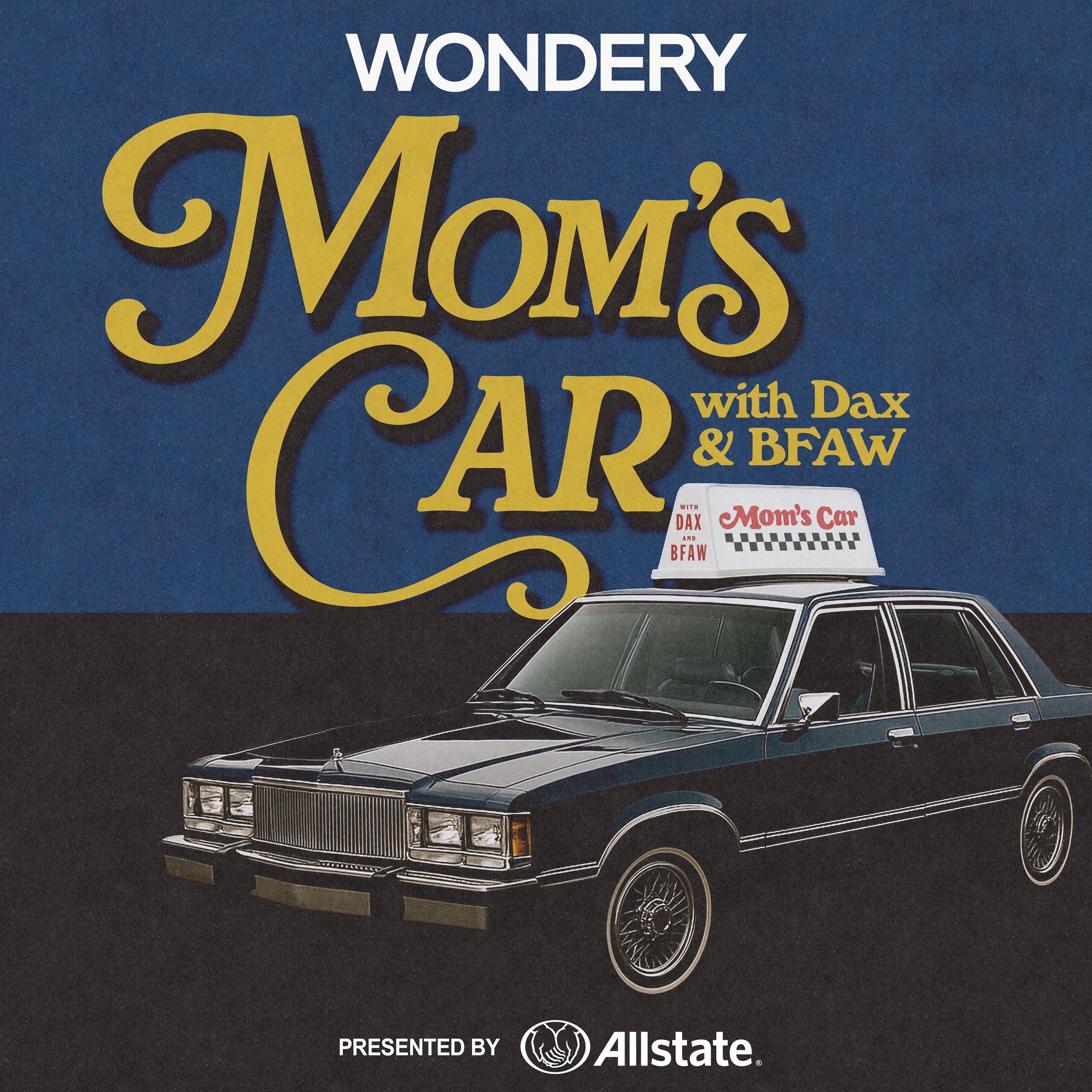
Mom's Car: Larry Trilling
On this week’s episode of Mom’s Car, we welcome acclaimed director of Parenthood and sweetest man Larry Trilling. Larry, Dax, and Best Friend Aaron Weakley talk through attending Santa Monica High School with the entire cast of The Outsiders, catching the directing bug making Super 8 films in middle and high school, directing the first Comedy Central original movie Porn and Chicken, learning how to motivate blocking with storytelling, and the gang discuss their top-five favorite movies and shows of all time.
#sponsored by @Allstate. Go to https://bit.ly/momscar to check Allstate first and see how much you could save on car insurance.
Follow Mom's Car on the Wondery App or wherever you get your podcasts. Watch new content on YouTube or listen to Mom's Car ad-free by joining Wondery+ in the Wondery App, Apple Podcasts, or Spotify. Start your free trial by visiting https://wondery.com/plus now.
See Privacy Policy at https://art19.com/privacy and California Privacy Notice at https://art19.com/privacy#do-not-sell-my-info.
Press play and read along
Transcript
Speaker 1 Hello, and welcome to Mom's Car.
Speaker 1 Today, and this is a long time coming,
Speaker 1 I think I talk about Larry Trilling more than any other director I've ever worked with.
Speaker 1 He directed something like 60 of the 100 and some parenthoods, and he's just the sweetest, sweetest, sweetest man I've ever worked with.
Speaker 1
And it's such a joy to have him in the car today and to get to introduce him to my best friend Aaron. We just had the most lovely, pleasant time.
He's so smart and he's so thoughtful
Speaker 1 and I just love him to death. Please enjoy Larry Trilling.
Speaker 2 You know what's smart? Checking all state first for a quote that could save you hundreds on car insurance. You know what's not smart?
Speaker 2 Not checking the coffee lids secure before you take that first sip. My morning coffee ended up all over me and let me tell you, that smell does not come out easily.
Speaker 1 Yeah.
Speaker 2
Checking first is smart. So check all state first for a quote that could save you hundreds.
You're in good hands with all state. Potential savings vary subject to terms, conditions, and availability.
Speaker 2 All State North America Insurance Co.
Speaker 1 and affiliates, North Brook, Illinois.
Speaker 1 So what state were you just in? Utah? I was in Vancouver, British Columbia. Oh, were you by Whistler?
Speaker 1 I actually drove up to Whistler for the day, rented a car and drove through Squamish and into Whistler. Have you been? Yeah, I went when I was probably 21.
Speaker 1
I was dating a girl that had moved to Bellevue, Washington, and then we were both snowboarded. It was very cool.
It was beautiful. All I remember is it was illegal to sell cold beer.
Speaker 1 So all of the liquor stores had these cooling tanks in front that were like ice-cold water, and you'd spin the beer in there to cool it down. That is insane.
Speaker 1
Yeah, there's another one of these systems where you're like, oh my God. So you can do it.
It's just you got to do it in a really complicated manner. Spins the beer around, flattens it.
Speaker 1
Either you can't have cold beer or you can't. You can't have a workaround.
What is the point of that law?
Speaker 1 I guess. I guess to discourage people from pounding them in the store.
Speaker 1 I guess, well, you know, remember the South always had the workers,
Speaker 1
the tall boy cans. At the register.
Yes, in the big bucket of ice.
Speaker 1
And it was like, well, you know damn well you're cracking it the second you walk out that door. And drive through liquor stores.
Oh, yeah.
Speaker 1
Okay, I've not told Aaron this because I knew it would be too exciting to learn about you before he was around you. He has a labradoodle.
Is that what you're going to tell me? Yes!
Speaker 1
That was it. That's the most interesting thing about me.
He likes some out. That's why I'm here.
Speaker 1 Aaron loves his doodle. When he walks his dogs in Michigan, people yell out the window, what kind of doodle is that? It's a very emasculating dog.
Speaker 1 Totally.
Speaker 1 Yeah.
Speaker 1 i've had the toughest guys go yo man what kind of doodle is that and i was like i'm anticipating a fight and i'm like oh golden golden doodle or both of them what's the little one a cavapoo he's a king charles cavalier and a poodle
Speaker 1 i wouldn't have predicted that for you in your future okay so We both, of course, like everyone, were obsessed with Outsiders, the movie, growing up.
Speaker 1 Oh, God, god yeah loved all gang movies aaron doesn't know that you went to school with virtually the entire oh you were in that they don't you went to santa monica
Speaker 1 high school with you know the penn brothers charlie sheen rob lowe
Speaker 1 and then i used to work out at the 24-hour fitness in brentwood and they all came in together tom cruise and rob lowe and the patrick's way they work out together see dollars howell and just kind of trot around brentwood together had their movies already aired did you have like a great interest interest in them?
Speaker 1 Well, Rob wasn't at school that much, so and he's a couple years older than me, but I remember when Class came out. Remember the movie Class? And they were like, that guy went to Samo.
Speaker 1
I said, oh, that's right. And I looked him up in the year, but he wasn't that involved in school versus like Robert Downey Jr.
was in the plays, and I saw him. He was absolutely riveting in this play.
Speaker 1
You thought that. Oh, my God.
He was magic. So Matt Reeves, the director, and I were students there.
And so we tried to get him to be in our film. Oh, okay.
Yeah, a student film. And a student film.
Speaker 1
And so he was like, How much are you going to pay me? Wow. And I said, no, we don't have any money.
He's like, no, no, no.
Speaker 1
He's already a professional actor, you know, but he was so unbelievable. So none of his success surprised me at all.
Charlie Sheen was a baseball player. He wasn't in drama.
Speaker 1
He was playing at Samo High. He played at Samoa and he was serious about baseball.
I think he may have had professional aspirations before acting.
Speaker 1
And then he did, what's the movie, The Cleveland Indians? Oh, Major League. Major League, yeah.
I remember reading that about him, that he was a baseball player.
Speaker 1
All those guys were a little older than than me. The only one I was actually friends with was Dean Kane.
Oh, wonderful. I mean, Superman.
Superman.
Speaker 1 Who didn't that school spit out? Well, the main reason why is because at that time, Malibu didn't have its own high school. It was the Santa Monica Malibu School District.
Speaker 1
So all those Hollywood kids lived in Malibu. Like the Sheens.
The Sheens, the Penn.
Speaker 1
Dean Kane's dad was a director. He directed Young Guns, Chris Kane.
Oh,
Speaker 1 he loved Young Guns.
Speaker 1 So Dean, I played basketball with, such a nice guy, an amazing guy. And then he went to Princeton, dated Brooke Shields, was the all-time leading interception leader in the Ivy League.
Speaker 1 Maybe took Brooke Shields' virginity, she said in her book.
Speaker 1
Could be. I think in her book, she said that.
Lucky both of them.
Speaker 1 Lucky both of them.
Speaker 1
I guess. You're right.
Superman. I hadn't seen him for a few years, and then it was kind of a low moment.
I was delivering pizzas, and I wound up delivering to him, and he answered. the door.
Speaker 1
How are you doing, Dean? He said, oh my God, I just got cast as Superman with Terry Hatcher. I'm going to be starring this show.
He's like, what are you up to? And I'm like, I'm giving you your pizza.
Speaker 1
I'm up to so much. It's even crazy I'm able to deliver this pizza in this moment.
So look at here we are. I'm delivering food.
So you never know. Nothing's popped up yet? Oh, no.
Speaker 1 It'll take a long time. Give him a name.
Speaker 1
We'll mostly just drive around and we pray that it comes up. Something will hit.
So none of those guys, though, other than Dean, were your direct age. At least one year older to a few years older.
Speaker 1
Holly Robinson also was there. Holly Robinson Pete.
Remember her? Holly Robinson. She's on some TV shows and movies.
She also married Rodney Pete, the football player. He was a Detroit lion.
Speaker 1
He was a lion. Yeah.
Oh, good job, guys.
Speaker 1 Sports college.
Speaker 1 Don't you think it says something about the evolution, and this is a debate you and I were just in recently, but nowadays, all those kids, because again, the Sheens are Martin Sheen's kids, right?
Speaker 1
Amelia Westevis and Charlie Sheen. A lot of these people had money.
Downey's dad was successful. Yep.
They would have definitely been at a private school now.
Speaker 1 It says a lot that all those kids were in public school. Yeah, well Santa Monica was a very esteemed school district back then and people moved to Santa Monica for the schools.
Speaker 1
And private school wasn't really much of a thing in LA yet. There were a couple.
Was Crossroads around? Crossroads was a weirdo experimental school.
Speaker 1 So it's not until the middle to late 80s did it become more established as a more mainstream place to go. And what about like the Harvard West Coast?
Speaker 1
Yeah, there was that class of kids that went to Harvard or Brentwood. If you grew up in Santa Monica, I mean, you went to public school.
That's why you would live there.
Speaker 1
What year did you graduate from there? I graduated to Santa Monica High in 1984. Was that when the Outsiders came out? 84, 85.
And then Rumblefish was like the year after, right? Yes.
Speaker 1
You guys Rumblefish fans too? Every S.C. Hanton movie I loved.
My favorite of all of them was That Was Then, This Is Now. Do you remember that one? Yeah, Emilio Steves.
That's right.
Speaker 1 And Craig Scheffer, right? Oh, sure, sure, sure. Do you ever ponder on this?
Speaker 1 There was a group of really famous young actors when we were younger that were leads and quite successfully leads and then they just kind of disappeared.
Speaker 1 That guy was one of them that you just mentioned. Well, I remember when Chris Sheffer was in, I think it was what, River Runs Through It.
Speaker 1
Oh my gosh. He was the bigger star.
Pitt was not the star. What a movie.
Speaker 1
Yeah. I'm going to have to get right down to the screen tonight.
That is
Speaker 1 a beautiful movie. It is.
Speaker 1
The narration's quite beautiful. I know.
I wonder about the people like that who, you know, if you have a little taste of that and then it goes away so quickly, is it painful?
Speaker 1
I mean, I think what would be for most people. Some people might make peace with it and say that, no, it's just a little chapter of my life.
Yes.
Speaker 1 And I've long had the urge to do maybe like a 10 episode little compartmentalized version of Armchair.
Speaker 1 where I talk to all those people, but I'm so afraid of approaching them and that it would feel to them like, where are they now? But I would just be more interested because I bet we're wrong.
Speaker 1 I bet a lot of people just saw their way out one way or another. And I think it's a battlefield for people who it happens to really young.
Speaker 1
Or that's interesting with someone like Ralph Macchio, who would have been that guy, but now he's having a renaissance in the same role. Yeah.
Like 30 or 40 years later.
Speaker 1 Has refused to learn a lick of karate.
Speaker 1
Sorry. I mean, like if you're on chips for 35 years and you never learned a word about it.
Of course. Yeah.
Believe me, I love the show.
Speaker 1 I watch it with my kids and I'm like, oh, he just really still hasn't worked out or learned karate, huh?
Speaker 1
And now he's doing it with Jackie Chan in a movie. So they make it.
Oh, yeah, yeah, that's right. I saw that coming up.
Speaker 1 And now I see it's the universe because I just saw a poster for like a karate kid something and it's like unrelated to all of it, but it's karate kid. Oh my God, the universe.
Speaker 1 Now, what age did you, Larry, set your sights on being a director? If you were offering Robert Downey a role in high school. It's interesting.
Speaker 1
Even though I grew up in Santa Monica and grew up adjacent to all this Hollywood stuff, I was not in that milieu at all. I didn't know anybody in the business.
What did your dad do?
Speaker 1 My dad was a stockbroker and my mom worked in her brother's pharmacy. You know, very middle class Santa Monica existence, upper middle class.
Speaker 1 But then I loved movies just as a viewer, but then I had the good fortune to meet Matt Reeves.
Speaker 1 He was just this little cinema geek genius from the time he was like 13 or 14 and he seduced me into his little world of filmmaking. Okay, he infected you, wasn't he? Yeah, he had a Fipper 8 camera.
Speaker 1
He had all the equipment and he asked me to write a movie with him. And then I wrote it with him and then I acted in it.
And then I just got bit.
Speaker 1 So we made three or four movies together in junior high and high school but he owned all the equipment so he got to be the director. And what kind of equipment are we talking about?
Speaker 1 Super eight super eight millimeter buttons sound so he had a more elevated sound system. Was his family in the business and anything?
Speaker 1
Yeah, his dad was an ABC television exec and worked with Michael Eisner. At one point had a little independent production company and made some movies of the week and stuff.
So Matt was my entree.
Speaker 1 And then we had this film that we made that got onto the public access station in LA. Okay, how did that happen?
Speaker 1 Because there was this dude named Gerard Revelle, and he had this show called Air Your Shorts. And so all the kids would send in their short films and he would air them.
Speaker 1
So we'd be like, oh my God, three o'clock today on Channel 3. Our movie's going to be on TV and we'd run home from school to watch it.
It was so exciting. Oh, that is so exciting.
And we met J.J.
Speaker 1
Abrams that way because our film and his film were in a film festival of these films that screen at the New Art Theater in LA. And where is he from? JJ's from the Palisades.
Oh, he is.
Speaker 1 I certainly meet a lot of people that work in this industry that are from here.
Speaker 1 But then also I've come up with people who were from here and they didn't have that same desperation, all of us who left our homes and our families.
Speaker 1 Your life would be a failure if you don't achieve that goal because it's the only reason you're here. How do you think it's a benefit and then how is it a curse? Well, that's a great question.
Speaker 1
I think the benefit is that you have better balance in your life. Like my family and friends are here.
My whole existence in LA isn't determined by the business, even growing up.
Speaker 1
So I wasn't feeling like a failure every second. I wasn't achieving my dream.
Like I was. Right.
That's probably the benefit.
Speaker 1 I guess the curse is that it's just, it's not a curse, but it's just like, I think I got bit just as hard as you or anybody who came here. Maybe I had the advantage of a little balance.
Speaker 1
I'm presuming you're that much closer to it because you're living in LA. You're seeing movie stars.
You're going to school with kids who do this already for a living.
Speaker 1
That must seem at least more achievable. Or at least you're meeting people that do it.
You're right. I think it seemed less impossible or distant or remote.
Speaker 1 I didn't grow up with people other than Matt and his family. I didn't know other people whose parents were in the business.
Speaker 1 Even so, it was just more part of the culture here and it seemed more doable. It made it impossible.
Speaker 1
It made it more or less difficult for you to announce to your parents, like, I'm going to go study this. I'm really blessed that that was not a challenge for me.
My parents were so supportive.
Speaker 1
They wanted you to be a stockbroker. Yeah, they were.
My dad initially wanted me to be a stockbroker with him. He wanted to teach me the business because he was very good at it, proud of it.
Speaker 1
And I just didn't have that in me. But he knew that pretty quickly.
And then he was like, all right, but if you're going to do this, first of all, he said, I don't want you to major in it in college.
Speaker 1
You want me to have like a good, solid liberal arts education to fall back on. So what was your major? I was an English major.
Okay. So it's just like a good liberal arts major.
At what school?
Speaker 1
At Columbia. Then I went to UCLA for film school.
So these are like, after you get your broad education, then we'll support you 100% going for it. Both my parents are really encouraging.
Speaker 1 When I meet young people who want to do this, and the first thing they say is, I don't know, my parents don't want to.
Speaker 1 I know they're not going to get there because that either has to not matter to you or it's going to stop you.
Speaker 1 But if you're mentioning it right away, it means it's probably ain't going to happen. It's not a great indicator.
Speaker 1
And how long after you got out of UCLA do you start being employed as a director? Several years. So college, then film school for four years.
Four years. Well, it's really like three.
Speaker 1 It's a lot of time for an MFA. I mean, mainly because
Speaker 1
four at Columbia, four at UCLA. Four years and no employment skills whatsoever comes out of it.
I mean, really, it's crazy. Because I was delivering pizzas during my time there and then after that.
Speaker 1 So yeah, I literally was like, here I come, Hollywood, but nobody cared. That's partly because it takes about a year to make a thesis film, raise the money, to shoot it, to edit it.
Speaker 1 And so it's probably like two to three years of classwork. And then you do a year where you're really just working on your thesis film.
Speaker 1 So I did that and it became a bit of a calling card and I got meetings and stuff and some encouragement, but it took a solid five more years before I made a nickel in the business.
Speaker 1 What was your like emotional state during that time?
Speaker 1 Were you ever considering deviating or for sure i mean i gave myself this artificial deadline of five years and said i'll go to law school in five years if i don't have anything happening and it was just maybe slightly more than five years but when that five-year ceiling was coming i was like i just got to take matters into my own hands yeah and so i co-wrote with my cousin a feature that we made then i sold a feature too that i co-wrote and that was produced as an independent low-budget film but the one that i made wound up becoming a calling card and got me an age and it finally started to get big ball rolling but that was five years and do you start in TV?
Speaker 1 Well, I started off making two independent films, and I definitely had a goal of being a movie filmmaker. Because that's what you had fallen in love with.
Speaker 1
Yeah, I mean, I like TV, but you know, when we grew up, it was all about movies. That was where the great acting and great storytelling was happening.
All the lines you were quoting.
Speaker 1
Yeah, it was just much more cultural. You know, the TV was fun and I liked it, but movies were.
It wasn't artistic at all. Yeah.
Speaker 1 I think it's funny if you were born 98 onward, that would be a crazy thought that the TV wasn't appealing or a little. I know.
Speaker 1 But it was either super procedural one hour or it was a multi-cam sitcom, pretty much. Right.
Speaker 1 And there were a couple of exceptions like 30 Something was incredibly inspiring or Hill Street Blues or shows that broke the mold a little bit that were more cinematic, more emotional, more meaty.
Speaker 1
What was the first TV show you got to direct? Felicity. Which was now J.J.
Abrams? Yeah, so that came full circle.
Speaker 1
So I made this feature film called Dinner and Driving, and it was a really fun little independent feature. Molly Shannon's in it.
Adam Scott is in it. Joey Slotten is.
We love Adam Scott.
Speaker 1 Do you love Adam Scott? I love Adam Scott.
Speaker 1
I gave him one of his first roles. Do you have like that sense of pride when you see him in Severance? 100%.
Him and the other one is Eben Moss Backrack. I gave him one of his first roles ever, too.
Speaker 1
It starred in Porn and Chicken that I wrote and directed. Which is Comedy Central's first original movie.
Porn and Chicken. Yes.
But you got a cough. Yeah, look at this.
This is called Petstaurant.
Speaker 1
Oh my God, I hope this is a good one. It's a dog.
It is. Look at it.
Oh, my God. The universe is a dog.
It's with us. Yeah, it's with us.
Speaker 1 If it's not a humbling enough job you deliver other people's food. The notion that you're bringing a dog as food is really unique.
Speaker 1 That's hilarious. I would like to just uber for dogs.
Speaker 1 A bunch of treats in your car. Right.
Speaker 1 They must have one, right? Because people need to get their dogs to one.
Speaker 1 Like to the bet. Yeah, you get bit attacks.
Speaker 1 So Felicity, did you knowing JJ play any role in that? Yes, JJ and Matt Reeves, they created the show together.
Speaker 1 So what happened was I made this feature film that I told you about and they really liked it. And they said, well, why don't you come and shadow and observe while Matt and I direct.
Speaker 1
JJ and Matt made that offer and I shadowed them. I hung around the set as much as I could and then they were incredibly generous.
They gave me a shot and went well.
Speaker 1 That was an incredibly popular show, right? It was never like an enormous hit, but it has a very devoted following.
Speaker 1
It's like Parenthood, but Parenthood was bigger than Felicity, but where it's grown over the years. Right, right.
Like, I think my daughters have watched it just like they watch
Speaker 1 Gilmore Girls. Yeah, like they are into all of the
Speaker 1
stuff still holds up. So when you started, I think, well, you tell me, I've only directed TV a couple times.
It's a tricky endeavor as opposed to movies. Yes.
Speaker 1 Because the director in a movie is the boss. It's the most important opinion on a set.
Speaker 1 And in television, the most important opinion is from the showrunner or the writer.
Speaker 1 And you're walking into a situation where the tone and everything's already established, so you kind of got to carry on the tone. It has its own unique challenges, right? Yes.
Speaker 1 What were you immediately good at? And what did you immediately go like, oh, I got to figure this part out?
Speaker 1 What's one thing if you're doing the pilot or the beginning first episode where you're really establishing the visual vocabulary and the style and tone of the show, that's different.
Speaker 1 But if you're coming in to do an episode and it's been established, you have to walk that balance of being respectful and mindful of what's been there, but then you can still have the ambition to elevate it or tell a great story story within the best version of it
Speaker 1 within the lines but the competitor in me was always like i'm gonna come and do the best episode look at all this ice cream this dog gets oh my goodness i'm joking it's not ice cream but it looks like it it's just a shit ton of dog flu wow
Speaker 1 this is great this is awesome i think i was good at kind of navigating that piece of the puzzle which is some episodic directors become too passive because they think they don't have enough of a role to play and they can just essentially come in and direct traffic which I know you experience as an actor of those kinds.
Speaker 1 And then they're ones who come and don't understand the show and are trying to take it in a direction that doesn't belong.
Speaker 1 So it's about really being confident and having a point of view, but within the boundaries of what the show is.
Speaker 1 And I think maybe if I had any early mistakes would have been not having enough confidence about where I thought, you know, like maybe listening to people who said, well, I think we should do it this way.
Speaker 1 And I might have deferred a little too much early on because, oh, well, they're here all the time, so they know. But really, the director is the one thinking about everything.
Speaker 1 And even if someone's been there all the time and they're the production designer or the editor or the dp whatever they're looking up their lane they may not necessarily be looking at everything yes and so i may have been overly deferential at the beginning to the other people that work there all the time yeah that dp or even a dolly grip or whatever i think we should push in here well no let's not we don't really do that and i was like well you know what Let's do that anyway.
Speaker 1
Right. So like finding my confidence, but that just came through experience.
And then also got a lot better at staging things.
Speaker 1 So one thing is blocking and moving the actors around in space and the dance between the actors and the camera.
Speaker 1 You go in by yourself and walk the set with the script and imagine how the actors are going to move through space. And then you write a shot list and you plan it that way.
Speaker 1
Well, when a talented, smart actor comes in, they might do something totally different in the rehearsal. I never come in that door.
I come in that door. Yeah,
Speaker 1 why would I sit there? I don't want to go there just because the shot is cool. I mean, it may have to be motivated.
Speaker 1 So A, I learned to motivate blocking with storytelling and also then to be able to be nimble enough to be like, you know what? Let's throw that away. Okay, let's do it this way.
Speaker 1 That's a skill set you have to to develop blocking for the camera.
Speaker 1 It can really throw an inexperienced director when the actors or anybody wants to change the blocking and you have to have the confidence to go like, you know what, that's a better idea.
Speaker 1 I don't look like an idiot for being overruled. I look good for being overruled because I recognize the better idea
Speaker 1
and just move on. So putting your ego aside, those are things that you kind of learn along the way.
Well, you are by far, and I would even argue of everyone I've ever worked with.
Speaker 1 I think you're among the best I've ever seen with dealing with actors. You're really, really, really quite good at it.
Speaker 1
And I did wonder if that was always the thing that came easy to you or that required a lot of learning as well. Well, thank you, first of all.
By a landslide. You're such a beautiful person to work
Speaker 1 and respectful. Well, I'm very touched.
Speaker 2 Because I can get triggered easily.
Speaker 1 Yeah.
Speaker 1
I'm sure you saw him. It's like male authority figures.
Well, you had a few battles, too. Sure.
But I mean, always very good-spirited. I think it was clear we loved each other,
Speaker 1
which helps. Yeah.
If you were a visitor and we had no rapport and you had to deal with that, then yeah, that was probably annoying for them.
Speaker 1 First of all, I did enough acting to at least understand a little bit about what the actor has to deal with and what the challenges are. Never aspired to do it professionally, but I did enough of it.
Speaker 1 And then I took classes directing actors.
Speaker 1 I had a wonderful teacher named Judith Weston who wrote a couple great books about working with actors, and she was really, really helpful in helping me develop vocabulary.
Speaker 1 Yeah, so what are some of the things? Because I have no formal education, so I'm just
Speaker 1
a formal education as an actor. Sure, sure.
And just being on sets for a long time. But I'm interested even that there is written about approaches.
I wouldn't have even known that.
Speaker 1 I mean, some of it is honestly just the natural empathic social skills, you know, about like understanding how to move someone in a direction of a more emotional place or whatever the aim of the scene is, whatever you're trying to get to, whether that's a laugh or a cry or whatever it is.
Speaker 1 And then what are the behaviors? But that's the thing that I learned from Judith Wesson is that don't talk about the result of what you want want to see. Don't give the adjective.
Speaker 1
Talk about the process, how they're going to get there. Talk about the verb.
So instead of saying, be angry at Aaron because he fucked up the delivery,
Speaker 1
no, scold Aaron for missing it. You know, attack Aaron.
Don't tell them what emotion they're supposed to have. Don't tell me, because by the way, someone could attack someone very quietly.
Speaker 1 Someone could attack someone very loudly. Another one is a really good one is the using an imaginative substitution as if.
Speaker 1 Like open the door as if you hadn't seen this person in 10 years, even if that's not what the scene's about.
Speaker 1 Or think about when you had a reunion with someone, you know, as if you had to confront your parents with something that was a very shameful, or trying to put the actor in the imaginative space of something urgent and emotional.
Speaker 1 As opposed to just saying, Can you be angrier here? Can you yell real loud and thrash this thing around?
Speaker 1 And then it becomes, you know, if the actor can process that and find a way to make it internal, great, but you haven't helped them get there. Right, right, right, right.
Speaker 1 You're like a football coach, too. I interviewed Pete Carroll and I was just fascinated.
Speaker 1 He gets this group of young men and some of them have had no dads and some of them have had a great dad who they love getting the approval of.
Speaker 1 And he clearly has to have two almost diametrically opposed approaches for those two situations.
Speaker 1 Do you think you got good at thin slicing personality types where you could go like, oh yeah, I need this approach for this person? I think so. Some actors really want a lot of engagement.
Speaker 1 They want to talk about everything, the whole life history of their character.
Speaker 1 Do you believe that? Because as a fellow actor, I'm like, this is all bullshit.
Speaker 1 You want us to know you worked really hard on this because we all have this guilt that the job is too easy, which it is too easy and it's too fun and you get paid too much money.
Speaker 1
You have to really demonstrate at all times, like, I'm working so hard at this. And I just, for the most part, I kind of reject that.
Yeah. Well, you're not that kind of an actor.
Speaker 1 For me, it's like whatever gets you there.
Speaker 1 For some people, that's their training, and especially actors that come out of the theater and they want to be able to be a deep well and pull from different imagined experiences to create the character.
Speaker 1
I think it's valid, but it's definitely not everyone's process. The challenge is when you're working with two actors that working together who have opposite processes.
So
Speaker 1 like when I worked on Goliath, I got to work with two of my heroes, Billy Bub Thornton and William Hurt, and they had opposite approaches.
Speaker 1 You know, William was a Juilliard-trained theater actor and I had to spend hours offset with him.
Speaker 1 And this is a guy who was like an Academy Award-winning, amazing actor, but he had really wanted to investigate the text in a way that was so exhaustive and could be exhausting.
Speaker 1
And Billy was like, if I talk about it, I'm ruining it. Just say action and let's see what happens.
Yes, yes.
Speaker 1
And so those two guys in a scene together, one who wants to rehearse for weeks and one who refuses to rehearse. Yeah.
The one who refuses to rehearse wins because he can't make him show up.
Speaker 1
So I would rehearse with William privately, and then Willie would just do his thing on the deck. And they're both amazing.
So it's like, to me, as long as you get the performance.
Speaker 1 Well, I got to say, I was in the tricky situation on chips, which is Pena's very much like William Hurt, and I'm very much like Billy Bob Thornton.
Speaker 1
So we have the weird dynamic of scene partners who have a different approach. And then we have me directing and I have to do for him things I wouldn't do as a scene partner.
It's very complex.
Speaker 1 When you were off camera and he's on camera, were you being more of a director than a scene partner? Like were you manipulating his performance through your off-camera performance?
Speaker 1 So I was definitely manipulating my off camera, right? Because what's easy for me is to go big. And he is an incredible actor and he's reticent to just go big.
Speaker 1
Like if there's explosions going off, like I want to hear screaming and blah, blah, blah. And so that wasn't his first instinct.
And I would just be so big, knowing I'm not even going to use it.
Speaker 1 Just minimally, he'd have to match somewhat.
Speaker 1 There was that dynamic, but the one I totally missed, it took me a good two or three weeks of filming before this occurred to me, which now is so obvious and stupid is we would cut.
Speaker 1
I wouldn't go anywhere. I'd be like, oh, that's great.
Let's do it a little faster, blah, blah, blah, right? And I would just say some things. And that was going on for a few weeks.
Speaker 1 And then one time I yelled and I go, Do you know that I say to myself, Dex, you got to be way louder and have way more energy?
Speaker 1 I go, You're not hearing it vocalized, but I'm beating the shit out of myself in my head. And then I talk to you, and he was like,
Speaker 1
Oh, yeah, I'm glad I know that. And then I was like, Yes, of course.
He must think he's never heard me receive an adjustment. Now I'm making adjustments, but he's not receiving it.
Speaker 1
He's just hearing adjustments for him. So that's the theme part.
Yeah, but the other guy's crushing it. i'm making all these things
Speaker 1 he thinks he's flawless on take one
Speaker 1 i was sympathetic to that but it just went over my head i'm like oh he knows i beat the shit out of myself and i hate everything i do i really admired that ability to be in those two spaces at once because you have to be so present for the other performance and then you have to give your own.
Speaker 1
Did you ever act outside of high school? Not seriously. I was in a few student films.
It was never going to be my life's ambition. I just didn't have it.
Did you love it, though? Yeah, it's fun.
Speaker 1
It's really fun. Yeah.
Pretend.
Speaker 1
Yeah. Yeah.
How about you, Aaron? Have you ever done any performing? Oh, gosh, no. He should have been.
He should have come out with me. Yeah.
This would have been a comedy duo.
Speaker 1
Yeah, that would have been fun. Regrets, right? I enjoyed performing.
Yeah, junior. Just being like spontaneously funny and goofy.
And three guys kind of like a team together that way. We were a duo.
Speaker 1 I'm sure you've heard me say this, but for both of us, the best year of our entire lives. And I've had a charmed life.
Speaker 1 Still seventh grade is the best year of my life.
Speaker 1 Did you grow a bunch that year, right? You got 12 years ago. No, it was already enormous, but I had moved to a new junior high and Aaron and I had become friends and we became friends in a way.
Speaker 1
And I'm sure you have these. Everything became crystal clear, which is like, as long as Aaron's laughing, I don't care what anyone else thinks.
I have a single audience member in my life now.
Speaker 1
It's so important to me that I make him laugh. And I think vice versa.
And I think when you're that age, that reads us such confidence. So we became this really popular duo.
Speaker 1
Like the kids would imitate whatever voices we made up and we go to parties and act obnoxious and everyone loved it. We were movie stars.
We just were so popular all of a sudden and we loved
Speaker 1
it so much. And did it grow from 7th to 12th or where did it go from there? We had a couple year gap in our seeing each other.
Do you guys have a follow-up?
Speaker 1
We were starting to go on divergent paths. I was into being bad, but I wasn't into stealing four-wheelers.
I was into throwing apples. I wasn't into smashing plate glass windows.
Speaker 1 I was into stealing cigarettes from the store, but I wasn't into getting hammered and huffing gas.
Speaker 1
Mild delinquency versus serious delinquency. Yeah, yeah, yeah.
I couldn't make the cut at some point.
Speaker 1 Yeah.
Speaker 1 Stay tuned for more mom's car.
Speaker 2
We are supported by all state. You know what's smart? Checking all state first for a quote that could save you hundreds on car insurance.
You know what's not smart?
Speaker 2 Not checking the back seat of your car before telling your coworkers to hop in.
Speaker 2 Nothing like having to explain why there's a half-eaten sandwich from last week and what appears to be every napkin I've collected since 2019 back there.
Speaker 2 And speaking of car-related mishaps, not checking the height clearance before pulling into a parking structure, that's definitely not smart.
Speaker 2
The sound of your roof rack scraping concrete is something that stays with you. Yeah, checking first is smart.
So check All State First for a quote that could save you hundreds.
Speaker 2
You're in good hands with Allstate. Potential savings vary subject to terms, conditions, and availability.
Allstate North America Insurance Co.
Speaker 1 and affiliates, North Brook, Illinois.
Speaker 2 We are supported by Uber Eats. Hey guys, did you know that you can order from the Home Depot on Uber Eats?
Speaker 1 Yeah, that Home Depot, really.
Speaker 2 And here's the kicker. Right now, you can get $30 off, $70 or more when you order from the Home Depot on Uber Eats.
Speaker 2 So if you're in the middle of a project and realize you're out of light bulbs, glue, or that one tool you swore you had, don't stop what you're doing.
Speaker 2
You can get your home improvement essentials delivered in as little as 25 minutes. No waiting on shipping, no last-minute store runs.
Just tap and get back to work.
Speaker 2 So stock up on DIY essentials, holiday decor, small appliances, or household must-haves like cleaning supplies and trash bags, all without leaving your project behind.
Speaker 1 Order from the Home Depot on Uber Eats.
Speaker 2
Ends 1231, exclusions may apply. Terms and minimum order apply.
See app for details.
Speaker 1 But then we caught back up in in 11th grade and it was as if no time really had lapsed. I couldn't believe, like, why did I even leave this? Like, I didn't like that other stuff.
Speaker 1
I don't know what I was doing. It was just all fighting and getting fucked up and stealing shit.
Yeah. Sean Penn bad boys.
Yeah, at that age, you're exploding in all different directions.
Speaker 1
It's all happening so radically. And Aaron's home life was considerably worse than mine.
Mine had straightened out by the time we met. That was the sweet spot of my life.
And there was no stepdad.
Speaker 1
Financially, it was working. Everything for me like started getting good and promising.
And then all of a sudden, I met him, who was the most understanding and non-judgmental and very caring.
Speaker 1 And it was something you rarely would see in a
Speaker 1 in a young, in a young man. Yeah, I love
Speaker 1 Aaron so much. Yeah.
Speaker 1 Have you always been easily express your affection for people and that kind of thing? That's been something. Have you always been like that?
Speaker 1 We came to the conclusion that, oh my God, did you just always want a child since you were 12?
Speaker 1 Like, he just needed to take care of someone always.
Speaker 1 Yeah. Aaron's been calling me dad since we were in jail.
Speaker 1
My nickname. Yeah, that's beautiful.
Like, I got him a car for Christmas in 11th grade. I like, yeah, I got this car running.
And I'd be like, look what my dad got me.
Speaker 1
This is the great love story of my life is Aaron Weakley. Yeah, I know.
When we got back together in high school, Aaron was now sober. I was sober.
Speaker 1
Then we entered the punk rock scene full on every single weekend. We went to shows.
In Detroit. In Detroit.
What were the main bands? Like, who were you guys hardcore into?
Speaker 1 At that time, it was a lot of bands from Washington, D.C.
Speaker 1
We were into like that straight-edge Ian McKay. You know, Fugaz, yeah.
And
Speaker 1
his label was Discord. So everyone on Discord, we liked.
But we go to these wild shows, Larry, that were like Sick of It All was a band from New York.
Speaker 1 And half the people that followed Sick of It All were like straight-edge progressives like us. And then the other half were straight skinheads, like racist skinheads.
Speaker 1
And you'd go to these shows and it was just terrifying in the most exhilarating way. Would you get into the scrum with them and bash around? Oh, they guys, yeah.
Sure.
Speaker 1
But we also, we were the jesters there. It was almost seventh grade all over again.
Like we had this little scene and we did weird stuff and people thought it was funny.
Speaker 1 And yeah, we're just kind of back in business. You know, when we graduated, we then went and lived in the car for six months together, driving around the country.
Speaker 1
And then when we got home, everything was honky-dory. And then I just woke up one day.
I was like, I got to get out of here immediately. You got to go to college? I'm having so much fun.
Speaker 1
We drink every day. Yeah.
He was like, I got to go back to Los Angeles and try to do something. Yeah.
And I was like, see
Speaker 1 already?
Speaker 1 Like, right, I'm kind of like just getting my foot in the oven here. What was that inspiration, Dax? Like, why did that happen? When it happened?
Speaker 1
I just could see my life was very obvious what was going to happen, which is I worked for my family business. My brother and mom were partners.
I was getting entrusted with more stuff.
Speaker 1
I was kind of good at it. And I just was like, this is what I'm going to end up doing.
I'm going to blink and I'm going to be 30. I just had the sense that I was going to blink and be 30.
Speaker 1
I got myself in kind of a really fun cage that maybe I'd be afraid I wouldn't break out of. And then when I came to California, it was like, I want to be Bukowski.
That's all I wanted to be.
Speaker 1
I wrote every night for hours and I submitted short stories. I was obsessed with that notion.
And then also I told myself I'll do stand-up and I never did it in Santa Barbara.
Speaker 1 And then I took a little trip on the weekend to LA and I did an open mic night and I was like, okay, we're in. We're going to move to LA.
Speaker 1 And I had met someone that explained the groundlings to me and that was less scary. And so I was a little embarrassed in our friendship group that I was out here pursuing acting.
Speaker 1
Did it just seem soft? It felt soft. Yeah, yeah.
It felt emasculating somehow that I was doing this. What were you doing to pay the bills then? Still working for my mom's company.
Speaker 1 All through college on the weekends, I'd get out of class at UCLA at like 2 p.m. and I'd immediately get in a car and I would drive all night and get to Detroit Friday night.
Speaker 1 I always got there around midnight. We had two hours and then we would get shit faced to like four in the morning.
Speaker 1 And then I'd wake up on Saturday at like seven or eight in the morning and get in a car and drive back to LA. Oh my gosh.
Speaker 1 To LA in a weekend. Yes, back and forth.
Speaker 1
And then go to school Monday. And I would do often twice in a month.
And every single time, it was always when I'd be in Colorado on the way back. I would go, I can't ever do this again.
Speaker 1 I cannot say yes when they asked me next weekend.
Speaker 1 And I couldn't resist not partying with my friends because I didn't live there and I was so excited to be home.
Speaker 1 I did that or then in the summer we would go away and do these big elaborate events at racetracks where you'd invite car journalists and they would drive all the new GM cars and those would be a week long and you could work 100 hours and make a lot of money.
Speaker 1 And then I worked at CPK for a minute, but generally I just did that. So one thing I thought could be really fun, Larry, to talk about is to make a couple lists maybe.
Speaker 1
And people may or may not know, 99% of being on a set is not acting or filming. It's hanging out, waiting for them to light.
waiting for something to happen.
Speaker 1
And you're really just shooting the shit nonstop. And you and I had just endless interest in each other's opinions.
Monday's a great day because everyone's watched 60 Minutes.
Speaker 1 How do we feel about 60 Minutes? But along the way, I discovered that I think you and I have very similar tastes in movies. We seem to have almost identical.
Speaker 1
And so I thought, because Eric asked you to make him a list of movies he should watch with his daughter. Right.
And you did. And he has loved it.
Speaker 1
And he is supposed to have forwarded me that list, which he's forgotten to do over the last few days. But I thought maybe we could do some top, like top five comedy, top five drama.
Okay, all right.
Speaker 1 You have time to think right now while I go up to get to think about it.
Speaker 1 How often do they know you can't almost never?
Speaker 1
Yes, it's a wonderfully humbling experience. Kristen went with us once and people saw it.
Yeah, and every single person. Yeah.
Speaker 1 All right, nice meeting you.
Speaker 1 Bye.
Speaker 1
Well, that was cute. Yeah, that was lovely.
Cute dog. It was a doodle.
How do you, Janie? Can you even believe it?
Speaker 1
It's meant to be, man. It is meant to be.
I mean, I can't believe that's where we started and our pickup was at a pet restaurant. And have you not been holding it? That is insane.
Yeah.
Speaker 1 So, well, I guess my first question before we do a list is, I'll go first. So you know what I'm saying? Yeah, yeah, yeah, yeah.
Speaker 1 The very first thing I ever watched that made me question what is going on that makes this what it is was Raising Arizona.
Speaker 1 Where you were thinking there's a voice or a person or an entity that's making this happen. It's just unfolding in real time.
Speaker 1 And more than that, you know, remember the sequence where he steals the Huggies and he's running down the street and then the dogs are chasing him through the house.
Speaker 1
I mean, what I didn't know then is like they're on a 17. They're on this really wide lens, which looks very specific.
And most things are not shot in that.
Speaker 1 So like A, just visually, there was something going on that was much different.
Speaker 1 I just started realizing like, oh, these are assembled and manufactured in a way that they can come out differently visually. And then obviously it was so original tonally.
Speaker 1 I think before that I just took movies as a matter of fact, here's a movie. I love movies, but I never got bogged down into like the mechanics of why it was pleasurable or that I liked it.
Speaker 1 That was kind of my gateway movie. How about you? Did you have a gateway? Yeah, but I think it was Annie Hall for different reasons because I didn't really develop a visual sensibility as much.
Speaker 1 I think I had more of an ear for dialogue and for behavior.
Speaker 1 The eye came later, but the way that people talked to each other and the way that he talked to the camera directly, the snappy banter and the way that there was a combination of comedy and then genuine emotion.
Speaker 1
How much of it that there was a Jewish lead? Was that in the mix? That was in the mix. That sort of self-deprecating, neurotic, Jewish trope was very familiar.
And hadn't really been done or had it?
Speaker 1
It had, but not in that particular way. Definitely there were TV characters like that.
But I would imagine those were Gentiles kind of lampooning what they had witnessed versus coming from the inside.
Speaker 1
Yeah. Also, he would always get the girl even though he was nerdy, you know? So I think that spoke to me.
Yes, yeah.
Speaker 1 Also like the smart guy wins kind of thing, you know, it's not that jock, it's the smart guy wins, he gets the girl, you know, so it was part of that.
Speaker 1 But it was really just the idea that there's this music to the language and there's a romance about New York City and that I just felt swept up in it.
Speaker 1 Movies were always immersive, but something I was just ready to go to recognize that there was a hand in that.
Speaker 1 And I think it was easier to know that because Woody Allen wrote directed and starred in it so it was very clear to go oh that's his movie and he made this as his point of view and his sensibility right it wasn't a committee right that's when I realized oh there's a point of view like you were talking about from a visual standpoint yeah well related to that reaction my breakthrough in that realm was definitely pulp fiction which I was like 18 I think when that movie came out I'm just starting to go to weird movie theaters that aren't the cineplex to see things and that was the first time I was like, I wouldn't have, again, known this language at the time, but where dialogue could be the set piece.
Speaker 1
Dialogue could be the big monster. It could be the big attraction.
And I found that like you, I always loved communicating. I loved words so much.
I loved vocabularies.
Speaker 1 And I just thought, oh, wow, I'm very attracted to that. And I think I could write like that.
Speaker 1
Do you remember watching Pulp Fiction the first time? I do. I loved it for all the same reasons you did.
But I think just like with music, I'm older than you. I was already steeped in loving movies.
Speaker 1
But I do think that with movies and with music, between the age of like 13 and 20 is the spot for things making lifelong gut-punching impact. Yeah, they are.
I think after that, it really diminishes.
Speaker 1
Even if you love something, it's unlikely to be seminal in your creative thinking. Yeah, you don't incorporate it into your identity.
Yeah. Yeah, you were, what, 27 when that came out.
Exactly.
Speaker 1
So you had already kind of defined your identity. Yeah, but I did love the movie.
It's nothing against the movie. It's just literally how it hits you.
If you had to list the top three Tarantino.
Speaker 1
Well, first of all, how big of a Tarantino file are you? Some people are obsessed. I'm obsessed.
Yeah, I would say not as far along as you are, but I love him and admire him.
Speaker 1
My very favorite movies make me feel deeply. Right.
And his don't. They are wildly entertaining.
Yes. They're visual delights, and I love them, but they don't rock my world.
Speaker 1
Water doesn't come out of my face watching the movies. So my favorite movies do that for the most part.
Like something about it just gives me the chills and I don't get that from him. Not a criticism.
Speaker 1
That's not what he's trying to do. Let me ask you this.
You are very, very, like, I guess I get credit often for being very emotionally available as a dude, but you're even nine years ahead of me.
Speaker 1 Were you hiding that side of you or were you very comfortable being that way? Because I think that's something I like a lot about you. Thank you.
Speaker 1 I was comfortable with it, but I had conflict because I always got along really well with girls and women, you know, growing up.
Speaker 1
But I think that I put myself in the friend zone so often with girls I actually was attracted to. Yes.
I didn't have any game. I was just like, I really like you and I want to know all about you.
Speaker 1
And pretty soon it's telling me about all about the guy they have a crush on and I have to hear all about it and it sucks. I wish that I didn't reveal it so much.
You paid a little price for it.
Speaker 1 I paid a price and I also feel like maybe because I have this high lispy voice that people maybe thought I was gay and you know stuff like that.
Speaker 1 Were you self-conscious of that self-conscious about being effeminate yeah and so that thing
Speaker 1 of being emotionally available and all that was it was a super prize to me it wasn't like there wasn't a whole lot of currency did make me popular but in terms of where the currency was you know getting girls getting the girlfriend it didn't help me there so i think it would have if i made a little pivot looking back like i could have done that and just been more confident with it you could have been swimming in ass totally yeah
Speaker 1 you would have mixed in a couple wheelies on dirt bikes that's what i did and that's in the level everywhere. But I think they underestimated the humor.
Speaker 1
You guys were funny, and you could do the wheelies. But they say, you know, if you can make them laugh, you can make them breakfast.
You know,
Speaker 1
I love that expression. Oh, I like that a lot.
You can make them laugh, you can make them breakfast. Yeah, so I think, I wish I knew that a little younger.
Speaker 1
Okay, so if you were to just give me your top three Tarantino movies. Top three Tarantino movies? In order.
Yeah, in order. Okay.
Speaker 1
I'm going to go... Is Kill Bill one movie or two movies? Great question.
I'll let you pick that as one. Okay.
Yeah. I'm going to go Pulp Fiction, Kill Bill.
Speaker 1
To me, those are above everything else by a lot. Okay.
And then I would say the next one, I could go for either Reservoir Dogs or Inglorious Bastards.
Speaker 1
Okay, now I'm going to make an educated guess right now. Okay.
I'm going to predict that you saw Once Upon a Time in the theater and you have not seen it since. That's correct.
Speaker 1
And I do like it, but it didn't even occur to me. You must, must, I proselytize this movie.
That's all I talk about. I have watched that movie six or eight times in the last 18 months.
Speaker 1 And then he asked me, when's the last time you've seen this? Like when it came out? So he watched it again. I watched it again when I got home.
Speaker 1 And I was like, oh my God, he was fucking right. How did I not love it that much? I know sometimes you have to watch it a couple of times, but yeah, then I.
Speaker 1 So I would have put Once Upon a Time after the first viewing, I would have put it in like the four or five slot. And I'm telling you, now it's number two.
Speaker 1
And it's like, the more I watch watch it, it's almost challenging pulp fiction. Wow.
I really need you to watch it again as quickly as you can possibly.
Speaker 1 The ending sequence in the house is the craziest 20 minutes of a movie of all time. And you'll have the revisionism of it is so great.
Speaker 1 You know, it's like, oh, if only it turned out this way, you know? Yes, if only Cliff Booth had intervened.
Speaker 1 Well, what you're hitting on, though, is I've thought a lot about this because people have often asked me my favorite movies. And so I decided to make a list, my 100 favorite movies.
Speaker 1 This is a long time ago.
Speaker 1 But then I decided I have to figure out the right criteria because i'm not really a cinephile like i am that i love and adore movies but i'm not a person who can tell you everything about the french new wave and italian neorealism you've already blown by my knowledge right so i don't have a comprehension
Speaker 1 i thought you both knew what that was i'm not an erudite film person like if you would talk to certain filmmakers who've watched everything tarantino tarantino martinscorsi james gray these guys they've seen everything yeah i'm not that i'm pretty mainstream taste yeah yeah me too my favorite thing is Smart Hollywood movie.
Speaker 1 And I like other things too, but I said I have to make my own criteria that is not pretending like I could be a film critic standing here telling you what the greatest
Speaker 1 graduate class.
Speaker 1 So I made it very clear to say favorite, not best. What makes a favorite film? There are three things
Speaker 1
and the favorite film ideally hits all three, but must hit at least one. Okay.
One is the size of the impact it had on you when you first saw it. How much did it blow your mind?
Speaker 1 How transformative was it? Number two, how
Speaker 1 relevant, important, influential, culturally, speaking, where does it rank among in its time, in its place? How is it, you know, how important is it? How much did it influence people on culture?
Speaker 1
Right. And the third thing is, how re-watchable is it? There's many films I love I don't ever want to see again.
I don't ever want to watch Schindler's List ever again. Yeah, agree.
Speaker 1
You know, you couldn't pay me. I loved it.
But
Speaker 1
The Godfather, Shaw Shank Redemption, there's movies. If they are on, I'll just watch them.
Those are your criteria. Are you open to giving me, though, in genres?
Speaker 1
Could we start with what you think are a few of your favorite comedies of all time? Okay, so I told you Annie Hall. That's number one.
Yes. Of course, you can't take that one away.
Speaker 1
Other Woody Allen movies on there that haven't aged as well, but that I used to love Manhattan was one of my favorites. Now it's sort of creepy and what happens.
What's he doing now?
Speaker 1
Well, he's a 43-year-old. He's in love with Mariel Hemingway, who's 17.
Oh, you know,
Speaker 1
he actually did wind up marrying his stepdaughter, so like it has that kind of unsavory. It it hasn't aged well.
Yeah, yeah, yeah.
Speaker 1 But I did love Manhattan.
Speaker 1
I loved the in-laws. The in-laws is amazing.
Alan Arkin and Peter Falk. It is hilarious.
I love
Speaker 1 Herbie Goes Bananas.
Speaker 1 I was thinking,
Speaker 1 I mean, I love something about Mary.
Speaker 1
Thumbs up there. Something about Mary.
Yep. How about you? What are your top comedies? Okay, it is Raising Arizona.
That's my pulp fiction of comedy. Yep.
And then Fletch.
Speaker 1 One that I had the most joy in the theater watching was Airplane. Because that was exactly the right age for it.
Speaker 1
And it was just mind-blowingly hilarious. Yes.
I think that's the hardest I've ever laughed in a movie. Sure.
Speaker 1 So that's the thing with something about Mary, too, which is like, I don't necessarily want to re-watch it all the time, but how hard I laughed in the theater watching it. Yeah.
Speaker 1
Surely you can't be serious. Yes, I'm serious.
So don't call me Shirley. He was great.
I mean, naked guns.
Speaker 1 My third comedy would be Flirting with Disaster. Oh, that's way up there for me, too.
Speaker 1
What a movie. It is great.
That's the Ben Stiller, right? Yeah. You know what?
Speaker 1 That's way up there.
Speaker 1
Okay, now what about dramas? The Godfather movies. Are they dramas? Or are they crime thrillers? I don't know, but they're dramas.
One that I really adore is Ordinary People.
Speaker 1
I just find it deeply emotional. Makes me cry every time.
And you can re-watch it? Yeah, very much so. Shaw Shank Redemption is way up there for me.
Yeah. Is Michael Clayton a drama or a thriller?
Speaker 1
I would put it in my drama. Okay, I'm going to put that way up there too.
My number one drama of all time is Thief, Michael Van's.
Speaker 1
I just re-watched it. It's pretty spectacular.
I've watched that movie more than any other movie. And you know, my history with this movie is I would get drunk.
Brie would go to bed.
Speaker 1
I'd be kind of blackout drunk. I'd watch Heat, and then I'd get crazy.
And I stole the parking meter. I like went and dug up a parking meter because I just want to steal it.
Really?
Speaker 1 I tried to rob 7-Eleven with a fake gun.
Speaker 1 After watching Heat. Yes, and Brie was like, you're not allowed to watch this movie after I went back to the movie.
Speaker 1
I He threw the PCR out the window. I would watch Thief.
Almost every night I was hammered that she went to bed. God, what was it?
Speaker 1 Yeah, he used to call me and tell me about the next thing that he had. I remember going to Santa Monica and there was a fucking parking meter in the living room.
Speaker 1 Yeah, and you couldn't get into it, of course. Wow.
Speaker 1
Yeah, that movie would make me crazy. Inspire this antisocial in you.
Well, it was this self-righteous, justified, I didn't have anything and I'm going to take it.
Speaker 1 It's so toxic and dangerous, but I do recognize I was fully like, well, I didn't get what I deserved and now I'm going to take it because fuck everyone.
Speaker 1 And this is my one chance on planet Earth and I'm not going to not experience this. And in my mind, I was, am I going to be rich from these like stealing the parking meter
Speaker 1 at the time?
Speaker 1
And the best part of me stealing the parking meter is you couldn't really pick it up because I took the concrete with it. Yeah.
Then drug it to my apartment.
Speaker 1 If you were missing this parking meter, all you'd have to do is look at the sidewalk and I drug it all the way up to my cops and then fucking got it up my steps.
Speaker 1
And then Brie comes out in the morning. I'm now passed out.
And she wakes me up and she's like, there's a parking meter in the living room. Did you ever break it open? Did you get the change out?
Speaker 1
Oh, no, I would shake it. I saw I got a hacks on.
I cut the top off so I'd get rid of the posts and the cement. And then I would shake it.
Speaker 1
No, I cut that thing somewhere on planet Earth with all the change in it. Oh my God.
No, I was never successful on any of them. The 7-Eleven thing was a big thing.
He said, give me your money.
Speaker 1 And the guy said, no.
Speaker 1 Panicked and then sprinted out of the zone
Speaker 1
and got on my motorcycle and rode way too fast all the way home. So I'm like, well, no, the police are coming.
Okay, let's talk TV shows. I think that should be our last breath.
Okay, great.
Speaker 1
What's your all-time favorite TV show? Ooh, might be Breaking Bad or it could be Mad Men. So the newer offerings.
The Sopranos in your list. Sopranos up there, Friday Night Lights, 30 Something.
Speaker 1
Those are the ones jumping right out. Of course, can't be objective about Parenthood, but I would hope it's up there somewhere.
Maybe it's one of my favorites.
Speaker 1 I think people would get a kick out of this. You and I were in the pool the other day, and we were like trying to understand whether or not Parenthood was as good as Friday Night Lights.
Speaker 1
Because Jason Katom, same creator, same showrunner. And we had many cast members from Friday Night Lights on Parenthood.
And we would always.
Speaker 1
or I would always gush about Friday Night Lights like, well, you were on the best Katom show ever. And they often said, no, Parenthood's better.
Yeah, Minka said that, right?
Speaker 1 And I thought, yeah, I guess you can only know so much about the show you're inside of.
Speaker 1 I asked Pitt that when I interviewed him, I asked Brad Pitt, is the only bummer about being in these Tarantino movies is you can't actually watch the Tarantino movies without it being very skewed.
Speaker 1 And he said, there's no bad part about being in a Tarantino movie.
Speaker 1
That's awesome. That is awesome.
And then I couldn't hear anything else he said. You're just like, oh, I love him.
Speaker 1
I love him so much. It's very fun to love a man that way.
Oh, yeah.
Speaker 1
He knows how you feel about him. Yeah, I think it's pretty obvious.
We even talked about in the interview that I have two versions of him.
Speaker 1 I have this person I know, which is just a person, but I very much hold Brad Pitt on screen as this other person that I'm in love with and obsessed with. Does he embrace that duality or recognition?
Speaker 1 Yeah, see, I asked him if he could relate to that and he said, for sure. First started with Redford.
Speaker 1
And then he said, you know, who's really like that for me is Sean Penn, which is like, he'll always be Sean Penn. Right.
And yet I know him. And we're friends.
Right.
Speaker 1
And I'm like, yeah, I I have that with Downey. Robert Downey is still this angel that fell out of the sky.
And he's a dude I know. Right.
Speaker 1
And they're friends. Yeah, they can coexist.
Lastly, as we're parked, we've kind of talked about this loosely. I think people who did love parenthood would know, like, would we ever do that again?
Speaker 1
I think Jason would be down. I've talked to him about it.
Oh, really? He would have to figure out a way to do it that wasn't just. Well, it wouldn't be a repetition, but what's a fresh take on it?
Speaker 1
Would you want to be part of something like that? I would want to be on a set with you again for some years. Yes.
That sounds really fun. Well, let's make that happen.
Speaker 1
That would actually just be the priority. Let's make that happen.
Yeah. You have to consider the notion of it's kind of like going back to high school.
Speaker 1 And that would be tragic because if we went-I don't want it to be the high school reunion where you're like, oh my God, everybody looks not that great.
Speaker 1 We go back, and that magic that I just cherish is not there for whatever reason.
Speaker 1
Well, there's numerous reasons that could be. You're doing all your own stuff.
I've quit acting. There's a lot of reasons it could go sideways
Speaker 1 When I found out I had to work more than three days a week,
Speaker 1
I could backfire. Well, I love you to death.
I'm really glad you're a good person. It's a thrill.
It's fun to be a witness to the beautiful friendship and love that you guys have for each other.
Speaker 1
I am so happy I got to meet you finally. Me too, Aaron.
I've heard so much about you for a long time. Sweet boy crew.
Speaker 1 Vulnerable boys. Vulnerable boys.