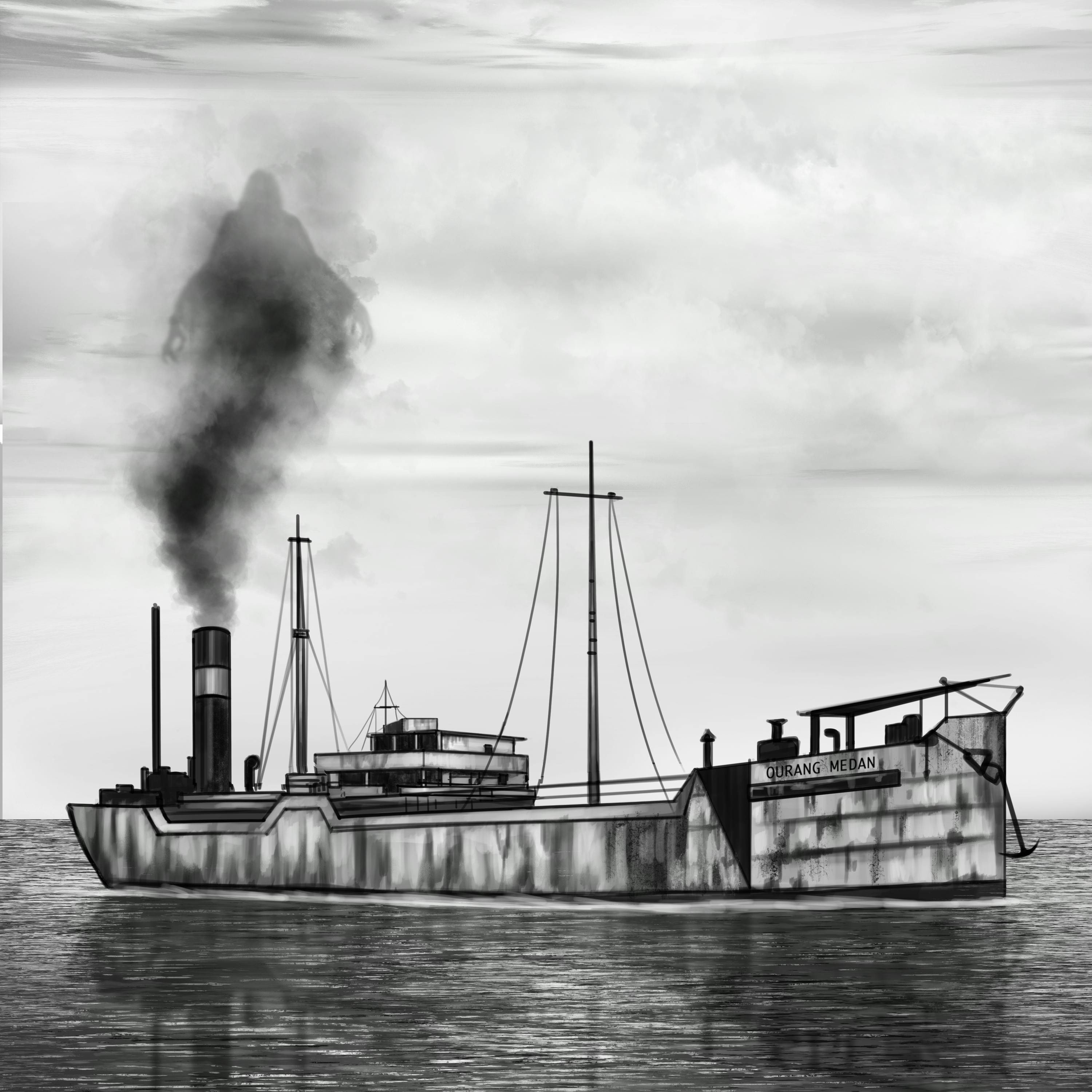
The Curse of the Ourang Medan
MUSIC
Tracks used by kind permission of Kevin MacLeod (incompetech.com) Licensed under Creative Commons: By Attribution 3.0
Tracks used by kind permission of CO.AG
Learn more about your ad choices. Visit megaphone.fm/adchoices
Press play and read along
Transcript
Speaker 1 So, I am a big fan of the It movies, and I'd be willing to bet that a lot of you are too.
Speaker 1 Well, there's a new series coming out made by the same director, and it takes place 27 years before the movies in the 1960s. It explores the origins of Pennywise the Clown.
Speaker 1 The new HBO original series, It Welcome to Derry, is now streaming on HBO Max.
Speaker 1 But if you're a real fan like me, you're looking for more, which is why I'm also going to be listening to the It Welcome to Derry official podcast.
Speaker 1 This is where hosts Mark Bernardin and Princess Weeks dive deep into each episode after it airs.
Speaker 1 They talk to the cast and crew, including the show's creators like Andy and Barbara Muscietti about the making of the show.
Speaker 1 And I'm looking forward to what they have to say about the little Easter eggs I'm seeing in the trailer, like the Shawshank State Prison Bus.
Speaker 1 New podcast episodes drop every week after the episode airs on HBO Max.
Speaker 1 Stream new episodes of HBO's It Welcome to Derry Sundays on HBO Max and listen to the It Welcome to Derry official podcast wherever you get your podcasts.
Speaker 2 In 1947, a cargo ship was discovered drifting aimlessly through calm waters in the Indian Ocean. When rescuers finally boarded, what they found defied all logic.
Speaker 2 Every member of the crew lay dead, sprawled across the decks, their eyes wide open, mouths frozen mid-scream.
Speaker 2 Yet the vessel itself showed no sign of fire, struggle or damage of any kind. No wounds, no blood, no explanation.
Speaker 2 To this day, no one knows what truly happened or why every man aboard the Orang Medan met his end in such terrifying silence.
Speaker 2 The Strait of Malacca, a narrow ribbon of ocean dividing the Malay Peninsula from the island of Sumatra, has long been one of the world's most vital maritime arteries.
Speaker 2 Linking the Indian and Pacific Oceans, it serves as a gateway between major global economies such as China, India, and Japan.
Speaker 2 Each day, roughly 260 ships make the passage, transporting nearly a quarter of the planet's traded goods. Everything from oil and machinery to food and textiles.
Speaker 2 Yet this bustling corridor of commerce carries with it a darker reputation.
Speaker 2 For centuries, the strait was a hunting ground for pirates who stalked its shallows and concealed themselves amongst the countless inlets and coves that fringe its shores.
Speaker 2 Even in modern times, it remains one of the most perilous and congested waterways on Earth.
Speaker 2 At its narrowest point, the Phillips Channel, the strait shrinks to barely one and a half miles wide, leaving enormous tankers with little margin for error as they navigate through one of the busiest bottlenecks in the world.
Speaker 2 But piracy and congestion are not the only reason sailors speak of the Strait of Malacca with unease.
Speaker 2 Beneath its sun-glazed surface lies a labyrinth of shifting currents and sudden squalls that can transform calm seas into chaos in moments.
Speaker 2 Its warm, oxygen-poor depths conceal reefs, sandbars and wreckage from centuries of navigation, creating a graveyard of ships that never reached their destination.
Speaker 2 In such treacherous waters, compasses have been known to fail, lights to flicker and entire vessels to vanish without leaving so much as a trace of their passage.
Speaker 2 Superstitious mariners have long believed the strait to be cursed, a place where strange lights glide across the horizon and ghostly ships are seen drifting silently through the mist.
Speaker 2 Some even claim that the sea itself seems to resist intrusion, swallowing steel and souls alike with eerie indifference.
Speaker 2 Over the last century alone, the Strait of Malacca has claimed more than 30 vessels, an average of one every few years.
Speaker 2 Each loss has its own tale of misfortune, collision, explosion, or inexplicable disappearance.
Speaker 2 Yet none have lingered in the collective imagination quite like the SS Orang Medan, a Dutch freighter whose fate would defy explanation and unsettle all who heard of it.
Speaker 2 Her story, one of sudden death, chilling silence, and fire upon the open sea, would haunt sailors for generations and secure her place amongst the darkest legends ever to drift across the world's oceans.
Speaker 2 In June 1947, merchant ships traveling the Strait of Malacca began to receive a mysterious SOS.
Speaker 2 The message transmitted in Morse code was fragmented but chilling.
Speaker 2 The sender did not give a name, a position, or even a vessel designation, only a stark description of what was unfolding aboard.
Speaker 2 All officers, including the captain, are dead, lying in chartroom and bridge, possibly whole crew dead.
Speaker 2
Moments later came a final, desperate transmission. Two simple words.
I die.
Speaker 2 Then, silence.
Speaker 2 Attempts to re-establish contact failed. No further signals were received.
Speaker 2 Radio operators across the region listened in vain as the signal faded into the ether, uncertain whether they had just just heard the final words of a dying man or a hoax broadcast designed to lure in rescue ships.
Speaker 2 The report reached harbours from Singapore to Penang, prompting a wave of confusion and concern.
Speaker 2 Ships passing through the strait began scanning the horizon for any trace of wreckage or drifting debris.
Speaker 2 Yet the waters remained calm and the skies were clear. There were no storms, no collisions, nothing to explain the distress call.
Speaker 2 Hours passed.
Speaker 2 Then, with the help of British and Dutch listening posts, naval authorities managed to triangulate the signal, tracing it to a remote position in the Indian Ocean far from any established shipping route.
Speaker 2 The coordinates pointed to a stretch of open sea known for its deceptive calm, a place where the ocean floor dropped sharply into the dark abyss.
Speaker 2 Merchant vessels were notified to investigate, but few volunteered.
Speaker 2 The source of the transmission lay hundreds of miles from the nearest port, deep within waters that mariners already regarded with a quiet sense of dread.
Speaker 2 For many, the risk of responding to a ghost signal in the middle of the Indian Ocean was too great.
Speaker 2 However, one ship did eventually investigate.
Speaker 2 The American merchant vessel Silver Star was the first to respond to the coordinates relayed from the radio triangulation stations.
Speaker 2 At the time she was steaming through the eastern reaches of the Indian Ocean, roughly a day's voyage from the presumed source of the SOS.
Speaker 2
Her captain Charles W. Moore understood the gravity of the message.
In accordance with maritime law, he immediately altered course and ordered full speed ahead towards the given position.
Speaker 2 For the next few hours, the crew crew maintained radio contact with regional listening posts, relaying updates on their approach. The tension aboard was palpable.
Speaker 2 Most distress calls turned out to be mechanical failures or minor fires, but this one was different.
Speaker 2 The abrupt and personal nature of the final message, I die, suggested something far more sinister.
Speaker 2 By early afternoon, lookouts reported that a vessel had materialised on the horizon.
Speaker 2 Through binoculars, the officers could make out the faint outline of a freighter, stationary and listing slightly to port.
Speaker 2 As they drew closer, the ship's name was visible across the stern, the SS Orang Medan.
Speaker 2 The vessel appeared intact, no smoke or apparent damage, but equally, no movement on deck, no human presence, and no response to repeated hails by radio or signal lamp.
Speaker 2 The Silver Star circled cautiously, noting that the ship's engines were silent and that no crew was visible on the bridge.
Speaker 2 It was clear she was adrift, carried only by the slow pulse of the tide.
Speaker 2 Finally, after several unanswered attempts to raise a response, Captain Moore gave the order to board.
Speaker 2 A small party of eight men, led by the first mate, took to the lifeboat and rowed across the still water to the silent vessel.
Speaker 2 As the boarding team climbed the ladder and stepped onto the main deck, an immediate sense of unease gripped them.
Speaker 2 The air was heavy, motionless, and unnaturally cold.
Speaker 2 Though it was a cloudless day and the tropical heat shimmered over the sea, the deck of the Orang Medan felt strangely chilled, as if the warmth had been drawn out of the air itself.
Speaker 2 Then
Speaker 2 they saw the bodies.
Speaker 2 When my dog Khan greets me, his tail wags so hard that his whole body wiggles. His love is steady, goofy, and unconditional, so I want to give him the best in return, which is why I use Ollie.
Speaker 2 Ollie offers fresh, human-grade ingredients in five tasty recipes, crafted with culinary experts and backed by vet nutritionists.
Speaker 2 Ollie tailors your perfectly portioned meal plan to your dog's needs so even the pickiest eaters get excited during mealtime. Khan absolutely loves this stuff especially the beef with sweet potatoes.
Speaker 2 His coat is shinier and I love the peace of mind I get from Ollie's on-demand health screenings.
Speaker 2 Your dog's well-being starts with their food and that's why Ollie delivers fresh human-grade food that your dog will love.
Speaker 2 Head to ollie.com slash bedtime. Tell them all about your dog and use code bedtime to get 60% off your welcome kit when you subscribe today.
Speaker 2 Plus, they offer a happiness guarantee on the first box, so if you're not completely satisfied, you'll get your money back.
Speaker 2 That's olie.com slash bedtime and enter code bedtime to get 60% off your first box.
Speaker 3 The second half of the basketball season is here and the race to the playoffs continues on PrizePicks, the best daily fantasy sports app to cash in on your favorite sports. The app is simple.
Speaker 3 Pick more or less on at least two players for a shot to win up to a thousand times your cash. Download the PrizePicks app today and use code FIELD and get $50 instantly when you play $5.
Speaker 3
That's code FIELD on PrizePicks. They get $50 instantly when you play $5.
Win or lose, you'll get $50 for just playing. Guaranteed.
PrizePicks. Run your game.
Must be present in certain states.
Speaker 3 Visit PrizePicks.com for restrictions and details.
Speaker 2 The first corpse was found sprawled beside the forward hatch, face upwards, eyes wide open and unseeing.
Speaker 2 His mouth was frozen in a scream, the skin around it drawn tight.
Speaker 2 A few steps further on, another sailor lay on his back, arms raised as if fending off an invisible assailant.
Speaker 2 Each man they encountered was locked in the same state, rigid, contorted, the features fixed in an expression of absolute terror.
Speaker 2 Everywhere they looked, the Dutch crew were scattered across the decks and passageways, their limbs twisted in unnatural angles.
Speaker 2 The ship's dog lay dead near the galley door, teeth bared, its body as stiff as stone.
Speaker 2
Not one of the victims bore any visible wounds. There were no signs of blood, bruising or struggle.
The deck was undamaged, the railings unbroken.
Speaker 2 Whatever had taken their lives had done so without leaving a trace.
Speaker 2 When the rescue party made their way to the bridge, they discovered the captain's body slumped near the wheel. His officers were found in the chart room, their logbooks open but unfinished.
Speaker 2 In the radio cabin, the operator still sat at his station, one hand resting against the Morse key as if he had died mid-sentence.
Speaker 2 It was assumed he had been the one who had sent the distress message.
Speaker 2 What puzzled the rescuers most, however, was the unnatural condition of the remains.
Speaker 2 Though the crew of the Silver Star had arrived mere hours after the final transmission, the bodies were already in an advanced state of decomposition.
Speaker 2 Their skin appeared mottled and discoloured, as though exposed to extreme heat. Yet the surrounding air was frigid.
Speaker 2 Thermometers brought aboard registered temperatures as low as 4 degrees Celsius, nearly 30 degrees lower than the ambient conditions outside.
Speaker 2 The boarding party quickly searched the lower decks, finding no survivors and no clear cause of death. Machinery compartments showed no signs of malfunction, and the cargo holds were dry.
Speaker 2 With their investigation yielding no answers and the atmosphere aboard growing increasingly oppressive, the men began to feel slightly panicked.
Speaker 2 One of them would later report that it was as if the entire ship was holding its breath, a dead thing adrift in a living sea.
Speaker 2 Within the hour, Captain Moore ordered preparations to tow the Orang Medan back to port for examination.
Speaker 2 Almost as if intent on erasing all trace of its own mystery, The SS Orang Medan met its end only moments after being secured for tow.
Speaker 2 As the crew crew of the Silver Star worked to fasten the lines from bow to stern, several of the men noticed a faint wisp of smoke rising from one of the forward cargo hatches.
Speaker 2 At first they assumed it to be residual heat or vapor escaping from the lower decks, but within minutes the smoke had thickened and begun to pour from multiple points along the vessel's hull.
Speaker 2 The strongest plume appeared to be emanating from the number 4 cargo hold, located amid ships.
Speaker 2 The Silver Star's captain ordered the boarding party to return immediately, fearing a fire below deck.
Speaker 2 The men barely had time to reboard their lifeboat before the smoke darkened and began to churn violently, carrying with it the acrid stench of burning chemicals.
Speaker 2 Orders were given to sever the tow lines, and the crew worked frantically to release the cables binding the two vessels together.
Speaker 2 They had scarcely cleared a safe distance when disaster struck. A massive explosion ripped through the Orang Medan.
Speaker 2 The blast was so powerful that witnesses aboard the Silver Star claim the entire hull lifted clear out of the water before breaking in two.
Speaker 2 The shockwave rolled across the surface, scattering debris and shattering windows aboard the rescue ship.
Speaker 2 In an instant, the Dutch vessel was engulfed in flames.
Speaker 2 For several moments, the stricken ship remained visible through the smoke, its skeletal frame glowing red against the haze before it began to list heavily to starboard.
Speaker 2 Then, as quickly as it had appeared, the Orang Medan slipped beneath the surface, vanishing into the depths of the Indian Ocean. No trace of her would ever be seen again.
Speaker 2 Miraculously, none of the Silverstar's crew were injured in the blast.
Speaker 2 The boarding party had already returned, and no one had remained aboard the doomed vessel when it detonated.
Speaker 2 Had the explosion occurred even a few minutes earlier, whilst the ships were still lashed together, the Silver Star and all her men would almost certainly have shared the same fate.
Speaker 2 In the aftermath, the calm sea offered no answers, only fragments of charred timber floated on the waves, as if the ocean itself had decided to swallow the mystery whole.
Speaker 2 The story of the SS Orang Medan was first officially reported in May 1952 in a circular released by the United States Coast Guard summarizing what it called one of the strangest maritime mysteries on record.
Speaker 2 From that moment on, historians, naval officers, and amateur sleuths have wrestled with a single question:
Speaker 2 What really happened to the crew of the doomed Dutch freighter?
Speaker 2 Since then, the case has taken on a mythic quality, part cautionary tale, part Cold War riddle.
Speaker 2 Every new investigation seems to produce another theory, and each theory only deepens the fog surrounding the ship's fate.
Speaker 2 In the decades following the incident, many noted the complete absence of any official record for the vessel.
Speaker 2 There was no mention of the Orang Medan in Lloyd's Register of Shipping, the Dutch Maritime Archives, or the International Mercantile Marine Lists.
Speaker 2 If the ship truly existed, it appeared to have done so so entirely outside the bounds of maritime law.
Speaker 2 Sceptics have long seized upon this, suggesting the whole story was a fabrication, perhaps an embellished retelling of another vessel's misfortune.
Speaker 2 Yet several independent accounts refer to the same series of details, the distress call, the terrified bodies, the explosion.
Speaker 2 The question remains, if the Orang Medan was imaginary, how did those accounts arise simultaneously in multiple languages and regions?
Speaker 2 One explanation is that the ship sailed under false registry, an act not unheard of in the years immediately after the Second World War.
Speaker 2 Smugglers and intelligence services frequently used flag of convenience vessels to transport sensitive or illegal cargoes across contested waters.
Speaker 2 Ships were often renamed at sea, their papers forged, and their previous identities erased.
Speaker 2 If the Orangmedan was one such vessel, this would neatly explain why her name appears in no official documents.
Speaker 2 A German author named Otto Mielke brought the case to wider attention in 1954, publishing an article in a maritime journal based in Hamburg.
Speaker 2 His piece claimed to have drawn upon interviews with several surviving members of the Silver Star's crew.
Speaker 2 Mielke supplied details absent from the Coast Guard memo, the freighter's route, its port of departure, and crucially, its cargo manifest.
Speaker 2 According to Mielke, the Orang Medan had sailed from Shanghai bound for Costa Rica, carrying a secret and highly volatile cargo, potassium cyanide, nitroglycerine and other hazardous compounds.
Speaker 2 The combination, if true, would have been disastrous.
Speaker 2 Potassium cyanide, when exposed to sea water, produces deadly hydrogen cyanide gas.
Speaker 2 Nitroglycerine, sensitive to even small temperature changes, could easily detonate if stored improperly. The mixture would have made the ship a floating bomb.
Speaker 2 Why would any captain take such a risk? The only plausible reason, Mielke suggested, was smuggling. an attempt to move outlawed substances outside official scrutiny.
Speaker 2 The cargo may have been intended for sale on the black market or for use by one of the competing powers still vying for chemical and explosive materials in the early Cold War.
Speaker 2 If the vessel was indeed operating illegally, then her disappearance would have benefited all concerned.
Speaker 2 A nameless ship, lost without witnesses, would leave no paperwork, no compensation claims, and no political scandal.
Speaker 4
Chronic spontaneous urticaria or chronic hives with no known cause. It's so unpredictable.
It's like playing pinball.
Speaker 4 Itchy red bumps start on my arm, then my back,
Speaker 4 sometimes my legs. Hives come out of nowhere
Speaker 4
and it comes and goes. But I just found out about a treatment option at treatmyhives.com.
Take that, chronic hives. Learn more at treatmyhives.com.
Speaker 5 This episode is brought to you by Progressive Commercial Insurance. Business owners meet Progressive Insurance.
Speaker 5 They make it easy to get discounts on commercial auto insurance and find coverages to grow with your business.
Speaker 1 Quote in as little as eight minutes at progressivecommercial.com.
Speaker 5 Progressive Casualty Insurance Company, coverage provided and serviced by affiliated and third-party insurers. Discounts and coverage selections not available in all states or situations.
Speaker 2 Mielke's hypothesis soon found supporters amongst naval engineers, who pointed out that even a small leak could have filled the ship's confined spaces with toxic fumes within minutes.
Speaker 2 The crew, breathing in the vapor, would have suffocated while simultaneously experiencing violent muscle contractions, perhaps explaining the grotesque rigidity of their limbs.
Speaker 2 But this theory also raises problems.
Speaker 2
When the Silver Stars rescue team boarded, none of them showed any sign of poisoning. Hydrogen cyanide gas disperses rapidly but not instantaneously.
Some residue would surely have remained.
Speaker 2 This discrepancy has led to refinements of the original explanation.
Speaker 2 One variant suggests that carbon monoxide produced by a malfunctioning boiler or leaking leaking fuel line could have saturated the lower decks, killing the crew slowly and causing panic.
Speaker 2 Another proposes that the men were overcome by methane or other combustible gases released from decomposing cargo in the holds, which would also account for the explosion that destroyed the vessel.
Speaker 2 Yet none of these conventional causes account for the most striking aspect of the incident. the extreme and unnatural postures of the dead.
Speaker 2 Their bodies were not relaxed but rigid, faces contorted as if caught mid-scream.
Speaker 2 This, according to some toxicologists, points to nerve agent exposure rather than simple asphyxiation.
Speaker 2 During the closing years of the Second World War, Nazi Germany developed a new class of chemical weapons known as G-series nerve agents.
Speaker 2 Amongst them was Tabin, or GA, an organophosphate compound so lethal that a single drop on the skin could cause convulsions, paralysis and death within minutes.
Speaker 2 After the war, both the Soviet Union and the United States raced to seize the remaining stockpiles.
Speaker 2 Shipments were quietly transferred across Europe and Asia, often using unmarked or chartered freighters.
Speaker 2 It is conceivable that one of these consignments was being transported aboard the ship later known as the Orang Medan.
Speaker 2 Taban's properties fit several of the facts reported by the Silverstar's crew.
Speaker 2 Victims of nerve agents die with muscles locked in spasm, eyes bulging and jaws frozen, identical to the accounts from the scene.
Speaker 2 Moreover, Taban evaporates quickly, leaving little chemical residue which would explain why the rescue team was unaffected.
Speaker 2 If the freighter was secretly transporting captured German or Japanese nerve agents for Western testing, her unregistered status makes sense.
Speaker 2 She may have been leased through a shell company, operated by a foreign crew with minimal knowledge of their cargo.
Speaker 2 Once the leak occurred, the gas would have swept through the ventilation ducts, killing everyone aboard before they could raise the alarm.
Speaker 2 Then, with the cargo heating under the tropical sun, the nitroglycerine or pressurized chemicals below deck ignited. triggering the explosion that obliterated the ship.
Speaker 2 Such an operation would have been deeply embarrassing if exposed, explaining the rapid suppression of records.
Speaker 2 The late 1940s was an era of secrecy and shadow diplomacy.
Speaker 2 The United States, Britain and the Soviet Union were racing not only for nuclear supremacy, but for chemical and biological warfare data seized from both Nazi Germany and Imperial Japan.
Speaker 2 Thousands of tons of experimental material, from mustard gas to plague cultures, were covertly relocated to research sites under the banner of scientific study.
Speaker 2 In that context, a single unregistered freighter vanishing at sea would barely merit mention. Governments routinely denied ownership of vessels linked to covert programs.
Speaker 2 Ships were scuttled, re-flagged, or written off as missing with all hands.
Speaker 2 If the Orang Medan had indeed been part of such an operation, it's no wonder her name vanished from all official records. She may never have been called that at all.
Speaker 2 The title could have been an alias chosen by the crew or later by those who reported the event.
Speaker 2 Beyond chemical explanations, other theories range from the plausible to the absurd.
Speaker 2 Some claim the ship was attacked by pirates who used gas or chemical grenades. Others suggest she encountered radioactive cargo leaking from a damaged container.
Speaker 2 A few have even even invoked the paranormal, speculating that the crew witnessed something so terrifying it caused instant cardiac arrest, a supernatural panic rather than a physical poison.
Speaker 2 Still others posit environmental causes. The Strait of Malacca and its adjoining waters are known for pockets of methane hydrate trapped beneath the seabed.
Speaker 2 Under certain pressures, these can erupt to the surface, displacing oxygen and briefly suffocating anyone caught in the cloud, a phenomenon suspected in several unexplained ship abandonments.
Speaker 2 Whatever the cause, each explanation struggles to fit all the facts, the unmarked vessel, the terrified crew, the rapid decomposition, the freezing air and the final explosion.
Speaker 2 What is perhaps most haunting about the case is not the mystery itself, but the human silence surrounding it.
Speaker 2 No relatives came forward, no shipping company filed an insurance claim, and no nation demanded an inquiry.
Speaker 2 For a ship allegedly carrying dozens of crewmen, this absence of official response is striking.
Speaker 2 It suggests either that the crew were recruited informally, transient sailors with no paper trail, or that their employers had strong incentives to remain quiet.
Speaker 2 In either case, the Orang Medan was a ghost long before she exploded.
Speaker 2 In the years that followed, divers and maritime historians attempted to locate the wreck. None succeeded.
Speaker 2 The coordinates given in early reports placed the disaster somewhere west of Sumatra, in waters up to 3 kilometers deep, an area still poorly mapped even today.
Speaker 2 Even with modern sonar, locating a small fragmented steel hull amidst the wreckage of countless other wartime losses would be nearly impossible.
Speaker 2 In 2001, a team of Dutch researchers sought to trace the ship through port records in Singapore, Penang and Batavia, but found nothing.
Speaker 2 One archivist suggested that if the ship's name had been deliberately altered even by a single letter, it would render any search fruitless.
Speaker 2 To this day, no document, logbook or photograph has surfaced that can conclusively prove the ship's existence.
Speaker 2 Despite this, the Orang Medan remains one of the most persistent legends in maritime lore.
Speaker 2 It has all the hallmarks of a perfect mystery, a clear signal of distress, an impossible tableau of death, a sudden explosion, and then nothing.
Speaker 2 It also embodies the anxieties of its age.
Speaker 2 The late 1940s were years of unease, nuclear tests in the Pacific, the beginning of the Cold War, and rumours of secret technologies spreading through the press.
Speaker 2 In that atmosphere, the idea of a ghost ship full of dead men, silenced by an invisible weapon, resonated deeply.
Speaker 2 Writers compared it to the Flying Dutchman and the Mary Celeste.
Speaker 2 Though unlike those tales, this one bore the unmistakable stamp of the modern era, a product of radio signals, chemistry, and Cold War secrecy rather than curses or superstition.
Speaker 2 Ultimately, the story can neither be proven nor disproven.
Speaker 2 The Coast Guard circular remains the only surviving document to mention it officially.
Speaker 2 No wreck has been found and all physical evidence including the ship's crew, her cargo and even her name has long since vanished.
Speaker 2 Still, the persistence of the tale suggests that something, whether a genuine maritime disaster or an elaborate fabrication, occurred to seed it in the public mind.
Speaker 2 Perhaps the Orang Medan was a nameless freighter destroyed by its own illicit cargo. Perhaps it was an experiment gone wrong, erased from the record books.
Speaker 2 Or perhaps it was never more than a sailor's ghost story that took on a life of its own.
Speaker 2
Whatever the case, one fact remains unaltered. No one who went aboard that day lived to explain what had happened.
The ocean, as ever, keeps its counsel.
Speaker 2 And the mystery of the Orang Medan endures not as a matter of fact, but as a question whispered endlessly between sailors on the world's loneliest seas.
Speaker 1 So, I am a big fan of the It movies, and I'd be willing to bet that a lot of you are too.
Speaker 1 Well, there's a new series coming out made by the same director, and it takes place 27 years before the movies in the 1960s. It explores the origins of Pennywise the Clown.
Speaker 1 The new HBO original series, It, Welcome to Derry, is now streaming on HBO Max.
Speaker 1 But if you're a real fan like me, you're looking for more, which is why I'm also going to be listening to the It Welcome to Derry official podcast.
Speaker 1 This is where hosts Mark Bernardin and Princess Weeks dive deep into each episode after it airs.
Speaker 1 They talk to the cast and crew, including the show's creators like Andy and Barbara Muschietti about the making of the show.
Speaker 1 And I'm looking forward to what they have to say about the little Easter eggs I'm seeing in the trailer, like the Shawshank State Prison Bus.
Speaker 1 New podcast episodes drop every week after the episode airs on HBO Max.
Speaker 1 Stream new episodes of HBO's It Welcome to Derry Sundays on HBO Max, and listen to the It Welcome to Derry official podcast wherever you get your podcasts.