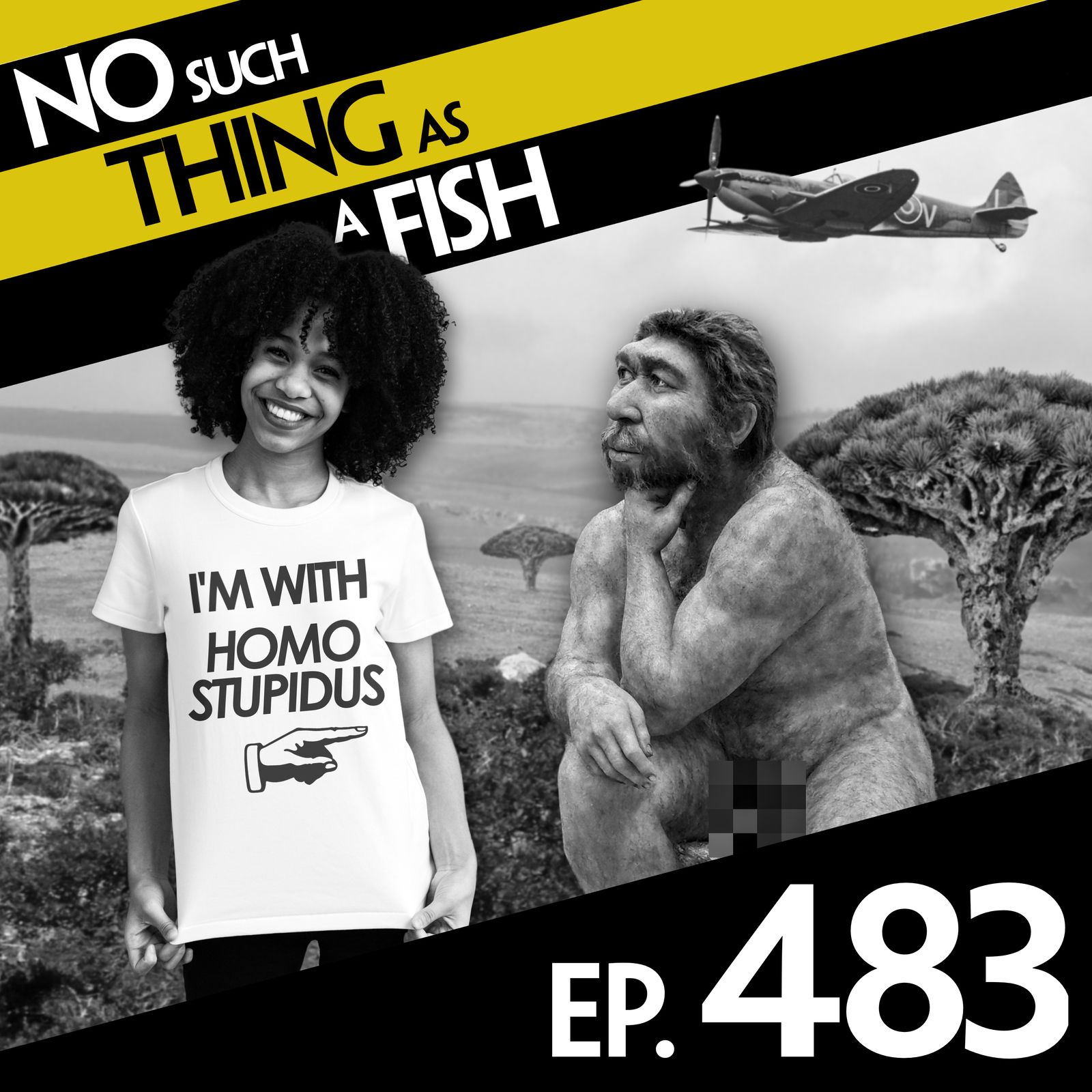
483: No Such Thing As Rivets On A Tombstone
Visit nosuchthingasafish.com for news about live shows, merchandise and more episodes.
Join Club Fish for ad-free episodes and exclusive bonus content at apple.co/nosuchthingasafish or nosuchthingasafish.com/patreon
Press play and read along
Transcript
Speaker 1 Running a business online?
Speaker 2 Look legit and own your own brand with professional tools from GoDaddy.
Speaker 5 Instantly build trust with your customers and boost your credibility with an email that matches your domain so people know you mean business.
Speaker 8 There's never been a better time.
Speaker 1 Just go to godaddy.com/slash GDNow and choose from a wide variety of popular domains to find one that's right for you.
Speaker 10 Pair that with a professional email that works for all your business needs, from daily communications to email marketing and everything everything in between.
Speaker 1 That's a little price for a lot of credibility.
Speaker 3 For a limited time, get a domain and matching professional email for just 99 cents a month for one year.
Speaker 1 Go to godaddy.com slash gdnow and look legit with godaddy. That's godaddy.com slash gdnow.
Speaker 2 Again, go daddy.com slash gdnow.
Speaker 5 There's never been a better time to choose the domain and email that's right for you.
Speaker 4 New customer purchases only products auto-renew separately. See terms on site.
Speaker 1 Go daddy.com slash GDNow.
Speaker 15
From unsolved mysteries to unexplained phenomena, from comedy goal to relationship fails, Amazon Music's got the most ad-free top podcasts. Included with Prime.
Download the Amazon Music app today.
Speaker 15 Hi everyone, welcome to this week's episode of No Such Things of Fish, where we are joined by the wonderful Ella Al-Shamahi.
Speaker 15
You might remember Ella from episode 373 of No Six Things of Fish when she last appeared. But if you don't remember that, then she is a paleoanthropologist.
She's an expert in Neanderthals.
Speaker 15
She is a National Geographic Explorer. She's just an all-round badass.
Ella has written a book called The Handshake, A Gripping History, which we talked about last time she was on.
Speaker 15 But she's also been on loads of TV shows, loads of documentaries. The last one I think was called Our Changing Planet, all about the world's most threatened ecosystems.
Speaker 15 And you can actually still watch that if you go to BBC iPlayer or PBS video app. Anyway, really hope you enjoy this week's show.
Speaker 15 Don't forget Club Fish exists, the place where you can get loads of extra content and add free episodes.
Speaker 15 Don't forget there are still one or two tickets, I think, possibly left for our live shows coming up in the Soho Theatre in London.
Speaker 15
And you can get those by going to nosuchthingsafish.com forward slash Soho. Anyway, that's enough of that.
Really hope you enjoy this week's show with Ella and it's on with the podcast.
Speaker 15 Hello and welcome to another episode of No Such Thing as a Fish, a weekly podcast coming to you from the QI offices in Hoburn. My name is Dan Dan Schreiber.
Speaker 15 I am sitting here with Andrew Hunter Murray, James Harkin, and Ella Al-Shamahi. And once again, we have gathered around the microphones with our four favorite facts from the last seven days.
Speaker 15 And in no particular order, here we go. Starting with fact number one, and that is Ella.
Speaker 16 American beer was so bad in the early 1900s that the US government sent Alexander Graham Bell's son-in-law on a secret mission to Bavaria to steal German hops.
Speaker 15 Wow. Gosh, so much to unpick.
Speaker 15
Okay, so Alexander Graham Bell's son-in-law. Was that an important part of the.
Was that what the American government was doing?
Speaker 16 The really sad thing is, David Fairchild is like a hugely celebrated botanist and is described as the food explorer. And yet, for our purposes, he's just Alexander Graham Bell's son-in-law.
Speaker 16 Because to be fair, if he was your father-in-law, that's the end of your identity, right?
Speaker 15 But was it maybe this was at the point when there were only two telephones in the country? And so the government would just call him up and say, you got any one we could use? Yeah.
Speaker 15
So you think when he invented two telephones, Alexander Graham Bell, he gave one to the government and one himself. Yeah.
Anyone else needs one? It's fine. And it became like the bat phone.
Speaker 15
It was any time they were needed for anything. The bell phone.
Yeah, the bell phone.
Speaker 16 I'm loving the facts today, guys.
Speaker 15 So yeah, what's this guy, Fairchild?
Speaker 16 So, alright, so David Fairchild. So he's a food explorer,
Speaker 16 and I think he's...
Speaker 16 absolutely fascinating because explorers usually go around the planet let's be honest discovering stuff but also pillaging a lot and what have you and like stealing artefacts and whatever takes your fancy.
Speaker 16 But this guy did it with plants, with botany, which is, in my mind, is just like the loveliest thing to go around the planet stealing.
Speaker 16 Because all he's doing is he's basically turned around at the beginning of the 1900s going and the end of the 1800s going, America is a country clearly on the rise,
Speaker 15 but our agriculture is bad.
Speaker 16 Our food is bad.
Speaker 16 Industries as related to, as you know, as they relate to plants are just bad.
Speaker 16 So I'm going to go off to 50 odd countries and just collect samples, send seeds back, send saplings back, that kind of thing.
Speaker 16 And because it's plants, I just can't get mad at him because I'm just like, you were just helping to feed your people and build industry.
Speaker 15 Could we get him cancelled because he was like stealing from the farmers?
Speaker 15
Are you trying to get him cancelled? I'm doing my best. I do this on this podcast.
Whoever we have on, I just. Don't ever mention anyone you like on the show.
James will find a way to destroy him.
Speaker 16 Do not, do not do this to me because I actually have decided that he is, he's like the one explorer that I really have nothing bad to say about.
Speaker 15 I'm like, oh, fair enough, you're trying to feed your people.
Speaker 16 He did give the Americans broccoli and kale.
Speaker 15
Oh, yeah, yeah. I love those two things.
It's interesting how limited American food was. I didn't really appreciate that before the 1890s when he really got cracking.
Speaker 15
They had occasional introductions, like in the World's Fair in 1876, which was effectively America's 100th birthday, they got the banana. That was good.
That was was a big amount of time.
Speaker 16 Also, can we just take a second to talk about world fairs?
Speaker 16 Aren't they just the best thing ever? Yeah.
Speaker 16
Just this world where you were like, oh, let's just do a world fair. And it actually was legit.
Like, everyone was like, oh, crap, that's actually, that's new. That's, what is that?
Speaker 16 It's yellow and it's bendy. That's amazing.
Speaker 15
When did we last have one? Well, I went to one in Dubai this year. Oh, yes.
Okay.
Speaker 15
So this year? Oh, yeah, they did. Yeah, they did one.
Well, they did one during COVID.
Speaker 15
And obviously, no one could go. And then when I went, everything was closed.
So you couldn't even get an Uber. Everyone had gone home.
Speaker 15 Because that's what it is. They build them, these sort of huge things, don't they?
Speaker 15 And all the different countries have their different stalls where they're saying, in Uzbekistan, we make amazing bananas or whatever. And then two years later, they all go home and that's it.
Speaker 16 They only do it with countries that are on the rise, right?
Speaker 15 Yeah.
Speaker 16 We wouldn't do a world fair. America wouldn't do a world fair anymore.
Speaker 15
We are the world. Why would we do a world fair? There was the big one in America Carl Sagan went to as a kid.
So Sagan would be in his 80s if he was still alive or 90s. So, you know, okay.
Speaker 15 The one thing in Dubai, just to say this, it's quite interesting because each country made their own sort of building, and they were all kind of shaped with Uzbekistani design or Azerbaijani design or whatever.
Speaker 15
And now they're changing it and they're turning it into flats, the whole place. Oh, wow.
And they're going to make it so you can live in this area.
Speaker 15 But it means that all these buildings are just these incredible designs that are made from the best architects in the world.
Speaker 16 It sounds like you're selling Dubai instead of cancelling Dubai, which I thought, I thought you were the cancelling man.
Speaker 15 What? Visit Dubai.
Speaker 15
You can't get a nooba there. There's no shops there or anything.
I'm not going to live there.
Speaker 16 Oh, that's the bad side of Dubai, guys.
Speaker 15 Of all the bad crap in the business. Famously, there are no shops in Dubai.
Speaker 15 Someone emailed in, and I'm going to butcher their fact now, and also not credit them, because I didn't think we're going to end up talking about world fairs.
Speaker 15
It was a few years ago, the Brazilian delegation turned their entire thing into a trampoline. What? It was something like a 4,000 square foot trampoline.
The Brazilian
Speaker 15 bit.
Speaker 15
Was it to sell rubber? I don't think it was. I don't even think it was.
I think it was just saying, look, everyone else has got good stuff here. We've got a big old trampoline.
Speaker 15 So just come along, have a bounce, enjoy yourself.
Speaker 15 They had a big project that at the last minute got taken away and they went, what have we got?
Speaker 15
Why are we talking about the World Fair? I'm sorry, I got to say that. Yeah, this is what happens when Ella comes around.
Because during the World Fair, the banana was introduced to America.
Speaker 15 And by Fairchild or someone else, this is is a good thing. By someone else.
Speaker 15
That was like a sporadic thing. But then when he really got going, he was privately funded as well.
Yes. By Barbour Lathrop.
Speaker 16 Yes, yes, yes. A wonderfully gay, fabulous figure, basically, who's just this incredible philanthropist.
Speaker 15
Squillionaire, just looking for something to fund. And they bumped into each other on a boat, didn't they? And he just went, I'll fund this trip of you trying to steal avocados.
Yeah, why not?
Speaker 15 This sounds great. What did I just say?
Speaker 16 As an explorer with National Geographic, that is our dream.
Speaker 15 No, no, no.
Speaker 16 If you think I am kidding, you do not know like my friend group in the sense that we are like, we literally just sit there constantly going, right, how do we get this kind of thing from philanthropy?
Speaker 16 And every so often it works out. So, like, I've got friends that like, they're like this smart friend of the philanthropist who's like some billionaire or millionaire.
Speaker 15 They're like their sugar mama daddy, whatever.
Speaker 16
Have I ever told you the story of Nat Geo? Somebody walks up to me. It's a really old guy, bless him.
First time I've ever been at National Geographic. And he looks at me and goes,
Speaker 16 I'm from Austin, Texas. I'm not an oil man, but I've got money and I want to give you some.
Speaker 15 What the hell?
Speaker 16 I saw that money in my account. An expedition was part-funded by it.
Speaker 15 Wow.
Speaker 15
So as simple as that. Okay, so it does happen.
Yeah. That's amazing.
Speaker 15
So Fairchild, I agree. I think reading about him, he seems like an extraordinary guy.
I'm surprised I'd never heard of him, for example.
Speaker 15 But if you're in America and you're eating, say, like peaches or nectarines or avocados or mangoes, most likely the one that you're eating right now, someone's bound to be eating one right now as they listen, shares genes from the ones that Fairchild introduced to the country.
Speaker 15 That is quite good. All those years ago,
Speaker 15 what a sort of footprint he's left
Speaker 15 in the country.
Speaker 15 It's incredible.
Speaker 15 Send us your photos if you're eatingo. If you're eating a mango now
Speaker 15 in America
Speaker 15
or an avocado, some quinoa? Yeah. Yeah.
Did he bring in quinoa? Yep. Podcast at qi.com.
We want to see. The mango steens? The mango steen.
Oh, great. Let's talk about this.
This is great.
Speaker 15
Guan, what is the mango steen? It's a fruit that he introduced and that never took off. Because he introduced thousands.
Yeah. And they didn't all take off.
Speaker 15
Yeah, you'd have to still buy mango steens, though, can't you? I think so. They just never exploded.
I had never heard of the mango steam before. I had.
Oh, really? Yeah.
Speaker 16 The guy who wrote the book on David Fairchild is Dan Stone, who's a friend of mine. And apparently, while he was writing this book, everybody would just send him really exotic fruit
Speaker 16 the whole time he was writing the book because they were like, this is good for you, no?
Speaker 15 He's like, sure.
Speaker 15
Yeah, the food's called The Food Explorer, by the way. I think it's fair to say that every bit of research I have is from Blue Stone.
So, yeah, well done, mate. Tell us about mangosteen, Sandy.
Speaker 15 Well, as far as I can tell,
Speaker 15 again, Dan and I have never heard of them before, and you two are like having them for breakfast every day.
Speaker 15 So, correct me if I'm wrong, but they're the size of a fist, roughly, and they're like a lychee.
Speaker 15 But the problem is, they're not great for farming. And what he was doing, Fairchild, you have to persuade the farmers to grow the things and the public to buy them.
Speaker 15 That's two jobs to carry out, basically. And he couldn't persuade either, apparently, either side of the equation, because they're really hard.
Speaker 15
They bruise worse than peaches, and they're just a nightmare to transport, and they go off really quickly. But he said they were the queen of fruits.
They were his favorite. I know.
Speaker 15 And he kept trying to make them happen. Like fetch in Mean Girls.
Speaker 15 He kept trying to make it happen. And no one was picking up on it.
Speaker 15 And so all these things he brought into the country, but the one of which you headlined your fact with is very interesting because it was the beer hops.
Speaker 15 And you'd think you'd just go into a country, grab some fruit, and leave the country, but no, people were so protective.
Speaker 15 They would have boys sleeping with the hops at night to make sure no one would see it.
Speaker 15
That's the thing. So he'd come in and integrate himself with the communities.
He would sort of become friends.
Speaker 16 So this particular hop, so this is, I think, the Semes hop.
Speaker 16 He basically started talking about Semes, the guy that came up with it, who was dead at this point. And he offered the son of Semes.
Speaker 16 Basically, he said, look, I'm really scared that in a few generations, people aren't going to know about your dad, blah, blah, blah.
Speaker 15 So he was like, why don't you build a plaque?
Speaker 16
I will pay for it. So he like basically put money down.
It's impressive US diplomacy here. And they made such a song and dance about it.
Everybody was really happy.
Speaker 16 The whole like everybody in the town was happy about it. And then apparently somebody at night knocks on his door when it's raining and goes, Do you want some? Do you want some cuttings?
Speaker 16 And apparently he has to like really restrain himself to not be like, yes, this is exactly why I did all this.
Speaker 15 And I've been manipulating you guys for like weeks. And he was like, yeah, okay.
Speaker 16 And he goes, okay, I can't do this publicly. i have to do it quietly but i'll send a hundred cuttings to the next the next station down the line oh not even handing them over there
Speaker 16 it was proper espionage that's amazing it's hilarious but also to think like of all the of all the uh espionage that the us government has ever done i just i just can't object to this watch
Speaker 15 that's why that's why american beer now is so delicious isn't it
Speaker 16 i mean how bad must it have been for the boss so so here's the crazy thing apparently during prohibition all his hops were uprooted.
Speaker 16 So all the Sams hops that Fairchild... Oh, yeah, yeah, they were all uprooted during the...
Speaker 15
I read that. Basically, when Prohibition came in, all the breweries closed down.
And then when they reopened, there was a few more big ones.
Speaker 15 And they decided to sell what they knew would sell because they weren't sure anyone would buy any beer anymore.
Speaker 15 And so they went with the really safe stuff, which was the light beers and the mass-produced stuff.
Speaker 16 Okay, now can you explain Hershey's?
Speaker 15 Hershey's?
Speaker 15
It tastes like sick. It tastes like sick to British people.
Well, you know, it contains some chemicals which happen to also taste like sick. I can't remember the exact details.
Speaker 16
I love how people have gone around tasting sick. They haven't.
They haven't.
Speaker 15 They really haven't.
Speaker 15 If you're eating a Hero Shoes bar right now, please send a photo. If you're being sick,
Speaker 15
by the way. Oh, yes, that one.
Podcast at QR.com.
Speaker 16 Do they have your address? Because I feel like if they have your address, they could send the mangosteens and the sick.
Speaker 15 etc etc to the address we've just moved offices and the reason being that the old office was just full of sick and mangosteens it's inundated yeah But everyone's tasted sick if they've ever been sick.
Speaker 15 True. Yeah.
Speaker 15 You just taste it in reverse, don't you? Sorry, I mean, to
Speaker 15
lower the tone. That's nasty.
But that's how we know what American chocolate tastes like. Yeah.
Great.
Speaker 16 Did you guys hear about the cherry blossom trees in DC and how he's responsible for all of them, basically? So, I mean, we have them now in London quite a lot.
Speaker 16 They're very kind of ornamental, very beautiful.
Speaker 16 But he introduced them from Japan, and then it became all the rage, and people were like queuing up to see him and Alexander Graham Bell's daughters resting It was at their house, wasn't it?
Speaker 15 He put it to his house. Exactly, exactly.
Speaker 16
And then basically, Washington, D.C. was not the beautiful metropolis it now is.
Back then, it was kind of ugly.
Speaker 16
And he started saying, well, maybe we should just plant some cherry blossom trees around here. And that would be kind of beautiful.
And then the First Lady heard of this.
Speaker 16 And before you know it, the Japanese, who at this point they're not particularly like chummy with, they're like, okay, this could be a symbol of friendship.
Speaker 16 If you give us 300 cherry blossom trees, we can plant them in D.C.
Speaker 16 And the Japanese got carried away, ended up shipping 2,000. But they opened the crates, I think it was in Seattle, and went, oh, crap, they were diseased.
Speaker 16 They were absolutely infested with invasive species. So then they had to publicly burn the symbol of friendship between Japan and the U.S.
Speaker 15 Yeah.
Speaker 16 And it was like on the front page of the New York Times.
Speaker 15 And the thing I read was it was from orders of the president, which feels like he should have been busier than having to make executive decisions about
Speaker 15 agricultural imports. Although it was his decision, wasn't it? Because it was him and the first lady who kind of made the decision to bring it over, wasn't it? Wow.
Speaker 15 But the Japanese were like, are bad. And so it was all fine.
Speaker 15 They sent more over, and then they are now. And as a result, U.S.-Japanese relations stayed very harmonious, didn't they?
Speaker 15 Yeah.
Speaker 15 Good. And it was interesting because the ones that they sent over the second time, they had to make sure that they were really not infested.
Speaker 15
So they raised the trees in virgin soil. So the soil was brand new and they'd never been anywhere else.
They wrapped the roots in damp moss to start.
Speaker 16 That's not going to work for a friendship, man.
Speaker 15 Yeah.
Speaker 15
That's great. It's great.
And they fumigated it twice,
Speaker 15 once to asphyxiate the insects and then once just in case.
Speaker 15
But yeah, and the reason that they did this is because this guy, Fairchild, had a nemesis called Charles Marlatt. Didn't he? Yeah.
This is an amazing story.
Speaker 15 So Charles Marlatt was in charge of the FDA sort of anti-insect part of the FDA but they were boyhood friends and actually Marlatt was Fairchild's best man at his wedding but then they fell out because Fairchild basically got a load of easy jobs through his friends and family, a bit of nepotism and stuff and Marlatt had to work hard for his for his job and so they really fell out and Marlotte basically whenever Fairchild brought in any new species he would be like there's insects on that get rid of it burn it do it now and so they really really fell out I have to defend the entomologist, even though I loved Fairchild.
Speaker 16 So it's worth saying that, like, Fairchild,
Speaker 16 he was, he did get a lot of fame, but a lot of that was off his own back. But then, yeah, sure, he married into like this really prominent family and became really big with National Geographic.
Speaker 16 But today, we would actually side with the entomologist.
Speaker 16 Yeah, like he scientifically, he's the sound one, not the botanist, just being like, well, let's just hope it's going to be fine when we bring all these plants from all over the world.
Speaker 15
Yeah, definitely. It was, it was dangerous.
Yeah, I read this amazing story that he wanted to send a thousand mangoes back to back to America, but he put them on a boat and they were too heavy.
Speaker 15
And so he solved it by getting a load of local children to eat them all. What? Because all he needed were the stones.
He didn't need the mangoes themselves.
Speaker 15
So he just got all the kids and said, free mangoes, as many as you can eat. They all went, oh, no, no, no, no.
U.S. diplomacy.
There we go. That's another.
Speaker 15
I thought you were going to say something really clever, like, he only needed to ship the children there. And then They poo them out.
Exactly, exactly.
Speaker 15 And I was thinking, God, those children are brave, like pooing out a mango stone. That's not funny.
Speaker 15 No, children famously a bit more heavy than a mango as well. So
Speaker 15
weight was your issue. I know.
I'm sorry.
Speaker 1 Running a business online?
Speaker 2 Look legit and own your own brand with professional tools from GoDaddy.
Speaker 5 Instantly build trust with your customers and boost your credibility with an email that matches your domain so people know you mean business.
Speaker 8 There's never been a better time.
Speaker 1 Just go to godaddy.com slash gdnow and choose from a wide variety of popular domains to find one that's right for you.
Speaker 10 Pair that with a professional email that works for all your business needs, from daily communications to email marketing and everything in between.
Speaker 1 That's a little price for a lot of credibility.
Speaker 3 For a limited time, get a domain and matching professional email for just 99 cents a month for one year.
Speaker 1 Go to godaddy.com slash gdnow and look legit with GoDaddy. That's godaddy.com slash GD Now.
Speaker 2 Again, go daddy.com/slash GDNow.
Speaker 3 There's never been a better time to choose the domain and email that's right for you.
Speaker 4 New customer purchases only products auto-renew separately.
Speaker 1 See terms on site, go daddy.com slash GDNow.
Speaker 15
From unsolved mysteries to unexplained phenomena, from comedy goal to relationship fails, Amazon Music's got the most ad-free top podcasts. Included with Prime.
Download the Amazon Music app today.
Speaker 15 Okay, it's time for fact number two, and that is James. Okay, my fact this week is that at one stage of the 17th century, every woman living on the Yemeni island of Socotra was called Maria.
Speaker 15 Was it okay? Okay, how many women were on the island? Well, I don't know, but it wasn't completely insignificant. It's a big island, right? It's about the size of what, Mayor King? New Baylor.
Speaker 15 It's big. Haven't you? Long Island.
Speaker 15 Is it that they were hosting a sound of music reality show? In the 17th century, yeah. Oh, yeah.
Speaker 15 I feel like that's a real Yemeni vibe.
Speaker 16 It's like the tribesmen and the sound of music.
Speaker 15 Well, I don't know exactly how many people live there. How many people would you say live there now? It's in the 10th, 10th.
Speaker 15 I think it's about 40,000. 40,000.
Speaker 15 It would have been less then. But basically, it was a Christian island.
Speaker 15
By tradition, it was St. Thomas who was shipwrecked there in the year 52 AD.
And he supposedly brought in Christianity. But definitely, the Greeks brought it in the 4th century.
Speaker 15
That definitely happened. And Marco Polo wrote about it in the 13th century that there were Christians there.
And in the 17th century, there was a guy called Padre Vincenzo, and he visited Socotra.
Speaker 15 And he found that they were still Christian, ostensibly, but they'd kind of moved to other beliefs because Socotra is a place that's very difficult to get to, especially at certain times of year.
Speaker 15 You can't really get there at all.
Speaker 15 Good luck. And so, because they were isolated from the rest of the world, they kind of had this new version of Christianity.
Speaker 15 So, a lot of them were called Maria, and there were still a lot of churches, but for instance, they used to do sacrifices to the moon and a few different things.
Speaker 15
I'm gonna keep some of your old beliefs in, just spice it all up a bit. What year was that again? Uh, it was in the mid-17th century.
Why were they called Maria? Because Mary, the mother of Jesus. Oh,
Speaker 15
yeah, that must have been confusing. Oh, yeah, no, because they don't.
Have you been there? Have you been there?
Speaker 16 Yeah, so I've been to Socotra. It is, is i can verify that's very difficult to get there have you met a maria uh i have not met a maria because weirdly there's no christians left on the island
Speaker 15 what's that someone said the rear
Speaker 16 yeah they're all uh muslims now so i went there kind of 2018 i think or 2019 and we had three options to get there either we uh fly in via mainland yemen but the airport we were flying into was an al-Qaeda stronghold so decided maybe that's not the best way of getting in.
Speaker 16 And then the other route was via kind of almost like a private jet via the Emirates, the place that you like.
Speaker 16 But they were only giving us verbal permission, not written permission.
Speaker 16 And then the third option was to get on a cement cargo ship from Oman and sail through pirate waters. And the ship was like infested with cockroaches, like completely infested.
Speaker 15 And it had like a...
Speaker 16 the toilet was like a basket on the side of the ship, like attached with ropes.
Speaker 15
Is this the route you went? Yeah. Woah.
Yeah, it was hilarious.
Speaker 15 No pirates.
Speaker 16 Yeah, we luckily didn't. That's
Speaker 16
the cockroaches. Yeah.
The Swede in the group had his wits about him, let me tell you that every time a ship went past, he was like,
Speaker 16 just very nervous.
Speaker 15
But yeah, so it's really hard to get to, and that's the thing, right? But then that's good news for other things. So it means that they have amazing biodiversity there.
Yeah.
Speaker 16 You've seen the trees there.
Speaker 15
They look incredible. I mean, the dragon blood tree, I know that's the most famous, really.
That's the sort of like the headline tree out there. But they do look beautiful.
Speaker 15 They're described, if you'd want to picture it, they're described as sort of looking like umbrellas.
Speaker 15 But a lot of them look like umbrellas with a high wind where, you know, when your umbrella flips inside out, because you see the stems coming up, and they're known for the fact that if the sap comes out, it's red sap, hence the kind of dragon blood thing.
Speaker 15 And they've been exporting that for years, and it's been used for all sorts of like nail polish and medicines and so on. Smearing gladiators? Really?
Speaker 15 Gladiators supposedly had a bit of it smeared on them as decoration and a bit as disinfectant.
Speaker 15 But the thing is that the tree,
Speaker 15 I think it only exists there now, but pollen has been found all around the Mediterranean, as in fossilized or archaeologists have found pollen of it around the med.
Speaker 15 So this is what the med used to look like. There used to be these trees much more commonly.
Speaker 16 So the dragon's blood tree, there's different species of dragon's blood.
Speaker 16 And there are still what we call in biology relic populations. So kind of populations that are on their last leg in Socotra, but there's different species of dragon's blood in the the Canary Islands.
Speaker 16 There's another species in Oman and kind of a remote part of Oman. And it looks like the dragon's blood tree was like a really dominant tree
Speaker 16 in the whole of kind of that old world.
Speaker 16 It's kind of old school. It should kind of really be on its out and it is now.
Speaker 15 Well, it is right. They're saying possibly in the next 80 years, if we're not careful, it's going to be an extinct species of tree.
Speaker 15 And it's so interesting how it survives because most trees obviously get their water through the roots under the ground. But this tree has worked out a way.
Speaker 15 I don't know if that's a language you use about trees, but it's got the ability to take in the moisture of the clouds that are going above it.
Speaker 15 So it can pull from above as well as below, which is pretty amazing.
Speaker 15 It injects much more water into the soil from the air than it gets in rainfall. Because sometimes it's foggy and cloudy and it sort of sucks all that.
Speaker 15 It's called horizontal precipitation capture, which is as it sounds. But they've got
Speaker 15
92 different plant species which live in the undergrowth. A few surveys have found that.
And seven of them are only found living in the undergrowth of the dragon's blood tree. That's mad.
Speaker 15 I suppose that would make it an umbrella species. It looks like an umbrella tree.
Speaker 15 I'll tell you what, National Geographic, they're going wild for chills. Yeah, yeah.
Speaker 16 I mean, when you turn up there, I'm not going to lie, you're like, what is this place? It looks, there's so few places on Earth where you look at them and you go, oh, that looks really alien.
Speaker 16 Like, that's a really unusual landscape.
Speaker 16 And Soquatra is definitely that.
Speaker 16 Like, these canyons, like Grand Canyon, almost obviously not that scale, but with these dragon blood trees and other trees as well, you know, and giant snails and a bunch of stuff that you're just like, what is this?
Speaker 15 Well, Ella, can I ask you, as the only one who's been there,
Speaker 15 did it seem to you at all like the atmosphere of the planet Pandora in the
Speaker 15 global mega-hit avatar films?
Speaker 15 Okay, okay,
Speaker 15 I read somewhere.
Speaker 16 This is a good crowd to ask this to, because
Speaker 16 I've heard that as well, that that was an inspiration.
Speaker 15 Somewhere, right.
Speaker 16 And I wondered if we knew what the source of that was, because I could see. Here's the thing.
Speaker 16 The thing with Socotra is if you speak to people that are really in the know, so people, the kind of off-the-beat travelers, people that are very interested in kind of biology, that kind of thing, they all know Socotra.
Speaker 16 It's like this hidden secret that actually everybody in a certain industry knows about. Like, you know, and it's on people's dreams.
Speaker 16 I've met very rich people that are desperate for me to take them to Socotra. I'm like, sure, once I've dealt with the pyro situation, I will get you and your very rich people.
Speaker 15 Cue wizard Texans persuaded me.
Speaker 16 But yeah, I wondered about that because I was like, I can see that, but I just wonder what the source is. Because I just, being that we care about facts here, guys, right? Right?
Speaker 15
Right. I need more.
Well, there's one thing we care about more than facts, and that's the continued success of the Way of Water franchise.
Speaker 15 Never mind, never mind, never mind. Just on the Christianity in Yemen in the 17th century, this was what Padre Vincenzo was talking about.
Speaker 15
A few weird things that they did. They had a priest called Adambo who was elected by the people and changed every single year.
Just like almost like an archbishop of the of the island but democratic.
Speaker 15 That's quite cool isn't it?
Speaker 16 Let me tell you about modern day Yemen
Speaker 15 and the other thing is in the churches they had like a what would you call it like an altar and every day they would smear it with butter. Oh lovely.
Speaker 15 That sounds great. For what reason? Yeah, did they slide along it? Oh.
Speaker 15 Because that would be a great way of starting a service, wouldn't it? You know, whoosh, whoosh, I'm here.
Speaker 15 You're going up for your body of Christ.
Speaker 15 Would you like some butter?
Speaker 16 I love how this is just the fantasies that these two have.
Speaker 15
That's what would take those two heathens back to church. I've got a general Yemen fact.
Oh, yeah.
Speaker 15 So Yemen, I think, used to be a British colony, protectorate.
Speaker 15 That's safe to say about anywhere in the world.
Speaker 16 The British were involved in something.
Speaker 15 So
Speaker 15 during that era, the port of Aden, which was and I think even after the rest of Yemen might have gained independence, Aden maintained a kind of special status.
Speaker 15 Basically, Aden was in a a pretty constant state of emergency.
Speaker 15 Things were so dicey there that British citizens living there were issued pretty much as standard with revolvers in case of assassination attempts on them. Imagine that.
Speaker 15 Imagine just moving to somewhere and being fitted with a revolver.
Speaker 16 Yeah, Yemen's an interesting place. Like during so there was a revolution and obviously now there's a war and there was like a protest and outside the protest it says
Speaker 16 no bazookas.
Speaker 15 So you're allowed to be
Speaker 15 allowed to be
Speaker 16
other weapons. Just no bazookas.
We're drawing the line of bazooka. Oh and landmines.
There were like no bazookas and no hand grenades.
Speaker 15 Oh god, so funny. Because like we just had protests here and if you brought like
Speaker 15 a whistle or a luggage tag they'd kind of ship you away to prison. No, no, no, no.
Speaker 16 But in defence of my parents' homeland, I will say it is a like, have you seen pictures of mainland Yemen and the island of Scotland? It's the most stunning place.
Speaker 16 And I know I'm biased, but it is absolutely epicly beautiful.
Speaker 15
I saw a photo of the place. I wonder if you've seen it in person.
You've been there quite a few times, right? It's described as the Manhattan of the Desert. Yes.
I mean, it sounds incredible.
Speaker 15 That was Freya Stark, explorer, who called it that in the 1930s. But this is a 16th century walled city that was the first ever city of skyscrapers.
Speaker 15
They went seven floors high and the buildings were made. made of mud.
It was just a
Speaker 15 higher action.
Speaker 15 And there's still, obviously there's been renovations and so on. Is there anything original?
Speaker 16
Oh, it's all there. Yeah, yeah.
So it's a UNESCO World Heritage Site.
Speaker 16 So Socotra is also a UNESCO World Heritage Site. And it's basically buildings 10, 11, whatever stories high.
Speaker 16 The really cute thing is that some of those houses have bridges
Speaker 16
on the top of the houses because people can't be bothered to go all the way downstairs. They don't have elevators.
They're like
Speaker 15 historic buildings, right?
Speaker 16 So instead of going all the way downstairs to go visit the neighbours, they just go to
Speaker 16 the top, which they call the Jumba, and they just leg it along these little bridges.
Speaker 15
But the thing is, it's so old and it's still inhabited. That's the amazing thing.
Oh, no, it's inhabited!
Speaker 16
It's completely inhabited, it's a lived-in World Heritage site. It's great.
I mean, when you turn up there, you're like, Are you kidding?
Speaker 15 Wow.
Speaker 16 So, bazookas and pistols, yes, but also heritage.
Speaker 15 It was the uh go visit, guys.
Speaker 15 It was the only place you could get coffee from for 200 years until one of these people who stole plants went in.
Speaker 15 Suddenly, I don't like them, went in, nicked all the coffee.
Speaker 15 And if Mokka, which is the place where the coffee was exported from, if they still had the monopoly on coffee, there would be enough money for everyone in Yemen to get a payment of $16,000 per year on top of anything else they eat.
Speaker 15
Are you kidding me? And that would be eight times higher than the actual average salary of a person from Yemen. Wow.
So, yeah.
Speaker 16 Oh, man. I must have been.
Speaker 15
Just one more thing on Mary's. Oh, yeah.
At the end of the 18th century, 24% of women in England were called Mary.
Speaker 15 Mr. Cottra of the North, that they're called there.
Speaker 15 And in Vexan, which is in France, just northwest of Paris,
Speaker 15
in 1740, 68.4% of women were called Mary. What? Or Marie, it would be.
Yeah, of course.
Speaker 16 Do any of you have Maria's in your families? My mother.
Speaker 15
I have a cousin. Yeah, my Rosemary is my auntie.
So there's... I wonder if it's that, if it's the double barrel first.
Well, in France, that's what happened.
Speaker 15 So around that time, around the 18th century, they started doing the double names. So, you could have Marry Claire or Marry whatever.
Speaker 15 And yeah, so they started, almost everyone was called Marry something.
Speaker 15 In
Speaker 15 1379, 33% of the male population of Sheffield were called John,
Speaker 15 and 22% of the women were called Alice.
Speaker 15 John and Alice have invited us round. Be more specific.
Speaker 15 That's us.
Speaker 15 Okay, it is time for fact number three, and that is Andy.
Speaker 15 My fact is that during the Second World War, the making of Spitfires was so secret that one married couple didn't know they were both working on it. Was that John and Alice? It was John and Alice.
Speaker 15 That's cool. So
Speaker 15 I wonder if they both thought that the other was having enough.
Speaker 15
I know, imagine them going to work in the morning. Like, off to work.
Yeah, me too.
Speaker 15
See you later. I'm going in this direction.
Oh,
Speaker 15 I'll just pop back to the house for a minute.
Speaker 15 Was there someone at work whose job it was to keep them apart as well? A nightmare life of them coming to the canteen at the same time. Oh, hey, what are you coming for?
Speaker 15
It's such a weird fact. How did they find out? So many of them.
They found out decades later. That's the crazy thing.
So this is a slightly different way.
Speaker 15 Was that the only secret thing they were working on?
Speaker 16 I have so many questions. Was that the only secret thing they were working on?
Speaker 15 I think they were both working in this specific factory.
Speaker 16 It was at the same factory, even.
Speaker 15
Yeah, it was the same factory. Yeah, yeah.
but the thing so this i mean they might be idiots guys
Speaker 15 basically for anyone who doesn't know we're talking about the spitfire the supermarine spitfires legendary plane of the second world war and you know big big big thing in britain big kind of national myth item in britain the spitfire and there was a factory in southampton which made i think most of the spitfires and it was bombed in 1940 by the luftwaffe and it was not just bombed it was flattened and this was a disaster and they needed to work out how to you know keep spitfire production going but keep it safe from bombing raids.
Speaker 15 And what they did was they said, well, we'll make it in secret.
Speaker 15 And not only that, we'll divide all the factories into, you know, lots of different tiny micro factories around the place, which are all hidden.
Speaker 15
So they used all sorts of little offices or garages, a laundry, an old glove factory. They just divide it.
It was amazing. They just divided it up.
Speaker 15 And lots of them were in Salisbury and Reading and Trowbridge and just like all over the place, basically. And this came out decades after the war that this is how it had been done, basically.
Speaker 15 And there was an engineer who worked on them called Norman Parker. And he said in 2021, he was interviewed about it, he was about 95 at the time that he was talking about this.
Speaker 15 He said, We had one case, there was a couple at a dinner party in the 1970s, and over the dinner table, the wife said, Oh, I was building Spitfires in Salisbury during the war.
Speaker 15 And the husband said, No, you weren't. I was.
Speaker 15 And they had both been working in the same factory, and they didn't know it. It could be a false memory, couldn't it? I guess.
Speaker 16 I think this is a really bad marriage, guys.
Speaker 15 Yeah.
Speaker 15 Well, there are a number of things it could have been, but basically,
Speaker 15
yeah. I reckon I have things with my siblings that we talk about when we were really, really young, and we all think that we were the one who did a certain thing.
Oh, right.
Speaker 15
I mean. You're throwing sh.
Yeah, I see. You're throwing shade on them.
Speaker 15 I'm not saying that's true, but I'm just saying, like, I remember, like, I was, you know, my brother was locked in a toilet in France when we went to a restaurant once and we had to get him out.
Speaker 15
And then he thinks it was my sister who was that. Do you know what I mean? So it's like...
Yeah.
Speaker 15
Weirdly. Yeah.
Yeah. Or it could be that they're both, that they're telling the truth and it's a real thing.
Speaker 15
Oh my gosh. Do we know what they worked on specifically? Well, I think that's the other thing.
Production was divvied up in lots of ways. So it might have been by the same factory.
Speaker 15 It was, you know, a factory. It was at different sites, or it was, you know, they probably weren't in the same room.
Speaker 15 He could have been making the leather chairs for what could be used for a car, but was for a plane. And as in, like,
Speaker 15 that's what I mean, to the level of what were they making. Exactly.
Speaker 15
And people were plausible for sure. Yeah, I mean, it's.
I think they sort of dug into it. It was very secretive.
And people were very secretive.
Speaker 15 Or you might know in a couple, I'm working on something that's secret and I can't really tell you what it's about. And they're both in war work.
Speaker 15 And the thing is about aviation, during the Second World War, 65% of the aviation workforce were women because most of them were. So statistically, she's more likely to be correct.
Speaker 15 Yeah, like I say, I think they're both correct.
Speaker 15 So she's told this guy at the dinner table, he's gone, wow, what an amazing life. What did you do? Yeah, yeah, Spitfires as well.
Speaker 15 So anyway, the Spitfire.
Speaker 16 Spitfire is amazing. So are you into the Spitfire?
Speaker 15
Yeah. Because I I feel like I don't...
I feel...
Speaker 16 How do I put this politely? The people that talk about Spitfires a lot tend to be a few years older than you.
Speaker 15
Thank you. That's actually a compliment, guys.
I don't know if you heard.
Speaker 15 I'm young seeming for a guy who's interested in Spitfires.
Speaker 15 I'm not so sure.
Speaker 16 My teacher at school when I was a kid, who's an older guy, was really into Spitfires.
Speaker 15
I think, actually, Ella, you'll find the more that you meet Andy and talk to him. He's an old man.
Well, a lot of the things he's interested in, you would expect older men to be interested in.
Speaker 15 Is that fair to say? I think it's not unfair. Yeah.
Speaker 15 I'm not deeply into them, but I am interested in logistics.
Speaker 15 I love how you're saying. I love it.
Speaker 16 So, for those who can't see this, he might be shaking a little bit as he's...
Speaker 15 I'm not really, really into it.
Speaker 15
I'm trembling with joy. Yeah, yeah, yeah.
I can't believe. I had a look at, just, you know, we check what we've talked about before in this podcast.
I had a look.
Speaker 15
I can't believe you guys have stopped me for nine years from ever mentioning the Spitfire on this show. We've never mentioned it.
Well, then, guys, high-five to the rest of the show.
Speaker 15
Great plane. Yeah, incredible plane.
And also,
Speaker 15 what a group effort of the UK during wartime to make this plane built to the numbers that it was built at.
Speaker 15 Basically, there was, I was reading an article saying that it was effectively like one of the early Kickstarters where people funded cult communities would go around funding single planes.
Speaker 15 And they, as a result, got to name the plane.
Speaker 15
So, lots of the planes flying that were in the war had names like Dorothy of Great Britain and Empire, and that was funded entirely by women called Dorothy. So it's so funny.
Yes, it's so funny.
Speaker 15 Maria played. Yeah, but in fact, 70% of women were called Dorothy.
Speaker 15 There was the dogfighter as well.
Speaker 15 There was
Speaker 15
the Kennel Club who had a lot of people. Oh, right.
That was the people who did dog fighting.
Speaker 15 People in the back of the park.
Speaker 15
But check this out. This is the most incredible one.
There was one that was POWs of Oflag. This is a prison camp in Germany.
Speaker 15 These captured officers who donated their month's pay through the Red Cross, then that went into the building of a plane. So they were in prison and they were funding the plane.
Speaker 15 I read about that, and they had to send letters back saying, I want to give my money to this crowdfunding, right? Yeah. But they had to do it in code.
Speaker 15 So, because you couldn't send a message that the Germans would be able to read saying, please put all my money into Spitfires, otherwise they're just going to accidentally lose it, aren't they?
Speaker 15 Exactly. It's amazing.
Speaker 15 That was a really nice thing, this crowdfunding effort yeah
Speaker 15 what would they have called it back then though it wouldn't have been crowdfunding they were called spitfire funds um and the planes were kind of arbitrarily priced they said five thousand pounds will buy a spitfire which was not actually a true figure but it sort of was a peg for people to but also that thing of charities these day was a two pounds will buy a meal for one thousand yeah it was like sixpence will buy a rivet exactly two thousand pounds will get you a wing no so you could see the what you were buying it raised a lot of lot of money it was nearly given a much less sexy name than the spitfire Spitfire is quite a swashbuckling name.
Speaker 15 Other contenders included Scarab, Shrike, which is quite good, because that's a bird that impales its prey. You know, it's quite sort of...
Speaker 15 But I looked up the complete list of Supermarine aircraft, and there were many, there were many bad options that the Spitfire could have been called.
Speaker 15 There was the Supermarine Commercial Amphibian, the Supermarine Sea Urchin, Supermarine Spiteful,
Speaker 15 Supermarine Seagull, Supermarine Sea Otter.
Speaker 15
No, no, no, they're taking the picture. No, they're a rip.
And the Supermarine Baby. Oh, I know.
Speaker 15
Yeah, I know. In a brainstorm, sometimes there are bad ideas.
Unleash the babies. Yeah, yeah.
Speaker 15
But they mostly began with us, and they were mostly seaplanes. That's what they started out as the firm started out making seaplanes.
And so
Speaker 16 I love seaplanes.
Speaker 15 Isn't that cool?
Speaker 16 Imagine they're a plane where you can just land anywhere.
Speaker 16 As long as there's a body of water, you just land.
Speaker 15 So not on land. Well,
Speaker 15 I'm sorry.
Speaker 15
And Diane suddenly brings the facts. You got special life jackets in case you land on land.
Yeah, yes, exactly.
Speaker 15 These
Speaker 15 supermarine Spitfires, when they were taxiing, so just kind of driving around the airport, they quite often sort of not overturn, but get really wobbly.
Speaker 15 And so what would happen is someone would often sit on the tail of the plane to keep them steady.
Speaker 15 And it was often a woman who did this. And there was a particular woman called Margaret Horton who did this in 1943 at RAF Heiboldstow.
Speaker 15
and she was sat on the back and the guy was a little bit anxious to get in the air and forgot to get her off the tail. No, no.
So started taking off while she was sitting on the tail of the Spitfire
Speaker 15 and he radioed down to traffic controls saying there's something wrong with this plane.
Speaker 15 It's kind of really heavily
Speaker 15 back.
Speaker 15
And so they talked him. He was hanging on.
Yeah, yeah. So they talked him down, but they never told him that there was a woman on the back.
Oh, no way.
Speaker 15 Well, because as soon as they tell him, he's going to be fascinated. Yeah,
Speaker 15
that's so true. So they're like, oh, yeah, there's obviously a problem with a wing.
We'll just talk you down on how to get down. And so he never knew until he landed that this woman was a woman.
Speaker 15 She survived.
Speaker 15
She survived. She survived.
There's a museum called Tagmir Military Aviation Museum. And when you go to it, there's a model that they've made.
Speaker 15 So you can see a model of a Spitfire taking off with this woman.
Speaker 15 A little plasticine woman or whatever the material is holding on a tailwing.
Speaker 15 So funny. So brilliant.
Speaker 15 Should we say why it was so good? I guess why you're not. I'm intrigued, yeah.
Speaker 16 So apparently all the pilots loved it, but I'm like, what?
Speaker 15 Why? Why did they all love it? Well,
Speaker 15
it was really nimble. It turned very, very fast.
And also, the other thing about it was it was, it flew very, very fast, partly because.
Speaker 15
Okay, this is quite niche. If you guys want to tease me when I say this, but I don't mind.
Okay.
Speaker 15 But basically,
Speaker 15 it had flush riveting, which is a good thing.
Speaker 15 Okay. talk amongst yourselves.
Speaker 15
Dear listener. No, so metal skin, very, very cool.
But if you had lumpy rivets all over it, which most planes did before that, it drags the plane back a bit.
Speaker 15 Whereas if you sink little counter-sunk rivets so you sort of it's exactly level with the surface of the plane, then the airflow is very efficient and you get a much faster plane.
Speaker 15 And they did some experiments on early Spitfires.
Speaker 15 They replicated what it would be like if it had external rivets by gluing split Ps onto the spots where the rivets were all over the plane and then flying it, doing a speed test basically.
Speaker 15 And it was about twenty twenty two miles an hour slower.
Speaker 15 A fair chunk slower, which would have had a serious effect if you were in a combat situation.
Speaker 15
So yeah. Could you have um like stopped the enemy by going in and putting peas on his plane? Definitely.
That was a big part. That was a big part of the early SAS job.
Speaker 15 I used to do that and so did my wife.
Speaker 16 So um that fact would be even more impressive if I knew what a rivet was.
Speaker 15 Yeah.
Speaker 15 Well, you've got to retain some mystery, I'm afraid.
Speaker 15 That's still under the Secrets Act, actually.
Speaker 15
Oh, that was a rivet. A kind of screw.
Kind of screw. It's like a big old screw.
It joins the bits of the plane to the other bits of the plane. It's a wriggling rivet.
Speaker 15
That's so funny. You know the word riveting.
It's got nothing to do with what a rivet is.
Speaker 15
Hold on, rivet. Just googling.
I know it's a rivet. It's because it holds you together.
Speaker 15 It holds you in place. Yeah, you're right.
Speaker 16 This is a screw. Yeah, they're just
Speaker 16 a kind of screw, right?
Speaker 15 Yeah, yeah, basically, yeah.
Speaker 16 Yeah, yeah, message in if you didn't know what a rivet was.
Speaker 15 And if you like, I can repeat that fact for you now, and it'll be even more exciting this time round.
Speaker 15 Should we move on?
Speaker 15 Yeah, I'll just go and mention it.
Speaker 15 I feel like we've got enough. I haven't read a tenth of my style out.
Speaker 15 I haven't told you about the supermarine walrus.
Speaker 15 So, does that have interest?
Speaker 16 Like, what are your subjects that they won't let you normally talk about?
Speaker 15
I just need to know, like, how valid. It's mostly second ball logistics.
Yeah.
Speaker 15 We end up letting him do it because he does crowbar it in somehow into any old facts. So here's a question for you.
Speaker 16 Do you follow current war strategy and logistics? Like, I've got a whole bunch of male friends who are so into the logistics of the Ukrainian war that it's gone beyond anything that I think is normal.
Speaker 15 You'd have to ask my wife what's normal
Speaker 15 in terms of what...
Speaker 16 It's past and present.
Speaker 15 I think
Speaker 15 logistics is interesting.
Speaker 15 And I'm not...
Speaker 15 I'm blushing now, but actually, I'm not ashamed.
Speaker 16 Interesting needs to go on your tombstone.
Speaker 15
We can't all be bloody explorers, you know, on cool cement ships. I'm going to stay on the cement ship.
Thank you. I don't want to see Sukoncho.
Look at the rivets on Andy's tombstone.
Speaker 15 Oh, dear.
Speaker 16 You've been so mean. Look, some people need to be in logistics.
Speaker 15
Well, actually, James is right. We're not actually out of time, but we should move on.
Oh, can I tell you one more? Like, sort of. Yeah.
Speaker 15
Spitfire here. He actually wrote a book partly about the Spitfire.
Douglas Bader? Yeah. Oh, yeah.
Now,
Speaker 15
he was a really famous pilot, partly because I think it was in... I don't know if it was an accident.
He famously had no legs. He had no legs.
But he nonetheless. He had lost his legs during
Speaker 15
a flying accident. Yeah, yeah.
Flying incidents. And he became a Spitfire ace nonetheless.
Speaker 15 In the Second World War, he was shot down over France and he ejected, so he survived, but he lost one of his prosthetic legs in the course of being shot down.
Speaker 15 Well, no, he was treated with a lot of respect by the Germans who captured him because there were rules about that. And he was in a prisoner of war camp.
Speaker 15 And Goering, who was the head of the Luftwaffe, gave special permission for an artificial leg, a spare leg, to be parachuted into his prisoner of war camp. Amazing.
Speaker 15 Yeah, I think what happened was, though,
Speaker 15 he kept trying to escape, and so they confiscated his prosthetic.
Speaker 15 They did, yeah, yeah.
Speaker 15
That was before the relationship soured, I guess. Yeah, yeah, yeah.
And that was called Operation Leg. Nice.
Speaker 15 Where do they keep their legs?
Speaker 15
There's one other hero we should mention, which is Lady Houston. Lady Houston's sort of the reason that the Spitfire became the Spitfire during the war.
She was a suffragette, political activist.
Speaker 15
She also was one of the richest women in the UK, if not the richest at one point. And she was someone who kept helping out with war efforts.
She was always donating things.
Speaker 15 I think the war people didn't like her very much, right? Because she kept saying that, you know, they weren't giving enough money to the war effort.
Speaker 15
They weren't giving enough equipment, all that kind of stuff. And she would go around with placards saying, give them more guns, kind of thing.
And they got really annoyed. But she did, like...
Speaker 15 get a lot of money together. And I think, are you going to say that she helped to pay for the design of the Spitfire?
Speaker 15 Yeah, basically what it was was there was a thing called the Snyder Trophy, which was a biannual international airspeed race. And Britain won it twice.
Speaker 15
And the idea was if they won the third one, they would get to keep the trophy for good. But at this point, the government said, we're not going to fund this stuff.
We need all the money.
Speaker 15
And she thought that was a huge mistake. This is a bit of a, like, this is a crazy wonder weapon idea.
Is it going to, like, this is a mad waste of money?
Speaker 15
It was in a depression. It was.
Yeah, this was in late 20s, early 30s. This was before the 60s.
Exactly. And so she said, well, no, that shouldn't be the case.
So she funded it.
Speaker 15
She funded it for it to go ahead. And as a result, Rolls-Royce developed a new engine that became Spitfire's engine and so on.
So it was down to her and making that happen.
Speaker 15
She was the wizened old Texan of her day. Yeah, she was.
Exactly.
Speaker 16 They're wonderful. Let me tell you, if you've got some money, lose some of it with me.
Speaker 15 It's fine.
Speaker 15 We also have a Patreon, just the same.
Speaker 15 Damn it.
Speaker 1 Running a business online?
Speaker 2 Look legit and own your own brand with professional tools from GoDaddy.
Speaker 5 Instantly build trust with your customers and boost your credibility with an email that matches your domain so people know you mean business.
Speaker 8 There's never been a better time.
Speaker 1 Just go to godaddy.com slash gdnow and choose from a wide variety of popular domains to find one that's right for you.
Speaker 10 Pair that with a professional email that works for all your business needs from daily communications to email marketing and everything in between.
Speaker 1 That's a little price for a lot of credibility.
Speaker 3 For a limited time, get a domain and matching professional email for just 99 cents a month for one year.
Speaker 1 Go to godaddy.com slash gdnow and look legit with godaddy. That's godaddy.com slash gdnow.
Speaker 2 Again, go daddy.com slash gdnow.
Speaker 3 There's never been a better time to choose the domain and email that's right for you.
Speaker 4 New customer purchases only products auto-renew separately. See terms on site.
Speaker 1 Go daddy.com slash GDNow.
Speaker 17
Sucks! The new musical has made Tony award-winning history on Broadway. We demand to be home! Winner, best score! We demand to be seen.
Winner, best book. We demand to be quality.
Speaker 17 It's a theatrical masterpiece that's thrilling, inspiring, dazzlingly entertaining, and unquestionably the most emotionally stirring musical this season.
Speaker 17 Suffs, playing the Orpheum Theater, October 22nd through November 9th. Tickets at BroadwaySF.com.
Speaker 15 Okay, it's time for our final fact of the show, and that is my fact. My fact this week is that one of the original names proposed for what we now know as Neanderthals was Homo Stupidus.
Speaker 15 Brilliant. Yeah, so this was in the early days when we were finding skulls of what was then thought like, is this a bear? Is this a sort of just like no one knew what it's a plane?
Speaker 15 There was a point where we were finding lots of skulls and we didn't quite know what this thing was. It would later turn out to be Neanderthals.
Speaker 15 And when it got to a point where they were thinking, okay, actually, we do have a new different species of Homo here. We need to give it a name.
Speaker 15 But by the look of it and by the skeletons that have been found, it looked like a very clumsy, bulky idiot.
Speaker 15 And so a very famous scientist at the time, Ernest Haeckel, suggested, why not call it Homo Stupidus to really dig home that this is why this moron is no longer existing on our planet.
Speaker 15
Now, we now know that this is completely wrong. That Neanderthals were actually very intelligent.
They did art.
Speaker 15
They could sing, perhaps. You know, there's lots of things that we're discovering more and more about them.
They used penicillin even, like an old version of penicillin.
Speaker 15
Prehistoric version. Prehistoric, yeah, yeah.
Not over-the-counter stuff.
Speaker 15
Yeah, yeah, yeah. But you're a Neanderthal expert.
Yeah, so I have a number of questions.
Speaker 16 One is...
Speaker 15 I feel we're doing this the wrong way around.
Speaker 16 Well, no, this is definitely targeted at you three. So when you have the guest on, are the topics always consistently the topics that they are specialists in? And if so, why did I get a Spitfire?
Speaker 15 I think try, we try
Speaker 15 to do things that our guests are going to know a lot about. Yeah, on your Wikipedia page, it says you're an expert in rivets.
Speaker 16 Please, nobody edit it.
Speaker 15 There's already a whole bunch of untruths on that page.
Speaker 15 But sometimes a little fact about maybe logistics or a military strategy will just flip through.
Speaker 16 Oh, I wish this is being filmed because you're facebook.
Speaker 16 Yeah, no.
Speaker 16 The thing with,
Speaker 16 so taxonomy is
Speaker 16 the system of naming things in biology. And there's this rule called, it's an a priori thing.
Speaker 16 And what it means is that if we find a fossil today
Speaker 16 and we call it something, that is the name it is given if it becomes a species. So if I find a fossil today and I go, oh, it might be Homo sapien or it might be Homo schreiber.
Speaker 15 Okay, so we already had a homo stupidess.
Speaker 15 Right.
Speaker 16 Then let's say there's this, but I publish it. So if I publish it in any journal, then later on,
Speaker 16 if people are still like, no, no, no, we don't think that's a separate species.
Speaker 16 If suddenly two more of them are found that really do look similar and somebody goes, no, actually, we really do think that now needs to be a species, they can't go, well, we want to call it, you know, Homo, whatever.
Speaker 16
No, no. The a priori rule is very clear.
It has to be called that. So luckily, Homo neanthalensis must have got in there earlier because otherwise, we would be stuck with that bloody name.
Speaker 15
Yeah, it was proposed. It was never seriously taken to a board.
It was a guy called Dr.
Speaker 15 William King, who was an Irish geologist, who eventually was the one who said, Let's call it Neanderthal because it was found.
Speaker 15
The particular one they were looking at was found in 1856 at the Neander River Valley, and so it was named after the area. Yeah.
And Thal is valley, isn't it? I didn't know that.
Speaker 15 Oh, I didn't know that. It was a Neanderthal.
Speaker 15
It was in the Neander Valley. Wow.
That's all. So the Homo Neanderthalensis is what we call it now.
Speaker 15
But some people call it Homo sapiens Neanderthalensis because it might be a subspecies of Homo sapien. If it was called Homo sapiens stupidus, then that would literally be stupid wise man.
Oh, yeah.
Speaker 15
Because sapiens means wise. Yes.
And that would have been quite a. Yeah.
Speaker 15 I don't actually know how sapiens was picked because it does feel like we've given ourselves the nice element. But we are, you know, aren't we?
Speaker 15
Yeah, we are like, yeah, we're great, but I'm just saying it's a bit of a good idea. It's a bit naming committee.
Of course we're gonna.
Speaker 15 Some people said once that the brain is the only thing that named itself,
Speaker 15 which I think is nice. So brain must be a really good word for it.
Speaker 15
It's actually a rubbish word, isn't it? Yeah, yeah. Your brain would have come up with something better than that.
Yeah. Idiot.
Speaker 15 One of the names that the Neanderthal could have had was Gibraltar man, Homo Gibraltaris or whatever, because the first, I think the first skulls were found in Gibraltar, but they were found too early.
Speaker 15 And they were found by, I think, a soldier, and he was a soldier and geologist, and he and he said i think this might be something new but he he didn't really get anywhere you know yeah i think there was a few that were found technically before but they just didn't identify i think there was one in i think the spi one as well which is belgium i think that's also an early one yeah where they just didn't um oh flint sorry flint was his name edmund flint which is a nice sort of prehistoric sounding name you know like it sounds like he's from the flint style yeah he does yeah yeah and he he found it but again he didn't get anywhere and actually i think the last neanderthals also lived in gibraltar well yeah that's oh disagree with with that.
Speaker 15 Go on.
Speaker 16 No,
Speaker 16 I think the team out there really believe that, but I don't think most of the rest of us believe that.
Speaker 15 I think we think
Speaker 16 they might have been the Iberian Peninsula, but I just, yeah.
Speaker 15 Was it somewhere island-y where things kind of cling on a bit?
Speaker 16 It was probably just the south, but also we just don't know, actually. The dates are constantly shifting.
Speaker 16 When I say that, I mean that when the scientists are dating them, they're realising that all the dates we thought we had are kind of
Speaker 16 not as great, shall we say? There's many question marks about these dates.
Speaker 15 i was reading about a neanderthal site in croatia uh called crap in a cave yeah uh and what i found is that they they found coprolites in there so that suggests that nenderthals might have actually crapped in a cave
Speaker 16 do you know what it would take you lot for me to realize that crapina which is an integral part of my research
Speaker 15 is actually crapina
Speaker 15
I had never in all my years realized that before. That's so good.
Thank you. You're very good.
Really appreciate it. Now, I'm not going to to hide from you.
Speaker 15 Sometimes it takes a fool to teach a wise woman. That's stupid, as
Speaker 15 Ella, do you know whether or not you're a bit Neanderthal?
Speaker 16 Yeah, yeah, I got tested. Yeah.
Speaker 15
What's your number? I don't know. I can't remember.
You can't remember. You studied Neanderthals and you couldn't be bothered to.
Speaker 16 I can't remember retaining it. It was average-ish.
Speaker 15 As far as I remember.
Speaker 15
2%. 2% is it.
2%. And you can do that.
Speaker 15 So the National Geographic Society, they have a genographic project where you you do a swab in your mouth and you send it in and then they can give you the results and tell you whether you're not.
Speaker 15 And then I think we've, you know, we know Aussie Osborne is a bit neandethal.
Speaker 16 I mean, we mostly are.
Speaker 15
Everyone outside Africa is a couple of percent. And because early humans left Africa, bred with Neanderthals, those populations spread to like Europe, Asia.
But then, so is it called ghost DNA?
Speaker 15 I love this.
Speaker 15 Even people in Africa these days have kind of a small fraction of a percent of Neanderthal DNA.
Speaker 16
Well, so there's a few things going on there. One is that, yes, it's so everybody outside of sub-Saharan Africa.
So like the Tunisians have got some, you know, the Egyptians have got some.
Speaker 16
And what it is is Neanderthals were a more European Asian species and never went into Africa. So it was, that's why sub-Saharans don't really have it.
The ghost DNA, so this is really cool.
Speaker 16 So now ancient DNA is so fascinating that they have been able to identify that there are other species out there called homo god knows what,
Speaker 16 but they just don't have a single fossil for it they don't know anything about this but they know based on looking at all of our dna globally there were other species that we interbred with and we just don't know so we know that we interbred with neandathos we know that we interbred with a species called dinisiva and then yeah in in the process of doing all this they've also come across a few ghost lineages and they're like how do you marry it up with the fossils that are out there because you're like i don't know what it looks like so can we do we not name it until we find the fossil or so some so in genetics if if it's a ghost lineage, they tend to give it like population Y or population X or that kind of thing.
Speaker 16 They don't give it a name because they really don't know.
Speaker 15 Got to give it a cooler name than that.
Speaker 15 You know?
Speaker 15
Yeah, that's the whole point. It's a standby name, isn't it? Oh, yeah, I see.
And they'll come up with a really nice. You want to come up with a cool name first.
Yeah, exploration.
Speaker 16 But imagine if, like, so you've got Homo Neledi, which is a new species that they discovered in South Africa. And that might be the ghost lineage.
Speaker 16 But that might be one of them, but we just, we don't know because until we've got DNA, we can't compare the two.
Speaker 15 A DNA from a fossil.
Speaker 15 Yeah, yeah, yeah.
Speaker 16 You need the DNA.
Speaker 16 You need DNA from the fossils you've got to be able to compare it to this ghost lineage.
Speaker 15 So it might be from home. It might be Naledi.
Speaker 16 It might be Naledi. We just don't know.
Speaker 16
It's so cool. So the guy who found Naledi, Lee Berger, is like, I reckon it is.
But we were all like, maybe.
Speaker 15
We don't know, though. Yeah.
So I got very excited. No, it is exciting.
It's incredible. Do you know, is his name Svante Pabo? Svante Pablo, yeah.
So he's a Swedish DNA expert.
Speaker 15
Did he start the field of extracting DNA from ancient bones? He just won a Nobel Prize for it. Oh, nice.
Well, congratulations.
Speaker 15 Oh, yeah.
Speaker 16 And it was really funny because he won it for medicine. And
Speaker 16 everybody went,
Speaker 16 we just had COVID.
Speaker 15 What?
Speaker 16 We just had COVID and you've given it to this guy who's found Neanderthal DNA.
Speaker 15 Slow clap.
Speaker 15
He published this study. And, you know, he'd realised that you could extract DNA from old bones.
That's a huge realization. He worked out how to do it as well.
Speaker 15 And he got letters, lots of letters letters from men saying, I think I'm Neanderthal, actually. I think I'm...
Speaker 15 He said fully or partly Neanderthal and offering him samples to analyze for his work.
Speaker 15 I don't know.
Speaker 15 I think spit samples. I think.
Speaker 15 But there was a really interesting, there's definitely a gender divide here because...
Speaker 15 12 women wrote in to him to say, my husband is definitely, he's a Neanderthal.
Speaker 15
You can study him if you like. Only two men wrote saying the same of their wives.
And I don't know if any women wrote in saying, I'm in Neanderthals. I think I'm pretty sure I'm a Neanderthals.
Speaker 15
Right, okay. So there's an interesting thing about how we think of Neanderthals today.
That's what it tells us about, really. Yeah, yeah, fair enough.
Speaker 16 That's actually so true because... Sorry, I pointed at you very aggressively then.
Speaker 15 Andy, just for the listeners.
Speaker 16 Yes.
Speaker 16 So I made a show called Neanderthals for the BBC and PBS. And...
Speaker 15 Oh, with
Speaker 15 Andy Serkis. Andy Serkis, who is Gollum in Lord of the Rings.
Speaker 16 Yeah, and a million other things. Like the guy's got a very impressive resume.
Speaker 16 And there was this really big discussion because we were like, blatantly, you're going to make the reconstruction is going to be a male.
Speaker 16 But actually, why are the reconstructions of cavemen always men?
Speaker 16
Like, it doesn't make it. Like, think about the descent of man image where it's like, you know, from ape to human.
It's always just men.
Speaker 16 And it's like, well, they definitely didn't do that on their own.
Speaker 15 Right. So it's like, where are the women in this?
Speaker 16 And we had a really big discussion. And in the end, we did, we did make a man and we called it Ned.
Speaker 16 But we did make a Nelly, but the Nelly was not of the same quality.
Speaker 15
But the animation wasn't, It wasn't Andy Serkis' work. Let's just put it like that.
Was Andy Sukis playing the motion captured? Yeah, so he brought the Neanderthal to life, basically.
Speaker 15 Did he co-host as...
Speaker 16
He was. He was...
No, no, no. He was...
There's this scene where he... Actually, I love this scene.
It kind of gives me goosebumps when I see it, where he wakes the Neanderthal up from his slumber.
Speaker 16
So it's an Iraqi Neanderthal, and he wakes it up from its slumber. So he's used it.
He's like Andy's freaking circus.
Speaker 15 Both of the male and the female.
Speaker 16
No, no, no. They literally...
Their nelly was forgotten, but not in your nelly.
Speaker 15 No, no, no, no, no.
Speaker 15 But he was. I do wish he co-hosted it as the Neanderthals.
Speaker 15 That shouldn't be Al-Shamahi.
Speaker 16 So, do you guys know why Neanderthals have got such a bad rep?
Speaker 15 Oh, was it? Oh, did they find what were effectively, unfortunately, deformed skeletons and so on? And yeah, and so we just thought, oh, that must be what they all look like.
Speaker 16 Yeah, so basically it was it was
Speaker 16 an individual,
Speaker 16 La Chabalau Saint, don't don't query my French,
Speaker 16 and it was a highly arthritic individual.
Speaker 16 It was an old man, although I'm pretty sure it was only like 40, but old for the time.
Speaker 16 But very young for today.
Speaker 16 And they basically, he was.
Speaker 15 I don't like the way you looked at me when you said that.
Speaker 16 He was highly arthritic. And there's a number of things going on here, but the guy who did
Speaker 16 the reconstruction of this fossil basically portrayed it as being like essentially knuckle-dragging. Well, kind of its head's jutting forward,
Speaker 16 its knees are bent, blah, blah, blah.
Speaker 16
And then they obviously realized later on that was completely incorrect. But it was too late.
It was like it got out there that this is.
Speaker 16 And because we were looking for a missing link in inverted commas, right? So it kind of fit the narrative. And it was a new field, right?
Speaker 16 Reconstructing what somebody looked like from a fossil was such a new field that, you know, and so essentially it's everybody's speculating since as to why he did such a bad job, which is really embarrassing because his legacy, amongst other things, because he's quite a renowned person, is that he basically did an awful PR job on Neanderthals.
Speaker 15 Oh, it's amazing. Like, if just like, for instance, in a million years' time they find humans and they only find my body,
Speaker 15
I have very bad sinuses, right? They're just going to think all humans had a cold all the time. That's it.
Isn't that? You know, and that's basically what happened. That's completely.
Speaker 15 They're going to find Dan's body and think all humans were unbelievably hairy. They'll think, oh, wait.
Speaker 16 I love how you guys don't know how bodies and decomposition works.
Speaker 15 Sure, yeah, hair is going to be found.
Speaker 15 They'll find Andy and they'll be like, well, all humans used to make model aeroplanes.
Speaker 15
That's because they'll have found me in my tomb where I've been buried with all my air fixes. And all your rivets, pivots, rivets, rivets, rivets.
Homo riveting.
Speaker 15
Okay, that's it. That is all of our facts.
Thank you so much for listening.
Speaker 15 If you'd like to get in contact with any of us about the things that we have said over the course of this podcast, we can all be found on our Twitter accounts. I'm on at Schreiberland, Andy.
Speaker 15 At Spitfire, Spitfire, Spitfire. Jesus.
Speaker 15 James? At James Harkin. And Ella.
Speaker 16 Ella underscore Al-Shamahi.
Speaker 15 Yep, or you can go to our group account, which is at no such thing, or you can go to our website, no such thingasoffish.com. All of our previous episodes are up there, so do check them out.
Speaker 15 And Ella does want to give another shout-out quickly to Daniel Stone's book, The Food Explorer. Uh, it is an amazing book, so do try and track that down.
Speaker 15 Um, but otherwise, come back next week because we'll be back with another episode, and we'll see you then. Goodbye.
Speaker 17 Sucks! The new musical has made Tony award-winning history on Broadway.
Speaker 15 We demand to be home.
Speaker 17
Winner, best score. We demand to be seen.
Winner, best book. We demand to be quality.
Speaker 17 It's a theatrical masterpiece that's thrilling, inspiring, dazzlingly entertaining, and unquestionably the most emotionally stirring musical this season. Suffs.
Speaker 17 Playing the Orpheum Theater October 22nd through November 9th. Tickets at BroadwaySF.com.