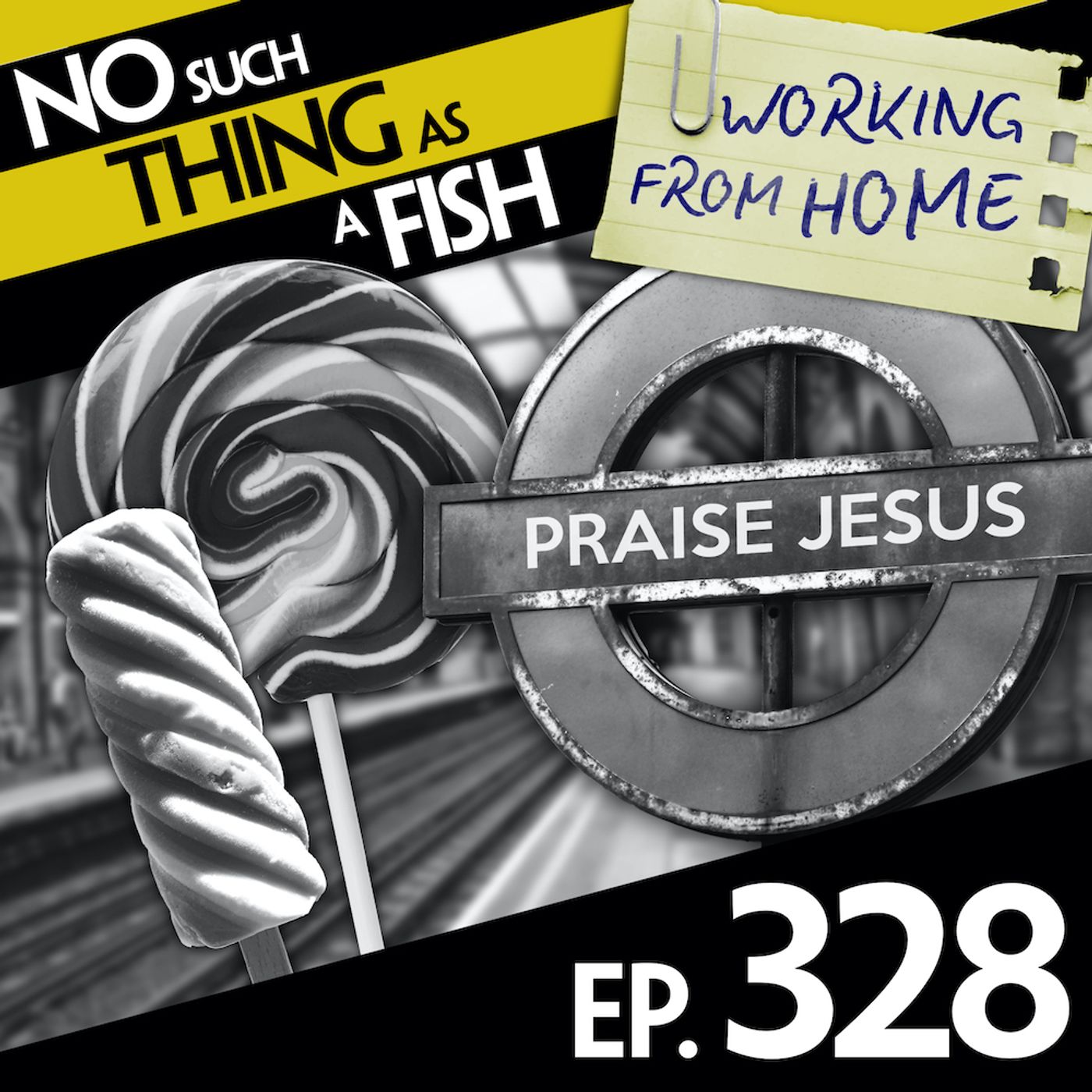
328: No Such Thing As A Romantic Lollipop
Visit nosuchthingasafish.com for news about live shows, merchandise and more episodes.
Press play and read along
Transcript
Speaker 1
Let's do the 60-second savings challenge. Step one: Download Rocket Money.
Step two, link your accounts and see every subscription you're paying for. Tap one you don't use and cancel it.
Speaker 1 That's money back every month. Step three: create a financial goal: $50 every paycheck, or let the app automatically move small amounts of cash when you can afford it.
Speaker 1
In a week, you'll forget you set it up. In a month, you'll see real dollars piling up.
In a year, you'll be shocked at how much money you've saved.
Speaker 1 Bonus challenge, upload an internet or phone bill and let Rocket Money try to lower it. You only pay if they find you savings.
Speaker 1 On average, Rocket Money members can save up to $740 a year when using all the app's premium features. Users love the app with over 186,000 five-star ratings.
Speaker 1
Make saving money the resolution you actually keep. Start the 60-second savings challenge at rocketmoney.com/slash cancel.
That's rocketmoney.com/slash cancel. Rocketmoney.com/slash cancel.
Speaker 2 While holiday shopping is almost always fun, credit can be confusing. That's when you get My FICO.
Speaker 2 Download the My FICO app now and shop with confidence, knowing that you can stay on top of your credit 24/7.
Speaker 2 Get your FICO score straight from the people that created it, plus free credit monitoring and a free credit report every month. No credit card required.
Speaker 2
FICO scores are used by 90% of lenders, so trust the My FICO app to keep you in the know. Visit myfico.com/slash free or download the MyFICO app today.
today.
Speaker 3 Hello and welcome to another episode of No Such Thing as a Fish, a weekly podcast coming to you from four undisclosed locations in the UK.
Speaker 3 My name is Dan Schreiber. I'm sitting here with Anna Tzinski, Andrew Hunter Hunter-Murray, and James Harkin.
Speaker 3 And once again, we have gathered round the microphones with our four favorite facts from the last seven days. And in no particular order, here we go.
Speaker 3 Starting with fact number one, and that is my fact. My fact this week is that the London Underground used to have a church interval on Sundays.
Speaker 3
Wow. Yeah.
It affected the church. It would stop services during church times.
Stop services so that you could have a service. Very nice.
And we're off.
Speaker 3 It's a bumpy start, but at least we're moving.
Speaker 3 If you were halfway between stations, would it just stop underground and you're trapped there having to worship God from the subterranean? That's such a good point. I don't know.
Speaker 3 I did find a thing called the London Underground Church, and I thought, oh, great, there's going to be a church down there. But apparently, it was a political movement.
Speaker 3 It was a sort of like underground in the sense that it wasn't allowed to be known.
Speaker 3
So it was a couple of hours on a Sunday so people could go to church. Is that all? Yeah, it it was 11 a.m.
to 1 p.m. roughly.
And this is a thing that has existed for a very long time.
Speaker 3
So the London Underground, very, very old. The first line opened in 1863.
Just to put in context, nine days before that, Abraham Lincoln signed the Emancipation Proclamation in America
Speaker 3 to do with slightly, just to put it in context of how old this is. Interestingly, though, Dan, I know how old the London Underground is better than I know when the proclamation was signed.
Speaker 3
So it didn't really help me that much. I think that was more for American listeners.
Got it. Yep.
Got it.
Speaker 3 Yeah, and it's so there was a big thing where you had to respect a lot of the church during those times. And one of the things was transport also had to do that.
Speaker 3 And that extended to the London Underground. And that extended all the way till 1900, when I think it was the Central Line, was the first line that didn't abide by the church interval.
Speaker 3
And interestingly, a famous celebrity on the first Central Line ride. Oh, wait, did you say what year it was? 1900.
Oh, who was famous in 1900? Who we would have heard of today?
Speaker 3 Gladstone. It was,
Speaker 3
this is again for the American listeners. It was an American visiting.
Oh, Charlie Chaplin. Who is British, but that's cool.
Yep, got it. Cool.
Speaker 3
What about Edison? No, not Edison. I mean, it's going to be too hard to get.
Henry Ford. No, not Henry Ford.
No.
Speaker 3 Alexander Graham Bell, who I appreciate was Scottish, but he spent a lot of his career in America.
Speaker 3 Aladdis Borissette, who is Canadian, but a lot of people think she's American. She's North American, isn't she?
Speaker 3 Is it Freddie Mercury, who was born in Zanzibar?
Speaker 3 Ah, very nice.
Speaker 3
So we need someone who was alive in 1900. Let's start with that.
Oh, you're still making us guess. You're not just going to tell us.
Oh, I've been waiting. Slightly.
Speaker 3
A silent movie star. A silent movie star.
JFK. It was an author.
Speaker 3
Hemingway. An American author.
Yeah. Again, 1900, Anna.
Yeah, he would have been very young.
Speaker 3
He would have been very young. Yeah, but...
He got on for free.
Speaker 3
They just carried him over the barriers. It was fine.
Hemingway could have been a little two-year-old on holiday in Britain at the time. That's true.
Speaker 3 We wouldn't.
Speaker 3 Dan, put us out of it. Mark Twain.
Speaker 3 It was Mark Twain. Yes.
Speaker 3 Hemingway. Yes.
Speaker 3 Wow. Do we know what he thought of it?
Speaker 3 I didn't actually, no, I didn't actually find, but we do know what the Daily Mail reported about us. It said, vorocious curiosity, astonished satisfaction, and solid merit.
Speaker 3 If this kind of thing goes on, London will come to be quite a nice place to travel in. The conductor was all a quiver of joy and pride, but there was no indecorous exhibition of emotion.
Speaker 3 Every man was solidly British. These early breaks, though, or these rather, these kind of Sunday trading rules, a lot of it, I think, because there used to be trains every day.
Speaker 3 There used to be Christmas Day expresses.
Speaker 3 And then a lot of the trains had to be axed on Sundays partly because of religion But that was a bit of an excuse really because a lot of it was down to economics and the fact was there was this thing called the railway mania which sounds like an amazing time in Britain's history where every person in the country was invested in or actively building a railway and they got all the you know thousands of railways across the country and most of them didn't make any money because they didn't have any passengers and this was an easy thing to axe with Sunday trains yeah and companies were needing to save money in the 1860s and these were lightly used trains.
Speaker 3 They were an obvious target.
Speaker 3 It's a bit like, do you remember when they opened up directory inquiries and you had all those different 118 numbers? Like 118, 118 or 118, 888, or 118, 111, or 118, 222, whatever.
Speaker 3 It's like they opened this thing up for anyone with a little bit of money to think, I can make something big there. And everyone came in, and then, of course, most of them just died out.
Speaker 3 But what were the things that you could ring and ask? Like, what is Andy's phone number?
Speaker 3 I hope no one would tell you that. I hope the only people who could tell you that would be me with my phone number, and you haven't heard already.
Speaker 3 Well, it's interesting you should say that, Andy, because in the olden days, which you won't remember, there used to be phone books that had everyone's phone numbers in them.
Speaker 3 I'd be ex-directory.
Speaker 3
They let you take yourself off, though. They let you take yourself off, yeah.
And if I rang up and said, what's Andy's phone number? This is back in the day, and
Speaker 3 you'd take yourself off, they say, oh, he's taking himself off. My mum definitely still does 118, or she certainly was a couple of years ago.
Speaker 3 She would ring up for someone's number, and you don't want to be ex-directory, because they were always pricks, if you remember.
Speaker 3 You know, it was either your parents were a doctor, which for some reason was okay,
Speaker 3 or you're a bit of a dickhead.
Speaker 3 On Sunday, Sunday trading and Sunday hours and things like that, the history of Sunday trading in Britain is very funny when you look into it.
Speaker 3 And did explain to me why, still, if I ever go out to buy something on a Sunday, my mum will say, Well, I mean, the shops won't be open. What are you doing?
Speaker 3 Because, so the Sunday Shops Act happened in 1950, which basically said no shops except essentials can open on a Sunday because of church. And it was repealed in 1994.
Speaker 3 But I was reading all these parliamentary debates in the interim, which showed how very controversial it was because the rules were so convoluted. So for instance, you could buy essentials.
Speaker 3
People acknowledged that perishables couldn't wait another day. So you could sell vegetables.
So there were all these people, for instance, who would have furniture shops.
Speaker 3 There was a case in 1972, Waller versus Hardy, where a furniture shop was selling carrots for £250 each. but you got a free item of furniture with your carrot as a free gift to get away with it.
Speaker 3 There was this bizarre rule where fish and chip shops were specifically banned from selling fish and chips on a Sunday, but anyone else could sell fish and chips.
Speaker 3 So a Chinese takeaway could sell fish and chips, but a fish and chip shop couldn't. But a fish and chip shop could sell a Chinese takeaway on a Sunday.
Speaker 3 It was wild. There was a thing where you could buy,
Speaker 3 you're not allowed to buy dog food, but if you said to the guy at the shop i have a pony who only eats dog food you're allowed to buy it because you're allowed to buy pony food and it didn't say oh because because dogs are very religious but i think horses are that's right yeah that's insane yeah i found out about um a sex shop in cheshire yeah uh called the private shop and in 2014 they were applying to be allowed to trade on a sunday right um and they were they were not allowed to do so, but they were granted permission to leave the door slightly open.
Speaker 3 Right.
Speaker 3 but the thing is i bought a carrot from there for 5.99 and they gave me a free dildo
Speaker 3 well that's two dildos for the price of one that's great yeah
Speaker 3 i'm not going around to yours for sunday lunch
Speaker 3 um in 1816 in massachusetts there was a guy who was called George Pierce who was arrested for riding on a Sunday because in America you weren't allowed to ride your horse on a Sunday.
Speaker 3 He was arrested as acting against the peace and dignity of the Commonwealth of Massachusetts and he was put in prison and then he was only let out on a Monday.
Speaker 3 But then he sued the officer for false arrest because he said, yeah, you're not allowed to do anything on Sundays including arresting me. And
Speaker 3 he won his court case and he got $500 of damages from the police officer for arresting him. Wow.
Speaker 3 Brilliant move. That's great.
Speaker 3 I read a bizarre thing that in this is just things that were banned in the UK on sundays um it was in for about 28 years roughly in the 16th century it was it was made illegal to not wear a woollen cap on a sunday and this was this was not for all parts of society but it was predominantly for the people who couldn't afford to pay uh the fight so queen elizabeth basically put a law in place where she said that um maids, ladies, gentlemen, noble personages, and every lord, knight, and gentleman of 20 marks land
Speaker 3 were exempt from having to wear this hat, but everyone else had to wear a woollen hat on a Sunday in the UK.
Speaker 3 And if you were caught not wearing it, you'd be fined so much that you probably couldn't afford it and then would have to do jail time. So there was a huge risk to it.
Speaker 3 And the reason was to help the woolen industry, right?
Speaker 3 Yeah, exactly. Yeah.
Speaker 3 What are you in for? Well,
Speaker 3 I think you can see.
Speaker 3 That's very hot in summer.
Speaker 3 Yeah. yes.
Speaker 3 Were there regulations about the size of the woollen cap? Could you basically wear a very small sort of button-size woollen cap? I think it was just tied on your head.
Speaker 3 I think it was a very specific design. It was a sort of a uniform-style bobble hat that you would have to wear.
Speaker 3 Yeah, that's been quite a common way of policing these kind of Sunday laws is to fine people for not doing it. In 1581, it was the law that you had to go to church every Sunday.
Speaker 3
Everyone in the country had to go to church. And if you decided you didn't want to, you had to to pay a fine of £20 per month.
And that was 20 times the average monthly wage. So
Speaker 3
it would take you almost two years to earn that fine if you didn't do it. Oh my gosh.
Yeah.
Speaker 3 Just while you mentioned church ceremonies, I found out about the longest church service because this fact is about church intervals. Okay.
Speaker 3 Have you heard of the Sigui?
Speaker 3
Segui. I don't think so.
Are you trying to do a segue?
Speaker 3 No,
Speaker 3 I am trying to do a segue into a fact about the segui, but that is just a coincidence. Um, this is a mask festival held by the Dogon people of Mali, and it's the last one lasted for six years.
Speaker 3 Come on, so it's a long service.
Speaker 3 I'm not sure you have to spend all your time at it. It's not like a sermon that lasts for six years, but you have to carve a great mask, and it's several meters long, these masks sometimes.
Speaker 3
And then you have to perform what the Guinness Book of Records calls a time-consuming procession of dances from village to village. Wow.
And yeah, they're not doing another one until 2037.
Speaker 3 I was wondering if Southern Rail have been on a church interval for the dog on people of Mali for the last seven years.
Speaker 1
The number one resolution for people last year was to save more money, but nearly half gave up by February. Don't let that be you.
Download Rocket Money to reach your financial goals this year.
Speaker 1 Track your spending, cut waste, and automate savings in one simple app.
Speaker 1 Rocket Money shows you all your expenses and categorizes them so you know exactly where your money's going and where you're overspending.
Speaker 1 From there, the app cuts waste by canceling your unused subscriptions and lowering your bills. No customer service needed.
Speaker 1 With that money freed up, the app will automatically set some cash aside for your goals. Whether it's an emergency fund, paying off debt, or saving for vacation, Rocket Money's got you covered.
Speaker 1
Users love the app with over 186,000 five-star ratings. And on average, users can save up to $740 a year when using all the app's premium features.
Make saving money a priority this year.
Speaker 1
Go to rocketmoney.com/slash cancel to get started. That's rocketmoney.com/slash cancel.
Rocketmoney.com/slash cancel.
Speaker 4 Running a business is hard enough. So, why make it harder? With a dozen different apps that don't talk to each other, one for sales, another for inventory, a separate one for accounting.
Speaker 4
Before you know it, you are drowning in software instead of growing your business. This is where Odoo comes in.
Odo is the only business software you'll ever ever need.
Speaker 4 It's an all-in-one, fully integrated platform that handles everything. CRM, accounting, inventory, e-commerce, HR, and more.
Speaker 4 No more app overload, no more juggling logins, just one seamless system that makes work easier. And the best part, Odo replaces multiple expensive platforms for a fraction of the cost.
Speaker 4 It's built to grow with your business, whether you are just starting out or already scaling up. Plus, it's easy to use, customizable, and designed to streamline every process.
Speaker 4
So So you can focus on what really matters, running your business. Thousands of businesses have made the switch, so why not you? Try Odoo for free at odu.com.
That's odoo.com.
Speaker 3 Okay, it is time for fact number two, and that is James. Okay, my fact this week is that the first ice cream on a stick was called the Good Humor Bar.
Speaker 3 It was a modified version of a lollipop called the Jolly Boy Sucker.
Speaker 3
You said that like the jolly boy sucker. Well, I would say it was the jolly boy sucker.
There's no punctuation, so I don't really know. I don't know how to say it.
Speaker 3 It's in the eye of the beholder, isn't it? So
Speaker 3 this is the weather outside at the moment, as we record, is absolutely sweltering.
Speaker 3 So I thought we could do a fact about ice creams.
Speaker 3
And this is about ice creams on a stick. So things like, I don't know, Magnums or Mini Milks or whatever you would have.
And they were invented in around 1923.
Speaker 3 So a few years earlier, Harry Burt, who is a guy from Ohio, he'd put a lollipop on a stick, which he called the Jolly Boy Sucker.
Speaker 3 And his son suggested adding ice cream on the outside of it and maybe a chocolate covering. And it became really popular.
Speaker 3 And he called it good humor because he thought that your mood was related to your sense of taste. So if you tasted something really good, you'd always be in a good mood.
Speaker 3
And if you tasted something bad, you would always be in a bad mood. Hang on.
Is that like the medieval theory of the four humours?
Speaker 3 Where if you're too choleric you have too much bile i don't think when he called it good humor he thought it has half a bit of cholera half a bit of bile half a bit of blood i don't think he thought that but actually good humor i didn't know this uh because i haven't spent much time in america but it's quite a big brand in america it's owned by unilever i think yeah i i don't know it by name but i recognize the logo as almost a childhood ice cream bizarrely it's what so sorry was there a lolly was it like
Speaker 3
he kept the lolly inside did you say so you break the chocolate then the ice cream, and then you chow down on a rock-hard piece of candy. Oh, I did.
That's amazing. That's good, isn't it?
Speaker 3
Do you remember those, like those, what were they called? You used to get ice creams where you had some bubblegum at the bottom. It's a bit like that.
Oh, cool.
Speaker 3 You guys are all too young to remember these things, but.
Speaker 3 Well, Anna's mum will text 118, 118. This whole fact is going to be me reminiscing about the ice creams of my youth and you guys going, oh, we only have Cornettos.
Speaker 3 These good humor bars, they were kind of, they were seen as very proper and sort of very, the firm was seen as a very moral one.
Speaker 3 So there was a book about ice cream, which I looked at a bit of called Sweet Spot. And it has this to say about the good humor trucks, because he kind of invented the ice cream truck in a way as well.
Speaker 3 It said, the white shirt and the cap the drivers sported helped create a mythology around the good humor brand of trustworthiness and dependability.
Speaker 3 That lasted until the mid-1970s, when the Brooklyn District Attorney's Office filed a 244-count indictment indictment of good humor, charging the company with falsifying records to hide excessive amounts of bacteria in its products.
Speaker 3 Really?
Speaker 3
Wow. That was a long time ago, though, we should say.
Yes. Very long time ago.
But the origins of, as you say, like the ice cream truck, and
Speaker 3 they really cared about the presentation of how they were going through the community.
Speaker 3 So anyone who became a good humor man, which became quite a culturally significant role, there was movies made using that title, The Good Humor Man, later on.
Speaker 3 They all had to go and do courses to learn how to be the best version of that role. So there was a two to three day course that you would go on.
Speaker 3
They were taught to always tip their hat towards a lady if they came towards them. And if they didn't do that, they would be fired.
And they had to say ice cream, good humor.
Speaker 3
If they said good humor, ice cream, that was the improper way of saying it. And that could lead to them being fired as well.
So
Speaker 3 yeah, there was a handbook called Making Good at Good Humor that they all had to study in order to become this
Speaker 3 representative of the company. Don't forget, Dan, they also had to falsify records to hide excessive amounts of bacteria in the product.
Speaker 3
Do you know what people's favourite ice lolly is today? I was quite surprised by this. Also, lolly or ice cream? Ice cream or lolly on a stick.
Anything cold on a stick. Anything cold on a stick.
Speaker 3
Magnum. Yeah, I would assume.
Oh, you straight away went for Magnum.
Speaker 3 Okay, it's Magnum. It's bang on Magnum.
Speaker 3 28% of the country think they're the best. And the runner-up is on like 8%.
Speaker 3 I think it's because it's not very easy to remember any others.
Speaker 3 yeah do you think you're right yeah yeah i would go feast absolutely yeah any day of the week yeah feast is magnum in but it's not a market leader in the way that magnum is it's like saying what's your favorite flavor of cola you're only going to get people to say pepsi or coca-cola aren't you like
Speaker 3 yeah
Speaker 3 well anyway it might be so popular because they invented a new kind of chocolate for the magnum
Speaker 3 which was a really exciting move uh they've only been around since the late very late 80s uh, I think. And basically the problem was that um chocolate cracks at a certain low temperature.
Speaker 3 So it was actually very hard to get good quality chocolate around ice cream. And they created this new kind of chocolate that didn't break at minus forty degrees.
Speaker 3 And I read this weird um blog by a business analyst which was saying that Magnum is the epitome of good business'cause of its simplicity.
Speaker 3 And then when they brought along the new flavours like Cherry Guevara, John Lemon, Woodchock and Jami Hendrix,
Speaker 3
none of which I knew existed. He described them as the four horsemen of the apocalypse.
Wow.
Speaker 3
I don't think we've ever mentioned this before. There is quite a widely known claim that Roger Moore, James Bond, invented the Magnum.
Yes. Okay.
Speaker 3 And it's because he was being interviewed in the 1960s and he was asked, if you could ask one person any question, what would it be? And he said, I would like to meet Mr.
Speaker 3 Walls of Wall's Ice Cream and say, why don't you do a chalk ice with vanilla on a stick?
Speaker 3 And he also said, I didn't realize that other people at the time said they wanted to meet Gandhi or Jesus. That was his answer.
Speaker 3 Anyway, Walls sent him a cake which had plain chocolate on the outside and vanilla ice cream on the inside. And this later got parlayed into he invented the concept of the Magnum.
Speaker 3
Anyway, the Magnum was eventually made 23 years later, give or take. Okay, well, he was ahead of his time.
Yeah. A spokeswoman for Unilever
Speaker 3 told the Sun, who asked them about it, sadly, we've never heard this brilliant story, but we are thrilled to hear the late, great Sir Roger Moore was a fan of Magnum, very carefully saying there's no truth in this matter at all.
Speaker 3 I believe it, because it often takes a long time between the prototype. Like Alexander Fleming discovered penicillin, it was a long time before he was able to market it.
Speaker 3 So, probably in the same way, that first Magnum cake, you know, there was, of course, there was a gap before they could make it marketable. Well, didn't a Magnum cake sound like that.
Speaker 3 Didn't Harry Burt spend three years trying to get his good humor bar patented as well? And no one was granting the patent.
Speaker 3 And I think he eventually went down to the patent office with the ice cream and gave out samples.
Speaker 3 And then, according to the story of Good Humor's official website, that's when they were granted the patent.
Speaker 3 Yeah, he apparently had a five-gallon bucket of these ice creams and just handed them out to absolutely everyone who could make a decision.
Speaker 3 We were just talking about walls, which is kind of the UK version of Good Humour because they're both owned by Unilever.
Speaker 3
They started around the start of the 19th century. In 1812, George the Prince of Wales granted Richard Wall a royal warrant as the purveyor of pork to the king.
And that's where they started. He was
Speaker 3 the official royal purveyor of pork.
Speaker 3 And it was because he had a shop on German Street in London where he could make sausages and no one really else could make as good sausages as him because he had this machine and it was a donkey that would walk around the machine and it would like create a cutting motion that would turn the meat into mince meat, which he could then turn into sausages, which he could then purvey pork-like to the king.
Speaker 3
That's amazing. Because these days, like a technical edge is having a better factory that makes microprocessors more effectively.
And in those days, the commercial edge was just your
Speaker 3 donkey on a string.
Speaker 3 Yeah.
Speaker 3 And then in 1913, they came up with the idea because what would happen is in the summer, no one wanted pork anymore because it was too hot for pork and they were like have to lay people off.
Speaker 3 And so, they came up with the idea of making ice creams because he had refrigeration, so they came up with the idea of making ice creams to avoid layoffs.
Speaker 3 And that's when they became this big, probably the biggest ice cream company in the UK.
Speaker 3
I thought you were going to say that they sold frozen pork for people to suck, and that was how they partlayed it. That's right.
The magnum used to be a flat sausage on a stick.
Speaker 3 And the thing was, he also sent people around in kind of an early ice cream van way.
Speaker 3 They had tricycles with the ice creams in, and they had the slogan, stop me and buy one, which still exists today.
Speaker 3 But he would let them go on a Sunday when most people wouldn't let people work on a Sunday.
Speaker 3 He would let his ice cream sellers go on a Sunday, but he said that they would only let them do it if they went to church in the morning and it was under his supervision.
Speaker 3
So they had to go to church with him in the morning. And if they did, then they could sell the ice creams in the afternoon.
Wow.
Speaker 3
And just a little ice cream news story I found in the process of this. In 2018, a man called Mr.
Tickle was arrested for threatening an ice cream van owner with a samurai sword while high on cocaine.
Speaker 3 Wow.
Speaker 3
Oh, that started off so visible with Mr. Tickle and then it went dark really quickly.
It's actually an awful story. There were children present.
It was incredibly upsetting for them.
Speaker 3 He later went and hit by some bins before being arrested. Unfortunately, they saw his really long arms poking out from the bins, didn't they?
Speaker 3 He put up his hands to the cops
Speaker 3 knocked down some aeroplanes
Speaker 3 anyway it's probably too inappropriate because yeah he did threaten the van owner with a he was called jamie tickle okay very it's all right okay no one died no he gets out of prison quite soon and i just don't want him to come find me
Speaker 3 it's all right he'll get stopped by the long arm of the laugh
Speaker 3 um i've got a 2008 press release that i can tell you about um you guys are too young to remember this but until until 1988, all lollipop sticks had jokes on them. Oh, yeah.
Speaker 3 So, whenever you ate your magnum, when you got to the end of it, you could read the little joke on the sticks.
Speaker 3 And they were phased out in 1988 because they thought that people who were eating ice cream were becoming a bit more sophisticated.
Speaker 3
They didn't think that the jokes were appropriate anymore. Wait, this is so weird, James.
I thought I remembered that, but I was not in a position to read lolly stick jokes in 1988.
Speaker 3 It's possible your parents had a lot of out-of-date ice creams that they were giving you.
Speaker 3 I think that must be it.
Speaker 3 Knowing my parents, that is likely. They phased them out in 1988, so I suppose there might have been a few stragglers a bit later.
Speaker 3 But maybe like the kids ones, like Minnie Milks might have kept them on.
Speaker 3 But in 2008, Walls approached James Corden to start a new career writing jokes for ice cream sticks because they wanted to bring them back.
Speaker 3
They said that he would be ideal because James is an up-and-coming comedian who is cutting edge. Yeah.
True, that's a missed career opportunity for James. I know.
Speaker 3
We don't know if he said no yet, Hannah. We don't know he said no.
Well,
Speaker 3 I think he did say no.
Speaker 3 But where is he now? Where is he now? Where is he now? Yeah.
Speaker 3 Something else they phased out in the 80s, which only James will remember, is the
Speaker 3
double popsicle. Actually, I think this was in America, but I didn't know these were such things.
I remember though. It's like, is it an ice lolly with two sticks? It's a lollipop with two sticks.
Speaker 3
Oh, right. No, I don't remember that.
These were actually a ploy in the Great Depression to sell more people lollipops. So it was invented so that they could sell two for the price of one.
Speaker 3
So the idea, a public health nightmare, you'll agree, is that you would share a lollipop. So you'd buy one lolly, but you have two sticks.
So two people can share it and they hold it.
Speaker 3 You're each holding a stick and eating it.
Speaker 3 Your mouths are right next to it. It's like a lady in a tramp moment, just a lot longer.
Speaker 3 That's a much longer scene.
Speaker 3 That was it.
Speaker 3 They both lick either side of this lollipop until eventually they both get to this final sliver of lolly where they lick the final bet and then eventually romantically they're licking each other's tongues
Speaker 3 this is our romance
Speaker 3 i'm telling you
Speaker 3 but over the years i think people forgot that it was meant for two people and so it just became a lolly with two sticks you know in sorry you know in lady of the tramp yeah he basically pretends that he doesn't know what's happening right he's just eating the spaghetti yeah and he pretends he doesn't know what's happening he turns around and he's like oh now i've got to kiss the other dog i don't think you could pull that off if you're licking a lollipop because you'd see that there's no there's no flex and give no like there is in the spaghetti you're looking dead into the other person's eyes for several minutes while you lick as well literally the very start everyone knows what they're getting themselves into
Speaker 3 well actually scientists have worked out precisely how many licks it takes to lick a lollipop to the end to the time
Speaker 3 scientists which scientists are these Anna so I just I want to defend the scientists they did a very important experiment and then they thought how are we going to get the press to pick up on this well we can use this experiment to also work out how many licks to lick a lolly so they cooked up this hard candy and they had water currents flow over it and then they calculated that it would take 2 500 licks to lick a lolly it's a thousand licks per centimeter okay which i think is extraordinary and flawed because we have saliva right whereas they were using water currents so our saliva is much more abrasive.
Speaker 3
Yeah. Okay.
You'd think so.
Speaker 3 A lot of licks though, is what we're saying. Just to take us back to the lady of the traps, I think that means that you're licking for 40 minutes before you eventually lick each other's tongues.
Speaker 3 It's a long scene.
Speaker 3 Yeah, there's a director's cart available where you can actually see that original scene.
Speaker 3 Okay, it is time for fact number three, and that is Anna.
Speaker 3
My fact this week is that Kublai Khan's summer palace could be dismantled and folded away at the end of every summer. Oh.
It was clever. Like a camping trip.
exactly.
Speaker 3
Yeah, every summer he went on a big, long camping trip. It's sort of everyone's nightmare except Kublai Khan's.
Did they have it?
Speaker 3 Did they have that same problem of once they dismantled it, fitting it into the bag that it just always seemed too big to get into? He could never do it.
Speaker 3 He was always to be heard, roll it, don't scrunch it.
Speaker 3
It was a nightmare. So, this was in it was Kublai Khan, who was the grandson of Genghis and extended his empire.
So, we're talking the second half of the 13th century.
Speaker 3
And he had a summer capital in Shangdu, or made famous as Zanadu, of course, by Coleridge in his poem. But it was called Shangdu.
And in his summer capital, he had this big palace.
Speaker 3 And it was apparently, you know, really ornate, amazing palace, huge. And it was based on the Mongolian kind of yurt or gur.
Speaker 3
design. So they all had gurs, who were very nomadic people.
And so it was held up by 200 silk cords. And at the end of the season, you release the cords and the whole thing folds up.
Speaker 3
Although I don't know how, because it was made of proper materials. It wasn't made of canvas.
It was made of like cane and it had these huge pillars and stone dragons on top of it.
Speaker 3 Yeah, there's a lot of solid stuff to go in that bag.
Speaker 3 Yeah. So Kubla Khan, we should say that
Speaker 3 we largely know this from Marco Polo's account and then supported by Chinese historians who, for instance, lists there were five great halls, which might have all been removable because essentially the Mongols were nomadic.
Speaker 3
This was the fundamental thing about them. And so they just wanted new land to graze.
All their conquering was just about having new grazing land.
Speaker 3
And so, yeah, they took all their buildings down and buggered off at the end of every season. Wow.
And they went somewhere where they could graze more easily. Is that right? Is that what you say?
Speaker 3 No, this was this the buggering off here was just you know summer was over so he went back to the winter capital.
Speaker 3 But in all of their conquests and stuff, like one of so obviously they conquered the biggest contiguous land empire ever known to man and they didn't care about like settling cities and founding big cities.
Speaker 3 So they just flattened cities and then would leave them and go home again.
Speaker 3 And I think people think the reason they didn't take over the whole of Europe is because once they got to Hungary and Poland, it wasn't such good grazing land. So it was kind of pointless.
Speaker 3 So Kublai-Khan was
Speaker 3
the, was he the first non-Chinese emperor of China, as it were? Yes. He founded the Yuan dynasty? Yeah.
Yeah. It's really interesting.
Speaker 3
One of the things that Marco Polo says about him is the introduction amongst his group of paper money. So Marco Polo writes about that, brings that back.
And
Speaker 3 just a very tiny thing is the Ruan dynasty or Ruan.
Speaker 3 In Chinese, another way, if you put a different tone on that, means money.
Speaker 3 And I do wonder if there's a connection to those two, because that was such a dominating thing.
Speaker 3
for his court. Yeah.
Used to be centered, some of it, apparently. Some Chinese paper money was centered, I think, around about this time.
Speaker 3 Well, they were very big on counterfeiting right away, weren't they?
Speaker 3 They tried to stop everywhere. If you went to a bar in Mongolian times, they didn't take a £20 note, sniff it, and go, this isn't real, did they? I don't think.
Speaker 3
I'm not sure that was a counterfeiting thing. Oh, maybe it was.
I don't know. Maybe it was.
Speaker 3 But it was all mulberry bark.
Speaker 3 Sounds really cool, but actually, it was a sheet of paper-like substance derived from the bark of mulberry trees. And it had to be signed by multiple officials.
Speaker 3 And it had pictures of the old money on it as well, which I think might have been a way of explaining what this is to people who weren't accustomed to paper-like money, because the old money was just ropes with coins hanging off them.
Speaker 3
So it just had a picture of this. Hey, this is what this was, and now this is what it is.
That's so cool.
Speaker 3 That's a bit like when you have,
Speaker 3 you know, when we all got mobile phones, and you'd have a picture of an old-shaped phone on your mobile phone, so you knew that was what you pressed a call to. Something exactly like that.
Speaker 3
That's so cool. I love that.
Scuomorphism, it's called, isn't it? yeah or a picture of a floppy disk being the sign to save something yeah or a picture of a carrot to sell dildos
Speaker 3 yeah
Speaker 3 yeah sure um because he had such a big empire kubla khan it meant that people could travel from all the way from europe all the way to the other side of asia and that's obviously why marco polo managed to get across there because before that it was really difficult to to traverse those areas so what's what's the deal with marco polo in that i the last that I'd read or was told about him is that you know he might have been a fraud or that these weren't trustworthy.
Speaker 3 But all the places that he described, like we know where Xanadu was, we've found the dragon statues, we found he got the perimeter sizes wrong, but they were not too far wrong.
Speaker 3 Well, he was blindfolded a lot of the time, Marco Polo, so that's why he wasn't able to.
Speaker 3 There are theories, but they're still pretty unusual that he genuinely didn't get there. I find it totally implausible because he wrote about it in so much detail, and it was possible to access.
Speaker 3 And other people went there as well from the West. William Brubrick was another one.
Speaker 3
But people use things like he didn't mention the Great Wall of China. But actually, the Great Wall of China wasn't really that great at that time.
So not really worth mentioning.
Speaker 3 There's people in China who still don't know what the Great Wall of China is, genuinely, because
Speaker 3 they've not been up in space, have they? So they've not been able to see exactly.
Speaker 3 I think the argument is, and I don't subscribe to it either, that he got the stories from other people and he wrote them down rather than him actually going and experiencing it.
Speaker 3 That's the argument, I think. Okay.
Speaker 3
Another guy who did go and experience the Mongols was this guy called William Rubrik, who was a bit of a Marco Polo. He was a Franciscan.
We talked about Franciscans recently. He was a missionary.
Speaker 3 And he revealed to us a serious problem with the Khan dynasties, with the Mongol dynasties, which was alcoholism. So a lot of them had a real issue with this.
Speaker 3 He talked about this amazing thing called the Silver Tree of Karakoram in the Mongol capital. And it sounds extraordinary.
Speaker 3 So it was a huge, tall, silver tree in the centre, and it had an angel, a sort of angel-type fairy figure, with a trumpet on top of it.
Speaker 3 And then it had lions all around it, and the lions would spout a different drink from their mouths.
Speaker 3 So, there were four lions, and the lions produced grape wine, fermented mare's milk, rice wine, and honey mead, depending on which you fancy.
Speaker 3 And the way it worked, well, the way it was supposed to work was that the angel on top of the fountain was an automaton, and he blew some bellows at the bottom, it played a trumpet, servants rushed out and filled it.
Speaker 3 But the angel automaton never worked, and so what there had to be was a man inside the trunk of the tree at all times with a trumpet, who, as soon as the emperor decided he wanted a drink, had to blow the trumpet so it looked like the angel was blowing it.
Speaker 3
And then everyone flocked in to refill it. Wow.
But then, how amazing is that? He'd have a party and there'd be a lion fountain spouting every drink of his choice. That's so good.
Pretty good.
Speaker 3
That's amazing. I probably would have replaced the mares milk with like maybe sangria, but that's just me.
That's what I like. Yeah, maybe the later dynasties went there.
Speaker 3 It's like those magical machines that you get in Nando's, which have five different kinds of soft drink in them, basically.
Speaker 3 It is.
Speaker 3 They actually have a very small bat inside them
Speaker 3 with a pair of bellows.
Speaker 3 I do actually have another Nando's related Kublai Khan fact. Do you mean another? That last one wasn't related to Nando's.
Speaker 3 You just shoe-honged it in.
Speaker 3
That's so true. Okay, well.
Whenever he had his raw horse meat he used to put a little flag in it didn't he to say how spicy he wanted it
Speaker 3 well if you thought that link was tenuous james you wait till you hear this one
Speaker 3 one of ani's famous su gwas or whatever it was you were calling them sequa i think that kubla khan basically invented the nando's black card which is a card where you get free nandos forever if you have this right yeah that's what the nando's black card is so kubla khan had a bit of a correspondence with the then Pope.
Speaker 3 And
Speaker 3 obviously, this is incredibly difficult to do because you're thousands of miles away and transporting letters is a nightmare.
Speaker 3 But he sent Khan, this is, sent an ambassador with a Pisa, which is a golden tablet, which is three inches wide and one foot long.
Speaker 3
And what the Paiser does is it authorizes the holder to free food and lodging anywhere throughout Kublai Khan's dominion. So it's effectively a Nando's black card for a whole country.
Yes.
Speaker 3 No, I'm going to give you that, Andy.
Speaker 3
Yeah, that works. Well, Marco Polo had one of those as well.
You were saying it was.
Speaker 3 Yeah, Marco Polo, when he left to come back to Italy, he was given one of these golden tablets and it worked brilliantly until he sort of reached the stronghold of his influence and it sort of got weaker and weaker.
Speaker 3 And at that point, the gold tablet meant nothing and they started getting beat up and they started losing the clothes.
Speaker 3 And it's what led to basically him arriving back as a ruffian, supposedly, and being jailed. Oh really? Yeah.
Speaker 3 It's like when he tried to pay with Scottish money for something
Speaker 3 this is legit I promise you.
Speaker 3 So the person who made it for the whole dynasty was Genghis right and he's he started off really poverty stricken. So he started off being a hunter-gatherer because he was basically exiled.
Speaker 3 But he was born, this is this weird thing, he was born with a clot of blood in his hand, apparently, which meant that you were going to be a great ruler.
Speaker 3 I mean, obviously he wasn't if we don't believe in the mythology of these times but if you're a mongol clot of blood in his hand and was a sign he was going to be ruthless and he was so once he massacred as well as massacring an entire city he massacred all the pets all the cats and dogs and cows and camels in a city as well what an awful person
Speaker 3 he was he was a bad guy yeah but he really liked loyalty he was a good guy to his mates he was one of those like if you're friends with him he's really good to you um he was in he was in one battle and someone almost killed him, shooting his horse out from underneath him.
Speaker 3 And he sort of stopped the battle, took a bunch of them prisoner and was like, who was it who almost shot that horse out from under me? And the guy put his hand up for some reason.
Speaker 3
And Genghis said, okay, you, that was a great shot. Come on my side.
And this guy ended up being one of his most important generals, helped him conquer the world. Wow.
Speaker 3 You just had to go on his good side. When he went through the Middle East, trying to siege all these cities.
Speaker 3 The reason that they were so good is they had these massive catapults and their catapults were amazing. And they would fire the stones at the city walls and then eventually they would have to give up.
Speaker 3 And they were so important that if you know how they killed all the dogs and cats and stuff like that? Well, they wouldn't kill the engineers of the city.
Speaker 3 They give them a chance to kind of come over to the Mongol side because they knew how important the engineers were.
Speaker 3 And if they agreed, then they would come over and they'd become part of the Mongol army. And there was one city in China somewhere, I can't remember what what it's called.
Speaker 3 And they heard about this, that this was happening. They heard the Mongols were coming and they decided to get rid of all the stones from the area.
Speaker 3 So for a couple of days, they literally, within about a mile circle, they grabbed every single stone they could find and brought it into the city.
Speaker 3 But then what the Mongols did instead was they got some mulberry trees, chopped them down, put them in water, left them out to dry, and they became rock hard.
Speaker 3 And they could use those instead of stones to fire in the city.
Speaker 3 Now, there's some argument,
Speaker 3 yeah, there's some argument that they weren't good enough and in the end they had to bring in some stones from somewhere else because they had like a like a postal service for stones that they used sometimes where
Speaker 3 they get like storage of stones like an Amazon storage site of parcels but they would keep stones in all these different places and really yeah they would be like one day's ride away and they bring the stones to each place.
Speaker 3
So there's an argument that they might have done that or it might have been these mulberry trees. We don't know.
That's so funny. It's so expensive.
Speaker 3 If you're shipping stones internationally, it's hard enough to ship a hardback book, but imagine like 100 bricks or something. And you're asking for next day delivery on a lot of these stones.
Speaker 3 Presumably, though, you could catapult it to the area you want to get it to.
Speaker 3
That's such a good idea. Just catapult onto the next catapult.
I don't think they even thought of that, Dan. Only been in charge.
Speaker 3
They used to also tie trees to their horses. If they didn't need the trees to be replacement rocks.
So they had all these clever tactics for scaring the enemy.
Speaker 3
And one of them was tying trees to the horses that didn't have riders. So it sounded like they had a much bigger army than they did.
The horses would sound much heavier.
Speaker 3
Is the horse dragging along a tree? Okay, sorry. Tying trees to the horses makes it just sound like you're tying your horse to a tree.
Sorry. But you're getting it wrong.
Speaker 3 There's a very big difference between tying your tree to a horse and trying your horse to a tree.
Speaker 3 It's a completely different thing. Imagine being the one guy who's just standing there going, I don't understand this tactic.
Speaker 3 Where's everyone gone?
Speaker 3 Oh, no.
Speaker 3 How embarrassing. Yeah, sorry.
Speaker 3 They uprooted the trees and branches and they did things like they banged metal pots together and they rattled bells when they galloped into battle so that the opposing army couldn't hear each other shout instructions.
Speaker 3 They wanted it into battle. When they were going into battle, they would bang metal pots and pans together and they'd run lots of bells and stuff.
Speaker 3 And that meant that the opposition couldn't hear each other shout instructions.
Speaker 3 That's really interesting. You won't be able to hear yourself think
Speaker 3 but that's what happens in um that's what happens in american football like when the other team's on offense and they need to make all their signals you get your fans to make as much noise as possible so that they can't get the signals across and it means that they can't do it so that is a really common thing in american football wow and then you slaughter the entire coaching
Speaker 3 hang on just to go back to this time your tree to a horse thing yeah doesn't that
Speaker 3
and so the what the idea is the enemy thinks you've got a much bigger army because it sounds bigger. It's rumbling.
It sounds bigger, isn't it?
Speaker 3 Well, the rumble is bigger, but this only works in a place where the enemy can hear you but not see you, for one thing.
Speaker 3 Well, no, if you're running with an army, presumably a lot of this is going to be on dirt. There's going to be a lot of dust raising.
Speaker 3 You're going to create...
Speaker 3 It's all theatrics.
Speaker 3
Dan's thought it through. You really should have been in charge.
You're so right. The Mongolian desert, there's sand everywhere.
Speaker 3 You can't see a thing, but the reason Dan didn't go there is because of the death worms they have in mongolia isn't there
Speaker 3 killed by lightning bolts from the anus no thank you this uh kubla khan samuel taylor coleridge sort of um
Speaker 3 immortalized xanadu in that great poem of his and uh this is such a basic thing that i didn't know so i'm saying it for the other people out there who did not know this uh even though 90 of you will He never finished the poem because someone knocked at his door, a person from Portlock, and he lost his creative thread and didn't know how to finish it.
Speaker 3 And I didn't realize that that's become a term that you use for when creativity is disrupted, when your inspiration suddenly goes because of some exterior thing.
Speaker 3
A person from Porlock has come, is the term to say, I've lost my thread of it. I think it's fair, Dan, that that is not an extremely common phrase that people use all the time.
Oh, really?
Speaker 3 It's like, yeah, yeah, yeah.
Speaker 3 I wouldn't say 90% of the people listening to this. If you're listening to this, you're not in a 10% of people who didn't know it.
Speaker 3
Because you just say, it's not that common. That is a way to make all of our listeners feel very stupid.
Well, I was in the category, but then that's even more insulting, I guess.
Speaker 3
Yeah, so he wrote it in this opium haze. He was inspired after reading about the description of Xanadu in Marco Polo's accounts.
And it never got, now I haven't actually read it myself.
Speaker 3 So does it just cut off?
Speaker 3 Yeah.
Speaker 3
But does he write about a person from Porlock at the end? He doesn't write into the poem. Oh, Sonnet.
Who's that at the door? Hang on. I'll be back in a minute.
I've got a great idea for the ending.
Speaker 3 And then he comes back and he's like, I've got to rhyme something with ending now. What am I going to do?
Speaker 3 No, it does stop halfway through. And actually, a lot of people think that there was no person from Porlock and it was just an excuse.
Speaker 3 A lot of people think that it might be just because he was off his face on opium that he maybe didn't finish it.
Speaker 1
The holidays are expensive. You're paying for gifts, travel, decorations, food.
And before you know it, you've blown way past what you were planning to spend.
Speaker 1 Don't start the new year off with bad money vibes. Download Rocket Money to stay on top of your finances.
Speaker 1 The app pulls your income, expenses, and upcoming charges into one place so you can get the clearest picture of your money.
Speaker 1 It shows how much to set aside for bills and how much is safe to spend for the month so you can spend with confidence. No guesswork needed.
Speaker 1 Get alerts before bills hit, track budgets, and see every subscription you're paying for.
Speaker 1 RocketMoney also finds extra ways to save you money by canceling subscriptions you're you're not using and negotiating lower bills for you.
Speaker 1 On average, Rocket Money users can save up to $740 a year when using all the app's premium features. Start the year off right by taking control of your finances.
Speaker 1
Go to rocketmoney.com slash cancel to get started. That's rocketmoney.com slash cancel.
Rocketmoney.com slash cancel.
Speaker 4
Running a business is hard enough. So why make it harder? With a dozen different apps that don't talk to each other.
One for sales, another for inventory, a separate one for accounting.
Speaker 4
Before you know it, you are drowning in software instead of growing your business. This is where Odo comes in.
Odo is the only business software you'll ever need.
Speaker 4 It's an all-in-one, fully integrated platform that handles everything. CRM, accounting, inventory, e-commerce, HR, and more.
Speaker 4 No more app overload, no more juggling logins, just one seamless system that makes work easier. And the best part, Odo replaces multiple expensive platforms for a fraction of the cost.
Speaker 4 It's It's built to grow with your business, whether you are just starting out or already scaling up. Plus, it's easy to use, customizable, and designed to streamline every process.
Speaker 4
So you can focus on what really matters, running your business. Thousands of businesses have made the switch, so why not you? Try Odo for free at odoo.com.
That's odoo.com.
Speaker 3 Okay, it is time for our final fact of the show, and that is Andy. My fact is that, according to the people who have drunk it, billion year old water tastes terrible.
Speaker 3
I know. Shock.
I know.
Speaker 3 Wait,
Speaker 3
this doesn't make any sense. Because I've got some water right here and I've been drinking it.
And this water here, I would say, is more than a billion years old. Really?
Speaker 3
I reckon this water is like four billion years old or something, 12 billion years old. And it tastes fine to me.
All water, surely. Surely it's been cleaned.
It's been...
Speaker 3 No, so you don't make water, do you? Like the Earth doesn't make water. The water that we have now is the same water as was when the dinosaurs were around.
Speaker 3 So I'm receiving a lot of early challenges on this fact, and I'll go into it a bit more.
Speaker 3 So you're absolutely right that
Speaker 3 pretty much all the water on the planet is unbelievably old and may well be much older than a billion years. This is
Speaker 3 a
Speaker 3 pocket of water which was found by a team of Canadian scientists led by Barbara Sherwood Lollar, who is an earth sciences professor.
Speaker 3 And she and her team found a bit of water about a mile down in Canada beneath a mine. And this pocket has been isolated from the rest of the world for over a billion years.
Speaker 3 So much of the, pretty much all of the water on the planet is part of the water cycle where it will cycle into the oceans, it'll cycle into clouds, it'll maybe go into underground aquifers.
Speaker 3
But this stuff that she found and her team has been isolated for up to two and a half billion years. It's really, really, really, you know, it's been kept separate.
It's not been in circulation. And
Speaker 3 she was interviewed about it a few years ago and she says she tastes it from time to time and it always tastes terrible.
Speaker 3
And she doesn't let her students do it because obviously there isn't a huge amount of this stuff to go around. And so.
So this is a common thing, apparently, right?
Speaker 3 Geologists just go around licking and tasting the stuff that they're investigating.
Speaker 3 She was saying to find, because apparently you can get an immediate read, if you're good at that kind of thing, of the kinds of minerals and stuff or the extent of the minerals.
Speaker 3
And she did say that if you're a geologist who works with rocks, you've licked a lot of rocks. Yeah.
Which is quite weird. The point is that she's looking for the oldest water in the world.
Speaker 3
That's like what their job is. That's what they're looking for.
And the older it is, the saltier it gets because it means all the bits from the rocks are leached into it.
Speaker 3
So as you're going, you're kind of licking little bits of water to get saltier and saltier and saltier. And the most salty one you get is probably the oldest.
Right. So that's why she does that.
Speaker 3 If that was her job, she did a bloody good job of it because the previous record holder was only tens of millions of years old.
Speaker 3 So she's not only found one that's older, but by almost two and a half billion years, which is pretty good going.
Speaker 3 The reason that they realized that this one is so much older than any they found before is they've got a new technique of checking how old things are.
Speaker 3 And by using this new technique, which was, I think, discovered by the University of Manchester in England.
Speaker 3 They kind of looked at the isotopes of various gases which are found in this water. And by doing that,
Speaker 3 i won't explain exactly how you do that because it's pretty obvious for everyone but basically you you work out how many of certain isotopes of these uh noble gases are in your water and that will tell you when when it kind of landed there in your aquifer yeah but to go back to anna's original complaint about this fact it is bizarre that water is there's a lot of water which is older than the sun
Speaker 3
Most water is older than the sun. Four billion years old.
Four and a half billion years old. Is that bizarre?
Speaker 3 You don't find it bizarre that the water on the planet is older than the rock?
Speaker 3 I find it bizarre. But I know that we have a lot of alien water, so it's...
Speaker 3 Yeah, that's the thing I'm saying. It's bizarre that there's a lot of alien water which predates the planet forming.
Speaker 3
I think that's mad. It is mad.
He's right.
Speaker 3 So
Speaker 3 most of the water that we have on Earth, we think...
Speaker 3 Actually, it's interesting because no one really knows where all the water comes from, but we think most of it comes from asteroids because you can look at the chemical compositions of your water and notice that it's quite similar to what you find in asteroids but some of it has come from the actual formation of the sun itself so when the sun forms all this all these bits come together to make this massive body in space but some of it becomes what's called the solar nebula which is like a gaseous part of the sun which doesn't become the sun itself and apparently a lot of that stuff has come down to earth and become some of the water so it didn't all come from asteroids some of it came from the formation of the sun and apparently um for every 100 molecules of water, one or two come from the solar nebula.
Speaker 3 So Anna's big jug of water that she's drinking from at the moment will have millions and millions, well, way more than millions of molecules that came from the formation of the sun.
Speaker 3 But most of it will have probably come from asteroids.
Speaker 3 And that could be why water evaporates if you believe in a fringe theory, because the sun causes water to evaporate because it wants its water back.
Speaker 3
So it's trying to suck it back up. I mean, wow.
Yeah. It's just a new theory.
But why it would put itself out? It sounds like a brand new theory at us. Oh my God.
Speaker 3 There is so much going wrong in these last few things that people have said.
Speaker 3
We should move on. Just leave that as accepted facts.
Move on.
Speaker 3 Just to go into slightly more kind of human time scales of water.
Speaker 3 Do you know why water tastes weird when you've left it overnight? It's gone funky because
Speaker 3 flies have gone in there and
Speaker 3
glasses of water are always full of flies floating. No, they've flown off again.
They kind of go in for a little bath in the evening when I'm not around.
Speaker 3
James, you have to sort out your fly situation. No, that's not it.
It's that carbon dioxide from the air has dissolved in the water and it's formed carbonic acid.
Speaker 3 So you basically, according to one article I read about it, you're basically drinking very, very mild acid rain the next morning. Wow.
Speaker 3 It was really interesting. This is a bit of a personal story, but
Speaker 3 I'm in Sussex at the moment and had visitors come recently from Oxfordshire when it was after the time when you were allowed to have visitors.
Speaker 3 And they came from Oxfordshire, and one of them had a bottle of water they brought from Oxford. And we tasted, and then they tasted the water here and said, Oh, Sussex water is so delicious, isn't it?
Speaker 3
So much nicer. I was like, What are you talking about? And we all could tell immediately by just the smell of the water.
We did blind taste testing, which came from where.
Speaker 3 You can 100% tell the difference from certain places.
Speaker 3 Like from the difference between bolt and london is it might as well be a different liquid it just does tastes nothing like it it's bolton sometimes it's because of the um rocks this is because of the chemicals that are added in oxfordshire
Speaker 3 more chemicals with us it's because we have soft water in bolton but we have hard water in london which is just like it might as well be orange juice and lemon juice it's completely different wonder if there's anyone who can tell every single county by the taste of the water
Speaker 3 skill in 2016 they did a taste test of all the different waters in the uk uh with a with a group of judges that included Michelin star chef Tom Aitkens.
Speaker 3 Okay, so these were experts on water and they tasted them all and they said that the best tasting tap water was the West Midlands. It was found in the West Midlands.
Speaker 3 And the worst was served by Wessex Water, which included Bath and Bristol.
Speaker 3 But that was because the water was polluted by a statue of a slave trader.
Speaker 3 But no, apparently, according to, but then you see these every kind of few, every couple of years they come up with a new survey and someone else is the best and someone else is the worst.
Speaker 3
Bath, though, that's very embarrassing. Bath.
I know. It's been trading on its water for centuries.
I suppose they're quite sulphurous, are they, in Bath? Is that the whole point of bath?
Speaker 3 The actual springs are, yeah, that you can buy you to cost 50p for a glass of the actual springs water and it's so eggy. It's really gross.
Speaker 3
People used to order it by delivery, though. So back when bath became a thing, it became, there was the resurgence of bath.
So bath was a big deal in Roman times because of the spa.
Speaker 3 And then the 18th and 19th centuries, people like Jane Austen and Cosa had holidaying there to take to the waters, which were thought to be very curative.
Speaker 3
And you'd visit to cure your sickness. And sometimes it worked because water was very polluted, let's say in London.
But you'd visit to cure your sickness.
Speaker 3
But sometimes people didn't have weeks to spare to go holidaying in bath. And that's where the bottled water industry started.
So they'd write to bath and say, oh, can I just have water delivered?
Speaker 3 And you'd get subscriptions of spa water delivered to you once a month to cure your
Speaker 3 tiger water
Speaker 3 so they also invented the subscription meal service did they as well they did podcasts in the 19th century would advertise this
Speaker 3 do you know we talk about the oldest water the oldest rock the oldest earth rock do you know where they found that is it in space
Speaker 3 yes oh on the moon on the moon yeah the oldest rock that they think belongs to the earth and that was formed on the Earth was found on the Moon by the Apollo 14 crew in 1971.
Speaker 3 They brought down a load of samples and this particular one has got all the right isotopes or whatever to think that it did come from the Earth. Wow.
Speaker 3 And they reckoned that what happened was an asteroid hit the Earth really, really early on in its development and it flew a load of stuff into space.
Speaker 3 And then this kind of went around, went around, went around and eventually landed on the moon when the moon formed.
Speaker 3 The moon was a lot closer to the Earth in those days and then was found by these astronauts in 1971. You would be furious if you were NASA.
Speaker 3 If you were NASA and you said, right, guys, can you bring back some moon rocks? You don't mind like literally any bloody rock you can find. It's all moon rock, isn't it?
Speaker 3 Thank God the Apollo 11 astronauts didn't bring it back. That would not have helped the conspiracy theorist.
Speaker 3
Okay, that's it. That is all of our facts.
Thank you so much for listening.
Speaker 3 If you would like to get in contact with any of us about the things that we've said over the course of this podcast we can be found on our twitter accounts i'm on at shreiberland james at james harken andy at andrew hunter m and anna you can email podcast at qi.com yep or you can go to our group account which is at no such thing or our website no such thingasoffish.com we have everything up there from previous episodes to links to our merchandise as ever we all hope that you're doing well and that you're safe and um thank you so much for continuing to listen to us in this bizarre bizarre time we will be back again next week with another one of these great episodes of facts and we'll see you then goodbye
Speaker 3 and in no particular order here we go
Speaker 3 starting with my
Speaker 3 Do you just forget the words to the intro
Speaker 3 yeah I human buffered I it's not internet.
Speaker 3 Your brain has been buffering for a long time, hasn't it, Dan? It's really odd. It's a big rainbow wheel.
Speaker 5 California has millions of homes that could be damaged in a strong earthquake. Older homes are especially vulnerable to quake damage, so you may need to take steps to strengthen yours.
Speaker 5 Visit strengthenyourhouse.com to learn learn how to strengthen your home and help protect it from damage. The work may cost less than you think and can often be done in just a few days.
Speaker 5
Strengthen your home and help protect your family. Get prepared today and worry less tomorrow.
Visit strengthenyourhouse.com.
Speaker 6 Make your home smell as good as it looks with Purifor, the smart fragrance diffuser that lets you control your scent from anywhere.
Speaker 6 Choose from hundreds of premium fragrances, schedule your favorites, and set the perfect mood for every moment. And right now, get yours free when you subscribe to two cents for 12 months.
Speaker 6
Don't wait, this limited time offer won't last. Try it risk-free for 30 days.
Now at Pura.com.
Speaker 7 Start your journey toward the perfect engagement ring with Yadev, family owned and operated since 1983. We'll pair you with a dedicated expert for a personalized one-on-one experience.
Speaker 7 You'll explore our curated selection of diamonds and gemstones while learning key characteristics to help you make a confident, informed decision.
Speaker 7 Choose from our signature styles or opt for a fully custom design crafted around you.
Speaker 7 Visit yadivejewelry.com and book your appointment today at our new Union Square showroom and mention Podcast for an exclusive discount.