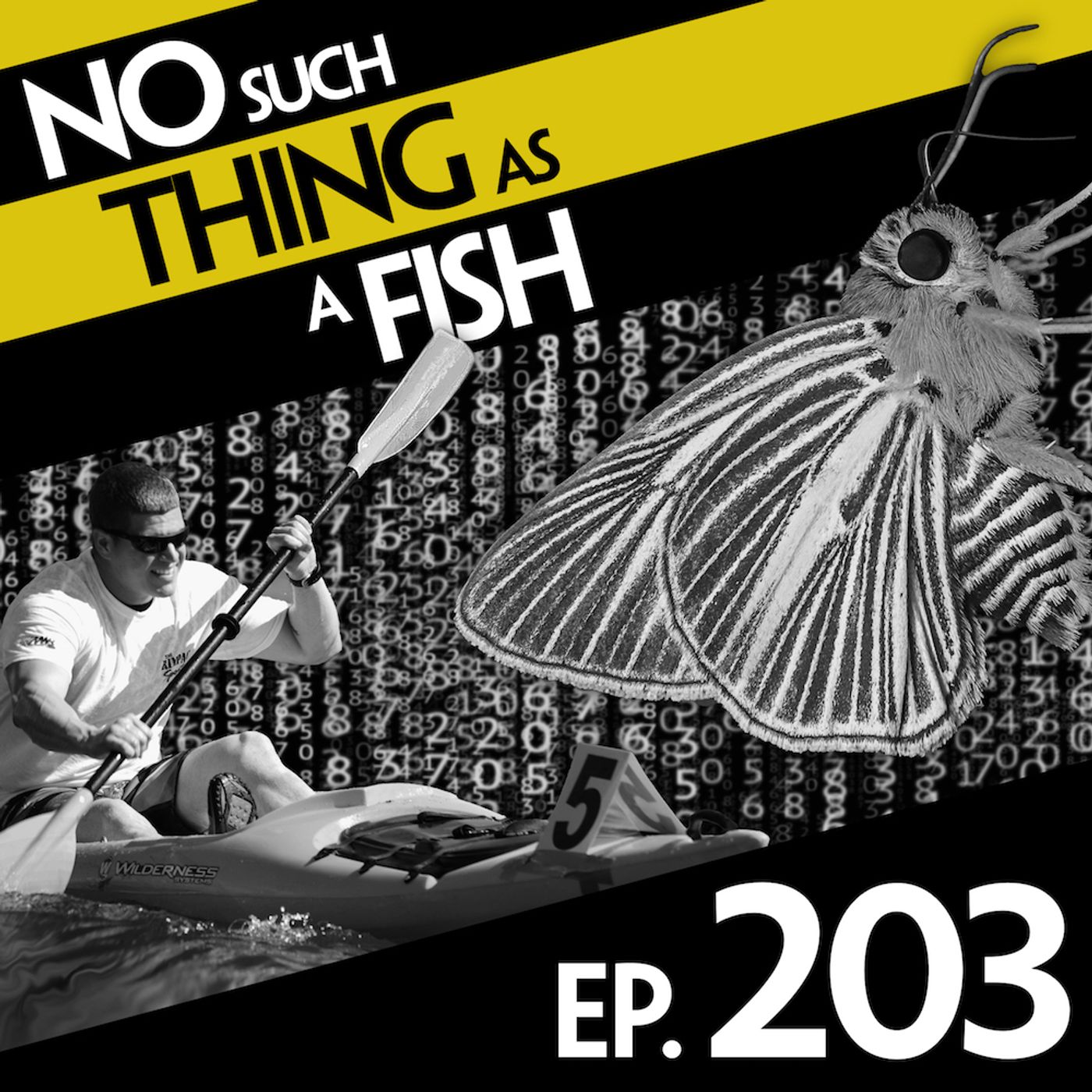
203: No Such Thing As A Muscular Butterfly
Dan, James, Anna and Andy discuss the secret Matrix sushi recipes, why our skin doesn't leak and butterfly sperm trickery.
Press play and read along
Transcript
Speaker 1 Running a business online?
Speaker 2 Look legit and own your own brand with professional tools from GoDaddy.
Speaker 7 Instantly build trust with your customers and boost your credibility with an email that matches your domain so people know you mean business.
Speaker 10 There's never been a better time.
Speaker 12 Just go to godaddy.com/slash GDNow and choose from a wide variety of popular domains to find one that's right for you.
Speaker 12 Pair that with a professional email that works for all your business needs from daily communications to email marketing and everything everything in between.
Speaker 17 That's a little price for a lot of credibility.
Speaker 13 For a limited time, get a domain and matching professional email for just 99 cents a month for one year.
Speaker 1 Go to godaddy.com slash gdnow and look legit with godaddy.
Speaker 6 That's godaddy.com slash gdnow.
Speaker 3 Again, go daddy.com slash gdnow.
Speaker 15 There's never been a better time to choose the domain and email that's right for you.
Speaker 20 New customer purchases only products auto-renew separately.
Speaker 21 See terms on site.
Speaker 1 Godaddy.com slash GDNow.
Speaker 22 This is Bethany Frankel from Just Be with Bethany Frankl. Here's my summer tip: don't overthink your dogs' meals.
Speaker 22 My pups love just fresh from just food for dogs, complete, balanced, fresh, shelf-stable meals that go everywhere from New York City to weekends in the Hamptons.
Speaker 22
I mean, you can have real food ready to go for your pup anywhere. No cooler, no hassle, just grab and go.
I've seen the difference. Healthier coats, more energy, tails wagging at mealtime.
Speaker 22
Biggie and smalls love it, and I'm all about stuff that just makes sense when life is busy. Go to justfoodfordogs.com and get 50% off your first order right now.
No code needed.
Speaker 19 Hello and welcome to another episode of No Such Thing as a Fish, a weekly podcast coming to you from the QI offices in Covent Garden.
Speaker 19 My name is Dan Schreiber and I'm sitting here with James Harkin, Anna Chaczynski and Andy Murray and once again we have gathered around the microphones with our four favorite facts from the last seven days and in no particular order, here we go.
Speaker 19 Andrew Hunter Murray, I saw your face.
Speaker 19 Starting with fact number one, and that's my fact. My fact this week is that scientists have finally worked out why the four of us and all humans are not constantly leaking.
Speaker 24 They started with the four of us didn't they?
Speaker 19
We were the guinea pigs. And they extrapolated.
Yes, exactly. No, this is this is we've just worked out.
Speaker 19 Actually, I say just actually and also I think Andy you are leaking are you oh sorry yeah hang on
Speaker 19 we've already had these chairs upholstered once this week Andy come on this is uh this was discovered or published at least in November of 2016 and I didn't know this but scientists have been desperately trying to work out desperately, is a bit of a stress, desperately is a bit of a stress, why we don't constantly leak.
Speaker 19 Because we shed more than 500 million cells every 24 hours. So, basically, in a two to four week period, our entire body of outer layer skin is completely replaced.
Speaker 19 In the process of that happening, we should just be suddenly, you know, a bit of arm skin goes and suddenly bloods spurting out or sweat, or we should be like just sprinkler systems non-stop, but we're not.
Speaker 19 And they don't know why, except for now they do.
Speaker 24 And why is it then,
Speaker 19
James? It is so easy to explain. I'm not even gonna bother.
Why don't you try?
Speaker 19 Okay, what it is, is we have effectively three layers of skin, which I think works a bit like a conveyor belt. You know how, like, sharks' teeth get replaced the further they go forward?
Speaker 19 Yeah, so the top layer is just the dead skin almost, it's it's really flaky and it goes all over the shop. Then there's this middle one, which is a bit fluidy, and that's really
Speaker 19 nice. Um,
Speaker 19
and then we have an original layer, which is sort of like the real, the real meat of the cake. Of the meat cake.
Oh, yeah.
Speaker 16 Excellent metaphors and sounds.
Speaker 19 I didn't realize it was this easy to explain, I have to say.
Speaker 19
And so what happens is they all shift up one place. And what they didn't know was how it was that no holes were being revealed when the...
flakes of skin were disappearing. What was plugging the gap?
Speaker 19 And what they've discovered is what effectively is kind of like a pritstick glue. It's like a temporary glue,
Speaker 19 not as good as super glue, which eventually comes to the second layer. but that original layer has a sort of prit stick glue which
Speaker 19 holds the gaps closed so it holds all the stuff in.
Speaker 24 So it's like a meaty cake with prit stick on it.
Speaker 19 Yeah, at the bottom layer.
Speaker 16 And don't forget there are three layers of sharks teeth on the top layer.
Speaker 19
Yeah. I didn't realize that we were completely dead on the outside.
No, we're not dead.
Speaker 24 Some of us are dead on the inside.
Speaker 19 No, the very outermost layer of skin cells are dead, I guess. Yeah, we're just we're we're wearing death.
Speaker 19
What are you wearing today? Just death. That's the worst bits of me.
That is weird, isn't it?
Speaker 19 Because the cells are there and they're full of keratin, which is also in your fingernails and your hair and things, but none of the cell machinery is in that outermost layer. Yeah, that is bizarre.
Speaker 24 So, this study has found the structure of that second layer down. The second layer is called the stratum granulosum.
Speaker 24 And that layer has got a special structure that they've just found out, and that's the reason that they've worked out that we're not leaking, right?
Speaker 24
This structure is an extremely efficient way to pack together shapes. And it was first discovered by Lord Kelvin.
And it is tetradecahedrons, which means it's objects with 14 faces.
Speaker 24 And our cells are made of these shapes, so they really pack together nicely, which means nothing can get through.
Speaker 16
Yeah. Although I've been so confused by this, and so.
I know.
Speaker 19 Mine was way easier as an explanation.
Speaker 19 What was that? Tetradekrageons.
Speaker 16 The thing is, tetradecahedrons, you would have thought if that's good at plugging gaps, then the ones with 16 faces are going to be even better. And shapes with 18 faces are going to be even better.
Speaker 16 It can't be that 14 faces is the maximum goodness of plug-in gaps.
Speaker 24 But then think about a cube.
Speaker 24
That fits together perfectly. Yeah.
But then an object with five faces isn't quite as good as a cube, is it?
Speaker 16 I don't really know.
Speaker 19
Okay. But I'll take your word for it.
But are you saying that nature should have selected a better decahedron?
Speaker 16 I'm just saying it's interesting that this 14-faced shape seemed to be the ideal shape for our skin to be.
Speaker 16 Okay, yeah. It's the the same shape as the new £1 coin.
Speaker 19
Is it now? So, in Extremis, could you plug a gap or a wound in your skin with a £1 coin? Yes. But hang on, no, is it the same shape as that? I thought it's a 3D.
It would be if it was a 3D.
Speaker 16 It's the same shape as that because the new £1 coin has 12 sides around the edge and then it has two sides on the front and back.
Speaker 19 Does that mean it's the same shape? It's not exactly, it's got the same number of faces. Yes, yeah, because it's more like a Rubik's cube, but with more faces.
Speaker 16 It's more equilateral, I think, the one in the skin, compared to the pound coin.
Speaker 16 But basically, as you say, Andy, when I seriously wound you later, you can shove a one pound coin in there and see how much good it does.
Speaker 24 So, Lord Kelvin back in the day, he was trying to work out what is the best way that foam can work.
Speaker 24 So, if you have a load of bubbles, what's the absolute most efficient way that they can pack together? And he came up with this particular shape.
Speaker 24 And then it's only recently that we found out it's in the human body.
Speaker 19
That's amazing. That's really cool.
Why was there a problem in the 19th century with foam being inefficiently packed?
Speaker 24 Well, no.
Speaker 24 So
Speaker 24 he was studying mathematics, and there's a really interesting thing in maths, which is if you get a load of bowls and put them together, how do they pack nicest?
Speaker 24 And the way it turns out is the same way as greengrocers do it with oranges. So you put them all down, then you put spheres in all the gaps, and that's the most efficient way of packing it.
Speaker 24 And they've done it with four-dimensional, five-dimensional, six-dimensional. It's a really interesting kind of mathematical thing that they do.
Speaker 19 Have you guys guys heard of mattech no it's a lab in america and its business is growing human skin
Speaker 19 so there's an incredible feature about them in wired i really recommend reading it they grow two humans worth of skin every week but in thousands of little coin forms and basically it's so that you can test shampoos or or cosmetics or anything you like detergent or loot cleaner or suntan lotion on these little coins of skin yeah and they grow them so what they do is they get off off-cuts from hospitals.
Speaker 19 So if you've been circumcised in Boston, your skin may have been, your foreskin may have been grown to two football pitches in size and then cut up for experiments. Wow.
Speaker 16 So a shampoo will have the same effect on someone's foreskin as it will on someone's scalp. Can we be sure of that?
Speaker 19
No. Okay.
We cannot.
Speaker 19 Is that the thing that says on the bottom? No, it's been tested on foreskins, so
Speaker 19
they know what they're doing. Yeah.
All the other operations as well, like a tummy tuck or breast surgery or various things like this. Yeah.
Wow. I know.
And they grow it. And so imagine that.
Speaker 16 Someone else who experimented on skin is a guy called Brown Seccard, who I reckon we probably talked about before. He was a scientist in the 19th century who was always experimenting on himself.
Speaker 16 And he wanted to know why we needed skin and whether we'd be fine without it. And so
Speaker 19 to find out whether we'd be alright without our skin,
Speaker 16 he didn't do the disgusting thing you're imagining. He covered his skin completely from head to toe in fly paper varnish, which completely blocks it up.
Speaker 16 So it was to find out if the skin's actually having a useful interaction with the outside world
Speaker 16 and almost died because it turns out we do need our skin.
Speaker 19 Yeah, that's like Goldfinger. Yeah, the lady who,
Speaker 19
not the villain, it was the lady in the movie. She was covered in gold.
And she died. And there was a rumor.
Did she, though? I think, was that not a rumour?
Speaker 24 No, in the movie she died.
Speaker 19 Oh, in the movie, she died, yeah, yeah.
Speaker 19 I don't go to the movies and just listen to the rumours afterwards.
Speaker 19 I see everyone who dies in the movie. I'm like, did he really die?
Speaker 19 It was a rumour he did. It would be a bigger bit of film trivia if one of the Bond movies had killed an actress by painting her goals.
Speaker 19 No, but that was one of the great myths about it, is that in real life, she suffers from that and she died. I thought it was a real myth that if that happened, you would die.
Speaker 19 But I thought they had left something like a patch of skin on her back, unpainted, and she breathed through the hat.
Speaker 19 That was a rumour.
Speaker 16 But we don't know the absolute truth about this Bond lady, I don't think, based on that conversation, except that she definitely didn't die.
Speaker 19
Right? Don't know. Oh, she's alive.
She's fine.
Speaker 16 But yeah, Brown Saka did that and he did nearly die and you can if you do that and his student bursts in and found him completely unconscious in the corner of the room covered in varnish and so he got some sandpaper and started sandpapering his fast.
Speaker 16 Yeah, he sanded him down and then when he regained consciousness he shouted.
Speaker 24 Must be a better way.
Speaker 19 Did he then cover him in a layer of tea coil and slowly work that in with the grain?
Speaker 16 Yes, is that a carpentry joke?
Speaker 19
Kind of, yeah. Okay.
He jokes a bit much.
Speaker 16
But yeah, and he was really pissed off, Brown Saka, when he regained consciousness. He said, You've ruined the experiment.
We were going to find out if it could kill somebody.
Speaker 19 That's amazing.
Speaker 16 And then the student was like, No, it can. He's the same guy who ate a patient's vomit once to give himself cholera so he could prove that laudanum worked.
Speaker 16 And then he almost died from that as well, actually, and had to be revived by the same thing.
Speaker 19 Is it the same student who's just saving
Speaker 19 comes into work each day? Hey, oh, Jesus, he's covered in rats. What's going on?
Speaker 19
You know, house mites? Yeah. So they live on our skin and they eat skin.
And do you know what they also eat? They also eat their own skin. Do they? Yeah.
Speaker 19 So house mites are as much of a problem for themselves as they are for us, basically.
Speaker 24 Do dung beetles eat their own dung? I don't know.
Speaker 19 You would, wouldn't you? You would.
Speaker 16
If you were into dung. Yeah.
It's the most readily accessible dung you can get, isn't it?
Speaker 19 Yeah. But the thing about house mites is that they have skin, and then when it flakes off, they eat it,
Speaker 19 and they also excrete it and then eat it several times
Speaker 19
to get all the nutrition out of it. Clever.
Yeah.
Speaker 19 I know.
Speaker 19 I read a fact that I found pretty astonishing today, which is that we have a microbiome, so we're covered, obviously, every apparently centimeter of our skin is covered in thousands of different species of bacteria.
Speaker 19 So we are literally housing a planet in the same way that our planet is housing life.
Speaker 19 We're doing the exact same thing, just on our own body with bacteria.
Speaker 19 And the article said that if you were to, if there was a scientist who decided to grind up a single person and sequence all the DNA from that guy grind up himself
Speaker 19 He's got one foot in the grinder and his mate comes in and comes in boss no
Speaker 19 But so yeah, so the article was saying if a sadistic scientist like him did decide to do that grind up and sequence all of that DNA that was on our entire body either in our body or out on top of our body only 2% of the genetic material that he would find would be us, the human beings.
Speaker 16 And the rest of us are the bacteria.
Speaker 19
The rest of us are all 98%. We're carrying 98% something else other than us.
Filthy.
Speaker 19
Yeah. That's very cool.
We need a shower. Disgusting.
Speaker 1 Running a business online?
Speaker 2 Look legit and own your own brand with professional tools from GoDaddy.
Speaker 7 Instantly build trust with your customers and boost your credibility with an email that matches your domain so people know you mean business.
Speaker 10 There's never been a better time.
Speaker 12 Just go to godaddy.com/slash GDNow and choose from a wide variety of popular domains to find one that's right for you.
Speaker 12 Pair that with a professional email that works for all your business needs, from daily communications to email marketing and everything in between.
Speaker 17 That's a little price for a lot of credibility.
Speaker 13 For a limited time, get a domain and matching professional email for just 99 cents a month for one year.
Speaker 1 Go to godaddy.com/slash gdnow and look legit with godaddy.
Speaker 6 That's godaddy.com slash gdnow.
Speaker 3 Again, go daddy.com slash gdnow.
Speaker 15 There's never been a better time to choose the domain and email that's right for you.
Speaker 20 New customer purchases only products auto-renew separately.
Speaker 1 See terms on site, go daddy.com slash gdnow.
Speaker 19 Today, we're exploring deep in the North American wilderness among nature's wildest plants, animals, and
Speaker 19 cows.
Speaker 25
Uh, you're actually on an Organic Valley dairy farm where nutritious, delicious, organic food gets its start. But there's so much nature.
Exactly.
Speaker 25 Organic Valley small family farms protect the land and the plants and animals that call it home.
Speaker 19 Extraordinary.
Speaker 25
Sure is. Organic Valley, protecting where your food comes from.
Learn more about their delicious dairy at ov.coop.
Speaker 19 Okay, it is time for fact number two, and that is James.
Speaker 24 Okay, my fact this week is that the iconic green code at the start of the Matrix movie is made from sushi recipes.
Speaker 19 So cool.
Speaker 24
So this is a fact. It's been on the internet a little bit over the last few weeks, but I really like it.
And it was an interview with CNET by production designer Simon Whiteley.
Speaker 24 And he said that these little things that are going up and down are made of reverse letters, numbers, and Japanese katakana characters, which are from sushi recipes.
Speaker 19 You know, it was his wife's sushi recipe book, wasn't it? He scanned it in and took all of the
Speaker 19 writing. So cool.
Speaker 16 So do you think there's anyone who just watches The Matrix when they need to cook a Japanese meal for their friends?
Speaker 19 Where is that DVD?
Speaker 24 I also think I've only eaten sushi, I've never made it. There can't be much in the way of recipes in there.
Speaker 19 Take some fish, take some rice, wrap it up, eat it.
Speaker 24 So The Matrix, we all live in The Matrix.
Speaker 19 Oh, yeah. It's an exciting theory, isn't it?
Speaker 24 Yeah, actually a relatively mainstream theory these days that we might live in the matrix.
Speaker 19 It is, but like I was reading a lot of
Speaker 19 articles about it off the back of you putting this fact forward and uh there's a lot of conferences with big scientists talking about it and even i who love this kind of thing was a bit like guys
Speaker 19 this is bullshit wasting your time but then i have a physics degree and i actually believe it do you yeah do you know what the problem is i this is what i noticed you had these big scientists neil degrasse tyson uh was the host of this big conference and a lot of scientists talking about it and i realized the differences is that stoners say this stuff all the time.
Speaker 19
No one takes it seriously. But if you're able to say an equation at the end of your sentence, suddenly the world is really interested.
And that's what that was.
Speaker 19 That was a stoner conference with maths.
Speaker 24 Maybe every time you say something stupid, if you just say y equals x squared.
Speaker 19 Exactly. Do you just only like conspiracy theories before they get mainstream? I think you're kind of a hipster for
Speaker 19 nonsense. Yeah, the JFK assassination is so hack.
Speaker 24 So one of the most basic ways of looking at this is we think it's probably possible for us to make a simulation of the universe. At some stage in the future, it will be.
Speaker 24
And when that happens, it will be done. And it'll be done more than once.
And we wouldn't know if we were in here or if we're in the simulation.
Speaker 24 And so likelihood is there's one reality and loads of simulations. So statistically, we're more likely to be in one of the simulations.
Speaker 16 Although, I have a problem with that slightly because I'm not quite sure how we know there's only one reality. And then there's like a kind of multiverse theory and a parallel universe theory.
Speaker 16 So there could just be infinite numbers of simulations and realities.
Speaker 24 It's true, although it could be that each of the realities has a load of simulations.
Speaker 19 Oh, God, of course.
Speaker 24 So you can have different levels of infinity. You can have higher infinities and lower infinities.
Speaker 19
Stop clogging the joint. Hand it over, man.
Give me a hit of that.
Speaker 16 Elon Musk, I think, says, and I know he's got, he's a bit wacky, but he does say that he thinks there's a billions to one chance that we're not living in a simulation.
Speaker 19 Yeah, I would say.
Speaker 16
But you say that. I don't know if people really believe it.
You know intellectually it's probably true. But do you really think we're in someone's video game?
Speaker 24 I think it's more likely than not, but then I also think that it doesn't make any difference.
Speaker 19 Well, I was about to ask, what can I do?
Speaker 19 If we're in a simulation,
Speaker 19 what am I to do about it?
Speaker 16 You can hire in Silicon Valley two tech billionaires who have remained anonymous have hired a bunch of scientists to try and work on breaking out of the simulation.
Speaker 19 It must be Musk, right? It It must be him who's one of them.
Speaker 16 They remain anonymous, so I don't want to spread rumours about who it might have been.
Speaker 19 People have been given money to try and break us out of the simulation that we're in.
Speaker 19 That was two sentences, I think, in a New Yorker article, right? And no one has followed up on who these people are, but it sounds like it's true.
Speaker 24 What's a good job, though, isn't it? What a job.
Speaker 19 Being a scientist.
Speaker 19 Sorry, yeah, still nothing, but we'll need another grant, I'm afraid.
Speaker 19 Yeah, we haven't beaten the boss on level three yet, so.
Speaker 19 Do you think they would just play The Sims and try and work out how to get The Sims out of their simulation? That's such a good idea. Yeah.
Speaker 19 Can you make The Sims play Sims when you're playing The Sims?
Speaker 24 Dunno, man.
Speaker 19 Because if you can do that, I'm with you and your theory.
Speaker 16 Only Alex Bell, who almost came on this podcast today, would know the answer to that, because he's a Sims fanatic and he's not here. Yeah.
Speaker 19 Oh, well.
Speaker 16 There was an engineer from MIT who worked out
Speaker 16 how much computer memory it would take up to simulate the universe as it is now. So the universe is massively complicated.
Speaker 16 And he looked into the size of the computer that would be needed to get in all this information.
Speaker 16
And he worked out that the computer itself that is running our simulation would have to be bigger than the universe. So that's impossible.
But then.
Speaker 19 But what is he using? Windows?
Speaker 24 It looks like you're trying to build a universe.
Speaker 19
Then he upgraded his system, and it turns out it's fine. Because you would just put on that little star screensaver with the stars, wouldn't you? Yeah.
That's basically good enough for a first step.
Speaker 16 See, I think a lot of people think that's not good enough, and there's more to the universe.
Speaker 19 Well, maybe we're not even the computer game. Maybe we're the screensaver.
Speaker 19 How embarrassing.
Speaker 16 The point is, we don't require much computer memory because it's not like there's an entire universe that's been simulated. They've only simulated the bits that we're clever enough to spot.
Speaker 16 So we're too stupid to see all the massive gaps in this computer system.
Speaker 16 So it's like every time we study the movement of stars or something, then in this computer simulation, they go, okay, the humans are looking at it now.
Speaker 16
We better provide some information for them here. But the rest of the time, they don't have that information there.
And that saves on computer memory.
Speaker 16 And that's why there is a computer that's the right size to run this simulation that we're all in.
Speaker 24 And that's why, in quantum physics, things only change when you actually observe them.
Speaker 16 Yes, because we're all in a computer.
Speaker 19 That's the thing. Like, does you don't see the
Speaker 19 you know, I haven't played Sims, but presumably there are people in it. Are there people in it? Yeah, yeah, you build a family and they have jobs and they like.
Speaker 19 So, you don't see the family suddenly sitting around dinner going, Do you think we're in a simulation? Because if we are, the simulation has started to question itself.
Speaker 19 There is a philosophy expansion pack of The Sims where
Speaker 19 they do do that. So it's really good.
Speaker 24 So one way you might be able to tell if you're in the Matrix is if there's a glitch in the Matrix. This is a thing, isn't it? It's like a little meme.
Speaker 24 If you go into Reddit, you can go onto Reddit.com slash glitch in the matrix and you can see examples of when people have
Speaker 19 spotted it.
Speaker 24
So some of them, I only read the headlines because I read a few of the ma of the actual explanations. They were a bit boring.
But someone said, Three eggs have disappeared in my fridge.
Speaker 19 Glitch in the matrix, guys.
Speaker 24 Where is my sandwich?
Speaker 19 Glitch in the matrix.
Speaker 24 I think I heard perfect by Ed Sheeran in 2008 or 2009.
Speaker 19
Wow. Come on, guys.
If that isn't evidence, I don't know what is. It's irrefutable.
There's a famous one as well, which I was told about by our buddy Joel,
Speaker 19 who is one of the writers of those Ladybird books.
Speaker 19 And he's very much convinced that this is the glitch and it's that there used to be a series of kids books which I used to read as a kid called the Berenstein
Speaker 19 What's that? We've never heard that before.
Speaker 24 Oh, we got a bit close to reality guys.
Speaker 19 Witch alert, witch alert.
Speaker 19 They're coming for
Speaker 19 men in black coming.
Speaker 19 Yeah, so the Berenstein Bears, it was a series of kid books, and the glitch is that everyone seems to remember that they're called the Berenstein Bears but in fact they're called the Berenstain Bears.
Speaker 19 The authors were Baron Stain
Speaker 19 and genuinely there's a whole thing on the internet of people talking about I swear to God I grew up on these books my whole childhood it had an E, not an A in Stein, not Stain.
Speaker 19 And the glitches, the books have suddenly just all changed themselves to a different name.
Speaker 16 That's like Walker's crisps. Everyone thinks they remember Walker's cheese and onion crisps being the blue flavour or the whatever flavour they're not.
Speaker 19 The The green flavour. They are the blue flavour.
Speaker 16 Yeah, they are the blue flavour, and everyone thinks that they used to be the green flavour, and they never were.
Speaker 19 But that sounds like it's another glitch.
Speaker 16 Yeah.
Speaker 24 And it's like, what happened to my sandwich, guys?
Speaker 19 So many glitches.
Speaker 16 In The Matrix, the creators of it were quite keen that everyone who was involved got to grips with a philosophy, weren't they?
Speaker 16
So it was the Wachowski brothers, who are in fact both the Wachowski sisters now. So it was the Wachowski brothers who wrote the screenplay for and directed The Matrix.
And they are both transgender.
Speaker 16 And they are both now Lana and Lily Wachowski. But they, you know, cited as their influences for The Matrix, like Homer and Hitchcock and Dostoevsky, and this whole array of kind of different sources.
Speaker 19 That's why Neo always goes, DOL!
Speaker 16 You think it's the first part of the word Dostoevsky?
Speaker 19 Sorry, I'm just
Speaker 19 wow.
Speaker 19 We're really on different planes, aren't we, darling? Sorry.
Speaker 16 Anyway, during the filming of it, everyone who works in it, all the actors were made to read three books. They were made to read three books of philosophy.
Speaker 16 So Simulacra and Simulation by Jean Baudrillard, who's like a sociologist and philosopher.
Speaker 16 And then they were made to read Out of Control by an ex-editor of Wired, and they were made to read Introducing Evolutionary Psychology.
Speaker 16 So they had to really come to terms with the philosophy that they were exploring.
Speaker 19 Yeah, that's interesting. That must have come in very handy during the massive gunfight scene in the lobby.
Speaker 19 So the Warner Brothers, they didn't trust the Wachowski brothers at first because the Wachowski brothers have very little experience making films and this was a very big idea.
Speaker 19 So they told them they had to go away and direct another film first.
Speaker 19 They just said, go away and make a different film and if that one's a success, we'll let you make the Matrix. And what was the other one?
Speaker 19 They went and made a film called Bound, which is described by the New Yorker as a lesbian thriller with a happy ending.
Speaker 19 Which doesn't sound very close to the Matrix. It doesn't seem like a perfect proof of concept.
Speaker 16 No,
Speaker 16 you mean they've set them sort of a bad job interview there?
Speaker 19
Yeah, but it was a success. And then they said, all right, you can go away and make the matrix.
And did they do a sort of classic happy ending, or did they misinterpret it as a massage?
Speaker 19
Happy ending. I haven't seen Bound.
Just curious. If I was able to make a movie with a happy ending, you would do that.
Would you, though?
Speaker 19 It doesn't fit in with the plot, but they told me to do it.
Speaker 16 Every Disney film would end in a masturbation scene if danced there.
Speaker 19 Well, we saved saved the day. I'm just gonna have a quick message.
Speaker 16 It's very weird that you hear happy ending and that's the first thing you assume.
Speaker 19 The matrix would not have been made if you were the one to ask about this.
Speaker 19 Okay, it is time for fact number three, and that is Chaczynski.
Speaker 16 My fact this week is that the longest ever kayak trip was completed by a man who couldn't swim. This was a really good article in Vanity Fair over sometime over the last couple of weeks.
Speaker 16
It's about a guy called Oscar Speck, who's just this amazing guy. He was German, and in 1932, he climbed into a kayak.
His business wasn't going very well. Germany was in the doldrums then
Speaker 16 because of the Depression and because of the Versailles Treaty, a combination of the two.
Speaker 16 And so he got in a kayak, thought, sod this, got onto the Danube, and he kayaked for 30,000 miles all the way to Australia, where he arrived in 1939.
Speaker 24 And when he arrived?
Speaker 16 And when he arrived, he was immediately put in prison because the World War II had started.
Speaker 16 He was German.
Speaker 19 But he enjoyed it so much that he decided he was going to go to Australia. That was never the plan.
Speaker 19 So he would kayak during the day and then he would dine in the evenings with ambassadors and the rich of every place that he was staying.
Speaker 19 In fact, he even, and this is maybe potentially why he was arrested when he got to Australia.
Speaker 19 He was German, obviously, but at one point he met up with a Nazi officer who gave him money funding the next leg of his kayak trip and he had a Nazi flag on the front of the kayak as he was going they probably thought they were being invaded by the smallest ever german bosses
Speaker 19 you wait till the other guys get here
Speaker 24 yeah he didn't think he was going to go to australia did he his um he had a vague goal of reaching cyprus to work in the copper mines yeah that was his big dream wasn't it he wanted to work in a mine that was his and he realized it yeah so he ended up by kind of coincidence i guess uh kind of north of sydney in a big opal mining area.
Speaker 16 And he really did make his living from then on with opal mining.
Speaker 16 So he had this fantasy about mining and he was always sending random bits of rock home to his family and saying, I think this is really precious. And they'd just go, it's a lump of rock, mate.
Speaker 16 Keep kayaking. And but he really did make his fortune in opal mining and he never went back home, I don't think.
Speaker 16 Or he didn't go back home until 1970, never saw his parents again, spent the rest of his days out in Australia. Well, seven of them were spent in a prison of war.
Speaker 19
He was he was, we should add, um, he stayed in Australia post-war, but for the entirety of World War II, he was in jail. Yeah.
So he arrived, was arrested, and spent World War II.
Speaker 16 Although he did escape twice.
Speaker 19 Did he get recaptured because he insisted on going with his kayak?
Speaker 19 Just look for any waterways suitable for a kayak. He'll be on one of those.
Speaker 19 He got arrested in India on the theory. They believed that his kayak was also a submarine.
Speaker 19 Really? Yeah.
Speaker 16 Yeah.
Speaker 19 And they thought he was a spy, right? They thought he was a spy and that he was kind of scouting for the for the Nazis.
Speaker 24 I've been canoeing or kayaking, and for a lot of the time, my kayak was a submarine.
Speaker 24 I had the problem where I went,
Speaker 24 I think it was kayaking, with my wife, both of us in the same kayak, but I sat at the back and she sat at the front, and I'm a lot heavier than she is. And so she was paddling in midair
Speaker 19 and I was just sinking.
Speaker 19 So the one thing that I didn't read in all of this stuff about him is that he couldn't swim. Did that change at all when he was...
Speaker 16 No, he never learned to swim.
Speaker 19 He never learnt to swim. And there's huge stretches of just ocean, like dangerous high-wave ocean.
Speaker 16 Well, there wasn't, I mean, there were stretches where he'd go for like 50 miles or whatever, but actually, if you look at the route, he did hug the coast as much as he could, as you would.
Speaker 19
Also, he didn't really reach Australia. He reached an island that the Australians had colonised.
And
Speaker 19
it wasn't mainland. But it's still Australia.
I would argue that you would have quite a journey to then get actually to the coast of Oz.
Speaker 16 He'd been all the way around Papua New Guinea as well by that point and dropped down. Yeah, he landed in Saibai, which was Australia.
Speaker 19 I'm impressed.
Speaker 16 I'd love to see you do it, Dan.
Speaker 19 But it's interesting. The
Speaker 19 not being able to swim thing is extraordinary because... As soon as you're even this far away in a pool from a ledge and you can't swim, that becomes dangerous.
Speaker 19 You know, a kilometre is dangerous if you can't swim.
Speaker 16 Yeah, it is mad. Yeah.
Speaker 19
He was probably a bit mad. I'm bigging him up here.
Yeah, man.
Speaker 16 So, Britain sells kayaks to the Inuits now? Really?
Speaker 16 Yes, because a school trip went there a few years ago with a few kayaks, and then by the end, they didn't need the kayaks anymore, they were going home.
Speaker 16 And so they said to those guys, Do you want these? And they were like, Oh, yeah, we ran out a few decades ago. We'll take some back.
Speaker 16 And then the company that makes them now sends a few over every year.
Speaker 19 That's very cool. That's very nice.
Speaker 16 Pope John Paul II loved kayaking. Did he? Yeah, he was in a race and he was winning it and just before the finish line he got a hole in his boat and he sunk.
Speaker 19 Just holy holy foot.
Speaker 19 So good.
Speaker 1 Running a business online?
Speaker 2 Look legit and own your own brand with professional tools from GoDaddy.
Speaker 7 Instantly build trust with your customers and boost your credibility with an email that matches your domain so people know you mean business.
Speaker 10 There's never been a better time.
Speaker 12 Just go to godaddy.com slash GDNow and choose from a wide variety of popular domains to find one that's right for you.
Speaker 12 Pair that with a professional email that works for all your business needs, from daily communications to email marketing and everything in between.
Speaker 17 That's a little price for a lot of credibility.
Speaker 13 For a limited time, get a domain and matching professional email for just 99 cents a month for one year.
Speaker 1 Go to godaddy.com slash gdnow and look legit with godaddy.
Speaker 6 That's godaddy.com slash gdnow.
Speaker 3 Again, go daddy.com slash gdnow.
Speaker 15 There's never been a better time to choose the domain and email that's right for you.
Speaker 20 New customer purchases only products auto-renew separately.
Speaker 21 See terms on site.
Speaker 1 Go daddy.com slash GDNow.
Speaker 19 Today, we're exploring deep in the North American wilderness among nature's wildest plants, animals, and
Speaker 19 cows.
Speaker 25 Uh, you're actually on an Organic Valley Dairy Farm where nutritious, delicious organic food gets its start.
Speaker 19 But there's so much nature.
Speaker 25 Exactly. Organic Valley's small family farms protect the land and the plants and animals that call it home.
Speaker 19 Extraordinary.
Speaker 25
Sure is. Organic Valley, protecting where your food comes from.
Learn more about their delicious dairy at ov.coop.
Speaker 19 Okay, it is time for our final fact of the show, and that is Andy. My fact is that male butterflies use fake sperm to trick each other into thinking they're extra-fertile.
Speaker 24 I'm glad we've got a happy ending to this podcast.
Speaker 19 90% of butterfly sperm is fake. What? So what's it?
Speaker 16 What is it, Plaster of Paris?
Speaker 24 It's just filler.
Speaker 19 Polyphilla.
Speaker 19 It's not polyphylla.
Speaker 19
It's completely bogus sperm. It's sperm lookalikes, which have no nucleus.
They carry no proper genetic information that can be passed on in a mating sense. 90%.
Speaker 19 Wow.
Speaker 24 So a sperm without a nucleus.
Speaker 19 Yeah.
Speaker 19 So it's just a dummy. It's a dummy.
Speaker 19 Do they know that? As in
Speaker 19
sperms, are they? No, no, as in the butterflies. Are they like, what? They don't know.
They don't know how much sperm or they're like, I'm going to manufacture my fake sperm.
Speaker 24 I don't think they even know they're butterflies.
Speaker 16 They don't know anything, the animals, okay? They don't know what they're doing.
Speaker 19 I think
Speaker 19 they do know what they're doing here. Because when they're mating, right, male butterflies, this is a bit gross, but they use their penis to measure inside the females how full she is, i.e.
Speaker 19 whether she's mated before.
Speaker 19
And it's like using the dipstick in a car's oil tank is the closest analogy. Yeah? Okay.
Yeah. They then decide how much.
Speaker 16 So sorry, do they pull it out and see where the line is?
Speaker 19 I don't know what they do, but they
Speaker 19 don't know exactly how they do it, but they then decide how much sperm to deposit based on the female's mating history. And it's much cheaper for them to produce non-fertile sperm, right?
Speaker 24 Cheaper in form as far as energy energy is concerned.
Speaker 19
Exactly, it takes a lot less resources. A lot of money.
Yeah.
Speaker 19 So if the female is nearly empty, then the male will inject lots of fertile sperm, but then loads and loads of fake stuff, which is designed to put off future males who might mate with the females.
Speaker 19 Because then they do the dipsticks. They come along and they'll say, oh, then there's females mating with loads of males, and there's a less of a chance that my
Speaker 19
genetic material will get passed on to the next generation. So they might be deterred from mating.
Yeah. Yeah.
So that's why they have these huge amounts of phony sperm.
Speaker 16 They also eject, maybe this is the same thing that they eject actually.
Speaker 16 It's something called methyl salicylate, which is also called oil of wintergreen, which I think is that substance, and it smells really, really strong.
Speaker 16 And that's what tells the males don't mate with this one she's already been mated with.
Speaker 19 And it's the same. It's an anti-aphrodisiac
Speaker 19
deodorant. Exactly.
They spray on the female. It turns you off.
Speaker 16 Yeah, okay. But
Speaker 16 it's in mouthwash.
Speaker 19 And
Speaker 16 in chewing gum and in various things that we use.
Speaker 24 That's why you never have butterflies trying to mate with your mouth.
Speaker 16 Yeah, and thank God.
Speaker 19 So can I just get my head round this whole animals don't know what they're doing thing?
Speaker 19 So they don't know that they've put the filler in. I don't know that we know what they know.
Speaker 19 No, no, but they're again. They must not know that they've put the filler in because otherwise they would then put the dipstick in to someone and be like,
Speaker 19 I reckon that's all filler. No, because
Speaker 19 if they find that the female's tank is already full, they inject a more potent mixture to compete more with the other males.
Speaker 19 So they have different tactics depending on the mating situation, basically.
Speaker 19 And why would you not just go for your most potent sperm? Because
Speaker 19
it takes a lot of resources. Okay.
So it's easier to use the fake stuff.
Speaker 16 I know what you mean. I do know what you mean.
Speaker 16 I don't understand why they haven't evolved to instinctively think when they go in and then they dip in and they realize that she's full up, instinctively evolve to be like well I do that a lot and it's not real that's my trick yeah exactly maybe the other guys have caught on so they don't know they don't know that they're all filler maybe some of them do maybe they're not doing it as much as they were a few thousand years ago um so the females if they don't want the um sperm they will eat it because they have a stomach next to their vaginas which will eat the sperm.
Speaker 24 So this is specifically to male cabbage whites and And when your male comes in, he might do a blockage in the vagina to stop anyone else coming in.
Speaker 24 But obviously, that's not good for the female because she wants as much genetic material as possible.
Speaker 24 And so, they found that she has something called a bursa copulatrix inside her reproductive tract, which is basically a second stomach, which means she can digest stuff that's in there.
Speaker 19 How are you?
Speaker 24 So, she can eat through her mouth and her vagina.
Speaker 19 It's quite the party trick.
Speaker 19
No, but there are are jaws. She's got jaws down there.
Because the stuff the male deposits is surrounded by an incredibly hard shell,
Speaker 19 which is designed to block up the entire thing so that other males can't mate with her. So she has evolved incredibly tough jaws to chew through this thing.
Speaker 16 There's a film where...
Speaker 19 Jaws, yeah. With jaws.
Speaker 19 There's a few.
Speaker 19 It's not the one I'm thinking of.
Speaker 19 There's a giant butterfly vagina.
Speaker 19
Isn't there a film where the vaginas have jaws. Yes, yeah.
Yeah. I think it's a bee movie.
I don't think it was a Spielberg.
Speaker 16 Obviously, meant a bee movie as opposed to a butterfly movie.
Speaker 16 But yeah, it is good to eat, isn't it?
Speaker 16 So the semen can actually contain useful stuff, and the men know that, and so they do this thing called puddling male butterflies, where they suck salts off the ground.
Speaker 16 So the way butterflies drink is they drink through a straw in their mouth, this long proboscis, which they uncoil, and the males will go along the ground sucking up lots of salt, lots of sodium, and then this goes into their sperm.
Speaker 16 And when the woman, the woman, when the female butterfly eats that, then that creates good offspring.
Speaker 24 So, what happens when it's winter and there's loads of ice, and we put loads of salt on the roads, and the butterflies come down and eat loads of salt? What happens then, Anna?
Speaker 16 You get super, super butterflies.
Speaker 24 That's what you get. Yeah, you get.
Speaker 19 Do you actually? You do.
Speaker 24 You get males with extra muscles and females with bigger eyes and bigger brains.
Speaker 19
Wow. I didn't see many butterflies in winter.
In gyms. In gyms.
Speaker 19 I thought they all, I didn't think you'd got many flying around in winter.
Speaker 24 Yeah, so you can get, let's say, you might salt the roads when it's not winter. Or you might salt them in higher places when it's cold or whatever.
Speaker 24 But basically, they found out recently that if you salt the roads and the butterflies eat the stuff, then the next summer they have extra muscles, bigger eyes, bigger brains.
Speaker 24 And they asked the scientist who is involved, so surely that means that road salt is good for butterflies.
Speaker 24 And she said, I do not want that to be the take-home message.
Speaker 19 Why not?
Speaker 19 Yeah.
Speaker 24
Well, I think because basically you are changing nature in some way. And generally speaking, we think that doing that is probably not a good idea.
There's going to be
Speaker 24 something, isn't there?
Speaker 19 Oh, I would love to see muscular butterflies flying around with big arms.
Speaker 19 I didn't read more on this because I didn't think it would be a good topic to talk about, but in Fukushima there were mutant butterflies off the back of the radiation that were super strengthed.
Speaker 19 Really? Butterflies.
Speaker 24 Yeah, again, the take-home message is not that give a load of radiation to butterflies is good.
Speaker 19 Just quickly on this burst of copulatrix that you were talking about, James. So it's
Speaker 19 the chewing and digesting organ. It takes 36 hours of constant chewing by the female to get through it.
Speaker 24 That's how tough the thing is. That's a lot of chewing, even with your mouth.
Speaker 19 Yeah.
Speaker 19 Exactly.
Speaker 16 Well, it's flinching.
Speaker 16 It's a whole new ball game.
Speaker 19 So.
Speaker 19 Oh, God.
Speaker 19 But no, a team of scientists looked into how the super strength spermatophore, and they could only break it down by boiling it in concentrated sulfuric acid.
Speaker 19 That is how tough this thing that the male produces is.
Speaker 19 And the males, the spermatophore, the actual package that they give to the female, is up to 13% of the male's weight.
Speaker 24 It's amazing, isn't it? And it's all just a fight.
Speaker 24 Basically, the males are just going to make it harder and harder and more difficult to break down, and the females are just going to learn more tricks to break it down.
Speaker 19
Yeah. Yeah, yeah.
It's crazy. It's amazing.
Speaker 16 It's the battle of the sexes.
Speaker 16 We're all fighting it.
Speaker 19 Yeah.
Speaker 19 James and I were talking to our group buddy, Levin Skyra, who's been on the podcast a bunch of times, and he was saying there's a new report that just came out, which showed that the butterfly mouth and tongue predate flowers.
Speaker 19 And so you kind of go, well, that's what were they eating beforehand if it wasn't that? And the suggestion from this new study is dinosaur tears.
Speaker 19
Yeah. I mean, that's very cool.
Isn't that amazing?
Speaker 16 So they dip into the... So they've got this proboscis that we think has evolved to go into flowers, but actually it's evolved to dip into the dinosaur's eye sockets.
Speaker 19
Yes. No, no, yeah.
I guess these sockets themselves. Yeah.
Speaker 19 I didn't, I'm just remembering all. Because James and I literally saw him yesterday.
Speaker 24 Yeah, so even now, butterflies will eat the tears of animals.
Speaker 19 I think we all probably knew that.
Speaker 24 But yeah, the idea is that because they existed before flowers, they must have been eating the tears before even the flowers came along.
Speaker 19 Well, you would think if you were trying to gain sustenance from drinking animals' tears, that you would be more subtle than a massive butterfly. Yeah, you know what I mean?
Speaker 19 And then they've got big, colourful wings. If something like that landed on my eye, I would notice.
Speaker 24 I I suppose that you could say that I don't know what these animals are because I haven't seen this study, but I imagine that they didn't look exactly like butterflies, like with the big ear-shaped wings and stuff.
Speaker 19 Yeah, yeah.
Speaker 16 But do you think the butterflies had to evolve to make the dinosaurs cry?
Speaker 19 Like, developers evolve to say hurtful comments. Yeah, yeah.
Speaker 16 Otherwise, how do they do it? Or to punch them? Maybe that's why they had those superhuman butterflies then.
Speaker 19 Look like a butterfly, sting like a butterfly, punch like a butterfly.
Speaker 19
Okay, that is it. That is all of our facts.
Thank you so much for listening.
Speaker 19 If you'd like to get in contact with any of us about the things that we have said over the course of this podcast, we can be found on our Twitter accounts.
Speaker 19 I'm on at Triberland, Andy, at Andrew Hunter M. James, at James Harkin, and Chaczynski.
Speaker 16 You can email podcast at qi.com.
Speaker 19
Yep, or you can go to our group account, which is at no such thing. You can also go to our website, no such thingasoffish.com.
Got lots of of stuff up there.
Speaker 19
We've got the links to our tour, which is still going on in 2018. We're going to be going around the UK.
We're going to be doing Ireland. We're also going to Australia in May.
Speaker 19 So check that out if you're down under New Zealand as well. We have a link to our book, which is on Amazon.
Speaker 19 And we also have, as we said at the top of the show, a link to our new behind-the-scenes documentary, Behind the Gills, which is now up online. Okay, that is it, Andy.
Speaker 19 Time for my massage, and we'll see you all next week. Goodbye.
Speaker 23 It's 2025, a new year, and the perfect time to turn your business dreams into reality. Maybe you've been tossing around a great idea, but haven't acted yet.
Speaker 23 Well, Shopify is how you're going to make it happen. Shopify makes it simple to create your brand, open for business, and make your first sale.
Speaker 23 With thousands of customizable templates, you don't need coding or design skills. Just drag, drop, and go.
Speaker 23 Plus, Shopify's social media tools help you connect all your channels and create shoppable posts so you can sell everywhere your customers scroll. Managing your business is easy too.
Speaker 23 From shipping to taxes to payments, Shopify handles the details on a single dashboard, letting you focus on what really matters: growing your business.
Speaker 23 Established in 2025, it has a nice ring to it, doesn't it? Sign up for your $1 per month trial period at shopify.com slash DAX. All lowercase.
Speaker 23 Go to shopify.com slash DAX to start selling with Shopify today. Shopify.com slash DAX.
Speaker 26
Life's messy. We're talking spills, stains, pets, and kids.
But with Anibay, you never have to stress about messes again.
Speaker 26 At washablesofas.com, discover Anibay Sofas, the only fully machine-washable sofas inside and out, starting at just $699.
Speaker 26 Made with liquid and stain-resistant fabrics, that means fewer stains and more peace of mind.
Speaker 26 Designed for real life, our sofas feature changeable fabric covers, allowing you to refresh your style anytime. Need flexibility? Our modular design lets you rearrange your sofa effortlessly.
Speaker 26
Perfect for cozy apartments or spacious homes. Plus, they're earth-friendly and built to last.
That's why over 200,000 happy customers have made the switch. Upgrade your space today.
Speaker 26
Visit washablefas.com now and bring home a sofa made for life. That's washablesofas.com.
Offers are subject to change and certain restrictions may apply.