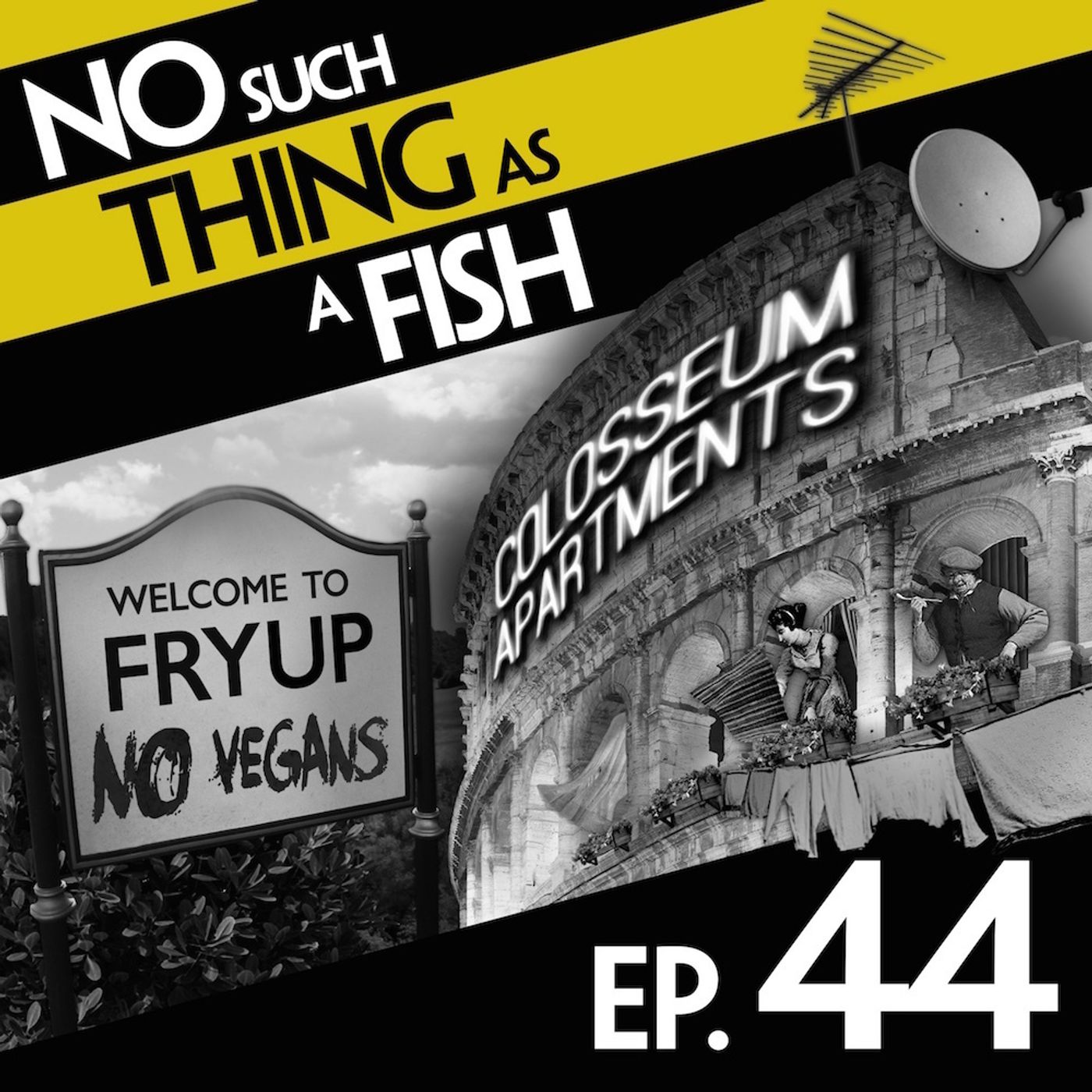
44: No Such Thing As A Vegan Fryup
Andy, James, Anna and Anne discuss obscene pottery, seriously bad signal, an Ancient apartment block and Australia's swear box.
Press play and read along
Transcript
Speaker 1 From Australia to San Francisco, Colin Jewelry brings timeless craftsmanship and modern lab-grown diamond engagement rings to the U.S.
Speaker 6 Explore solitaire, trilogy, halo, and bezel settings, or design a custom piece that tells your love story.
Speaker 6 With expert guidance, a lifetime warranty, and a talented team of in-house jewels behind every piece, your perfect ring is made with meaning.
Speaker 4 Visit our Union Street showroom or explore the range at colournjewelry.com.
Speaker 1 Your ring your way.
Speaker 8 Suffs! The new musical has made Tony award-winning history on Broadway.
Speaker 9 We demand to be home.
Speaker 1 Winner, best score.
Speaker 8 We demand to be seen. Winner, best book.
Speaker 8 It's a theatrical masterpiece that's thrilling, inspiring, dazzlingly entertaining, and unquestionably the most emotionally stirring musical this season. Suffs.
Speaker 8 Playing the Orpheum Theater, October 22nd through November 9th. Tickets at BroadwaySF.com.
Speaker 10 Hello, everybody, and welcome to another episode of No Such Thing as a Fish, a QI podcast coming to you from our offices here in Coverd, Gardern.
Speaker 10
Dan Schreiber is still away, but we are working on the pronunciation. My name is Andrew Murray, and I'm here with three of the other QILs.
They are Anne Miller, James Harkin, and Anna Tožinski.
Speaker 10 And we have gathered around the microphones to bring you our four favourite facts from the last seven days and then a lot of other facts we found out off the back of those.
Speaker 10
So let's get going. The first fact of today is Anna.
My fact is that from the year 800 to the year 1349 the Colosseum was used as an apartment block. Really? Yeah.
Speaker 10 But yeah we only discovered this a couple of years ago.
Speaker 10 A bunch of archaeology was done at the Colosseum and they excavated it and they discovered things like sewage pipes and that is evidence that it used to be a block of flats and we know it was owned it was bought by monks and then they would rent it out to normal people who would take a flat there that's that's what happened and the community so the space where they all did all the fighting in the back in the ancient world was a communal living space where they'd have their market space or where they'd graze their animals or where they'd just hang out have a barbecue have a barbie of a Sunday afternoon yeah it was used for a lot of things wasn't it it wasn't just an apartment block once it had fallen into disrepair.
Speaker 10 I read that it was used for lots of trades like cobblers and blacksmiths and also glue makers and also a fortress for 12th century warlords called the Frangipani.
Speaker 10 Almond paste? Yeah.
Speaker 10
That was their main weapon of choice, I think, in the old days. They just smothered people with delicious, delicious comestibles.
I think it was used as a dumping ground.
Speaker 10 So between when all the vicious sports were banned there in the fifth century and when it was bought up by these monks about 500 years later, it was used as just a garbage dump where everyone dumped their old detritus.
Speaker 11 I mean, I guess if you've got a big storage centre, you might as well put stuff in it.
Speaker 10 Yeah, it's weird though, they obviously didn't have much respect for this amazing edifice.
Speaker 12 I think that happens in general around the world, doesn't it? Like something will go slightly into disrepair, and then people will just steal bits of it to build their own houses and
Speaker 12 whatever. You use what you can, don't you?
Speaker 11 Yeah, there's actually in St Andrews, we have so quite a lot of St Andrews's places to visit blew down because it's quite a windy place. So the castle blew down, the cathedral blew down.
Speaker 12 The castle blew down.
Speaker 10 They shouldn't have made it out of straw, should they?
Speaker 11
It was on the coast. The cathedral blew down, they built it back, it blew down again.
But they've got this room of all this sort of bits they found around the town.
Speaker 11 And there's one bit, this statue, like it would be on top of a tomb, and they found that used to make someone's windowsill on one of the town's streets. Oh, really?
Speaker 11 And they found out, like, hang on, this belongs to the cathedral, and they took it back.
Speaker 12 So, they didn't call the Colosseum the Colosseum, did they?
Speaker 10 No, that's a medieval name for it.
Speaker 12 They called it the Flavian Amphitheatre. And also, the name Colosseum comes from a word for big, but it's not because that's big, it's because it's next to another statue which happened to be big.
Speaker 10 Really? Yeah.
Speaker 12 And there was a huge statue of Nero nearby. And that was so big that the area became known as the Big Statue Place.
Speaker 10 That's great. The Pantheon burnt down twice.
Speaker 10 So the Pantheon, the inscription on it reads, Marcus Agrippa, son of Lucius, consul for the third time, built this when actually he died about 100 years before it was built because he built the initial one, but it just kept burning down.
Speaker 12 You shouldn't have made it out of sticks.
Speaker 10 People and building materials. Means Harkin is available for architectural consultancy to any little pigs listening.
Speaker 10 So, in the Coliseum itself, when you were having games there, the person who organised and paid for the games was called the editor, which I did not know. That's rather nice, isn't it?
Speaker 11 So, he was selecting who played, or was he?
Speaker 10
Well, I think he definitely got to choose who lived and who died. So, obviously, it doesn't matter.
No, it's fake.
Speaker 12 If it's someone who decides who lives and who dies, that means it's it's kind of fixed, a bit like WWF wrestling.
Speaker 10
Yeah. Doesn't it? Really? Same old story.
Do you think people complained about that a lot? And there was a genuine wrestling place around the corner.
Speaker 10 These guys are really injured.
Speaker 12 Well, Greco-Roman wrestling is not from Greece or Rome. It's from France.
Speaker 10 Great. France.
Speaker 12 Yeah, it was invented in France and they gave it the name because they thought it was probably similar to what they did in classical times.
Speaker 10 That's very funny. Oh, so when was it invented?
Speaker 12 Oh, a couple of hundred years ago. Oh, okay.
Speaker 10 Okay.
Speaker 12 It was based on like there's a French wrestling.
Speaker 12
Oh, gosh, I wish I could remember what it's called. I think it's called Savat or something.
And
Speaker 12 what happens is you kind of crouch down
Speaker 12
like a crab and then you kick people like that. And it was done on ships.
And because the ships rock all the time, you had to hold onto like a bar so you didn't fall over.
Speaker 12 And so you do all your wrestling with your feet. Now, this is all coming from memory, so it might all be completely wrong.
Speaker 11 It's like your shin kicking, isn't it? Yeah, Yeah,
Speaker 11 but that was they were in barrels, so they couldn't fall over.
Speaker 10 I don't understand how big the barrel must be for you to get two of you in it kicking each other.
Speaker 11 Well, if it's like ones that they make whiskey in, like, for 40 years, they're pretty big, aren't they?
Speaker 10
Yeah, I suppose so. Yeah.
But then also, there's no fun for any contestants unless you have a see-through barrel.
Speaker 10 It's like having a football match where you can only see the waist up of all the players. Well, maybe you're looking down into it.
Speaker 12 Well, Diogenes lived in a barrel, so they must be quite big.
Speaker 10 He didn't have people around much, did he?
Speaker 10 Barbecues.
Speaker 10 Your place or mine. I think mine again, if that's okay, Diogenes.
Speaker 10 This is another thing I learned about this week about the Greeks, the ancient Greeks used to paint obscene pictures on the inside of their drinking vessels, of their wine glasses, and then they would reveal themselves to you as you drunk.
Speaker 10 So there's, you know, pictures of a man and then his willy is in the bottom of the glass, and as you drink it, you're drinking. Sorry, it's a picture of his willy, isn't it?
Speaker 10 Wow. Wow,
Speaker 10 that's amazing. It's not, yeah, so I used to have a pen like that.
Speaker 10 Do you remember how they made those pens where you turn them upside down, and a picture is either rude or normal, depending on what?
Speaker 12 I'm just imagining someone coming around going, oh, I'm going to read your tea leaves. Oh my god.
Speaker 10 Rather rude. And also, they used to paint eyes on the bottom of the glasses, like on the outside, on the bottom of their glasses, so that when you drank, it looked like you were wearing a mask.
Speaker 11 See, they're making a comeback. I bought my brother party cups with novelty noses, so when you drink, you get like a beak or a pig snout.
Speaker 10
Honestly, 2,000 years too late. That's a mine.
I came from the Greeks.
Speaker 11 I read a thing about the Colosseum as well, which is that in the 1500s, inspired by the previous people who lived in the Colosseum, Pope Sixtus V wanted to turn it into a wool factory, so the factory would be on the ground floor and then living quarters on the top.
Speaker 11 That's good. But he died and they ran out of money and didn't get made.
Speaker 12 I like Sixtus V.
Speaker 10 Yeah, I know.
Speaker 10 Was there a Sixtus VI? I can't even say that. It's too much of a tongue twister, that's why.
Speaker 10 He was actually the sixth. He just just had to say he was the fifth because no one could pronounce Sixtus VI.
Speaker 10 Roman concrete is quite interesting, the material that they made the Colosseum out of, in that we don't know how it's lasted so long.
Speaker 10 And we've sort of lost the exact formula for Roman concrete and how they made it.
Speaker 10 So the concrete that we use now is stronger than what the Coliseum is made out of, but it wouldn't last nearly as long. It erodes much faster.
Speaker 10 And they think it's because it uses a lot of volcanic ash, and that's much harder to erode and then they also used animal fat and milk and blood to kind of adhere it together didn't they?
Speaker 11 I guess the colseum had fair supplies. Exactly.
Speaker 10
Scoop it up, builders and play. That's amazing.
Yeah, quite cool. And oh this is cool.
In ancient China they used to use sticky rice as a building material
Speaker 10
to stick stuff together in their concrete equivalent. Did it work? Yeah worked really well.
It's still standing?
Speaker 12 Still standing. If you think about it though if you have like a Chinese takeaway and then the day after it's on a plate and the rice is still on the plate, it's pretty hard to get off of it.
Speaker 12 It sticks a lot, yeah.
Speaker 10 On the Coliseum, just a couple of things I thought you might like.
Speaker 10 So two American tourists chipped off a bit of the Coliseum in Rome and they later returned it, but they returned it 25 years later in 2009.
Speaker 10 They felt really bad about it every time they looked at it in their collection of
Speaker 10 things they've stolen from landmarks.
Speaker 12 Do you know that people often steal bits of Uluru, which is airs rock. Oh, yeah.
Speaker 12 But they almost always send it back. And they get these, very often they get these bits of Uluru sent through the post to the national park.
Speaker 12 And the reason is because people steal it and then they have some bad luck and they always blame it on the fact that they stole this from Airs Rock and so they always send it back.
Speaker 10 You know, there's gladiator guys who hang around outside it asking tourists if they want to have their photo taken.
Speaker 12 Wolf and Shadow and.
Speaker 10 Yeah.
Speaker 10 So I love this story. Italian police arrested 20 of them recently in an undercover operation because they were intimidating all the rival gladiators and being physically aggressive with them.
Speaker 10 Yes, that's brilliant.
Speaker 12 How did they arrest them with like a net and a stick?
Speaker 10
That's the thing. Some police officers had to dress as gladiators to get evidence of them being intimidating.
And then they took down the... I just think it's the funniest story.
Speaker 11 It's an elaborate sting operation.
Speaker 10 Yeah, arresting them for being aggressive when they are dressed as gladiators.
Speaker 12 Arresting them for fighting each other as well.
Speaker 10 Yeah.
Speaker 11 I think they get in trouble because they'd sort of say, oh, pose for a picture and then like demand 30 euros or something.
Speaker 11 Or there's another story that some of the rogue ones would like take your camera and they wouldn't give it back until you paid them a certain amount of money.
Speaker 10 Because they need to pay for their freedom. Otherwise they'll be gladiators for life.
Speaker 10
And that's no life. They used to dye the sand in the Colosseum red, didn't they, to make it blend in with all the blood? No.
Yeah. How did they dye it? I'm not sure with blood.
With blood.
Speaker 12 Yeah, the hot the walls were made out of blood and animal fats and whatever.
Speaker 10 You know what, guys? I think there's not enough blood in this.
Speaker 12 Okay, some what about some unusual places to live?
Speaker 10 Yeah. Yeah.
Speaker 12 There was a guy in Morocco called Azeh Adine Uldbaja, and he and his family listed city toilets as their official address. So they were living in in a toilet block.
Speaker 12 Fed up with his situation, he went to his local newspaper to tell his story, but then the local authorities read the article and then blocked up the toilet's entrance with cement and concrete so he couldn't live there anymore.
Speaker 12 Isn't that the saddest story you've ever heard?
Speaker 10 Was he going from stall to stall?
Speaker 10 Did he have a bedroom stall and a living room stall
Speaker 10 and a library stall
Speaker 10 and a bathroom?
Speaker 10 Does anyone have anything else?
Speaker 11 Oh, I just had that one, just unusual housing, that story that did the rounds a while ago about a woman. He was found living in a man's cupboard in Japan.
Speaker 11 Then he only found out when food started vanishing from his fridge. And then he set up cameras and she moved into his cupboard.
Speaker 10
What? Yeah. Japanese homes are quite small, Japanese.
Yeah,
Speaker 10 I've never noticed.
Speaker 11 It was described as a cubby hole, the cupboard area. And in fact, she said she'd been there for a year, but only on and off.
Speaker 10 Oh my god. Oh my god, it's so creepy.
Speaker 11 If you have covers you don't go into, just check them every now and again.
Speaker 10 Get back in.
Speaker 1 From Australia to San Francisco, Cullen Jewelry brings timeless craftsmanship and modern lab grown diamond engagement rings to the US.
Speaker 6 Explore solitaire, trilogy, halo, and bezel settings, or design a custom piece that tells your love story.
Speaker 6 With expert guidance, a lifetime warranty, and a talented team of in-house jewels behind every piece, your perfect ring is made with meaning.
Speaker 4 Visit our Union Street showroom or explore the range at cullinjewelry.com.
Speaker 1 Your ring, your way.
Speaker 1 From Australia to San Francisco, Cullin Jewelry brings timeless craftsmanship and modern lab grown diamond engagement rings to the US.
Speaker 6 Explore solitaire, trilogy, halo and bezel settings or design a custom piece that tells your love story.
Speaker 6 With expert guidance, a lifetime warranty and a talented team of in-house jewels behind every piece, your perfect ring is made with meaning.
Speaker 4 Visit our Union Street showroom or explore the range at cullenjewelry.com.
Speaker 1 Your ring your way.
Speaker 10 Okay, guys, let's move on to fact number two, which this week comes from James.
Speaker 12 Okay, my fact this week is that you can be fined for swearing in Australia, and in the last financial year, people in Australia's Northern Territory paid $48,372 in fines.
Speaker 10 Fuck off.
Speaker 10 It's unpredictable. Why are people being fined for swearing?
Speaker 12 Yeah, I mean, it's actually been against law in lots of different countries at different times.
Speaker 12 It's illegal in this country to use threatening, insulting, or abusive behaviour,
Speaker 12 especially against police, but that's not necessarily swearing. You could still swear and not be abusive and you could
Speaker 10 get away with it.
Speaker 11 You said banana in a really menacing way, you'd probably get in trouble.
Speaker 10 He told someone to F off quite friendly.
Speaker 10 When Australia introduced this law, there were lots of sweary protests, and one of them was called The Fuck Walk.
Speaker 10 And I found a quotation from it, which was from a Green MP in the Victoria State Parliament called Colleen Hartland. She said, Is farty poo-bum a swear word?
Speaker 10 Is windy bottom a swear word?
Speaker 10 Yeah, it's a very valid point because you can just say very, very mild things, but it's all about the intent, as you say, the banana.
Speaker 12 So I read this fact on a website called Nothing to Do With Our Growth. It's a blog of weird kind of news from around the world.
Speaker 12 And in the article that I read, they had an interview with local man Jack Bullen, who said, I find those words slip into my vocabulary even when they shouldn't.
Speaker 12 I think the heat contributes to people being more aggressive, but swearing isn't really a sign of aggression, it's more of a communication tool.
Speaker 10 Mr. Bullen has since lost his job at the primary school.
Speaker 12 And then the article goes on: Some residents said they had no idea letting loose a foul-mouthed tirade could cost them a fine. Others just didn't give a shit.
Speaker 10
It's gone back for centuries being fined for swearing. Oh, yeah.
It dates back to the 18th century, I think. No, the 17th century.
Purple wars. Yeah.
Speaker 10 And this is quite interesting.
Speaker 10 The fines that you got varied according to your social class.
Speaker 10 So the Profane Oaths Act of 1745, you got fined five shillings if you were a gentleman or above, two shillings if you were below that, and only one shilling if you were a day worker or a common soldier or a sailor or something like that.
Speaker 10 Really? So it was worse if you were well-bred to be.
Speaker 10 Yeah, that was the idea.
Speaker 12 Or it could be just that you could afford more.
Speaker 12 Like that law in, is it in Sweden where your driving fine depends on how much you earn?
Speaker 10 Yeah.
Speaker 11 Oh, that's smart. So it means tested fining.
Speaker 10 In Sydney, you can get the fine went up a couple of years ago for swearing from $150 to $500.
Speaker 10 Oh, Wow.
Speaker 12 But the worst thing is, as soon as you get fined and they tell you that, you swear again.
Speaker 11 It's a double fine.
Speaker 11 I was reading this brilliant book
Speaker 11 excerpt from a book online about the history of swearing and said that so in the original OED, which is 1888, they describe bloody as like the worst, most terrible word.
Speaker 11 But be Victoria, they didn't list the F and the C's, so bloody was the worst word they could put in the OED.
Speaker 10 So this is just that this is the worst of the
Speaker 11
ones that we'll list. But then it's better.
So there's another book, which is in 1785, the classical dictionary of the vulgar tongue, included the word huffle, which was too filthy for explanation.
Speaker 11 And in a later book, there's another book that wouldn't describe what bagpiping was.
Speaker 12 What is bagpiping?
Speaker 11
I think they were both for fellatios. The Victorians were not impressed.
But huffling and bagpiping, huffle.
Speaker 10 Is that where Jacob Orlando got Hufflepuff from? I hope so. They were originally called House Fallatio, but they got it.
Speaker 12 Actually, Fallatio does sound like a magic word.
Speaker 10 Fallatio!
Speaker 10 I don't know what would happen.
Speaker 10 I think I do.
Speaker 10
But Bloody was really bad, wasn't it? Yeah. And was when Pygmalion came out and Eliza Doolittle said the word bloody, there was like a big scandal about it.
And then people, so
Speaker 10 Eliza Doolittle in Pygmalion said, walk, not bloody likely in this posh voice.
Speaker 10 And there was the quote is: the first night's audience greeted the word with a few seconds of stunned, disbelieving silence and then hysterical laughter for at least a minute and a quarter.
Speaker 10 I think it's so nice, these stories of when swear words weren't as bad. I think we've kind of missed out on words that are really, really uncommon unless you're a soldier or a sailor or something.
Speaker 10 Yeah.
Speaker 12 Maybe there are words and we just don't know them. Huffling.
Speaker 10 Yeah.
Speaker 10 The army has new top-secret swear words.
Speaker 10
So yeah, swearing was the worst in medieval times, wasn't it? And because they were always blasphemous. Oh, yeah.
And blasphemy was obviously a terrible thing.
Speaker 10 and you could, I think you could be killed for it.
Speaker 12 Yeah, probably.
Speaker 10 But they used to think that swearing would physically hurt, like blasphemy would physically hurt Jesus Christ. So the worst thing you could possibly say was Jesus Christ's nails.
Speaker 10 And that was absolutely horrific. And that's because he's up in heaven and you physically hurt him every time you say that.
Speaker 10 Or if you say, by Christ's blood, then, you know, I don't know, he bleeds.
Speaker 12 I think that's where bloody comes from, isn't it? From the blood of Christ, probably. I think so.
Speaker 10
I'm not sure I know. Sounds comes from the phrase God's wounds.
Sorry, sorry, what's this swear word that you're telling us? Sounds. You must have heard it before.
Speaker 10 Yeah, we've heard it, but you say it as though it's a standard parliament. Ever zoinks? Yeah, zoinks, like in
Speaker 10 Scooby-Doo. Yeah.
Speaker 10
Well, yeah, that's probably a palliative version of zounds. So these are what's called minced oaths.
Yeah.
Speaker 10 So,
Speaker 10 alright, Godzuk's.
Speaker 10 Have you heard the word Godzoks? God's hooks. No.
Speaker 10 Okay, it's another old school swear word, and it was, yeah, exactly, by God's hooks.
Speaker 12 Yeah, that could be where Zoichs comes from, then. God's hooks, Zoichs.
Speaker 10 Yeah, I think it might be. So it's a minced oath of a minced oath itself.
Speaker 10 And there were things like slid, which was from the late
Speaker 10 16th century, which was by God's eyelid. Really was.
Speaker 12 Spoot, by God's foot. They're just taking all his body parts, right?
Speaker 10 About 0.7% of the words we use are swear words. Which doesn't sound like very much, but apparently that's the same as pronouns.
Speaker 10
So we swear on average as much as we're saying like your or our or ourselves. That's a lot.
It is quite a lot. 1.7%.
I don't even know if they're including sounds.
Speaker 10 Okay, time for fact number three, which is my one this week, and it is that when the first transatlantic cable was laid in 1858, the reception on it was so bad that it took 17 hours to send the first message across.
Speaker 12
Wow. Yeah.
That's similar to our Wi-Fi in this hour.
Speaker 10 Was it an urgent message? Is a message from Queen Victoria to President Buchanan urgent? Probably not.
Speaker 10 Depends. It was a 98-worder, to be fair, so it was longer than your average text.
Speaker 12 Are there any swear words in there?
Speaker 10 There were, I mean, there's fervently, reciprocal and pleasure.
Speaker 10
Going to you, yes. Wait a minute, wait a minute.
The Queen sent a message to the President about reciprocal pleasure. It was the first sext, I think we believe.
Speaker 10
No, the friendship is founded on their common interests and reciprocal esteem. The Queen has much pleasure in thus directly communicating with the present.
A lot of internationalist flat ones.
Speaker 11 That's the first time they could communicate directly over 17 hours.
Speaker 10 Yeah, but that isn't, I mean, before that, it would have taken something like 12 days to get a message across. So it was an incredible achievement.
Speaker 10 Yeah, but the story of how they installed the first cable is just, I mean, it's unbelievable. They had one across the English Channel that was the first one.
Speaker 10 And this was after decades of people just testing it out in ponds and things like that. So the first test were just people with their garden ponds.
Speaker 10 They just put a load of cable in the pond and saw if they could get a message from one end to the other, and they could. I know that there was a whale scare in that laying of the first one.
Speaker 10 They wrote that they saw a whale swimming over the cable and they thought, Oh my god, it's gonna ruin it and then it brushed up against it and so I'm on its way.
Speaker 10 Wow. But it was quite rubbish, wasn't it? The reception wasn't good for the one you're talking about, the first one, because it just wasn't successful.
Speaker 10 So it was broken within a month, I think, by this guy called Wildman Whitehouse, who applied excessive voltage to it, trying to get the signal better, I guess, and trying to make it take less than seventeen hours.
Speaker 10
His his full name is amazing. It was Edward Edward Orange Wildman White House.
Yeah. And actually, the Victoria one wasn't the very first message.
Speaker 10
The very first ever transatlantic message read: Laws, White House received five-minute signal. Coil signals too weak to relay.
Try drive slow and regular. I have put intermediate pulley.
Speaker 10 Reply by coils.
Speaker 10
I mean, there's always the first telegraph was supposedly what God hath wrought, and actually it wasn't. It was telegraph tests.
Yeah,
Speaker 10 exactly.
Speaker 12 Yeah, and the first words on the moon were supposed to be one small step, but actually, it was contact-liked.
Speaker 10 Yeah.
Speaker 10 Oh, but you know, the Alexander Graham Bell thing. Oh, yeah.
Speaker 10 So, 40 years after that first seminal phone call, there was the first ever transcontinental phone call, which went from Boston to San Francisco.
Speaker 10 And they'd tested it several months before, so it wasn't the first actual contact.
Speaker 10 But they did a ceremony where Alexander Graham Bell and Watson spoke by telephone to each other over the same connection, and they did a reprise of the original conversation. So he said, Mr.
Speaker 10
Watson, come here, I want you. And then Watson replied, It would take me a week to get to you this time.
Isn't that cool? Mr. Watson, come here, I want you.
I think that was the first sexting.
Speaker 12 Trust. That was the first booty call.
Speaker 10 So the first time they used cables in a telephone conversation
Speaker 10 between the US and Britain was in 1927.
Speaker 10 And The Guardian has quite a funny description of it. So it relays the conversation.
Speaker 10 We don't know who took part in this conversation, but The Guardian says, Conversationalists, quite unawed by the marvel in which they were taking part, fell back as we all do on the weather, which was quite bad enough on either side to make a strong bond of sympathy.
Speaker 10 Indeed, a more pleasantly futile dialogue could hardly have taken place over a suburban party wall in Dulwich or Chalton-Cum Hardy than that which so astonishingly bridged the ocean.
Speaker 10 This is quite interesting, though, actually.
Speaker 10 Only one unusual item of small talk broke its commonplace flow, and we may take it that in transoceanic gossiping, what's the time with you has come to stay as an addition of conversation.
Speaker 10 Suddenly, the idea of a time difference, which had never been considered before, became a thing. It would be like, what is a different time of day? Hadn't crossed my mind.
Speaker 10 And people were apparently astonished by this.
Speaker 12 Still, now, if you ring people up in another country, it's like, what time is it there?
Speaker 10 Exactly. So, that was quite a good prediction, wasn't it?
Speaker 11 I've been up for ages.
Speaker 10 I still find it amazing that most of the internet is going around the world in undersea cables. Yeah,
Speaker 10 it's really odd.
Speaker 10 There are nearly 300 communications cables under the sea around the world. And they're these vast things, and lots of them are not even on.
Speaker 10
There are 20 which are not yet in use, which are called dark cables. And eventually, they will be in use if our bandwidth increases.
And they cost hundreds of millions of dollars.
Speaker 10 When the first so the first message that was sent over the ARPANET, which was like the precursor to the internet, it was where the internet started.
Speaker 10 It was in 1969. Do you know what the message was?
Speaker 12 What time is it with you?
Speaker 10 It was not that. Was it Ed Bowles?
Speaker 11 Was it logging? It wasn't even.
Speaker 10 Well, it wasn't logging. It was supposed to be because that was the first command they were giving, but the system broke down after two letters, so it was just low.
Speaker 12 So, how do you know he was going to say login? He might be trying to say lol.
Speaker 10 Yeah.
Speaker 10 The first message. Well, I don't think he should have admitted that it was wrong, because low could have just been low.
Speaker 10 You know, low, you are familiar with like really old-school words that no one uses anymore. God zooks, I am.
Speaker 10 Doinks. You say low all the time, right? Lo, we're out of tea.
Speaker 10 What I'm like around the office. What he means is the level of tea is low in this office.
Speaker 10 Low.
Speaker 11 The guy who sent the first email doesn't remember what it says.
Speaker 10 Oh, no.
Speaker 10
I bet he does, but he's embarrassed. I think he wrote something embarrassing about a colleague and accidentally sent it to the colleague that he doesn't want anybody to know.
I think Dave is an ass.
Speaker 10 But at that time, there's only two email addresses. Here's Dave.
Speaker 10 Dave's like, come on. The second email is, dear Dave,
Speaker 10 I think there may have been a bit of a mistake.
Speaker 10 I was talking, of course, about Dave in accounts.
Speaker 10 Yeah, I just think people should plan this. I was thinking about this because we talk about the first text of the phone calls and the cables.
Speaker 10 And you should plan, if you're sending the first email, make sure it's something funny or weird or that people are going to be writing down history books and repeating on podcasts.
Speaker 11 But I suppose it's the equivalent of like, you know, if you meet someone who's going to become your best friend or your, you know, your other half, and you don't know.
Speaker 11 So you don't say something profound, you just say, like, hi.
Speaker 10 I say something profound to every single woman I meet, just in case they're not.
Speaker 11 Like, well, actually, we said something lovely.
Speaker 12 I am married, so
Speaker 10 yeah, it worked eventually.
Speaker 13 Your night in just got legendary.
Speaker 14 Legends.com is the only free-to-play social casino and sports book where you can spin the reels, drop parlays, chase the spread, and hit up live blackjack without leaving your couch.
Speaker 14 Slots, sports, original games.
Speaker 13 Legends has it all. Win real prizes and redeem instantly straight to your bank.
Speaker 9 Legends is a free-to-play social because you know Google Prohibitive must be 80 plus pay responsibly visit legends.com for full details.
Speaker 14 Get in the game now and score a 50% bonus on your first purchase only at legendswithaz.com.
Speaker 15 Planning ahead isn't just smart, it's a gift to your loved ones.
Speaker 15 At Skylawn Funeral Home and Memorial Park in Half Moon Bay, we help you make thoughtful pre-need arrangements, easing emotional and financial burdens later.
Speaker 15 With breathtaking ocean views, affordable funeral, cremation, and cemetery options, and financing plans up to six years, Skylawn is a place like no other.
Speaker 15
Mention iHeartRadio and receive 15% off your pre-arrangements. Some restrictions apply.
Skylawn Memorial. Peace of mind begins here.
Visit skylawn.com.
Speaker 10 Okay, time for fact number four, which comes from Anne. Yes.
Speaker 11 Last year, to celebrate World Vegan Day, Peter, the animal charity, asked Fry Up in Yorkshire to change its name to Vegan Fry Up.
Speaker 10 And did they do that? No.
Speaker 11 It It was a fair offer.
Speaker 11 Peter did say they only had to do it for one day, and if they did so, they provide the whole town village with a free vegan breakfast, vegan sausages, and vegan bacon, which, rather pleasantly, is called Facon.
Speaker 11 The town didn't go for the offer. One of the councillors said, first of all, there's not really anyone in charge of the town's name, so it'd be quite hard to get everyone to agree.
Speaker 11 And that they're not named after an actual fry-up, after the goddess Frigger, who's an Anglo-Saxon page.
Speaker 10 Yeah.
Speaker 12 After whom Friday is named.
Speaker 10 Yes, not the breakfast. It really is an indictment on veganism, isn't it? That when an entire village says they're not willing to change their name for one day to all get a free vegan fry-up.
Speaker 10 People do not want vegan fry-ups.
Speaker 10 No matter how much bacon you put in them.
Speaker 10
Yeah. Great fry-up.
It's not a very exciting place.
Speaker 10 I tried to find an exciting place.
Speaker 12 There's a place called Little Fry Up nearby, isn't it?
Speaker 10
There is next to it. That's even smaller and I think less exciting.
It has no shops, nor even a pub, according to Wikipedia.
Speaker 10 It has a telephone box, a post box, a village hall, and an outdoor centre, and it also has a local cricket pitch and a coits pitch.
Speaker 10 And I think if you're having to claim and brag about your coits pitch, but I like the idea of there being a great fry up and a little fry-up because it's like an option for breakfast, isn't it?
Speaker 12 Well, you want to get one sausage for this one.
Speaker 10 Yeah, all the health-conscious people live in little fry-up.
Speaker 11 I did read about DB this horrible thing as a cafe in Great Yarmouth sells the kids' breakfast, K-I-G-Z. Not for kids, it weighs the same as a child.
Speaker 10 It's nine pounds of
Speaker 11 basically, yeah, six eggs, twelve bacon pieces, twelve sausages.
Speaker 10 It weighs the same as a child.
Speaker 12 And then the worst thing is that people who are doing the kids' breakfast might be kids if they don't realise that, and so they get a breakfast which is the same size as them.
Speaker 11 I can possibly beat that, though, for terrible food ideas.
Speaker 11 So, this is again, I'm very proud to say, this is my hometown, did this, made the news last year, because the local hospital is selling a fry-up pie for £1.50 in the hospital canteen.
Speaker 10 That sounds delicious.
Speaker 10 That sounds great.
Speaker 11 It sounds safe. Well, one in the bakery said, Well, we're already making a full Scottish breakfast in a wrap, so we thought, why not fry it in the pie?
Speaker 10 I've always thought when having a full Scottish breakfast, there's not enough carbohydrate to keep me going until 11 tis.
Speaker 12
In Bolton, we would have like pasty balms. It's quite common, or a pie balm.
Oh, yeah. In Wigam, they'd have that.
What's that?
Speaker 10 Is that something you rob on yourself? Pie balms.
Speaker 10 Soothe your cracked lips.
Speaker 10 Smear pastry into every orifice of your body.
Speaker 12 No, a balm is a balm cake as in a bread roll or whatever you would call that.
Speaker 10 So it's like a pie sandwich.
Speaker 12 It's meat and potatoes, so you've got carbs there with your potatoes. Inside pastry, which is more carbs, inside a bread, which is more carbs.
Speaker 12 In New Hampshire, you can buy a scratch card where when you scratch it, it gives off the smell of bacon. Great.
Speaker 12 It's called the iHeart Bacon Scratch Ticket.
Speaker 10 Well, that is a very imaginative name.
Speaker 10 What should we call it, guys?
Speaker 10 They should have called it Pork Scratchings.
Speaker 10 What the hell?
Speaker 10 Come on, people. You're so right.
Speaker 10 That's really good. There's bacon perfume, isn't there? Well, you can get bacon-scented perfume.
Speaker 12 It wouldn't go well with my pie balm that I'd wear in the water.
Speaker 12 PETA have tried to change loads of different places' names, haven't they?
Speaker 10 Have they?
Speaker 12 Yeah, a few years ago, or it might have been even this year, they tried to get Nottingham City Council to change the name to Not Eating Ham
Speaker 12 over Christmas.
Speaker 10 Has this ever worked?
Speaker 10 It gets to the few headlines. I think it does work.
Speaker 12 Yeah, it does work because it gets them in the newspapers. The mayor of Fish Kill was asked,
Speaker 12 it's near New York City, if they change it to Fish Save.
Speaker 10 Did they contact the mayor of Dead Cow Burger Mead?
Speaker 12 There's a place called Featherbed Rocks,
Speaker 12 which is near Siam, and they wanted to call it Synthetic Feather Bed Rocks.
Speaker 12 And also, the pet shop boys, they asked them to change their name to the Rescue Shelter Boys.
Speaker 10 Oh, yeah, because they hate pets, don't they? They're against pets. Did they ask the super furry animals to change their name to the super synthetic furry animals?
Speaker 10 They should have done, shouldn't they?
Speaker 12 The other thing they tried to change, Peter, was I think we mentioned it on the TV show, which is they tried to change fish into sea kittens in the hope that people wouldn't eat them as much.
Speaker 10 Well, that's not an insane idea. I mean, obviously, it's an insane idea, but the name does severely alter your perception of something, doesn't it?
Speaker 12
It does. So, for instance, there are other fish.
There's a fish called a slime head, and if you eat that, actually, it's called an orange ruffy.
Speaker 12 So if you eat orange ruffy, the original name of that fish was a slimehead fish, but they changed it so that people would eat it.
Speaker 10 So what would it take to agree to change your town's name? Would you go for so there was the town of Clark, Texas, renamed itself Dish
Speaker 10 after the EchoStar Communications Dish Network, and they all got free satellite dishes on their houses.
Speaker 12 That's good. It's a shame that Clark isn't in Kent.
Speaker 12 I'd be happy to change Hackney into Sky Sports if they they gave me free Sky Spots.
Speaker 10 Yeah, I think I'd sell my town's name immediately for a bag of sweets.
Speaker 10
There was a place in Texas which the mayor and the members of the Chamber of Commerce wanted voters to approve the name change they had in mind. This was in 2005.
The place is called White Settlement.
Speaker 10 The measure was voted on and was defeated by 9 to 1.
Speaker 10 As one resident said, why don't they go ahead and change the name of the White House to the West House? It's all a bunch of poppycock.
Speaker 10 The thing is, the White Settlement is named from the 1840s when a community of white settlers occupied an area surrounded by several Native American villages.
Speaker 10 Right, so it's not an innocent explanation.
Speaker 10 It's not like being called Mr. White.
Speaker 10 There is a
Speaker 12 village in Spain called Castillo Matajudios,
Speaker 12 which translates as Fort, kill the Jews.
Speaker 10 What?
Speaker 12
Wow. And they voted last year to change their name, and it went through.
It should go through because it takes about a year for the process to go through.
Speaker 12 So, by around June or July this year, they should change their name.
Speaker 10 You've got to wonder why. That is interesting.
Speaker 12 I mean, I know it's offensive, but it is interesting.
Speaker 10
It's really interesting. You've got to wonder why it took them so long.
Yeah,
Speaker 12
it dates back from the expulsion of the Jews in 1492 by King Ferdinand and Queen Isabella. Wow.
So, it's a very long historical thing, but they've finally voted to do it.
Speaker 10
You can get a map, I wanted to get this one for Christmas, of all the funny place names in the UK. I mean, it is just riddled with them.
It's really good, yeah. I mean there are so many.
Speaker 10 What's the best? I like Netherthong.
Speaker 12 I think that's my favourite. I like Brown Willie which is the highest point of is it Dorset or Death?
Speaker 10 Podman Moor, the highest point of Podman. And there is a meteorological effect called the Brown Willie effect.
Speaker 10 Yep. Which is where
Speaker 10 banks of cloud hit a hill, go high and then it leads to at least a rain, it leads to thin drizzle all across Podman Moor. Brown Willie effect.
Speaker 10 Someone getting undressed in the morning. Oh god, it's going to rain today.
Speaker 10 That's the most disturbing weather report I've ever heard.
Speaker 10 And now over to Jeff with the wet. Oh my god.
Speaker 10 It's gonna rain, guys. It's gonna rain.
Speaker 12 Okay, that's all of our facts for this week.
Speaker 10
Thank you very much indeed for listening. We hope you've enjoyed the show.
We will be back next week with more facts and a special guest, Horrible Histories resident historian Greg Jenner.
Speaker 10 If you do want to follow us on Twitter, you can do that because that's a thing. Anne is available on I'm at Miller underscore Anne.
Speaker 11 James.
Speaker 12 At egg shaped.
Speaker 10 I'm at Andrew Hunter M and Anna is not on Twitter but you can email podcast at QI.com.
Speaker 10 Okay, so thank you very much again for listening and we will see you next time. Goodbye.
Speaker 16 At Azure Standard, we believe healthy food shouldn't be complicated.
Speaker 16 That's why we've spent 30 years delivering clean, organic groceries and earth-friendly products to families who care about what goes on their plates and into their lives.
Speaker 16 From pantry staples to wellness essentials and garden-ready seeds, everything we offer is rooted in real nutrition, transparency, and trust. Join a community that believes in better naturally.
Speaker 16 Visit AzureStandard.com today and discover a simpler, healthier way to shop for the things that matter most.