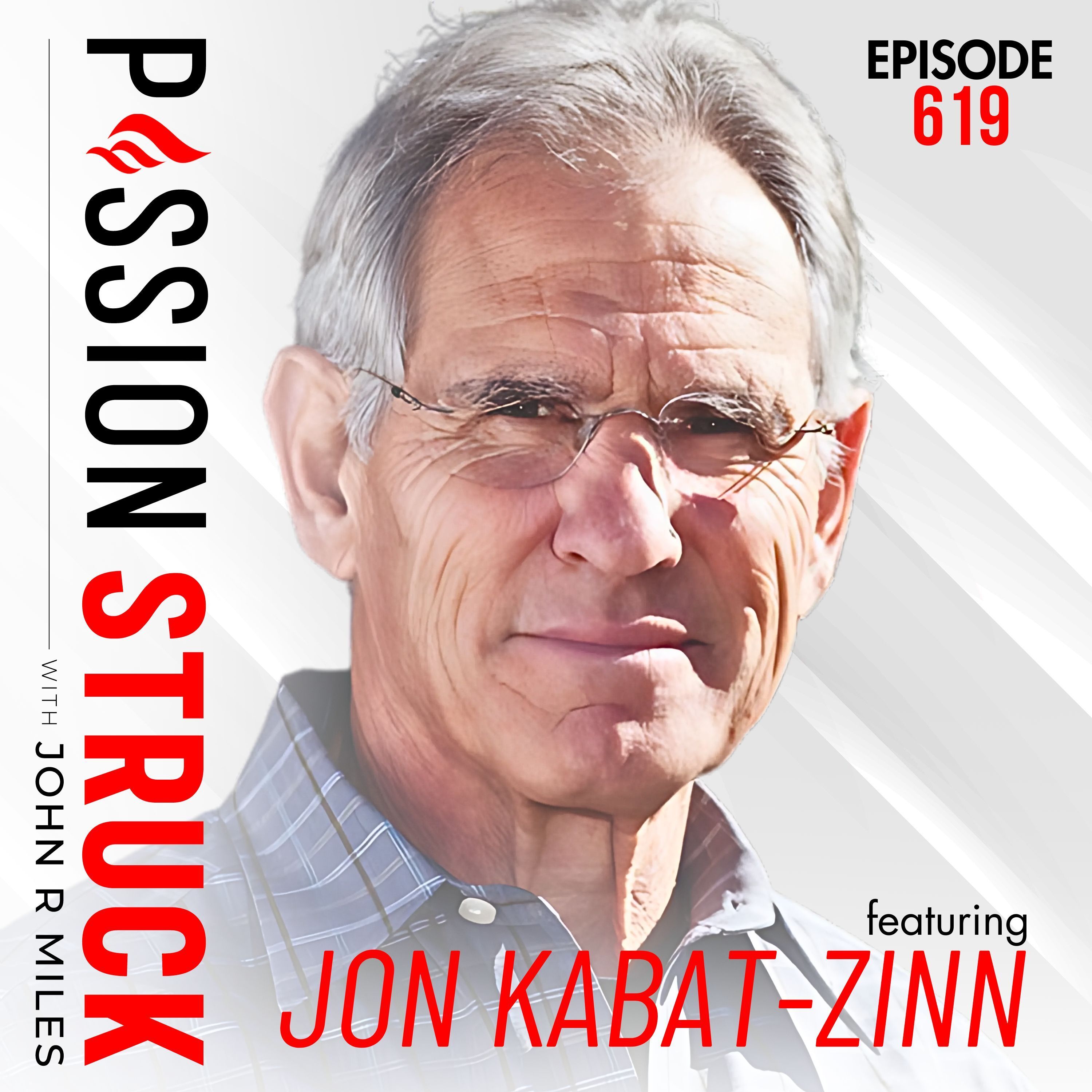
Jon Kabat-Zinn on Why You Can’t Heal What You Won’t Feel | EP 619
In this powerful episode of Passion Struck, I'm joined by world-renowned mindfulness pioneer Jon Kabat-Zinn, founder of Mindfulness-Based Stress Reduction (MBSR) and author of Full Catastrophe Living and Wherever You Go, There You Are.
We dive deep into the essence of mindfulness—not as a buzzword, but as a radical invitation to fully feel our lives. Jon unpacks why true healing requires presence, why you can’t bypass your emotions, and how mindfulness isn’t about relaxing—it’s about awakening.
show up.
Click HERE for the full show notes
Explore More: The Ignited Life Newsletter
If today’s episode sparked something in you, you’ll love The Ignited Life—our free Substack newsletter created to fuel your growth between episodes.
👉 Subscribe now at TheIgnitedLife.net.
Catch more of Jon Kabat-Zinn: https://jonkabat-zinn.com/
We also explore:
- The misunderstood purpose of meditation
- How to work with pain, fear, and overwhelm
- The dangers of spiritual bypassing
- Why being present is the most courageous act of our time
- The biological roots of connection, compassion, and consciousness
If you liked the show, please leave us a review—it only takes a moment and helps us reach more people! Don’t forget to include your Twitter or Instagram handle so we can thank you personally.
How to Connect with John:
- Connect with John on Twitter at @John_RMiles
- Follow him on Instagram at @John_R_Miles
- Subscribe to our main YouTube Channel and to our YouTube Clips Channel
- For more insights and resources, visit John’s website
See Privacy Policy at https://art19.com/privacy and California Privacy Notice at
See Privacy Policy at https://art19.com/privacy and California Privacy Notice at https://art19.com/privacy#do-not-sell-my-info.
Press play and read along
Transcript
Speaker 1 Why choose a sleep number smart bed?
Speaker 3 Can I make my site softer?
Speaker 4 Can I make my site firmer? Can we sleep cooler?
Speaker 6 Sleep number does that, cools up to eight times faster, and lets you choose your ideal comfort on either side. Your sleep number setting.
Speaker 4 Enjoy personalized comfort for better sleep night after night.
Speaker 6 It's our Black Friday sale, recharged this season with a bundle of cozy, soothing comfort.
Speaker 7 Now only $17.99 for our C2 mattress and base, plus free premium delivery.
Speaker 1 Price is higher in Alaska and Hawaii.
Speaker 6 Check it out at a sleep number store or sleepnumber.com today.
Speaker 4
This episode is brought to you by Progressive Commercial Insurance. As a business owner, you take a lot of roles.
Marketer, bookkeeper, CEO.
Speaker 4 But when it comes to small business insurance, Progressive has you covered.
Speaker 4 They offer discounts on commercial auto insurance, customizable coverages that can grow with your business, and reliable protection for whatever comes your way.
Speaker 4 Count on Progressive to handle your insurance while you do, well, everything else. Quote today in as little as eight minutes at Progressive Commercial.com.
Speaker 4 Progressive Casualty Insurance Company, coverage provided and serviced by affiliated and third-party insurers. Discounts and coverage, selections not available in all states or situations.
Speaker 8 Coming up next on Passion Struck.
Speaker 4 We already have this superpower called awareness.
Speaker 4 And yet when we go to school, all we're taught is how to think. And thinking is a great superpower and it's given rise to science and everything else.
Speaker 4 But actually, even a lot of the science comes out of the moments before the thinking sets in where you have a nonverbal realization and aha moment where you see things that no one else has seen up to that point.
Speaker 4 Then you win the Nobel Prize or everybody thinks, wow, what a great insight. And sometimes mindfulness is even called insight meditation, but it's not something you do.
Speaker 4 It's something you learn to inhabit that's already yours and that's awareness.
Speaker 9
Welcome to Passion Struck. Hi, I'm your host, John R.
Miles.
Speaker 9 And on the show, we decipher the secrets, tips, and guidance of the world's most inspiring people and turn their wisdom into practical advice for you and those around you.
Speaker 9 Our mission is to help you unlock the power of intentionality so that you can become the best version of yourself. If you're new to the show, I offer advice and answer listener questions on Fridays.
Speaker 9 We have long-form interviews the rest of the week with guests ranging from astronauts to authors, CEOs, creators, innovators, scientists, military leaders, visionaries, and athletes.
Speaker 9
Now, let's go out there and become passion struck. Welcome back to episode 619 of Passion Struck.
I'm your host, John Miles, and if you're new here, I am so glad you've joined us.
Speaker 9 Passion Struck isn't just a podcast.
Speaker 9 It's a movement, a global community of change makers, seekers, and everyday heroes who are committed to living intentionally and creating lives of deep purpose, connection, and impact.
Speaker 9
And if you've been on this journey with me, thank you. Your presence truly matters.
A few quick updates before we dive in. The Ignited Life, My Substack, is thriving.
Speaker 9 Every week I go beyond the podcast with stories, tools, and insights. You won't find anywhere else.
Speaker 9 It's also where you'll find our new Passion Struck merch, Gear, that embodies bold, intentional living. Visit either theignitedlife.net or Passionstruck.com to check it out.
Speaker 9
On YouTube, we're posting full episodes, exclusive clips, and shorts every week. Just search Passion Struck with John R.
Miles or hit the show note links.
Speaker 9 This past month, we went through a series where we explored mental health awareness and featured powerful interviews with Gretchen Rubin on the secrets of adulthood, Dr.
Speaker 9 Judith Joseph on high-functioning depression, Zach McCurio on workplace mattering, Joseph Wynn on emotional mastery, and Dr. Andrew Newberg on neurotheology and the mind.
Speaker 9
I also released five episodes. In episode 606, I discussed why mental health is the root beneath everything that matters.
In 609, I touched on five foundational habits to anchor you in uncertainty.
Speaker 9 In 612, I discussed how to reframe your inner world with the LENS method. In 615, I discussed the home framework and mental health as an ecosystem.
Speaker 9 And then this past Friday, in episode 618, I discussed how we need to rethink return on investment as return on energy.
Speaker 9 And this month, we're kicking off a new series, The Art of Connection, diving into how we form deep, meaningful relationships with others, ourselves, and the world.
Speaker 9 We started last week with Andrew Brodsky on intentional virtual communication. Today we're going to go even deeper.
Speaker 9 Let me ask you, what if the key to navigating life's chaos isn't doing more, but being more? I couldn't be more honored. to bring you today's guest.
Speaker 9 John Cabot-Zinn is not only a pioneer in the field of mindfulness, he's one of the most influential voices in modern contemplative science and practice.
Speaker 9 As the founder of mindfulness-based stress reduction, John has spent over four decades helping people from all walks of life transform their relationship to stress, pain, illness, and ultimately to themselves.
Speaker 9 His work has fundamentally reshaped how we understand healing, presence, and human potential. not just in medicine and psychology, but in education, business, and beyond.
Speaker 9 Personally, this conversation was a true highlight. John's wisdom is both grounded and expansive, equal parts poetic and practical.
Speaker 9 It's rare for me to speak with someone whose presence alone invites you to slow down, pay attention, and remember what really matters.
Speaker 9 His books, Full Catastrophe Living, Wherever You Go, There You Are, and Coming to Our Senses, have reached millions.
Speaker 9 But it's his unwavering message that continues to resonate, that mindfulness isn't about escaping life. It's about waking up to it.
Speaker 9 in this conversation we explore why mindfulness is a radical act of love not just relaxation how awareness transforms stress anxiety and chronic pain the myths of meditation and how anyone can begin how technology erodes presence and how to reclaim it and how mindfulness helps us wake up not just check out if you've ever felt overwhelmed disconnected or hungry for meaning this episode is for you.
Speaker 9 Let's dive into episode 619 of Passion Struck with the legendary John Cabot-Sinn.
Speaker 9 Thank you for choosing Passion Struck and choosing me to be your host and guide on your journey to creating an intentional life. Now, let that journey begin.
Speaker 9 If you've followed me for any length of time, you know I'm constantly searching for the breakthroughs that actually make a difference in how we age, feel, and perform.
Speaker 9 Lately, I've been taking timeline Mito Pure gummies, and I got to tell you, I'm feeling the shift. My energy is more sustained, my focus sharper, and my recovery quicker.
Speaker 9 It's like I upgraded my engine at the cellular level. What makes them stand out?
Speaker 9 They're powered by Mitopure, the only clinically proven form of urolithin A, a compound that activates your longevity pathways, supports muscle strength, and improves cellular energy.
Speaker 9
It's clean, vegan, and backed by over 15 years of cutting-edge science. Dr.
Mark Hyman calls urolithin-A a game changer for longevity.
Speaker 9 And with MitoPure, everyone can benefit, no matter your gut health. If you want to stay strong and energize now and as you age, then you have to try MetoPure gummies.
Speaker 9
My friends at Timeline are offering 20% off just for my listeners. Head to timeline.com slash passionstruck to get started.
That's timeline.com/slash passionstruck. Yourselves will thank you.
Speaker 2 Hi, I'm William Googe, a Vuri Collaborate and professional ultra runner from the UK. I love to tackle endurance runs around the world, including a 55-day, 3,064-mile run across the US.
Speaker 2 So I know a thing or two about performance wear. My go-to daily short is the core short from Viewery.
Speaker 2 It's perfect for my daily run in the gym, strength training, or even when I'm taking a day off, relaxing, doing some stretching, and recovering the best way I can.
Speaker 2 Check them out by visiting viewery.com slash William.
Speaker 2 That's V-U-O-R-I dot com slash William, where new customers can receive 20% off their first order, plus enjoy free shipping in the US on orders over $75 and free returns.
Speaker 2 Exclusions apply, visit the website for full terms and conditions.
Speaker 4 When is the right time to sell a stock? How do you protect against inflation? Financial decisions can be tricky, and often your own cognitive and emotional biases can lead you astray.
Speaker 4 Financial Decoder, an original podcast from Charles Schwab, can help.
Speaker 4 Join host Mark Reby as he offers practical solutions to help overcome the cognitive and emotional biases that may affect your investing decisions. Listen at schwab.com slash financial decoder.
Speaker 8 It is my profound honor today to have John Cabot-Zinn on Passion Struck. Welcome, John.
Speaker 4 Thank you. It's wonderful to be with you, John.
Speaker 8 Well, John, it's an absolute honor to have you today.
Speaker 8 And I want this conversation to be one that truly serves both you and my audience, one that goes beyond mindfulness as a practice and instead really explores it as a radical act of sanity, love, and presence in today's world.
Speaker 8 So I'm so glad that we're sharing this space today.
Speaker 4 Wonderful. I love that.
Speaker 4 And I think you zeroed in on exactly what I think is most important to investigate and bring more into the world at this juncture in time.
Speaker 8 And I'm going to get more into that. But for those listeners of mine who might not be familiar with your work i want to create a starting point so there was a moment when you were at mit
Speaker 8 that things started to change for how you were thinking and i've heard you describe it before but you were walking down the hall at mit when you happened to see a lecture poster featuring a zen teacher And I was hoping you might be able to take the story from there because my understanding is you said it blew the top off of your head.
Speaker 4 Yeah.
Speaker 4
Well, thanks for starting there. Interesting place to start because it's like a long time ago.
This is now, we're talking 1965 and the Vietnam War was just heating up.
Speaker 4 There was this naval incident off the coast of Vietnam where the American Navy accused the non-existent Vietnamese Navy of attacking it and it was the pretext for war. And
Speaker 4 I was like depressed about the political situation to a great extent. And I was a first year graduate student in molecular biology at MIT.
Speaker 4 And I'm walking down the corridors at MIT, which are longer than any other building in the world, except maybe the Pentagon.
Speaker 4 And at that time, they weren't painted colorful, imaginative ways, but they were all like a junior high school in New York City.
Speaker 4 And then I see this poster saying the three pillars of Zen, talk by Zen Master Philip Kaplow at the the invitation of Houston Smith, who was a professor of philosophy and religion at MIT.
Speaker 4 I didn't know who Kaplow was. I didn't know who Houston Smith was, and I certainly didn't know what Zen was, but I was in this kind of funk.
Speaker 4 And so I went to the talk at five o'clock in the afternoon at seminar hour at MIT.
Speaker 4 And they had a fairly big room for the talk. And there were only five people in the room, the speaker, the guy who invited the speaker, and then maybe three people who went to the talk.
Speaker 4
And I was one of those three people. And I did say that it took the top off my head because it did.
It's the first time
Speaker 4 that I had met anybody who seemed to really put together something that had been bothering me my whole life, which was
Speaker 4 how to bring different ways of knowing together. Because I grew up in a family where my father was a samurai scientist at Columbia University Medical Center.
Speaker 4 These are razor-sharp mind when it came to science, but really opaque when it came to art or anything else. And my mother was a painter, a very unknown painter.
Speaker 4 She never showed her work until she was like 101, then she had an exhibit. But she was very prolific and really, I felt, quite talented.
Speaker 4 It was beautiful to look at a lot of her stuff, and she never stopped in a lot of different mediums.
Speaker 4 And I could see, as even a young child, that the world of science and the world of art were having a hard time understanding the depth of the other's vision of
Speaker 4
and place in the world. And so I guess there was this kind of familial kind of koan of these can't be that separate.
They have different ways of knowing. There has to be something to unify them.
Speaker 4
And when I heard Kaplow talk, it was like an aha moment for me. And it was like, this is it.
What unifies different ways of knowing is knowing itself, non-conceptual knowing, but pure awareness.
Speaker 4 And that's what Zen is all about and how to not
Speaker 4 acquire it or achieve it or attain it but to realize it because it's not ever not here
Speaker 4 so i know i've used a couple of negative assertions in that sentence but that's part of the difficulty of talking about awareness or mindfulness is that it and now this is like not 1965 anymore, but I'm talking in my present and the present day, that awareness, since I heard Greta Thornberg talk a lot about her illness, her being on the sort of autism spectrum, was actually a superpower in a certain way.
Speaker 4
And you could see it when she gave a talk. It was selfless.
There's like nobody there. She's just speaking her truth in a way that there's no ego behind it.
There's no selfing.
Speaker 4 And it had enormous effect on me and many other people, including the Dalai Lama, who was then later in conversation with her. And I felt this is
Speaker 4 mindfulness is that unifying factor that transcends opposites and that we already are born with it.
Speaker 4
Mindfulness, by the way, for everybody who's tuning in, in my vocabulary, mindfulness equals awareness, pure awareness. So it's not like it's something you don't already know.
And more than that,
Speaker 4 it's not something you have to acquire. Because the amazing thing that we never get any schooling in or pointed out is that we already have this superpower called awareness.
Speaker 4 And yet when we go to school, all we're taught is how to think. And thinking is a great superpower and it's given rise to science and everything else.
Speaker 4 But actually, even a lot of the science comes out of the moments before the thinking sets in where you have a non-verbal realization and a ha moment where you see things that no one else has seen up to that point.
Speaker 4 Then you win the Nobel Prize or everybody thinks, wow, what a great insight. And sometimes mindfulness is even called insight meditation, but it's not something you do.
Speaker 4 It's something you learn to inhabit that's already yours. And that's awareness.
Speaker 4 So that's what meditation is all about, is learning how to actually take up residency, so to speak, in the only moment any of us ever have, which is now.
Speaker 4 Everything else is either gone or yet to come.
Speaker 4 And to learn how to live inside of awareness so that we're not captured and tortured to a large extent by our thoughts and emotions and our likes and dislikes and our reactions and our othering and the enemy and the friends and all of that kind of stuff, which has its own place.
Speaker 4 But without this kind of awareness, there can't be any wisdom, there can't be any compassion, and there can't be any clarity around how to thread the needle of
Speaker 4 human beings not just killing each other forever, each generation of which does it with more and more horrifyingly sophisticated weapons, which now include like toy drones that you can put a grenade or a missile launcher on and then kill all sorts of people with these like digital devices that cost like $50 in the store.
Speaker 4 And I've said an awful lot up to this point, but that gives you into some sense the arc of the sweep of like from when I was 21 years old and a student at MIT and where this showed me in a way a new hidden dimension of what it means to be human.
Speaker 4
What I called when I was at MIT, because we like fancy words, an orthogonal dimension of reality. It's here all the time.
Only until you learn how to recognize it,
Speaker 4 you just don't even know it's there. And it can.
Speaker 4 help with enormous enormously with how much you drive yourself crazy, how much you suffer, how angry you get, how lonely you get, how depressed you get.
Speaker 4 And you already have the solution in a certain way.
Speaker 4 And that is as the buddhas speak about it because the buddha gave historically the most articulate teachings around mindfulness and the most thorough and profound that you're already okay
Speaker 4 and there's no place to go nothing to do nothing to attain meditation is not about attaining some special fantastic meditative state where all of a sudden you're you and everything is good forever.
Speaker 4 It's just not like that. It's like discovering an old friend, which is awareness and it's never not been here for you, but you have to learn to let that become your default address, so to speak.
Speaker 4
I live here in awareness rather than I live in stress reactivity and anger and fear my whole life. And that's a choice every single one of us can make.
And it's not that hard.
Speaker 8 No, it's not. And for some background on me, I
Speaker 8 ended up graduating from the Naval Academy and
Speaker 8 did some time working in SEAL teams. And my first exposure to the SEALs came around 1994.
Speaker 8 And one of the things that I found very interesting was that they were already using mindfulness, yoga, breath work
Speaker 8 as a way to control basically their breathing, their whole system. their nervousness and so i was introduced to this in what i look back upon is the least likely place i thought I would find it.
Speaker 8 But I've been using these practices ever since, which is now 30 plus years.
Speaker 8 And
Speaker 8 one of the things that I often think about, and I've heard you reference as well, is the work of Henry David Thoreau.
Speaker 8 And I've always loved the words, I went to the woods because I wish to live deliberately.
Speaker 8 And I talk on this show a lot about being intentional. But as I have been looking into
Speaker 8 his wisdom he often talks about this state of quiet desperation
Speaker 8 and do you believe in modern society we're in more of a state of quiet desperation than we've ever been
Speaker 4 totally he was living in concord massachusetts uh in the 1830s and the railroad was the biggest technological innovation, which of course brought on the entire industrial revolution when the steam steam engine was invented.
Speaker 4 That's when we started global warming and burning fossil fuels.
Speaker 4 And it's been non-stop since then and not just non-stop, but exponential, which is the problem with that we're facing now in terms of planetary endangerment on a lot of different levels.
Speaker 4 Thoreau, it's said that one day he just stood in Walden Pond up to about his nose
Speaker 4 and just observed everything that was going on the surface of the pond. I used to swim in Weldon Pond all the time when I lived in Lexington, Massachusetts.
Speaker 4 My wife and I would go there all the time. And his presence and his legacy,
Speaker 4 along with Emerson, who also lived in Concord,
Speaker 4 is just really profound.
Speaker 4 And I think in my book, Wherever You Go, There You Are, I featured a lot of quotes from Henry David Thoreau for just that reason, that it's evidence that this is not Asian or Oriental or Buddhist.
Speaker 4 It's a universal realization of the power of the present moment when you get out of your own way. And he said things like, I sat in my doorway from morning to night and just watched the
Speaker 4
sort of sun move across the sky. And this was better than any work I could ever have done.
So he really understood meditative contemplation and what he called the foregoing of works.
Speaker 4 In other words, not just busying yourself with doing, and even criticized the farmers of Concord, Massachusetts for living kind of lives of quiet desperation.
Speaker 4 And he was just an incredible visionary. And I think that's a very, very, that whole transcendentalist movement in America was like really both are looking backwards to ancient.
Speaker 4 very often oriental wisdom and are looking forward to a time where there's no east and west anymore.
Speaker 4 There's just one world. And we're waking up to the fact that we better take care of it because we've been despoiling it in ways that
Speaker 4 we have been ignorant of because we're so industrious in the Industrial Revolution,
Speaker 4 pumping carbon and methane into the atmosphere. and not caring the way we're seeing now emerge in the Trump administration, just not caring, drill, baby, drill.
Speaker 4 Yeah, you can go that route, but the costs ultimately for the next generation and future generations are going to be even higher.
Speaker 4
So maybe we have to literally and metaphorically burn ourselves out because we invited that to happen in the United States, that mindset. But that's not going to be forever.
It can't be because
Speaker 4 the body politic basically won't allow it and the body of the planet will create conditions where we either wake up or we die. And I'm talking as a species.
Speaker 4 Now, the Earth and the universe won't care one tiny little bit if life itself was completely eradicated on planet Earth. But of course, life won't be eradicated on planet Earth.
Speaker 4
The cockroaches will have no problem, even if we have a gigantic nuclear war. Cockroaches will do just fine.
They may mutate into giant cockroaches or something else.
Speaker 4 But if we care about our lives and our children's lives and our grandchildren's lives and their grandchildren's lives, then there's a certain kind of responsibility that all of a sudden, maybe we haven't realized until now to wake up literally and metaphorically and do the right thing.
Speaker 4
And it's not Democrat or Republican or conservative or liberal or woke or not woke, but woke is just like a pejorative. What we really need is wake.
We need to wake the fuck up.
Speaker 4 And how long it takes, it's like the earth doesn't care, the sun doesn't care,
Speaker 4 but we should.
Speaker 4
And everything is interconnected. That's one of the things when you meditate, you realize there's nothing that's not connected to everything else.
Everything in this universe is interconnected.
Speaker 4 In fact, if people remember back to the periodic table of the elements,
Speaker 4 that's us. Those 92 naturally occurring elements.
Speaker 4 all either came out of the Big Bang, which was like the beginning of the universe with hydrogen and helium. And this is like the greatest scientists and cosmologists speaking.
Speaker 4
It's not just make-believe, although it's hard to believe. So that's where the hydrogen and the helium came from.
And all of our carbon atoms have hydrogen atoms associated with it.
Speaker 4 But the carbon and the oxygen and the nitrogen, the phosphorus, they all came out of stars. So it's almost the cliche that we're stardust.
Speaker 4 But no, if you wake up to this, it's like, it's a total miracle that there is a sun.
Speaker 4 you look up in the sky and there it is no sun no us and there's a deep relationship to it and if we're ignorant of it then we create conditions for our own self-annihilation now because we're clever and so industrious and we can and we pollute so fabulously with all sorts of waste products like sludge for instance that's putting all these micro plastics into our food that you can't get out of the food.
Speaker 4 And so we're discovering thousands of different chemicals in our bodies that none of which are good for us.
Speaker 4 So everything, again, is connected to everything else. And what the meditation practice does is it allows us to hold it in such a way that we don't fall into despair.
Speaker 4
But that we realize that, hey, things are constantly changing. We don't know how the future is going to unfold.
We can be really frightened by our own thoughts about how the future is going to unfold.
Speaker 4 But that's where the liberation comes in.
Speaker 4 If you are in the present moment, in the face of everything I've just said, then you can also find equanimity and compassion and kindness right in this moment.
Speaker 4 And a kind of clarity that allows you to, say, tilt things in the direction of, at least in your family, not being a pain in the butt, but maybe being kind when your impulse is to be angry or just impatient.
Speaker 4
And to recognize when you do that and to not blame yourself, because it's not you doing it. That's just habits.
That's not who you are.
Speaker 4 So in the meditative practices of mindfulness-based stress reduction and all mindfulness-based programs that are out there now in huge numbers, the real emphasis is that the meditation practice is a way of being in relationship to reality.
Speaker 4
And when it comes right down to it, it's a radical act. It's a radical act to stop.
and drop into the present moment and just be open the way Thoreau was saying and
Speaker 4 find yourself rather than lose yourself in your reactive emotions and thoughts and fears. And that's a kind of, I'm using the terminology, love affair.
Speaker 4 It's a love affair with how beautiful it is and how precious and how fleeting it is to have a human life at all.
Speaker 5 Nearly home.
Speaker 11
Isn't home where we all want to be? Reba here for Realtor.com, the pro's number one most trusted app. If you're hearing me, I'm going to assume you're awake.
And if you aren't,
Speaker 11 because while you're snoozing, someone else might be finding your dream home. That's where Realtor.com comes in.
Speaker 11 With over 500,000 new real listings straight from the pros every month, that's a lot of chances to find the place you've been dreaming of.
Speaker 11 Whether you're searching for a two-story mid-century with a pool or a little extra space with a spa-inspired bathroom, Realtor.com can help you find it today. So quit hitting that snooze button.
Speaker 11
Realtor.com isn't sleeping on finding your dream home, and neither should you. Download the Realtor.com app today because you're nearly home.
Make it real with Realtor.com.
Speaker 10 Pro's number one most trusted app based on August 2024 proprietary survey. Over 500,000 new listings every month based on average new for sale and rental listings February 2024 through January 2025.
Speaker 4 At Pluralsight, we don't just teach skills.
Speaker 12
We are building the tech workforce who deliver results fast, accelerated by top-tier content. Lead with confidence.
Lead with expertise. Visit us at pluralsight.com to tap in and learn more.
Speaker 4 I want to also say in terms of your work with the Navy SEALs, very often it's these elite military units
Speaker 4 and also elite sports, whether it's baseball or football or basketball, all of those great athletes know that the mind is going to defeat you far faster than your opponent.
Speaker 4 Your own mind is going to defeat you and moment by moment.
Speaker 4 So it's really worth exercising that muscle to train the mind to develop a certain kind of robust equanimity that's flexible, that is, and doesn't take the story of me and what your mind is producing to say how good you are, how bad you are, both of which are like breaks on what's possible.
Speaker 4 And instead see the story of me as a kind of like cloud moving through the sky. It's got its own structure and stuff like that, but it's really empty of any kind of essential nature.
Speaker 4 And it comes and it goes, and you aren't the cloud, you are the sky.
Speaker 4 And so, the story, whatever story you have about how good you are, how bad you are, it's nothing compared to how miraculous you are when you drop the stories altogether and learn rest and awareness.
Speaker 4
Now, that's it in a nutshell. We can talk about this forever, but that really is it in a nutshell.
This is a universal human capacity that even lies in the name that Linnaeus gave us as a species.
Speaker 4 We're called Homo sapiens sapiens. So there are two sapiens there, one for the genus and one for the species.
Speaker 4 And so we have a double dose of sapiens, which from the Latin means, sorry, means to taste or to know.
Speaker 4 So we're the species that knows and knows that it knows. And that's not, as is very often misapplied, it's not cognition and metacognition, because that's only one very limited way of knowing.
Speaker 4
It's awareness and meta-awareness, awareness and awareness of awareness. And this is, as I said, a skill set that you don't need to acquire.
You already have it.
Speaker 4
We're born with it, but we do need to exercise the muscle to access it. Access is what's most important.
And there's only one moment when you can access it. And guess when that is?
Speaker 4 Obviously, it's now. And most of the time, we're never in the now because we're often lost in thought or the future or the past or striving to get someplace else.
Speaker 4 And then you die, just the way Thoreau said.
Speaker 4 The full quote is, if I can remember correctly, I went to the woods because I wished to live deliberately, to front only the, meaning confront only the essential facts of life and see if I could not learn what they had to teach and not, when I came to die,
Speaker 4 discover that I hadn't lived.
Speaker 4 This is powerful stuff because I think a lot of people on their deathbed actually wake up and realize, holy shit,
Speaker 4
I was an SOB through a lot of my life. The people I loved the most.
I was the hardest on them.
Speaker 4 And then you wake up and you realize that was all a kind of evanescent play in the mind that you enacted out, but it was, you didn't have to do it, but you felt like you had no choice because
Speaker 4 you didn't realize that there was a whole other orthogonal space in which you could actually live moment by moment and learn how to not react to your most terrifying thoughts and emotions.
Speaker 8 It's very interesting, whether it's been Bronnie Ware's writings and her work in palliative care, or I know Cornell University studied thousands of people who were in their third trimester of life and they all came to the same conclusion.
Speaker 8 an overwhelming percentage regret not pursuing becoming their ideal version of who they could be. And we end up waiting for so long to get that awakening.
Speaker 8 And so that's why I think what Henry David Thoreau wrote about is so profound because he sensed it where he was at that point in life and realized he had the opportunity to change and to evolve into that person.
Speaker 4 Right. And he said an example that is really worth following, not to deify Thoreau or any other hero, but to realize what he was saying is this is universal.
Speaker 4 This is every single human being starts where they are
Speaker 4 and we can be fully present with this in-breath and this out-breath, this step,
Speaker 4 this sitting here,
Speaker 4 Rumi and Shalaladin Rumi said, this being human in his famous poem, The Guesthouse. This being human is a guesthouse.
Speaker 4 Every moment, a new arrival, a joy, a depression, a meanness, some momentary awareness comes as an unexpected visitor. And then he goes on and says, welcome.
Speaker 4 This is the kind of meditative instruction, and no one wants to follow it because we don't like a lot of the visitors.
Speaker 4 Welcome and entertain them all, even if they are a crowd of sorrows who violently sweep your house empty of its furniture. Still,
Speaker 4
treat each guest honorably. They may be cleaning you out for some new delight.
The dark thought, the shame, the malice. Greet them at the door laughing.
Speaker 4 Laughing is like advanced practice, but greet them at the door any way you can and invite them in. Be grateful for whoever comes because each has been sent as a guide from
Speaker 4 beyond.
Speaker 4 If we treated our thoughts and emotions that way, and didn't take them personally and build the story of me, starring me, how horrible I am or how great I am and why doesn't everybody love me or recognize it?
Speaker 4 And even if you are, even if you're a Hollywood movie star, there's no respite from that. You'll still have those kinds of thoughts that why didn't I do this? Or why didn't do that?
Speaker 4 Or why didn't they recognize me for this? And so there's no end to the human mind torturing itself. And yet there's a release and what the Buddhists call liberation.
Speaker 4
Only in this moment when you see what's happening and then you touch the soap bubble with awareness and it just self-liberates. It goes poof.
And then, next moment, you'll torture yourself again.
Speaker 4 So, you got to go.
Speaker 4 And then, over time, because I started on an awful lot of things in my 20s, but this is the only practice that has carried me through 60 years into my 80s.
Speaker 4 And it's, I feel like a ranked beginner, and it's just getting like more and more of a commonsensical
Speaker 4
love affair or adventure with this totally crazy, terrifying, beautiful world. And that everybody in it is beautiful too.
And when we can see that and not
Speaker 4 fall into using and theming and making those that don't look like us the enemy or those who even call us their enemy, they're not the enemy either. It's a sickness.
Speaker 4 It's a delusion because when you investigate who am I? which is like one of the core zen meditative practices heavy duty you just sit and you ask yourself, who am I or what am I?
Speaker 4 And then you just listen to what the mind comes up with, all of which is wrong. And then it can lead to you realizing that you're not who you think, you're not the story of you.
Speaker 4 Then all of a sudden, who am I becomes a really interesting
Speaker 4 question? And the important thing, as you're pointing out from the beginning, is Don't wait until you die to get into it.
Speaker 4 Die now. Get it over with.
Speaker 4 That's why I don't know if you have yoga teachers on your podcast, but all yoga teachers know that of all the 84,000 mainstream yoga poses and there are 10 variants of each one.
Speaker 4 So that's 840,000 yoga poses. The hardest one is what's called the corpse pose, which is just lying on your back.
Speaker 4 And it's called the corpse pose for a reason.
Speaker 4 And it's a very radical reason because the invitation really, and we use this in our body scan, it's the first meditation that our patients in the hospital, when they're taking the MBSR, I mean they enter the MBSR clinic, clinical program for eight weeks, the first meditation is really, well, it's the second meditation because the first one's eating a raisin, but the second meditation, the more extensive formal meditation, is lying down on the floor of the hospital and doing a body scan starting from the bottoms of your feet and slowly over 45 minutes going up through the top of your head and from your fingers and right up through the armpits and shoulders and the real reason it's called a corpse pose is because the invitation is to die die now get it over with and the rest of your life will be free because you won't torture yourself with those personal pronouns everybody's so into what are your pronouns now and now now pronouns have been outlawed there's only he and her with Trump, but that's completely a misunderstanding of the reality of things.
Speaker 4
But the important point is those pronouns, however many there are, they're not who you are. They're never who you are.
They're a tiny little secretion of the full story.
Speaker 4 And so why not live the full story moment by moment and not worry about who you are, but just be. And coming back to the military, isn't it the Marines? Be all you can be?
Speaker 4 Right? It's like
Speaker 4 different doors, same room. And then ultimately, the whole question of are we defensive or offensive? Are we trained to become killers or are we reducing the killing?
Speaker 4 And the whole question of harm and intrinsic compassion and wisdom are like, they're not something that a few sages or philosophers or academics should be debating.
Speaker 4 Every single one of us needs to recognize how when we're mindless, we create enormous amounts of harm and sometimes violence, lots of violence.
Speaker 4 And then, as I understand it, the people who are supposed to guard the society both inwardly as police and outwardly as military and so forth, they're to reduce the harm as much as possible and to protect the safety of the body politic.
Speaker 4 And that's a hard job because
Speaker 4 very often, as Pinatz used to say in the kind of comic strip from long ago, we have met the enemy and it is us. And on the planetary level, that's absolutely true.
Speaker 4 Look what happened with Germany in World War II and just like unthinkable
Speaker 4 horrors that the Germans
Speaker 4 inflicted on the world and killed 8 million people aside in concentration camps, aside from war and everything.
Speaker 4
And now we're friends. We were allied with the Russians and now we're enemies with the Russians.
This doesn't make any sense.
Speaker 4 There are some people who may be benefiting from this, but it's not the planet Earth and it's not humanity. And I've spent a lot of time in China.
Speaker 4 China is an amazing place. And they don't, we need to learn how to govern ourselves so that the governments aren't trying to figure out how to get an angle on each other so that we win and they lose.
Speaker 4 Because in this nuclear age, just no winning and losing. Everybody loses.
Speaker 8 Unfortunately, regardless of the political system, they all seem to be about one thing, and that is control.
Speaker 4 Concentration power in a small number of very wealthy people.
Speaker 4 And I think we let them do that until we don't,
Speaker 4 or until the circumstances are such that it becomes apparent that, and this is where the Homo sapiens sapiens comes in, it's time for humanity as a whole to wake up to its true nature.
Speaker 4
The species that is aware and is aware that it's aware. Well, I don't think we've gotten there yet.
We haven't evolved quite that far.
Speaker 4 The stakes are very high and the time is running out in a certain way because we are so precocious and our weapon systems,
Speaker 4 whether they're nuclear or drones or whatever, are getting so sophisticated. And then automatic weapons, autonomous weapons that make their own decisions with AI about killing robot armies.
Speaker 4 This isn't science fiction anymore. This is so the arms manufacturers are making out like bandits because they always win and everybody else loses.
Speaker 8 In the United States, that's what our whole economy is based upon is the.
Speaker 4 Right.
Speaker 4 And Eisenhower pointed that out in 1960 i think it was with the military industrial complex and then somebody recently said military industrial tech complex because because now technology and ai and robotics and everything else again if we continue on the same path
Speaker 4 it's like episodic destruction and then rebuilding but if the episodic episode of destruction gets to be too overwhelming, there's no rebuilding. There's no infrastructure left.
Speaker 4 And so waking up is not a kind of luxury, it's an absolute necessity. And it has to happen like
Speaker 4 globally. Every human being on the planet is the cell, the way I look at it, and I've written about it in Coming to Our Senses and other books.
Speaker 4 We could look at every human being, never mind every animal and plant, as a cell of the body politic of planet Earth.
Speaker 4 And if you have like, each one of us has, I don't know how many gazillions of cells, they're like 200 billion neurons in the brain and 200 billion glial cells that are taking care of those neurons.
Speaker 4 So we got trillions and trillions of cells. Now,
Speaker 4 every single one of those trillions of cells needs an adequate blood supply or it dies,
Speaker 4 right? With every heartbeat, it needs to get that oxygen. And if it doesn't, it undergoes what's called necrosis.
Speaker 4 In other words, before it dies, it just goes into senescence and necrosis, and then you create necrotic tissue, which is not a good prescription for living a long, happy life.
Speaker 4 So it becomes obvious at a certain point that if everybody on the planet is a cell of the one body of well-being of the planet, then everybody has to have enough oxygen or money or wherewithal or hope.
Speaker 4 to actually function in relationship to all the other trillions of people, or at this case, 10 billion people on the planet, to govern ourselves, and I'm using that word instrumentally, in ways that maximize well-being for everybody, every cell on the planet, and minimize harm.
Speaker 4 Minimize harm, because the more we create those kind of violent episodes and so forth, the more we're actually just creating more of the same old, but as I said, with much more powerful weapons.
Speaker 4 So it's interesting that we're even having this conversation where
Speaker 4 meditation could be thought of, especially in terms of MBSR and people with chronic illness and chronic pain in the hospital as something that's been really valuable and shown to be, through science, to have lots of effects on the body and the brain over the past 40 years of research and so forth.
Speaker 4 That's just at the level of individuals.
Speaker 4 And yes, learning how to reduce your stress and work intelligently with the forces at play in your own individual life, that's really important so that you can be kind to your children and kind to your partners and function effectively and do meaningful work and all of that kind of stuff.
Speaker 4 But you can't be healthy in a sick society and you can't be a healthy nation in a planet that's actually just, if you think about permafrost, or the fact that the melting is releasing, the permafrost captures unthinkable amounts, billions, trillions of tons of CO2 and even worse, methane, which is 80 times more warming than even CO2.
Speaker 4 And we're like you talk about Greenland or whatever, but the fact is we're melting the permafrost.
Speaker 4 And we have no idea when it will reach a critical point and it'll just kind of like burp to a much, much higher level of carbon dioxide and methane in the air.
Speaker 4 And we don't know how to capture it back. Maybe tech will figure that out, but they better figure it out very quickly if you're going to have a tech solution.
Speaker 4 Much better to actually slow down global warming. And we're going in exactly the opposite direction now.
Speaker 4 So we go from the hospital to the whole planet being, in some sense, a hospital or a medical center or a school.
Speaker 4 And the question is, what's the curriculum and when do we actually learn what we need to learn of this curriculum so that we don't self-destruct?
Speaker 8
This all makes sense. I want to take you to a different type of crisis.
Let's do that. So, my work on this podcast really focuses on the art and science of human flourishing.
Speaker 8 But a component of it that I've become really interested in, because similar to the calling you got in 1979, I got my own personal calling about a crisis that was unfolding worldwide.
Speaker 8 And I call it the crisis of mattering.
Speaker 8 I feel like there are so many people worldwide who are losing their sense of meaning and belonging.
Speaker 8 And one of the things you've written about is this concept that awareness itself may be the core intelligence of being human.
Speaker 8 And how do you see this awareness helping people reconnect with a sense of significance in their lives that it appears so many people have lost?
Speaker 4 Thank you for that wonderful question.
Speaker 4 It's not that hard, actually, because as soon as you start paying attention, you wake up.
Speaker 4 If meditation is really about paying attention and doing it on purpose in the present moment and non-judgmentally, which means not getting so caught up in your ideas and opinions and likes and dislikes, then maybe you'll see your child in a new way.
Speaker 4 My wife and I wrote an entire book on mindful parenting called Everyday Blessings because
Speaker 4 you can live like your whole life and raise a whole bunch of children and have no idea who they are.
Speaker 4 And they will come back and happily tell you, or unhappily tell tell you, 30 years later,
Speaker 4 how much hurt or harm was created by that.
Speaker 4 So it really is
Speaker 4 with us everywhere. There's no place that you turn, I think, where you can't take this moment and drink in the beauty
Speaker 4 right in this moment. So we don't get all caught up in anxiety and fear of nuclear war or what's going to happen in Ukraine and Russia or the monstrosity of Gaza and the death and destruction.
Speaker 4 It's all happening and it's always happened, only worse and worse with nuclear weapons and stuff like that.
Speaker 4 But at the same time, there's also the beauty. So we can't forget the beauty.
Speaker 4 And we have to actually exercise that muscle so that we can actually see the beauty. And what better place to do it than close to home?
Speaker 4 One reason to do yoga and to meditate is to actually start with your own beauty.
Speaker 4 Now, it sounds very narcissistic to say something like that, but every single human being is a miraculous being. So, from that point of view, we can start here and recognize that we're already okay.
Speaker 4 In this moment,
Speaker 4 underneath all our likes and dislikes and opinions, and the things that we did wrong in our lives that we regret, still we're fundamentally okay.
Speaker 4 There's nothing wrong with us.
Speaker 4 And that our
Speaker 4 story is much too little.
Speaker 4 little the story of me is much too small to capture who the miracle of who you really are and between now and the time each one of us is going to take our last breath why not let turn it into an adventure in seeing hearing smelling tasting touching loving
Speaker 4 and seeing how easily we get caught in those personal pronouns and then get angry because you're hurting my feelings or you're insulting me.
Speaker 4 Instead of inquiring about, well, aren't aren't you going to take some responsibility for your own feelings instead of just projecting it onto everybody else?
Speaker 4 So from that point of view, again, just links back to what was said earlier, that life itself is the meditation practice. And there's nothing that comes up that's not the curriculum.
Speaker 4 The curriculum is whatever arises.
Speaker 4 including all your thoughts and emotions and anger and everything else like even anger.
Speaker 4 You just hold it in awareness, all of a sudden it's a different kind of energy because the awareness, I hate to use this verb, but trumps the anger. And the same with pain or suffering.
Speaker 4 You can actually put out the welcome mat for your own pain and transform the suffering.
Speaker 4 And people with chronic pain conditions where there's no magic bullet that's going to make it all better for them, they find that the meditation practice is, first of all, it's a last resort, but second of all, it is liberating.
Speaker 4 It is liberating.
Speaker 4 It doesn't always make the quote-unquote pain go away in terms of the sensory dimension of it, but it can attenuate the emotional arousal around it, which compounds the pain, and the cognitive thinking around this is going to ruin my entire life forever and tell that kind of story.
Speaker 4 And when you write yourself a kind of restraining order on that, in that regard, or see it when you're doing it, then all of a sudden it's again like touching the soap bubbles and they just self-liberate.
Speaker 4 And right now, there's nothing wrong with you and i love that because if there's nothing wrong with us
Speaker 4 then maybe we'll do the right thing on every level or not do anything we can just be instead of just we're called human beings but we probably should be called human doings because it's so non-stop it's a cliche but so non-stop but what about just the love affair of being and the sanity of just being
Speaker 4 and that's where the formal practice of meditation meditation comes in.
Speaker 4 Just to say, I will sit for upwards of an hour every morning on my meditation cushion, but you can sit on a chair or whatever, but give myself over to the meditation practice.
Speaker 4
And I have an app with all my guided meditations on it. So called JKZKZ Meditations in the App Store.
People can download these kinds of things.
Speaker 4 But the real thing is like easy to...
Speaker 4 download something not so easy to actually do it every morning and wake up and actually first thing after you brush your teeth is brush your mind and just purify so to speak or recognize the original purity of your own mind so you don't have to do anything but the formal meditation practice and the formal yoga practice which also follows that for me every day
Speaker 4 it's like tuning the instrument before you take it out on the road to play And even the greatest musicians and orchestras with the greatest instruments and playing the greatest music in the world, they all tune their instruments before they play.
Speaker 4 And they tune to their own ear, and then they tune to each other's instruments.
Speaker 4 And that's what formal meditation practice is. And then when you get off your ass, off your cushion or chair or lying down doing body scan and your yoga, you take that into the world so that
Speaker 4
It's not like an hour or two of meditation. It's like, no, life is the real meditation practice.
Life is the real curriculum. And then every body movement is yoga.
Speaker 4 Everything you do, sitting down, standing up, hugging your children, whatever it is, it's like, are you here for it or not? If you're here for it, it's yoga. It's meditation.
Speaker 4 And it's also in that moment, which is the only moment we're ever alive,
Speaker 4 it's liberating.
Speaker 8 So, John, you have said the pain is not me.
Speaker 8 And that's a really powerful statement. And there's so many people today
Speaker 8 who are feeling pain and suffering in their lives. How does mindfulness help people separate their suffering from their identity?
Speaker 4
Well, the radical way is to just look at it deeply. Most people don't want to look at their suffering.
That's get me out of here. I go to the movies, anything to distract me from the suffering.
Speaker 4 So mindfulness is a kind of, as I said, a radical act of sanity and love.
Speaker 4 But part of the radical nature of it, and you'll know this from your work with the Navy SEALs, is you turn towards and move into
Speaker 4 what you most want to just run from.
Speaker 8 Yes.
Speaker 4 Okay.
Speaker 4
But you do it in a way that's actually loving. It's not trying to get a result.
It's realizing that we're too attached to our narratives around results. And so let's just do it to investigate.
Speaker 4 What is this stuff that's driving me crazy
Speaker 4 and then you can ask very elementary questions is my awareness of my anger for instance if anger is the big thing in the moment and you catch it right in the middle of some murderous impulse in your family is my awareness of my anger angry
Speaker 4 it's never angry the awareness is never angry Well, why am I choosing to go with the anger rather than the awareness?
Speaker 4 Take another example, is anxiety, because and even if you scratch the surface of anger, what you're really going to find underneath is fear. It's always fear.
Speaker 4 So let's put the welcome metal for our fear or anxiety and just invite it into the present moment. How does it feel in your body? Where is it in your body? Is it in your jaw? Is it in your chest?
Speaker 4 Is it in your shoulders? Is it in your fists or fingers?
Speaker 4 And then you ask yourself yourself that same question is my awareness of all this anxiety
Speaker 4 anxious
Speaker 4 and the giveaway is you're going to find that it's never anxious it's no it is not it's not anxious
Speaker 4 And so that's a kind of, it's like you're reclaiming the territory that is your birthright, who you really are underneath your age, your name, your gender, identification, all of that stuff.
Speaker 4
Who are you really? Can't be put into words. Maybe poets can do it.
Maybe if you were a haiku poet, you could do it in three lines.
Speaker 8 But
Speaker 4
what if you turned your whole life into poetry? Then you wouldn't need the poetry. You'd be the poetry.
And it's a love affair. And it's infectious too.
Speaker 4 If you ever meet somebody, I've seen this a lot around the Dalai Lama who had privilege to spend you know, a number of different occasions with pretty up close and personal.
Speaker 4 He can walk into a stadium with 100,000 people and people start start crying. They can't even see him, but they know he's there and people will start crying.
Speaker 4 And why is that? I've always wondered, why is that?
Speaker 4 And it's not just because they have all sorts of projections about how perfect or wise he is, and especially if you actually are in the room with him.
Speaker 4 You say the thing is...
Speaker 4 When he looks at you, he really sees you because he sees past the story whatever the story is there's the sense that he really feels me or sees me and people can feel that even in a stadium so it's a kind of really interesting example of how working on yourself in that way in that kind of a meditative way for your entire life is infectious it touches other people Sometimes it happens and it's, I guess, why we do podcasts.
Speaker 4 Why are we doing a podcast? Why do you do lots and lots of podcasts?
Speaker 4 Well, hopefully we're wagging our tongues and moving our lips and amazingly using our lungs to get air to go over our vocal cords in such a way that in concert with the lips and the tongue, I'm actually shaping the air into sounds that my laptop is picking up and going to your laptop.
Speaker 4 It's going into their ears through their microphones or speakers.
Speaker 4 And
Speaker 4 they're decoding this sentence and I don't even know how I'm doing it or where it's going to end.
Speaker 4 And it's like just one example of how miraculous it is to be human.
Speaker 4 We developed language, and no one knows how that came about 60 or 70,000 years ago, it's thought, that all of a sudden the human brain went through some major change.
Speaker 4 And then all of a sudden,
Speaker 4 through language, and language is much more related to thought than it is to conversation. It's like somehow once we
Speaker 4 thought arose at the same time as language in a certain way and thoughts that led to other thoughts so that this is an amazing superpower because I can say to you, if we actually took that stick and we sharpened it and we put some feathers on the other end of it and we threw it, maybe it could actually get us dinner for our starving family.
Speaker 4 Or if we took some seeds and we put them in some soil that we dug up, that maybe we could have food for the next time we run out of meat.
Speaker 4 And that's how agriculture happened, but it couldn't happen without thought.
Speaker 4 And thought and language are totally related, just the way I'm wagging my language.
Speaker 4 The word for tongue is long.
Speaker 4 So I'm wagging my tongue and creating all these vibrations, and we're all decoding them. Are you kidding me? This is like a miracle of miracle.
Speaker 4 Why do we have to kill each other over this?
Speaker 4 Why does this have to be us against us me against you or us against them when we're all us
Speaker 4 and one of the things that has been a marvel to me in terms of looking at this from the point of view of what the earth is going to need right now no matter what
Speaker 4 whether people want to deny climate change or not the climate doesn't care the planet doesn't care whether you deny climate change the ocean is going to keep rising the glaciers are going to keep melting and there's going to be an enormous amount of suffering but if you think about it for a moment
Speaker 4 all the aerial photographs of what's happening with the glaciers and the polar ice caps melting that's an extension of our senses these military photo and satellite photographs of planet earth it's like a body scan but not of your own body but of the planet earth and what's happening to the rainforest and you rainforest in the 1930s the 1940s the 1950s the 1960s and now and you see what's happening to the rainforest.
Speaker 4 If that were happening to your lungs,
Speaker 4
you'd be running to the hospital and asking for a cure. And there's no way to really repair lungs.
You might get a lung transplant, but it'd be a very rare thing.
Speaker 4
So here we have the Amazon and the Congo, and we're losing the lungs of planet Earth. So this is all part of the mindfulness practice.
Once we know this, we can't turn away from it.
Speaker 4 And from that point of view, just the last thing I'll say on this,
Speaker 4 because it blows my mind so much from an evolutionary point of view.
Speaker 4 So we're this like tiny little blue dot going around an insignificant sun in some completely like infinitesimally small area of the Milky Way galaxy.
Speaker 4 And that sun and the planets all, they know, just adhered from other
Speaker 4 suns, material that from supernovae and things like that in the formative years of the universe. And so the sun and the planets evolved together.
Speaker 4 And we happen to be at this just right Goldilocks distance. It's called Not Too Hot, Not Too Cold.
Speaker 4
Venus is way too hot, Mars, way too cold. And here we have this flourishing of life.
And the way it happened is first the thermal vents under the ocean where like heat is energy. So
Speaker 4 somehow chemicals figured out how to reproduce themselves and put membranes around themselves and become like organisms.
Speaker 4 And then they learned how that you don't get much energy from thermal vents and stuff like that. It's driving the metabolism on
Speaker 4 kind of chemistry.
Speaker 4 But at a certain point, somehow they managed to actually
Speaker 4 create receptors for sunlight.
Speaker 4 And now those receptors like have turned the entire planet green. And that green is chlorophyll, the molecule chlorophyll, which is what's called a porphyrin ring structure.
Speaker 4 If anybody remembers their basic chemistry, it's four porphyrin rings, and the porphyrin rings hold together
Speaker 4 in the case of chlorophyll, a magnesium atom at the center of it. So, magnesium atom comes out of stars exploding previously before our sun and stuff.
Speaker 4 So, everywhere you look outside in green, that's the universe allowing planet Earth to capture energy from solar energy through this chlorophyll. Now, if you cut yourself, you bleed red, not green.
Speaker 4
But the hemoglobin structure is almost identical to the chlorophyll structure. It's four hemes.
That's why it's called hemoglobin. It's a big protein that holds the heme.
Speaker 4 And at the center of that, not a magnesium atom, an iron atom.
Speaker 4
And that's why we need iron. And that iron atom binds oxygen, which is how we get all the oxygen to every one of the trillions of cells in our body.
You can't make this stuff up.
Speaker 4 This is like miraculous beyond miraculous. And the periodic table of the elements, whether it's carbon or oxygen or phosphorus or all of these nitrogen and all of the sort of...
Speaker 4 copper, we need all these micro, and now they're talking about the kind of rare earth elements.
Speaker 4 Nobody had ever heard of rare earth elements, but it's a big stretch at a periodic table in the middle because they use them in cell phones and in drones and all sorts of electronic stuff so now all of a sudden everybody's going to kill each other over rare earth elements not realizing you're a rare earth element you're a complete universe of rare earth elements and you're all they all come out of exploding stars and this is so miraculous why would you commit auto suicide why would you commit planetary global destruction of the species that is aware of all of this.
Speaker 4 So sooner or later, we're going to have to wake up. And the real question is it going to be sooner or is it going to be later and what does later mean almost like too late?
Speaker 4 This is not separate from meditative awareness. This is meditative awareness because the awareness is more like space than anything else.
Speaker 4 If you think about the universe, this is what the physicists and cosmologists tell us.
Speaker 4
There's no center to the universe. It's hard to understand this, but there's no center.
And it's continually expanding. And it's actually expanding exponentially.
Speaker 4 It's accelerating and it's an expansion and there's no edge to it. There's no periphery to it.
Speaker 4
So what do we know that's most like that? Awareness. Try to find the center of your own awareness right now.
Anybody who's listening, where's the center of it? Don't know. Where's the edge of it?
Speaker 4
Don't know. It's more like space than anything else and it's already you.
I can't say yours because us claiming that it's mine, we we don't even know how to use it. So why should we claim it?
Speaker 4 But the fact is, it's available to us. It's part of our, in some sense, our deepest nature.
Speaker 4 And so if we are a lot more like space and we're boundless,
Speaker 4 that's a lot in a certain, that's like
Speaker 4
the cat's meow. It's like, it doesn't get any better than this.
In the religious traditions, you might call that divine
Speaker 4 or a kind of illuminated.
Speaker 4 We're merging with the divinity or the cosmic mystery or whatever it is. It's right here, right now.
Speaker 4
And it's not mysterious. It's just insanely beautiful.
And if we're part of it, then maybe that comes with a certain kind of
Speaker 4 responsibility.
Speaker 8 I always think that one of the best specials I've seen explaining the changing of the planet has been the Netflix special that David Attenborough did, where he goes through the decades of his life and the changes that he's seen from when he started examining the wildlife on the planet and our ecosystems to where it sits today.
Speaker 8 That to me was just eye-opening how much has changed.
Speaker 4 Yeah, no, that was an incredible gift. And NOVA programs actually, a lot of this stuff, I don't watch them, but every once in a while I'll see one.
Speaker 4 There are people out there putting this stuff out in ways like I wrote in one of my books, why isn't every student in the world interested in science?
Speaker 4
Because it's so mind-blowing when you look at the nature of reality or the reality of nature. It's like you can't make this stuff up.
It's so amazing.
Speaker 4 And a good teacher should be able to ignite passion in students
Speaker 4 for
Speaker 4
not only how amazing it is, but how much we don't know. No matter how much we know, there's so much more we don't know.
It gives me a lot of hope that even in the face of all of the
Speaker 4 crazy stuff that's going on, that I really still have confidence that human beings can do the right thing. When they've exhausted every other possibility, we'll do the right thing.
Speaker 4 And that's maybe the learning process that...
Speaker 4
to lead to wakefulness. I don't know.
Or to compassion or to understanding that there's no separation between compassion and wakefulness.
Speaker 4 The different sides of the same coin.
Speaker 8 So John, we came here today to talk about wherever you go, there you are,
Speaker 8 which is now hit its 30-year anniversary mark.
Speaker 8 For you looking back upon that book, why was now the time to bring it back with a new edition?
Speaker 4 Well, in a sense, as probably people can get from listening to this, we're talking about mindfulness is really talking about the timeless.
Speaker 4 So in that sense, the meditation practice, as it's mapped out in that book, is timeless. And why
Speaker 4 put out a second, another edition. There have been many editions, but this was the one in which I redid it to whatever degree I felt it needed redoing and put a new forward on and a new afterward.
Speaker 4 And that book has sold millions of copies in its first and iterative incarnations. And I really felt like it hadn't finished its work in the world.
Speaker 4 And it was such a labor of love when I wrote it to begin with that I really felt like it was time to do it again, to take a look at it and then do whatever was needed to tweak it.
Speaker 4 And so I wrote some very personal stuff in the new foreword and in the new afterward, almost like a completion of something, talking about a story from ancient China in the Zen tradition of the Tang dynasty, which is started in the 600s, and then completed it at the back in the afterword to carry the reader through the whole thing and understanding
Speaker 4 everything that we've been talking about on this podcast, but mapping it out in such a way that hopefully it will land with people. It's a very popular book among 20-somethings.
Speaker 4 And the 20-somethings nowadays
Speaker 4 really need
Speaker 4 something analog
Speaker 4 to balance the kind of digital intoxication that's going on and the emergence of AI and everything is digital now. We spend so much time on our screens.
Speaker 4 And it really feels like it's an offering to help balance.
Speaker 4
our analog beauty and genius with what's coming in the digital future and is here in the present. And so that was really the the motivation behind it.
And that's true for all my books.
Speaker 4
Really, they're different doors, as I said earlier, into the same room. And that room, it's not about me and it's not about mindfulness.
It's about the reader.
Speaker 4
And some people read it. Some people get it as an audio book and hear it.
And whatever way, whatever the delivery system is for a book nowadays, my aspiration is that it goes into people's hearts.
Speaker 4
It's not a book. It's a vehicle of transformation.
And if it comes to you at the right time, then you'll know exactly what I mean by what I just said.
Speaker 9 John, it was such a profound honor having you on today.
Speaker 8 I know you're very searchable. If people want to go to the best place to learn more about your vast work, where would you have them go?
Speaker 4 Thanks for asking. It would be my website, johncabot-zinallstrungtogether.com.
Speaker 4 And as I mentioned earlier, one way that I was always dubious of, but went along with some of my students from Sweden wanting to create this, was an app for phones, a phone app.
Speaker 4 I want people to stop using their phones, not use them to meditate.
Speaker 4 But since everybody's so attached to phones, the thought was, why not load up the app with all of my guided meditations from all of my books and even some of the books themselves and make that all available in one place for a very reasonable amount of money.
Speaker 4 And if people can't subscribe, they can't afford the subscription, we'll give them a free subscription that's renewable year by year.
Speaker 4 But the most amazing thing about this app that I had not anticipated at all is that at a certain point, the guys who started it said, would you be open to having live sessions on the app?
Speaker 4
And I said, let's try it. So we have six to eight live sessions a year on the app.
We've been doing that now for three years.
Speaker 4 It's been unbelievable. It's like being back in the hospital at UMass in a class of like
Speaker 4 20 or 30 medical patients or just people who have stress or pain or illness in their lives. Only now it's thousands of people all together.
Speaker 4 And then a lot of it is like we practice together and then we people raise their hand and say things and i respond to what they're saying sometimes it's a question but sometimes it's just talking about their own meditation practice and how it's liberated their lives in one way or another it is mind-blowing i'm getting more benefit out of it i feel just from hearing the reach of it and of course rather than being in one room in the hospital in one time zone, it's in 24 time zones and thousands of people around the world so it's like we're living in that kind of era and i feel it is doing a certain kind of work so as long as it still feels that way i'm going to keep doing it well that's fantastic we'll make sure we'll put that in the show notes as well thank you it's an honor really talking with you i wish i knew more background about you it sounds like you've lived a very interesting life so far and you've created a platform and a program that really has integrity and that is a kind of deep dive into some of the more important questions that we need to be asking ourselves.
Speaker 4 So I feel really privileged to be part of it.
Speaker 9 Well, John, thank you so much for that.
Speaker 8 Yes, the whole purpose of this podcast was
Speaker 8 I saw so many people suffering and I wanted to just create a way that I could try to help people and create impact and create a ripple of making people start to see their lives differently and to try to give them hope that in the world that we live in, where there's so much doom and gloom and uncertainty, there's also compassion and kindness.
Speaker 8 And as we talked about today, awareness and meta-awareness and permanence, and so many
Speaker 8 ways that we need to be interconnected now as a species more than we've ever been. So I'm just glad we have technology that enables this to be listened to people in
Speaker 8 180 countries a month where just if it impacts one person, I feel like we're making a tremendous difference in the world.
Speaker 4 I'm with you on that. And so this is the deepest of thank yous and a deep bow to you for what it is that you're doing.
Speaker 4 And hello and goodbye to everybody who's tuning into this now or whenever your now is that you tune into it. And I hope that it speaks to you in a way that goes as deep as it's possible to go.
Speaker 8 Thank you so much, John. I'll end there.
Speaker 4 Okay.
Speaker 9 And that's a wrap on an incredible conversation with John Kabat-Zinn. His wisdom reminds us that mindfulness isn't just about stress relief or relaxation.
Speaker 9
It's about fully showing up for life moment by moment with awareness and intention. As we close out today's episode, take a moment to reflect.
How often do you truly inhabit the present moment?
Speaker 9 without being pulled into the past or future. What would it like to cultivate mindfulness, not just as a practice, but as a way of being?
Speaker 9 And how can you use awareness to navigate stress, uncertainty, and even suffering with greater resilience and clarity?
Speaker 9 The conversations we have on Passion Struck are meant to challenge perspectives and inspire action.
Speaker 9 Whether it's in your personal growth, relationships, or the way you approach your daily life, mindfulness isn't just a tool.
Speaker 9 It's a gateway to living more fully, more intentionally, and with a deeper sense of matter. If this episode spoke to you, please take a moment to leave a five-star rating in review.
Speaker 9 Your support fuels these meaningful discussions and helps more people discover the show.
Speaker 9 If someone in your life is struggling with stress, uncertainty, or the feeling of being overwhelmed, share this episode with them. It might just offer the perspective shift they need.
Speaker 9 All resources discussed today, including John Cabot-Zinn's books and teachings, are linked in the show notes at PassionStruck.com. If you like to watch the full video version, head over to the John R.
Speaker 9 Miles YouTube channel and don't forget to subscribe and share with others. who are passionate about learning and personal growth.
Speaker 9 I would also love bringing these insights into organizations and teams through my speaking engagements.
Speaker 9 If today's episode sparked new thoughts on leadership, resilience, or personal transformation, visit johnrmiles.com slash speaking to learn more about how we can work together.
Speaker 9 And coming up next on Passion Struck, I have a raw, inspiring, and deepful, joyful conversation with Cass and Mike Lazaro. We discuss their new book, Shoveling Shit.
Speaker 9 and go into building relationships that fuel creativity, generosity, and personal reinvention.
Speaker 3
I think the ego happens a lot. It comes forward.
And I think a lot of founders get blinded by their ego and pride. And we see this a lot when things aren't working.
Speaker 3 So let's just say a founder has told us that X, Y, and Z need to happen this year and that's their plan.
Speaker 3 And when there's enough data that they're looking for, they're looking at that basically says none of it's working, that's when the ego gets in the way.
Speaker 3 You start to see them trying to convince themselves that they shouldn't pivot or that something's not working because they tell themselves stories and those stories are attached to their ego.
Speaker 9 Until then, breathe deeply, connect intentionally, and as always, live life passion-struck.
Speaker 12 Worried about your future in tech? Master new skills, accelerate your team's impact, and redefine what's possible with Plural Sight.
Speaker 12 We're more than just another online learning platform.
Speaker 12
We're shattering the skills gap and shaping future generations of technologists. Transform your work.
Transform your team. Ready to tap in? Visit us at Pluralsight.com to learn more.