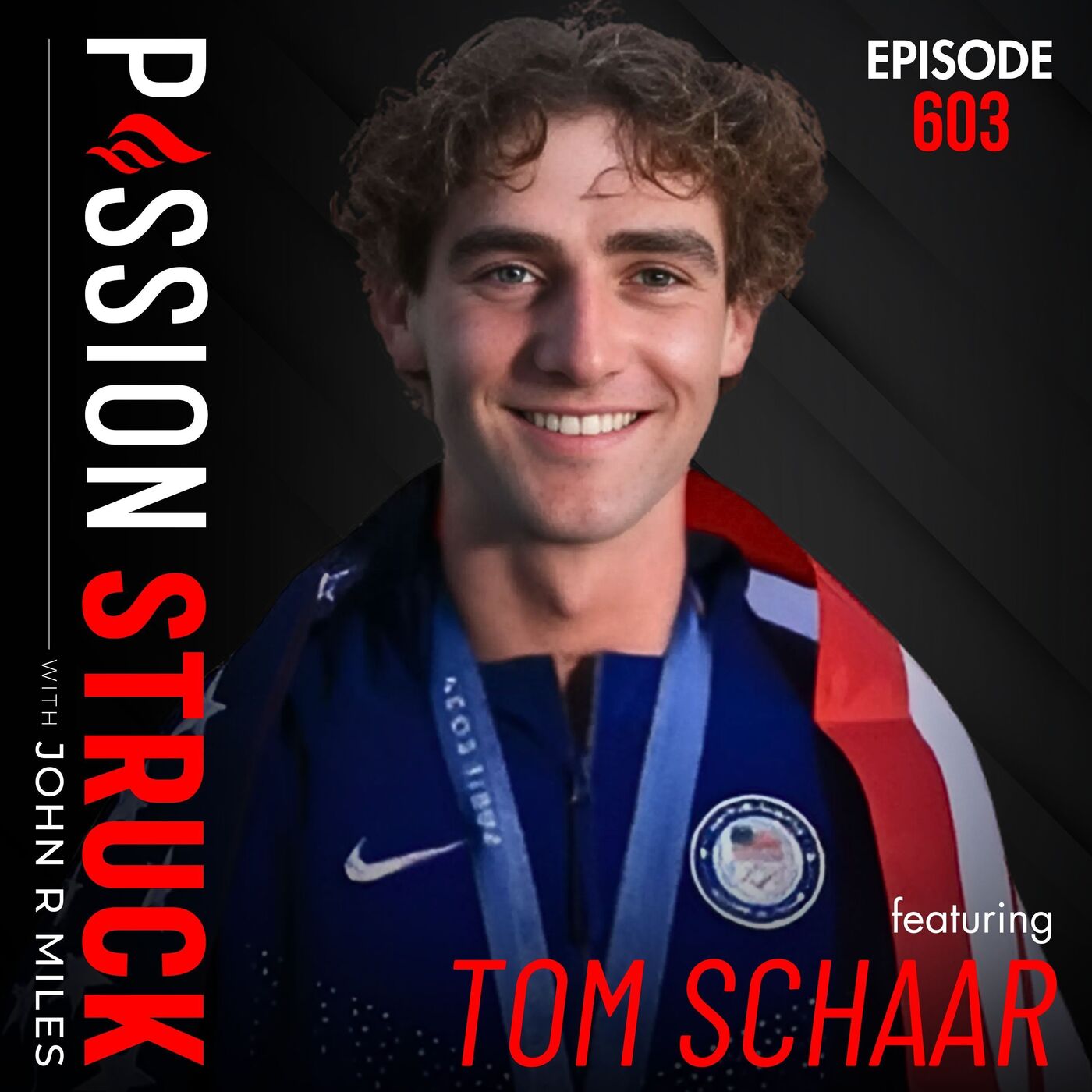
Skateboarding Legend Tom Schaar on How to Fall 999 Times and Still Win | EP 603
In this powerful episode of Passion Struck, John R. Miles sits down with Olympic silver medalist and skateboarding legend Tom Schaar, the first person in history to land a 1080—a mind-blowing three full spins mid-air. But Tom’s story isn’t just about defying gravity. It’s about defying doubt, embracing failure, and staying grounded while the world spins around you.
At just 12 years old, Tom did what no one had ever done in skateboarding. But what most people didn’t see were the 999 failed attempts it took to get there. In this intimate and inspiring conversation, Tom opens up about the mental discipline behind his success, how he handles fear, the evolution of his mindset from prodigy to pro, and what keeps him pushing limits even after Olympic podiums.
Whether you’re an athlete, entrepreneur, or simply someone trying to overcome a personal hurdle—this conversation is for you.
Click here for the full show notes: https://passionstruck.com/tom-schaar-how-to-fall-999-times-and-still-win/
Join the Ignition Room!
Join the new Passion Struck Community! - The Ignition Room: https://station.page/passionstruck
- What landing the first 1080 really required—physically and mentally
- Why failure isn’t a setback but a prerequisite to growth
- How Tom manages fear and high-stakes pressure in competition
- The surprising truth about balance—on a board and in life
- What keeps him grounded and hungry after Olympic glory
- How the mindset of micro-improvement has fueled his entire career
For more information on Tom Schaar: https://www.teamusa.com/profiles/tom-schaar
Sponsors:
- Factor Meals: http://factormeals.com/factormeals50off and use code “FACTOR MEALS 50 OFF”
- Rosetta Stone: Unlock 25 languages for life at “ROSETTASTONE.com/passionstruck.”
- Prolon: Reset your health with 15% off at “ProlonLife.com/passionstruck.”
- Mint Mobile: Cut your wireless bill to 15 bucks a month at “MINT MOBILE dot com slash PASSION.”
- Hims: Start your journey to regrowing hair with Hims. Visit hims.com/PASSIONSTRUCK for your free online visit.
- Quince: Discover luxury at affordable prices with Quince. Enjoy free shipping and 365-day returns at quince.com/PASSION
For more information on advertisers and promo codes, visit Passion Struck Deals.
Speaking Engagements & Workshops
Are you looking to inspire your team, organization, or audience to take intentional action in their lives and careers? I’m available for keynote speaking, workshops, and leadership training on topics such as intentional living, resilience, leadership, and personal growth. Let’s work together to create transformational change. Learn more at johnrmiles.com/speaking.
Episode Starter Packs
With over 500 episodes, it can be overwhelming to know where to start. We’ve curated Episode Starter Packs based on key themes like leadership, mental health, and personal growth, making it easier for you to dive into the topics you care about. Check them out at passionstruck.com/starterpacks.
Catch More of Passion Struck:
- My solo episode on The Mattering Mindset in Love – Choose the Love You Deserve
- Can't miss my episode with Jennifer B. Wallace on the Consequences of Prioritizing Achievements Over Mattering
- My episode with The Art of Listening: How to Make People Feel Like They Matter
- Catch my interview with Laurie Santos on How to Matter in a Busy World
- Listen to my solo episode on Fading into Insignificance: The Impact of Un-Mattering in Our Interconnected Era
If you liked the show, please leave us a review—it only takes a moment and helps us reach more people! Don’t forget to include your Twitter or Instagram handle so we can thank you personally.
How to Connect with John:
- Connect with John on Twitter at @John_RMiles
- Follow him on Instagram at @John_R_Miles
- Subscribe to our main YouTube Channel and to our YouTube Clips Channel
- For more insights and resources, visit John’s website
Want to explore where you stand on the path to becoming Passion Struck? Take our 20-question quiz on Passionstruck.com and find out today!
See Privacy Policy at https://art19.com/privacy and California Privacy Notice at https://art19.com/privacy#do-not-sell-my-info.
Press play and read along
Transcript
Speaker 1 Why choose a sleep number smart bed?
Speaker 3 Can I make my sight softer?
Speaker 2 Can I make my site firmer?
Speaker 5 Can we sleep cooler?
Speaker 6 Sleep number does that, cools up to eight times faster, and lets you choose your ideal comfort on either side.
Speaker 7 Your sleep number setting.
Speaker 6 Enjoy personalized comfort for better sleep night after night. It's our Black Friday sale, recharged this season with a bundle of cozy, soothing comfort.
Speaker 6 Now only $17.99 for our C2 mattress and base plus free premium delivery.
Speaker 1 Price is higher in Alaska and Hawaii.
Speaker 6 Check it out at a sleep number store or sleepnumber.com today.
Speaker 8 if your dog could talk they'd beg for Ollie the full-body tail wag the excited little hops the big goofy grin that's the Ollie effect Ollie delivers clean fresh nutrition in five drool worthy flavors even for the pickiest eaters made in U.S.
Speaker 8 kitchens with highest quality human grade ingredients Ollie's food contains no fillers no preservatives just real food with five protein packed recipes like fresh beef with sweet potatoes or fresh turkey with blueberries even the pickiest eaters can't resist You might think, dang, my dog eats better than I do.
Speaker 8
And that's probably true when it comes to Ollie. Dogs deserve the best, and that means fresh, healthy food.
Head to ollie.com/slash wondery.
Speaker 8 Tell them all about your dog and use code Wondery to get 60% off your welcome kit when you subscribe today.
Speaker 8 Plus, they offer a happiness guarantee on the first box, so if you're not completely satisfied, you'll get your money back.
Speaker 8 That's o-l-l-ie-e.com/slash wondery, and enter code wondery to get 60% off your first box.
Speaker 2 Coming up next on Passion Struck.
Speaker 5 At the end of the day, I'm very lucky that this gets to be my job. And I remind myself of that every day, not to ever really lose my mind over skating or anything like that.
Speaker 5 I do take it pretty seriously, and I do try and do the best that I can always.
Speaker 5 But my job is what I wanted to do when I was a kid. So I'm very lucky in that aspect of it.
Speaker 5 But I think a lot of random little kids will come up to me at the skate park and they tell me how cool it is that I get to do this as my job. And that always reminds me.
Speaker 5 It's very lucky that I'm not doing something else. Hopefully when someone watches me skate, it can bring them a little bit of joy or try and inspire kids to be better.
Speaker 5 I'll try my best to be a good example.
Speaker 9 Welcome to Passion Struck. Hi, I'm your host, John R.
Speaker 9 Miles, and on the show, we decipher the secrets, tips, and guidance of the world's most inspiring people and turn their wisdom into practical advice for you and those around you.
Speaker 9 Our mission is to help you unlock the power of intentionality so that you can become the best version of yourself. If you're new to the show, I offer advice and answer listener questions on Fridays.
Speaker 9 We have long-form interviews the rest of the week with guests ranging from astronauts to authors, CEOs, creators, innovators, scientists, military leaders, visionaries, and athletes.
Speaker 9 Now, let's go out there and become Passion Struck. Welcome to Passion Struck episode 603.
Speaker 9 Whether this is your first time tuning in or you've been with us for a while, thank you for joining a movement that's all about defying limits, living with intention, and making what truly matters matter most.
Speaker 9 Now let me ask you something. What does it take to defy gravity, literally and metaphorically?
Speaker 9 What happens when a 12-year-old doesn't just dream big, but becomes the first person in the world to land a trick that even the pros thought was impossible?
Speaker 9 And how do you evolve when the moment that made you famous becomes just the beginning? Today, we're answering those questions and more with my guest, Tom Scharr.
Speaker 9 Tom is not just a legend in the making, he's already made history.
Speaker 9 He's the first skateboarder ever to land a 1080 degree spin, the youngest X Games gold medalist, the youngest dutour and Vance Pool Party champion, and most recently, a silver medalist at the Paris Olympics.
Speaker 9 But behind these milestones is a mindset that goes far beyond skateboarding, a fearless dedication to growth, resilience, and reinvention.
Speaker 9 In today's conversation, we dive into what it really felt like to land that historic 1080, how Tom manages fear, and why it's part of the process, the mindset shift from prodigy to Olympic medalist, how to stay grounded when the spotlight hits, and the power of redefining success over and over again.
Speaker 9
But this episode isn't just about gravity-defying tricks. It's about resilient self-mastery and how to stay grounded when the world is watching.
Before we dive in, a quick heads up.
Speaker 9 If you're looking for a space to connect with other purpose-driven high performers, we've just launched the Ignition Room, a private membership community where podcast listeners, readers, and intentional leaders like you can go deeper on the topics we explore here.
Speaker 9 Think of it as your home base for curated tools, behind-the-scenes access, and conversations that fuel your growth. Check the show notes to sign up.
Speaker 9 And if you're just getting started with Passion Struck, check out our episode Starter Packs, theme playlists on resilience, mindset, and emotional mastery at Spotify or Passionstruck.com slash starter packs.
Speaker 9 And this week, we've had some amazing conversations. On Tuesday, I spoke with Yange Minur Rinpoche, one of the world's most respected meditation masters on how to awaken your true nature.
Speaker 9 And Thursday, we unpacked how sponsorship, not just mentorship, can transform a career with Carnegie Mellon's Rosalind Chow. And I have a special announcement that we just learned about today.
Speaker 9 Passion Struck has earned two Gold Stevie Awards at the 2025 American Business Awards.
Speaker 9 Passionstruck was awarded gold for best business book and the Passion Struck podcast was awarded gold for the best independent podcast. These prestigious accolades underscore Passion Struck's mission.
Speaker 9 to help individuals and organizations lead with greater meaning, intention, and humanity.
Speaker 9 And these awards validate the impact we're making through powerful storytelling, science-backed tools, and real conversations that transform lives.
Speaker 9 Now, let's jump into this inspiring episode with a living legend of skateboarding. Olympic medalist and true Passion Struck Trailblazer Tom Scharr.
Speaker 9 Thank you for choosing Passion Struck and choosing me to be your host and guide on your journey to creating an intentional life. Now, let that journey begin.
Speaker 9 If you've followed me for any length of time, you know I'm constantly searching for the breakthroughs that actually make a difference in how we age, feel, and perform.
Speaker 9 Lately, I've been taking timeline Mitopure gummies, and I got to tell you, I'm feeling the shift. My energy is more sustained, my focus sharper, and my recovery quicker.
Speaker 9 It's like I upgraded my engine at the cellular level. What makes them stand out?
Speaker 9 They're powered by MitoPure, the only clinically proven form of urolithin A, a compound that activates your longevity pathways, supports muscle strength, and improves cellular energy.
Speaker 9
It's clean, vegan, and backed by over 15 years of cutting-edge science. Dr.
Mark Hyman calls urolithin A a game changer for longevity.
Speaker 9 And with Mitopure, everyone can benefit, no matter your gut health. If you want to stay strong and energized now and as you age, then you have to try MitoPure gummies.
Speaker 9
My friends at Timeline are offering 20% off just for my listeners. Head to timeline.com/slash passionstruck to get started.
That's timeline.com/slash passionstruck. Yourselves will thank you.
Speaker 5 This episode is brought to you by Progressive Insurance. Do you ever find yourself playing the budgeting game?
Speaker 5 Well, with a name-your-price tool from Progressive, you can find options that fit your budget and potentially lower your bills.
Speaker 5 Try it at progressive.com, Progressive Casualty Insurance Company and affiliates. Price and coverage match limited by state law, not available in all states.
Speaker 2 I am so excited today to welcome Tom Scharr on Passion Struck. Welcome, Tom.
Speaker 5 Thank you. Thanks for having me.
Speaker 2 As you and I were getting to know each other before we came on, I can imagine as you were going through high school, the thought of being an Olympic medalist.
Speaker 2 I remember when I was in high school, I was just focused on how well could I perform in cross-country or track. Looking back.
Speaker 2 Did you ever in a million years imagine that you'd be where you are today when you were 14, 14, 15, 16 years old?
Speaker 5 No, not at all. Especially because when I first started high school, they hadn't even announced yet that skating was going to be in the Olympics.
Speaker 5 Up until then, well, it's still, all right, I'll finish what I was saying first. But up until then, I was just skating for fun or whatever, and doing
Speaker 5
just because I love it. And I still do.
That's the point I was getting to. But no, it was a weird transition.
Like you could really feel it. People
Speaker 5 just had this more nonchalant approach to skating. and then overnight it switched and then all of a sudden everyone became athletes and not skateboarders which was pretty funny actually
Speaker 2 well how did you originally get into skateboarding were you a cyclist at first and then transitioned or was this kind of the first passion you had i got into it because my older brother skated and being the little brother i had to copy steal whatever he was doing that's how i got started and yeah no
Speaker 5
as soon as i started started, I just fell in love with it. And that's pretty much all it's been.
Never looked back.
Speaker 2 Yeah, I remember you and my son are about the same age.
Speaker 2 And I remember when he was in elementary school, even in middle school, he loved ripsticks and the scooters and really anything he could, he could find out how to ride.
Speaker 2
And he's a really good snowboarder as well. So to me, the ripstick is hard.
For him, he just picked it up right away.
Speaker 5 Yeah.
Speaker 5 Snowboarding is, I have some beef with snowboarding i broke my collarbone twice in the same season so i'm on a long hiatus from snowboarding at the moment
Speaker 2 you know what having been a skier my entire life what always does it for me is when you ski you're really leaning forward and that's what gets me on when i snowboard all the time is i catch that front lip and then those face plants hurt yeah no they do not feel good
Speaker 2 snow is not soft So I'm going to take you back in history to what we were just talking about in middle school. You landed the first ever 1080 when you were just 12 years old.
Speaker 2 Can you take us back to that moment? And for a person who doesn't understand what a 1080 is, maybe explain it to them.
Speaker 5 And
Speaker 2 what was going through your mind when you finally stuck it?
Speaker 5
A 360 is just one spin around full circle. And then a 1080 is just three of those.
So it was like, you go up in the air, grab your skateboard, spin around three times, come back down.
Speaker 5 I was the first person to ever do one, but I was 12. It was 13 years ago, and I can honestly hardly remember it at all.
Speaker 5 I don't know if it's from like maybe hitting my head a few too many times skating, but my memory is not the best.
Speaker 5 And I do remember that day, but I really don't remember the whole process of it or like.
Speaker 5 really how it came to be or like how just the idea came up or anything but i remember landing it it took five tries, which was very surprising. I thought it was going to take 500 or something.
Speaker 5 And yeah, that really changed my life pretty much. I went on the Ellen show after that and did a whole bunch of crazy things that a 12-year-old had no idea what any of it really meant.
Speaker 5 But yeah, it feels, it's just so long ago that it feels like it was a different lifetime or a different person or something.
Speaker 9 When you look at the competition today,
Speaker 2 has the 1080 become more of a regular practice skill, or is it still pretty far in between to see people do it?
Speaker 5 It's still pretty far in between. There's
Speaker 5 five
Speaker 5
people that have done it now, me included. So it's still not that many people have done it.
But yeah, I don't know. It's
Speaker 5 like a weird side of skateboarding. It's just like
Speaker 5 not everyone really enjoys or wants to be the person that spins a bunch. So it's not for everybody, but it's still, I think it's cool in my book.
Speaker 2 Well, we were talking about snowboarding and I wanted to ask, what was it like to watch Sean White attempt the 1080 and then becoming the one to land it first? Did that fuel your drive at all?
Speaker 5
I think I was like seven and I'm from LA. So we used to live up there and the X Games always was in LA for a long time.
So we would go. My brother was obsessed with skating.
Speaker 5
I was obsessed with skating. So we would drag our parents to take us to the X games.
And then I remember, I like remember, I think I was like seven when I saw him try it, but I remember
Speaker 5
just being, it was in Staple Center. They had the big Vert ramp set up.
And it was pretty crazy. But I remember seeing Sean try it a few times and he almost did one.
Speaker 5 And then I think time ran out for the contest. But yeah, I mean, I don't really, I don't know if that exactly.
Speaker 5 connects with why I tried it. Maybe it does like subconsciously from being a kid, but it is pretty strange that I saw him try it first and then I somehow did it years later.
Speaker 2 For your sport, the X Games are really the pinnacle. Can you explain how they in the sport differ from the Olympics?
Speaker 2 Because X Games is where the sport became the sport and it's more recently started to become an Olympic sport. Is that a good way to understand it?
Speaker 5
Exactly. X Games has been like our Olympics for the longest time.
It's where a lot of
Speaker 5
pretty groundbreaking stuff for action sports have happened. Tony Hawk doing the 900, Travis Pestrano doing the double back flip on the dirt bike.
A lot of stuff is
Speaker 5 because of the X Games and what they've done for Action Sports is pretty, pretty remarkable. A lot of people,
Speaker 5 I guess, well,
Speaker 5 I just
Speaker 5
we wouldn't be doing much without X Games. They've really put action sports onto like a whole nother level for everybody to see.
But yeah, that was all we had for a while. Yeah.
Speaker 5 So it's really going from X Games to the Olympics is a pretty crazy jump, but I think it prepared us pretty well for what to expect.
Speaker 2 For people who aren't familiar with you, I'm going to just go down this path a little bit longer. So it makes sense why I'm asking you some of the questions later on in our discussion.
Speaker 2 Not only did you shock the world when you landed that 1080, but then you shocked them even more when you became the youngest X Games gold medalist
Speaker 2 after winning the Asian X Games in Shanghai.
Speaker 2 Can you walk us back to that experience?
Speaker 2 How much of that do you remember?
Speaker 5 How much do I remember? I remember just being in China with my mom at 11 or 12, which is a pretty crazy experience, just getting lost everywhere we were going. It was pretty fun, though.
Speaker 5 That was like the first time I really got to meet like all these other guys that I would end up skating with over the rest rest of my life. And they were all very nice to me, which is cool.
Speaker 5 And they were all very supportive. And
Speaker 5
yeah, that was a crazy moment. I didn't really know what I was getting into going into that contest or anything.
But yeah, I guess I could launch the beginning of my
Speaker 5 competitive skating career in a way.
Speaker 2 Well, you hear a lot about parents who take their kids all over the place because they're doing club sports, whether that's club soccer or club volleyball or club hockey.
Speaker 2 But it's next level when you're a parent and you take your kids to China.
Speaker 5 Yeah.
Speaker 2 How in the world did you convince your mom to do that?
Speaker 5
I have no idea. That's a great question.
She's been to China with me, Australia, Brazil, everywhere you can think of, pretty much.
Speaker 2 I can see going to Australia.
Speaker 5 Yeah, I love it every time I go there.
Speaker 5 You're right about
Speaker 2 China, though. I've been to Shanghai myself, and man, it's such such a big city with so much going on it's a lot different from the us
Speaker 5 yeah
Speaker 5 so
Speaker 2 not only were you not satisfied with one record-breaking feat you also became the youngest dutor champion the youngest vanpoles party champion and the youngest big air gold medalist you it's like one after another
Speaker 5 I had so
Speaker 5 yeah, I don't know.
Speaker 2 I guess where I wanted to go with this is how did breaking these barriers so young shape your mindset for where you are now in your career?
Speaker 2 Do you feel like it's a blessing or do you feel like it's a challenge to have to live up to those moments when you've accomplished so much already?
Speaker 5
Definitely both, I think. When I was younger, I was very like vert skating oriented.
And that was all I knew.
Speaker 5 I probably couldn't kickflip on flat until I was like 14 or something, which is very embarrassing.
Speaker 5 But I think as I got older, I either just got burnt out on skating vert and just mega ramps and I don't know, I just lost interest in it somehow.
Speaker 5 But skating started to kind of transition into more of what the Olympic park format looks like, like concrete bowls and that kind of skating. So I slowly transitioned from Vert and Mega
Speaker 5 into that. And I think when I was younger, I
Speaker 5
was pretty good at Vert and Mega. And then those few years that I was transitioning, it just, I felt a little lost.
I didn't really know exactly what I was getting into.
Speaker 5 But then
Speaker 5 I got older, I got stronger and figured out where I felt like I belonged in the world of skating.
Speaker 5 And everything started to click again, which I'm very happy about because there was a few years I was like, I don't know what I'm doing right now. There was definitely a large break in my
Speaker 5 competitive skating, or not really a a break, I was still doing contests and whatnot, but I was just trying to figure out
Speaker 5 how I fit in kind of in a way.
Speaker 2 I'm going to come back to that in a second because
Speaker 2 I don't care if you're a skateboarder, you're jumping off the ski jump, you're doing the tricks in the terrain park, you're doing the Sean White types of things. All of these things demand
Speaker 2 a tremendous amount of overcoming fear. Like, Like, how did you process that fear?
Speaker 2 Because I guess before you ever landed the 1080, you probably had to practice that thing a thousand times and probably wiped out
Speaker 2 about 990 of them.
Speaker 5
That's funny, actually. Some random kid on Instagram just DM'd me and asked me like the exact same question.
He was like, are you scared when you skate?
Speaker 5 And to be honest, I'm terrified most of the time. Some of the stuff is pretty scary, but there's a fine line that you have to ride along.
Speaker 5 Because if it's not scary, then there's not really much of a reward, it feels like. But at the same time, don't hurt yourself.
Speaker 5 But
Speaker 5 you just got to take things slowly. Take a trick and break it down into smaller pieces and kind of work on the individual parts of it until you feel you have the confidence to try and
Speaker 5 actually do the trick. But most of skating is
Speaker 5
that's really it. It's just mostly confidence.
If you you get to a certain point in skating where
Speaker 5 you know you can do certain things, but you just have to remind yourself that you know you can do them because a lot of it just testing the waters and seeing what feels right.
Speaker 5 But
Speaker 5 I don't know where I was going with that one exactly.
Speaker 5 But back to the point is there's, I think every skater is scared of what they're doing, but you just learn to let that sit with you and just yeah, I guess it's like a kind of fight or flight situation that you get into when you're trying new stuff.
Speaker 2 I myself am not a Navy SEAL, but I spent time working with them and deploying with them when I was in the service.
Speaker 2 And one of the things that I learned while I was with them is to get over fear, we did a lot of exercises that involved breath work. mindfulness, yoga, things like that.
Speaker 2 Are any of those types of techniques things that you've employed at all?
Speaker 5 Yeah, I think so. I think a really good one is to just stay present too.
Speaker 5 Just because a lot of the fear that you'll have is from thinking of what could go wrong.
Speaker 5 But that's just thinking into the future of something that hasn't happened yet. Because if you're trying a trick and you're scared that you might get hurt doing it.
Speaker 5 Well, you don't know if you're going to get hurt because you haven't tried it yet.
Speaker 5 So I think it's just about staying in the present and just trying to not really think about what could go wrong or what could go right even, just staying in that moment while you're going to try something.
Speaker 2 I remember I was interviewing Heather Moyce. You probably have never heard who that is, but she's a Canadian Olympian who's won a couple medals in the bob sled.
Speaker 2 And she was telling me, first time she ever got in the bob sled, she was in the two-seater and she was behind the driver. And no one really gave her any instructions.
Speaker 2 So she said that they're starting to fly down this course and she didn't know that she's supposed to duck her head.
Speaker 2 And so she's going down and she's getting the full feel of gravity and starting to pull all these G's.
Speaker 2 And she told me she's about ready to, she's starting to freak out because she sees how fast they're going and then almost blacks out and the force ends up pushing her down.
Speaker 2 But she definitely told me that in bobsledding, fear is one of the main things that you have to overcome because when they bite it, they bite it really hard.
Speaker 5 Yeah.
Speaker 2 yeah so
Speaker 2 i want to talk about mindset for a little bit skateboarding
Speaker 2 to me has got to be one of the most mentally demanding sports because you're constantly pushing limits you're constantly risking failure
Speaker 2 and that failure has got to get to you after a while
Speaker 2 How do you like mentally prepare yourself for that failure and to keep attempting new tricks?
Speaker 5 It's a great question.
Speaker 5 I get very frustrated a lot while I'm skating because it's just a lot of, like you said earlier, you're going to try something 999 times, but on the thousandth try, you'll land it eventually.
Speaker 5 And but yeah, that a thousandths try feels pretty good after
Speaker 5 falling 999 times.
Speaker 5 It's really, yeah, it's a lot of
Speaker 5 it's just, it's just a long process.
Speaker 5 Every, for me, at least, there's a lot of people that learn and pick up skating skating very fast but for me every trick i've ever tried to learn is has been a struggle at some point whether i learned it when i was a kid or now but yeah it's just a lot of kind of making yourself just keep trying stuff and you're gonna fail absolutely it's just it's not avoidable but that's that's why i like it though it's just always this
Speaker 5 process of
Speaker 5 failing and then learning from your failure and kind of continuously improving on what you've learned. And even if you don't end up landing a trick, you'll still be learning from that.
Speaker 5 And the more you fall, the more you'll figure out stuff. And it's just as
Speaker 5 it's like a chess game in your head until you finally figure out exactly what you're doing wrong and then
Speaker 7 it all clicks. You're tuned into auto intelligence live from Auto Trader, where data, tools, and your preferences sync to make your car shopping smooth.
Speaker 4
They're searching moving to you. Oh, yeah.
They find what you need.
Speaker 4 they're gonna find it can make a budget for your wallet to help you succeed pricing's precise and true so true it's smart to go shopping oh
Speaker 7 just for you oh it's just for you
Speaker 10 find your next ride at autotrader.com powered by auto intelligence I'm Martha Stewart and I believe the best gifts are not only beautiful but useful every single day and Lenox has brought timeless beauty and lasting quality to our tables for generations And their Lenox Spice Village is the perfect holiday gift for someone you love or for yourself.
Speaker 10 Spice Village transforms everyday spices into inspired memories filled with warmth and joy all year long.
Speaker 10 Give a gift that lasts beyond the holidays. Discover the collection at lenux.com slash spice village.
Speaker 2 One of the things that I talk a lot about on this podcast is the need to push boundaries and you can't ever stay comfortable with where you're at
Speaker 2 and one of the big things whether you're an executive whether you're a coach whether you're an athlete is
Speaker 2 the mental blocks that come about when trying to push boundaries and you talked about this earlier where you went through a period of time where things weren't just clicking like they had before
Speaker 2 When those doubts crept in, like, how do you analyze them?
Speaker 2 How do you overcome them because this is something that a lot of people face a lot of people who are a lot older than you yeah for me I just I took a really big step back and just kind of looked
Speaker 5 I just tried to figure out where I wanted to
Speaker 5
be and fit into this skating world it was never like the idea of me like stopping never came into my head. I just didn't really know where I fit in.
And I think just kind of trying to
Speaker 5
I don't know, just do your own thing is kind of what I figured out. If you love what you're doing, like it'll eventually, it'll all come together.
And I think that's what happened for me.
Speaker 5 I just found a different path and it I'm very glad that it worked out though.
Speaker 2
So I wanted to go to Paris for a little bit. So it was a little bit in doubt that you would even go to Paris.
Can you talk a little, talk us through that story?
Speaker 5
Yeah, I barely qualified by the skin of my teeth. I missed out on the the first, the Tokyo Olympics.
Well, the first one for skating. And I missed it.
Speaker 5 They take three Americans and I was the fourth by five points or something crazy. And then going into this one, I was number four again, by five points again.
Speaker 5 And the last qualifying stop was in Budapest, which was like June, like right before the Olympics. And I had to get second place.
Speaker 5 And the person that was in third had to get like 16th or something like that. Like it was very long shot chances that that it was going to happen because the person that was in third was very good.
Speaker 5 They would always do well in the contest.
Speaker 5 And somehow going into the finals, I didn't really, wasn't really paying attention to the placings or anything, but he was in 16th and the finals were about to start.
Speaker 5
And I was like, oh my God, this could happen. And then I ended up in second.
So it was like the exact number of points or whatever I needed to qualify. And
Speaker 5 I barely made the team, but then I think that kind of helped me because I got to Paris with the mindset of I'm not really supposed to be here.
Speaker 5 So I'm just going to have fun and try and take everything in.
Speaker 5 And I think that helped me mentally instead of knowing months prior to the Olympics that I was going to make it and really stressing out for a long time.
Speaker 5 I just got thrown in and was like, okay, I got to just deal with this, which I think was honestly maybe better for me.
Speaker 2 It makes you just wonder about what goes through the mind of Sean White, who we talked about, or Simone Biles, or some of these athletes who are expected to win and have all that pressure and to feel like you got a whole country like begging you to win.
Speaker 5 And then when you don't, that's a lot of pressure.
Speaker 2 It is.
Speaker 2 That's why I was so happy for Sean that last Olympic when he people pushed through, man. It's like the hero story.
Speaker 5 That was a very special one.
Speaker 2 So I
Speaker 2 understand that you got to meet Snoop Dogg.
Speaker 5 I did. I did.
Speaker 5
He was just bouncing around during all the different events and he was like this myth. You'd be like, you'd hear rumors.
You'd be like, oh, Snoop's here. And we'd all be looking around for him.
Speaker 5
And then we saw him. He came to the skating and he was sitting up top next to Tony Hawk.
They were all hanging out. And then like midway through the finals, he started to leave.
Speaker 5
As my run started, they played a Snoop Dogg song. And I could hear it.
I had my headphones in. I was listening listening to my own music, but I could hear it over my headphones.
Speaker 5
And as I was about to drop in, I just started smiling because I like saw him walking down the exit path. And then the song came on.
I dropped in. And then I landed my run.
Speaker 5
I popped out of the bowl. And he was like the first person I saw.
He was like 10 feet away from me. And then he yelled at me.
He said, Come over here. And he gave me like a high five, gave me a hug.
Speaker 5 And then, yeah, I met him for five seconds, but
Speaker 5 I'm counting it for sure.
Speaker 2 That is pretty awesome. Yeah.
Speaker 2 I just have to ask you, I watched the opening ceremonies and I thought that the French did a really cool job of how as the boats were going down, they were showing all these different events that kind of trace the history of France.
Speaker 2 How much of that did you get to experience being on the boat? I'm guessing it might have been something better to watch. on TV than be there, but I'm interested in your perspectives.
Speaker 5 It was still very cool from the boat. It was pouring rain, which was rough,
Speaker 5
but it didn't affect me that much. I felt bad for the girls that were in full makeup and then looked like their mascara was running and everything by the end of it.
But for me, it was fine.
Speaker 5 It was just a little cold and wet, but we still got to see the whole setup and all the different kind of just they set up everything. It was really cool just going down the river.
Speaker 5 They had a little skate park, floating skate park in the river that they. we went past and then we what's the band gojira the metal band i think they were set up.
Speaker 5 It was cool, but we only got to see these parts of it for 30 seconds as we floated by. But seeing everything was pretty cool.
Speaker 2 Did you ever go back and watch it on video?
Speaker 5 No, I haven't actually. I haven't seen that.
Speaker 2 Yeah, they just made it so dramatic. There were a couple of things I thought were cheesy, like the dude who kept jumping over buildings the whole time.
Speaker 5 There's always going to be some cheesy stuff, but yeah.
Speaker 2 But I thought some of the performances on TV were just amazing.
Speaker 5 Yeah, I saw some of it on Instagram. It definitely was cool looking.
Speaker 2 Tell me about, did you, you told me you didn't expect like you had to perform, you weren't expected to meddle, you didn't have this heavy weight of pressure on you, which made you feel like you could just go out there and just go for it.
Speaker 2 Can you lead us through
Speaker 2 like what was happening in the competition? And when did you realize? that you had a shot to be on the metal podium.
Speaker 5 It really wasn't going into it. I hold expectations of myself i have my own goals but going into it i i just really was just happy to be there i was just enjoying hanging out in the village and
Speaker 5 just seeing all my friends enjoying the fact that we made the team actually and
Speaker 5 i was doing more of being like a tourist than being an olympic athlete honestly which I think like really did help though because I saw
Speaker 5 I mean there's 10,000 of us in the village or something and i saw everyone and there was just it's just this like
Speaker 5 such a serious
Speaker 5 vibe going on and everybody just like no one's really talking to each other it's not like a very friendly experience like everyone's there to everybody is there to win so it's not everyone is gonna win so it's just like
Speaker 5 friendemy not between the skaters at all but more the other sports kind of this like
Speaker 5
just a weird kind of vibe so I was just trying to have fun. I was running around doing dumb stuff in the village the whole time.
And I think just trying not to like super stress out over it.
Speaker 5
Like I definitely was mentally preparing and getting ready for it. I wasn't just like goofing around the whole time.
But I think just having fun was more what I was getting at than
Speaker 5 pretending like this is a
Speaker 5
life or death moment. The future depends on this or whatever.
I was just having fun with my friends.
Speaker 2 And when did you realize that you would won a medal? Did you know immediately I nailed it?
Speaker 5 I had my whole run planned out. Like I knew exactly what I wanted to do.
Speaker 5 And you never know how the judges are going to
Speaker 5
judge your run, really. Skating is a very subjective sport, so it's hard to tell.
One thing for someone can be really hard, and it can be easy for someone else.
Speaker 5 So it's hard to really put a perfect score on a skateboarding run, but I think for the most part,
Speaker 5
I think 95-99% of the time, the judges nail it. They usually, and they're all professional skaters, and they know what they're talking about.
They know what they're looking at. So,
Speaker 5
but I just wanted to land my run. Like, I knew what I went there to try and do.
And I ended up landing it. And I honestly didn't really care if they put me in last place or if they put me in first.
Speaker 5
I just wanted to go do what I wanted to do. And that would have been good enough for me.
And I noticed I got a good score for it. And I was like, that's that could hold for a while.
And it did.
Speaker 5 I stayed. I got put in second and I stayed in second the whole rest of the contest.
Speaker 2 Well, congratulations again.
Speaker 5 Damn.
Speaker 2 And I have to talk about two things more about related to the Olympics. I heard you on another show, a person asked you, what was your favorite thing about the Olympics?
Speaker 2 And you told them table tennis.
Speaker 5 Oh, by far. It was so cool.
Speaker 2 Like, how competitive? I haven't seen those matches in person.
Speaker 2 So you can't really judge the speed and stuff. What's it like?
Speaker 5
The ball is just teleporting from side to side. You can't even follow it with your eyes.
It's, but those were like more of the very locked-in people that I saw in the village.
Speaker 5
Like, they were not there to have fun. They were there to win.
And it was cool. I admired that intensity.
But it was crazy. I went, we saw the mixed doubles finals
Speaker 5
and it was crazy. It's been a smaller like arena.
It was like a high school basketball size stadium and it was just packed. Like there was 5,000, 6,000 people in there.
And it was loud.
Speaker 5
Like it was insanely loud. You had to be completely silent while they were playing.
But as soon as somebody scored, these 6,000 people were just yelling. It was pretty cool.
Speaker 2 But some of those rallies go on for so long and there's so much strategy behind it, speed, all the spins that they do. Because I'm like you, I grew up playing ping pong all the time with my brother.
Speaker 2 And I always thought of myself as a pretty good ping pong player. And until I remember I was at a family camp one year and there happened to be an Asian.
Speaker 2 When I say Asian, they were an exchange student over from Japan or China. And I played them and I got literally.
Speaker 9 annihilated. It's crazy.
Speaker 5 They'll be 20 feet behind the table, still hitting it as hard as they can. And it's, it was pretty fun to watch.
Speaker 2
Okay. And then I got to get real here.
So
Speaker 2
here you are. You won silver medal.
You're this Olympian. And do I have it right that you flew home in a middle seat?
Speaker 5 Yes, I did.
Speaker 5 I did.
Speaker 5 To be fair, I changed my flight to come home early. I was supposed to stay for the closing ceremonies and everything, but not everybody stayed all the way from opening ceremonies till closing.
Speaker 5 And our event was pretty much at the end of the two-week Olympic window. So by the time I was done skating, I just wanted to go home.
Speaker 5
And I also, I got maybe three hours of sleep the night before the contest. I just couldn't go to sleep.
It was like 4 a.m. when I finally did.
I had to be up at 7.
Speaker 5 So it was a very long 48 hours after that. And then I went,
Speaker 5
I got home the night after the event at 4 a.m. again.
And I had to be up at six to do interviews. I got five hours of sleep in the course of 48 hours.
So I was dying. So I just wanted to go home.
Speaker 5 And that was the only seat that was available. So I was like, it's fine.
Speaker 2 Thanks, NBC.
Speaker 5 It was all right.
Speaker 2 Okay, so I'm going to go back to some of the main stuff we talk about on the show.
Speaker 2 One of the core things that we like to talk about on this podcast is this innate need to feel like we matter, to feel like we belong, that our lives hold some form of significance, not just about success, but in how we impact others.
Speaker 2 Do you feel like your skating truly matters beyond the competition?
Speaker 5
That's a tough one. Yes, I do.
At the end of the day, I am. I'm very lucky.
Speaker 5 that this gets to be my job and I remind myself of that every day, not to ever really lose my mind over skating or anything like that.
Speaker 5 I do take it pretty seriously and I do try and do the best that I can always.
Speaker 5 But my job is what I wanted to do when I was a kid so I'm very lucky in that aspect of it.
Speaker 5 But I think a lot of random little kids will come up to me at the skate park and they tell me how cool it is that I get to do this as my job. And that always reminds me just I don't know.
Speaker 5 It's very lucky that I'm not in doing something else. I don't think I could do a nine to five honestly
Speaker 5 but I don't know it's hard to say if it like is really
Speaker 5 an essential job hopefully if someone watches me skate it can bring them a little bit of joy or something like that or try and inspire kids to be better or anything like that I'll try my best to be a good example
Speaker 9 I'm glad that's where you took it.
Speaker 2 To me, what you're doing is really filling you with purpose. It's something that you absolutely love.
Speaker 2 And the fact that you're inspiring an entire generation of young skaters has got to make you feel like the stuff that you've done, the hard work that you've put in, that it matters and that other people recognize it and make you feel
Speaker 2 like it's been worth it. Do you ever feel the weight of that responsibility?
Speaker 5
For sure. But I just try and be a good example.
And there's a lot of skaters that I maybe would say aren't the best examples for kids growing up.
Speaker 5 But I just always try and remind remind them to have fun. And
Speaker 5 we are just, it is a kind of a children's toy at the end of the day. So, just have fun with it and do your own thing, and
Speaker 2 everything will work out. So, what advice would you give to some of the young athletes who are listening to the show?
Speaker 2 Or it could even be an older athlete who has put it in their mind that they want to do a marathon or maybe want to do a triathlon or something, and they're struggling to find
Speaker 2 that passion, that strength to push through the setbacks. What would you tell them to do? What's a starting point or a trick that you have used?
Speaker 5 For me, you got nothing to lose.
Speaker 5 And
Speaker 5 failing is a lot easier than living with regret, I think.
Speaker 5 So
Speaker 5 it's better to try. and fail than it is to never start and regret not ever trying.
Speaker 5 So I think just if you're you're going to do something, give it your all, have fun and take it seriously, but not to a point of where it becomes not fun.
Speaker 9 And maybe I'll just ask you another question on that.
Speaker 2 Have you ever put a goal in front of yourself or a trick that at the onset, you thought, man, this is virtually impossible, but I'm going to go for it?
Speaker 2 And what, and if you did, like, how do you psych yourself up that you have the ability to do it?
Speaker 5 I think with skating, it's a lot of who you surround yourself with because there's a lot of tricks that, or just stuff that I would not want to do alone or by myself.
Speaker 5 And if you get a good group of friends or just a good group of whoever you're skating with or whatever you're working towards doesn't have to be skating, that can really help push you out of your comfort zone a little bit in a good way because it's you're all if you're all in it together, it feels not as daunting or something like that.
Speaker 5 So I think just having good people surrounding you, working towards a goal with other people, is a lot more fun, also, than trying to do something by yourself. So, I think that also helps.
Speaker 2 And I'm sure, having those people there, as you're trying these new things, they're analyzing what you're doing and probably trying it out themselves, and you each using different techniques to do it probably helps in the learning curve.
Speaker 5 Yeah, you learn with each other for sure.
Speaker 2 One of the things I have really been talking to my son a lot about, who's 26, is
Speaker 2 like for kids who have grown up in in your age group I sometimes wonder who are the role models that you guys look up to so as you look at people who are older than you who do you look for inspiration
Speaker 2 within skating well in skating or beyond okay
Speaker 5
My brother is still one of my main inspirations. He got me into skating and he's always been there for me.
So I'm very grateful for him. My mom and my dad, too.
Speaker 5 They drove me to the skate park probably 10,000 times. And yeah, I definitely wouldn't be doing any of this without them.
Speaker 5 Within skating, though, I've known, I've known a lot of the professional skaters that I looked up to as a kid. And they always say, don't meet your heroes.
Speaker 5 But within skating, it's the opposite of that. To me, every skater is a very cool, nice person.
Speaker 5 And they've all helped me along the way. Tony Hawk's given me a lot of help and he's been very supportive of my career, especially as of recently.
Speaker 5 I ride for his skateboard company now, Birdhouse, and he's helped me out a lot.
Speaker 2 But
Speaker 5 I don't know. Outside of skating,
Speaker 5
I don't know. I really just stick within skating.
I'm not too well versed in other sports or any other kind of stuff like that.
Speaker 2 Yeah, I guess part of what I'm looking at is I'm very interested for younger men in understanding like what is your definition of a man of courage? Like, when you think of that,
Speaker 2 who pops in your mind? Is it, and what are the qualities or values that they possess?
Speaker 5 I think just being, having the humility to really be yourself, I think is a very courageous thing to do. Just really trying not to
Speaker 5
just go your own pace and doing your own. what you want to do.
I think that does take a lot of courage.
Speaker 5 Yeah, maybe, I guess humility is probably a pretty good one.
Speaker 2 That's a good one because you need to be humble to also be self-compassionate. So, I wanted to ask you a couple of things about progress and peak performance.
Speaker 2 One of the people I interviewed on this show was Sally Jenkins, who's a sports reporter.
Speaker 2 And I was asking her for the people like you who are world-class and reach that elite level compared to the people who are really great, but never become the LeBron James or the Simone Biles.
Speaker 2 I asked her, like, what does she see different
Speaker 2 between a Steph Curry and a player just underneath him? And she was saying that
Speaker 2 it all comes down to the training and how they go
Speaker 2 through the exercises and the unseen moments when no one's looking. It's the extra reps that they put in.
Speaker 2 their willingness to try things that their peers aren't willing to do, like Steph Curry learning how to dribble just as proficiently with his non-dominant hand as with his dominant one and all those things.
Speaker 2 Do you think that there's truth to what she says?
Speaker 5 Absolutely.
Speaker 5 I've been trying to make skating sound like this very fun adventure that I've just been just like going along, but I've definitely put in a lot of hours and a lot of stuff that no one will ever see.
Speaker 5 I think at a certain point, there is like a
Speaker 5 there's people people that have the talent that don't put in the hard work. And then there's also people that might not have the talent, but put in the hard work.
Speaker 5 And then I think there's those few that have both.
Speaker 5 And I think that's the Steph Curries and the LeBrons of the world.
Speaker 2 I always love the stories that you hear of the Michael Jordans or the Larry Birds or the Wayne Gretzky's or these people who...
Speaker 2 They're amazing, but Michael Jordan was also the first person in the practice facility, typically the last person to leave, put in the hours, was hard on his teammates, trying to uphold them to the same levels of performance that he held himself.
Speaker 2 It makes me wonder, what does training look like for a world-class skateboarder? Like, how much do you do weight training? How much does food come into play?
Speaker 2 Do you have to run and do things like that? What's training like?
Speaker 5 A lot of it's just basic stuff, just eating well.
Speaker 5 I do go to the gym a lot of weight training, but a lot of it's like more kind of injury prevention kind of stuff.
Speaker 5 Like you can get as strong as you want, but being a super jacked skateboarder doesn't really help you at a certain point.
Speaker 5 It's just eating really well, drinking enough water, just staying healthy and trying.
Speaker 5 I should stretch more. That's my big downfall, but being staying flexible.
Speaker 5 Yeah, most of the stuff I do in the gym is injury, like prevention, weird knee movements and trying to stay just kind of stay in agile. I definitely don't run.
Speaker 5 I do other versions of cardio, but I think I would die if I try to run more than five miles right now.
Speaker 5 But for the most part, I would say I'm a pretty healthy person and I like to try and stay on top of that as best as I can.
Speaker 9 Okay. And I've had past guests on this show.
Speaker 2
You may or may not have ever heard of them. They're behavioral scientists like B.J.
Fogg and Katie Milkman who talk about habit formation and how do you create the behaviors that
Speaker 2 influence your life. And where I'm going with this is,
Speaker 2 are habits something that you concentrate on? And have you found your habits have been crucial in your evolution as an athlete?
Speaker 5
I think so. I think most of it is just kind of the habit of just showing up.
There's a lot of days where I don't want to go skate or train or go to the gym or whatever it is.
Speaker 5 And you just got to make yourself go and
Speaker 5 just make your brain follow your feet in a sense if you just get there it'll all come together a little bit but
Speaker 5 besides that i'm not really a very
Speaker 5 superstitious person i don't have these super strict
Speaker 5 i don't do the exact same thing every day i go skate pretty much every day but i'm not always skating the same thing or really doing the same
Speaker 5 stuff
Speaker 5 But I think just getting in the habit of just showing up and just trying to go to work in a sense.
Speaker 2 So I've just got a few last fun questions for you. Skateboarding has changed so much over the years, even from when you got into it.
Speaker 2 How do you see the sport evolving, especially now that it's in the Olympics?
Speaker 5
Well, with how good these kids are getting, I'm going to be out of a job in a few years. So I'm trying to keep up with these kids.
But it's very cool. Since it got added to the Olympics, it's...
Speaker 5 the competitive side of it is completely changed it's not anywhere near the level it was at a few years ago, in the sense that it's higher now. And it's crazy.
Speaker 5
Every day I see some, some nine-year-old kid doing a trick that I've been trying to do for a few years or something like that. And, but it's good.
It pushes me a lot for sure.
Speaker 5 So it's, I mean, it's only going up and it's still evolving. There's tricks in the past couple of years that people have done that.
Speaker 5
If you told me a few years ago happened, I would not have ever believed you. It's in good hands.
The next generations,
Speaker 5 they got this pretty figured out.
Speaker 2 So, we got a lot of fun things to watch over the next 10, 15 years, is what you're saying.
Speaker 5 Yeah, it'll, it's just getting better.
Speaker 2 And what's the biggest, for someone who's not in the sport, what's the biggest difference between competing at the X Games versus the Olympics?
Speaker 5
I'm trying to think. The X Games is more of the Olympics, is okay.
Well, the X Games before the Olympics was our,
Speaker 5 it was our
Speaker 5 super bowl our nba finals or whatever you want to call it but now it's become this more it's more of a it's more like the all-star game now it's just this fun like debut of what skating should be we all definitely take it seriously it's still very fun and there's a there's some good money in it so we're all trying to do our best but next games is
Speaker 5
It's very different the way they run it. It's not as serious.
There's a lot more events too.
Speaker 5 There's motocross and BMXing, and there's the winter one, too, which just happened a couple days ago.
Speaker 5 But
Speaker 5 yeah, I don't know. It's just,
Speaker 5 you'll see the same people that are in the Olympics, but just with a different mentality.
Speaker 2
Different way to think about it for sure. So you've completed in everything from Vert to Park to Mega Ramps.
Do you have a favorite or do you thrive on being able to master all the different styles?
Speaker 5
I think the mega ramp might be my favorite. It's dead now.
There's not just one mega ramp in the world and it's pretty old.
Speaker 5 It's falling apart and there's only a handful of us that can skate it really. But I think back 10 years ago whenever it was really at its peak was it was pretty special.
Speaker 5
There was a lot of people skating it. I think it's and I think it's the most exciting thing to watch too.
So hopefully they could add that to the Olympics someday. It'd be pretty cool.
Speaker 2 I remember watching it years ago and it was, it looked like a heck of a lot of fun to do it.
Speaker 5 Yeah, it is.
Speaker 2
You're still really young. You're 25, but you're already a legend in skateboarding.
What do you want your legacy in the sport to be?
Speaker 5 Right now I'm trying to work on there's like the competitive side of skating and then there's like the more core side of it, which is like filming video parts and releasing your own your own videos of trying to do your best.
Speaker 5 stuff and i've been focusing on that a lot more because the people that i looked up to as a kid were more kind of
Speaker 5
video part oriented. And you can win a contest and that'll be exciting for a few months or a year or whatever.
But a video will last forever. It's that's your legacy.
Speaker 5
That's what you leave with skating. And that's what I've been really trying to focus on more.
And I've been working on one since as soon as the Olympics finished. So it's almost done.
Speaker 5
It should be done in the next. couple weeks or something.
Just got to finish a few more things and then start working on another one.
Speaker 5 And then I guess probably keep doing that until 2026 or whenever the next Olympic qualifiers, the season starts.
Speaker 2 So I want to go all the way back to high school and thinking about your high school classmates and everything else.
Speaker 2 If you didn't make it as a pro skateboarder, what do you think you'd be doing right now?
Speaker 5
I have no idea. I think about that a lot.
I honestly have no idea what I'd be doing.
Speaker 5 My dad runs a construction company, so he always says I can go work for him if I need to. So I'd probably be doing that right now.
Speaker 5
But I took wood shop in high school, and my teacher would always make fun of me. He's like, You're putting all your eggs in one basket.
He was like, What happens if it doesn't work out?
Speaker 5 And I was like, I don't know. I guess we'll find out if we get to that point.
Speaker 2 Well, cool. Well, the last question I wanted to ask you, Tom, is looking back on your journey so far, what's been the most defining moment for you, not just in skating, but in life?
Speaker 5 Oh, that's a tough, that's a tough question.
Speaker 5 I think, like, making the switch from
Speaker 5 being more of the mega ramp Vert skater to doing more parking, concrete kind of stuff, that's definitely changed my life a lot.
Speaker 5
It's introduced me to a whole new side of skating, new people, and I'm very grateful that I made that switch because I love Vert. That's like where my heart remains.
That's what I grew up skating.
Speaker 5 My first love was Vert, but now it's switched to this new
Speaker 5 different side of skating. And it showed me a lot that I definitely wouldn't have been able to do or see if I never ventured out of what I was doing before.
Speaker 2 Well, I'm not even sure if you know who Stephen Kotler is, but he is an author and really focuses on peak performance. But he decided to first get into park skiing when he was in his 50s.
Speaker 2 And you talk about a sport that is a young person's game, that's it. But he was able to do it and get quite good at it, which proves can do anything you set your mind to regardless of your age.
Speaker 5 Absolutely.
Speaker 2
So, Tom, I just wanted to end. I typically ask people if there's a place that someone can go to learn more about someone.
You're pretty discoverable.
Speaker 2 Is there anything that you're promoting right now or want people to know that you're doing?
Speaker 5
I guess the video part that I've been working on, it's been a long process, a very frustrating one, and it's almost done. It should be coming out in in like March.
And yeah, that's about it.
Speaker 5 The rest of my skating is on my Instagram. And yeah, that's pretty much all I got going on right now.
Speaker 9 Tom, thank you so much for being on Passion Struck.
Speaker 2 And congratulations again on all your success and for winning that silver medal.
Speaker 5 Thank you. Thank you very much.
Speaker 9 And that's a wrap on this high-flying, high-impact conversation with Tom Scharr.
Speaker 9 From being the first to land a 1080 at just 12 years old to standing on the Olympic podium a decade later, Tom's story reminds us that greatness doesn't just come from talent.
Speaker 9
It comes from the courage to go for it again and again. Here are a few takeaways I invite you to reflect on.
First, fear doesn't go away. It's how you ride with it that counts.
Speaker 9
Second, you don't have to wait to be ready to start rewriting the rules. Third, success isn't about one moment.
It's a mindset you keep choosing.
Speaker 9 And lastly, sometimes the biggest breakthroughs happen when no one's watching. If today's episode inspired you, please consider leaving a five-star rating and review on Apple or Spotify.
Speaker 9 It truly helps Passionstruck grow and reach more people who are ready to ignite their purpose.
Speaker 9 For show notes, resources, and links from today's conversation with Tom, including video highlights, head over to passionstruck.com or catch the full video interview on my YouTube channel at JohnR.
Speaker 9 Miles. If you're interested in bringing this kind of high-impact storytelling and intentional leadership to your teams or organization, check out johnrmiles.com slash speaking to learn more.
Speaker 11 And next up on Passionstruck, I'm joined by best-selling author and happiness expert gretchen ribbon as we dive into her latest book secrets of adulthood and what it really takes to live a life of joy wisdom and purpose so this book is really an exploration of how to fall in love with the questions of our lives particularly the ones that can be painful and especially in a culture in which so many of us have become addicted to fast easy answers And I'll say too, this book is really about my journey to explore this question through science, history, philosophy, poetry, religion, art.
Speaker 11 And I wrote it because when I was facing down this really painful uncertainty in my life, I was craving a guide to help me navigate it.
Speaker 11 Not someone or something to give me the answers, but to help me understand the experience better and to share wisdom from folks who had been there and come through it.
Speaker 9
Until then, remember, the fee for this show was simple. If you found value, share it.
But more importantly, live it because knowledge alone doesn't change the world. Action does.
Speaker 9 Until next time, live life passion-struck.
Speaker 13 At Pluralsight, we don't just teach skills, we are building the tech workforce who deliver results fast, accelerated by top-tier content. Lead with confidence, lead with expertise.
Speaker 13 Visit us at pluralsight.com to tap in and learn more.
Speaker 12 It's time your hard-earned money works harder for you.
Speaker 3 With the Wealthfront Cash Account, your uninvested cash earns a 3.5% APY, which is higher than the average savings rate.
Speaker 3 No account fees, no minimums, and free instant withdrawals to eligible accounts anytime. Join over a million people who trust Wealthfront to build wealth at Wealthfront.com.
Speaker 12 Cash account offered by Wealthfront Brokerage LLC, member FINRA SIPC, and is not a bank. APY on deposits as of November 7th, 2025 is representative, subject to change, and requires no minimum.
Speaker 12 Funds are swept to program banks where they earn the the variable APY.