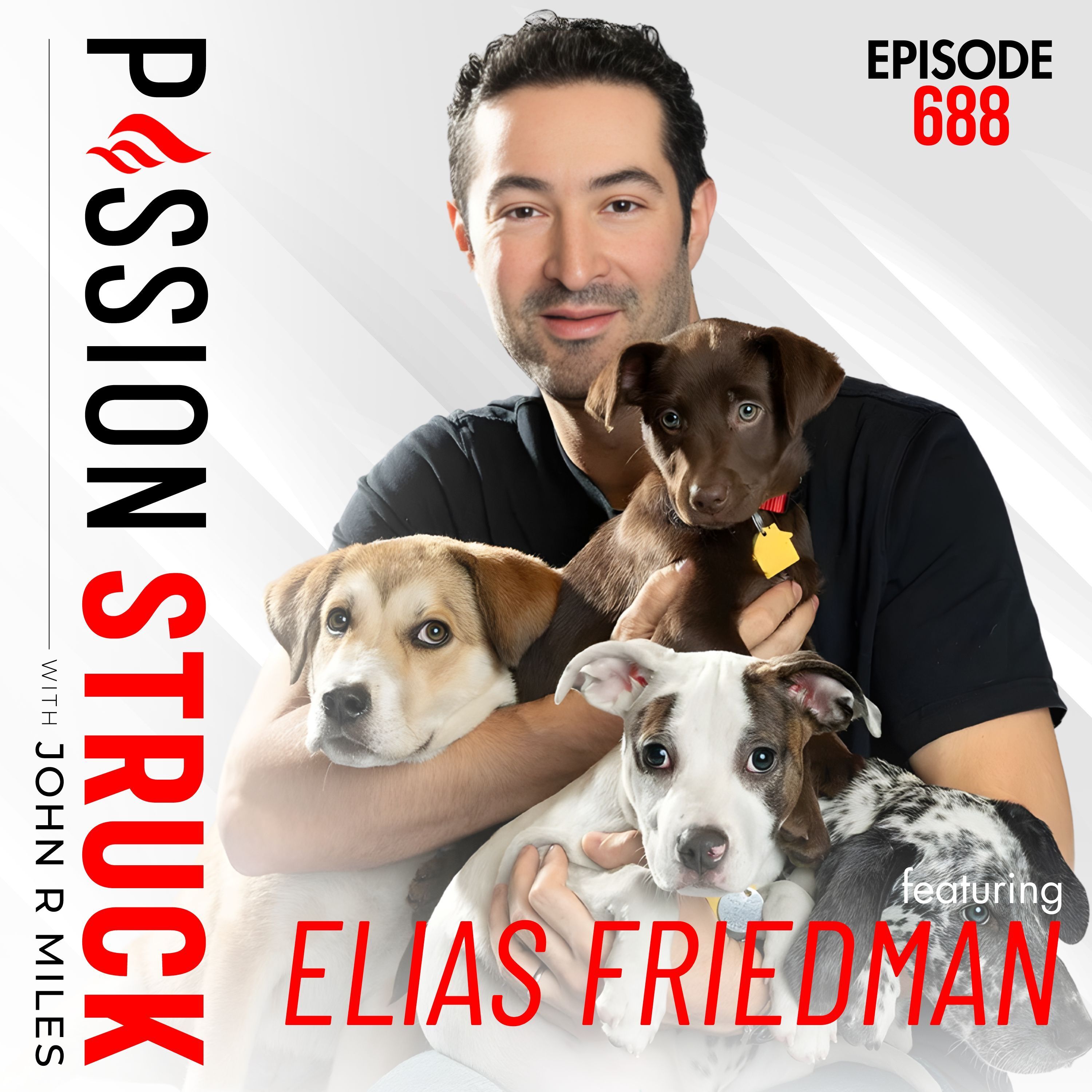
Elias Weiss Friedman (The Dogist) on How Dogs Help Us To Matter More | EP 688
In this heartwarming and insightful conversation, John R. Miles sits down with Elias Weiss Friedman, the creator behind The Dogist, the beloved photo-documentary project with over 11 million followers, and author of This Dog Will Change Your Life.
Together, they explore how dogs have become not only our best friends but also our greatest teachers: modeling presence, emotional regulation, and unconditional love. From rescuing animals in Puerto Rico to photographing 50,000 dogs around the world, Elias reveals how each encounter is a story of joy, resilience, and connection.
John and Elias also discuss why dogs are “factories of empathy,” how they help combat loneliness and trauma, and what happens when we slow down long enough to really see and be seen by them.
This episode is a celebration of light, loyalty, and the life-changing power of our four-legged companions.
Read the full show notes: https://passionstruck.com/how-dogs-help-us-remember-we-matter/↗
Listen + Watch + Go Deeper
All episode resources—including guest links, John’s books You Matter, Luma and Passion Struck, The Ignited Life Substack, and the Start Mattering store—are gathered here:
To learn more about Elias Weiss Friedman and The Dogist, visit thedogist.com.
🧠 About the Episode
- The Origin of The Dogist: How a layoff, a camera, and a love for storytelling sparked one of the most uplifting social media movements of our time.
- Dogs as Social Architects: Why walking a dog can transform neighbors into community and strangers into friends.
- The Light They Bring: How dogs embody optimism, presence, and nonjudgment—showing us what it means to live without ego.
- Healing Companions: From veterans with PTSD to overworked nurses, the science of how dogs regulate our emotions and restore hope.
- Human Invention, Canine Connection: Why breeds are a reflection of us—and what our relationship with dogs says about humanity itself.
- Rescue and Responsibility: The grit behind true rescue work and what it really takes to save a life.
- The Dog-Human Mirror: How dogs reflect who we are—and how, through them, we evolve into better versions of ourselves.
Join The Ignited Life Community
If this episode stirred something in you, The Ignited Life is where the transformation continues.
Each week, John shares behind-the-scenes insights, science-backed tools, and reflections to help you turn intention into action.
🔗 Subscribe free at TheIgnitedLife.net
Support the Movement
Everyone deserves to feel valued and important.
Show it. Wear it. Live it.
See Privacy Policy at https://art19.com/privacy and California Privacy Notice at https://art19.com/privacy#do-not-sell-my-info.
Press play and read along
Transcript
Speaker 1 Oh, triple treat, oh triple treat.
Speaker 2 How lovely are your pizzas?
Speaker 3
The triple treat box from Pizza Hut is back. Two medium pizzas, red sticks, and dessert starting in $19.99.
It comes in a festive box, and it's the only meal that holidays as hard as this song.
Speaker 1 Oh, triple treat, oh, triple treat.
Speaker 2 Heck yeah, we gonna eat some.
Speaker 3 The triple treat box, available for a limited time, only at Pizza Hut. Feed Good Times.
Speaker 4 Why choose a Sleep Number Smart Bed?
Speaker 6 Can I make my site softer?
Speaker 1 Can I make my site firmer? Can we sleep cooler?
Speaker 4
Sleep Number does that. Cools up to eight times faster and lets you choose your ideal comfort on either side.
Your sleep number setting.
Speaker 4
Enjoy a personalized comfort for better sleep night after night. It's our Black Friday sale.
Recharged this season with a bundle of cozy, soothing comfort.
Speaker 4
Now only $17.99 for our C2 mattress and base plus free premium delivery. Price is higher in Alaska and Hawaii.
Check it out at a sleep number store or sleepnumber.com today.
Speaker 1 coming up next on passion struck the dog doesn't have to ask you a question of like how are you doing just being in their presence and they have an ability to listen and sense the way you're feeling and whether it's eye contact touch warmth letting you connect with them there's just something that it has a powerful way of making you feel better and de-escalating and relieving stress.
Speaker 1 They're the best listeners and even though they don't speak to you, they know exactly what to say. And there's also a stigma around mental health.
Speaker 1
Not everyone's going to raise their hand and say, I need help. So with a dog, you don't have to raise your hand.
They just show up for you.
Speaker 8
Welcome to Passion Struck. I'm your host, John Miles.
This is the show where we explore the art of human flourishing and what it truly means to live like it matters.
Speaker 8 Each week, I sit down with change makers, creators, scientists, and everyday heroes to decode the human experience and uncover the tools that help us lead with meaning, heal what hurts, and pursue the fullest expression of who we're capable of becoming.
Speaker 8 Whether you're designing your future, developing as a leader, or seeking deeper alignment in your life, this show is your invitation to grow with purpose and act with intention.
Speaker 8 Because the secret to a life of deep purpose, connection, and impact is choosing to live like you matter.
Speaker 8 Welcome back, friends, to Passion Struck. I'm John Miles, your host, and this is episode 688 of our new series, The Irreplaceables, Rediscovering Human Worth in an Age of Acceleration.
Speaker 8 Whether you've been with us from the beginning, or you're just joining our community of intentional changemakers, welcome. You're part of a movement to live with greater purpose and connection.
Speaker 8 If this show has ever helped you take a step toward that life, here's how you can help it grow.
Speaker 8 First, share this episode with someone who needs it, and then leave a five-star rating or review on Apple Podcasts or Spotify. It's the best way to help others discover these conversations.
Speaker 8
Last week, in case you missed it, we explored two deeply human frontiers. First, with Dr.
Zach Seidler, who unpacked the crisis of male loneliness and how belonging, not toughness, saves lives.
Speaker 8
Then, with Dr. Zalana Momeni, who revealed how to own your attention in a world that steals it.
If you haven't heard those yet, they're the perfect foundation for today's conversation.
Speaker 8 Because today's episode explores one of the oldest and purest forms of connection we have. That's why I invited Elias Wise Friedman, better known as the Doggist, to join me.
Speaker 8 Elias is a world-renowned street photographer and storyteller with over 11 million followers.
Speaker 8 And his new book, This Dog Will Change Your Life, is a joyful and deeply human exploration of how dogs don't just make our lives better, they make us better people.
Speaker 8 In our conversation, we explore the origins of our ancient bond with dogs, why breeds are as much a human creation as a biological one, how dogs function as factories of empathy, and why they may hold the key to curing our modern loneliness epidemic.
Speaker 8 This conversation hit home for me. My dogs, Bentley and Luma, have been some of my greatest teachers, helping me process trauma, build daily rituals, and reawaken wonder.
Speaker 8
Before we dive in, a few quick notes. Our store, startmattering.com, is live.
It's part of the mattering revolution built on one truth. You matter, live like it.
Speaker 8 Every hoodie, tee, and hat carries that reminder. And second, if you haven't yet joined the Ignited Life, our rapidly growing Substack community, visit theignitedlife.net.
Speaker 8 Every week I share behind-the-scenes reflections, workbooks, science-backed frameworks, and practices to help you live more intentionally and connected.
Speaker 8 Now, let's dive into this heart-opening conversation with Elias Wise-Friedman, the doggist.
Speaker 8 Thank you for choosing Passionstruck and choosing me to be your host and guide on your journey to creating an intentional life. Now, let that journey begin.
Speaker 10 This podcast is supported by Neon, presenting the documentary Orwell 2 plus 2 equals 5.
Speaker 10 From Raul Peck, director of the Academy Award-nominated film, I Am Not Your Negro, comes a cinematic portrait of George Orwell, visionary writer of such literary classics as Animal Farm and 1984, made in association with the Orwell Estate, an official selection of the Cannes Film Festival, Orwell 2 plus 2 equals 5.
Speaker 10 Now available on digital.
Speaker 7 Hi, I'm William Googe, a Viewer Collaborate and professional ultra runner from the UK. I love to tackle endurance runs around the world, including a 55-day, 3,064-mile run across the US.
Speaker 7 So I know a thing or two about performance wear. My go-to daily short is the core short from Viewery.
Speaker 7 It's perfect for my daily run in the gym, strength training, or even when I'm taking a day off, relaxing, doing some stretching, and recovering the best way I can.
Speaker 7 Check them out by visiting viewery.com/slash William.
Speaker 7 That's vuori.com slash William, where new customers can receive 20% off their first order, plus enjoy free shipping in the US on orders over $75 and free returns.
Speaker 7 Excluding supply, apply, visit the website for full terms and conditions.
Speaker 11 You're tuned into Auto Intelligence, live from Auto Trader, where data, tools, and your preferences sync to make your car shopping smooth.
Speaker 5
They're searching inventory. Oh, yeah.
They find what you need. They're gonna find it.
Can make a budget for your wallet to help you succeed.
Speaker 5
Pricing's precise and true. So true.
Get smarter car shopping.
Speaker 5 Just for you.
Speaker 11 Oh, it's just for you.
Speaker 11 Find your next ride at autotrader.com. powered by auto intelligence.
Speaker 1
I am absolutely thrilled today to welcome Elias Friedman to Passion Struck. Welcome, Elias.
How are you?
Speaker 10 I'm great. How are you doing?
Speaker 1
I am doing fantastic. And I've been so excited about this interview because I absolutely love dogs.
And for those... who are tuning in you are the doggist so i thought i would start there
Speaker 1 you have grown this doggist brand on the internet to now over 11 million founders. How did this journey begin for you? My origin story, I think, would have to date back to when I was a kid.
Speaker 1 There's a picture of me in 1988 being licked by my grandmother's dog, Oreo, like on the face. And you can see a big smile on my face.
Speaker 1 Probably that was the very beginning of me really loving dogs. And since then, I developed a love for photography, and, but didn't know exactly what to do with my creative spirit.
Speaker 1 And coming from the family of two physicians, the first thought was, oh, maybe I'll be a doctor.
Speaker 1 But I moved to New York City, was working in brand strategy of an agency, was part of a layoff, and decided to dust off my camera and was inspired by Humans of New York and the sartorialist, the street photography blogs, and said, well, no one's doing this for dogs.
Speaker 1 And it seemed like a bit of a joke at the time because it's like, well, who's going to take dog photography so seriously? But I was like, I will.
Speaker 1 And so
Speaker 1
long story short, the rest is history. 11 years later, 50,000 dogs photographed.
I'm not, I'm, in retrospect, I'm not surprised people love the project, but at the time it was a little bit wild.
Speaker 1 I have to ask, do you remember the first dog you maybe photographed where you thought, this is so much bigger than a hobby. It's really my life's calling?
Speaker 1 Well, I think before I started the Doggists, I was like, I don't know, like an unveiled artist. I knew that I loved dogs, but I wasn't ready to create a whole project around it.
Speaker 1 But I was encouraged by other friends in the tech space in New York City and
Speaker 1 these sort of like aha moments, like the name The Doggists. It's like someone who dogs.
Speaker 1 And I remember photographing a Frenchie in williamsburg and he said what's this for and i said the dogist
Speaker 1 and so maybe that was one of the first moments the first picture posted to the dogist was a boxer i met in vienna it was the basis of the dogist logo
Speaker 1 but yeah i think
Speaker 1 someone this project is like every everyone's a dog photographer This is something that the world needs, right?
Speaker 1
Especially in these times of divisiveness and stress and shocking things that happen, dogs are the antidote to that. So I felt like we needed this project.
I missed having a dog.
Speaker 1 And dogs are one of the few things people want to talk about, their dogs.
Speaker 1 If I'm stopping people on the street and they're like, I don't want to talk about myself, or I don't want to talk about my kids, those are two, they're different.
Speaker 1 But when you ask about their dog, they just completely open up and they'll tell you like the most candid, sometimes embarrassing story right off the bat.
Speaker 1 And that's like a refreshing thing in today's world to just have someone like completely relax and just tell you an honest, authentic story.
Speaker 1 It does
Speaker 1
mean so much. And I'm wearing a shirt today that says I matter.
And I think. more and more of us just stay in our houses these days or our offices and we're not getting out and we're not connecting.
Speaker 1 So my whole message with this podcast is that you matter.
Speaker 1 And we just moved into a new neighborhood and we were walking the dog that we've had for a while, Bentley, we immediately encountered other people walking dogs and other neighbors.
Speaker 1 And so it really is a nice extension to your life because without Bentley, I wouldn't have met these 15 to 20 new neighbors throughout the neighborhood.
Speaker 1 Might have met my next door neighbors, but certainly wouldn't have had more invested conversations with other neighbors who who we pass along the way. They're like a force of socialization.
Speaker 1
The thing I've been saying recently is before you get a dog, you know your neighbor. And after you get a dog, you know your neighborhood.
Dogs are amazing social butterflies, right?
Speaker 1
They want to meet everyone. They want to sniff butts.
And they have to pee three times a day or more.
Speaker 1 And if you have to take them for a walk, then they will introduce you to everyone that you come across. And sometimes those connections are very meaningful.
Speaker 1 Well, dogs seem to be everywhere in our lives, like we were just talking about, but you seem to see them differently than most of us do. What do you look for when you raise the lens?
Speaker 1 It's a good question. I think I'm looking for something that stands out.
Speaker 1 I will always be a photographer, so I'm looking for something with...
Speaker 1 visual interest, whether it's a rare breed of dog, a unique looking dog, someone's crazy outfit, maybe the light is just right.
Speaker 1 Maybe it's like a scene, the dog's in a bag, dog's in a stroller, people are having brunch and the dog is by the table, something that represents something about life.
Speaker 1 And I'm, of course, I'm always interested in
Speaker 1 conveying it through the dog's perspective.
Speaker 1 So I'm always getting down to the dog's level, focusing on the dog, but always I'm interested in showing the context through which they're living their life.
Speaker 1 Yeah, people obviously who want to be have their dog on the dogist. That's one of their questions: it's like, how do you choose your subjects?
Speaker 1 And it is a bit random because I will shoot once or twice a week and we'll gather, I'll meet seven to ten dogs on each outing, but it's a little bit of a fit, I don't know, fate.
Speaker 1 Or I say every dog has its day
Speaker 1
Today, we're talking about your brand new book, This Dog Will Change Your Life. And you're already a New York Times best-selling author.
So it shows you how much these stories resonate.
Speaker 1 On Passion Struck the show, we tend to balance science and story, and your book opens up with both. Why did you go into Levi Strauss and Groucho?
Speaker 1 I think they're hilarious examples of like how we represent dogs in our culture. What was the Groucho quote inside of a dog? You can't, what was it? You can't read.
Speaker 1 I forget exactly. But
Speaker 1 yeah, I just felt like they were good representative examples of how dogs are pervasive throughout our culture and part of the fabric of our society.
Speaker 1 They absolutely are. And I thought it was interesting that you could have jumped directly into street stories and about the things that you do when you're out there photographing these dogs.
Speaker 1 But instead, you start with the question,
Speaker 1 what is a dog? Why define it first? Well, I think a lot of people think of their dog as a family member, as a best friend, and those things are true. But they are animals just like we are.
Speaker 1 And so understanding.
Speaker 1 where they come from, how they evolved, how they came to be. We created dogs.
Speaker 1 Unlike other types of pets, cats, turtles, they are less domesticated compared to dogs. We selectively bred dogs over hundreds, thousands of years to
Speaker 1
be what we want them to be. I like to think of this idea of like a wild pug.
There's no such thing as a wild pug.
Speaker 1 And so
Speaker 1 each of these dogs are a representation of us in all their forms, big, little, lap dogs, great Danes.
Speaker 1 And so understanding the origin of dogs, I think, is important to fully understanding them.
Speaker 1
I had to jump away for a second because this little one is our new addition. Her name is Luma, for those who are watching.
And she is five months old, but she's only 10 days new to us.
Speaker 1 And I have craned my lab over the years to when I'm filming, he goes into another room, sits in his bed, knows what I'm doing and doesn't say a peep. She is very distractible right now.
Speaker 1 So she is making it harder to do these interviews until I train her more.
Speaker 1 Yeah, so this is Luma? This is Luma. And what's her backstory? She's like a Chihuahua mix or? She's a Chihuahua Terrier mix.
Speaker 1 Cute.
Speaker 1 And what's her backstory? Is she from a certain part of the country?
Speaker 1 Her backstory is my wife's dog, Gibbs, passed away in January. And she lived long life, 16 years.
Speaker 1
And we were looking for a new addition to the family, keep Bentley more alive and alert as he gets older. Along with us.
So
Speaker 1 we.
Speaker 1 were struggling to find a new dog and my wife learned about this group that was having a big event because they found a person who was hoarding dogs and they had over 40 different dogs on their property.
Speaker 1 And she happened to be one of two or three litters that they discovered on the property. And when we went to the event, she came right up to all of us and we just couldn't get her out of her mind.
Speaker 1 Luckily, we were able to get her and the rest is history. Yeah, she crawled into your heart and wouldn't leave.
Speaker 1 That's how it can happen.
Speaker 1
But man, it's been a long time since I've had a puppy. So it's a little bit getting used to training them again.
Of course.
Speaker 1
It's a fun phase. I rescued my dog, Elsa, when she was basically an adult or about one years old.
So I didn't get to do the puppy phase with Elsa.
Speaker 1 And part of me wishes I could have, but also I know puppies are a lot of work.
Speaker 1
That is true. So we're still trying to potty train her.
Of course.
Speaker 1
Well, one of the things you write about in the book is you say that dogs are almost all about light. And that that really struck me.
What does that mean to you?
Speaker 1 I think dogs have an innate positivity about them.
Speaker 1 I spoke with someone recently who takes care of a dog
Speaker 1 whose hind legs don't work and has wheels to get around. And she said that dogs don't have this thought that we do of what if I fail.
Speaker 1 Dogs,
Speaker 1
they just look towards towards the future. They live in the present moment.
They don't dwell on the past and what their shortcomings are. And they just say,
Speaker 1 How do I do this?
Speaker 1 Let's do this.
Speaker 1 Even if it's just getting a treat from across the room,
Speaker 1 they're not thinking, Oh, woe is me. If only I were X, Y, Z, if only
Speaker 1 I were different.
Speaker 1 They just
Speaker 1 focus on the now. And so I think
Speaker 1 through that virtue and being around dogs, they live as
Speaker 1 this light, as you're saying, this source of motivation, of encouragement.
Speaker 1
Dogs aren't judgmental of themselves. They're not judgmental of others.
They don't care about what you look like, what kind of car you drive.
Speaker 1 They lead with trust.
Speaker 1
They don't lead with doubt. And so, as humans, people with, we have an ego we have to struggle with, and and we are often at odds with one another.
And
Speaker 1 for whatever reason, those things exist, I think they don't always serve us. And
Speaker 1 by being around dogs, by seeing the way that they behave, even without spoken language, we become more like them. And I think
Speaker 1 that is a good thing.
Speaker 1 I completely agree with you. I know one of the things with Bentley, when he looks at me, sometimes I feel like he's peering into my soul.
Speaker 1 And it's crazy how much you can just feel how much they love you, how much they care for you, which is something you often don't get from the human experience. Yeah.
Speaker 1 And when you say peering into your soul, it's like a lot of it comes down to direct eye contact. Like
Speaker 1 your average day, you can probably, even with the people closest to you, the amount of like direct eye contact you have gets less and less every day.
Speaker 1 You have five seconds with a barista, you have 30 seconds with your wife, whereas dogs are incredibly generous with their eye contact. You come home, they stare into your soul, like you're saying.
Speaker 1 And I think as humans, we crave that and we're missing that more and more.
Speaker 1 The ability as we work remotely, as we're on a podcast over a Zoom channel, and this counts for something, but it's not quite the same as being in in the same, be right next to someone.
Speaker 1 And a dog, the way a dog looks at you is just,
Speaker 1
we don't get that much anymore. And so it's important.
They remind us that we matter, like your shirt says.
Speaker 1 And
Speaker 1 that feeling of love that we get through eye contact is priceless. That reminds me of something that you wrote about in the book.
Speaker 1 You suggest that there's no dogs without humans, but I think it's maybe no humanity without dogs. I do think they bring out the best in humans.
Speaker 1 And yeah, just like when you walk around the street with your dog, you're talking about meeting new people.
Speaker 1 You probably wouldn't have met them otherwise. Who knows if your ideologies align, like whether you would have struck up a conversation with this person otherwise? The dogs don't ask these questions.
Speaker 1 They just have a magnetism, a gravity about everything they do in attracting other people, in attracting
Speaker 1
love, connection. I think we take it for granted.
It's something that we've gotten used to living with a dog.
Speaker 1 But my goal with this book and really the whole Doggus project, everything I'm doing is to deepen our appreciation for dogs and help them live better lives and hopefully save a number, as many as possible, from living life in a shelter.
Speaker 8 I hope you're enjoying my conversation with Elias Friedman. We'll be right back after a short break.
Speaker 12 November is all about gathering, friends giving feasts, Thanksgiving dinners, and football weekends.
Speaker 12 Total Wine and More has everything you need for your table and your toast with thousands of wines, spirits, and beers at the lowest prices.
Speaker 12 From bold reds to sparklers, you'll find the perfect wines to raise a glass this season.
Speaker 12 And when it comes to spirits, Total Wine has you covered from smooth bourbons and tequilas to all the essentials for your holiday cocktails. Hosting Thanksgiving?
Speaker 12 Total Wine's guides make it easy by taking out the guesswork. With the lowest prices for over 30 years, you'll always find what you love and love what you find only at Total Wine and more.
Speaker 12
Curbside pickup and delivery available in most areas. See TotalWine.com for details.
Spirits not sold in Virginia and North Carolina. Drink responsibly.
B21.
Speaker 9 What if I told you there was yet another tool where you could get surface-level data insights in static, uninformative dashboards?
Speaker 9 There are 170 of these products, and luckily for you, we're not one of them.
Speaker 9 Hex is a new platform for working with data. We combine deep analysis, self-serve, and trusted context in one platform with purpose-built AI tools for data work.
Speaker 9 Over 1,500 teams like RAMP, Lovable, and Anthropic use Hex.
Speaker 9 Learn why at hex.ai.
Speaker 8
Thank you for supporting those who support the show. You're listening to Passion Struck on the Passion Struck Network.
Now, back to my conversation with Elias Friedman.
Speaker 1
That's why we always tend to rescue our dogs. My other dog, Bentley, came from Alabama originally, and he had a sister.
And that sister was really mean to him in many ways.
Speaker 1 But the parents, for whatever reason, before I had them, moved to a place, not sure why people do this, where they wouldn't allow them to have big dogs like a lab.
Speaker 1
And so they gave them to a shelter, which became a kill shelter. And so we were able to find Bentley from a lab rescue organization and a great foster mom.
But it does really sometimes make me think
Speaker 1 as much love as dogs bring to you, how sometimes we treat them in the exact opposite way that they show the love to us that so many of us feel who love them.
Speaker 1 Yeah, it's a dark part of reality and being a human is
Speaker 1 abandoning
Speaker 1 things that we once cared about. Or
Speaker 1 I remember being in Texas, arriving at their municipal shelter, a city shelter, and
Speaker 1
I got there at 9 a.m. and there's already a line of people waiting to relinquish their dogs, to surrender them for whatever reason.
And of course, your instinct is to judge them.
Speaker 1 And I guess you can, but people may be struggling financially, health-wise.
Speaker 1 It's just an unfortunate thing. And in places where there's overpopulation around the country, especially in the South, they unfortunately have to do
Speaker 1 based euthanasia, which is unfortunate. And a lot of it has to do with overbreeding.
Speaker 1 And we don't have to get into all the details of that, but I just think it's a noble thing if you're interested in getting a dog to at least consider getting one from a shelter because dogs aren't meant to languish in small cages and be not social.
Speaker 1
They belong with their people in a family. Even going to a shelter and to seeing it for yourself, I think is a meaningful.
thing to do as someone who loves dogs.
Speaker 1 It is so sad to go to those facilities where where they're trying to breed purebreds and you see the dogs in all the cages and they just look miserable.
Speaker 1 And this is something that you bring up in the book, 16 Basil Breeds, and you call breeds human inventions. Why is this important for the listeners to understand
Speaker 1 about this breeding and making sense of modern dogs and what comes about with the responsibilities we have of breeding these human inventions.
Speaker 1 I think to make a distinction, not the practice of breeding a, responsibly breeding a dog that you care about, for example, like dog shows, for example, there is a best practice, and these
Speaker 1 people
Speaker 1 are not responsible for the overpopulation in shelters.
Speaker 1
They're not making money out of this. They're barely breaking even.
They are breeding a a breed they love to keep it alive, a legacy, whether it's a hunting dog, a
Speaker 1 it's the very 100 to 200 purebred
Speaker 1 breeds out there are interesting and I think
Speaker 1
worth preserving. It's a fascinating thing.
The issue comes when you have someone who's trying to make money off of a trend of a breed's popularity.
Speaker 1 Like a celebrity gets a dog and then everyone wants one of those. It's just impulsive, fashion-y phenomenon.
Speaker 1 And the hallmarks of a puppy male, if you will, is the ability to get a dog next weekend quickly with a credit card without any sort of
Speaker 1 the breeder looking into your background or interviewing you at all and without any accountability as if the breeder is not keeping up with you. Those are the dogs that can end up in a shelter.
Speaker 1 And so I just want to make that distinction off the bat is that if you decide that you really really want a specific breed,
Speaker 1 you need to make sure to do a lot of research and find a breeder that is doing it with love and a care for preserving their breed, not to make money. And
Speaker 1 it should take a year. It should take at least six months for you to get a dog, if that's the path you want to go down.
Speaker 1
But yeah, in terms of the basal breed, so there's, I don't know how many, whether or 16 or 11. 16.
Yeah. 16, Yeah.
So there's basically the first dogs that were, that we created, the first breeds.
Speaker 1 And it's like the chow.
Speaker 1 Is it the Shiba Inu? A lot of them were Asian, started in Asia.
Speaker 1 The Canan dog in,
Speaker 1 I guess, Africa. And
Speaker 1 that's just what all of our dogs today have a bit of in them. If you do any of these DNA tests, you'll see there's always a sliver of chow
Speaker 1 in every dog. And so it's just interesting history lesson if you look at the breed that they all started with a
Speaker 1 select few.
Speaker 1 Well, one of the things that you just mentioned was dog shows, and you've been shooting Westminster, as I understand it, for a decade. What do you think dog shows
Speaker 1 reveal about us, not just the dogs?
Speaker 1 I think they're of the variety of types of dogs they are in the most, these are called confirmation shows, as meaning that the dogs, there's a very specific description of what each breed should be, quote, should be.
Speaker 1 And so the dogs that conform to that the most are should be the ones that win. So you have Bloodhounds, you have Irish Setters, you have Newfoundlands, you have poodles, pugs, shizzo's, Bichons.
Speaker 1 The list goes on and on. And so each of the, what they call them, fanciers, dog fanciers,
Speaker 1 have chosen a breed that they love and have dedicated their life to
Speaker 1 showing them in this elite level, Westminster Dog Show, Crufts in England, and the National Dog Show in Pennsylvania, to try and preserve their breed and to create the epitome of what these breed standards are.
Speaker 1 And
Speaker 1 a lot of them will also, a lot of the corgis that show up are actually working dogs. They're right off the farm chasing cattle one day and then walking around a show ring the next.
Speaker 1 And so it's a very niche kind of, the whole thing is a bit wild. Like for anyone who's seen the movie Best in the Show,
Speaker 1 I remember I asked one of the handlers and mentioned that to him, and he was like, Oh, the documentary?
Speaker 1
And I was like, No, no, no, that's like a mockumentary. So now that's a documentary.
Like the sort of stereotypes that are portrayed in there have some truth to them.
Speaker 1 There's each breed has its own sort of like variety of people: poodle people, pug people,
Speaker 1 shizu people.
Speaker 1 It's just like an interesting expression of our diversity and humanity. And the dogs there are a representation of of that.
Speaker 1 Yeah. Well, speaking of people and their dogs, I want to talk about doppelgangers.
Speaker 1 There is so much truth that you walk around and it does seem oftentimes like people look like their dogs. What do you think that says about identity or belonging?
Speaker 1 I think we want to express a love towards our dogs and doing that in a visual way is one way of doing that.
Speaker 1 I often think some people obviously will choose a breed with an aesthetic, meet a dog that matches their aesthetic, whether it's maybe their hair or the way they think of themselves or interesting markings on them.
Speaker 1 And so it can often start with a dog, but then sometimes it starts with a dog and then the person starts to dress like the dog.
Speaker 1
So it's funny, like Elsa is like all white with a little caramel toasting on the top. And so when my wife, Sam, comes out, she's dressed in all white.
I was like, oh, this is awkward.
Speaker 1 Like, you guys are both wearing the same thing.
Speaker 1 So I think it can go both ways, whether it starts with the person looking for
Speaker 1 aspects of themselves in a dog, or
Speaker 1 the
Speaker 1
person starts to mirror their dog. And I think it's great.
Like, why not? When I'm walking around
Speaker 1 and I see that
Speaker 1 like juxtaposition of a person that matches their dog,
Speaker 1 it's like fascinating. And I think it's a beautiful expression.
Speaker 1 Yeah, I have to say, when people meet Bentley, who I've been walking around for a lot longer now, I'm never sure if they're reading the dogs or me. And it's
Speaker 1 a funny thing because I think Bentley does pick up a lot of my personality.
Speaker 1 I think he's introspective,
Speaker 1
but really caring. He gets along with everyone, humans and dogs.
Nothing seems to faze him. And it is so interesting how our dogs do resemble us.
Speaker 1 Not sure yet who Luma represents and not sure her personality will evolve over the next two to three months. Well, I like to think that everyone finds their dog, whether it's cosmic forces
Speaker 1 or luck, we end up with dogs that are like us in some way, and we become more like each other.
Speaker 1 Your dog sees your behavior, your energy, you see your dog's energy, and you end up evolving in some way to the next version of yourself.
Speaker 1 And mostly, you think, in a very positive way.
Speaker 1 Absolutely. I did want to go back to the rescues for a second, because one of the things that you wrote about was Chrissy Beckles and the Sato project, and I wanted to highlight that.
Speaker 1 What does her grit teach us about what real rescue requires?
Speaker 1 I think a lot of people view rescue or volunteering for a rescue as like holding puppies or getting to foster a puppy. But the reality is that you got to get your hands dirty.
Speaker 1 Like I remember Chrissy was doing a transport at an airport. Dogs were coming off of a plane and someone asked, like, how can I help? I really want to help out for the next transport.
Speaker 1 And she's like, oh, well, you can start by cleaning the crap out of these cages, like puppy poop.
Speaker 1 And the look on her face was like, you could see that was not what the answer she was expecting. And so the great you're talking about is getting her hands dirty.
Speaker 1
None of the actual dog rescue is glamorous. The reality is that in my trip down to Puerto Rico spending time with Chrissy, we got into a jeep.
We go to a beach
Speaker 1 that is unfortunately nicknamed Dead Dog Beach because it's the place people go in shame to drop their dogs off and drive back home and try and forget about them.
Speaker 1 We go to this beach and there's dogs living in a bush, often emaciated, covered in ticks and other maladies, other illnesses they might have, mange.
Speaker 1 And her job is to, and mind you, Chrissy is like allergic to dogs, of course. And her job is to lure these dogs who are maybe afraid of humans with food.
Speaker 1
She basically puts food out and to try and get these puppies off of the beach and into a better life. And so not everyone can do that.
And that's not how people,
Speaker 1 by the time the dog is transported to New York City and is on a, is in a adoption van in Columbus Circle and is then adopted by a
Speaker 1 well-off family and it's going to live a nice life in its brownstone in Brooklyn. That is the goal, but it didn't start that way.
Speaker 1 It's not the way these dogs live started.
Speaker 1 And so just having an appreciation for all the work it takes to rescue these dogs, often from the brink of death, a lot of these dogs literally, and I've seen the worst of it and the unfortunate reality of having to, dogs not make it.
Speaker 1 And so
Speaker 1 someone's got to do this work. And it's almost always these like badass women often who have tattoos and Chrissy the boxer.
Speaker 1 That was the first time I met her was seeing her box in a ring. There's just something like, you need, like you're saying, there's this grit about them.
Speaker 1
Well, I want to talk a little bit about relationships. And in the book, you write, a dog can bring people into contact.
It can bring people into conversation, but a dog can also bring people together.
Speaker 1 And when you say that, you mean together into sustained, romantic relationships.
Speaker 1 Can you maybe share a story from your time out as the dogist where you've encountered couples who met because of their dogs or through their dogs?
Speaker 1 I think I'm not sure if there's like some of the Hollywood version of, oh, well, my dog's leash got entwined with your dog's leash.
Speaker 1 And that's where I think the times that I'm thinking of are when I like help people get engaged, for example.
Speaker 1 Like, I remember this guy reached out and said, I'm going to propose to my girlfriend and she's such a fan of the doggist. And I don't know if the dog's name was, was i love let's say miles
Speaker 1 we love this our dog so much and we i want him to help could you photograph miles and we're gonna have a sign on his neck saying will you marry my roommate will you marry me and so
Speaker 1 helping this guy posting on the dogist at a specific time and then
Speaker 1 her seeing it and saying yes and people love these stories because people love romance and love, but it's just
Speaker 1
the fact that dogs can help with that and are so entwined in our lives. And it makes that moment so meaningful.
And it's, of course, it's like
Speaker 1 when I proposed to my wife, Sam,
Speaker 1 Elsa had to be there, my dog.
Speaker 1
It was a beach in Malibu, and Elsa was running around. And I wouldn't have it any other way.
Dogs are part of our story. And if we're lucky enough to find our human person, then our dog is just,
Speaker 1 we have to give them a lot of credit because they
Speaker 1 activate our hearts and they open another chamber of our heart, which we may not have known is there.
Speaker 1 And I would say that's true about my life is after I got Elsa, that was when Sam and I, Elsa basically catalyzed our relationship.
Speaker 1 We had known each other for a bit and dated a little, but Elsa made me realize who I wanted to be with and that I was capable and capable of having more love to give and deserve to be loved more.
Speaker 1 Well, you and Sam actually met in high school, if I have that.
Speaker 1
Yes. That's correct.
Yeah. She was one of my sister's good friends.
Speaker 1 Yeah, interesting how life brings people like who we're supposed to be back into our lives like that. And so interesting that Elsa had a big part in that story.
Speaker 1 It's not, I guess, uncommon for you to end up with someone that you have known for a while or grew up with. But of course,
Speaker 1 I feel like the dog aspect, Elsa, if it weren't for her, then I don't think we would be together necessarily. Who knows?
Speaker 1 So I wanted to talk about another area. One of the biggest things that Bentley has helped me with, and he is a service dog, is he's helped me regulate my experience with trauma.
Speaker 1 I know for a lot of veterans who have dogs and other people who've experienced trauma, dogs can be a huge influence in helping you regulate PTSD and other things that have happened.
Speaker 1 What patterns do you see in dogs as potentially co-regulators and helping people who experience anxiety or mental health issues? Yeah, I think this is like a fascinating aspect of.
Speaker 1 I've done a lot of series with working service dog organizations for veterans with PTSD, various types of PTSD.
Speaker 1 And it's just incredible the power that these dogs have that no other medication therapy can really match.
Speaker 1 And this is something that I've been trying to understand. Even yesterday, I was at a Temple University hospital with an organization called Crisis Response Canines, and they basically go into
Speaker 1 settings. where a disaster or tragedy has happened, a shooting, a natural disaster.
Speaker 1 And this was a hospital where they are going to visit nurses who experience something traumatic 10 times a day because they're in an emergency room.
Speaker 1 And
Speaker 1 there's just this unique ability for
Speaker 1 them to interact with a dog. And the dog doesn't have to ask you a question of like, how are you doing?
Speaker 1 Just being in their presence.
Speaker 1 and
Speaker 1 they have an ability to listen and sense the way you're feeling. And
Speaker 1 whether it's eye contact, touch,
Speaker 1 warmth, letting you connect with them. There's just something that
Speaker 1
has a powerful way of making you feel better and de-escalating and relieving stress. They're the best listeners.
And even though they don't speak to you, they know exactly what to say.
Speaker 1 And
Speaker 1 there's also a stigma around mental health. Not everyone's going to raise their hand and say, I need help.
Speaker 1
So with a dog, you don't have to raise your hand. They just show up for you.
And whether you are aware of the fact that you are feeling down
Speaker 1 or feeling like a trauma is having a grip on you,
Speaker 1 you
Speaker 1
feel the dogs just make you feel better. And yeah, it's a unique thing.
It's something that I think about a lot.
Speaker 1 There's this, I met with a veteran a couple of years ago that was in the Marine Corps, and he was talking about how his dog, he said he wouldn't be around here if it wouldn't be around if it weren't for his dog.
Speaker 1
And I had heard that before. I wasn't sure what he really meant.
And he was talking about how, how many more veterans commit suicide every day?
Speaker 1 and how many more of them would still be around if they've had dogs.
Speaker 1 And that's like a statistic that's theoretical that i remember leaving towards the end of this my time that day speaking with his wife and just asking her like has he ever talked to you about any of his experiences serving and she said no he's never talked to me about anything i knew nothing about his experience
Speaker 1 and that just was like shows you that dogs his dog was there for him and his dog listens his dog is the one that hears his stories and saved his life literally, because dogs can be there for in ways that people can't, even if you want them to be.
Speaker 1 But he felt like he didn't want to burden his wife with things that he suffers with.
Speaker 1 And so it's like, how do you quantify that? It's a really important topic. A couple of years ago, I had a Naval Academy classmate of mine, Chuck Smith, on the show.
Speaker 1 And Chuck did this TED talk that went viral about veteran suicide.
Speaker 1 And if you know anything about the TED organization, before you come on to speak, they do a ton of validation work, making sure that whatever you're going to put on the stage is accurate. And
Speaker 1 when you think about the war on terror, the war itself resulted in somewhere around 5,000 fatalities.
Speaker 1 But when you look at the suicides during that same period of veterans who took their lives outside of conflict, the numbers are staggering. It's like 145,000.
Speaker 1 If you just
Speaker 1 take that example you just gave, how many of those lives could have been saved if they might have had a dog companion in their life who gave them the vehicle of comfort that they couldn't find elsewhere.
Speaker 1
So I just bring that up because I think it's important. Yeah.
Yeah. And a lot of veterans think that they don't deserve one or someone else deserves it more than them.
Speaker 1
That's just built into the mentality of serving and being an officer. And you think that your job is to help others.
I don't need help.
Speaker 1 But people are human. They're not robots, right? And it's hard to go back to a civilian life and
Speaker 1 live the rest of your life out after
Speaker 1 seeing so much and experiencing these traumas.
Speaker 1 And part of the work, part of what I wanted to encourage in showing these stories is to hopefully help some people who are struggling to feel comfortable and like they deserve to have a dog.
Speaker 1 I want to bring this back to something lighter for a moment. Yes.
Speaker 1 You have interviewed, or I shouldn't say interviewed, you've done photographs with thousands of strangers, but also some well-recognized people like Naomi Watts and Chris Rock.
Speaker 1
But I wanted to focus in on one in particular. My aunt Pat grew up with Bill Murray.
She went to elementary school with them, starting in kindergarten.
Speaker 1 And in fact, he sometimes comes back to his grade school reunions, believe it or not. Of course.
Speaker 1 One time, she was an attorney during her career. And one time she left the office and she was walking down the street.
Speaker 1 And you can imagine you're in Chicago when all of a sudden someone grabs you from behind and starts twirling you around.
Speaker 1 Well, it happened to be Bill Murray, which she hadn't seen in over a decade at that point.
Speaker 1 But I have a friend who lives in Charleston who tells me Bill shows up unexpectedly at different events from time to time. What was it like shooting a whip Bill? Do you remember anything from it?
Speaker 1
I mean, yeah, it was unreally. I grew up watching Caddyshack.
I was starstruck myself.
Speaker 1
And he's the ultimate character. Everything you say, he's like cracking like like the perfect joke.
And
Speaker 1
he's a dog lover as well. No surprise.
He's had dogs over the years.
Speaker 1
And he had been doing this press junket for the movie Friends all day. He was doing interviews.
And so he was probably a bit tired. But I remember he came out.
We had about 20 minutes to shoot this.
Speaker 1
He was going to help me find dogs on the street. And I could just see when we described what we were doing, you're going to help us find dogs.
He's like, really? This is great. I love this concept.
Speaker 1 And so he lit up and Naomi lit up. And every dog that we met, you could see his curiosity and his excitement peaked.
Speaker 1 And that was awesome to see someone who has had so much experience doing all types of things, an incredible life he's led, to see him have this childlike curiosity.
Speaker 1 And I was so glad that I could show him what it's like to be the dogist, to live my life. And through the rest of the week, he would was going on interview shows he was on howard stern
Speaker 1 talking about his movie promoting that but he kept bringing up the dog he kept bringing up the dogist
Speaker 1 he's to howard have you heard of the doggist
Speaker 1 and he's like no i haven't oh it's this guy he walks around with cameras and he says may take a photo of your dog and so
Speaker 1 even this 20 minute half an hour experience stuck with him and
Speaker 1 that is really a testament to ultimately the power of dogs to change our lives, to make us appreciate everyone more.
Speaker 1 You can watch this video. It's still pinned to my Instagram, but just hearing the way people talk about their dogs, you could tell Bill sensed that this was something meaningful and it moved him.
Speaker 1 And that is my goal in general, not just to move people who are like Bill Murray and extremely famous, but everyone who
Speaker 1 loves dogs and wants to feel more connected to them.
Speaker 1 I'm glad you shared that because as we mentioned at the beginning, you've built a 11 million person community. And when I think about that, it's reach and responsibility.
Speaker 1 And I'm sure Bill Murray on that show helped increase that reach.
Speaker 1 Platforms keep shifting, technology keeps shifting. How do you adapt without losing the core mission and what's at the heart of it, which you just described?
Speaker 1 I think I consider myself to be an artist. I started as a photographer, slowly evolved into,
Speaker 1 through writing about dogs in short form, to now being an author and having published my first written narrative book.
Speaker 1 And every day on...
Speaker 1
the various platforms, Instagram, TikTok, you have to evolve your art. And so it's become much more video-based.
You're competing to get the algorithm decides
Speaker 1 how much of your audience gets to see your work at this point.
Speaker 1 So there's a lot of forces at play.
Speaker 1 And it's part of the challenge to keep up with it. Instead of complaining about it or being stagnant, you have to just
Speaker 1 keep changing and realizing that these tools can help spread your message even more. And so if my goal is to be a canine evangelist, a voice for dogs to help
Speaker 1 people deepen their appreciation for not just their dogs, but dogs in general.
Speaker 1 Just
Speaker 1 keeping up with, if my platforms are social media and, of course, books, and just being out. in person, doing my best to keep up with it.
Speaker 1 And I also have various people that I work with who make it all possible as well. If I'm the captain of the ship, you know,
Speaker 1 need support.
Speaker 1
Elias, I have one final question for you. Passion Struck is about mattering and intentional living, and dogs model both.
If every listener today changed one behavior with their dog, what should it be?
Speaker 1 I think from your perspective, it would be to sit with them on the couch and give them some time,
Speaker 1 dedicated time without your phone
Speaker 1 and just feel what it's like to be present with your dog because that's how they experience life is in the present moment.
Speaker 1 And for your dog's sake, when you're out on your next walk, let them sniff a little longer
Speaker 1 at something that they find interesting. The way I think of it is if you pull your dog away from a good scent, it's like taking a good book out of their hands.
Speaker 1 This is the the way the dogs experience the world through scents. For your sake, take a pause and be present with your dog for a few minutes every day.
Speaker 1 And for your dog's sake, let them sniff that thing a little longer.
Speaker 1 And Elias, people want to learn more about you. Where's the best place for them to do in the book and your social presence? Well, the book is This Dog Will Change Your Life.
Speaker 1 It's available online in every local bookstore, hopefully, at least a few copies, and online on social media at The Dogist. That's the D-O-G-I-S-T.
Speaker 1
Yeah, that's where to find me. Well, Elias, thank you so much for joining us.
I love to talk about dogs. So this was a real pleasure for me.
Likewise, you're a dog guy, so you get it.
Speaker 8
That's a wrap on today's conversation with Elias Friedman. What I love about this dialogue is that it reminds us that empathy isn't taught.
It's mirrored. Dogs don't care what you do, own, or achieve.
Speaker 8
They care that you show up. So here are three takeaways to carry forward with you this week.
The smallest creature can awaken the deepest humanity.
Speaker 8
Second, connection begins when we slow down enough to notice. And love, in its purest form, asks for nothing but presence.
If this episode moved you, help us keep growing the movement.
Speaker 8 Leave a five-star rating and review on Apple Podcast or Spotify. It helps new listeners find the show.
Speaker 8 Share it with someone who loves a dog or needs a reminder reminder to reconnect with what matters most.
Speaker 8 And subscribe to our YouTube channel for full video episodes, highlights, and exclusive behind-the-scene moments.
Speaker 8 You can also find extended reflections and key takeaways at theignitedlife.net, our community hub built to help you live a life with more intention and meaning.
Speaker 8 Next week, we continue our series, The Irreplaceables, with Amina Altai, a powerhouse executive coach helping high performers redefine success around wholeness and authenticity.
Speaker 6 Last year, as I was finishing up the book, I was working seven days a week. And now that I had a big burst of energy on the book tour, that finished a bit of a slowdown period.
Speaker 6
So I've been working like three days a week for this. And that to me feels right.
I'm recouping my energy. I talk about how ambition goes in cycles.
Speaker 6 You have these peaks in the sun, and then you have these moments where you go back underground to recuperate. And I'm in an underground moment.
Speaker 6 And last year, when I was working seven days a week, nobody asked, Are you okay?
Speaker 6 This year, when I'm working three days a week, people are like, Are you okay?
Speaker 6 Yeah, I'm great. But we're so indoctrinated to believe that going 90 miles an hour all the time is the way that when somebody slows down to take care of themselves, we think that's the problem.
Speaker 6 And so it's just so insidious and it's so pervasive that I feel like we have to question everything.
Speaker 6 I think the biggest lie is that the more you work, the more valuable you are.
Speaker 8 Until then, be where your feet are, lead with empathy, and as always, live life passion-struck.