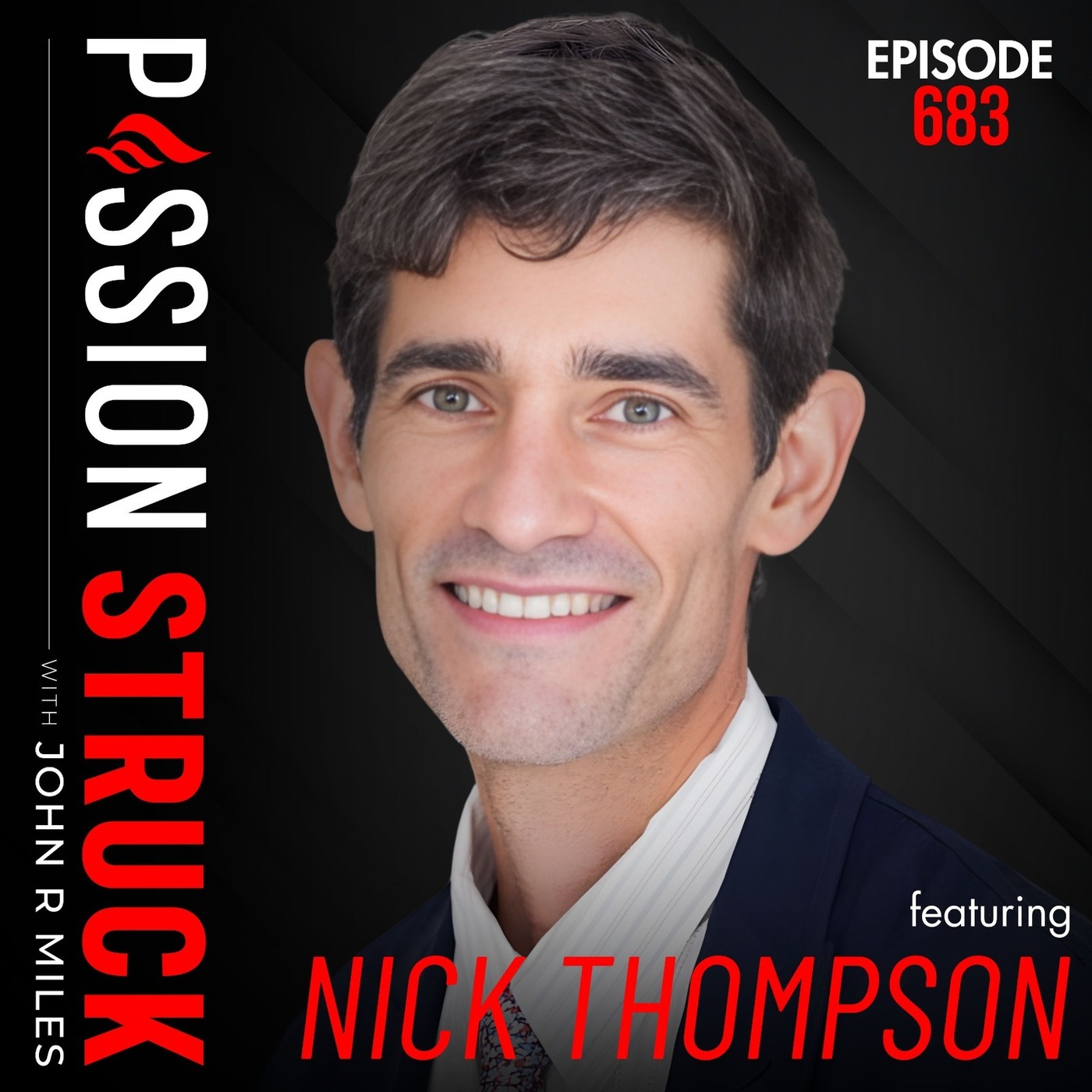
Nick Thompson on Grit, Growth, and the Miles That Matter | EP 683
In this powerful conversation, John R. Miles sits down with Nick Thompson, CEO of The Atlantic and author of The Running Ground: A Father, a Son, and the Simplest Sport. Together, they explore how running became a thread through Nick’s life—a tool for resilience, self-discipline, and understanding his father’s complex legacy.
From the early memories of running beside his dad during the American running boom to surviving thyroid cancer and breaking the three-hour marathon barrier, Nick shares how the sport has shaped his mind as much as his body. The discussion expands far beyond the track—touching on fatherhood, AI and authenticity, the psychology of limits, and how pain can be both teacher and truth-teller.
This episode is a reminder that sometimes the hardest miles—whether in life or on the road—are the ones that teach us who we really are.
👉 Read the full show notes: https://passionstruck.com/nick-thompson-the-miles-that-make-us-who-we-are/
🎧 Listen + Watch + Go Deeper
All episode resources—including guest links, my books You Matter, Luma, and Passion Struck, The Ignited Life Substack, and the Start Mattering store—are gathered here:
To learn more about Nick Thompson, visit nickthompson.com
Fuel your body with purpose
Get 20% OFF BUBS Naturals Collagen — clean, NSF Certified, and veteran-founded.
Use code PASSIONSTRUCK at bubsnaturals.com
After checkout, tell them our show sent you!
Feel younger, sharper, and stronger — from the inside out
Get 20% OFF Mitopure Gummies from Timeline, powered by clinically proven Urolithin A.
Head to timeline.com/passionstruck
Your cells will thank you.
🧠 About the Episode
- Running as Identity: How movement connects memory, focus, and meaning.
- Breaking Mental Ceilings: The invisible limits that look like data but are really belief.
- Discipline and Flow: What marathons teach us about self-trust and persistence.
- Fatherhood and Legacy: How Nick’s turbulent relationship with his father shaped his resilience.
- Authenticity in the Age of AI: Why real voices matter in writing and leadership.
- Pain as Information: Learning to differentiate discomfort from danger.
Join The Ignited Life Community
If this episode stirred something in you, The Ignited Life is where the transformation continues.
Each week, I share behind-the-scenes insights, science-backed tools, and reflections to help you turn intention into action.
🔗 Subscribe free at TheIgnitedLife.net
Support the Movement
Everyone deserves to feel valued and important. Show it. Wear it. Live it.
Visit StartMattering.com
See Privacy Policy at https://art19.com/privacy and California Privacy Notice at https://art19.com/privacy#do-not-sell-my-info.
Press play and read along
Transcript
Speaker 1 Shopify is a global commerce platform that helps you sell at every stage of your business and sell more with less effort thanks to the Shopify magic, your AI-powered all-star.
Speaker 1
Sign up for a $1 per month trial period at shopify.com/slash red circle. All lowercase.
Go to shopify.com slash red circle now to grow your business no matter what stage you're in.
Speaker 1 Shopify.com/slash red circle.
Speaker 2 Why choose a sleep number smart bed?
Speaker 1 Can I make my site softer?
Speaker 2
Can I make my site firmer? Can we sleep cooler? Sleep number does that. Cools up to eight times faster and lets you choose your ideal comfort on either side.
Your sleep number setting.
Speaker 2
Enjoy a personalized comfort for better sleep night after night. It's our Black Friday sale.
Recharged this season with a bundle of cozy, soothing comfort.
Speaker 2
Now only $17.99 for our C2 mattress and base plus free premium delivery. Price is higher in Alaska and Hawaii.
Check it out at a sleep number store or sleepnumber.com today.
Speaker 2 Coming up next on Passion Struck. The other thing that's really important is this principle called cognitive offloading.
Speaker 2 And so that's the principle whereby once you start to rely on a tool, a technological tool to do something, you get worse at it, right?
Speaker 2
So you use a calculator all the time, you forget how to do long division. You use waves, you forget how to navigate.
That's fine. Who cares?
Speaker 2
It's better to have a calculator do long division than we do long division. But when it comes to thinking and writing, I don't want to get worse at it.
So I don't want to rely on an AI for it.
Speaker 4
Welcome to Passion Struck. I'm your host, John Miles.
This is the show where we explore the art of human flourishing and what it truly means to live like it matters.
Speaker 4 Each week, I sit down with change makers, creators, scientists, and everyday heroes to decode the human experience and uncover the tools that help us lead with meaning, heal what hurts, and pursue the fullest expression of who we're capable of becoming.
Speaker 4 Whether you're designing your future, developing as a leader, or seeking deeper alignment in your life, this show is your invitation to grow with purpose and act with intention.
Speaker 4 Because the secret to a life of deep purpose, connection, and impact is choosing to live like you matter.
Speaker 4 Welcome back to Passion Struck episode 683. I'm your host, John Miles, and I am so grateful you're here.
Speaker 4 Whether you're a longtime listener or joining for the first time, thank you for being part of this growing movement to live more intentionally and unlock the power of mattering.
Speaker 4 If this show has ever given you clarity, courage, or momentum, here's how you can help it grow.
Speaker 4 First, share this episode with someone who will find it meaningful and leave a five-star rating or review on Apple Podcasts or Spotify.
Speaker 4 It helps more people discover Passion Struct and become part of this movement for intentional living.
Speaker 4 This week, we're continuing our series, The Forces That Shape Us, where we explore the unseen dynamics that define how we live, lead, and connect.
Speaker 4 Earlier this week, Claude Silver helped us rediscover the power of belonging and emotional bravery at work. But there's another force, one that threads through all of them, endurance.
Speaker 4 Because the way we move through struggle, uncertainty, and self-doubt shapes who we become.
Speaker 4 To explore that, I'm joined by Nick Thompson, CEO of The Atlantic, longtime journalist, and author of The Running Ground. A father, a son, and the simplest sport.
Speaker 4 Nick's story isn't just about running. it's about how movement helps us make sense of challenge, legacy, and the search for meaning.
Speaker 4 His journey through racing fatherhood and leadership mirrors the one so many of us are on, finding rhythm, meaning, and endurance amid chaos.
Speaker 4 In today's conversation, we explore what running can teach us about failure, focus, and perseverance. How discipline becomes a language for self-respect.
Speaker 4 Why endurance isn't about toughness, it's about trust. And how to find your stride when the path ahead feels uncertain.
Speaker 4 My hope is that by the end of this episode, you'll see your own challenges differently. Not as obstacles to avoid, but as invitations to grow stronger, slower, and more intentional.
Speaker 4 For deeper reflection and companion prompts, subscribe to theignited life at theignitedlife.net. It's where I share tools and insights for building resilience, purpose, and meaning.
Speaker 4
One intentional choice at a time. Before we begin, a reminder that my upcoming children's book, You Matter Luma, is now available for pre-sale.
Links are in the show notes.
Speaker 4 It's a story about courage, kindness, and the ripple effect of one small act, a message that resonates deeply with today's theme of persistence and purpose.
Speaker 4 Now, let's step into episode 683 with Nick Thompson. Thank you for choosing Passion Struck and choosing me to be your host and guide on your journey to creating an intentional life.
Speaker 4 Now, let that journey begin.
Speaker 5 This episode is brought to you by Progressive Commercial Insurance. As a business owner, you take a lot of roles, marketer, bookkeeper, CEO.
Speaker 5 But when it comes to small business insurance, Progressive has you covered.
Speaker 5 They offer discounts on commercial auto insurance, customizable coverages that can grow with your business, and reliable protection for whatever comes your way.
Speaker 5
Count on Progressive to handle your insurance while you do, well, everything else. Quote today in as little as eight minutes at progressivecommer.com.
Progressive Casualty Insurance Company.
Speaker 5 Coverage provided and serviced by affiliated and third-party insurers. Discounts and coverage selections not available in all states or situations.
Speaker 2 Oh, the car from Carvana's here.
Speaker 2
Well, will you look at that? It's exactly what I ordered. Like, precisely.
It would be crazy if there were any catches, but there aren't, right? Right. Because that's how car buying should be.
Speaker 3 With Carvana, you get the car you want.
Speaker 2
Choose delivery or pickup and a week to love it or return it. Buy your car today with Carvana.
Delivery or pickup fees may apply. Limitations and exclusions may apply.
Speaker 2 See our seven-day return policy at Carvana.com.
Speaker 6 Avoiding your unfinished home projects because you're not sure where to start? Thumbtack knows homes, so you don't have to.
Speaker 6 Don't know the difference between matte paint finish and satin, or what that clunking sound from your dryer is? With thumbtack, you don't have to be a home pro. You just have to hire one.
Speaker 6 You can hire top-rated pros, see price estimates, and read reviews all on the app. Download Thumbtack today.
Speaker 2
I am absolutely honored and thrilled today to bring you Nick Thompson, the CEO of The Atlantic. Welcome, Nick, to Passion Struck.
How are you today? Oh, thanks so much, John. I am thrilled to be here.
Speaker 2
Delighted to talk with you. You and I have something in common.
We both grew up in our childhood, at least a part of it, in Chicago. And then, as I understand it, you attended Andover.
Speaker 2 What was young Nick like? Were you curious, rebellious, driven?
Speaker 2
I was pretty driven. I was pretty curious.
I was rebellious in, a little bit rebellious in high school, like a little bit anti the system.
Speaker 2
I had hair down to here when I was at Andover, which sometimes surprises people. My kids laugh when they see my yearbook photographs.
But I always had,
Speaker 2 I think one of the things that my father
Speaker 2 gave to me, for better or for worse, but I think mostly for better, was
Speaker 2 a drive to
Speaker 2 succeed at the thing I was doing or to really try hard. It was so like deeply ingrained in what he believed was right for life that came to me and certainly had that when I was in high school.
Speaker 2 Speaking of your father, I understand he loved to run. What's your earliest memory of watching your father do that? How did it make you feel about him?
Speaker 2
I was born in 1975 and my father started to run in the late 1970s. And this is the great American running boom.
It's when the complete book of running comes out.
Speaker 2 You look at registrations for marathons, they skyrocket. And my dad at that time was a little bit of a rut professionally, not living up to his early promise.
Speaker 2 He was struggling with alcohol and he starts writing and it gives him a feeling of self-confidence and so in about 1980s when i was five he would take me out to run and we would go and we would run around i was living in brookline massachusetts and we would go and we would run out the door around the block i remember running a mile with him i remember running to this place called pine manor college having had children i can't quite square my memories with running like two or three miles with my dad with being five or six years old because i can't like but it must have been that because he left when i was six and a half so i have all these memories of running with him i must have been running a couple miles with my dad when i was five years old my running actually started when i was in seventh grade i had a paper out and i had it for a few years before that and it was an afternoon paper out but what i was finding was i wanted to play with my friends and stuff and so walking the route wouldn't give me enough time to get back and study and play with my friends.
Speaker 2 I started to run
Speaker 2
a jog route. And I grew up being a heavy set kid.
And so it was also my ticket to
Speaker 2
getting skinny and getting healthy. So that's how I started into it.
And it really became a huge passion for me.
Speaker 2 For a lot of people, it's they come into some people come into running because they join the track team. Some people come into running because it's like a good way to get around, right?
Speaker 2 You like, all, I don't know. Kenanisa Bekele, right? Like runs to school, but Ethiopia and Kenya, where people run for efficiency.
Speaker 2 My father's father used to hike seven miles in like the Arizona drylands to get to school. That gets you in shape and you learn about fitness in part because it
Speaker 2 gets you around.
Speaker 2 Well, I mean, it certainly does that. And where
Speaker 2 growing up where you did and then going to Andover, you certainly had to deal with different conditions. I had to deal with them when I was in Pennsylvania too.
Speaker 2
And I remember having to go out in the sleet, the snow. And funny enough, those were some of my favorite runs.
Totally.
Speaker 2 Just because it made you like notice more or it was just different. I don't know what it was about it, but I almost looked forward for moments like that.
Speaker 2
It increases the intensity of the run. If you go out and it's 100 degrees or it's three below or it's pouring rain, you feel more.
It just, it heightens your awareness.
Speaker 2 It heightens all of your sensory perceptions and makes you more present in your run.
Speaker 2 It's the times where I like to run where it's like nice and cool, and there are times where I like to run where it's just madness out there.
Speaker 2 Before we dive into your book, which is the main reason for you coming on the show today, and the book's name is The Running Ground, a father, a son, and the simplest sport, I did want to ask you a question about technology, given it's something you're all so passionate about.
Speaker 2 So I have a ton of listeners who are Gen Z, like my son, who's 27,
Speaker 2 and my daughter is 21, and they all come to me with career advice because they're struggling right now in a lot of different ways where to put their attention because they're all very fearful of what technology is going to do to industries.
Speaker 2 And I wanted to ask you, since you're kind of in the middle of this, what would be your advice to someone who's coming out of college or a young adult right now?
Speaker 2 They have some obstacles and they have some advantages. So one of the obstacles is like we're seeing unemployment rates shift up for young people.
Speaker 2 And it seems based on the data, that is partly because of AI. The bottom rung of career ladders is getting knocked out.
Speaker 2 Companies are hiring fewer people because AI or AI agents can do the work that young people traditionally do.
Speaker 2
So higher up the career ladder, we're seeing very few effects of AI. Lower down the career ladder, we are starting to see those impacts.
So that
Speaker 2 works against young people.
Speaker 2 But working for them, they actually know how to use these systems because they all grew up using them.
Speaker 2 Ideally, they have used AI as a tutor, not as just a thing to do their homework, but they understand these models at a deeper level. So they should be able to learn the skills that come with AI.
Speaker 2 The lesson, I think, for young people and the lesson for future careers is that no one can foresee how AI is going to change businesses. And I don't know exactly which industries are going to change.
Speaker 2
I can give you a hypothesis, but I don't know for sure. But what I do know.
is that it's going to be jagged. It's going to input some industries and some professions here, not others.
Speaker 2 And so the skill that you're going to need to cultivate is the ability to be flexible right to be able to move and to shift right and it expands our capabilities right if you're really good at design ai also gives you like a little bit of ability to code if you're really good at coding gives you a little bit ability to design so individuals are going to have a broader skill set and so what you should cultivate if you're young and this is what i would tell my kids or a little younger than yours come out
Speaker 2 Focus on what you're curious and passionate about, right? That's the thing. If you love it, you'll figure out a path to success.
Speaker 2 Be flexible and understand what AI is doing because people deeply want that. Every company wants people who are AI native, 100%.
Speaker 2 Okay. And I have to ask you just one other question.
Speaker 2 Let's talk about this stuff. Since you are right at the epicenter of writing, obviously, and I'm an author.
Speaker 2 I know one of the things in all my writing and especially being very involved on Substack is the impact of AI on kind of authenticity of writing. Yeah.
Speaker 2 What are your thoughts in this space?
Speaker 2 Well, it's a huge question, both for me personally, right, as someone who's just written a book, and someone who's CEO of the Atlantic, where we have lots of writers.
Speaker 2
My view is that AI is a tool that can make writers much more productive and much more efficient. It helps the research.
It can help sorting through notes. It's a very useful quick editor.
Speaker 2 It's not as good as the best human editors, but it is a good quick editor, right? Like I've written the Substack post.
Speaker 2 Please identify any parts of this post where I use redundant language, repeat words, or have unclear phrasing, right? We should run all of our posts through that.
Speaker 2 What I don't use it for is I don't use it for writing, right? And I don't use it for writing for a couple of reasons. One, it's not a good writer.
Speaker 2 Two, there's some interesting legal implications, right? If you were to go into Substack and say, hey, OpenAI, write a post for me in my style.
Speaker 2 It's not clear that you own that post or whether the chatbot you own owns that post, right? And eventually there'll be court cases and be settled. And then most important,
Speaker 2
it's like people expect it to be real and to be you. And I think as time goes on, there's going to be a real premium on authenticity.
And no one's going to trust people who use AI to write.
Speaker 2 So don't do it for bad,
Speaker 2
possibly illegal. And it breaks the trust bonds.
I just went, for example, I went and read the entire audio book of the Running Ground.
Speaker 2 It took me like, I don't know, it's 13 hours or something to go and read it beginning and end.
Speaker 2 I could have used an AI voice generator and have it sound pretty much like me, but I think it's important to
Speaker 2
do these things and do it as us. And so, can I say one more thing about this? The other thing that's really important is this principle called cognitive offloading.
And so,
Speaker 2 that's the principle whereby once you start to rely on a tool, a technological tool to do something, you get worse at it, right?
Speaker 2
So, you use a calculator all the time, you forget how to do long division. You use waves, you forget how to navigate.
That's fine. Who cares?
Speaker 2
Better to have a calculator do long division than we we do long division. But when it comes to thinking and writing, I don't want to get worse at it.
So I don't want to rely on an AI for it.
Speaker 2 I find it almost impossible to avoid AI at this point because no matter what you plug into Google or any search engine, it's using AI on the back end.
Speaker 2 But I use it in many ways that you just described. It's a great way as I'm trying to think of a framework or a way.
Speaker 2 to explore a topic before I write it to test out different ideas and get tonality and how readers will perceive it, how they'll feel, stuff like that. But you're right.
Speaker 2
It always tends to repeat itself. It always tends to say things that I've heard a million times before.
So I find like when I'm writing, I want to be unique.
Speaker 2
I want to say something that's different and more profound than what's, what I've read out there. So it's never going to do that for you.
Yeah, I think you're using it the right way.
Speaker 2
You should definitely use it, right? It's amazing. You just got to be careful.
Let's get back to running.
Speaker 2 I have to ask, and maybe I'll give you mine, what's the most meaningful mile you've ever run and why that mile? The most meaningful mile? It will be
Speaker 2 when I was
Speaker 2 summer when I was 17 years old, going into senior year in high school. And
Speaker 2
there was a mountain called Kinson Mountain in the White Mountains in Finconey, New Hampshire. And I was a tennis instructor there.
It was my summer job.
Speaker 2 And I remember trying to run up the mountain and I couldn't. And I kept turning around, right?
Speaker 2 You like, you would run up like I was like two miles, and there's a right turn to go to bald knob and a left turn to go up Kinsman. So you run two miles up there.
Speaker 2 And if you want to sort of chicken out, you go to bald knob, you look at the view, you come back, or you can turn left and try to go up Kinsler.
Speaker 2 And I kept, like, during breaks, you know, two-hour break between teaching the kids tennis, I'd go run and I'd go and I'd turn left, and then I would eventually get too tired and come back.
Speaker 2 And so there was a moment when I actually did it and I got to the top, right? It was maybe my third attempt. I was like, oh my God.
Speaker 2 And
Speaker 2 I'm using that as a mile because it probably took 30 minutes. So it's like an extra long mile.
Speaker 2 But it was the first time I'd really
Speaker 2 summited a mountain.
Speaker 2 And
Speaker 2 I think it opened up something spiritually and opened up like a connection to the sport.
Speaker 2 So, even more than running a fast mile, even more than setting a record, even more than winning a race, I think it was, maybe that is the origin of my passion for the sport.
Speaker 2
I love that story. My most meaningful mile also happened about the same age.
I was a little bit younger than you at the time. I was a sophomore in high school, and we had a really good team that year.
Speaker 2
I ended up winning the state championship, in fact. But we were in the county meet.
And we were, there was another team in the county that was also very strong, a bigger school than us.
Speaker 2 So they competed at a different level.
Speaker 2 But during that race, at about the two mile mark i was attacked by a rottweiler who took out a big chunk of my leg and i remember at the time i was running i was in second place on my team the person who was the fastest on our team you might know his name keith dowing marathon yes that's cool
Speaker 2 a huge marathon runner yeah of course He was ahead of me, but one of my teammates, we ended up winning the county championship. But it was really the first time for me that I stared at that much fear.
Speaker 2 And it was really a defining moment because I realized at that point that I could overcome setbacks. Yeah.
Speaker 2 That's a very intense story. Yes.
Speaker 2 My God.
Speaker 2 Yeah.
Speaker 2 So your father was really brilliant in pioneering the way you describe him, but do you also say he was turbulent? And there was a period of time when you were five years old, five or six,
Speaker 2 where
Speaker 2 your family was breaking apart. Can you talk about that moment and what it meant to him and what it meant to you?
Speaker 2
Yeah, so my father, he was brilliant. He grows up in Oklahoma.
He then gets a scholarship to Andover, Stanford, wins a Rhodes Scholarship, Oxford, comes back, marries my mother. And
Speaker 2
he's extremely successful, but, or extremely successful as a very young man, extremely extremely promising. It's John F.
Kennedy, and John F.
Speaker 2 Kennedy is like this kid's going to be president before me. And he's like a big photograph of my dad in Life magazine when he was 20 years old, which is bonkers.
Speaker 2 But he comes back and he comes back with his road scholarship. And it's like a little harder to,
Speaker 2
he doesn't get elected to the Senate when he's 29 years old. And he struggles and has a hard time finding himself.
By the late 1980s, he's approaching 40. And he's starting.
Speaker 2
He's like, he comes a White House fellow, right? He's sort of a young Cold War hawk. He knows he's lined up for a pretty good job in the Reagan administration.
But it's at this moment when he also
Speaker 2 realizes he's gay. And
Speaker 2
to some, I don't know exactly when he first knew that. I don't know.
It's not like it's an on-off switch, right? So it's not like a light. It's like you're gay, you're not gay.
Speaker 2 Clearly, he's bisexual and he's on a spectrum of sexuality, but he realizes that he's gay. And
Speaker 2 he leaves my mother, moves to Washington, begins dating men. And
Speaker 2 also, it's not a smooth transition, right? That's not like he goes into like monogamous long-term relationships with appropriate people.
Speaker 2 He goes into these utterly chaotic, totally inappropriate relationships with people he picks up in DuPont Circle. And he also blows up his life financially.
Speaker 2
He can't manage his money, blows up most of his old friendships. It's just an incredibly chaotic period in his life.
And obviously, my parents divorced and he's gone.
Speaker 2
And I don't know all that's going on. I don't even know he's gay, right? I'm six years old.
But that was
Speaker 2 a real transition for him. And from that moment on,
Speaker 2 his life was defined not by his professional successes, not by his ambitions, not by the roles he played in government, though he did play interesting roles in government. And he did actually have a,
Speaker 2 he is,
Speaker 2 I believe, the first
Speaker 2 Senate-approved openly gay government official. He is a civil rights pioneer in some ways, but he's also just like absolute madness and chaos for the next 30 years of his life.
Speaker 2 My roommate at the Naval Academy was actually a Rhodes Scholar, and I always thought Dave was going to go into politics and turn out that way.
Speaker 2
He ended up becoming a Navy SEAL and now he's an environmental attorney. But that's where I always thought he was going to go.
Well,
Speaker 2 being a Rhodes Scholar is hard, right? You get this stamp on your forehead and it's great because it like gives you access to all kinds of things.
Speaker 2 But if you don't live up to your promise, it can be really tough.
Speaker 2 Yeah, I would think it's the same thing as if you win the MacArthur Genius Award. Yeah, if you're forever a genius, and then like your new work is law, and people are like, dude.
Speaker 4
Hang tight. We've got more from Nick Thompson coming up right after the break.
Thank you for supporting those who support the show and make it possible.
Speaker 7
Adobe Acrobat Studio, so brand new. Show me all the things PDFs can do.
Do your work with ease and speed. PDF spaces is all you need.
Do hours of research in an instant.
Speaker 7
With key insights from an AI assistant. Pick a template with a click.
Now your prezzo looks super slick. Close that deal, yeah, you won.
Do that, doing that, did that, done.
Speaker 8 Now you can do that, do that, with Acrobat.
Speaker 7 Now you can do that, do that with the all-new Acrobat. It's time to do your best work with the all-new Adobe Acrobat Studio.
Speaker 9 You know, they say it's not what you say, but how you say it. And when it comes to making an impact, nothing speaks louder than your actions.
Speaker 9
For those who lead by example, who adapt and overcome, there's a vehicle that matches your drive. The Range Rover Sport.
The Range Rover Sport is a perfect blend of power, poise, and performance.
Speaker 9 With its assertive stance and refined driving experience, it's designed to make a statement.
Speaker 9 Want to elevate your drive, activate noise cancellation and cabin air purification for a pure, unadulterated drive, and with terrain response, you're ready to take on challenging landscapes with confidence.
Speaker 9 Plus, choose from a range of powerful engines, including a plug-in hybrid option. Ready to make your mark? Explore Range Rover Sport at rangerover.com slash US slash sport.
Speaker 4 You're listening to Passion Struck, part of the Passion Struck Network. All right, to this inspiring conversation with Nick Thompson.
Speaker 2 Having interviewed Angela Duckworth a couple times, I understand why she got it. She's definitely living up to it.
Speaker 2
Your father's diaries, as I understand it, ended up in your possession. Was there something that surprised you the most about what you discovered there? Yeah, definitely.
They ended my possession.
Speaker 2
Like he moves away from the United States. He abandons his house.
His house is like falling down in Virginia, this old farmhouse he owned. He's living in Southeast Asia for complicated reasons.
Speaker 2
I go to the house. Big filing cabinet out front.
It's like a snake in one of the drawers.
Speaker 2 Leave the snake, take the cabinets. And then a few years later, I realized that in the cabinets, they're his diaries.
Speaker 2
What most surprised me, I went through and I read them all after he passed. What most surprised me was his relationship with his father.
And I didn't really know Frank Thompson, my grandfather.
Speaker 2
I had known that he had played an important role in my dad's life. My dad often said that he could only laugh fast marathon after his father died.
But the diary entries are like all.
Speaker 2
They're basically two subjects in my father's diaries. Alcohol.
Why can't he stop?
Speaker 2 And then his father and his relationship with his father and like how hard it is, what happened, letters they wrote, and also, somewhat ironically, his father's drinking and why can't that guy stop?
Speaker 2 Which you would have thought would have been a good lesson for teaching my dad to stop drinking. But I was surprised by both
Speaker 2 the depth of his feelings towards his father, the prominence of his feelings towards his father, and then most by the fact that the sins of his father were all sins that he directly repeated and imposed upon me
Speaker 2 it's like he psychologically
Speaker 2 the things that he most complained about his father doing in the 1970s with one very important exception were things that he would then later do in his own final years
Speaker 2 so for you do you think running initially was a way to hold on to him or to get some distance from him for you both both totally both and initially it was all a way to hold on to him it was It was a sport that he'd introduced me to.
Speaker 2 It was a sport that we did together when I would travel and see him.
Speaker 2 We'd run together at all ages first he was of course much faster than me eventually i was faster than him it was a great sport for father-son bonding when he died it was a way to hold on to him and to mourn him right think about him the fact that it's a sport where you can focus devote yourself to specific goals excellence achievement that of course was something he taught me but this is a man who like
Speaker 2 very much lost his discipline, lost his focus.
Speaker 2 And I believe that running running is a way to keep your discipline and keep your focus. And so I keep running, in part to honor him and remember him, and in part also to not become him.
Speaker 2 So if you had the opportunity to run one more mile with him today, is that what you would say to him? Yeah, of course.
Speaker 2
Yeah, totally. He would love hearing that.
And he would like,
Speaker 2
maybe he'll fight back a little bit, but if he'd been drinking, he'd fight back a lot. But we'd have a good conversation.
We always had good conversations and good arguments.
Speaker 2 So I want to move on to your journey becoming passion struck in your running career.
Speaker 2 So like many people who run marathons, I think one of the first things that anyone wants to do is to aim for the three-hour barrier. Yeah.
Speaker 2 For you early in your running career, what did that three-hour barrier mean to you? Why was it so important? That was the line.
Speaker 2 That was like, I kind of what you said, like I've either run a three-hour marathon or you have not. Like, it just seemed like that was the cutoff and the only cutoff that mattered.
Speaker 2
My dad had wanted to break that. He'd run three hours and 41 seconds or something like that.
He just missed. And I had watched him run that race when I was seven years old.
Speaker 2 So it was like deeply implanted in me that 259.59 is good. 30001 is bad.
Speaker 2
And so in my 20s, I tried over and over to run a three-hour marathon. The first one I did, I was like on pace.
And then I bombed out and ran 318. And the second one, I think I got closer, ran 306.
Speaker 2
And then I got a flat tire on my way to the third one. And the fourth one, I dropped out.
Fifth one, I like was on pace and then totally bombed out and ran at 343.
Speaker 2 So I think it was maybe my sixth one or it might have been my sixth or my seventh where I ran, finally ran 257.
Speaker 2 I have to ask for you, when you're doing the marathon,
Speaker 2 where do you, what mile range do you find is the hardest? For me, it was always around the 18th mile mark, 18, 19.
Speaker 2
Back then. Back then, it was like 21 through 24, but that was because I knew how to train.
I believed this, you know, the insane thing that they teach people coming to the marathons.
Speaker 2
So just run 20 and you're building up. Like, it's all you need to do.
Don't run more than 20. The last 6.2, they'll take care of themselves on race day.
That's the worst advice. Run more than that.
Speaker 2 If you run 20 in your training, you will die at 20. Why does everybody die at 20? Partly, you run out of carbohydrates and partly because all of these race books tell you just to run 20 miles.
Speaker 2
So run more. Anyway, so I would always die at the later part of races.
Now that I'm much faster, I understand the race better. The hardest part is like
Speaker 2 staying calm at like miles four through 10 and not,
Speaker 2 you can tell yourself a million times, right? I'm going to run this pace, this heart rate range, or I'm going to stay behind this person and I'm not going to go ahead and
Speaker 2 then you're out there and people are cheering and you feel so good. And it is easy to go a little fast and then kapooch, you're done.
Speaker 2 And so that to me is like the first, that's when you suffer more and you hurt a lot more in miles, 18 through 25 but the trick right the moment where you're going to succeed or fail is earlier
Speaker 2 it absolutely is so you then join if my history is correct you you then join a new york running club yep where you end up setting a more audacious goal of goal for yourself of trying to hit 240. yeah
Speaker 2 And you weren't successful at doing that for a while.
Speaker 2
Maybe you can talk about that journey. Yeah, it's funny.
I tried forever to break three hours and like finally broke it. Then I'm, then I get like way faster.
I run 243.
Speaker 2
And I'm like, okay, I'm going to break 240. And then that takes forever too.
That also takes seven years of just repeated failure. Yeah, I kept running 243, 243, 242, 242, 245, 245, 246, 243, 242.
Speaker 2
I just couldn't do it. And I eventually cracked it.
Philadelphia Marathon. It was the year, I remember what year it was.
Speaker 2
It was the year of Hurricane Sandy, which I think was the year of the elections. That would have been 2012.
And the New York marathon was canceled. So I ran the Philadelphia Marathon.
I cracked 240.
Speaker 2
And I thought that would be the fastest I'd ever go. I would have been 37 then.
I was pretty psyched. It's very hard.
Speaker 2 It's almost like when you set a goal and you miss it, it becomes easier to miss it the next time. And
Speaker 2 I just got in a, I couldn't break through physically in those prime years. I couldn't break through and go much faster.
Speaker 2 I think that's a good stopping point because if you're someone who's listening to this and they're maybe facing that same mental block that they have, whether it's running or some area in their life, what would your advice be to them?
Speaker 2 I think what I didn't do, the reasons were buried pretty deep psychologically and they dealt with the sickness I had.
Speaker 2 But for someone who hasn't gone through the medical stuff that I went through in that same period,
Speaker 2 the trick is to like,
Speaker 2
you have to figure out a way to force yourself to go at a speed that you don't think you can go. Right.
And that's really hard because
Speaker 2 you have to use your mind to make yourself do a thing that your mind thinks you can't do.
Speaker 2 And I tell this story about when I was in the book, I tell this story about when I was 15 and I was running track. And I thought I could only run two miles in 11 minutes and 30 seconds.
Speaker 2
That's where I run like 1130, 1140. And then I enter this race where I don't know the size of the track.
And because of that, I don't know how fast I'm going.
Speaker 2
And I end up running 1048, which is much better. In my 40s, where I started.
I figured out how to crack this barrier. And then some,
Speaker 2 it was partly by convincing myself that a six-minute mile wasn't fast. And to do that, I went out on the track and I would run 200 meters at 430 pace, right?
Speaker 2 Just to get used to seeing fours on my watch. And I'd go out and I'd run two mile repeats at like 530 pace, just to get used to being much faster than 559, right?
Speaker 2 I had to, like, at a deep level, convince my body that running a six-minute mile was not fast, it was slow. And it's a very hard mental process.
Speaker 2 And whether you're trying to go under a six-minute mile or an eight-minute mile or a 440 mile, you've got to figure out a way of
Speaker 2
getting past those mental limits. And the same thing applies at work.
Like sometimes you just have to set a goal that seems impossible and push to it.
Speaker 2 This thing that you think is going to take you five days, right? And you're going to just do it in a day.
Speaker 2 And
Speaker 2 you learn different habits, you learn different processes, you learn better ways of not wasting time. This, in a way, it happened to me.
Speaker 2 I remember this is part of the book too, but it's a pretty relevant story because it's quite similar. It was the day of the Boston Marathons.
Speaker 2 I worked at the New Yorker at that time, amazing magazine, loved it. And I was the editor of the website and I edited and I managed and had lots of confidence.
Speaker 2
And I was like, you could give me a story. And I was absolutely convinced I could make it better.
I could put it on the internet. I could help spread it through our audience.
Speaker 2 What I did not have confidence is that I could write or that I could write quickly. And Boston Marathon happens.
Speaker 2 Bombs happened at the Boston Marathon. It's 2013.
Speaker 2
And David Remick, who runs the New Yorker, one of the greatest journalists of our lifetime, comes into my office. He's my boss.
And he's, Nick, you're going to write about this.
Speaker 2
I was like, no, David, I've got other things to do. I'm an editor.
I can't do this. Blah, blah, blah, blah, blah.
All these excuses, all these reasons why it's not right for me.
Speaker 2 And oh, this other guy, he's a runner and a writer. Like, why don't we get like Murakami? David is shut up.
Speaker 2
And he's like, he says to me, he doesn't say shut up. He's way too gentle, nice for that.
He like listens, but you can tell he's like rolling his eyes.
Speaker 2 And he's like, Nick, this is what's going to happen.
Speaker 2 You're going to put down your phone.
Speaker 2
I'm going to walk out of this door, Ross's office. I'm going to close the door.
And in one hour, I'm going to come back. I'm going to open the door.
Speaker 2
And when I do that, you're going to take a story you've written and you're going to give it to me. And then he walks out, closes the door.
An hour later, he comes back. And
Speaker 2
I did it. Right.
And like, basically, it was this forcing mechanism that was like,
Speaker 2 you have to do it.
Speaker 2 Stop thinking about your limits and stop thinking that you're a bad writer or stop thinking that you're incapable of writing quickly or doing this particular thing because you can't.
Speaker 2 And so sometimes you need a boss or a teammate or a coach to force you into that uncomfortable position. Now, there are like limits.
Speaker 2 If he'd said, I'm going to come back in 12 seconds, like I couldn't have written the story in 12 seconds, right? You need someone who actually knows what you can do.
Speaker 2 So he was the right coach and the right manager at that moment.
Speaker 2 Other people have been the right coaches and right managers at different moments who have forced me into uncomfortable situations, which is how you improve.
Speaker 2 Do you think part of that, and thank you for sharing it, goes back to your father's line: never take on mice when you can take on tigers.
Speaker 2 Yeah, that's what it made me think of when you were talking about it. Yeah, that's what
Speaker 2 that was. It was an email he sent me back when I was a kid.
Speaker 2 Nick, I want to go back to this period of your life because I have found that anything that's ever been worth accomplishing in my life has taken far more effort and I've encountered far more setbacks than I ever possibly could have imagined.
Speaker 2 And long before you broke 240, you were faced, you mentioned it, a health crisis that stopped you in your track. You heard the one word that no one ever wants to hear.
Speaker 2 So
Speaker 2 You describe that in the book is like the after getting that diagnosis of thyroid cancer is like the worst year of your life. Can you take us back to that moment and that period?
Speaker 2
Because it wasn't just running. I mean, there were a ton of things going on in your life.
Yeah, it's everything. So, well, a lot of stuff is going on in my life at that moment.
Speaker 2
I was 30 years old and I've just been married, which is important. I had been in a professional rut and was like coming out of it.
I had just gotten a good job.
Speaker 2
And really, I had been in a professional rut for 10 years. I just gotten the job that had pulled me out like two months before.
And then I'd run this awesome marathon. I'd run a 243 marathon.
And so
Speaker 2 I went to go see the doctor right after the race.
Speaker 2 I was supposed to see the doctor before the race, but I didn't want to because I was worried he would tell me not to run the race because there's something wrong with my knee, which is not the best way to operate, but it's the way all runners operate.
Speaker 2 And so I go and see him like a week after the marathon, and he puts his hands on my throat, does the stuff, and he like sees a little nodule, right?
Speaker 2 And
Speaker 2
says we have to get that tested out. And I was like, whatever, it's whatever.
But then over time, it becomes thyroid cancer. And then they have to operate.
I actually have to operate at me twice.
Speaker 2 See, it's a little bright, but you can see I have the scar. It's a little bit like a necklace right there.
Speaker 2 And
Speaker 2
this made me confront mortality in a way that was quite different. I was 30 years old.
I was healthy. I'd never had, I'm sick as a baby, but I'd never been sick in a real way.
Speaker 2 And I was convinced I was going to die.
Speaker 2 It wasn't doctors and rational people who look at the numbers know that a healthy 30-year-old male who gets thyroid cancer is almost certainly going to get through it.
Speaker 2 But you go through radiation treatment, you spend all these hours like lying on the floor, just feeling the worst. And then you come out to live in isolation for a little while.
Speaker 2 You come out, you can't walk, you're just too beat down and exhausted. And it had been right after, like it was inextricably tied to my running because it had been right.
Speaker 2 after I had run this awesome marathon, right? You spend all these years trying to break 230, then you're 243, and you're like, I'm on top of the world.
Speaker 2 And and then you're like no you're not and so it was a big shift and so then i came back
Speaker 2 you eventually i got healthy i figured out the dose of lepothoroxin that i was supposed to take to modulate my internal systems get back on it and get back to running it was really important to run another marathon once i was healthy and i came back to the new york marathon two years later So in 2005, I ran the New York Marathon in two hours, 43 minutes, and 51 seconds.
Speaker 2 In 2007,
Speaker 2 after all that, I run it in two hours, 43 minutes, and 38 seconds, which is pretty awesome.
Speaker 2 Now, what did those 13 seconds mean for you? When I started that race, I wanted to break 240, just because basically every race, I want to break 240.
Speaker 2 And I ran on pace to try to run 240. Like, I wasn't trying to, but when I, I remember coming, it's you've turned, you run down like Central Park South, come to Flambeau Circle, you turn into.
Speaker 2 turn back into the park, then you're running up towards Tavern on the Green, and you're running to this beautiful place that's like profoundly important in my memory it's where my track team used to meet it's where my aunt uncle used to live aunt said uncle used to live this is awesome part of new york and i'm running up there and i'm like looking at the clock and i'm like oh my god i'm like on the exact same time as two years ago and i just the emotions when i crossed that finish line were
Speaker 2 when i realized that i was faster than i'd been even though i hadn't run 240 even though i was hadn't run the race exactly right and all that so it was a very profound moment that i'll never you know let go of
Speaker 2 So I want to go back to your sickness just for a second because I think it's an important point. You write that we don't think about death most days, which means we also forget we're alive.
Speaker 2 And that line really struck me. For someone who's listening today, what practice helps you remember you're alive on the ordinary Tuesday?
Speaker 2
Partly running. I mean, like running reminds me, in part because running is so tied up with my sickness.
I don't think about my sickness often. I do think about it often when I rock.
Speaker 2 And so there are a number of things that just remind me that I'm here for a short period of time and it matters.
Speaker 2 One, of course, is having children and being with my children, thinking about them and their options in their life.
Speaker 2
Same sort of questions that you and I were discussing with your kids a few minutes ago. Running is a practice that helps remind me of that.
And then just whenever I see beauty in the world, whenever I
Speaker 2
saw a dance show the other night with my wife, it was just amazing. And I think it triggers a feeling of being alive.
in a way that
Speaker 2 when I was in my teens and 20s, I appreciated art and music and life maybe in ways that were deeper, the spiritual highs, the emotional highs that you'd reach.
Speaker 2 The kind of the emotional meaning I could find in music was a young man's mind versus an old man's mind. But I didn't associate it as much with being alive as I do now.
Speaker 2 And I think that's a function of having been through my sickness.
Speaker 2 For those who listen to the podcast, you might remember an episode I did in episode 670 with a gentleman named Joel Beasley, host of the Modern CTO podcast.
Speaker 2 And the reason I'm bringing this up is Joel talks about the importance of setting ceilings for yourself. And
Speaker 2 he was telling me when he started Modern CTO, we set this ceiling for him that he ended up breaking seven years later. So he decided that he wanted to become a stand-up comedian.
Speaker 2 And so now he's setting a ceiling that for him, success means that he's going to sell out
Speaker 2 Madison Square Gardens someday. So that's
Speaker 2
awesome. That's the ceiling he has is set.
Yeah. You were at this ceiling of 240 for a while.
Speaker 2
And in fact, I heard you say in another podcast that the people in your running club started to call you Mr. 243, which I know.
That's so annoying. I mean, they weren't wrong, but like.
Speaker 2 Well, I love this story. So you get approached by a major brand who is doing an experiment on, can they take people who are amateurs, not professionals, and change their performance trajectory.
Speaker 2
And man, I would love for you to talk about this because I found this so interesting. I know it's crazy in retrospect.
It's this whole
Speaker 2 trajectory of my running life changes. I get this email from a Combs executive at Nike guy named
Speaker 2 Matt Neller. And he's like, hey, at that point, I'm the editor-in-chief of Wired, right? So I'm not exactly, it's not like they take my name out of a hat, right? I covered Nike.
Speaker 2 But they know that I run, and I had written a story about their new shoes in the New York City Marathon. And
Speaker 2
he sends an email. He's like, hey, we're starting this program.
We pair elite coaches with non-elite runners. You want to be part of it.
Speaker 2 And I like legit, almost didn't write him back.
Speaker 2
And I didn't write him back for a few days because I was like, oh man, running is getting old. Do I need to do this? It's a selfish sport.
Do I spend enough time on it?
Speaker 2 Do I really want to have to deal with a bunch of like elite coaches trying to coax a little more speed out of this broken down? I was
Speaker 2 43 years old.
Speaker 2 And I didn't write him back for, I'm very fast on email but i didn't write him back and then he wrote on the monday or tuesday and then that weekend it was my 25th high school reunion and i go out and it was like super intense because a lot of my friends on that team died i had one of them in his early 20s like died while like on a stage performing like fell off the stage and died i had two of them who like died from cancer right like one of them was struck by they've just had the worst Well, all the different cohorts in my life, this is the cross-country team of Andover when I was there has just had the most misery my closest teammate
Speaker 2 the guy who like beat me at new england right the guy i trained with goes to college of top runner williams and then has given a cancer diagnosis and given like a five percent chance at survival and he makes it and becomes a doctor treating people but just the tragedy that befalls this group and so i'm like thinking about that and i'm going for this run
Speaker 2 where I go and run this route up Holt Hill that we had all that I used to do pretty a friend of mine had just died this guy Tim really close to me and
Speaker 2 it'd been a year since my father died and there's something about the intensity of the emotion and i remember on that run i was like you know what i'm going to try this i'm going to try it i'm just going to try to be more intense i'm going to try to be a little bit like i was as a high schooler and then i was thinking about my dad i was like what would my dad say if i had been offered this chance to get much better so i write back finally maybe it's on that monday i write back to matt i'm like okay let's talk right
Speaker 2 And so then Matt begins this process. The next step, he organizes a conference call where I get on the phone with the three coaches, one of whom's Joe Holder, who's an expert in motion, mobility.
Speaker 2 Another is Brett Kirby, who's this like mad scientist, spiritual leader. He like designs a lot of the programs for Elliot Kitcho gave.
Speaker 2 And then there's Steve Finlay, who's like a coach who will go on and run the Brooklyn Track Club. He becomes an epic coach.
Speaker 2
And I talked to the three of them and they're like, okay, tell us about your running. And I'm like, well, I'm this old guy.
I have this intense job. Nicknamed Mr.
243.
Speaker 2 I'd love to run, love to, I told them my goal is,
Speaker 2 my goal is to run better than two hours plus my age in minutes. So that meant run faster than 243.
Speaker 2 And they would later tell me, they listened and they're like, what's wrong with this dude? He can go so much faster. And so
Speaker 2 they have this conversation in the background. And they're like, look, given what this guy has done, given his training, given his natural ability, like we can get him faster.
Speaker 2
And so they put me on a program. They start training me.
And then
Speaker 2 everything shifts.
Speaker 2 So Coach Finley tricked you past a mental cap. For listeners, what's the practical playbook for bursting a ceiling that looks like data, but is actually belief?
Speaker 2 That's like the best anybody's ever said it.
Speaker 2
Looks like data, but is actually belief. That's so good, John.
That's so good. I love it.
I told you I'm a writer. That's beautiful.
No AI could write that.
Speaker 2 So he basically decides that he needs to convince me that I can fit myself into a younger man's body and that I can be as strong and fast as I was when I was 18 years old.
Speaker 2
And so he starts having me run faster. Like he has me go to the track and run 400-meter repeats, which I haven't done since college.
He has me go out there and run like fast miles.
Speaker 2
And he's starting to just reset the calibration in my mind about what is fast and what is slow. And he wants me to run 238.
Basically, he wants me to run six-minute miles. Six-minute miles, 237, 12.
Speaker 2
He wants me to run that more or less. And so we start to, he doesn't tell me this is what he's doing.
He only tells me later.
Speaker 2 He's trying to convince me that I can do these things that I couldn't do, but he's not telling me directly.
Speaker 2 He's not saying nick you can run at 237 let's go bro no he's just like setting these schedules that slowly are shifting my perception about what i can do and he's setting them in exactly the right way so that i'm hitting them and succeeding and i'm like feeling like i'm accomplishing them and
Speaker 2 he lays out a google doc with a schedule joe tells me what to eat tells me the cross training to do Brett observes from a distance, but then weighs in on these sort of deep physiological questions about, of course, because I'm a a reporter and a journalist.
Speaker 2
I'm always like, explain what happens to your mitochondria as you get older. Brett's there to talk through everything.
And
Speaker 2
I started seeing them getting faster, right? I started like running these faster mile repeats. I started hitting these workouts I haven't hit before.
I do really well in a race. I'm like, huh.
Speaker 2
I run the Aspen Marathon, part of a workout. I'm like, wow, I did that pretty quickly.
It's up and down mountains. Not in a fast time, but impressive finish.
Speaker 2
And then I go out and I run the Chicago Marathon and I run it in 238. And then I come back and I'm like, you know what? I feel good.
I'm going to run the New York Marathon four weeks later.
Speaker 2
And I run that in 238, too. And I'm like, huh, something's shifting.
And then I'm like, you know what, guys?
Speaker 2 And then the Nike Experiment ends. Like, Nike Experiment was supposed to run to the end of the Chicago Marathon.
Speaker 2 I think those guys, like Brett, Joe, and Steve, were probably paid to like train a cohort through the Chicago Marathon. And then I'm like, Steve, can we keep going? And he's like, yeah.
Speaker 2 And so then he trains me, trains me for more.
Speaker 2 Well, one thing that I really wanted to ask you about is, so you hit 229. Yeah.
Speaker 2
But after you do it, you wanted to get right back at it. Yeah.
And this is how I really got injured in running. My coach at the Naval Academy, Coach Al,
Speaker 2 like never gave us a break and ended up just. pounding us into the ground.
Speaker 2 And on top of everything else at the Naval Academy that you have to deal with, my body just started collapsing on me and it was terrible.
Speaker 2 So there's definitely this rest that you need to take that oftentimes you don't want to. What convinced you to stop and what did you learn from taking a pause?
Speaker 2 So I run those two 238s and then I come back in the next spring I run 234 and then the next fall I run 229 and that's the fall of 2019.
Speaker 2
And so I run this 229. I've had this like magical sequence, right? Where I've gone, I've taken 15 minutes off my time in a year.
And I finished the race, right? And I'm like, all Robbie, 229.
Speaker 2
And so I don't think I've ever admitted this before, John. So I'm giving you some breaking news here.
I didn't even admit this to my wife or my kids. It's so embarrassing.
Speaker 2 I finished that race and I'm like, I think I can qualify for the Olympic trials, right? Which is like 219 a year, right?
Speaker 2 And or 218, right?
Speaker 2 And for those of you who aren't runners, like it may seem like 229 isn't that far from 218. Like it's phenomenally different, right?
Speaker 2
Like even at that moment, I could run two miles or three miles at the pace. Like, people don't quite understand.
Like, I'm a very good runner.
Speaker 2
I could not keep up with the marathon leaders for like more than 400 meters. Like, they go so much faster.
And so, I finished the race, and I'm like, Steve,
Speaker 2 and I think I wanted to run it because I can't remember the qualifying window, but I was like, Maybe I'll run the CIM marathon in eight weeks.
Speaker 2 And I was like, Steve, maybe we can make a program to try to run like 219 in eight weeks. And he was like, Nick,
Speaker 2 you know,
Speaker 2
he didn't say you can't do it. And if I had said we have to do it, he probably would have done it.
But But he's like, look, I've been watching you and I'm looking at you.
Speaker 2 And I got to tell you that the night before the marathon, every other rice we've run, I've known you're going to get it. I can't tell you I've known you're going to get it.
Speaker 2
I've known you're going to get it. He said, but I looked at you and I was worried before this one.
He said, he looked skinny. He looked worn out.
He looked like we'd gone to the max.
Speaker 2 And he's like, you don't need to go to try to run a two-night team now. You need to sleep.
Speaker 2 And so
Speaker 2 it's interesting, right? Because what he had done in both cases, at the beginning, he had reset my expectations to make me go faster because that was rational.
Speaker 2
And at the end, he reset my expectations. No, you can't actually do that.
You're not going to run too neck. You're not making, all you're going to do is wreck your Achilles or whatever.
Speaker 2
And so he gets me to dial it back and slow it down. And then a couple months later, we start going.
And then I get in the best shape of my life. So this is in the winter of 2020.
Speaker 2 And I was assuming I was going to go fast in 2029, but then we have COVID. So everything gets reset.
Speaker 2
Well, one of the phrases that I caught in the book is pain is information, not truth. Yeah.
And I think you got this from running ultra distance races.
Speaker 2 How did you teach yourself mid-race or mid-life to tell yourself how to figure out protective signals from genuine red flags? Every runner struggles with this, but it's so interesting.
Speaker 2
This is partly from talking with Kirby. It's partly through.
reading a lot of the literature. But as you get deeper into the sport, you realize this phenomenal thing, right?
Speaker 2 It's a theory that initially began with this guy, Tim Noakes, called the central governor theory.
Speaker 2 But the theory, which I believe absolutely, is that most of the pain you feel in running is not strictly physiological. It is psychological.
Speaker 2 And what's happening is that your brain has expectations about what your body can do.
Speaker 2 And it believes that in the given the current temperature conditions and your current level of fitness and your heart rate and your body heat and everything else it's measuring, if it worries that you're going to head out of homeostasis and go to an unsafe spot, it sends a pain signal, right?
Speaker 2 And that is useful because your brain is trying to protect you, right? It's an evolutionary signal. If you are, it knows you're going to go run 100 miles across the savannah.
Speaker 2 It has a sense of how hard it is to run 100 miles across the savanna. And if it's too hot, it's going to send a pain signal.
Speaker 2 And where that pain signal appears, it's not quite random, but it's not related to where the most exertion is, right? You might feel it in your elbow, right? And your elbow does nothing when you run.
Speaker 2 You might feel it in your digestive system, right? You might feel it, you might feel it in your calf, right? So you get all this pain that is information, but it's not real.
Speaker 2 On the other hand,
Speaker 2 you might actually have torn your Achilles, right? And so your Achilles might hurt, not because your brain is sending a signal that you're about to lose homeostasis.
Speaker 2 You might have literally torn it, right? You might have broken your femur. And learning when you run,
Speaker 2
like what is real and what is not. I just went through this on Saturday where I went out and I was like, my hamstring was hurting.
I injured my hamstring playing soccer with my kids like a while ago.
Speaker 2
And it's hurting when I was running and starting. I was all right.
Let's get clear up. I'm good.
And then like eight or nine miles in, I'm like, this is just body worried. I'm good.
Speaker 2
And then 10 miles in, I'm like, oh my God, I can't move. I have to walk home.
So
Speaker 2 probably would have been useful for me to have
Speaker 2 recognized this at mile six.
Speaker 2
And so they're just all pretty good at it, but I'm not perfect. And recognizing like what is real pain and what is not is what prevents you from getting injured.
It's what allows you to go faster.
Speaker 2 It's a very very complicated process and it's like a huge part of becoming a successful runner.
Speaker 2
Yeah, man. I remember, especially in critical races, my mind would always have that crossfire debate.
Yeah.
Speaker 2
When I'm trying to push myself to some place that I've never gone before. And sometimes I lost the debate and sometimes I won the bait.
Yeah.
Speaker 2
Yeah. Every runner knows this debate.
Like part of your brain is like, stop. Part of your brain is no, I'm still going.
And you have it and you keep going.
Speaker 2 So what's, because I think this is applicable to life too, because we do the same debate and any goal we're trying to chase.
Speaker 2
What have you learned to get yourself through that debate and come out on the other side of it positively? Yeah. Sometimes you just can't do it.
Right. So we'll say that.
Speaker 2 But maybe I'll tell you the story about a race I just ran. So the last
Speaker 2 I guess maybe two races ago was the Lake Warramog 50 Miler. And I was trying to set the American record in the 50 mile run for men over over 45, which means running 635 pace for 50 miles.
Speaker 2
And I did it. And I was right on pace, a little head of pace.
So we were like, mile 35. And I felt great, right? And I'm hydrating well.
I'm eating well. It's a good day.
Speaker 2
And then 35, I start to feel it. Right.
And
Speaker 2
the first thing you do is you try to push it aside. It's okay.
Right. Like steady, like you're doing it, right? You just concentrate.
It's like a form of meditation. You're trying to like,
Speaker 2
you know what? I'm just going to stay in my mind. I'm going to concentrate.
I'm going to relax. I'm going to push this pain aside.
I'm going to think about different things, right?
Speaker 2 All I'm going to do is I'm not going to worry that I have 15 miles to run. I'm going to reset my expectations because my brain is sending these signals because it's worried I can't run 15 more miles.
Speaker 2 I'm just going to try to convince myself that this is just a race about getting to the next mile or the next aid station or that telephone pole, right?
Speaker 2 As you've reset what you think you're trying to do, right? Or you've reset it. There was another person.
Speaker 2
There's a guy I have lapped. but he likes good.
He was like highlighting people. I was like, dude, can you do me a favor? I'm trying to set the American record.
Speaker 2
You look like you're you're fine, even though I just lapped you. Will you run with me at 630 pace? And he's like, yeah, dude, let's do it.
Right. And so I like run behind this guy at 630 pace.
Right.
Speaker 2 And so I'm like holding on to him.
Speaker 2 And then he gasses out at about mile 42. And he's, I'm going back to like high five and the stuff he does.
Speaker 2
And so I'm still on pace at mile 42. Right.
And I've held on.
Speaker 2
And so then I'm like, oh boy. right.
And so then I'm like, okay, now I'm going to focus on my mantras, right? So I have these like things I think about when I'm running to try to push the pain aside.
Speaker 2 And the main one I do is I like think about one, two, three, one, two, three, one, two, three. And so I'm like putting the emphasis.
Speaker 2 It's like a drummer putting the emphasis on my right foot, then my left foot, then my right foot, then my left foot.
Speaker 2 And I'm like trying to keep myself balanced and like straight and steady, but also just trying to calm the mind and shut everything out. And so I'm like doing that.
Speaker 2
I'm like trying to think about other moments where I've succeeded. I'm trying to think about other things I've done that are hard.
And I'm doing what I can,
Speaker 2 but
Speaker 2
to no avail. I like started to slow.
I was in agony. I pushed so hard.
And I actually crossed 50.0 miles ahead of the second American record for one age group, but not both age groups.
Speaker 2
But the loop course, you can't run perfect tangent. So I ended up finishing and missing both records.
I tried, I wasn't, I was not able to overcome whatever signal was going on in my body.
Speaker 2 But man, did I try?
Speaker 2
Man, I love that story. So I understand that another race, you finally win the race you vowed to win as a kid.
And then later you pace your son through his own breakthrough.
Speaker 2 What did those two finish lines teach you about things like pride, pressure, and letting your own kids tell their own story? Oh, I love that so much. So yeah, there's this race.
Speaker 2
I spent when I was a kid, I spent all this time in this place called Northeast Harbor up near Acadia National Park in Maine. Yeah, I was just there.
Oh, really? Yeah. It's great, right?
Speaker 2
It's like the best place in the world to run, like these carriage trails. That's gorgeous.
Yeah. Honestly, like if I were to, if I didn't have a job and if I were just a runner, I would move there.
Speaker 2
So there's always a race. Sadly, it's been canceled.
If anybody listening wants to restart it, that would be God's work.
Speaker 2
But when I was a kid, there was always this five-mile race that would end in town. And I remember watching it as a kid.
My dad ran it one year. And I remember just vowing I would win it
Speaker 2
and like making this pledge while I walked around my backyard as a child. And then I tried to and I couldn't.
And I like ran it when I was an undergraduate. I was strong and good.
Speaker 2 I came in my third, fifth. I ran it like a bunch of times and I never won.
Speaker 2 Then in the summer of
Speaker 2 2019, summer where I'd end up running, where I would run 229, I pledged that I would win and I did. And I win and my kids are there at the finish line cheering and everybody's exciting.
Speaker 2 And, you know, who cares? It's like a local road race, but you have to be fast to win. Like they're good people who run that race.
Speaker 2 And so two years later, it's canceled the next year, 2021, I come back. And my son, my middle son, who's then 11 is like you know what dad i'm gonna run it awesome
Speaker 2 and we train together and i try not to put pressure on him right they may dispute this but i do my very best to my goal as a parent is
Speaker 2 to be available for them anytime they want to do something and if they want to push themselves they want to get good at something i will help them right they want to get good at chess i will play chess with them every night but I'm not going to tell them to play chess, right?
Speaker 2 If they want to get good at soccer, I will train with them every night, but I'm not going to tell them to go practice right and so he wants to get better at running and so i go out and i take him to the track and he gets better and then we go out and we he runs the race so i run i finish i think i come in third that year and then i circle back and there he is like mile to go he's trucking doing a running nine minute mile pace as an 11 year old and i get with him and i like to tell him listen to his breathing and I run about a little bit with him.
Speaker 2 I like tell him to, actually, I think I have to tie his shoes at one point.
Speaker 2
His shoe gets untied. But I try to to help him focus.
And like, he speeds up, accelerates, and then he like guns it to the line. And his cousins are there cheering.
Speaker 2 And it was an amazing experience for him and a great experience for me to see him
Speaker 2
do something to support and love it. And like he and I now, he's now 15.
On my 50th birthday, we went out and ran. I wanted to run a sub-five-minute mile for my 50th birthday.
Speaker 2
So he went out and paced me for the first 1,200 meters of it. We'd go to the track and we'll do 8x400 where I'll lead one, he'll lead one, I'll lead one, he'll lead one.
It's awesome.
Speaker 2 Yeah, it's so cool.
Speaker 2
Well, I want to end talking about Michael Westfall. You're right that Michael says there's more to running than just beating people.
He then goes on to say, I realized that when I was 58. Yeah.
Speaker 2 What did Michael change in your understanding of things like excellence, dignity, and community and what they mean? And Michael Westphal is a hero. So
Speaker 2 this race, the Northeast Harbor Road race, when I'm running with my son and we're finishing, I was with this guy, my training partner out there is this cop, a guy named Judson, killer runner, right?
Speaker 2
That year where I came in third, he came in second. And we, I see this guy.
I think at that point in the race, he was just ahead of Zachary. And I was like, Judson is okay, right?
Speaker 2
He's like running, his arms flailing all over and like circling up. Right.
And Judson said, that's Michael Westlaw, man. He's a legend.
And I was like, what? Okay.
Speaker 2 And then the run with Zachary, Zachary ends up finishing just ahead of this guy. And so I'm like, Michael Westlaw, who's Michael Westlaw?
Speaker 2 And I look up and he had actually won the Northeast Harbor Road race the year my dad had run.
Speaker 2 And so
Speaker 2
I say to Judson, I was like, where's this guy live? What is this story? And so I write to him and I'm like, hey, my name's Nick. I love running.
You finished just ahead of my son.
Speaker 2
I'd love to come talk to you. And so he has this incredible story.
He grows up on this island, Cranberry Island. And it's this little island off the coast of Land.
Speaker 2
So there's Mount Desert Island, which is off the mainland. That's where Acadia is.
That's where I was. And then off of Mount Desert Island is Cranberry Island.
Speaker 2
And it's got a year-round population of about 50. And there's one road, this two-mile road, runs through the middle of the island.
And then there's like little off-roads and beaches. And
Speaker 2
he grows up there. And like, when you grow up on a little island, like not enough kids to go to high school.
His mom has to get power of milk.
Speaker 2 His dad like works in Boston Monday through Thursday, comes up Friday, Saturday, Sunday. Mom is like raising the kids in the little house.
Speaker 2
They didn't have electricity. They're in a tiny island off the coast of Maine.
And there's not a lot to do. And so everybody runs.
Speaker 2
And there's like a population, whatever, 40 or 50, and seven of them become sub-three-hour marathoners, which is crazy. And so Michael becomes this awesome runner.
And he runs, he's 229, 228.
Speaker 2
He's this great runner, wins all these races in Maine. He's also a carpenter, strong man.
Like he's, he builds a lot of the houses.
Speaker 2 There are all these sort of affluent families who come for the summer and the people who live year round. And he builds the houses for everybody, builds his tennis courts.
Speaker 2
He's flowing, like rock gardens. Great Bright Islands are awesome.
And he builds a lot of it. And he's the caretaker for all the homes.
Speaker 2 And then when he's like 49 years old, he gets this sort of shake in his shoulder. And he's like, what is this? I'm sore.
Speaker 2 And then eventually he realizes he's got Parkinson's.
Speaker 2
And so then his arm starts to flail and he gets the symptoms of Parkinson's. We've all seen Michael J.
Fox. We've all seen the consequences.
And at first he's embarrassed, right?
Speaker 2
He's this strong guy who builds the island. These are his customers.
tries to hide it. And then he's like, I'm not going to hide it and I'm going to run.
And so he learns to run with it, right?
Speaker 2
And he like ties his hand back with string and he learns how to like handle running with Parkinson's. And he's phenomenal.
I think he runs like a 316 marathon with Parkinson's, right?
Speaker 2
In his 50s, right? He comes in like the top of his age group, competing in people who don't have Parkinson's. Like it is amazing.
And so when I go and see him, he's in his 60s.
Speaker 2
And I get on to, I get off the boat and I go up and there he is. And he's like, his arms are flailing all over the place.
I I brought my eldest son. And we go and we drive with him.
Speaker 2
We're getting in the car. And I'm like, oh my God, right? This can't be safe.
I brought my child. And I'm like, you know what? This guy knows this island.
I'm going to just trust him.
Speaker 2
And so we talk about his life. We talk about what he learned.
We talk about his embarrassment initially and then his pride and learning how to handle it. And that quote.
Speaker 2
It was him describing what he got from running. And when he was young, he just wanted to beat everybody, like everybody, right? He wants to run and win.
And you ran 230, you want to run 229.
Speaker 2 You run 229, you want to run 228, right?
Speaker 2 And then once you get Parkinson's, and once it's a little bit like my experience with cancer, but you multiply it by 100,
Speaker 2 he starts to really fall in love with the community that comes from it and the people he meets and like other people who are struggling with different forms of Parkinson's, different kinds of medical treatments, different kinds of reactions.
Speaker 2
And he travels around talking to people, running, racing. He learns that he has to run with support because he might fall.
He might need, it's very hard to get a watercolor, right?
Speaker 2 There are a lot of things that are hard when you're controlling your body. And
Speaker 2
he just becomes this amazing runner. He sets the world record, I believe, for fastest marathon besides with Parkinson's.
And he keeps going and going. And then eventually he can't go any further.
Speaker 2
He can't do it anymore. He becomes too sick.
He goes through a treatment that gets him more control, but he can't really run. Except
Speaker 2
I went out to see him this summer. So five years after I first saw him or four years after I first saw him, and I bring my youngest son this time.
And my youngest son is also a great runner.
Speaker 2 He's now 11. We go out there and
Speaker 2
we talk for a while. I'm just catching up.
Like the book is already done. I've written about him and I'm just seeing him because I like him and admire him.
Speaker 2
And then he says, Well, let's go for a run. And we go out, and the three of us go and run a mile on that road on Cranberry Island.
And
Speaker 2 he's one of those people who I just, I feel blessed.
Speaker 2 Well, I just have to ask you one and one last thing, and you can answer it quickly.
Speaker 2 But given his story, tomorrow morning, a listener who's heard this wants to start, maybe not running, but their own version of it. What's the smallest, most durable step you recommend?
Speaker 2 And what would you say they should stop doing that's been capping their own ceiling? They just should go out the moment they want to go out.
Speaker 2
That's the beautiful thing about running is you get to decide and you get to control. If you want to play tennis, you need someone else.
You need a racket, you need a ball.
Speaker 2
You want to run, and you also need to reserve a cork. You want to run, you can just go.
You turn the knob, right? And so
Speaker 2 whatever's limiting them whether they don't want to run because it's hot they don't want to run because they don't have the right shoes or they don't want to run because their knee hurts or whatever they're worried about something like just go out run around the block right run five minutes run 10 minutes or walk five minutes walk 10 minutes try to identify the thing that's holding you back and making you not want to do it and
Speaker 2 one of the reasons i think this one of the reasons i wrote the book is because there's this realization that like you really can just do you really can just run just you like it's all on you there's nothing else there's no one out there is stopping you from running that you don't need to rely on anybody else like you can run anywhere right
Speaker 2 if you like i've done long runs i've run 10 miles around a parking lot right you can go and run wherever you are if i run i have run when it's 110 i have run when it's negative 10 right
Speaker 2 you can
Speaker 2 go out there and you just make something michael westball said i was like how many days
Speaker 2 that i was like how many days did you not run because of the weather? He's on the island, right in the middle of Maine.
Speaker 2 It's like, how many days did you like not run because it was icy or the snow piled up in front of the front door? You couldn't get out
Speaker 2
or it was stormy or tree had come down. He's like, never.
It's just a choice. And so that's one of the beautiful things about running.
So just take advantage of that.
Speaker 2 It's one of the things that it makes this sport so special.
Speaker 2 So whether it's running, whether it's walking, it's going out on your bike, whatever it is, just go try to do something that's like a little further, a little faster, a little more intense that you've done before.
Speaker 2
Awesome. Well, Nick, such an honor to have you today.
What's the best place that people can go to learn more about you and your work? So I'm on nickthompson.com.
Speaker 2
I'm CEO of the Atlantic, TheAtlantic.com. I'm all over social media, usually at Annex Thompson.
You can see all my runs on Strava. I post a video every day about AI and tech on LinkedIn.
Speaker 2 So I'm all over the internet.
Speaker 2
Thank you so much for joining us and congrats on the book. Thank you so much, John.
I'm so glad that you liked it. I'm so glad you read it.
Speaker 2 It was a real pleasure to talk with you, and it's a real pleasure to meet your audience.
Speaker 4 That's a wrap on today's conversation with Nick Thompson. What I love most about this episode is how much it reminds us that endurance isn't just physical, it's emotional and spiritual.
Speaker 4
Running for Nick was never just about miles. It was about meaning.
Here are three reflections to carry forward as you get through the rest of your week and your weekend.
Speaker 4
First, pain is information, not truth. Sometimes what feels like a limit is really an invitation.
Second, growth happens in the space between resistance and renewal.
Speaker 4 And lastly, the most powerful finish lines aren't the ones we cross, they're the ones we create within ourselves.
Speaker 4 If this episode helped you rethink your relationship with effort, struggle, or discipline, consider paying the fee by sharing it with someone who needs encouragement and leaving a five-star rating or review.
Speaker 4 You can find the companion workbook and takeaways for today's episode at theignitedlife.net. where I share reflections and science-backed strategies for living a life that matters.
Speaker 4 And don't forget to check out our YouTube channel at Johnner Miles or our clip channel at Passion Struck Clips.
Speaker 4 Next week, we're starting a new series for the month of November on the inner irreplaceables, resilience and emotional mastery. We'll be joined by Dr.
Speaker 4 Zach Siedler, Global Director of Men's Health Research at Movember. And together, we'll explore the evolving crisis of men, identity, and mattering.
Speaker 4 and how redefining masculinity could be the key to our collective healing.
Speaker 10 I think with anyone, if you're going to get up each and and every day and do something that really matters to you, that you have a sense of purpose and meaning around, it has to resonate on a personal level.
Speaker 10 It has to light your fire one way or another.
Speaker 2 And
Speaker 10 really, there are many different interweaving narratives that led me to where I am today.
Speaker 10 The more I reflect on it through conversations like this, I pick up different threads along the way that really turned me into the man that I am and led me down the path to doing the work that I do.
Speaker 4 Until then, stay resilient, stay curious, and as always, live life passion-struck.
Speaker 3 With markets changing and living costs rising, finding a reliable place to grow your money matters now more than ever.
Speaker 3 With the Wealth Front Cash Account, your uninvested money earns a 3.5% APY, which is higher than the average savings rate. There are no account fees or minimums.
Speaker 3 And you also get free instant withdrawals to eligible accounts 24-7. So you always have access to your money when you need it.
Speaker 3 And when you're ready to invest, you can transfer your cash to one of WealthFront's expert-built portfolios in just minutes.
Speaker 3 More than 1 million people already use Wealthfront to save and build long-term wealth with confidence. Get started today at WealthFront.com.
Speaker 3 Cash account offered by Wealthfront Brokerage LLC, member FINRA SIPC. Wealthfront Brokerage is not a bank.
Speaker 3 Annual percentage yield on deposits as of November 7, 2025 is representative, subject to change, and requires no minimum. The cash account is not a bank account.
Speaker 3 Funds are swept to program banks where they earn the variable APY.