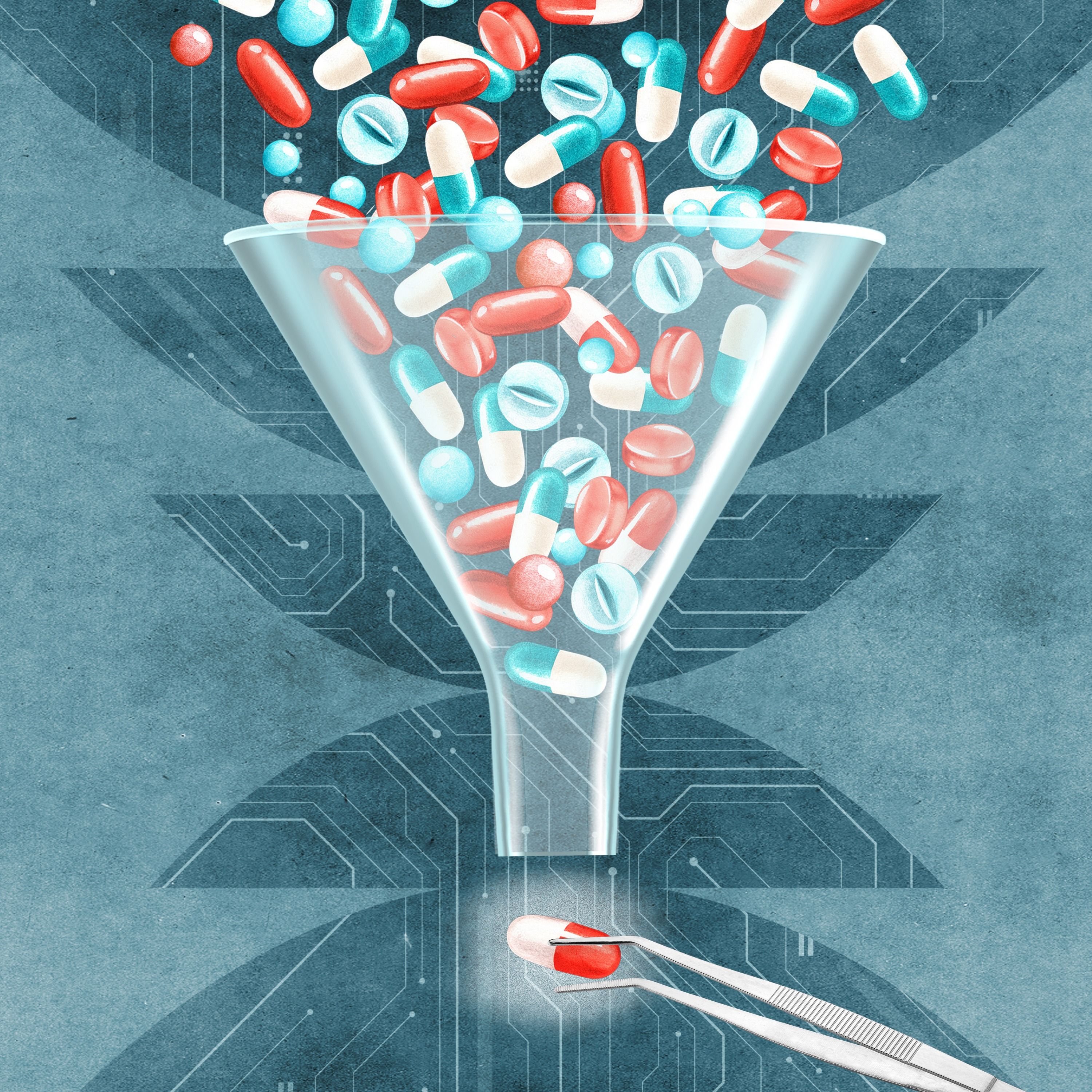
The Medical Matchmaking Machine
David Fajgenbaum - Chasing My Cure, (https://davidfajgenbaum.com/)
Radiolab | Lateral Cuts:Check out Death Interrupted (https://radiolab.org/podcast/death-interrupted), a conversation with Blair Bigham about a worldview shifting change of heart.The Dirty Drug and the Ice Cream Tub (https://radiolab.org/podcast/dirty-drug-and-ice-cream-tub) to hear the crazy story about how Rapamycin was discovered.
Signup for our newsletter!! It includes short essays, recommendations, and details about other ways to interact with the show. Sign up (https://radiolab.org/newsletter)!
Radiolab is supported by listeners like you. Support Radiolab by becoming a member of The Lab (https://members.radiolab.org/) today.
Follow our show on Instagram, Twitter and Facebook @radiolab, and share your thoughts with us by emailing radiolab@wnyc.org.Leadership support for Radiolab’s science programming is provided by the Simons Foundation and the John Templeton Foundation. Foundational support for Radiolab was provided by the Alfred P. Sloan Foundation.
Press play and read along
Transcript
Speaker 1 Radio Lab is brought to you by Progressive Insurance. Do you ever think about switching insurance companies to see if you could save some cash?
Speaker 1
Progressive makes it easy to see if you could save when you bundle your home and auto policies. Try it at progressive.com.
Progressive casualty insurance company and affiliates.
Speaker 1 Potential savings will vary. Not available in all states.
Speaker 3 WNYC Studios is supported by Apple TV.
Speaker 5
It's 1972. A young British family is attempting to sail around the world when disaster strikes.
Their boat is hit by killer whales and it sinks in seconds.
Speaker 5 All they have left is a life raft and each other. This is the true story of the Robertson family and their fight to survive, hosted by me, Becky Milligan.
Speaker 5 Listen to Adrift, an Apple original podcast produced by Blanchard House. Follow and listen on Apple podcasts.
Speaker 3 WNYC Studios is supported by Sony Pictures Classics and Fathom Entertainment, presenting Merrily We Roll Along: Three Best Friends Through Two Decades of Time, directed by Maria Friedman, starring Jonathan Groff, Daniel Radcliffe, and Lindsey Mendez, by legendary composer Stephen Sondheim and winner of four Tony Awards.
Speaker 3 Merrily We Roll Along, playing only in theaters starting December 5th.
Speaker 2 Wait, you're listening.
Speaker 2 You are listening
Speaker 2
to Radio Lab. Lab.
Radio Lab. From
Speaker 1 WNYC.
Speaker 1
Hey, I'm Latif Nasser. This is Radio Lab.
And today I want to share a conversation that I had with a guy named David Fagenbaum.
Speaker 1 He's a doctor and a professor at the University of Pennsylvania. And there's a combination of reasons why I
Speaker 1 think his personal story is so extraordinary and why I wanted to share it with you. Part of it is this
Speaker 1 staggering series of crises that he faced in his personal life starting when he was in university. Part of it is
Speaker 1 kind of his personality, like how he,
Speaker 1 what there was in him that made him stand up to these crises in a really particular way.
Speaker 1 And then part of it is the way that he He took his response to those crises and now he's scaling it up using one of the most controversial technologies around AI.
Speaker 1 The result of all of this is that he is right now in the middle of doing something wildly ambitious. Something I find kind of miraculous,
Speaker 2 also
Speaker 2 maybe troubling.
Speaker 1 Either way, it is definitely going to change the medical system down to the level of the pills that you put in your mouth.
Speaker 1 That said, I just found my conversation with David so fascinating and his personal backstory in general.
Speaker 1 I found it so dramatic that I wanted to let it unfold at its own pace without jumping too quickly to the end.
Speaker 2 So here we go.
Speaker 2 And then I'll hit join studio.
Speaker 2 Latif? Hey.
Speaker 2 How's it going? Oh my God, it's great.
Speaker 1 How you doing? Doing good.
Speaker 2 We've got double mics here. I've got a friend who's here
Speaker 2
helping with the audio. So we're double mic'd right now.
Great.
Speaker 1 So are we good to begin sure okay let's begin with the beast tell me who is the beast and what is the beast and where did the beast start
Speaker 2 the so yeah i don't know if i've ever um answered a question this way but so um when i was in medical school i worked out all the time and part of that was because for the previous 15 years of my life i was obsessed with wanting to be a college quarterback and uh and why why was it why was that the thing you know it's, it's, so I grew up in Raleigh, North Carolina, where college sports are really big and NC State had a football team and I grew up sort of like loving their team.
Speaker 2 But I think maybe more than anything is once I started playing football and I started like,
Speaker 2 I'm biased, but I think football is unique among team sports in that.
Speaker 2 You connect with your teammates in such a way because literally like your health and your life is like on the line. If someone else doesn't do the thing to protect them,
Speaker 2
you don't do the thing to protect them as a quarterback. Yes.
And so I just fell in in love with football as a kid. I mean, as a kid, I just was in love with it.
Speaker 2 If you could have seen my walls when I was growing up, literally every corner of every wall in my bedroom was covered with charts measuring like how far I could throw a football, how fast I could run, all with the goal of getting better.
Speaker 1 But you actually get your dream.
Speaker 2
I get my dream. I get this opportunity to go to Georgetown to play football.
And it was the dream where it was like, okay, I can go to a great university that has a health science program.
Speaker 2 So I can keep studying health science and I can play football.
Speaker 2 football i i really love the coaches there um but then uh you know i got to school and i was there for only a couple weeks before i got this just horribly devastating call my dad called and um said david your mom has brain cancer you need to come home right away so i immediately went back home to to raleigh um i was able to just see my mom just before um her brain surgery and then um she went we went to duke for her brain surgery and um and what what was the what was the what was the horizon of possibility here?
Speaker 1 Like, what did you think was going on? What did you think was possible?
Speaker 2 Yeah, so before the brain surgery, they just said it's a brain tumor. It looks like it's brain cancer, but we need to go in there and actually see what it is.
Speaker 2 So, you know, my family and I, we were just so just nervous about everything because, you know, they did warn us before that, you know, the person that comes out of surgery isn't always the person that goes into surgery.
Speaker 2 And I remember going back to see my mom with my dad, my two older sisters, and she had this wrap around her head. She had a bandage around her head from where the tumor had been resected.
Speaker 2
And she had this bulb that was coming out of the incision side. It drains out fluid from the incision.
And we were all so nervous. No one really knew what to say.
Speaker 2 We said, you know, mom, how are you doing?
Speaker 2 And she pointed up at her head with this bulb and the wrap around it. And she said, Chiquita Banana Lady.
Speaker 2 which is like referring to like if you look at this sticker on your bananas there's like you know there's the chiquita banana lady she has a wrap and she's got all the fruit yeah yeah yeah her head kind of looked like the chiquita banana lady and like
Speaker 2 it was exactly what we needed it was like exactly what we needed like we all burst out laughing and crying and we're snot crying and like our mom's with us like it just yeah like that uh yeah that's just she's still herself she's still herself that's like that's who she was yeah what was the sort of prognosis after that or what was the timeline yeah so the doctors came in and they explained that it was the it was they explained it as grade four glioblastoma um which uh the average survival is around six months and i think they said the longest someone had survived i think i remember it was around five years
Speaker 2 so um i spent a few more days at home after surgery and just was like would not leave her side um and then when and how long did your mom last
Speaker 2 she lived 15 months after diagnosis she was diagnosed july of 2003 she passed away october 26th of 2004 but uh while i was home we had a lot of just really special time together One of the things we did was actually go through old home videos.
Speaker 2
Like, you know, we had these like Betamax videos. I don't know if you remember these like old home videos.
Went through them and just we did like all the things that you would, you know, want to do.
Speaker 2 All the things that, you know, you'd want to do before. Um,
Speaker 2 you know, someone like my mom passes, and um, hmm,
Speaker 2 this was 21 years ago. Um, did all those things, and um,
Speaker 2 it was really special.
Speaker 2 And it also, as you can even tell, this is 21 years later. It
Speaker 2
created such a drive in me to just say, yeah, I want revenge. I want to do whatever I can to take this thing on.
Yeah.
Speaker 2 And
Speaker 2
I told her, I was like, mom, I'm going to dedicate my life to trying to help people like you. Like, that's just like full stop.
Like this whole football thing, that was fun these last eight years.
Speaker 2 But yeah, I'm going to be a doctor and I'm going to dedicate my life to just find treatments for this horrible thing that was taking my mom from me. Yeah.
Speaker 1
Okay. So now cut to, so you finish college, you get into med school.
Yeah.
Speaker 1 The, the, the same way that you were calorie counting and, and quizzing yourself on playbooks, like you're doing the same thing, except now cancer is the, is the other team.
Speaker 2 That's exactly right. And of course, the challenge in med school is it's very much a training period, which is hard for someone like me, right? It's like, you know,
Speaker 2 I want to take this on. I want to make a difference, but I'm in this period where, yeah, I've just got to train, train, train.
Speaker 1 So you're doing that. And then
Speaker 1
at some point. Yeah.
Okay. And so what happens?
Speaker 2 So I'm on my OBGYN rotation and
Speaker 2 just started noticing that I was more tired than I'd ever felt.
Speaker 2 And I sort of always was able to run on low amounts of sleep and lots of caffeine, but I was really, really tired, like this fatigue that I had never felt before.
Speaker 2 And I remember sort of like trying to just like put it out of my mind, like whatever this is is going to go away. And I I went into the hospital to take this medical school exam.
Speaker 2
And I remember during the exam, I was like dripping sweat head to toe. And then I was like, you've never felt like this before.
Something's going wrong.
Speaker 2
I also had noticed these bumps appearing on my body. They're called blood moles.
And they're normal as you get older, but they are abnormal to appear rapidly.
Speaker 2 And so like, as I was studying for this exam a couple of days before, I like noticed these blood moles on my body.
Speaker 2 And so I actually handed in my exam and I just walked down the hall to the emergency department in the same hospital that I was taking the exam in and I just told them about my symptoms.
Speaker 2 They did blood work and,
Speaker 2 you know, I had worked in that ER just a few months before and doctors are usually really slow to come back. And it's like, you know, things take a while unless there's something really wrong.
Speaker 2 And they come back really quickly. The doctor came back really quickly.
Speaker 2 And he told me, he said, David, he said, your liver, your kidneys, your bone marrow, your heart, and your lungs are shutting down. We have to hospitalize you right away.
Speaker 2 And I was just, that's like the whole body.
Speaker 1 Like, what, what else is there in your body?
Speaker 2 Yeah, there's there's like your brains left, but like pretty soon that was going to not be as clear. Right.
Speaker 2 But yeah, it's this concept called multiple organ system failure where everything was shutting down. And so they hospitalized me and I just went downhill from there.
Speaker 2 I started getting really sick really quickly and I knew things were bad. And the doctors were using the language that I had used when I talked to patients when things were really bad.
Speaker 2 And like, what were they saying exactly?
Speaker 2 You know, we've run a lot of tests and, you know, we're, we're, you know, we're on top of things, but we're not really in a position yet to tell you exactly what we think is happening.
Speaker 2 And it took a total of about 11 weeks before we finally made the diagnosis. And
Speaker 2 with that diagnosis, um, came almost immediate use of
Speaker 2 a type of chemotherapy. Um, well, before we get there, before we get there, so what was the diagnosis? What was oh, yes, yes.
Speaker 2 So, the diagnosis was what's called idiopathic multicenter Castleman disease.
Speaker 2 Castleman disease describes a group of these rare diseases where basically your immune system attacks your organs for an unknown cause that we call it idiopathic because we don't know what the cause is um and had you ever heard of had you ever heard of that like as a med student when i heard it when i heard it the first time i vaguely remembered like i think i've heard that once in med school that's how rare it was i was like third-year med student and i think i heard it once yeah but definitely not i definitely wasn't familiar with it right and and was that
Speaker 1 you get the test done finally
Speaker 1 um Yeah, can you talk about that moment?
Speaker 2
Sure. Yeah.
So we were like really happy that it wasn't cancer. We were like, yes, like this is not cancer.
You know, we thought it was lymphoma this whole time and it's not.
Speaker 2 And then there was this, you know, really quick realization shortly thereafter that
Speaker 2 my subtype of calcium and ziopiopathic multi-entral calcium disease actually has a worse survival rate than lymphoma does.
Speaker 2 And that actually the thing that we were hoping it was not actually would have been better than the thing that it turned out to be. And I was so sick when the diagnosis came in
Speaker 2 that the doctors told my family, we don't know if this medicine is going to work, but he's so sick that we don't think he's going to survive much longer.
Speaker 2 You should go ahead and say goodbye to him and prepare him for
Speaker 2 not being here.
Speaker 1 And you were awake and aware of that happening.
Speaker 2 I don't know if I was mentally, I wasn't totally there, but I do have some memories. And those memories are
Speaker 2
the room being really dark, my family hugging me and crying. And they just started telling me all the things that I told my mom, right? Like what I meant to them.
And
Speaker 2
we're reminiscing on old memories. And then I remember the priest coming in.
I mean, of course, I'd never had my last rites read to me before.
Speaker 2 So what sort of like confirmed my biggest fears, which is that like, this is going to kill me.
Speaker 2 Just a couple days before the priest had come in, the doctors had tried this one chemotherapy. It was the only chemotherapy they thought to try.
Speaker 2 Like there were actually others they could have tried, but this was the one they tried.
Speaker 2 And amazingly,
Speaker 2
it just started to kick in really within days. And it didn't last long term.
I relapsed about a month later.
Speaker 2 And it was a real roller coaster because like the euphoria that we all had when I was feeling better
Speaker 2 and the hope that we had.
Speaker 2 And then just, you know, a few weeks later, when it would come back, just the heartbreak.
Speaker 2 And that cycle happened a total of five times in three and a half years where I went from being, you know, totally,
Speaker 2 you know, in a critically ill in ICU to much better to then back again.
Speaker 1 And what was the moment? Was there a moment where you kind of
Speaker 1 engaged, where you were like, okay, I'm, I, I need to, I need to sort of activate.
Speaker 2
Oh, yeah. Yeah.
That moment for me, I remember very vividly, it was May 12th of 2012. Um, it was sort of, I mean, if I think back on like my life in these moments, like
Speaker 2 the moment when I got the call from my dad that my mom had brain cancer, and the moment I was sitting in the hospital room, and my doctor explained to me that the only drug that had ever been studied for my disease wasn't working, and that there was nothing else.
Speaker 2 Like, I was, and I, and I was just searching for something like, is there a gene or a protein or a cell or something that we might know about this thing?
Speaker 2 Like, give me something, like, begging for like some lead. And he just was clear, there's nothing like, like
Speaker 2
you are going to die from this disease. The chemotherapy is going to stop working.
And there is nothing out there. That was when I, everything changed.
Everything in me shifted.
Speaker 2 If I want to survive, like, if I want to spend more time with this girl beside me that I love Caitlin, and I want to get married to her one day, I want to spend more time with my family.
Speaker 2 Like, I've got to activate. And was it right around that time? I was learning about how a drug that was being used for Castleman's was also working for other diseases.
Speaker 2 And I was like, wait a minute, there's a Castleman's drug working for other diseases. Is there anything somewhere? Maybe there's another drug for other disease that could work for me.
Speaker 2
Like, it just is sort of like this, like very simple concept. And it frankly, it was the only path.
It wasn't like I was like, oh, it would be great to do this or to do that.
Speaker 2
It was like, this was the only path was to find an existing medicine. And that became just my central focus.
So
Speaker 1 what do you do? How do you even start that?
Speaker 2
Yeah. So first thing I did is I went to my mentor, Arthur Rubenstein.
He was the dean of the medical school before,
Speaker 2
and he just retired. And so I went to him for advice and his support.
And he said, David, I'll support you. And he's been amazing over these years.
Speaker 2 But so I wanted to go to someone who sort of like could give me advice. I didn't know what I was doing.
Speaker 1
So you're like, I just need, I need, I need help. I need a team.
I need people.
Speaker 2
I need to build a team. Exactly.
It was like, I don't know what I'm doing. I need to build a team.
So first went to Arthur. He came on board.
Speaker 2 The second task would be to understand what was going on in my blood and in my immune system and see if there was something that was already approved for another disease that could maybe be repurposed to treat me.
Speaker 2 And that's when I, you know, I guess they did the equivalent of, you know, covering my walls and poster boards for throwing the football. And it just became all-encompassing.
Speaker 2
I got to find a drug for this disease. I remember turning to Gina, my sister, and saying, Gee, I need you to call UNC and Duke.
I need you to get all my medical records, ship them to Philadelphia.
Speaker 2 I need you to get all the blood samples and lymph node samples at each of the hospitals.
Speaker 2 They need to be in Philly because I'm going to get out of here in a few few weeks and when i get to philly like the clock's ticking i need to get to work and and her and caitlin just got to work um and a few weeks later i was back in philly and the blood samples were there the lymph node samples were there the medical records were there and i just it was all day every day um to try to find a drug and i I presume at that moment too, you're like, and another, because another flare is like right around the corner.
Speaker 2
It's coming. Exactly.
Yeah. And Caitlin and I.
Speaker 1 It's like a train coming. It's a train.
Speaker 2
And it's hit me. It's hit me five times.
There's no chance it's not coming back. This was, it's coming, and I don't have another shot.
And I had a really big date in front of me.
Speaker 2
May 24th, 2014 was Caitlin and I's wedding day. We were engaged.
And
Speaker 2 now we're talking January of 2014. So I had, you know, about four months between getting out of the hospital and making it to our wedding day.
Speaker 1 Like, if you last that long.
Speaker 2
If I last that long. Yeah.
Exactly.
Speaker 1
Yeah. Okay.
So then, so what do you, what, what do you do?
Speaker 2 So I thaw all those samples and I started doing something called serum proteomics, where the idea is you measure a thousand different things in your blood or a thousand analytes or proteins in your blood.
Speaker 2 And then we did something called pathway analyses where we tried to understand what are the signals in the blood that are coming from these proteins being up or down.
Speaker 2 I did something called flow cytometry to look to see which of my immune cells were turned off and turned on.
Speaker 2 And then cytokine panels where we measure these 13 different proteins and their changes in the blood. And what emerged was that my mTOR was in overdrive.
Speaker 2 And m-TOR is a communication line your immune system uses to turn on, to turn off, to proliferate.
Speaker 2 And when I saw that result, I immediately remembered that there's a drug called Cerolimus, the other name for it's rapamycin,
Speaker 2
that is really good at turning mTOR off. It's like an mTOR inhibitor.
So like I saw the result and it's like mTOR is on. And I was like, oh my gosh, isn't there a great mTOR inhibitor?
Speaker 2 And it rapamycin?
Speaker 1 That's the drug?
Speaker 2 Rapamycin is the drug that saved my life. Oh my God,
Speaker 1 we already did a story about rapamycin.
Speaker 1 i didn't even connect it in my head and i love that story let's i listened to that story and i love that story and of course it's you know found on the island of rapanui yeah yeah yeah hidden in a freezer in canada like i connected mTOR but I didn't connect that it was rapamycin it was literally rapamycin yes um so it's like you find in the tests of your blood and your lymph node and whatever, like it's like that is leading you to a problem.
Speaker 1 And then you're like, is there a drug that solves this problem? And you're like, oh, there's one drug right there.
Speaker 2 That's exactly right. And so I told one of my doctors and I went through all the data and I just said, like, do you think that we should try this?
Speaker 2 Like, I know it's never been used before for castlemans, but like, can we try it? Like, it's like, should we try it?
Speaker 2 And his thought process was like, probably it's about a 10 to 20% chance it could work, but it's a 0% chance if I don't take it. And, and I'm willing to take that risk.
Speaker 2 And so he said, yeah, I'll prescribe it. And so you do it and then what happens?
Speaker 1 You take it. It's a pill.
Speaker 2
It's a pill. It's three pills.
Well, at first, it was, I took five pills and then, and now it's three pills. But
Speaker 2 within a couple of days, I started to feel better. And the blood work started to get better more rapidly than it would have otherwise.
Speaker 2 But again, I still wasn't ready to say, like, this drug is working.
Speaker 2
And so for me, I was like, I'm not going to get my hopes up. It's going to be a test of time.
Am I going to make it to my wedding day? Am I going to make it a year?
Speaker 2 Am I going to make it longer than that? And yeah, just four days ago marks 11 and a half years that I've been in remission on this drug.
Speaker 2 I mean, I almost died five times in three and a half years before, and now it's 11 and a half without this disease coming back. Wow.
Speaker 2
Amazingly, you know, it weakens my immune system in the right way so that I don't attack my own organs. Wow.
And
Speaker 2 I mean, the moment that that drug, the moment that I started thinking that drug was helping me, and knowing that it was, you know, always there for something else.
Speaker 2 And then certainly as the time went on, when I got to marry Caitlin, and as the years have gone on, I've just gotten more and more
Speaker 2 obsessed with this idea. Because I'm literally breathing and alive because of a drug that wasn't made for my disease.
Speaker 2 I just feel this tremendous sense of responsibility that, like, hey, David, if you're going to get lucky enough to have one of these medicines help you, you sure as hell better spend the rest of your time trying to find as many more of these medicines to help other people.
Speaker 1 What happens next is that this story moves from being a personal story about David finding his own medicine for his own disease.
Speaker 1 And thanks to some supercharged technology, it becomes a story about all medicines and all diseases and the entire way we figure out which works for which.
Speaker 1 That's after the break.
Speaker 1 Radiolab is supported by Capital One. Banking with Capital One helps you keep more money in your wallet with no fees or minimums on checking checking accounts and no overdraft fees.
Speaker 1
Just ask the Capital One Bank guy. It's pretty much all he talks about in a good way.
He'd also tell you that Radio Lab is his favorite podcast, too. Aw, really? Thanks, Capital One Bank Guy.
Speaker 1 What's in your wallet? Terms apply. See capital1.com slash bank, capital One N-A, member, F-D-I-C.
Speaker 6 Hey, I'm Molly Webster, and this is an ad by BetterHelp. So it happens every year.
Speaker 6 The seasons are changing, the days are getting shorter, and basically, once it becomes dark outside of my window, I feel like the rest of the world disappears, and I'm just alone, and there's nothing left to do but watch television.
Speaker 6 This November, BetterHelp is asking everyone to reach out to our people. That could be your family, your friends, your neighbors, and to resist this call of the cocoon.
Speaker 6
And yeah, reaching out can take some courage. I've got text messages from January I haven't responded to.
And you know what? I'm gonna write them back right now.
Speaker 5 Hi.
Speaker 6 Sorry, I've been missing. How are you?
Speaker 6 Why don't we all do this sooner? Therapy is the same way. BetterHelp makes it easier to take that first step.
Speaker 6 You just fill out a short questionnaire and they find a licensed therapist who they think you'll like. Our listeners get 10% off their first month at betterhelp.com/slash radiolab.
Speaker 6 That's betterhelp.com/slash radiolab.
Speaker 1 Radiolab is supported by the National Forest Foundation, a nonprofit transforming America's love of nature into action for our forests.
Speaker 1 Did you know that national forests provide clean drinking water to one in three Americans?
Speaker 1 And that national forests and grasslands cover nearly 10% of the U.S., hosting 150,000 miles of trails and providing habitat for over 3,000 species of plants and animals.
Speaker 1 The National Forest Foundation supports the places where we come alive. keeping the trails, rivers, and forests we love healthy.
Speaker 1 Last year, they planted 5.3 million trees and advanced over 300 projects to protect nature and communities nationwide.
Speaker 1 Their work creates lasting impact by restoring forests and watersheds, strengthening wildfire resilience, and expanding recreation access for generations to come.
Speaker 1 And when forests struggle, so do we, the water in our taps, the air we breathe, and the trails that connect us all. Learn how you can help at nationalforests.org.
Speaker 1 Radiolab is supported by the National Forest Foundation, a nonprofit transforming America's love of nature into action for our forests.
Speaker 1 Did you know that national forests provide clean drinking water to one in three Americans? And when forests struggle, so do we.
Speaker 1 The National Forest Foundation creates lasting impact by restoring forests and watersheds, strengthening wildfire resilience, and expanding recreation access for all.
Speaker 1 Last year, they planted 5.3 million trees and led over 300 projects to protect nature and communities nationwide. Learn more at nationalforests.org/slash radiolab.
Speaker 4 Radiolab is supported by ATT.
Speaker 4 There's nothing better than that feeling like someone has your back and that things are going to get done without you even having to ask, like your friend offering to help you move without even having to offer drinks and pizza first.
Speaker 4 It's a beautiful thing when someone is two steps ahead of you, quietly making your life easier. Staying connected matters.
Speaker 4 That's why in the rare event of a network outage, ATT will proactively credit you for a full day of service. That's the ATT guarantee.
Speaker 4 Credit for fiber downtime lasting 20 minutes or more, or for wireless downtime lasting 60 minutes or more, caused by a single incident impacting 10 or more towers.
Speaker 4
Must be connected to impacted tower at onset of outage. Restrictions and exclusions apply.
See ATT.com/slash guarantee for full details. ATT, connecting changes everything.
Speaker 1 This is Radio Lab. I'm Latv Nasser, and we are back with a conversation I had with Dr.
Speaker 1 David Fegenbaum, who after almost dying five times, started obsessively studying his own body, his own disease, to try to find a drug, any existing drug out there that might be able to help him.
Speaker 1 And he did.
Speaker 1 And after three years of being repeatedly at death's door, he's now been in remission for 11 years.
Speaker 1 After he found that cure, he turned his kind of monomaniacal mind,
Speaker 1 and not just that, his whole lab at the University of Pennsylvania, toward understanding his disease, Castleman's disease, hoping to do the same for other people who are suffering from it.
Speaker 2 So that led us to then say, okay, we need to do more laboratory work. We need to start uncovering more pathways that might be important, more genes, more proteins that are important.
Speaker 2 And so we started getting really involved in that sort of laboratory work.
Speaker 2 And in parallel,
Speaker 2 the next probably big milestone to go from like, okay, we help someone else with my disease was actually my uncle was diagnosed with angiosarcoma, which is a horrible form of cancer, the same week that my brother-in-law was diagnosed with ALS.
Speaker 2
I went down to Raleigh to be with my brother-in-law. Happened to be the same week my uncle got diagnosed with angiosarcoma.
So I went with my uncle to his doctor's appointment.
Speaker 2 And the doctor explained, you know, there are these two chemotherapies and
Speaker 2 they'll, you know, give you a couple months to live, but they're going to stop working. And so I suggested that we start
Speaker 2 looking for drugs that could be repurposed. And his doctor explained, like,
Speaker 2
there isn't anything for angiosarcoma. I'm like, yeah, I know, but like, there wasn't anything else for Castlemans.
And like, you know, I'm here. Maybe we can find something else for angiosarcoma.
Speaker 2 And that's when we came across a study that had been published.
Speaker 1 And is that annoying? Like, are you annoying to them when you do that?
Speaker 2 I'm so annoying to them. They're like, they're looking at me and they're like, your uncle has a terminal illness.
Speaker 2 The last thing he needs is for his nephew to tell him or me that there's a treatment out there that could help him. Like, that's not what he needs right now is what they're thinking.
Speaker 2
And in my mind, I'm like, are you kidding me? He's still here. He's still breathing.
I just walked past a CVS. And last time I checked, there's 4,000 drugs in that CVS.
Speaker 2 And I know those 4,000 drugs haven't been tried for him. So until we've tried all 4,000 drugs, you can't tell me there isn't a drug in there that could help him.
Speaker 2 And so we find a study that had been published three years earlier. that basically says that four out of five people with my uncle's cancer have very high expression of something called PD-L-1.
Speaker 2 I'm here saying like, let's test his tumor for PD-L-1. And the doctor says, I'm not going to test it because no one with angiosarcoma has ever been given a PD-1 inhibitor.
Speaker 2
I think there's like a less than 10% chance that this gene panel that you want to order for Michael is going to come out with anything helpful. And I hear less than 10%.
And I'm like, that's great.
Speaker 2 Less than 10%? Like, you mean like 5%? He's like, yeah. I'm like, amazing.
Speaker 2 So you're telling me there's a 5% chance that this test is going to give us something something that's going to keep them alive longer than two months?
Speaker 1 Amazing.
Speaker 1 You're like the dumb and dumber guy.
Speaker 2 So you're saying there's a chance.
Speaker 2 That's right. Yeah, yeah, yeah.
Speaker 1
That's the guy. You're that guy.
Yes.
Speaker 2 And so I don't blame them because when you're a doctor and you do this a hundred times and it works one in a hundred times, that is frustrating.
Speaker 2
But when you're a patient and it helps you that one in a hundred times, it's everything. Yeah.
And so I got another doctor to order the test. So we get the test results back.
Speaker 1 You are such an annoying patient relative.
Speaker 2
I'm so annoying. I am.
Yes. Yeah.
Okay. So it comes back.
Speaker 2
Well, first off, I should say, I had him order two tests. The first of the tests, it came back with nothing informative.
He was totally right. And that was actually the expensive test.
Speaker 2 That was a test that cost $2,000 that came back with nothing useful. So I will totally give it to him.
Speaker 2 The inexpensive test that I wanted him to order came back 99% of his cancer cells were positive for PD-L1 expression. 99%,
Speaker 2 which is not a guarantee, but it is a high likelihood that therefore a drug that inhibits this might be useful. And we got Michael on this medicine, and
Speaker 2
April of this year marked nine years that he's been in remission from his angiosarcoma. Oh, wow.
Other patients have been treated with this.
Speaker 2 Other doctors learned about this and started treating their patients.
Speaker 2 And it turns out about a third of people with this horrible cancer, previously uniformly fatal cancer, will respond really well to Pemberlizumab, to this medicine.
Speaker 2 It's now standard of care for his form of cancer.
Speaker 1 It's now standard of care?
Speaker 2 It's now standard of care without ever doing a clinical trial.
Speaker 2 And that goes to show you when you have a disease that's this bad and you find a drug that works this well, you can change the paradigm for the disease for relatively, I mean, as close to zero dollars as humanly possible.
Speaker 1 But like, why is it that everything is so like, it's like we almost have this idea of like lock and key, like this medicine does this thing for this drug and da da da da.
Speaker 2 But then it's it's like and then you're like no no no but this law this key works in this lock over here like why is it that that is that anyway yeah tell me there so the reason i think that our system is like this drug works for this disease is because in order to get a drug approved a drug company has to develop a drug for a specific disease and submit to the fda for that disease the fda approves it for that disease and if that drug company mentions a single word about that drug working in another disease, they will get fined billions of dollars for what's called off-label promotion.
Speaker 2 So when the FDA approves a drug, what they're really doing is they're approving a drug company to market a compound for a specific disease.
Speaker 2 And that company cannot market that compound for any other diseases until they come back to the FDA to get that change made.
Speaker 2 But every time a drug company does that, it costs lots and lots and lots of money. So they don't go after all the opportunities they have.
Speaker 2 But insurance companies and payers realized, well, if this drug that's approved for this one thing could also be useful in this other thing and it would be good for for patients, shouldn't we allow doctors to prescribe things off-label?
Speaker 2
And so that's something that happens very commonly. About a quarter of all prescriptions in the U.S.
are off-label. No.
Yeah.
Speaker 2 So it's somewhere between 20 and 30% of all prescriptions written every day in the U.S. are off-label.
Speaker 1 Are not for the reason they're supposed to be.
Speaker 2 Yeah, exactly. So that includes examples like doxycycline for Lyme disease, where like every doctor in the world would be like, yes, use doxycycline for Lyme disease.
Speaker 2 But doxycycline is a cheap old generic antibiotic.
Speaker 2 So whoever made doxycycline 100 years ago, 30 years ago, when people figured out it worked for Lyme disease, they aren't going to submit for a label change.
Speaker 2 And that gets into the other factor here, which is that once a drug becomes generic, whoever originally made the drug, they stopped making money off of the drug because you have generic competition.
Speaker 2 You have multiple companies that make the identical drug, and the price plummets per pill. And so, no one in our system makes any money off finding a new disease for that drug.
Speaker 2 But, why wouldn't, like, you would think from the drug company's perspective, like that they would want to go to the FDA get as many uses approved as possible because then then they could go out and say this helps this this helps that this helps this this helps that like like you you they would make their market as big as possible except it's more complicated than that because you can only sell a drug for one price regardless of what disease you you sell it for it always has to be the same price so what that means is that you have to pick the first disease that you get your drug approved in you have to pick the optimal market for that drug for the optimal price because pricing is actually not based on the cost of the medicine.
Speaker 2
Pricing is based on the value for that disease. So the fewer competitors there are for a disease, the more expensive the drug.
The rarer the disease, the more expensive the drug.
Speaker 2 There's all these factors that affect how expensive the drug is going to be. And you want to max, if you're a drug company, you have to maximize your profit.
Speaker 2 So you need to come up with the highest price for the highest number of people. But it might be that a low number of people at a higher price is better than a high number of people at a lower price.
Speaker 2 And so you can imagine it gets really complicated really quickly. And it's all about the first disease you get your approval.
Speaker 2 And so companies have to be really thoughtful and strategic to maximize their profits about what their first approval is.
Speaker 2 Once they get that first approval, now they have to remember that they can't change the price for the next disease.
Speaker 2 And so this is this horrible economic issue, which is just so depressing because like on the other side of these economic issues are people suffering.
Speaker 1
Okay, I want to hear more about what you're doing now. You're like, amazing this works for me.
How does that then go to, oh, no, wait a second, I'm not just doing this for my family.
Speaker 1 Like I can, I can big this up.
Speaker 2
Yeah, the next big milestone was early in the pandemic. I was actually driving down to Raleigh, North Carolina.
I had my wife in the car and I'm listening to the radio about this pandemic.
Speaker 2 And I'm sitting there thinking, you know,
Speaker 2 gosh, this involves the immune becoming activated and causing all these problems. And gosh, it's going to take us months or years to come up with new drugs.
Speaker 2 Like, I really wish there was a lab somewhere out there that was really good with inflammatory stuff and could repurpose drugs and could like direct drugs at this thing.
Speaker 2 And then I was like, oh, maybe, maybe we should do that.
Speaker 2 And so that, so we decided to create a program called the Corona Project, where basically we redirected my like 15-member lab to focus specifically on COVID.
Speaker 2 And early on, as you'll remember, there was a lot of drugs that were repurposed. Some worked, some didn't work, but there was a lot of repurposing.
Speaker 2 This is the first time we did like a very concerted effort to be like, what else is out there for this one disease? Very much informed by what we'd done previously.
Speaker 2 And COVID, of course, there's lots of controversy about what worked and what didn't. But the two drugs that unquestionably worked incredibly well were dextamethasone and tosalizumab.
Speaker 2 They saved millions of lives and they were, you know, old drugs that have been around for a long time.
Speaker 2 And so That further got my wheels turning on like, what if we could create a system to automate what my little lab was doing for one disease, but we did it for all diseases and all drugs simultaneously.
Speaker 2 And thankfully,
Speaker 2 in parallel to those dreams, the field of machine learning, artificial intelligence has matured so much that we can actually do that.
Speaker 1 Okay, so tell me about AI. How are you using AI to like to matchmake here? How did you think like, okay, this part of it can be done by AI or this part of it or whatever, that kind of thing?
Speaker 2 So in my case,
Speaker 2 You know, you can think about this. We use what are called biomedical knowledge graphs, which are just sort of mapping out like every medical concept on a map.
Speaker 2 So you can imagine like if you have this giant wall and every single gene, every disease, every protein, every pathway was put against the wall.
Speaker 2
So if we were to start with that concept and say, well, what do we do for me? Well, you'd find Castlemans on that wall. It would only be there in one place.
You'd find Castlemans.
Speaker 2 And what you'd find is you'd find an edge or a line between Castlemans and activated T cells, because I discovered that T cells were activated in my disease.
Speaker 2 You'd find another line to mTOR activation because I discovered that mTOR activation was really up in my particular immune cells.
Speaker 2 And then you would find a a drug from T cell activation and mTOR activation to Cirulimus. Right, the drug.
Speaker 2 Because Cerulimus is able to inhibit mTOR activation is able to inhibit these activated T cells.
Speaker 2 And so now within this giant graph of every disease, every gene, every protein, you would find Castlemans
Speaker 2 with lines or edges to these two concepts and then lines or edges to Cerulimus. And you would see a connection between them.
Speaker 2 And so now imagine doing that for every disease, every gene, every protein, basically what the world knows about all of medicine.
Speaker 1 It's almost like mechanical what you're doing. It's like
Speaker 1 you're trying to make
Speaker 1 the mechanical blueprint of what is going on.
Speaker 2
That's exactly right. This leads to this, leads to this, and this reverses this, which reverses this, reverses that.
Everything is there. It's this, it's the, it's, it's everything.
Speaker 2 Well, now what we do is we train machine learning algorithms on all of those known treatments.
Speaker 2 So like the serolimus for Castlemans, sildenophil for pulmonary arterial hypertension, you know, insulin for diabetes.
Speaker 2 Imagine training this algorithm because machine learning algorithms are so good at finding patterns. And so we're giving the machine learning algorithm lots of information about known treatments.
Speaker 2 And we're saying, this is an example of when a drug works for a disease. And we do it thousands of times with all of the treatments that are out there for all the diseases that are out there.
Speaker 2 And then we say, okay, algorithm, now go and score how close of a pattern the connection is between a known treats relationship for every other drug versus every disease. So if
Speaker 2 a toenail fungus drug looks like there's no way it could work for pancreatic cancer, you need to give it as close to a zero as possible, 0000, 0.0001, right? Right.
Speaker 2 But if leucovorin looks really promising for a subtype of autism, because the pattern of connections are there and there's a clear intermediary between that subtype of autism and that metabolite, give it a high score.
Speaker 2
So you get a 0.99. And so now what we do, we do all 4,000 drugs, all 18,000 diseases.
So it's about 75 million scores that we generate, that our machine learning algorithms generate.
Speaker 2 And then that gives us a list in rank order from the things that are 0.99 all the way down to things that are 0.00 of every drug versus every disease.
Speaker 2 And so we come across matches that are incredible that we never could have imagined that now the algorithm is saying you should really look at this.
Speaker 1 It's like the body is so complicated.
Speaker 1
These drugs are so versatile. It's like, like our minds can't even comprehend that.
It's like, that's why you need to go to AI.
Speaker 2 You would have to, as humans, think about 75 million possibilities. Like, like, my lab's really good at looking at like dozens of possibilities for like one disease.
Speaker 2 Like, we, like, my lab can spend like a year and we can get through a few dozen for one disease, right? But, like, we could never think about like 75 million possibilities and then compare them.
Speaker 2 And I'm not saying AI is perfect, but directionally, it's really good. The things that are the 0.99s are way better than things that are the 0.5s.
Speaker 1 How likely do you think it is that, like,
Speaker 1 if there's an ordinary person person with an ordinary disease that existing treatments don't work for, that there is something
Speaker 1 in there for them?
Speaker 2 Yeah, I guess there's two probabilities here. I think that one is that what is the likelihood that there is a drug out of those 4,000 that could work for that disease?
Speaker 2 And then what's the likelihood that you or anyone else is going to find it, right? Because it's just like, A, does it exist? And B, can you find it? I think the A, does it exist?
Speaker 2 This is obviously a really hard thing to guesstimate on, but like, I'm going to say somewhere in the realm of for any given disease, somewhere in the realm of maybe 10 to 20%, that there's something out there.
Speaker 2 And then in the realm of are you or is a team going to find it in time for you? It becomes much lower than 10 to 20% likelihood, right? Just because the steps that have to happen.
Speaker 2 And so for us, you know, we're going to be the organization that is going to identify and unlock as many of these drugs as possible.
Speaker 2 So that way we don't have to be throwing Hail Marys so that like when you get diagnosed, it's, oh, wow, you have pulmonary arterial hypertension, you should just take this medicine.
Speaker 2 Oh, wow, you have glioblastoma, you should take this medicine.
Speaker 2 And so we've intentionally taken the approach of let's use AI and data to find the best uses for the best drugs so that we can move them forward. So that way we aren't doing hail Marys.
Speaker 2 But the reality is, Letif, is that like...
Speaker 2
People are suffering all the time and we are contacted all the time and we want to help any way we can. And we're going to be making our algorithms publicly available in about nine months time.
But
Speaker 2 until then, we want to continue to improve them. We feel this tremendous responsibility that once we share it, that it's out, right?
Speaker 2 And so we're going to continue to improve it over the next nine to 12 months. But then we will share it.
Speaker 1 And are you imagining patients would use that or are you imagining doctors would use that?
Speaker 2
So the intention will be for doctors and researchers to use it. So that way they can come up with new areas for research.
They can think about it for their patients.
Speaker 2 But the reality, I think, is that patients will also use it.
Speaker 1 I'm trying to imagine, like, so that is, that is really interesting that you're making that public. And I think it's also like it's, there's something beautiful and hopeful and gemini.
Speaker 1 So the conversation went on for a while after this, but I was, I was honestly surprised and a little taken aback that this algorithm that David had made, that he was going to take it public.
Speaker 2 And it took me a while to kind of process that
Speaker 1 and figure out like what I thought about that or what I even wanted to ask him about that.
Speaker 1 That part of the conversation, which actually felt a little bit trickier to me, is coming up right after the the break. Stick around.
Speaker 1 Radiolab is supported by Planet Visionaries, the podcast created in partnership with the Rolex Perpetual Planet Initiative.
Speaker 1 The show is hosted by Alex Honult, who you may recognize from Free Solo where he climbed El Capitan without ropes.
Speaker 1 Now he's turning his focus to the biggest challenge of all, protecting the only planet we've got. Every episode brings you stories that prove climate optimism isn't naive, it's a strategy.
Speaker 1 The episodes span the globe from Arctic scientists and Amazon forest guardians to entrepreneurs reimagining fashion and food systems.
Speaker 1 You'll hear from explorers, scientists, activists, and storytellers who are working to reshape the future in practical human ways.
Speaker 1 In one episode, Alex sits down with wildlife photographer Bertie Gregory to discuss how animals can teach humans resiliency, empathy, and hope.
Speaker 1 In partnership with the Rolex Rolex Perpetual Planet Initiative, check out Planet Visionaries. Listen or watch on Apple, Spotify, YouTube, or wherever you get your podcasts.
Speaker 1
Radiolab is supported by Apple TV. It's 1972.
A young British family is attempting to sail around the world when disaster strikes. Their boat is hit by killer whales and it sinks in seconds.
Speaker 1 All they have left is a life raft and each other. How will they survive? The true story of a family's fight for survival, hosted by Becky Milligan.
Speaker 1
This is Adrift, an Apple original podcast produced by Blanchard House. Apple TV subscribers get special early access to the entire season.
Follow and listen on Apple Podcasts.
Speaker 7 This holiday season, find something extraordinary.
Speaker 7 The Genesis Signature event is your moment to experience design that draws you in, power you can feel, and space that fits up to seven when you need it.
Speaker 7 And every Genesis comes with Sirius XM, three months of ad-free music, plus sports, news, and more.
Speaker 7 Find the Genesis that's right for you at the Genesis Signature event, happening now, and make Genesis a memorable start to your season.
Speaker 1 Hey, Fidelity,
Speaker 2 how can I remember to invest every month?
Speaker 8 With the Fidelity app, you can choose a schedule and set up recurring investments in stocks and ETFs.
Speaker 2 Huh, that sounds easier than I thought.
Speaker 8 You got this.
Speaker 1 Yeah, I do.
Speaker 2 Now, where did I put my keys?
Speaker 8 You will find them where you left them.
Speaker 2 Investing involves risk, including risk of loss. Fidelity Brokerage Services LLC, member NYSE, SIPC.
Speaker 1
Okay, so I did that interview with David Fagenbaum. And it's funny, he genuinely surprised me when he said he was taking this thing public.
Like I had not heard or seen that before.
Speaker 1
It has since been reported that he's doing that. But when we did the interview, like I didn't know he was going to say that.
And so when he said it, I was like kind of shocked that he would do that.
Speaker 1 It like re-slotted the story in my brain from being like a slam dunk, like a no-brainer best possible use case for AI to something that was like, wait, wait, wait, what?
Speaker 1 What do I think about this?
Speaker 1 Should ordinary people be able to look up what drugs AI thinks will help them is that is that helpful is that reckless so i i really didn't know what to think i called up a bunch of my doctor friends some thought it was like so exciting especially for people with rare diseases you know where there's not a lot of research money they were like yeah this tool is going to be so useful for so many people but then there were other doctor friends of mine who said no no no
Speaker 1 This is going to make my job harder and it's going to hurt people, which you will hear more about in a minute. Anyway, so i called david back
Speaker 1 and i had way more questions and i was just like okay just tell me the specifics what are you putting out there exactly and why are you so sure this is a good idea sure
Speaker 2 i don't even know what to call it uh like okay your ai matchmaking tool what do you call it how do you use it yeah so we call it the matrix so it's an acronym everything has to have an acronym in my life um it's so it's aided therapeutic repurposing in extended uses matrix okay so ml aided machine learning aided therapeutic therapeutic t for therapeutic repurposing are yeah i in
Speaker 2 and then it gets a little sloppy then extended we're using the x in extended okay x for matrix uses oh okay then usage there's no uses doesn't get a letter it's not matrix to you it's just
Speaker 2 it's just it's just matrix okay because you're a fan of the movie or something it actually is a matrix in that it's 4,000 drugs, it's 18,000 diseases.
Speaker 2 So it's actually, we're building actually a matrix of drugs versus diseases and a fan of the movie.
Speaker 1 Okay, so how does it work? Like, say I'm just somebody, I'm a random patient with a random disease and I want to use it. What do I do?
Speaker 2 Yeah, so we're still working on some of these things. We're actually like literally like.
Speaker 2 talking about prototypes and processes, but I can tell you that it'll be the ability to type in the name of your disease or maybe the drug that you care about, probably more likely the disease that you care about because most people care about diseases as opposed to drugs.
Speaker 2
But then actually, go to look at a rank order list for that disease. So to say, like, oh, wow, I care about ALS.
These are the 4,000 drugs ranked in order for ALS according to this AI platform.
Speaker 2 That I'm almost certain will be available in a format like that. But the bells and whistles, we sort of, we still have to work out.
Speaker 1 Is it like a chat GPT style thing?
Speaker 1 Like, I'm imagining like you put your disease name into the thing, and then it'll like spit back out at you a bunch of names of drugs, and it'll give you the percentage.
Speaker 1 Yes, but then you can also be like, Hey, by the way, I'm also a smoker, and I have diabetes or whatever other conditions you have, and then it'll like, like, like, how much information would you put in, like, as a user?
Speaker 2
I mean, what you're describing would be sort of like a holistic patient support treatment tool. And we're really not building that.
Um, you know, I hope someone does.
Speaker 2 Like someone should build that, but we're not building a tool that is going to be that sort of treatment co-pilot, though I would love for someone else to do it. Okay.
Speaker 1
So this is very much just insert name of disease. And what's going to come out is a list of names of drugs that may or may not work.
And here's the odds that they will.
Speaker 2 Yeah. And these are in the same list that we're getting on our medical team and
Speaker 2 our research and development team.
Speaker 2 We're giving you the same results and same scores that we're getting because we feel this obligation or this responsibility that if we're going to have put our eyes on them, the world should be able to put their eyes on them.
Speaker 2
You know, here are the tools that we use. Like our medical team uses these same machine learning algorithms.
You can use them too.
Speaker 2 But it's important to remind them that when our medical team uses those machine learning algorithms and they come up with something like lidocaine for breast cancer, we still then go on to do a bunch of laboratory work of lidocaine and breast cancer.
Speaker 2 And then we think about doing the right clinical trial of lidocaine and breast cancer. So it's not like we use the algorithm to immediately move forward into action.
Speaker 2 We use it to then plan out what to do next.
Speaker 1 Okay. So why did you make the decision to make it public?
Speaker 2 So
Speaker 2 our feeling is that we as a nonprofit at Every Cure, we're only going to be able to go through like
Speaker 2 dozens. I mean, if we can get into the hundreds, I would be over the moon about it.
Speaker 2 But like there are still thousands of diseases that like could potentially benefit from our scores that we'll just never be able to get to unless it's like because the list that Matrix is spitting out is just so big.
Speaker 2 Is that it's so big and it's so powerful the things like when we look at the top we are blown away by the number of promising drugs we're like wow and actually let's some of the cases there's actually been clinical trials that have shown the drug works but someone stopped after the small trial because there was no way to commercialize it so one part is let's make it available to the world so that other people can can can you know pursue these things that we're not able to go after.
Speaker 2 And the other is sort of probably a little bit inspired by maybe we shouldn't be so paternalistic in medicine and maybe we should like, you know, allow this information to be out there.
Speaker 2 Of course, when I say that, I do like cringe just a little bit because like I don't want us to create problems by putting this out there.
Speaker 2 But it feels like the responsible thing is to share the scores, but to appropriately caveat them and disclaim them to say like, these are for research purposes.
Speaker 2
At every cure, our nonprofit, we don't take a score and then put that drug into a person. We take a score, we evaluate it it by MDs, PhDs, and MD PhDs.
We spend months on it.
Speaker 2
And then we do laboratory studies. We do clinical trials.
We work with experts to get into guidelines. That's our process.
So we want other people to take a similar process.
Speaker 2 Have you thought about what could go wrong?
Speaker 1 by making this public?
Speaker 2 Yeah, a couple of things immediately come to mind. I mean, number one is patient harm.
Speaker 2 A patient taking a medicine that causes harm to them that had not undergone the studies necessary to evaluate it in that disease.
Speaker 2 Now, the good news is that every drug we score is already FDA approved for something.
Speaker 2
So, we're not, there's no drugs on there that like someone, like, oh my gosh, just never got a regulatory approval. They all have been approved.
You're not recommending cyanide to people.
Speaker 2
Yes, exactly. Yeah, cyanide is not on our list.
Right.
Speaker 2 Actually, I will tell you, there is a drug repurposing platform that I will not name on this podcast where literally one of the top five predicted drugs for Castleman disease or predicted treatment for Castleman disease is car fume exhaust as a treatment.
Speaker 2 No, this was the top predictions predictions that, like, I guess inhaling car fumes, like if fumes.
Speaker 1 This is just like an AI hallucination kind of thing.
Speaker 2
It was like AI. It was like, AI made the connection.
You'd be like, you know what? You just, and I was like, oh my gosh, that's the problem. I just haven't been inhaling enough car fumes.
Like,
Speaker 2
that's why my castle was out of control. Right.
I just needed to inhale.
Speaker 1 It's every morning after breakfast.
Speaker 2 So, so I say that not just to say that, oh my gosh, this one platform had this bad prediction, but it's to say that AI is going to make silly predictions that make no sense.
Speaker 1 Not silly, like harmful.
Speaker 2
Harmful, yes, harmful, yes. Right.
That's why humans have to be a part of this and humans who can critically evaluate this and say like, this is not good.
Speaker 2 So I think the most important thing is going to be, I think, how we communicate around these scores when they are made publicly available, that these scores are intended for our research team to find things for us to research more.
Speaker 2 These were not ever intended to be.
Speaker 2 you know, scores to say this thing that's number one is what I should get because that's going to save me. And so I think it's going going to be context is going to be really important.
Speaker 1 But like, what's the thing you say? Like, how do you expectation set in a really clear way to make it super distinct?
Speaker 1 Like, this is a machine that generates research ideas versus something that tells you what drug to take now.
Speaker 2 I see what you're saying. Your point is that you can say it all you want, but for that, not that like just may not stick, right?
Speaker 1 It may not stick. And also people are desperate.
Speaker 2 Like a lot of these people i mean you you know you know better than i do yes they will do anything it's a great point i think that the way to make it stick um
Speaker 2 i think it's it's trying to explain that that we don't use these um
Speaker 2
predictions to decide how to treat someone. This is not, and maybe even to use the terminology, this is not a solution engine.
This is an idea generator.
Speaker 2 And we at EveryCure do a lot of further work. And so we hope you, if you're going to use these scores, will also do further work.
Speaker 2 And so if you're a patient, that might mean working with a research lab to do the work to figure this out.
Speaker 2 What we recommend is talking to the disease organization that you're a part of, whether it's the ALS Association or you name it, it's talking to a lab to see if there's further work you can support.
Speaker 2 But none of those options are
Speaker 2 go take this medicine.
Speaker 1 I'm trying to imagine, like, so that is like it's, there's something beautiful and hopeful and democratic about that. I can also see, though, there's a big danger here.
Speaker 1 Like, okay, so I talked to a friend of mine about what you're doing and she was like, I've already seen this play out. Like, I, I, she's like, I know exactly what's going to happen here.
Speaker 1 I saw this play out with ivermectin during COVID. So all my patients were coming in, asking me for ivermectin, even though, like,
Speaker 1
I knew that that wasn't. gonna help.
She was like, last week, someone asked me for ivermectin for cancer. It's an anti-parasitic drug.
It's not going to help you for your cancer.
Speaker 1 So I said, no, like, no, I'm not going to sit here and prescribe you a thing that there's no evidence for.
Speaker 1 But what then this is doing is it's like, it's like driving a wedge between the patient and the doctor.
Speaker 1 Because now, once the doctor says no to the patient, then the patient now doesn't trust the doctor.
Speaker 1 Now, the patient is either going to probably, you know, go doctor shopping until they find a doctor who will prescribe it to them, or they'll wind up at the black market or do medical tourism or some other, you know, non-ideal situation.
Speaker 1 But anyway, like, like her point was that the doctor-patient relationship is already in a bad place. Like it's already in a really bad place.
Speaker 1 And now if patients come in with these drug recommendations, like who knows? Maybe they'll be great, but also maybe they won't. And then she has to be the doorstop.
Speaker 1 Like she has to be the one who crushes the hopes and dreams and has to hold the line. And, and that's like, I agree.
Speaker 2 And I, and I, and I totally empathize and, and can really like see the, the concerns. I think that, um, where I go when I think about COVID is, is not so much ivermectin, but I go to dexamethasone.
Speaker 2 So dexamethasone saved millions of lives during the pandemic. It was the only drug, Letzif, that was recommended against when the pandemic started.
Speaker 2
It was whatever you do, don't give people a corticosteroid. Corticosteroids weaken your immune system.
Don't take dexamethasone. Literally, there was no recommendation for what to take.
Speaker 2
There was only recommendation for what not to take. Well, some amazing pioneering doctor in the UK still decided to do the trial of dexamethasone, and it worked.
It reduced mortality by 35%.
Speaker 2
But the prevailing medical system believed that it would actually be harmful. So we didn't know what to do.
We just don't do dexamethasone.
Speaker 2 Turns out dexamethasone actually reduces risk of death by 35%.
Speaker 2 So I'm so glad that someone asked the question, are we sure dexamethasone shouldn't be used? So I love that. I'm glad that Dex saved like millions of lives.
Speaker 2 And I'm glad that like that there was a sort of a one doctor who was willing to go against everyone else. And so I think that the whole point of this is to find dexamethasone, not ivermectins.
Speaker 2 If there's a drug that someone thinks might work for a disease, and it's snake oil and it's not working, we want to study it. We want to prove that it doesn't work.
Speaker 2 If there's a drug that looks kind of promising, but no one's studying it, we want to study it and prove that it does work. We just want to prove that they work or they don't work.
Speaker 1 So do you feel like
Speaker 1 what you're doing,
Speaker 1 do you feel like, oh, this existing medical system needs to be respected? It needs to be shored up. And it's like you're trying to
Speaker 1
like. fix a part of it that's wrong? Or do you feel like it's like, no, no, no, no, no.
The existing systems are failing us in these key ways. We can't be bogged down by them.
Speaker 1 Like, I'm building a whole new thing here.
Speaker 2 Yeah, I think where my mind is, is that
Speaker 2 I think I'm still so appreciative for what doctors do for patients and that doctors bring just this laser focus on helping the person in front of them. I'm so grateful for that.
Speaker 2
And I'm so grateful for all the things that our biomedical system has figured out are true. Like this drug works for this disease.
Like I'm so grateful for that.
Speaker 2 So I don't want to break down any of that. Like I want everything about our doctors caring about patients and the relationship.
Speaker 2 And I want everything about all the known knowns, like where we know this drug works for this disease. I think what I really, really want to bring forward
Speaker 2 is uncovering the unknowns. So that way those doctors can use that unknown can become a known so it can be easy for them to use it.
Speaker 2 I don't want to create some crazy new system where patients are picking drugs off AI. Like I want to use AI so we can find out what we can elevate to the level that a doctor feels comfortable.
Speaker 2
Like, wow, that steroid actually could be useful for this thing. Huh, never would have thought about it.
But you know what? They did a clinical trial and it works. So like, I'm going to do that.
Speaker 2 So in my opinion, it's not about breaking down the system.
Speaker 2 It's about enabling the system to do exactly what it's trying to do, but that we're caught up in these assumptions that I think we have around what we know and what we don't know.
Speaker 2 And I think we're really, we're certain, we're very good at what we know. Like, I totally, I believe everything we know in the system is rock solid.
Speaker 2 I think we're just not as good at understanding what we know to be not the case versus what we just don't know at all.
Speaker 2 Like, the amount of our, and actually, there's a term for it that computer scientists use, and that's the ignorome, which is basically the things we don't know about medicine.
Speaker 2 Like, the ignorome, I think, is a lot bigger than most of us in medicine want to appreciate. And I think if we can be a part of uncovering the ignorum and making it less ignoromous or whatever it is,
Speaker 2 then I think that that's where we can serve medicine, doctors, patients,
Speaker 2 and not to try to break it down. And it's really about
Speaker 2 lifting things up.
Speaker 1 Yeah. I mean, like, I mean, look, you've already been doing miraculous work.
Speaker 1 At the same time,
Speaker 1 I can't help thinking about this other Radiolab story that we did.
Speaker 1 I don't know, it was like a year or two ago, about this ICU doctor named Blair Biggum, who was kind of like you, was like the annoying patient relative.
Speaker 1 And the story is kind of about him watching his dad basically contract cancer and die.
Speaker 1 And his takeaway from that experience was.
Speaker 1
Like, we don't need more hope. We don't need more like Hail Marys at the end.
We need more dignity. Like we just, we glamorize doing everything we can,
Speaker 1 you know, because we, because we want to like keep the people we love alive.
Speaker 1 But actually, the reality is like those last ditch efforts like tend to make things worse for the patient, for the family, for the hospital.
Speaker 1
And now it's funny because I'm talking to you and I feel like you have the exact opposite, 180 degrees different takeaway. Fight, fight, fight, never say die.
Like try every drug in every pharmacy.
Speaker 1 So, like, like, I just don't even know. Like, how do you square those two things?
Speaker 2 So,
Speaker 2 I actually think that during this discussion, I think you've actually sort of opened my eyes a little bit.
Speaker 2 Um, just because you sort of like highlighted to me, I've just told you the three most special months of my life were the last three months of my mom's life when we weren't fighting for a treatment.
Speaker 2
Yet, I just try to extend other people's lives with the drugs we already have in my own. And so, I think everything's context-dependent.
And
Speaker 2 I mean, if I think that what he said is conceptually correct, but I think that when you feel it, when you experience it, and especially when you experience like the positive side, when you do make it, it creates a new sort of value that you put on if you if you do get extra time.
Speaker 2 But of course, this at the end of the day, this is like philosophical around like individual versus collective societal.
Speaker 2 Like, you know, there are people that will say like, I want to die at 70 years old because I don't want society to have to take on my burden.
Speaker 2
Like, even if I'm not sick, like I just should die at 70 years old. So society doesn't have to pay for my costs.
And then there's other people who are like, we're only on this earth one.
Speaker 2
So like, like, I'm going to like squeeze out all the time I can get. You know, I'm going to live as long as I can get.
I don't think that I'm sort of on either camp.
Speaker 2 I think you can, you know, you know, be reasonable and decide. I mean, I should also share about a patient recently that
Speaker 2
I had helped to discover a repurposed drug for. And I mean, it got him out of the ICU.
And I remember sitting with my team and jumping up and down.
Speaker 2
And like when we got the news that, that he was responding to this medicine, it was like literally. What was the sickness he had? He has castama, the same exact subtype that I have.
Wow.
Speaker 2
It was just, I was so excited. I remember I cried tears of joy.
I was so happy that we found this drug for Paul. And
Speaker 2 The next couple of weeks went by and he kept getting better.
Speaker 2 And he got out of the hospital and I got in touch with him and and he explained to me David this drug got me out of the hospital it turned everything around it saved my life but I feel horrible on it it makes me nauseous I'm vomiting all the time like it's controlling my disease but I don't like the way that I'm living and he was a 70 year old gentleman and he decided to go off that medicine for the exact reason you mentioned Latif is I want to spend the time that I've got with my with my my kids and and with my wife.
Speaker 2
And I was like, Paul, but we already found something for you and it got you out. Like, we've shown that we can do it.
Like,
Speaker 2 let's try another one. And, and he said, he said, no, David, I don't want to.
Speaker 2 And, and then the two of us just cried, you know, tears of sadness, you know, cried tears of joy before that cried tears of sadness, but it was, but it was okay. Like, this was his decision.
Speaker 2 Like, he knew that if he put me on the case, he know, he knew that I was going to be all in. And he knew that I'd been able to do it once before, like, but he told me he didn't want to.
Speaker 2 I was very sad, but I felt that it was absolutely the right thing. And I
Speaker 2 100% respected it.
Speaker 2 I understood that like for him at this moment in his life, that was the right decision.
Speaker 2 And
Speaker 2 he passed away a few days later.
Speaker 1 So you're saying it like it just basically, it needs to be personal. It needs to be case by case.
Speaker 2 Yeah.
Speaker 2 Maybe that's the big takeaway: is that it seems like everyone wants to tell us what everyone else's decision should be.
Speaker 2 So, like, it's best for society for you to do this, or it's selfish of you for you to do this. But I think that maybe that's the real fundamental thing this comes down to:
Speaker 2 it's got to be that patient's decision.
Speaker 1 This episode was reported by me, Latav Nasser, produced by Maria Pazgutierrez, edited by Pat Walters, and fact-checked by Natalie Middleton.
Speaker 1 Special thanks to all of the folks at TED, including Chloe Shasha Brooks and Helena Bowen, who introduced me to David and his work.
Speaker 1 I was right there in the wings when he did his talk on the TED stage. That talk should be on their website, the TED website, very soon.
Speaker 1 And in the meantime, for more on David's story, you can check out his book, Chasing My Cure, or for more on the work that him and his team are doing, you can go to their website, everycure.org.
Speaker 1 Special thanks to Peyton and the rest of the staff at Every Cure.
Speaker 1 If you have not had enough Radio Lab,
Speaker 1 we referenced two prior episodes today,
Speaker 1 and I think they're both totally worth a listen.
Speaker 1 The first was the one I mentioned about that ICU doctor, Blair Biggum, who basically writes a book about how we should make our peace with death and we should die with dignity.
Speaker 1 And then while his book is on the bestseller list, his dad gets pancreatic cancer. And all of a sudden, everything he wants to do completely contradicts everything he wrote in his book.
Speaker 1 That one is called Death Interrupted.
Speaker 1 Second Radiolab episode that we mentioned was...
Speaker 1
Kind of the backstory of the drug that saved David's life, rapamycin. It is an entirely improbable backstory.
It is shockingly dramatic.
Speaker 1 It's about one immigrant scientist who basically single-handedly saves this potential drug from the trash can by smuggling it across a border.
Speaker 1 That episode is called The Dirty Drug and the Ice Cream Tub.
Speaker 1 That is all for us today.
Speaker 1 Thank you so much for listening. Until next time, I wish you good health.
Speaker 9
Hi, I'm Connor and I'm from Minneapolis, Minnesota, and here are the staff credits. Radio Lab was created by Jad Abumrod and is edited by Soren Wheeler.
Uu Miller and Latif Nasser are our co-hosts.
Speaker 9 Dylan Keith is our Director of Sound Design. Our staff includes Simon Adler, Jeremy Bloom, Becca Bressler, W.
Speaker 9 Harry Fortuna, David Gable, Maria Paz Gutierrez, Zindhu Nandan Sambandan, Matt Kilty, Annie McEwen, Alex Neeson, Sara Kari, Kari, Sarah Sandback, Anissa Vitze, Arianne Wack, Pat Walters, Molly Webster, Jessica Young, with help from Rebecca Rand.
Speaker 9 Our fact-checkers are Diane Kelly, Emily Krieger, Anna Puhol-Mazzini, and Natalie Middleton.
Speaker 10 Hi, this is Jenny from Brooks, Maine. Leadership support for Radio Lab science programming is provided by the Simons Foundation and the John Templeton Foundation.
Speaker 10 Foundational support for Radio Lab was provided by the Alfred P. Sloan Foundation.
Speaker 1 Radio Lab is supported by Capital One. Banking with Capital One helps you keep more money in your wallet with no fees or minimums on checking accounts and no overdraft fees.
Speaker 1
Just ask the Capital One Bank guy. It's pretty much all he talks about in a good way.
He'd also tell you that Radio Lab is his favorite podcast, too. Aw, really? Thanks, Capital One Bank Guy.
Speaker 1 What's in your wallet? Terms apply. See capital1.com slash bank, capital One NA, member, FDIC.
Speaker 1 Radiolab is supported by the National Forest Foundation, a nonprofit transforming America's love of nature into action for our forests.
Speaker 1 Did you know that national forests provide clean drinking water to one in three Americans? And when forests struggle, so do we.
Speaker 1 The National Forest Foundation creates lasting impact by restoring forests and watersheds, strengthening wildfire resilience, and expanding recreation access for all.
Speaker 1 Last year, they planted 5.3 million trees and led over 300 projects to protect nature and communities nationwide. Learn more at nationalforests.org/slash radiolive.