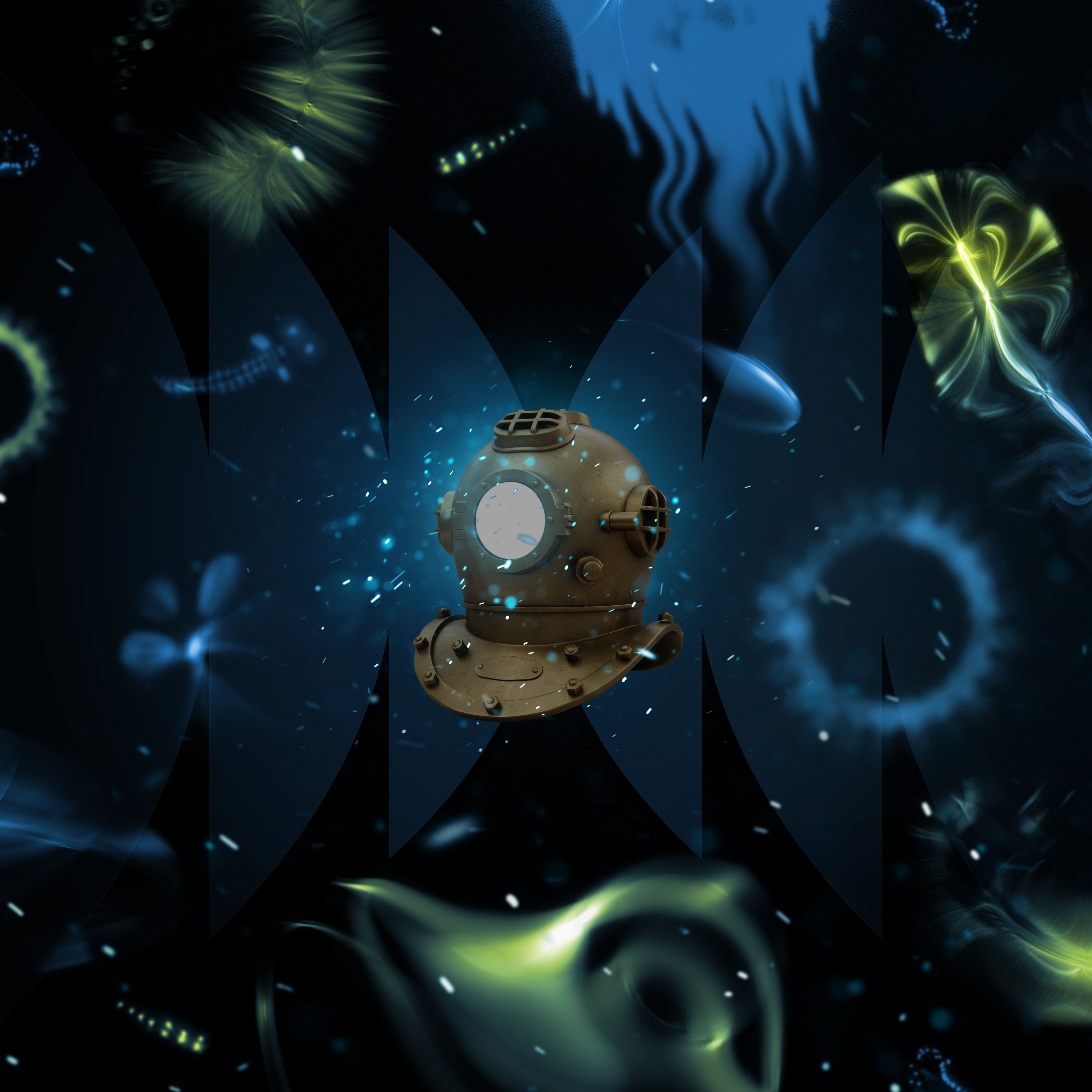
The Glow Below
LATERAL CUTS (Other Radiolab episodes you may like):
Octomom - https://radiolab.org/podcast/octomom
The Darkest Dark - https://radiolab.org/podcast/the-darkest-dark
EPISODE CITATIONS:Documentary - Coming soon, there’ll be a new doc about Edie’s life and work studying bioluminescence in deep sea creatures. According to Edie, “A Life Illuminated”, contains some of the best deep sea bioluminescence footage ever recorded. It’s from our friends at Sandbox Films, and director Tasha Van Zandt.https://www.sandboxfilms.org/films/a-life-illuminated/Books - Edie Widder wrote a memoir! Go read, “Below the Edge of Darkness: A Memoir of Exploring Light and Life in the Deep Sea”.https://www.penguinrandomhouse.com/books/564185/below-the-edge-of-darkness-by-edith-widder-phd/Videos - It’s not in the episode, but a few years back, Edie’s fame reached new heights when she captured footage of a never-before-seen Giant Squid … here’s the story, and video.https://www.youtube.com/watch?v=krDdv9KLmuM
Articles -
A look at some glowing shrimps.https://zpr.io/3jyHWi7VFBw5A photogallery of different types of deep sea glow, from different types of deep sea creatures, including one of counterillumination, which Edie talks about in the episode.https://zpr.io/hdFFsArGjhau
Signup for our newsletter!! It includes short essays, recommendations, and details about other ways to interact with the show. Sign up (https://radiolab.org/newsletter)!
Radiolab is supported by listeners like you. Support Radiolab by becoming a member of The Lab (https://members.radiolab.org/) today.
Follow our show on Instagram, Twitter and Facebook @radiolab, and share your thoughts with us by emailing radiolab@wnyc.org.
Leadership support for Radiolab’s science programming is provided by the Simons Foundation and the John Templeton Foundation. Foundational support for Radiolab was provided by the Alfred P. Sloan Foundation.
Press play and read along
Transcript
Speaker 1 Radiolab is brought to you by Progressive Insurance. Do you ever find yourself playing the budgeting game?
Speaker 1 Well, with the Name Your Price tool from Progressive, you can find options that fit your budget and potentially lower your bills. Try it at Progressive.com.
Speaker 1 Progressive Casualty Insurance Company and Affiliates. Price and Coverage Match Limited by State Law, not available in all states.
Speaker 2 WNYC Studios is supported by ATT, offering a guarantee covering both wireless and fiber internet service that is all about having your back. Staying connected matters.
Speaker 2
That's why ATT has connectivity you can depend on, or they'll proactively make it right. That's the ATT guarantee.
Visit ATT.com slash guarantee to learn more. Terms and conditions apply.
Speaker 2
Visit ATT.com slash guarantee for details. ATT, connecting changes everything.
WNYC Studios is supported by Apple TV.
Speaker 3
It's 1972. A A young British family is attempting to sail around the world when disaster strikes.
Their boat is hit by killer whales and it sinks in seconds.
Speaker 3 All they have left is a life raft and each other.
Speaker 3 This is the true story of the Robertson family and their fight to survive, hosted by me, Becky Milligan. Listen to Adrift, an Apple original podcast produced by Blanchard House.
Speaker 3 Follow and listen on Apple podcasts.
Speaker 5 Wait, you're listening. Okay.
Speaker 5 All right.
Speaker 5 Okay.
Speaker 5 You're listening
Speaker 5
to Radio Lab. Lab.
Radio Lab. From
Speaker 1 WN Weiss.
Speaker 4
This is Radio Lab. I'm Molly Webster.
I'm going to open up the show today with Deep Sea Explorer and Oceanographer Edie Witter.
Speaker 5 I'm still here. Ready to go.
Speaker 4 Why don't you tell me how you bumped into our friend?
Speaker 5 Our friend, the giant squid?
Speaker 4 No, our friend, the anglerfish.
Speaker 5 Oh, the anglerfish. I'm here for the small.
Speaker 4 I called Edie because I wanted to talk to her about anglerfish and this kind of weird thing I had heard about their immune systems and how they mate with each other.
Speaker 5 Wanted to be, but never.
Speaker 4 But then Edie wooed me with a story that had to do with none of that about being a grad student in the 80s, working on the back of a boat and pulling sea creatures out of the deep.
Speaker 5 I was going to sea on ships with a scientist who had developed a way to bring animals up from the deep sea alive.
Speaker 5
So they usually come up dead when you bring them up in the net because of temperature changes. They're basically cooked alive.
Oh, wow.
Speaker 5 So he had developed what was called a thermally insulated closing cod end that went on the end of a net. And so you'd bring them up and they'd still be alive.
Speaker 5 So, you know, they'd be swirling around in that tub and you'd have to plunge your hand into this icy cold water, and your hand would go completely numb.
Speaker 5 And one of the first animals I pulled out was this bright red shrimp, about the size of a hamster, and it was squirting neon blue light out of tubes on either side of its mouth.
Speaker 5 And it pulled in my hand and then dripped between my fingers back into the tub. Really? It was astonishing.
Speaker 4 What was it like to hold
Speaker 4 dripping light?
Speaker 5
I can't describe it any other way. I mean, it was cold light, and it was brilliantly blue.
If you're fully dark adapted, bioluminescence can look very bright.
Speaker 5 And it went on glowing in the water and then kind of swirled around and disappeared.
Speaker 4 Wow, I can't even...
Speaker 4 Because I didn't, I guess I always think of light or something that creates light as like in a container, you know, like almost like a light bulb has a border. I never think of it as like oozy.
Speaker 5 Oh for me it was revelatory.
Speaker 5 I just couldn't believe that all of this existed. And you know at that time you could pick up a marine biology textbook and find no mention of bioluminescence.
Speaker 4 No way. Oh really?
Speaker 5
Yes. It's not that they didn't know about it.
It just didn't think it was very important.
Speaker 4 After that experience, Edie spent the next 40 years and counting, because she's still going, chasing the light, diving into the ocean over and over and over again in search of creatures that glowed like the shrimp.
Speaker 4 How many times have you gone down 3,000 feet in the ocean?
Speaker 5 I stopped counting after about 300.
Speaker 5
I'm in the hundreds, definitely. Wow.
Oh yeah, so many things I've seen from submersibles that I'm pretty sure nobody's ever seen.
Speaker 4 Edie has plunged into the unknown in a way that few few people on the planet ever have.
Speaker 4 And so I very quickly abandoned my sort of angler fish interest and I just followed her into the deep, into a world of brilliance and color where light
Speaker 4 suddenly comes to life.
Speaker 5 My first open ocean dive was in the Santa Barbara Channel. I was testing this diving suit called WASP that was developed by the offshore oil industry for diving on oil rigs down to 2,000 feet.
Speaker 4 Is it like you're in like an astronaut suit that you can like control?
Speaker 5 Yeah, it's exactly like an astronaut suit. It's got a plexiglass bubble for the head, Michelin man arms,
Speaker 5 no legs for walking on the bottom, just a pod with thrusters that are attached to it, and you control the thrusters with foot switches. on the bottom of the suit.
Speaker 5
It's like being in a fishbowl, but the fish are on the outside and the people are on the inside. You're the fish.
Yep.
Speaker 4 Wait, your first like big dive was in this like marshmallow man suit? Yep.
Speaker 5 But that first dive was just to be to 800 feet to make sure I wasn't going to have a claustrophobic meltdown.
Speaker 4 Oh my God, you are so gutsy.
Speaker 4 Did you get nervous? Yeah.
Speaker 5 Okay.
Speaker 5 I was nervous.
Speaker 5 It was an early evening dive
Speaker 5 and
Speaker 5 they lowered me off the back of the ship
Speaker 5 and
Speaker 4 I'm just imagining kind of an ungainly splash when you hit the water.
Speaker 5 Yeah, that's about right.
Speaker 5 And they got down to 800 feet and
Speaker 5 I turned out the lights.
Speaker 5 And I was instantly
Speaker 5 in the center of this fireworks display
Speaker 5 and I was just blown away by how much light there was all around me
Speaker 5 just sparkles and glows and squirts squirts squirts
Speaker 5 all of it different shades of brilliant brilliant blue oh blue all blue oh I was imagining yellow no blue is the color that travels farthest through seawater and so most of it by far is blue hmm and is it pointalistic glowing?
Speaker 4 Like, is it dots, or is it like some of it's dots
Speaker 5 streaming things, some of it's like a little smoke cloud, or it can be a little cloud of particles. So cute.
Speaker 5 The weirdest thing for me, though, was that when I turned on the lights,
Speaker 5 there was almost nothing in the water column that I could identify as a potential source for all this luminescence that I was seeing.
Speaker 5 But you couldn't see it with the lights on.
Speaker 4 You have to turn the lights off to actually see what you want to see.
Speaker 5 Right.
Speaker 4 And could it all have been the same thing? Or do you think it was many different things?
Speaker 5 That first dive, it was many different things, but I was just overwhelmed by how much luminescence there was. And
Speaker 5 my brain was racing as they pulled me up because I just thought, you know,
Speaker 5 this is so important, but how the hell do you study it if you turn on the lights and there's nothing there?
Speaker 4 and why did you think it was so important
Speaker 5 because
Speaker 5 it takes so much energy to produce light to use that much energy so critical to life that um i mean there was no question this had to be about life or death
Speaker 5 There have been experiments that have been done that have found, for example, if you starve bioluminescent copepods, they will give up the ability to make eggs before they give up the ability to make light.
Speaker 5
Wow. Because they use their light for defense in that particular case.
And so
Speaker 5 they can't live without their bioluminescence.
Speaker 4 Wait, so it's so, yeah, tell me about the different ways these animals use bioluminescence.
Speaker 5 So one way is to find food. So a lot of them have like fish and squid and shrimp that have built-in light organs next to their eyes that they use like flashlights to be able to see in the dark.
Speaker 5 There are animals that have oddly shaped light organs that allow the male to find this female of his species to mate with, so to attract a mate. There's
Speaker 5 animals that will use every light organ they've got, which may have many different functions, but they'll flash like crazy if they're caught in the clutches of a predator because their luminescence is functioning as what's known as a bioluminescent burglar alarm.
Speaker 5 It's meant to attract the attention of larger predators that may attack their attacker and therefore afford them an opportunity for escape.
Speaker 5 And then there is a huge amount of it that's used for camouflage, something that's called counterillumination.
Speaker 5 A lot of them will produce bioluminescence from their bellies that exactly matches the color and intensity of sunlight filtering down from above to camouflage their silhouette.
Speaker 5 And if a cloud goes over the sun and dims the sunlight, they dim their bioluminescence.
Speaker 4 That quickly? They can respond that quickly?
Speaker 5 Absolutely.
Speaker 5 The cookie cutter shark, which is one of my favorites, produces bioluminescence from its belly.
Speaker 5 It's the most perfect counterillumination pattern you've ever seen because the light organs are so small that it just completely disappears. It's the perfect cloaking device.
Speaker 4 But like, if the sun is passing over and then a cloud passes over the sun, like, how does it sense like the right amount of
Speaker 4 light shift that must occur and then quickly adapt it? Well that's like how can it read the light?
Speaker 5
That is an excellent question. So some of them actually have a light organ above their eye that they can see.
They can see that light organ relative to the background light to be able to adjust.
Speaker 5 to exactly match. Some of the others, we're not sure how they do it because they don't seem to have a sensor system, a feedback like that.
Speaker 4 Edie just kept going back again and again to how much we don't know about the deep sea, like how light is used, how light is made.
Speaker 4 And then she had so many cool weird stories about like these convoluted, almost gothic light organs.
Speaker 5
There is one type of anglerfish known as the bearded sea devil. Okay.
It's got a luminescent lure on its forehead to attract food, the way most anglerfish do, but it's got a chin barble
Speaker 5 on its chin. And the absolutely insane thing about this is not only that it's got these two completely different light organs on its head, but the one coming out of its chin is
Speaker 5 intrinsic chemistry, luciferin and luciferase, but the one coming up out of its forehead is bioluminescent bacteria.
Speaker 4 The anglerfish literally has kind of a bauble that comes out over its forehead and has bioluminescent bacteria tucked inside of it.
Speaker 5 Right.
Speaker 4 Where does the bacteria come from? Like, does it find the fish early in life or is it like birthed with the fish?
Speaker 5 Well, a lot of these bioluminescent bacteria are available in ocean water. And so it's thought that they pick the bacteria up from the environment.
Speaker 5 But the weird thing about bioluminescent bacteria is bacteria glow all the time
Speaker 5 because their light output is linked to their, what is basically their breathing their respiratory chain so as long as they've got enough oxygen they just go on glowing so some of these angler fish control the light output by just controlling the amount of oxygen I mean it's different in different fish some of them do it by having a mechanical shutter that just covers the light organ almost like an eyelid yes there's some flashlight fish
Speaker 5 that have an eyelid that closes up over the light organ to be able to block out the glowing bacteria.
Speaker 5 There's others that roll the whole light organ back into their head, like the headlights on your Lamborghini.
Speaker 5 What? Yep.
Speaker 4 I really, this is so, I just think of light as like so passive in a way, like the fact that it's so active
Speaker 4 and alive feeling.
Speaker 5 That's exactly right.
Speaker 5 I've always taken bioluminescence as an indicator of life, and I think it's got a lot to tell us about life in the ocean. Like
Speaker 4 what?
Speaker 5 Where it is,
Speaker 5 how the carbon pump is functioning.
Speaker 5 You know, but like
Speaker 4 those are, but even more than that, it feels like almost the idea of having another eye on my body
Speaker 4 that is searching around and reading the environment and then changing what I look like to match that environment. It feels like
Speaker 4 super intelligence.
Speaker 5 It's super evolution.
Speaker 4 We'll be back in just a minute.
Speaker 6 Radiolab is supported by Built. Nobody wants to pay rent, but if you have to, Built works to make it more worthwhile.
Speaker 6 By paying rent through Built, you can earn flexible points that can be redeemed toward hundreds of hotels and airlines, a future rent payment, your next lift ride, and more. But it doesn't stop there.
Speaker 6 You can dine out at your favorite local restaurants and earn additional points, get VIP treatment at certain fitness studios, and enjoy exclusive experiences just for BILT members every month.
Speaker 6 Earn points on rent and around your neighborhood, wherever you call home, by going to joinbuilt.com/slash radio lab. That's J-O-I-N-B-I-L-T.com slash radio lab.
Speaker 4 Hey, I'm Molly Webster, and this is an ad by BetterHelp.
Speaker 4 So it happens every year, the seasons are changing, the days are getting shorter, and basically, once it becomes dark outside of my window, I feel like the rest of the world disappears, and I'm just alone, and there's nothing left to do but watch television.
Speaker 4 This November, BetterHelp is asking everyone to reach out to our people. That could be your family, your friends, your neighbors, and to resist this call of the cocoon.
Speaker 4
And yeah, reaching out can take some courage. I've got text messages from January I haven't responded to.
And you know what? I'm gonna write them back right now. Hi.
Sorry, I've been missing.
Speaker 4 How are you?
Speaker 4 Why don't we all do this sooner? Therapy is the same way. BetterHelp makes it easier to take that first step.
Speaker 4 You just fill out a short questionnaire and they find a licensed therapist who they think you'll like. Our listeners get 10% off their first month at betterhelp.com/slash radiolab.
Speaker 4 That's better H-E-L-P
Speaker 4 dot com/slash radiolab.
Speaker 6 Radiolab is supported by ATT.
Speaker 6 There's nothing better than that feeling like someone has your back and that things are going to get done without you even having to ask, like your friend offering to help you move without even having to offer drinks and pizza first.
Speaker 6 It's a beautiful thing when someone is two steps ahead of you, quietly making your life easier. Staying connected matters.
Speaker 6 That's why, in the rare event of a network outage, ATT will proactively credit you for a full day of service. That's the ATT guarantee.
Speaker 6 Credit for fiber downtime lasting 20 minutes or more, or for wireless downtime lasting 60 minutes or more caused by a single incident impacting 10 or more towers.
Speaker 6
Must be connected to impacted tower at onset of outage. Restrictions and exclusions apply.
See ATT.com/slash guarantee for full details. AT ⁇ T, connecting changes everything.
Speaker 1 Radiolab is supported by Planet Visionaries, the podcast created in partnership with the Rolex Perpetual Planet Initiative. Stay tuned for a trailer and subscribe wherever you get your podcasts.
Speaker 7 I'm Alex Honel, professional rock climber and founder of the Honnell Foundation.
Speaker 7 I wanted to let you know about a brand new season of the Planet Visionaries podcast in partnership with the Rolex Perpetual Planet Initiative.
Speaker 7 This is the podcast exploring bold ideas and big solutions from the people leading the way in conservation.
Speaker 7 Join me in conversation with the likes of climate champion Mark Ruffalo, biologist and photographer Christina Mittermeyer, and one of the most successful conservationists of our time, Chris Tompkins.
Speaker 7 Join us on Planet Visionaries wherever you get your podcasts.
Speaker 5 I have one answer for a question you didn't ask.
Speaker 4 Oh, please tell me. I love those.
Speaker 5 Is how did bioluminescent bacteria come to be?
Speaker 4
Oh, my God. This is Radiolab.
I'm Molly, and we are back with Edie.
Speaker 5 Because this was a hotly contested topic when I was a graduate student, because the conundrum was that a single bacterium does not produce enough light to be seen by any known organism.
Speaker 5 So how how could there be a selective advantage to producing light? How could it ever be selected for?
Speaker 5 Well, there were some experiments done a few years back by some Polish scientists where they had light producing bioluminescent bacteria and a dark strain, and they mixed them together.
Speaker 5 And when they grew them in a dish, the dark strain always overgrew the light strain because it takes energy to produce bioluminescence.
Speaker 5 So further questions about, you know, what could possibly be the selective advantage when it's energetically costly to produce light.
Speaker 5 But if they irradiated that dish then with UV light, then suddenly the thing flipped and now the light producing cells had the advantage and they overran the dish.
Speaker 5 And it turned out the reason was a enzyme called photoliase
Speaker 5 that repairs DNA damage from UV light. which happens in the upper ocean.
Speaker 5 And so
Speaker 5 the light light produced by a single dinoflagellate was enough to activate this light-activated enzyme called photoliase. And so the selective advantage had nothing to do with vision initially.
Speaker 5 It had to do with protection against UV light.
Speaker 4 So hundreds of millions of years ago, there were these tiny cells out in the ocean and they glowed.
Speaker 4 And even though no one could see it, it made a difference because it let them heal their DNA that was damaged by the sun.
Speaker 4 But as these creatures went deeper and deeper into the ocean, the sun started mattering less and the glow started mattering more. They could use it to lure and to lie, to hunt or mate or survive.
Speaker 4 And it's into this world that Edie goes, basically just to observe and study it until one day, almost by accident, she becomes a part of it.
Speaker 5 In 1985, I got to pilot a single-person submersible called Deep Rover.
Speaker 5 And what I discovered with that, which was
Speaker 5 a major breakthrough in understanding the nature of the visual environment in the deep sea, was if I trimmed the sub-out
Speaker 5 to neutral buoyancy and just made it as dark as I possibly could, I had black tape, so I blackened out any little indicator lights
Speaker 5 and I waited
Speaker 5 and I waited
Speaker 5 and I waited. Nothing.
Speaker 5 Just as black as black you can imagine. But if I activated the thrusters,
Speaker 5 there would be these vortices of light swirling up out of the thrusters and particles streaming back over the sphere and just light all around me.
Speaker 5 With later dives, I discovered that I I could also stimulate it by turning the lights on and off.
Speaker 5 I think it was probably one of the pilots that alerted me to it originally, where you just flick the lights on and off, and
Speaker 5 everything surrounding you seems to come on in unison
Speaker 5 and then fade out in unison.
Speaker 5 It's a phenomenon we call the flashback phenomenon.
Speaker 4 And how long is the flash that you put out?
Speaker 5 It would be on, off, on, off,
Speaker 5 and on the second flash,
Speaker 5 you are surrounded by all of these things lighting up. We actually don't know what is flashing back at us, which makes it even more intriguing.
Speaker 5 But I think what I'm seeing with the flashback is bioluminescence in marine snow.
Speaker 5 Marine snow are all of these particulate organic matter that filters down through the ocean and is the base of the food food web in the deep ocean. So, plankton photosynthesizing at the surface die,
Speaker 5 and as they sink through the ocean, they often are described as looking like marine snow, these flocculent white particles.
Speaker 5 And some marine snow is bioluminescent,
Speaker 5
and it seems to be bioluminescent because of bacteria. And so, when you bump the particle, you're introducing oxygen into the marine snow environment, and you create light.
I see.
Speaker 5 I think the reason that the light stimulus works is because there are cyanobacteria also in marine snow, and you're activating photosynthesis, which produces oxygen.
Speaker 4 And do you think it's all marine snow that's doing the flashback, or are there other creatures that are also doing it?
Speaker 5 Mostly the marine snow.
Speaker 5
We would occasionally see something identifiable like a tamopterid worm. That was particularly recognizable because it's yellow.
It almost looks like gold. It's so beautiful.
Speaker 4 Edie doesn't know for sure what's happening, but she thinks that the flashback is a natural phenomenon, that it's actually something that's happening between the deep sea creatures when she's not there.
Speaker 4
So a fin brushes the water and mixes in oxygen and it gets bacteria to light up. Or a light on a fish's belly flashes and it makes photosynthesis happen.
And again, the world comes alive.
Speaker 4 And Edia believes that this back and forth with light is not accidental, but that it's purposeful.
Speaker 5 The bacteria glow in order to be eaten. They want to be eaten, excuse the anthropomorphism,
Speaker 5 but it is to their advantage to be eaten because then they are reintroduced into the food-rich environment of a fish's gut.
Speaker 4 And that when she does that flashback with the creatures in the deep sea, in a sense, she's become one of them. So her submarine thruster is like a fin, or her flashlight is like a lure.
Speaker 4 And in those moments, she's become part of the dance.
Speaker 5 It's just such a remarkable feeling. I'm not a poet,
Speaker 5 but there's no question I feel a tremendous sense of awe.
Speaker 5 Very often the feeling of, you know, I want to stay here, I want to understand this.
Speaker 5 I mean, that's, that's key to who we are as human beings.
Speaker 5 You know, we were, we were born as strangers in a strange land. We don't know anything when we're born.
Speaker 5
And our survival on the planet has been to explore the world around us and share that information. And I think that there's something very innate in us that responds to that.
And
Speaker 5 others that I have shared it with have had the same experience.
Speaker 4 I don't have a ton of experience with bioluminescence, but I always have, but one story always sticks with me, which is, and I've never seen this happen before, but I grew up in a kind of rural Ohio in farm country, and we had a pond.
Speaker 4 And my parents sold the property that we grew up on. And my very last night at the property, I
Speaker 4 went out for a walk at night. Like I loved walking around in like the woods and listening to night creatures and stuff.
Speaker 4 And so I went for a walk and I walked down to the edge of the pond and the whole edge where the water met the soil was all lit up.
Speaker 5 Glowing.
Speaker 4 And yeah, it was like all bioluminescent.
Speaker 5 And I've that had to be bacteria.
Speaker 4 And like, where would it suddenly come from?
Speaker 5
Well, something organic in the water, but that's still, it's surprising. You don't see that very often.
um
Speaker 4 wow that's that's an interesting story actually it was so beautiful and i actually went back inside and woke my parents up and uh and they we all marched down to the pond and just stood there and like looked at this glowing um see now there's a mystery that needs to be solved we do i i can't tell you for sure what that was but it's so powerful
Speaker 5 i think it's interesting that people that have had interactions with bioluminescence sometimes often rank them as
Speaker 5 their m most meaningful lifetime experiences that they carry with them throughout their lives. It's interacting with life.
Speaker 5 It's life illuminated.
Speaker 5 And there's this interactivity to it where you're making things happen. You know,
Speaker 5 you're in a bioluminescent bay and you run your hand outside your kayak and, you know, off of every fingertip, you've got sparkles. It's like being Merlin.
Speaker 4 Yeah, there is like a deep communication. It almost feels like you're like saying something to each other that
Speaker 5 it's a form of communication. I've somewhat provocatively tried to claim several times that it may be the most common form of communication on the planet.
Speaker 5 Partly depends on how you define communication.
Speaker 4 And what do you think you're communicating, and what do you think it is communicating back to you?
Speaker 5 I'm most focused on what it's communicating back to me. I have no idea.
Speaker 5 Okay.
Speaker 5 Actually, there have been a few times when I've communicated with luminescent animals. And
Speaker 5 in one case, there were some deep-sea shrimp that I was getting a great response out of. And I had no idea what I was saying, but I was pretty sure it was something sexy.
Speaker 4 Why?
Speaker 5 Because that was the kind of response you'd expect from
Speaker 5
a crustacean that was responding to a titillated. Yeah.
was putting out a string of dots in the water.
Speaker 4 A string of
Speaker 5 glowing pearls. Yeah.
Speaker 4 And that's what it does when it's like turned on, when it's like, hey, come hither. Yeah.
Speaker 4 So you do believe that there's like some sort of messaging in the light.
Speaker 5
Like they can be. Oh, there can be, yes.
And definitely some of these animals have pretty elaborate displays. And
Speaker 5 I think they're communicating something important, but we have done so little actual observing that we most of it's guesswork.
Speaker 4 And so, you, when you're like down there flashing, you're like, I'm gonna flash three times, and I don't know if in shrimp language that means something.
Speaker 4 We'll just see what happens.
Speaker 5 Yep.
Speaker 5 Best job in the world.
Speaker 4 This episode was produced by Maria Paz Gutierrez with original reporting and production help from me, Molly Webster. I want to thank Dr.
Speaker 4 Edie Witter, who is the CEO and senior scientist at the Ocean Research and Conservation Association.
Speaker 4 If you're interested in seeing more of Edie's work, it just so happens that there is a documentary that is soon to drop about her. It's currently making the rounds at festivals.
Speaker 4
It is called A Life Illuminated. It's by our friends over at Sandbox Films and director Tasha Van Zandt.
And Edie says it has some of the best underwater footage of bioluminescence ever recorded.
Speaker 4 But you know what? If you're too impatient to wait for that documentary, if you just want to go see it all, you can totally do that, you know.
Speaker 5 Wait, how? Oh, there's commercial operations.
Speaker 4 Like, how deep do they go?
Speaker 5 Uh, 2,000 feet.
Speaker 4 Are these going to cost me like my, like, like $50,000?
Speaker 5 Oh, they
Speaker 5 might be great, yeah. Something like that.
Speaker 5 Okay.
Speaker 4 Okay, well, I'll work on that public radio team.
Speaker 5 Good luck.
Speaker 4 If you are interested in more deep sea stuff, Radiolab has got the content for you. I would say go check out Octomom, which is about an octopus and her brood of eggs.
Speaker 4 It also happens to feature a diving buddy of Edie's. And then we also produce something called The Darkest Dark, which is about darkness.
Speaker 4 And it features a former mentee, now colleague of Edie, because apparently nothing happens in the deep sea that Edie Witter doesn't know about. I don't actually know if that's true,
Speaker 4
but for now, I will just say thank you so much for listening. This is Radio Lab.
I'm Molly Webster.
Speaker 5 Goodbye.
Speaker 8
Hi, I'm Basetkari, and I'm from Somerset, New Jersey and here are the staff credits. Radio Lab is hosted by Lulu Miller and Latif Nasser.
Soren Wheeler is our executive editor.
Speaker 8
Sarah Sandback is our executive director. And our managing editor is Pat Walters.
Dylan Keefe is our director of sound design. Our staff includes Simon Adler, Jeremy Bloom, W.
Speaker 8 Harry Fortuna, David Gable, Maria Paz Gutierrez, Sindhu Niyasambandham, Matt Kielty, Mona Medgafker, Annie McEwen, Alex Neeson, Sara Kari, Anissa Witsa, Ariane Wack, Molly Webster, and Jessica Young, with help from Rebecca Rand.
Speaker 8 Our fact checkers are Diane Kelly, Emily Krieger, Anna Pujol-Mazzini, and Natalie Middleton.
Speaker 9 Hi, I'm Maddie, and I'm from Frederick, Maryland. Leadership support for Radiolab science programming is provided by the Simmons Foundation and the John Templeton Foundation.
Speaker 9 Foundational support for Radio Lab was provided by the Alfred P. Sloan Foundation.
Speaker 1 Radiolab is supported by the National Forest Foundation, a nonprofit transforming America's love of nature into action for our forests.
Speaker 1 Did you know that national forests provide clean drinking water to one in three Americans? And when forests struggle, so do we.
Speaker 1 The National Forest Foundation creates lasting impact by restoring forests and watersheds, strengthening wildfire resilience, and expanding recreation access for all.
Speaker 1 Last year, they planted 5.3 million trees and led over 300 projects to protect nature and communities nationwide. Learn more at nationalforests.org/slash radiolive.
Speaker 10
Birds chirping, leaves rustling, a neighbor's doorbell ringing, his dog says hello, your wife hums that song she loves. Your morning is full of sounds that make your day come alive.
Don't miss them.
Speaker 10 Take control of your hearing with exclusive access to savings on hearing aids, transparent pricing, and flexible support packages.
Speaker 10 Available for all AARP members through AARP Hearing Solutions provided by United Health Care Hearing. Visit AARPHearingsolutions.com/slash new today.