The Long Road Home for Gazans
Rachelle Bonja, a producer of “The Daily,” recently spoke by phone with three Gazans who were making or contemplating the journey home. One of them, Saher Alghorra, is a photojournalist who often works with The Times; another is Nidal Kuhail, a former restaurant worker whom The Times has spoken to over the course of the war.
The third is Hussein Khaled Auda, a former bodybuilder who ran a small gym in Jabalia. Mr. Auda’s story is about his family. His four young children were killed in airstrikes during the war, and his wife was seriously injured. He has been traveling back home in large part to find and bury the remains of two of his children, who had been in the rubble of his house after one of the airstrikes. We interviewed his wife, Rawa, and other relatives, and reviewed death certificates and video footage to help understand what happened to his family.
In our reporting, The Times also learned that a cousin of Mr. Auda’s was a senior leader of Hamas in Gaza who was killed during the war last year. The Times asked Mr. Auda if he himself had any ties to Hamas. He said he was not a member of Hamas and not political, and had dozens of cousins. He said he had seen the one affiliated with Hamas just a couple of times in his life.
Like other news organizations, The Times has not yet been able to send its own staff journalists into Gaza unescorted. This episode, like many other Times pieces for more than two years, seeks to help our audience understand the experiences of Gazans during a devastating war.
Press play and read along
Transcript
Speaker 1 This podcast is supported by USA for UNHCR, the UN Refugee Agency. Right now, millions of refugees are facing deadly winter conditions without essentials to stay warm.
Speaker 1
Your donation can rush relief within 72 hours of an emergency. $15 provides a kitchen set to make warm meals.
$60 delivers 10 thermal blankets. $95 supplies warm winter clothes to a child.
Speaker 1 Every gift helps someone stay warm this winter. Donate at unrefugees.org/slash the daily.
Speaker 2 I wanted to ask you because I know that you were one of the people that actually went back today.
Speaker 2 So I was wondering if you could tell me a little bit more about your journey. I wonder if you could tell me that story.
Speaker 2 Every house, every section, everything looked different.
Speaker 2 Everything had changed on the way. And it was a strange feeling.
Speaker 2 We had the strange feeling that this place that we had known
Speaker 2 was different from the way that we'd remembered it.
Speaker 2 Can you describe what looked different?
Speaker 2 So, can you make the question easier by telling me what
Speaker 2 actually stayed the same? Because this question is too hard to answer.
Speaker 4 From the New York Times, I'm Rachel Abrams, and this is the daily
Speaker 4 Earlier this month, after Israel and Hamas reached a ceasefire agreement, the Israeli military said it would pull back from certain areas of Gaza.
Speaker 4 This meant that some Palestinians who'd been displaced to the south could try to return home to the north.
Speaker 4 Foreign journalists still aren't allowed inside Gaza.
Speaker 2 Okay, so I'm going to speak to him in Arabic first. I'm going to explain the whole setup, and then I will start speaking in English.
Speaker 4 So daily producer Rochelle Banja spoke with Gazans by phone
Speaker 4 and followed them on their journeys north, along a seaside road and through parts of Gaza that have been devastated by two years of war as they tried to return home.
Speaker 2 Um, you're going back to your house, it's destroyed. Why would you go?
Speaker 2 It's so hard to describe the pain of being away from your own house.
Speaker 2 So, the second that I heard that I could go back, I didn't think about it. Immediately, I knew in my heart that it was time for me to go back.
Speaker 4 It's Thursday, October 30th.
Speaker 2 The city of Khan Yunis in the south of Gaza was once known by Gazans for having some of the best watermelon in the region.
Speaker 2 In the days following the October 7th attacks, it became known as a Hamas stronghold and it turned into a focus of Israeli bombardment.
Speaker 2 More recently, Khanyunes has become an area where displaced families from across Gaza have sought refuge, waiting for an end to the war.
Speaker 2 And when the ceasefire was announced three weeks ago, Khanyunis was transformed again as people spilled onto the streets to celebrate.
Speaker 2 Watching them, there was a photojournalist named Sahel Ghara.
Speaker 2 He was there capturing the moment for the New York Times.
Speaker 2 So, you mentioned that you were taking photos of people after the ceasefire.
Speaker 2 Was there something that stood out to you?
Speaker 2 What touched me the most was the children.
Speaker 2 They were jumping, they were laughing,
Speaker 2 and they were blowing bubbles
Speaker 2 and
Speaker 2 they were chanting things like we don't want to die anymore,
Speaker 2 saying things like ceasefire, ceasefire.
Speaker 2 And I, as a photojournalist, had been taking a lot of photos of children that were displaced, that were dying, that were disabled because of the war.
Speaker 2 And I just had imagined all of these difficult moments that these children had gone through and the fear they went through when they would hear these airstrikes, the pain that they felt when they lost their parents.
Speaker 2 And so I just was really touched when I saw these children finally feel this little moment of joy.
Speaker 2 So after that, I went to Wadi Gaza, where there is the pathway that goes to the north, and there there were people waiting for the road to open to the north.
Speaker 2 And there was like almost like a checkpoint.
Speaker 2 And then the road opened, and the road was like all rubble, and then people just rushed in at once
Speaker 2 and I started walking in with them.
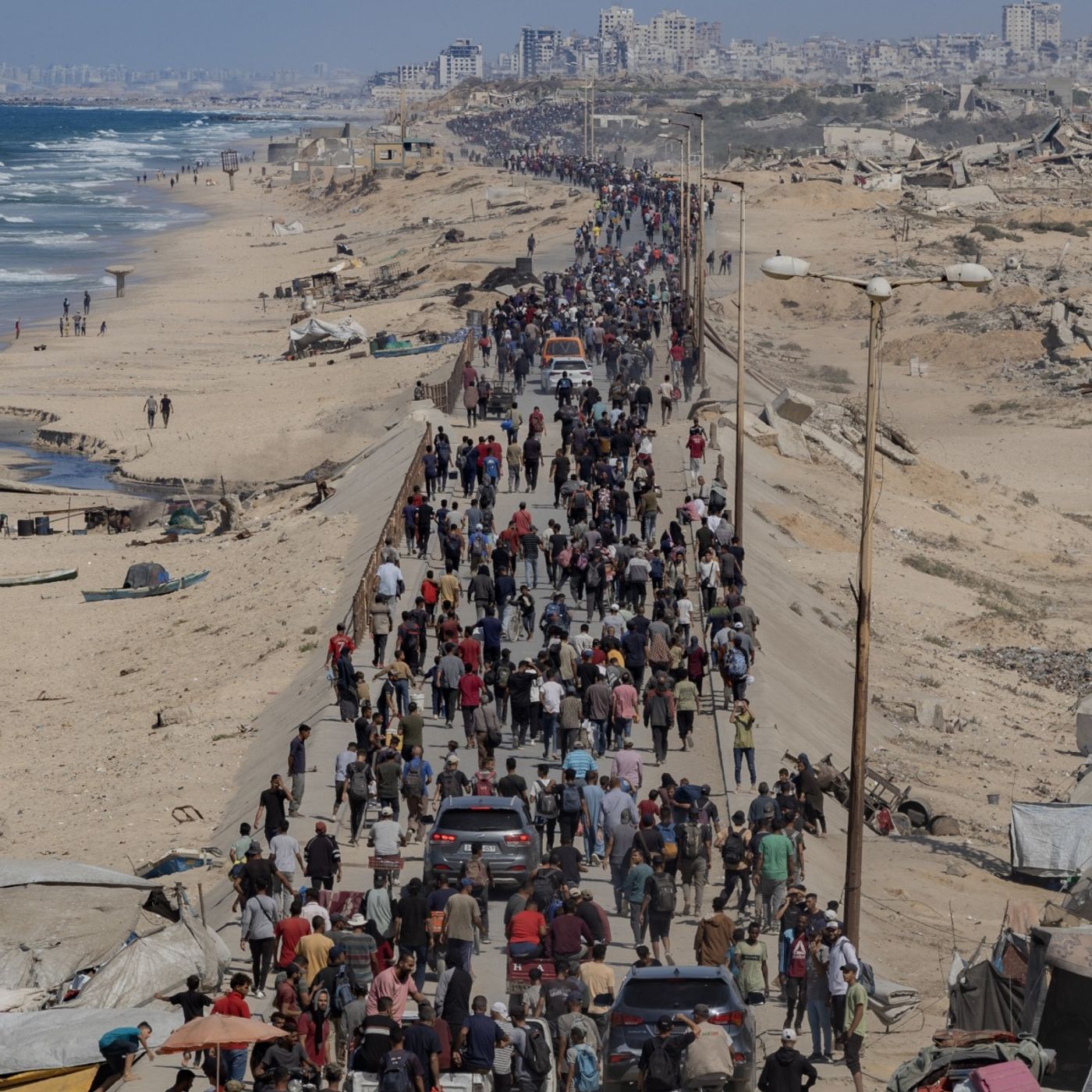
Speaker 2 To go home, to go north, many people traveled on this one road, El-Rashid Street, the seaside road.
Speaker 2 It runs along the coast on the western side of the Gaza Strip, connecting cities like Khan Yunis in the south to Gaza City in the north.
Speaker 2 When the ceasefire went into effect, that road reopened and people were finally able to return to what's left of their homes. Sehir joined them and started walking north.
Speaker 2 So I was walking, there were thousands of Palestinians who were all walking by foot and they were sort of carrying their bags and they have a few things in them and they're all walking and it's very dusty.
Speaker 2 And on the road there's also a man selling roasted peanuts to people who are walking by.
Speaker 2 There were some people that were not walking, they were on other traditional forms of transportation like a tuk-tuk or like a car
Speaker 2 and they had like their horn on like the whole time because they wanted to get there really really fast.
Speaker 2 They were really excited and they just wanted to make sure that people in front of them would make space for them.
Speaker 2 I guess I'm wondering: did people seem different?
Speaker 2 So, people's personalities have changed so much, it's hard to describe.
Speaker 2 When I used to take photos of people getting displaced, people would come up to me and they would complain and they would say, Why are you taking photos of me?
Speaker 2 But now they're saying the opposite they're saying please take my photo
Speaker 2 why why do you think that they want you to take photos of them now
Speaker 2 it's because of the situation that they're in there's a difference when you're getting displaced and when you're coming back to your house and you know even today I saw people were wearing their nice clothes because they were going back to their homes
Speaker 2 and so they were ready to get their photos taken.
Speaker 2 Farther north, the seaside road passes by a place called Nusayra.
Speaker 2 That's where I reached Nidal Kuhayl.
Speaker 2 Unlike Zahir and thousands of other Palestinians who were walking north that day, Nidala was sitting in a cafe. He was watching videos of those scenes on his phone.
Speaker 2 Are you planning to go back to your place in the north of Gaza now that the ceasefire has happened?
Speaker 2 So of course,
Speaker 2 but the place that my house is is still in a place where the operations are ongoing and it's unknown what has actually happened to my house.
Speaker 2 The information that we have is based on the news that said that everything in that neighborhood was destroyed. And so based on that, it's very possible to think that my house was destroyed.
Speaker 2
Nidal is 31. He used to work as a waiter in what he describes as a famous Thai restaurant in Gaza.
It was called Al-Tai Landi. The place was destroyed in the war.
Speaker 2 For the past few weeks, Nidal's been living in Usayrad camp with five of his seven sisters and his parents since they had to leave their home in the north.
Speaker 2 Can you describe that house for us as best as you remember it?
Speaker 2 So, the house, I remember it very well.
Speaker 2 And my dad built this house. It was a piece of land that my family owned.
Speaker 2 It was modest. It was small.
Speaker 2
And you would walk in and there'd be these white walls and these purple walls. And that was the living room.
And it was an old building.
Speaker 2 It didn't have any of the modern sort of architectural complications of buildings these days. But there was a sort of spiritual warmth to the house.
Speaker 2 And you just walked into it and you felt this kind of comfort, like it's like an old home.
Speaker 2 And did the house have a smell?
Speaker 2 The house smells like what warmth smells like when it's cold and raining outside.
Speaker 2 There's like this word for it in Gaza
Speaker 2 that you would say the house smells like ulfa, like a feeling that you know,
Speaker 2 like love.
Speaker 2 And I remember my room. In my room, I had this little desk, and I especially loved going there after work.
Speaker 2 When I was a bit tired, my small desk, it was like a friend of mine, and on my desk, I had this small coffee machine. I loved drinking this coffee after work, and you know, I just miss that feeling.
Speaker 2 When I think of a home, I think of it as a place where the initial spark in somebody starts.
Speaker 2 It's where you express the anger that's inside of you, the joy that's inside of you, the belonging that's inside of you.
Speaker 2 To lose a home, I don't have words for the kind of agony that it feels, and I don't wish it on anybody to know that kind of pain.
Speaker 2 It's like the small country in your big country is gone. That's what a house is to me.
Speaker 2 Do you have any hope that your house might still be standing?
Speaker 2 So, I hope that the house is still standing.
Speaker 2 I mean, I really have no words. Even if it's just the roof, I'll bring a tarp and I'll just remake a house out of it.
Speaker 2 And I wish to God that anything is left of the house, anything that's left of it, I will go back and I will rebuild it, I'll restore it, and I'll live in it again.
Speaker 2 A few miles away from Nidal, photojournalist Sahid continued traveling north.
Speaker 2 He took photos as he went of Gazna as headed home on a road crowded by piles of rocks and the sprawling remains of buildings.
Speaker 2
But Sahid was not only taking photos of other people's journeys, he was on one himself. Because Gaza City is also his home.
It's where he grew up.
Speaker 2 Sehed has been displaced six times during this war.
Speaker 2 At some points, he was living in tents with his family. When he got to Gaza City, Sehid made his way to his neighborhood, Tall al-Hawa.
Speaker 2 I did go back to my street and I'm telling you, I'm from there, and I got there and I didn't recognize anything at all. I couldn't even tell the streets part.
Speaker 2 There was only half of our building standing and one more building standing.
Speaker 2 And there was no other building in the entire neighborhood.
Speaker 2 Nothing, nothing, nothing.
Speaker 2 And I was looking around at the structures around me and I was thinking,
Speaker 2 what did this used to be?
Speaker 2 And I looked around and I saw a store and I thought,
Speaker 2 okay, this was a store that used to sell cake and ice cream.
Speaker 2 And then, what was that store?
Speaker 2 It used to sell wedding dresses.
Speaker 2 And it was really like a loss of identity.
Speaker 2 Like, is that really where I used to live?
Speaker 2 And I thought about how much time it would take us to come back and bring back what it was that we used to have.
Speaker 2 And I thought about how much time it would take me to come back and rebuild and return to the life that I used to live.
Speaker 2 And what were people
Speaker 2 saying around you, especially in your neighborhood?
Speaker 2 What was all this for?
Speaker 2 For what? Why did this all happen?
Speaker 2 This war, it ruined us.
Speaker 2
It ruined all of our lives. And we're going to need many, many years to rebuild all of this.
And what was it all for?
Speaker 2 After I left this neighborhood, I went to northwest Gaza City. And in this part of the city, the streets are very dense and the alleys are kind of narrow.
Speaker 2 It used to be a very lively neighborhood.
Speaker 2 There used to be towers and homes and malls. It was full of life.
Speaker 2 And so, when I first got there,
Speaker 2 I didn't
Speaker 2 raise my camera. I just stood there and I looked around and I remembered
Speaker 2 what this place used to be.
Speaker 2 I look left and I look right and all I see is just rubble.
Speaker 2 Just rocks to the right,
Speaker 2 rocks to the left, and rubble in the middle.
Speaker 3 Wow.
Speaker 2 And because of how much destruction there is, you could see the sea, the Mediterranean Sea.
Speaker 2 This is a part that you couldn't see before because there were so many towers and buildings that would cover up the view, but now you can see that far.
Speaker 2 And it was this feeling that if there was any bit of hope left, it's entirely gone.
Speaker 2 It's like if I was gonna go sit somewhere, where would I sit?
Speaker 2 I just had this feeling that everything was over.
Speaker 2 And it just feels like this entire place where people used to live, like an entire city, is just gone.
Speaker 2 It's just a pile of rocks.
Speaker 2 We'll be right back.
Speaker 5 Every day, countless people turn to TikTok in search of something new.
Speaker 5 And whether it's topics like science and history or literature and math, they're finding individuals who make knowledge accessible.
Speaker 5 TikTok adds a new layer to learning by turning curiosity into everyday discoveries. Readers share recommendations that revive forgotten classics and launch new authors into the spotlight.
Speaker 5 Parents trade tips that make everyday challenges feel a little easier. Home cooks pass down family recipes and global food traditions while language learners swap tricks that make new words stick.
Speaker 5 People on TikTok are teaching life skills like budgeting, job prep, or how to fix something around the house right alongside lessons on philosophy, art, and culture.
Speaker 5 And every day, diverse voices offer new perspectives on the issues shaping our world, from learning and creativity to community and connection.
Speaker 5 TikTok is a tool for curiosity, a resource for self-education, and a place where discovery turns questions into conversations. To learn more about the world and about yourself, Discover TikTok.
Speaker 1 This podcast is supported by Bank of America Private Bank.
Speaker 6 Your ambition leaves an impression. What you do next can leave a legacy.
Speaker 7 At Bank of America Private Bank, our wealth and business strategies can help take your ambition to the next level.
Speaker 7 Whatever your passion, unlock more powerful possibilities at privatebank.bankofamerica.com. What would you like the power to do? Bank of America, official bank of the FIFA World Cup 2026.
Speaker 7 Bank of America Private Bank is a division of Bank of America and a member of DIC and a wholly owned subsidiary of Bank of America Corporation.
Speaker 2 In a neighborhood in the northwest of Gaza City, just across town from Mursehir, the photojournalist was, there's a cemetery.
Speaker 2 This is where a six-year-old boy named Yusuf was buried earlier this year.
Speaker 2 When the seaside road reopened, his father, Hussein Khaled Aouda, paid $15 to get here. He made the journey in the back of a trailer with 20 other people who were all traveling north.
Speaker 2
But the cemetery was only a pit stop in a larger journey. Hussein wasn't going home to rebuild his old life.
He knew that he never could.
Speaker 2 He was going home to say goodbye.
Speaker 2 When Hussein arrived in the cemetery, he dug up his son's body, he put him in a white bag, and carried him on foot, roughly three miles to Jabalia, where his family used to live.
Speaker 2 He wanted to bury Yusuf with the rest of his children, who were all killed in the war.
Speaker 2 Hussein told me his family home used to be a happy place,
Speaker 2 and he still can't believe this is the way his life turned out.
Speaker 2 So, my life before the war, I was a professional bodybuilder.
Speaker 2
I participated in local and international competitions, for example, Mr. Universe.
And I was also a manager at a gym. And that gym belonged to my father.
And we opened it just a year before the war.
Speaker 2 And my wife, Roa, she was a housewife. But when we opened the gym, she came and she worked with me at the gym.
Speaker 2
And my children, Khaled, he was six years old. And my daughter, Iman, she was five.
And they would go to school.
Speaker 2 I also had a son named Yusuf, he was three, and another son, Mohammed, and he was a baby.
Speaker 2 So, when Khaled and Iman would go to school in the morning, my wife, she would take Yusuf and Mohammed to the gym, and there she did administrative work.
Speaker 2 And then the rest of the time, we would go on family trips or to a restaurant,
Speaker 2 or I would take them to the beach. The beach was close to our house,
Speaker 2 you know, things like this.
Speaker 2 We had a normal life like everybody else.
Speaker 2 But when the war started, our life, it was flipped upside down.
Speaker 2 Many members of my family were killed on the 29th of October 2023, including my mother, two of my older siblings, and one of my siblings who has Down syndrome, and also my daughter during an airstrike.
Speaker 2 Tell me more about that airstrike that happened. Were you present at the time?
Speaker 2 The rocket came through from the top of the building on the fourth floor, and then it finally exploded on the ground floor.
Speaker 2 and I myself happened to be in that building when the airstrike happened but I was on the first floor.
Speaker 2 I just saw black all in front of me
Speaker 2 and I heard almost like nothing
Speaker 2 because when you're really close to a strike like this you don't hear anything. It's only when you're far from it that you actually hear the sound of it.
Speaker 2 Then I heard my wife calling me
Speaker 2 and I heard her ask where the children were, but only three of them were with me on the same floor and they were not harmed.
Speaker 2 At that moment, did you realize that you had lost your daughter?
Speaker 3 So, yes,
Speaker 2 because I remembered that day that my daughter
Speaker 2 had gone that morning to go buy
Speaker 2 candy or like a lollipop from the store. And then after that, she was going to go see her grandmother to say hi to her on the ground floor.
Speaker 2 And then, when I went downstairs,
Speaker 2 I was really shocked to see that there was not really human beings there.
Speaker 2 There were just slims on the floor. I knew for a fact that my daughter was there.
Speaker 2 Ten people were killed that day. Hussein's daughter, Iman, was buried in the family grave in their hometown, Jabalia.
Speaker 2 So, what did you do after that explosion? Where did you go?
Speaker 2 After that, Hussein and his family were displaced several times.
Speaker 2 They lived inside a school,
Speaker 3 a camp,
Speaker 2 a hospital.
Speaker 2 And then, after all that, they couldn't find a place to live, so they moved back home during a temporary ceasefire in January into the building that had been damaged by the airstrike, but was still standing.
Speaker 2 The place was in ruins. The walls were knocked down, but the ceiling still provided some cover.
Speaker 2 They hung tarps up to close up the walls. They cleaned up the rubble as best they could inside, and tried to make two rooms and a makeshift bathroom.
Speaker 2 Hossein never let his sons out of his sight. His muscled body was getting thinner and thinner, but he still made his sons feel safe, feel protected.
Speaker 2 The family stayed there for around four months, until one night in May, the fighting got so intense they felt like they had to leave.
Speaker 2 So in the morning, they packed up their belongings and got ready to go.
Speaker 2 And we had agreed with the driver that we were going to meet up at noon.
Speaker 2 So I go down and I'm going to meet up with the driver.
Speaker 2 And I come back, and in that very small amount of time,
Speaker 2 I hear a huge explosion.
Speaker 2 And so I saw that the house that was bombed was mine. I was 200 meters away.
Speaker 2 And it was all
Speaker 2
very dusty. It was all very hard to see.
And so I'm walking back
Speaker 2 by foot, and everything is destroyed. I just see rubble everywhere, and I'm just yelling, yelling,
Speaker 2 and just trying to hear back from someone.
Speaker 2 Finally, I hear back
Speaker 3 one voice,
Speaker 2 my wife's voice,
Speaker 2 and we bring her out, and she's all broken,
Speaker 2 and it's a miracle
Speaker 2 that she's alive.
Speaker 2 But my children, Khaled, Muhammad, and Yusuf
Speaker 2 were all killed that day.
Speaker 2 My son, Muhammad, he happened to be next to my wife. We rescued his body,
Speaker 2 but my children, Khaled and Yusuf, we could not find their bodies, so their bodies stayed in the rubble.
Speaker 2 What was going through your mind after
Speaker 2 this loss?
Speaker 2 I just felt like it was unfair because, like, this house, it was it was bombed twice,
Speaker 2 and these kids, they were in the house.
Speaker 2 What did these kids do? What did they do?
Speaker 2
It's very unfair. I just feel a lot of pain.
I just feel a lot of agony.
Speaker 2 And actually on the day they were killed at 9 a.m. They were very excited because they thought we were going on a trip.
Speaker 2 They were all dressed up and they didn't understand that we were actually getting displaced. And on that day, I asked them what they wanted.
Speaker 2 And my eldest, he said he wanted a PlayStation.
Speaker 2 And Yusuf said he wanted an electric car.
Speaker 2 And Mohammed, the youngest, said he wanted a small electric car.
Speaker 2 You know, they really wanted to have a room and their own toys because we were always going back between sleeping in tents and being displaced, and they just wanted to be in a house.
Speaker 2 So,
Speaker 2 that was their last wish. That was the last things that they wished for.
Speaker 2 I asked Hussein if there might be any reason his building was bombed, whether it might have been a target for the Israeli Israeli military. He said no.
Speaker 2 He told me that he's not political, nor is he a member of Hamas, and neither were any of his family members who were killed in either of the strikes.
Speaker 2 We have not found any evidence that goes against that.
Speaker 2 We do know that one of Hussein's cousins was a senior leader in Hamas, who was targeted and killed in a separate Israeli airstrike. But Hussein told me he wasn't close to that cousin.
Speaker 2 He has dozens of cousins, and he'd only seen this particular one a couple times in his life.
Speaker 2 Ultimately, Hussein rejects the idea that his building was hit because of his cousin's affiliation with Hamas. He says his family was killed indiscriminately.
Speaker 2 Most of those killed in both strikes on his building were women and children.
Speaker 2 We asked the Israeli military about the two strikes. We provided them with the coordinates of Hussein's building and the names and ID numbers of those killed.
Speaker 2 They provided no reason or explanation for the strikes and didn't dispute Hussein's account of the story.
Speaker 2
The days that followed the second airstrike were frantic for Hussein. His wife Rawa had been seriously injured.
Hussein rushed her back and forth between several hospitals.
Speaker 2
After multiple visits, they found out she'd suffered a broken and dislocated pelvis. She also had severe nerve damage.
The injuries left her partially paralyzed from the hips down.
Speaker 2 Doctors told her she'd require a lengthy surgery, but they couldn't do it.
Speaker 2 First, because they didn't have the medical equipment required to do it in Gaza, and second, because the surgery would take hours, hours, in which they could save many people's lives.
Speaker 2 They just couldn't spend so much time on a single patient. The doctors told them she would have to leave Gaza to get the operation.
Speaker 2 Amidst trying to get his wife medical care, Hussein was also trying to find Khaled and Yusuf's bodies in the rubble.
Speaker 2 He looked and looked until it was no longer safe to do so. He and his wife had to flee south.
Speaker 2 Hussein had to leave his sons' bodies behind. He grieved his sons and he grieved over not being able to bury them.
Speaker 2 Weeks later, Hussein asked a family friend who was still in Jabalia to look under the rubble one more more time to see if he could find anything. He did.
Speaker 2 He found Yusuf's body, but it was too dangerous to bury Yusuf in the family grave. So his friend took Yusuf's body south to Gaza City and temporarily buried him in the cemetery there.
Speaker 2 But he never found Khalid's body. And that's why, after the seaside road reopened, After he picked up Yusuf's body in Gaza City, Hussein headed north.
Speaker 2 He wanted to look for Khalid's body himself.
Speaker 2 So I picked up my son, Yusuf.
Speaker 2 I took him on my way to Jabalia.
Speaker 2 And to be honest, it was a very hard day. Just imagine carrying your children in bags from one place to the next.
Speaker 2 Like if I was traveling to another continent by foot, it would have been easier.
Speaker 2 And then I went to the house and I started looking for my son Khalid's body.
Speaker 2 But I only managed to find part of his body.
Speaker 2 And then we eventually went to the cemetery
Speaker 2 and we did a small funeral
Speaker 2 and we eventually buried all of them,
Speaker 2 Muhammad, Yusuf, and Khalid
Speaker 2 in the same grave.
Speaker 2 What did it feel like that day to finally be able to bury all of your children?
Speaker 2 it was a great relief
Speaker 2 because just the idea that my son's body was under the rubble this whole time and I couldn't bury him.
Speaker 2 It's beyond loss.
Speaker 2 So, the smallest thing that I could do at least was to dignify them in burying them. And I know that I didn't do 100%, but I'm at least happy to know that
Speaker 2 they are buried in their graves.
Speaker 2 Khalid, Yusuf, and Muhammad were buried in the family grave two days after the ceasefire came into effect.
Speaker 2 They were 10, 6, and 3 years old. They were buried next to their sister Iman.
Speaker 2 She was seven.
Speaker 2 And what about your house? Do you have plans to rebuild the house? Do you have any hopes for making this a home again for you?
Speaker 2 Or is it just too painful to think about that?
Speaker 2 No.
Speaker 2 No, because this place, it took too much from me. My wife is in a wheelchair and we've lost all of our children.
Speaker 2 And, you know, everything that I felt in this war-like losing my children, and my wife getting injured, and getting displaced, and my house getting bombed twice, and losing the gym.
Speaker 2 I mean, at this point, we're dead people walking around. I mean, I wonder if dead people are actually living better than us.
Speaker 2 So, this whole place, it took too much for me. I don't want anything to do with it anymore.
Speaker 2
My wife, I'm thinking about her the most. I want her to restart her life.
You know, she still needs to do the surgery that she needs in order to heal.
Speaker 2 And we're just trying to figure out how to make it by with the rest of my wife's life.
Speaker 2 And, you know,
Speaker 2 when the ceasefire happened, it was kind of bittersweet because I remembered my children and how much they thought about that day. It's funny to think that they even knew that word.
Speaker 2 They knew the word ceasefire.
Speaker 2 And they used to talk about all the things that they would do after the ceasefire.
Speaker 2 They wanted to go to the beach, that they would go back to school.
Speaker 2 And I promised them that I would take them to the beach.
Speaker 2 Oh, I promised them that we would fly a kite at the beach.
Speaker 2 That's what they loved the most, was flying kites.
Speaker 2 But I couldn't protect them.
Speaker 2 The last two years
Speaker 2 we slept in the same same tent every day and in the same room all the time, and because I was so scared that something would happen to them.
Speaker 2 It was just minutes that we were separated, and that's what hurts me the most.
Speaker 2 It was just a minute that I was far from them.
Speaker 3 So, yeah.
Speaker 2 To be honest, I'm just really sad that this war ended and that they didn't see a single beautiful day.
Speaker 2 They opened their eyes to the world, and all that they saw was war.
Speaker 4 The UN estimates that since the beginning of the war, 90% of Gazans have been displaced, many of them repeatedly.
Speaker 4 Hundreds of thousands of them have traveled from the south to the north, back to their homes since the ceasefire began.
Speaker 4 But many on this journey have found only rubble. The UN also estimates that nearly four out of five buildings in the strip have been damaged or destroyed.
Speaker 4 Pictures and videos have emerged of tents sprouting up where homes have been flattened, families sweeping up debris, children resting on dusty mattresses among boards and concrete, and it's unknown how many bodies are buried under the rubble.
Speaker 4 To date, roughly 68,000 Palestinians have been killed in the war, 18,000 of them children. That's according to the Hamas-run Ministry of Health.
Speaker 4 Around 9,000 people have been reported missing, and they're presumed dead under the debris.
Speaker 4 Several thousand are still not counted among the dead.
Speaker 4 Meanwhile, on Tuesday, the Israeli government accused Hamas of violating the ceasefire. The Israeli military launched strikes that killed at least 100 people, according to Gaza health officials.
Speaker 4 It was the deadliest day since the ceasefire was agreed on three weeks ago.
Speaker 4 The ceasefire resumed Wednesday morning.
Speaker 2 We'll be right back.
Speaker 8
Get personal with Alexa Plus and see how well it gets to know you. The new Alexa learns your preferences and remembers them to serve you better.
Planning a vacation?
Speaker 8 Ask Alexa to recommend a once-in-a-lifetime trip to check off your bucket list. Use it to find the name of that song you love, discover new favorite shows or recipes, and do so much more.
Speaker 8
Ask the all-new Alexa Plus anything. Get started at amazon.com/slash new Alexa.
This podcast is supported by NBC News.
Speaker 8 At a moment when the news feels overwhelming, NBC News works to bring clarity and context. From every corner, NBC News reports on the facts that shape daily life and the stories that show who we are.
Speaker 8
It's coverage that looks deeper, listens wider, and puts people at the center. So you can see the full picture and form your own opinion.
Facts that inform, stories that connect.
Speaker 8
NBC News, Reporting for America. At Memorial Sloan Kettering Cancer Center, we know that a cancer diagnosis touches more than one life.
It touches entire families.
Speaker 8
Make a gift to MSK in honor or in memory of someone you love. Your donation fuels groundbreaking research and compassionate care for patients and their families all over the world.
Honor their legacy.
Speaker 8
Give hope to others. Your impact can be doubled for a limited time.
Donate now at msk.org/slash honor-2x.
Speaker 4 Here's what else you need to know today.
Speaker 4 By Wednesday night, more than 20 people, including children, were killed in Haiti and five bodies were recovered in Jamaica after Hurricane Melissa made landfall this week.
Speaker 4 The hurricane was a Category 5 storm when it hit Jamaica on Tuesday before it moved on to Cuba.
Speaker 4 It has been downgraded to a Category 1 storm and began churning through the southern part of the Bahamas on Wednesday evening.
Speaker 4 Officials said that more than 1 million people in Jamaica, or a third of the population, were directly affected by the storm, which devastated the island to levels never seen before.
Speaker 4 And
Speaker 4 two federal prosecutors will be put on leave after they requested a stiff sentence for a man who showed up armed near Barack Obama's house.
Speaker 4 The man had previously been pardoned for his role in storming the Capitol on January 6th, and the prosecutors had described him as being among the mob of rioters in their sentencing memo.
Speaker 4 The news was the latest act of retribution by the Trump administration against prosecutors in the U.S. Attorney's Office in Washington who worked on cases relating to January 6th.
Speaker 4 That campaign has also included dismissals and demotions.
Speaker 4 Today's episode was reported by Rochelle Bonja. It was produced by Lindsey Garrison, Rochelle Bonja, and Claire Tennesketter.
Speaker 4 It was edited by Maria Byrne with help from Michael Benoit, Ben Ben Calhoun, and Paige Cowett. It was fact-checked by Susan Lee.
Speaker 4 Contains music by Marion Lozano, Dan Powell, Pat McCusker, Alicia Ba'Yetube, and Diane Wong. It was engineered by Alyssa Moxley.
Speaker 4 Research help by Sarah Mawad and Eric Toller. Special thanks to Adam Razgon, Yara Bayoumi, Adrian Carter, Tara Godvin, Aaron Boxterman, Muna Bushnak, Gaia Tripoli, and Haweda Saad.
Speaker 4
That's it for the daily. I'm Rachel Abrams.
See you tomorrow.
Speaker 8 We all have moments when we could have done better. Like cutting your own hair.
Speaker 2 Yikes.
Speaker 8
Or forgetting sunscreen so now you look like a tomato. Ouch.
Could have done better.
Speaker 8
Same goes for where you invest. Level up and invest smarter with Schwab.
Get market insights, education, and human help when you need it. Learn more at schwab.com.