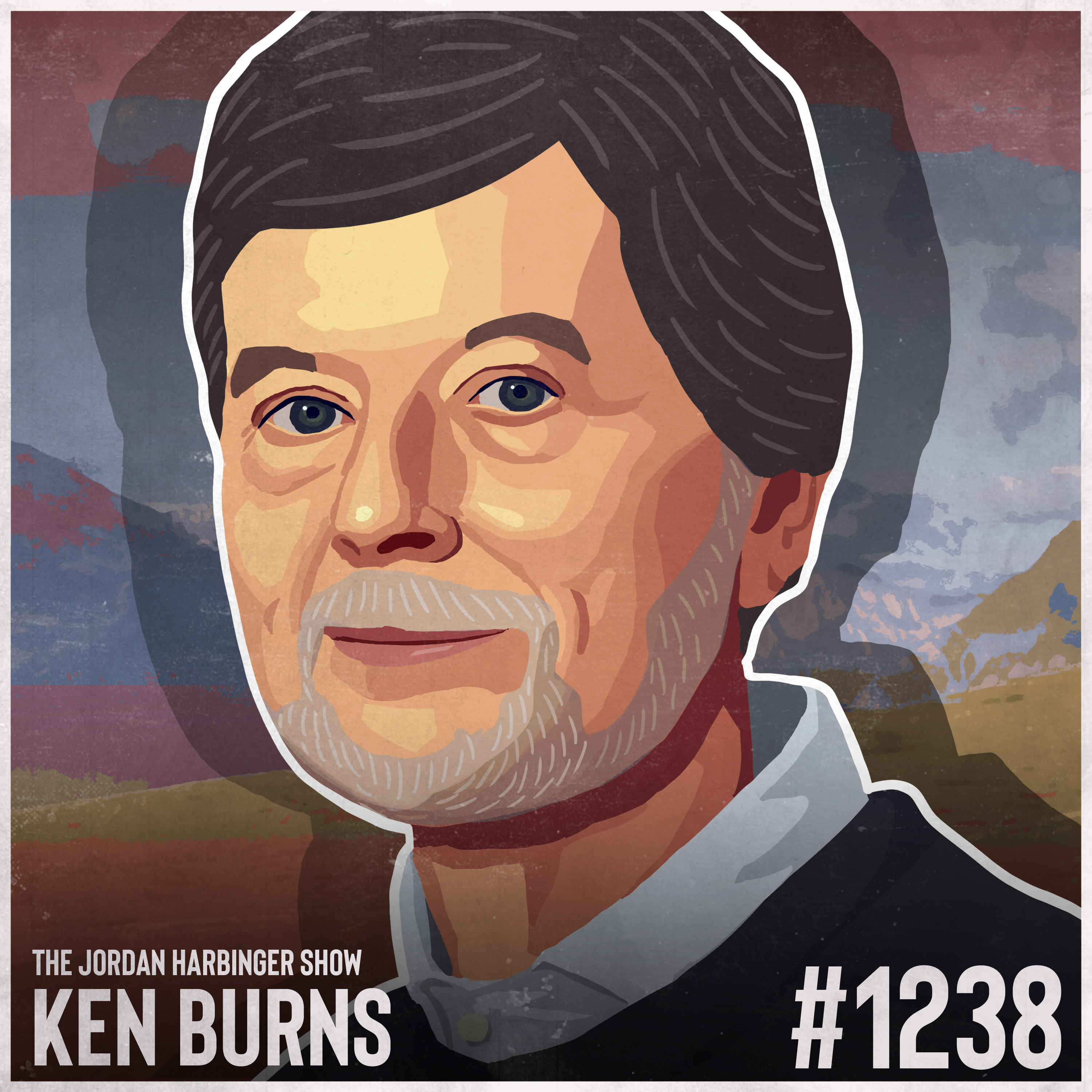
1238: Ken Burns | What If the American Revolution Isn't Over?
The American Revolution isn't over — it just changed uniforms. Documentary legend Ken Burns explains why we're still debugging an experiment from 1776.
Full show notes and resources can be found here: jordanharbinger.com/1238
What We Discuss with Ken Burns:
- America's origin was born from division, not unity. Ken Burns argues the US was born from violence and division, not unity. The Revolutionary War was a brutal civil war with brother fighting brother, not a clean myth of freedom and fireworks.
- The Revolution is an ongoing experiment. Ken sees the Revolution as the start of a political experiment still being debugged 250 years later. It's not a finished story but a continuous process of living up to founding ideals.
- Contradictions compose the country's core. The Revolution's hypocrisy is staggering: freedom built on slavery, liberty denied to women and Native peoples, idealism mixed with self-interest. These contradictions remain eerily familiar today.
- Good storytelling transcends politics. Ken found that compelling narratives neutralize binary thinking. His Vietnam documentary avoided expected backlash because a good story makes people say "I didn't know that" rather than taking sides.
- History is an active conversation. History isn't fixed answers, but an ongoing dialogue with the past. By listening closely, we can ask ourselves if we're living up to the promises made — and continue writing that unfinished story.
- And much more...
And if you're still game to support us, please leave a review here — even one sentence helps!
- Sign up for Six-Minute Networking — our free networking and relationship development mini course — at jordanharbinger.com/course!
- Subscribe to our once-a-week Wee Bit Wiser newsletter today and start filling your Wednesdays with wisdom!
- Do you even Reddit, bro? Join us at r/JordanHarbinger!
This Episode Is Brought To You By Our Fine Sponsors:
- Cayman Jack: Explore uncharted flavor: caymanjack.com
- Masterclass: 15% off annual membership: masterclass.com/jordan
- BetterHelp: 10% off first month: betterhelp.com/jordan
- Progressive: Free online quote: progressive.com
- Airbnb: Turn your house into a host: airbnb.com/host
See Privacy Policy at https://art19.com/privacy and California Privacy Notice at https://art19.com/privacy#do-not-sell-my-info.
Press play and read along
Transcript
Speaker 1 episode is sponsored in part by cachava.
Speaker 1 Someday, as I get so deep into recording for you guys that I end up having to skip a meal or just forget to eat one, I'll look up from the mic, like, wait, it's 9 p.m. How did that happen?
Speaker 1 All in the name of another great episode or three. So, on those late nights, when the house is quiet, Jen, and the kids are asleep, my reward for a long day of work is cachava.
Speaker 1 It's convenient, it's really tasty. It's actually a whole body nutrition that is ready in seconds, which for me is key because if it takes longer than 30 seconds, I'm just going to bed at that point.
Speaker 1 With every two scoops, you get 25 grams of 100% plant-based protein, 85 plus superfoods, nutrients, plant-based ingredients, all the good stuff your body needs without the junk, no artificial flavors, no preservatives, no soy, no gluten, none of that nonsense.
Speaker 1 It's packed with fiber, probiotics, and B vitamins that support metabolism, digestion, even cognition. Basically, all the things I need after talking for eight hours straight.
Speaker 1
My voice is about to give out. My go-to actually is the strawberry flavor.
I blend it with ice, a little bit of milk, but the chocolate and a little peanut butter, mmm, that is next level good.
Speaker 1 You also got vanilla, matcha, coconut, acai, all legit options.
Speaker 2
Your future self will thank you. Go to kachava.com and use code Jordan for 15% off your next order.
That's cachava. K-A-C-H-A-V-A.com code Jordan for 15% off.
Speaker 3 This episode is brought to you by Progressive Insurance.
Speaker 1 Do you ever find yourself playing the budgeting game?
Speaker 3 Well, with a name-your-price tool from Progressive, you can find options that fit your budget and potentially lower your bills. Try it at progressive.com.
Speaker 3 Progressive Casualty Insurance Company and affiliates. Price and coverage match limited by state law, not available in all states.
Speaker 1 Special thanks to Kayman Jack for sponsoring this episode of the Jordan Harbinger Show. Coming up next on the Jordan Harbinger Show, America comes out of violence.
Speaker 4
It's born in violence. People go, oh man, we are so divided.
And you go, okay, when were we not divided?
Speaker 4 If you're at a point now where we are fractured seemingly beyond repair, on the verge of dissolution, whatever the chicken little sky is falling thing you're going to say about it, might be good to go back to the origin story and sort of pick it up and understand the complexity.
Speaker 1 Welcome to the show. I'm Jordan Harbinger.
Speaker 1 On the Jordan Harbinger Show, we decode the stories, secrets, and skills of the world's most fascinating people and turn their wisdom into practical advice that you can use to impact your own life and those around you.
Speaker 1 Our mission is to help you become a better informed, more critical thinker through long-form conversations with a variety of amazing folks from spies to CEOs, athletes, authors, thinkers, and performers, even the occasional mafia enforcer, rocket scientist, or Russian chess grandmaster.
Speaker 1 If you're new to the show or you want to tell your friends about the show, I suggest our episode Starter Packs.
Speaker 1 These are collections of our favorite episodes on topics like persuasion and negotiation, psychology, geopolitics, disinformation, China, North Korea, crime and cults, and more that'll help new listeners get a taste of everything we do here on the show.
Speaker 1 Just visit jordanharbinger.com/slash start or search for us in your Spotify app to get started. Today on the show, what if the American Revolution isn't over? That's not a conspiracy theory.
Speaker 1 That's how Ken Burns, the legendary documentary filmmaker behind the Civil War, the Vietnam War, baseball, and now the American Revolution, sees it.
Speaker 1
He calls the revolution the most important event since the birth of Christ. That's pretty big.
Because for Burns, this wasn't just a war that ended in 1783.
Speaker 1 It was the start of an experiment that's still being debugged two and a half centuries later.
Speaker 1 His new six-part 12-hour epic dives into the revolution, not just as a clean myth of freedom and fireworks, but as a brutal, messy civil war, brother against brother, ideals against hypocrisy, and freedom for some built on the backs of others.
Speaker 1 Women boycotting British goods, enslaved people fighting for liberty they were denied, native nations trying to survive the birth of a country that would erase them.
Speaker 1 The contradictions are staggering and, as Burns shows, eerily familiar.
Speaker 1 We'll talk about how a bunch of colonialists with bad Wi-Fi and no memes, believe it or not, managed to start one of the most radical political experiments in history and what that experiment says about us now.
Speaker 1 We'll also dig into the propaganda of revolution, Sam Adams, spin skills, the first viral slogans, and how every movement needs its storytellers.
Speaker 1 I had producer Gabriel Mazrahi here with me for this one.
Speaker 1 Ken, Gabriel, and I also get into the craft, how you take on something this massive without losing the thread, why the Ken Burns effect became a literal software feature, and what keeps him curious after half a century of documenting America.
Speaker 1 And maybe the biggest question of all, if the revolution isn't over, what part are we living through right now?
Speaker 1 So let's roll back the clock 250 years and maybe fast forward a little bit too, with the one and only Ken Burns right here on the Jordan Harbinger Show.
Speaker 1 You have the documentary about Vietnam.
Speaker 4 People go, wow, this is really good.
Speaker 1 It also highlights a lot of things that we maybe would rather forget.
Speaker 4
That's right. It's so funny.
I was pretty worried about Vietnam. And we kind of had a war room set up.
Speaker 4 We got a couple of folks from John McCain and John Kerry, who we thought would be a war room that would be able to hurl back the thunderbolts that would inevitably come from tackling a subject as controversial as Vietnam.
Speaker 4 And it turned out to be the opposite. Cobwebs grew on them.
Speaker 4 There was a normal kind of expected trolling in the far left and the far right over pretty interesting stuff, but it was nothing like the kind of mainstream shit we expected to get.
Speaker 4 And it was really, I think, had to do with a good story.
Speaker 4 A good story neutralizes the kind of binary, yes and no, you know, you're bad, left, right, young, old, rich, poor, whatever the dialectic is you're involved in.
Speaker 4 A good story can sort of neutralize it and go, oh, wow, I didn't know that.
Speaker 4 And so there was an element because we had gone into territory we didn't know anything about, and we had scholars who were helping us understand, and each one of the scholars had one area of expertise, and you'd be in this room with 25 scholars and somebody would speak after a script meeting or during a script meeting or after a screening of an episode as it was developing.
Speaker 4
And you'd realize that all the other scholars were turning around. They never knew this information.
So then the next person would talk and everybody looked at her or him. And it was great.
Speaker 4 You realize, oh, wow, this is going to be the cutting edge of what scholarship has determined about Vietnamese intelligence or military stuff recently declassified. by the Vietnamese.
Speaker 4
And they've not listened to all the tapes of Johnson and Nixon. They're not, therefore, transcribed.
And then somebody comes across.
Speaker 4 We had an intern who was working with us, just listening all the time, and went, I think I have something good here. And it was unbelievable moments.
Speaker 4
So you have this receptivity if you spend enough time doing it. God, we spent 10 years on that.
10 years. 10 and a half.
Speaker 4 What is it like to be in a relationship with a subject for a decade? It's the opposite of what you're worried about.
Speaker 4 What am I worried about? You're worried about how could anybody ever spend that much attention on something? And what if you don't like it? And what if...
Speaker 4
And if you stay curious for 10 years about something. Yeah, you get more curious.
And in fact, because PBS doesn't have huge budgets for promotion, it's a lot of shoe leather.
Speaker 4
And I travel all around, as I'm doing right now, 40 different markets. But it's this air chamber that allows you to decompress.
The evangelical period, if I can call it that.
Speaker 4 Hey, I've got a show that I would like you to watch all around the country.
Speaker 4 is a way of not having that grief of turning it off because spending that amount of time close to this stuff and you lock the film and then you kind of are looking behind you like there's stuff going on you're we i've got overlapping projects and and teams so there's it's not like i'm i'm going to be out of work it just means i'm really sad to leave this thing and this period of being able to talk about it is the air chamber that permits you not to really totally grieve about it because
Speaker 4 when it's by the time it's done it's yours like literally it's yours it's not mine anymore that's interesting with this show i don't spend 10 years on each episode but i might spend 10 hours on it.
Speaker 1 And I will tell you respectfully that after the interview is done, I'm like, I don't want to read or hear about that person for at least another week or maybe like a couple of months.
Speaker 1 You're calling the American Revolution the most important event since the birth of Christ. Everybody probably starts with that, but here we go.
Speaker 4
No, nobody. Every once in a while, people come around.
People have done their homework, which is very, very rare in the United States of podcasts. And they're like, Christ was born.
Thank you.
Speaker 4
Christ was born in a manger, by the way. There wasn't any room for the family.
It's right here. Very tight quarters.
Very tight quarters.
Speaker 4 You know,
Speaker 4 I feel ambivalent about having said that. It was somewhere along the line when I was talking, evangelizing, and the post, the film's done, it's leaving for college, you know, and going home.
Speaker 4 And I'll have a relationship forever, but it's not the same way as do your homework, eat your dinner, you know, that sort of stuff.
Speaker 4
And I was thinking about how I spent my entire professional life engaged in American history. And I had not avoided this.
It was just a hard enough topic.
Speaker 4 I need to have some chops to be able to take a subject that has no photographs and no newsreels and make it come alive in a way.
Speaker 4 And so I just at one point blurted it out that I thought it was the most important event. And I'll stand by it and I'll defend it and I'll argue it if it needs to be argued.
Speaker 4 But it's a way of saying that everybody heretofore had been a subject. And for the first time, there's some people living on the eastern seaboard of the United States that were citizens, not subjects.
Speaker 4 And that that was an extraordinary responsibility.
Speaker 4 The Old Testament says there's nothing new under the sun, meaning human nature doesn't change and superimposes itself over stuff and the venality that I can uncover in the American Revolution and the greediness is matched by virtue and goodness.
Speaker 4
And you can find that in every era of any subject. And I probably assume in every other country that anybody would choose.
to focus on.
Speaker 4 It was a rhetorical thing that, of course, the second you say it gets away from you.
Speaker 4 I mean, it doesn't have the negative effect of John Lennon, you know, that we're more important than Jesus at a time, so they're burning Beatles records for a period.
Speaker 4 Because I think people want to be challenged in ways to think about a subject. And I think the revolution is so smothered in gallant, bloodless myth.
Speaker 4 It's us having noble ideas in Philadelphia, and we're against the British, and nobody understands just what revolution's involved in.
Speaker 4 And the revolutions happening at the end of the 18th century, it's really bad and bloody.
Speaker 4 You die from a musket, but more often than not from a bayonet or a cannon that's taking off a leg or a head or whatever like that.
Speaker 4 And it's not only a revolution, it's a civil war and more of a civil war than our civil war. Our civil war was a sectional war, South against North, North against South.
Speaker 4 Very few civilian deaths outside of Missouri and bleeding Kansas, as they called it, because civil wars mean civilian deaths, but lots of civilian deaths in the revolution, because it's Americans killing loyalists and loyalists killing Americans and loyalist brigades fighting against patriot and militia brigades.
Speaker 4
I mean, it's super complicated. And it's also a global war.
Not just the French come in on our side. Spain does, the Netherlands.
And it's the fourth global war for the prize of North America.
Speaker 4
So you realize you're into some deep stuff. And it's got multi-levels.
And it isn't just these guys in Philadelphia thinking great thoughts.
Speaker 4 The war doesn't happen without women who are at the heart of the resistance movement and the tenures leading up to it.
Speaker 4 There's Native American population assimilated and sort of integrated and also coexisting within the 13 colonies.
Speaker 4 The Brits have 13 other colonies in the Caribbean that are much more profitable because they're dependent on slave labor. There's free and enslaved black people who are up and down throughout.
Speaker 4 Everybody's got their music. Everybody's got their culture.
Speaker 4 And on the western border are native nations that are as distinct and have been on the world stage of economies and trade and geopolitics as say France is and Prussia is.
Speaker 4 So the Shawnee and the Mohawks or the Delaware or the Ashinanabe and they are as distinct a group from one another as we would distinguish between Germans and English.
Speaker 4 And so if you can wrap your head around that dynamic, then you have one hell of a story.
Speaker 1
If this is a board game, there's like 200 pieces. and 800 cards in a stack.
That's right. And the board is bigger than the table.
Speaker 4 So we want to simplify simplify everything, right?
Speaker 4 We want to just say, oh, you know, it's sort of, this is our origin myth, and we can accept the violence of the Civil War and the 20th century wars that we've been involved in, but let's just protect the big ideas.
Speaker 4 And they are super big ideas.
Speaker 4 But in fact, I find them more inspirational as we dug in and we're able to say, you know, as the historian in the film Maya Jasinoff, the Scholar says, America comes out of violence.
Speaker 4
It's born in violence. It helps you even today where people go, oh man, we are so divided.
And you go, okay, when were we not divided? Yeah, that's a really good point. When were we not divided?
Speaker 4 And it doesn't necessarily say that this isn't an existential moment for us, threatened moment for us, but it allows you to sort of have the tools.
Speaker 4 And then if somebody's in distress, we were talking about somebody that we know who was in distress just before you came in, Gabriel.
Speaker 4 And you go to a professional, you know, you go to somebody and the first thing they want to know is, where'd you come from? What's your origin story? Who are your mom and dad? Where'd you grow up?
Speaker 4 What was that experience like? And you begin to rebuild a sense of your own narrative.
Speaker 4 So if you're at a point now where we are fractured seemingly beyond repair, on the verge of dissolution, whatever the chicken little sky is falling thing you're going to say about it, might be good to go back to the origin story and sort of pick it up and understand the complexity and the diversity.
Speaker 4 I mean, if we're beginning to have a group of people who are selecting us into this sense of heritage Americans, you know, meaning white, Protestant, the story of our beginning doesn't reflect that.
Speaker 4 It's really dynamic and diverse and complex, and people are involved. And those guys did that.
Speaker 4 I mean, I will tell you of all the characters, and we try to take a little bit of the opacity away from the people like George Washington's unknowable and Thomas Jefferson's unknowable and all this, try to make them more human.
Speaker 4 But more important, we introduce you to literally scores of other human beings, you know, teenagers and the wives of German officers and Native American warriors and this person and that person.
Speaker 4
And they're all read by the greatest cast that we have ever assembled for any movie anywhere. I can start listing them and then it'll get boring enough for me.
There we go.
Speaker 4 Sometimes it feels like Miranda Priestley from the Democratic Republic.
Speaker 4 Morgan Freeman, Tom Hanks, Liev Shriver, Maya and Ethan Hawke, Jeff Daniels, Josh Brolin, Sir Kenneth Branow, Domnell, Gleason, Matthew Rees, Hugh Dancy, Claire Daines, Laura Linney.
Speaker 4
And they really bring to life. So what they do is they take something.
And, you know, 99.9% of people didn't have a portrait painting, but that didn't mean they didn't exist.
Speaker 4 So we got the portraits of George, and we got the portraits of Tom, and we've got it of John and Abigail, but we don't have a lot of these characters.
Speaker 4 But they may exist in a line when Joseph Plum Martin, 15 years old and from Connecticut, signs up. And then you find that he's left some stuff, some writings that are the ultimate grunt stuff.
Speaker 4
This film has so many echoes. There's a failed invasion of Canada.
We wanted to make it the 14th state, believe it or not. It was failed.
So just fair warning.
Speaker 4 There's a continent-wide pandemic that kills more people than the revolution does, and arguments about inoculation. I can't make this up.
Speaker 4 There's a full eclipse. That would never happen again.
Speaker 1 There's a full eclipse.
Speaker 4 And there's this kid, this soldier who's a teenager. He's saying, yeah, you know, in other times, it would have been an omen of good or ill, but we kind of like just shrugged our shoulder and went on.
Speaker 4
And we go wherever they tell us. We don't ask why.
We just go and we tell them. I mean, I've got Civil War soldiers who said that.
I've got World War II soldiers in our film on World War II.
Speaker 4
And I've got Vietnam. And they're all the same attitude.
And then you interview the North Vietnamese soldier. They're saying the same thing too.
You know, so it's like a grunts, a grunts, a grunt.
Speaker 4 So you get to know him. One of the joys of your documentaries is just the breadth of the voices and the perspectives that you bring into these things.
Speaker 4 I mean, in this doc, you open with a quote from Thomas Paine, and then the next two quotes are from a spokesman for the Six Nations, I believe. It's a Tana Satego, yeah.
Speaker 4 About the anxiety over losing their land to settlers.
Speaker 4 So just that interest in voices that are typically on the margins of a story, at least they're not the ones that are taught in most schools in America, I would say, might imply a certain political lens, or at least I imagine certain viewers might read into that.
Speaker 4 Do you consider your documentaries political in any way, or is featuring these voices just good storytelling? It's Calling Balls and Strikes.
Speaker 4
So we live in a world in which we just have sports highlights, right? So Babe Ruth hits a home run every time. But Babe Ruth struck out a lot of times.
He struck out more than he hit home runs, right?
Speaker 4
You got to show all of the bats. And oh, by the way, he only comes up one every nine times.
There's a big story in the rest of this information, and telling that doesn't have a political thing.
Speaker 4
I have my own politics, but I don't, I leave it out of there. Calling Balls and Strikes is really important.
Let me tell you that Matthew Rees read Thomas Paine quote.
Speaker 4 Thomas Paine gives the name of every one of our episodes, and he basically is saying this idea of liberty is a big idea, and it's a spark that consumes everywhere without destroying, and that you just need to will it in order to overcome despotism.
Speaker 4
It's kind of a wonderful thing, and we had moved it at the very end of the process to the very beginning. I had begun with Cana Sastega.
His first one is an anxiety about losing land.
Speaker 4 The white people don't think we value this land, but we do.
Speaker 4 But the next one is a description of who he was and what he represented and the six tribes that he represented and the democracy they had had functioning for centuries that Benjamin Franklin is attracted to and says, why can't we do this for us?
Speaker 4 So we have a Native American inspiration for the idea of union. And he says, the second quote is, we are a powerful confederacy, and whatever you do, never fall out one with another.
Speaker 4 And then it's Franklin runs with the ball, and nobody wants to, 20 years before the Revolution, give up any autonomy. Georgia and New Hampshire just,
Speaker 4 what are you talking about?
Speaker 4 And Franklin assembles them in Albany, seven of the 13 colonies, and they pass his plan of union because he's cut, drawn a picture of a snake cut up into portions representing the various colonies.
Speaker 4 And underneath it, the dire warning, join or die.
Speaker 4 Even though the plan fails because nobody wants to give up their autonomy back home, it becomes a rallying cry 20 years later in, as we say, the most consequential revolution.
Speaker 4 So all of a sudden, what you've done, Gabriel, what I'm trying to say is, if you begin the film with a curveball, you're not expecting it.
Speaker 4 Maybe you expect to hear from Thomas Paine, but you're not expecting to hear from Conestatega. So it comes in over the pro and you go, whoa, I had no idea.
Speaker 4 And then all of a sudden, you're prepared to receive the complexity of the story that we've spent nearly 10 years ago.
Speaker 4 Yes, it makes the audience feel like they're in the hands of a storyteller who's going to take them in a very specific way through the story in a way that they haven't been.
Speaker 4 So normally in the political question, which is very reasonable to ask, you're in a binary situation. You're in a dialectic, right?
Speaker 4 The novelist Richard Powers said the best argument, which is the function of a binary thing, and that's all we do is argue, right? The best arguments won't change anybody's mind.
Speaker 4
The only thing that can do that is a good story. So a good story is like, I said this to someone at the New York Times, is like a benevolent Trojan horse.
Like it comes in at night.
Speaker 4 It doesn't come out and kill you or destroy the city. It just says, oh, there may be another way to look at this.
Speaker 4 And it's like a wheel, and you're trying to get to the hub of what happened, where did we come from? Meaning, what's the origin of the United States? What's our mythology, you know?
Speaker 4 You're coming at it from lots of different angles, some of them familiar. Oh, John Adams, I've heard of him.
Speaker 4 Samuel Adams, his cousin, you know a failure as a brewer did not know that that's funny failure as a brewer because that's kind of what that you know that's the go-to that he's known for now is the but he is a guy who is a writer who is able to keep people's anger and upset at the british going He says, my purpose is to keep people alive to their grievances.
Speaker 4 Grievances.
Speaker 4 And so isn't this what we see on our own media today?
Speaker 4 We were literally discussing this yesterday because that guy has a rare gift for taking these very big concepts and turning them into easily digestible, very incendiary ideas.
Speaker 4 And that playbook is obviously still being used. Human nature doesn't change.
Speaker 4 Are you trying to draw a line between someone like Adams and certain figures? No, no, and that's the important thing. So Mark Twain, we like to say that the cliché we do is history repeats itself.
Speaker 4
It never has. Tell me one event that's happened twice.
What happens is human nature doesn't change. Mark Twain said history doesn't repeat itself, but it rhymes.
Speaker 4 So you see the rhymes, you see the echoes, you see the themes and the motifs that come from just human nature.
Speaker 4 You know, if you've got greedy people, which there will always be greedy people, that greed is going to manifest in a certain way. And you're going to go, oh, that's so much like that.
Speaker 4 You don't need to do that. And in fact, when I began this project in December of 2015, Barack Obama had 13 months to go in his presidency.
Speaker 4 The next month was the Iowa caucuses, out of which Donald Trump, everyone agreed, was not going to emerge.
Speaker 4 Okay. So if you spend a lot of time going, whoa, isn't Sam Adams so much like Fill in the Blank, right? You're lost.
Speaker 4 I mean, if this film had come out last year, last fall, instead of this fall, there is the wife of a German officer that we follow. She's a big character in this thing.
Speaker 4 She stayed behind because she's having the third daughter.
Speaker 4 And so she makes the perilous crossing to join her husband at the triumphant victory of the British and the German German higher lings at the Battle of Saratoga.
Speaker 4 It doesn't work out that way, and Saratoga is a big defeat and the General Burgoyne surrenders and the French go, whoa, you guys are real.
Speaker 4 Here, how's $30 billion in current money to help you win this war? And we'll send an army and a navy, too, and here's some money and some stuff. And we win because of that.
Speaker 4
It's not a given how it's going to be. But she's worried.
as she's making the crossing, as she writes, because she's heard that Americans eat cats.
Speaker 4 Okay, so if this had come out last year, I think it's going to go by now that I've said it, I've blown it, but I think it's going to go by like, you know, nothing. You know, maybe not.
Speaker 4 But a year ago, that would have been a different. Yeah, last year it would have been like, oh, you did that, you put that in because you want to point out because Springfield, Ohio, and J.D.
Speaker 4 Vance, and, you know, one of the big, you know, and if you step back and think about it, we just have it in the diary of the wife of a German officer that plays a significant role in the Battle of Saratoga.
Speaker 4
But that is an an eerie paragraph. That is very strange.
They're everywhere. And you'll hear it in the way husbands and wives communicate to each other, like Abigail and John Adams.
Speaker 4 You hear it in the way the teenagers that are in our film are fighting and complaining or not complaining, or how a little girl 10 years old when the war begins, Betsy Ambler, that Maya Hawk reads like she's an angel.
Speaker 4 And you go, wow, that's, I got four daughters. I go, whoa, that's, you know, it's the same.
Speaker 4 And so if you spend a lot of time saying, isn't this so much like today, you've missed the point, which is to tell a story.
Speaker 4 Like when we go, why is half the phrases we use, expressions that we use, come from William Shakespeare? It's because he figured out how we are. not just from his time, but in all time.
Speaker 4 And so when we say, you know, the whole world's a stage or this band of brothers, the first quote you hear from George Washington in this film, he's talking about a band of brothers, that's Henry V.
Speaker 4 He'd read Henry V. It's the speech in Agincourt, and it's in Henry V.
Speaker 4 And so Band of Brothers, somebody yesterday, somebody really smart yesterday said to me, I thought it was just a World War II expression from, you know, the HBO series.
Speaker 4
You know, you know, well, so George Washington said it. I said, no, it's William Shakespeare.
You know, I'm really struck sitting talking with you about this.
Speaker 4 This should not be a surprise at all, but you seem to have such a deep love for the characters you encounter in your work.
Speaker 4 Do you come by that affection honestly, honestly, easily, or is that the product of spending years with these people and getting deeply invested in a subject?
Speaker 4 Yeah, I'm pretty ignorant in the beginning and
Speaker 4 there's an aspect of it of the team that we have, which is relatively small, is nonetheless digging into this and you're finding somebody. How many people are on your team, by the way?
Speaker 4 So, okay, there is, I have two other co-directors, and this time people I've worked with for a long time, particularly Sarah Botstein, who's been close to 30 years, and David Schmidt, who's been working since the Vietnam series.
Speaker 4 And there's a writer, Jeff Ward, who I've worked with for 45 years.
Speaker 4 And then there's a handful of co-producers around them. And then the editors, who are significant forces in this, three editors and their assistants.
Speaker 4
And then there's, so it may be this like band of sisters and brothers who are 20 people that are making it. Even, you know, we thank hundreds of people quite correctly.
But it's sort of handmade.
Speaker 4 And that over that period of time, we're together and we're learning.
Speaker 4 And I'm kind of the guy who's the filter we'll get something that maybe is a four-hour assembly and i'm the guy who brings it down to under two hours but and they're all going but you can't miss that so i said we'll leave it in italics and then the next pass it's still there and i go leave it one more time and then if it doesn't survive the next time then you take it out of the script but it tells you that at all times this is not an additive process it's subtractive you know i live in new hampshire rural new hampshire and we make maple syrup and it takes 40 gallons of sap to make one gallon of syrup.
Speaker 4
That's more than we have like 40 or 50 to one shooting ratio. Wow.
And so we're collecting. 40 gallons of sap to make.
Yeah, one gallon of syrup. And you don't boil it either.
Speaker 4
If you boil it, you have rock candy. But if you just keep it under that and evaporate it with an evaporator, you get the elixir.
So, and it takes time.
Speaker 4
Like you can turn the burner up on sap and you'll get. rock candy, right? But if you evaporate it, you will get this elixir.
If I was from Kentucky or Tennessee,
Speaker 4
I'd be talking about distillation. But it's really important.
So you develop this affection for people and they get realer. And then, you know, usually we're doing the scratch.
Speaker 4 I'm the scratch narrator all the way through, 99% of the process.
Speaker 4 And then in this case of the American Revolution, you bring in Peter Coyote or it's Keith David for Leonardo da Vinci or Muhammad Ali, whatever it might be.
Speaker 4 They're interns and they're associate producers that are reading the voices. But then all of a sudden you start collecting.
Speaker 4 And when Tom comes in and Tom Hankson Hankson comes in and reads, you know, I said,
Speaker 4 I'm not going to make you George Washington because everybody's going to go, that's Tom Hanks. And he could read it.
Speaker 4 I mean, he could read it upside down backwards in his sleep and it would be perfect. And so I gave him like 14 quotes, I think from maybe 12 different people, and every single one is in.
Speaker 4 He's Albigens Waldo, two quotes in the episode about Valley Forge that has Valley Forge in it. And he's a doctor at Valley Forge.
Speaker 4 And he's just talking about seeing these people, these sort of frail wraiths of people in tattered clothing, sort of moving through the snow.
Speaker 4 And then another moment, he marks the death of a Native American soldier fighting, which is unusual for the Patriot cause rather than the British cause, because most Native tribes thought, sheesh, the way we keep these people from pouring over the Appalachians is to go with the British who'd beat the French.
Speaker 4 So we kind of earned the respect
Speaker 4
a Mohawk descendant says of this. So it's a very complicated dynamic.
And these people then begin to fit in.
Speaker 4 And the puzzle and the narrative puzzle of what you leave in and what you leave out doesn't necessarily become instantly clear, but you begin to figure out how it is.
Speaker 4 It's based a lot on your affection for people. And I mean that in not a way like a real friend, but in a way that these are elements of a story.
Speaker 4 And a good story is the best thing that human beings have. Honey, how is your day?
Speaker 4 Does not begin with, I back slowly down the driveway, avoiding the garbage can at the curb unless somebody t-bums you. And that's exactly what he's saying.
Speaker 4 So you edit human experience, and that's all we're doing.
Speaker 4 We're saying, we can't represent the entire revolution, but we can tell you that it isn't just Lexington and Conquered followed by, oh, didn't he cross the Delaware and defeat the Christians on Christmas Eve?
Speaker 4
Well, it wasn't Christmas Eve. It was supposed to be Christmas night, but they didn't get there till the morning of the 26th.
And, you know, of the three different attack prompts, only one made it.
Speaker 4 It happened to be Washington's, and they routed the Hessians. No, they didn't get, you know, the Hessians weren't drunk.
Speaker 4 The Americans discovered their catch of rum, and Washington ordered it destroyed, worried that his soldiers would get drunk. So you've got, there's just stories that have levels of it.
Speaker 4 And there's also in the leaving out of it, nobody says, don't fire until you see the whites of their eyes at Bunker Hill, which is actually fought on Braids Hill.
Speaker 4
But they do say hold your fire until they're 90 yards out. And then the next charge, they're 60 yards out.
And then by the time you're running out of ammunition, wait till it's 30 yards.
Speaker 4 And we lose, but we've inflicted so so much casualty on the British that they're not going to see this kind of loss until the first day of the sum in 1916.
Speaker 4
That's how bad the revolution is in terms of fighting. And Paul Revere gets on his horse.
He does. He sees they put the lanterns up.
Speaker 4 He knows they're coming across the Cambridge marshes and by sea, in quotes. It's the Charles River's mouth.
Speaker 4 But he's riding to Lexington and all the towns in between and then on to Concord saying, not the Redcoats are coming or the British are coming, but the regulars are coming out.
Speaker 4
The regulars are coming out. Doesn't have the same ring.
Doesn't have the same ring to it. But it's truer.
And when you hear that,
Speaker 4
we talk about the flag several times. No mention of Betsy Ross.
We don't know who made the first flag. And so you leave that out.
Speaker 4 Nathan Hale, who's captured after Washington abandons New York, and then all of a sudden it's mysteriously burned down.
Speaker 4 And the British are certain and the loyalists are certain that George Washington has done that. He's actually applied to Congress to burn it, and they say no, and then somebody burns it.
Speaker 4 So whoever it is, but they capture a spy simultaneously, like an espionage agent for Washington, part of an elite group of spies named Nathan Hale. And he goes to his death.
Speaker 4 He's hung immediately under a sign that says Washington, the man they blame for the fire. And a British officer just notes that he went to his death with great composure.
Speaker 4 Now, did he say, I regret that I have but one life to give to my country? We can't prove it. And so it's out of the film.
Speaker 4 And so what happens is it's not myth-busting, like we're taking this thing, pointing arrows at, we don't say, hey, nobody ever said Betsy
Speaker 4 Ross. It's just we don't.
Speaker 4 And the accumulated stuff gives a sense with the way the narrative moves around and the complexity of being able to balance lots of different storylines, which is what we all love, right?
Speaker 4 We love that in Yellowstone. And somehow history, how we've been told, now has to be reduced to very simple things.
Speaker 1
Pop on a masterclass while having a coffee or getting ready. It's amazing how much you can absorb in just a short time.
I really like Chris Voss's class.
Speaker 1 He's a former FBI hostage negotiator on episode 678.
Speaker 1 It'll change the way you handle conversations, conversations, whether it's in a business deal, an interview, getting your kid to put on their shoes. These negotiation tactics really work.
Speaker 1
And that's the beauty of Masterclass. You can learn from the best to become your best.
With over 200 classes across everything from leadership to writing to cooking, there's something for everybody.
Speaker 1
You got people like Bob Iger, Indra Nuye, Howard Schultz, even folks teaching AI and productivity. And the classes are bite-sized.
You can fit them into even the busiest schedule.
Speaker 1
Plans start at just $10 a month, billed annually. There's a 30-day money-back guarantee.
So there's really no risk.
Speaker 1 Three out of four members say they feel inspired every time they watch, and I totally get it.
Speaker 2
Right now, our listeners get an additional 15% off any annual membership at masterclass.com/slash Jordan. That's 15% off at masterclass.com slash Jordan.
Masterclass.com/slash Jordan.
Speaker 1
This episode is also sponsored by BetterHelp. When I used to live in Michigan, winter would roll around and it was like, oh man, here comes the seasonal depression.
I'm talking gray skies for months.
Speaker 1 This time of year, well, it can be rough. The shorter days, the cold, everyone goes into hibernation mode, and it's easy to isolate without even meaning to do that.
Speaker 1 And that's why BetterHelp is encouraging everyone this November to reach out, check in on a friend, call your granny, grab coffee with somebody you haven't seen in a while.
Speaker 1
We're all just a little healthier when we stay connected. And if you've been thinking about therapy, this is a great time to do that as well.
BetterHelp makes it super easy.
Speaker 1
You fill out a quick questionnaire. They match you with a licensed therapist.
If it's not a good fit, switch anytime. They've got over 30,000 licensed therapists.
Speaker 1
They've helped more than 5 million people worldwide. Sessions average 4.9 out of 5 stars.
So clearly, it's working for a lot of folks, including yours truly.
Speaker 2 This month, don't wait to reach out. Whether you're checking in on a friend or reaching out to a therapist yourself, BetterHelp makes it easier to take that first step.
Speaker 2 Our listeners get 10% off their first month at betterhelp.com/slash Jordan. That's better, H-E-L-P.com/slash Jordan.
Speaker 1 If you're wondering how I managed to book all these great authors, thinkers, and creators every single week, it is because of my network, the circle of people I know, like, and trust.
Speaker 1
I know people are like, oh, you just have a big platform, and so they come to you. I mean, you know, not entirely true.
You can really build the same thing for yourself.
Speaker 1 You're probably not booking a podcast, but I bet you're working in your career. You're trying to maintain your social circle.
Speaker 1
You're trying to make a name for yourself, just starting out in your job, wherever you are in your life. This will absolutely help you.
It's super easy. It is non-cringy.
It's very down to earth.
Speaker 1
It's not going to make you look bad. It's just going to make you a better connector, a better colleague, and a better peer.
And six minutes a day is all it takes.
Speaker 1
Many of the guests on the show subscribe and, more importantly, contribute to the course. So come on and join us.
You'll be in smart company where you belong.
Speaker 1 You can find the course free of all shenanigans at sixminutenetworking.com. Now, back to Ken Burns.
Speaker 1 The lesson here is if you're going to get executed for being a spy or something along those lines, think of a really good quote beforehand.
Speaker 4 That's right.
Speaker 4 So that whoever kills you can go like, wow, that was pretty bad.
Speaker 4 I need to give Ken Burns something really good.
Speaker 4 He may have said it. But I love the fact that you can...
Speaker 4
I made a film about the Statue of Liberty very early on in my professional life. And at the end of it, it was two parts.
And so it was the first was the construction and how it got bit.
Speaker 4 And then the day, you know, it ends, the first part ends with the dedication of the statue in October of 1888. And the last line of that first part is, no one mentioned immigrants.
Speaker 4 It's only later that this is this thing that immigrants going to Ellis Island pass and they attach to it the symbolism of conversation. Yeah, you're resisting these easy.
Speaker 4
There are no layups. There are no layups.
You see this war and the founding of America not as a one-and-done victory, but as an ongoing negotiation. I think you say unfinished business.
Speaker 4
I'm sort of stealing from Benjamin Rush, who's the only physician who signed the Declaration of Independence from Philadelphia, from Pennsylvania. I have a connection to him.
I didn't really realize.
Speaker 4 An ancestor of mine, Gerardus Clarkson, actually with Rush formed the first medical school college in the United States, or certainly in Pennsylvania.
Speaker 4 But anyway, Rush said at the end of the Revolution that the American War is over, but the American Revolution is still going on.
Speaker 4
And you think part of what is the genius of some of the stuff is the unfinished business. These were all guys, when Jefferson said, we hold these truths to be self-evident.
They're not self-evident.
Speaker 4
He actually wrote sacred and undeniable. And Franklin said, no.
And sacred and undeniable would have been a better way of saying it and kind of more emotional.
Speaker 4 And so it was really good writing on Jefferson's part. But he goes self-evident.
Speaker 4 And as somebody said in a film we made a few years ago about Benjamin Franklin, they said it's the old lawyer's dodge, you know, just tell them it's true.
Speaker 4
These are the least self-evident truths there. Right.
That all men are created equal. What they mean is all white men have property free of debt.
We don't mean that now.
Speaker 4 The key to the word, the scholar Yuvel Levin said, is the word all. Once you said all, it's all over.
Speaker 4 It may take you four score and nine years for slavery to go, 144 years to women to get the vote, but it's done.
Speaker 1 It's hard to write footnotes with a little quill.
Speaker 4 It's just really hard. So
Speaker 4
I didn't bother. This Benjamin Rush quote that you just mentioned, he said, on the contrary, nothing but the first act of the great drama is closed.
The revolution is not over.
Speaker 4
You lay that audio over images of modern-day New York City, which I thought was a really nice choice. Modern day, lots of places.
Lots of Austin. There wasn't New York in the Valley Ford.
Speaker 4 It ends in New York.
Speaker 4 So you're bringing this into the present or maybe bringing the present back into the past?
Speaker 4 I think it's an invitation to the present to go back and sort of rethink about it and think about the process words like pursuit of happiness in the Declaration, which is a process.
Speaker 4
We always are thinking what happiness is. It must be material wealth.
No, they meant lifelong learning.
Speaker 4
And then later on in the Constitution, written in Philadelphia and passed there, a more perfect union. So you have a sense of process.
And that's, I think, made all the difference for us.
Speaker 4 It's kept us open and expanding to the possibilities of the meaning of the words. Aaron Powell, what phase of the revolution are we in now?
Speaker 4 I think we are approaching one of maybe restoration and repair.
Speaker 4 That is to say, that as we've inevitably, even the fastest fastball by the greatest pitcher is going to inevitably arc towards the ground, that we have in our power the ability to resuscitate by re-engaging with the original principles of our founding, who we actually are and understanding the complexity of the story and understanding the unbelievable force of the idea that people were not subjects, but citizens, and the responsibilities that entailed, the examples.
Speaker 4 I mean, after telling you how diverse it is, there's only one person responsible for the United States, right? And that's George Washington. Without him, we don't have a country.
Speaker 4 And you can't say that about anyone else.
Speaker 4 Franklin's a second because he got all the money from the French to help us win the war and helped originally think of the idea that maybe we could come together.
Speaker 4 But without Washington, who is deeply flawed, who is rash, rides out on the battlefield at Kipps Bay, nearly is killed, does the same thing at Princeton, does the the same thing at Monmouth Courthouse in New Jersey, and is nearly killed, but stops a retreat, who's unknowable.
Speaker 4 Scholar Joe Ellis says, maybe Martha gets in there, maybe Hamilton, maybe Lafayette. He's taller than everybody else, but he's able to inspire people who are not of his station.
Speaker 4
He may be the richest person in America. Think about that.
The richest person in America, risking, as they say in the last line of the Declaration, we mutually pledge to each other our lives.
Speaker 4
That's a big deal. Our fortunes.
In many many cases, that's an even bigger deal, and our sacred honor.
Speaker 4
So maybe we can say, we don't use the word sacred too much now, and we certainly don't use the word honor. So leave that off to the side for whatever you can make of it.
What would you guys do?
Speaker 4 What would I do? Would I be a loyalist? Would I be a patriot? What would I be willing to fight for? What would I be willing to give my life and all that I've accumulated in my life, my fortune?
Speaker 4 Would I do that? And so while his officers are deserting at Valley Forge because they've heard, oh, there's money to be made off the war if we go home, he stays there.
Speaker 4
One of the richest men, risking everything. He's caught.
He's dead. It's an amazing story.
And he's able to get men to fight in the dead of night. He understands subordinate talent.
Speaker 4
He goes, you and you are really good. And I'm not threatened by that.
Please be my generals. I mean, he picks the smartest people you could possibly imagine.
Speaker 4 It's like a revelation as you tell the story. It's a wonderful return back to the old simplistic, superficial, sentimental, useless story about George Washington.
Speaker 4 Now, are there cherry trees and never telling a lie controlling a coin across the Potomac? No, we settle that too in this film. Oh, right.
Speaker 4 Yeah, we've got a young guy that we follow from the first, early on in the first episode, who's a little, little kid, where he sees the British who are occupying Boston.
Speaker 4 They have these great Afro-Caribbean bands in yellow and red, you know, and they're playing fife. So he becomes a Pfeiffer and then later joins the Patriot cause when he's 14.
Speaker 4 At the end of his life, he's a dentist making teeth for George Washington out of ivory from a hippopotamus.
Speaker 4 Now, first of all, I did not know that hippopotamus teeth are considered ivory the way the elephant did not know.
Speaker 4 So there you go.
Speaker 1 You'll learn a lot from the duck, yeah. Namely, but okay, that's less grim because I know that some people back then had teeth just from other people that they had to remove.
Speaker 4
There's some of that too, but there's not wooden teeth. Right.
And that's
Speaker 4 and you don't have to say not wooden. Do you know what I I mean? That's the kind of thing.
Speaker 4
Whereas if you're hedge-of-thumb on the scale, whether it's political or aha, look how much we've, how much research we've done, not wooden. You don't need to do that.
You just don't include it.
Speaker 4 And what you've said to your audience is, you're really smart. And people are really smart, particularly when it comes to the complexity of stories, because you know what?
Speaker 4
We may be politically idiots. That is to say, so certain there's an us and a them.
There's only us. The biggest lesson I've learned in my entire professional life, there's only us.
Speaker 4 The things that we've forgiven ourselves and each other, the people that we love and the people that we care about, the friends that we have, the family members, we understand the complexity.
Speaker 4
You know, it's white people love Yellowstone. That guy is a murderer, right? He dumps dead bodies off here and he's our hero.
And he's got a very strong daughter.
Speaker 4 He's got one son that's married to a Native American woman, another who's Benedict Arnold, a traitor, right?
Speaker 4 And then you know all of the levels of his generals and then the people who work for him and they're gay and they're women and they're black, right? And they're Native people throughout.
Speaker 4
And the main theme is about greed and land and whether that happens. They'd go, this is a communist film.
Well, no, apparently Yellowstone is the bellwether of conservative storytelling.
Speaker 4
It's not conservative. It's good storytelling.
And in good storytelling, you have to have bottom-up as well as top-down. You have to have conflict.
You have to have people who are neither and both.
Speaker 4
I can't make stuff up. Taylor Sheridan can.
William Shakespeare can. But I believe there is as much drama in what is and what was, my business, as anything the human imagination.
Speaker 4 Yeah, I mean, we love this complexity in the entertainment. Why not in our history? But there are no easy heroes or villains in your documentaries, or maybe that's what you discover along the way.
Speaker 4 And I wonder if that's also why documentaries like the Vietnam War eventually do go down well with people, because they can't deny that once you start digging into it, these easy myths don't hold up very well.
Speaker 4 I went to John Kerry and John McCain when we first decided to do it. I said it took 10 and a half years to do it.
Speaker 4
I said, I need your help, and I'm not going to interview you because you're still in the public life. You're still publishing your Apple.
And no matter what we'd say here, you're going to do that.
Speaker 4 You'll be in it as archival figures, right? Testimony that this young...
Speaker 4 almost a hippie John Kerry gives, the experience of being shot down and a prisoner in Hanoi and the stuff recorded from his bed and his release and all of that.
Speaker 4 They said, of course, I understood it completely. But at the end, I came to his office and aide said, well, he's got like 10 minutes, show him some stuff.
Speaker 4
So we started showing and they said, Senator, you have to go. He goes, like this.
He goes, show me the Vietnamese. Because he knew we'd interviewed North Vietnamese and Viet Cong soldiers.
Speaker 4
And that was the thing he wanted to know. He wanted to meet and understand and then realize the complexity.
And so this was like. late spring.
Speaker 4 And then we did a big event in August, I think, at the Kennedy Center, just before the broadcast in September of 2017. Now we'd given him the whole thing and he'd looked at it all.
Speaker 4 And he walked into the green room and there's Chuck Hagel, who's part of the panel, who was a Vietnam War senator and, you know, Secretary
Speaker 4 and Kerry, you know, who was by then the Secretary of State or had been the Secretary of State, I can't remember. And he just walked over and he said, I love you, Ken.
Speaker 4 And that means that there's a story there that has a complexity that opens up a pretty, this is a pretty tough character.
Speaker 4
And I said, I love you too, Sunder, because I do, because you got to know him and who he was. Now, do I agree with his politics? It doesn't really matter.
Do I agree with Carrie's politics?
Speaker 4 What does it matter? These are human beings who have extraordinary experiences.
Speaker 4 And that's the idea that maybe good stories help sort of just reconcile the differences and reminds people, oh, right, there's no them. There's just us.
Speaker 4
And it's very convenient that us is the lowercase U.S. Badoom, Mike dropped.
Yeah, nice.
Speaker 4 One of the experts you interviewed points out that in the European world back then, during the revolution, democracy actually had a bad name. Oh, totally a bad name.
Speaker 4 It is a synonym, right, for anarchy. Yeah, it's lawlessness.
Speaker 4 Rule of the mob. Demo, right? So it means the people rule.
Speaker 4 And it was seen as a system that could be exploited by ruthless politicians, demagogues, people who pandered to the passions of the common people in order to whip them up and get them to do passionate things and get the government to serve them.
Speaker 4 I have to say, again, it's hard to watch your documentaries and not map a lot of this stuff onto what is happening, but I think this is also a timeless story.
Speaker 4
It's hard to argue with that view in many cases. There is at least a kernel of truth to that.
Are all democracies necessarily turbulent and messy, or do they get that way over time?
Speaker 4 Well, democracy is a really messy form of government, but it's better than all the other forms because the other forms involve a kind of tyranny and authoritarian certainty.
Speaker 4 Democracy is messy because you actually have to listen to people that you disagree with and you have to compromise. And that's when that breaks down, then you lose the possibility of having that.
Speaker 4 But democracy has an aspect of mob rule, not the democracy that we imagine, not 435 representatives and 100 senators and
Speaker 4 that. It's best described by two loyalist ministers in Boston who are looking at the constant demonstrations that are going on against British occupation.
Speaker 4 They didn't like the idea that the British Army was in Boston, not to protect it, but to police it. That's also a rhyme of the present moment moment in many ways.
Speaker 4 But we don't have to say anything about it.
Speaker 4 And that was in our film well before that happened, including the discussion of people who, passionate people who exploit the stuff that Alan Taylor, the scholar that you're quoting, says in the film.
Speaker 4 But one of the ministers says, what do you want? One tyrant 3,000 miles away or 3,000 tyrants not a mile away? We like to say, well, you know, our revolution created our democracy.
Speaker 4
Democracy was not an object of our revolution. It's a consequence of it.
Because these propertied men wanted, they'd had a disagreement.
Speaker 4 But because we're in the Enlightenment, the arguments they're arguing are that these are natural rights.
Speaker 4 And then all of a sudden they're articulating things that the people at the margins, as the scholar Maggie Blackhawk in this A, are hugely influenced by.
Speaker 4
When you say liberty and freedom, the people who hear that the most are the people who are serving you. They hear it.
They're not dumb. They hear these discussions and they want it too.
Speaker 4 And so what happens is our image of the person fighting the militiamen, who's a small farmer and the landowner and whatever, that's the ideal.
Speaker 4
Actually, the militia are less reliable in the fighting and they tend to run. They're not experienced with this.
It's terrifying.
Speaker 4
Battles are horrible. No, no shame in that reaction to battle.
I'm not sure what I would do. I'm not sure if you asked yourself what you would do.
Speaker 4 Maybe you'd be a loyalist, then that would settle it all.
Speaker 4 But people decided to pledge their lives, their fortunes, and their sacred honor and move all their chips to a space that had never been proven.
Speaker 4 So it turns out in the Continental Army, who survives are teenagers, ne'er-do-wells, felons, second and third sons without a chance of an inheritance, property, recent immigrants without property from Germany and England, and they do the fighting and they do the dying.
Speaker 4 And somewhere along the line, there's a realization that they have to be included in this new thing. So Pennsylvania is first, and in their constitution, they don't say men of property.
Speaker 4
They say all men 21 years old, meaning all white men. And that's the beginning.
That's the foot in the door. So democracy is not the object of our revolution.
It's a consequence of it.
Speaker 4
But it's not the mob democracy. It's the most disciplined democracy you can imagine.
Does it have problems? Of course it does.
Speaker 4 The Articles of Confederation don't work, that people are rebelling and chase rebellion. And then we do a constitution, and it works pretty damn well.
Speaker 4 Civil war, big exception, and other places throughout our history, but we're always divided. We're always arguing.
Speaker 4 There's always like a minority that would prefer what is the seeming simplicity of authoritarianism. It's always a thread, like just let's be certain.
Speaker 4
So to me, the opposite of faith, don't worry, I'll get there. The opposite of faith is not doubt.
Doubt is central to faith, just as the sort of free electrons of a democracy are messy.
Speaker 4 The opposite of faith is certainty, right? Which kills mystery and kills the thing that you're looking for in faith, whether it's art or relationship or actual spiritual things.
Speaker 4 And so what happens is democracy is a kind of way of permitting the uncertainty of everything to be okay.
Speaker 4 And that's the only thing where human progress comes from and where the expansion of the idea that all men are created equal, the scholar Yuvel Lovin says, the minute you say all, it's there.
Speaker 4
It's you're going to say it. It's not even equal or men.
It's all. And that's the doorbuster of centuries.
Speaker 4 And remember, this revolution inspires revolutions all around the world for more than 200 years, even when we can't extend it to a significant part of our population and half of it is disenfranchised for 144 years, women.
Speaker 4 Are that uncertainty and mystery also essential to your filmmaking process? It's the heart of art. It's hard for me, Gabriel, to describe exactly how it is because the buck stops here.
Speaker 4 So do I get the final decision? I'd be an idiot if I didn't listen to everybody else and was just a dictator and saying, oh, we're going to do it this way.
Speaker 4 Every once in a while, I'll say, let's do this. And I wake up the next morning and look at it and go, what idiot thought this was, right?
Speaker 4 So I think part of the struggle is trying to figure out, particularly with mastering complex narrative of how to juggle all this stuff. I'll give you an example kind of in a way.
Speaker 4 Say we say there's 16, maybe 16 dead, maybe 16 months, maybe 16 battleships, right? It doesn't matter. We've got those footnotes for reputable scholars, 16.
Speaker 4
Then we read something else and it's a scholar who says, I'm not sure it's 16. Could be 18, it could be 14.
So we're freaking out. We've already locked the film.
This is the level that we're at.
Speaker 4 And I go running and we find somewhere the narrator has said the word perhaps and we duplicate it and bring it and say perhaps 16. And then we go sit back and go,
Speaker 4
right? And I swear to God, we will fight over that. And the last weeks of editing, they're not moving stuff around usually.
They're me opening up or closing down a twelfth of a second.
Speaker 4 That is two frames, a twelfth of a second to make the reception of that quote.
Speaker 4 It may be within the phrase of the quote or just before the quote begins, or maybe it's closing it up at the end so that the cut is closer to that, but a 12th of a second, and it makes a big difference.
Speaker 4 And I'm spending weeks doing that so that when you see it, and then we've been working and editing with four or five sound effects tracks, but in the middle of the worst battles, we might have 150 going.
Speaker 4 And it's, I was at a place last night in New Jersey, and I was supposed to go out in the audience and sit with my comrades and watch it. But as I heard the first gun go off at the opening quote by
Speaker 4 the first cannon rumble, the stage shook because of the bass.
Speaker 4 I drew up a folding chair just behind the curtain on the sides, and I did the whole thing there because it was every gunshot was like every cannon fire just rocked it.
Speaker 4 And I just, I wanted to be back there.
Speaker 1 My video editor is going to love this Ian. He's going to be like,
Speaker 1 yeah, it's two frames because that's for people who don't edit film, there's like 24 frames per second generally.
Speaker 4 Yeah, and each one of those frames, just to get nerdy with you, is not that I haven't been very nerdily here. Sorry,
Speaker 4 in film, you see each one of those 24 frames for a 48th of a second because in the old-fashioned film, the shutter, there's a claw and the sprockets pulling it down. So
Speaker 4 you see it for a 48th, a thing comes down, it moves, it goes up and you see it for a 48th, and it is, that's the way it works.
Speaker 4
And if I put black and just one frame of a tree, which you would see for a, you would go tree. So physiologically you can receive that.
May not have any meaning, but you're looking for meaning.
Speaker 4 And so I think what editing is doing, what all these layers of sound effects, with the first person voices complementing the third person narration, which is the narrative bus driver, right?
Speaker 4
And then the voices are all the all of that stuff. I mean, you understand why.
And by the way, there's only one place I could have done all of these films, 40 of them. Some of them are an hour.
Speaker 4 Some of them are 20 hours hours, is PBS. Because PBS, I can go to a streaming service or a premium cable and say, hey, I want to do the Vietnam War.
Speaker 4
It's going to be $30 million, which is what it costs. And I spent 10 of the 10 and a half years with my cup out trying to raise, desperately trying to raise it.
It's not fun, but I did it.
Speaker 4
I could go to a pitch meeting and walk out with $30 million. Yeah, Netflix could cut you a check for that.
But they wouldn't give me 10 and a half years.
Speaker 1 No, probably not.
Speaker 4 They'd say, How's 10 and a half weeks? Yeah. No, no, they wanted 10.
Speaker 4 And I can't do that because I have to be down at that two frames I have to be at the complexity of the story I have to like not do the traditional dramatic stuff so I have a neon sign in lowercase cursive up on the wall in my editing room and it says it's complicated if you're a filmmaker and you have a scene that's working you don't want to touch it so we've been touching it and destabilizing good scenes because You can't, in the case of history, have the art overwhelm the facts.
Speaker 4
You want them to coexist, but at every time the fact always has to win. And the facts are not convenient necessarily to story.
People have undertow.
Speaker 4 And yet, at the end, by being faithful to that undertow, the fact Wenton Marsalis said in our jazz series, he said, sometimes a thing and the opposite of a thing are true at the same time.
Speaker 4
We know this in our personal lives, right? But we can't sort of, there's a disconnect in a political, historical, military dynamic to it. They're bad guys, they're good guys.
Come on.
Speaker 4
So, in our film, we just call balls and strikes. The loyalists, perfectly reasonable choice to make.
They're the conservatives of today.
Speaker 4
They're the saying, wait, the British constitutional monarchy is the best form of government that's ever existed. And they're right.
And you want to put it for this crazy, untested idea? No, no way.
Speaker 4 All of my health, all of my prosperity, my literacy, my good fortune comes, my land, my property come from it. Why would I change? And they're passionate loyalists.
Speaker 4 You know, we have one scene where a guy named John Peters kills his best friend growing up in New Haven, who's accidentally met him on the parapet at the Battle of Bennington, which John Peters is about to lose, but Jeremiah Post comes up and says, Peters, you damn Tory, sticks his bayonet in his friend's breast.
Speaker 4 It's deflected by the bone, and John Peters says as... a phrase that is true to the revolution as we hold these truths, which is, I was obliged to destroy him.
Speaker 4 This is a moment in which you understand it's been deflected. He's not going to die, but he's killed his friend with his gun.
Speaker 4 And that to me is as much the revolution as distilling the century of Enlightenment thinking.
Speaker 4 And if you can tell that story and they can coexist and those big ideas can still shine and perhaps be even more inspirational because they're set in the relief of the real stuff, the mucky stuff.
Speaker 4
Like one of my favorite shots, you know, we, I don't really like reenactments. I think, oh, you just should make a feature film.
And so we we shot reenactors. We didn't do reenactments.
Speaker 4 We just watched them for years and years in British uniforms and American militia and continental and Native American, French, German uniforms. And they're really authentic.
Speaker 4
They really care about this. I'm sure their underwear is correct, right? Right.
And we just collected a whole bunch of stuff that we could use little bits.
Speaker 4 So it's not like you're going to recreate the Battle of Long Island over in Brooklyn that is this way.
Speaker 4 It's just we'll grab the shot of the muskets fire and the intimacies, something that's, you know, impressionistic. You don't see faces.
Speaker 4 You see just parts of hands warming over a fire or a cannon, you know, the ramrod going down in a cannon. So all of that contributes to the sense of trying to wake up that moment.
Speaker 1
If history teaches us anything, it's that ideas need fuel to survive. And so do podcasts.
So before we continue debating the fate of democracy, here's something to keep the lights on.
Speaker 4 We'll be right back.
Speaker 1 This episode is sponsored in part by Cayman Jack, America's number one margarita.
Speaker 1 We had a little backyard hang recently, just a bunch of us friends catching up, snacks on the table, music playing, you know, that kind of thing. A few lawn games that somehow get way too competitive.
Speaker 1 You know how it goes. Eventually, everyone hit that moment of looking around, like, okay, so who brought the good stuff? That's when we broke out the Cayman Jack.
Speaker 1 Cracking one open was like flipping a switch. Instant margarita state of mind.
Speaker 1 It's got that perfect laid-back beach bar flavor, but without any of the effort, no squeezing limes, no sticky blender cleanup, just real blue agave nectar and lime juice, ready to go right out of the bottle.
Speaker 1 People were really into it, like really into it. Someone even was like, oh, is this bottled? You serious? Yeah, that's how good it is.
Speaker 1 So if you're hosting a crew or you just want to feel like you're on vacation for a minute, crack into your margarita state of mind with Kayman Jack.
Speaker 2
Crack into your margarita state of mind. Pick up Kayman Jack at your local store or visit kaymanjack.com to find it near you.
Please drink responsibly. Premium all beverage with natural flavors.
Speaker 2 American Vintage Beverage Company, Chicago, Illinois.
Speaker 1 This episode is also sponsored by Progressive, fiscally responsible, financial geniuses, monetary magicians.
Speaker 1 These are things people say about drivers who switch their car insurance to progressive and save hundreds because progressive offers discounts for paying in full, owning a home, and more.
Speaker 1 Plus, you can count on their great customer service to help you when you need it, so your dollar goes a long way. Visit progressive.com to see if you could save on car insurance.
Speaker 1
Progressive casualty insurance company and affiliates. Potential savings will vary.
Not available in all states or situations. This episode is sponsored in part by Airbnb.
Speaker 1 I've been so burned out cranking out content lately that all I can think about is travel. There's just something about stepping out of your routine that hits the reset button like nothing else.
Speaker 1 I got a trip to Patagonia coming up, which I'm ridiculously excited about. It's that magic of meeting new people, trying foods you can't pronounce, exploring new cities.
Speaker 1 That's really what travel's about, frankly. Not the checklist or the perfect itinerary, but the experiences and connections you make along the way.
Speaker 1 Those moments end up being worth more than anything you buy, which got me thinking, while you're off exploring, your home is just sitting there empty. Why not host it on Airbnb while you're away?
Speaker 1 If you ever considered hosting, but you were worried maybe it'd be too much to manage, Airbnb's co-host network can help.
Speaker 1 With Airbnb's co-host network, you can hire a local co-host to manage everything from creating your listing and messaging guests to on-site support and even design and styling.
Speaker 1 So while you're away, you can rest easy knowing your home is in good hands and your guests are happy.
Speaker 1 It's a smart way to turn your space into a source of additional income without adding to your plate.
Speaker 1 If you've ever thought about hosting but you want a little help, find a co-host at airbnb.com slash host.
Speaker 1 If you like this episode of the show, I invite you to do what other smart and considerate listeners do, which is take a moment and support the amazing sponsors who make this show possible.
Speaker 1 All of the deals, discount codes, and ways to support the podcast are searchable and clickable on the website at jordanharbinger.com slash deals.
Speaker 1 If you can't remember the name of a sponsor, you can't find the code, email us, jordan at jordanharbinger.com. We're happy to surface codes for you.
Speaker 1 It is that important that you support those who support the show. Now for the rest of my conversation with Ken Burns.
Speaker 1 We've gotten emails from show fans who are reenactors, and we mentioned it on the show once and he was like, you don't even understand.
Speaker 1 If a button comes off a uniform, it's like a crisis because you can't just go, oh, I need to go to Michael's and grab another black button.
Speaker 1
It's like, I need to find another handmade, hand-carved wooden button from the same type of tree. So I got to order it from wherever.
And it's like, then I got to whittle this button.
Speaker 1 It's like, you can't get it in an hour.
Speaker 4 One of my favorite, favorite moments in the film, as you could imagine, would be in the dismount of the Battle of Yorktown.
Speaker 4 Spoiler alert, that's where the British finally surrender and the revolution ends. And we've been following a German grunt all the film named Johann Evald is contemptuous of this liberty talk.
Speaker 4
The British army is decimated, so they hire Germans to come. And their princes are willing to sell their services.
And Johann Evald is very contemptuous, and he's throughout.
Speaker 4 But he's part of the group that has to surrender at Yorktown.
Speaker 4 And he has this wonderful quote, half of which says, who would have thought a hundred years ago that out of this multitude of rabble could come a people who could defy kings?
Speaker 4 And we are tilting up just about a foot and a half of a continental uniform whose buttons are falling off, that's ripped and torn.
Speaker 4 And you just, you hear Johann Ewald who now has to say, and by the way, a lot of German soldiers during the war just deserted and blended into German-speaking communities in Pennsylvania and in
Speaker 4 New York State and in New Jersey and everywhere. And then those that went back after the war, a lot of them came back with their families to settle.
Speaker 4 The ideas are really, really powerful at the heart of this. The idea that you could be a citizen, that you could have a say in your government after living.
Speaker 4 Your family has worked the land for a thousand years in Wales or Scotland or Ireland or England for a thousand years for somebody else.
Speaker 4 And all of a sudden you come here and you own some land and you have a farm and you can do this and you're literate.
Speaker 4 I mean, we're as literate upon upon probably only some Scandinavian countries even at that time are more literate. But this is, we're a really smart group.
Speaker 4 We're the least profitable of the British colonies. Only Virginia and South Carolina are profitable and I don't need to tell you why.
Speaker 4 All the British colonies in the Caribbean are super profitable and help fuel the British Empire and the profits of the British Empire because it's based on slave labor, which makes some of the ironies of this war.
Speaker 4 The enslavers, like the Washingtons, are using the metaphor of slavery to describe what the British are doing to them and the people who are being owned, it kind of whatever, but they want it too. So
Speaker 4 you're setting in motion. Nobody really talked about the evils of slavery until the Revolution.
Speaker 4 And as soon as white people started using the metaphor of the British enslaving us, then the question is paramount everywhere.
Speaker 4 While it will take four score and nine years till the end of the Civil War for the 13th Amendment to pass and end it, it's over the second you start saying all men are.
Speaker 4 I was wondering while I was watching how they managed to pull off that black belt-level compartmentalization because there's slavery and freedom playing outside.
Speaker 4 Are you actually surprised that human beings could be at times hypocritical? Not really. Or miss the fact that the joke is on them, that the booger is coming out of their nose?
Speaker 4
Clearly not, but I wonder how much they knew about it at the time. They knew.
They knew. I mean, George Washington, everybody, I mean, even Washington and Jefferson spoke to it.
Speaker 4 I mean, there's a wonderful moment in the film when the scholar Annette Gordon-Reed says, you know, slavery is foundational to him and it bounds his life and he knew it was wrong.
Speaker 4 And then she comes on camera and she goes, so how could he do something that was wrong? She goes, well, that's the human question for all of us. She's not letting Jefferson off the hook.
Speaker 4 She's putting us on the hook. With all this involvement and such meticulous detail, how do you know when you're done with a documentary? A story has a conversation with you.
Speaker 4
Like a shot tells you how long it should last. The voice tells you that maybe it's a phrase too long and you could snip it here.
The narration feels redundant or we've said it in another place.
Speaker 4 Or actually, you know, as important as this, it's not going to be in our film. So inevitably, you're going around the country and people say, well, do you do Molly Pitcher and do you do this battle?
Speaker 4
And you go, no. And I love these questions.
And afterwards, when people criticize in the Civil War, oh, this general wasn't done, this battle wasn't done.
Speaker 4
Baseball, this World Series wasn't covered, my hero wasn't. I feel great because we're not doing an encyclopedia.
We're doing a story. And so a story develops a kind of momentum is not quite the word.
Speaker 4
It has an is-ness. It starts speaking back to you.
And a lot of times most of the work you're doing is not so much pushing, oh, I know exactly what it should be.
Speaker 4 That's, you know, Steven Spielberg has to do that because he can make stuff up.
Speaker 4 I have to say, There's this weak voice in me that says, I'm not totally crazy of this thing we're supposed to already decided is really good for the last year and a half, and we need to change it.
Speaker 4 And I remember calling up Sarah Boston, my co-director, one day, and I said, I'm having anxiety about the intro, and I'm expecting she's going to hear, we locked it, we're done.
Speaker 4
She goes, yeah, me too. And so working with our editor of that episode, Tricia Reedy, the first episode, we blew this thing up.
We moved that Thomas Paine quote to the very beginning.
Speaker 4 I was trying desperately not to protect Cana Satega. I was worried that, are we saying that it isn't central?
Speaker 4 We once again put a white person thinking in the head of the Native Americans who are the author of this, and then we did this beautiful live stuff of a, you know, we took out some narration that was sort of didactic and the rest of the film would take it.
Speaker 4 So we replace it with there's one cut from women washing bloody cloth in the middle of a stream at night.
Speaker 4 at sunset, and then it cuts to a black hand on a musket, and then to a woman picking up a lantern and moving through an encampment, and then the drums of a review, and then you hear Paul Giamatti, John Adams saying, we are in the midst of a revolution.
Speaker 4
And you just go, whoa, okay, now that is a little bit better. But this is like, you know, I can't even say 11th hour.
It was well after midnight. It's the next day.
And we were just
Speaker 4
late, late, and we blew the thing up. And it was good to listen to that voice.
So it's really not necessarily, oh, I'm a great filmmaker and I'm going to exert my artistry on this thing.
Speaker 4 And sometimes you go, how come I didn't let that voice say? I wasn't really quite excited about about having the Thomas Paine quote in the middle of this thing that let's try.
Speaker 4 And Sarah was the one who said, let's try it at the beginning. And then the music we put with it is music that a composer of ours, David Sierra, wrote for Vietnam.
Speaker 4 And we were using stuff like that because I said, the experience of battle is horrible. It's universal and out of time.
Speaker 4 And so what you hear are these scary, unsettling chords that is not 18th century music, but I'm sure it's in the gut and the sphincter of every soldier who's hearing battle.
Speaker 1
Exactly. Yeah, it's universal.
That's the word that came to me too. What I'm taking away from this is working for you must be extremely frustrating.
Speaker 4 Yeah, no, no, no. It's actually nobody else.
Speaker 4 I have a
Speaker 4
dictum, and I say that every year. This is not brain surgery.
And I don't think even in brain surgery, if somebody hands you the wrong tool that you yell at them, it's counterproductive.
Speaker 4
And so we work together, we hear, and I'm now as curious about what the interns have to say. These are people who are 22 years old.
When I was 22 years old, I knew everything. I'm now 72 years old.
Speaker 4 I know nothing.
Speaker 4 I want to hear from the people.
Speaker 1 I'm just 22-year-olds then, yeah.
Speaker 4 You know, and so here, and it's very interesting to see from people who think what they believe. It's an important bit of information.
Speaker 4 I used to go from the seniority down after an editing session, an internal editing session. Now I'd go from the bottom up, and I'd listen to them, and then finally you get.
Speaker 4 You average the stuff out, and some of the stuff is good, and some of the stuff isn't, and you figure it out, and some of the stuff I think is good, and some of the stuff isn't. And we rewrite stuff.
Speaker 4 And so it's incredibly collaborative. And a key to this is that I've been working with my cinematographer, Buddy Squires, for 51 years.
Speaker 4 I've been working with Jeffrey Ward, the principal writer that I've worked with, for 43 years. I've been working with Lynn Novick, someone who didn't work on this, for 36 years.
Speaker 4 and a few other people for that, Sarah Bostein for 30. So
Speaker 4 there's no frustration. There's actually people stick around.
Speaker 4 And like we're grant funded, it means that as long as I've raised the money, the salaries for the line that says director get paid or assistant associate producer get paid.
Speaker 4
And if it runs out, it doesn't happen. I was going to say, they're not sticking around for the PBS salaries.
So
Speaker 4 there's something going on. And I, I mean, I moved from New York after I'd done a line tier of shooting on my first film that PBS would broadcast called Brooklyn Bridge.
Speaker 4
And I moved to this tiny little town in New Hampshire because I thought I had just taken a vow of anonymity and poverty. I really needed a real job in New York.
Somebody offered it to me.
Speaker 4 And I got super scared because I realized I put the footage that I'd shot on top of the refrigerator on that shelf. And then, boom, I'd be 40 years old or 45 years old.
Speaker 4 And I'd look back at the thing that I was always going to do. And I said, no, I want to look back and having finished that film.
Speaker 4
And so I did. And I'm still sleeping in the same bedroom I moved to 46 plus years ago.
Oh, wow.
Speaker 1 How does someone get an internship with Ken Burns? That's got to be a pretty good internet.
Speaker 4 So there are some things that are mostly all in editing because that's where you need to help and where it's a good entry level because these films are all made in the editing room.
Speaker 4 And they usually we draw from Dartmouth and from Hampshire College where I went and Amherst, Massachusetts, and Keene State College in Keene, New Hampshire, which is very close to us.
Speaker 4 And then it's usually from that. But every once in a while, Belmont University had
Speaker 4 studies in country music.
Speaker 4 It's in Nashville and we were doing a history of country music and there was a gal who came up from Belmont and they'd paid her way and some little stipend and you know we give them minimum wage and you know we just wonderful and to have the people who do that but it's a handful and now things are sort of quiet in New Hampshire.
Speaker 4
There's more stuff going on. We may not be having interns for another six months or another year.
And then we might in the old analog days we'd have like 15.
Speaker 4 Like I watched my 16 year old daughter blush at a company picnic and I turned to Sarah Botstein and said, who is it? Because I know that blush on a 16 year old means it's a boy.
Speaker 4
And she goes, it's an intern. And I said, which one? She goes, Dave.
And I said, they're all named Dave.
Speaker 4 Get me my bayonet.
Speaker 4 Yeah, get me my bayonet. But it turns out he's my son-in-law and they're
Speaker 4 working together and they're
Speaker 4
married for 20 years. And it's really great.
Dave's still on thin ice with Ken Bear.
Speaker 4 Well, it's funny. I tease him about that, but he says, you know, being with the boss's daughter is also job security.
Speaker 4 So we agree to disagree.
Speaker 4 He's a terrific person. And he's been a co-director, along with Sarah, on the Leonardo da Vinci and the Muhammad Ali and Jackie Robinson and the Central Park V films that we've done together.
Speaker 1 Guess you have to hire him when he's the father of your grandkids.
Speaker 4 A good side door, buddy. Yeah, exactly.
Speaker 4
A lot of your legacy is not just in your documentaries. It's also in the way you make them.
And it isn't a singular thing.
Speaker 4 I mean, I walk around with this, you know, Ken Burns thing, and, you you know, I'll get stopped on the street, and people say, oh, this Civil War, baseball, jazz, I can't wait for American Revolution.
Speaker 4 But it's a lot of people, right?
Speaker 4 In this case, it's Sarah Botstein and David Schmidt, the co-directors, Jeffrey Ward, the writer, Buddy Squires, the cinematographer I've been working with since college.
Speaker 4 All sorts of people who find the paintings, who catalog it. thousands and thousands of paintings and drawings and maps that are hugely important in this one.
Speaker 4 It was a map in the Vietnam film that said, I just said, shit, man, maybe I can, maybe we can do the revolution.
Speaker 4
Like, because we don't have any pictures, we don't have newsreels, but we could do maps. And so I love maps.
And we have maps in a lot of films.
Speaker 4 And we have more maps in The Revolution than in all the other films combined. And they're really cool.
Speaker 4 Some of them we just let this beautiful work of art just alone. Some of them we take a beautiful work of art and maybe put the red or blue arrows of the movements of troops.
Speaker 4 Or maybe we take it and we spent years working with a cartographer to make three-dimensional maps of, and it's different. Boston doesn't look like it did then.
Speaker 4 And then we even did some CGI of Quebec City and of Trenton and of Yorktown. And that's cool, too.
Speaker 4 And, you know, we just, you know, for people who kind of stayed, we like opened up and everything was possible. After this media blitz,
Speaker 1 are you able to talk about what you're working on now?
Speaker 4 Yeah, you know, I love to. I don't know why people do that.
Speaker 4 Yes, we've been working for many years on a film on LBJ and the Great Society.
Speaker 4 My daughter, Sarah Burns, and her husband, David McMahon, and I have been working for many years, and we're beginning to now go into full stuff on something called Emancipation to Exodus.
Speaker 4 I've always wanted to do Reconstruction, the most misunderstood period, and understand
Speaker 4
really complex stuff about race in the United States. And race is in almost all the films we've done.
I can count on the fingers of one hand and still have enough to do this.
Speaker 4 The films that don't have race in it, because we were founded on the idea that all men are created equal, but oops, the guy who who wrote it owned other human beings.
Speaker 4 I've done eight two-hour interviews with Barack Obama and I hope to do probably two.
Speaker 4 He'd probably say one more, just completely independent, not part of anything, just on a handshake of just doing a history, very interesting, powerful, articulate stuff about it.
Speaker 4
We've been filming people who knew Dr. King.
I'm interested in doing a history of the CIA.
Speaker 4 We started on it.
Speaker 4 For many, many years, it was going to be Reconstruction, and then we backed it up and and called it emancipation, people self-emancipating, to exodus, meaning leaving the South as part of the Great Migration.
Speaker 4 We wanted to do the Cold War for a long time, but now I'm thinking you get the Cold War if you do the CIA, and you're much more intimate. You're now down with intimate stories.
Speaker 4 So God and funding, which is not always, you know, neither are cooperative.
Speaker 4 I would love to see that Cold War stuff.
Speaker 4 So, I mean, I'm 72, and if I were given a thousand years to live, which I will not run out of topics in American history, and it's why I'm working on more films now than I ever have because there's a kind of urgency.
Speaker 4 You know, there are too many good stories to try to wrestle to the ground, to speak to your process questions, you know, just about like they don't come out because we just sort of know that we're telling you what we know and what therefore you should know.
Speaker 4
And the implication is, of course, for everyone in history that there's a test on Tuesday. There's no test.
We'd share with you our process of discovery.
Speaker 4 So all the stuff I've said about the revolution, I had no idea going in. And I am so overwhelmed with the joy of acquiring it that giving it away feels even better.
Speaker 4
I don't know if everyone knows what the Ken Burns effect is. It's a feature in most major editing softwares.
In fact, I just found out it's in CapCut. Do you know that? No.
Speaker 4
I'm sure my youngest daughter knows this. So it's TikTok's editing software, right? Which is so cool.
Did they call it Ken Burns? They call it the Ken Burns effect.
Speaker 1 That's how I first heard of Ken Burns because it's like pan, zoom, rotate, Ken Burns.
Speaker 4 I was like, who's this Ken Burns guy who's up there with the story behind it? That's impressive. So it's basically a slow, continuous pan and zoom, right?
Speaker 4 Motion across still images that brings the image to life.
Speaker 4 So I have been trying to wake images up. I wanted to be a feature filmmaker when I first was 12 years old.
Speaker 4 And I'm trying to take an old photograph and treat it as a master shot that a Hollywood director had, that has a long shot, a medium shot, a close, a tilt, a pan, a reveal, insertive details.
Speaker 4
And so I do that. I energetically explore the surface.
And I don't don't only just see it, I try to hear it. Are the cannon firing? Are the bat cracking? Is the crowd cheering?
Speaker 4 So I've been doing that since the late 70s on films, the Brooklyn Bridge film, for one. There was one moment where a woman told me that I had a newsreel of the building of the bridge.
Speaker 4
I said, motion picture hadn't been invented then. She goes, no, no, no, this and that.
I realized
Speaker 4
I'd won. I'd won.
She thought that the way we moved on this thing and the sound effects and the seagulls and the hoists and the men yelling,
Speaker 4
she just thought it was moving. And I thought, just to let her say, okay, and declare victory inside.
Anyway, I got called by Steve Jobs in November of 2002 and he said, I'd like to meet you.
Speaker 4 And so I flew out to Cupertino and he led me into this all. We talked for a while.
Speaker 4 He led me to this office and there are two guys, engineers, and he said, we've been working on this for a really long time and it allows you, and I'm a Luddite, allows you to, with the upload or download your photographs, to be able to move and pan on them.
Speaker 4
And I said, well, that's cool. And he goes, next month, it was now December, January of 2003, every Mac computer will have this on it.
Wow. And I said, okay, cool.
Speaker 4
I'm trying not to betray what an idiot I am technologically. And he goes, and so we'd like to keep the working title.
And I said, what is it? And he goes, the Ken Burns effect.
Speaker 4 I said, I don't do commercial endorsements. And he goes, what? And the two engineers, I think perhaps aware of his periodic galvanic temper,
Speaker 4
kind of shrink. And then he goes, come with me.
So we go back to his office. We ended up talking for another hour and became good friends.
Speaker 4 And we would stay with him to the rest of his life, too short life.
Speaker 4 And I finally walked out of there and I agreed reluctantly, but only in exchange for him, Apple, giving what has probably turned out to be more than a million dollars of hardware and software that I could give away to nonprofits, to schools like Final Cut Pro, which was their great editing software at that intermediate level, and actual hardware of Mac computers.
Speaker 4 And I have to admit that a couple fell off the truck our office didn't have and they're going, you're such an idiot, you can't use your Selectric typewriter. It's 2002, you have to have it.
Speaker 4 We need another computer here than the one we have, which is ancient and old. So we got a couple computers, but mainly we were able to give away.
Speaker 4
And it's a very superficial version of what we try to do in waking up a photograph. But I know it saved millions of bar mitzvahs and vacations and weddings.
And, you know, it's organized stuff.
Speaker 4 And if you look, if you've got an iPhone and you go back every day, it's going to offer you a little tiny movie of some event in your past and it dissolves, which we sometimes do, and then it moves again in almost the same way, and it will add a cheery music soundtrack to it.
Speaker 4 And it just feels so many things, you know, not quite the depth of what we're trying to do, which is like pretty serious anxiety-producing desire to try to wake up something that is essentially inanimate and moribund and about something that's long dead and to try to make it come alive, to will to life the moment that we're trying to do.
Speaker 4 You've talked about a lot of your work as waking up the dead. And I think I heard in an old interview that there was a kind of Freudian
Speaker 4
analysis of this impulse to wake up the dead. Do you still feel that way? And tell us about that.
Well, my mom had cancer or got it when I was very young.
Speaker 4 I mean, I don't remember a moment where there was a happy childhood, where there wasn't this sword of Damocles of her death coming.
Speaker 4
I was even told when I was seven that she was going to die in six months. And she died just a few months short of my 12th birthday when I was 11.
And
Speaker 4 my dad didn't cry, didn't cry when she was sick or when she died or at the funeral, but he let me stay up late with him.
Speaker 4
And when I was 12, we were watching an old movie on TV, Odd Men Out by Sir Carol Reed, about the Irish Troubles. And my dad started to cry.
And I just at that moment said, I want to be a filmmaker.
Speaker 4 So that meant a feature filmmaker. I went to Hampshire.
Speaker 4
Because it gave him an emotional safe haven. And I realized it instantly.
It was not, I mean, my friends had pointed out that he hadn't cried.
Speaker 4 And that, and they'd suggested that was a pejorative thing. And yet, here here was this man who had a very too short life and probably was bipolar and some undiagnosed other mental stuff.
Speaker 4
But he was very smart. And there's just nothing in his life that gave him the ability to express, as many of us do, shut down stuff and only do it.
But this movie made him cry.
Speaker 4 And I just, I thought it was like an aha moment. But many years later, I was in a crisis of myself 39 or 40, going through a divorce.
Speaker 4 And my father-in-law, my late father-in-law, was an eminent psychologist.
Speaker 4 I was talking to someone else about how the fact that the day that my mom had died, April 28th, 1965, was always approaching and always receding, but I was never present during the day, ever, for years.
Speaker 4 And then he looked at me and he goes, yeah, and I bet you blew your candles out on your birthday wishing she'd come back. And I go, how'd you know?
Speaker 4
And he named two or three other intimate things that only he knew, strategies that I had. Like they were just personal to me and he knew them already.
And then I was just like so perplexed.
Speaker 4
And he goes, well, look what you do for a living. I said, excuse me.
He said, you wake the dead. You make Abraham Lincoln and Jackie Robinson come alive.
Speaker 4
Who do you think you're really trying to wake up? And so plowing from that, my father had never picked up the ashes. We didn't know where she was.
There was no there there for her.
Speaker 4 So there's no gravestone. There was no place.
Speaker 4 So we did, my brother, my younger brother, Rick, and I did this exploration and we found out where her ashes were buried with 26 other paupers in a grave at a cemetery way outside the town where we lived.
Speaker 4 And we were able to find the location and couldn't get it out because there were cardboard containers of creams, the euphemism. But we put a gravestone, not upright, but one that's flat.
Speaker 4 And I never, have never forgotten April 28th since then.
Speaker 4 And even during a day when you're looking at a football game and it's now four minutes and 28 seconds in the first quarter, I say out loud, mommy, mama, because mama is what my younger daughters call their mom.
Speaker 4 And mommy is what my brother and I still in our 70s call our mother. So there's something intimate about Waking the Dead.
Speaker 4 I think it is, and I'm not sure if it's Freudian, but it may be very human to try to...
Speaker 4 Let me just reverse engineer this for a second and tell you that I would not be sitting here if my mother had not died.
Speaker 4
And once a sociologist asked me, what was your mother's greatest gift to you after three hours of interview? And I blurted out, dying. And I started to cry.
I didn't want her to die.
Speaker 4 But that loss has propelled all that I have become.
Speaker 4
And there's a great gift in whatever the sacrifice was. It was cancer.
It was not anything that was intentional on her part.
Speaker 4 But the gift, if you can say that, of dying changed me in really bad ways and made me bury it for so many years and then had me discover it.
Speaker 4 And it was, I'm not sure I could say it was, it made me a better filmmaker, but it was made me a better person to be able to do that and to reclaim her.
Speaker 4 And then my oldest daughter named her daughter after my mother, a woman, a grandmother she had never met.
Speaker 4 It was a great gift, and the name was no longer draped in black crepe, but now birds sing and flowers bloom. And so
Speaker 4 there has been, as often as the case, we are always trying to arrange our lives so it's all working out well.
Speaker 4 You know, that we live in kind of the gated community, the proverbial gated communities of everything.
Speaker 4 But the inevitable vicissitudes of life will visit everybody, and nobody is getting out of this alive. And so we're often more defined by these tragedies and these losses than
Speaker 4 we care to remember that these are the formative things in a strange and even still emotionally painful way for me. But that's how you move forward and that's how you get better.
Speaker 4 The half-life of grief is endless, but it does have an aspect to it that could be creative.
Speaker 4 And so I think I'd let the Freudian adjective drop and just say that somehow people have the ability to transform the worst situations into something that may have a positive.
Speaker 4 In my case, I took the loss of a mother and not consciously, I'm not in any way suggesting it's conscious, but I've been able to talk about and try to make people come alive, not to the dry dates and facts of the past, but to a kind of emotional archaeology that makes us feel these people and know these people as a way of waking the dead.
Speaker 4 And as my late father-in-law said, who do you think you're really trying to wake up?
Speaker 1 Ken Burns, freeze frame, slow pants.
Speaker 1 I feel like we should put it down there.
Speaker 4
Forget the rest of the stuff that's written on this. This is a lovely place to really.
Thank you.
Speaker 1 How do you earn the trust of a violent outlaw gang, knowing the whole time you're going to betray them? Jay Dobbins didn't just infiltrate the Hells Angels.
Speaker 1 He became one of them, living a lie so deep it nearly consumed him.
Speaker 4
The Hells Angels in Arizona were operating violently and with impunity. No one was really checking them.
And so I was approached by a case agent.
Speaker 4 He was a savage of an investigator, and he approaches me and he says, I want you to lead this undercover investigation, and we're going to get side by side with the Hells Angels.
Speaker 4 My first reaction was like, I'm not the right guy. I had already started crossing paths with members of the Hells Angels, not as targets, just in the criminal community, in that society.
Speaker 4
He's like, dude, you got a head start. You'll figure out how to play the game.
They already know who you are. We don't have to start from scratch.
Speaker 4 You know, I jumped in and my mentality on this job was always dangerous boys go to dangerous places. ATF didn't hire me to sit at a desk and do a computer investigation.
Speaker 4
They hired me to get out and get in the weeds and get down and dirty. The Hells Angels, they have historically bled and died in defense and fighting for that.
That is their religion.
Speaker 4 It's more important than their wives or girlfriends, than their kids, than their jobs, than their house, their income.
Speaker 4 There's nothing more important to those true believers than that Hells Angels name and that deathhead logo. And they are very much willing to die for it.
Speaker 1 In this episode, we unpack the fake crimes, real danger, and brutal psychological cost of going all in undercover. Check out episodes 1111 and 1112 for more with Jay Dobbins.
Speaker 1 So maybe the American Revolution isn't over. Maybe it's just changed uniforms.
Speaker 1 Ken Burns reminds us that this country was built on contradictions, freedom and slavery, idealism and self-interest, unity and rebellion, and that the real fight wasn't about who ruled the colonies, but about what kind of people we wanted to be.
Speaker 1
250 years later, we're still figuring that out. History, as Ken says, isn't a set of answers.
It's a conversation with the past.
Speaker 1 And if you listen closely, it's a conversation that keeps asking, are we living up to the promises we made? Big thanks to Ken Burns.
Speaker 1
His new series, The American Revolution, premieres November 16th on PBS. And I can tell you right now, it's worth every minute.
It's history, but it's also a mirror.
Speaker 1 If you enjoyed this episode, please share it with somebody else who believes history is boring, or maybe somebody who needs a reminder that history is not over yet.
Speaker 1 In the meantime, all things Ken Burns will be in the show notes on the the website.
Speaker 1 Advertisers, deals, discount codes, and ways to support the show are searchable and clickable at jordanharbinger.com slash deals. Please consider supporting those who support the show.
Speaker 1
Also, our newsletter, Wee Bit Wiser, it's very specific, very practical. It's a two-minute read every Wednesday.
It'll have an immediate impact on your decisions, psychology, and relationships.
Speaker 1
And if you haven't signed up yet, I invite you to come check it out. It's a great companion to the show.
JordanHarbinger.com slash news is where you can find it.
Speaker 1
Six Minute Networking over on sixminutenetworking.com. See you there.
I'm at Jordan Harbinger on Twitter and Instagram. You can also connect with me on LinkedIn.
Speaker 1 And this show, it's created in association with Podcast One. My team is Jen Harbinger, Jace Sanderson, Robert Fogarty, Tadas Sedlauskis, Ian Baird, and Gabriel Mizrahi.
Speaker 1 Remember, we rise by lifting others. The fee for this show is you share it with friends when you find something useful or interesting.
Speaker 1 Really, the greatest compliment you can give us is to share the show with those you care about. In the meantime, I hope you apply what you hear on the show so you can live what you learn.
Speaker 1 And we'll see you next time.
Speaker 5 When someone walks into your workplace, a guest, a contract, or a delivery, do you really know who they are? That's where SignINAP comes in.
Speaker 5 It's the simple secure visitor management system that replaces paper logs with instant visibility.
Speaker 5 Scan an ID, sign in, and you'll know exactly who's on site and why they're there because confidence starts with control.
Speaker 5
Over 22,000 businesses already trust SignIn App to keep their workplaces safe, professional, and welcoming. Try it free at signinapp.com.
Smart, secure sign in for workplaces.
Speaker 6 Shopify's point-of-sale system helps you sell at every stage of your business. Need a fast and secure way to take payments in person?
Speaker 6
We've got you covered. How about card readers you can rely on anywhere you sell? Thanks.
Have a good one. Yep, that too.
Want one place to manage all your online and in-person sales?
Speaker 6
That's kind of our thing. Wherever you sell, businesses that grow grow with Shopify.
Sign up for your $1 a month trial at shopify.com slash listen. Shopify.com slash listen.