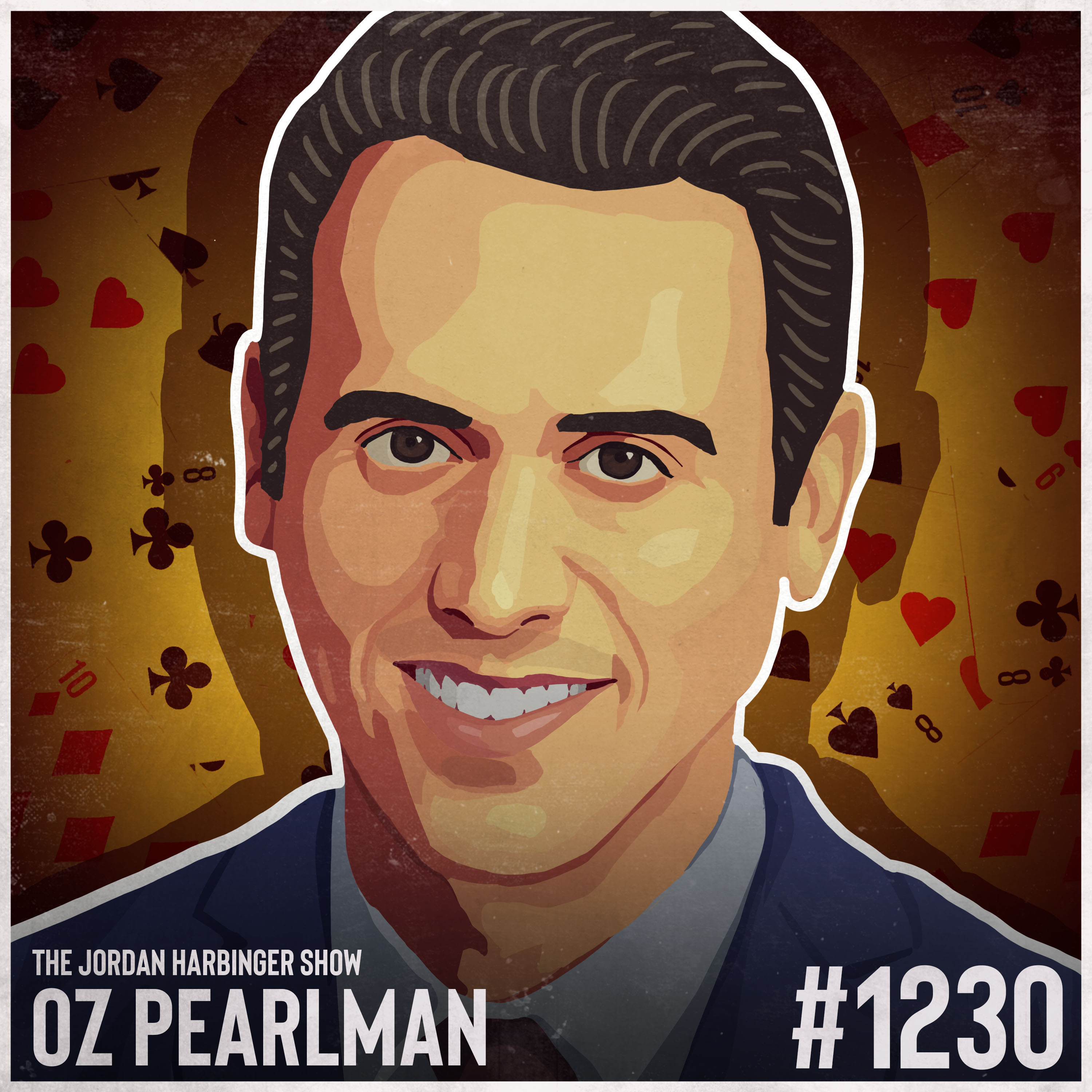
1230: Oz Pearlman | Making Magical Human Connections Like a Mentalist
Ever wonder how mentalists read minds? It's not really magic. Oz Pearlman is here to expose the secrets of influence, charisma, and seeing others deeply.
Full show notes and resources can be found here: jordanharbinger.com/1230
What We Discuss with Oz Pearlman:
- Mentalism isn’t psychic — it’s psychology, empathy, and showmanship combined to read people’s cues and create the illusion of mind reading.
- The foundation of charm isn’t being likable — it’s making others feel likable and seen.
- Failure builds resilience. Learning to separate rejection from self-worth frees you to take bold risks.
- Authenticity and kindness are superpowers. People sense when you’re genuine, and remembering names or small courtesies leaves a lasting mark.
- Reframe your mindset with gratitude. Even on bad days, focus on what you do have — your time, your health, your chance to grow — and choose to enjoy your life.
- And much more...
And if you're still game to support us, please leave a review here — even one sentence helps!
- Sign up for Six-Minute Networking — our free networking and relationship development mini course — at jordanharbinger.com/course!
- Subscribe to our once-a-week Wee Bit Wiser newsletter today and start filling your Wednesdays with wisdom!
- Do you even Reddit, bro? Join us at r/JordanHarbinger!
This Episode Is Brought To You By Our Fine Sponsors:
- Kindred: Free signup + 5 nights travel credit: livekindred.com, code JORDAN
- LinkedIn: Post your job for free: linkedin.com/jordan
- Signos: $10 off select programs: signos.com, code JORDAN
- Progressive: Free online quote: progressive.com
- Homes.com: Find your home: homes.com
See Privacy Policy at https://art19.com/privacy and California Privacy Notice at https://art19.com/privacy#do-not-sell-my-info.
Press play and read along
Transcript
Speaker 1 This episode is sponsored in part by Dell. It's time for Black Friday, Dell Technologies' biggest sale of the year.
Speaker 1 Enjoy huge savings on select PCs like the Dell 16 Plus, featuring Intel Core ultra-processors, and with built-in advanced features, it's the PC that helps you do more faster.
Speaker 1 Plus, earn Dell rewards and enjoy many other benefits like free shipping, price match guarantee, and expert support.
Speaker 1 They also have huge deals on accessories that pair perfectly with your Dell PC and make perfect gifts for everyone on your list. Shop now at dell.com/slash deals.
Speaker 1 Extra value meals are back.
Speaker 2
For just $5, get a savory and sweet sausage, egg, and cheese McGrittles, plus hash browns and a coffee. Only at McDonald's.
For limited time only, prices and participation may vary.
Speaker 2 Prices may be higher in Hawaii, Alaska, and California, and for delivery.
Speaker 1 This episode is brought to you by Progressive Insurance. Do you ever find yourself playing the budgeting game?
Speaker 1 Well, with a name-your-price tool from Progressive, you can find options that fit your budget and potentially lower your bills. Try it at progressive.com.
Speaker 1
Progressive casualty insurance company and affiliates. Price and coverage match limited by state law, not available in all states.
Coming up next on the Jordan Harbinger Show.
Speaker 2 If you have a job you hate and you're not making enough money and maybe you're ill and maybe you've got a chronic disease and all of these things that stacked up that I, you say to me, you don't get my life owes.
Speaker 2
And I'm like, I don't. You know what you are, though? You're alive.
And there's literally every second of every day, two people taking their last breath.
Speaker 2 Every second that would give anything they could have to have what you have, which is being alive for another day, another month, another year.
Speaker 2
That one day, I will be taking my last breath and I will give anything to have more time. This is silly.
Enjoy your life.
Speaker 1 Welcome to the show. I'm Jordan Harbinger.
Speaker 1 On the Jordan Harbinger Show, we decode the stories, secrets, and skills of the world's most fascinating people and turn their wisdom into practical advice that you can use to impact your own life and those around you.
Speaker 1 Our mission is to help you become a better informed, more critical thinker through long-form conversations with a variety of amazing folks from spies to CEOs, athletes, authors, thinkers, performers, even the occasional drug trafficker, rocket scientist, Hollywood filmmaker, or organized crime figure.
Speaker 1 And hey, if you're new to the show or you want to tell your friends about the show, I suggest our episode starter packs.
Speaker 1 These are collections of our favorite episodes on topics like persuasion and negotiation, psychology, geopolitics, disinformation, China, North Korea, crime occults, and more that'll help new listeners get a taste of everything we do here on the show.
Speaker 1 Just visit jordanharbinger.com/slash start or search for us in your Spotify app to get started. Today on the show, Oz Perlman, the mentalist, magician, marathoner, and master of mentalism.
Speaker 1 You've probably seen on America's Got Talent, the Today Show, or maybe just blowing people's minds on the streets of New York. Now, I've known Oz since back in undergrad at Michigan.
Speaker 1 We lived in the same dorm area, and honestly, I should have known he'd end up famous when I saw one of his old penguin magic videos while I was grinding through law school.
Speaker 1
He was just one of those guys where you're like, wow, this guy's like got an extra something. He's got the X factor.
And so, no surprise that he ended up super famous and successful.
Speaker 1 Hey, if you've ever seen him perform, you know exactly what I mean.
Speaker 1 The guy, he doesn't just read minds, he reads people, their tells, their tone, their energy, the subtle cues that most of us miss entirely.
Speaker 1 And he turns all that data into what looks like straight-up wizardry. Now, there's probably a trick or 10 in there somewhere, but I have no idea how any of it works.
Speaker 1
You'll see him blow my mind on this show. Of course, Oz is not psychic or actually magical.
He's more like a psychologist with flair.
Speaker 1 He treats mentalism as a trained skill, part observation, part empathy, part showmanship, a lot of showmanship. And we're going to break down how those tools apply far beyond the stage.
Speaker 1 We'll talk about how to build rapport in seconds, how to use scarcity and status to command a room, and why charm isn't about being likable. It's about making other people feel likable.
Speaker 1 We'll also get into the uncomfortable stuff, what happens when tricks go wrong, how to turn failure into resilience, and why visualizing failure might actually be the secret weapon to performing under pressure.
Speaker 1
This conversation has been on my schedule for literally, I think, three years. And I promise you, it was worth the wait.
Here we go with my old friend, Oz Perlman.
Speaker 1
I've been looking forward to this. It's funny because I knew you in undergrad.
For people who don't know, we lived in the same dorm. I said, oh, I'm going to Israel.
Speaker 1
And you're like, dude, I'm Israeli. Let me teach you some Hebrew.
You taught me like mashlamcha or something like that, right? And I was like, okay. And I couldn't say it.
Speaker 1 I was like, oh, gosh, am I going to keep spitting on me? I was like, am I going to have to keep doing that sound? Cause that's uncomfortable. And then I went to to law school at Michigan.
Speaker 1
Also, somebody had sent me a video of some cool magic, and I was like, oh, Penguin Magic. And I was like, wait, I know that guy.
And I was like, that's Oz Perlman. He's in a magic video.
Wow.
Speaker 1
I knew he was like an outgoing guy, but he really is doing this magic thing. That's pretty damn cool.
And then 10 plus years later, I'm in New York and I'm walking and it's like near Broadway stuff.
Speaker 1
And I saw some poster or sign and I was like, oh my God, he's got a show on/slash off Broadway. That's really cool.
And it was like, wow, Oz is really doing it.
Speaker 1 And then I looked recently when I booked this and I was like, wow, you really did it. Cause this is not quite the metric we mostly look for.
Speaker 1
But I don't know, you have like 7.5 million followers on Instagram and all your posts. You're on Rogan recently.
You got a ton of stuff. And so this has been on my calendar for two or three years.
Speaker 2
I know. We've been like slowly making it happen.
And I'm so glad we did it.
Speaker 1 And now I'm like, wait, actually, good thing I booked this three years ago because that's probably the lead time on getting you on a show now because your career is like doing hockey stick stuff.
Speaker 2
You know what? I'm blessed. I'm lucky.
I've been working really hard.
Speaker 2 And I think if you put out consistently good content and also just, you really know how to develop and build an audience, which you've done really effectively by delivering a product that people love, that's it.
Speaker 2
You do a great job. You exceed expectations.
And then I just do hundreds of live events a year so people see me perform.
Speaker 1 We should tell people what mentalism is because I don't want people to think you're pretending to be psychic.
Speaker 2
Sure. Oh, yeah.
Very important. What do I do? It's called a mentalist.
I make the joke my wife thinks I'm mental. And that is very true.
Speaker 2 But a mentalist is kind of a subset of magic, but it's not magic. So it's really important to understand when people ask me, is that a trick you did? Yeah, it's a trick.
Speaker 2
But it's a trick in a different way because a trick when you're seeing a magician, it involves sleight of hand. And I love magic.
I started as a magician.
Speaker 2
When we saw each other in college, you saw me doing card tricks. And I love that stuff.
I go to my kids' school. I'm busting out the magic tricks again.
Speaker 2 But what happened is an evolution over time where I use less and less props and less sleight of hand.
Speaker 2 And what I start doing is using the core foundation of magic, which is things known as misdirection, influencing, deception.
Speaker 2 When you're doing a magic trick, you're usually not quicker than the eye, but you distract the eye at the moment you do a move.
Speaker 2 So the illusion that you see is typically that when a car disappears on stage with David Copperfield, it didn't really disappear. He made you look away at the moment he did the move.
Speaker 2 So that right there, the knowing how to influence where you think and what you think.
Speaker 2 And then when you take away the visuals is what i do for a living now which is i know how people think i've spent almost 30 years reverse engineering the human mind the things you convey to me your non-verbal communication the way you pause the way you enunciate the way i move you in a certain direction by speaking very quick and then going very slow all of that is my instrument on how i can entertain you create memorable moments but do things that appear to be psychic, appear to have no explanation, that I can seemingly read your mind.
Speaker 2
mind. Literally the title of my new book, Read Your Mind, but I can't read minds.
I read people. It's not supernatural.
It's not psychic.
Speaker 2 I want people to know that I am not talking to dead people or trying to rip you off.
Speaker 1
That's good. The talking to dead people stuff is particularly despicable.
There's a couple of other guys they'll pretend to be like talking to dead people. And I'm like, it's such a shame because...
Speaker 1 You can do all these incredible things that blow people's minds.
Speaker 1 Those guys could theoretically do that too, but instead they take some old lady's money because she thinks she's talking to her dead grandchildren.
Speaker 1 And I'm like, wow, you really could have just gone this way.
Speaker 2 Bam, technical Sunday. I'm with you right now.
Speaker 1 But like instead, you decided to be like the scumbaggiest of all scumbags. I don't understand the choice.
Speaker 1 And then they put all this effort into doing it because I can only imagine how much effort and time over 30 years it takes to be able to quote unquote read minds.
Speaker 2 Cold reading, learning all the skills, learning how to manage audiences, learning how people think.
Speaker 1
Yeah, that's a lot. Everything you do, I assume, has a purpose when you're doing this.
Can I give away a little bit? Like before the show, we were talking. You're like, think of these things.
Speaker 2 I wanted to get your mind racing and even then in that moment when i said jordan i want you to go back in time because we know each other so if i said to you on air think of something i as a skeptical viewer would even go well they knew each other right yeah i set in motion we walked in and i want to make sure there's nothing written down you didn't whisper something i just said start thinking in your past things and people and inside jokes and think of stuff that there is no way i could know And that over the course of 2,000 plus episodes, guests that have had an impact on you.
Speaker 2 And I don't even know if your thoughts are fully formed yet, but right when I got here, I started setting in motion what I think you would think about.
Speaker 2 And it's interesting to see later if you feel I influenced you into picking what you picked.
Speaker 1 I don't see, so I was like, I'm going to pay attention to everything he says and does and see if he influences me. And I'm like, so far, coming up pretty dry.
Speaker 2
The thing that Jordan's going to tell you is that nothing's happened yet. He walked in.
He didn't have water. So we went downstairs to get water.
Was that the trick?
Speaker 2 And then he told me to think of some people, but I don't know who to think of yet.
Speaker 1 Well, I got the water afterwards because I was like, I'm going to know every word word he says.
Speaker 1 So it's psychology, suggestion, misdirection,
Speaker 1 anchoring, framing, stuff like that.
Speaker 2 Very smart. Anchoring and framing are huge amounts of it.
Speaker 2 And then good old-fashioned deception, which is that I lead you on a path in my performance where it's like one of those little mice going to cheese.
Speaker 2 They go in a maze and they keep turning left and right. And I try to guide you at certain moments to thinking that you know how I did it.
Speaker 2 And right then, I cut that method away and then cut the method and cut the method so that at the end, you keep getting engaged. Because if someone's not engaged in my show, then I've failed miserably.
Speaker 1 That's the whole point of the show.
Speaker 2
But the whole point is you don't want someone to tune out. And that's a kind of a breadcrumb.
Think of it.
Speaker 2 There's a book called The Game by Neil Strauss, where he talked about something called cat string theory, which is, he used it to pick up girls, but it's something in all of human dynamics and just relationships is a cat, if you drop a piece of string on the ground, doesn't want to play with it.
Speaker 2
The cat likes the string when it's moving around outside of its grasp. So the same thing here.
People like it where if they have no idea how you're doing something, they will actually tune out.
Speaker 2
They're not impressed. They're not engaged.
But if they feel like they got a little bit, I know how he did that. Oh my God, that's how he did it.
Speaker 2 If you give them that little taste along the way, then they're at the edge of their seat and they're excited and they feel like they're being taken along and they're figuring out what's behind the curtain.
Speaker 2 But then they didn't realize there's a second and a third curtain. And so every time you're upping the ante.
Speaker 1 Maybe I'm easily entertained because I'm always blown away by how anybody does any sort of mentalism, especially.
Speaker 1
There was a time time I saw a show in San Francisco and the guy's like, think of a weird vacation destination. And I was like, oh, I'm going to put North Korea.
That's the weirdest of all.
Speaker 1 And he's downstage and I'm way up there in the dark and I wrote it like under the chair and then he guessed it. And I was like, okay, what are there? Cameras under every chair? Like, what is going on?
Speaker 1
I was so lost. And I looked under the chair because I was like, clearly there's a camera under every chair.
Either it's the tiniest camera or there was no camera.
Speaker 1 I just, I don't think there was a camera.
Speaker 2 I'm going to tell you the truth.
Speaker 1 No, it's just something.
Speaker 2
Mentalism. He knew you were the guy who do North Korea.
I know this jerk right here.
Speaker 1 This is the schmuck who's going to do it. Yeah, it's very.
Speaker 2
The girl next to you was going to do the Seychelles for the record. Yes.
Deep cuts. That's right.
Speaker 1 What are ethical boundaries in mentalism? We kind of talked about manipulation, but how do you decide what to reveal or not or what sort of areas you won't touch?
Speaker 1 Are there kind of like, I won't talk about these specific things or I won't get people to talk about these specific kinds of.
Speaker 2
So I would say there's a few red lines for me. I sometimes find out information about people that would be embarrassing.
There's been lots of occasions.
Speaker 2 I just know something about them that I know they don't want me to share.
Speaker 1 So I won't do it. What's an example of that?
Speaker 2 Rabbit infidelity, like somebody hating somebody in the room, just things that I can suss out that I figured out or that people in jest will challenge me to get.
Speaker 2 But then once I'm in that moment, I won't do it because I know that the repercussions to them won't be what they want.
Speaker 2 Giving away people's passwords that I figure out, just things that cross a certain line. I won't give away social security numbers, even though I've been challenged to get it.
Speaker 2
And some of you will never guess mine. I'll write down a piece of paper, show it to them.
They're like, what the f? And then I'm like, I'm not going to say that on stage because you can't change that.
Speaker 2 TransUnion experience, Equifax, you're screwed, brother.
Speaker 2 There are certain things like that where they typically are challenges or that I'm able to discern, but I don't like to scare people by saying that because they go, oh my God, I don't want to be in the room with you.
Speaker 2
I will only figure stuff out that you can know. So, again, if you can know the information, I can find ways to find it out.
That's kind of the goal because that's what a mentalist does.
Speaker 2 I reveal secret information that I shouldn't be able to know in a way that's inexplicable. But there's lots of ways to package that to make it entertaining, exciting difference.
Speaker 1
It must feel incredible to do that. I've got a little taste of it because I saw a mentalism show in the city.
And after the show, there were drinks.
Speaker 1
And I was talking to this old couple that was standing in the corner. And I said, oh, what are you doing here? And they're like, actually, our son is the performer.
And I said, oh, that's great.
Speaker 1
You must be really proud. And they were like, actually, he doesn't know we're here.
And I was like, wait, we have to play a joke on him if he doesn't know you're here.
Speaker 1 I said, what was his like favorite stuffed animal as a kid or something? And they were like, why? And I was like, trust me, this is going to be worth it.
Speaker 1
So they told me he had a little binky named something and it was like a whatever. It was like a little stuffed elephant.
So I walked up to him and was like, That was a great show.
Speaker 1 I've been dabbling in this stuff myself. And I don't know how to deliver it in an entertaining way because I don't know what I'm doing.
Speaker 1
So I basically was like, I'm getting a vision of something from when you were a kid. Can I share it with you? And he's like, Yeah, okay, whatever.
And I was like, He had a little stuffed elephant.
Speaker 2 He was, his mind was blown because he knew it was a trick, obviously. But he was like, How did you do that?
Speaker 1
And you could sense him looking at me like, surely this guy knows me from child. He like couldn't figure it out exactly.
And I was like, let me release you from this prison. Your parents are here.
Speaker 1 And he was like, no way.
Speaker 2
So what you should have done there is you have to create a false explanation. So you would have driven him crazy.
Right. Because you did something what's known as the two perfect theory.
Speaker 2 So two perfect means there's only one solution because you walked up and there was no procedure. So procedure is something to get to the answer.
Speaker 2 And so if I just went, ba-bam, and it happened, you're like, oh, I don't know how that happened. I did a few things.
Speaker 2 And if I lifted something and went, wah, then you go, oh, maybe it has to do with that clipboard or maybe, right? You create some sort of alternate.
Speaker 2 So for him, as a mentalist, it would have driven him insane. I would have literally said, take a marker, your marker, and I want you to write down, you know what?
Speaker 2
Think of your best friend when you're seven. He's like, I don't know.
I go, no, that's too easy. I could have looked up.
Did you have any stuffed animals? I would have made him change his mind.
Speaker 2
So he feels like he was in charge and he conveyed the information. Write it down the palm of your hand.
Hold it tight against you. Hold your hand out in front of me.
And I'm going to close my eyes.
Speaker 2 Let me feel your hand and rub your hand. I would have had you rub his hand and it would have destroyed his world because now he would have said, how did you feel the marker?
Speaker 2 You would have given him a path to go down that would have driven him insane because there is no way to have done that.
Speaker 2 And so again, that's how I think as a mentalist, because what I'm creating is the memory and the story that you will tell to the next person.
Speaker 2
If you boil down what my real skill is, it's not fooling you. It's not entertaining you.
It's creating memorable moments. And you have to define what that really means.
Speaker 2
Memorable moments are ones that people tell others about. And that's my secret to success.
And that's what a viral video is at the end of the day.
Speaker 2
You share it, you comment on it, you're captured, and you want other people to know. That's what makes it viral.
Literally, it's memorable. It's different.
It's the purple cow, right? It's the Mr.
Speaker 2 Beast running with the millions of dollars that keeps you in an economy where every attention is swiped. How do we capture them?
Speaker 1 Yeah, I knew like when I got the delivery, I was like, well, I don't know what to do with this information.
Speaker 2
You should have texted us. You're like, they need you right now.
We really need to mess with this guy. Do you remember who it was?
Speaker 1 Yeah. Oh, no, I don't.
Speaker 2 He was good, though.
Speaker 1 Like, we all know each other. It's a small community.
Speaker 2 Yeah, it can't be that big.
Speaker 1 People who are good at this, there just can't be that many because of the amount of work it would take to get good at this.
Speaker 2 That's really, truly the case is there's a steep learning curve. And it's more similar to comedians in many ways than magicians because magicians can practice to perfection.
Speaker 2 You can practice a trick with sleight of hand.
Speaker 2 over and over and over the same way you could practice juggling so that when you get in front of people guitar the same way now keep in mind you might not have the creative juices of writing, Hey Jude, but you might be able to play other people's songs as a cover band.
Speaker 2
That's what most magicians are: a cover band. They don't create their own material.
They do others' material.
Speaker 1 Yeah, there's only a few pen and teller guys catching.
Speaker 2
That's exactly right. And some of the people that create don't perform.
There's songwriters who write the songs for the artist. Same thing here.
There's consultants who make magic for magicians.
Speaker 2 Interestingly enough, you don't know that.
Speaker 1 Like, why would those guys don't perform? They just make tricks.
Speaker 2
Because sometimes you're behind the camera talent. You're not necessarily the performer, but you're a great creative mind.
Comedy writers are a a great example.
Speaker 2
But a comedian doesn't know they're funny, impossible to know until they're in front of an audience. The audience conveys your worth to you.
So that's identical to a mentalist.
Speaker 2 A mentalist cannot be good without an audience because you can't read your mind in a room versus somebody who's incredibly good at magic still has to interact with an audience.
Speaker 2 There's still that presentation, but there's people who go on stage who do illusions and do manipulations, who literally don't even interact with an audience. They just do their amazing stuff.
Speaker 2
They can win the World Championship of Magic and they never speak to a spectator. They do amazing things.
They have the dexterity. So how the heck do you develop these skills then?
Speaker 1 Because you basically, like you said, a comedian, you have to do like the equivalent of magic mentalism open mic where you're just like getting everything wrong and people are like, yo, don't quit your day job.
Speaker 1 Holy smokes, that was terrible. And you're like, I need a thousand more of these and I'll eventually be able to do this.
Speaker 2 And it's like, it's just got to be terribly brutal.
Speaker 2 Literally, there's a chapter in my book that exactly explains that analysis of when I was working restaurants, the failure and the rejection that you have to take in at a young age, for me, it was as a teenager doing this, has served me in my entire life.
Speaker 2 And every single thing I do, being able to stomach failure, because so many of us fear failure to our core, it's in our DNA where fear of failure stops people from quitting their job as a lawyer and starting a podcast because they go, you did it, but there's no way I could do it.
Speaker 2 Just that thought, there's no way I could do it, internalizing that, repeating that to yourself day after day becomes a self-fulfilling prophecy versus someone who internalizes, I'm going to do it.
Speaker 2
I know I'm going to do it. And they start taking step one, step two, step three.
Now they might not do it, but I guarantee you they're never going to do it with the wrong mindset.
Speaker 2 So with me, that rejection and failure, I got better and better at it
Speaker 2
because I was able to absorb those blows and know that, hey, it's not really me they hate. I kind of was able to separate.
I created these silos. I've got my own ego that doesn't get crushed.
Speaker 2
I said, it's the tricks they don't like. It's the entertainer.
You can do that in life where you can separate yourself. It's the same as when I would approach girls at a certain age.
I was so nervous.
Speaker 2
I'll never forget in high school. This one girl, like, I asked her to go out to the homecoming.
Her friend said, how could you even think to ask her?
Speaker 2 I was like, oh, stabbed me in the side, twisted, pulled it out, and I just bled to death on the floor is what I felt like. I'll never forget her saying that to me in French class.
Speaker 2
And so I took that to heart. But later, a few years later in college, I started saying, That's not me.
She didn't even know me. I started thinking, I have an agent.
Speaker 2
Like if I was at William Morris, WME, I have an agent who represents me. If somebody says, agent, we don't want him for this.
That's not me. They told my agent that.
Speaker 2 I started having this mindset where I have a representative and I have me. And all the stuff that was crapping on me, I sent to my representative.
Speaker 2 I found a way in my mind to deflect and separate and move it over. And it's just like having a bowl right now.
Speaker 2
If we had a bowl of water and you took right now salt and poured it in, we got salt water. Can't separate it.
But put a piece of invisible plastic in the middle.
Speaker 2
Just put right there a little piece of, I don't even even know what to call it, Pyrex. I don't know, something right there.
Boom. Pour into one side.
The other side says fresh water.
Speaker 2
Separate that failure away. And you can do that.
There's tricks to rewire your brain because as soon as you lose that fear of failure, it opens you up. It opens you up to be successful.
Speaker 1
That's really smart. Of course, it's a little bit easier said than done at first.
Young guys approaching women. Hey, she's rejecting your representative.
Okay, cool, but everyone still laughed at me.
Speaker 2 Yeah, but my representative is five foot seven and three quarters and she wants six feet. And I need the three quarters because that's average for a Jew.
Speaker 1
So yes. Yes, I know.
God, just wear taller shoes. That didn't work for me either.
That's bad advice.
Speaker 1
Back in Ann Arbor, actually, there were these two magicians that would work on Main Street, and they were like medium. They're probably college students.
I don't know.
Speaker 1 And I just remember they would get super harassed.
Speaker 2 And people be like, that sucks.
Speaker 1 And I remember feeling so bad for them because that's not easy to do. Walk around the tables in an Irish pub working for free, doing card tricks, or just doing like rope stuff or whatever it was.
Speaker 1
I don't remember. And it was free, for God's sake.
Come on. And people were just crapping all over them.
Speaker 1 And I remember even to this day thinking like, God, I hope those guys made it and love doing what they do because people were not nice to them at all.
Speaker 1 And surely even now, there are people that are like, I don't want to deal with this.
Speaker 1 When you're engaging with folks and they're just either rude or that probably happens to you far less now, but maybe they're just not giving you the proper attention.
Speaker 2 They're not engaged.
Speaker 1 You have something where you remove your attention from them and they chase you.
Speaker 2 Absolutely. So I think it's group dynamics and peer pressure.
Speaker 2 And in so many instances in life there's a power dynamic when you meet someone which is who needs something from the other more you could say that that seems very transactional manipulative but it's not it's life even if you have a child and i want them to eat breakfast i'm trying to get something from them and if they don't eat breakfast there's a problem for me because now they're going to be a mess and they have low blood sugar and they're not going to study well in school so in most of your interactions every single part of every single day there's someone that's getting something and hopefully you have mutual benefits.
Speaker 2
But when I'd walk up to somebody at a table, they they had all the power over me, which is, hey, kid, get out of here. I don't want to watch this crap.
Get out of here. Go to the next table.
Speaker 2 They could reject me.
Speaker 2 But when I'd approach them, I learned all these different tactics from the way my body was positioned to the first words out of my mouth to taking away all of their resistance when I approached them.
Speaker 2 This is called channeling your inner mentalist is knowing what the other person is thinking, not to guess or to do magic, but know what they're thinking when you meet them or know what they're thinking when you approach them needing something.
Speaker 2
So for me, I knew that when I walked up to you at a restaurant, first things first, I'm some 14-year-old trimp. You don't even know who I am.
You don't know if I work at this restaurant.
Speaker 2
You don't know what I'm about to do. You see me take out a pack of cards.
So now in your mind, you go, oh, is he doing card tricks? Oh, God, is this magic? Is he going to be good?
Speaker 2
Is he going to leave soon? Do I have any money in my pockets to tip him? Oh, all of this dread sets in. I don't want dread.
I want excitement.
Speaker 2 So I learned in my mind, iterating over time, what people thought of me when I walk up to them. What did they think of me? And I noticed a few things.
Speaker 2
If I approached you head on, it's very aggressive. It's from the animal world.
An animal that you look at directly feels fear versus if you're at an angle, they only see one of your eyes.
Speaker 1 Approaching women 101 as well. Like never get full on, like side and then you offhand do something else.
Speaker 2
And never hesitate. So when you walk up to somebody, if you walk up with a smile, no hesitation, bam, confidence can be felt.
It's sensed. So when I walk up, I'd walk up at an angle, only one eye.
Speaker 2 It looks like I'm about to leave. And I'd say, I've only got one minute, but did you hear what's going on tonight?
Speaker 1 False time constraint.
Speaker 2
False time constraint. Exactly.
I'm not staying long because right away, most people don't know when you walk up to them, how long is this going to be?
Speaker 1 Be here all night.
Speaker 2
And so I've only got a minute, but did you hear what's going on? It's your lucky night. And that's the lottery.
You didn't give them a yes or no question. Hey, guys, want to see some magic? No.
Speaker 2
Where do you go from there? But I'm really good. My mom says I'm good.
You go away.
Speaker 2 But if I ask you a question that's rhetorical, that only has upside, which is, what would you do if you had $1,000 right now? Who's going to say, no, I don't want $1,000? Few and far between.
Speaker 2 So if I walk up and say, you've won the lottery, did you hear what's going on tonight with that level of tone? No, what's going on?
Speaker 2 The owner brought me here as a special treat for you, and I have something incredible to show you. Nothing has been a yes or no question so far.
Speaker 2 The worst case scenario you ever get is you didn't read the room right and they're in the middle of a conversation. They're like, you know what? We're just in the middle of something.
Speaker 2
Can you come back? That's the worst thing I'd ever get. And I go, of course, enjoy yourself.
I'll see you later if I can make it. Like right away.
Again, I've taken away a a little bit of the value.
Speaker 2 So when I would approach in that manner, the first thing I'm saying is, I'm only going to be here for a minute. Have you heard what's going on? Next, the owner brought me here as a special treat.
Speaker 2
That three seconds, those 12 or 14 words I just said, the owner knows I'm here. I've been invited to be here as a special treat.
I don't owe you money. I don't have to search for a tip.
Speaker 2
Owner brought you a special treat. You're taking all of these things away.
Now, again,
Speaker 2
objections and sales, like objections and sales, the way you get a script, boiler room, amazing. I love that you're a stockbroker.
You're such a savvy investor.
Speaker 2
That's great that I can talk to you about this opportunity. Now, you want to kill with kindness.
You don't want to create yes or no's. You want to create more openings to branch a conversation.
Speaker 2
It's rapport building. It's sales 101.
And make no mistake, everything in life is sales, whether that's deepening connections, being seen, being heard.
Speaker 2 Everything in life can be boiled down to an interaction with other people. I don't care if you're a loner and how you're able to have that person like you and want to do things with you.
Speaker 2 Winning people over and having them be your champions is the path to success in life.
Speaker 1 That's funny because that's right where I was going with this is you and I share this outlook where nine out of 10 people in podcasting, they'll try your show and they'll be like, nah.
Speaker 1 And sometimes the reason I'll be able to get feedback from people and they'll go, my wife doesn't like your voice. And I'm like, okay, that's not like a thing I'm going to change.
Speaker 1
And I'll go, I'm so curious why. And then I remember one old couple, couple, she was like, you talk a little too fast.
You remind me of somebody that I don't like.
Speaker 1
And it's like, I'm not going to overcome that. There's no reason to.
And she even felt bad. She's like, I just have an illogical aversion to the way that you talk.
Speaker 1
I reminded her of probably like some ex-boyfriend or something. Who knows? But 90% of people more who try your show are not going to care.
And you kind of have this as well.
Speaker 1
Like 5% of your clients, they're your super fans. The other 95%, they were like, oh, yeah, I saw that guy once.
He was great. I think.
I kind of remember it. I don't know.
I had a lot of email.
Speaker 1 I was on my own.
Speaker 2 I hope the numbers are higher than that, but yes, I see your point.
Speaker 1 Five to 10%, though, they love you in their life.
Speaker 2
Especially if you do big numbers. Right.
Yes. It's a numbers game.
Life is a numbers game. And you have to be aware of that.
Speaker 2 And the rejection, when you can reframe rejection, I realized, and I'm a numbers guy, like I was really good at math growing up as a kid.
Speaker 2
It was honestly one of my superpowers because at a certain point in school, I started screwing up and being rebellious. My folks got divorced.
And I was like, just started becoming a bad kid.
Speaker 2
But this is, I can only chalk this up to luck and genetic lottery. I was incredibly good at schoolwork and math.
I was like a math savant in certain ways. So things were easy for me.
Speaker 2 And if I had not had it be easy for me, I would have definitely gone down a different path in life because I was able to still get good grades, even though I was such a screw up and wasn't really studying or doing homework.
Speaker 2
And so I reframe things in my mind. And it's the same way when I was a little kid, when I count stairs, it was like the rain man stuff.
When I jumped stairs, I count stairs everywhere I went.
Speaker 2
I know the stairs at school were seven, twelve, and eight. Do you understand what I mean? Like real psycho stairs.
It's like OCD.
Speaker 2 OCD, but it's how my mind worked because when I was even young, I realized that when you go to the grocery store, the price of stuff wasn't what they charge you. And my mom said there's tax.
Speaker 2 And so I learned about percentages and I found out the percentage tax. And this is like some Rainman stuff.
Speaker 2 When we get to the counter and they would scan everything before, this is like when I was eight years old, it would be like $87. And I know that it's 8.25% tax.
Speaker 2
I would tell her what the total was going to be. I would tell her she's going to pay with $90 and it's $87.36.
And I know that I'm getting back $2.64.
Speaker 2
Like it was like this weird, crazy, like a human cash register. I would be doing that to tabulate, but that would race my mind and make it fun.
It was a game I play. It seems psycho.
Maybe it was.
Speaker 2 A lot of people are like, we lost you at this point, but I think it sharpened my mind.
Speaker 2 And that exact skill has allowed me as a mentalist to be at the top of my game because I'm able to role play what people will do in my shows and what will go wrong and iterate like a Monte Carlo scenario as to like, boom, boom, boom, this could go wrong, this could go wrong, this could go wrong.
Speaker 2 And I map it out and I figure out what I'm going to do in each of those cases.
Speaker 1 So you're inoculating yourself against potential of failure.
Speaker 2 1,000%. And if you were to look at me and competitors, I would immediately tell you, just like a business, why did Nvidia blow up?
Speaker 2 In my business, that has been one of my major secrets is I stress test what I'm going to do more forcefully and more in depth than anyone else in the game.
Speaker 2 And that's why I'm able to do things that are much, much riskier on TV and in my profession, because other people won't do it because it's too risky. And what if it goes wrong? I do risky stuff.
Speaker 2
Audiences can sense risk. There's a bigger payout.
And I've done it because I've hedged the risk in a certain way. It'll still go wrong sometimes.
Speaker 2 Listen, you're always going to roll craps, but I'm willing to take those big swings in a lot of my appearances and it's paid big time.
Speaker 1 Yeah, that's interesting. It's almost, you're doing a lot of listening, mirroring, guiding perception, things like that, tools people can use in life or business.
Speaker 1 But there's something you're doing that's almost like empathy that's, I don't know, disguised as magic.
Speaker 2 it's hard to describe but i see empathy as i focus more on the person i'm performing for than on me i turn the mirror around is the way i describe it and so again if i'm performing for someone i could just say think of a card and i'll find the card and that's from the world of magic but what if instead we take that same framing which is the net effect is i'm going to guess a card one out of 52.
Speaker 2 what if i say to you when you were a child did you ever play cards with anybody and they go i did and i go stop right there picture that person's face maybe it was a grandparent maybe it was a cousin maybe it was something but there's always those moments that we share with people that are carefree when we're kids that are so precious think of that person right now okay that you're playing cards with as a kid and i want you to see yourself playing a game tell me what game you're playing crazy eights love that game and i go and now eights are the best cards so don't let me influence you but let's say you're playing with them and you stop on one card and right before you turn it over you have a feeling you know what it is think in your mind is it red is it black?
Speaker 2 Is it a heart, diamond, club space? And then I say to them, look at me, and I write down six of diamonds. And I go, what was the card you were imagining yourself turning over?
Speaker 2
And they go, six of diamonds. I turn it around.
Oh, that is such a, and then the kicker is I go, and by the way, you're with your grandmother, weren't you? Now, so think about it.
Speaker 2 The net effect is the same as the card trick, but the story that you tell to somebody the next day is, I met this guy, O's, is unbelievable.
Speaker 2 He told me about me playing cards with my grandma when I was a kid and that she handed me the six of diamonds how could he have possibly known that the story has evolved it's created an emotional hook that now means something to the person that a card the six of diamonds doesn't you're understanding people so deeply that they feel seen which is really special because again you're not just going hey i did something with this deck where you had to pick the card i had already written down what i've done is amazing but it wasn't about me it was about them and what's the most important thing to you to everybody?
Speaker 2 Themselves, followed by their family, followed by their friends, followed by their interests, followed by their finances. Know what core things mean something to you.
Speaker 2
All of us are the star of our own movie. There's 9 billion movie stars in this world.
Everybody else is just supporting cast.
Speaker 2 So if you can make them the star of their movie and that you let them shine in that role, that's the thing they're going to remember. And that's important to note.
Speaker 2 If you've ever met somebody incredibly famous, I've had so many encounters with people that are my heroes where they have been so awesome to me that I will talk about them until my dying day because they not only met the expectations, but they exceeded them.
Speaker 2
And do you know how they did that in most instances? Because they didn't brag about themselves. They asked questions about me.
They were interested in me.
Speaker 2 The most interesting person in most rooms is the most interested person. It's the person who not only is charismatic, but allows you to shine.
Speaker 2 They ask you questions about yourself that you have been asked before. They don't say, oh, what do you do for a living? Where'd you grow up? The 10 questions everyone asks.
Speaker 2 Not a problem if we're doing an interview.
Speaker 2 But if you meet somebody and they ask you a question you've never thought about before, that makes you scratch your head and you go out of autopilot and you go, man, I've never been asked that before.
Speaker 2
That's so fascinating. And then you answer and then they go deeper with you and they ask you another question and you feel like you've opened up to them.
You leave the party or you leave the event.
Speaker 2 You go, did you meet John? How great was that guy? And what did they do? Their superpower was making you shine. And that's something, it's in my book, not mentalism.
Speaker 2 It's the skills surrounding mentalism.
Speaker 1 Charisma and charm, whatever you want to call it.
Speaker 2
Charisma and charm are two different things. And I describe them in the book, both of which you can work on.
Some people have them naturally. So some people go, I'm just introverted.
I disagree.
Speaker 2
I was introverted also. There's tricks you can do that allow you to be better.
That's like saying, I'm not in shape. You know what? Go work out a little bit.
Speaker 1
I'm technically an introvert too. I just know how to get people talking about themselves.
I can talk all day. Obviously, I get paid to do that in many ways, but really, I can get other people talking.
Speaker 1 and I just use my natural curiosity. I don't have to be outgoing to be curious about other people.
Speaker 1 And I think that's something that a lot of people who use the medical excuse of like, I'm an introvert, so I can't be social. I think they lean on that.
Speaker 1 I wonder, how do you get yourself in the mood to be energetic, perform, be dynamic on a microphone or in front of a crowd? Surely there are days where you wake up and you go, oh man, I'm tired.
Speaker 1
I slept like crap. I got five kids.
Four of them are crying and one poops. You don't strike me as a guy who just has fake performance O's and real O's.
Speaker 1 It's like me, it's you're the same person you were on mic or on camera and off. Sometimes I'm like, okay, caffeine and block out the world and just get really curious in this person.
Speaker 1
And then you can have your hangover or your headache or whatever it is that's bugging you. Sure.
Do you have something similar? Because you can't blow it at a gig. You can't blow it on a big podcast.
Speaker 1 It's not good for business.
Speaker 2
Yeah. So honestly, you hit two things so like nail on the head.
One is authenticity is something that people can instantly feel and sense.
Speaker 2
I've watched performers and you know what I instantly say, I go, that's not who that person really is. That's putting on an act.
Now, some people do that and that's not a bad thing.
Speaker 2
Don't get me wrong. Some people have a character.
But for me, I connect with audiences and I connect with them on an emotional level because I am my real self.
Speaker 2 I might be an amplified version of myself.
Speaker 2 tells a little more jokes, is a little more alpha and dominant because I have to be in my show, and then occasionally vulnerable because I think that lets you in as well.
Speaker 2 But I think your audience connects with you because they know who you are. And if they saw you off camera being a totally different person, it's a little bit like you lied to me a little.
Speaker 1
Yeah. One of the highest compliments I get is, wow, you're like the same guy in real life as you are on the show.
And I'm like, they're like, is that weird?
Speaker 1 And I'm like, no, thank you for saying that. My wife said that to me before, obviously before we were married, right after she met me, she was like, I'm almost surprised.
Speaker 1
I had a listener meetup here in New York a couple of days ago. And well, it was impromptu.
My producer just messaged some people he was talking to.
Speaker 2 And they were like, oh you're like the same guy in the coffee shop to me that means i'm doing something right because if you're like an angry bitter asshole and then someone sees you and you're like oh hey what's up everybody it's like oh you're just like a weird guy with a fake personality that i like and then the real you sucks that's so disappointing and so i think another big part of it is just kindness if you were to tell me like if i died tomorrow what i want my kids to remember one more than anything is that i love them yeah which is it's cliche but it's true but the second thing is is that they would be polite and kind.
Speaker 2
Those two words, polite and kind. I tell them so many times a day, please and thank you.
To say please, say thank you, say bless you.
Speaker 2
My wife gets annoyed by that, but I have some weird fixation on if somebody sneezes, you have to say bless you. She's like, I don't know why you do that.
But the kindness goes so far.
Speaker 2
And I'm getting mic'd up probably 180 times a year, more than that even, just getting on a TV show on a thing. A sound person doesn't feel seen.
I go, hey, what's your name, by the way?
Speaker 2
And I say, great to meet you. And then when I take off the mic, I know their name.
And I go, Marcel, you did a great job for me today, man. Thank you so much.
Speaker 2 I bet you that they can count on one hand in the last month, how many people asked their name, remembered their name, and made them feel seen and heard.
Speaker 2
Now, again, there's moments where I've missed that, but I make an effort for that all the time. When I get in and out of an Uber, I tell my kids, say thank you.
Oh, but we paid that guy. I don't care.
Speaker 1 Oh, I hate that argument.
Speaker 2
Say thank you. We paid that guy.
Anyone who's rude to somebody as a waiter or a hostess or anything like that, I instantly judge you. Because one, I've cleaned toilets at a bagel store when I was 14.
Speaker 2 I've done all of those things where I've been a busboy, I've been a magician, I've worked in maintenance, I've done all these jobs, which I think build me up to having a certain level of resilience and toughness.
Speaker 2
And also I put in the reps to, at this point, be able to pull up my sleeves and be like, yes, I've achieved success, but I'm glad that I had kind of shitty jobs earlier. Pardon my French.
Yeah.
Speaker 2 Because I don't know if my kids will ever have that.
Speaker 2 And that's unfortunate because of just the success I've had, where they're in a different socioeconomic class and just an ease of life than I had, which there's nothing you can do.
Speaker 2 Everyone has that problem where if at a certain point you're flying first class, do your kids fly first class with you? And can you stick them in coach?
Speaker 1 As soon as they're old enough to fly in coach by themselves, yeah, they're flying in coach.
Speaker 2
I never got to go to restaurants when I was a kid. I went few and far between.
Getting dessert was on my birthday. Now, again, I'm not judging anyone who has means.
Speaker 2 I'm not saying that I'm better than you. I'm saying I grew up in a different way.
Speaker 2 So I appreciate things in a different way because at some point in life, I didn't have them versus people that I meet who are now at a level where they've had everything since they were a kid.
Speaker 2 Do they appreciate it as much?
Speaker 1 This is why wealth doesn't last more than a few generations in most cases because some grandpa, which is like going to be you and I, busted their ass and made a big business and did everything right.
Speaker 1 My kids, maybe I can make them do a couple crappy jobs when they're younger. Maybe I can put them in coach.
Speaker 1 Are they going to inherit a bunch of my money when I croak and then maybe use it responsibly? I hope so.
Speaker 1 But then are their kids and their grandkids going to be like, oh, they're not going to be like, I better take good care of my grandpa's money. They're going to be like, whatever.
Speaker 2 I want a boat. I didn't even know
Speaker 2
a boat. Yeah, I didn't even know that guy.
Whatever.
Speaker 1 Who cares? He was a podcaster, whatever that means. I don't even know what that is.
Speaker 2
They're like, the AI doesn't let us podcast anymore. It makes its own.
That's right. Yeah.
Speaker 1
Apparently, humans talked on microphones back then. I don't know.
That must have been super boring.
Speaker 2
Why do they spend so much time and energy? Yeah. To go back, you said, how do I show up at 100% every time? And I think, because I've tried to boil it down and I have bad days.
Everybody has bad days.
Speaker 2
I get yelled at my wife. I'm in trouble for this.
I didn't do that. Business email things fall through.
It's just like life hits you. There's just no perfect world.
Speaker 2
And I'm in bad mood sometimes for things that are external that I can't control. But at the end of the day, if I'm listening to this, I'm beyond blessed.
I get to do what I love for a living.
Speaker 2
Do you know how many people get to say that? So few and far between. I get to be my own boss.
No one's telling me you get vacation for three days and not this and not that and punch it a clock.
Speaker 2
I'm my own boss. That is the lottery in life.
I have a roof over my head. I have food.
So at its core, and it's not because I have those things, I constantly look at my life from a place of gratitude.
Speaker 2 And that's a way that you can frame your mindset because I've met people that have very little who have that same attitude that I have.
Speaker 2
And all they look at is the positive and they focus on that rather than the negative because it doesn't matter where you are in life. Someone always has ER than you.
They're younger. They're richer.
Speaker 2
They're smarter. They're anything you want to be.
There's people out there that's a compare and dispare mentality.
Speaker 2 So the superpower is how can you reframe your mind, rewire your brain the same way as a mentalist. I try to get in your head and start to focus on all the positive things you have.
Speaker 2 And even when you feel like crap, even on those days where you don't want to do it, before I get on stage, I inevitably, I still don't feel like doing this, the moment I hit the stage or the moment I'm there is I go, I'm the luckiest guy in the world right now.
Speaker 2 And if I come at that with a genuine sense of saying that to myself, I'm going to get into it. I'm going to get into whatever I'm doing.
Speaker 2 And if you have a job you hate and you're not making enough money and all of those things are not in your fortune and maybe you're ill and maybe you've got a chronic disease and all of these things that stacked up that I, you say to me, you don't get my life owes.
Speaker 2
And I'm like, I don't. You know what you are, though? You're alive.
And there's literally every second of every day, two people taking their last breath.
Speaker 2 Every second that would give anything they could have to have what you have, which is being alive for another day, another month, another year.
Speaker 2 And so if you can reframe your mind, because I know in my core, and you could find ways where I don't know if it comes from your mind, if you have a psychedelic experience, if you meditate, everyone has different ways, but I've had that experience to know that one day I will be taking my last breath and I will give anything to have more time.
Speaker 2 And so right now, while I have that time ahead of me, I always appreciate no matter what I have, I can get in my head and say, this is silly. Enjoy your life.
Speaker 2
You have to find a way to do that to yourself. Everybody has an excuse why they don't.
But like I said, think about that. There's people dying every second and you're not one of them now.
So enjoy it.
Speaker 1 You know, it's wild. O's can make you believe he can read your mind, but I can make you believe you need the fine products and services that support this show.
Speaker 2 We'll be right back.
Speaker 1
This episode is sponsored in part by Buy Optimizers. It's Black Friday savings season.
This is huge.
Speaker 1 You know, the BiOptimizers products we talk about here on the show, the ones that are science-backed, lab-tested, like Magnesium Breakthrough for sleep support, MassZymes for digestive support.
Speaker 1
From November 23rd to December 3rd, you get 25% off. This is a once-a-year sale.
You don't want to miss if you're into this stuff.
Speaker 1 Sure, you can always get 15% off with Code Jordan, but if you want the biggest savings and gifts, load up your cart now and check out between November 23rd and December 3rd to lock in an even bigger discount of 25% off.
Speaker 1 Plus, this part is exclusive to my audience only, and at buyoptimizers.com/slash Jordan, you'll not only get an amazing discount, but also free gifts with selected purchases.
Speaker 1 And I'm going to go ahead and guess those gifts make your poop better because that's always kind of what the deal is with these guys. Anyways, go to buyoptimizers.com/slash Jordan now.
Speaker 1
Use code Jordan. Grab your favorites before this deal disappears.
Before this deal flushes down.
Speaker 1
I'm not going to do it. After December 3rd, it's gone.
Don't miss it. This episode is also sponsored by Drip Drop.
I've always been big on staying hydrated. It's one of the easiest things you can do.
Speaker 1
It makes a huge difference. Your body's about 60% water.
So when you're not hydrated, everything takes a hit. You know, your energy, your focus, even your skin.
Speaker 1
When I'm on top of my hydration, I just feel sharper. I feel more dialed in.
That's why I've been using Drip Drop. You probably heard how important electrolytes are.
Speaker 1 Well, Drip Drop is a doctor-developed, science-backed formula that works fast and tastes great.
Speaker 1 It uses a precise ratio of sodium, electrolytes, and glucose for rapid absorption, giving you 3x the electrolytes and half the sugar of leading sports drinks. You can literally feel the difference.
Speaker 1 More energy, better focus, no midday crash. It's trusted by firefighters, medical professionals, and over 90% of top pro and college sports teams.
Speaker 1 My favorite flavor is watermelon, but any of the sugar-free classics are solid. They've got over 16 original flavors, eight zero sugar options, so there's something for everyone.
Speaker 3
And right now, Drip Drop is offering listeners 20% off your first order. Go to dripdrop.com and use promo code Jordan.
That's dripdrop.com, promo code Jordan for 20% off.
Speaker 3 Stock up now before the heat hits hard. Dripdrop.com and use promo code Jordan now.
Speaker 1 If you're wondering how I managed to book all these great authors, thinkers, creators, magicians, and mentalists every single week, it's because of my network, the circle of people I know, like, and trust.
Speaker 1 I'm teaching you how to build the same thing for yourself. I know you're probably not booking for a podcast, but this will come in handy, I promise you.
Speaker 1
Teaching you for free over at sixminutenetworking.com. There's no shenanigans in this.
It's a super easy, non-cringy, down-to-earth course. Very practical.
Speaker 1 Do it in five six minutes a day many of the guests on the show subscribe and contribute to the course come on and join us you'll be in smart company where you belong you can find the course again it's all free over at six minutenetworking.com now back to oz perlman
Speaker 1 New York's an interesting place for that because you look to your left and there's an investment banker talking on his phone and you're like, I bet that guy made $7 million last year or something like that, which is, you know, fiction you tell yourself in your head.
Speaker 1
I was on Wall Street too. You're like, man, the partners here made $4 million in bonuses.
What would I do with that money? And then you look to your right. Literally on my way here, I was walking.
Speaker 1
It was raining a little. So I was going extra, extra fast because it's New York and it's raining.
And I see this group of like rough around the edges kind of people waiting in line.
Speaker 1
And there's a tent, I guess we got an overhang set up. And there's guys making tea and there's some cake or whatever.
And I walked my way around them and I was like, what is that? That's weird.
Speaker 1 And then this guy taps me and goes, sir, are you from here? And I said, because I used to live here. I don't, I don't anymore.
Speaker 1 And he goes, would you mind cutting the cake and serving it were shorthanded?
Speaker 1 I looked then and I realized, oh, these are all like, I think, unhoused people standing in the rain waiting for free coffee and some kind of cake thing that whatever group this was had set up.
Speaker 1 And I was like, if I didn't have a live show in 10 minutes, I would do it. And he was like, okay, have a blessed day.
Speaker 1 And I was just like, man, I was a little bit miffed that it was raining on my trip to New York after getting up in my super comfy bed at my hotel.
Speaker 1 with my coffee, going to see my old friend from a quarter century ago and doing an interview. I felt a little guilty about feeling like, oh, but it's raining.
Speaker 1 Those people woke up soaked and now they're getting free cake if someone shows up to serve it to them.
Speaker 2
It's always that. You just learn that you get to decide your mood.
And I'm guilty of this. This isn't like, again, if I heard myself saying this, I would judge it from another person's perspective.
Speaker 2
But it's so easy to say. You can always create this excuse of, oh, well, you have money.
Oh, oh, you have fame. Oh, you're successful.
But I didn't at one point.
Speaker 2 A lot of these things have been worked to be achieved. Even somebody who's silver spoon, you can always say, oh, well, they inherited their money.
Speaker 2 There's always a thing that you can say from an internal place of negativity but i would say when i look at that i've allowed people to inspire me where i see what they have and i go that's awesome what can i do to further myself so i try not to like look at people and try to see how i can cut them down but look to see what is it that i can learn from them or that excites me and a lot of the time when i see success now i say that's so awesome they did that like how did they make that happen and does that have anything that i can learn from them And so that's a different mindset that took years to come with because early on when I was not successful, I looked at the people who're successful and be like, what does he have that I haven't had?
Speaker 2 So why don't I have that? And that is not a mentality that brings you up. It pulls you down.
Speaker 1
It also can get worse the more successful you are. Plenty of people who are successful.
I see a lot of people here on this show as well.
Speaker 1 And I'm like, you mean to tell me that you've got 7 million subscribers to your whatever, you probably flew here in a private jet and you're pissed off that like some other guy you know has a slightly bigger yacht than you.
Speaker 1
You're hung up on this, man. And it's, wow, you need perspective.
I don't know how to give it to you, but holy smokes. Oh, you're sad.
You only have $100 million and the other guy next to you has 500.
Speaker 1 You will die with 50 million and he's going to die with 250 million and your kids aren't going to love you anymore or any less. It's just, it's unbelievable.
Speaker 1 So I try to remember that when I'm like, oh, should I make my show bigger? And it's like, why?
Speaker 2 Okay.
Speaker 1
So people stop you more often in the street. On the rare occasion, you leave your house wearing pants.
Like, who cares? You know, what matters? My kid wants to play Legos. Like that matters way more.
Speaker 1 So I try to give myself perspective there because I found myself when I was younger, when we were in college, dude, I didn't care about being famous or rich or anything.
Speaker 1 I just wanted to live a normal middle class life. And then I worked on Wall Street and I was like, oh, money is important in America because you need to get healthcare.
Speaker 1
And the only way to do that is like to have enough money to insure yourself against disasters. And then the show got bigger and I was like, oh, people recognize me.
That feels good.
Speaker 1 And then it was like, oh, I need more of all of this.
Speaker 1
And thankfully, I started to shed that. And then once I had kids, I was like, none of that matters.
But I see people who have a a bunch of kids and they're still obsessed with this.
Speaker 1
And it's sad because I'm like, look at the example you're setting for your kids. And you're miserable.
You've got these kids that love you more than anything.
Speaker 1 And you're like, am I going to get on the Today Show again? No offense to the Today Show, but who cares?
Speaker 2
I'm guilty as anyone. It's a hamster wheel where if you have an internal drive, it's a fire that just keeps getting fed.
And unfortunately, it's a content machine where that's what the world's become.
Speaker 2 But also. if you decide you have ambitions and goals.
Speaker 2 The problem is if the goals are completely externally validating, like I need this amount of money to feel whole, which a lot of people who didn't come from money think that when you have a certain amount of money, that's going to be it.
Speaker 2 Like I'm fulfilled. And again, I'm not judging anyone right now who is on food stamps, who can't make bills.
Speaker 2 And that's a lot of the country that can't like literally deal with their day-to-day existence or have huge credit card debt or pay for stuff.
Speaker 2 So it's a very different barometer where once you achieve a certain amount of financial success and you have your main requirements fulfilled, beyond that, they've shown study after study, I don't know that your happiness goes up by that much of a factor.
Speaker 1 I don't know the exact numbers, but it was like there was a certain amount of happiness at basic needs met, which was, I don't know, it was like 60 grand in the US or something.
Speaker 2 It was like, it's gone up since because inflation.
Speaker 1 Let's say it's 75 now or 80. It's like food, housing, you don't have debt, kids are going to be educated, whatever.
Speaker 1 And then there's more happiness all the way up to like the equivalent of back then in the 90s, whenever they did this, was like 150 grand.
Speaker 1 And then there's this dead zone, and then it goes back up again at a billion dollars if you are making x dollars and your needs are met you've got this moderate increase until you're kind of like lawyer doctor money and then you've got this dead zone until you found paypal or something and then fine you've got like your own jet your own yacht your 17 houses and even then it's like slightly more
Speaker 2 money no problems yes i'm around people of that level all the time and i assure you with their kids with their third wives there's definitely problems no matter how much money you have at the end of the day people are people i would love to hear are there any funny stories of performances gone wrong that you were able to rescue somehow god i've had a bunch people always see it now and they're like oh you're killing it but man early on was not killing it there's one that really stands out where i used to do various trade shows and events where it would be kind of a themed performance i still do a lot of these where they're customized content for a law firm for a product launch where my show is tailored to the messaging because people digest messaging different when you're being lectured where they kind of tune out to if they're seeing a performance where data points are weaved in organically.
Speaker 2 It's the same as remembering the lyrics to a song versus if I handed you a sheet of lyrics, you'd never remember it. But to music, you take it in and process and you could sing the song back to me.
Speaker 2
That's interesting, yeah. So it's the way our brain processes certain things.
It's a real value proposition to companies that hire me to do that.
Speaker 2 But in the past, I would do these and they weren't as fleshed out as they are now, 20 years later after being a pro. Okay.
Speaker 2 So there was a genie lamp on stage that they did not really tell me about beforehand, bigger than a human, maybe 12 feet long.
Speaker 2 So they had this huge thing on stage and they wanted smoke to come out of it. And then I would rub the genie lamp so that the CEO would walk out and be the genie.
Speaker 2
So what they didn't realize is that smoke, once they turn on, it stayed on. They couldn't turn it off.
And there's going to fill the whole stage. The whole stage was just filled with smoke.
Speaker 2
And we were on there and nobody could figure out how to turn it off. And we can't stop the show.
But I needed to know all of these fun facts about this city. I need to have all these facts memorized.
Speaker 2 So the show is already very challenging because I have to insert all of these bullet points into a show that's only 15 minutes long. And oh, by the way, did you know that? Nightmare.
Speaker 2
So I'm flop sweating. First trick, colossal bomb.
Just doesn't go well. I can't see.
And I'm supposed to read someone. I'm supposed to see what they're doing.
Speaker 2
And I can't see them because of all the smoke. Bam.
Every trick was worse than the last one. Thank God the finale kind of worked.
I go off stage.
Speaker 2 You know, it's never a good thing if you are apologizing to the client, right? Oh, yeah. Apologizing to the client, being like, I'm so sorry.
Speaker 2
They seem to have liked it because people, you always forget. Whenever you think something's bad, most people just don't care as much as you do.
Of course. That's the case.
Speaker 2 Also, people typically remember the last thing they felt. So if you have a great finale, you can bring things back really strong.
Speaker 2
So know that if you can somehow even take a dud, and at the end, negative one times negative one becomes positive one. So find a way to end on a high note.
That's what people will remember at the end.
Speaker 2 But did it go terribly? I was rethinking my profession at the end of that moment. So yeah, there's been moments like that, but that's one key one where I learned it's always my fault.
Speaker 2
The Buck stops me. Even though they did this, I should have said no.
But I've been so scared to say no for so many years. I'm going to go with the flow.
I'm a people pleaser.
Speaker 2
That's what I have internally. I'm a performer.
I want to please the people around me. So what happened here is that I learned that sometimes I have to advocate for myself.
I have to be my own agent.
Speaker 2 If you're creating an experience for other people, you've got to be your own like best friend. You've got to take care of yourself.
Speaker 2 And sometimes we're willing to let other people walk all over us because we just want to not be a stick in the mud. I'm not saying be a diva, but be smart.
Speaker 2 When you decide to make a point for yourself, make it the right way.
Speaker 1 Do you still procrastinate all the time?
Speaker 2 I procrastinate all the time.
Speaker 2 Like I have a chapter in my book where my wife read it when she was one of like helped me to edit and she goes, how in the world are you writing a chapter on not procrastinating?
Speaker 2 And so what I've learned is I've learned over and over, I have a trick that I use in my mind and that I tell people to try and use. This is so effective.
Speaker 2
I procrastinate the stuff I don't like to do, just like everyone else. Surprise, surprise, people will be like, how could you be procrastinating? You run 20 miles a day.
I like running.
Speaker 2 I've created a life where I like running so i run marathons me going to run is joyful it's where i tune out zone in so other people hate running so they don't want to do it it's like going to the gym yeah but calls that are confrontational i don't like like we just hired somebody to do work in our home didn't like what he did i have to tell him that in essence we're not continuing this you don't tell your wife to handle that stuff i should have but she's like you hired him you're fired okay so it wasn't a good fit so normally what i would do is string this person along until the last moment which is not respectful of their time or mine but it allows me to avoid that thing of saying the thing.
Speaker 2
And you know what I did? I asked myself, how will I feel 24 hours from now? Right now I have dread. I'm like, oh my God, one to 10 dread eight.
I'm dreading writing this text or this call.
Speaker 2
I'm dreading. How will I feel in 24 hours? One to 10, like literally one.
I won't even remember I did it. I won't even remember that this happened a day from now.
Speaker 2
So all that's happening is I need time. I need to age like an aged barrel of scotch.
I need to age by one day this moment.
Speaker 2 If I could just have a remote that fast forwards like like a DVR to one day from now, then I would do this in a second. Who cares? So what I do is I imagine what I would feel like a day from now.
Speaker 2
Now, the first few times, it's hard to do. So what I suggest is I would set an alarm the next day and say, how do you feel now about X, Y, Z? And just set an alarm.
15% worse. Yeah.
Speaker 2
And the next day, see how you feel? And you're like, oh, I totally forgot about that. So funny.
Yesterday I was dreading it. So now here's what you do.
Do that. Once.
Don't pretend. I'm dead serious.
Speaker 2
Right now, think, what do you, the listener, not want to do today? What are are you like dreading? Set an alarm for tomorrow. Do it now.
Do it now. Just do whatever you have to do.
Speaker 2
Now, I sent that text immediately, right when I thought it. I'm texting him now.
Have the alarm on your phone tomorrow and see how you feel.
Speaker 1 Oh, I see. After you actually do it.
Speaker 2
Exactly. And now, what I want you to trick yourself is the next time you feel that dread, say to yourself and feel, remember in your core, here's how I felt the next day.
I felt like nothing.
Speaker 2
I want to feel that now. So I'm going to trick my brain, just like a mentalist does.
I'm going to rewire my brain, say, that's how I'm going to feel tomorrow. I feel that now.
I'm sending it now.
Speaker 2
I'm calling now. I'm doing the thing I don't want now.
And I'm getting it off my plate. That was the way I tricked myself because otherwise the dread overwhelmed me.
Speaker 2
A lot of the time, even writing my book, it was always the starting, the writing. Once I got into it, I was fine.
I never wrote anything down either.
Speaker 2
Computer, I did all of it transcribed, dictated while running. That's where my mind is free.
But the starting, the first sentence was always the hardest. The dread of starting.
Speaker 2
Trick yourself into doing things you dread because you know how you'll feel once you start them. And that's it.
That's going to solve 95% or more of your procrastination.
Speaker 1
I love that. I think the other 5% is Chad GPT.
Outline this for me and you go, that's a terrible outline. Then you fix the whole thing.
Yeah, I wrote the thing. Why did I do that?
Speaker 2 Because you ever heard this?
Speaker 1 If you want to get an answer on the internet.
Speaker 1 Don't go on the internet on Reddit or whatever and ask people for the answer.
Speaker 2
What you do is you go and you post the wrong answer and people will spend hours correcting you. Amazing.
Oh, here we go. Amazing.
It's like the same thing. So smart.
Speaker 1 It's like, you just got to make sure that you say it wrong enough that some nitpicky person is like i got to spend my lunch hour correcting this guy i know someone's wrong on the internet don't hold the presses i'm not going to bed i got to correct this guy who's wrong on the internet works every time have a grammatical mistake engagement goes through the roof when the grammar police come in and suddenly boom boom boom boom boom boom boom it's just a great way to get instant engagement that's right you want you post something you want engagement make a couple grammatic mistakes and then say something factually incorrect oh goodness i saw you on america's got talent i think a lot of of people did.
Speaker 1 Obviously, I was hoping you would win that, but you frame the so-called loss.
Speaker 2
I don't mind at all that I didn't win. Right.
Tell me about that. So that's a couple things.
One, expectations. Expectations are the kill joy.
Speaker 2 They kill joy in certain ways where if you expect something,
Speaker 2
then if you don't get it, you're crushed. So it's the same as if you watch the kettle, it won't boil.
But if you just do other things, oh, it's already boiling before I even notice it.
Speaker 2
So when I went into that show, I had a couple of great things going for me. I didn't care at all.
Now, I'm going to explain to you why. I didn't get on that show the first two times I tried out.
Speaker 2
That was a blessing because people that I would meet later, I'll never forget. Some guys like, dude, you were on AGT.
And he just framed out my whole career. And I go, I love that you said that.
Speaker 2
Let's discuss because it was a jealousy, but it was, nah, you were on that show. So this is why you're here.
I go, I didn't get on the first time. Did you try it? He goes, yeah.
Speaker 2
And I go, so he hated the show. And I go, did you try it again? He goes, no.
And I go, I did. Did I get on that time? No.
Speaker 2
Right there, the reframing blew blew this guy's mind because he knew what he was going to say to me, another magician, which is, dude, you got on AGG. So of course you got all these gigs now.
I see.
Speaker 2
And we both tried out, but he assumed that I had gotten out of my first try. But when he didn't try again, I just showed him, did you try it again? No.
Why would I have done that? Because I did.
Speaker 2
I didn't get out until my third try. And right away, it's better than anything of shutting someone down or being defensive.
I saw his mind click.
Speaker 2 I saw in his mind go, oh, crap, I could have tried out again. It's the same as I have so many people in my craft who I've mentored who are like, you're on TV all the time.
Speaker 2 I stop them right there and I go, have you been on TV? And they go, no. I'm like, what have you done to try? And he goes, nothing.
Speaker 1 Yeah, I never bought a ticket.
Speaker 2
I go, do you think a producer is going to see it? Be like, oh, kid, you're a star. Like, like it's start dancing vaudevillion like we're on South Park.
I try every day.
Speaker 2 I literally network and promote harder than anyone I know. And that's why I'm on DMs all the time networking.
Speaker 2 I'm finding opportunities where even when I was a 14-year-old kid, somebody's talking to the person at the table. And I learned this early on is they were like, wow, this guy's so great.
Speaker 2
I saw him at a Christmas party. Same way you just talked about seeing that person.
I never let an opportunity go. I'm like, that's amazing.
Are you having a Christmas party this year?
Speaker 2
Let me take your card. What's your number? Never, oh, let me get your card.
I go, oh, you're not going to be in charge of my success and destiny. Let me get your info.
Speaker 2
We're going to follow up with you. I'm 14 years old.
I don't have a team. We as me, myself, and I, and my mom, who drove me here, if I even got lucky enough to get a ride.
Speaker 2 I realized early on that if you put somebody else in charge of your success, they're never going to be your champion. You are going to be your number one cheerleader in life always.
Speaker 2 You're the one who is to drive your success, never someone else.
Speaker 1 The world rewards the politely relentless. I think that's a quote from you as well.
Speaker 2
Yes, I couldn't agree more. Polite and relentless.
Man, I wrote that. Love it.
Speaker 1
Look, it's one of the key superpowers of the show. I hope.
Up to the audience to decide, I suppose. Do you have some sort of tactical listening skill where you remember people's names?
Speaker 1 There's something about the gift of attention that people can't really purchase it, at least not effectively and reliably.
Speaker 2 It just works every time.
Speaker 2 So I think I had teachers along the way that didn't even know they were teaching me, that I just was around people and I tried to assess, and you guys try to do this in your own life, you guys and girls, think about people you meet, like when you leave an event, but most people in their day-to-day life have a certain subset of people they meet every day, people I work with.
Speaker 2 Maybe they have clients, maybe they have family members, they have friends.
Speaker 2 But when you get to be around people that you don't know as well, in social settings or business settings or wherever, at school, ask yourself the people that stand out to you, what was it about them?
Speaker 2
Try to quantify what made them special. Now, there's certain things that are genetic lottery.
They're really attractive. I can't do anything about that.
This is the face, Jordan, made for radio.
Speaker 2
But there's other things where people make you feel a certain way and they make you feel good. They make you feel seen.
They make you feel heard. They make you feel interesting.
Speaker 2
They make you feel like, I don't know, a better version of yourself. Those are the people you gravitate towards.
And we call that charisma, that Riz.
Speaker 2 And what is it about them that does that? And if you've done a good job, I've analyzed that over time, either on purpose or just by osmosis.
Speaker 2
And I noticed time and again that those people are great listeners. It's usually not to be able to talk about themselves endlessly, brag, brag, brag, brag.
Oh, that's a turnoff.
Speaker 2
There's something about that. There's the people that can weave in things about themselves that make them interesting.
I'm not saying to have, no, have not of achievements.
Speaker 2
but their achievements shine while letting yours shine. And I've seen that.
And I have one story very specifically where I met Steven Spielberg.
Speaker 2 And so I performed at Steven Spielberg's dad's 99th birthday party.
Speaker 1 Wow, what a gig.
Speaker 2
It was awesome. And I knew about it and I knew who the client was.
I did his party and I knew about this a month before. So I'm like freaking out.
Speaker 2 This is a fan experience because there's certain people I'm fans of where I watched all his movies when I was a kid.
Speaker 2 And I would consider myself somewhat of a cinephile where I watched these movies over and over and I would watch director's cuts and I was fascinated with the art of making movies as well.
Speaker 2
I wasn't going to be in cinema, but I I liked it. So I had questions.
I'm just so curious. Why did you make this choice? Or what was it like working with this person, right?
Speaker 2 I just really wanted to know things. So when I went in there, I didn't know if I'd have any time with Steven Spielberg.
Speaker 1 Yeah, he's there for his dad's birthday.
Speaker 2
Who knows? Yeah. At the end of the show, it was really good.
It went really well. And I'm not humble bragging, but it's just, I felt great.
And it was also intimate. It was a very small group.
Speaker 2
It wasn't like Hollywood. It was their family.
And he beelines for me. And I'm thinking, oh, this is my moment, man.
This is my moment. Shakes my hand.
Speaker 2 And we end up spending, again, I wasn't looking at the clock, but like 20 minutes together it was like crazy and how many questions did i ask him zero and it's not for because i was starstruck or anything he didn't give me a chance and it wasn't that he was a motor mouth there's nothing like this it was he asked me all of these such introspective interesting questions now he asked a few of the beginning which like how long have you been doing this where i go into autopilot but then you saw why he was Steven Spielberg.
Speaker 2 He asked me all these fascinating questions about why I do this, where this came from, where this originated, like what made you make this choice rather than this choice?
Speaker 2
He was so interested in me that I almost wanted to be like, time out. Time out, Steven.
I got questions for you, brother. Are we going to have another conversation? Can I get your digits? Yeah.
Speaker 2
But I learned when I left, first I was mad. I'm not kidding you join.
I was like, this sucks. I didn't see it.
I didn't ask him anything. I blew it.
Speaker 2
Yeah, I'll just motor mouthed about me the whole time. That sucked.
I always questioned myself after an event and been like, did I talk too much? Was I too forward with that person?
Speaker 2 I start second guessing myself.
Speaker 1 Sounds very familiar.
Speaker 2
Right. And I second guess social interactions and I'm like, God, I didn't wear the right thing and da-da-da.
Like, was my breath good? All these crazy things. I have like an obsession with breath.
Speaker 1 Exactly. Eternal monologue, yeah.
Speaker 2 But he gave me lessons that took me time to realize, which is, why is he Steven Spielberg? Because of that.
Speaker 2 Everyone that meets him has a story they're probably going to tell for years to come about the time they met Steven Spielberg, whether it was for a minute or two minutes or a lunch.
Speaker 2
That's like somebody that you probably, it's an amazing human being. And so he gave me an experience where he made me feel like a star.
And I realized he turned the mirror around on me.
Speaker 2
So the more you can make someone else feel good about themselves by learning more about them. And some people go, I've had people say this to me.
I'm boring.
Speaker 2
Like my wife has gone with me to parties where we're with a lot of A-list celebrities. She's like, what I've talked about, I'm like, you have so much to talk about.
It's so silly.
Speaker 2
You've helped build a huge business. You've birthed five kids.
You have a huge career of your own. You can't just equate what you do now and these things that like you feel of yourself.
Speaker 2 where I go, you're a fasting human being. It's so silly that you would even think that, right? Like you need to be your own best cheerleader.
Speaker 2 Everyone has their own unique perspective on life because there's been only one of you in history. And so find the things that are interesting about you or that you're fascinated by.
Speaker 2 And it might not be these grandiest stories where you've traveled the world and done this or that and this, but you can find something about anyone. that you've not heard before.
Speaker 2 And if you can find that out, that makes that person feel good about themselves.
Speaker 1 Charm is not necessarily about being liked. It's about making other people feel likable, essentially.
Speaker 2 Absolutely.
Speaker 1
I think you're onto something with that. I think it's a learnable skill.
I know you agree with that. We talked about that in the beginning here.
Speaker 1 So I've got a note that says Jim Gaffigan story, and I have no clue what to do with that.
Speaker 2 So Jim Gaffigan, so me and Jim have worked together on several gigs, and we did a gig where I was on America's Got Talent in 2015. And when you're on a show like that, you get heat.
Speaker 2 Now, what does heat mean in showbiz? Heat is like moments where everybody just saw you on something, so everyone's talking about you. Everyone knows who you are because I was just on a big show.
Speaker 2 Oh, and you're in the airport and people are like, yeah, exactly. And that dissipates real fast.
Speaker 2 And if you just get caught to that and be like, I want that forever, good luck because you're in for a big recalibration when fame goes up and down. And do not assign your self-esteem to that.
Speaker 2
But I did a show where the company that hired me had hired me eight or nine months before I was on America's Got Talent. So it's like buying Amazon stock eight years ago.
Bam, it popped.
Speaker 2
As soon as you're off that show, everyone's calling. My rates went up tenfold because that's showbiz.
Make hay when you can. So they got me for super cheap.
And I had done their event the year before.
Speaker 1 Surprise your agent wasn't like, cancel it and put something better on top of it.
Speaker 2
I have, that's where you said ethics. Like, I am not going to do that because something like that burns you.
Your reputation is everything. Yeah.
It's a dick move.
Speaker 2
And long term, you do that over and over. Word gets out.
You need to be smart. You need to treat people the way you want to be treated.
Golden rule. So I didn't do that.
I honor my commitments.
Speaker 2
They hired me. There's two things going against them here.
One, this was a modern Orthodox Jewish crowd. Spoiler alert, Pearlman, member of the tribe here.
Speaker 2 So I'm home team, where, for example, I have a great buddy, Sebastian Maniscalco, one of the best comedians in the world. He's fine.
Speaker 2 When Italians see him, other people see him and think he's funny too, but the Italians love Sebastian.
Speaker 1 Because the family stuff.
Speaker 2 Come on, it all hits. It's the texture.
Speaker 2 His stories, his jokes are like the story of people's lives growing up with their parents, first generation.
Speaker 1 Don't sentiments. It's not for you people.
Speaker 2
Exactly. So I'm the same with the Jews, even though I've tried to broaden my appeal, but in that moment, I'm their guy.
I'm home team.
Speaker 2
They've cheered for me all along the AGT process because they all saw me before I got on the show. And they're like a Jew and showbiz.
Stop the presses. It's like them cheering the Mets.
Speaker 2
You know what I'm saying? I'm the underdog. I'm not the Yankees.
I'm the Mets. They're cheering me.
Long story short, I go on the show. I get third place.
Speaker 2
I'm hired to do a show for them like two weeks after this. Jim Gaffigan was the headliner.
He got paid so much more than me. He's headlining Madison Square Garden four days after the show.
Speaker 2
I think it was a, that was a Friday. We were on a Tuesday.
They have me introduced Jim and they tell me, you're going to do 45 minutes or an hour.
Speaker 2 I can't even remember how much, but it was like a full set.
Speaker 2 And I was like, that's not what you normally do if you're opening because people don't have enough energy to expend for two full sets of entertainment. You only have so much energy to commit.
Speaker 2
It's like eating two full meals. You eat an appetizer, then you eat the meal.
I'm the appetizer. He's the main attraction.
Speaker 1 But you were just on AGT and everyone's stoked.
Speaker 2
Exactly. So I go on.
I knock it out of the park. And again, I don't want to brag because most shows, I'm a perfectionist.
I go, I could have have done this and this better. No, man, I crushed it.
Speaker 2 These guys, multiple standing ovations, they freaking love me. I'm their guy.
Speaker 1 Except you weren't supposed to do that.
Speaker 2
So I wasn't supposed to, but they told me to. So then I'm introducing Jim Gaffick and they say, introduce him.
Now, get him up. You're going to, I don't see him.
Speaker 2 I never introduce somebody I don't see in a room without a thumbs up because I know when I've done that to me and I'm somewhere else, it's
Speaker 2
I'm furious. Yeah.
Because now you come up weird where everyone's like, where is he? And then the energy goes down. People start talking.
It's awful. I introduced him.
He wasn't ready.
Speaker 2
He came out like a minute later. So I already set him up.
He's staring daggers at at me. I'm like, I'm so sorry.
He proceeds to absolutely bomb. Oh, no.
Speaker 1 Now, it's not his fault.
Speaker 2 The crowd was already on my side. The crowd didn't connect with the material as much.
Speaker 2 At one point, I'm in the sound booth and he lands like a greatest hit, like something that should have been just insane, hot pockets, like if Jim Gaffigan, no one laughs, tumbleies.
Speaker 2 He goes, what the hell did that mentalist do to you people? And like, I start laughing hysterically in the back. I walked up to him after the show in the green room and I apologized profusely.
Speaker 2
Like I just over and over, I'm so sorry. And he gave me just the sage advice where I go, dude, you're doing Madison Square Garden this week.
And he just let me know that there's no way around.
Speaker 2 It doesn't matter what you are. And forget, if you're not in showbiz listening to this, at some point, I don't like to cuss, but you're going to eat a steaming pile of crap.
Speaker 2
Everyone eats shit at some point, even at the level where I'm some nothing. I was on a reality show and got third place.
This guy's headlining Madison Square Garden.
Speaker 2 At that point, there's a handful of comedians that ever done that, right? Andrew Dice Clay and Chris Rock, and you could count on two hands how many.
Speaker 2 So the realization of a guy like this who's charging six figures, stuff that I could never even visualize my career would eventually attain, I learned right then and there, know this forever.
Speaker 2
This guy just gave you a diamond. He polished it for you and he let you know that you're going to do this too.
And that that messing up is going to just get you. to the place you want to be.
Speaker 2
Those mess ups you stack for the wins. You have to.
So like even now when I've had bad shows, I had things on bad TV and you learn from it. You better learn from it.
Speaker 2 You better not just blame other people. But I know that's a stepping stone to what I eventually want in terms of success.
Speaker 2 And he showed that to me in a way that could never have been learned from a book or a video or hearing it from another person's story. I saw it with my own eyes and I've taken that with me forever.
Speaker 2 I thank him profusely because now when things go wrong for me, I secretly find a way to enjoy it and go, good, good. This is a lesson I can actually use.
Speaker 1 Man, every time Oz talks about reading people, I start thinking maybe I should start using these powers.
Speaker 1
Except instead of predicting your next card or your childhood friend, I'm predicting the ad you're about to skip. Stick around though.
I promise this next one is not a mind trick, or maybe it is.
Speaker 1 Depends how good the copywriter was.
Speaker 2 We'll be right back.
Speaker 1 This episode is sponsored in part by Kachava.
Speaker 1 Someday as I get so deep into recording for you guys that I end up having to skip a meal or just forget to eat one, I'll look up from the mic like, wait, it's 9 p.m. How did that happen?
Speaker 1
All in the name of another great episode or three. So on those late nights, when the house is quiet, Jen and the kids are asleep, my reward for a long day of work is cachava.
It's convenient.
Speaker 1 It's really tasty. It's actually a whole body nutrition that is ready in seconds, which for me is key because if it takes longer than 30 seconds, I'm just going to bed at that point.
Speaker 1 With every two scoops, you get 25 grams of 100% plant-based protein, 85-plus superfoods, nutrients, plant-based ingredients, all the good stuff your body needs without the junk, no artificial flavors, no preservatives, no soy, no gluten, none of that nonsense.
Speaker 1 It's packed with fiber, probiotics, and B vitamins that support metabolism, digestion, even cognition.
Speaker 1 Basically, all the things I need after talking for eight hours straight, and my voice is about to give out. My go-to actually is the strawberry flavor.
Speaker 1 I blend it with ice, a little bit of milk, but the chocolate and a little peanut butter,
Speaker 1 that is next level good. You also got vanilla, matcha, coconut, acai, all legit options.
Speaker 3
Your future self will thank you. Go to kachava.com and use code Jordan for 15% off your next order.
That's cachava. K-A-C-H-A-V-A.com, code Jordan for 15% off.
Speaker 2 I've got homes.com is a sponsor for this episode.
Speaker 1 Homes.com knows what when it comes to home shopping, it's never just about the house or the condo, it's about the homes. And what makes a home is more than just the house or property.
Speaker 1
It's the location. It's the neighborhood.
If you got kids, it's also schools, nearby parks, transportation options.
Speaker 1 That's why homes.com goes above and beyond to bring home shoppers the in-depth information they need to find the right home. It's so hard not to say home every single time.
Speaker 1 And when I say in-depth information, I'm talking deep. Each listing features comprehensive information about the neighborhood, complete with a video guide.
Speaker 1 They also have details about local schools with test scores, state rankings, student-teacher ratio. They even have an agent directory with the sales history of each agent.
Speaker 1
So when it comes to finding a home, not just a house, this is everything you need to know, all in one place, homes.com. We've done your homework.
This episode is sponsored in part by Airbnb.
Speaker 1 We just booked our very first cruise with the kids and we could not be more excited. Seriously, can spring break get here any faster?
Speaker 1 The kids are already bouncing off the walls and honestly, I will too once I see those water slides and all the onboard activities.
Speaker 1 It's basically a floating adventure playground and it feels like the perfect mix of relaxation for us and exploration for them. But here's the thing.
Speaker 1
While we're out at sea, our home back on land, just sitting empty. And that's what it hit me.
Why let it sit unused when I could actually have it work for us by hosting it on Airbnb?
Speaker 1 With their co-host network, you can even hire a local pro to help take care of everything from guest messages to check-ins so you're not trying to juggle it all from the middle of the ocean.
Speaker 1 And here's the best part. we get to enjoy the cruise, create these family memories, and know that our place was earning a little extra while we were away.
Speaker 1 So, if you've got a spot that just sits empty while you're away, why not let it work for you? Find a co-host at airbnb.com/slash host.
Speaker 1 If you like this episode of the show, and I sure hope that's the case, I invite you to do what other smart and considerate listeners do, which is take a moment and support our amazing sponsors.
Speaker 1 They make the show possible. All the deals, discount codes, and ways to support this podcast are searchable and clickable over on the website at jordanharbinger.com slash deals.
Speaker 1 If you can't remember the name of a sponsor, you can't find the code, just email us, jordan at jordanharbinger.com. We are happy to surface codes for you.
Speaker 1 Yes, it is that important that you support those who support the show. Now for the rest of my conversation with Oz Perlman,
Speaker 1 you're good at with performance. You're good at closing the power gaps between people and performances.
Speaker 1 It's like you're not just a dancing monkey for your clients, but you're also flattening the power balance between, let's say, the CEO and someone further down the corporate ladder in a performance.
Speaker 1 And that sort of flattens the corporate hierarchy in a fun way, I guess, because like that can't happen in a board meeting or a thing where he's doing all hands and he's at the front.
Speaker 1
You can't have this. I'm just one of you guys.
Right. He can say that and everyone's like, yeah, okay, sure, but you flew here in a helicopter.
But you can do that at your show.
Speaker 2 Right.
Speaker 1 And it's like a unique experience. Can you discuss humanizing the hierarchy?
Speaker 2 Because you do this consciously, right?
Speaker 1 This isn't just a thing of it.
Speaker 2
Very consciously. Yeah.
So I always think right now of somebody listening to this and switching off and being like bored by this guy and thinking, what can I tell you that you can use in your life?
Speaker 2 That's my inner mentalist. So in my profession, I'm seeking out unique selling propositions.
Speaker 2 I'm always trying to find something that either I do different than everyone else, I do better than everyone else, or in a best case scenario, I do both, something different and better than anyone else.
Speaker 2
And as an entertainer, yes, I'm creating those fun moments and I'm creating that dynamic in the room. And that's great.
That's amazing.
Speaker 2 But if you're paying me a lot of money to come into a corporate event, I'm trying to see what else can I I provide you that's a value.
Speaker 2 Ask yourself, whatever your job is, what can I provide a value to a client, right, that other people aren't?
Speaker 2 And I learned very early on that in these rooms, there's sometimes a big distance between the people hiring me and the people at the top.
Speaker 2
And what I want to do is be a safe bet who makes people look good. Making people look good is always a secret to success.
Think about that.
Speaker 2 In every business, whoever brings you in, it doesn't matter what you are. I don't care what you do.
Speaker 2 If you're a teacher in a school, if the students students are doing a great job and they like you, you're going to do a better job also.
Speaker 2 They'll want to learn your thing versus the teacher they hate and they throw paper planes around at and are on their phones.
Speaker 2 So in my situation, I learned that the CEOs sometimes have this chasm between them and everyone else. So the humanizing them is if I, who's an outsider, can do things that are fun with them.
Speaker 2
Now, I call it playful ribbing. I'm never going to embarrass you or I won't get hired back.
But if I can do something funny, I'll give you a great example.
Speaker 2 I'll ask them to think of something from their childhood that's silly, like a story that's back there, like who is the name of your first crush? Or this is maybe one of the best stories of my life.
Speaker 2 Jeff Bezos stood up at a show of mine. Heard of him? Amazon?
Speaker 2
Jeff Bezos stood up. I said, Alexa has changed my life.
You're a smart speaker because like real magic, my kids ask it to play songs. They ask it, what's the weather going to be?
Speaker 2
You have invented real magic in my life where we ask questions and it answers by pure magic. I go, so Jeff.
I want to give you a gift because you've given me such a great one in my family.
Speaker 2 Ask me any question you want right now, but something that with all of the technology of Amazon web services, if I had the whole internet at my disposal, I could never find this out about you.
Speaker 2
You've never written it. You've never said it.
You've never whispered it. Nobody would know this ever, but you.
And he stood up there and it was this weird moment.
Speaker 2
He goes, what was the name of a kid I got into a fight with in third grade? Okay. And I go, you're a man of numbers and you know how to scale a business.
What percent chance could I know this?
Speaker 2
0.1, 0.00? He goes, zero. I go, we're going to make this a moment you talk about for the rest of your life.
And then I did what I do and figured out exactly the way I read people.
Speaker 2
I got a few of the letters, just like Wheel of Fortune, and I got the name. I believe in my core.
He's seen other magicians in his life. He's seen other mentalists.
He'll remember that story forever.
Speaker 2 Now, in a room like that, what I've done is I've created, think about it, an inside joke that everyone in that room can walk up to the big boss and say, oh man, you beat up that kid Jerome.
Speaker 2
He had nothing on you. I've created a level playing field where I even say in it, I go, guys, you ever want to talk to Jeff? Just ask him about Jerome.
He got the rough end of the stick.
Speaker 2
Am I right, Jeff? And so I've created a joke. I've created a moment that's shared with everybody that they now have a dynamic they didn't have before.
A great way to think about this is a parallel.
Speaker 2 If you're in New York City and you go in an elevator or a skyscraper, you don't talk to people. What are you, some psycho?
Speaker 2
You look down at the floor, buddy. Exactly.
Right. Stay on your phone.
Stay in your lane.
Speaker 1
Yeah, I got to say, in New York, this is changing. People now are bantering in elevators.
And I'm like, what planet am I on? We used to be the unfriendly city.
Speaker 2
What's going on here? I don't think it's unfriendly. It's just they stay in their lane.
But let's just shift the dynamic very shortly.
Speaker 2
Let's say you're in an elevator and it takes 30 or 40 seconds to get there. You're still not talking to people.
The social contract is in place.
Speaker 2
But let's say that the elevator stops, stuck for 30 seconds and then keeps going. Everyone in that elevator starts joking around with each other.
What happened? Nothing changed.
Speaker 2
The amount of time was the same. The people were the same.
Something shifted in the room, the perspective where we've got gallows humor.
Speaker 2 And now you are all in it together because you had this situation. That's that that elevator stuck moment is what I do for the people.
Speaker 2 And I realized that's a value that I can give to audiences where the CEO will write me personal notes.
Speaker 2 And sometimes there's mergers and acquisitions, there's layoffs, there's just new hires that don't know each other.
Speaker 2 I want to create memorable bonds in the room so that people can approach each other and break that glass wall and break that ice. And that's just something I do.
Speaker 2 I tell you, what could you do in your profession that allows you to do that? If you're in sales and you sell pharmaceuticals, everyone else just goes in and pitches what's so great about the medicine.
Speaker 2 What if you walk in there and they always give the same goodies to the doctor? Here's a pen with the name. Here's Virussi or whatever the name is.
Speaker 2
How do you instead learn something about that person and personalize that moment? Oh, their kid plays lacrosse. That's so funny.
Why don't we ask them about that next time?
Speaker 2 Why don't you bring a special lacrosse, like a gift that's lacrosse tailored to that person that shows you took the extra thought and made it about them, right?
Speaker 2 That's where you become the above average person. Because everybody thinks they're above average, but facts, 49% of us are below average.
Speaker 2
That's a fact. Scary fact.
You ask people if they're below average. 90% of people go, that's not me.
Sorry. Statistically, it is.
Speaker 1 Yeah, that's Lake Wobegon effect where everybody thinks they're above average. Yeah.
Speaker 2 I found that as my USP, my unique selling proposition, which is I could do something for them that's above and beyond most entertainers and speakers they've had. Find your superpower like that.
Speaker 2 And if you can't find it, look for the pain points. That's one of the things people don't like to do that you do better than them.
Speaker 1 Humanizing high status people unlocks that extra level of connection.
Speaker 2 Humanizing, I don't want to say low status, but humanizing the people at the bottom, closing the top.
Speaker 2 Closing a gap where everyone feels comfortable with each other.
Speaker 1 I like that. Can you imagine how that guy feels now getting beat up by Jeff Bezos?
Speaker 1 Either he's telling that story or he's taking it to the grave because it's, oh man, you got beat up by Jeff Bezos and look at what he did made for himself.
Speaker 1 It's like, yeah, you still live with your mom.
Speaker 2 When we did this, said beat up in third grade, you look and you ask yourself the same question. You're like, did you get in a fight in third grade?
Speaker 1 I was like, what grade was it where I got in a fight with that kid? And I was like, I wonder if he could get that.
Speaker 2 So what's funny is, do you see, what happens is the way our brains work is if I say right now, walk into your home and sit down on your couch.
Speaker 2 In your mind, it is impossible for your mind not to conjure up an image of your couch when I said that. Do you understand? There's a picture in your mind that occurred when you did that.
Speaker 2 So for example, when I said that, most people will be like, I wonder what I would have said in that situation. And the first question I asked was to think of your first crush.
Speaker 2 And the same thing happened in your mind where you looked up, and this is where you asked me how much of this is reading people versus reading minds. I can't read minds.
Speaker 2 The first thing I say in a show, I read people. And so when I asked you, right, before to think of your first crush, people always go back in time and they go, oh my God, it was my first crush.
Speaker 2
I want to ask you a question. Before today, right, I walk up into the studio.
We hadn't seen each other in 25 years. Right.
And you're married eight years. Is that right?
Speaker 2 I asked you about that earlier.
Speaker 1 And I got it on the first try. Yes.
Speaker 2
Yes. Make sure she knows.
When was the last time that you even thought of the person you had your first crush on? Before today, would you have said it was days, months, or years?
Speaker 2 It's been months or years, probably years. Have you ever mentioned on a podcast ever come up? Is there any way we could know this?
Speaker 1
Very unlikely. I can't say it.
It's been 2,000 episodes.
Speaker 2
I'm going to tell you, most people, they'll think if it's not, I want you to think of her first name. That's all I got.
Okay. And I want you.
to count the letters in her first name to yourself. Okay.
Speaker 2
See, it was people, when they do this the first time, it's much easier. The second time is different because I have different tactics.
You said okay very quickly.
Speaker 2
Now, that's not because of knowing her name. It's because counting shorter names takes less time.
Counting longer names, if this name was Alexandra, oh my gosh, so is a quick name.
Speaker 2
But most people, if the name is three or four letters, they nod and then say yes because it was quick. It's a sight word.
If they just say yes.
Speaker 2
It's five or six letters. And when you get to seven, eight, nine, there's a noticeable pause in much the same way as playing drums.
You can hear the beats.
Speaker 2
I just said the numbers to see your reaction. And I could tell you, again, I'm not 100%.
It's not imaginary. Her name is five letters long, isn't it? Yeah.
See?
Speaker 2
So I'm watching and studying you to do it. And now I've created a wheel of fortune puzzle, Hangman.
Again, there's no way that I could know this name.
Speaker 2 Can we just let the listener know this is not set up or state?
Speaker 1 No, and people know I'm a skeptic and they're
Speaker 1 writhing and squirming right now.
Speaker 2 Now you have five letters in this person's first name and you see them all in front of you and we're playing a game of hangman i want you to imagine that you have guessed a letter in the name and you've gotten it right you're like oh my god and i write that letter down i write on one of the one letter and you can see it in your mind right now can you see one of the letters in the name don't tell me what it is but think about it yeah now my instinct knowing that you're skeptic is assuming i don't think you would have done the first letter because the first letter is the biggest giveaway in most words you didn't do the first letter did you no because again you're like if i tell him that he's gonna know the whole thing and then like you were on the fence and you were doing it and then right here you were trying trying to cover your mouth so I wouldn't see it.
Speaker 2 There's two letters that I get very confused because they sound almost the same on customer service. If I call customer service and say the letter T, you can't tell if I said a D or a T right now.
Speaker 2
Is it D is in David or T is in Tom? You didn't do that, but you did this. And it's the inflection.
It's the squeezing of the lips phonetically, which is either M or N.
Speaker 2
N is the letter you were thinking of, wasn't it? Yes, it is. And then the N is in the middle.
Renee, is her name Renee? Yes.
Speaker 1 What the hell, man?
Speaker 1 I know you said it's not magic magic and I don't believe in magic, but that sure as shit felt like magic.
Speaker 2 I hope it feels like magic.
Speaker 1 Because I came into this being like, I'm going to pay attention to everything this guy does.
Speaker 2
I didn't give this away earlier. You didn't give anything away.
No. You don't even know where we'd go with this because I was like talking about first crush and then I mentioned Jeff Bezos.
Speaker 2
There's all different paths we went down. But I did ask you to do one thing before we got here.
I said to you, how many episodes have you had? And you said, well, I've had two shows.
Speaker 2
So it kind of didn't count. So we had two different shows.
And I said, I want you to think in your mind of all different guests you've had on.
Speaker 2 And I said, I want you to go back and forth and change your mind a bunch of times before you stop on one person in your mind and you focus on just this one person. Is that correct? Yeah.
Speaker 2
You did not think of one person. You thought of multiple people before you decided to stop in your brain on one person.
Is that a fair assessment? Yeah. I'm putting you on the spot.
Speaker 2 Do you know about how many different people you thought of before you got to this person or you don't really know? It's kind of like between four and six. Okay, I would have guessed it.
Speaker 2 Most people would have done that because the illusion of free choice, you don't go to your second person because you're like, that's obvious.
Speaker 2
So then you go to your third, then your third, you're like, I can do better than this one. So you go to fourth.
Exactly. It's getting to like deeper.
Speaker 2
When we did Renee, female, that's a female interaction that's romantic. When you're romantic, you're more tense.
It's just your body language.
Speaker 2 It's like when you walk up to a girl or a guy, member of the opposite gender or same gender, depending on if you're heterosexual, homosexual, is your body conducts tension in a different way if you're attracted to that person than if you're just friends.
Speaker 2
It's just, it's, I don't think that's a weird thing. We know that.
I think you switched gears. I saw a a distinct switch.
The guest you thought of was a guy. Is that correct?
Speaker 2 It's just the shift in the body language. I'm not going to go through the whole path of, did you do this? I don't think you did an athlete.
Speaker 2 When we were talking earlier, I name-dropped, man, your Kobe Bryant episode was amazing. And you were like, thank you so much.
Speaker 1 Yeah, that was the first guy. And I was like, not picking that.
Speaker 2 And so as soon as I said that, that's like a disqualifier. So if you're not going to do Kobe in your mind, you immediately go, I'm not going to do another athlete either.
Speaker 2 Cause now he's trying to get me to pick an athlete.
Speaker 2 That was the end of my process.
Speaker 2 i didn't do any subliminals from that moment on but i'm gonna write down i think you would have done a big picture thinker and then i mentioned oh man you had one with a mob boss sammy the bull gravano love that episode i name dropped a few of the episodes i liked i showed you i was a bit of a fan now i think you wanted a big picture thinker i've written down a name I'm putting it down on the table.
Speaker 2
Just so everybody knows, I don't want to narrate baseball. I'm closing the marker.
Is that correct? You're closing. There's nothing for me to change right now.
This is not a trick.
Speaker 2 I think the third person was like, again i think was a famous guest in your mind i don't know if you remember who you went with but this is just where your mind went and then you jump to somebody less famous and then you go i don't think he's gonna get this one though so you felt a little bad for me you're like he's not gonna get it how often do you repeat guests yeah not super rare but it happens it happens and so i thought that you had a repeat guest earlier in your mind and clicked it you're like i've had them on more than once this person of you only had on once I feel like it's been a couple has been a couple yeah I wrote it I'm done it's not Malcolm Gladwell gladwell is it no so it's funny because that's what i was going to write and instead if you want to say it and i'm going to turn it around tell us all who did you think of charles duhig charles dohig is exactly what i wrote down on this paper that is crazy okay that is crazy and you know what it was a repeat guess but not even from i think my current show i think it was on my old show and this one And we've been together the whole time.
Speaker 1 It's not like you sat around and even if you had access to the things in my brain, had time to Google any of this.
Speaker 2 Like you've been with me in person with your phone and you forgot it and we went downstairs and got water with my phone and paid for it too and we talked the whole time there's either an earpiece in your ear come check my ear right now i like i feel like i need to it's funny when people say there's an earpiece because i tend to roll up to these things alone there is no trick to it it was a go for it and go for broke and you would know more than anything where you could have changed your mind even at this last moment you could have picked somebody different yeah there's just you could have and would i have gotten it 100 i would it's where your mind goes and you're giving it up of course crazy.
Speaker 1 I thought about it, but then I was like, I can't do it. I was like that.
Speaker 2 Could have.
Speaker 1
Unreal. Actually, unreal.
Like really amazing.
Speaker 2 Wow.
Speaker 1
I don't want to figure it out, actually. It's more fun not having a clue and being like, like you said before, like having a little bit of an idea that's probably totally wrong.
I'm fine with that.
Speaker 1 That's like the fun of this whole.
Speaker 2
I think that's the fun. I think that's the wonder.
I think we don't get that enough. That dopamine hit.
I like to laugh. I really love laughing.
I love comedy, but I love to be blown away.
Speaker 2 And being surprised and being blown away are two things that are in rare supply these days, especially when you have the world at your fingertips in a phone where you can see anything at any time, anywhere.
Speaker 2 That moment of being like, oh my God, how did that happen is few and far between.
Speaker 1 Yeah, I kind of don't want to know how it works. Although I did try to find out yesterday, I was like on the Reddit magic trick thing and I was like, so bad.
Speaker 2
It's funny the YouTube exposure videos and the Reddits. They might get 10% right, but man, the stuff they get wrong, it's not even Occam's razor.
I'm like, dude.
Speaker 1 Most of the threads threads were like, I'll tell you what, he's really good at what he does. And people were like, yeah, we want to know how it works.
Speaker 1 And people were like, it's a mixture of sleight of hand.
Speaker 1 And I was like, this person has no clue. No one had a clue, which is.
Speaker 2
Some people do. I tell you, 10 to 20% of the stuff is right and it's fascinating.
And occasionally be like, it's stuff really right.
Speaker 2 I'm like, I wonder if they're mentalists, even though we're in a pretty tight code where most of us don't reveal things. Yeah, that would be because it's an insular world.
Speaker 2 And if you crap on it, you're crapping on everyone. But I don't think that's a bad thing.
Speaker 2 There's just no way around the fact that if you're that that interested, that you go down the wormhole that much to really learn how I did enough things, you will likely get into this stuff.
Speaker 2
I would imagine so. That's what I did.
So it's hard for me to fault somebody who's that fascinated and passionate because you know what? Maybe you actually want to start doing this yourself too.
Speaker 2 And at that point, once you prove to us that you do, that's how people start taking you under their wing and you start becoming a mentalist. Wow.
Speaker 1
It's really. incredible.
I mean, so you're not mind reading, you're pattern reading.
Speaker 2 I'm doing a lot of things. The last thing I want to do is people false impression because I'm here on a sales path promoting a book.
Speaker 2 The last thing I ever want somebody to do right now is buy my book and be like, why did I learn any of the tricks? I'm not teaching a single trick in the book.
Speaker 2 If I were right now to teach you right now for the next few hours how to get someone's first crush, you know what you'll do with that? Nothing. Not in your day-to-day life.
Speaker 2
It's an awesome party trick. I have taken that party trick and capitalized on it on a huge way.
I've literally taken that one thing and I've done a lot with it.
Speaker 2
You most likely won't unless you want to become an entertainer and a mentalist. But you asked me earlier, what are my ethics? I don't work for the CIA or the FBI.
I don't sit.
Speaker 2 No, you didn't say massage. Everyone online thinks I'm working massage.
Speaker 2
So I don't necessarily work for corporations and lawyers and tell them which juror to pick. Have I been offered those roles? Yes.
That's Murray Geller crash.
Speaker 2 So it's Murray Geller, but I'm torn on that because I am a very good student of the human condition and what people do. But I don't want to promise something I can't deliver.
Speaker 2 So I don't have any points percentage-wise I could give you of telling you based on instinct what I think of someone, not because of mentalism, but because I've spent thousands, thousands of hours studying people, not doing tricks, that I have insights into how they behave.
Speaker 2 People take pharmaceuticals and test them against a sugar pill because that's how strong a placebo effect is. The core belief that you can do something is enough to make it happen for some people.
Speaker 1 For certain things like pain, yes.
Speaker 2
Exactly. For many things, to be honest.
Where am I going with this? The book is taking all of the skills of a mentalist that aren't guessing things.
Speaker 2 And what I did is decided, otherwise, why would I write this? I don't need this. There's nothing in my life that needs me to write a book.
Speaker 1 I did wonder why you wrote a book.
Speaker 2 I wrote a book because I had so many people asking me these questions where I said, I have these skills that I think will help people genuinely. I don't need the money from this.
Speaker 2 I don't need any of that. I want to see how people using these skills can improve their life.
Speaker 2 And these are skills that are surrounding being the most memorable person in a room, channeling your inner mentalist, where you use the ability to know what people are thinking, not as a trick.
Speaker 2 but to gain a tactical advantage in your life, to read them better, to make better relationships with people, to win them over.
Speaker 2 If you know how people think to create deeper bonds and better your relationships and increase your sales, and it's going to help your life, it's the ultimate cheat code in life is the skills of a mentalist used in your everyday world.
Speaker 1 What's one principle from mentalism that you think should be taught, like in schools, for example?
Speaker 2 I think there's something to do with mirroring body language that I think is really useful, which is I get people to share things they wouldn't want to share because I make them feel at ease and open.
Speaker 2
It's what you do. You don't realize it's a mentalist skill.
It's the ability to know when to pause,
Speaker 2
when to listen, and when to allow people to continue. So in my show, people give me a lot of the material I end up using.
The same way you have a set of questions, but you're not a robot.
Speaker 2 You sometimes zig and zach and you ask different questions. So for me, within the guys of my world, I will sometimes go on a tangent where somebody tells me something that, oh, I just hit a nerve.
Speaker 2 Ding, ding, ding, ding, ding, like that game operations.
Speaker 2
If I get this right, they're going to really freak out. I didn't know going into it, that's what I was going to do.
It's called cold reading.
Speaker 2 I'm assessing them in real time as to things that they aren't necessarily knowing they're giving away to me.
Speaker 1 Because it's like tone, micro expressions, narrative cues, language stuff.
Speaker 2 I'm saying those little tidbits that people give you.
Speaker 2 So again, active listening and using your memory as your superpower are two incredible cheat codes that are in the book, that you'll finish the chapter. You'll be doing them 10 minutes later.
Speaker 2 And my hope is that 10 years from now, you'll still be using them in your day-to-day life. That to me is a book that is worth its weight in gold.
Speaker 2 If I have something from it, like when I read Malcolm Gladwell, the first time it got the 10,000 hours and learned what that means, muscle memory and how you learn your craft and all of those different things that he put in there and blink and outliers.
Speaker 2
Wow, this is how people became the best of the best at what they did. And he studied it from a perspective of not, they got lucky.
There's no luck in life.
Speaker 2 There's hard work, persistence, dedication, putting yourself in the right spot in the right time over and over where you create luck.
Speaker 2 It's me trying out for AGT three times and not taking no for an answer that changed my life. So I think those are the core parts of my book.
Speaker 2
There's great stories thrown in there to make it exciting and entertaining. And I'm an entertainer.
So it better be funny. It better be topical.
Speaker 2 But if I can enhance your memory, if I can allow you to walk into a room and be the most memorable person, if I can allow you to read the people around you more effectively so that you can deepen those bonds, whether it's your relationships, whether it's your friends and family, whether it's people you work with, work for, or selling to, I think that will make a meaningful impact in your life.
Speaker 2 And that's why I wrote this book.
Speaker 1 What's the hardest type of person to read, you think?
Speaker 2 An apathetic person.
Speaker 1 Just not apathless.
Speaker 2 Somebody who's on their phone who doesn't care who you haven't earned their trust. A heckler is better because a heckler means they're in it, but they're in it for a different kind of attention.
Speaker 2 So if you can learn people's motives and what's going on in their head, you can appeal to their motives.
Speaker 2 Most people would think that somebody who's negative is worse than somebody who's neutral in this case. Somebody apathetic who looks at me and doesn't care what I'm doing, very hard to win them over.
Speaker 2
Somebody who's heckling me, I want to do this. No, no, do that, do that.
All that means is they want to be in charge. They want the attention to be on them.
Speaker 2
I'm learning what drives them, what motivates them. They want attention.
I'm going to give you the attention you want. And we're going to try and do things under your rules.
Speaker 2
So, oh, I have a deck of cards. I don't want that.
I want my own deck cards. Get your own deck.
You don't shuffle. I shuffle.
Good. Let's make this impossible.
Speaker 2
Let's build this up where this is going to be so crazy. There's no way I can do it.
Is there there anything else we should do right now? I'm for sure cheating. What else could you think of?
Speaker 2 Because I can tell you're a guy who doesn't like to have people fool them. So you tell me, what can we do next? All you're doing is shining a spotlight on that person.
Speaker 2
So now they're getting that feeling. And now if you can do something amazing, bam, now you've won them over.
So that's just within my world. Know in your world what that is.
Speaker 2
In your world, if somebody ignores you, to me, it's very hard to overcome ignorance. But somebody that doesn't like you or likes you, they're interested in you at the very least.
They're aware of you.
Speaker 2 Awareness is huge.
Speaker 1 Yeah, it's funny.
Speaker 1 The people who write in with critiques and say, I hated this and I hate you now and I'm unsubscribing, there's a part of me that's like, God, how did you take so much time to comment?
Speaker 2 Yeah,
Speaker 1 but I also don't believe them.
Speaker 1 I think that if I got offended by a random podcast that I didn't really care about, I would just unsubscribe and never listen again and not think the host needs to know about it.
Speaker 1 But if I was upset by something and I really actually did care about that show, that host, whatever, then maybe I'd say I was incredibly disappointed by this.
Speaker 1 But I don't think I would be like, and I'm never listening to you again. That's just a weird reaction.
Speaker 1 I think those people secretly did not unsubscribe and were maybe slightly disappointed by something and are possibly more engaged than ever.
Speaker 2
It's wild that they took the time. I just very rarely go out of my way to leave negative reviews, even though I know you should.
I know there's instances where save the next person.
Speaker 2
hair in your food, tell me that. So I decide on Yelp whether to go there.
So I always give people the benefit of the doubt.
Speaker 2 I'm a benefit of the doubt kind of guy, unless somebody wrongs me several times and then I go, shame on me. But typically I really work on that golden rule as often as possible.
Speaker 2 So the fact that somebody go out of their way to do that, I honestly find it fascinating and I want to win them over. That's a negative one.
Speaker 2 Like if they're negative five on me, if I turn them to me, somebody with that kind of passion, when that passion is turned around and amplified towards being positive, that person might be one of your champions.
Speaker 1
Yeah, I really like that. mode as well.
Kill them with kindness in many ways, if you can. And some people just love to be angry, but you can flip that around.
Like, yeah, you love to be angry.
Speaker 1 You want to be angry at me. What if we agree on more than you think? What if there's something else here?
Speaker 1 And I like finding those connections with show fans or anti-fans or whatever you might call them. And man, you don't need to hear this from me, but I'm super proud of you, bro.
Speaker 1
Like, it's been 25 years. And I remember when I met you in SouthQuad, you were incredibly charming, outgoing, fun.
Everybody liked you.
Speaker 1 It does not surprise me at all that you have achieved a huge level of success, but it's still cool and inspiring to watch. And I'm very happy to see this.
Speaker 1 I love the fact that in the next few months, when I get to say, oh, yeah, I went to college with those Pearlmen.
Speaker 2 And they're like, oh, my God.
Speaker 1
Like that guy that was on everything. Yeah, that guy.
It does not surprise me at all that you've made an amazing career for yourself. And I'm excited to root for you from the sidelines, man.
Speaker 2
Appreciate you, Jordan. That's touching, man.
You too. I think both of us, like, you never know what the future will hold.
Speaker 2 And there's a lot of pinch me moments where, did you dream for yourself that you would have this as well? It's like one of those things where I never had a goal of this.
Speaker 2 So people, when they say to me, like, oh, was it always your dream to be a mentalist for a living? I'm like, are you kidding? I didn't even know that was an option on a multiple choice.
Speaker 2
Give me a break. No, I hit the lottery.
If this is a simulation, I got a cheat code up, up, down, left, left, right on control. I don't know how.
Speaker 2 I don't have the 99 lives, but it's one of those things where, again, I'm a person who's all about not motivation because motivation fizzles within a few hours, a few days, it's gone.
Speaker 2
I'm about action. And I think that so much of what I've learned over time is that no one will get things done for you.
That's a misnomer in life.
Speaker 2 And when I quit my job 20 years ago, it was about 20 years ago, I worked on Wall Street. I had a very high-paying job for being a 22 and a half-year-old kid out of college.
Speaker 2
I didn't deserve any of this. God bless.
I don't know how it happened, but again, hit the lottery. I quit that job.
Speaker 2 And everyone around me, while they were supportive, air quotes, and they're like, oh, yeah, go after your dream. I know behind closed doors, people are like, dude, this guy's an idiot.
Speaker 2 Like, what's he doing?
Speaker 1 You left whatever firm to go do magic?
Speaker 2 That's like when I started dating my wife, she's like, what do you mean you're a magician? And I'm like, no, she's like, so, no, but what do you do? I'm like, no, I'm a microphone.
Speaker 2
I'm going to make your future disappear. Oh, yeah.
That was like the opposite. Quote unquote, it's a panty drop.
All your dreams. Yeah, like you are not worthy of us kissing right now.
Speaker 2
Who does magic for a living? But that's a different story. I can't believe I won her over.
That was the best trick of my whole life.
Speaker 2 I don't call it a trick, but that was the best thing I've ever done in my whole life.
Speaker 2 But when I quit, I had a realization the following morning, which is just a moment that it's exactly like seeing you now achieve the success and being proud of you as well. I was on a couch.
Speaker 2
I was eating cereal. I was in my boxers.
My girlfriend went to work. I'm like, screw you.
Speaker 2 I'm sleeping in watching daytime television that I haven't watched except the one time I had a fever when I stayed home from work and having this moment that dawned on me where I'm like, this is the life, man, just chilling.
Speaker 2 And I couldn't keep watching TV. No, I turned off the TV and I was like, I could do this until the money runs out that I saved.
Speaker 2 I have like a year of savings that I gave myself, like runway, which was a blessing, but I set myself up for success. I call it stacking the deck in your favor.
Speaker 2
But I was like, I can just keep doing this and nothing will happen. Or I have to make it happen.
There is no playbook for success in being a magician. It's not like being a lawyer.
Speaker 2
I would say anybody. It used to be that you get a job, you work at a factory, you get benefits.
I would say over and over in every profession now, doctors, it's all changing.
Speaker 2
Lawyers, it's all changing. Every field that you can do, the people at the top make their own success.
They differentiate from others. So you don't just go to Harvard and then get a degree.
Speaker 2
There's no rules anymore. The phones have democratized the world.
You, in one year from now, could have a seven-figure business that you have built from the palm of your hand. And that's not good.
Speaker 2
That's people are doing it every single day. No excuse anymore.
You can learn anything on YouTube in a day if you sit down and crunch at it and keep at it and keep at it.
Speaker 2
You can learn to be a plumber. You can learn anything.
I don't know. I have this mentality of if you hear this podcast and you're inspired, make goals, take action right away.
Speaker 2 If I could become a mentalist and you could become a successful podcaster, the person listening to this in five years, 10 years, 20 years can be the thing they want and be successful at it.
Speaker 2 I guarantee it.
Speaker 1 What if the next mass shooting wasn't random, but entirely preventable, hidden behind obvious warning signs that we've been trained to ignore?
Speaker 1 With school shootings, most mass shooters are using legally purchased firearms. It's an overwhelming majority.
Speaker 1 We are also a country that has a huge number of firearms and they're very easy to get in most places. So therefore, it makes sense on a very fundamental level that we have more mass shootings.
Speaker 1 You want to get a gun, you can get a gun. Everyone goes to their corners.
Speaker 1 I'm either totally for guns everywhere or I'm against all guns and this is all about mental health or it's about something else entirely. Politics, ideology, it's all these things together.
Speaker 1 It's a complex problem. For decades, people have tried to figure out can you predict an act of violence like this? And the answer is definitively no.
Speaker 1 There is no way to predict someone doing this, but you can prevent it if you can identify the process leading up to it. So that's what the profiling is.
Speaker 1 It's studying the process of behavior and circumstances leading up to the attack.
Speaker 2 Each case is unique.
Speaker 1 They're studying patterns of behavior, there's a body of knowledge about how to go about evaluating and intervening to stop people from committing violence like this, but every case is different too.
Speaker 1
I think it's really important to have good, solid, dispassionate reporting on what's happening. Follow the evidence, tell the story.
That's what I do.
Speaker 1 The people who are going to do this work are already in place. Teachers and administrators and counselors in a school system, they're already tasked with the safety and well-being of students.
Speaker 1 It's really more about training and expertise and institutional knowledge of how to handle the situation when it arises.
Speaker 1 My focus on violence prevention in this space is really ultimately a hopeful story.
Speaker 1 For more on the overlooked clues and urgent choices that could mean the difference between tragedy and prevention, check out episode 1140 on the Jordan Harbinger Show with Mark Fulman.
Speaker 1
Really enjoyed that conversation. Oz is a great dude.
He always was even an undergrad. It doesn't surprise me at all that he's famous and doing great.
Speaker 1 He's exactly the charismatic, cool, fun guy in real life.
Speaker 1 Maybe the energy's turned down a little bit when he's not doing a show for a thousand people or whatever, but I really, I'm so stoked to see him win.
Speaker 1
By the way, I know many of you are going to go, oh, you knew O's in college. This is fake.
You're in on it. I don't know how to guarantee this.
I promise you I wasn't in on it.
Speaker 1
I was hoping he would do something. with mentalism to slash with me, but he didn't tell me what we were doing.
And I didn't want to be like, hey, show me a trick, bro. because I don't know.
Speaker 1
It's probably annoying, but he did. And it was awesome.
And I don't know how he did it. And no, I wasn't in on it.
And no, I don't even really have any working theories.
Speaker 1
Honestly, if anybody knows how this was done at all, I'm so curious. I don't even know.
You probably won't tell me, but I would like to know a little bit about it.
Speaker 2 You don't have to give away the whole goat, but like, how did he do that?
Speaker 2 I don't get it. How did he do that?
Speaker 1 All things Owes Perlman will be in the show notes at jordanharbinger.com. Advertisers, deals, and discount codes, ways to support the show, all at jordanharbinger.com slash deals.
Speaker 1 Please consider supporting those who support the show.
Speaker 1 Also, our newsletter, WeeBitWiser, the idea is to give you something specific and practical that'll have an immediate impact on your decisions, on your psychology, on your relationships in under two minutes, almost every Wednesday.
Speaker 1
If you haven't signed up yet, I invite you to come check it out. It is a great companion to the show.
JordanHarbinger.com slash news is where you can find it.
Speaker 1
Don't forget about six minute networking as well over at sixminutenetworking.com. I'm at Jordan Harbinger on Twitter and Instagram.
You can also connect with me on LinkedIn.
Speaker 1 And this show, it's created in association with Podcast One. My team is Jen Harbinger, Jace Sanderson, Robert Fogarty, Tada Sedlowskis, Ian Baird, and Gabriel Mizrahi.
Speaker 1 Remember, we rise by lifting others. The fee for the show is you share it with friends when you find something useful or interesting.
Speaker 1 The greatest compliment you can give us is to share the show with those you care about.
Speaker 1 If you know somebody who's interested in magic, mentalism, or the interpersonal skills we discussed today, definitely share this episode with them.
Speaker 1 In the meantime, I hope you apply what you hear on the show so you can live what you learn. And we'll see you next time
Speaker 1 This episode is sponsored in part by Vital Proteins. You've probably heard of Vital Proteins.
Speaker 1 They're the number one brand of collagen peptides in the US and for good reason a lot of people myself included take it pretty much daily to support things like healthy hair skin nails bones joints all the good stuff that starts to matter more the longer you've been walking around on this planet but now vital proteins is shaking things up literally you can tell a dad wrote this copy with a brand new collagen and protein shake and this isn't your average protein shake that tastes like chalk and sadness.
Speaker 1
This one's light, chocolatey, super smooth, and it's got something pretty unique going for it. High quality protein, 30 grams of it plus collagen.
That's pretty good ROI.
Speaker 1 Usually you're choosing one or the other, but Vital Proteins gives you both a ready-to-drink shake you can toss in your bag or fridge, zero added sugar, no artificial sweeteners, and no... Karagenin.
Speaker 1 And I don't know what that is or if that's even how you say it, but you're supposed to avoid that.
Speaker 1 If you're already taking collagen or you're just curious about how it might support your hair, skin, nails, joints, and you don't want any carrageenin, this is a super easy, tasty way to try it.
Speaker 1 Get 20% off by going to vitalproteins.com and entering promo code Jordan at checkout. This episode is sponsored in part by Everything Everywhere Daily.
Speaker 1
You've heard the phrase, learn something new every day. Sounds nice, but do you actively do it? That's where Everything Everywhere Daily comes in.
This podcast makes it effortless.
Speaker 1 Just 10 minutes a day, you'll walk away with a fascinating fact, a slice of history, a science gem. It's no wonder the show has climbed up to the top as the number one history podcast.
Speaker 1 It covers history, science, technology, technology, geography, and stories of remarkable people, always in a way that keeps you hooked. Not sure where to jump in?
Speaker 1 Start with these favorites: the eruption of Krakatoa, nature's fury in one of the deadliest volcanic events ever recorded, or the spice trade, how a handful of spices changed the course of global history.
Speaker 1
If you want to make learning effortless and fun, check out Everything Everywhere Daily. It's quick, fascinating, and a perfect way to stay curious.
Listen now, wherever you get your podcasts.