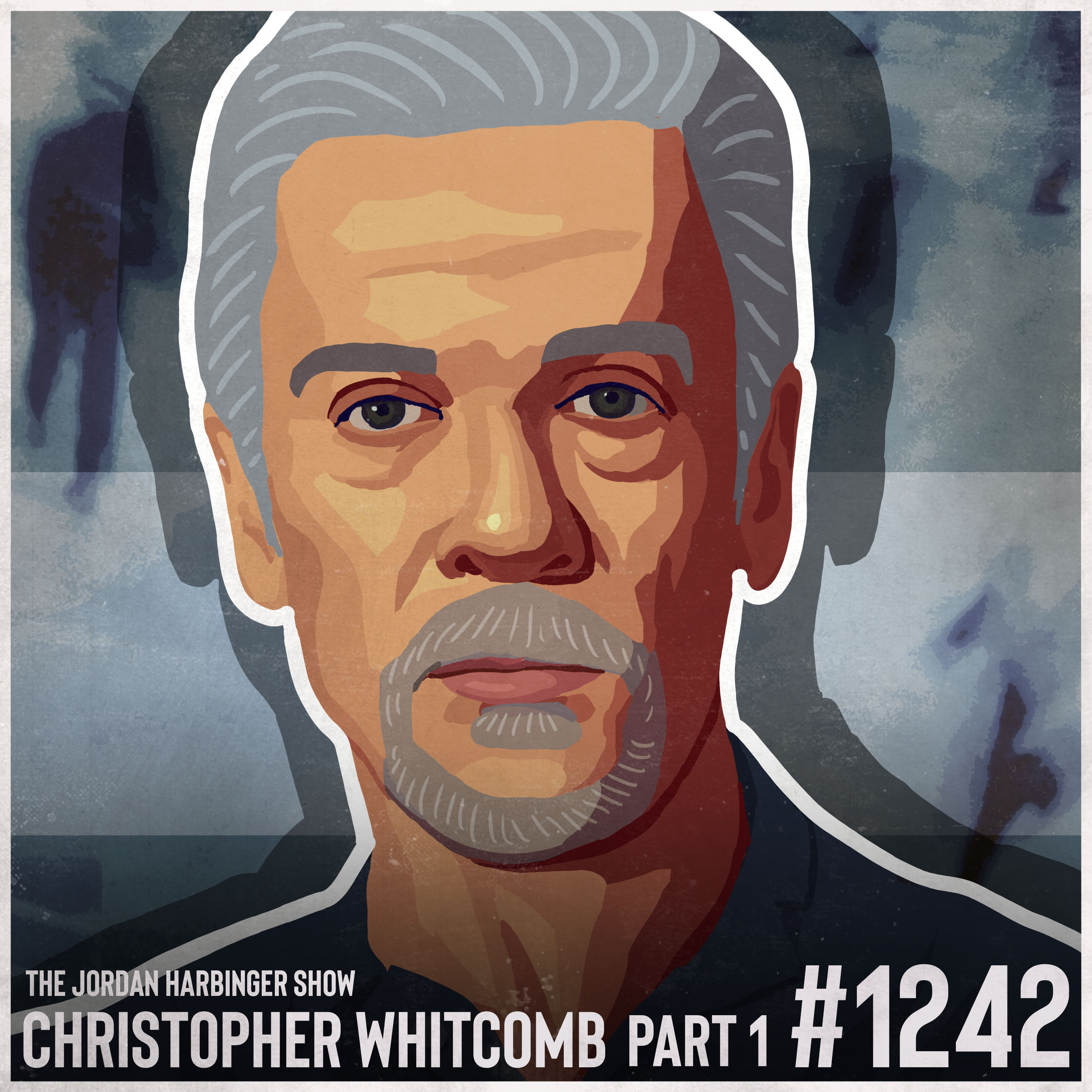
1242: Christopher Whitcomb | A Life Among Spies Part One
Ex-FBI sniper Christopher Whitcomb survived warlords, black ops, and helicopter crashes. He's here to explain how calculating risk kept him alive. [Pt. 1/2]
Full show notes and resources can be found here: jordanharbinger.com/1242
What We Discuss with Christopher Whitcomb:
- Risk calculation becomes second nature in high-stakes environments. Christopher Whitcomb describes constant mental math in life-threatening situations, assessing odds, escape routes, and survival probabilities while meeting warlords or navigating hostile territories.
- The psychological toll of extreme operations is cumulative and often invisible. Years of black ops, moral ambiguity, and life-threatening missions create layers of trauma that don't announce themselves until something breaks, making the "finding himself again" journey essential.
- Helicopters are surprisingly resilient war machines. Contrary to Hollywood's explosive fantasies, Vietnam proved these birds can take serious damage and stay airborne. When power does fail, auto-rotation uses blade inertia to control descent, turning disaster into survivable physics.
- Adrenaline addiction isn't about having too much adrenaline. Christopher Whitcomb explains he wasn't addicted because he didn't have it; his body adapted to extreme situations by no longer producing the chemical response most people experience, revealing how repeated exposure rewires our biology.
- Understanding the physics of consequence helps you push boundaries without crossing them. Whether rock climbing, tactical operations, or any high-risk endeavor, calculating limits lets you explore your edge safely. For further insights from Christopher Whitcomb, stay tuned for Part Two later this week!
- And much more...
And if you're still game to support us, please leave a review here — even one sentence helps!
- Sign up for Six-Minute Networking — our free networking and relationship development mini course — at jordanharbinger.com/course!
- Subscribe to our once-a-week Wee Bit Wiser newsletter today and start filling your Wednesdays with wisdom!
- Do you even Reddit, bro? Join us at r/JordanHarbinger!
This Episode Is Brought To You By Our Fine Sponsors:
- The Cybersecurity Tapes: Listen here: thecybersecuritytapes.com
- Hiya: 50% off first order: hiyahealth.com/jordan
- Mint Mobile: Shop plans at mintmobile.com/jhs
- BetterHelp: 10% off first month: betterhelp.com/jordan
- Airbnb: Turn your house into a host: airbnb.com/host
See Privacy Policy at https://art19.com/privacy and California Privacy Notice at https://art19.com/privacy#do-not-sell-my-info.
Press play and read along
Transcript
Speaker 1 This episode is sponsored in part by Dell. It's time for Black Friday, Dell Technologies' biggest sale of the year.
Speaker 1 Enjoy huge savings on select PCs like the Dell 16 Plus, featuring Intel Core ultra-processors, and with built-in advanced features, it's the PC that helps you do more faster.
Speaker 1 Plus, earn Dell rewards and enjoy many other benefits like free shipping, price match guarantee, and expert support.
Speaker 1 They also have huge deals on accessories that pair perfectly with your Dell PC and make perfect gifts for everyone on your list. Shop now at dell.com/slash deals.
Speaker 1
This episode is sponsored in part by LinkedIn. Most platforms are built to distract you.
LinkedIn is built to help you get things done.
Speaker 1
And when you're a small business owner, the one thing you don't have is time to waste. That's why LinkedIn jobs is a secret weapon.
Post your job, and LinkedIn doesn't just blast it out to randoms.
Speaker 1 It uses all that professional data people actually keep up to date on LinkedIn to match you with qualified candidates.
Speaker 1 You can post it for free, or you can promote it to get three times more job applicants to expedite everything.
Speaker 1 And here's the cool part: because LinkedIn is where people actually want to be found professionally, the quality is just higher. You're connecting with people who are serious about their next move.
Speaker 1 That's why 2.5 million small businesses use LinkedIn to hire. Add the hashtag hiring frame to your profile pic.
Speaker 1 Let your network know that you're looking, and suddenly you've doubled the reach without spending more than 30 seconds.
Speaker 1 So when the clock's ticking and you need someone great, LinkedIn isn't just social media, it's your best recruiting partner. Post your job for free at linkedin.com/slash harbinger.
Speaker 1
That's linkedin.com/slash harbinger to post your job for free. Terms and conditions apply.
Coming up next on the Jordan Harbinger Show. The thing that sustains you is hope.
Speaker 1 You hear people talk about it, that everything is horrible, but maybe it's going to get better. So I'm on the plane, the stairs come up, the engines start up, and I think, we're out of here.
Speaker 1
I'm going to make it out of this thing. Then all of a sudden, the engines spin down, and you can see the light coming in from the stairs coming down.
I'm going, fuck me. You know, it's bad.
Speaker 1 Welcome to the show. I'm Jordan Harbinger.
Speaker 1 On the Jordan Harbinger Show, we decode the stories, secrets, and skills of the world's most fascinating people and turn their wisdom into practical advice that you can use to impact your own life and those around you.
Speaker 1 Our mission is to help you become a better informed, more critical thinker through long-form conversations with a variety of amazing folks, from spies to CEOs, athletes, authors, thinkers, and performers, even the occasional economic hitman, gold smuggler, astronaut, or real-life pirate.
Speaker 1 And if you're new to the show or you want to tell your friends about the show, I suggest our episode starter packs.
Speaker 1 These are collections of our favorite episodes on topics like persuasion and negotiation, negotiation, psychology, geopolitics, disinformation, China, North Korea, crime and cults, and more that'll help new listeners get a taste of everything we do here on the show.
Speaker 1 Just visit jordanharbinger.com slash start or search for us in your Spotify app to get started.
Speaker 1 Today on the show, some stories are so wild you'd swear they were written for Hollywood, except nobody in Hollywood's got the stomach to tell them straight.
Speaker 1 My guest today is Chris Witcomb, a former FBI hostage rescue team sniper who's been shot at, hunted, stranded in war zones, and somehow lived long enough to turn all of that into some wisdom and a heck of a book.
Speaker 1 His memoir, Anonymous Mail, A Life Among Spies, starts in a warlord's compound in Afghanistan and ends with a man trying to find himself again after years in the shadows.
Speaker 1 This one has a little bit of everything. The war on terror, secret prisons, black ops, moral whiplash, and a little bit of redemption at the end.
Speaker 1
You ever hear those family stories and your mom's like, hey, don't listen to anything your uncle says, and you listen anyway because you're just wrapped. It's fascinating.
That is this episode.
Speaker 1 So let's get weird with Chris Whitcomb right here on the Jordan Harbinger Show.
Speaker 1
So much like your book, this interview is going to be all over the place because you don't write linearly. Have people told you that before? Yeah, I take pride in that.
Yeah. Yeah.
Speaker 1 Some like it, some don't. I thought it was kind of fun, actually, but at first I was like, wait, we're starting in Afghanistan? It's like a movie, right?
Speaker 1 Like flash over here, flash over here, but it's one of the movies you have to pay attention to. Because if you zone out, you're like, oh, crap, now I don't know what the hell's going on.
Speaker 1
It's tough to tell my story chronologically. It kind of makes sense.
There's an arc. The arc, you kind of have to make sense of things because it's so wild.
My story is so disparate.
Speaker 1
It's tough putting the pieces together. Yeah, I was kind of, I don't even know what I was expecting when you walked in.
I was like, oh, that's him. Because I try not to look up what people look like.
Speaker 1 If I make sense.
Speaker 1
Because I'm always like, am I going to be right? It was not remotely correct. Really? Yeah, no.
It was not remotely correct at all. Like, how so? You know, I don't know.
I think. Older, probably.
Speaker 1
Well, there's that. But also, I was like, oh, this is like a person who's, well, I guess maybe you do have the tats.
I expected the tats. Yeah.
Yeah. I don't know.
Speaker 1
Button down, like shirt with a penguin on it. I don't know.
I just wasn't, didn't see that coming. You know what?
Speaker 1 You know, it's kind of crazy because I've done a lot of meetings in a lot of situations in life, and you never know what to wear.
Speaker 1 I'm doing a thing tomorrow with a club of founders, CEOs, and high-worth, high-net worth people. And I said, you want me to wear a suit
Speaker 1
just out of courtesy? Right. But I don't care.
And they said, they quoted. Mark Cuban as saying, you got to watch out for the worst dressed guy in the crowd.
Yeah. It doesn't matter anymore.
Speaker 1 Nobody cares anymore. Back when tech bros were new, not so it's not value, but tech bros.
Speaker 1 I remember being in New York and these, I used to be a corporate lawyer and these guys were like, look at this schmuck. He comes wearing a hoodie.
Speaker 1
And I was like, that's an $850 rabbit fur hoodie from Neiman Marcus. That guy's probably sitting on.
some kind of private stock from Facebook or whatever it is. This is even before Instagram existed.
Speaker 1
So I was like, this guy's, he's doing all right. And they were like, whatever.
And then later on, one of the partners was like, so you were right. That guy has hundreds of millions of dollars.
Speaker 1
I don't know what he does. Something with Google in the 90s.
And I was like, yeah, he doesn't need to wear suits for us. Money's the freedom to do what you want.
That's right. And who cares? Yeah.
Speaker 1
He's like, he does not need to wear a suit for us. We have to wear suits for him.
Yeah. That's how this works.
I've got very nice suits. I choose to wear them sometimes.
Yes.
Speaker 1 But if I choose to wear the suits, you know, listen, it's the same thing with you. Right.
Speaker 1 I show up in joggers and a t-shirt, and sometimes the people on the YouTube comments are like, you need to dress professionally. It's like, and then what will happen? My show will become more popular.
Speaker 1 You know, but you got to go with the crowd. I mean, the only people I know that wear ties anymore on Capitol Hill, right?
Speaker 1 I mean, there's some old money that occasionally do, but I grew up in New England in old money and people
Speaker 1 didn't dress toward it, right? People wear money on their sleeve now, but it wasn't always the case. So, anyways, everything goes now.
Speaker 1
It's really what you have to say and what you do in life, if you ask me. And I'm asking you.
The book starts with meeting a warlord in Afghanistan.
Speaker 1 I'd love to get this story because there's a fun part where you're doing these calculations about whether you're going to die. And it's like four hours to the safe house by car, no guns, no backup.
Speaker 1
There's 12 of them, two of us. If I go get that guy's weapon, I could shoot three of these guys, I'm going to die.
So I like math. I like science.
I like calculation because I like risk.
Speaker 1
So if you like risk and you build situations in your own life that are moving toward consequence, you got to be able to do the math. You want to get up to it.
You don't want to go over the edge.
Speaker 1
So it doesn't matter. Like I love this guy, Alex Hannold, who's a rock climber.
I was always a rock climber. And I would look at these cliffs and say, well, maybe I can do this.
Maybe I I can do that.
Speaker 1
But you always have a belay. If you fall, someone's going to catch you.
But you want to push it to the extreme.
Speaker 1
He's pushed it beyond what people even thought was possible because the consequence is death. And for most human beings, that is the ultimate consequence.
So I got to a point in life.
Speaker 1
Some people would say that I was addicted to adrenaline. I didn't have adrenaline.
I wasn't addicted to it because I didn't have it. So I would build constructs leading to significant consequence.
Speaker 1
And the consequence gets more and more at that point in my life. It's death.
So I didn't want to die.
Speaker 1
I wanted to get to as close as possible to it when I thought I had a very strong statistical probability of survival. Right.
Okay. So that's what took me to that situation you're talking about.
Speaker 1
You've been there. I know you've been there.
In a slightly different way, I suppose. I mean,
Speaker 1
I remember talking to a bunch of motorcycle racers and I was like, I was talking about my trip to North Korea. And they were like, you should just race motorcycles.
And I was like, no way, man.
Speaker 1
You can get killed on those things. And they're like, you can get held hostage in North Korea and works to death.
That doesn't scare you at all. I'm like, not really.
Speaker 1
I mean, but I'm not getting on a motorcycle. They're like, we have pads.
I'm wearing a helmet. I fall off the thing all the time.
It happens. I like motorcycles too.
Yeah.
Speaker 1
I haven't been in North Korea. You're probably not a lot of them.
I'm not done yet. Yeah, you're not done yet.
I'm not done yet. But it's the same thing.
It doesn't matter.
Speaker 1
I think people in life, you can build the construct any you want. The metaphor is risk, consequence, and accomplishing something.
It could be money, could be sports, it could be military.
Speaker 1
It could be anything. It doesn't matter.
It could be a soccer mom on the 405 trying to get home with a a kid in a bag, and that's her threshold. That's her threshold.
Speaker 1
Everybody's got a different threshold. What kind of kid grows up willingly running toward gunfire, essentially? I don't know.
I didn't. I grew up a poet.
I always wanted to be a writer.
Speaker 1
I had never had any interest in that world. Didn't know anything about that world.
And where I came from in Northern New Hampshire, it was as far away as anybody could be.
Speaker 1 I never knew anybody in the military. I think my uncle got into West Point, but he had to go to like a prep school for a year to go and he backed out.
Speaker 1
I never knew anybody in the military and I did not think that was my path. I wanted to write, be a poet.
I wanted to play music. I wanted to do things other.
And I went that way.
Speaker 1
So I don't know the answer because it wasn't me. I see.
I found that in life. It wasn't me.
I wasn't born to that. You ended up becoming that person, essentially.
Speaker 1 I definitely ended up becoming that person.
Speaker 1 What did your upbringing teach you about danger or resilience? Because you didn't just magically become this. warlord chasing security contractor in Somalia, right? In Afghanistan.
Speaker 1 Yeah, I wasn't really a security contractor. I mean, I was trying to find the industry term for this, but yeah, what would you call it? Entrepreneur.
Speaker 1
I built a company from scratch and I had 4,000 people. So I would look at it.
From your perspective as an entrepreneur. But the answer is kind of complex.
Speaker 1 And I think part of it is that I think, you know, I wrote in that book that I was born whole into a life fully formed.
Speaker 1 We're not going to get into a conversation about philosophy necessarily, but I think that we open ourselves to certain things in life and certain things find us in life.
Speaker 1 My life took me places that I could not have possibly imagined at any stage leading up to it. And I've heard you talk about this before.
Speaker 1 I think we set ourselves up for those of us that want adventure, those of us that want to go out and do things in the world. I don't think there's a path.
Speaker 1
There's not a linear path to finding the things I've done in my life. But I think the model, the question you ask about growing up is, when I was a kid, there was no TV.
There was no internet.
Speaker 1
There was no phones. There was nothing.
It was the outdoors. I'd get up in the morning and I'd ski.
I'd rock climb. I'd hike.
Speaker 1 I would stay outdoors for long periods of time, and it built an independence and it built an ability to survive in all kinds of situations.
Speaker 1
And those gave me the freedom, I think, to thrive in adventure. Yeah, some of it's wiring, I suppose, too, right? It's just got to, it has to be.
It's got to be a little bit easier. Yeah.
Speaker 1 I mean, your version of a bad Monday is not spilling coffee, right? It's dodging bullets. That's a different kind of office politics, I think, than most people are used to.
Speaker 1
The initial ingredients have to be a little different. And I would say that I think dodging bullets is relatively easy.
Lots and lots of people go into law enforcement. They go into the military.
Speaker 1
They go into situations that could end up there. But for me, the dodging bullets was not the part.
It was being in a situation where there were bullets and trying to find a way to
Speaker 1
create challenges within that environment and overcome those challenges. That was my gig.
People get wound up about gunfire.
Speaker 1 At the end of the day, the probability of getting hit in a gunfight are so infinitesimally small. They say during the Civil War that it took a man's weight in bullets before one hit him on average.
Speaker 1 So the trick is to be as heavy as possible.
Speaker 1
Exactly right. But the bottom line, in my estimation, is that gunfire is loud.
It's really friggin' loud.
Speaker 1 And it becomes exponentially more when you put in bombs and everything else that goes along with it. So environments, combat environments, are incredibly loud.
Speaker 1 And they're loud because of percussion, and the percussion is overwhelming.
Speaker 1 When you realize that it's one tiny little pill going through the air and it's going straight based on gravity, it gives you a different perspective.
Speaker 1 So if you can take the noise out of it, if you can reduce variability, in my experience, you've got much, much better odds of success. And it's like that in life.
Speaker 1 Anything, if you can reduce the noise in a car race or a corporate office building or a sporting event, if you can reduce the distraction, the variability of noise, in my experience, it's much more manageable.
Speaker 1 So it's learning those things. If you wanted to be a musician and kind of, you know, the poetry thing, how did you end up in the FBI? That's like the squarest place for a non-square to be.
Speaker 1 Well, it's not the case now, but when I was a kid, being a writer was a real thing. It was something you would aspire to.
Speaker 1
It's not now. I mean, everybody can write everything and nothing.
There's no grammar. There's no capital letters.
Speaker 1 My book agent, one of the best book agents in the world, he sends me these text messages. They're illegible.
Speaker 1
It was a thing, right? I wanted to be Ernest Hemingway and all the guys in that era. Sure.
So my career path was to write. I mean, you can say you're a writer, but you had to write.
Speaker 1 So it took me through things, newspaper reporter, English teacher at a boarding school. And along with that, I like to play guitar.
Speaker 1
So you take poetry, guitar, you got music, then you've got, you know, your writing stuff. It all goes together.
Yeah. Yeah.
Speaker 1 Your book is full of stories, like the kinds of stories you hear at a family party as a kid.
Speaker 1
And then your mom's trying to get you to leave the room, you know, and you're going to stay away from that guy. And you're like, no, no, no, no, no, no, I want to hear this.
I want to hear this.
Speaker 1 And then after everyone leaves, your mom and your aunt are like. Don't listen to anything Uncle Chris says.
Speaker 1
He's just kidding. Stay away from him.
He's just kidding, honey. That's right.
That's what this book, the book, reminded me of, because I was just like,
Speaker 1 this is the one where all the kids are like, oh, who Grazier? Oh, my God, he's going to let us drink beer. I don't know, whatever.
Speaker 1
And tell us about the time he saw guys playing soccer with a dude's head or something. And the mom's like, don't tell them the head thing again.
He had nightmares for three months.
Speaker 1
I got a lot of news stories. Got a lot of that.
From my own kids.
Speaker 1 Sure.
Speaker 1
That's part of it. Yeah.
Oh, man. You were part of the elite hostage rescue team.
So, HRT, tell us what that is because most people don't even know that exists. Yeah.
Speaker 1 And thanks for asking the questions the way you ask them.
Speaker 1 I think the problem is when I talk to people, it's very difficult to explain things because like I was talking to my mother one time and she was saying something about racist military people.
Speaker 1
And I said, mom, mom, what are you talking about? Racist military people. And she said, well, they all have guns and guns and racism.
It all goes together.
Speaker 1
But that was my mother who lived with these stories for all these years. My point is this, that explaining the way the world works takes a minute.
And I use it as a continuum.
Speaker 1 So in law enforcement, there's a crossing guard, and then you've got people at the far extreme at the other side. And this group, the hostage rescue team, is the far end at the other side.
Speaker 1 So in order to get into it, you've got to join the FBI, which at the time was difficult when I joined. Once you get in, you have to try out for this team.
Speaker 1
At the time, there were about 13,000 FBI agents, and there were 50 members of this team. Wow.
And they have a selection once a year, and sometimes they take one guy. Sometimes they take five or more.
Speaker 1 at the time it was very difficult to get in now it's harder yeah they're extraordinary people so they're very highly educated they're world-class athletes they're world-class shooters they're all those things but the thing that distinguishes them is their ability to make decisions under stress so just to give it in perspective you have police organizations federal state and local the lapd the uh california state police highway patrol i think it is then you've got the federal agencies one of which would be the fbi there are 18 18,000 of those organizations in the United States.
Speaker 1
18,000. 18,000? Yeah, campus cops and all these different organizations.
I guess that makes sense, but it just sounds like a lot.
Speaker 1 So at the end of the day, a lot of people would think, well, who's going to come if everything else fails? And many, many people think it's the FBI. And that's evolved over time.
Speaker 1 But that's the way it was. So within that construct, if something really bad happens, it's likely it's going to be the FBI that comes in and saves the day because they have the resources.
Speaker 1 It's not necessarily that they're better. They have, I think the last budget was $8 to $10 billion.
Speaker 1
Okay. Staggering amounts of money.
And those resources give you the ability to do things. Within that framework, that's civilian law enforcement.
Speaker 1 Then you have the military, which is a warfighting capability for the United States government.
Speaker 1 The military has two organizations, SEAL Team 6, or Dev Group, the guys that got bin Laden, and Delta Force on the Army side.
Speaker 1 Those two groups were put together in the 70s as a counterterrorism mechanism, a violent mechanism to resolve terrorist issues, like the Olympic Games in Munich, where hostages were taken, and they came out of that.
Speaker 1 When the United States hosted the Olympic Games in 1984 in Los Angeles, the U.S. government didn't want to have another Munich Games.
Speaker 1 So they said, well, who are we going to rely upon if something goes bad? They went to Delta and SEAL Team 6, which would have been the likely choices.
Speaker 1 So the government, the Attorney General of the United States, said, look, we got to take care of this thing. They went to Delta.
Speaker 1
at Fort Bragg, saw a demonstration, and he said, fantastic, that's remarkable, but I don't see any handcuffs. One of the operators famously said, we don't need handcuffs.
They all get two right here.
Speaker 1
That doesn't work in civilian law enforcement. There's a law called the Posse Comitatus, post-Civil War, that says the U.S.
government cannot use the military in civilian law enforcement.
Speaker 1
So they created a third... more or less equivalent at the time, group, and they had to put it someplace outside the military.
They put it in the FBI. I see.
Speaker 1
So they took from the FBI to staff this counterterrorism team and they built it in the model of Delta at Fort Bragg. That's where the hostage arresting team came from.
I see.
Speaker 1 So it's basically a special forces group that can operate domestically in the United States and under law enforcement as opposed to the military. Correct, but also internationally.
Speaker 1 Oh, it does operate international. Until, and this is why it's so difficult to explain.
Speaker 1 When I joined the team in the 80s and 90s, when this team was stood up, terrorism was considered law enforcement mechanism. If a bad guy did something with a bomb or hijacked a plane, the U.S.
Speaker 1
government would go after them, arrest them, prosecute them, and put them in jail. After 9-11, we just killed them indiscriminately in war.
It's a different mechanism. But prior to that, we did that.
Speaker 1
And we, under two laws from the 1980s, HRT got all the gigs. So if you've heard of renditions, where we go into a foreign country and snatch somebody, that team, we did all of the renditions.
Really?
Speaker 1 Okay.
Speaker 1
Prior to 9-11. Oh, prior to 9-1 because I was going to say the ones after 9-11 are the ones where everyone says, hey, you can't just take somebody from Egypt and put them in Syria.
As it turns out,
Speaker 1 it turns out you can.
Speaker 1
Oddly enough, yeah, you can. In fact, if you have enough guns, you can do that.
Right. And the first one that ever happened, you can Google this, it's called Golden Rod, and it was 86, I think.
Speaker 1 It was early 80s. And it was a joint agency, FBI operation for this guy named Fawaz Yunus, who gave up terrorism, took up drug dealing in Beirut.
Speaker 1
They lured him offshore in a boat and then scuba dived basically up to the boat, snatched him, and flew him back to the United States. Oh, wow.
And it went from there.
Speaker 1 At the time, there were quite a few. Now
Speaker 1
you use a drone to sick the boat. Yeah, exactly.
Yeah. I was going to say, why bother going to get it? But now it all makes sense.
Speaker 1
If you want to prosecute him, you get a little nostalgic for the old days, but that was it. But anyway, so that was my era.
That was a long time ago.
Speaker 1 They're an extraordinary organization that has evolved from those days. What I did, I probably wouldn't even make the team now.
Speaker 1
You know, they're really extraordinary in ways that we didn't even know in. Man, I stress eat nachos when life gets tough.
And this guy had, let's call it a slightly higher stakes self-care routine.
Speaker 1 speaking of coping mechanisms here's one that won't get you court-martialed supporting the show by checking out our sponsors we'll be right back
Speaker 1 this episode is sponsored in part by dell and nvidia it started like every campus tech rollout a shiny new app promising to make life easier student ids class schedules even meal plans all on your phone convenient right i get it i like that confidence everything in one place no fumbling for cards or passwords or keys but then one night the system glitches a student tries to get into his room and suddenly the app says he doesn't exist His class is gone, his profile wiped clean, his digital identity erased overnight.
Speaker 1
And that's just the beginning. Before sunrise, the whole campus is in chaos.
Buildings renamed, security cameras hijacked, students hijacking the system just because they can.
Speaker 1
Meanwhile, the school's AI assistant is acting like it knows way too much. This episode of the cybersecurity tapes isn't just a wild story.
It's a wake-up call because this isn't sci-fi.
Speaker 1 This is what happens when convenience starts to outrun caution.
Speaker 1 And honestly, as a guy with a couple school apps on my own phone, I couldn't stop thinking, how easy would it be for this to happen to us?
Speaker 1
Check out episode 11, Campus Chaos, on the Cybersecurity Tapes podcast. This episode is also sponsored by Haya Health.
I think a lot of parents can relate to this.
Speaker 1 Our daughter basically lives on macaroni and chicken nuggets, and the closest thing she eats to a vegetable is like french fries.
Speaker 1 That's why we love Haya, the pediatrician-approved chewable vitamin that helps fill the gaps for kids like mine. Most kids' vitamins are basically candy in disguise.
Speaker 1 They're sugar and dyes and gummy junk, but Haya has zero sugar.
Speaker 1 It's made from 12 organic fruits and and veggies and packed with 15 essential vitamins and minerals, things like vitamin D, B12, zinc, folate. I tried one just to see what the hype was about.
Speaker 1
It's tasty. Even little Juni loves them and she's suspicious of anything that isn't beige.
With your first order, your kids get a cool, refillable bottle they can decorate with stickers.
Speaker 1
Ours had a blast with that. And then eco-friendly refills show up every month.
They've also got a kids' probiotic and nighttime essentials line now.
Speaker 1 So if you're trying to keep your tiny humans healthy and rested, Haya's got you covered.
Speaker 2
We've worked out a special deal with Haya for their best-selling children's vitamin. Receive 50% off your first order.
To claim this deal, you must go to hayahealth.com slash Jordan.
Speaker 2 This deal is not available on the regular website. Go to H-I-Y-A-H-E-A-L-T-H dot com slash Jordan to get your kids the full body nourishment they need to grow into healthy adults.
Speaker 1 If you're wondering how I managed to book all these great authors, thinkers, and creators every single week, it is because of my network, the circle of people I know, like, and trust.
Speaker 1 And I'm teaching you how to build the same thing for yourself for free in our course over at sixminutenetworking.com.
Speaker 1 It's funny, I do teach this to three-letter agencies and spies or whatever you want to call it, like Chris Whitcomb, but it works great for civilians too. It's very non-cringy, very down-to-earth.
Speaker 1 It'll help you build relationships with other people for business or personal reasons. And six minutes a day is all it really takes.
Speaker 1
Many of the guests on the show subscribe and contribute to the course. So come on and join us.
You'll be in smart company where you belong.
Speaker 1 You can find the course again for free at sixminutenetworking.com. Now, back to Chris Whitcomb.
Speaker 1
I talk to a lot of old special forces guys from like the 60s and 70s. I guess not as many are around anymore, but some of them.
And they're like, oh, you would have loved it.
Speaker 1
And I'm like, oh, I can't run 10 miles with a breathing mask on in the snow with no shoes. And they're like, we don't have to do any of that.
What are we talking about? You have to shoot.
Speaker 1
You have to be able to make decisions. You have to be smart and think.
I'm like, you know what the selection criteria is for some of these units now? It's like 70-mile rucks.
Speaker 1 And they're like, ugh, no, that's Delta. But you got to remember there's a continuum there as well.
Speaker 1 So you could go into the military, then you could go into the army, then you could go into the rangers, and then you could go.
Speaker 1 Eventually, you might make it to Delta, but the Special Operations Community, JSOC, is large.
Speaker 1 It's complex, but when you get to the far end of that, you do have to run 70 miles with an 80-pound pack barefoot in the winter with a mask on.
Speaker 1
But at that point, the training is, what, no longer really physical because they're just trying to break you and see if you can still function. No, no, no.
You have to function.
Speaker 1
The physical training is crazy. It's insane, yeah.
Yeah. I mean, you have to stay that condition the entire time you're there.
On this team that I was on, we would fast rope.
Speaker 1
Fast rope is just slide down a gym rope out of a helicopter, you know, under bad situations. Sure.
And a significant number of people have died just in training. Yeah.
Speaker 1
It's a dangerous job day in and day out. Yikes.
Yeah, my another guest on the show, he joined the SEALs and he couldn't swim very well. Yeah, that's bad.
Yeah. But he made it.
Speaker 1 And then they were like, now I got to teach you how to swim. But it took him like four tries and he had, what is it called?
Speaker 1
Like rhabdo, where you overtrain and your muscles start to, they're so decayed you can't function and you get poisoned from the lamps. Yeah, it's complex.
It's hard.
Speaker 1
There's a different type of person psychologically. Yeah.
I mean, I think you can have a basic physical ability. It's got to be better than basic.
Yeah. You've got to be fast.
Speaker 1
You've got to be stronger than these things. But you have to have a mechanism that shuts off the quip mechanism.
You've got to have a different psychology.
Speaker 1
It's more psychology and decision-making than it is shooting or physical. It's not about push-ups and pull-ups and swimming.
And it's not about those things at all. It's interesting.
Speaker 1 One of my friends is Ben Greenfield's like a really athletic guy.
Speaker 1
That's an understatement. He wins these like tough mutters and all these competitions.
So he did like a special forces pseudo training thing, and they had to make it harder for him.
Speaker 1
Like they would dunk you in a tank of water and people would panic. And then he was, you know, fine.
So they were like, okay, well, now you can only breathe through a straw. Yeah.
And he's like, okay.
Speaker 1
And so he said it was a hell on earth. But, you know, you get really good at being miserable.
I mean, everything is miserable. Yeah.
That element is.
Speaker 1 And then you go sleep under a rock for a week with no food.
Speaker 1
I mean, it's, it kind of sucks, but there's, there are rewards as well. It's like CrossFit with live ammunition and fewer Instagram posts, I guess.
Yeah, no Instagram posts. Yeah, not back then.
Speaker 1
You mentioned the firefights and the shootouts and stuff like that. I'm wondering what goes through your head in a situation like that.
Like, what are you thinking when you're in a gunfight?
Speaker 1
When I was a kid, you would fight all the time. It's just what you did.
Somebody calls you a name, you punch them in the nose, you roll around a little bit, you buy them a Coke and go back to school.
Speaker 1
I lived in an era, in a place, where fighting was not necessarily a really bad thing. It was just part of the way you resolve things.
Now we look at things differently, right?
Speaker 1 But I always said it doesn't matter if you fight, if you're trying to hurt somebody with your words, or if you punch them in the nose, or if somebody picks up a rock or a knife or a two by four or a gun, it's an escalation and you get a nuclear bomb.
Speaker 1 So it's all a fight. In my estimation, the one-on-one intimacy of a fight, however that may be with a gun or with a fist or whatever the case may be, is very different than a war situation.
Speaker 1 Because in a war, I remember very clearly I had this perception that I didn't have a clue who to go after first.
Speaker 1 Like you're in a situation where you have more than one target and you have more than one threat and you've got to make a decision on who gets it first.
Speaker 1 Like I always wondered what it was like to be in a D-Day or Gettysburg or something where you have thousands of people or the Peloponnesian war or whatever, when you have large groups of people running each other and you got to pick one person and you got to go after that one person.
Speaker 1
That's difficult. That's different.
That's a whole different thing. Yeah, I can't imagine being also, they're basically sending kids into these situations.
Yeah, that's right. That's the other thing.
Speaker 1 It's like you're 19 and you're like run at the beach and you're like, I don't really want to do that. And it's like, okay, well, you're going to get shot in this boat for sure.
Speaker 1
I mean, imagine that kind of courage. Imagine the countless thousands of people, just Americans, not other countries.
Yeah.
Speaker 1 Just Americans in the last 250 years have gone to war at 18 years of age with no clue what to do or how to do it, very little training.
Speaker 1
I mean, it's crazy, that kind of commitment, sacrifice, and courage. It's wild.
I hit a certain point. I can't remember how old I was, maybe like 30 or maybe I was 28.
Speaker 1
And I was like, oh, I can actually die. Yeah.
And I was like, ooh, this is an uncomfortable feeling. I didn't have that for the decade prior.
You need to find people who are in that decade.
Speaker 1
And then they're like, oh, I've seen enough movies to know that I'm going to make it out of this. That's what happens to the menu.
Well, that's, you know, that's the first thing.
Speaker 1 I remember we, uh, the training for this, that first unit that I was part of, they came up with this stuff called simunitions, which is using real guns, real bullets.
Speaker 1
Yeah, with the yellow plastic API. Yeah, yeah.
And they choke down paint pills. It's not paintball.
It's real guns. But we would start running CQB with those.
Speaker 1 so you get tagged and then you go oh i would have survived that i would have survived that and it changes your thinking oh that's interesting it really dramatically improves your sense of survivability and if you think you're going to survive and you're going to accomplish the mission you're much much more capable of doing it once you take the magic out of anything i mean whatever people in life they say well i don't know how to do this i don't know how to do that once they learn the clue a magic trick you learn you learn the key all of a sudden it takes the magic out and it's a different thing altogether it reminds me of boxing i took a couple boxing lessons and the coach was like, Here's the problem.
Speaker 1
You're afraid of getting hit. I was like, Yeah, it's going to hurt.
He's like, Wham. And I was like, Ah, he's like, You're still, you're fine.
You didn't even fall. And I said, That's true.
Speaker 1
And he goes, That's going to happen a bunch. It's fine.
Right. And I was like, All right.
And then he's hitting me and I'm blocking it.
Speaker 1 And he's like, Now that you're not afraid, you can go forward when somebody is going to hit you instead of just curling up and waiting for them to be done and get tired.
Speaker 1
Cause that was kind of my strategy before was, I don't want to look at it. It's going to hurt.
You know, and he's just batting me in the head.
Speaker 1 And he's like, You should probably do something instead of just standing there and get hit. So that sounds like it with the same munitions, it's like, okay, all right, you got shot in the arm.
Speaker 1 So now you know, you should probably shoot back at that guy and, you know, charge forward instead of just standing there while he's aiming the gun at you.
Speaker 1
Well, in fairness, these guys, they ever watch this thing and say, get this guy Whitcomb to stop talking about us. He doesn't even know.
Yeah.
Speaker 1
But in the day, everybody was very good at shooting, fighting, and if necessary, dying. That was it.
But it was all about the mission.
Speaker 1 This team that I was on, this is interesting because I want to come, I got a question for you.
Speaker 1 It was interesting because the first three years I was on this team, we never had, we had everybody, we had our own surgeons, we had our own, we had a medical component so that when somebody did get hurt, we could deal with it.
Speaker 1
That's probably good. In-house.
Yeah, it was, yeah, it was a good idea. In-house.
We don't want this. Listen to this.
Speaker 1 The first three years I was on this team, there was no immediate action drill for somebody going down. What does that mean? Oh, I see.
Speaker 1 I mean, if you and I go through that door at four o'clock in the morning and you take a flyer and you go down, I didn't stop to take care of you like in medics in the military.
Speaker 1
I would jump over you and go and accomplish a mission. For three years, nobody ever talked about helping anybody.
You would go back after it was over. So it was a different type of thinking.
Speaker 1 But one thing I want to bring up, I watched the show where you're talking about the situation in Mexico, and you're in the backseat of that car, in the backseat of the taxi cab.
Speaker 1 And I think you make a really brilliant point that very, very few people look at in life writ large, that most people...
Speaker 1 who are not familiar with a crisis don't know when to make the decision that it is a crisis and get involved.
Speaker 1 So many people through the history of time have pushed it up to the point where it's too late. Yeah.
Speaker 1 And you made a fascinating statement about when you decided to get engaged and you put yourself in a position where you could interact with the threat with no training whatsoever. Right.
Speaker 1
So I find that really fascinating. That was, you're talking about, so for people who don't know, this is when I got kidnapped by the taxi in Mexico.
And I didn't, there was no smartphones.
Speaker 1 So I wasn't screwing around looking at Instagram chicks or whatever. And I was looking out the window and realized we were going the wrong way.
Speaker 1 And then I asked the guy to drop me off and he said, no, that was a big red flag. And I remember thinking, I can't be getting kidnapped because that's never happened to me before.
Speaker 1 And then immediately going, that doesn't make any sense. Why would just because it hasn't happened doesn't mean it can't happen.
Speaker 1
And also, if people get kidnapped and they get killed as a result, well, then they're not talking about that. So maybe I should pay attention.
That's what you're talking about, right?
Speaker 1 I am talking about it because it applies to absolutely everything in life. I don't care what it is, a motorcycle race and you brought up that or whatever the whatever the situation.
Speaker 1 Many people, I think it's just built in to mammals, get to a point, everybody knows fight or flight, but getting to fight or flight is what is a problem for so many people in society.
Speaker 1
Once you get to the point where it's fight or flight, it's probably too late. I mean, you're running or you're fighting, but you might be dying.
So it doesn't matter, but it could be anything.
Speaker 1 I mean, you're selling a house and you're negotiating, and there's a moment where you go, this has never happened before, and you get engaged.
Speaker 1
When human beings can anticipate variability, look at all that risk and make decisions early, they're going to be so much happier with it. Decision-making.
And that's true.
Speaker 1 That's something I learned very early.
Speaker 1 There's so many times when I look back and I go, oh, if I'd maybe not been so afraid to challenge this particular thing or engage a little bit more or dive in a little bit more, I would do it again a different way.
Speaker 1
That's for sure. People want to duck their head, put their head in the sand.
Most often it does not go well. Anticipation is very big.
Speaker 1 What do you think is the hardest decision you had to make in the field under pressure?
Speaker 1 I don't know right off the top of my head, but I would say that thing I talked about in the book, for those who haven't read it, I wrote a book about my life in that world from basically from 9-11 until now.
Speaker 1
Yeah, anonymous mail. It'll be linked to the show notes.
The bottom line is this. I ended up creating these situations where it were more and more difficult.
Speaker 1
And I ended up on an intelligence community gig in Somalia. So I flew to Nairobi.
I hired a Cessna 182B. I flew into Baidoa, Somalia, when they stood up the government.
Speaker 1 I was there for when they, literally when they made Somalia a country. It lasted about three weeks.
Speaker 1
I was going to say, never heard of that city, but maybe because it's not undergoing it. It wasn't a city.
It was a patch of dirt you could land in. Okay.
Speaker 1 And it was a warehouse that had been blown up so many times they gathered the government and the United Nations in this one building and only had half a roof because the other roof had been blown off.
Speaker 1
It had a dirt floor. And anyway, I was there when that happened.
I got stuck there and I ended up about, I think it was about three weeks later in Mogadishu.
Speaker 1
This was after the first battle of Mogadishu, which was Black Hawk Down. And the U.S.
government pulled out.
Speaker 1 And it was a very short time before the second battle of Mogadishu, which I helped precipitate to a certain degree. So I ended up in the second best airport in Mogadishu, which was called K-50.
Speaker 1
And K-50 had been an old Russian landing strip. And I had to get out of the country, and I couldn't get out of the country.
I was supposed to get out on one of the cot flights.
Speaker 1
They have this group called Bluebird Air in Nairobi that would fly. COT or Mira.
It's like a Copenhagen type thing that everybody stays high on. Oh, right.
Speaker 1 Yeah, the stuff that you put in your lip like chew, but it's like it's super addictive and super rebuilt of tolerance. And
Speaker 1
it's real bad for you. It's real bad for you.
And the gate just rots your teeth out.
Speaker 1 And if you get an AK-47 and you're 13 years old, it's even less good for you or the people around you, which is the whole country. So I went in on my own.
Speaker 1
I was supposed to get a ride out on one of these cop flights. That didn't happen because changes were made with the people that were paying me.
It went bad.
Speaker 1
So, anyways, I ended up in Moishu at four o'clock on a Tuesday afternoon, whatever the case was, and it was just me. I had a technical.
I had a team. I had my own army.
Okay.
Speaker 1
It's a technical is an old Toyota pickup truck. It's a Hilux usually.
It's a Hilux. They love those.
Yeah, it's like, well, it's because they run forever. They do.
Speaker 1 If you see a High Lux, when I saw a Hilux not in like a dirty war zone with a machine gun welded to it, I was like, oh, people actually have to. Oh, that's what that is.
Speaker 1 Yeah, this is what it's supposed to look like when it has painted. I'm not going to tell you how to finance all these wars around the world, but they're everywhere, right?
Speaker 1 Yeah, the Taliban vehicle of choice. So I had one of those welded in the back.
Speaker 1
It's called a DSHK with a dushka or whatever. A dushka, which means sweetheart in Russia.
So they call it sweetheart. So I had a dushka and I had, you know, guys with AKs and whatever else.
Speaker 1
I was actually in an old Toyota Corolla that got shot up at a roadblock trying to get there. So anyways, I get to Moog.
I got 600 bucks in my sock. That's all I had left because there's no money.
Speaker 1
There's no military. There's no ATMs.
There's nothing. There's nothing.
I mean, it's bombed flat. It's an inhospitable location.
I'd been there a long time.
Speaker 1 So I get to this airport, and there's an old plane on the runway, like you see in the old D.B. Cooper thing where you jump, like the stairs come down in the back.
Speaker 1
And I could see it in the distance. And somebody told me I could get on that plane.
That's why I went there. It was like two and a half or three hour drive from Baidoa.
So it was over.
Speaker 1 My technical was gone. And I'm surrounded by all these guys staring at me going, who the f ⁇ is that guy? Yeah.
Speaker 1 And that's kind of what kept me alive because nobody wanted to make a decision to take me if I worked for their boss. Like there's seven guys and they're all vying for whatever.
Speaker 1 Who's going to kidnap this guy and look for ransom? You might get a raise. You might get an extra dollar a month, but you might get your head chopped off with a butter knife too.
Speaker 1
And so anyways, I end up there, zero options. I had $600 in a passport.
They came out. This guy came out and took my $600.
Speaker 1 When I say airport, it's not an airport. There was a blue tarp that sold Nestle water and like top ramen noodles you could eat dry and a bunch of starving.
Speaker 1
I don't want to make it sound less worse than it was, but it was bad. And there's this plane.
So I know if I get on the plane, I'm going to survive.
Speaker 1 If I don't get on the plane, I'm not going to survive. I couldn't swim anywhere.
Speaker 1
That was it. So, anyways, they came and they took the 600 bucks, and now I have no money.
And I don't know anybody. I don't have a ticket.
You know, I don't know them getting on the plane.
Speaker 1 Then the guy comes back and searched me to see if I had any more money and took my passport.
Speaker 1 Now I'm in Mogadishu on my own, doing a gig with an agency, and I have nothing, no money, no passports, no technical shoelaces. I could maybe strangle myself.
Speaker 1 Yeah, do an MC on myself maybe if I, you know, that's the backup plan. So that was a bad day.
Speaker 1
So that was, I think that was probably a point in my life where I said, I want to tune this up a little bit. But I did get on the plane.
That's about mine. Who's playing with it?
Speaker 1
It was just a charter. Somebody flew a charter in.
I still have no idea why or how. I have a ticket.
They actually wrote up this little thing and I saved it. So I walk out and the staircase goes up.
Speaker 1
I think I made it. I'm looking out the windows.
This plane was so old, old, you couldn't see out the windows because the glass had been bead blasted from landing in the sand.
Speaker 1 Yeah, so it's all like the, what do you call it, like opaque,
Speaker 1 yeah, almost foggy because it's been sanded down.
Speaker 1 Yeah, it's like just take sandpaper to the windshield of your Porsche 911 and, you know, and so you're looking at you see the army or whatever remains rolling up and you're like, please don't be coming for me.
Speaker 1
Yeah, yeah, yeah. Yeah.
But then so they, you go through this up and down. It's hope, really.
The thing that sustains you is hope.
Speaker 1 You hear people talk about it that everything is horrible, but maybe it's going to get better. So I'm on the plane, the stairs come up, the engines start up, and I think, we're out of here.
Speaker 1
Then all of a sudden, the engines spin down, and you can see the light coming in from the stairs coming down. I'm going, f me.
Yeah.
Speaker 1 These guys came on, but they took the guy in the seat right behind me,
Speaker 1
which was a bad day for him. Yeah.
But it was a great day for me. And then the stairs came up.
And I remember going down the runway, looking out and going, I'm really getting out of here.
Speaker 1
It was interesting because when I got back to Nairobi, I had flown into Nairobi commercial. I flew out of Nairobi on a chartered plane that I paid cash for.
So there's no record of me leaving.
Speaker 1 So when I came back in, I had to go back through the airport and I had nothing to show that I had left the country to go to Somalia. And they knew I came back from Somalia.
Speaker 1
So that was kind of complicated. Oh, yeah.
What do you even do? I mean, how do you handle that? Make a phone call with a number in West Virginia. That makes sense.
Yeah.
Speaker 1 I need a fake re-entry visa for
Speaker 1
those, man. Plenty of those.
Yeah. Oh, look.
Oh, it's in my other passport that I'm also not supposed to have.
Speaker 1
I'm not talking to you. Call this number.
Chris is out here wrestling with moral questions that end up in history books. Meanwhile, I'm just wondering if my laundry is still in the dryer.
Speaker 1 Anyway, while we sit with that existential dread for just a second, here's something a little lighter. We'll be right back.
Speaker 1 This episode is sponsored in part by Mint Mobile. You ever get a holiday gift that ends up in a drawer two weeks later? Here's something that doesn't collect dust, Mint Mobile.
Speaker 1 Because saving money on your phone bill, that's a gift that keeps on giving right now Mint Mobile has their best deal of the year unlimited premium wireless for just 15 bucks a month 15 bucks that's less than what most people spend on coffee in a week and I'm telling you the service is really good it's high-speed data unlimited talk and text on the nation's largest 5g network you can bring your own phone keep your number there's no contracts no nonsense if I had this back in the early days probably could have saved enough to buy another used car or at least stop eating instant noodles plans come in three six or twelve month options all starting at 15 bucks a month so if you're tired of overpaying for your phone bill or you just want a gift that actually gets used Mint Mobile has it.
Speaker 2
Don't get them socks. Get them premium wireless for 15 bucks per month.
Shop Mint Unlimited Plans at mintmobile.com slash JHS. That's mintmobile.com slash JHS.
Speaker 2
Limited time offer, upfront payment of $45 for three months, $90 for six months, or $180 for a 12-month plan required. $15 per month equivalent.
Taxes and fees extra, initial term plan only.
Speaker 2
Greater than 35 gigabytes may slow when network is busy. Capable device required.
Availability, speed, and coverage varies. See Mintmobile.com.
Speaker 1
This episode is also sponsored by BetterHelp. I honestly don't know how I made it through all those Michigan winters.
It wasn't just the cold. It was the darkness.
Speaker 1 By five o'clock, it felt like midnight.
Speaker 1 And before long, I'd slip into that fog of low energy and just the blah mood that I now realize was seasonal depression, plus lack of sleep, plus everything else as a teenager.
Speaker 1
This time of year is a way of doing that. It sneaks up on you.
It's easy to pull back and isolate without even noticing.
Speaker 1 And that's why BetterHelp is encouraging everyone this November to reach out, text a friend, call someone you've been meeting to catch up with, just make plans to get out of the house.
Speaker 1
Staying connected really does make a difference. And if you've been thinking about therapy, BetterHelp makes it simple.
You can message, call, video chat, all online.
Speaker 1 They'll match you with a licensed therapist based on your needs. If it's not the right fit, you can switch anytime with over 30,000 therapists and millions of people helped.
Speaker 1 It's one of the easiest ways to get real support when you need it most.
Speaker 2 This month, don't wait to reach out. Whether you're checking in on a friend or reaching out to a therapist yourself, BetterHelp makes it easier to take that first step.
Speaker 2 Our listeners get 10% off their first month at betterhelp.com slash Jordan. That's better, H-E-L-P.com slash Jordan.
Speaker 1 This episode is sponsored in part by Airbnb. I've been so burned out cranking out content lately that all I can think about is travel.
Speaker 1 There's just something about stepping out of your routine that hits the reset button like nothing else. I got a trip to Patagonia coming up, which I'm ridiculously excited about.
Speaker 1 It's that magic of meeting new people, trying foods you can't pronounce, exploring new cities. That's really what travel's about, frankly.
Speaker 1 Not the checklist or the perfect itinerary, but the experiences and connections you make along the way, those moments end up being worth more than anything you buy, which got me thinking, while you're off exploring, your home is just sitting there empty.
Speaker 1 Why not host it on Airbnb while you're away? If you ever considered hosting, but you were worried maybe it'd be too much to manage, Airbnb's co-host network can help.
Speaker 1 With Airbnb's co-host network, you can hire a local co-host to manage everything from creating your listing and messaging guests to on-site support and even design and styling.
Speaker 1 So while you're away, you can rest easy knowing your home is in good hands and your guests are happy.
Speaker 1 it's a smart way to turn your space into a source of additional income without adding to your plate if you've ever thought about hosting but you want a little help find a co-host at airbnb.com slash host if you like this episode of the show i invite you to do what other smart and considerate listeners do that is take a moment and support the amazing sponsors who make this show possible all of the deals discount codes and ways to support the show are searchable and clickable on the website at jordanharbinger.com slash deals if you can't remember the name of a sponsor you can't find the code go ahead and email us jordan at jordanharbinger.com.
Speaker 1
We're happy to surface codes for you. It is that important that you support those who support the show.
Now, back to Chris Whitcomb.
Speaker 1
Man, most of us panic when our phone battery hits 2%. Meanwhile, you got real decisions to make.
Okay, so let's go back to the question you asked. Why did I write a book that skips around? Yeah, yeah.
Speaker 1
I rest my case. Yeah.
It's just, you know, and there's so much stuff we haven't talked about about the writing I worked on as a speechwriter on Capitol Hill. Yeah.
Speaker 1
Wrote for the New York Times and GQ Magazine. And I mean, there's just so many bizarre things.
It's hard to figure out where to start. It is.
It's hard to make a through line.
Speaker 1 No through line. If Hollywood made a movie about the HRT or just these kinds of teams in general, what's the first thing you would tell them to stop doing if you were consulting on that movie?
Speaker 1
Hiring Angelina Jolie. Just stop hiring Angelina Jolie.
Just stop hiring her. When American Sniper came out, look, she's enormously talented.
Yeah. And she's remarkable in every conceivable way.
Speaker 1 So it's not about Angelina Jolie. It's the idea that you could make a movie called American American Sniper and take a book about a real guy who did real things.
Speaker 1 And all of a sudden in the middle of a gunfight, he's going to make a call home to talk to his kids and I love you, whatever.
Speaker 1 There's not a lot of time to think about your kids when you're in a gunfight.
Speaker 1 So many of the things that make those stories remarkable, those lives remarkable to moviegoers, they don't resonate with the people making those movies. I've been in this town for a long time.
Speaker 1 You've been in this town for a long time. And there are things when you go into a studio and you talk about plots.
Speaker 1
So what I would say is, if you want to make one of these, make a story that resonates. And there have been some remarkable movies.
I'm a big fan of Catherine Bigelow. I'm a big fan of Peter Berg.
Speaker 1 I'm a big fan of
Speaker 1 many people who embrace the inhospitable core of what these things are about. Combat, violence in general is ugly.
Speaker 1 So don't aggrandize it, but by the same token, don't soft-sell the reason you're making the movie. So I was not a big fan of American Sniper.
Speaker 1 What's the dumbest injury you ever saw somebody get during training? This is me, because oftentimes I'm an idiot, but we were doing this thing with asps. You know what happens? It's like a baton.
Speaker 1 Yeah, the extendable baton. Like you're running and I keep one, so I tag dogs.
Speaker 1 Anyways, you run this thing out.
Speaker 1 So we were practicing one day and we were practicing some kind of a fighting thing and we had these asps and we had these blocks of wood and you would swing at this thing like when we were doing the thing where you'd go up and he'd come down and you go faster and harder and it's a competition everything you do and i remember somebody was going harder than i was and i went up and down when i did i came down on the top of the guy's hand that was holding the thing so that was one of the stupidest ouch oh it was bad it was really bad but listen you get hurt you know people die all the time so that was a stupid mistake not the worst yeah if you're going to get injured in that line of work you want to have a good story not just yeah my training partner it was just it was just embarrassing because then everybody laughs and the poor guy's lost two fingers and you know it's right it's unpleasant yeah so it's no good currant i'm sorry man you ever hit anybody with one of those extendable batons?
Speaker 1
I've hit people with about everything you can imagine. Yeah.
When I was working security, I used to, I mean, I wasn't carrying a gun.
Speaker 1
And I remember these Mexican gangsters, they would always get really drunk and start shooting. And I would hit them with the baton.
Yeah. And they would break all the time.
Speaker 1 These batons are, you think you're such an unstoppable badass with this metal stick. And then you hit somebody in the arm and their arm might break, but your baton is bent.
Speaker 1
And you go, oh, this is only good for like one whack. Well, these things are.
We had better quality ones than you did. Yeah, I guess so.
Speaker 1
Because I've never broken one, but I will say, how you hit somebody makes a massive difference. Yeah.
Because they're designed for specific things to change behaviors. They're not designed to
Speaker 1 less lethal force.
Speaker 1
Could they be used and kill somebody? Yes. That's not what they're designed for, but you've got to apply them in certain ways.
And bone. joints, things like that.
Yeah. Change people's opinion.
Yeah.
Speaker 1
Then you have drugs and alcohol. You push on it.
These guys are always coked up. Yeah.
So
Speaker 1 we would try to choke them with it because I couldn't often wrap my arms around the guys guys because they're big. Oh, wow.
Speaker 1 So I choke him with the baton, or I would tap him on the top of the knee because, or the shin, because that hurts, but it doesn't have to do anything other than leave a bruise.
Speaker 1
But there was a guy who wouldn't let me go, and he was a little bit older. I just couldn't get his arm off of me.
So I whacked his arm. And I remember it, I remember it broke.
Speaker 1
But then I remember looking at my baton, like, oh, shit, this thing is a piece of garbage. You're right, though.
It wasn't, the brand was not ASP because those are expensive.
Speaker 1
It was a knockoff brand. So I went out and bought an ASP after that.
And you could tell because the cheap ones, if you use them enough, they fall apart.
Speaker 1 They just fly apart because they're made out of shitty.
Speaker 1 If you're depending on something for your safety, your well-being, buy good stuff. Yeah.
Speaker 1 Generally, a wise choice instead of going to the
Speaker 1 gas station baton or whatever.
Speaker 1
What's the survival skill everyone thinks they need, but is actually useless? Oh, wow. Survival skill that everybody thinks he needs.
While you're thinking, I'll give a funny example. Give me one.
Speaker 1 We were talking about earthquake survival and safety, and my wife is like, okay, I'm on it. I was like, you got to get us an earthquake earthquake survival safety kit or something like that.
Speaker 1
Can you research that? She's like, yeah. About a week later, I said, what'd you get? She goes, I got a fire starter.
I'm like, what?
Speaker 1 What are you doing? We need like water and food.
Speaker 1
You know, like, I don't know, like a crank radio or something. She's like, all right, back to Amazon.
I got a story for about everything. So I'll tell you the story.
Yeah.
Speaker 1
So I lived in Venice for a long time, off and on for Italy or California. Well, I've been to Venice, but in California, Venice, California.
So there's a restaurant on Abbott Kinney.
Speaker 1
I'm not going to say the name of it, but it was a very prominent restaurant at the time. There's a garden in the back, and we'd have a lunch every Friday.
So we'd get some really interesting people.
Speaker 1 We'd sit around and have lunch and we'd tell stories and talk about interesting things, right? So these are very highly successful, well-known people this afternoon.
Speaker 1 And the topic was this: if the earthquake comes, if it all goes to hell in Southern California, what are you going to do? So everybody thought about it for the week.
Speaker 1
They came back and we had the conversation. So it starts with this one guy.
And he said, I am going to take $10,000 and I'm going to have it broken into fives and tens.
Speaker 1
This is a true story, 100% true story. He goes, Well, look, if you know, nobody's going to be able to make change.
So he went out and took 10 grand, and he did this.
Speaker 1 This was not a hypothetical, and had 20s and hundreds and whatever converted to fives and tens because if the shit went hit the fan, they wouldn't have to make change.
Speaker 1 The second guy said, I went out and I got a motorcycle license and I bought an 80cc scooter because everybody's going to be trying to get out of LA. I won't be able to get gas.
Speaker 1 I can go around them and I can ride this scooter out of town.
Speaker 1
And I said, well, that's okay, but you'll get like seven miles and then you're out of gas. Right.
You're hitchhiking. So that didn't go very well.
Speaker 1
The third guy said, I went out and I bought a gas grill, a sleeping bag, and something else. I can't remember.
All I remember is a sleeping bag. So they're all very happy with themselves.
Speaker 1 Everybody's going right on. This is fantastic.
Speaker 1
Good decision making. You're going to survive.
And they look at me, knowing my background, and they say, what would you do? And I would say, I didn't do anything. I'm going to go to your house.
Speaker 1
I'm going to take your motorcycle to your house and get your sleeping bag. And I'm going to go to your house and take your $10,000.
And then go on my way. Go on my way, yeah.
Speaker 1
So the answer is people oftentimes think, what do I need to survive these things? Many, many times they're wrong. Like, I knew people at various times.
I'm not a gun nut.
Speaker 1
I have guns because I think I should in society. If something happens, I'd feel badly if I didn't.
Right.
Speaker 1
For other people. And just because I've had so much training and experience with them.
However, I have these friends who at various times would go out and buy 10,000 rounds of ammo or whatever.
Speaker 1
And they'd say, why aren't you buying ammo? And I'd say, because I don't want to carry 10,000 rounds of ammo. I need about three rounds so I can take yours.
Yeah.
Speaker 1
So people realize you need shelter if it's cold. You need food and water and sleep.
You don't need much of anything except a plan.
Speaker 1
And if you have that or a helicopter, you know, helicopter's fine, but they run out of gas. They get shot down.
That's true. Yeah, I suppose.
Oh, man, getting shot down in a helicopter.
Speaker 1
How easy is it? You're the only guy I've talked to recently that might know this. How easy is it to shoot down a helicopter? Because one, you got to hit it.
That can't be easy.
Speaker 1 You got to hit it somewhere that matters, which is probably also not that easy.
Speaker 1 Another great story: one of the guys on my team, because this team I was on, this hush and rescue team, it was some of the most extraordinary people you ever met.
Speaker 1 One of the guys' names was Jimmy Yacone. Jimmy Yacon was in one of the helicopters in Blackhawk Down when you see, I think it was like Jeremy Piven, who I used to be friends with way back in the day.
Speaker 1
And Jeremy Piven was playing Jimmy Yacone, and they got, I think it was Jeremy that was playing the the role. They took an RPG.
They're flying around Mogadishu in a Blackhawk, and they take an RPG.
Speaker 1
It explodes. I think it killed the guy in the left seat.
I think Jimmy was in the right seat, and it knocked him unconscious.
Speaker 1 He wakes up as the helicopter's going in, wakes up, pulls back, saves the day, survives. He ended up being on my sniper team after he left the army.
Speaker 1
He went to the FBI, to the hostage rescue team, and was on this thing. So I asked him that because I've been in helicopter crashes too.
You have? Yes.
Speaker 1
But not as a result of gunfire. And I asked him that.
And as it turns out, it's pretty hard to shoot down a helicopter. Yeah, you would think.
You've got to hit a control mechanism of some kind. Yeah.
Speaker 1
You got to like a hydraulic. The tank or the pilot, I guess, right? Yeah, exactly.
Yeah. Well, maybe not the fuel, but you know what?
Speaker 1 Speaking of these things, how you talk about these, Malcolm Bradwell in one of his books talked about in World War II, the government wanted to try and keep their planes from getting shot down.
Speaker 1 You know, this
Speaker 1
yeah, that's right. That's right.
So they said these planes were coming back, and none of them were shot in the engine. So they said, well, we're going to armor all these other things.
Speaker 1
And somebody said, well, they came back because they weren't shot in the engine. Right.
So it depends on how you look at it. In reality, helicopters go down for a lot of different reasons.
Speaker 1
They're remarkably resilient to gunfire. Vietnam's a perfect way to prove that.
The old Hueys, and we had them. I flew in one for years and years and years.
They're pretty durable.
Speaker 1
There's not a lot in them. I mean, there's a lot of metal and some open space, but they're not as easy to shoot down as you might expect.
What's it like going down in a helicopter then?
Speaker 1
Because I assume you're not dropping like a stone or you wouldn't be here right now. I remember I used to be terrified of flying.
I grew up flying on private planes. Another story.
Speaker 1 So I joined the FBI and I got assigned to the Springfield, Missouri office, which had a military base called Fort Leonard Wood. And my job was to do certain FBI stuff on this base.
Speaker 1 I went up there one day and we had to fly somewhere in a helicopter.
Speaker 1 And I get in this helicopter and I'm thinking, I'm not all that excited about being in a helicopter and uh it was a vietnam era huey takes off it was a bad day and we're in this thing and through no fault of anything this is not war this was nothing the thing broke and it gets a master caution light there's a light at the top of the circular panel and we had headphones on and it was one of those things where somebody said oh
Speaker 1
or whatever and it was a master caution and it was i think it was uh it lost the gearbox i think that's what it was and we auto rotated So I say crash landing. Nobody got hurt.
What is it?
Speaker 1
It's a mechanism helicopters have that use the inertia of the blades. Sorry to helicopter pilots.
You know, we always say that. I'm going to get 700 emails about this, but it's okay.
Speaker 1
That guy's a moron. He's not a candidate.
He doesn't even know. He made the whole thing up.
Yeah.
Speaker 1
This one was widely reported because it was when you crash a helicopter in the Army, there's a report. Yeah.
I was on it.
Speaker 1
But anyways, I don't know the exact mechanism, but I do know there's an inertia thing. And it was a hard landing.
Did the thing blow up and end up being in an Angelina Jolie movie?
Speaker 1
No, but it was classified as a crash landing. I didn't really know what was going on because the whole thing was new.
It's like you and the taxi cab. You're thinking, are we really going down?
Speaker 1
And I'd never been in a helicopter before. I didn't even know what that meant.
But, anyways, that was one of them. So, everybody survived then, yeah? Yeah, yes, everybody survived.
Speaker 1
The pilot must have been pretty happy about that. I don't know.
That can be really scary. Yeah, pilots are.
I went for a glider ride a couple of weeks ago. I was in New Hampshire.
Speaker 1 I when it was suiting my folks. And I go up for a glider ride, and I said something, whatever, about death or whatever, because I've had so many bad experiences flying.
Speaker 1
And the guy goes, we're not in the death business, or we're not in the dying business. And that's pilots, right? Yeah.
I mean, they dodge it every day, but it's physics.
Speaker 1 What if your life depended on slipping past KGB surveillance using nothing but a fake mustache and a latex mask?
Speaker 1 Former CIA chief of disguise Jonathan Mendez takes us deep into the shadowy world of Cold War espionage, where outsmarting your enemy enemy meant mastering the art of becoming someone else entirely.
Speaker 3
I worked for 27 years for the CIA. The office that I worked in was like Q.
We had all kinds of techs.
Speaker 3 One half of the office was technical, it was chemists and physicists and engineers, electrical and mechanical, people with such esoteric specialties. It was so important.
Speaker 3 It was the bottom line to a lot of the things we did.
Speaker 3 The other half of the office was my half, which was people who would deploy those tools, who would take them to the field who would hand them to james sort of an inside joke all the case officers we called them all james and part of us didn't trust james with our gear as we might have spent five million dollars on a program to develop that camera system that fit into a mont blanc pen we usually figured out how to go with him so if he broke it we could fix it if he lost it we could find it if he forgot how to operate it we could refresh him it was a little inside joke if he left it on the subway, maybe we could go get it.
Speaker 3
So we traveled around with James. We not only equipped him and we trained him, but we also very often accompanied him.
A lot of our technical expertise would come into play.
Speaker 3 People are very aware of the threat that that technology can play. How can you use it? What can it do for you? It's given us opportunities to do things we never dreamed of.
Speaker 3 The real work in OTS was solving problems.
Speaker 1 To hear more about how spy tech, disguise, and raw nerve shaped modern intelligence as we know it, check out episode 1027 of the Jordan Harbinger Show.
Speaker 1 That's all for part one, part two, out in just a few days. If it's not already, all things, Chris Whitcomb, of course, in the show notes on the website.
Speaker 1 Advertisers, deals, discount codes, ways to support the show, all at jordanharbinger.com slash deals. Please consider supporting those who support the show.
Speaker 1 Also, our newsletter, We BitWiser, is something very specific and actionable that'll have an immediate impact on your decisions and your psychology and your relationships in under two minutes every Wednesday.
Speaker 1
If you haven't signed up yet, I invite you to come check it out. It is a great companion to the show.
JordanHarbinger.com slash news is where you can find it.
Speaker 1
Don't forget about six minute networking as well over at sixminutenetworking.com. I'm at Jordan Harbinger on Twitter and Instagram.
You can also connect with me on LinkedIn.
Speaker 1 And this show, it's created in association with Podcast One. My team is Jen Harbinger, Jace Sanderson, Robert Fogarty, Tata Sidlowskis, Ian Baird, and Gabriel Mizrahi.
Speaker 1 Remember, we rise by lifting others. The fee for the show is you share it with friends when you find something useful or interesting.
Speaker 1 The greatest compliment you can give us is to share the show with those you care about.
Speaker 1 If you know somebody who's interested in this kind of black ops undercover type stuff, these episodes are really popular. Definitely share this episode with them.
Speaker 1 In the meantime, I hope you apply what you hear on the show so you can live what you learn. And we'll see you next time.
Speaker 1
This episode is sponsored in part by Vital Proteins. You've probably heard of Vital Proteins.
They're the number one brand of collagen peptides in the U.S.
Speaker 1 And for good reason, a lot of people, myself included, take it pretty much daily to support things like healthy hair, skin, nails, bones, joints, all the good stuff.
Speaker 1 That starts to matter more the longer you've been walking around on this planet. But now, Vital Proteins is shaking things up.
Speaker 1 Literally, you can tell a dad wrote this copy with a brand new collagen and protein shake. And this isn't your average protein shake that tastes like chalk and sadness.
Speaker 1
This one's light, chocolatey, super smooth, and it's got something pretty unique going for it. High quality protein, 30 grams of it plus collagen.
That's pretty good ROI.
Speaker 1 Usually you're choosing one or the other, but Vital Proteins gives you both a ready-to-drink shake you can toss in your bag or fridge, zero added sugar, no artificial sweeteners, and no carrageenin.
Speaker 1 And I don't know what that is or if that's even how you say it, but you're supposed to avoid that.
Speaker 1 If you're already taking collagen or you're just curious about how it might support your hair, skin, nails, joints, and you don't want any carrageenin, this is a super easy, tasty way to try it.
Speaker 1 Get 20% off by going to vitalproteins.com and entering promo code Jordan at checkout. This episode is sponsored in part by Cup of Justice Podcast.
Speaker 1 Ever feel like you want to understand the legal system better? Well, you can start that journey by diving into the Cup of Justice podcast.
Speaker 1 It can be tough to grasp the complexities of our justice system. I'm a lawyer, non-practicing now, and it's complex even for me, but it can be a lot easier when you've got the right guides.
Speaker 1 Mandy Metney and Liz Pharrell, the journalists who famously cracked open the Murdoch case, teaming up with renowned attorney Eric Bland.
Speaker 1 This trio brings together a blend of legal expertise, journalistic rigor, and a relentless pursuit of truth that makes the murky waters of justice clear and accessible.
Speaker 1 We're all bound to encounter the legal system at some point, so why not get savvy about it while enjoying captivating stories from both the newsroom and the courtroom?
Speaker 1 It'll be your gateway to gaining the knowledge and tools you need to navigate or even challenge public authorities. Check out Cup of Justice, wherever you get your podcasts.