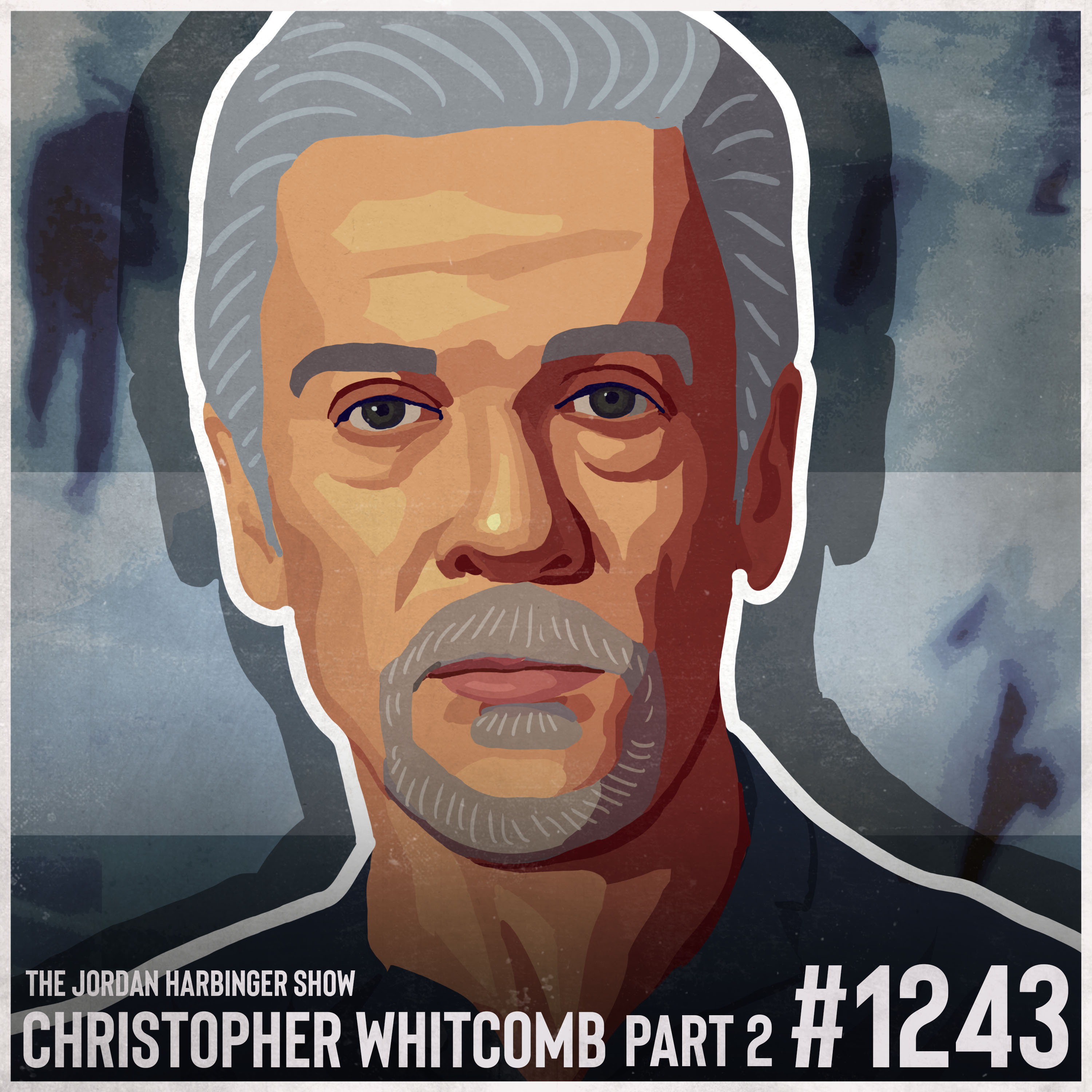
1243: Christopher Whitcomb | A Life Among Spies Part Two
Ex-FBI sniper Christopher Whitcomb survived warlords, black ops, and helicopter crashes. He's here to explain how calculating risk kept him alive. [Pt. 2/2]
Full show notes and resources can be found here: jordanharbinger.com/1243
What We Discuss with Christopher Whitcomb:
- Guantanamo Bay exposed the systematic breakdown between official policy and reality. Christopher Whitcomb witnessed 13-year-olds detained 12,000 miles from home while interrogators chanted "Fair, firm and impartial" over prisoners' screams. The same general later oversaw Abu Ghraib's abuses.
- East Timor combined apocalyptic violence with staggering natural wealth. Indonesia massacred up to 300,000 people during the island's secession, yet oil bubbled from the ground and natural gas ignited hillsides, creating a Wild West economy that attracted contractors seeking manageable chaos.
- Intelligence work often pays in ways that complicate normal life. Christopher earned contracting money through intelligence agencies that was "hard to spend sometimes," revealing the strange economics of covert operations.
- Elite operators face profound psychological costs. Christopher's friend warned him to "stop trying to get 14-year-old guys to kill you because you have some death fantasy," highlighting how repeated high-stakes missions create patterns of self-destructive behavior that operators must eventually confront.
- Recognition of dysfunction is the first step toward meaningful change. By acknowledging his own "insanity" and identity crisis, Christopher demonstrates that even those in extreme professions can develop self-awareness and begin questioning the systems they served. If you haven't already, make sure to hear part one of this two-part episode here!
- And much more...
Like this show? Please leave us a review here — even one sentence helps! Consider including your Twitter handle so we can thank you personally!
And if you're still game to support us, please leave a review here — even one sentence helps!
- Sign up for Six-Minute Networking — our free networking and relationship development mini course — at jordanharbinger.com/course!
- Subscribe to our once-a-week Wee Bit Wiser newsletter today and start filling your Wednesdays with wisdom!
- Do you even Reddit, bro? Join us at r/JordanHarbinger!
This Episode Is Brought To You By Our Fine Sponsors:
- BiOptimizers Magnesium Breakthrough: 15% off: magbreakthrough.com/jordan, code JORDAN
- Signos: $10 off select programs: signos.com, code JORDAN
- Quince: Free shipping & 365-day returns: quince.com/jordan
- Tonal: $200 off: tonal.com, code JORDAN
- Progressive Insurance: Free online quote: progressive.com
See Privacy Policy at https://art19.com/privacy and California Privacy Notice at https://art19.com/privacy#do-not-sell-my-info.
Press play and read along
Transcript
Speaker 1 This episode is sponsored in part by Dell. It's time for Black Friday, Dell Technologies' biggest sale of the year.
Speaker 1 Enjoy huge savings on select PCs like the Dell 16 Plus, featuring Intel Core ultra-processors, and with built-in advanced features, it's the PC that helps you do more faster.
Speaker 1 Plus, earn Dell rewards and enjoy many other benefits like free shipping, price match guarantee, and expert support.
Speaker 1 They also have huge deals on accessories that pair perfectly with your Dell PC and make perfect gifts for everyone on your list. Shop now at dell.com/slash deals.
Speaker 2 Ever notice that everyone always wants more of a good thing? More rewards, more savings, more special offers?
Speaker 2 Well, when you become a new member of the Shell Fuel Rewards program, that's exactly what you get. More.
Speaker 2
Join today to save 10 cents per gallon on your first fill, 20 cents on the second, and 30 cents on the third. Then enjoy everyday savings afterwards.
Want more?
Speaker 2
Then head to Shell where members get more. Offer ballot from 421.25 to 1231.26 at participating shell locations.
Offer must be redeemed within 60 days of registration. Limit 20 gallons.
Speaker 2 Restrictions apply. Visit fuelrewards.com/slash join 25 for more information.
Speaker 3 You're tuned into Auto Intelligence live from Auto Trader, where data, tools, and your preferences sync to make your car shopping smooth.
Speaker 4
They're searching inventory. Oh, yeah.
They find what you need. They're gonna find it.
Speaker 4
Pricing's precise and true. So true.
Get smart at car shopping. Oh,
Speaker 4 just for you.
Speaker 3 No, it's just for you.
Speaker 3 Find your next ride at auto trader.com. powered by auto intelligence.
Speaker 1 Welcome to the show. I'm Jordan Harbinger.
Speaker 1 On the Jordan Harbinger Show, we decode the stories, secrets, and skills of the world's most fascinating people and turn their wisdom into practical advice that you can use to impact your own life and those around you.
Speaker 1 Our mission is to help you become a better informed, more critical thinker through long-form conversations with a variety of amazing folks from spies to CEOs, athletes, authors, thinkers, performers, even the occasional former jihadi, national security advisor, or Emmy-nominated comedian.
Speaker 1 And if you're new to the show or you want to tell your friends about the show, I suggest our episode starter packs.
Speaker 1 These are collections of our favorite episodes on topics like persuasion and negotiation, psychology, geopolitics, disinformation, China, North Korea, crime occults, and more.
Speaker 1 That'll help new listeners get a taste of everything we do here on the show. Just visit jordanharbinger.com slash start or search for us in your Spotify app to get started.
Speaker 1
Today, part two with Chris Whitcomb. If you haven't heard part one yet, definitely go back and check it out.
Former FBI hostage rescue team sniper who has been shot at, hunted, stranded in war zones.
Speaker 1
A lot of crazy tales here on the show. Great conversation so far.
So let's keep it going. Here's part two with Chris Whitcomb.
Speaker 1 Tell me about East Timor because you start this security company, not contractor.
Speaker 4 Yeah,
Speaker 1 you start the security company, but it sounds kind of like the Wild West meets mafia extortion racket, meets like typical Africa, except if it's not in Africa, kind of stuff.
Speaker 1 This place sounds like it's the Somalia of South Asia.
Speaker 4 I mean, it's just
Speaker 4 true. It's true.
Speaker 1 It really sounds like that. Yeah.
Speaker 4
So in 2006, I came back from Somalia and I had this buddy at a bookstore on Abikini in Venice. Great place.
It was a crazy clubhouse. Really fun.
And he said,
Speaker 4 you got to stop being a pussy. And I said, what do you mean?
Speaker 4 He said, you got to stop trying to get 14-year-old guys to kill you because you have some death fantasy because you're like Hemingway, right? And I said, well, you got a good point there.
Speaker 4
So I said, I need a war I can. that I could manage.
So as it turned out, I had two things.
Speaker 4 One, I had some money that I had made contracting through intelligence agencies was oddly enough hard to spend sometimes because of the nature of how those things pay out. Okay.
Speaker 4 And then I had a friend who was an entrepreneur who was a member of another intelligence agency in another country.
Speaker 4
And we had a conversation in New York and he had an idea and it involved this country called East Timor. East Timor is half of an island.
that's north of Darwin, Australia, and east of Bali.
Speaker 4 What's the other half of the island? Sri Lanka or Zone? West Timor. West Timor? Oh, really?
Speaker 1 I've never never heard of West Timor.
Speaker 4
I mean, it's just a little tiny island. So they divided it in half, and they seceded from Indonesia.
It was part of Indonesia.
Speaker 4 When East Timor said, we're out, Indonesia came in and they killed a third of the population.
Speaker 4
Massacred men, women, and children. And I don't know the number.
You'll have to Google it. But I think it's between 200 and 300,000 people.
Speaker 4 A staggering number of people.
Speaker 1 So West Timor is part of Indonesia then?
Speaker 4 It still is.
Speaker 4 So as a matter of fact, that's another story. So I said, all right, what's going on in East Timor?
Speaker 4 They have, it's one of the most remarkable places on earth because they have massive gas reserves, oil and natural gas, including literally pools of oil that look like ponds, but they're just oil bubbling out of the ground.
Speaker 1 Sounds like some dinosaur shit.
Speaker 4 It is dinosaur shit. It's like the Labrea tarpus, but it's real, but it's like still active.
Speaker 1 Except you can put it in your lawnmower. Yeah.
Speaker 4 Yeah, that's right.
Speaker 4
And they have natural gas, which is wild, but it comes out of the ground, and it will light on fire. And you'll see these hillsides that look like a giant barbecue girl.
That's really cool, though.
Speaker 4
It's so cool. As long as it doesn't kill anyone.
And I always said it's five of the most beautiful places I've ever been in my life because they have red coral beaches. I mean, red coral.
Speaker 4
Red sand, yeah. No, red coral that takes over that, but they have black sand.
Oh, wow. So that's really cool.
And they had Jumanji jungle.
Speaker 4 I mean, just the most beautiful primeval jungle with everything that you would find in those jungles.
Speaker 1 What is it with any place that's that beautiful is always a complete shit dangerous because they're going to hack you up with a machine.
Speaker 4 Right.
Speaker 1 Like they can't just sit and enjoy the sand and the coral and the natural resources. They've got to kill everybody.
Speaker 4 Right. And listen, I don't want to say anything bad about the Timorese because I have great, great, great respect for the leaders of the country and the Timorese.
Speaker 4 I had a wonderful time there within the parameters of my insanity. But getting killed with a gun is one thing.
Speaker 4
Getting killed with a rock or stoned to death or getting cut up with a machete is nothing. It's a whole machete.
Exactly right. So anyway, so I said, all right, what are we going to do?
Speaker 4 And they had this plan that was closely aligned with the fact that it was strategically important to major Five Eyes countries, including the United States.
Speaker 1
Here's a question that's probably just above both of our pay grades potentially. But when that country secedes, Indonesia is like, you're not leaving.
Why?
Speaker 1 Because of the resources or because it sets a bad precedent to let everybody who wants to leave leave?
Speaker 4
I think so. I mean, there are, I don't know how many UN studies.
And I mean, this is very, very broadly written about documentaries.
Speaker 4 When I went from Somalia, which was stood up as a country and fell down a very short period of time afterwards, I went to Timor, which at the time was the newest country in the world.
Speaker 1 I remember reading about, it was great fanfare that this was the newest country, and backpackers were like, I'm going to go check it out. The newest country.
Speaker 4 And after hearing your stories, I'm like, did any of those backpackers ever come back? I knew a lot of those backpackers. I mean, technically, I was one of those backpackers.
Speaker 4 I mean, I flew to Timor with a suitcase and a one-way ticket.
Speaker 1 You maybe knew a little bit more about what you were getting into than the people from Lonely Planet.
Speaker 4
Fair enough. Yeah.
Yeah, I did know a little bit more, and I did have a little bit more of a mechanism. Yeah.
But it is a stunningly beautiful place.
Speaker 4
When the Indonesians killed a third of the population, they also razed the country. They took the phone lines.
They blew up the roads. They burned the buildings.
Speaker 4
They killed anybody who wasn't either on their side or was too old or too young to care about. So it was decimated.
So into that vacuum came the United Nations. They stood up what they call a mission.
Speaker 4 So it would be the United Nations mission in Timor, UNMET, and they restored some kind of livability and got the country back on its feet a little bit.
Speaker 4 When they pulled out, all of a sudden you had a civil war because everybody wants whatever shit's left over, right?
Speaker 4
So the military got in a big gunfight with the police and it went downhill from there. So I went in during the Civil War, not during the secession from Indonesia.
Gotcha.
Speaker 4
But when I went in, there were tanks in the streets. The Australians were there.
They had an international defense force, which was Portuguese. It had started out as a Portuguese colony.
Speaker 4 Oh, that was, yeah, okay, that makes sense. Plus, all the guys that you see in the blue helmets from the United Nations, they were in there.
Speaker 4 So anywhere you go, there were tanks and helicopters and guys with machine guns walking up and down the dirt roads that were supposed to be streets. It was wild, absolutely wild.
Speaker 4 And there was no government per se, really.
Speaker 1 Why did I get confused and think it was Sri Lanka? Is there another did Sri Lanka go?
Speaker 4 You might be talking about Myanmar. Myanmar was a big backpacker place until that one.
Speaker 1 No, I was thinking about it. For some reason, I had it pegged as Sri Lanka because with the Tamil Tigers, the terrorist group was.
Speaker 4 I think they're partially there, but.
Speaker 1
But that was another island. I just got the name.
I don't know. I don't know.
Speaker 4 I got confused because you're right it's in indonesia so it's in asia i didn't clock that indonesia is a fascinating country because it's so big it's the largest muslim population in the world isn't it like a thousand different islands something like that or hundreds and hundreds 3600 oh so it's more than it's thousands thousands yeah and thousands of dialects so timor for example spoke tetern the local language the local dialect they spoke indonesian because it was an indonesian country basically it was part of indonesia they spoke english because that's what the united nations requires and they spoke all the languages If a United Nations country came in and they wanted to work in the house, they would learn that.
Speaker 4 So anytime you find these colonized, impoverished, marginalized countries around the world, whatever terminology, third world, a developing nation, whatever terminology, and you actually live it, I mean, I was there off and on for seven years.
Speaker 4
And when you see how those things actually work, it's pretty disillusioning about the world and charity. Anyway, that's another story.
But I ended up there.
Speaker 4
I started this company and I brought in a couple expats. I hired the prime minister's son, who was a remarkable guy in his own right.
It was the third company that I'd started.
Speaker 4 So, entrepreneurially, I looked at that as entrepreneurial, not like I just wanted to start an army on my own in the jungle. That's what it turned out to be, but that's not where I started.
Speaker 4
But anyway, they had no currency, so they used U.S. dollars.
But the U.S. dollars came from China, pallet loaded on cargo planes.
Speaker 4 And my buddy, the backup guitar player in my band, was the president of ANZ Bank, And he would have three to seven million dollars at any given time, like in the telecounter, because there was no credit, there was no checks, no credit cards.
Speaker 4 Right. Everything was cash.
Speaker 4 They were real dollars? Real dollars.
Speaker 4
But they came from China. Wow.
So you could just wipe the ink off with your thumb. It was all counterfeit.
Yeah, that's what I mean. So they weren't real dollars.
No, they weren't real dollars.
Speaker 4
But they operated. I mean, this was monopoly money in a country that had nothing.
What was it like Poland
Speaker 1 during the Cold War? They would use like Kent cigarettes. And so you'd be passing this pack of cigarettes that was
Speaker 1
unsmokably destroyed. But it was like, nah, it's still a pack.
It still counts because it was just currency. It didn't matter what it looked like.
Speaker 4
People talk about money and cash. We don't use cash anymore.
You go to Starbucks, they look at you. You're nuts if you try to give them a $5.
Speaker 1 There are places around where I live up in NorCal, and it says cash-free.
Speaker 4
If you show up with cash, you're washing dishes. You're out of luck.
Yeah, that's exactly right. When I built that company, I built that company with no safety net at all.
Speaker 4 And as it grew bigger and bigger, you needed a safety net because if you don't make, if billing doesn't match up with receipts at the end of the month, you got all the guys that you hire as henchmen to burn everybody else down.
Speaker 4
They're coming after you. So they'd line up 4,000 people all over the country and they'd show up to get paid in cash.
And we'd go to the bank and get $2.5 million in 20s on a Friday morning.
Speaker 4
And then you line up. And we'd have our own guys, like the inner guys, who would be ready to go after the other guys.
Anything could happen.
Speaker 1
Yeah, because it seems like an invitation to get robbed. But then again, you are robbing the security company for the whole country.
So maybe no one's going to steal.
Speaker 4
Yeah, but they are at war, too. So I mean, it was not easy to start that company.
But somehow it worked. You know, really extraordinary people.
Yeah.
Speaker 4 And the Timorese, by and large, are remarkable people in their own way, just the culture of the island itself. Now, remember, they started out as a Portuguese colony in the 16th century.
Speaker 1 I didn't know that. Okay.
Speaker 4
17th century. So they were Catholic, but they were also animist.
So they would go to church on Sundays in these big cathedrals that had been built in the 1800s.
Speaker 4 And then they would go out, or I would go out with them, and we'd go to these cemeteries that were all totems, you know, like water buffalo skulls and we'd have cast spells. That's cool.
Speaker 4 It was wild because for somehow, I don't know how, somehow they, being the people in the company and the people that I interacted with, thought that I had black magic that was stronger than everybody else.
Speaker 1 They thought you had black magic?
Speaker 4 Me personally. What gave them that idea? I have no idea.
Speaker 1 Just you're like a tall white guy, so they're like, he must be magical.
Speaker 4 I don't know what happened, but I can tell you that that's why I survived and that's why i thrived there really i don't know why i don't know why but i can tell you endless stories about what that means chicken sacrifices and and uh you know all the different stuff exercising there was the ghost in the well that story that i wrote about so they would call you and be like hey man i got evil spirits well i had this guy named johnny and johnny is like j-a-u-g-h-n-n-y-i-e like it was phonetic of whatever his tattooed name was, right?
Speaker 4
But Johnny was a stud. Johnny was the greatest.
He was one of the senior local executives in the company. And he came up one day and he said, boss,
Speaker 4
I need Thursday off. And I said, okay, cool.
What's going on?
Speaker 4 He said, my aunt died. And I go, Johnny, didn't your sister die yesterday and somebody else died the day before? What's going on with your family?
Speaker 4
And he said, well, you know, I've got a really good job. My uncle's really jealous.
So he's cast all these spells on my family to kill them. And he goes, I really need your help.
And he wanted me.
Speaker 4
to come over on his day off to put together some spells that were stronger than his uncle's. So you don't anticipate those types of tasking requests as CEO of a company.
No. But that's Tuesday.
Speaker 1 But it's also better than him telling you to come over so you can go kill his uncle, right?
Speaker 4
No, there's plenty of that too. There's plenty of that too.
There's plenty of that too.
Speaker 1 That's kind of where I saw the story going. And then it just made a hard write into
Speaker 4
you never know what you're getting. I mean, violence that you're exposed to day to day is awful.
It sounds like a life is cheap kind of country.
Speaker 1 Is that accurate?
Speaker 4 You know, that's a really great question.
Speaker 4 I don't know that because the people that the team receives that I knew and worked with and I had enormous respect for, they were beautiful in a lot of ways, but something would snap.
Speaker 4
Like, I had this guy one time. He was a guard outside.
It was not a supermarket, but it was like a place where you'd buy expired canned goods from China. Okay.
That's how you'd survive.
Speaker 4
Yeah. And bald eagle.
That was a delicacy, too. Actual bald eagle? Yeah, but that's another story.
Speaker 4 It's really.
Speaker 1 You should start a podcast that's called That's Another Story.
Speaker 1 And if you're playing the drinking game at home where you drink every time he says that's another story, I am not paying for your hypothesis.
Speaker 4
I mean, we only have so much time. I think we're probably already running out of this.
We got another hour, man. All right, don't worry.
Speaker 4 Well, just we'll play a game where you go, tell me one of those other stories.
Speaker 4 This story is important because when the Indonesians started the war and when it went from there, most of the weapons were taken out of the general population.
Speaker 4
So you'd have some in the army, some in the military, in the police. Most of them were taken out of society.
So you would have bows and arrows, poison darts, machetes, which were most often handmade.
Speaker 4
It was like being in prison, right? Everything was manufactured. I'd rather get shot, I think.
Yeah.
Speaker 1 If I had to choose between poison, bow and arrow, and shot, I'm choosing shot every time.
Speaker 4
I think you're a smart guy, Jordan. You get a lot going on.
But anyway, so this guy's guarding a supermarket. Let me back up.
Speaker 4 You needed a private security company to guard whatever you had as a Westerner.
Speaker 4 If you wanted to go and live there and work there, you had to hire my company or my competitor, because if not, they would burn you out, take your women, and kill your whatever else.
Speaker 4
It was that bad. Just Civil War situation where everybody's dying.
Well, Well, the Civil War didn't last that long. It wasn't really the Civil War.
Speaker 4 It was that when you take that much from a culture, it creates a vacuum. In that vacuum, you pour in human nature, and human nature says, I want what's left.
Speaker 4
You have a complete lack of order in ways that we take it for granted. So people are going to say, well, maybe I could take his refrigerator.
I'm going to go find out.
Speaker 4
And you go take his refrigerator. You know, it goes downhill fast from there.
So there was a lot of that. It wasn't necessarily the Civil War.
It was everything that came around.
Speaker 4
They had this guerrilla leader named Renato who was going to come in and take over the government. Actually, tried.
We had a coup d'état. Oh, really?
Speaker 4 Yeah, he came down with his rebels out of the mountains. I mean, literally, like, came down out of the jungles, attacked the president's house, and attacked the prime minister's house.
Speaker 4
They shot the president, Ramos Horta, who won, he was a Nobel Prize winner. They shot him, I think, seven times, and he survived.
Who survived? He survived. No, the guy's a stud.
Speaker 4
That's why he chose getting shot instead of the machete. Okay.
And it survived the machete. That's right, because now we're going to talk about the machete.
That's right.
Speaker 4 So somebody calls up and and says, hey, Jimmy Joe just chopped off somebody's head at the supermarket, which is, you know, it's like a cave with some dead stuff out front that you could buy to eat.
Speaker 4
So we go over there and I go up and there's this guy sitting on a bucket turned over. And I go up to him and there's a guy with his head chopped off.
And I go, dude, what's going on?
Speaker 4
You know, you're supposed to protect him. Why'd you chop his head off? And he just looks up at me and he looks back down at his feet.
So things would happen that you would try to intellectualize.
Speaker 4
There's no intellectualizing some behaviors. Yeah.
It's just, he didn't know why I did it. Just chopped the guy's head off.
Jeez.
Speaker 4 Anyways, you learn a lot about human nature traveling in different cultures. And I've been in a lot of different cultures.
Speaker 1 It would be exhausting to live that way.
Speaker 4 It was exhausting. Yeah.
Speaker 1 Like when you leave, you don't miss it, I assume.
Speaker 4 I mean, maybe
Speaker 4 I always missed it. You missed it?
Speaker 1 Bet. What do you miss? I feel like the hyper vigilance would get old-fashioned.
Speaker 4
Because every day, every moment of every day was every single possible thing you could expect out of life. It was so intense.
It was like a 24-hour, seven-year gunfight.
Speaker 4 Sometimes it was, you know, those things, but I think that some people get to a point, and you probably find this with professional athletes.
Speaker 4 You've interviewed everybody, remarkable people, extraordinary people. And I think many of those people probably told you, you're the perfect example.
Speaker 4
You're not there yet, but you're going to be there someday. When you look back and you're going to miss the VIG, you're going to look back and you're going to miss the action.
whatever it is.
Speaker 4
So many professional athletes hang on as long as they can because when it's over, it's over. Get used to it and you accept that you've moved on to something else in life.
And that sucks.
Speaker 4
My life has been a scale down of those things going from combat to whatever to business because business can get that too. When you're going to make a payroll every month.
In fake dollars. Yeah.
Yeah.
Speaker 4
In fake dollars. But it doesn't matter what it is.
When you live a life intensely and you realize it's starting to become less intense, many people don't like that. I didn't like it.
Speaker 1 I could see that.
Speaker 4 I mean, it could just be my midlife crisis talking, but I feel like I could taste a little bit of that by the way where do you buy millions of dollars in counterfeit u.s money from china asking for a friend what people don't realize in my opinion like i've worked with many of the primary intelligence agencies the five eyes you know the five eyes are the the ally intelligence agencies us uk canada australia new zealand yes exactly right am i
Speaker 4 no no that's it but then you have mossad or let me say you have the israelis and you have mossad should bet all those organizations but then we have favored nation status with some countries and work well with them, like the French and the Italians sometimes.
Speaker 4
But I was working like with Mozambique and South Africa. Sure.
I've spent a great deal of time in Africa. And some of these organizations have a whole different set of rules.
Speaker 4
And your interaction with them creates a lot of problems for the five eyes countries that you're working with. It becomes very, very complex.
Very complex.
Speaker 4 What sort of rules conflict with the Ice Eyes? Like you'd go to jail for talking improperly to a foreign intelligence agency.
Speaker 4 Here's the thing that I learned about the Chinese that I think people need to know. When I went to Timor, I was the largest employer in the country, and I was an American.
Speaker 4
And I went to the United States Embassy in Timor in seven years. I went there one time.
It was 4th of July, and it was a pool party, and I talked to nobody. The USAID.
Speaker 4
It was disbanded basically by Trump. So many people wouldn't have known about USAID unless it had happened.
But USAID is very big in certain countries, and they were very big in Timor.
Speaker 4 But here's the difference, and here's where we're going with the story.
Speaker 4 The Chinese came in, and their model would be: the Chinese would come in, and they would go to the government, and they would say, We're going to give you literally did, this is not hypothetical.
Speaker 4 They brought in 12 BMW SUVs on a boat. They gave them to the 12 ministers in charge of the departments that they wanted to influence.
Speaker 4 Then they say, We're going to build you a new government building that's going to cost $2.5 million.
Speaker 4 They brought in the concrete, they brought in the architects, they brought in the laborers, they brought in all the materials, and all the money went back. On paper, they gave Timor $2.5 million.
Speaker 4 2.45 went back to China.
Speaker 4 But they leave the laborers behind. You go anywhere in Central America, South America, Africa, many developing nations, you're going to see the same model.
Speaker 4 So they have been brilliant in colonizing the world with a business model where they bring in... foreign aid, but they leave people behind to integrate within the culture.
Speaker 1 The Chinese have been doing that for thousands of years.
Speaker 4
Yeah, and it's genius. It's brilliant.
So the Chinese came in and did this, and a buddy of mine ran Manitoba Hydro Electric.
Speaker 4
They literally Timor was powered by a bunch of gas diesel generators and Connex boxes. You never had power.
I mean, living there was really rough. Yeah, I bet.
Speaker 4
But the government finally had enough money held in what they called a Stockholm Trust because they weren't allowed to spend the money. The UN would appropriate.
a portion money.
Speaker 4 So the government came out and went to tender with a new power grid system for the entire country. And I don't remember, so I'm going to get it wrong, but I know it was more than a billion dollars.
Speaker 4 It might have been 1.516.
Speaker 4 I know this because my buddy ran the power company or ran the power grid, right? The government opened the contract at 11 o'clock at night. Another exaggeration.
Speaker 4 They opened it for a very, very brief time period, like midnight to eight in the morning. They had one bid, and it was the Chinese company that had put the whole thing together.
Speaker 4 They got the contract and they did very, very poorly on the job, but all the money went back.
Speaker 4 So the Chinese come come in with $2.5 million for government building and 12 BMW SUVs, and they leave with a billion dollars. And they leave their people behind to integrate with the culture.
Speaker 4
And you now have an infrastructure that gives you any information that you want. And that's what they've done around the world, including the United States of America.
That's their model.
Speaker 4 The United States model at the time, this is not an exaggeration, this is specifically. The United States came in with $12,500 to buy t-shirts that said, support Timor, buy local.
Speaker 4 There were these ugly brown t-shirts with gold lettering, and that was the contribution the United States government made to one of the potentially primary important sites near the nuclear highway and with this oil and natural gas.
Speaker 4
And you take those two models together and you realize how we've been asleep at the wheel for quite some time. It's over.
I mean, that's a very small metaphor.
Speaker 4 that I would use to explain where we are in the world right now.
Speaker 4
Russia doesn't do that. that.
Iran doesn't do that. North Korea doesn't do that.
China has done it. And I've seen these things living in those environments, how they work on a day-to-day basis.
Speaker 1 So he's sitting there doing the math like 12 guys, two of us, no guns, four hours to the safe house. That is a word problem they don't give you on the SATs.
Speaker 1 Speaking of math, let's run the numbers on keeping the show going. Here's a quick word from the people who make it possible.
Speaker 4 We'll be right back.
Speaker 1
This episode is sponsored in part by Bioptimizers. It's Black Friday savings season.
This is huge.
Speaker 1 You know, the Bioptimizers products I always talk about, the ones that are science-backed and lab-tested, like Magnesium Breakthrough for sleep support, Mass Zymes for digestive support.
Speaker 1 From November 23rd through December 3rd, you get 25% off. This is the once-a-year sale you don't want to miss.
Speaker 1 Sure, you can always get 15% off with Code Jordan, but if you want the biggest savings and gifts, load up on your cart now.
Speaker 1 Check out between November 23rd and December 3rd to lock in an even bigger discount of 25% off. Plus, this part is exclusive to my audience and only at buyoptimizers.com slash Jordan.
Speaker 1
You'll not only get an amazing discount, but also free gifts with select purchases. So go right now to buyoptimizers.com slash Jordan.
Use code Jordan. Grab your favorites before the deal disappears.
Speaker 1 After December 3rd, it's gone.
Speaker 4 Don't miss it.
Speaker 1
This episode is also sponsored by Cygnos. I've always been a data guy.
I like having real numbers to back up how I feel, whether it's fitness, sleep, or focus.
Speaker 1
I learned that what you measure, you can improve. And one thing I've gotten more curious about lately is how my body actually responds to what I eat.
That's where Cygnos comes in.
Speaker 1 It uses a small continuous glucose monitor. So you've probably seen people wearing these little sensors on their arms.
Speaker 1 And of course, they've got an AI-powered app that shows in real time how your food, stress, sleep, activity all affect your body. It's not just about the numbers, it's about awareness.
Speaker 1 You know, you start to see how that healthy smoothie spikes your glucose or how a short walk after dinner can actually bring your levels right back down.
Speaker 1
You begin to connect the dots between what you eat, how you feel, energy, focus, even your mood. It's no wonder these glucose monitors are trending.
People are realizing it's not just for diabetics.
Speaker 1 It's a way to understand your metabolism and make smarter choices every day.
Speaker 5 Cygnos took the guesswork out of managing my weight and gave me personalized insights into how my body works.
Speaker 5 With an AI-powered app and biosensor, Cygnos helped me build healthier habits and stick with them. Right now, Cygnos has an exclusive offer for our listeners.
Speaker 5 Go to Cygnos.com, that's S-I-G-N-O-S.com, and get $10 off Select Plans with code Jordan. That's Cygnos.com, code Jordan, for $10 off Select Plans today.
Speaker 1 Don't forget about our free course, Six Minute Networking. It is something that I teach to three-letter agencies and private organizations, just like the one that Chris Whitcomb used to be a part of.
Speaker 1 And I would love to share the, well, the safe-for-work stuff with you all and do it for free. No shenanigans.
Speaker 1 Sixminutenetworking.com is about inspiring other people to create a relationship with you, doing it in a systematic way that really only takes a few minutes a day.
Speaker 1
And many of the guests on the show subscribe and contribute to the course. Come on and join us.
You'll be in smart/slash dangerous company where you belong.
Speaker 1 You can find the course again all free at sixminutenetworking.com. Now, back to Chris Whitcomb.
Speaker 1 I was in Laos about this time last year, and not in the touristy areas, generally, just kind of driving around, fronting around in the country, hiking, stuff like that.
Speaker 1 And you see this big dam and you're like, wow, that's out of place and looks really new. And there's Chinese writing on it.
Speaker 1
This is a really nice highway. This looks pretty new.
Yeah, yeah. It's brand new.
It's built by the Chinese. All right, we're going to take the train.
And I'm like, oh, nice.
Speaker 1
What's a Laotian train going to look like? Am I right, guys? Let's hope the thing stays on the tracks. And you go and it's a brand new station.
There's a Chinese police officer in the corner.
Speaker 1
All the writing is in Chinese. There's a video playing in Chinese.
They're selling Chinese snacks at the train station. And a bullet train arrives.
And I'm like, what country am I in?
Speaker 1
Yeah, yeah, yeah. Because I thought I was in a lot.
I just got out of the jungle swatting away bugs that probably have some kind of venom that rots your skin away.
Speaker 1 And I'm getting on a bullet train with air conditioning. where the even the writing and all the parts are in Chinese and the bathroom signs are in Chinese.
Speaker 4 They didn't even bother making it readable to the local population.
Speaker 1 They were just like, nah.
Speaker 4 All the Chinese nationals watching this podcast right now, you're the best. Yeah.
Speaker 1 I mean, I speak Mandarin, and part of it is just because, look, they're so smart. I need to be able to get it.
Speaker 4
And they're so committed. They're smart.
They're committed. I'm not saying that it's good.
Don't get me wrong. I'm not saying it's right, but I'm saying the gig is over.
Speaker 1 I don't even know how we could try to catch up at this point. It's like an insurmountable task.
Speaker 4
That's true. Yeah.
Listen, I'm a patriot. Well, yes.
Lived and died for my country. You are, right? Haven't died.
Speaker 4 I make these statements out of the reality of the life that I've lived in those worlds. I'm not saying I want it to be the case.
Speaker 4 I'm not saying I have an answer of how it happened or where we go from here.
Speaker 4 I'm just saying people need to realize when you're watching all these stories about what's happening in the world right now, you may be looking in the wrong direction.
Speaker 4 The Chinese are really committed.
Speaker 1 The only way that I can see us getting ahead is either AI or quantum supremacy that allows us to just have a crazy edge, which is they're investing in that as much or more than we are.
Speaker 1 There's some economic bubble or something that bursts in China that just sets them back 20 years and gives us a chance to seize that advantage instead of just going, oh, look at that guy tripped over his own shoes and then continuing to pick our nose and, you know, watch television, which is anyway, like you said, another conversation.
Speaker 1 Can we talk about Waco and Ruby Ridge and the FBI?
Speaker 4 I'll talk about it only because you're a great guy and because
Speaker 4 people are going to ask. People are going to ask.
Speaker 4
But I'll say it this. There's no way to sugarcoat this.
Waco, people know what Waco is. Some people know what Ruby Ridge is.
I don't know if if people know what Waco is. We're old.
Speaker 4
You got to realize that. Well, it's only because, well, it's become a folk thing.
It's become like the Kennedy assassination. And because
Speaker 4 that's a friend of mine named Tiller Russell, who's a brilliant movie director, did a big Netflix show called Waco, American Apocalypse. It popularized it.
Speaker 4 If it wasn't popularized enough, he brought four people in to talk about it. An FBI hostage rescue team sniper, which is me.
Speaker 4
a negotiator who tried to talk the thing out, which is a guy named Gary Nesner. Oh, yeah.
And the guy that ran it, and then a branched Davidian.
Speaker 4
And he talked to Dick DeGuerin a little bit, bit, who was an attorney that came in for David Crush. Bottom line, it was a shootout with the ATF.
A lot of people died, both sides.
Speaker 4
The government didn't really have anything, any backstop to take over once the firefight ended, and it was war. And that was us.
We were the final backstop, the hush rescue team. We flew in.
Speaker 4
51 days later, the building burned down and 80-something people died. Now, this is 30 years ago.
And
Speaker 4 32 years ago. Many people that would watch don't even know what we're talking about.
Speaker 4
However, it's become a very, very big controversy because people have very strong things to say about the government, about the FBI, about how these things happen. I was involved in it.
So people ask.
Speaker 4
It was not an issue in my life for 30 years because I've lived such a broad life. It was a very, very small event.
It was a tragic event where 80-something people died.
Speaker 4 I'm not belittling the impact, but I'm saying imagine what happened to your life, not 30 years ago, but like two-thirds of your life ago. Now my learners perform it.
Speaker 4
two-thirds of your life ago, something happens. Yeah.
And it did. So people always ask me about it.
I respect that. And I'll answer specific questions that you have about it.
Speaker 1 I think most people forgot what it was. And I'm going off memory here, but wasn't it so? David Koresh started a cult.
Speaker 1 They built a compound in Waco, Texas, and then they decided we're going to buy a bunch of guns and stockpile weapons and ammunition.
Speaker 1 ATF got wind of it and said, you probably don't need this unless you're going to be up to something. And then I assume there's licenses required for the amount of weapons and ammo they had.
Speaker 1 They were kind of preparing for an apocalyptic situation, right?
Speaker 4 Yeah, but just really quickly, you hit all the major points. A guy named Vernon Howell changed his name to David Koresh because it was prophetic and he became the second coming of Christ.
Speaker 4
This isn't me. This is widely written about.
He said it in his own words. You can watch it on YouTube a thousand times, right? When he did that, he built this compound.
Speaker 4
People came to stay there, to worship with him. He took all their stuff.
took their women, none of which anybody really cares about. It's people do in America.
Speaker 4 However, what happened was there's no license to buy a bunch of guns or to buy a bunch of ammo.
Speaker 4
But if you put fully automatic trigger seers, converting a regular gun to fully automatic, you do need a license for that. He didn't have those.
And he was buying hand grenade husks.
Speaker 4
He was putting the components back together to build hand grenades. So at the time, there's always some kind of terrorism.
There's always some topic du jour that people are worried about.
Speaker 4 At the time, it was a Christian national white supremacy domestic terrorism thing wrapped around this thing called the Turner Diaries, which was the government's coming to get you and Zog was the Zionist occupational government.
Speaker 4
It was a big thing at that time and agencies looking for something to do sought out people. It was like a crime with a scene waiting to happen.
Okay.
Speaker 4 And so ATF went in with a search warrant to look for those guns and to look for those grenades. The people in the compound, led by David Corest, said no, and they had a hellacious gunfight.
Speaker 4
So that's what it was. I'm not saying it was right or wrong.
I'm not saying they couldn't have picked him up in town. All of these things are widely debated.
Speaker 4 People are going to yell at me and say, whatever, call me all these names. But the reality is this went on for 51 days.
Speaker 4 At the 51st day, Janet Reno, the Attorney General of the United States, said, is enough is enough. We inserted tear gas into the building with tanks because they were shooting the shit out of us.
Speaker 1 I remember watching a video of this like tank with a... without a cannon.
Speaker 4
It had like a, I don't know, a wall pusher in or whatever you call it. Yeah, it had a boom on it.
Yeah, it looked like a gun. Yeah.
But it just looks bad. It was a fire and boom.
Speaker 1 Yeah, he knocks a wall in.
Speaker 4 And it shoots tear gas, and we were shooting tear gas in it. But they were hosing us, man.
Speaker 4 I mean, they shot, the Branch Devidians inside that compound shot so many bullets, so many rounds, they had to weigh them. They picked him up with a front-end loader, and they had to weigh them.
Speaker 4
He had millions of rounds of ammo, and they shot a lot of them at us. So there's not a lot to say, except that I now have come to terms with the fact that it's an American story.
Yeah. A bad one.
Speaker 4 A very bad one.
Speaker 1 Do you feel like you carry mortal weight when this mission goes like a mission like that goes becomes so tragic and shitty?
Speaker 4 Why?
Speaker 1 Not like it's your fault, but I just mean like you were like, oh man, maybe I wish I wasn't part of that or anything along those lines.
Speaker 4
Nobody wants to be part of something like that. I mean, you know, you join the military and you storm the beaches of wherever and you save the world for democracy.
That's what you want. Yeah, yeah.
Speaker 4
You ask military law enforcement people writ large over the last 200 years, you ask them how many actually got that. Not many.
Right. No.
You sign sign up waving the flag saying, send me.
Speaker 4
You get a politician involved. It doesn't go well.
We just came off the longest two wars in American history, Iraq and Afghanistan.
Speaker 4
And you look at the countless heroes, heroes that said, I'll go after 9-11. And you look at what came back.
War is always bad. In my experience, and I've been in a shitload of it, it's always bad.
Speaker 1
I wonder what sort of psychological toll. That stuff takes on you emotionally, even like spiritually.
I know you think about that more now than you used to.
Speaker 4
I went down hard, man. I think I've done well in my life.
Now I'm happy and I have a good life. That was not the case for a long time.
You were drinking a lot.
Speaker 1 I mean, the book mentions alcohol several times. Most people who drink moderately don't have that many alcohol references in one publication.
Speaker 4
Well, that's probably true, but I think many people that live life experiences wouldn't write as intimately as I did. You read that thing.
Yeah.
Speaker 4 How many people have you ever known that said, I did this and I did that? That book didn't do me any good in terms of being a paradigm of virtue in the world, right? No.
Speaker 4 But the reason I wrote that book was because I feel that the people that do take my path, and there aren't many, and that have the ability to write it down need to do that because somebody's got to tell that story.
Speaker 4 Not everybody wants to admit that story exists. They can take aim at me for a lot of different things, but it's the truth about that world in a way that I felt that I could write down.
Speaker 4
that would make sense to people, good, bad, or otherwise. I should have a little bit of context, but I wanted to be a writer.
So I was a, I came to California.
Speaker 4
I wrote for Orange Coast magazine, trying to be a rock star. Lived in Orange County, didn't go well.
I went back and was an English teacher at a boarding school.
Speaker 4 Then I went and worked for a newspaper. Then I got hired to be a speechwriter in D.C.
Speaker 4
Then I ended up in the FBI. So there's the media side, the government side.
Then on 9-11, my first book came out September 12th. 2001.
So I'd already resigned from the FBI to go into writing.
Speaker 4
I said, well, I've done all I can in the FBI. I'm going to go after this now.
NBC hired me. So I went to work for NBC.
So I was on air. I was at Talking Head talking about all this stuff.
Speaker 4
So I was on the Today Show and nightly news. My first book signing was September 12th, 2001 at a borders in the South Tower of the World Trade Center.
So September 11th. Wow.
Speaker 4
I was supposed to go to New York for a book signing on the next morning. And I was in my FBI office when the towers went down.
And I'd already been scheduled because it was a big press tour.
Speaker 4
My first show was Larry King Live. Do you remember Larry King? Sure, yeah.
I used to have Larry King. Really? Yeah.
Is that right? Yeah. That was the first show I ever did.
Speaker 4 And then it went from Larry to all the other shows in NBC and ended up getting a show on NBC with Martha McCallum, who went to Fox, a daily show.
Speaker 4
And so I worked in TV for five years. GQ excerpted my first book and I had the inside cover of GQ magazine, which was wide ridicule, hatred from guys I worked with.
Too fluffy. It was absurd.
Speaker 4
Too soft. It was so bad.
It was so stupid. It was so idiotic.
But they excerpted a book and they put me on the masthead. So I wrote for them.
And then the New York Times hired me to write op-eds.
Speaker 4 So I was writing for the New York Times GQ and I was on NBC.
Speaker 4 But I went out to Langley and set up a thing where I could work using those covers for elements within the intelligence committee. That's how I got into the intelligence side of things.
Speaker 1 So basically, you were a journalist and then you were like, hey, I could use this to be a spy and a journalist. That's right.
Speaker 4
That's right. I didn't necessarily do spy stuff.
I worked with spies, but I had specific skills that worked in those environments in support of spies, if that makes sense. It does.
Speaker 1 There was one part in the book you said you were selling technology to intelligence organizations or something like that.
Speaker 4 Yeah, that's another element of it. That was much, much later because when I grew up, I grew up with this guy named Harold Janine, who was one of the world's first multinationalists.
Speaker 4
And he, this is also widely written about. Because I know you get the bullshit factor, like, shut this guy up.
He's just bullshit. But it's all documented.
Speaker 4 When Random House bought this book, they they made me prove everything photography i'm surprised that publisher gave a shit honestly because i read stuff and i go there's no way any of this is true and the publisher's like that's what they said we don't really care yeah no they said they cared they cared so they wanted to see the plane ticket from somalia they wanted contracts with the united nations which publisher random house props to them for giving a shit i swear i a lot of the books i read i go i'll call penguin and go guys yeah yeah come on yeah ask anybody who's ever worked in this industry and they will i got let me introduce you to somebody who will tell you that this isn't even possible i got to give a shout out to the legal department at Random House because I've done two books with them.
Speaker 4
I did this book and I've got another one, a true crime book that's coming out shortly, both with them, and they're the best. I mean, I think the world of those guys.
They're remarkable.
Speaker 4
My previous publisher was Time Warner. They were fantastic.
And now I'm at HarperCollins. They're good.
But anyway, they verified absolutely everything.
Speaker 4 But going back to the intelligence side of things, my uncle Harold was, he started ITT, which is now community colleges or something like that, but in the day was the world's first multinational corporation.
Speaker 4
He was a Time magazine man of the year. He was the highest paid executive for a decade.
He was a remarkable guy. But he was a private money financier for the CIA.
Speaker 4 He would use his money or the company's money to finance CIA operations, one of which was in Chile. He paid cash money to overthrow the government of Salvador Ande in Chile.
Speaker 4 in 1970 or 71, something like that.
Speaker 1 What's in it for him to use his own money to do that?
Speaker 4
Because ITT was international telephone and telegraph. Okay.
They used copper for the wires. Copper was produced, a lot of copper was produced in Chile.
They had a general strike.
Speaker 4 Chile nationalized the companies and they put ITT out of business to a certain extent. The company of ITT had an interest in getting copper from Chile.
Speaker 4
The U.S. government had a vested interest in keeping communications.
So the government needed phones and telegraphs and everything else, which were produced by ITT.
Speaker 4
So it was an interface, and there is to this day. People don't realize that much of almost the vast majority of what the U.S.
government buys and uses is produced by private corporations. Sure.
Speaker 4
Electric Boat, General Dynamics, Raytheon, et cetera, et cetera. DARPA, the Defense Advanced Research Projects Agency, I believe that's what it is.
And I've done a lot of stuff with them.
Speaker 4
A lot of stuff. Like an invisible suit.
We made this invisible sniper suit using light fiber optic.
Speaker 1 That's awesome.
Speaker 4
Oh, they do crazy stuff. Does it work? It worked pretty well, but I don't know what happened.
I mean, I don't know where it is right now. Yeah, currently.
They do crazy stuff.
Speaker 4 That was kind of a guy's generic sitting in the corner wearing. Like a Monsanto killy suit, right? Yeah.
Speaker 4 It's going on.
Speaker 1 You step on the carpet and you're like, what the hell?
Speaker 4 There's a person under here.
Speaker 1 I mean, it seems possible.
Speaker 4
It was kind of like that thing in Predator. You know, when Predator's got the cloaky thing? Yeah.
It was very much like that.
Speaker 4 It had sensors that would read what's around you and it would feed it to the fiber optics.
Speaker 4 It was actually very, very good.
Speaker 1 It just projects what's behind it to the front.
Speaker 4 Here's another thing. I remember I had this project one time, and if you shoot from a helicopter at something, it's hard because the helicopter's moving.
Speaker 4
If you're shooting at a boat, the boat's moving, the helicopter and the boat's moving, the odds of hitting something are small. Yeah.
It's bad. Yeah, yeah.
Speaker 4 So a buddy of mine in Hollywood, a movie director, was whatever. I called him up and I said, how do you stabilize the cameras? Yeah, that's a good idea.
Speaker 4
In a helicopter, and he said, go see this guy in the valley. I fly from Quantico, Virginia, out to L.A., go over the 405, and I end up in this guy's place.
It's the same guy that invented the jetpack.
Speaker 4
The guy flying around in the jetpack? The water one? I don't know if it was water. I think it was air.
The first one was air.
Speaker 4 It became now it's like you go to Cancun and you drink two margaritas and go for a ride back in the day. But anyways, fascinating guy.
Speaker 4
So we pioneered a sniper platform based on what was the Steady Cam concept, which generates artificial mass with inertia. It spins a wheel and it stabilizes.
Anyway, the point of the story is that
Speaker 4 going back to all these organizations that
Speaker 4 many of them are private, they produce money.
Speaker 4 And the interface between the application from the federal government and the private industry behind them, that interface is massive, massive, massive money. And that's what I wanted a piece of.
Speaker 1 Who's the guy that overthrew the government? Hey, to overthrow the government. His name is Harold Janine.
Speaker 4
Google him. Harold Janine.
It's widely written about.
Speaker 4 But anyway, they killed, I think it was Salvador Andy they killed, but they sent, they being the Chilean government, sent a hit team after him, and they blew up their offices building in New York.
Speaker 4 And he went to hide out in an estate that he had in northern New Hampshire.
Speaker 4 So I grew up, he hired a guy named Jack McCone, who I call Jack. It was John A.
Speaker 4 McCone, I think, but he was the acting director of the CIA and Harold Janine hired him to come to work and made him a board member at ITT.
Speaker 4 So I grew up with these guys, spies and the money behind them, just hanging out in this house in New Hampshire.
Speaker 4 And it was an interesting interface as my life moved forward because I had that perspective in youth.
Speaker 1 So he pays to overthrow the government in Chile, and in return he gets access to copper and the CIA gets to overthrow the government of Chile.
Speaker 4 Yeah, but the CIA per se did not have an interest in overthrowing the government of Chile.
Speaker 4
The U.S. government had a strategic national security interest in having communications.
At the time,
Speaker 4
in order to have communications, you needed to have wires. In order to have wires, you needed copper.
And where do you get the copper? You get it in Chile.
Speaker 1 They needed to make that friendly enough to buy the copper.
Speaker 4
Basically. They shut the copper off.
They nationalized the interest.
Speaker 1 I just mean they wanted to undo that.
Speaker 4
The government? Yeah, yes. Right.
So So who's the mechanism for the federal government at that time? Right. The CIA.
You're not going to send the Postal Service after them. Right.
Speaker 4
You're not going to send the Marshal Service after them. So the CIA put it together.
But the money in these things, Jordan, we can't talk about this in one conversation. But the money is fascinating.
Speaker 1 The dumb question is, why doesn't the CIA just pay to have the government overthrown? Why do they need Harold's money?
Speaker 4
Because the way you spend it. Remember, it's a perfect example.
Remember the Oliver North thing with the birthday cake and the
Speaker 1 Sandinistas? I was just going to bring that up because I had Oliver North on the show and I asked him about this and he gave me the most ridiculously like upside-down answer ever.
Speaker 4
Look, he's not going to say it, but I am. Yes.
I'm going to tell you. Not that anybody cares because this is ancient history.
Does it still go on? Of course it does. Of course it still goes on.
Speaker 4 I mean, ask anybody, ask a private first class who was in Interlink Air Force Base or whatever, the joint base about pallets of $100 bills flying into Iraq and Afghanistan for 20 years.
Speaker 4
The world operates in cash. We buy stuff.
It's so much easier to pay money for something than it is to blow it up. Sometimes you got to do both.
Speaker 4 But the world, my exposure to how the world of money interface with the government world of intelligence operations was the most fascinating thing I've done in my life and finding out how to work in that world and how complex that world is.
Speaker 4 And on a very really pedestrian level, you could see it in Timor because the money was coming in from China and it was, you know, a UN guy from Africa would take his money back to Africa.
Speaker 4 He'd take all those fake dollars back to Africa. But my Uncle Harold growing up was bigger money with bigger operations.
Speaker 4 And today, the money and the bigger operations are astronomically, exponentially larger.
Speaker 4 Private money in the government intelligence community around the world, in my life, that's the most fascinating thing I've ever been involved with.
Speaker 1 Yeah.
Speaker 1 Give me another example of this because I think, I mean, is there another sort of common example of that?
Speaker 4 Okay, well, I'll give you, I'll give you an example that I'll try not to get in trouble with, but I helped build a company that had a technology, and it was a very cool technology, and it appealed to intelligence agencies.
Speaker 4 So vague.
Speaker 4 I don't want to be because I really, I love the guys.
Speaker 4
The company still exists to a certain extent. Okay.
And I don't want to step on a bunch of cranks, but I'll just talk conceptually about how it goes.
Speaker 4 Let's say you come up with a phone, and this phone could
Speaker 4
count to 10. Okay.
So you find all the intelligence agencies in the world that want to count to 10, and you label them. And because of my connections, I could get a hold of them.
Speaker 4
So I would go to Mozambique. I would go to Israel.
I would go to Lebanon. I would go, well, maybe not Lebanon, because there are exclusion lists.
There are countries that you can't talk to.
Speaker 4
Yeah, Iran or whatever. I never talked to Iran, but did I talk to elements within Iraq? Yes.
Did I talk to countries that did not necessarily have great relationships with Israel? Yes.
Speaker 4
Because they all want it. And it's business.
That's the way business works. I mean, if you think that Raytheon is not selling missiles to other places, you're out of your mind, right?
Speaker 4
I mean, that's the way it is. It has to be approved on some levels.
Anyways, I've got some crazy arm steel stories for you. Yeah.
So I have this watch, and a watch can count to 10.
Speaker 4
What people don't know about the watch that can count to 10 that I'm going to sell to you, let's say pick a country. You're the intelligence agency for Turkey.
Let's go to Turkey.
Speaker 4 So I was a former FBI agent who had worked for the intelligence community, including the CIA, and it was fairly widely known because I talked about it on CNN or CNBC and NBC.
Speaker 4
And I did it for about five years. So it's not like I was a secret.
I'm not saying I was famous, but I was not a secret, right? So I end up in this office in Ankara.
Speaker 4
I didn't end up there. I went there all the time.
I was in Ankara all the time. Anchor, Turkey, it looks just like Santa Monica.
Speaker 4 So I end up in this office with this guy who is a retired military officer.
Speaker 4 I'm not going to say his rank because I don't want to get him in trouble because you can get in real trouble dealing with these guys. So we're in in this place.
Speaker 4
It's on the second floor of a beach house in Santa Monica. So I'm sitting there with a buddy of mine who is a crazy out there guy.
He's a full-on arms merchant who's dead now.
Speaker 4
So we can talk about him. Okay.
But he was very high up in the Republican Party of the United States government. He was married to a woman who was a name.
Okay.
Speaker 4 So we're on a couch and this military officer who's retired, who's putting the whole thing together is over here.
Speaker 4
French doors that are open. It's a nice sunny day.
Santa Monica. These two guys come in and this one guy looks like something straight out of a Van Dom movie, right? Like Chuck Norris movie, right?
Speaker 4
He's got the chest hair. He's got a cheap suit.
He's got gold chains. He's got like food crumbs in his hot job, basically.
He's got crumbs in his chest hair. Oh, God.
And he's got a walleye.
Speaker 4
Like, I say walleye. My dad is a walleye.
So I feel like I'm not trying to. Is that like a lazy eye? Yeah, yeah.
So he's looking at me like this, but
Speaker 4 the other eye's looking over here, and I'm trying to figure out what he's looking at because I know he's loaded, right? I know he's carrying a gun. Sure.
Speaker 4 And I'm thinking, I'm not sure how this thing is going to go. And I was going to their organization, the organization they called it, right? There was an intelligence component.
Speaker 4
So I'm there selling this thing, the watch that counts to 10 with this guy. And then this little tiny guy that's with him is the money guy.
And he's doing all the talking while.
Speaker 4 Odd job is staring at me with his, you know, one of his eyes.
Speaker 4
With one of his eyes. And I'm not trying to make fun of this.
It was hysterical. It was funny.
I mean, I was trying not to laugh the whole time because it was so stupid, but it was so real.
Speaker 4 It was bad. So, anyways, I'm there to sell the watch that counts to 10.
Speaker 4 All of a sudden, my buddy over here, who's a real guy in government, all of a sudden they start talking about buying this very specific brand of machine guns and proximity fuses for projectable ordnance.
Speaker 4
And at some point in that thing, I go, wait a minute, we're not selling watches. We're here.
We're selling proximity fuses for ordnance and various types of machine gun.
Speaker 4
Then they stop talking, whatever else. They were going to Sudan.
So they're talking about delivery to a certain place.
Speaker 4 This big arms deal is going down at this nice looking house in Santa Monica that's in Ankara, Turkey.
Speaker 4
And so we do this deal and we say, okay, then we go to this, the meeting that I was really there for to sell the watch. It counts to 10.
Is this making sense? So far, so good. Okay, good.
Speaker 4
So I know this meeting that we're going to is with Erdogan's intelligence organization. I know that.
They know I'm coming. I walk in the room and there's a conference table, 10 chairs.
Speaker 4
Any conference room in the world could be wherever. There's a board and I'm going to make my presentation on the board.
I walk in.
Speaker 4 There's three guys at the table sitting down and there's a guy standing over on the side looking out the window. Nefarious looking.
Speaker 4
You make these assessments very simple, very quickly. There's nothing.
I mean, anybody could, you know, the game. So the guys turn around and one of them stands up and shakes my hand.
Speaker 4 The other two just stare at me.
Speaker 4 It's all posturing. And so we go through the whole thing and I'm making my pitch.
Speaker 4 And this guy from the window turns around, like 45 minutes into this conversation, the guy at the window turns around and looks at me, and he goes, in perfect English, almost on accent in English, says, why would I listen to a former FBI agent who works for the CIA who talked about all the stuff on NBC, come in here and sell me this watch that counts to 10?
Speaker 4
And I said, because all your enemies already have. Yeah.
He has to.
Speaker 4
What he didn't know is that the watch that counts to 10 has a back door in the service agreement that downloads me everything he does. Right.
Yeah, sure. He's just a Trojan horse.
Speaker 4 So does that happen constantly in private industry? Yes, of course it does. You buy a phone and, you know, Nokia or an iPhone wants to listen and whatever else.
Speaker 1 Tim Cook's listening to our conversation right now.
Speaker 4
Exactly. But that's a world we live in.
Yeah. But what happens is that you get in these situations where somebody decides that it's not a good thing that they're doing with that.
Speaker 4 And then private industry decides to go in a certain direction that does not jibe with the Biden administration going to the Trump administration because all of the intelligence objectives change.
Speaker 4 Or a general gets fired, another one gets hired, and things change. It becomes outrageously complex because it's very difficult to tell what the common denominator is at any given time.
Speaker 4 So you see that in business all the time. You start a hotel, it goes out of fashion, another one comes up, a new shoe, a podcast is up, a podcast is down, it's the world.
Speaker 4
But when you do it and the consequence is you lose a lot of money in investments, that's one thing. When the consequence is you just don't come home, that's a little different.
And I like that.
Speaker 4
I like that consequence. You'd like that consequence.
Yes.
Speaker 1 Like it's more exciting to you.
Speaker 4
I don't know if it's exciting. It's more complex.
I like the problem-solving mechanism that goes along with that.
Speaker 1 I see. So what are you doing now to scratch that itch now that you don't live in East Timor? Write books.
Speaker 4
Is that doing it for you? It's not doing it in the same way. Yeah, I can imagine.
But here's, I'm not pitching a new book, but I got to say this. You know that story, the Brian Koberger case in Idaho?
Speaker 1 Oh, is he the one, the guy who killed the college kids in the house?
Speaker 4
Yeah. Pled guilty to killing four college kids in Idaho.
Yeah. Horrible crime, tragedy in every imaginable way.
And it is not what you think.
Speaker 1 Say more about that.
Speaker 4
I got to be careful what I say. But it's widely talked about.
It's probably the most widely true crime case in quite some time. For sure, yeah.
Speaker 4 And the police department, meaning the Moscow Police Department, the Idaho State Police, various organizations have given out a lot of information.
Speaker 4 But under a 1964 Supreme Court case, Brady versus Maryland, the prosecution has to give all of their information to the defense, meaning everything, exculpatory information and everything.
Speaker 4
The defense has to farm that out to get experts interpreted. Like we all know about the DNA and a knife sheath.
We know about the cell phone tower pings. We know about the white car that was suppoted.
Speaker 4 We know Bill Thompson's case, the prosecutor, we know about his case because he said at the hearing, the plea change hearing, what those things were. So a lot of this information is out there.
Speaker 4
What people don't know is that files about 59,000 separate items comprising hundreds of thousands. Well, I don't want to exaggerate.
Well over 200,000 bits of information, data points in this thing.
Speaker 4 And hypothetically speaking, if somebody looked at that and had six months to analyze that, it is astonishing what people don't know and what actually happened.
Speaker 4 I find the consequence extraordinary because you have the murders of four young people and you have a guy in prison for the rest of his life who pleaded guilty to this.
Speaker 4
And when people find out what happened, it'd be shocking. Yeah.
I have no theories. I don't speculate anything.
All I do is line up documents as they were found and presented.
Speaker 4 I don't know how to explain it, except that it's baffling.
Speaker 1 Only at Gitmo do you find McDonald's and Moral Crisis in the same zip code. That is a weird combo meal.
Speaker 1 Speaking of mixed feelings, here's a quick word from the fine folks helping us keep the lights on.
Speaker 4 We'll be right back.
Speaker 1
This episode is sponsored in part by Quince. Cold mornings, holiday plans.
This time of year, I just want to feel cozy and look sharp. That's Quince.
Speaker 1
I love wearing Quince's Mongolian cashmere sweaters, which are 50 bucks. They're so warm.
They're so soft, as well as their wool coats.
Speaker 1
They're stylish, durable, and about a third of the price you'd pay at some fancy department store. And Quince isn't just clothing.
They've got everything.
Speaker 1 Home goods, travel gear, bedding, accessories. I actually just grabbed one of their expandable large suitcases because I'm gearing up for a two-week trip to Patagonia.
Speaker 1 I need the space for all the random gear I'll convince myself is essential. Quince partners directly with ethical factories and top artisans.
Speaker 1 So you're getting high-quality pieces without the middleman tax. It's the luxury without the nonsense.
Speaker 1 And if you're shopping for the holidays, their home, travel, and bath stuff make very giftable options or, you know, gifts you accidentally keep for yourself. Jen.
Speaker 5
Give and get timeless holiday staples that last this season with Quince. Go to quince.com/slash Jordan for free shipping on your order and 365-day day returns.
Now available in Canada too.
Speaker 5
That's quince.com slash jordan. Free shipping and 365 day returns.
Quince.com slash jordan.
Speaker 1
This episode is also sponsored by Tonal. I like strength training.
I work out often, but realistically, I am not the guy who pushes himself real hard when I work out alone.
Speaker 1 And I think that's just human nature. That's why Tonal is so great because Tonal is the ultimate strength training system.
Speaker 1 It's basically like having a full gym and a personal trainer built into your wall.
Speaker 1 Sleek, compact, available 24-7, it gives you the convenience of a full gym with the structure and accountability to stay on track.
Speaker 1 It starts with a quick strength assessment to set the perfect weight for every move, then automatically adjusts in one-pound increments as you get stronger. So you're always challenged.
Speaker 1 And unlike me, Tonal doesn't fall for, yeah, it's good enough for today. And no more second guessing your form, Tonal gives you real-time coaching cues to help you lift safely and effectively.
Speaker 1 You can pick from tons of expert-led workouts, strength, arrow hit, yoga, mobility, so you'll never get bored.
Speaker 1 It's designed to take the mental load out of working out so you can stop overthinking and just focus on getting results.
Speaker 5
Black Friday preview is on. For a limited time, Tonal is offering our listeners $1,000 off your Tonal 2 purchase.
That's T-O-N-A-L.com for $1,000 off your purchase. Tonal.com for $1,000 off.
Speaker 1 This episode is also sponsored in part by Progressive. You ever find yourself playing the budgeting game, shifting a little money here, a little there, hoping it all works out?
Speaker 1 Well, with the Name Your Price tool from Progressive, you can be a better budgeter and potentially lower your car insurance bill too. You tell Progressive what you want to pay for car insurance.
Speaker 1
They'll help you find options within your budget. Try it today at progressive.com.
Progressive Casualty Insurance Company and Affiliates. Pricing coverage match limited by state law.
Speaker 1 Not available in all states. If you like this episode of the show, I invite you to do what other smart and considerate listeners do, which is take a moment, support the amazing sponsors.
Speaker 1 They make the show possible. All of the deals, discount codes, and ways to support the show are searchable and clickable on the website at jordanharbinger.com slash deals.
Speaker 1 If you can't remember the name of a sponsor, can't find a code, please do email us, jordan at jordanharbinger.com. We are happy to surface codes for you.
Speaker 1 It is that important that you support those who support the show. Now for the rest of my conversation with Chris Whitcomb.
Speaker 1 It seems like a wide departure from setting up a security company in East Timor or meeting warlords in Afghanistan. You're like, next stop, true crime podcast.
Speaker 4 Yeah, yeah, yeah. Yeah.
Speaker 4 No, it's not a podcast. I'm just, I know.
Speaker 1 I'm kidding, but it's like in a similar vein, right?
Speaker 4
Yeah, you stay busy, man. Yeah.
You got got to find something.
Speaker 1 So, the complexity of that is what appeals to you.
Speaker 4
The complexity appeals to me. And I did another one.
I did another, another book that's coming out before or after that.
Speaker 4 I don't know, a cold case, 32-year-old cold case in Springfield, Missouri, and found the guy in Solve the Crime. And that was the same thing.
Speaker 1 You found the guy in Solve the Crime? Yes.
Speaker 4 Really? Yeah, in writing the book. Yes.
Speaker 1 Can you speak to that a little bit? That's actually
Speaker 4
crazy. Okay, 1992, three women disappear from a house in Springfield, Missouri.
It's called the Springfield 3. Google it.
There are a very large number of blogs, podcasts, documentaries.
Speaker 4
It's been everything, 48 hours. The Oprah Winfrey show is a very, very widely known case.
33 years after the fact, I was looking, I was saying, what am I going to do now?
Speaker 4
And I got access to the entire file. The case has never been closed in 33 years.
The police department kept it open so they would not have to disclose information.
Speaker 4 If a case is open, it's not discoverable under Freedom of Information laws FOIA requests.
Speaker 1
Right. That's a journalist like us used to go, you have to tell me this.
And they go, no, I don't. And then we say, I'm going to compel you to do it.
Speaker 1 So the way around that is to go, sorry, this is an opening.
Speaker 4
I'm going to talk about the investigation. Can't talk about it.
I can't talk about it. Well, that was the case for 33 years.
Yeah. But I was friends with people that did the initial investigation.
Speaker 4
One of them took a bootleg file of the entire case and had it in his garage for 33 years. Wow.
And he says, go get him, kid. Wow.
Speaker 4 So I started going through it, and it was very obvious, very quickly, what happened. And it's taken all this time to get the police department, but they're fully engaged with it right now.
Speaker 4 It was a mother, her daughter, and their daughter's friend disappeared disappeared after graduation on a Saturday into Sunday morning, disappeared, and
Speaker 4 no clue has ever been found, nothing until now. You can't tell us who, what happened or who did it?
Speaker 4 I don't want to tell you right now because that would blow the book, and I don't have the publication date on it.
Speaker 1 Oh, it's not out yet.
Speaker 4
Okay, no, no, no, no, no, no, no, no, you did say that. No, but I will say this.
The case is... Not that far behind John Benet Ramsey in terms of people that know the case.
Yeah, sure.
Speaker 4 And it's really fascinating and compelling. And the solution, what actually happened, I went out and interviewed one of the the two guys that were involved in it.
Speaker 4 And the truth about what happened in this case is stunning. I got to get handed to you.
Speaker 1 Whenever I see these complex investigations, I just think, man, somebody's looking at all these grains of sand and just arranging them into a picture.
Speaker 4
I don't have the patience. They don't.
Oh, yeah, that's what I'm trying to do. Yeah.
I don't have patience, but I'm disciplined. Like, I don't have any patience.
Speaker 4 But if I've got a matter of hand, I can be very focused on it.
Speaker 1 This is so funny, right? Because it's like, oh, what are you going to do when you retire? Oh, I'm going to do jigsaw puzzles. You see these old people doing jigsaw puzzles.
Speaker 1 And you're like, yeah, me too. But what you're doing is you're taking it.
Speaker 4 But I want 200,000 pieces and no picture.
Speaker 1
And no picture on the front. Just that's right.
And then you're going to make a page. So you're like the Chris Wickcomb version of the little old lady doing a thousand-piece jigsaw puzzle.
Yeah.
Speaker 4 I don't know what Chris Wickham is, a version of anything. I have no clue, right? Yeah.
Speaker 4
People come on and they're a rapper or they're a sports star or they're a celebrity, whatever else, and their life makes sense. Mine doesn't make sense.
No, it doesn't. That's true.
Speaker 1 Man, I have a question for you. You mentioned in the book, so you started doing those extraordinary renditions.
Speaker 1 And first of all, tell us what that means because a lot of people will think, oh, I've heard of that, but I don't know what that is.
Speaker 4 There are two laws under the Reagan administration, one
Speaker 4
1984 and 1986. I think one was like the Diplomatic Security Act or something.
They're very obscure laws, but you can Google them. And I talked about them.
I cite them in the book. Okay.
Speaker 4 But at that time, the government looked for terrorists as a, they wanted to arrest them and prosecute them. And prior to 9-11, there were a lot of them.
Speaker 4 When I left the FBI, the entity that I worked in the FBI, we classified 66 different organizations as terrorist organizations. Okay.
Speaker 4 And including, I talked to somebody the other day about what's going on in Gaza with Israel. I've been to PLO headquarters in Gaza with the Assa Arafat with a machine gun under my jacket pocket.
Speaker 4
I'll show you a picture of it after this if you're interested in it. Definitely.
So I had a lot of exposure doing these really out there
Speaker 4
things. But when the U.S.
government decided somebody was bad and they needed to come back for justice, they would usually be hiding in a country that did not want to give them back.
Speaker 4 So we'd have to go get them. So you don't just walk up, knock on the door and show them an FBI badge and say, could you come with me, sir? It doesn't work that way.
Speaker 4 So I will just use this as an example. There's a very famous case that people can Google where I think it was 12 CIA employees were indicted in Italy for an operation that went bad.
Speaker 4 And that was very, very widely publicized. So it would be that type of an operation.
Speaker 4 You put together a surreptitious entry into a reasonably denied area with the objective of arresting somebody, bringing them back to the United States, and trying them and putting them in jail.
Speaker 4
That's the idea. When you go into a country like that, you just don't show up and stay at a Marriott.
Well, actually, you do show up and stay at a Marriott. Okay, but
Speaker 4
you're selling tripods for cameras or something, right? Yeah. And got that titanium status.
So that rendition means the extraction of someone charged under U.S. law at the time, charged under U.S.
Speaker 4 law to be brought back without the, necessarily without the consent of the government of the country you need to go in to get them.
Speaker 1
Gotcha. Okay.
And you say in the book, if you want someone tortured, you send them to Syria. If you want them disappeared, you send them to Egypt.
Speaker 1 If you want them interrogated, you send them to Jordan. The uncomfortable question is who gets tortured, who gets disappeared, and who just gets interrogated?
Speaker 1 What kind of people get put in each place?
Speaker 4 Well, they're all bad.
Speaker 1 Well, I would hope so. Yeah.
Speaker 4 Well, actually, that's not true because look, I've been to Guantanamo Bay, and I've seen a lot of people that I didn't necessarily think were bad.
Speaker 4
And I can tell you this, it doesn't matter who I thought was bad. Somebody else made that decision.
Yeah. And a whole lot of the time they were wrong.
Speaker 4 We all know about enhanced interrogation and the compliance gestures and sickening a doberman pincher on somebody whether they're wearing women's underwear on their head.
Speaker 4
The abuses are widely written about. I was never the person who made that decision.
Wasn't there a a 13-year-old kid at Guantanamo? Yes.
Speaker 1 I mean, how can that guy be that? There's no scenario in which that guy is.
Speaker 4
I wrote about most of these stories I write about in the book. But when I went to Guantanamo Bay, it was surreal.
When I was a little kid, there was this thing called
Speaker 4 a TV show, and this person was trapped on an island, and they were trying to escape, and this bubble would come over and like wrap them up every time to escape.
Speaker 4
A surreal island when nothing made sense. That was Guantanamo Bay.
And I went down there and I saw how these prisoners were being held, who they were, what their process was like.
Speaker 4 And it would take five of these episodes just to explain that because a lot of the people doing these interrogations, I had trained.
Speaker 4 I taught interrogation for the FBI and to the CIA for a short period of time.
Speaker 4 But anyways, looking around this thing with a government minder, they'd show you, now we do this and they have a balanced meal and they get a Bible and they get a Koran and this is, you know, there's an arrow pointing to Mecca.
Speaker 4 And then you go out there at night and you hear them screaming. I mean, it sounded like it was hell on earth in certain ways, right?
Speaker 4
And everybody that's walking around would greet each other, not by saying, hey, how are you doing this morning? Good morning. They would say, fair, firm, and impartial.
It was this mantra.
Speaker 4
Everybody creepy. Creepy.
You just walk around and everybody you see goes, fair, firm, and impartial. And you go, what?
Speaker 1 It's like a 1984.
Speaker 4
Yeah, it was just, the whole thing was surreal. Those were stupid examples.
Writ large, it was bizarre. However, they had one little compound set off to the side.
Speaker 4 I think they called it Camp Iguana, but it was a house and a building, and it was completely surrounded by, it looked like a tennis court, you know, the 10-foot fence with a green cloth that you have around tennis courts.
Speaker 4
You know what I mean? Oh, yeah. It's like a green tarp.
Yeah. So that you couldn't see in.
Speaker 4
But they wouldn't admit at the time that it was a 13-year-old, but they had three, at the time, they had three kids that were 13 and younger. That's there.
Why? But listen to this story.
Speaker 4 So the guy that ran Guantanamo Bay when I was there, his name was General Jeffrey Miller. And he left Guantanamo Bay to take over Abu Gray Prison, where they had the dogs
Speaker 4
on guys, same guy. Yeah.
And he had kids of his own. I don't know this.
I talked to him, but I didn't ask him this question.
Speaker 4 But I was told by one of the people that worked for him that he was upset that these kids were being held in this on Guantanamo Bay.
Speaker 4 So he cut a big square out of the green cloth in the 10-foot high concertina wall where they were imprisoned 12,000 miles from home so that they could look out into the ocean.
Speaker 4 So it would make them feel better. That's just so, it's such a, it's so horrible somehow.
Speaker 4 You just see things that in those situations, in my experience, in my experience, you see so many things that don't make sense so they don't end up in the New York Times and they don't end up on CNN.
Speaker 4 I mean, they do brilliant jobs. I'm not knocking those news agencies.
Speaker 4
I'm saying that the craziest shit that you see living in a life like mine, eventually it all just seems like a few silly Jerry universe. You know, it all seems nonsensical.
That's true.
Speaker 4 Man, your books, or the one I read, will be linked in the show notes.
Speaker 1 And then the new one's coming out sometime.
Speaker 4
One of them is coming out in February, and one I think is coming out in April. Okay, so we won't leave it.
But Anonymous Mail is the one here. That's the one out in April.
Speaker 4 And, you know, I really wanted to come and talk to you, and you got to write a book to do it.
Speaker 1 You're about to hear a preview of the Jordan Harbinger Show with geopolitics analyst Peter Zion.
Speaker 6 We're kind of in this soft moment in history where everyone's holding their breath and wondering if the next time there's an incident, the U.S. is going to intervene or not.
Speaker 6
And I would argue we are not. Safety on the waves is what allows us to have the East Asian manufacturing model.
Less than 1%
Speaker 6 of that shipping happens on land. And that is a recipe for 1910s and 1930s style conflict and competition.
Speaker 6 Countries are increasingly finding it in their best interest to kind of hoard what consumption they do have and not allow trade access to it, and then producing more locally.
Speaker 6 We were moving this way before the Ukraine war, before the Chinese started to break down, and before the German industrial model started to implode. This has just sped everything up.
Speaker 6 So we'll probably see significant drops in agricultural output next year, especially in the second half of next year, which should suggest that we're going to have significant problems with food supply on a global scale in the months that follow.
Speaker 6 I mean, the food issue is the issue that gives me nightmares because I don't see a way to fix it. The biggest loser by far is China.
Speaker 6 Everything about China's functionality is dependent on a globalization and a demographic moment that has passed.
Speaker 6 I think we're in the final decade of the European Union because without that Russian energy, there is no German manufacturing model.
Speaker 6 And without the German manufacturing model, you don't have the money that is used to keep the EU in existence. The pace of the disintegration here is really difficult to wrap your mind around.
Speaker 6
We've had a really good run the last 75 years. It was never going to last.
but it's going to be a rough ride. So anyone who thinks that this is going to be easy is wrong in every possible way.
Speaker 1 For more about how globalization and our way of life will change dramatically in the coming decade, check out episode 781 of the Jordan Harbinger Show.
Speaker 1 Man, what a ride from FBI standoffs and warlords in Afghanistan to black magic in East Timor and a full-blown identity crisis somewhere between God and a surfboard in Indonesia.
Speaker 1 Man, Chris Whitcomb's life is proof that you can run a hundred covert ops, dodge death a dozen times, and still wake up one morning realizing the real battle is the one going on in your own head.
Speaker 1 Some people are just built different. All things Chris Witcomb will indeed be in the show notes at jordanharbinger.com.
Speaker 1 Advertisers, deals, discount codes, and ways to support the show at jordanharbinger.com slash deals. Please consider supporting those who support the show.
Speaker 1 Also, our newsletter, We Bit Wiser, we've revamped this a little bit. It's a two-minute read.
Speaker 1 It's very practical, something that'll have an immediate impact on your decisions, psychology, relationships. Every Wednesday, just about.
Speaker 1
And if you haven't signed up yet, I invite you to come and check it out. It is a great companion to the show.
JordanHarbinger.com slash news is where you can find it.
Speaker 1
Six Minute Networking, don't forget about that as well on sixminute networking.com. I'm at Jordan Harbinger on Twitter and Instagram.
You can also connect with me on LinkedIn.
Speaker 1 And this show is created in association with Podcast One. My team is Jen Harbinger, Jace Sanderson, Robert Fogarty, Tata Sedlauskis, Ian Baird, and Gabriel Mizrahi.
Speaker 1 Remember, we rise by lifting others. The fee for the show is you share it with friends when you find something useful or interesting.
Speaker 1 The greatest compliment you can give us is to share the show with those you care about. If you know somebody who's into this black ops undercover type stuff, these episodes are quite popular.
Speaker 1
Definitely share this episode with them. In the meantime, I hope you apply what you hear on the show so you can live what you learn.
And we'll see you next time.
Speaker 7 In business, they say you can have better, cheaper, or faster, but you only get to pick two. What if you could have all three at the same time?
Speaker 7 That's exactly what Cohere, Thomson Reuters, and Specialized Bikes have since they upgraded to the next generation of the cloud. Oracle Cloud Infrastructure.
Speaker 7 OCI is the blazing fast platform for your infrastructure, database, application development, and AI needs, where you can run any workload in a high availability, consistently high performance environment and spend less than you would with other clouds.
Speaker 7
How is it faster? OCI's block storage gives you more operations per second. Cheaper? OCI costs up to 50% less for computing, 70% less for storage, and 80% less for networking.
Better?
Speaker 7 In test after test, OCI customers report lower latency and higher bandwidth versus other clouds. This is the cloud built for AI and all your biggest workloads.
Speaker 7
Right now, with zero commitment, try OCI for free. Head to oracle.com slash strategic.
That's oracle.com slash strategic.
Speaker 3
Lowe's early Black Friday deals are going fast. Don't miss up to 50% off select major appliances.
Plus, up to an extra 25% off when you bundle select major appliances.
Speaker 3
And with Christmas around the corner, you're going to need more string lights, right? Save $4 on GE LED 100 count string lights, now just $5.98. Lowe's, we help.
You save. Valentine 12.3.
Speaker 3
Selection varies by location. Select locations only while supplies last.
See Lowe's.com for more details.