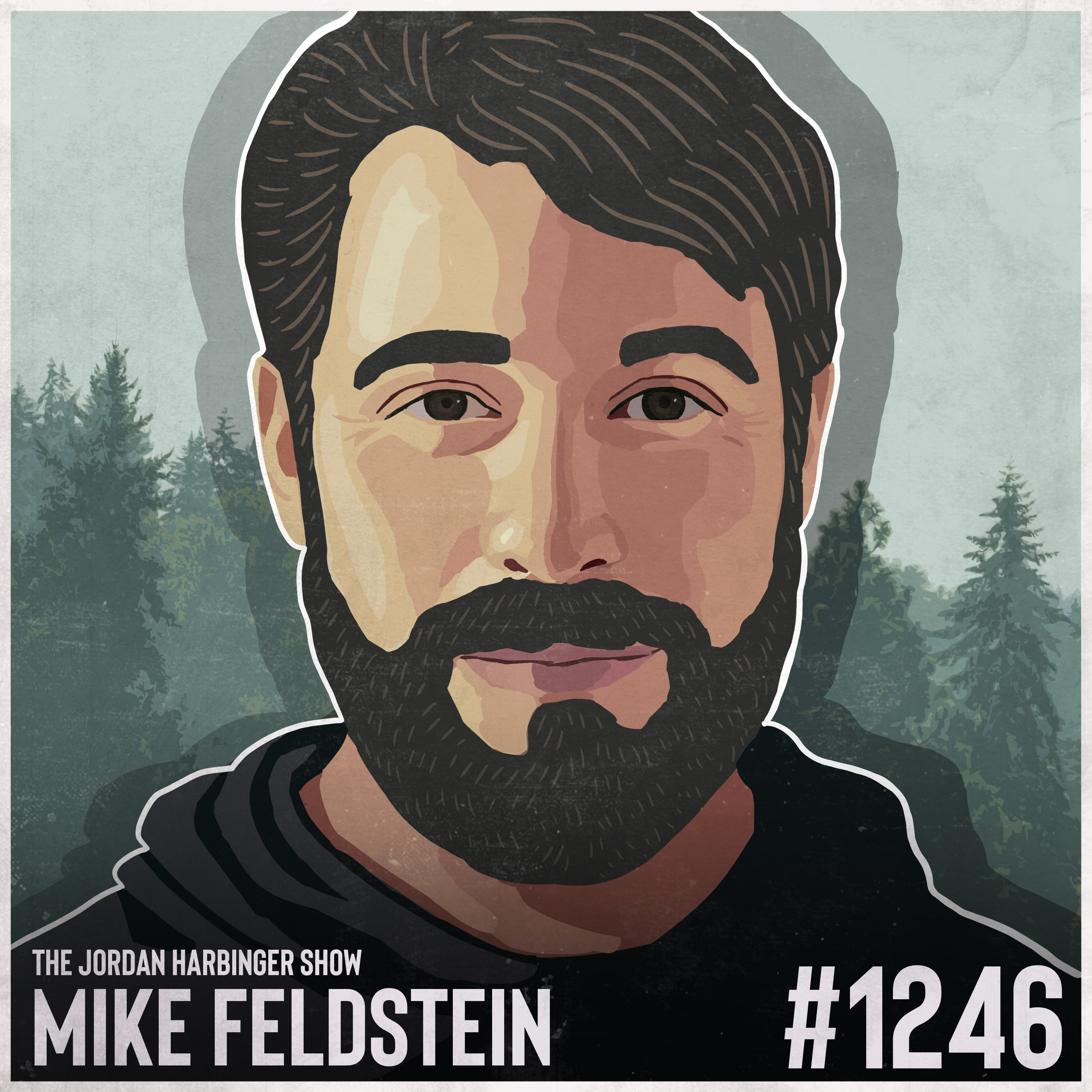
1246: Mike Feldstein | How Bad Air Hijacks Your Brain and Body
Clean air is free, so we ignore it. Air quality expert Mike Feldstein reveals why the thing we breathe most is the health pillar we optimize least.
Full show notes and resources can be found here: jordanharbinger.com/1246
What We Discuss with Mike Feldstein:
- L.A. wildfires created unprecedented contamination that lingered for weeks. 15,000+ homes and cars (including thousands of lithium batteries) burned, releasing toxic chemicals that kept fluctuating in the air six weeks later, with rain spreading toxins into soil and water rather than washing them away.
- Mold industry fear-mongering has created unnecessary panic. Many inspectors and naturopaths fuel anxiety about air quality, leading to expensive home remediation that may not be needed, forming a self-reinforcing ecosystem of concern.
- CO2 and oxygen levels in your home directly impact focus, mood, and performance. Poor ventilation affects everything from kids' classroom behavior to your sleep quality, yet we optimize diets and workouts while ignoring what we breathe 20,000+ times daily.
- We ignore air quality because it's free and abundant. Unlike food or water that require purchase and have immediate taste feedback, air seems invisible and consequence-free, making it the most overlooked pillar of health despite its constant impact.
- Improving air quality requires minimal daily effort for maximum health impact. Unlike meditation, journaling, or gym routines, clean air doesn't demand willpower every day, making it one of the most accessible ways to boost cognition, sleep, and recovery.
- And much more...
And if you're still game to support us, please leave a review here — even one sentence helps!
- Sign up for Six-Minute Networking — our free networking and relationship development mini course — at jordanharbinger.com/course!
- Subscribe to our once-a-week Wee Bit Wiser newsletter today and start filling your Wednesdays with wisdom!
- Do you even Reddit, bro? Join us at r/JordanHarbinger!
This Episode Is Brought To You By Our Fine Sponsors:
- Function Health: $100 credit: functionhealth.com/jordan, code JORDAN100
- Caldera + Lab: 20% off: calderalab.com/jordan, code JORDAN
- Jaspr: 25% off: jaspr.co/jordan, code JORDAN
- Airbnb: Turn your house into a host: airbnb.com/host
- Shopify: 3 months @ $1/month (select plans): shopify.com/jordan
See Privacy Policy at https://art19.com/privacy and California Privacy Notice at https://art19.com/privacy#do-not-sell-my-info.
Press play and read along
Transcript
Speaker 1 This episode is sponsored in part by Dell. It's time for Black Friday, Dell Technologies' biggest sale of the year.
Speaker 1 Enjoy the lowest prices of the year on select PCs like the Dell 16 Plus, featuring Intel Core ultra-processors. And with built-in advanced features, it is the PC that helps you do more faster.
Speaker 1 Plus, earn Dell rewards and enjoy many other benefits like free shipping, price match guarantee, and expert support.
Speaker 1 They also have huge deals on accessories that pair perfectly with your Dell PC and make perfect gifts for everyone on your list. Shop now at dell.com/slash deals.
Speaker 1
This episode is sponsored in part by 1-800 Contacts. You know, that last pair of contacts panic.
My wife, Jen, knows it way too well.
Speaker 1 She's had these mornings where she's out of contacts and stuck wearing these old glasses she's got to keep wiping clean with her sleeve.
Speaker 1 But now she makes sure to load up ahead of time because her next set is always on the way from 1-800 Contacts. They're the only major retailer that lets you renew your prescription online.
Speaker 1 So Jen gets her same doctor-prescribed contacts fast with free shipping without leaving the house. 1-800 Contacts has been doing this for over 30 years.
Speaker 1 They've got millions of lenses in stock, award-winning customer service, and perks like free returns, free exchanges, even free torn lens replacement.
Speaker 1 Jen loves their Express exam, which lets you renew your prescription online in under 10 minutes. It's a vision exam, not a full eye exam, but it gives you a doctor-issued prescription.
Speaker 1 If you're seeing clearly with your current lenses, no waiting rooms, no dilation drops, remember those things.
Speaker 1 And with their best price guarantee, if you find your contacts cheaper somewhere else, they'll beat it. Getting contacts doesn't have to be a hassle.
Speaker 1 Let 1-800 Contacts get you the lenses you need right now. Order online at 1-800Contacts.com or download the free 1-800 Contacts app today.
Speaker 1 Welcome to the show. I'm Jordan Harbinger.
Speaker 1 On the Jordan Harbinger Show, we decode the stories, secrets, and skills of the world's most fascinating people and turn their wisdom into practical advice that you can use to impact your own life and those around you.
Speaker 1 Our mission is to help you become a better informed, more critical thinker through long-form conversations with a variety of amazing folks, from spies to CEOs, athletes, authors, thinkers, performers, even the occasional former jihadi, astronaut, hacker, or real-life pirate.
Speaker 1 If you're new to the show or you want to tell your friends about the show, I suggest our episode starter packs.
Speaker 1 These are collections of our favorite episodes on topics like persuasion and negotiation, psychology and geopolitics, disinformation, China, North Korea, crime and cults, and more.
Speaker 1 That'll help new listeners get a taste of everything we do here on the show. Just visit jordanharbinger.com slash start or search for us in your Spotify app to get started.
Speaker 1 Today on the show, we're back with Mike Feldstein, founder of Jasper, mold slayer extraordinaire, and a guy who looks at indoor air the way a sommelier looks at a questionable gas station Chardonnay.
Speaker 1 Mike just got back from the aftermath of the LA fires, and the news is not great.
Speaker 1 We'll talk about what the smoke actually leaves behind, how long the air stays toxic even after the flames go out, and what people are really breathing when the sky looks normal again, but the particulate count is still doing numbers like a crypto scam.
Speaker 1 We'll also get into the mold industry's dark side, the fear-mongering, the unnecessary home destruction, and why an entire ecosystem of naturopaths and mold inspectors has turned into a feedback loop of panic about air quality.
Speaker 1 And if you've ever wondered how your house could be giving you sick home syndrome or what might zucchosis for humans, you're in the right place.
Speaker 1 Then, of course, my favorite part, the air-brain connection, how oxygen and CO2 levels in your home can impact your focus, your energy, mood, recovery, and why your kids' behavior at school might have more to do with classroom CO2 than screen time.
Speaker 1 We're obsessed with breath work while completely ignoring the air that we actually breathe the rest of the time, which is kind of like trying to optimize your diet while living on vending machine burritos.
Speaker 1 All this and a whole lot more today on the Jordan Harbinger Show. Here we go with Mike Feldstein.
Speaker 1
Welcome back to the show. Look, I took a little doing here.
We got our wires all set up. We got our Jasper in the shot.
That's actually always there.
Speaker 1 I want people, I feel obliged to tell people that I did not put that there.
Speaker 3 I was actually saying, move it.
Speaker 1
Yeah. Yeah.
You wanted it out of the shot, but that's where that goes, actually. So it's authentic to leave it there, even though it looks like product placement.
Speaker 3 Oh, thanks for having me here.
Speaker 1
Yeah, man. I appreciate you coming back because I know before we talked about air quality, we talked about fire remediation stuff.
And I kind of want to go over a little bit of that.
Speaker 1
People can always go back to the original episode. Producer Jace, why don't you drop the episode number in here? Because I don't have it in front of me.
Tell everyone where to go find that.
Speaker 4 Sure thing, Jordan.
Speaker 2 Hey, everybody.
Speaker 4 The previous conversation with Mike is episode 1071.
Speaker 5 You can find that in the feed, wherever you get your podcasts, or search for it at jordanharbinger.com.
Speaker 1 But since you were here, there were actually major wildfires in California, and you went back to LA to check out the aftermath of the fires.
Speaker 1 And I'd love to talk about how bad the air is because before we kind of talk just generally about fires and what they can do to the air.
Speaker 1 But I wonder how bad the air is after, say, Palisades, for example, and how long the air stays toxic after a fire.
Speaker 3
The first episode was Air Quality 101. Yeah.
So if you didn't hear the last one and you're like, what does air quality have to do with anything? Right.
Speaker 3 And you have no awareness of air and maybe you pay attention to the food you eat and the water you drink, but you have not yet thought about air as a really important thing.
Speaker 3
Then, yeah, listen to the first episode. So the LA Wildfire was a really interesting one.
The big answer is no one knows for sure because this was unprecedented.
Speaker 3 How long it's going to be contaminated? What is the actual...
Speaker 1 But it's still contaminated, I assume, yeah.
Speaker 3 Well, you have to go test again. I see.
Speaker 1 You have to test.
Speaker 3 It's not just air. How about the soil? How about the water? people's carpets, the materials in their home.
Speaker 3 But the reason I also went is I'm very qualified in this type of fire because most fire restoration companies, they have experience with a kitchen fire, a house fire, not like giant regional fires where a whole city is infected.
Speaker 3 Because, you know, you see on the news, they talk about people who lost their home, but way more people have smoke damage than people who lost their home.
Speaker 3
Also, we've never had a fire before where 15,000 cars burnt down. When a regular forest fire happens, you just have like tree smoke.
And it's still a problem, but it's regular smoke.
Speaker 3 When homes and cars and stores every can of paint every wd40 all the the insulation the drywall materials just think about when you put like you've everyone's been at a campfire and they run out of s'mores and someone puts that bag of and you smell that toxic plastic bag on the fire you're like that smells like cancer well imagine that times 15 000 homes right 10 20 000 cars and thousands and thousands of those cars were teslas and other electric vehicles right so what happens when you burn 10 000 lithium batteries yeah we don't know well it's more than that right?
Speaker 1 Because each Tesla has hundreds of lithium batteries that are about the size of, well,
Speaker 1 bigger than any battery you'd have in your house, about the size of a small flashlight.
Speaker 3 So that's the thing that's really concerning.
Speaker 3 The wildfire smoke, you know, we normally look at things like something called PAH, polycyclic aromatic hydrocarbons, a bunch of big fancy words for a lot of chemicals that are really bad for you.
Speaker 3
But in this case, we had homes and we had cars that burned down. The one thing that LA has going for it is it's coastal.
Nature is the best air purifier.
Speaker 3 And being right on the coast, a lot of the winds brought everything out. Whereas like if it's in Alberta, Canada or Utah or Colorado, socked into these valleys, things aren't flowing as much.
Speaker 3 But yeah, when I went six weeks after the fire, so mid-February of this year, 2025, and I tested a bunch of homes and it was wild. The air quality, I was measuring it throughout the day.
Speaker 3 It was fluctuating dramatically throughout the day because all it takes is a little bit of wind. And then everyone thought, like, once they had their first rain, everyone's like, we're fine now.
Speaker 3
I'm like, not exactly, guys. First of all, now that's all into your water.
Yeah. It's all in your soil.
And then it dries up. It's not like those toxic materials aren't still a problem.
Speaker 3 I put a picture on my Instagram of molten aluminum rivers running down streets because literally like the aluminum blocks in cars got so hot that metal would melt and liquefy and form rivers down street.
Speaker 1 That's crazy.
Speaker 3
So if we know heavy metals are a problem, generally, imagine at that degree. So like 9-11, turns out it was really bad.
And a lot of people got sick who were in that area.
Speaker 3
So yeah, I was getting asked the question a lot from people. And I'm like, should we move? And I'm like, if you were on the fence about it already, like this would be a thing that would tip it.
Sure.
Speaker 3 But everybody there, if you weren't filtering your air, and even if you had a lot of air filtering, but you didn't have like you lost power.
Speaker 3 their carpets, their furniture, their clothing, everything was really contaminated. And if you didn't do something about detoxing it, it still is.
Speaker 3 There was a lady, we went to her home because we messaged our local, our Jasper customers and were like, hey, we're in town.
Speaker 1 We'll come to your home, test your air.
Speaker 3 And this one lady, she asked me to check her friend who lived one floor above in an apartment.
Speaker 3 Cool thing is she had like an 800 square foot apartment, one Jasper, one floor above, exact same unit, no Jasper's.
Speaker 3 The air quality and his carpet was like uninhabitable, like you have to leave completely toxic. And her place was almost perfectly normal.
Speaker 1 Really? So this is a good, what do you call it?
Speaker 3 Like almost single variable.
Speaker 1 The only difference is it's a floor higher, but otherwise the layout's the same.
Speaker 3
Santa Monica, two miles from the fire. Wow.
And we built Jasper for wildfire smoke. For anyone who didn't listen last time, my background was in wildfire remediation, floods, hurricane cleanup.
Speaker 3 So my career was traveling around to Hurricane Harvey and California wildfires, like wherever the most toxic disasters were. That's where I would go.
Speaker 3 And the reason that I got into Jasper making these air scrubbers is because the machines that we would use on the job site were these big, large industrial machines.
Speaker 3 And when you would compare that to little air purifiers in the store, I was able to see like these little things don't work. So the vision was let's create a product that has the effectiveness.
Speaker 3
Basically, let's make the world's first air scrubber design for your home. So now I'm kind of on a mission to just.
talk about air quality.
Speaker 3 Anyone who's thinking about water and hasn't thought about air, my kind of mission for the next 20 years is to increase people's awareness of the air that you breathe.
Speaker 1 One thing that we were talking about this at lunch, how we ended up meeting. So we were friends for years before.
Speaker 1
And then I thought, hey, I might have mold in my house. I can't remember why.
Oh, right. Because I had them come and figure out something out with the HVAC because my studio had crappy circulation.
Speaker 1 So we called the HVAC guy and he goes, Yeah, I added, I don't know, a return or something. So yada yada, it works better.
Speaker 1
But he's like, by the way, you have mold in something, the tube wasn't fit correctly, something, something with the HVAC. Okay.
And he's like, there's mold in there.
Speaker 1 And I was like, oh, what should I do about that? He's like, well, I fit the tube in, but there's still mold in there. You might want to do something about that.
Speaker 1 So I emailed a mold expert and they were like, yeah, well, you know, what you can do is I can test it, but you're still going to have mold.
Speaker 1 So here's this $30,000 mold remediation system that filters all the mold out of your HVAC forever.
Speaker 3 And I was like, damn, that's a lot.
Speaker 1
I don't want to sanity check that. So I emailed someone else and they were like, no, talk to this guy, Mike Feldstein, because he knows a lot.
And I was like, I know that guy.
Speaker 1 So I emailed you because you had just spammed me with something for Jasper like the week prior. And I was like, not only are we friends, I got the air filter thing.
Speaker 1 And you were like, hey, dude, this is what stayed with me since our last episode.
Speaker 1 You were like, no matter how clean your HVAC is, it kind of doesn't matter because if it's on your couch or your carpet or somewhere else in the house, you can blow in clean air from outside.
Speaker 1 But if you have dirty air in your house, you have dirty air in your house. Something has to clean the air in the house.
Speaker 1 There's no point in getting a 30,000, maybe maybe for me anyway, no point in getting a $30,000 mold thing for your HVAC when you might have mold in your carpet or your couch or some other thing.
Speaker 1
Just get, it's kind of like at the end point. Yes.
Get something that cleans.
Speaker 3 It's kind of like water. You can have the cleanest pipes ever and still have horrible city water.
Speaker 3 With water, you know, you could put a filter on your shower, you could put it on your sink, you could put it on the fridge, you could put a whole home water filter system in.
Speaker 3
But basically, it doesn't matter what's happening upstream. You need that clean water as close to the point of consumption, and air is the exact same.
Yes.
Speaker 1 My point with the mold was that the industry for mold is
Speaker 1
like fear-based and possibly scammy. Well, I was so relieved when I didn't need to buy a $20,000 system to get rid of this mold that was in my HVAC unit.
And I bought Jasper's instead.
Speaker 1 And they're doing a better job. Because even the thing that that guy said it couldn't do, which is clean the air that's already in the house.
Speaker 3
And I love the, it just worked out with that timing. So I remember I like, you know, we were new at the time.
We were in business for like a couple of years.
Speaker 3
And I was like, hey, none of my old like high school friends or anybody knows what I did. Yeah.
So I pulled together all the emails of like everyone's email I ever had from Gmail and from Facebook.
Speaker 3
And I was like, hey, this is what I'm doing. You're like, you know, you got my email.
And within a couple of weeks, you had like a crazy story with like a fire in the neighborhood. Oh, that's right.
Speaker 3 And that's when you, you were like, more, you were like, yo, this is no joke.
Speaker 1 Yeah. I gave you a testimonial by accident, I think, because I thought, oh, this is pretty cool how it has an air quality meter on it.
Speaker 1 Cause I had bought a separate air quality meter because we were getting fires and I wanted an air quality meter outside to see what the air was like outside of my neighborhood.
Speaker 1
And I checked it in this app, this purple app or whatever. Yeah, purple air.
And it would be clean, clean, clean. And then there'd be a fire.
Speaker 1 It'd be orange, it'd be like 68, so not super clean or whatever it was. And then I noticed that the Jasper has it right on the display, and none of our other air purifiers actually had that.
Speaker 1 So I thought that was kind of interesting. And then one day, the Jasper went crazy while I was sitting here doing work.
Speaker 1
And I was like, ah, I better tell Mike that this thing is just defective and randomly going crazy. And it kept going and going.
And I was getting up to go unplug it when I heard fire engine sounds.
Speaker 1 And then I went out the front door because I heard the fire engine sounds really loud. And a block and a half away, there was a house fire that I couldn't smell at all, but the Jasper had picked up.
Speaker 1 early and had been furiously scrubbing the air. And of course, as soon as I went outside, it was like, boom, because it just smelled like burning rooftar.
Speaker 1
And the fire engine had come. And I drove, I got in my car and drove right.
I mean, it was a massive, massive house fire.
Speaker 1 And I thought that was really interesting because the Jasper had been going for like 10 minutes.
Speaker 1 So basically that fire started and seconds, maybe minutes later at most, the Jasper started cleaning the air. I smelled nothing until I went outside and then I smelled it.
Speaker 1 And so this, this thing is, it's got a pretty sensitive sniffer on it.
Speaker 3 It's like with, you know, why do we have carbon monoxide detectors and carbon dioxide detectors? Like we're decent at smelling things, but we're not that good. Right.
Speaker 3 So there's a lot of these situations where we like to say Jasper's nose knows before your nose knows.
Speaker 3 So this type of stuff happens all the time. And really, the way homes are built now, that's like what I was telling you last time is homes just aren't designed well for humans to live inside of them.
Speaker 3 At its core, there's a builder, maybe an architect, and a developer. It's like, how fast can we build this home? How cheap? You know, make a nice master bathroom in a pretty kitchen and people buy it.
Speaker 3 You get a home inspection, $70, $800.
Speaker 3
It literally says, so I became a home inspector. By the way, it was like a four-day online course.
Okay. Isn't that crazy? Yeah.
Speaker 3 And so to become a certified mold man, it's a two-day course with a very long lunch break. And to become a home inspector was a four-day online course.
Speaker 1 That explains why they come over high when they do their job.
Speaker 1 We had a couple of stoned home inspectors. We had to rotate and make sure they were actually doing their job.
Speaker 3 That's funny. So people are making the biggest investment of their entire life.
Speaker 3
And Googling a trusted home inspector who comes over. And on that contract that they give you, it basically says, This is not looking for anything environmental.
So, mold, asbestos, lead, bacteria.
Speaker 3 Basically, you know, they're looking for like a plug that doesn't work or a crack in your foundation. Crack, yeah, silly things like that.
Speaker 3 Like, hey, uh, your GFCI outlet is like, you know, like, that's a $200 electrical fix, but it's like you might have a mold infestation, and they won't mention it at all.
Speaker 3
They don't know anything about mold. They're not trained on mold.
The same way doctors aren't really trained on nutrition.
Speaker 3 The HVAC industry and home builders and home inspectors aren't trained about mold, which is like the purpose of the home is to safely house a family.
Speaker 3 And then there's this stuff that a lot of homes have in it that's killing people.
Speaker 3 And you're making your biggest investment of your life where your family's also going to live in and no one's actually checking for it.
Speaker 1 So I think there's scary.
Speaker 3 There's a huge opportunity now and some home inspectors are getting into it.
Speaker 3 But like also, if you're ever going to buy a home and you go into it and you smell air fresheners, Unplug them, first of all, and you must demand another inspection because it's the oldest trick in the book.
Speaker 3 when people are selling moldy homes they put air fresheners everywhere so you come in and how do air fresheners work they hijack your ability to smell so fragrances scents think christmas tree in the uber glade plug-ins all that kind of stuff those products are not designed to they don't clean they don't disinfect all they do is they hijack your nose's ability to actually smell things do you know how febreze works yeah so i didn't know this i thought febreeze not spot this episode is clearly not sponsored by you'll hear why in a second i thought febreeze killed the bacteria or whatever that was making the smell.
Speaker 1
I was like, How does this work? Turns out what it does is it basically limits your nose's ability to smell things. So it's like, wait, wait, wait.
So this thing still reeks.
Speaker 1 It's just that all of our noses inhale this thing first. It's like Novocaine for your sense of smell.
Speaker 1 So basically, you sniff that and then you can't smell the fact that it smells like absolute crap and has BO all over it or whatever else.
Speaker 3 It's a big, big, great deal. It's kind of like natural flavors in food.
Speaker 3 They They feed you a bunch of garbage, they pour some chemicals in, they don't make it taste good, they just stop your ability to smell the net, taste the nasty stuff. That's so gross.
Speaker 3 And then they hammer you with some chemicals that give you some addictive sensations.
Speaker 3 But the fragrances, like I'm on a war against synthetic fragrances, I am screaming from my the rooftops that synthetic fragrances are the new second-hand smoke.
Speaker 1 I want to hear more about that. Well, let me back up a little bit because I actually, before this thought flies away from me, I gifted a Jasper to a couple of friends because they had a mold problem.
Speaker 1 And what they did is they, they went to the doctor and the doctor was like, oh, maybe you have mold exposure. They did a bunch of testing in their house.
Speaker 1 And then they were like, dude, I got to gut my entire wall of and pay 80 grand or whatever it was, like some crazy amount of money to remediate this mold.
Speaker 1 And I told him to get us, I mean, look, you don't want mold in your house, but you're going to tear down your whole house. It just seemed a little bit unnecessary.
Speaker 1 And I remember talking to you casually about this. Can you, you know what I'm talking about?
Speaker 3
You remember this? I'm very glad you brought that up. In the mold industry, they have two sayings: one is the mold rush, and the other one is mold is gold.
I remember this.
Speaker 3 Yeah, so it's a big, big problem, man, because people now are going to the functional medicine doctor or that you know the naturopath or whatever it is, and they're sick and they've been sick and they don't know why, they don't know what's making them feel weird.
Speaker 3 They got brain fog, they have fatigue, they have gut issues.
Speaker 3
They go, functional medicine doc gives them a bunch of urine and blood testing, and they say, You got the mold, and then they say, Test your house, too. You got the mold.
Basically,
Speaker 3 everybody has mold and everybody's house has mold.
Speaker 3
So all it's like heavy metals, like it's like microplastics. It's not a black and white thing.
How much mold? What species of mold?
Speaker 3
But the functional medicine doctors are literally trained in one or two days also. They're like, ah, I'm getting thousands of calls about mold toxicity.
Let me take a quick two-hour webinar.
Speaker 3 Yeah, what have I done?
Speaker 3
Become a certified mold expert myself. And who teaches the testing? It's usually the companies that do the urine and blood testing.
I see.
Speaker 3
So they're the ones who sell the diagnostics to the functional medicine docs. So they go, you got the mold.
They check your ass. You got the mold.
Speaker 3 If we go outside and run the test, there's mold everywhere. Mold is just in the air.
Speaker 1 See, that was my question is all these people that are really sick with certain types of mold, I'm not doubting that these people are getting sick from mold, but they can't be getting sick from the amount of mold you would get.
Speaker 1 playing in your backyard unless they have a serious allergy like a medical issue with it but specifically for that but like if you go outside and you don't get sick every single time you do you obviously can tolerate some level of.
Speaker 3
So it's like pollen and seed. It's kind of like another allergen.
Indoors, it's a bigger problem because you've trapped the mold inside. Right.
So the best air filter in the world is nature.
Speaker 3 Sun, wind, trees, rain.
Speaker 3 Homes, since the 70s, since the energy crisis, they've built homes so tight with the primary goal being energy efficiency that they've turned your home into like a Tupperware box, a little Tupperware container.
Speaker 1 So I should leave this big back slider open. Is that what you're saying? Yeah, like fresh air is good.
Speaker 3 There's no birds in here.
Speaker 3
Screen, I mean, California, you have pretty beautiful weather. So like this is the place to do it.
Yeah. But if not, and most HVAC systems aren't designed to have fresh air intakes.
Speaker 3 So the problem is like you don't get typically mold on the bread until you put it in the Tupperware and you choke it in there.
Speaker 3
So the reason that people are having these issues inside their home is you have no sun, you have no wind, you have no rain, there's no filtration. It's trapped inside.
Your home can't breathe.
Speaker 3 The HVAC is the lungs of your home. And if your home can't breathe, the people inside it can't breathe.
Speaker 3 A lot of people get triggered by mold, but it's become a very fear-induced industry because basically I did mold remediation for years. Yeah.
Speaker 3 If you ask a company to come and renovate your bathroom, the demolition process to gut it is going to be like a thousand bucks. If there's a little bit of mold, it's like $10,000 now.
Speaker 3 The only difference is you put up a piece of poly, basically about an hour of prep, $100 of material, and antimicrobial spray. So the cost for the mold remediation company is negligible.
Speaker 3 There's almost no difference.
Speaker 3
So if you are a contractor doing demolition, charging $1,000, you're like, wait a second. And also, most bathrooms had mold anyway.
Like we were already ripping out bathrooms with mold.
Speaker 3 You mean make a bit more of a show out of it and 10x the price? This was a very attractive opportunity for a lot of contractors.
Speaker 1
I guarantee you my bathroom has mold where there's a. So our bathtub has one of those shower heads that you can like pull out and then you can spray.
It's in the bathtub.
Speaker 1 I pulled it up one time because I never use it. I pulled it up one time and sawdust fell off of it.
Speaker 3 And I was like, what?
Speaker 1
So I shined a flashlight down there. Honestly, this thing that drips water constantly because it's a shower head, it goes into this little holster.
And inside there is just the guts of the house.
Speaker 1
Like it's just wooden beams, the crawl space. It's just a hole that the shower rests in.
And I'm like, wait a minute. There's not like a plastic thing in there.
There's not some sort of receptacle.
Speaker 1
Nope. It just goes into the bottom of the house next to the bathtub.
So there's a cavity there that just probably has like mold in it.
Speaker 1 I don't see how it could not have mold in it at this point and earwigs. Shitload of earwigs.
Speaker 3 What'd you do about the earwigs? Nothing. I killed them every day.
Speaker 1 I kill these earwigs.
Speaker 3 Well, like the main thing here is there is a dark side of the mold industry. Not everybody's a bad actor, but you have to be quite careful when you're navigating it because...
Speaker 3 you know, you feel the sense of relief when you get a blood test and you're like, hey, wait, this is the cause of my sickness. Right.
Speaker 3
So you're, you're upset about the cost and you're annoyed, but you're you're like, finally. Like I have an explanation for my, yeah.
Have you noticed no one talks about Lyme disease anymore?
Speaker 3 Mold is the new Lyme disease. Mold is the new Lyme disease.
Speaker 1 Yeah, you're right. That was trendy for a while.
Speaker 3 It's mold now.
Speaker 1 Trending.
Speaker 3 So it's crazy. Like if you look at the Google search volume of Lyme disease versus mold toxicity, it's like swapped.
Speaker 1 That's interesting. You're right.
Speaker 3 People are always kind of looking for a it's that thing of like, I don't feel good and I just need like a blank. It's like fibromyalgia.
Speaker 3 You kind of, a lot of people, there's these things that come that's like, this is this thing that can't exactly be diagnosed that explains why i'm sick but the the sad thing is mold actually makes some people very sick for sure yeah um people just have a really hard time deciphering what's true and what's not true but basically what i want to get across is unfortunately you have to do a little bit of your own homework and a little bit of your own digging but it's not black and white just because you have some a little bit of mold spores in your air and in your blood like everybody does if you test 10 people who feel great everybody has mold in their blood and their urine so don't think it's like a black and white thing i see so if i went to the the doctor and i said i don't feel good and they tested for mold in my blood and urine it would show up yeah but if i went in there and said i feel great can you test my blood and urine for mold they would find it in there anyway it's always there so it's like ah okay so this is one of those things where when you feel bad you find that and you go this has to be it but then somebody else who feels totally fine goes in there and they have the exact same or higher level of mold and it's just not doing anything yes interesting and it's like heavy metals of course we live unless you live in like the amazon rainforest you have microplastics you have heavy metals.
Speaker 1 So this will interest you, I suppose.
Speaker 1 I went to Taiwan. We did this like CEO health check where it's like ridiculously cheap, relatively speaking, for like an MRI and a CT scan.
Speaker 1 And they get through every organ on your body and every system and they scan your brain for like possible places where you're going to have an aneurysm.
Speaker 1 Like they just really go all in and they find stuff that's like stage zero cancer where they go, if this is still here next year, you take this medicine and it'll go away, basically.
Speaker 1
And then like, if it grows, you know, you might have something. But if not, and like every, I was like, oh my God, I have nodules in my thyroid.
And she was like, let me calm you down.
Speaker 1
Everyone has these. Everybody.
Nodules in your lungs. Yeah.
You have lived on Earth for 45 years. You have two nodules in your lungs.
They're tiny. It is nothing.
It's like a grain of sand.
Speaker 1 She's like, the problem is if it's the size of 10 grains of sand in two years when you come back, then it's a problem because then it's, it's growing.
Speaker 1 But she's like, everybody has something like this.
Speaker 1
And I was like, oh my God, my spine's degenerating. She's like, yeah, and it's going to get worse.
And I was like, oh, my God. She's like, it's called aging.
It's called using your phone.
Speaker 1
It's called standing up. It's called sitting in a chair.
So all these things. But one thing they did test for was heavy metal.
Speaker 1 And I was like, oh, my gosh, I have super high off-the-charts heavy metals, mercury, namely.
Speaker 1 And then I came back and I went to Kaiser and I was like, I need another check because this test could be spurious. I need to find out if I have all these heavy metals.
Speaker 1 I took another test and then Kaiser was like, we're going to do another test just to make sure. I was like, okay, so I've had three tests all high in heavy metal.
Speaker 1
They're like, you need to call with toxicology. I called the toxicologist and he goes, yeah, do you ever eat sushi? I go, Yeah.
He goes, How much? I'm like, I don't know, once or twice a week.
Speaker 1
And he's like, Okay, any other fish? I was like, I don't know, salmon. He's like, Yeah, I wouldn't worry about this.
And I was like, But my mercury levels.
Speaker 1 And he's like, Yeah, why'd you test for mercury? I said, Oh, it was part of this big blood work package.
Speaker 1 He goes, Yeah, I think if you picked 99 out of 100 people in your neighborhood or any neighborhood anywhere in California, you'd all have high mercury levels. He's, he goes, You know what?
Speaker 1 I tested myself. I have high mercury.
Speaker 3 It doesn't matter.
Speaker 1 Everybody who eats fish or lives in a modern economy, like you said, doesn't live in the Amazon rainforest, has high mercury levels. He's like, and I said, but why is the test showing red?
Speaker 1 He goes, this is a problem if you don't eat fish because then you have mercury in your house. But if you're eating fish, this is a perfectly normal level of mercury to have in your blood.
Speaker 3 And I was like, so I appreciate that nuance
Speaker 3 because they could have sold you on a very extensive mercury detox protocol.
Speaker 1 There was a guy who was like, you should do chelation, right? And the toxicologist was like, that is the chelation process, which is removing heavy metals from the body.
Speaker 1 He's like, is so much more harmful for for you than just dealing with this baseline level of mercury because chelation is like it's oversimplified chemotherapy for getting rid of heavy metals.
Speaker 1 Like you're taking all these other metals and other minerals out of your body.
Speaker 3
Yeah, you go. You're like, they're like, you have too much of this thing.
Here's 26 supplements to take and 17 drops. And you're like taking them.
You're like, you might feel worse for a while.
Speaker 3 I'm like, this, this doesn't feel right. No.
Speaker 1
Yeah, exactly. This is like cutting off your nose to bite your face.
It's really, it's, so he basically was like, no need to go nuclear on it.
Speaker 1
The reason this relates to what you were saying is the fact that you're testing for mercury. Oh my God, you have high mercury.
Okay. Do you have any symptoms? No.
Speaker 3 Okay. Then go home.
Speaker 1 That was his moral destroy. So the mold is very similar from the sound of it.
Speaker 3
So, yeah, exactly. It's like, check your body for bacteria.
Yeah. It's like you're like half bacteria.
You're infested. Yeah.
Oh, yeah. There's all these little creatures living inside you.
Right.
Speaker 3 So at the end of the day, though, it's not to say mold can ever be an issue. But unfortunately, because of the fragrances and things like that, we've lost our ability to smell.
Speaker 3 I tested probably a thousand homes for mold. And anyone I know who tests tests them do remediation within five seconds of walking in someone's home, if they have mold or not.
Speaker 3
Just because you can smell it. Because you smell it.
I see it. And you feel it.
It's a little more difficult to breathe. It smells musty.
It smells damp.
Speaker 3
If you walk into a baby's nursery, it smells like poo. You don't need a poo tester or a airborne bacteria analysis.
Right.
Speaker 3 Unfortunately, we've gone to this like quantifiable metrics data testing thing and we've all lost the ability to just trust how we feel and trust our sense of smell.
Speaker 3 And that's what this comes down to.
Speaker 3 So if it smells musty and there's a black patch growing on the wall or there's water damage, check your attic, check under bathrooms and sinks and look for like bubbling drywall.
Speaker 3 Like the visual inspection and the smell is by far the best inspection of all. That's why the best mold inspector is the mold dog.
Speaker 3
I've never heard of this. Yeah.
There used to be, there's a few people who have like mold canines. That's the best by far because they're going to smell and they're going to go find the source of it.
Speaker 3
Amazing. But just to test your air and then then they start investigating, basically, just ripping out walls and stuff.
That is similar to like being like, your levels of whatever are high.
Speaker 3 Let's just do some investigative surgery.
Speaker 1 Take some injectable whatever.
Speaker 3 So let's just cut some holes in you and check inside. You're like,
Speaker 3 I don't think this is a good idea.
Speaker 3 So people often go into debt of hundreds of thousands of dollars, rip their homes apart, move into apartments or homes that were moldier than their first home, and debt and stress.
Speaker 3
And then they get much more sick. So I've been seeing this increasing at a large scale.
And that's why I has a mold remediation guy. How would we do mold removal?
Speaker 3
We'd remove the physical mold and we would scrub the air. It was very simple.
Like, so the Jasper was very similar. It's basically the same machine that we would use to scrub the air from the mold.
Speaker 3 So, like, I'm not, I don't think you need to test your tap water. Just get a water filter.
Speaker 1 While you let that horrifying thought settle in, here's some stuff that won't slowly kill your whole family.
Speaker 5 Probably.
Speaker 1 We'll be right back.
Speaker 1
This episode is sponsored in part by function. All All right, so here's the deal.
You know how I'm kind of a nerd for data. I like to see what's going on, whether it's business, sleep, or health.
Speaker 1
If you can measure it, you can improve it. And that's why I've been using Function Health.
Most people never get access to this kind of data unless they're in some kind of high-end clinic.
Speaker 1 Function lets you test over 100 biomarkers, hormones, heart health, toxins, inflammation, stress levels, all that stuff. Even add an MRI or chest CT if you want to go deeper.
Speaker 1 And it's not just one and done kind of snapshot stuff. It tracks everything over time securely so you can actually see your health changing.
Speaker 1 What I love is that function doesn't push supplements or fad advice. It's real objective data interpreted by top doctors who are not trying to sell you anything.
Speaker 1
If you want to go out and get all this testing done on your own, go ahead. It's going to be like 10 grand.
With function, it's $4.99 a year, even less if you use our code. To me, it's a no-brainer.
Speaker 1 You can't improve what you don't measure. Function gives you a 360-degree view of what's actually happening in your body so you can stay ahead of your health.
Speaker 6
Learn more and join using our link. Function is a near 360 view to see what's happening in your body.
And our first thousand followers get a $100 credit toward their membership.
Speaker 6 Visit functionhealth.com/slash Jordan or use gift code Jordan100 at signup to own your health.
Speaker 1
This episode is also sponsored by Caldera Lab. I've never been a 10-step skincare guy, American Psycho Anyone.
For years, I didn't even use soap.
Speaker 1 But eventually, my skin started feeling dry and rough, and that's why I found Caldera Lab. It's simple, made for men, actually works.
Speaker 1 Their flagship product, The Good, is an award-winning serum with, I guess they have words for serum now.
Speaker 1 Anyway, it has 27 active botanicals, over 3 million antioxidant units per drop that's probably a lot it protects your skin from all the daily junk pollution stress lack of sleep ha can protect you from lack of sleep how about protecting the rest of me from lack of sleep anyway it makes it look smoother and healthier there's eye serum which helps with dark circles puffiness which i have plenty of my face is a battleground for these products my favorite is the base layer it's their lightweight moisturizer super hydrating fast absorbing leaves a clean matte finish no grease no shine just healthy looking skin that's just like how simple it is there's no crazy routine there's no gimmicky ingredients.
Speaker 1 Everything's backed by science developed by top cosmetic chemists who test every formula until it's perfect.
Speaker 1
And since using it, people actually have told me my skin looks good, which is a weird compliment to get as a guy. It's high praise.
I'm pretty proud of that.
Speaker 6 Skincare doesn't have to be complicated, but it should be good. Upgrade your routine with Caldera Lab and see the difference for yourself.
Speaker 6 Go to calderalab.com slash Jordan and use Jordan at checkout for 20% off your first order.
Speaker 1 If you're wondering how I managed to book all these great authors, thinkers, and creators every week, it's because of my network, the circle of people that I know, like, and trust.
Speaker 1 I'm teaching you how to build the same thing for yourself for free over at sixminutenetworking.com.
Speaker 1 This is a down-to-earth, non-cringe, decidedly non-awkward course that is just practical stuff that'll make you a better colleague, a better friend, a better connector.
Speaker 1
A few minutes a day is all it takes, and many of the guests on the show subscribe and contribute to the course. Come on and join us.
You'll be in smart company where you belong.
Speaker 1 The course, once again, all free at sixminutenetworking.com. All right, now back to Mike Feldstein.
Speaker 1
It's funny, this exact same thing happened. I thought we need to test the water in San Jose because I'm from Michigan.
We have clean water. And
Speaker 1 there was a guy who was next door, who was a doctor, and he was just like, why don't you just get a reverse osmosis filter and then you know your water is clean?
Speaker 1 And I was like, this guy, you're onto something, right? Either test the water and hope that the quality stays consistent, periodically tested every month, or just get a machine that's
Speaker 3
cleans everything. It's usually not good.
Yeah. If you have well water, you have bacteria problems.
Speaker 3 If you have city water, you're going to have a lot of chlorine and potentially way too much fluoride. Because think about it.
Speaker 3 They're taking like rainwater and other people's sewer water and they're disinfecting that water so it doesn't kill you. So like that's what more do you like? People are like mad at the city.
Speaker 3
The city's trying to make us sick. I don't think so.
They're trying to make it so the bacteria doesn't kill you immediately. And then you have to filter that drinking water.
Speaker 3 And with air, there's no intermediary.
Speaker 3 So the rubber from the tires, the chemicals, the restaurants, the forest fire, the glyphosate, the chemicals people are using in their bounce sheets, all the toxic things in the world come into your home.
Speaker 3
So I think we're going to look back in 10 years from now. 25 years ago, dentists didn't use masks or gloves.
As a kid, you would just drink straight from the hose and you would just drink tap water.
Speaker 1 That yummy metal, copper, whatever penny taste.
Speaker 3
And then we all learned. You're like, oh, you need to filter your water.
And then we're like, oh, microplastics. And then once you realize it, when you get the plastic bottle, you taste the plastic.
Speaker 3
Yeah. It's like if you just trust yourself.
So I think we're going to look back now.
Speaker 3 And in Asia, like I remember going to Kuala Mpur and other parts of Asia where like, I went to a bank and every single teller had an air filter in each little room.
Speaker 3
Like, and I'd go to the mall and they'd have air purifier stores. So their air awareness is way more head.
Why do you think that is?
Speaker 1 Is that a dirty city with a lot of pollution?
Speaker 3 I think the pollution historically was worse, which increased their air awareness. They're like, we're getting sick.
Speaker 3 I put this machine in my room and I'm breathing better and I'm sleeping better and I'm feeling better. It's like, why do we filter our water now? Because Because we realized that it was dirty.
Speaker 1
Taxi drivers in Beijing and Shanghai, they'll have this little tiny box. It's like this big, it's like the size of your, you know, a fat wallet.
And I'm like, what is this?
Speaker 1 And they're like, it's an air purifier.
Speaker 1 And I'm like, I don't want to be the bearer of bad news, but this $9.99 Timu air purifier that you've had in here for a decade is not cleaning all the air in this car with the doors opening every five minutes.
Speaker 1
Like it's not doing anything. And they're smoking, right? They smoke their cigarette and they blow it out the window.
And they're like, don't worry, I got an air filter.
Speaker 1 And it's like, oh, China, you change. This reminds me of a skeptical Sunday episode we did about expiration dates for food.
Speaker 1
And one of the subject matter experts, he was just like a food expert of some kind. I can't remember.
I said, like, what about this? And the dates for this. What about meat? It's dangerous.
Speaker 1 And he goes, you know what? If you smell meat and it smells really bad, don't eat it.
Speaker 1 And if you smell meat and it smells fine, it's almost, almost certainly fine, even if it's expired by a week or two. And I was like, but why the date? And that was what the whole episode was about.
Speaker 1 But basically, to your earlier point, your nose is really good at telling you whether something is safe to eat or breathe or not, because that's literally the whole point.
Speaker 3 But all of these things, like tracking your sleep, you know, if you track your sleep and you track your steps, not that you shouldn't, there's a lot of good data that you can get from that stuff.
Speaker 3
The downside can be, though, is going off the expiry date, you can go down a path of not trusting yourself. Yeah.
To be like, do I feel like I need to walk? Like, did I move enough today? Yeah.
Speaker 3
Let me check my phone. Yep.
We're good.
Speaker 1 You get obsessed with that. I think I've mentioned on the show before that there were fires outside, so I couldn't go outside and I wanted to get 10,000 steps.
Speaker 1
I walked around my kitchen island like a thousand times. I maybe literally, because I wanted 10,000 steps and it was a smaller, it was smaller than this kitchen island.
I went around that thing.
Speaker 1 It took like three and a half hours of me just walking. So my mom was like, Are you okay? Because I looked mentally ill, right?
Speaker 1 I was just walking around the kitchen island over and over and over until I had knee pain and 10,000 steps.
Speaker 3 It was just, yeah.
Speaker 1 And I've sat down and went, why did I do that? How important was it to get those 10,000 steps?
Speaker 1 Before we forget, I want to go back to something you said earlier, which was that some of these artificial smells are, I can't remember how you phrased it, kind of the new smoking.
Speaker 3 Synthetic, like fragrances are the new secondhand smell.
Speaker 1 Yes, because whenever I get in an Uber, if they have those rock chunk things that they keep in the little can.
Speaker 1 that smell terrible like fake cherry i tell the driver i have to cancel i go oh i'm sorry i'm allergic to these I don't know if I'm really allergic, but I will get a slamming migraine if I can get it for an hour, right?
Speaker 1 Yeah, I don't know. I don't know how to do it.
Speaker 3 Christmas tree of death. Yeah.
Speaker 1
Or if there's one Christmas tree, I'm probably okay. If there's eight, which why are you using that many? If it's expired, throw it away.
Or do you just want eight times the scent?
Speaker 1
That to me is like, I can't deal with that. It makes me want to vomit.
It makes me car sick. So it doesn't surprise me at all that these are bad for you.
Speaker 1 But I'd love data because I'm going off of, I feel like these are.
Speaker 3 Which is actually what you should do.
Speaker 1 Yeah, I suppose what we should do. Yeah, another thing, Glade plug-ins, disgusting.
Speaker 3 It's the same as the February stuff. Yeah.
Speaker 3 And it's heavily correlated to what we were saying before about the mold because oftentimes the reason that people are desensitized to the mold, also the molds that are really bad for you smell the worst.
Speaker 3
What a surprise. Yeah, sure.
Like the ones that make you sick, you smell and you feel crappy.
Speaker 3
So because of all this synthetic fragrances, whether it's perfume, cologne, I can smell Speedstick or Old Spice like across the house. Yeah, it's like bad deodorant is so.
This is really cool.
Speaker 3 When cigarette smoking was very normal and you could do it everywhere, if you would tell someone to stop smoking, you were just like a bitch. You're an asshole.
Speaker 1 Yeah, you're the jerk who's running everybody's fun.
Speaker 3
It was your preference, like, hey, stop smoking. Right.
And you know, asshole, like you were just this annoying person. Right.
Then we learned about this little thing called secondhand smoke.
Speaker 3 Secondhand smoke was one of the greatest marketing campaigns, like positive marketing campaigns of all time, because it took it from you're giving my kid cancer so telling someone not to smoke was like you invading on their fun but when you realized that the secondhand smoke was just as cancer causing and making you just as sick as the person who is smoking it that angered you that galvanized you that gave you permission to be pissed because now they were impacting you kind of like the covet stuff it's like you know you're making me sick right so when someone else's choice is impacting you then that gets people kind of fiery and that's how you get a mission and get things moving then the reason i call it fragrances of the secondhand smoke is because you're not the one who put that fragrance in the Uber, in the Airbnb, in the hotel room, when you walked in the mall.
Speaker 3
They're everywhere now. And synthetic fragrances, it's like natural flavors in food.
It's like thousands of chemicals.
Speaker 3 So, if you look, like anyone could Google it, type in like what chemicals are in cigarettes that are in fragrances. And there's a huge list like formaldehyde being right at the top and benzene.
Speaker 1 You should chat GPT this. It's probably like the Venn diagram is probably a pretty nice thing.
Speaker 3 It's very similar.
Speaker 3 Like, formaldehyde benzene would be two of the really big ones but there's a lot more so the same stuff is put in the fragrances that's put in the cigarette I'm actually writing a blog post right now on this and the the AI image that I got generated was a guy smoking a glade plug-in so there's good news and bad news here and I always tell people I'm like the only bad thing that happens if you put a jasper in your home or in your bedroom is you will become an air snob they're like ha ha i want to become an air snob yeah yeah you do so all of a sudden you're going to go to like friends homes and family's homes like your home stinks and you didn't notice it before.
Speaker 1 It's a great way to make friends. Wow, your home smells like shit.
Speaker 3 Yeah,
Speaker 1 how to not get invited back to Thanksgiving.
Speaker 3
Your home stinks, but things will bother you. No, you're going to be asking people to open windows and doors all the time.
It's an air problem.
Speaker 1 It's December in Michigan. We're not opening the doors, Jordan.
Speaker 3
So, your olfactory system is a fancy way of saying, like, your smelling system. Yeah.
So, get this. When you smell something delicious, you start salivating.
Sure.
Speaker 3
So, I learned this from Dr. Sacha Patel.
Not sure if you know him, but he's great. He helps people lose a lot of weight and change their whole health and everything.
And a lot of it is by how you eat.
Speaker 3
So he's like, never eat unless you're salivating. The idea is like that, the salivation is a very normal part of the process.
That's what happens when you smell the food.
Speaker 3 And then the saliva tells your gut, like, yo, this is what food's coming.
Speaker 3 Some steak, some broccoli, start preparing the enzymes to break down and absorb the nutrients of whatever's coming.
Speaker 3 So I've heard the stats vary, but 50% roughly of the enzymes that get created in your gut are from your olfactory system, from your ability to smell.
Speaker 3 So if you've been smelling fragrances, whether that's from the speed stick or the cologne or the perfume or the Christmas.
Speaker 1 And get ready to digest some ban or whatever the hell is that.
Speaker 3 No, your body doesn't know food's coming.
Speaker 1 Oh, because it's masking all that.
Speaker 3
It's masked. So all of a sudden, your ability to absorb nutrients is completely blended.
Your ability to absorb the nutrients and process it all. So it's huge.
Speaker 3
It impacts your weight and it impacts your nutrients. So what happens is, and that's why I actually started to smell my food more closely.
Like, when you take your food, it's amazing.
Speaker 3 Put the food to your nose and take a few deep breaths through your nose. If there's a few different things on the plate, smell each thing slowly.
Speaker 3 All of a sudden, you'll feel like a rush of saliva gets created.
Speaker 1 This is such a funny thing to do in front of other people. But yeah, okay, I'm following.
Speaker 3 I mean, people pray anyway. Like, what is prayer? Like, have a moment of gratitude, add a little smell.
Speaker 1 Give it a little sniff.
Speaker 3
Okay. Try it once.
Smell your food and you'll feel just a rush of saliva get created. It's like, whoa.
Speaker 3 So your olfactory system regenerates every 30 to 60 days. So, what does that mean?
Speaker 3 Basically, the neurons in your nose that are blunted from all the fragrances in your modern life, when you stop using synthetic products and you start filtering the air at home, your ability to smell in 30 to 60 days is completely regenerated.
Speaker 3
And so, now all of a sudden, you can smell food. You start salivating more.
I find I eat way less. And the air snop thing is not just a placebo because your
Speaker 3 system is much clearer and your neurons are replaced replaced from all those fragrances and the Febreze effect that was blunting it because it doesn't just stunt it in the moment.
Speaker 1 That was my next question.
Speaker 3 There's a residual effect.
Speaker 1 So it permanently damages. It can permanently damage.
Speaker 3 Up to two months. I did not know that.
Speaker 1 That's crazy. I just figured all this was really poorly understood.
Speaker 3
I didn't think people actually. But it's amazing.
So there's a brand that I love called Primal Epure. They make really good deodorants and other products.
They have a regenerative farm in Temecula.
Speaker 3 So they make all their own products. When you start using like a better, cleaner deodorant for a couple of weeks, all of a sudden those speed sticks are like repulsive.
Speaker 1 I could never stand that stuff. Even the, I think we were talking in the car, really expensive, you know, French perfume or cologne, I can smell it and I can go, this is good stuff.
Speaker 1
And if it's cheap or deodorant or whatever, I can smell that it's cheap. And I think it's probably just the chemicals they use.
And if cologne or perfume has gone bad, I can smell that.
Speaker 1
Most people don't know that that stuff goes bad. You can tell a three-year-old bottle of cologne or perfume from a fresh one.
And it's because the chemistry changes.
Speaker 1 And so my friend, a girl that I dated when I was in New York a long million years ago, she was like a French nose, right? So she smelled different perfumes and ingredients and designed the fragrances.
Speaker 1 And she told me that I was the only other person that she knew who wasn't working with her that could smell these different things. So this is not a blessing.
Speaker 1 It's not a humble brag because mostly I'm just smelling really disgusting things or comes in handy on the subway, right? It's an enhanced sense of smell.
Speaker 1 But really cheap fragrances give me a headache. They almost taste bad, if I can phrase it that way, and they burn my throat or my nose.
Speaker 3 That lemon glade thing, there's no lemons in there.
Speaker 1 There's no lemons in there, right?
Speaker 3 It's funny how the word chemicals is bad. Natural flavors is a really nice word for chemicals and fragrances too.
Speaker 3 So I'm here to make you realize when you're saying fragrances, you're typically just saying chemicals. Chemicals, yeah.
Speaker 1 Well, everything is a chemical. So there's the other side of that, but basically
Speaker 1 good air should basically smell like nothing.
Speaker 3 Yeah. Or like nature, like cedar, like pine, like what outside smells like? Close to nothing.
Speaker 1 close to nothing yeah exactly so no essential oil diffusers there are good oils are there yeah because i would think oil in the air is bad generally i mean i'd rather do it outside or open my windows or scrubbing my air yeah but if you do that you can get away with a little bit more yeah clean air for me is just it's become more and more important as time goes on just because i'm in that room all the in my office in my studio all day And I've got electronics in there.
Speaker 1 I don't know what that does. I used to be in a room with a monitor that I think generated a lot of ozone because you could smell it.
Speaker 1
And it would make me like, I've been loving being in there all day with that. And so having fresh airflow and things like that.
But part of that could have been CO2.
Speaker 1 And I'm wondering about CO2 levels because I feel like when I'm in that closed room for a while, a couple hours, let's say I do a three-hour podcast in my studio, I start to feel tired.
Speaker 1 And I'll turn the fan on because I think I'm hot. And then eventually that sort of circulates air.
Speaker 3
Do you feel a CO2 monitor? Feel better for a lot. No.
I'm going to leave you one.
Speaker 1 Yeah, please, because I bet you I'm just breathing all the oxygen out of it.
Speaker 3
I'm going to leave you one. I got one here.
I take one everywhere I go. Yeah.
I bring them on planes. I bring them on everywhere I go.
Speaker 1 So that room is soundproof, which means that air does not go in and out under the door. It does not go through the return unless the HVAC is on, which it never is because it's California.
Speaker 1
I barely almost never need it. And so unless it's hot as balls or somehow cold, the HVAC is off.
And if I'm in there for three hours, man, it's yawn city.
Speaker 1 And I used to just think, oh, I need more caffeine.
Speaker 1
I'm tired from talking. But I'll be in there doing emails and it's like, nope, it's 10 a.m.
And I'm already like beat. And I come in here, do a lap around the living room, and I'm a new man.
Speaker 1 And so I'm convinced that's something with the CO2.
Speaker 3
And you can get a vent, a very, very quiet vent that will just vent directly outside. And then it will just pull air in from the rest of your home.
And that will make a big difference.
Speaker 3
So I'll give you a CO2 sensor. Yeah, thanks.
And you can track it.
Speaker 1 I'm so curious now because I was doing a little bit of a talk with my friend who's like a breathwork person. It's just ironic to me that we're obsessed with like breath work and yoga.
Speaker 1 And then it's, but then like the air you breathe outside of that 20-minute burst, screw it, whatever.
Speaker 3 And a lot of people are doing breath work in moldy rooms with high C2.
Speaker 1
Pickled plug-in masking the scent. Exactly.
So I know that that air quality, that CO2 has got to mess up.
Speaker 3 And that's why everybody sleeps on planes.
Speaker 1 I always fall asleep on planes.
Speaker 3
Yes. So CO2 is typically 1,800.
So outdoor CO2 is like a little over 400. Indoor, 600 to 800 is normal.
At 1,000, the brain fog starts kicking in. Planes are typically 1,800, 2,200.
Speaker 3 By the way, planes have some of the cleanest air of anywhere. Because they cycle it in.
Speaker 3
If the filtration wasn't amazing, everyone would get sick every time. Yeah, that's what I thought.
So very clean, like scrubbed air, but very high carbon dioxide.
Speaker 1 Is that just because of the, it's so...
Speaker 3 They're not bringing in much fresh air, energy efficiency.
Speaker 1 How are they filtering the air, cycling the air if they're not bringing in the air?
Speaker 3 I mean, they're able to recycle it to be as energy efficient as possible. If they were breathing in more and more cold air, the heating cost would be pretty high.
Speaker 1 Oh, so they're not bringing in outside air in a plane. They're just scrubbing the interior air of the plane.
Speaker 3
I didn't know that. That's gross.
I'd rather. That's something I could have.
I could have. But the CO2 is high, and that makes you really tired.
Speaker 3 So if anyone's in, like, you know, in an, whether you're in an elevator or a classroom or an office, that, or if you're at a house party and you're just like, I just need to go outside and get a breath of fresh air.
Speaker 3
Pay attention to if you're in an indoor space with a bunch of people. And then when you go outside and take that first breath, you're like, ah.
Yeah.
Speaker 3
And I wish I could tell you, Jasper will solve this. It will not.
Yeah, that's a you need fresh air. It needs to vent out.
Speaker 3 And I think, like, with all the climate stuff, the thing that they should really be pointing their finger at is the carbon dioxide is going up.
Speaker 3
Because, like, it used to be 150, a few hundred years ago. It's going up by two or three a year.
When they call it like carbon gases, it's so unrelatable.
Speaker 3 But if you put anybody in like a closet with five people and they made it feel stuffy, you're like on this path in 50 years. Outside is going to feel like that recording studio in terms of stuff.
Speaker 3 You're like, now that is a scary thing. That makes me want to take action.
Speaker 1 That's scary because it means, I mean, my brain just doesn't work as good. And that can be
Speaker 1 so we're all going to have brain, CO2, brain fog.
Speaker 3 I don't know how fast we can evolve, but probably not that fast.
Speaker 1 Yeah, probably not that fast.
Speaker 3 What about sleep?
Speaker 1
I've noticed that when I sleep with a window open, I just sleep better. And I don't think it's white noise.
I think it's got to be the air.
Speaker 3 So yeah, that's why the ingredients of a good sleep, usually a comfortable bed, good pillow, hopefully non-toxic linens, clean air, cool air, and quiet.
Speaker 3 And if any one of those things is off, you're going to have a bad sleep. Like your sleep quality is only as good as the weakest link.
Speaker 3 So you can have the most comfortable bed in the world, but if it's really hot or really loud or the air is really dry or really humid, clean air is a huge deal though.
Speaker 3 I always tell people, like, if you're buying one Jasper, put it in your bedroom, fan speed three, and dark mode. You can get the air about 30 times cleaner in the bedroom.
Speaker 3 So fresh air is good with a window, especially if the CO2 is high, but scrubbing the air is like essential. So we did a study with 150 people using Aura Rings last year.
Speaker 3 So we gave 150 people Jaspers in exchange for one month of sleep data. The average person slept 25 minutes more per night, 18% more deep sleep.
Speaker 3 HRV scores went up a little bit, and people fell asleep five minutes faster. Because think about it, the average indoor air is five to 10 times dirtier than outside.
Speaker 3 So if you think about it, at night, you're sleeping, you're not drinking water, you're not eating food. Literally, the only thing that's keeping you alive is the air.
Speaker 3 When you test the average air inside, you're breathing in mold, bacteria, VOCs, bug particulate, fragrances, paint fumes, everything. So your body is somewhat playing defense.
Speaker 3 It's dealing with all that stuff. When you turn your bedroom into a clean air sanctuary, your body can heal itself if you get out of the way.
Speaker 1 What about babies and kids? Are they more susceptible to dirty air than adults?
Speaker 3
Average adults. So you eat three pounds of food a day, two or three liters of water, and you breathe 17,000 liters of air.
Adults breathe about 15 to 20,000 times a day.
Speaker 3
Toddlers breathe about 60,000 times a day, and newborns can breathe 100,000 times a day. So their respiratory rate's much higher.
So they're breathing more. Their lungs are smaller.
Speaker 3 Their immune system is less refined. So that would probably be the case there.
Speaker 1 It is a toxic world out there. How about a breath of fresh air from those that make this show possible? We'll be right back.
Speaker 1 This episode is sponsored in part by Jasper. Quick side note, the guest today, Mike Feldstein, he's the guy who created Jasper, which we have all over the house because it works so well.
Speaker 1
I'm not just saying that because he's here. We've tested a ton of different air purifiers over the years.
Mike came up with Jasper after working on home restorations after wildfire.
Speaker 1 So he knows what bad air really looks like, smells like, does to you. He basically realized the stuff people buy for their homes, it's just not on the same level as what's used commercially.
Speaker 1
So he built Jasper to bridge that gap. Industrial level performance, but it's quiet, it's efficient, something you don't mind having out in your living room.
What I like is how it reacts.
Speaker 1
You cook the air changes, it ramps up. Wildfire smoke rolls in, it kicks into gear.
It's also been great for allergies. My whole family breathes just a little bit easier with these things running.
Speaker 1
Last year, they sold out when he was on the show. People had to to wait and their inventory is actually running a little bit low again.
Now is really a good time to beat the rush.
Speaker 1
It's also the best deal. So if you want to check it out, jasper.co slash Jordan is the link.
Code Jordan gets you 25% off.
Speaker 1
But honestly, even if Mike weren't here, I swear I'd still be talking about it. And I have before.
It's that good. That's jaspr.co slash jordan, code Jordan.
Speaker 1 This episode is sponsored in part by Airbnb. I've been so burned out cranking out content lately that all I can think about is travel.
Speaker 1 There's just something about stepping out of your routine that hits the reset button like nothing else. I got a trip to Patagonia coming up, which I'm ridiculously excited about.
Speaker 1 It's that magic of meeting new people, trying foods you can't pronounce, exploring new cities.
Speaker 1 That's really what travel's about, frankly, not the checklist or the perfect itinerary, but the experiences and connections you make along the way.
Speaker 1 Those moments end up being worth more than anything you buy, which got me thinking, while you're off exploring, your home is just sitting there empty. Why not host it on Airbnb while you're away?
Speaker 1 If you ever considered hosting, but you were worried maybe it'd be too much to manage, Airbnb's co-host network can help.
Speaker 1 With Airbnb's co-host network, you can hire a local co-host to manage everything from creating your listing and messaging guests to on-site support and even design and styling.
Speaker 1 So while you're away, you can rest easy knowing your home is in good hands and your guests are happy.
Speaker 1 It's a smart way to turn your space into a source of additional income without adding to your plate.
Speaker 1 If you've ever thought about hosting but you want a little help, find a co-host at Airbnb.com slash host. This episode is also sponsored in part by Shopify.
Speaker 1
I've got a lot of friends who run businesses. Every single one of them who sells online uses Shopify.
They've even shown me the dashboard. You can see all your sales metrics.
Speaker 1 You run your store right from your phone, which is pretty awesome. So when a friend and I launched our own e-commerce business recently, of course, we went straight to Shopify.
Speaker 1 That's the sound of another sale on Shopify, the platform powering millions of businesses around the world. Shopify runs about 10% of all e-commerce in the U.S.
Speaker 1 What makes it great is how easy it is to get going.
Speaker 1 You build a store with hundreds of beautiful templates, tweak everything to fit your brand, and use Shopify's built-in AI tools tools to write product descriptions, headlines, even enhance your product photos.
Speaker 1 And when it's time to grow, Shopify's got you covered with marketing tools, inventory management, shipping, returns, all the stuff that usually gives you a headache.
Speaker 1 So if you're ready to sell, you're ready for Shopify.
Speaker 6 Turn your big business idea into
Speaker 6
with Shopify on your side. Sign up for your $1 per month trial and start selling today at shopify.com slash Jordan.
Go to Shopify.com slash Jordan.
Speaker 1 If you like this episode of the show, I invite you to do what other smart and considerate listeners do, which is take a moment, support the amazing sponsors who make this show possible.
Speaker 1 All of the deals, discount codes, and ways to support the show are searchable and clickable over at jordanharbinger.com slash deals. You can also email us if you can't find a code.
Speaker 1
We'd love to help you with it. I'm Jordan at jordanharbinger.com.
Yes, it is that important that you support those who support the show. Now for the rest of my conversation with Mike Feldstein.
Speaker 1
I always gift people an air filter. Usually get them a Jasper.
What is it?
Speaker 1 Yeah, I kind of figured figured it would be because one thing I've noticed that's kind of, I don't know, ironic is people will have a baby, right?
Speaker 1 And so one of the first things they do is they go, we just repainted the nursery. And I'm like, that's a nice thought, but now you've got this paint, latex paint off-gassing in the room.
Speaker 1 And they go, don't worry, the baby is a month out. And I'm like, still.
Speaker 1 And then it's like, okay, well, but then you put all the baby blankets and the pillow and the stuffed animals and the crib that you assembled is all in there, getting all of that stuff stuck to it or whatever.
Speaker 3 And then the diaper pail.
Speaker 1 And the diaper pail.
Speaker 3
Okay, I hadn't thought about that. I'm on a war against diaper pails, and I got a new baby at home right now.
Yeah, oh, that's right.
Speaker 3 So, anybody who is having a baby soon or is going to have another baby, I would recommend five, six months.
Speaker 3 I know you like to wait till the end, but as early as you can, if you want to paint and do all that stuff, do it as early as you can.
Speaker 3 You know, don't get a used bed, but if you can get a crib secondhand, that would be a good idea because it's already off-gassed.
Speaker 1 What's off-gassing? I probably should have explained that.
Speaker 3
So, off-gassing is think about that new car smell, new home smell. You bring in that bed, you get that whiff of formaldehyde that stays for a while.
Yeah, yeah.
Speaker 3
Off-gasting smell is basically formaldehyde. Yeah, okay.
And it could take a year for something to off-gast.
Speaker 3 And when things are manufactured in a factory, as soon as it's assembled, they wrap it up tight, they ship it up, and then you open it in your home and bam. So little baby just got born in a hospital.
Speaker 3 By the way, I've been saying this a lot and it's been a lot lately, but if anyone's, we're local in Austin.
Speaker 3 So if anyone is having a baby in a hospital or a home birth in Austin, we will bring a Jasper to the hospital, to your birthing suite for free and you get to take it home. That's a gift.
Speaker 3 That's Jasper's gift
Speaker 3 to the next generation. Well, I believe that it's the adults' responsibility to give their kids clean air.
Speaker 3 And part of the mission at Jasper's, if the parents aren't going to do it, we'll do it for you.
Speaker 3
So, and that way that kid's going to be breathing clean air. So if you're in Austin, that is a little perk that we offer.
But those diaper pails, man, if it smells like shit, it is shit.
Speaker 3
And if it's shit, it's bacteria. Put the diaper pail outside of the baby's room and then empty it.
If you're going to use it, empty it every single day.
Speaker 3
And if you still disagree, then I have a little challenge for you. Put it in your bedroom.
Put it in your bedroom. One night.
One night. See what it feels like to have dirty diapers in your bedroom.
Speaker 3
And if you can't tolerate it, it's funny. Like people love their babies and you do anything for your babies.
And then you literally put them six feet away from a poop canister.
Speaker 3
And I like that as an example because it's like, it just shows how much things are just a lack of awareness. Yeah.
All you have to do is be told that once and no one argues that.
Speaker 3 Everyone's like, oh shit, no punished. Yeah.
Speaker 1
Yeah. Jeez, that is gross.
How do people take advantage of the free Jasper?
Speaker 3
Go to our website, contact us. Okay.
Tell us a week or a month or however much, the more heads up you can.
Speaker 3
And then we'll either send it to your home or we'll drop it off at the hospital and then you take it home. That's your baby's first gift.
That's pretty cool.
Speaker 1
It's pretty nice of you. So people who heard the last episode that we did a couple years ago now, they ordered the Jasper after the show.
A lot of people did.
Speaker 1
And they said that it was back ordered, which, you know, I'll pat myself on the back. Maybe we ended up selling plenty of Jasper's.
You did. Did you end up shifting your manufacturing?
Speaker 1
I mean, this is a little inside baseball. I don't know how much people care, but I'm curious because manufacturing stuff is a huge pain.
You have tariffs now. Like, how's that? How's that all shifted?
Speaker 3 It's been a two and a half year process to add a second factory.
Speaker 3 It's just not very responsible business to have one factory, especially when people are trusting you to have that filter there every six months.
Speaker 3
So we have added redundancy to our manufacturing. manufacturing.
We're trying to build a factory in Texas. It is so hard.
Yeah. Yeah.
Yeah.
Speaker 3 It is so, so hard to manufacture here from the cost of the land. And you just think about like, when you think about it, you just imagine like the labor.
Speaker 3
And then you're like, wait, no, the land is way more expensive. Right.
Like when you look at a commercial lease for a building, it's like 50 to 60,000 a month. Then you're like, in China, it's 5,000.
Speaker 3
So you don't realize it's the real estate. Then it's the cost to build the building.
Then it's the electrical cost. So it's not just like the labor and can we get steel and paying people more money.
Speaker 3 It's the whole thing that makes it nearly impossible.
Speaker 1
There's a during COVID, a guy also from Texas who's a friend of a mutual friend of ours. He wanted to make masks domestically.
And he was like pulling out all the stops. Like, how do we do this?
Speaker 1
How do we get the material? I need this. So I was helping him source special kinds of fabric for these masks.
And one of the ways that he got stuck was.
Speaker 1 It's very, very expensive to buy machines, import machines and put them on enough land to make it worthwhile worthwhile in the United States. Even in Texas, where it's like, hey, we're not California.
Speaker 1 We don't have all these dumb rules and regulations that are stopping business. It's like, it's still 10 times the price.
Speaker 3
And in China, they have these companies that do basically like third-party skilled manufacturing. Yeah.
So you can call and have 5,000 people show up. who know how to do assembly.
We don't have that.
Speaker 3
We have that for like construction, kind of like temp workers and stuff, but not so much for manufacturing. Wow.
So they're just so well built. And it's very frustrating.
Yeah. Because
Speaker 3
every bone in our bodies want to make the product here. Yeah.
But it is very, very difficult. Yeah.
But we will be able to. We will be able to do it.
Speaker 3
It's probably going to take us about two years to manufacture in Texas. We will be able to do it.
Also, America only can make 20% of the steel that we need as a country. Oh, I didn't know it.
Yeah.
Speaker 1 Where do we get it? Canada?
Speaker 3 Like Turkey and like a bunch of different countries.
Speaker 1 I figured we bought it from Canada.
Speaker 3
Yikes. No, it's coming from all over, but America can only produce 20% of of the steel that we need in the country.
And it takes 25 years to set up more steel production.
Speaker 1 That sounds like a national security issue.
Speaker 3 It's not good.
Speaker 1
Yeah, yikes. Especially like when you put it, China can have 5,000 people show up overnight and assemble things.
And we can't do that here. And also we don't have steel.
Speaker 1
Somebody email me about this and make me feel better or worse and we'll do a show on it. Man, thank you.
This is really interesting stuff. I never really think about air quality.
Speaker 1
Like I said after the first episode, it was something I just never focus on. Before I let you go, you're building a school.
That's kind of a departure from clean air. Or is it? I don't know.
Speaker 3
No, it's not. Okay.
So my daughter, Arya, she's five now. When she first started going to school, she was two and a half.
Speaker 3
And when she started, first week, she comes home, boogers, stuffy nose, cough, sick. Yeah.
She got better for like two days, sick again. And all of us were sick constantly.
She wasn't in bubble wrap.
Speaker 3 So basically the doctor reading online, talking to doctors, like, it's totally normal. Until your child's like seven, they have to get every infection and build up their immune system.
Speaker 3
I'm like, I don't understand because because she was on planes and we were at hotels and we were traveling. She didn't get sick.
She's been exposed to a lot of people. Why schools?
Speaker 3 You know, I'm picking her up from school and I'm like, literally, if you designed a classroom to make kids as sick as possible, they got like a perfect grade.
Speaker 3 So think about the way, the way the school was built. First of all, two glade plug-ins.
Speaker 3 I would unplug it every single day when I would pick her up and I would like hide it and every day it would be re-plugged in. They have toilets in the class with no ventilation.
Speaker 3 So there's two toilets with a diaper pail, no window, no fans, windows that don't open, carpets that don't get cleaned, horrible fluorescent lighting, harsh chemicals and cleaning products that they're using after hours.
Speaker 3
We switched Aria's school and we gave the school Jaspers for every classroom. And instantly, Aria stopped getting sick.
What a surprise. Because like when we, kids are gross.
They are, really.
Speaker 3 Boogers and poops and breathing and coughing, they get each other sick all the time. I started reading more and more into this.
Speaker 3 And there was a study done in Finland where they put air purifiers in 50% of the classrooms and absentee rates in teachers and students dropped by 30%.
Speaker 3 They put air purifiers in half the classes, the classes that were cleaning the air, absentee rates drop by 30%.
Speaker 3 So the school is called Kindling Academy. We purchased the school in our neighborhood in Austin.
Speaker 3 The whole purpose of the school is we're going to try to reduce absentee rates by 50% by creating the healthiest school in America. So what are we doing? Jasper's in every class.
Speaker 3
whole building water filtration. We're getting lighting systems that actually match the circadian rhythm of the sun.
So throughout the day, the frequency of the lights will change.
Speaker 3 And if it's a cloudy day or a sunny day,
Speaker 3
kind of like that. Yeah.
But like it will match the weather. So if it's a sunny day versus the cloudy day, the frequency of the lighting will match the sun that day.
Huh. That's kind of cool.
Speaker 3 The classic.
Speaker 1 What does that do again?
Speaker 3 Well, it's just unnatural for your body to go outside and then come inside to this very artificially lit environment. Like your body's like tripping out, doesn't know what to do.
Speaker 1 I wonder if I can do these are all like what it Phillips Hue bulbs.
Speaker 3 I would recommend as a low-hanging fruit, I would set them up to go red in the evening. They do.
Speaker 1 They go red and they get get really dim.
Speaker 3 So that's like a pretty good way.
Speaker 1 They go orange and then they go red or something like that.
Speaker 3
Yeah. So the idea is public schools are funded on attendance.
That's why they have all these truancy laws.
Speaker 3 So you can't miss more than two weeks of public school or they like do hearings and you get in trouble and all that because that's how they're funded.
Speaker 3 So our thought process is if we can reduce absentee rates by 30, 40, 50%, it becomes financially aligned for the public schools to create healthier buildings. I see.
Speaker 1 Wow, that's smart.
Speaker 3 And we were trying to find a good school for our kids and they were either like awesome and outdoor and kind of like nature hippie schools. Yeah, we got one of those.
Speaker 3 But like they wouldn't teach them to read.
Speaker 1 Yeah, yeah, you can't do math, but you can climb trees.
Speaker 3
Exactly. Yeah.
Or it was completely the other side where it's like they're teaching them to be these little baby geniuses and they don't get to go outside at all. Right.
Speaker 3
I'm like, it's not that much to ask for both. And like kids should be excited.
Like kids love kids. Why don't they love school? School should be fun.
Speaker 3 So we're like, how do we take a school where they're mostly outside?
Speaker 3 We're going to build screened in porches around the whole school so they can kind of have that indoor, outdoor, fresh air environment.
Speaker 3 So basically, pay teachers well, make really healthy environments track the attendance track the sick rates and inspire people to try to do the same yeah that's pretty interesting i i never really thought about schools being super unhealthy and also that you could make it financially you could basically basically make it profitable or at least financially aligned for them to have the right kind of lighting right kind of water right kind of air yeah so we're gonna and uh by the way this is another thing right now we're only doing texas because we got overwhelmed on the last few podcasts yeah but any school in texas if your kids are in private schools message us and we will donate Jaspers to every class in your kids' school.
Speaker 3 Nice. We can only do it with private schools because public schools are a pain in the ass to deal with.
Speaker 1 Because you need like 16 lawyers to clear having a device in the classroom.
Speaker 3
But if your kid's in a school or if you're a teacher or principal yourself and you want clean air in your school, hit us up. We got the babies.
We got the kids.
Speaker 1
Mike, thank you very much, man. I appreciate it.
I always, it's one of those topics that I just didn't think I would care about until you realize it affects your sleep. It affects your health.
Speaker 1 It affects your muscle growth. It affects your cognition.
Speaker 1 It affects your, for me, I'm, I know everyone says this but i'm like actually adhd and it's hard enough for me to focus having low oxygen content or smells bugging me is like the last i just don't need more distractions i so once you find out that air is kind of connected to like every aspect of your performance
Speaker 3
i had this recent insight that was i think the reason that people don't pay attention to air is because it's free. Yeah.
So like food, you like, you get really hungry and then you have to go buy it.
Speaker 3 Like you physically have to, you get thirsty, you have to go get it.
Speaker 3 But air is so abundant and free that you're not really like thinking about the quality of it and how it impacts you and that it's not all the same.
Speaker 3 So once we got aware of better food and better water, we started to take action.
Speaker 1 Also, though, with water, you taste it and you go, yuck, something's not right. But very, unless you, like you said before, with mold, unless it's like, holy crap, what's wrong with your home? Yeah.
Speaker 1 It just smells mostly like nothing. And or it smells the same equal bad for years at a time and you just ignore it.
Speaker 3 So yo, the interesting thing about this timing is, so yeah, last time I was on the podcast was about five or six weeks before Black friday oh yeah and we were backordered two months yeah whoops yeah black friday no dude it's on swamp code jordan was a big hit yeah this time no code jordan guys because it's already black friday right now
Speaker 3 so um i think for about one more week it's 400 off on jasper so jasper is normally 11.99 and right now it's 7.99.
Speaker 3 After Black Friday season, though, if you use Code Jordan, like let's say you're listening to this episode weeks or months later,
Speaker 3
Code Jordan will forever be $200 off. Nice.
So that will never go away. But right now happened to be the cheapest time that Jasper will ever be.
Speaker 3 We basically don't ever do sales except for the week of Black Friday, and that is right now. So Jasper's are $400 off right now for about one more week.
Speaker 3
So we might be sold out by the time you heard this, but if we are, it'll be a few weeks or so. And I firmly believe that.
cleaning up the air quality in your home is by far the lowest effort.
Speaker 3
You know, you don't have to take a sauna every day. You don't have to journal.
You don't have to go to the gym. Like, do those things too.
Speaker 1 You don't have to meditate.
Speaker 3
You don't have to cold plunge. Very few things are so good for your health and your energy and your sleep that don't take willpower every single day.
That's why, me too. My willpower is not great.
Speaker 3 This is one thing I do. So the website is jaspr.co.
Speaker 3
And if you really do like using code, Jordan, throw it in there. Maybe it will save you a couple extra bucks.
We'll see.
Speaker 1
Yeah, nice. We'll link to it in the show notes.
Normally, I don't allow people to pitch like that, but whatever. I was going to do it because it's Black Friday.
It's right. It's Black Friday.
Speaker 1 So pay those bills, Mike.
Speaker 3 Black Friday.
Speaker 1 Thanks for coming in, man. All right.
Speaker 1 Imagine facing a rare, incurable disease and finding out that AI could repurpose an FDA-approved drug as a potential cure. That's the breakthrough achieved by Dr.
Speaker 1 David Fegenbaum and the mission of his company.
Speaker 5
I'll never forget. The doctor walks in the room and says, David, your liver, your kidneys, your bone marrow, your heart, and your lungs.
are all shutting down. That's it.
Like, we've tried everything.
Speaker 5
There's nothing more that we can do. I was terrified.
I was like, had my last rights read to me. Fortunately, no one thought that it was even possible that I could survive.
Speaker 5 You're dying from this horrible disease. Chemotherapy just gave you a little bit of a window, but it's probably going to come back.
Speaker 5 So, you know, what's your game plan to prevent this thing from killing you? Well, the only way to get back is to use the tools that you have within reach.
Speaker 5 I'm like, shit, I've got this horrible disease. And the only way that like I might be able to save myself is if I can find a drug that's already at the CVS.
Speaker 5 And so my mission then became, could I figure out what the hell hell is going wrong in my immune system? So then maybe I could find a drug that already exists that could treat it.
Speaker 5
I'm not supposed to be here. Like my drug wasn't made for me.
It saved my life. It was always there.
Speaker 5 I am completely on fire about this idea that there are drugs at your nearby CBS, your nearby Walgreens, that could help more diseases and more people.
Speaker 5 but the incentives aren't aligned for us to do that.
Speaker 5 So we created Every Cure a couple years ago because we believe that every drug should be utilized for every disease it possibly can, regardless of whether it's profitable or not.
Speaker 5 80% of our drugs that can help people today and tomorrow, no one's doing any research whatsoever to figure out more uses for them.
Speaker 1 Tune into episode 1005 of the Jordan Harbinger Show to explore how existing medications are bringing new hope to those confronting elusive illnesses.
Speaker 1 Huge thanks to Mike for joining us once again. If today's episode made you question everything you're breathing in right now, good.
Speaker 1 Because wildfires don't just burn trees, they leave chemical souvenirs in your lungs for months or even years.
Speaker 1 And your home is not just a home, it's an ecosystem full of CO2, mold fragments, synthetic fragrances, and VOCs that your body is quietly dealing with in the background.
Speaker 1 The truth is, clean air is one of the most overlooked pillars of health, cognition, and recovery. We optimize our sleep, we optimize our diet, we optimize our workouts.
Speaker 1 Some people out here doing cold plunges at 4 a.m., but we ignore the literal thing that we breathe 20,000 plus times per day.
Speaker 1 Links to Mike, the new Jasper research, and more will all be in the show notes.
Speaker 1 Share this episode with somebody who lives in a moldy apartment and calls it character, a parent who wants better for their kid than fluorescent lit brain haze or a friend who thinks synthetic lavender is healthy.
Speaker 1 Advertisers, deals, discount codes, ways to support the show, all on the website at jordanharbinger.com slash deals. Please consider supporting those who support the show.
Speaker 1 Also, our newsletter, WeBitWiser, the idea here is to give you something specific and practical that'll have an immediate impact on your decisions, your psychology, your relationships in under two minutes.
Speaker 1
And if you haven't signed up yet, come check it out. It's a great companion to the show.
JordanHarbinger.com slash news is where you can find it.
Speaker 1
Don't forget about six minute networking as well over at sixminutenetworking.com. I'm at JordanHarbinger on Twitter and Instagram.
You can also connect with me on LinkedIn.
Speaker 1 And this show is created in association with Podcast One. My team is Jen Harbinger, Jace Sanderson, Robert Fogarty, Tata Sedlauskis, Ian Baird, and Gabriel Mizrahi.
Speaker 1 Remember, we rise by lifting others. The fee for the show is you share it with friends when you find something useful or interesting.
Speaker 1 The greatest compliment you can give us is to share the show with those you care about. In the meantime, I hope you apply what you hear on the show so you can live what you learn.
Speaker 1 And we'll see you next time.
Speaker 1
This episode is sponsored in part by Vital Proteins. You've probably heard of Vital Proteins.
They're the number one brand of collagen peptides in the U.S.
Speaker 1 And for good reason, a lot of people, myself included, take it pretty much daily to support things like healthy hair, skin, nails, bones, joints, all the good stuff.
Speaker 1 That starts to matter more the longer you've been walking around on this planet. But now, Vital Proteins is shaking things up.
Speaker 1 Literally, you can tell a dad wrote this copy with a brand new collagen and protein shake. And this isn't your average protein shake that tastes like chalk and sadness.
Speaker 1
This one's light, chocolatey, super smooth, and it's got something pretty unique going for it. High quality protein, 30 grams of it plus collagen.
That's pretty good ROI.
Speaker 1 Usually you're choosing one or the other, but Vital Proteins gives you both a ready-to-drink shake you can toss in your bag or fridge, zero added sugar, no artificial sweeteners, and no karaginin.
Speaker 1 And I don't know what that is or if that's even how you say it, but you're supposed to avoid that.
Speaker 1 If you're already taking collagen or you're just curious about how it might support your hair, skin, nails, joints, and you don't want any carrageenin, this is a super easy, tasty way to try it.
Speaker 1 Get 20% off by going to vitalproteins.com and entering promo code Jordan at checkout.
Speaker 2 Most workplaces still track visitors with paper logs or clunky systems. Sign-in app is the simple, secure visitor management system that replaces all that.
Speaker 2 Check in guests, contractors, and employees with an iPad, QR code, or badge, and see who's on site instantly. No setup pain, no IT team required, just plug it in and go.
Speaker 2 Start your free trial today and join over 22,000 businesses keeping their workplaces safe, professional, and welcoming. Try it free at signinapp.com.
Speaker 2 Smart secure sign-in for workplaces that take safety and experience seriously.