95. JFK vs the CIA: Death in Dallas (Ep 6)
Join Gordon and David as they explain why the case is absolutely not closed in the minds of most Americans. We discuss Oswald's own extraordinary character, the subsequent Warren Commission, and the role of the mob in Kennedy’s downfall. This history of secrecy and failure, which begins with the Bay of Pigs, is the root of the distrust of institutions that defines American political life today.
-------------------
Join The Declassified Club: Start your free trial at therestisclassified.com - go deeper into the world of espionage with exclusive Q&As, interviews with top intelligence insiders, quarterly livestreams, ad-free listening, early access to episodes and live show tickets, and weekly deep dives into original spy stories. Members also get curated reading lists, special book discounts, prize draws, and access to our private chat community.
To sign up to the free newsletter, go to: https://mailchi.mp/goalhanger.com/tric-free-newsletter-sign-up
-------------------
Order a signed edition of Gordon's latest book, The Spy in the Archive, via this link.
Order a signed edition of David's latest book, The Seventh Floor, via this link.
-------------------
Email: classified@goalhanger.com
Twitter: @triclassified
Social Producer: Emma Jackson
Producer: Becki Hills
Senior Producer: Dom Johnson
Exec Producer: Tony Pastor
Learn more about your ad choices. Visit podcastchoices.com/adchoices
Press play and read along
Transcript
Speaker 1 For exclusive interviews, bonus episodes, ad-free listening, early access to series, first look at live show tickets, a weekly newsletter, and discounted books, join the Declassified Club at the RestisClassified.com.
Speaker 2
This episode is brought to you by eBay. Buying a car should feel secure start to finish.
That's why you should buy your next ride on eBay. Whatever you're into, eBay's got it.
Speaker 2
From classics to SUVs and trucks to imports, all in one place. And with secure purchase, the process is streamlined and protected.
Secure purchase means no DMV visit.
Speaker 2 Sellers and titles are verified, all the paperwork is handled, and financing, delivery, and insurance options are built right in.
Speaker 2 Plus, eligible vehicle purchases are backed by up to $100,000 in protection. Looking to sell your ride? Secure purchase makes that easy too.
Speaker 2
Your buyer and their funds are verified, and the title transfer and loan payoff are totally seamless. So skip the hassle.
Shop with confidence. Buy your next car on eBay, eBay, things people love.
Speaker 2 Secure purchases powered by Caramel Dealer Services LLC, an eBay subsidiary.
Speaker 3
This podcast is brought to you by Carvana. Carvana makes car selling fast and easy from start to finish.
Enter your license plate or VIN and get a real offer in seconds, down to the penny.
Speaker 3 If you accept, Carvana will come pick up your car from your driveway, or you can drop it off at one of our car vending machines. Either way, you get paid instantly.
Speaker 3
It's fast, transparent, and 100% online. Car selling that saves your time.
That's Carvana.
Speaker 3 Carvana. Pickup fees may apply.
Speaker 4
You're deep into your favorite true crime binge. The twist, the theories, and suddenly, hunger hits.
Grab a Paleo Valley 100% grass-fed beef stick. These aren't your average gas station snacks.
Speaker 4
They're made from real beef sourced from regenerative, small American family farms. No preservatives, no gluten, no grains, soy, or sugar.
Just naturally fermented protein that fuels your obsession.
Speaker 4 Whether you're road tripping, hiking, or pulling an all-nighter with your favorite case, choose from five bold flavors, original, jalapeno, summer sausage, garlic summer sausage, and teriyaki.
Speaker 4 They're keto, paleo, and carnivore-friendly, made to work with your lifestyle, not against it. With over 55 million sticks sold and a 60-day money-back guarantee, you've got nothing to lose.
Speaker 4 Get 15% on your first order at PaleoValley.com. Just use code Paleo at checkout.
Speaker 5 From Dallas, Texas, the flash, apparently official, President Kennedy, died at 1 p.m. Central Standard Time.
Speaker 1 Cuba itself is really quickly going to become the Kennedy administration's top priority.
Speaker 6 The next four years are going to be difficult and challenging years for us all.
Speaker 1 At the end of the day, the U.S.
Speaker 8 is facing off against this tiny island, Cuba.
Speaker 1 How could you lose?
Speaker 7 Castro will tell the General Assembly the United States is seeking to overthrow him.
Speaker 1 Kennedy really looks to the CIA to get the business of the Cold War done. Castro and his fellow dictators, they rule nations, they do not rule people.
Speaker 8 The CIA were kind of playing JFK.
Speaker 5 In the eyes of some CIA-trained militants, Kennedy had become a traitor to the cause.
Speaker 7 B-26 bombers of the Cuban Exile Air Force attacked Castro's airfield.
Speaker 1 Everything that could go wrong does.
Speaker 8 Out of ammunition, men fighting in water, if no help given, Blue Beach lost.
Speaker 7 The airstrike has humiliated the United States before the world.
Speaker 8 Were you ever offered money to assassinate President Kennedy?
Speaker 1 Directly.
Speaker 8 On numerous occasions.
Speaker 6 It is clear that the forces of communism are not to be underestimated in Cuba or anywhere else in the world.
Speaker 5 It's like a nightmare.
Speaker 1 It's
Speaker 5 something you think, well, I'll wake up tomorrow and it's not true.
Speaker 8 We still know too little about the real situation inside Cuba, although we are taking energetic steps to learn more. However, some salient facts are known.
Speaker 8 It is known that the communist regime is an active Sino-Soviet spearhead in our hemisphere and that communist controls inside Cuba are severe.
Speaker 8 Also, there's evidence that the repressive measures of the communists, together with disappointments in Castro's economic dependency on the communist formula, have resulted in an anti-regime atmosphere among the Cuban people, which makes a resistance program a distinct and present possibility.
Speaker 8 Since late November, we've been working hard to reorient the operational concepts within the US government and to develop the hard intelligence and operational assets required for success in our task.
Speaker 8
Americans once ran a successful revolution. It was run from within and succeeded because there was timely and strong political, economic and military help.
by nations outside who supported our cause.
Speaker 8
Using this same concept of revolution from within, we must now help the Cuban people to stamp out tyranny and gain their liberty. Well, welcome to The Rest is Classified.
I'm Gordon Carrera.
Speaker 1 And I'm David McCloskey.
Speaker 8 That was Brigadier General Edward Lansdale writing in a top-secret memo for the White House in February 1962 entitled The Cuba Project, which sounds like the title of a kind of one of those sinister conspiracy theory films.
Speaker 1 It's a good spy novel title, I think.
Speaker 8 It is the Cuba Project.
Speaker 1 It's got some legs. Yeah.
Speaker 8 But we're now in the aftermath of the Bay of Pigs, the kind of fiasco disaster, whatever other word you can use to talk about it.
Speaker 8 But it's not the end, is it, of the story of JFK, the CIA, Castro, and the kind of battle between those different parties.
Speaker 8 I mean, if anything, the heat's actually going to get turned up after the US failure.
Speaker 1 If you were expecting the Kennedy brothers to just sort of let Castro go after Bay of Pigs and go find some other political problem to deal with, you're wrong.
Speaker 1 I mean, as we teased at the end of the last episode, I think one of the most impactful consequences of the Bay of Pigs is that the Kennedy brothers, and now it's the brothers, because JFK has pulled Bobby in to essentially run Cuba at the National Security Council and White House.
Speaker 1 They are even more committed, bizarrely, to ousting Castro. And it's personal now, I think.
Speaker 1 You know, come back to that kind of family cohesion, brotherly loyalty point that their dad had really beat into them when they were young.
Speaker 1
Although, as we'll see, lots of different bureaucratic elements of the U.S. government will get involved in this next phase of the fight against Castro.
But it looks a lot like Kennedy's v.
Speaker 1
Castro at this point in time. And their attitudes on Cuba haven't really changed after Bay of Pigs.
There are National Security Council meetings in the weeks after the Bay of Pigs that show that U.S.
Speaker 1 policy is still aimed at the downfall of Castro. Bobby Kennedy is going to set up a new special group, parentheses augmented, at the National Security Council to deal specifically with Cuba.
Speaker 1 And despite the fiasco at Bay of Pigs, I mean, the CIA is still working the Cuba target. Brigade 2506 might be gone, but the CIA has a commando unit that's got 35 exiles in it.
Speaker 1
It's got dozens of agents and radio operators that it can infiltrate into Cuba. It's got 26 agents in Cuba, most in Havana that the agency is in contact with.
There's still support to exile groups.
Speaker 1 They're still running that propaganda unit, Radio Swan, that's pumping CIA kind of written and funded programming onto the airwaves in Cuba.
Speaker 1
So it's got tools, right, that it can deploy against the Cuban problem. Now, there's been a leadership shake-up at CIA.
Dulles and Dickie Bissell are over the really the rest of 1961 shown the door.
Speaker 1 They're not pushed out right afterward.
Speaker 8 Because that would look too much of an admission of failure, wouldn't it?
Speaker 1
And two new characters join us. One, Richard Helms, becomes the deputy director for plans.
So he takes over Dickie Bissell's slot. Helms will become, in later years, the DCI himself.
Speaker 1 And then a man named John McCone is made the DCI. Now,
Speaker 1 McCone
Speaker 1 is personally close to Bobby.
Speaker 1 There are great stories about Bobby Kennedy's wife, Ethel, actually picking John McCone up from Langley on her motor scooter to drive him out to Hickory Hill, this estate that Bobby lived at.
Speaker 1 Bobby really, in this part of the story, becomes, I would argue, a micromanager of the Cuba effort.
Speaker 1 And keep in mind, Bobby Kennedy is the Attorney General of the United States of America at this stage, but he is interacting, as we'll see, with all kinds of kind of mid-level officers of the Pentagon and the CIA that are a few steps down from Helms and McCone.
Speaker 8 Yeah, it's interesting because some of Kennedy's aides, I think Schlesinger particularly, writes a memo basically saying we need to kind of clear out the CIA. We need to reform the whole bureaucracy.
Speaker 8 This whole thing is broken. But the decision is not really to do that.
Speaker 8 Yes, Dulles and Bissell are gone, but Helms, Angleton, some of these other figures who we hear about, who've been involved in Cuba, stay and rise up.
Speaker 8 And yeah, McCone is there, but he feels like he's Kennedy's man who's there, relatively close to him. But it's still the same world.
Speaker 8 There's not been the shake-up that I think some people felt there should have been or ought to have been at that point. So it's interesting, isn't it? Because there is a kind of continuity.
Speaker 8 And the Kennedys again opt for continuity rather than radical reform.
Speaker 1 No, they move high-level personnel around. I mean, for example, the Cuba task force that Bissell had been running is kind of
Speaker 1 stood down, but then reconstituted in different parts of the bureaucracy.
Speaker 1 So the org org chart kind of changes but i think a lot of the mid-level players are still there right and nothing massive has really changed and so now this new leadership is going to be told basically we want regime change in cuba but also specifically go after castro isn't it i mean that was always as we'd heard a kind of priority but it's it's going to be even more so now and there's going to be two new men who are brought in to lead the cuba charge that are kind of seen as bringing a fresh perspective on this problem the first one, you read an excerpt from a memo that he wrote to start the episode, Brigadier General Edward Lansdale.
Speaker 1 And by the way, tip of the cap here to Max Boot's wonderful book, The Road Not Taken, Edward Lansdale and the American Tragedy in Vietnam.
Speaker 1
He's got some just exceptional stuff in there on Lansdale's experience with respect to Cuba here, which is remarkable. So Lansdale...
is a supposed expert on guerrilla warfare techniques.
Speaker 1
He's alleged wrongly to be the model for the protagonist in The Quiet American, the Graham Greene novel. Fantastic novel.
Fantastic novel.
Speaker 1
But rightly, he is the inspiration for one of the few positive characters in The Ugly American. So Lansdale is kind of a notorious figure.
He's got a reputation as a can-do covert action specialist.
Speaker 1 He's an advertising exec, turned Air Force officer, turned CIA man. And in the early 50s, he had helped to mastermind the defeat of a communist uprising in the Philippines.
Speaker 1
and then he was in Saigon in 1954. So Lansdale is seen as kind of a covert action guy.
He's got no experience in Cuba. The Kennedys, Bobby, see this as an asset.
Speaker 1
So he's kind of bringing in a fresh perspective. He'd not been involved in the Bay of Pigs.
And in late 1961, Lansdale is
Speaker 1
a special operations chief at the Pentagon. He's no longer working for CIA.
And he is made chief of an interagency task force, which which comes to be known as the Caribbean Survey Group.
Speaker 1 And for cover purposes, it's given a much better name, Gordon, which is Operation Mongoose.
Speaker 8 Good code name. Which is a good code name.
Speaker 8 Good code name.
Speaker 1 It will report directly into Bobby Kennedy's special group augmented at the National Security Council. And the goal is to put as much pressure as possible on Fidel Castro.
Speaker 1 And what Lansdale does is he produces a wild, pretty detailed, and also, you know, I would argue, kind of thoroughly delusional plan for Cuba in February of 1962.
Speaker 1
So we're not yet a year away from the Bay of Pigs. This plan is to start in March.
It runs over six phases from gathering intelligence up to guerrilla operations.
Speaker 1 And then it's supposed to culminate in October of that same year with what Lansdale called the touchdown play, which is the overthrow of Castro by an open revolt.
Speaker 1 And there's a lot of different elements to this plan. There's eight different sub-plans to the different elements of the main plan.
Speaker 1 It includes things like inserting Pathfinder agents, establishing a clandestine headquarters, conducting work slowdowns, sabotage, and all of this sort of culminates in the overthrow of Fidel.
Speaker 1
After being briefed on the plan, RFK says that Mongoose is to be the top priority of the U.S. government.
All else is secondary. No time, money, effort, or manpower is to be spared.
Speaker 1 Some of the ideas in Mongoose are run run the mill, like blowing up infrastructure, burning down crops, you know, broader sabotage, all things
Speaker 1 have been considered before, right? Yeah, how do you destabilize the regime? In one case, actually, a team was inserted into Cuba, and then they used Belgian diplomatic pouches to smuggle in spy gear.
Speaker 1 The team created a network of almost 100 agents that operated through late 1963, helped create supply lines for armed groups.
Speaker 1 So, what we're going to talk about here in a minute is going to show that Mongoose kind of goes nowhere, but there are elements of the plan that do come to fruition.
Speaker 1 And you get the sense in this time period that there's a lot of this activity of inserting exiles or commando groups into Cuba to conduct raids, to gather intelligence, to sabotage critical infrastructure.
Speaker 1 But it's kind of happening slowly and in a little bit of a drip. So, by
Speaker 1 really the middle of summer 1962, the CIA expected that 11 teams would have been inserted into Cuba, but a huge number of the missions have been aborted at sea.
Speaker 1 Agency operations had managed to only really plant four or so supply caches in Cuba, and they had plans for sabotage, but most of the sabotage that had been carried out by summertime had been sparked by Cuban exiles directly, who were kind of freelancing rather than by the CIA.
Speaker 8 And so that's the kind of, if you like, the more more obvious side.
Speaker 8 But I guess what this period becomes known for is some of the wackier ideas, which come out precisely because the mainstream ideas are clearly not working, not effective, probably not going to work.
Speaker 8 So you get this sense that people in the CIA are kind of like, hell, what can we do? Maybe partly, what can we do to keep RFK off our backs and show we're doing something?
Speaker 8 You know, they're just throwing out some of these ideas, which some of them are bizarre, aren't they?
Speaker 1 Some of them are insane.
Speaker 1 I do think when we look at this whole stretch of the JFK presidency and Cuba, it's basically a rite of passage for anybody looking at destabilizing the Castro regime or trying to kill him.
Speaker 1 That you have to come up with an insane idea and you have to put that idea on paper for the historical record so that now we can look back on it and talk about what a lunatic you are.
Speaker 1 And Lansdale, he undergoes this rite of passage just like everyone else does.
Speaker 1 So on October 15th of 1962, I think to your point, Gordon, realizing that a lot of this sort of mainstream stuff is just not really working, Lansdale writes a memorandum titled Illumination by Submarine.
Speaker 1 And it proposes firing starshells from a submarine to illuminate the Havana area after dark on the second of November, critical date, which is All Souls Day, in order to, quote, gain extra impact from Cuban superstitions.
Speaker 1 Now, the memo... contrary to the popular lore on this, which
Speaker 1 argued that the net effect of this would be to convince Castro and the Cuban population that this was the second coming of Christ. That's not actually what Lansdale was intending to accomplish.
Speaker 1 But the memo does suggest that the Starshells could be coupled with a CIA-generated rumor inside Cuba about mysterious portents signifying the downfall of the Castro regime and the growing virility and strength of the resistance.
Speaker 1 And when this idea came out over a decade later in the church pike hearings, it was mocked as elimination by illumination.
Speaker 8 I mean, it is a bit almost medieval, you know, when they used to think that a comet was a kind of portending some doom for your king or your country if you saw it overhead in those days.
Speaker 8 I mean, it sounds pretty
Speaker 8 desperate to me. Although we should say they'd already done some pretty desperate stuff already.
Speaker 8 I mean, we've heard previously that we've had the poison cigars and drugs and things and diving suits for fungus.
Speaker 8
So, I mean, I just get the feeling these people inside the CIA are kind of spitballing. Well, what can we do? We could do this.
We could do that.
Speaker 1 And I will share with you, without giving away any of the details of which country I'm talking about, a very similar experience I had almost 60 years later when I'm working at the CIA and there's a covert action program that is targeting an unspecified country.
Speaker 1
And we had written a paper. on the pillars of support that this particular regime enjoyed.
And
Speaker 1 the tasking that came to us was,
Speaker 1 doesn't matter how crazy the idea,
Speaker 1
give us a list of all of the different things we could do that would chip away at these pillars of support. Don't censor yourself.
Just write everything down.
Speaker 1 And so we came up with dozens of ideas, many of which were insane.
Speaker 8 You're obviously not going to share any of those details.
Speaker 1 No, I'm not going to share any of the details. But I mean, as we're writing it, it's like some of these are bonkers.
Speaker 8 It's pub talk, as we'd call it here.
Speaker 1 The request is to be comprehensive and to not
Speaker 1 let the risk or, you know, frankly, even just the appropriateness of an idea get in the way. So this is a long-standing CIA tradition, obviously.
Speaker 8 And I mean, some of the ideas here of mongoose, I mean, just to run through some of them, Operation Free Ride, create unrest and dissension among the Cuban people by airdropping valid Pan Am or KLM one-way airline tickets, good for passage to Mexico City or Caracas.
Speaker 8
I mean, giving people free airline tickets. I mean, I guess, you know, saying you can get out of the country.
I mean, quite expensive, but also I just don't see why how that's going to work.
Speaker 8 I mean, Operation Good Times disillusion the Cuban population with the Castro image by distribution of fake photographic material such as an obese Castro with two beauties
Speaker 8 in any situation desired, ostensibly within a room in the Castro residence lavishly furnished, and a table brimming over with the most delectable Cuban food. Airdrop toilet paper into Cuba.
Speaker 1 That's one of my favorites.
Speaker 8 Airdrop toilet paper into Cuba with pictures and alternate sheets of Fidel and Khrushchev. I mean, it is slightly childish.
Speaker 8 It's slightly prank-like, but I guess if you're desperate, desperate times, call for desperate measures.
Speaker 1 I mean, this one, which would have been real grim, Operation Northwoods, which was to create pretexts that would provide justification for U.S. military intervention in Cuba.
Speaker 1 And one idea here was having friendly Cubans in Cuban army uniforms attack Guantanamo Bay.
Speaker 1
There was another one about potentially carrying out a terror campaign in the Miami area that could be blamed on Castro. False flag.
False flag, right? I mean, none of these plans are adopted.
Speaker 8 Yeah, we should say none of them were adopted.
Speaker 1 But I think what they do signal is,
Speaker 1 number one, the immense amount of pressure that's coming down on Mongoose by Bobby Kennedy to just come up with results, to generate results, and the fact that the kind of normal stuff that the CIA would do as part of a covert action program, working with exiles, building up a paramilitary group, propaganda, sabotage, they're not working, right?
Speaker 1 It's just not having the desired effect. Now, another character, and he is indeed a character who gets involved in the Cuba effort at this point is at the CIA.
Speaker 1 He's a renowned case officer named William Harvey, who had had been station chief in Berlin and had helped actually mastermind the Berlin tunnel operation.
Speaker 8 He also had been one of the first to spot that Kim Philby might be a badden when Philby was in Washington.
Speaker 8 So he's kind of a very, very interesting character, but also kind of slightly erratic, slightly tricky, I think it's fair to say.
Speaker 1 He's pear-shaped. So if you're picturing a sort of swashbuckling James Bond figure, Bill Harvey is not that.
Speaker 1 Although he does seem to have the Bond libido, Bill Harvey claims that he slept with a woman every day of his life since he'd been an adolescent.
Speaker 1 He also carried a gun at all times, which is not common for CIA officers. Now, what he starts to run at the CIA is something called Task Force W,
Speaker 1
which is going to be the kind of revamped Cuba effort at the agency. He stands up a group called ZR Rifle, which is going to undertake executive action against Castro.
And so, very
Speaker 1 interestingly, we have this contrast between JFK essentially not authorizing the airstrikes that might have enabled the Bay of Pigs invasion to succeed, doesn't want to get into overt conflict with Castro, but we're now sort of doubling down on actually killing him.
Speaker 1 Gordon, we have not talked in a while about our Mafia hitman friends who had been dispatched to go after Castro, right? Now, Bill Harvey, in kind of the spring, summer of 1961,
Speaker 1 he takes over that portfolio.
Speaker 1 And he's running, if you recall, our mafia friends were handsome Johnny Roselli, Sam Giancana of the Chicago outfit, and they were being essentially run by a guy named Bob Mayhew, who was a former FBI agent who the CIA used for sort of odd and sometimes sleazy jobs.
Speaker 8 And I can imagine Harvey being just the right man for this because he's more like them than anyone else. I mean, he kind of looks and feels a bit Tony Soprano-Bill Harvey.
Speaker 8 So I think he's going to get on quite well with these gangsters, which is perhaps, again, going to lead to some of the conspiracy theories, which will come later on down the line.
Speaker 1 One of the first things that Bill Harvey does is he looks at the interaction with the mobsters.
Speaker 1 And I mean, plotting had kind of been stalled since the first failed effort to deliver poison pills to an anti-Castro agent in Cuba.
Speaker 1 Now, Harvey looks at this and says, okay, I want Sam Giancana out of the picture. You remember, Sam Giancana has a big
Speaker 1 and also had convinced the agency to help him bug a hotel room to see if his girlfriend was cheating on him and gotten the CIA and some hot water with the FBI.
Speaker 1 So Bill Harvey says this guy's a liability. There's another mobster involved named Santo Trafficante, who is a drug runner, but that's not the only reason he's fallen out of the agency's favor.
Speaker 1 And it's because he's actually suspected of maybe sabotaging that earlier poison pill attempt, or perhaps more worrisome, that the agent to whom those pills were passed was, in fact, a double and working for Castro.
Speaker 1 And so, this whole network under Trafficante is sort of suspect. And what happens is that the mob effort is essentially whittled down to handsome Johnny Roselli, and they hatch another plan, Gordon.
Speaker 1 And do you know what it is?
Speaker 8 It is poison pills.
Speaker 1 It is the exact same plan as the one they hatched before.
Speaker 1 And the idea is that, again, the CIA will deliver poison pills that a a band named Tony Verona, who's part of this exile group in Miami, Tony Verona will run those poison pills to a contact in Havana who works at one of Castro's favorite restaurants.
Speaker 1 And in exchange, Tony Verona's group wants guns and money. So Bill Harvey and the CIA's Jiva Station in Miami fill a U-Haul trailer with $5,000 worth of explosives, detonators, 30-caliber rifles.
Speaker 1
45-caliber handguns, radios. They leave it all parked in the U-Haul at a drive-in restaurant in Miami.
Verona's people pick it up, and those pills will eventually find their way into Havana.
Speaker 1
Now, Rosselli is pulled deeper into the work by Bill Harvey. And it seems that Rosselli and Bill Harvey get along really well, actually.
There's like a mutual respect between them.
Speaker 1 Essentially, Rosselli, who is a member of the mafia, is is tapped by Harvey to help organize Cuban exile kind of commando and gun running missions into Cuba, oftentimes outside the purview of the station in Miami.
Speaker 1 And this is a period where there are just wild stories of near-miss assassination attempts against Fidel.
Speaker 1 In one case, Roselli prepares a team who had allegedly nearly assassinated Castro at a Havana intersection in September of 1961. That team's rolled up and captured and executed.
Speaker 1 In another case, a team is infiltrated into Cuba with with the idea that they will fire rocket-propelled grenades at Castro when he appears during a public ceremony, but there's problems with the weapons and they're arrested.
Speaker 1 And then,
Speaker 1 back to the poison pills, in another case in 1963, one of Verona's, Tony Verona's assets, who's a waiter in Havana at one of Castro's favorite haunts, the Hotel Havana Libre, is working when Fidel shows up and orders a chocolate shake.
Speaker 1 Now, the asset apparently has one of the poison pills hidden in the freezer of the restaurant in kind of a back panel, but the pill had frozen to the metal siding.
Speaker 1 And when the waiter is trying to claw the pill off so he can put it into the shake, it bursts open and is totally useless. So,
Speaker 1 again, we have just failed assassination attempt after failed assassination attempt. All the while, the CIA's effort against Cuba is
Speaker 8 getting huge.
Speaker 1 I mean, this is a period where the CIA station in Miami is probably one of the largest in the world, and there are so many boats ferrying agents and supplies into Cuba that the agency may have controlled the third largest navy in the Caribbean at that period of time.
Speaker 1 But despite all of this activity, by October of 1962, Mongoose and the CIS Task Force W under Bill Harvey have fallen well short of expectations.
Speaker 1 They're putting together kind of lists of targets to hid inside Cuba. They're compiling a target list, but really
Speaker 1 not much has actually happened.
Speaker 8 And there, I think, is a perfect moment to take a break because in October 1962, something else is going to happen in Cuba, which is going to be very important when it comes to JFK's presidency.
Speaker 8
So let's take a break. And after that, we'll look at the last months, really, of JFK's presidency leading up to his death.
See you after the break.
Speaker 9
Rainx wipers are the number one wiper blades in America. That means all kinds of drivers choose Raynex.
Big drivers and small cars choose Rainx. Small drivers and big cars choose Rainex.
Speaker 9
Drivers with long hair and short commutes choose Rainex. Drivers with short hair and long commutes choose Rainex.
Drivers with pets on board, babies on board, and bored babies on board choose Raynex.
Speaker 9 Basically, drivers who love a clear view of the road all choose Rainex wipers. The number one wiper blades in America.
Speaker 10
Adobe Acrobat Studio, so brand new. Show me all the things PDFs can do.
Do your work with ease and speed. PDF spaces is all you need.
Do hours of research in an instant.
Speaker 10
With key insights from an AI assistant. Pick a template with a click.
Now your Prezo looks super slick. Close that deal.
Yeah, you won. Do that, doing that, did that, done.
Speaker 1 Now you can do that, do that, with Acrobat.
Speaker 10 Now you can do that, do that with the all-new Acrobat. It's time to do your best work with the all-new Adobe Acrobat Studio.
Speaker 11
Tires matter. They're the only part of your vehicle that touches the road.
Tread confidently with new tires from Tire Rack.
Speaker 11 Whether you're looking for expert recommendations or know exactly what you want, Tire Rack makes it easy.
Speaker 11 Fast, free shipping, free road hazard protection, convenient installation options, and the best selection of Firestone tires.
Speaker 11
Go to tire rack.com to see their Firestone test results, tire ratings, and reviews. And be sure to check out all the special offers.
TireRack.com, the way tire buying should be.
Speaker 8
welcome back. We left things in October 1962.
And of course, that is a
Speaker 8 big month in World War II.
Speaker 1 What happens, Gordon?
Speaker 8 Something called the Cuban Missile Crisis.
Speaker 8 Now, I should say, in case you're wondering how we're going to kind of squeeze that in into the last of a six-part series, we're going to do it in 15 minutes.
Speaker 1 Let's do it.
Speaker 8 10-second summary. Some missile.
Speaker 8 No, we're not going to do it in 10 seconds because I think it's worth its own series, particularly because it intersects with some really interesting spy stories about Penkovsky and about imagery intelligence and things like that.
Speaker 8 But, you know, the crucial point is October 62, U.S. intelligence U-2 spy planes detect the fact that the Soviet Union looks to be putting missiles onto the island of Cuba.
Speaker 8 And this is going to cause one of the great crises of the Cold War, isn't it?
Speaker 8 Because President Kennedy is going to have to decide what to do about it, how far to go to confront the Soviet Union about these missiles.
Speaker 8 The fear being, of course, that they are nuclear-tip missiles, which are going to be close to the United States. And that is something which he's not willing to tolerate.
Speaker 8 And it's very interesting, I think, because he learns quite a lot from Bay of Pigs.
Speaker 8 And one of the things that I think he learns is not necessarily to listen to people like the CIA and the military, because I think he feels that was my mistake that time around.
Speaker 8
And of course, when it comes to the Cuban missile crisis, the military particularly are saying, let's go to war. Let's invade Cuba.
Let's go to war.
Speaker 8 Some of them are basically thinking, let's just get on with this whole World War III thing with the Soviet Union because we've got to do it.
Speaker 8 And Kennedy actually, you can see him having grown from the experience, I think, of Bayer Pigs in the way he handles the Cuban missile crisis.
Speaker 8 And I think it's really interesting because, you know, he could have had taken that opportunity to basically do what he wants to do, which is get rid of Castro.
Speaker 8 And there are definitely people wanting him to do that.
Speaker 8 he's learned to be skeptical and back away from the most aggressive option and think quite carefully.
Speaker 8 So he learns and, you know, it's emblematic of a person who's suddenly put the right structures and right systems in place to handle a crisis. And it comes through very well.
Speaker 8 But of course, it does leave this issue of Cuba unresolved.
Speaker 1 But it does have a very significant impact on
Speaker 1 how the Kennedy administration pursues its goal of eliminating Castro.
Speaker 1 Because those U-2 reconnaissance flights, they showed not just missiles, but actually a massive Soviet military buildup on the island. aircraft, thousands of troops.
Speaker 1 Much later, historians will learn that the number was like 40,000 Soviet troops.
Speaker 1 So all of a sudden, the risk of military or covert action adventures in Cuba has gone way up from the perspective of the White House.
Speaker 1 So every command omission, every act of sabotage could result in direct conflict with the Russians in theory.
Speaker 1 And on the 29th of October, so this is in the middle of the missile crisis, the RFK goes to, Mongoose goes to the CIA and basically says, shut down the Cuba operations.
Speaker 1 Like, I don't, I don't want there to be any commando missions or infiltrations done anymore.
Speaker 1 And I think the Russian presence there and the kind of sense of a near miss in the missile crisis, what it does is I think it drives the Kennedys to actually kind of look even more closely at executive action or assassination targeting Castro, rather than this broader effort to kind of sabotage the island or to run exiles or commando raids in that might potentially hit the Russians.
Speaker 8 A more targeted option is better. But it also leads to a massive row with Bill Harvey, doesn't it?
Speaker 8 Which I think is very, very interesting because they're worried during the Cuban Missile Crisis of CIA covert action kind of triggering a war or undermining the policy.
Speaker 8 And Bill Harvey is basically kind of still going at it.
Speaker 1 Well, Bill Harvey sends a team in during the Missile Crisis.
Speaker 8 Which is nuts.
Speaker 1 Which is nuts. And against orders, Harvey had approved an infiltration operation during the cuba missile crisis and when rfk finds that out i mean he goes absolutely nuts
Speaker 1 and it's also i think the case that there was kind of simmering personal beef between rfk and harvey that had been building up apparently there's a story about how the year before rfk had actually been stopped by harvey when he was walking out of out of a room with a classified cia cable and harvey tells him basically give that back to me So there's like a personal beef here.
Speaker 1 I also think that Bill Harvey looked back at Bay of Pigs and said, Kennedys were responsible for this.
Speaker 1 There's sort of an actual verbal altercation between Bill Harvey and RFK over the Bay of Pigs that leads McCone, who's the head of the CIA, basically to say, look, Harvey has destroyed himself today.
Speaker 1
His usefulness is ended. So Bill Harvey gets sent to Rome.
Although he does meet one more time with handsome Johnny Rosselli in January of 63.
Speaker 1 It's a little murky because he pays Rosselli to defray some of his expenses.
Speaker 1 And then a few weeks later, Harvey tells Handsome Johnny that, look, the operation against Castro has terminated, but this bounty, this $150,000 bounty, is still in place. So
Speaker 1 what seems to have happened in this kind of mafia stream. is that throughout 1963,
Speaker 1 there's probably something like an open contract on Castro that the mob has put out there that's well known inside the Cuban exile community in Miami.
Speaker 1 So even if the CIA isn't pulling the strings, there's kind of an outstanding mob reward if someone could pull it off.
Speaker 8 Yeah, and it's also worth just saying, you know, Bill Harvey, who has this massive falling out with the Kennedy White House, blames them for the Bay of Pigs.
Speaker 8 He clearly leaves with a grievance and a gun. And one of the kind of tracks of the theories around the conspiracy, around the Kennedy assassination, will involve Harvey, actually.
Speaker 8 The people who do believe that the CIA might have been responsible, people will point to Harvey as a man who had this kind of real bitterness towards the Kennedys and who felt they'd let the CIA down and who's been moved out of his job and has contacts with the mob.
Speaker 8 So you can see why he becomes part of the kind of folklore around what might have happened there.
Speaker 1 A theory that we will be and are exploring in our exclusive mini-series for declassified club members about these theories surrounding the JFK assassination in Cuba and the mob. And the CIA.
Speaker 8 Don't forget the CIA.
Speaker 1 I always forget to mention the CIA there, Gordon, for some reason.
Speaker 8
But meanwhile, back in the run-up to the assassination, I guess Harvey is out. He's going to be replaced by someone else, Desmond Fitzgerald.
I guess partly because he's more of a RFK man.
Speaker 1 Yeah, I mean, RFK is basically making personnel decisions four or five rungs down the ladder at the CIA. So Desmond Fitzgerald takes over the Cube effort at CIA.
Speaker 1 He's a Harvard man like the Kennedys, been a a lawyer in New York before the Second World War. He's part of this elite kind of Georgetown set of journalists and politicians and CIA men in Washington.
Speaker 1 Des Fitzgerald sees RFK socially on the weekends, kind of like Bacone. Like all good Cuba guys at the CIA, he has his own sort of
Speaker 1 dabbling with lunatic ideas of how you get rid of Castro.
Speaker 1 Fitzgerald is the one who apparently came up with the, I think, now infamous idea to develop an exploding seashell that would be so attractive that Castro, who is an avid diver, would be sorely tempted to pick it up while he's underwater.
Speaker 8
This is one of the most stupid ideas. It's no wonder it becomes legendary.
How do you know who's going to pick up that particular attractive seashell?
Speaker 1 That's the problem, Gordon.
Speaker 8 Or that some other random diver is going to, you know, pick it up and blow themselves up. I mean, that's kind of nuts, isn't it? And what? It's going to be replaced by a midget submarine.
Speaker 8 Is that right? I mean, anyway, I think.
Speaker 1 That's one of the other problems.
Speaker 1 A midget submarine has to get very close to the the Cuban shore to deposit the seashell, and you have no idea who else is going to pick it up.
Speaker 1 Also, how do you design a seashell that's just unbelievably attractive such that Fidel could not help but pick it up? Anyway, lots of problems. That idea is abandoned.
Speaker 8 So more ideas on assassination and more ideas on sabotage as well, I guess, to try and kind of keep the momentum going.
Speaker 1 That's right. And in the spring of 63,
Speaker 1 the CIA is kind of getting, I think, fed up with these commando raids that the exiles are running. It's kind of seen as a way to to pump up the exiles, but it's having really no impact inside Cuba.
Speaker 1 And it, again, runs the risk of direct conflict with the Russians. So in April of 1963, JFK asks for the CIA to go back and come up with an updated sabotage plan.
Speaker 1 So we get some sense here of like, it's the definition of crazy. You just kind of keep doing the same things over and over again, you know, expecting different results and getting the same one.
Speaker 1
The Kennedys go back, let's try sabotage. So Des Fitzgerald works up a plan over the summer.
In June, he presents his proposal to JFK.
Speaker 1 The sabotage plan would be targeted at four different segments of the Cuban economy, electric power, oil refineries, railroads, and highways, manufacturing.
Speaker 1 The program was designed to kind of interlock with efforts by the exiles to keep conducting these raids.
Speaker 1 And interestingly, though, Gordon, there's a question at this meeting about whether the Cubans might retaliate in kind.
Speaker 1 And this seems to be maybe the first or one of the first times that the possibility of any Cuban retaliation appears in notes of discussions at the National Security Council level, which again, when you're talking about different theories around the assassination, I mean, this is the middle of 1963.
Speaker 1
We're just months away from John F. Kennedy's assassination.
Where's that coming from?
Speaker 1 You know, the Cubans started to think about how do we make the Americans pay a price for everything they're doing.
Speaker 8 Yeah, and they've tried to do some things, haven't they, the Cubans?
Speaker 8 I mean, in 1962, I think Castro dispatches some agents to New York to carry out some bombings targeting the Statue of Liberty and Grand Central Station.
Speaker 8 They get caught by the FBI, but it does show that Castro wants to do something, which again feeds into one of the theories around JFK. He knows that they're trying to kill him.
Speaker 8 There's no doubt about that. So it's not implausible to think he might want to return the favor.
Speaker 1 One of the other threads here in the last months of JFK's life is that Des Fitzgerald and the CIA are looking for an asset close to Castro who might be willing to help kill him and then to maybe instigate a coup, right?
Speaker 1 So
Speaker 1 there is an effort in the fall or the autumn, as you would be fond of saying, Gordon, to kind of look at the Cuban military, the upper echelons of the Cuban military, and evaluate each of those personalities for suitability as a recruitment target.
Speaker 1 And the agency looks through maybe 150 potential recruits. It's in contact with a very small number of them, maybe three or four.
Speaker 1 And one of those is a Cuban major named Rolando Cubela-Sacedes, who will get the cryptonym AM Lash. AM is the digraph for Cuba, for Cuban assets back in those days.
Speaker 1 Now, Cubela, he's a prominent Cuban who had been a communist. He'd actually been a player in the revolution.
Speaker 1 He was responsible for killing the deposed dictator Batista's director of military intelligence.
Speaker 1 But Cubela has had a falling out with Castro, and he has met with CIA handlers off and on and always outside of Cuba since 1961. He's considered defecting.
Speaker 1
He's gone back into Cuba for periods of time and been incommunicado. He's refused a polygraph.
He's really hot-headed and very mercurial.
Speaker 1 So he's not a great asset from the standpoint of having any kind of control over him.
Speaker 1 What the CIA tried to set him up with from a commo standpoint was the idea that he would have a one-way listen radio receiver, right?
Speaker 1 And the idea with that is that the agency would send messages into Cuba on the radio, but he would not respond back, which would make it much harder to track the frequencies.
Speaker 1 He would respond back using secret writing. That combo plan had not actually worked when he was inside Cuba, so he had gone dark.
Speaker 1 But by September of 63, the CIA has re-established contact with Cubela, and he seems to be warming up to the idea of helping to instigate a coup.
Speaker 1 But again, in a sign of just how
Speaker 1 rough of an asset this guy was to handle, in order to do that, he wants to meet with Bobby Kennedy, which, of course, is a no-go. So instead, Desmond Fitzgerald flies to Paris to meet him.
Speaker 1 And of course, the whole idea here is maybe this guy would run a military coup for us, right? And we could handle Castro that way.
Speaker 1 What Cubelo wants is an indication of some kind of kind of policy support from the Kennedys.
Speaker 1 He wants weapons, he wants explosives, and he wants a means of protecting himself in a confrontation with Castro or his security forces.
Speaker 1 Now, there has been endless speculation about whether Cubela was real or whether he was a dangle from Castro in this period.
Speaker 1 And of course, it's fed these conspiracy theories that Castro knew in the days and weeks running up to JFK's assassination that the CIA was actually trying to instigate a military coup against him.
Speaker 1 So there's arguments and theories on both sides. But what is clear is that the agency ends up authorizing a bundle of kind of weapons for Cubela that'll be hidden at a cache inside Cuba.
Speaker 1 And while Des Fitzgerald says, look,
Speaker 1 we don't want to kill Castro, it's clear that the agency also seems to be arming Cubela with weapons that he could use in just such a case.
Speaker 1 What ends up being delivered to him and worked on by the Technical Services Division inside CIA is that Fitzgerald gives to Cubella a poison-injecting pen.
Speaker 1 It's a paper-made pen filled with a poisoned hypodermic syringe, and Cubella has to fill it with Blackleaf 40, which is this kind of lethal mix of nicotine and pesticide.
Speaker 1 The CIA report later said that the pen's needle is so fine that the victim would hardly feel it when it was inserted.
Speaker 1 The pen, Gordon, which the CIA hopes will finally put an end to Fidel Castro, is delivered to Cubella on when else? November the 22nd of 1963.
Speaker 8 A fateful day.
Speaker 8 I guess that pen has echoes, doesn't it, of the Ricin umbrella tip used against Markov in London many years later, you know, as a kind of a device where someone will barely notice that they've been poisoned.
Speaker 8 But yes, so the pen is delivered to Kubella on that day. And that is, of course, what will be the final day of JFK's presidency, November the 22nd, 1963.
Speaker 1 That's right. It's a bright, sunny, and windy day in Dallas, Texas.
Speaker 8 Where you are now?
Speaker 1
10 minutes from where I'm recording this. JFK is at the tail end of a four-day tour of Texas.
He's been to San Antonio, Houston, Fort Worth. He's now in Dallas.
Speaker 1 After Dallas, he's planning to go on to Austin and then spend the weekend at his vice president, LBJ's East Texas Ranch. JFK wakes up that morning in Fort Worth.
Speaker 1 There's a small rally that he attends across the street from his hotel. He goes to a breakfast.
Speaker 1 And when he returns to his hotel room, his wife Jackie shows him a full-page ad in the paper that is highly critical of him.
Speaker 1 And he makes this famous comment that they're in nut country, which I love that the city that I now live in is referred to as nut country.
Speaker 1 And he says that, you know, someone could have assassinated him with a pistol the previous evening.
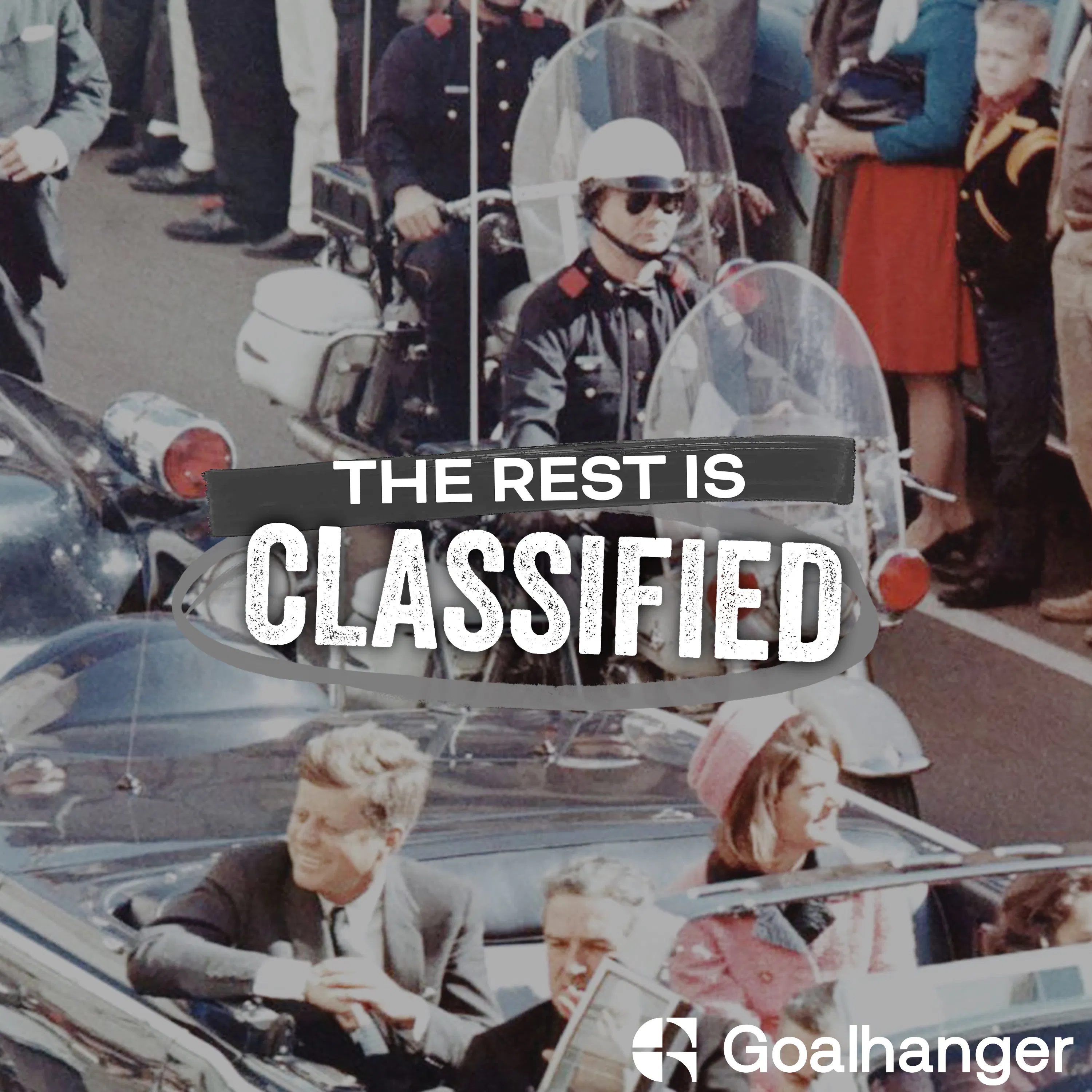
Speaker 1 So at 12:30 p.m., JFK on that bright sunny day is riding in an open-top motorcade accompanied by Jackie, the governor of Texas, and the governor's wife. And they're driving through downtown Dallas.
Speaker 1
He's headed to a luncheon at the Dallas trademark. The motorcade passes through Dealey Plaza.
At that time, it's a grassy square surrounded by fountains and concrete pergolas.
Speaker 1 And there are three shots, although some will say as many as six, but three shots are fired. The first one is a miss.
Speaker 1 The second one, about three and a half seconds later, tears through JFK's upper back between his neck and right shoulder and exits through his neck, hits Governor Connolly.
Speaker 1 The third, five seconds later, is a straight-on shot through the brain. He is rushed to Parkland Hospital and declared dead by 1 p.m.
Speaker 1
Later that day, of course, Lee Harvey Oswald is arrested on suspicion of being the lone gunman who murdered John F. Kennedy.
And Gordon, case closed, right?
Speaker 8 And just three shots, no magic bullet, no grassy knoll.
Speaker 1 Well, that's the thing is, it's part of the resonance of this entire story today
Speaker 1 is coming out of the fact that case is absolutely not closed. In the minds of most Americans, case not closed.
Speaker 8 We'll get into this obviously much more in the mini-series, some of the theories around it.
Speaker 8 I think what's so important is if you see that moment of the assassination in the context of what has come before,
Speaker 8 you can start to see where the theories come from, because you can start to see, you know, the kind of anger from Cuban exiles. You can see the anger from some parts of the CIA.
Speaker 8 You can see see the anger and the relationship between the CIA and the mob. And you start to see this web which can be woven into an idea that it wasn't a low government.
Speaker 8 And of course, Lee Harvey Oswald, as well, is such an extraordinary character.
Speaker 8 I mean, this is someone who has defected to the Soviet Union, who approaches Soviet embassies after re-defecting back to the United States in Mexico City, who's involved in kind of Cuba campaigning in New Orleans.
Speaker 8 So the kind of overlap between the Cold War, between the Soviet Union, but also between the Cuban issue specifically, is all there in the gunman, Lee Harvey Oswald.
Speaker 8 So with this kind of context, it's not hard to understand why there will be so much focus on the question of whether it really was a lone gunman or not.
Speaker 8 And finally, I mean, the big investigation, the Warren Commission, who's going to be appointed to the Warren Commission?
Speaker 1 Oh, I knew you were going to break this.
Speaker 8 Alan Dulles.
Speaker 8 Embrah's favorite shadowy spy master gets appointed to the commission, which kind of very much wants to say it's a lone gunman.
Speaker 8 Now, I'm not saying it's not a lone gunman, you know, we'll come to that later, but there's a kind of pressure to not open up the can of worms about all these other things.
Speaker 8 And there are all these other secrets, you know, about what the CIA has been up to, about Cuba, about the mob, about assassination plots, which will feed into that.
Speaker 8 And it's that secrecy, which is still only now, you know, with more releases in the recent months being unwrapped.
Speaker 1 But I think you can also
Speaker 1 draw a pretty straight line that begins in this period and includes Bay of Pigs,
Speaker 1 the zany
Speaker 1 and oftentimes illegal plotting by the CIA against Castro,
Speaker 1 and the Warren Commission.
Speaker 1 And you look at those three things, and I think the Warren Commission, as we'll talk about in the miniseries, is kind of riddled with politics and problems and conspiracies of its own.
Speaker 1 You can look at those three things and kind of draw a line to say this is a period period where prior to this in the 50s, the 40s, there was a knee-jerk trust of institutions and government by most Americans.
Speaker 1 And after
Speaker 1
you no longer have that. And you just have to look at the way the CIA is viewed today through the lens of a lot of these kind of activities.
or the way the Warren Commission is viewed today.
Speaker 1 I mean, the official record on the assassination is not trusted by the majority of Americans. And at one point in the late 90s, it was not trusted by 80%
Speaker 1 of Americans.
Speaker 1 So this distrust of institutions, this distrust of the political narrative, this distrust of the central intelligence agency, I think we've talked a lot in other episodes of this podcast about the role of the kind of Church Pike proceedings in the 70s as being this turning point.
Speaker 1 But you could make the argument that the seeds of that distrust start in this this period under Kennedy and go back to Cuba.
Speaker 8 I think that is absolutely right.
Speaker 8 I think, you know, there's a sense in which innocence is lost for America, in which a kind of cynicism and conspiracism takes root, because of the kind of psychic shock of having this hugely popular, young, vibrant, virile president murdered in this dramatic way.
Speaker 8 People are going to want to look for answers. And we know, you know, people will often want to look for reasons behind it.
Speaker 8 And then, of course, because of this history with the CIA and because of the fact Leo Harvey Oswald has this kind of curious background, there's going to be layers of secrecy which are placed over the story of the assassination and over Lee Harvey Oswald.
Speaker 8 We had document releases just in the last few months, which may have not told us a different answer as to who killed Kennedy, but which certainly kind of reveal, for instance, you know, what the CIA was up to in Latin America in a different way, or what they knew about Lee Harvey Oswald, what they were doing in Mexico City.
Speaker 8 And of course, all these secrets had been kept because the CIA felt they needed to keep them.
Speaker 8 But because people knew there were secrets there, that's also fueled the kind of conspiracism which has come out of it.
Speaker 8 And so we'll have more time, I guess, to explore who we really think did kill Kennedy. But I think this series does give you a feel of why, at least.
Speaker 8 a theory that it wasn't a lone government has taken root and just the kind of crazy nature of those times, I think.
Speaker 1 And why, and again, we'll discuss this much more in our mini-series for club members, which I would encourage everyone who is listening to this, if they have not already, to go to therestisclassified.com, become a club member, and listen to that mini-series.
Speaker 1
Because in the wake of the assassination, Bobby Kennedy asks McCone if the CIA did it. Bobby Kennedy wonders if it could have been the Cubans.
So again, he's obviously grief-stricken.
Speaker 1 At the time, given this history we just talked about, these are not zany ideas.
Speaker 1 These are hypotheses or suggestions that are held by senior officials in the United States government, right?
Speaker 1 I do think also the connection between Cuba, Bayapigs, Kennedy, the agency, and the deepening involvement of the United States in Vietnam is also an enduring legacy of this time period.
Speaker 1
Where when JFK takes office, there are maybe a few hundred American advisors in Vietnam. And by the time he's shot on November 22nd, 1963, there's over 15,000.
So it obviously becomes LBJ's war.
Speaker 1 But so much of the pivot in many ways to Vietnam and the focus on Vietnam is a legacy, I think, of the very personal failure that JFK felt at the Bay of Pigs and a desire that you wouldn't have governments.
Speaker 1 in other parts of the world lost to communism on his watch.
Speaker 8 I mean, just to wrap it up, I think that is why this is such a consequential story.
Speaker 8 Because, you know, it tells you something about the CIA, tells you something about the CIA and JFK, tells you something about America and the American psyche.
Speaker 8 And it tells you something about international history and Cold War history, whether it's the Cuban Missile Crisis or the buildup in Vietnam.
Speaker 8 So many of those things kind of relate back, almost so many of them, to the kind of Bay of Pigs and to the failure that takes place there.
Speaker 8 I think it's a kind of remarkably pivotal and important and kind of consequential event. So it's been a kind of absolutely fascinating series.
Speaker 8 And I think it has opened up my eyes to just how important that event was and the consequences of it.
Speaker 8 So just a reminder, if you want to hear more, we will be talking about the assassination and how the CIA might have done it.
Speaker 8 But I'll, David's scoffing, laughing and the Cupid
Speaker 8 and the mob.
Speaker 1 We're going to look at all the alternatives that connect into this story.
Speaker 8
With the mooch, amongst others. Yeah.
Yeah. So do join up if you want to hear that.
But otherwise, we'll see you next time.
Speaker 1 Well, see you next time.
Speaker 12 The holidays mean more travel, more shopping, more time online, and more personal info in more places that could expose you more to identity theft.
Speaker 12 But Life Lock monitors millions of data points per second. If your identity is stolen, our U.S.-based restoration specialists will fix it guaranteed or your money back.
Speaker 12
Don't face drained accounts, fraudulent loans, or financial losses alone. Get more holiday fun and less holiday worry with Life Lock.
Save up to forty percent your first year.
Speaker 12 Visit Lifelock.com slash podcast. Terms Apply.