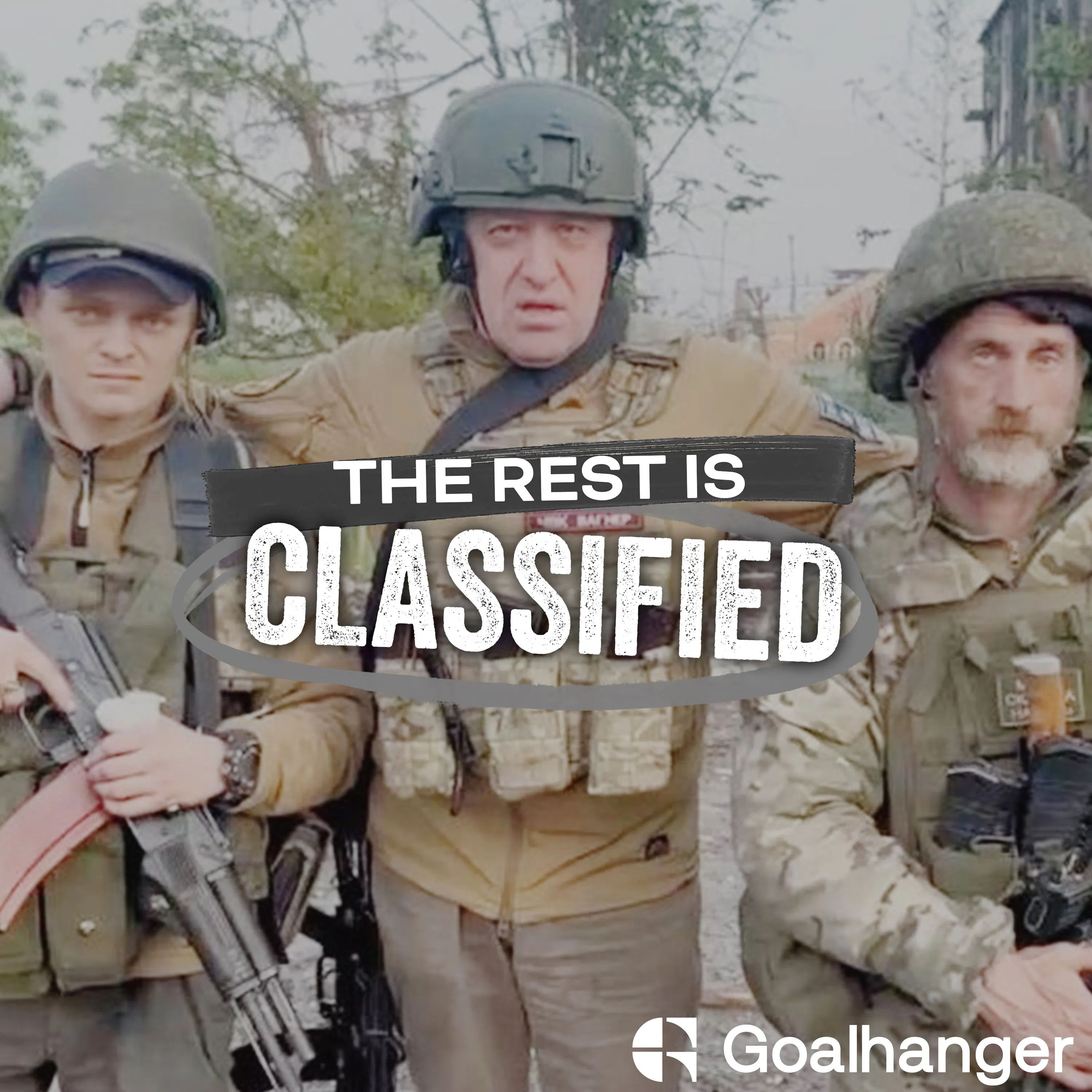
100. Putin's Secret Army: Fighting With Assad In Syria (Ep 3)
Listen as David and Gordon chart the growth of one of the world’s most infamous mercenary groups as Prigozhin embeds himself in the Middle East, helping President Assad of Syria take on the CIA.
-------------------
THE REST IS CLASSIFIED LIVE 2026: Buy your tickets HERE to see David and Gordon live on stage at London’s Southbank Centre on 31 January.
-------------------
Try Attio for free at https://www.attio.com/tric
-------------------
Join The Declassified Club: Start your free trial at therestisclassified.com - go deeper into the world of espionage with exclusive Q&As, interviews with top intelligence insiders, quarterly livestreams, ad-free listening, early access to episodes and live show tickets, and weekly deep dives into original spy stories. Members also get curated reading lists, special book discounts, prize draws, and access to our private chat community.
To sign up to the free newsletter, go to: https://mailchi.mp/goalhanger.com/tric-free-newsletter-sign-up
-------------------
Order a signed edition of Gordon's latest book, The Spy in the Archive, via this link.
Order a signed edition of David's latest book, The Seventh Floor, via this link.
-------------------
Email: therestisclassified@goalhanger.com
Twitter: @triclassified
Social Producer: Emma Jackson
Video Editor: Vasco Andrade
Producer: Becki Hills
Head of History: Dom Johnson
Exec Producer: Tony Pastor
Learn more about your ad choices. Visit podcastchoices.com/adchoices
Press play and read along
Transcript
Speaker 1 For exclusive interviews, bonus episodes, ad-free listening, early access to series, first look at live show tickets, a weekly newsletter, and discounted books, join the Declassified Club at the RestIsClassified.com.
Speaker 2
You're deep into your favorite true crime binge. The twist, the theories, and suddenly, hunger hits.
Grab a Paleo Valley 100% grass-fed beef stick. These aren't your average gas station snacks.
Speaker 2
They're made from real beef sourced from regenerative, small American family farms. No preservatives, no gluten, no grains, soy, or sugar.
Just naturally fermented protein that fuels your obsession.
Speaker 2 Whether you're road tripping, hiking, or pulling an all-nighter with your favorite case. Choose from five bold flavors, original, jalapeno, summer sausage, garlic summer sausage, and teriyaki.
Speaker 2 They're keto, paleo, and carnivore-friendly, made to work with your lifestyle, not against it. With over 55 million sticks sold and a 60-day money-back guarantee, you've got nothing to lose.
Speaker 2 Get 15% on your first order at paleovalley.com. Just use code Paleo at checkout.
Speaker 3
This is an Etsy holiday ad, but you won't hear any sleigh bells or classic carols. Instead, you'll hear something original.
The sound of an Etsy holiday, which sounds like this.
Speaker 3 Now that's special.
Speaker 1 Want to hear it again?
Speaker 3
Get original and affordable gifts from small shops on Etsy. For gifts that say, I get you, shop Etsy.
Tap the banner to shop now.
Speaker 4 If you used Babel, you would. Babel's conversation-based techniques teach you useful words and phrases to get you speaking quickly about the things you actually talk about in the real world.
Speaker 4 With lessons handcrafted by over 200 language experts and voiced by real native speakers, Babel is like having a private tutor in your pocket. Start speaking with Babel today.
Speaker 4
Get up to 55% off your Babel subscription right now at babel.com slash Spotify. Spelled B-A-B-B-E-L.com slash Spotify.
Rules and restrictions may apply.
Speaker 1
Chefs are nutters. They're all self-obsessed, delicate, dainty, insecure little souls, and absolute psychopaths.
Every last one of them. Well, welcome to the Rest is Classified.
I'm David McCloskey.
Speaker 1
I'm Gordon Carrera. And that Gordon is not Yevgeny Pragosha.
Really? Speaking about his chosen profession of chef, that is Gordon Ramsey,
Speaker 1 famed British chef,
Speaker 1 potential psychopath. I think actually self-admitted psychopath, right there in that quote,
Speaker 1 a nutter.
Speaker 1 And as we were talking earlier, I think in a different context,
Speaker 1 Gordon Ramsey himself may have become a mercenary warlord.
Speaker 1 But didn't
Speaker 1 he? Can we just make clear?
Speaker 1 Yes. For legal reasons.
Speaker 6 He was never involved in mercenary activities or large-scale massacres in Africa and around the world.
Speaker 6 But that is the kind of wildness of this story is a guy who starts off as a hot dog salesman, stroke chef, restaurateur, high-end restaurants like Gordon Ramsay, and yet also becomes a mercenary warlord?
Speaker 6 I guess he's leading a coup against the government.
Speaker 1 I mean, I guess the equivalent in this case, because we're going to talk in this episode about this transition that Progozhin makes from when we left him last time, he was not the hot dog salesman anymore.
Speaker 1
He's moved on from that. He's moved on.
He spent
Speaker 1 a lot of the mid 2010s running a large sort of PR and disinformation campaign firm called the Internet Research Agency, which is very useful to the Kremlin during the 2016 U.S. election.
Speaker 1 And we're going to see now how the next chapter of the Afghani Progoshian story becomes mercenary warlord.
Speaker 1 And I guess it's kind of like if at some point, after running one of his wonderful restaurants, I should say wonderful restaurants, Gordon Ramsey, if you're listening, Gordon Ramsey, through contacts that he had at 10 Downing Street, decided that he would outfit a military company
Speaker 1 to help the sort of flailing
Speaker 1 allied effort in Afghanistan. And he was going to go and round up a bunch of very
Speaker 1 undesirable characters from his kitchens. Which still can be plausible.
Speaker 1 And give them an offer that they can't and absolutely won't refuse to fight and die in Afghanistan.
Speaker 6 Which sounds like a bad action movie, which will come to bad action movies later because they are also going to play part of this story. That's right.
Speaker 6 So, how does it happen that Evgeny Prudyozhin goes from this businessman to warlord?
Speaker 6 Spring of 2014, he's introduced to another key character, a 44-year-old called Dmitry Utkin. Now, Utkin is a former lieutenant colonel in the Russian Special Forces.
Speaker 6 What kind of person was Dmitry Utkin? I've got a picture of him, which I think tells you quite a lot. Shaved head, mean eyes,
Speaker 6 mean eyes. He has SS tattoos on his shoulders and neck, supposedly a Nazi eagle on his chest, and he's into weird paganism, Slavic rituals, racial purity with fascist tendencies.
Speaker 6 What kind of person do we think he is? I mean, I don't know.
Speaker 1 Sounds like the person that maybe Gordon Ramsey would have had a hard time finding in his kitchen. Yes.
Speaker 1 But Pragozhin
Speaker 1
has somehow contacted him. This seems like a guy who, number one, this seems like a guy that Progozian probably gets along with fairly well.
I mean, yeah, the hard people. He was in a people colony
Speaker 1 in Soviet Russia.
Speaker 6 So this, this guy. He can relate to the people who are in the city of the people.
Speaker 1 He knows people.
Speaker 1 He knows this guy.
Speaker 6
So, yeah, so Udkin has fought in the Chechen wars. His career stalled in the military.
And it's interesting, partly because he preferred fighting. to sitting in headquarters.
Speaker 6 His wife would say he was never happy unless he was fighting. I mean, you know,
Speaker 6
and in Russia, if you hit 40 in the military, no sign of advancement, you're out. So he'd left because he kind of wants to fight rather than go up the ranks.
So he joins a mercenary group.
Speaker 6 Initially, this is doing stuff like anti-piracy. He then part of another group called.
Speaker 1 This isn't a normal thing to do when you leave the Russian military at this point, is it?
Speaker 6 It's not impossible that some of them will join some of these mercenary groups.
Speaker 6 You're seeing some of them emerge, even though technically, and we'll come back to this, mercenary groups are technically illegal in Russia, but there are security berms and big companies have security arms, some of which look a little bit like mercenary groups and militias.
Speaker 6 But at this point, they're kind of taking on a slightly different role. There's one called the Slavonic Corps, and they get sent to Syria.
Speaker 6 And Utkin was going to go with them in 2013, supposedly to protect pipelines, because this is often how it's kind of phrased. Russia, big international resources extraction.
Speaker 6
It's got these big companies like Gazprom, the gas company. You know, they often hire mercenary groups to protect some of their facilities abroad.
Utkin's going to be part of them.
Speaker 6
Ends up fighting ISIS with kind of crap weapons. They're going to withdraw in failure.
He's looking for what to do next. He gets introduced to Progozhin.
And I think it's a fortuitous meeting.
Speaker 6 It's a kind of romance. You know, no, it's not a romance.
Speaker 6 Romance.
Speaker 6 Budkin has got a reputation for violence. He would sometimes greet Progozhin with Hail Petrovich, using his boss's code name, and supposedly sign some documents with SS symbols.
Speaker 6 So again, I think you're getting a slight picture. And the key thing about him, and this is a...
Speaker 1 I didn't think Russians were super hot on Nazis, Gordon.
Speaker 1 What with the
Speaker 1 invasion
Speaker 1 in 1941?
Speaker 6 And I asked someone about this, and they said, like, it is weird, but there's a kind of bit of hard Slavonic nationalism that emerges with fascism.
Speaker 6 So they wouldn't think of themselves as German Nazis, but maybe admiring Nazism and wanting a kind of Slavic version of that, I think is the best way to understand it. But here's the crucial thing.
Speaker 6 Again, back to his kind of Hitler obsession, though, because I think he really does have a Hitler obsession. He had become
Speaker 6
Utkin does. He'd become obsessed with Wagner, the composer who was Hitler's favorite.
And so his call sign as a mercenary is Wagner. So he is Wagner.
Speaker 1 Not Progosian.
Speaker 6
Nogoshian. And the Wagner group will be...
you know, effectively named after Utkin, his group. This is Progosian, the kind of deal maker, isn't it?
Speaker 6 You know, we saw last time how he's understood that the Kremlin needed help with social media and with trolling, and he was going to offer a service there.
Speaker 6 And he's going to understand now that the Kremlin needs a little bit of help with men of violence and mercenary work. And with Utkin and with his people, there's an opportunity there.
Speaker 6
So I think it's again that moment of possibility that, you know, mercenaries might be in. Now, I think the value of mercenaries, as we'll see, is they're kind of useful for a state.
They're deniable.
Speaker 6
They've got lots of benefits. I mean, they've had that through history, haven't they? In a way, it's a business opportunity.
Yeah.
Speaker 1
I will say there's a wonderful book on Wagner and kind of the return of private warfare by John Lechner. It's called Death is Our Business.
And I highly recommend it.
Speaker 1 I think it's a great read on kind of Wagner in particular, but this dynamic in general. And, you know, one of the points that...
Speaker 1 Lechner makes in the book, which I think is spot on, for those of us who have grown up in a world of the military is a public good,
Speaker 1 and military is sort of financed and resourced by the state, and it's official.
Speaker 1 That's not usually been the case in history, actually. And we're sort of going back to this world of, you know, maybe 400 years ago where private military companies are a real thing.
Speaker 1
I mean, I guess you think of in the states, Blackwater. You can call it a contractor, but it's really a private military company.
I think here in the UK, executive outcomes. Yeah.
Speaker 1 Those are the kind of of outcomes I want for the executive kind. So Wagner is
Speaker 6 a longer tradition, isn't there?
Speaker 6 If you go back to the kind of the Italian city-states, you know, and the Thirty Years' War, you'd have mercenary groups fighting in Europe hired by a state to do their business.
Speaker 6 So yeah, I think Wagner is in a tradition of mercenaries, which is quite age-old. But I guess each age has its own mercenaries, doesn't it? You know, depend and each country has its own mercenaries.
Speaker 6 And I guess Wagner are in the image of the kind of Putin's Russia and in Progozhin's image, I guess, is more to the point, kind of greedy, brutal, nationalistic, and actually quite closely tied to the state, closely aligned to the Kremlin and its priority.
Speaker 6 And that's what's different.
Speaker 1 Aaron Powell, Jr.: And I guess the value, the immediate value that they'll provide will be in Ukraine, where this mixture of deniability will be relatively cheap when compared to using state resources or sort of the official military.
Speaker 1 You can see how Progozhin brings this entrepreneurial streak to violence in what is turning out to be this kind of hybrid gray zone conflict in Ukraine in 2014. Yeah, exactly.
Speaker 6 Because I think the context here is important. We're talking about that meeting between Utkin and Progozhin in 2014.
Speaker 6 This has happened just as a pro-Kremlin government has been removed from power in Ukraine, much to the Kremlin's anger and disappointment following popular protests.
Speaker 6 The issue being how close should Ukraine be to Europe versus Russia? It's moving more towards the European side rather than the Moscow. Kremlin is angry, determined for that not to happen.
Speaker 6 Famously, Russia kind of seizes Crimea using undercover special forces who just pop up in Crimea. These are the famous people called Little Green Men.
Speaker 6 They've got no visible affiliation to Russia and they say they're a local self-defense force, but basically they're Russians.
Speaker 6 And before anyone knows it, before the West can react, Moscow seized Crimea
Speaker 6 and is going to annex it.
Speaker 6 But then in the east of Ukraine, there's also violence in the Donbass region, Donetsk and Luhansk, the source of fighting now, but back then also, an area where there are significant numbers who are pro-Russian, against the kind of tilt towards Europe in Kiev in the capital.
Speaker 6
And so you get separatist forces there who are going to start to fight the new government in Ukraine. You get militias to protect people.
It's a kind of conflict heavy with Russian nationalism.
Speaker 6 And it's going to draw in Russian nationalists and imperialists from Russia to come and fight in Ukraine.
Speaker 6 You know, they want that bit of adventure, but they're struggling against the Ukrainian military. And so mercenaries are the obvious answer, aren't they, for Russia?
Speaker 6 If you want to help these groups fight, but you don't want to invade at that point, it's 2014, not 2022. You don't want to have your own military go into a war.
Speaker 6 You don't want the West to then, you know, kind of turn against you at this point. They don't want to do that.
Speaker 6 They don't want to also lose lots of their own troops if, you know, and have the body bags come home. There's a need there.
Speaker 1
There's a need. There's a business need.
There's a business need. Yeah.
And for folks who have just heard of Wagner and maybe heard of Progozhin to think he's kind of the commander on the ground.
Speaker 1 He's not really.
Speaker 1
He's the guy who can link supply and demand here. Yeah.
Right.
Speaker 1
He's that kind of commercial guy, right? He knows what the Kremlin wants. He's got the connection to Dmitry Utkin.
And Udkin knows Ukraine well, right? Because he's been brought up there. Yeah.
Speaker 1
So there's kind of this natural fit. And Progozhin can source violence.
Yeah. Exactly.
And violent capacity for Putin.
Speaker 6 Yeah. So it is a little bit unclear how far Progozhin is talked into kind of backing Utkin and Mercederies and how far he's just sensed an opportunity to make money or to be useful to the Kremlin.
Speaker 6 But I think that, you know, being useful to the Kremlin, you know, as we've seen from his restauranting days all the way through, you know, that's one of the kind of threads because he knows that moves him upwards, closer, I guess, to the inner circle, closer to more wealth, closer to more power, closer to more status.
Speaker 6 The other thing is he's already in the world of military contracts because he's doing the catering contract.
Speaker 1 That's right.
Speaker 6 So you've already, you already know.
Speaker 1 He knows how to navigate the bureaucracy. He knows
Speaker 6 how to do a proposal and a contract.
Speaker 1 Right, which anyone who's ever tried to get a contract from probably any Ministry of Defense or Pentagon would know there's a particular set of skills that you need to get these contracts.
Speaker 1
It's not, there's the barrier to entry, right? There's a real barrier to entry. And he already knows how to do this.
Yeah, he's a contract actor.
Speaker 1 We laughed, by the way, at that, you know, sort of the food contracts, but it was a 500 million pound contract. It's a massive contract
Speaker 6 that he's gotten. And also, it does mean as well that his kind of catering business has logistical and supply lines because he's got to get the food out to all parts of Russia and all kinds of places.
Speaker 6 So he's also got a kind of logistical network, which also is useful if you're going to smuggle mercenaries, gangs, weapons to mercenaries around. So in a weird way, you start to see
Speaker 1 how he moves into that space.
Speaker 6 So he's going to meet with Utkin. Utkin is, as I said, Wagner.
Speaker 6 The group also sometimes called the orchestra, which I love, you know, and the fighters, musicians, and the battles they engage in are called concerts.
Speaker 6 I mean, this weird jargon, but it's only 200 people or so at the start. when it's in Ukraine.
Speaker 6 And they're going to turn up in Luhansk in the Donbass, where local forces are on the back foot to fight against the Ukrainians. They'll open up supply corridors into Russia.
Speaker 6
Crucially, they down a military transport in June 2014, which kills 49 Ukrainian servicemen. So a big deal.
The mythology starts to build.
Speaker 6 Utkin, you know, will claim he was injured in the fight for Luhansk airport, where his 40 men take on 400 Ukrainians, taking them by surprise.
Speaker 6 Ukrainians actually say it was more like 150 of their men. But you can see the beginnings here of this mercenary work.
Speaker 6 Next, I think, interesting fact, though, is that the money for this, a lot of it is coming from the Kremlin, and partly because it's easier to be deniable if it's from the Kremlin.
Speaker 6 And there's already you start to get the first signs of bits of tension with the Ministry of Defense in Moscow, which is run by one of Putin's old St. Petersburg pals, Sergei Shoigu.
Speaker 6
He's defence minister from 2012. He's kind of pragmatic and low-key, but he's a kind of Putin pal.
And already you get the kind of military in Moscow, I think, already starting.
Speaker 6
These guys are not under our control. There's a tension there.
There's going to be some big developments.
Speaker 6 2014, MH17 disaster when a Malaysian airlines passenger jet is shot down by Russian-backed rebels in Ukraine. A disaster for
Speaker 6 the people involved, most of all. And it's going to get investigated, interestingly, by a new group called Bellingcat, the open source investigation.
Speaker 1
Which that point is basically unknown. Yeah, right.
Unknown.
Speaker 6 Eliot Higgins in his bedroom investigated this. And they're going to start doing open source investigations.
Speaker 6 This is where you also see the kind of merging of Progoshin's different things, because then Progoshian's media trolls will unleash on Bellingcat, but also try and muddy the waters about who was behind MH17.
Speaker 6
So then you see the launch of kind of trolls to say, oh, no, it was someone else who did it. No, it was the Ukrainians who did it.
You know, trying to muddy the waters about the events.
Speaker 6 So again, you see the kind of value to the Moscow and to the Kremlin of Progozhin's media machine and it's kind of merging with security work and what's going on in Ukraine.
Speaker 6 So the mercenaries are on the ground in Ukraine and Putin is kind of engaging them more and more. They come under the deputy head of the GRU, a general Vladimir Alexeyev.
Speaker 6
He's in charge of the kind of dirty work for the GRU, Russian military intelligence. Sabotage, intimidation, assassination.
He's going to oversee some of the Wagner connections.
Speaker 6 They've got a training base at Morkino next to a special forces base, which tells you how close they are.
Speaker 6 And also, Wagner also at this time, it looks like, as well as doing some fighting, they do a lot of dirty work for the Kremlin.
Speaker 1 I'm shocked. You sure it is?
Speaker 6 These bunch of fellow separatist leaders, so pro-technically pro-Moscow leaders, get assassinated.
Speaker 6 It's always claimed it's the Ukrainians, but it looks like it's Wagner.
Speaker 6 And it looks like what Moscow is doing is basically getting rid of anyone who they can't control, you know, and who won't agree with their strategy for what's to happen.
Speaker 6
And Wagner and, you know, Utkin's team are doing this. And they get known as the cleaners for that work.
So you can see that they're already more than just fighters and mercenaries.
Speaker 6 They're kind of involved in the darker side of things. And they're growing by 2014 to about 500 and then maybe 1,000.
Speaker 6 But then you get the Minsk agreements, which are going to kind of freeze the conflict, stop it being quite so full-on and more of a kind of low-level conflict for the following years, which I guess in a way means it's over for Wagner.
Speaker 6 Their need seems to have passed at that moment.
Speaker 1 Well, Gordon, though, an enterprising and psychopathic chef, of course, is going to find new markets, isn't he?
Speaker 1
And I mean, maybe there with the Russians beginning to turn their attention elsewhere to new hotspots around the world. Let's take a break.
When we come back, we'll see how Wagner goes global.
Speaker 1 This episode is brought to you by Attio, the CRM for the AI era.
Speaker 6 Now, David, people think that spycraft is just car chases and secret codes, but an awful lot of it is just idling around, waiting for the action.
Speaker 1 It's a bit like starting your own business.
Speaker 1 You think it's going to be as easy as creating and selling a product, but the reality is business owners spend far too long trying to get their CRM to fit a system not built for them.
Speaker 6 Attio's AI-driven CRM enables you to take control of your platform, to build something from the ground up that fits your needs.
Speaker 1 James Bond had Q's X-ray shades, an explosive watch, and a pen grenade. Business owners have Attio's real-time customer insights and platform that grows with them.
Speaker 1 All tools relevant for your mission to build a company from the ground up.
Speaker 6 Attio even has something called agent collaboration.
Speaker 1 Yes, but in this case, that means giving people the ability to let AI work seamlessly in the background for them.
Speaker 6 Try Attio for free at attio.com slash trick.
Speaker 7 You can't count on much these days.
Speaker 8 No way, Jim! This is incredible!
Speaker 7 But you can always count on Sundays with the NFL on CVS and Paramount Plus.
Speaker 8 Here we go, this time for real!
Speaker 7 Watch your local NFL game live every Sunday, all the way through the AFC Championship game.
Speaker 1 And he's in for a touchdown!
Speaker 7 Visit paramountplus.com slash NFL to get started today and count on Sundays with the NFL on CBS and Paramount Plus.
Speaker 9 What's going on? I'm Arch Manning, Veori athlete and college quarterback. Whether I'm running, training, traveling, or just unlining at home, I love doing it in my core shorts from Veori.
Speaker 9 With a breathable boxer briefliner, they're quick to dry, dry, super versatile, and stand up to even my most intense training sessions. Plus, they come in three inseams and a ton of colors.
Speaker 9
Ready to try a pair? Go to Viori.com slash Arch and get 20% off at checkout. I think you're going to love them as much as I do.
That's vuri.com slash A-R-C-H and get 20% off your first order.
Speaker 9
Exclusions apply. Visit the website for full terms and conditions.
Not only will you receive 20% off your first purchase, but enjoy free shipping on any U.S. orders over $75 and free returns.
Speaker 1 Have a great day.
Speaker 8
Tires matter. They're the only part of your vehicle that touches the road.
Tread confidently with new tires from Tire Rack.
Speaker 8 Whether you're looking for expert recommendations or know exactly what you want, Tire Rack makes it easy.
Speaker 8 Fast, free shipping, free road hazard protection, convenient installation options, and the best selection of Bridgestone tires.
Speaker 8
Go to tire rack.com to see their Bridgestone test results, tire ratings, and reviews. And be sure to check out all the special offers.
TireRack.com, the way tire buying should be.
Speaker 1 Welcome back. It's September of 2015
Speaker 1
and a new, I think we could say a new business opportunity is beginning to emerge for Yevgeny Progozhin and the Wagner Group. And it's not in Ukraine.
No. It's in Syria.
Speaker 6 Yeah, most restaurateurs would be like, where can I open my new restaurant?
Speaker 6 We're here with our Gordon Ramsey of
Speaker 6 the Russian warlord warlord going, new market. You know, Syria looks good
Speaker 1 for an opening.
Speaker 1 I also like how essentially a map of the other parts of the world where Wagner will expand is essentially inversely related to how well off that part of the world happens to be doing at any point in time.
Speaker 6 Yeah, because normally if you're a restaurateur, you'd be like, where's a nice place where lots of rich people are going to pay lots of money for my fancy food?
Speaker 6 Here he's thinking, where is there death and destruction, chaos, disorder, and a desire for mercenaries? So it's slightly opposite.
Speaker 1 And we should, I will say, and this will probably be the only time in the series that I defend Yevgeny Progozhin.
Speaker 1
But you put on your mercenary hat. Yeah.
Yeah. The whole, the whole value he's providing is,
Speaker 1
you know, essentially as an antidote to that. He's going to provide the security quarter.
That's so horribly lacking.
Speaker 6 Yeah, that in some of these countries.
Speaker 1
Eastern Syria. They bring order, central instability.
Yeah, order, peace, and stability.
Speaker 6 Because here, we've talked about, he's worked in Ukraine, but there's been a peace deal. But now,
Speaker 6 Syria, country you know well,
Speaker 6
the civil war, I guess, has been raging. President Assad is struggling in Syria against the opposition forces, rebels and ISIS.
At this point, September 2015, it's reached a critical juncture.
Speaker 6 And of course, Russia
Speaker 6 has a lot of interest, doesn't it, in Syria?
Speaker 1 I guess at the face of it, you think, well, why in the world would that be so? I mean, Syria at that point has got maybe 20 million people.
Speaker 1
From an oil and gas standpoint, it really has no impact on the international market. Although we'll see there are resources there.
No nuclear weapons. It's just why? And I think a couple of reasons.
Speaker 1 I mean, one is that the timing matters. We're at a period in 2015 where much of the Arab world is in sort of turmoil.
Speaker 1 I mean, you have real sort of protest movements, insurgencies, civil wars that have grown out of the Arab awakening in 2010 and 2011.
Speaker 1 I think from the mindset of Vladimir Putin and the Russian sort of leadership, there's a sense that the U.S.,
Speaker 1 and in particular in places like Libya, the U.S. has sort of attempted to intervene or intervened to suit its own geopolitical ends.
Speaker 1 And so I think there's a sense here that the Russian state to project power and influence
Speaker 1 to the region, to be a global power, needs to intervene to prop up its own sort of friends and allies in the region in the same way way that the U.S. has done.
Speaker 1 I mean, more tactically, I guess, the Russians have a naval base at Tartus on the Mediterranean coast of Syria. They've had that since they've had that concession, I think, since the 67 war.
Speaker 1 There's an opportunity in a Putin's mind to sort of extend Russian influence in the Mediterranean. And as we'll see over the course of the Civil War, that naval base is hugely expanded and modernized.
Speaker 1 There's an airfield at Khameim in the northwest of Syria that gets built, Russian airfield.
Speaker 1 So there's a lot of Russian linkages, not to mention, of course, that the Russians have been a massive arms supplier to the Assad regime going back into the days of the Cold War.
Speaker 1 So there's a lot of connection there. And at this point in 2015,
Speaker 1 we would have thought that Assad had probably lost control of maybe three quarters of the country.
Speaker 1 And I think there was a feeling in Moscow that in the fall of 15, Assad's days are maybe numbered.
Speaker 1 And so Putin, there's a whole bunch of kind of reasons that coincide to get the Russians involved.
Speaker 6 Yeah. And of course, Moscow wants to support Assad, but a bit like Western governments, it doesn't want to do the full-scale intervention.
Speaker 6 It doesn't want to put, you know, boots on the ground, does it?
Speaker 6 So I guess what it's going to do is use air power to bomb the rebels and then give some support on the ground through mercenaries, you know, through Wagner and others.
Speaker 1 Now, there eventually will be a Russian military intervention that's that's pretty extensive, but why use Russian, you know, special forces, troops, soldiers, you know, when you can use mercenaries?
Speaker 1 Yeah.
Speaker 6 By 2016, you're going to have about 2,500 Wagner mercenaries stationed in Syria. Interesting enough, directed to some extent by the GRU, by Russian military intelligence.
Speaker 6 You can see that they're kind of, you know, they're not out there on their own and they get loads of equipment from the Russian military. I think this is really interesting.
Speaker 6 You've got T-90 tanks, helicopters, anti-aircraft batteries, howitzers, artillery, you know, all from the Russian military, which is going to kind of help them.
Speaker 6
And technically, it's training and equipment. It's going to get flown on military transport.
Interestingly enough, the salary for a mercenary then is about $4,000 to $5,000 a month. Pretty good.
Speaker 6
It's not bad. It's not bad.
Nearly four times what a normal Russian soldier earns.
Speaker 6 So Wagner's now got some kind of tends to be experienced commanders, you know, Utkins and his people who are kind of running the show.
Speaker 6 And then you get all of these recruits who are coming in in to kind of be the guys on the ground doing it basically for the money, you know, often only for six months or so.
Speaker 6 Sometimes they're people who are ex-soldiers themselves. But you read about them and, you know, they're sometimes like taxi drivers, you know, or mechanics who are just like, it's good money.
Speaker 6 It's good money. I'll do this for six months, big payday, then go back home.
Speaker 1 It's hard to go back a little bit in the chronology, but I think it's an important point because it speaks to the nature of progosion.
Speaker 1 We're talking about the sort of official wrapping of this intervention. And it is true that Wagner has connections, deep connections, and in some cases, I think is being subordinated to the GRU
Speaker 1 and Russian intelligence and the military.
Speaker 1 But Progojin, the entrepreneur, as soon as he sees sort of, you know, the Russian state tilting towards Syria, you know, he starts interacting with Syrians, senior Syrians in the government.
Speaker 1 There's
Speaker 1
a couple of Alois close to Syrian President Pashar al-Assad, known as the Jabber brothers. And Progozhin cuts a deal with them initially.
And these guys ran these kind of pro-regime militias in Syria.
Speaker 1 So you can kind of see how Progojin
Speaker 1 gets himself almost ingratiated or woven into these situations to create facts on the ground. that then the Russian state has to kind of respond
Speaker 1 to making himself useful.
Speaker 6 Yeah, Wagner is going to kind of train alongside and work alongside some of these Syrian soldiers. But there's going to be tension, I think, with the Syrian military.
Speaker 6 As you'd expect, both sides, you know, think the other's a bit inept.
Speaker 6 There's all these reports that at times Wagner try and get Syrian troops to join a battle by shooting at their feet, to try and get them moving.
Speaker 6 And at other times, the Syrians shoot at the backsides of the Wagner men. But I think one of the other things that comes to that is the reputation for brutality really starts to emerge here in Syria.
Speaker 6 And there's one particular set of videos which come out in June 2017,
Speaker 6 which I think we should say: if you're listening to this with your kids, shame on you, shame on you.
Speaker 1 You've opened up a six-part podcast series on a mercenary warlord with your young children. Yeah.
Speaker 1 But if you have, if you've made this life decision, you may want to skip just the next couple of minutes. Yeah.
Speaker 6
Because there's these videos, June 2017, which emerge. There's some of a man being beaten with a sledgehammer.
Also, of a body being set alight. There's a beheading.
Speaker 6 There are people kicking the guy's head around who's been beheaded. And these videos start to circulate amongst Russian military veterans.
Speaker 6 And you can hear someone, it's clearly in the desert, so it looks like Syria, someone speaking Russian in the video. And it gets geolocated to a gas facility in Syria.
Speaker 6 And this is a kind of big moment, actually, in Wagner, in its story, because it's going to cement this idea that Wagner are a kind of nasty bunch capable of brutality, but also create a kind of cult around them amongst people who kind of like that in Russia, I think, which is a bit wild.
Speaker 1 I like to
Speaker 1 now, I think you could picture as kind of your mental model for this if Gordon Ramsey was running Gastown in the Mad Max movies, you know, out in the desert.
Speaker 1 He's kind of, you know, he's wearing like a medieval dungeon master outfit. There's sort of an apocalyptic, you know, there's gas flares going off,
Speaker 1 guys driving around in gigantic trucks, you know, with skulls mounted on the front.
Speaker 1 This is what's going on in Eastern Syriac. You're right, it is Mab.
Speaker 1 Yeah.
Speaker 6 So the man who's kind of getting sledgehammered, it was supposedly a deserter from the Syrian army who'd been captured by Wagner.
Speaker 6 There's an investigation by Wagner's internal security, not into killing the man, but how the film got out of killing the man.
Speaker 1 I love that.
Speaker 6 You know, and it turned out had been shared and it kind of creates this weird dark fan culture online as it goes viral, part of the kind of brand.
Speaker 6 And Progoshin will say, and there's no such thing as bad publicity, but it's going to help recruitment.
Speaker 6 That's what's kind of crazy amongst, particularly amongst military veterans, nationalists and others.
Speaker 1 Who would like to be swinging a sledgehammer? Who would like to be swinging a sledgehammer? Yeah.
Speaker 6 Because the sledgehammer is going to become associated as the kind of unofficial logo brand thing of the Wagner group.
Speaker 6 So that's the kind of brutality also
Speaker 6 important for later in the story that Progoshin will get to know the new Russian military commander on the ground, a brutal general called General Surovikin, who was known as General Armageddon because of his preference.
Speaker 6
His preference for flattening cities from the air. And the two will become allies.
And the general, interestingly enough, becomes an honorary member of Wagner.
Speaker 6 Wagner plays a role in the Palmyra operations 2016 and the Syrian forces.
Speaker 1
This is a fight against the Islamic State. Yeah, I think it's a very good thing.
In this central, there's a city in central Syria, Palmyra, ancient set of ruins, actually. Lovely, beautiful place.
Speaker 1 I visited. It had been a kind of hotbed of Islamic state activity during the civil war.
Speaker 6 When Wagner wins some battles there, who gets the credit? Defense Minister Sergei Shoyu tells Putin, we took Palmyra, and then Progoshin says, no, no, no, we did.
Speaker 6 And Shoyu reportedly stated that the Gopniks cannot go down in history. Now, Gopnik is like a low-level crypto, it's a thug.
Speaker 1 Thug.
Speaker 6
Thug. Or also have the kind of connotation of being trashy, working class.
It says something already about the way in which Wagner is seen as these kind of rough guys. The military are like,
Speaker 6
can't let them have credit. You see this also, this kind of view of some of the elite, which is Progoshian's getting a bit a little bit above his station.
He's a bit of a thug.
Speaker 6 The other thing, which is going to be important for Progoshin, though, I think, is that he starts to see, doesn't he, that
Speaker 6
how do you make money? And one of the answers is in Palmyra, there's, I think, there's some oil and gas. Yeah.
And he's going to work out.
Speaker 1
Gas town. It's a gas town.
Yeah. Yeah.
Speaker 6 There's a way of funding this through the resources which are on the ground.
Speaker 1 Which would suggest to me that these contracts that he's on are lucrative, but not
Speaker 1
staggeringly so. From the military, yeah, from the Kremlin, yeah.
Yeah, exactly.
Speaker 1 And it makes a ton of sense that if you're going to provide security to a regime, a great way to ensure that you're paid well is to get access to some amount of the cash flow that comes out of an asset, right?
Speaker 1
And it could be a mine, could be a gas plant, right? It's a change to his business model here. It's a next evolution.
That's right.
Speaker 6 Which is, you know, you can sign a contract with the Syrian government saying, if we bring a gas facility back under Syrian control, we get a quarter of the profits.
Speaker 6 And it's kind of good business for both sides, isn't it? Because you create an incentive for yourself to get it back. And for the Syrians, yeah, we have to give up a quarter of the profits.
Speaker 6 But if these guys can take back some of these facilities from ISIS, then it kind of, you know, you get 75% of something we had nothing of before.
Speaker 1 Yeah.
Speaker 6 I think what's interesting as well is you start to get the ambiguity of, is he doing this for the Russian state? Is he doing it for himself?
Speaker 6 It feels like much more for himself.
Speaker 6 You know, the overall policy of help the Syrians is for the Russian state, but the, I'm going to do a deal to get this gas facility is about enriching himself and Wagner, basically, and funding their activities.
Speaker 1 Here you could say, yeah, he might not be doing this at the exact direction of the Russian state, but he's operating with overall sort of protection and cover from the big boss.
Speaker 1 And so he knows there's a set of rules and there's sort of some guardrails to his behavior.
Speaker 1 And I'm sure, how much he can take and how much needs to be kicked up the chain money-wise to the powers that be. So I think he knows the rules.
Speaker 1 He's doing this because, you know, Putin and the people above him in the Kremlin,
Speaker 1 they want this to happen. Yeah.
Speaker 6 That also explains this one absolutely fascinating story, which we'll just look into. So this incident happens in February 2018 in Deirazor, am I? Deirzur.
Speaker 1
Yeah, largest city in eastern Syria. At this point, it's a really complicated place because we have a small contingent, as we'll see, of U.S.
troops on the ground.
Speaker 1 We have the U.S.-backed sort of Kurdish forces that are there.
Speaker 1 We have, of course, the Russians operating in Syria. And
Speaker 1
the Russians have been really on the ground in force in Syria since 2015. So three years at this point, the U.S.
and the Russians are trying desperately to avoid accidents, killing each other.
Speaker 1 There's a deconfliction mechanism that's been set up to make sure that we don't get into a shooting war with the Russians.
Speaker 1 And now we've got Wagner out there.
Speaker 6 Yeah, and Wagner forces at this point in February 2018 are going to, along with Syrians, and it's a bit unclear which Syrians, you know, militia or government and even how many Syrians there are, but Wagner forces are heading for a particular gas facility, the Conoco gas facility.
Speaker 1 Gas town. Gas town.
Speaker 1 Yeah, yeah.
Speaker 6 Which had, you know, traded hands a number of times in the Civil War. It's a kind of pretty valuable gas facility in the country, potentially offering hundreds of millions of dollars a year revenue.
Speaker 6 But it is right over that deconfliction line, you know, with the other forces, just on the other side of it.
Speaker 6 And right next to the Conoco gas facility is a small observation post containing about 30 U.S. Special Forces, you know, know, Delta Force rangers and some Kurdish allies.
Speaker 6 Now, they watch a kind of buildup of these Wagner forces, you know, maybe with some Syrian forces near their base over a period of days. And then they see them getting closer and closer.
Speaker 6
They cross the Euphrates River. They cross what would normally be the line of separation.
The Americans have a support base about 20 miles away.
Speaker 6 which is looking at drone feeds and they can see what looks like a force assembling to take the plant.
Speaker 6 plant so at about 3 p.m one afternoon they see the forces include which is about 500 troops nearly 30 vehicles edging towards the plant and of course at the plant is this outpost you know of special force u.s special forces and kurtz by early evening they're getting very close to the base and this gets escalated upwards as you'd expect to the kind of us air operations base in Qatar base in Kuwait and to the Pentagon so it's going all the way up aircraft are placed on alert everyone's watching drone feeds um You know, at 8.30 p.m., three Russian T-72 tanks are moving within a mile of the plant.
Speaker 6 The mission support base, 20 miles away, the Green Berets and Marines are thinking we might have to go and fight.
Speaker 6 And as you said, this contact, isn't there, for Russian and US forces to communicate and deconflict. So as you'd expect, the Americans are on the phone, you know, and kind of...
Speaker 6 Every day they're talking to each other. And the Americans ask the Russians, are the troops approaching the base yours? And the Russian high command says, no, they're not ours.
Speaker 6 Now, that's what is later testified, you know, by the Secretary of Defense to a Senate committee.
Speaker 6 And yet, the people on the ground are listening to radio transmissions with the people speaking Russian.
Speaker 1 You can see how it would not be immediately believable that you don't know who they are. And yet,
Speaker 1
go to the Russian side of this. It's easy to see why the Russian military may have thought, that'd be kind of great, the U.S.
killed these guys. Yeah.
Speaker 1 Because there's no love lost between the military and Wagner.
Speaker 6 So in the outpost, you know, by the gas facility, they see the tanks. These T-72 tanks turn out of a kind of neighborhood, and then they start to fire.
Speaker 6
And they're firing tank artillery mortar rounds at the base. The Americans dive into foxholes.
For another 15 minutes, they're trying to call the Russians and tell them to stop.
Speaker 6
You know, nothing back. The U.S.
fire warning shots still advancing.
Speaker 6 Now, having been told the Russians denied all knowledge, the Secretary of Defense directs, you know, the chairman of the Joint Chiefs for the force to be annihilated, the attacking force. So the U.S.
Speaker 6 launches this staggeringly, overwhelmingly ferocious attack on the forces attacking the outpost.
Speaker 1 I love the just alphabets
Speaker 1 of weapons platforms that were brought to bear.
Speaker 1 F-15 fighters, MQ-9 Reaper drones, fire-kell hellfire missiles, AC-130 attack aircraft. AC-130, that's a weapon system that's a friend of the pot.
Speaker 1 If you remember back to our early Afghanistan episodes,
Speaker 1 they were called up to absolutely wreck
Speaker 1
al-Qaeda prisoners during that prison rebellion. AH-64 Apache attack helicopters, B-52 strategic bombers.
Strategic bombers? It's just
Speaker 1
everybody's in the game. I wonder what the U.S.
taxpayer paid for this.
Speaker 1 It's pretty big.
Speaker 1 It's overkill.
Speaker 6 I mean, it's literally overkill. And then you also have the kind of special forces team from the kind of support base kind of arrives and they get there about 11.30.
Speaker 1 It's dark.
Speaker 6 They've driven 20 miles using thermal imaging cameras. And they actually have to stop because there's just so much kind of fire going into this.
Speaker 6 And eventually they engage the fighters as well with machine guns from the roof of their vehicles. So now there's about 40 Americans on site.
Speaker 6 The Russians don't seem to have night vision, which I think is also a disadvantage.
Speaker 6 And so there's just this massive wave of air power, which goes on for you know about an hour, and it's kind of total annihilation.
Speaker 1 You have Gennie Progoshan, like that Homer Simpson meme where he's just slowly backing into the hedge
Speaker 1 after this happens.
Speaker 6 That didn't go very well.
Speaker 6
Retreat, I think, is the cool thing. So, at the end, there's no US casualties, one Syrian ally to the US is wounded.
How many of the attackers are killed? I mean, the truth is, no one knows.
Speaker 6
I mean, dozens best guess around 80. Some people thought 200, 300.
It's a kind of crazy story because, as you said, what is going on? Progoshin will say this was an authorized operation.
Speaker 6
I had permission. You know, I discussed it with the head of the military.
Others, though, will suggest that this was Progozian freelancing. That also, I have to say, seems entirely plausible to me.
Speaker 6 And then the question is: why does the Russian military say he's not ours and kind of, you know, go for it?
Speaker 1 I mean, it has a lot of sort of Progozhin
Speaker 1 maybe pushing the limits of what's acceptable and finding, you know, sort of, he's seeing what's possible and
Speaker 1 he found the limit. Yeah.
Speaker 1 And he might have thought, or he might have thought he had agreement from the, you know, Ministry of Defense, or he might have thought that if we really get into it, we'll get some backup.
Speaker 1
And it didn't happen. So I'm not sure if it's some elaborate, you know, Ministry of Defense or Russian military setup of Progojin.
It could be more that he thought he would get some help
Speaker 1 and he didn't get it.
Speaker 6 Progoshin will claim that the Russian Ministry of Defense never passed on the warnings that, you know, the Americans would attack to him.
Speaker 1 That seems entirely believable.
Speaker 6 Which also seems kind of believable. It's possible the Russian military thought at first, yeah, let him take that.
Speaker 6
And then when they see the Americans pile in, they're like, oh, actually, we don't want to start a war. We're not going to go defend Wagner.
So let's pretend it's all Wagner's fault.
Speaker 6 But, you know, it's very ambiguous. But I guess the crucial point is it leaves Progozhin furious with the Russian Ministry of Defense.
Speaker 6 And so, you know, there's been a bit of tension before, but this is already the start of a kind of story which will plot not with the Kremlin, but with the Ministry of Defense in Moscow.
Speaker 6 Sergei Shoygu, the defense minister, you know, General Garasimov, who's the kind of professional head of the military.
Speaker 6 General Armageddon. Yeah, General Armageddon, who is Surovikin.
Speaker 1 Oh, so that's Surovikin. Yeah, dear.
Speaker 6 You've got your generals.
Speaker 1 I've got my generals all messed up. I got Gordon Ramsey on the brain.
Speaker 6 And he feels betrayed and angry, Progoshan.
Speaker 6 He's kind of on his own path to some extent now, still allied to the Kremlin.
Speaker 6 Just eight days after this big, big battle is the moment he gets indicted publicly by the US in 2018 for election interference for the 2016 election.
Speaker 6 So he's now, I guess you have a picture of a guy who's...
Speaker 6 growing in power, but who's also getting more angry and more high profile, but who's also got a kind of business model which he thinks works.
Speaker 1 I think there, with the business model working, Progozhin extremely angry with the Ministry of Defense and with some other terrible places in the world where he can expand that business model.
Speaker 1
Let's end it and we come back. We will see how he moves out from the Syrian foothold into Africa.
But
Speaker 1 if you don't want to wait, you don't have to. If you want to see how Evgeny Progozhin marches around the world, join the Declassified Club.
Speaker 1 Go to therestisclassified.com, sign up, become a member, binge listen to the episodes.
Speaker 6 We'll see you next time. See you next time.
Speaker 5
K-Jeweler's early Black Friday sale is happening now. Get up to 50% off Black Friday deals and up to 40% off everything else.
Don't miss this sale. Start your season with savings.
Only a K.
Speaker 5 Exclusions Apply. ck.com slash exclusions for details.